
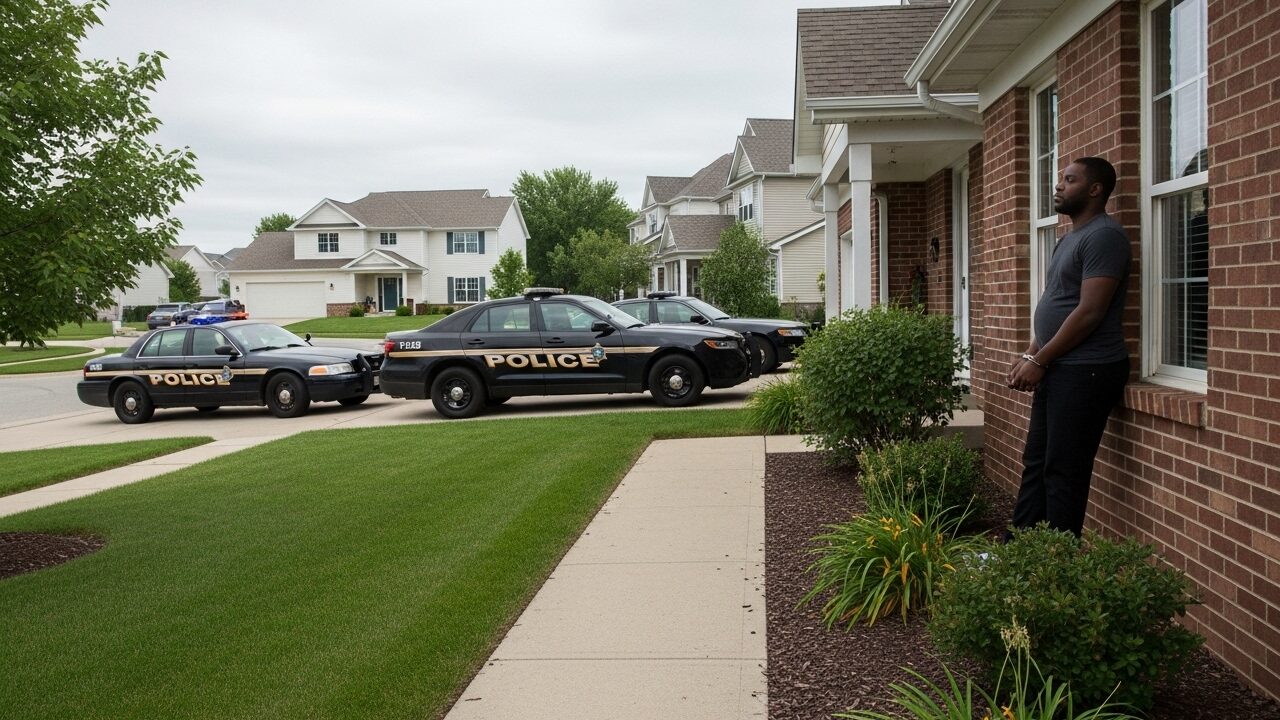
I Was Handcuffed On My Own Front Porch After 3 Police Cruisers Surrounded My House—What Happened Next Destroyed My 15-Year Suburban Dream.

Chapter 1
There is a very specific, metallic click that a pair of Smith & Wesson handcuffs makes when the ratchets lock into place around your wrists. It’s a sound you hear on television, in movies, in passing news clips. But when that sound is happening right next to your ears, echoing against the pristine, white-painted brick veneer of the house you just closed on three months ago, it doesn’t sound like a movie. It sounds like the end of your life.
The brick was rough against my right cheek. I had chosen that specific brick pattern—a distressed, antique red—with my wife, Sarah, at a design center six months ago. She was pregnant with our first child, a little girl. She loved the character it gave the house. Right now, that same brick was scraping the skin off my jawbone as a heavy hand pressed the back of my neck into the wall.
“Do not move. Do not make a sound. Keep your feet spread,” a voice barked. The voice was gruff, out of breath, thick with an adrenaline that I didn’t understand.
I couldn’t move if I wanted to. The man holding me against my own house was easily two hundred pounds of tactical gear and authority. My shoulder screamed in protest as my arms were wrenched backward at an unnatural angle.
“Officer,” I choked out, my voice muffled by the mortar between the bricks. “My ID is in my left pocket. I live here. This is my house.”
“Shut your mouth!” the officer yelled. I felt the vibration of his voice against my back. “Miller, check his pockets. Watch his hands. Watch his hands!”
It was 6:45 PM on a Tuesday. The sun was just beginning to dip below the horizon, casting a beautiful, golden-hour glow across the manicured lawns of Oak Creek. It was the kind of neighborhood where people left their garage doors open. Where kids rode Razor scooters in the cul-de-sac until the streetlights came on. Where property values only went up, and the homeowners association sent you a polite but firm letter if your grass grew a quarter-inch too high.
I am thirty-four years old. I am a lead software architect at a mid-sized tech firm downtown. I drive a hybrid sedan. I pay my taxes. I recycle. And I am a Black man.
Until this exact moment, I had allowed myself the luxury of believing that my degrees, my salary, and the six-hundred-thousand-dollar mortgage tied to my name offered me a shield. My father, a man who worked three jobs in South Side Chicago just to keep the lights on, used to tell me, “Marcus, you gotta work twice as hard to get half as far, and even then, they’ll look at you like you stole it.” I used to roll my eyes at him. I thought he was a product of his time. I thought the world had moved on.
As I stood there, feeling the cold steel biting into my skin, the flashing red and blue lights from three separate police cruisers reflecting off my bay windows, I realized my father had been right. The shield I thought I had built was made of paper.
Let me take you back exactly forty-five minutes.
It was a beautiful evening. Sarah had gone over to her sister’s house for a baby shower planning session. I had just finished logging off from a brutal string of Zoom calls and decided to clear my head with a quick jog around the neighborhood. I threw on my gray sweatpants, a faded college hoodie, and my running shoes. I didn’t grab my wallet. I didn’t grab my phone. I just grabbed the single brass house key off the kitchen counter, locked the front door behind me, and hit the pavement.
The run was great. I passed Mrs. Higgins, the elderly white woman who lived two doors down. She was out watering her prized petunias. I gave her a wave. She offered a tight, polite nod—the same nod she’d given me since we moved in. It wasn’t warm, but it wasn’t hostile. Just… cautious. I didn’t think anything of it.
After about three miles, I looped back to my street. I was sweating, breathing heavily, feeling the good kind of exhaustion in my legs. I walked up my driveway, admiring the new landscaping Sarah and I had put in last weekend. I walked up the three concrete steps to my front porch, sliding the brass key into the deadbolt.
I turned it. It caught.
This lock had been sticking for a week. I had bought a can of WD-40 but kept forgetting to use it. I jiggled the key. It wouldn’t turn left, and it wouldn’t turn right. I groaned, wiping sweat from my forehead, and put my shoulder into the heavy oak door, trying to force it while turning the key simultaneously. It was a trick that usually worked.
Jiggle. Push. Turn. Nothing.
I stepped back, frustrated. I looked around the porch, wondering if I had left the side gate unlatched so I could get in through the back patio door. I walked to the window next to the door, pressing my face against the glass to see if I had left the backdoor open. The house was dark inside.
I went back to the front door, grabbing the handle and giving it a hard, frustrated shake. “Come on,” I muttered to myself.
That was when the first cruiser rolled up.
There were no sirens. Just the sudden, violent burst of red and blue LED lights slicing through the calm evening air. The cruiser didn’t just pull up to the curb; it angled aggressively into my driveway, the tires chirping against the concrete.
Before I could even process what was happening, a second cruiser skidded to a halt right behind it, blocking the street. Then a third.
My heart did a strange flutter in my chest. Did something happen in the neighborhood? I thought. I actually looked over my shoulder, thinking maybe a suspect was running through my yard.
Then the doors flew open.
“Hands! Let me see your hands right now!”
The voice tore through the quiet street. I turned back. An officer—I’d later learn his name was Thorne—was advancing up my walkway. He had his hand resting heavily on the holster at his hip. His face was tight, his jaw clenched, his eyes locked onto me with a laser-like intensity. He was a white man in his late forties, thick around the middle but moving with the aggressive speed of a predator.
“Officer? Is everything okay?” I asked, instinctively taking my hand off my front doorknob.
“I said let me see your hands! Step away from the door!” Thorne barked, unstrapping the retention strap on his holster. The loud snap of the button echoed in my ears.
Panic, icy and sharp, flooded my veins. My hands shot up into the air. “Whoa, whoa, my hands are up,” I said, trying to keep my voice steady. “I live here. This is my house. The lock is just jammed.”
A second officer, younger, maybe in his twenties—Miller—flanked Thorne, moving onto my lawn. He looked nervous. His hand was also on his weapon.
“Step down from the porch. Keep your hands where I can see them. Do it now!” Thorne ordered.
“Sir, I promise you, I am the homeowner,” I said, keeping my hands high, my palms open. I took one slow step down the stairs. “My name is Marcus Vance. I just went for a run. I just—”
“Shut up!” Thorne yelled, closing the distance between us in two massive strides. He grabbed my left wrist with a grip so tight it felt like a vise, yanking my arm down and twisting me around with brutal force.
I stumbled, losing my balance. My chest slammed against the brick wall of my house.
“Hey! What are you doing?!” I yelled, fear finally cracking my composure. “You’re making a mistake!”
That was when he drove his forearm into the back of my neck, pinning me to the brick. The cuffs came out.
Click. Click. Click.
“Stop resisting,” Thorne hissed in my ear.
“I am not resisting!” I pleaded, tears of sheer panic and frustration springing to my eyes. “Check my pockets! My ID is right there! Please, just look at my ID!”
“Miller, pat him down,” Thorne commanded, ignoring me completely.
The younger officer stepped up. I could feel his hands rapidly patting down my sweatpants, checking my waistband, sliding down my legs. It was deeply violating, deeply humiliating. I was standing on the porch of the house I worked eighty-hour weeks to afford, being treated like a violent intruder.
“He’s clean,” Miller said, his voice a little shaky. “Got a wallet here.”
He pulled my thin leather cardholder from my pocket.
“Check the ID,” Thorne said, keeping his weight pressed against me. “And run the address.”
I closed my eyes. The rough brick was biting into my skin. Out of the corner of my eye, through the blur of adrenaline and unshed tears, I saw movement.
Across the street, curtains were twitching. Doors were cracking open. My neighbors—the people Sarah and I had baked cookies for when we moved in—were standing on their lawns, watching. I saw Mr. Davis from across the street, holding his golden retriever on a leash, staring. I saw Mrs. Higgins, the woman I had just waved to ten minutes ago, standing on her porch with her arms crossed, watching me get manhandled by the police.
A sickening realization washed over me. The police didn’t just happen to be driving by. Someone had called them. Someone had looked out their window, seen a Black man in a hoodie struggling with a door in Oak Creek, and immediately dialed 911.
“Dispatch, run a driver’s license for a Marcus Vance,” Miller said into his shoulder radio.
The silence that followed was the longest thirty seconds of my life. I could hear the static of the police radio. I could hear Thorne’s heavy breathing. I could hear the distant sound of a lawnmower a few streets over, a jarring reminder that for the rest of the world, it was just a normal Tuesday.
“ID comes back valid,” the dispatcher’s voice crackled over the radio. “Address listed is the current location. No warrants.”
I felt the weight on my neck lighten just a fraction. But the handcuffs didn’t come off.
“He says he lives here, Gary,” Miller said quietly to Thorne.
Thorne didn’t let go. Instead, he pulled me backward off the wall, spinning me around to face him. His face was flushed. He looked at my ID in Miller’s hand, then looked back at me. There was no apology in his eyes. There was no realization of a horrific mistake. There was only annoyance.
“Sit on the curb,” Thorne ordered, giving me a slight shove toward the street.
“Are you going to take these off?” I asked, my voice trembling, holding up my bound hands. “You know I live here now.”
“I said sit on the curb until we figure this out,” Thorne repeated, his voice dangerously low.
I walked awkwardly down my own driveway, my hands cuffed behind my back, the eyes of the entire neighborhood burning into my skin. I sat down on the hard concrete of the curb, right next to the mailbox that had my last name painted on it in beautiful cursive letters.
I looked down at my knees. My hands were going numb. My shoulder was throbbing. But the physical pain was nothing compared to the deep, hollow canyon opening up in my chest.
I looked up at my house. The beautiful brick, the pristine windows, the porch swing Sarah had bought at a flea market. It didn’t look like a sanctuary anymore. It looked like a crime scene. And I was the suspect.
Thorne and Miller were standing a few feet away, talking in low voices. I couldn’t hear what they were saying, but I saw Thorne violently tap his radio, a gesture of sheer irritation.
Then, a black SUV turned onto our street, driving slowly past the cruisers. My heart stopped.
It was Sarah.
She pulled into the driveway across the street, parking awkwardly because the cruisers were blocking ours. She stepped out of the car. She was six months pregnant, wearing a floral maternity dress, carrying a tray of leftover cupcakes from the shower planning.
She looked at the police cars. She looked at Thorne and Miller.
And then she looked at me, sitting in the gutter, in handcuffs, in front of our home.
The cupcakes slipped from her hands, the plastic tray shattering on the pavement.
“Marcus?” she screamed, a sound of pure, unadulterated terror tearing from her throat as she started running toward me.
And that was when Officer Thorne put his hand back on his gun.
Chapter 2
Time didn’t just slow down; it fractured into a million jagged, agonizingly sharp pieces.
The sight of Sarah dropping that plastic tray—the sickening splat of vanilla frosting and yellow cake hitting the asphalt—was eclipsed entirely by the subtle, terrifying shift in Officer Thorne’s body language. He didn’t draw his weapon. He didn’t unholster it. But his broad right hand, thick-fingered and tense, dropped immediately to rest on the black grip of his Glock. He widened his stance, pivoting his hips away from me and toward my pregnant wife. His shoulders bunched up toward his ears. He was bracing for a threat.
He looked at Sarah, a white woman in a floral maternity dress, running toward a handcuffed Black man in the gutter, and his brain—wired by years of whatever training or biases he carried—did not compute wife. It computed chaos. It computed unpredictable element.
“Ma’am! Stop right there! Do not advance!” Thorne bellowed. His voice was no longer just authoritative; it was laced with a raw, high-strung panic that made the blood freeze in my veins.
“Sarah, stop! Don’t move! Just stop!” I screamed.
My voice tore out of my throat, harsh and desperate, scraping against my vocal cords. I tried to stand up from the curb, a pure, primal instinct to put myself between the man with the gun and my pregnant wife, but the awkward angle of my cuffed hands behind my back threw off my center of gravity. I stumbled forward, my knees scraping against the rough concrete of the gutter.
“I said sit down!” Thorne roared, whipping his head back to me.
Officer Miller, the younger cop, seemed to suddenly realize the absolute powder keg they were standing on. He stepped forward, raising both hands in a placating gesture, putting himself slightly ahead of Thorne.
“Whoa, hey, everyone just take a breath. Ma’am, please stay right there,” Miller said, his voice trembling slightly. He looked from Sarah to me, and I saw the horrifying math finally click together behind his eyes. He looked at her maternity dress. He looked at the house. He looked at me.
“What are you doing to him?” Sarah shrieked. She hadn’t stopped completely, but she had slowed to a hesitant, trembling walk. Tears were already streaming down her face, ruining her makeup, leaving dark streaks of mascara on her pale cheeks. “That’s my husband! Take those off him! What the hell is wrong with you?”
“Ma’am, we received a 911 call regarding a suspected break-in at this residence,” Thorne said. His hand was still resting on his holster. He refused to let go. He was a man incapable of retreating, incapable of looking weak, even when the truth was staring him right in the face. “We are securing the scene.”
“He lives here!” Sarah yelled, her voice cracking, echoing down the pristine, quiet street of Oak Creek. She pointed a trembling finger at the house, then at Thorne. “We both live here! His name is on the deed! My name is on the deed! Are you out of your minds?”
She closed the final few feet between us, ignoring Thorne entirely, and dropped to her knees right there in the street beside me. The rough asphalt tore into the thin fabric of her dress, but she didn’t care. She threw her arms around my neck, burying her face into my shoulder. She was shaking violently, her chest heaving with dry, panicked sobs. I could feel the swell of her stomach, our unborn daughter, pressing against my ribs.
And I couldn’t even hug her back. My hands were trapped in cold steel behind me.
“Sarah, I’m okay. I’m okay, baby. Just breathe,” I whispered into her hair, though my own heart was hammering so hard against my ribs I thought it might shatter them. I looked up over her shoulder, glaring directly into Thorne’s eyes.
“You ran my ID,” I said, my voice dropping to a low, venomous register I didn’t know I possessed. “You ran it. It cleared. The dispatcher told you this is my house. My pregnant wife is sitting on the ground next to me. Take. The cuffs. Off.”
For a second, nobody moved. The red and blue lights of the cruisers continued to wash over the street in a nauseating, rhythmic pulse. Red, blue, red, blue. Illuminating the crushed cupcakes. Illuminating Sarah’s blonde hair. Illuminating Thorne’s tight, unyielding jaw.
Across the street, the audience of neighbors remained frozen on their manicured lawns. Mr. Davis was still holding his golden retriever’s leash, his mouth slightly open. Mrs. Higgins was still on her porch, her hand now covering her mouth. They were watching a tragedy unfold on a stage they thought was reserved for evening news broadcasts about neighborhoods miles away from their own.
Thorne looked at Miller. Miller gave a tight, almost imperceptible nod.
“Stand up,” Thorne commanded me. He didn’t apologize. He didn’t lower his voice.
Sarah pulled back, her hands gripping my biceps to help me to my feet. I stood, my legs shaky, adrenaline still flooding every nerve ending in my body. Thorne stepped behind me. I flinched involuntarily as I felt his hands brush against my lower back. I heard the scrape of a metal key, felt the sudden, agonizing release of tension, and then the heavy cuffs fell away.
I brought my arms forward. My shoulders burned with a deep, searing ache. The skin around my wrists was rubbed raw, angry red indentations deeply stamped into my flesh. I rubbed them instinctively, trying to get the blood flowing back into my numb fingertips.
Sarah immediately grabbed my hands, inspecting my wrists, letting out a small, broken gasp. She turned back to the officers, her eyes flashing with a fury I had rarely seen in the seven years we had been together. Sarah was a kindergarten teacher. She was gentle. She was patient. But right now, she looked ready to tear Thorne apart with her bare hands.
“You assaulted him,” she said, her voice shaking with rage. “He was just trying to get into his own home, and you assaulted him.”
“Ma’am, we responded to a call of a suspicious individual attempting to force entry into the property,” Thorne recited, his voice a flat, bureaucratic monotone. It was a shield he was hiding behind. “The individual matched the description provided by the caller. When I approached, he was uncooperative.”
“Uncooperative?” I laughed, a bitter, hollow sound that held no humor. “I told you I lived here. I offered you my ID. You slammed me against my own house before I could finish a sentence.”
“You were acting erratically and forcefully manipulating the door handle. In these situations, officer safety and community security dictate that we secure the subject until identity can be verified,” Thorne replied, adjusting his duty belt, puffing out his chest. “We are doing our jobs. You’re free to go, Mr. Vance.”
You’re free to go. Those five words felt like a physical blow. He wasn’t talking to a homeowner he had just deeply wronged. He was talking to a suspect he was generously deciding not to arrest. The sheer arrogance, the absolute lack of accountability, took my breath away.
“Who called?” Sarah demanded, stepping toward him. I quickly grabbed her arm, pulling her gently back. I didn’t want him finding an excuse to touch her. “Who called you? I want to know right now.”
“Caller information is confidential,” Miller said softly, finally speaking up. He looked at the ground, unable to meet my eyes or Sarah’s. He looked ashamed. It didn’t make me feel any better. Ashamed men with badges were just as dangerous as angry ones. “I’m… I’m sorry for the confusion, folks. Have a good night.”
A good night. Thorne didn’t say another word. He turned on his heel, his heavy boots crunching on the driveway, and walked back to his cruiser. Miller followed, casting one last, fleeting glance back at us.
We stood there in the driveway, holding onto each other, and watched as the three police cars slowly backed out, their blinding lights finally clicking off, leaving the street suddenly plunging back into the dim, purplish twilight.
Silence descended on Oak Creek. But it wasn’t the peaceful, idyllic silence I had bought into. It was a heavy, suffocating silence. It was the silence of a dozen sets of eyes watching us.
I looked around. Mr. Davis immediately turned his back and began dragging his dog toward his front door. Mrs. Higgins quickly stepped inside and shut her door, the deadbolt clicking loud enough for me to hear it from my driveway. Down the block, curtains fell back into place. Doors shut. The audience was dispersing now that the show was over. Not a single one of them walked over. Not a single one of them asked if we were okay.
They just went back inside their safe, secure homes.
“Let’s go inside, Marcus,” Sarah whispered, her voice fragile. She reached down, mechanically picking up the shattered plastic tray of cupcakes. The frosting was smeared across the dark asphalt, a pathetic, absurd casualty of the evening.
“Leave it,” I said, my voice hoarse. I took the tray from her hands and dropped it in the trash bin next to the garage.
We walked up the driveway together. Every step felt like walking through wet cement. We climbed the three concrete stairs to the porch. I looked at the heavy oak door. I looked at the brick wall next to it. In the fading light, I could clearly see a faint smudge on the white mortar where my sweaty face had been pressed against it.
I reached into my pocket, pulled out the brass key, and handed it to Sarah. My hands were shaking too badly to try the lock again.
She took it without a word, slid it into the deadbolt, gave it a firm push, and turned it. The door clicked open smoothly. The irony was enough to make me want to vomit.
We stepped inside, locking the door behind us.
Our house was beautiful. It was everything we had dreamed of. Vaulted ceilings, wide-plank hardwood floors, a massive kitchen island with quartz countertops. Sarah had spent weeks picking out the perfect shade of warm beige for the living room walls. She had filled the space with soft rugs, oversized linen couches, and framed photos of our wedding in Napa Valley. It smelled of eucalyptus and lavender. It was designed to be an oasis.
Right now, it felt like a museum exhibit I had broken into.
I walked into the living room and collapsed onto the edge of the couch, resting my elbows on my knees, burying my face in my hands. The adrenaline was finally beginning to recede, leaving behind a profound, bone-deep exhaustion and a creeping, icy nausea.
I heard Sarah moving in the kitchen, the running of water, the clinking of ice. A moment later, she walked into the living room. She had kicked off her shoes. She carried a damp, warm washcloth and a ziplock bag filled with ice wrapped in a dish towel.
She knelt on the rug in front of me, placing the ice pack on the coffee table. She gently took my hands, pulling them away from my face.
“Let me see,” she murmured.
She took the warm washcloth and began to carefully clean the dirt and grit from my cheek where it had scraped against the brick. Her touch was incredibly gentle, her fingers trembling slightly against my skin. Then she moved to my wrists, dabbing at the raw, bruised skin. The cold metal had bitten deep. The marks looked like dark purple bracelets against my brown skin.
A tear slipped from her eye, falling onto my forearm.
“I’m so sorry,” she whispered, her voice breaking. “Marcus, I am so, so sorry.”
“You have nothing to be sorry for, Sarah. You didn’t do this.”
“But I brought you here,” she said, looking up at me, her blue eyes swimming with tears and guilt. “I’m the one who pushed for this neighborhood. I’m the one who wanted the good school district. I thought… I thought it was perfect.”
Sarah grew up in a suburb much like Oak Creek, just outside of Boston. Her father was a retired corporate lawyer, her mother a prominent real estate agent. She grew up in a world where police officers were friendly faces who gave presentations at elementary schools and helped retrieve stolen bicycles. She grew up believing that bad things only happened to bad people, or at least, only happened in bad neighborhoods.
When we started dating, she had been blissfully ignorant of the reality I lived in. I remembered the first time we were pulled over together. We were driving back from a weekend trip. I was going five miles over the speed limit. When the lights flashed, I immediately rolled down all the windows, turned off the engine, put my keys on the dashboard, and placed both my hands flat on the steering wheel. I told her, in a very calm, flat voice, to put her hands on her knees and not to reach for her purse until the officer asked.
She had looked at me like I was insane. “Marcus, it’s just a speeding ticket,” she had said, reaching for the glove compartment to get the registration.
I had snapped at her. “Don’t move your hands!” I had yelled, terror making me harsh.
She had cried that night, not because of my yelling, but because when the officer—a stern, older white man—approached my window, she saw the shift in my posture. She saw my humanity shrink. She heard the forced, subservient politeness in my voice. Yes, sir. No, sir. My wallet is in my back right pocket, sir. May I reach for it? She saw a man she loved, a confident, brilliant man who managed teams of engineers, reduce himself to make a stranger with a badge feel safe.
We had a long talk that night. It was the first time she really understood. But understanding it in theory, or seeing it during a routine traffic stop, was vastly different from watching her husband get assaulted on the lawn of their half-million-dollar home.
“It’s not your fault, Sarah,” I said gently, taking the washcloth from her hand and cupping her cheek, wiping away her tear with my thumb. “I wanted this house too. I wanted this for our daughter.”
“They treated you like an animal,” she choked out, resting her forehead against my knee. “Right in front of our house. Everyone was watching. And they just left. They didn’t even care.”
“I know.”
“Who do you think called?” she asked, looking back up, her eyes narrowing with a dark, unfamiliar suspicion.
The question hung in the air, toxic and heavy.
I leaned back against the couch cushions, staring up at the vaulted ceiling. I closed my eyes, running through the mental rolodex of my neighbors.
We had been here three months. We had done everything right. We had hosted a small meet-and-greet barbecue in our backyard. We handed out artisanal baked goods. We smiled. We waved. We kept our lawn pristine. I made sure to wear my college alumni sweaters when I worked in the garage, projecting the ultimate, unthreatening suburban image. I was playing the game. I was performing the role of the “Acceptable Black Man.”
Was it Mr. Davis? He had seemed stiff at the barbecue, talking mostly to Sarah and avoiding eye contact with me, but I had chalked that up to social awkwardness.
Was it the young couple next door, the ones who always seemed to quickly herd their toddlers inside whenever I came out to get the mail?
Was it Mrs. Higgins? The sweet old lady who grew prize-winning petunias? I remembered her face clearly when I jogged past her earlier. That tight, polite nod. The cautious eyes. Had she watched me loop back around, seen me struggling with the door, and immediately assumed a Black man in a hoodie was breaking in?
The realization was a slow, agonizing poison seeping into my blood. It didn’t matter who specifically made the call. What mattered was that someone in this neighborhood, someone I smiled at, someone whose property value I helped maintain, looked out their window and saw me not as a neighbor, but as an intruder. As a threat.
“I don’t know who called,” I said quietly, the words tasting like ash in my mouth. “But they live on this street.”
Sarah didn’t say anything else. She just sat on the floor, holding my bruised hands, staring blankly at the wall. The illusion of our sanctuary had been violently stripped away, leaving us exposed and vulnerable in the one place we were supposed to be safe.
That night, sleep was impossible.
We went to bed around midnight. Sarah lay facing away from me, her breathing shallow and uneven. I knew she was awake, her mind racing just like mine, but neither of us had the energy to speak. The silence in the bedroom was deafening. Every creak of the house settling, every rush of wind against the windowpanes, made my muscles twitch.
By 2:00 AM, I gave up. I carefully slid out from under the duvet, making sure not to wake Sarah. I pulled on a pair of basketball shorts and an old t-shirt, walking out of the bedroom and into the dark hallway.
The house felt entirely different now. It didn’t feel like a home. It felt like a fishbowl.
I walked down the stairs, my bare feet silent on the hardwood. I didn’t turn on any lights. I navigated by the pale, silvery moonlight streaming through the large windows. I went to the front door first. I checked the deadbolt. It was locked. I checked the chain. It was secure.
I stood by the window next to the door, peeking through the edge of the blinds. The street was dead quiet. The streetlights cast long, dark shadows across the manicured lawns. I looked at Mrs. Higgins’ house. It was completely dark. I looked at Mr. Davis’s house. Dark.
Behind one of those doors, someone was sleeping soundly, completely unbothered by the fact that they had nearly gotten me killed tonight. Did they feel justified? Did they watch the police let me go and feel disappointed that I wasn’t hauled off in the back of a cruiser? Or did they realize their mistake and feel a twinge of guilt?
I realized, with a sickening drop in my stomach, that I would never know. I would have to walk out of my front door every single day, wave to these people, smile at them, and wonder which one of them tried to ruin my life.
I turned away from the window and began to pace. I walked through the living room, into the kitchen, through the dining room. I was a ghost haunting my own house. My shoulder throbbed with a dull, rhythmic ache. My wrists burned where the cuffs had dug in.
But the physical pain was secondary to the profound crisis of identity that was tearing me apart from the inside.
All my life, I had played by the rules. I grew up in a rough neighborhood in Chicago where sirens were a nightly lullaby. My father had drilled it into my head: Keep your head down. Get your grades. Go to a good college. Get a good job. Move out. Build a wall of success so high they can’t touch you. I had done exactly that. I had climbed the corporate ladder. I had married a wonderful woman. I had bought the house in the suburbs. I thought I had bought my way out of the danger zone. I thought my ZIP code and my tax bracket made me exempt from the realities of my skin color.
I walked upstairs, my steps heavy. I stopped at the end of the hallway, pushing open the door to the nursery.
It wasn’t finished yet. The crib was assembled, sitting against the far wall. Sarah had painted the walls a soft, pale lavender. There were stacks of unopened diapers in the corner, a plush rocking chair by the window, and a mobile of tiny white clouds waiting to be hung from the ceiling.
I stood in the doorway, staring at the empty crib.
In three months, my daughter was going to be sleeping in there. A little Black girl, born into a world of privilege and comfort. She would go to the best schools. She would have piano lessons and soccer practices. She would grow up playing in a cul-de-sac with neighbors who smiled at her.
And then, one day, she would grow up. The neighborhood would stop seeing a cute little girl and start seeing a young Black woman.
Would they look at her the way they looked at me tonight? When she inevitably forgot her key and had to jiggle the lock on her own front door, would a neighbor call 911? Would she find herself slammed against the brick wall of her own home, a gun pointed at her back, wondering if she was going to die simply for existing in a space where others decided she didn’t belong?
A wave of absolute, terrifying grief washed over me. I walked into the room, gripping the wooden rail of the crib with both hands, hanging my head. Tears, hot and bitter, finally spilled over my eyelashes, dropping onto the pristine mattress below.
I wasn’t crying because of the humiliation. I wasn’t crying because of the pain in my wrists.
I was crying because my father’s warning had finally caught up to me. You gotta work twice as hard to get half as far, and even then, they’ll look at you like you stole it. I had bought the dream, but I was still just a tenant. I was allowed to live here only as long as I didn’t make sudden movements. Only as long as I didn’t struggle with my own front door.
I stayed in the nursery for a long time, watching the moonlight slowly shift across the floorboards. When I finally walked out, shutting the door softly behind me, the grief had burned itself out, leaving behind something much colder. Much harder.
I couldn’t just let this go. I couldn’t wake up tomorrow and pretend this was normal. I couldn’t look my wife in the eye, and I couldn’t look at my unborn daughter’s crib, and accept that this was just the cost of living in Oak Creek.
I needed to know who made that call. I needed to look them in the face.
The police wouldn’t tell me. But someone in this neighborhood knew. And I was going to find out. I walked back into the master bedroom. Sarah was finally asleep, her breathing deep and rhythmic. I slid into bed next to her, staring at the ceiling until the sun began to bleed through the blinds, painting the room in the harsh, unforgiving light of a new day.
The nightmare wasn’t over. It was just beginning.
Chapter 3
Morning came not with a gentle awakening, but with a harsh, unforgiving clarity.
The sunlight slicing through the wooden blinds of our bedroom felt abrasive, illuminating the dust motes dancing in the air and the stark, white ceiling above. I lay perfectly still, staring up at the fan blades turning lazily. Every muscle in my upper body ached. It was a deep, structural soreness, the kind that radiates from the joints outward. My right shoulder throbbed with a dull, rhythmic pulse, a souvenir of Officer Thorne wrenching my arm backward. But the worst of it was my wrists.
I slowly pulled my hands out from under the heavy duvet, bringing them up to my face. The skin, usually a warm, even brown, was violently marred. The angry red indentations from last night had deepened into a vicious, mottled purple. The bruises wrapped entirely around my forearms like a pair of grotesque bracelets. They were physical, undeniable proof that the nightmare on the front lawn wasn’t a hallucination born of stress. It had happened. The state had put its hands on me, violently and without cause, right on my own property line.
Beside me, the bed shifted. Sarah sat up slowly, the sheets pooling around her waist. She didn’t say good morning. She didn’t reach for her phone on the nightstand. She just looked at my wrists.
Her jaw tightened, the muscles ticking beneath her pale skin. Her blue eyes, usually so bright and full of easy warmth, were dark with a cold, terrifying fury. I had known Sarah for seven years. I had seen her angry at bad drivers, frustrated with difficult parents at her kindergarten, and stressed over wedding planning. But I had never seen her like this. This was a primal, protective rage.
“I’m calling my uncle today,” she said, her voice a flat, hollow rasp that didn’t sound like her at all. Her uncle was a partner at a civil rights litigation firm in Boston.
“Sarah, let’s just take a breath—”
“No, Marcus. No taking a breath,” she snapped, throwing the covers off and swinging her legs over the edge of the bed. She stood up, her floral maternity nightgown billowing around her. “They don’t get to do that. They don’t get to put their hands on you, humiliate you in front of the entire street, and just drive away. We are suing the department. We are suing that officer. I want his badge.”
I sat up, wincing as my shoulder protested the movement. “And what happens then? It makes the local news. ‘Affluent Black Tech Exec Claims Police Brutality.’ The police union closes ranks. They dig into my past, my driving record, looking for anything to justify Thorne’s ‘fear for his safety.’ And meanwhile, we still have to live here. We still have to walk out that front door every day and wave to the people who watched it happen.”
“I don’t care,” she said, her voice breaking as she turned back to me, tears of sheer frustration spilling over her lower lashes. “I don’t care what they think. You could have been killed, Marcus. If you had panicked, if you had pulled your arm away too fast… he had his hand on his gun when I walked up. He was ready to shoot you.”
The words hung in the air, heavy and suffocating. She had voiced the exact terror that had kept me awake all night. I looked away from her, staring at the hardwood floor.
“I know,” I whispered.
She walked over and sat on the edge of the mattress, wrapping her arms around my neck, burying her face in my shoulder. I held her, feeling the swell of her stomach pressing against my side. Our daughter. The thought of my little girl growing up in a house where her father had been pinned to the bricks like a criminal made me feel physically sick.
“We need to know who made the call, Sarah,” I said quietly into her hair. “Before lawyers, before lawsuits. I need to know which one of my neighbors looked out their window and saw a monster instead of a man.”
“How are we supposed to find that out?” she asked, pulling back to look at me. “The police won’t tell us. They said it was confidential.”
“I’ll figure it out,” I said, a cold, hard resolve settling over my chest. “Someone on this street is hiding behind their curtains. And I’m going to smoke them out.”
By 9:00 AM, the illusion of normalcy had to be maintained. That was the cruelest part of the American machine; it didn’t stop grinding just because your personal world had shattered.
I worked fully remote on Wednesdays. I walked into my home office, a beautiful room with French doors, a mahogany desk, and a wall of built-in bookshelves filled with coding manuals and leadership biographies. It was a room designed to project authority and success. Today, it felt like a cage.
I sat down in my ergonomic chair and clicked the mouse to wake up my monitors. Instantly, Slack messages began cascading down the right side of the screen. Jira tickets needed approval. My team in India was waiting for a code review on the new API endpoints. The company was pushing a major software update on Friday, and as the lead architect, I was the bottleneck for half a dozen critical decisions.
I opened Zoom and clicked the link for my 9:30 AM one-on-one with Brad, the VP of Engineering.
Brad’s face popped onto the screen. He was a white man in his early forties, broadcasting from his home in a wealthy Seattle suburb. He was wearing a Patagonia fleece vest over a crisp button-down, sipping from a Yeti mug. He was a good boss—fair, intelligent, and relentlessly upbeat. He championed diversity initiatives at the company and had a Black Lives Matter sign in his Zoom background for all of 2020.
“Morning, Marcus! How’s the new house treating you?” Brad boomed, his voice aggressively cheerful. “Getting settled in? The nursery ready for the little one?”
I looked at his smiling face. I looked at the little green dot of my webcam. I slowly lowered my arms so my bruised wrists were out of the frame.
“Morning, Brad,” I said, forcing my voice into the bright, professional cadence I had perfected over a decade in corporate tech. “Yeah, we’re getting there. The house is great. Really enjoying the quiet.”
The lie tasted like bile.
“Awesome, awesome to hear,” Brad said, taking a sip of his coffee. “Listen, I wanted to touch base on the backend migration. The QA team is flagging some latency issues in the staging environment. Think we can get the load balancers reconfigured before the all-hands meeting tomorrow?”
For the next thirty minutes, we talked about server loads, database queries, and deployment schedules. Brad drew diagrams on a digital whiteboard. I nodded, offered technical solutions, and took notes. I functioned flawlessly. I was the highly paid, highly competent professional they expected me to be.
But beneath the surface, I was dissociating.
While Brad talked about optimizing code structure to save milliseconds of processing time, my brain kept flashing back to the cold steel of the handcuffs biting into my skin. While he stressed about server crashes, I was remembering the sickening realization that Officer Thorne’s thumb had been resting on the retention strap of his holster.
The cognitive dissonance was deafening. I was a man who held the digital infrastructure of a fifty-million-dollar company in his hands, yet twelve hours ago, I couldn’t even convince a high-school-educated cop that I belonged on my own front porch. In Brad’s world, problems were logical. If a server failed, you checked the error logs, found the bug, and deployed a patch. In my world, the bug was my skin color, and there was no patch in existence that could fix the code of the people living around me.
“Marcus? You with me, man?” Brad’s voice broke through the static in my head.
I blinked, refocusing on the screen. Brad was leaning closer to his webcam, looking mildly concerned.
“Yeah, sorry, Brad. Just… just a lot on my mind with the house and the baby coming,” I lied smoothly.
“No worries, I get it. You look a little tired, honestly. Take it easy today, okay? Don’t burn yourself out before the sprint ends,” Brad said, offering a sympathetic smile.
“Thanks, Brad. I’ll have the load balancer specs to you by noon.”
I ended the call and stared at my reflection in the black screen of my monitor. Take it easy today. The sheer, agonizing privilege of that phrase. Brad could log off, walk out of his house, and be completely invisible. He could jog through his neighborhood without his ID and nobody would bat an eye. His existence was the default setting. Mine was a constant, exhausting negotiation for the right to simply be in the room.
I couldn’t stay in the house. The walls felt like they were closing in. I needed to see the street in the daylight. I needed to look at the battlefield.
I put on a long-sleeved quarter-zip sweater to hide my wrists, slipped on my sneakers, and walked out the front door.
Oak Creek in the late morning was a picture of suburban perfection. Landscaping trucks hummed in the distance, trimming hedges into immaculate geometric shapes. A sprinkler system ts-ts-ts-ts‘d rhythmically onto a lush green lawn. The sky was a brilliant, cloudless blue. It looked like a commercial for allergy medication.
I walked down my driveway, my eyes scanning the asphalt. There, right near the curb, was a large, dark stain. The remnants of Sarah’s cupcakes. A swarm of ants was already busy dismantling the sugary ruins of vanilla frosting. It was the only ugly thing on the entire street.
I started walking down the sidewalk, my hands shoved deep into my pockets. I wasn’t jogging today. I was patrolling.
I passed the young couple’s house next door. The Millers—no relation to the cop. They were a white couple in their late twenties, always dressed in expensive athleisure. Their driveway was empty, their garage door shut. They were likely at work downtown.
I kept walking until I reached Mrs. Higgins’ house. Her prized petunias were vibrant and blooming out of large terracotta pots on her porch. As I approached, the front door opened, and Mrs. Higgins stepped out, carrying a small watering can. She was wearing a floral blouse and beige slacks, her white hair perfectly coiffed.
She saw me, and she froze.
It was a microscopic hesitation, a sudden stiffening of her spine, but I caught it. I stopped on the sidewalk, right at the edge of her property line. I pulled my hands out of my pockets and offered her the same polite, tight smile she had given me a thousand times before.
“Good morning, Mrs. Higgins,” I called out, my voice smooth and loud enough to carry over the sound of the distant lawnmowers. “Beautiful day for the garden.”
She clutched the watering can to her chest with both hands. Her eyes darted from my face down to my long sleeves, then back up. She looked terrified. Not just uncomfortable, but actively frightened, like she expected me to vault over her pristine white picket fence and attack her.
“Good… good morning, Marcus,” she stammered, her voice thin and reedy. She took a step backward toward her open door. “Yes. Beautiful day.”
She didn’t ask how I was. She didn’t mention the three police cruisers that had turned our street into a circus twelve hours ago. She didn’t apologize for the fact that she had stood on this exact porch and watched me get handcuffed.
She knew. I could see it in the frantic flutter of her eyes. Did she make the call? Or was she just a coward who watched an injustice and decided it wasn’t her problem?
“The petunias look great,” I said, holding her gaze, letting the silence stretch just long enough to make it agonizingly awkward. “You have a good day, ma’am.”
I turned and kept walking. I felt her eyes burning into my back until I heard the heavy thud of her front door closing behind me.
Strike one. I crossed the street, aiming for the house directly across from mine. This was Arthur Davis’s house. Davis was a retired military contractor, a man in his late fifties with a buzz cut, a flagpole in his front yard flying an oversized American flag, and a bumper sticker on his Ford F-150 that read, We Don’t Dial 911. The irony was not lost on me.
Davis had a Ring doorbell camera installed on his doorframe. Its angle pointed directly at my driveway and my front porch. If anyone had a clear, high-definition recording of the entire assault, it was Arthur Davis.
As I walked up his driveway, the front door swung open before I even reached the steps.
Davis stepped out onto the porch, letting the screen door slam shut behind him. He was a big man, broad-shouldered, wearing faded jeans and a tight black t-shirt that showed off faded military tattoos on his forearms. He crossed his arms over his chest, blocking the doorway, staring down at me from the top of the stairs. He didn’t look frightened like Mrs. Higgins. He looked territorial.
“Can I help you, Vance?” he asked. His tone was rough, clipped. He didn’t say hello. He didn’t use my first name.
I stopped at the bottom of the stairs, refusing to be intimidated by the physical height difference. I squared my shoulders.
“Morning, Arthur,” I said, keeping my voice perfectly level. “I’m sure you saw the commotion at my house last night.”
“Hard to miss,” he grunted, his jaw tight. “Lot of flashing lights for a quiet neighborhood.”
“Yeah. It was a misunderstanding,” I said carefully, watching his face for any micro-expressions. “I was locked out, and someone called the police thinking I was breaking in. To my own house.”
Davis didn’t flinch. His expression remained a mask of stony indifference. “Police got a tough job. Better safe than sorry, I always say. Neighborhood watch is important around here. Lots of transients coming up from the city these days.”
Transients. The word hit me like a physical slap. I was a man standing in front of him wearing a two-hundred-dollar cashmere sweater, holding a mortgage that paid for the roads he drove on, and he was casually equating my presence with a vagrant invasion.
“Right. Better safe than sorry,” I repeated, swallowing the rage that threatened to choke me. “Listen, Arthur. The officers were a little… aggressive before they realized their mistake. I’m trying to piece together exactly what happened. I noticed you have a camera there.” I pointed to the glowing blue ring on his doorframe. “It points right at my porch. I was wondering if you’d be willing to share the footage with me. Just so I can see how it all went down.”
Davis’s eyes narrowed into tiny, dangerous slits. He uncrossed his arms and rested his hands on his hips, a classic posture of aggressive dominance.
“Camera’s motion-activated, Vance,” he said, his voice dropping an octave. “Doesn’t pick up across the street. Even if it did, I don’t make a habit of handing over my private security data. Not to the cops, and not to neighbors.”
It was a lie. I had installed the exact same system at my old house. You could set the motion zones to pick up activity two houses down if you wanted to.
“Arthur, I was assaulted on my own property,” I pushed back, dropping the polite neighbor facade. “I’m just asking for a little help from my community.”
“Look, Vance,” Davis said, taking one step down the stairs, bringing himself closer to me. “I don’t know what kind of neighborhood you moved here from, but around here, we look out for our own. Someone saw something suspicious, they reported it. System worked. Nobody got shot. You want to make a federal case out of a jammed lock, you do that on your own time. But don’t come around my property demanding things. We clear?”
The racism wasn’t overt. He didn’t use a slur. He didn’t mention my skin color. He didn’t have to. It was baked into every syllable. I don’t know what kind of neighborhood you moved here from. Translation: You don’t belong in this one. We look out for our own. Translation: You are not one of us.
I stared into his pale, watery blue eyes. I could see the cold hostility radiating from him. He wasn’t the one who called. I knew it in my gut. A man like Davis wouldn’t call the cops anonymously from behind a curtain. If he thought I was a burglar, he would have come out with his own shotgun. No, Davis didn’t make the call. But he fully supported whoever did.
“Crystal clear, Arthur,” I said, my voice barely a whisper. “Have a great day.”
I turned my back on him, my hands shaking violently as I walked down his driveway. The feeling of absolute, terrifying isolation was overwhelming. I was trapped behind enemy lines, and the enemy was wearing golf shirts and watering petunias.
“Hey! Marcus! Wait up!”
I stopped, taking a deep breath to steady my racing heart before turning around.
Jogging across the street from a house three doors down was David Keller. David was exactly my age, thirty-four. He worked in marketing for a green-energy startup downtown. He drove a Tesla. He wore Warby Parker glasses. His lawn had a small, discreet sign that read In This House We Believe Black Lives Matter, Science Is Real, Love Is Love. When Sarah and I moved in, David was the first one to come over, bringing us a bottle of natural, biodynamic wine and talking for an hour about his favorite hip-hop podcasts. He desperately wanted to be seen as one of the “good ones.”
Right now, he looked panicked. He was wearing shorts and a t-shirt, his hair uncombed, rushing toward me with an urgency that immediately put me on guard.
“Hey, David,” I said cautiously.
“Man, I am so, so sorry,” David gasped as he reached me, out of breath. He looked around nervously, glancing at Davis’s house and then down the street, as if he were afraid of being seen talking to me. “I saw the whole thing last night. The cops, the… the way they handled you. It was horrific. I’m literally sick to my stomach about it. It’s exactly what I was talking about in my book club last week, the systemic carceral state, it’s just…” He shook his head, looking deeply distressed.
I stared at him. He saw the whole thing.
“You saw it?” I asked, my voice dangerously calm. “From where?”
“From my upstairs window,” David said, pointing to his house. “I was putting my son to bed, and I saw the lights. I looked out, and I saw them throw you against the wall. It was traumatizing, man. I can’t even imagine how you feel.”
Traumatizing for him. “If you saw it, David,” I said, taking a step toward him, forcing him to look me in the eye, “why didn’t you come out? Why didn’t you come over and tell the police that I was your neighbor? That you knew me?”
David blanched. The color completely drained from his face, leaving his pale skin looking almost translucent. He swallowed hard, taking a half-step back.
“I… man, you know how cops are,” he stammered, his hands fluttering nervously. “I didn’t want to escalate the situation. You introduce a third party into an active police encounter, especially with a white officer and a… you know, a Black suspect, it can trigger their threat response. I was going to film it, I had my phone out, but then your wife came out, and they let you go, so…”
He trailed off, unable to maintain eye contact.
I looked at this man. This progressive, enlightened man with his yard signs and his podcasts. When the moment of truth arrived, when he had the actual, tangible power to walk across the street and use his white privilege to de-escalate a situation that was threatening my life, he chose to stay in his safe, climate-controlled bedroom and watch me get brutalized like it was a true-crime documentary. He was ready to film my trauma for the internet, but he wasn’t willing to step outside and prevent it.
I felt a profound, exhausting disgust. The blatant racism of Arthur Davis was almost preferable to the cowardly, performative allyship of David Keller. At least Davis looked me in the eye when he told me I didn’t belong.
“Right,” I said, my voice dead, devoid of all emotion. “Thanks for the support, David. Really appreciate it.”
I turned to walk away, completely done with the conversation, completely done with this street.
“Wait, Marcus, hold on,” David said, his voice dropping to a harsh, conspiratorial whisper. He grabbed my forearm. I yanked it away immediately, glaring at him. He put his hands up in surrender. “Sorry, sorry. Look, man. I feel terrible. I really do. And… I think you should know something. About the call.”
I stopped dead in my tracks. I turned back slowly. “What do you know?”
David looked around again, his paranoia palpable. He pulled his iPhone out of his pocket, unlocking it with his face. “You and Sarah aren’t on the Oak Creek Community Watch app, right? It’s like Nextdoor, but private. Just for homeowners on this street and the next two blocks over. Patty Carmichael, the HOA president, she runs it.”
“No,” I said, my heart rate accelerating. “We never got an invite.”
“Yeah, well, it’s invite-only. To keep out ‘solicitors,'” David said, putting air quotes around the word. “Anyway, I get notifications on my phone. Last night, right before the cops showed up, the chat blew up.”
He tapped his screen a few times, opening an app with a green shield logo. He scrolled back through a feed of text. His hands were shaking. He handed the phone to me.
“Read it yourself,” he whispered. “I took screenshots just in case they delete it, but it’s still up.”
I took the phone. The screen was glaring in the mid-morning sun, but the text was crystal clear. It was a group thread titled Oak Creek Safety Alerts. There were over forty members in the chat.
The timestamps started at 6:42 PM. Exactly three minutes before the first police cruiser arrived.
Patricia (Patty) Carmichael [HOA Pres]: Alert to all neighbors on Maple Drive. There is a suspicious individual lingering around the Vance property (the new house with the red brick). Male, dark skin, wearing a grey hoodie with the hood up. He is aggressively pulling at their front door handle.
My blood ran cold. My hood hadn’t been up. I was sweating from a run. But she added the detail to make me sound more threatening. More like a thug.
Eleanor Higgins: Oh my heavens. I saw him running down the street earlier. I thought he looked out of place. Should we call someone?
Arthur Davis: I’m grabbing my piece. Stay inside, ladies.
Melissa Miller (Next Door): My kids are in the living room! The Vances aren’t home, I saw the wife leave an hour ago. He’s definitely trying to break in. He’s shaking the door violently.
Patricia (Patty) Carmichael [HOA Pres]: Do not engage, Arthur. We don’t want a violent altercation spilling onto our lawns. I am dialing 911 right now. I’m telling dispatch it’s a break-in in progress by a large, aggressive male.
I stared at the screen. I couldn’t breathe. The air in my lungs felt like broken glass.
It wasn’t just one person. It was a committee.
They had convened a digital tribunal while I was standing on my own porch, sweating, trying to figure out why my key wouldn’t turn. They had discussed me. They had analyzed me. They had determined, collectively, that I was a criminal. Patty Carmichael, the sweet, sixty-year-old woman who had brought us a welcome basket of artisanal cheeses when we moved in, had explicitly told 911 dispatch that I was a “large, aggressive male” to ensure the police arrived ready for a war.
I scrolled down further. The messages continued while I was being handcuffed.
Melissa Miller (Next Door): Police are here! Three cars. They have guns drawn.
Eleanor Higgins: Thank God. Good work, Patty.
Patricia (Patty) Carmichael [HOA Pres]: They have him on the ground. Looks like they’re putting him in cuffs. Good response time by the precinct.
And then, a gap in the timestamps. Five minutes passed. The exact five minutes where Sarah pulled up, where the police realized their mistake, where my handcuffs were taken off.
At 6:58 PM, the final message in the thread was posted.
Patricia (Patty) Carmichael [HOA Pres]: False alarm, everyone. The police let him go. Apparently, it was just the homeowner. Mr. Vance. He forgot his key or something. Still, better safe than sorry. We have to remain vigilant to protect our property values. Good job looking out for each other tonight.
False alarm. Better safe than sorry.
I handed the phone back to David. My hands were perfectly steady now. The terror, the panic, the grief that had consumed me for the last fourteen hours burned away, incinerated by a white-hot, diamond-hard rage.
“Can you send those screenshots to my phone?” I asked, my voice completely flat.
David looked at me, swallowing hard. “Marcus, what are you going to do?”
“Just send them, David,” I said, holding his gaze until he looked away, defeated.
“Okay. Okay, man. I’ll send them.” He tapped his screen a few times. My phone buzzed in my pocket. “Listen, I… I really think you should just let it go. It’s messed up, it’s totally racist, but Patty Carmichael’s husband is a district court judge. She’s got a lot of pull in this town. You don’t want to make an enemy out of her.”
I didn’t answer him. I turned around and started walking back toward my house. My sanctuary. My trap.
I had played the game my entire life. I had worn the suits. I had spoken softly. I had smiled at the micro-aggressions. I had bought the house in the right neighborhood to protect my family. And they had still put a gun to my back.
My father was right. You couldn’t buy your way out of it. And you certainly couldn’t smile your way out of it.
I walked up the concrete steps to my front porch. I looked at the heavy oak door. I looked at the brick wall, remembering the exact texture of it against my cheek. I pulled my brass key out of my pocket. I slid it into the lock. It jammed.
I didn’t jiggle it. I didn’t try to force it.
I pulled my arm back, balled my fist, and drove it directly into the center of the heavy wood paneling. The wood splintered with a loud, violent crack that echoed down the quiet suburban street. My knuckles split open, bleeding freely, but I didn’t feel the pain.
I was done playing the acceptable Black man. If Patty Carmichael and the rest of Oak Creek wanted a large, aggressive male to worry about, they were finally going to get one.
Chapter 4
The pain was instantaneous, a sharp, blinding flare that shot up my forearm and exploded in my shoulder, but I welcomed it. It was real, tangible pain. It wasn’t the suffocating, psychological agony of being politely profiled. It was physics. Bone against wood. Action and reaction.
I stood on the porch, staring at my hand. The skin across my right knuckles was split wide open, welling with dark, thick blood that dripped steadily onto the pristine concrete welcome mat Sarah had bought at Target. The heavy oak door had a fresh, jagged indentation right in the center of the panel.
I didn’t try the key again. I just stood there, breathing heavily, letting the blood drip.
A moment later, the deadbolt clicked from the inside. The door pulled inward, revealing Sarah. She was holding a throw pillow, her eyes wide with alarm.
“Marcus? I heard a bang, what—” She stopped, her gaze dropping to my hand, then to the splintered wood of the door. The blood was loud against the grey concrete. “Oh my god. What did you do? Are you hurt?”
She dropped the pillow and reached for my wrist, her touch frantic. I let her pull me inside, the heavy door clicking shut behind us, sealing out the brilliant, mocking sunshine of Oak Creek.
“I’m fine,” I said. My voice sounded hollow, echoing in the vaulted foyer.
“You’re bleeding everywhere,” she ushered me toward the kitchen, grabbing a roll of paper towels. She turned on the cold water in the stainless-steel sink and gently pulled my hand under the stream. The water turned a pale, watery pink as it washed over my knuckles. The sting was sharp, but it grounded me.
“Marcus, talk to me,” she pleaded, wrapping a thick layer of paper towels around my hand and pressing down to stem the bleeding. “You went for a walk to clear your head. What happened out there? Did someone say something to you?”
I looked at her. My beautiful wife. She was so desperate to fix things, so deeply invested in the idea that if we just communicated, if we just explained ourselves, the world would eventually be fair. I hated that I was about to strip the last remaining layer of that innocence away from her.
With my uninjured left hand, I pulled my phone out of my pocket. I opened the photo gallery and pulled up the screenshots David Keller had sent me. I set the phone face-up on the quartz countertop, right next to the sink.
“Nobody said anything to my face, Sarah,” I said quietly. “They saved it for the group chat.”
Sarah looked from me to the phone. She let go of my hand, leaving the paper towels wrapped around my knuckles, and picked up the device.
I watched her face as she read. I watched her read the words suspicious individual. I watched her read large, aggressive male. I watched her read the timeline, the cold, clinical, terrifyingly casual way our neighbors had orchestrated an armed police response against her husband.
It took her maybe two minutes to read through the entire exchange. When she finished, she didn’t scream. She didn’t cry. The reaction was far more profound. All the color drained from her face, leaving her looking physically ill. She set the phone down on the counter with a trembling hand, as if the glass and metal were suddenly radioactive.
“Patty,” Sarah whispered, the name catching in her throat. “Patty Carmichael called them.”
“And Eleanor Higgins cheered her on. And Arthur Davis grabbed his gun. And Melissa Miller next door gave them play-by-play updates while her kids watched TV,” I added, my voice devoid of emotion. It was just data now. Cold, hard facts. “They didn’t make a mistake, Sarah. They didn’t accidentally misidentify me. They saw exactly who I was, and they decided I was a threat that needed to be neutralized to protect their property values.”
Sarah backed away from the counter, leaning against the refrigerator. She wrapped her arms around her stomach, protecting our unborn daughter.
“She brought us cheese,” Sarah said, her voice cracking. It was an absurd detail, but it was the anchor her brain was clinging to in the storm of betrayal. “When we moved in, she stood in this exact kitchen and gave us artisanal cheese. She asked me about my kindergarteners. She… she smiled at you.”
“Smiling racism is the most dangerous kind, baby,” I said, leaning against the island. “Because it lulls you to sleep. It makes you think you’re safe. And then you forget your keys, and they send men with guns to your front lawn.”
The silence in the kitchen stretched, heavy and suffocating. The hum of the refrigerator felt deafening.
“We’re suing,” Sarah suddenly said, her head snapping up. The shock had burned off, replaced by a cold, righteous fury. “We’re giving this to my uncle. We’ll sue the HOA. We’ll sue Patty Carmichael for filing a false police report. We’ll take her house. I want them ruined, Marcus.”
I looked down at my bandaged hand, watching a small circle of crimson seep through the white paper towels. I thought about a lawsuit. I thought about years of depositions, lawyers parsing through every text message, the neighborhood circling the wagons, the character assassination the defense attorneys would attempt on me. I thought about the stress it would put on Sarah during her third trimester.
“No,” I said quietly.
“No?” Sarah practically shouted, pushing off the refrigerator. “Marcus, you cannot tell me to let this go! You can’t ask me to smile at that woman ever again!”
“I’m not asking you to let it go. And I’m never asking you to smile at them again,” I said, looking up to meet her eyes. “But a lawsuit happens behind closed doors. It happens in conference rooms and courtrooms months from now. They’ll spin it. They’ll hire expensive lawyers and claim it was a genuine misunderstanding. They’ll hide.”
“Then what do we do?” she asked, her voice dropping to a desperate whisper.
“We hold up a mirror,” I said, a plan crystallizing in my mind with frightening clarity. “They like to watch? They like to monitor the neighborhood and protect their pristine image? Fine. We’re going to give them something to look at.”
I didn’t log back into work. I sent Brad an email citing a family emergency and turned off my laptop.
I spent the next three hours at a commercial print shop two towns over. I didn’t want anyone in Oak Creek catching wind of what I was doing. I sat at a high-top table with a graphic designer named Chloe, a college kid with pink hair who looked increasingly horrified as I dictated exactly what I needed printed.
I took the screenshots David had sent me and had them blown up. I didn’t alter a single word, didn’t fix a single typo. I wanted their exact syntax, their exact punctuation, immortalized in black and white.
“You want these on the heavy-duty weather-resistant corrugated plastic?” Chloe asked, double-checking the order form. “The kind they use for real estate signs?”
“Yes,” I said. “And I need metal H-stakes for all of them. I need them big. Twenty-four by thirty-six inches. And I need the font as large as the boards will allow.”
“It’s going to cost a premium to rush this for today,” she warned me, tapping her keyboard.
“I don’t care what it costs. Just print them.”
When I loaded the back of my hybrid sedan an hour later, the stack of pristine white boards took up the entire trunk. It was a gallery of bigotry, neatly printed and ready for display.
I pulled back into Oak Creek just as the late afternoon sun was beginning to cast long, golden shadows across the manicured lawns. Friday evening. The beginning of the weekend. Neighbors were coming home from work, pulling into their driveways, walking their dogs. The neighborhood was waking up for its evening routine.
I parked in my driveway and popped the trunk. Sarah walked out of the front door, wearing a comfortable maternity sweater and jeans. She looked at the stack of signs in the trunk, then looked at me. There was a fierce, unwavering resolve in her blue eyes. She didn’t hesitate. She reached in and grabbed the first board, along with a pair of metal stakes.
Together, in broad daylight, in full view of anyone who cared to look out their window, we went to work.
We didn’t say a word to each other. The task required a rhythmic, methodical precision. I would place the metal stakes into the soft earth of our front lawn, right near the sidewalk edge where anyone walking or driving by couldn’t possibly miss them. Sarah would slide the corrugated plastic signs onto the prongs. Then we would move exactly five feet to the right and do it again.
It was a picket line. An installation art piece of suburban trauma.
The first sign was planted directly at the corner of our property line, facing the street. In massive, bold, black Arial font, it read:
“Alert to all neighbors… There is a suspicious individual lingering around the Vance property. Male, dark skin… aggressively pulling at their front door.” — Patricia Carmichael (HOA President), 6:42 PM
Five feet down the lawn, the next sign read:
“I’m grabbing my piece. Stay inside, ladies.” — Arthur Davis, 6:44 PM
Next to that:
“He’s definitely trying to break in. He’s shaking the door violently.” — Melissa Miller, 6:45 PM
And the centerpiece, planted directly at the end of our front walkway, facing outward like a monument:
“I am dialing 911 right now. I’m telling dispatch it’s a break-in in progress by a large, aggressive male.” — Patricia Carmichael, 6:46 PM
We planted eight signs in total, wrapping around the entire curvature of our front yard. The pristine green grass was now heavily punctuated by a timeline of the neighborhood’s collective racial panic.
By the time we hammered the last stake into the ground, the street had completely changed.
The silence was deafening, but it was a different kind of silence than the night I was arrested. That was the silence of people holding their breath in the dark. This was the paralyzing silence of people caught in the blinding light of their own actions.
A woman jogging past with a golden retriever slowed to a halt, her jaw literally dropping as she read the first sign. She looked at me, looked at Sarah, then looked down at the grass, her face flushing bright red before she power-walked away in the opposite direction.
A black SUV drove slowly down the street, the brake lights flashing as the driver craned their neck to read the massive text.
Sarah stood next to me on the lawn, her hands resting on the swell of her stomach. She looked exhausted, but she stood tall.
“They’re going to come over,” she said quietly, her eyes scanning the houses. “They won’t be able to stand it.”
“I know,” I said, wiping a bead of sweat from my forehead, my bandaged hand throbbing dulling. “Let them come.”
We didn’t have to wait long.
Ten minutes later, the front door of the large, colonial-style house at the end of the cul-de-sac swung violently open. Patty Carmichael marched out. She was a woman in her early sixties, meticulously maintained, wearing a cashmere cardigan draped over her shoulders. Trailing slightly behind her was her husband, Richard—Judge Carmichael. He was wearing a casual polo shirt and slacks, looking distinctly uncomfortable but radiating an aura of entrenched authority.
Patty didn’t walk; she marched. She crossed the street, her heels clicking aggressively on the asphalt. As she got closer to my property line, I saw the deep flush of public embarrassment painting her neck and cheeks. Her eyes were locked onto the signs, widening in horror as she read her own private text messages broadcasted in 72-point font to the world.
Arthur Davis stepped out onto his porch across the street, his arms crossed, watching the confrontation unfold. Next door, Melissa Miller peeked through her living room blinds. The audience was assembling.
Patty stopped exactly on the property line. She didn’t dare step onto the grass.
“Marcus,” she breathed, her voice trembling—not with apology, but with absolute, unadulterated outrage. “What is the meaning of this? What are you doing?”
I stood my ground, my hands resting in the pockets of my jacket. I looked at her, really looked at her. I didn’t see the sweet woman who brought cheese. I saw the architect of my near-death experience.
“I’m landscaping, Patty,” I said, my voice dead calm. “Adding some character to the neighborhood. I thought these quotes really captured the spirit of Oak Creek.”
“Take these down immediately,” she hissed, pointing a manicured finger at the signs. “This is libel. This is defamation. You are publicly harassing me!”
“It’s only libel if it’s not true, Patty,” Sarah spoke up, stepping forward to stand shoulder-to-shoulder with me. Her voice was icy. “Did you type those words or not?”
Patty looked at Sarah, her expression faltering for a fraction of a second. She tried to pivot, aiming for the ‘concerned mother’ angle. “Sarah, sweetheart, you’re pregnant. You shouldn’t be dealing with this stress. Let’s all just calm down. Your husband is having an episode. It was a misunderstanding!”
“Don’t you dare patronize my wife,” I snapped, taking a step toward the edge of the lawn. Patty flinched, stepping back. Even now, even in the middle of a confrontation she started, she was terrified of me. “And don’t call it a misunderstanding. A misunderstanding is knocking on the wrong door. You told a 911 dispatcher that a ‘large, aggressive male’ was breaking in. You used those specific words because you knew exactly what kind of police response they would trigger.”
“I saw a man in a hoodie acting violently at a door!” Patty yelled, her composure fracturing. The neighbors were definitely listening now. “I was protecting our neighborhood! I didn’t know it was you! You shouldn’t have been dressed like a thug!”
The word hung in the air. Thug. The ultimate, sanitized substitute for the word she really wanted to use.
“I was wearing a college sweatshirt,” I said, my voice dropping an octave, cold and flat. “On my own porch. Fumbling with a jammed lock. And because of your phone call, three men with guns threw me against a brick wall and put me in handcuffs. If I had panicked, if I had reached into my pocket to show them my ID too quickly, I would be dead. And you would be hosting a neighborhood watch meeting talking about how tragic it was.”
Judge Richard Carmichael finally stepped forward, putting a hand on his wife’s shoulder. He looked at me with the tired, condescending expression of a man used to ruling his courtroom.
“Mr. Vance, let’s keep the hyperbole out of this,” Richard said, his voice deep and resonant. “The police did their jobs. They detained you, they verified your identity, and they released you. No harm, no foul. But planting these signs? Broadcasting private communications? This is a clear violation of HOA bylaws regarding yard displays. Furthermore, I could have you cited for disturbing the peace. Now, take them down, and we can discuss this like civilized adults.”
I looked at this man, a judge who likely handed down sentences to young Black men every single day. He looked at the violence inflicted upon me and saw “no harm, no foul.” He looked at my signs and saw a breach of etiquette.
“You want to talk about civilized, Richard?” I asked, laughing—a harsh, bitter sound. “Civilized is walking across the street and asking your neighbor if he needs help with his door. Civilized is not acting as a judge, jury, and executioner from behind your blinds. And as for your HOA bylaws? You can take them and burn them. I’ll pay whatever fine you levy. Every single day. But these signs aren’t coming down.”
“Marcus,” Patty said, her voice dropping, trying a different tactic. Intimidation. “You work for a very prominent tech firm, don’t you? How do you think your employers would feel about you engaging in a public, unhinged smear campaign against your neighbors? You’re ruining the peace of this community.”
She was threatening my livelihood. She was cornering the animal.
I pulled my bandaged right hand out of my pocket. I held it up, showing her the blood seeping through the white paper towels.
“You want to talk about ruining peace, Patty?” I said softly, the anger crystallizing into something sharp and precise. “You shattered my peace the moment you looked at my skin and decided I was a criminal. You weaponized the police against me. You tried to ruin my life, and you expected me to just swallow it, smile, and mow my lawn the next day. I’m not playing your game anymore. I don’t care about the HOA. I don’t care about the neighborhood watch. And I frankly don’t care about you.”
I pointed to the signs.
“Everyone who drives down this street is going to know exactly who lives here. Every delivery driver, every mail carrier, every guest. They’re going to read your words. You are going to have to look at your own ugliness every single time you back out of your driveway.”
Patty stared at me, her chest heaving. She looked frantically around the street. Mrs. Higgins had retreated inside. David Keller, the progressive ally who leaked the messages, was nowhere to be seen. Even Arthur Davis had stepped back into the shadows of his porch. They were abandoning her.
“You don’t belong here,” Patty whispered, the mask finally slipping completely, revealing the raw, unvarnished hatred beneath. It wasn’t about the door. It wasn’t about the hoodie. It was exactly what Arthur Davis had implied. We didn’t belong in their sanctuary.
“No,” Sarah said, stepping forward, her hand gripping my arm tightly. “We don’t. Because this place is toxic. It’s built on a foundation of paranoia and racism masquerading as property value. You can keep your manicured lawns, Patty. You deserve each other.”
Sarah turned to me. “Let’s go inside, Marcus. We’re done.”
I didn’t break eye contact with Patty. I let the silence stretch for a long, agonizing moment. Then, I turned my back on them and walked with my wife up the driveway, up the concrete steps, and through the splintered oak door, locking it firmly behind us.
Through the front window, I watched Patty and Richard stand on the edge of my lawn for another minute. They looked small. They looked pathetic. Eventually, they turned and walked back to their house, their heads bowed, passing by the glaring black text that documented their shame.
The signs stayed up all weekend.
They became a local spectacle. Cars from other neighborhoods drove slowly down our street, people filming the lawn with their phones. Someone posted a video to TikTok, and by Sunday morning, the story of the “Oak Creek HOA Racist Texts” was circulating on local social media pages. The neighborhood was plunged into a chaotic, very public embarrassment.
We didn’t answer the door. We didn’t answer calls from unknown numbers. We sat in our beautiful, vaulted living room, surrounded by unpacked boxes, and made a decision.
On Monday morning, we didn’t take the signs down. Instead, we hammered one more sign into the center of the lawn, right next to Patty Carmichael’s quotes.
It was a glossy, professional sign with a picture of Sarah’s mother on it.
FOR SALE. BY OWNER. We didn’t try to make a profit. We priced it aggressively, fifty thousand dollars under market value. We wanted out. We wanted a clean break.
The house sold in four days to an investor who paid cash and didn’t care about the neighborhood drama.
Moving day was a blur of cardboard and packing tape. The weather had turned gray and drizzly, matching the somber mood. I carried the pieces of the unassembled crib down the stairs, loading them into the back of a rented U-Haul truck.
As I walked out of the front door for the last time, carrying a box of kitchen supplies, I stopped on the porch. The splintered indentation in the oak door was still there, a permanent scar of my breaking point. I looked out over the street. The signs were gone now, thrown into the dumpster by the new owner’s property manager. The lawn was pristine again.
Oak Creek looked exactly as it had the day we bought the house. Quiet. Beautiful. Serene.
But I knew the truth. It was a movie set. A beautiful, hollow facade hiding a deeply ingrained rot.
Mrs. Higgins was watering her petunias. She didn’t look up as the U-Haul engine roared to life. Arthur Davis’s truck was in the driveway. The street was meticulously maintaining the illusion that nothing had happened. They were erasing us.
I climbed into the driver’s seat next to Sarah. She reached across the console and took my hand, her fingers tracing the healing scab on my knuckles.
“Are you okay?” she asked softly.
I looked at the house one last time, feeling a profound, surprising sense of relief wash over me. The heavy, invisible weight I had been carrying since the day we moved in—the pressure to be perfect, to be unthreatening, to be acceptable—was gone.
“I’m free,” I said.
I put the truck in drive and pulled away from the curb, not looking in the rearview mirror as we left Oak Creek behind.
Six months later.
The air in our new apartment in the city was thick with the smell of warm milk and baby powder. It was smaller than the house in Oak Creek, much smaller. The floors squeaked, and you could sometimes hear the neighbors arguing through the walls. But when I looked out the window, I saw life. I saw kids playing stickball in the alley. I saw Puerto Rican grandmothers sitting on stoops, Black teenagers arguing over music on the corner, white hipsters walking rescue dogs. It was loud, it was messy, and it was real.
I sat in the plush rocking chair by the window, the soft glow of a streetlamp filtering through the blinds.
In my arms, wrapped in a pale yellow blanket, was my daughter, Maya. She was three weeks old. She had a full head of dark, curly hair, my nose, and Sarah’s bright, observant eyes. She was asleep, her tiny chest rising and falling in a rhythmic, peaceful cadence.
I held her against my chest, feeling the profound, terrifying weight of her fragile existence.
I couldn’t protect her from the world. The nightmare on the front porch had taught me that. I couldn’t buy her a ZIP code that would shield her from the color of her skin. I couldn’t build a wall high enough to keep out the Arthur Davises and the Patty Carmichaels of the world.
The American Dream wasn’t a destination. It was a negotiation. And for people who looked like me, the terms of that contract were subject to change without notice, enforced by violence.
But looking down at Maya, I made a silent promise.
I wouldn’t teach her to shrink. I wouldn’t teach her to smile at people who hated her. I wouldn’t teach her to walk on eggshells in her own home just to make other people feel comfortable.
My father told me I had to work twice as hard to get half as far, and he was right. But the game had changed. I wasn’t just working for a house anymore. I was working to build a world where she could simply stand on her own front porch, breathe the air, and be seen as a human being.
A siren wailed in the distance, echoing off the concrete canyons of the city.
Instinctively, my shoulders tensed. The ghost of the handcuffs tightened around my wrists. The trauma hadn’t disappeared; it had just settled into my bones, a permanent passenger.
But in my arms, Maya shifted, let out a soft, sleepy sigh, and settled deeper into my chest, completely untroubled by the noise outside.
I closed my eyes, resting my chin gently on the top of her head, and for the first time in a very long time, I finally felt at home.
The dream of the suburbs was dead. But here, in the noisy, chaotic reality of the city, we were wide awake.
END

About the Author
dream01
A writer passionate about human stories and real-life experiences that inspire and move readers.
 Black
57 min read
Black
57 min read
I Was Sixty Seconds Away From Saving Millions Of Lives From A Massive Cyberattack… Until A Security Guard Put A Loaded Gun To My Head And Made The Biggest Mistake Of His Life.”
I’ve spent the last twenty years building digital fortresses for the biggest tech companies in the world, but nothing prepared…
 Black
2 min read
Black
2 min read
I Just Needed Two Things From The Pharmacy. I Didn’t Grab A Basket. What Happened Next Still Makes My Blood Boil.
Chapter 1: The Invisible Tag The bell above the glass door chimed, and a blast of overly conditioned air hit…
 Black
65 min read
Black
65 min read
A 34-Year-Old Pediatric Nurse Saved 3 Lives Today, But 2 Cops Pinned Him to the Concrete for ‘Looking Suspicious’—What Happened Next Will Break You.
Chapter 1 The concrete of Elm Street tasted like grit, copper, and profound humiliation. Marcus Hayes couldn’t feel his right…
Leave a Reply