
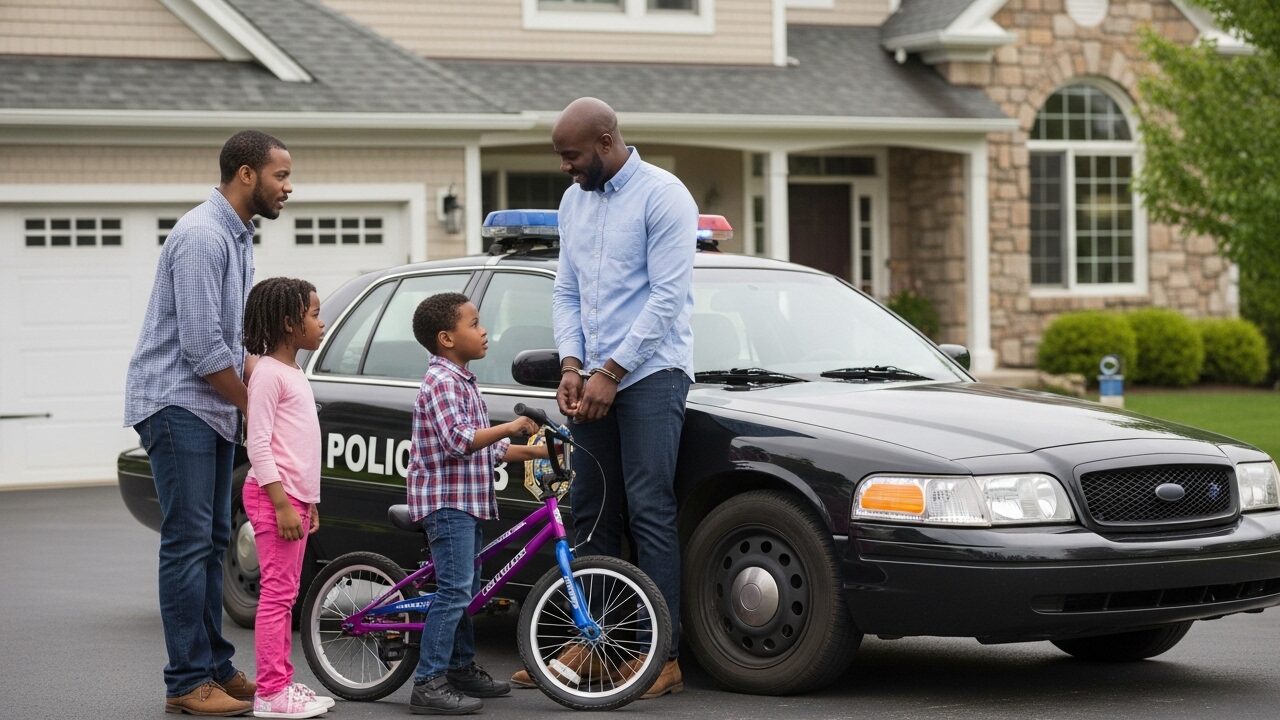
A Devoted Father Spent $400,000 to Move His Family to a Safe Suburb, Only to Be Handcuffed on His Own Driveway While His 8-Year-Old Son Watched in Absolute Horror

CHAPTER 1
The steel of the handcuffs was freezing against my wrists, but it was the heat of my eight-year-old son’s tears that burned a hole straight through my chest.
I was thirty-eight years old. I had a master’s degree in architecture from Cornell. I wore a tailored Patagonia fleece, owned a four-bedroom colonial house that cost me half a million dollars, and paid my neighborhood HOA dues on time every single month.
None of that mattered.
To the two white police officers currently pressing my chest against the cold hood of my own SUV, I wasn’t an architect, a homeowner, or a father.
I was just a Black man in the wrong zip code.
It was Saturday morning, 9:00 AM. The air in Oakridge was crisp, carrying the scent of cut grass and my wife’s famous buttermilk pancakes wafting through the open kitchen window.
This was supposed to be the perfect day. It was Leo’s eighth birthday.
For the last three hours, I had been hiding in my open garage, quietly assembling a customized matte-blue mountain bike. It was the exact one Leo had been begging for since Christmas.
I had dirt on my hands and a grease smudge on my forehead, but I was smiling so hard my jaw ached.
I remembered being Leo’s age, growing up in a cramped, two-bedroom apartment in East Baltimore. My father had worked three jobs just to keep the lights on. I never got a brand-new bike. I got hand-me-downs with rusted chains and flat tires.
I had made a silent vow the day I held Leo in the delivery room: I will give you the world. I will build a fortress around you so high that the ugliness of this country can never touch you.
I moved us to Oakridge specifically for that fortress. It was an affluent, predominantly white suburb known for its top-tier schools, manicured lawns, and microscopic crime rate.
We were the only Black family on Elm Street.
I knew my neighbor across the street, Arthur Pendelton, watched us. Arthur was a sixty-five-year-old retired insurance adjuster. Ever since his wife passed away from pancreatic cancer two years ago, Arthur had appointed himself the unofficial watchman of the neighborhood.
He found control in measuring the length of people’s grass and reporting unfamiliar license plates. But I noticed his gaze always lingered a little longer on my driveway. His blinds would twitch whenever I brought the groceries in.
I brushed it off. I told myself it was just an old, lonely man projecting his grief into paranoia. I told my wife, Sarah, to just wave and smile at him.
I was tightening the final bolt on the bike’s front tire when the silence of the suburban morning was shattered by the aggressive crunch of tires on gravel.
I didn’t even have time to stand up.
Two police cruisers skidded to a halt, cutting off the entrance to my driveway. The red and blue lights flashed violently, bouncing off the pristine white walls of my garage.
Before I could process what was happening, the doors flew open.
“Step away from the bicycle! Put your hands where I can see them! Now!”
The voice was frantic, pitched high with adrenaline.
I stood up slowly, the wrench still in my right hand.
“Drop the weapon! Drop it right now!”
My heart slammed against my ribs like a trapped bird.
Standing ten feet away from me was Officer Bradley Hayes. He looked no older than twenty-five, his face flushed red, his blue eyes wide and darting. His hand was hovering inches from his holster. His fingers were actually trembling.
Next to him was a veteran cop, Officer Miller, a heavy-set man in his fifties whose face was unreadable, a cold stone wall. His hand rested casually on his belt, but his stance was strictly tactical.
“Officers,” I said, my voice dangerously calm. I knew the rules of survival. I had been taught them since I was a teenager. Keep your voice low. Make no sudden movements. Over-enunciate. “I am dropping the wrench.”
I let the metal tool clatter to the concrete. I raised both my empty hands in the air, palms facing forward.
“Kick it away!” Hayes barked, taking a step forward. He was breathing heavily, terrified. And a terrified cop with a gun is the most dangerous creature on earth.
I gently nudged the wrench with my sneaker. “It’s away. How can I help you officers? This is my home.”
“Shut your mouth and turn around!” Miller commanded, stepping up to take control from the panicked rookie. “Face the vehicle. Put your hands flat on the hood.”
“I live here,” I repeated, my voice straining as the injustice started to curdle in my throat. “My ID is in my back pocket. My name is Marcus Vance. I am building a bike for my son.”
“I said turn around!” Miller roared, closing the distance.
Before I could speak again, Miller grabbed my left shoulder, spinning me around with a force that shocked me. He slammed my chest against the hood of my own Ford Explorer. The metal was freezing against my cheek.
“Do not resist! Hayes, get the cuffs on him!”
“I’m not resisting!” I yelled, the panic finally breaking through my controlled facade.
Rough hands grabbed my wrists, twisting my arms behind my back. The cold, heavy metal of the handcuffs bit brutally into my skin. The sharp click-click-click echoed in the quiet garage.
At that exact moment, the front door of my house swung open.
“Marcus, honey, the pancakes are—”
Sarah’s voice stopped dead.
I twisted my head, my cheek burning against the car hood.
Standing on the porch was my beautiful wife, wearing her favorite floral apron, holding a plate covered in aluminum foil.
Beside her, holding a balloon in one hand and a wrapped present in the other, was my eight-year-old son, Leo. Behind him, peeking through the screen door, was my five-year-old daughter, Maya.
Time completely stopped.
I watched the smile melt off my son’s face. I watched his wide, innocent brown eyes take in the flashing police lights.
He looked at the officers. Then he looked at me, his father, his hero, the man who promised nothing would ever hurt him, pressed against a car in handcuffs like a criminal.
“Daddy?” Leo’s voice was a fragile whisper that shattered the morning air. The balloon slipped from his fingers, floating up toward the porch ceiling.
“Marcus!” Sarah screamed, dropping the plate. Ceramic shattered across the wooden deck. “What are you doing? Get your hands off my husband!”
She lunged down the steps, a fierce, terrified mother bear.
“Ma’am, stay back!” Officer Hayes yelled, stepping between Sarah and me, his hand moving back toward his waist.
“Sarah, stop! Don’t move!” I screamed, genuine terror seizing my throat. If she rushed them, if Hayes panicked… I couldn’t let my children watch their mother get shot on their front lawn. “Stay right there! Keep the kids back!”
Sarah froze, tears instantly spilling over her cheeks. She grabbed Leo by the shoulders, pulling him against her legs, shielding him. Maya started wailing from inside the house, a high-pitched, terrified shriek.
“He lives here!” Sarah cried out, her voice cracking with a mixture of rage and despair. “He’s an architect! He’s building a birthday present! What is wrong with you?”
Officer Miller ignored her. He was patting down my pockets, aggressively searching my body. He pulled out my wallet, flipping it open.
He stared at my driver’s license. Then he looked at the house number painted on the curb. Then he looked back at the license.
I could see the exact moment the realization hit him. The slight widening of his eyes. The tightening of his jaw.
But police don’t apologize. They justify.
“We received a 911 call,” Miller said gruffly, not taking the handcuffs off. “A neighbor reported a suspicious individual matching your description stealing a bicycle from this open garage.”
I turned my head.
Through the gap between the police cruisers, I looked across the street.
Standing in his living room window, partially hidden behind his beige vertical blinds, was Arthur Pendelton. He was holding a cell phone. He looked right at me, then quickly shut the blinds.
The fortress I had spent my entire life building for my family came crashing down in an instant.
I had played by all their rules. I went to the right schools. I wore the right clothes. I bought the right house in the right neighborhood. I did everything a Black man in America is told to do to be considered “safe.”
And none of it mattered. Because to Arthur Pendelton, and to Officer Hayes, and to Officer Miller, I would never be a father building a bike.
I was just a threat.
“Take the cuffs off my husband,” Sarah demanded, her voice dropping to a terrifying, deadly whisper. “Right. Now.”
Chapter 2
The click of the key turning in the handcuffs sounded like a gunshot in the silent garage.
Officer Miller didn’t look me in the eye as he guided the heavy metal bracelets off my wrists. He kept his gaze fixed on my chest, specifically on the Patagonia logo, as if trying to reconcile the expensive fleece with the suspect he had just assaulted. The steel had bitten deep into my skin, leaving angry, red indentations that throbbed with the rhythm of my racing heartbeat. I rubbed my wrists, the physical pain completely eclipsed by the suffocating weight of the humiliation settling over me.
“Like I said, sir, we received a call about a theft in progress,” Miller muttered. His voice had lost its commanding bark. Now, it was defensive, heavily layered with the bureaucratic detachment cops use to shield themselves from liability. He took a half-step back, creating a strategic distance between us. “We have a duty to investigate. You match the description.”
“A description of what?” Sarah’s voice trembled with a lethal mixture of rage and unshed tears. She had moved off the porch and was standing right beside me, her shoulder pressing firmly against my arm. It was a silent, defiant gesture of solidarity. “A description of a Black man? Is that it? Because I guarantee you, if my husband were white and assembling a bicycle in his own driveway, your guns would have stayed securely in your holsters.”
Officer Hayes, the young rookie who had been seconds away from pulling his weapon on me, looked visibly sick. The adrenaline was leaving his system, replaced by a pale, sweating realization of how close he had come to making a catastrophic mistake. He refused to look at Sarah, keeping his eyes glued to the concrete floor, his hands resting nervously on his utility belt.
“Ma’am, we’re just doing our jobs,” Miller replied, his jaw tightening. He was a veteran; he had been through this routine before. The deny-deflect-depart maneuver. “Neighborhood watch reported a suspicious individual. We verified his identity. The situation is resolved. Have a good day.”
“Resolved?” I finally spoke, my voice dangerously low, practically vibrating with a suppressed fury that terrified even me. I stepped forward, forcing Miller to look up and meet my eyes. “You threw me against the hood of my own car in front of my eight-year-old son on his birthday. You terrified my family. You humiliated me in front of my entire neighborhood. And you call this resolved?”
Miller’s face hardened into a stone mask. He recognized the anger, but he had no empathy for it. To him, I wasn’t a victim of racial profiling; I was a piece of paperwork that was rapidly becoming a headache. “If you have a complaint, sir, you can file it down at the precinct. Let’s go, Hayes.”
Without another word, the two officers turned their backs on us. They climbed into their respective cruisers, the heavy doors slamming shut with a finality that made my stomach churn. The flashing red and blue lights were killed, leaving the driveway suddenly, violently quiet. The engines roared to life, tires crunching over the gravel as they backed out and sped down Elm Street, disappearing around the corner as if they had never been there.
But the damage was already done. It was permanently etched into the air, into the concrete, into the horrified eyes of my son.
I stood frozen in the driveway, my hands shaking uncontrollably. The morning sun, which had felt so warm and promising just twenty minutes ago, now felt glaring and oppressive. I slowly turned my head, my eyes scanning the pristine, manicured lawns of Oakridge.
I saw them.
Behind the impeccably trimmed hydrangeas, peeking through the gaps of expensive plantation shutters, the neighbors were watching. I saw the silhouette of Mrs. Gable, the retired librarian three doors down. I saw the Anderson teenagers standing on their porch, cell phones in hand—though whether they had filmed it or were just texting about it, I didn’t know.
And across the street, standing brazenly on his perfectly edged front lawn, was Arthur Pendelton.
Arthur was a man who prided himself on order. He was a sixty-five-year-old retired insurance adjuster, a man who had spent his entire career calculating risk and placing people into neat, statistical boxes. He wore neatly pressed khaki slacks and a tucked-in polo shirt, his white hair combed back severely. Since his wife, Eleanor, had passed away from pancreatic cancer, Arthur’s world had shrunk. His pain, unaddressed and festering, had mutated into a rigid obsession with control. He attended every HOA meeting. He reported overgrown weeds. He monitored the trash pickup times.
And he monitored us.
I locked eyes with Arthur across the sixty feet of asphalt that separated our properties. I wanted to see a flicker of guilt, a moment of realization that his paranoid phone call had almost cost a father his life. Instead, Arthur just stood there, his arms crossed defensively over his chest. He didn’t look away. His expression wasn’t apologetic; it was indignant, as if the police had failed him by not dragging me away in a squad car. After a long, suffocating moment, he turned on his heel and marched back into his house, locking the deadbolt loud enough for the sound to carry across the street.
“Marcus,” Sarah whispered, her hand gently touching my shoulder.
I flinched. The ghost of the police officer’s grip was still burned into my muscles. I closed my eyes, forcing myself to take a deep, shaky breath, fighting the sudden, terrifying urge to vomit.
“I’m okay,” I lied, my voice cracking. I turned away from the street, my eyes falling on the driveway.
There, lying in a puddle of grease and morning dew, was the matte-blue mountain bike. The red birthday bow I had carefully tied to the handlebars was crushed under the front tire where I had dropped it. A few feet away lay my wrench.
And standing on the bottom step of the porch was Leo.
He hadn’t moved. The blue balloon he had been holding was gone, snagged somewhere in the branches of the old oak tree in the front yard. His hands were hanging limply at his sides, his small shoulders hunched. The innocent, joyous anticipation that had lit up his face an hour ago was completely extinguished. In its place was a profound, traumatized confusion that broke my heart into a million irreparable pieces.
I walked slowly toward him, my knees feeling like they were made of water. I dropped down into a crouch so I was eye-level with him. I reached out, wanting to pull him into a bear hug, wanting to shield him from the ugly reality of the world he had just witnessed.
He took a tiny half-step backward.
It was the most devastating movement I had ever seen in my life. My own son, the boy I had read bedtime stories to, the boy whose scraped knees I had bandaged, was looking at me with a flicker of hesitation. The police had treated me like a dangerous criminal, and in a child’s mind, police are the good guys. If the good guys were hurting Daddy, what did that make Daddy?
“Leo, buddy,” I choked out, tears finally breaking free and tracking hot paths down my cheeks. “I’m so sorry. I’m so sorry.”
“Daddy, did you steal my bike?” Leo’s voice was a fragile whisper, trembling with fear.
The question hit me like a physical blow to the stomach. I gasped, the air knocked out of my lungs. Sarah let out a heartbroken sob, turning away to hide her face in her hands.
“No, Leo. No, baby, of course not,” I said, my voice thick with emotion. I closed the distance, ignoring his slight flinch, and wrapped my arms securely around his small, shaking body. I buried my face in his neck, breathing in the scent of his strawberry shampoo. “I bought this bike for you. It’s your birthday present. The police… the police made a mistake. A really bad mistake.”
“But they had guns,” Leo sobbed into my shoulder, his little hands gripping the fabric of my fleece as if he were drowning. “The man yelled at you. He pushed you on the car. Bad guys go on the car.”
“I’m not a bad guy, Leo. I promise you,” I whispered fiercely, squeezing my eyes shut as the tears flowed freely. “I’m just your dad. I’m just your dad.”
The rest of the morning was a hollow, agonizing blur. The birthday pancakes were cold and congealed, dumped into the trash without a second thought. The meticulously planned schedule—a trip to the local trampoline park, followed by pizza and a movie—was quietly abandoned. Maya, sensing the heavy, toxic atmosphere in the house, cried continuously until Sarah managed to rock her to sleep in her nursery.
I sat at the kitchen island, staring blankly at the granite countertop. My hands were wrapped tightly around a mug of black coffee that had gone cold an hour ago. The silence in the house was deafening, a thick, suffocating blanket of trauma.
The doorbell rang.
I jumped, my heart immediately seizing in my chest. The trauma response was instant. My mind flashed back to the flashing lights, the barking orders, the heavy metal of the handcuffs.
“I’ll get it,” Sarah said softly, placing a reassuring hand on my back as she walked past.
I listened intently to the sound of the front door opening. I braced myself for more police, for more questions, for more humiliation.
“Dave,” I heard Sarah say. Her voice was polite, but incredibly tight.
“Hey, Sarah. Is Marcus around? I just… I wanted to check in.”
Dave Harrison was the President of the Oakridge Homeowners Association. He lived next door to us, a fifty-year-old owner of a string of successful regional hardware stores. Dave was the quintessential suburbanite—he drove a spotless Ford F-150, spent his weekends meticulously edging his lawn, and always greeted everyone with a booming, slightly overbearing joviality. Underneath the friendly exterior, however, Dave was a man struggling to hold his life together. His wife had filed for divorce six months ago, taking their teenage daughter with her. Dave poured all his anxiety and loneliness into the neighborhood, obsessing over property values and maintaining the illusion of a perfect, harmonious community.
I stood up and walked to the foyer. Dave was standing on the porch, holding a Tupperware container filled with what looked like store-bought chocolate chip cookies. He was wearing his weekend uniform: khaki shorts and a polo shirt tucked into a braided leather belt. He looked uncomfortable, shifting his weight from one foot to the other.
“Hey, Marcus,” Dave said, offering a tight, anxious smile. He held out the cookies. “Just, uh, thought I’d bring these over. For Leo. Happy birthday to the little guy, right?”
“Thanks, Dave,” I said, taking the container. My voice was flat, completely devoid of emotion.
Dave shoved his hands deep into his pockets, looking anywhere but at me. He looked at the roof, the driveway, the street. “Listen, man. I saw what happened this morning. The whole street saw it. It was… well, it was a hell of a thing.”
“It was an assault, Dave,” Sarah corrected him sharply, leaning against the doorframe. “My husband was racially profiled and assaulted by the police on our own property.”
Dave grimaced, visibly recoiling from the harsh truth of Sarah’s words. He was a man who hated conflict, especially conflict that forced him to confront the ugly realities of the world outside his manicured bubble.
“Now, Sarah, let’s not jump to conclusions,” Dave said, adopting a placating, reasoning tone that instantly made my blood boil. “I know it looked bad. It was terrible. But the police, they’re just on edge these days. We had those car break-ins over in the Willow Creek subdivision last month. They’re just being extra cautious. Protecting the neighborhood.”
“Protecting it from me?” I asked, my voice deadly calm.
Dave’s face flushed a deep, uncomfortable red. “No, no, Marcus, come on. You know I don’t mean that. You’re a great neighbor. You keep your yard looking fantastic. It’s just… well, it’s Arthur.”
“Arthur,” I repeated, the name tasting like ash in my mouth.
“Look, Arthur is… he’s having a hard time,” Dave continued, leaning in closer as if sharing a secret. His voice dropped to a conspiratorial whisper. “Since Eleanor passed, he’s just not right in the head. He’s paranoid. He sits at that window all day. He calls the HOA on people for leaving their trash cans out an hour too long. He called the cops on the Amazon delivery guy last week.”
“The Amazon delivery guy was wearing a uniform and driving a branded truck,” Sarah pointed out, her eyes narrowing. “Marcus was in his own garage, wearing a fleece, putting together a child’s bike. Arthur didn’t call the police because he’s paranoid about crime, Dave. He called the police because Marcus is Black.”
Dave sighed heavily, running a hand through his thinning hair. He looked exhausted, burdened by the responsibility of keeping the peace in a neighborhood that was suddenly fracturing. “Sarah, please. Don’t make it about that. Arthur is an old man from a different generation. He’s grieving. He just got confused.”
“He got confused and almost got my husband killed,” Sarah fired back, stepping forward.
“Sarah, let it go,” I interjected quietly, placing a hand on her arm. I looked at Dave. I saw the desperate pleading in his eyes. He didn’t come over here to offer genuine support or to condemn Arthur’s racism. He came over here to smooth things over. He wanted to minimize the incident, to sweep the ugliness under the rug so the neighborhood could go back to pretending everything was perfect. He wanted absolution without accountability.
“Dave,” I said, my voice steady, staring directly into his eyes until he was forced to look at me. “I understand Arthur is grieving. I understand he’s lonely. But his grief does not give him the right to weaponize the police against my family. His confusion could have left my children without a father today.”
Dave swallowed hard, unable to hold my gaze. He nodded slowly, clearly uncomfortable with the gravity of the situation. “I know, Marcus. I know. It’s a mess. I’ll… I’ll go talk to Arthur. I’ll tell him he needs to apologize. We’re a community here. We look out for each other.”
“Don’t bother,” I said, stepping back and beginning to close the door. “An apology from Arthur isn’t going to fix what happened to my son today. Have a good weekend, Dave.”
I shut the door firmly, the solid click of the latch echoing in the silent foyer.
Sarah let out a long, shaky breath and leaned her forehead against the cool wood of the door. “I hate this place,” she whispered, her voice cracking. “I hate these people. They smile at us, they invite us to their block parties, but the second something goes wrong, we’re the outsiders. We’re the threat.”
I wrapped my arms around her from behind, burying my face in her hair. I wanted to tell her she was wrong. I wanted to tell her that Oakridge was still the safe haven we had dreamed of. But I couldn’t. The illusion was shattered. The fortress I had built was made of glass, and Arthur Pendelton had just thrown a brick straight through it.
The afternoon dragged on with agonizing slowness. Around 3:00 PM, the doorbell rang again.
This time, it was Claire Montgomery from across the street, two houses down from Arthur. Claire was thirty-five, a former marketing executive turned stay-at-home mom. She was married to a high-powered corporate lawyer who was notoriously absent, leaving Claire to raise their two young daughters alone in a massive, echoing house. She filled her time with hot yoga, organic baking, and an intense, almost desperate need to be perceived as a “good person.”
When I opened the door, Claire was standing there holding a massive, foil-covered casserole dish. Her eyes were red and puffy, her mascara slightly smudged. Before I could even say hello, she burst into tears.
“Oh, Marcus,” she sobbed, practically shoving the heavy dish into my arms. “I am so, so sorry. I saw the whole thing from my kitchen window. I couldn’t believe it. I was shaking. I’m still shaking!”
She pushed past me into the foyer, dropping her expensive designer purse on the floor. Sarah emerged from the kitchen, looking alarmed.
“Claire? What’s wrong?” Sarah asked.
“I’m just so horrified,” Claire wept, grabbing a tissue from her pocket and dabbing aggressively at her eyes. “To think that this happened on our street! To you! You guys are the nicest family. It’s just so unfair. It’s systemic racism, right here in Oakridge. I feel so guilty.”
I stood holding the heavy, warm casserole dish, feeling a strange, hollow detachment. Here I was, the man who had actually been assaulted, the man whose child had been traumatized, and yet I was currently expected to comfort the crying white woman who had merely witnessed it.
It was a dynamic I had experienced a hundred times before in corporate America, but having it play out in my own hallway felt uniquely exhausting. Claire’s tears weren’t really about me. They were about her own discomfort, her desperate need to distance herself from the ugliness of what had happened, to prove that she was one of the “good ones.”
“Claire, we appreciate the food,” Sarah said gently, taking the dish from my hands and setting it on the console table. She was playing the diplomatic host, a role she had perfected over years of navigating predominantly white spaces. “We’re okay. We’re just trying to process it.”
“If there is anything I can do,” Claire continued, sniffing loudly. “I can organize a meal train. I can post about it on the neighborhood Facebook group. People need to know what Arthur did! He’s a monster. I never liked him. My girls are terrified of him.”
“Please, no Facebook,” I said quickly, panic flaring in my chest. The last thing I wanted was my family’s trauma turned into neighborhood gossip or a debate topic for bored suburbanites. “We just want to keep this quiet for now, Claire. Leo is very upset. We just need some space.”
Claire looked slightly deflated, as if I had rejected a grand, noble gesture. “Of course. I completely understand. Your trauma is valid. I’m just here as an ally, Marcus. Whatever you need.”
She left ten minutes later, leaving behind a heavy lasagna and an atmosphere thick with exhausted frustration.
Night finally fell, cloaking the neighborhood in darkness. The streetlights flickered on, casting long, distorted shadows across the manicured lawns. I finally managed to get Leo to sleep around 10:00 PM. I had to lay in his bed for two hours, holding his hand, reassuring him over and over again that the police weren’t coming back, that I wasn’t going to jail. Every time a car drove down the street, his small hand tightened convulsively around mine.
When I finally crept out of his room, Sarah was already asleep, her face pale and drawn, tear tracks still visible on her cheeks.
I couldn’t sleep. My body was thrumming with a toxic mixture of adrenaline, rage, and profound grief. I walked downstairs, moving silently through the dark house. I stepped into the garage and turned on the overhead fluorescent lights.
The blue mountain bike was still lying on the floor.
I walked over and knelt beside it. I picked up the red birthday bow, brushing off the dust and grease. I looked at the bike, thinking about the hours I had spent picking it out, the joy I had felt assembling it. I had wanted to give my son a memory of pure happiness. Instead, I had given him a memory that would require years of therapy to unpack.
My phone buzzed in my pocket.
I pulled it out. It was 11:30 PM. The caller ID flashed a name I hadn’t seen in months: Tom Decker.
Tom was another dad from Leo’s elementary school. He was forty-two, a civil rights attorney who ran a small, struggling practice downtown. Tom was a complicated guy. He came from a family of wealthy, conservative judges, but he had rebelled, dedicating his life to fighting police brutality and civil rights violations. He was brilliant, deeply cynical, and battling a well-known, barely concealed alcohol problem. His marriage was hanging by a thread, and his law firm was constantly on the verge of bankruptcy. But when it came to the law, Tom was a shark.
I answered the phone. “Tom? It’s late.”
“Marcus,” Tom’s voice was gravelly, a little slurred, but completely focused. The sound of ice clinking in a glass echoed through the receiver. “I just got off the phone with Claire Montgomery. She’s a hysterical mess, but she managed to spit out what happened this morning. Is it true? Did Oakridge PD put you in cuffs on your own driveway?”
I closed my eyes, leaning my head against the cold frame of the bicycle. “Yeah, Tom. It’s true.”
“Over a 911 call from Arthur Pendelton?”
“Yes.”
I heard a sharp intake of breath on the other end, followed by the sound of a glass slamming down hard on a table. “Those absolute bastards. Listen to me, Marcus. You have the officers’ names? Badge numbers?”
“Hayes and Miller. I don’t have the badge numbers. I was a little distracted being pressed against my car,” I said bitterly.
“I can get the badge numbers. I can get the dispatch tapes and the body cam footage,” Tom said, his voice picking up speed, the lawyer in him fully awakened. I could hear the desperate hunger in his tone. This was exactly the kind of high-profile, slam-dunk civil rights case that could save his failing firm. But beneath the opportunism, I could also hear genuine, blistering anger. “Marcus, this is a massive civil rights violation. False arrest. Battery. Emotional distress. We can sue the department, and we can sue Pendelton directly for filing a false police report.”
“Tom, I don’t know,” I sighed, rubbing my temples. A massive headache was throbbing behind my eyes. “I don’t want to drag my family through a lawsuit. I don’t want Leo testifying. I just… I just want to protect my kids.”
“You think staying quiet protects them?” Tom challenged, his voice dropping into a harsh, realistic register. “Marcus, you’re a smart guy. You know how this works. You moved out to the suburbs to escape this exact shit, and it followed you anyway. Why? Because guys like Arthur Pendelton think they own the world, and guys like Officer Miller are happy to act as their personal security force. If you let this slide, Arthur wins. He learns that he can weaponize the police against you without consequences. What happens next time? What happens when Leo is a teenager walking home from school in a hoodie, and Arthur decides he looks ‘suspicious’?”
The image hit me like a physical blow. My breath caught in my throat. I pictured Leo, ten years from now, tall and broad-shouldered, walking down Elm Street. I pictured Officer Hayes, older but no less terrified, pulling his gun.
“I can’t let that happen,” I whispered into the dark garage.
“Then we fight back,” Tom said firmly. “I’ll be at your house tomorrow at 10:00 AM. We’ll start taking statements. We’re going to tear them apart, Marcus.”
I hung up the phone. The silence returned to the garage, heavy and pregnant with anticipation.
I stood up, leaving the bike on the floor. I walked to the window at the front of the garage and looked out.
The street was dead quiet. Across the way, Arthur Pendelton’s house was completely dark, save for a single, warm light glowing in the living room window. He was awake. He was probably sitting in his armchair, feeling safe, feeling righteous, feeling like he had protected his neighborhood from an invader.
He had no idea that the real war hadn’t even started yet.
I had spent my entire life trying to be the “safe” Black man. I had kept my head down, worked twice as hard, smiled politely at microaggressions, and bought my way into their exclusive, gated world. I thought assimilation was the key to safety.
I was wrong. Assimilation was just a hostage situation with better landscaping.
If they were going to treat me like a threat, no matter what I did, no matter how much money I made or how perfectly I maintained my lawn… then it was time to stop pretending.
It was time to become exactly what Arthur Pendelton feared. It was time to fight back.
Chapter 3
Sunday morning arrived not with the gentle grace of a suburban weekend, but with the brutal, heavy thud of a hangover that didn’t come from alcohol. It came from a severe deficit of sleep and an absolute surplus of adrenaline.
The house felt like a crime scene. Every shadow in the hallway seemed sharper, every creak of the floorboards louder. Sarah was in the kitchen, mechanically wiping down the pristine quartz countertops with a sponge, staring blankly out the window at the bird feeder. She had been wiping the same two-foot section of counter for the last ten minutes.
Leo was in the den. He had been sitting cross-legged on the plush rug for an hour, watching cartoons on mute. The TV screen threw chaotic bursts of colored light across his small, expressionless face. He hadn’t asked for breakfast. He hadn’t asked to go outside. He was just existing, folded in on himself, trying to become as small and invisible as possible.
At exactly 10:00 AM, a battered, ten-year-old Volvo station wagon groaned its way up my driveway, the muffler rattling violently against the undercarriage. It parked crookedly, one tire resting in the mulch of Sarah’s prized rose garden.
Tom Decker stepped out.
He looked exactly how a man whose life was slowly unraveling should look. He wore a rumpled gray suit jacket over a black t-shirt, his jeans slightly frayed at the hems. He was forty-two but had the exhausted, deeply lined face of a man a decade older. His sandy blonde hair was unkempt, and the dark circles under his pale blue eyes looked like bruises. As he walked up the driveway, he popped a breath mint into his mouth, a futile attempt to mask the stale scent of bourbon that seemed to permanently seep from his pores.
Despite his disastrous personal life, Tom possessed a feral, predatory intelligence. He was a man who had burned every bridge in his prestigious family’s social circle to fight for the underdogs, only to realize that the underdogs rarely paid enough to cover overhead.
I opened the door before he could ring the bell. I didn’t want the sound triggering Leo again.
“Marcus,” Tom said, his voice gravelly. He didn’t offer a handshake. He just stepped into the foyer, his eyes immediately scanning the house, assessing the environment like a general surveying a battlefield. “House is quiet. Too quiet.”
“Leo is in the den,” I said softly, leading him into the kitchen. “He’s… he’s not doing well, Tom.”
Sarah looked up from the counter, dropping the sponge into the sink. She crossed her arms tightly over her chest. “He asked me this morning if the police were going to come back and take Marcus away. He asked if we needed to hide the kitchen knives so they wouldn’t think Marcus was dangerous. He’s eight years old, Tom.”
Tom stopped in the center of the kitchen. The cynical, fast-talking lawyer facade slipped for a fraction of a second, revealing the fractured father underneath. Tom’s own daughter, Lily, was seven. He hadn’t seen her in three weeks because his estranged wife, Karen, had filed for supervised visitation following his last DUI.
He swallowed hard, his jaw tightening. “I’m sorry, Sarah. Truly. But I’m going to make them pay for that. I promise you.”
Tom pulled out one of the heavy oak barstools and sat down, unzipping a scuffed leather briefcase. He pulled out a yellow legal pad, three cheap ballpoint pens, and a small, silver digital audio recorder.
“I didn’t sleep much last night,” Tom began, his tone shifting into pure, aggressive business. “I have a contact down at the county dispatch center. A dispatcher whose brother I kept out of prison a few years back. She owed me a massive favor. I cashed it in at 2:00 AM.”
He pushed the silver recorder across the granite island toward me.
“This is the 911 call. Arthur Pendelton’s call,” Tom said. “You need to listen to this, Marcus. Both of you.”
Sarah stepped closer, leaning against my arm. I stared at the small device. It looked like a bomb waiting to detonate. I reached out and pressed the play button.
A burst of static hissed from the tiny speaker, followed by the tired, nasal voice of a female dispatcher.
“Oakridge Emergency Dispatch, what is the nature of your emergency?”
“Yes, hello. I need officers at my location immediately. There is a robbery in progress.” It was Arthur. But his voice didn’t sound panicked. It didn’t sound like a confused, grieving old man who had made a mistake. It sounded sharp, authoritative, and profoundly indignant. It was the voice of a man who believed he owned the world and was deeply offended that someone had dared to step onto his property.
“Okay, sir. What is your address?” Arthur rattled off his address, his voice steady.
“Are you in danger, sir? Can you see the suspect?” the dispatcher asked.
“I am safe inside my home,” Arthur replied. “But I am looking right at him. He is in the open garage directly across the street. Number 442 Elm.”
“Can you describe the suspect?”
There was a half-second pause.
“He’s a large African-American male. He’s hovering over a bicycle with a weapon in his hand. A metal pipe or a crowbar, I can’t tell. He’s actively trying to steal it.”
My blood turned to ice. A weapon. He had told them I had a weapon. He had escalated the situation from a suspicious person to a violent, armed robbery in a split second.
“Okay, sir. Do you know who lives at that residence? Could it be the homeowner?” the dispatcher asked, following protocol.
Arthur didn’t hesitate. “Absolutely not. The people who live there are a young, respectable couple. This man does not belong in this neighborhood. He is a thug. He’s aggressive. You need to send someone right now before he breaks into the house.”
The recording clicked off. The silence in the kitchen was absolute, thick, and suffocating.
Sarah’s hand was gripping my arm so tightly her nails were digging through my shirt. “He said you had a weapon. He called you a thug. He knew exactly what he was doing.”
I felt nauseous. The realization of how close I had come to dying washed over me in a cold wave. Officer Hayes hadn’t just been a nervous rookie; he had been a rookie responding to an armed robbery in progress, expecting a violent confrontation. Arthur hadn’t just called the police; he had effectively swatted me. He had loaded a gun, pointed it at my chest, and let the police pull the trigger.
“He lied,” I whispered, the words tasting like copper in my mouth. “He watches us every single day. He knows exactly what I look like. He knows I live here.”
“Of course he does,” Tom said, his voice flat, devoid of surprise. He leaned forward, resting his elbows on the counter. “Arthur Pendelton is a sixty-five-year-old retired insurance risk assessor. His entire professional life was built on profiling. He didn’t make a mistake. He weaponized his prejudice, and he used the Oakridge Police Department as his own personal enforcement squad.”
Tom picked up a pen and started tapping it aggressively against the legal pad. “Here is the reality of the situation, Marcus. Legally speaking, suing the police department is going to be a nightmare. It’s called qualified immunity. It’s a legal doctrine designed to shield government officials from being sued for discretionary actions performed within their official capacity. Unless we can prove they violated a ‘clearly established’ statutory or constitutional right, the judge will toss the case before it even sees a jury.”
“They assaulted him!” Sarah snapped, her voice rising. “They threw him against a car without asking a single question!”
“I know, Sarah. I know,” Tom said gently, holding up a hand. “But they will argue they were responding to a 911 call reporting an armed felony in progress. They will say their actions, while aggressive, were ‘objectively reasonable’ given the information they had at the time. They will hide behind Arthur’s lie.”
“So they get away with it?” I asked, feeling a cold, dark anger settling deep into my bones.
“I didn’t say that,” Tom countered, a dangerous, predatory smile touching the corners of his mouth. “I said it’s difficult. Not impossible. We need the body cam footage. We need to see exactly what Hayes and Miller did, how they approached, how long it took them to realize you were the homeowner. If they continued to use excessive force after the threat was neutralized, we have an angle.”
He pointed the pen at the audio recorder. “But our real target is Arthur. We sue him for malicious prosecution, intentional infliction of emotional distress, and filing a false police report. We subpoena his phone records, his computer, his emails. We rip his life apart until we find the paper trail of his racism. We prove that he knew you lived there and intentionally lied to dispatch to trigger a violent police response.”
I looked at Tom. I saw the hunger in his eyes. He wasn’t just doing this because it was right; he was doing it because he needed a war to fight, something to distract him from the smoking crater of his own life.
“What’s the catch, Tom?” I asked quietly. “There’s always a catch.”
Tom stopped tapping the pen. He leaned back in his chair, suddenly looking very tired. “The catch is that this is going to get ugly, Marcus. Really, really ugly. Oakridge is a wealthy, insular community. They protect their own. The police department will close ranks. The city council will try to bury it. And your neighbors? The same people who brought you cookies and casseroles yesterday? They will turn on you the second this hits the news. They don’t want to be known as the racist suburb. They will vilify you to protect their property values.”
He looked directly into my eyes, his gaze unflinching. “If we do this, your life as you know it in this neighborhood is over. Your privacy is gone. Your family will be under a microscope. You have to be prepared for that.”
I thought about Dave Harrison, the HOA president, begging me to just let it go. I thought about Claire Montgomery, crying her performative tears in my foyer. They wanted me to absorb the trauma silently so they could continue living in their comfortable illusion.
Then I thought about Leo, sitting in the dark, wondering if his father was a bad guy.
“Do it,” I said, my voice hard as granite. “Draft the papers, Tom. Burn it all down.”
Monday morning felt like stepping onto a different planet.
I was a senior project manager at Kensington & Vance, a boutique, high-end architectural firm in downtown Chicago. The “Vance” in the title was ceremonial; I had been made a junior partner two years ago, a massive achievement that, in retrospect, was largely a diversity play by the senior partner to help secure municipal contracts.
I walked into the sleek, glass-and-steel lobby of the firm at 8:30 AM. My stomach was a tight knot of anxiety. The adrenaline from the weekend had completely crashed, leaving me feeling hollowed out and incredibly fragile. My wrists still ached, the deep purple bruises hidden beneath the cuffs of my tailored dress shirt.
As I walked through the open-concept bullpen toward my office, I felt the subtle shift in the atmosphere. Conversations died down as I passed. Eyes darted away from computer screens to track my movements. The hushed, suffocating silence of office gossip wrapped around me like a wet blanket.
They knew.
Somehow, the news had leaked. Maybe Dave Harrison had talked to someone who worked in the city. Maybe a neighbor had posted something vague on a private forum. In the world of elite Chicago corporate circles, secrets were just currency waiting to be spent.
I reached my office, a glass box overlooking the Chicago River, and closed the door. I hadn’t even sat down at my desk when my phone rang. The caller ID read: Richard Kensington.
Richard was sixty-two years old, a man composed entirely of expensive scotch, custom Italian suits, and an unwavering, ruthless pragmatism. He was old-money Chicago, a man who believed that any problem could be solved with the right amount of leverage or the right charitable donation. He liked me. He mentored me. But he viewed me primarily as an asset, a brilliant mind attached to a demographic profile that looked fantastic on a firm brochure.
“Marcus,” Richard’s voice boomed through the receiver, falsely cheerful. “My boy. Step into my office for a moment, would you? Let’s have a quick chat.”
It wasn’t a request.
I walked down the hall to the corner office. Richard was standing by his massive mahogany desk, staring out the floor-to-ceiling windows. He turned as I entered, a tight, controlled smile on his face. He gestured to one of the leather club chairs.
“Sit, sit,” he said, walking over to a crystal decanter on a side table. It was 8:45 AM, but he poured himself two fingers of amber liquid. He didn’t offer me any. “How was the weekend? Leo had a birthday, didn’t he? Eight years old. Fantastic age.”
“It was… eventful, Richard,” I said, keeping my voice neutral, my posture stiff.
Richard took a slow sip of his drink, his pale blue eyes locking onto mine. The jovial facade vanished instantly, replaced by the cold, calculating stare of a CEO protecting his bottom line.
“Eventful is an interesting word,” Richard said smoothly, walking back around his desk and leaning against the edge. “I got a phone call this morning, Marcus. From an old friend on the Oakridge City Council. He mentioned there was an… incident at your residence on Saturday. Something involving the local police and a misunderstanding with a neighbor.”
“It wasn’t a misunderstanding, Richard,” I said, my voice tightening. I felt the familiar, exhausting need to defend my own humanity rising in my chest. “I was racially profiled. A neighbor called the police and falsely reported an armed robbery while I was building my son’s bike. Two officers assaulted me and handcuffed me in front of my family.”
Richard flinched slightly at the word ‘assault,’ a micro-expression of distaste crossing his perfectly groomed features. He held up a hand, a gesture meant to placate but which only served to silence.
“Marcus, please. You know I sympathize. It sounds like a dreadful experience. Truly awful,” Richard said, his tone dripping with a practiced, corporate empathy that meant absolutely nothing. “And I know emotions are running high. But we have to look at the bigger picture here.”
He walked behind his desk and picked up a thick, glossy folder. I recognized it immediately. It was the proposal for the Southside Community Center revitalization project, a massive, seventy-million-dollar municipal contract the firm had been desperately trying to land for six months.
“We are in the final stages of the bidding process for the Southside project,” Richard said, tapping the folder against the desk. “The mayor’s office loves our design. They love our team. But they are incredibly sensitive to public relations right now. The city is a powder keg. They want a clean, controversy-free firm to handle this.”
He looked at me, letting the silence stretch out, making sure I understood exactly what he was implying.
“My contact on the city council mentioned that there are rumors you are retaining legal counsel,” Richard continued softly. “That you might be planning to file a civil rights lawsuit against the Oakridge Police Department.”
I stared at him. The betrayal was cold and sharp. “Are you telling me not to seek justice for my family, Richard?”
“I am telling you to be pragmatic, Marcus,” Richard snapped, his patience fraying. “A lawsuit against a wealthy suburban police department? It will be a media circus. It will be dragged through the press for years. You will be labeled an activist. You will become a lightning rod for controversy. And this firm…” he paused, pointing a manicured finger at the desk, “…this firm cannot afford to be attached to a high-profile racial controversy right now. It will kill the Southside deal.”
He leaned forward, lowering his voice into a paternal, warning register. “You have a brilliant future here, Marcus. You are a partner. You make half a million dollars a year. You have a beautiful home. Do not throw all of that away over a neighborhood dispute. Let the lawyers negotiate a quiet settlement. The city will offer you a check to make it go away. Take the money, Marcus. Protect your career.”
I sat in the leather chair, feeling the weight of the invisible chains that bound me to this world. Richard wasn’t threatening to fire me outright—that would be too messy, too obvious. He was doing something much more insidious. He was threatening my legacy. He was telling me that my success, my title, and my wealth were entirely conditional upon my silence. I was allowed to be in the room, as long as I didn’t make the white men uncomfortable.
I looked at Richard Kensington, really looked at him. I saw a coward. A man who would trade my dignity for a contract without a second thought.
I stood up slowly, smoothing the front of my jacket. I didn’t yell. I didn’t argue. I just looked at him with a cold, dead certainty.
“My son watched me get put in handcuffs, Richard,” I said, my voice barely above a whisper, yet it echoed in the large office. “No amount of money, and no architectural contract in the world, is going to buy my silence on that. If the firm considers my civil rights a ‘controversy,’ then perhaps I am at the wrong firm.”
Richard’s face flushed an angry, mottled red. He opened his mouth to speak, to assert his dominance, but I didn’t give him the chance. I turned on my heel and walked out of the office, the heavy glass door clicking shut behind me.
By 2:00 PM that afternoon, Tom Decker was standing in the austere, fluorescent-lit lobby of the Oakridge Police Department.
The precinct was a modern, imposing brick building that looked more like a corporate headquarters than a police station. It smelled of floor wax and stale coffee. Tom approached the thick bulletproof glass of the front desk, his leather briefcase in hand.
“I need to speak with Captain Sterling,” Tom told the desk sergeant, sliding his business card through the narrow metal slot. “Tell him Tom Decker is here. Tell him it’s regarding the false arrest of Marcus Vance on Saturday morning.”
Ten minutes later, Tom was escorted down a sterile hallway into the office of Captain Robert “Bob” Sterling.
Captain Sterling was fifty-eight years old, a man built like a fire hydrant, with a thick neck, a buzz cut of silver hair, and a face permanently etched with the stress of three decades in law enforcement. Sterling was an old-school cop, fiercely loyal to his officers and deeply distrustful of anyone with a law degree. His son, a patrol officer in Chicago, had been killed in the line of duty a decade ago during a routine traffic stop. That tragedy had hardened Sterling, turning him into a man who viewed every civilian as a potential threat and every police action, no matter how brutal, as a necessary evil for survival.
Sterling didn’t stand up when Tom entered. He sat behind his cluttered metal desk, his arms crossed over his chest, glaring at the lawyer.
“Decker,” Sterling growled, his voice like grinding rocks. “I haven’t seen you since you tried to sue my department over that bullshit excessive force claim three years ago. You still ambulance chasing?”
“I go where the constitutional violations are, Bob,” Tom replied smoothly, pulling up a chair and sitting down without being asked. “And right now, they seem to be happening in the driveway of 442 Elm Street.”
Sterling snorted, waving a dismissive hand. “I know why you’re here. Vance. It was a textbook response to a high-risk 911 call. Pendelton reported an armed robbery. My guys responded accordingly. They secured the suspect, verified his identity, and released him. Zero harm, zero foul. End of story.”
“You threw a father against a car in front of his eight-year-old kid because a racist neighbor didn’t like the look of him,” Tom fired back, leaning forward, the professional veneer cracking just a little. “That’s not textbook, Bob. That’s a massive lawsuit waiting to happen.”
“Careful, counselor,” Sterling warned, leaning forward as well, his eyes narrowing to dangerous slits. “You’re throwing around words like ‘racist’ without a shred of proof. Pendelton is an upstanding citizen. He made a mistake in a high-stress moment. And my officers followed protocol. They have qualified immunity, and you know it.”
“I don’t care about qualified immunity right now, Bob,” Tom said, his voice dropping into a deadly serious register. “I care about the evidence. I am formally requesting, right now, the body cam footage from Officers Hayes and Miller from the incident on Saturday morning. I have the drafted subpoena right here.”
Tom pulled a crisp, folded legal document from his jacket pocket and placed it on the desk.
Sterling stared at the document for a long, heavy moment. He didn’t touch it. A muscle feathered in his jaw. The blatant confidence in his demeanor slipped, replaced by a subtle, defensive tension.
“Body cam footage,” Sterling repeated slowly, leaning back in his chair. He picked up a pen and started clicking it.
“Yes. Both officers,” Tom said, watching the captain intently.
Sterling sighed, a heavy, theatrical sound. “Well, Tom, I’d love to help you out. Really, I would. But there’s a problem.”
“What kind of problem?” Tom asked, his eyes narrowing.
“Technical malfunction,” Sterling stated smoothly, not blinking. “Officer Hayes is a rookie. He forgot to activate his camera when he exited the vehicle. In the heat of the moment, responding to an armed robbery call, it slipped his mind. He’s been verbally reprimanded for the oversight.”
Tom stared at him, pure disbelief warring with mounting fury. “You’re lying. It’s department policy. They activate automatically with the sirens.”
“The system was undergoing a software update,” Sterling replied, reciting the lie with the practiced ease of a man who had done this a hundred times before.
“And Miller?” Tom demanded, his voice rising. “A twenty-year veteran forgot to turn his camera on too?”
“Officer Miller’s camera was damaged during a foot pursuit on Friday night,” Sterling lied effortlessly. “It was logged into maintenance on Saturday afternoon. The footage from Saturday morning was corrupted. Unrecoverable.”
Tom stood up so fast his chair scraped loudly against the linoleum floor. His hands were curled into tight fists at his sides. He was vibrating with rage. He knew Sterling was lying. Sterling knew Tom knew he was lying. But without the footage, it was the police department’s word against a Black man’s word in a predominantly white jurisdiction.
It was a brick wall.
“You’re covering for them,” Tom said, his voice shaking with a cold, terrifying anger. “You’re covering for a panicked rookie and a racist neighbor, and you’re willing to destroy a family to do it.”
“I am protecting my officers from predatory lawyers looking for a payday,” Sterling fired back, slamming his hands flat on the desk. “You want to go to war, Decker? Bring it. But you have no video, you have no proof of malice, and you are operating in my town. You will lose. Now get the hell out of my office.”
Tom grabbed the subpoena off the desk, shoved it back into his pocket, and walked out without another word.
That night, the atmosphere in my house was suffocating. Tom had called me and delivered the news about the “missing” body cam footage. The realization that the system was rigged from the inside, that they could simply erase the truth to protect themselves, left me feeling entirely powerless.
At 7:00 PM, the Oakridge Homeowners Association held its monthly meeting at the community center. I hadn’t planned on going. I wanted to hide. I wanted to pack my family into the car and drive until we hit an ocean.
But Sarah walked into the bedroom, wearing a sharp, tailored blazer and a look of absolute, terrifying resolve.
“Get dressed,” she said. “We are going to that meeting.”
“Sarah, no,” I pleaded, sitting on the edge of the bed. “It’s going to be a firing squad. Dave Harrison is going to try to spin it. Arthur will be there. I can’t look at him right now.”
“That is exactly why we are going,” Sarah said, her voice fierce and unyielding. “If we hide, they control the narrative. They get to paint you as the angry, aggressive outsider who doesn’t fit in. We are not going to let them erase what happened. Put your shoes on, Marcus.”
The community center was packed. It seemed every resident of Elm Street, and half the surrounding subdivisions, had crammed into the folding chairs. The air was thick with tension and the smell of cheap coffee. As Sarah and I walked down the center aisle, the room fell dead silent. You could hear a pin drop. People awkwardly averted their eyes, pretending to look at their phones or read the agenda flyers.
We sat in the second row. Directly across the aisle, sitting with his arms crossed and an expression of smug, aggrieved victimhood, was Arthur Pendelton.
He didn’t look at me. He stared straight ahead at the podium.
Dave Harrison stood at the front of the room, tapping the microphone, looking like a man walking to the gallows. He cleared his throat, his face sweating profusely.
“Alright, folks, let’s bring the meeting to order,” Dave stammered, shuffling his notes. He quickly blew through the budget approvals and the landscaping updates, his voice rushing, desperate to avoid the elephant in the room.
Finally, he couldn’t stall any longer.
“Now, moving on to new business,” Dave said, his voice trembling slightly. “I know there has been a lot of talk, a lot of rumor, regarding an incident on Elm Street this past Saturday. I want to address it briefly.”
Dave gripped the edges of the podium like a life raft. “We had a situation involving a police response to a… a misunderstanding. It was an unfortunate sequence of events. Emotions ran high. But I have spoken to the police captain, and I want to assure everyone that our neighborhood is safe. There is no threat. It was simply a neighbor, looking out for the community, who made an honest mistake.”
“An honest mistake?”
My voice cut through the silent room like a whip.
I stood up. I didn’t plan it. The words just tore their way out of my throat, fueled by decades of suppressed rage and the immediate, burning trauma of my son’s tears.
I stepped out into the aisle. Dave looked terrified.
“Marcus, please, this isn’t the forum…” Dave pleaded, holding up a hand.
I ignored him. I turned to face the crowd. I looked at the sea of white faces, the people I had shared beers with at block parties, the people whose kids played with my kids.
“My name is Marcus Vance,” I said, my voice echoing in the large room. It wasn’t shaking anymore. It was loud, clear, and commanding. “I live at 442 Elm Street. I am an architect. I am a father. And on Saturday morning, while I was building a bicycle for my eight-year-old son on his birthday, I was assaulted by the police on my own driveway.”
A low murmur rippled through the crowd. Some people looked horrified. Others looked distinctly uncomfortable, shifting in their seats, wishing I would just sit down and stop making a scene.
I turned and pointed directly at Arthur Pendelton.
“And it wasn’t a misunderstanding,” I said, my voice dropping to a hard, deadly cadence. “That man right there, Arthur Pendelton, called 911. He told dispatch I had a weapon. He told them I was a thug trying to break into a house. He knew exactly who I was. He lied to trigger a violent police response because he did not want a Black man in his neighborhood.”
“That is a lie!” Arthur suddenly roared, leaping to his feet, his face turning a dark, apoplectic purple. “You are twisting the facts! You were acting suspiciously! You had a metal pipe!”
“It was a wrench, Arthur!” I shouted back, closing the distance between us, standing in the center aisle. “It was a wrench to tighten the wheels on a child’s toy! You almost got me killed in front of my family!”
“You people always play the victim!” Arthur spat, completely losing his composure, the ugly, festering truth finally boiling over for the entire room to see. “You come into our neighborhoods, you bring down the property values, and then you cry racism when someone tries to protect their home!”
Gasps echoed through the room. Even Dave Harrison stepped back from the podium, horrified by the blatant, undeniable racism that had just been unleashed into the open air. The mask had completely slipped.
“I bought my home, Arthur,” I said, my voice dropping to a terrifyingly calm whisper. “I earned my place here. And I am not going anywhere. You are going to have to look at me every single day.”
I turned my back on him. I looked at Sarah, who was standing now, tears in her eyes, holding her head high. We walked out of the community center together, the silence behind us deafening, broken only by the sound of our footsteps.
We reached the parking lot. The cool night air hit my face, doing nothing to calm the fire burning in my chest. We had declared war. There was no going back now. The entire neighborhood was fractured.
As I unlocked the car door, I heard a voice call out from the shadows near the dumpsters.
“Mr. Vance. Wait.”
I turned around. Stepping out of the darkness was Mrs. Gable, the seventy-year-old retired librarian who lived three doors down from us. She was a quiet, unassuming woman who kept mostly to herself, spending her days tending to her immaculate garden. She was clutching her purse tightly against her chest, looking around nervously as if she were committing a crime.
“Mrs. Gable?” I asked, confused. “Are you okay?”
She walked quickly over to us, stopping a few feet away. She looked terrified, her pale blue eyes darting toward the community center doors.
“I heard what you said in there,” Mrs. Gable whispered, her voice trembling. “I heard what Arthur said. He is a wicked, hateful man. He has always been a wicked man.”
“We know, Mrs. Gable,” Sarah said softly.
Mrs. Gable took a deep breath, her hands shaking as she reached into her purse. “I live alone, Mr. Vance. Since my husband passed, I get nervous. My son, Greg, installed a security system for me a few months ago. High-definition cameras. On the porch, on the garage.”
My heart stopped.
“The camera on my garage,” Mrs. Gable continued, her voice dropping even lower, “it points directly down the street. It has a clear view of your driveway. And it records audio.”
She pulled a small, silver USB flash drive from her purse. It looked impossibly small in her frail, shaking hand.
“I watched the footage on Sunday,” she whispered, tears welling in her eyes. “I saw the police car pull up. I saw them jump out. They didn’t ask you any questions, Mr. Vance. You had your hands in the air. The young officer… he had his gun unholstered. The older one, he just grabbed you. I saw it all. And I heard them laughing about it afterwards, before they took the cuffs off.”
She held the USB drive out to me.
“They are lying,” she said, a sudden, fierce strength entering her fragile voice. “The police are lying, and Arthur is lying. And I won’t let them do this to your family.”
I reached out and took the small piece of plastic. It felt heavier than a gold brick. It was the key. It was the truth that Captain Sterling had tried to bury.
I looked at Mrs. Gable, a profound, overwhelming gratitude washing over me. “Thank you. You don’t know what this means.”
“Just make them pay, Mr. Vance,” she whispered.
She turned and walked quickly away into the darkness.
I stood in the parking lot, the USB drive clutched tightly in my fist. The despair that had choked me all day vanished, replaced by a cold, righteous fury. They thought they were untouchable. They thought their system would protect them.
They were wrong.
I pulled out my phone and dialed Tom Decker’s number. He answered on the first ring.
“Marcus?” Tom asked, his voice rough.
“Tom,” I said, a dark smile spreading across my face as I looked up at the moonlit sky over Oakridge. “Cancel the subpoena. We don’t need the police department’s footage anymore. We have our own.”
Chapter 4
The digital clock on the microwave read 1:14 AM. The numbers glowed a stark, neon green in the otherwise pitch-black kitchen.
Tom Decker sat at the granite island, the harsh, blue light from his battered MacBook Pro illuminating his exhausted, deeply lined face. He had driven back to Oakridge the second I called him, breaking every speed limit on Interstate 290. He hadn’t bothered to put on a tie, and the stale scent of coffee and cheap tobacco clung to his leather jacket. Next to him, Sarah stood with her arms wrapped tightly around her own waist, her knuckles white, her jaw clenched so hard I thought her teeth might shatter.
I stood behind Tom, my hands resting on the back of his wooden chair. I was hyperventilating, shallow and fast, though I was trying desperately to hide it.
“Okay,” Tom said, his voice a low, gravelly whisper that seemed to echo in the silent house. “I ran the file through a video enhancement software I use for security footage. Mrs. Gable’s son didn’t cheap out. This is a 4K resolution camera with a highly sensitive directional microphone. It’s better quality than half the body cams the state issues.”
He looked up at me, his pale blue eyes deadly serious. “Are you ready? Both of you? Seeing it from the outside… it’s going to be different than living it. It’s going to be hard.”
“Play it, Tom,” Sarah said, her voice stripped of all emotion, reduced to a hollow, terrifying absolute.
Tom hit the spacebar.
The screen flickered to life. The camera angle was high, mounted beneath the eaves of Mrs. Gable’s garage three houses down. It offered a wide, unobstructed, crystal-clear view of Elm Street, my front lawn, and the gaping maw of my open garage.
The audio kicked in first. It was jarringly peaceful. The sound of a lawn sprinkler ticking rhythmically in the distance. The gentle rustle of the wind through the oak trees. I could hear myself humming. A low, off-key rendition of a Stevie Wonder song as I leaned over the matte-blue frame of Leo’s bicycle.
I watched myself on the screen. I looked so incredibly relaxed. So hopelessly naive. I was a man who believed he was safe in his own castle.
Then, the audio shifted. The distant, rising wail of sirens.
On the screen, my head snapped up. A second later, the two police cruisers tore into the frame, their tires locking up, smoking against the asphalt as they skidded into a V-formation, completely blocking my driveway. The flashing red and blue lights strobed violently against the pristine white siding of my house.
The doors flew open.
“Step away from the bicycle! Put your hands where I can see them! Now!”
The audio picked up Officer Hayes’s voice perfectly. But seeing it from Mrs. Gable’s angle revealed a horrifying detail I hadn’t fully processed in the chaos of the moment.
As Hayes leaped from the driver’s seat, his service weapon was already drawn.
He didn’t have his hand hovering over the holster. He had the Glock 19 out, gripped in both hands, the barrel pointed dead center at my chest. He was twenty-five feet away, his stance wide, his shoulders hunched in a combat posture.
Sarah let out a choked, ragged gasp, turning her face away from the screen and burying it in my shoulder. I wrapped my arm around her, feeling her entire body tremble violently. I stared at the screen, my blood turning to ice. One sneeze. One slip of my foot. One sudden movement to brush a fly away from my face, and that terrified kid would have pulled the trigger.
“Drop the weapon! Drop it right now!” Hayes screamed on the video.
I watched myself raise my hands slowly, the wrench clattering to the floor. I looked small against the backdrop of the heavy SUVs and the armed men.
Then, Officer Miller moved in. I watched the veteran cop grab my shoulder, spin me around with brutal, unnecessary force, and slam me chest-first onto the hood of my Ford Explorer. The sickening thud of my body hitting the metal was picked up flawlessly by the microphone.
Then came the front door opening. Sarah rushing out. Little Leo, holding his birthday balloon, standing frozen on the porch.
I watched my own family’s trauma play out like a silent movie that suddenly had a horrifying soundtrack. I heard Sarah screaming. I heard Leo’s tiny, fragile voice asking, “Daddy?” Tom paused the video. He let out a long, heavy breath, rubbing his hands over his face.
“That’s the assault,” Tom said quietly, pointing a finger at the frozen frame of me pressed against the car. “That proves excessive force. They didn’t assess the scene. They didn’t ask a single identifying question. They went straight to kinetic, physical control based entirely on a fabricated 911 call. But this… this next part is what’s going to end Captain Sterling’s career.”
He hit the spacebar again.
The video resumed. It showed Miller checking my wallet. The realization hitting him. The cuffs coming off. The tense exchange with Sarah. And then, the officers turning their backs and walking toward their cruisers.
The camera was positioned perfectly to capture their conversation as they met between the two vehicles, out of our earshot, but right in the directional path of Mrs. Gable’s microphone.
Officer Hayes leaned against the door of his cruiser. He looked visibly shaken, his face pale, running a hand through his short hair.
“Jesus Christ, Miller,” Hayes breathed out, a nervous, adrenaline-fueled chuckle escaping his lips. “My finger was on the wall. I swear to God, I was a hair away from smoking him. I thought he was gonna swing that pipe.”
Officer Miller leaned against the opposite car, shaking his head. He didn’t look remorseful. He looked annoyed.
“You gotta control your breathing, kid,” Miller grunted, adjusting his heavy utility belt. “You were tight. But honestly? Look at the guy. Built like a brick outhouse. What the hell is a guy like that doing living in Oakridge anyway?”
Hayes laughed again, a harsh, ugly sound. “Quota, probably. Or a lottery winner. Pendelton’s a paranoid old bastard, but you can’t blame him for getting spooked. They don’t exactly blend in around here, do they?”
Miller smirked, a cold, dismissive lifting of his upper lip. “Just a rich guy in the wrong zip code. Keep your head on a swivel next time, Hayes. Let’s get out of here before the wife starts demanding badge numbers.”
They climbed into their cars and drove away.
The screen went black.
The silence in my kitchen was absolute. It was a heavy, suffocating weight that pressed down on my chest until I felt like I couldn’t breathe.
They had almost killed me, and thirty seconds later, they were laughing about it. They were rationalizing it. They viewed my very existence in this neighborhood as an anomaly that justified their violence. I wasn’t a citizen to them. I was a target that got lucky.
“They destroyed the body cam footage,” Tom said, his voice a low, dangerous rumble. He slowly closed his laptop. The blue light vanished, plunging us back into the darkness. “Sterling knew exactly what was on those tapes. He watched his officers laugh about almost murdering an innocent man, and he decided to bury it to protect the department’s image.”
Sarah pulled away from me. She walked over to the sink, gripped the edge of the counter, and stared out the window into the black night. When she finally spoke, her voice didn’t shake. It was harder than diamond.
“Burn them, Tom,” she said. “Burn all of them.”
“That’s the plan,” Tom replied, a predatory grin spreading across his face in the shadows. “We don’t go to the District Attorney. The DA relies on the police union for reelection. They’ll convene a secret grand jury, drag it out for eighteen months, and quietly decline to indict. We don’t play their game.”
He stood up, grabbing his briefcase. “We take this directly to the court of public opinion. We bypass the system entirely. We are going to hold a press conference in downtown Chicago tomorrow afternoon. We are going to release this video to every major news network in the country simultaneously. By the time Captain Sterling wakes up from his afternoon nap, his precinct will be surrounded by satellite trucks.”
“And Arthur?” I asked, the name tasting like poison on my tongue.
“Arthur filed a false police report that resulted in an armed, violent police response,” Tom said, his eyes gleaming. “That is the textbook definition of ‘swatting.’ In Illinois, swatting that results in the dispatch of emergency services is a Class 4 felony. Once this video goes viral, the State Police or the FBI will have no choice but to step in and bypass Oakridge PD entirely. Arthur Pendelton is going to leave his house in handcuffs.”
Tom walked toward the front door. “Get some sleep, Marcus. Tomorrow, your life changes permanently. You are no longer the quiet architect on Elm Street. You are ground zero.”
After Tom left, I didn’t go to bed. I walked upstairs to Leo’s room.
I stood in the doorway for a long time, watching my son sleep. His chest rose and fell in a steady, peaceful rhythm. The tension that had gripped his small face for the past forty-eight hours had finally melted away in his dreams. He had his arms wrapped tightly around a stuffed bear I had won for him at the Navy Pier carnival three years ago.
I had spent my entire adult life trying to build a fortress for him. I had gone to an Ivy League school. I had spoken with the precise, modulated cadence required of Black men in corporate boardrooms. I had purchased a half-million-dollar home in a zip code known for its manicured lawns and blue-ribbon schools. I had done everything the American Dream demanded of me to prove I belonged.
But looking at Leo, I finally understood the brutal truth.
The fortress was a lie. The zip code was a trap. Respectability politics was just a cage painted gold. As long as men like Arthur Pendelton could weaponize a phone call, and men like Officer Hayes could unholster a gun based on my skin color, my son would never truly be safe.
I couldn’t protect him by hiding. I could only protect him by fighting.
I walked back downstairs to my home office. I sat down at my desk, opened my laptop, and began to type.
To: Richard Kensington, Senior Partner, Kensington & Vance From: Marcus Vance Subject: Resignation
Richard,
Effective immediately, I am resigning from my position as Junior Partner at Kensington & Vance. I will not be returning to the office to clear my desk; please have my personal effects boxed and shipped to my home address.
You advised me yesterday to prioritize my career over my family’s dignity. You asked me to accept a quiet settlement and absorb the trauma of a racist assault to protect a municipal contract. I realize now that my presence at your firm was merely a demographic convenience, tolerated only so long as I remained silent and compliant.
I am no longer compliant.
Do not contact me. Marcus Vance.
I hit send. A profound, overwhelming wave of relief washed over me. For the first time in a decade, I wasn’t carrying the crushing weight of performing for people who would never truly see me. I was free.
At 9:00 AM the next morning, my phone started ringing frantically. The caller ID flashed Richard’s name over and over again. I silenced it, tossing the phone onto the kitchen counter. I poured myself a cup of black coffee and looked at Sarah. She was dressed in a sharp, navy blue suit, her hair pulled back immaculately. She looked like a warrior preparing for battle.
“He’s panicking,” Sarah noted, glancing at the buzzing phone.
“Let him panic,” I said quietly. “We have a press conference to get to.”
The Chicago Press Club was located on the forty-third floor of a massive skyscraper downtown, offering panoramic views of Lake Michigan. Tom had booked the largest conference room they had. By 1:00 PM, the room was packed.
Tom had called in every favor he had accumulated over a twenty-year career in civil rights law. There were reporters from the Chicago Tribune, the Sun-Times, local affiliates for NBC, CBS, and ABC. He had even managed to get a correspondent from CNN. Mixed among the press were prominent local civil rights leaders, pastors, and community organizers. The air in the room was thick with anticipation, the constant click of camera shutters and the hum of conversations creating a low, vibrating energy.
Sarah and I sat at a long table at the front of the room, flanked by Tom. I wore a tailored charcoal suit, a crisp white shirt, and a simple blue tie. I didn’t want to look angry. I wanted to look exactly like what I was: a successful, educated professional who had been brutalized for no reason.
Tom stood at the podium. He adjusted the microphone, looking out at the sea of lenses. He was in his element. The exhausted, rumpled lawyer from my kitchen was gone. In his place was a legal shark, smelling blood in the water.
“Ladies and gentlemen,” Tom began, his voice booming over the sound system, commanding instant silence. “Thank you for coming. We are here today to expose a grotesque miscarriage of justice, a blatant civil rights violation, and a systemic cover-up orchestrated by the Oakridge Police Department.”
Flashes erupted from the press pool. Reporters leaned forward, pens hovering over notepads.
“This past Saturday,” Tom continued, his cadence measured and powerful, “my client, Marcus Vance—an architect, a homeowner, and a father—was violently assaulted, detained at gunpoint, and humiliated on his own property by Officers Bradley Hayes and David Miller. The justification for this assault was a 911 call placed by a neighbor, Arthur Pendelton, who falsely reported an armed robbery in progress.”
Tom paused, letting the severity of the words sink in.
“Captain Robert Sterling of the Oakridge Police Department assured me, on the record, that this was a textbook response,” Tom said, his voice dripping with venomous sarcasm. “He also informed me that both officers’ body cameras miraculously malfunctioned during the exact three-minute window of the assault. A convenient technical glitch that would have buried the truth forever.”
Tom looked directly into the center camera at the back of the room. “But they forgot one crucial detail. In modern America, someone is always watching.”
Tom pressed a button on a remote control. The massive projector screen behind us flared to life.
The room went dead silent.
The high-definition video from Mrs. Gable’s security camera began to play. The audio was pumped through the room’s massive speakers. The peaceful sound of the lawn sprinkler. My off-key humming.
And then, the sirens.
When the cruisers skidded into frame, a collective gasp rippled through the press corps. When Officer Hayes leaped out, his gun fully drawn and aimed directly at my chest, several reporters actually shouted in shock. The sheer, unadulterated violence of the response, contrasted against the image of a man standing over a child’s bicycle, was visually devastating.
They watched Miller slam me onto the hood. They heard Sarah screaming. They heard Leo’s heartbroken, fragile voice.
I reached out and grabbed Sarah’s hand under the table. She was squeezing so hard her nails bit into my palm, but neither of us looked away from the crowd. We watched the journalists’ faces contort with horror, outrage, and disbelief.
But Tom wasn’t done.
The video reached the moment the officers walked back to their cars. The audio crackled through the speakers, loud and undeniable.
“I swear to God, I was a hair away from smoking him.”
“What the hell is a guy like that doing living in Oakridge anyway?”
“Quota, probably… They don’t exactly blend in around here, do they?”
“Just a rich guy in the wrong zip code.”
When the screen finally went black, the silence in the room lasted for a full ten seconds. It was a stunned, vibrating silence. Then, absolute chaos erupted.
Fifty reporters started shouting questions simultaneously. Camera flashes blinded me. The civil rights leaders in the back row were on their feet, yelling in outrage.
Tom held up his hands, demanding order. It took a full minute for the room to quiet down enough for him to speak.
“As you can see and hear,” Tom said, his voice cutting through the remaining murmurs like a scalpel, “this was not a textbook response. This was a racially motivated assault fueled by a weaponized, fraudulent 911 call, followed by a deliberate cover-up by police leadership. As of an hour ago, I have formally submitted this video, along with a request for a federal civil rights investigation, to the FBI field office in Chicago. I have also petitioned the Illinois State Police to arrest Arthur Pendelton for felony swatting and filing a false report.”
A reporter from the Tribune shoved a microphone toward the table. “Mr. Vance! Mr. Vance! What do you have to say to your neighbors? To the police department?”
I slowly stood up. Tom stepped away from the podium, gesturing for me to take it.
I looked out at the flashing lights. I felt the weight of millions of eyes that would soon be watching this footage. I thought about Dave Harrison, begging me to be quiet. I thought about Claire Montgomery, crying her fake tears. I thought about Richard Kensington, telling me to take a check and go away.
“My name is Marcus Vance,” I said, my voice steady, echoing with a profound, unshakeable calm. “I moved my family to Oakridge because I believed in the promise of that community. I believed that if I worked hard enough, if I achieved enough, I could buy safety for my children. I was wrong.”
I gripped the edges of the podium. “Arthur Pendelton looked out his window and didn’t see a father building a bicycle for his eight-year-old son. He saw a threat. He saw a stereotype. And he used the Oakridge Police Department as a weapon to eliminate that threat. And the police? They arrived ready to kill, not to protect. They joked about taking my life because, to them, my presence in their affluent neighborhood was an offense that justified violence.”
I looked directly into the lenses of the television cameras.
“I am not asking for an apology,” I stated firmly. “Apologies do not fix the trauma inflicted upon my son. Apologies do not dismantle the system that allowed Captain Sterling to erase body cam footage. I am demanding accountability. I am demanding that Arthur Pendelton be prosecuted to the fullest extent of the law. I am demanding that Officers Hayes and Miller be stripped of their badges. And to anyone who thinks they can quietly sweep my family’s humanity under the rug to protect their property values… you are severely mistaken. We are done being quiet.”
I stepped away from the podium. Tom quickly wrapped up the conference, handing out flash drives with the unedited video and audio files to the press pool.
By the time Sarah and I reached the parking garage, my phone was practically melting. I had hundreds of text messages, missed calls, and notifications.
The video had hit Twitter. It was a wildfire.
Within two hours, the hashtag #WrongZipCode was the number one trending topic globally. Millions of people were watching Officer Hayes point a gun at a father holding a wrench. Millions of people were listening to the sickening, racist banter of the officers. The internet, in all its chaotic, terrifying power, had been fully mobilized.
We drove back to Oakridge in silence, the radio turned off. The tension was thick, but it was a different kind of tension now. It wasn’t the suffocating anxiety of victimhood; it was the sharp, vibrating adrenaline of the offensive.
When we turned onto Elm Street, the reality of what we had unleashed became visible.
The quiet, manicured suburban street had been transformed into a circus. Five massive news vans, with their satellite dishes extended toward the sky, were parked haphazardly along the curbs. A crowd of at least two hundred people had gathered on the sidewalks. Some were reporters with boom mics. Others were activists from the city who had driven out immediately after the press conference, holding hastily made cardboard signs that read “Arrest Arthur” and “Fire Sterling.”
But the most shocking sight was Arthur Pendelton’s house.
The beige vertical blinds were tightly shut. The front door was locked. But standing on his perfectly edged front lawn, looking completely bewildered and terrified, was Dave Harrison, the HOA president. He was trying to block a local news crew from walking up Arthur’s driveway.
“Please, this is private property! You have to leave!” Dave was shouting, his face red and sweating.
As my car slowly rolled down the street, the crowd recognized me. A cheer went up, completely shattering the quiet suburban decorum that Oakridge prized above all else. People raised their fists. Reporters rushed toward my car, tapping on the windows.
I didn’t stop. I pulled into my driveway, the garage door opening automatically. I drove inside, and the door slammed shut, cutting off the noise and the flashing lights.
Sarah and I sat in the car for a moment, just breathing in the scent of motor oil and concrete.
“We did it,” Sarah whispered, tears suddenly springing to her eyes. Not tears of fear, but of profound, overwhelming release. “We actually did it.”
“It’s not over yet,” I said, putting the car in park.
I walked out of the garage and stood on my front porch. The crowd across the street noticed me and started shouting questions, but I just stood there, leaning against the wooden railing, watching Arthur’s house.
Ten minutes later, the final act of the tragedy played out.
Two unmarked black SUVs, distinctly different from the Oakridge PD cruisers, turned onto Elm Street. They didn’t use sirens, but they moved with a heavy, aggressive authority. They pulled directly into Arthur Pendelton’s driveway, forcing the news crews to scatter.
Four men in tactical vests with “ILLINOIS STATE POLICE” emblazoned on the back stepped out. They didn’t knock politely. One of them pounded on Arthur’s front door with a heavy, metal flashlight.
“State Police! Open the door!” the trooper bellowed.
The crowd went dead silent. The only sound was the whirring of news cameras.
A full minute passed. Finally, the door slowly creaked open.
Arthur Pendelton stepped out onto his porch. He looked incredibly small. The arrogant, indignant man from the HOA meeting was gone. He was wearing wrinkled khaki pants and a stained undershirt. His white hair was disheveled. He looked terrified, his eyes darting frantically across the sea of reporters, the angry protesters, and finally, settling on me standing on my porch across the street.
The state troopers didn’t give him a chance to speak.
“Arthur Pendelton, you are under arrest for felony filing a false police report and reckless conduct,” the lead trooper said, his voice carrying over the silent street.
The trooper grabbed Arthur’s arm, spinning the sixty-five-year-old man around and pressing his chest against the brick wall of his own house. It was a mirror image of what had been done to me, stripped of the immediate threat of a firearm, but heavy with the crushing weight of reality.
The sharp click of the handcuffs echoed perfectly in the quiet air.
Arthur didn’t resist. He just slumped, his shoulders shaking as the trooper led him down the steps. As they walked him toward the black SUV, Arthur looked at me one last time. His face was pale, his eyes wide with a mixture of shock and utter ruin. The fortress he had built around himself, the fortress of privilege and assumed superiority, had completely collapsed.
I didn’t smile. I didn’t cheer. I just looked back at him with absolute, cold indifference. I wanted him to see that he had failed. He hadn’t broken me. He had only broken himself.
The trooper pushed Arthur into the back of the SUV and slammed the door. The vehicles backed out and drove away, taking the architect of my family’s nightmare with them.
The crowd erupted into cheers again, but I turned around and walked back inside my house.
The fallout over the next week was swift and merciless, a testament to the brutal efficiency of the internet when confronted with undeniable evidence.
By Tuesday, Captain Robert Sterling was forced into early retirement by an emergency session of the Oakridge City Council, desperate to staunch the bleeding of their town’s reputation.
By Wednesday, Officers Hayes and Miller were suspended without pay, their badges and weapons confiscated, pending a joint investigation by the Department of Justice and the FBI for civil rights violations under the color of law.
By Friday, Richard Kensington was removed as Senior Partner of my former firm by the board of directors. The Southside Community Center project had immediately pulled their contract upon seeing the video, citing “misaligned values.”
And Arthur Pendelton was sitting in a county holding cell, denied bail by a judge who cited his actions as a severe threat to public safety. His house went on the market three days later, listed by his estranged daughter who refused to speak to the press.
We had won. The system had been forced to eat its own. Tom Decker became a fixture on national news networks, his career instantly resurrected.
But winning a war doesn’t mean you walk away without scars.
It was Saturday morning. Exactly one week since the incident.
The news vans had finally left Elm Street. The neighborhood had returned to an eerie, strained quiet. Dave Harrison and the other neighbors avoided making eye contact with our house, their silence a heavy, awkward admission of their own complicity. We knew we couldn’t stay in Oakridge long-term. The illusion was broken. We would sell the house and move, perhaps to a more diverse suburb, perhaps back to the city. But we would leave on our terms, not because we were chased out.
I walked out to the garage. The air was cool and crisp.
The matte-blue mountain bike was leaning against the wall, exactly where I had left it. I picked up the wrench, checked the bolts one last time, and wiped a smudge of grease off the chrome handlebars.
I walked back into the house. Leo was sitting at the kitchen island, picking at a bowl of cereal. He was doing better. The night terrors had stopped, though he still jumped when a car drove past the house too quickly.
“Hey, buddy,” I said softly, leaning against the counter.
He looked up, his big brown eyes studying my face. “Hi, Dad.”
“You busy?” I asked, offering a small smile.
He shrugged. “Just eating.”
“Well, if you’re not too busy,” I said, pointing my thumb toward the garage. “I think there’s a blue mountain bike out there that needs someone to ride it. And I know a great trail over by the forest preserve. Way out of this neighborhood.”
Leo’s eyes widened slightly. A flicker of the old spark, the innocent joy that had been stolen from him a week ago, returned to his face. He looked at Sarah, who was standing by the sink, smiling with tears in her eyes.
“Really?” Leo asked, his voice hesitant.
“Really,” I said. I walked over and knelt beside his stool, looking him directly in the eyes. I didn’t want to lie to him anymore. I didn’t want to promise him a world that didn’t exist. “Leo, what happened last week was bad. There are people in this world who will look at us and make bad choices because they are scared or hateful. The police made a bad choice. That neighbor made a bad choice.”
I reached out and placed my hand over his small chest, right over his heart.
“But you are safe,” I told him, my voice thick with absolute certainty. “Because your mom and I will never stop fighting for you. We will never let anyone make you feel like you don’t belong. You are smart, you are brave, and you are so, so loved. Do you understand me?”
Leo stared at me for a long moment. He processed the words with a solemn maturity that broke my heart, but also filled me with immense pride. He nodded slowly.
“I understand, Dad,” he whispered.
Then, he threw his arms around my neck, hugging me fiercely. I closed my eyes, burying my face in his shoulder, holding my son, my anchor, my entire world.
Ten minutes later, we were loading the bike into the back of the SUV. The morning sun was shining, casting long, golden rays across the driveway. I looked across the street at Arthur’s empty house, the “For Sale” sign driven deep into the manicured lawn like a tombstone.
We got into the car. I started the engine, backed out of the driveway, and drove away from Elm Street, leaving the ghosts of Oakridge behind us.
I couldn’t protect my son from the ugliness of the world, but I had taught him exactly how to survive it: with your head held high, your truth spoken loud, and absolutely zero apologies for existing.
END

About the Author
dream01
A writer passionate about human stories and real-life experiences that inspire and move readers.
 Black
2 min read
Black
2 min read
I Just Needed Two Things From The Pharmacy. I Didn’t Grab A Basket. What Happened Next Still Makes My Blood Boil.
Chapter 1: The Invisible Tag The bell above the glass door chimed, and a blast of overly conditioned air hit…
 Black
52 min read
Black
52 min read
“I Was The Secret Guest Of Honor At New York’s Most Exclusive Art Gala. But When I Stepped Into The Alley To Call My Mom, The Night Turned Into A Nightmare Of Cold Brick, Handcuffs, And A Desperate Fight For My Life.”
I’ve spent my entire life trying to prove I belong in rooms made of marble and gold, but nothing prepared…
 Black
31 min read
Black
31 min read
“I Thought Getting Straight A’s Would Keep Me Safe. But When The Glaring Spotlight Hit My Back In That Wealthy Neighborhood, I Realized Exactly What They Really Saw.”
I am fifteen years old. I take Advanced Placement Calculus, I play first-chair violin in the school orchestra, and I…
Leave a Reply