
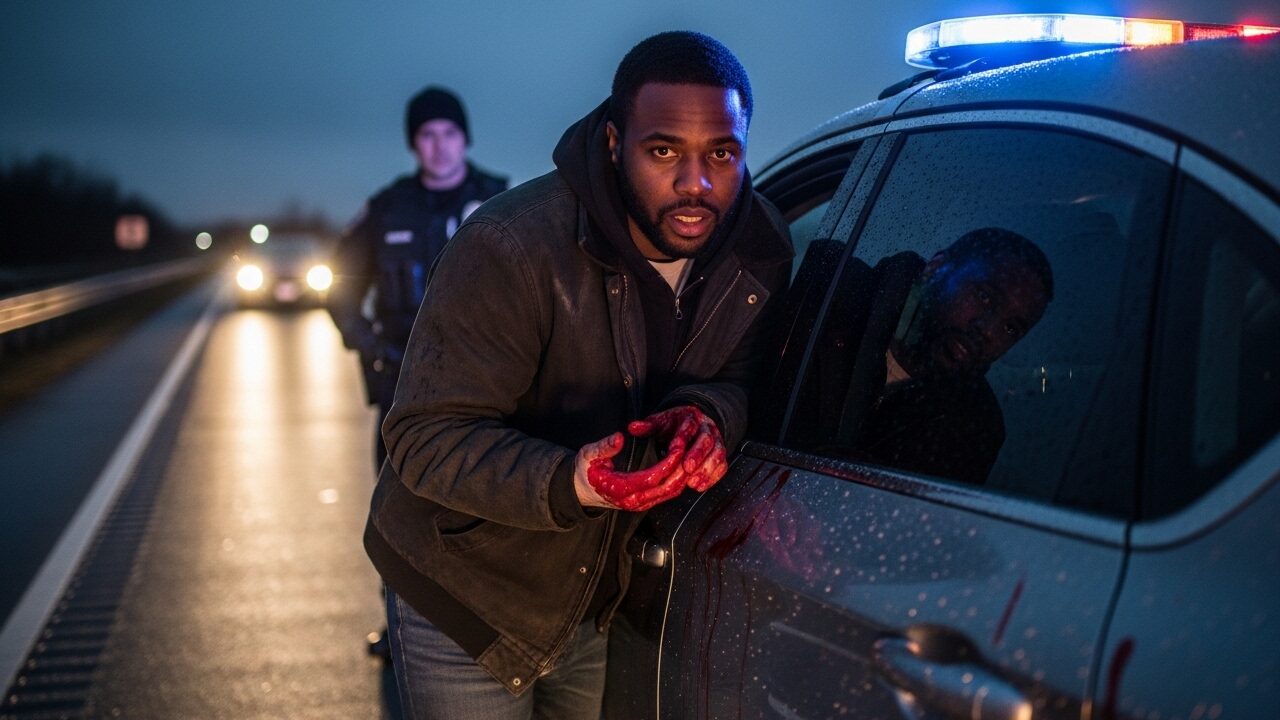
2 White Officers Drew Their Guns On A Black Driver Speeding At 3 AM—But The 1 Discovery In His Front Seat Left Them Speechless

Chapter 1
The flashing red and blue lights didn’t just reflect in Marcus’s rearview mirror; they seemed to ignite the entire cabin of his battered 2012 Chevy Tahoe, casting violent, strobing shadows across the dashboard.
It was 3:14 AM on a desolate stretch of Route 119, the kind of pitch-black, rural Ohio road where cell phone service went to die and the trees seemed to lean in, ready to swallow you whole.
Marcus Hayes gripped the steering wheel so hard his knuckles turned an ashy gray. He was thirty-eight years old, a Black man who had spent the last fifteen years working as a trauma paramedic in downtown Cleveland. He knew how to handle arterial bleeds, collapsed lungs, and the frantic screams of mothers holding their children. He was trained to be the calmest person in the room on the worst day of someone’s life.
But right now, his heart was hammering against his ribs like a trapped bird.
He glanced down at his right hand. It was completely coated in dark, sticky blood. The crimson fluid had seeped into the creases of his palms, staining the cuffs of his faded gray thermal shirt.
He didn’t dare take his hand off the makeshift pressure dressing he was holding against the passenger seat.
“Hold on,” Marcus whispered, his voice trembling as he pressed down harder. “Just hold on. We’re almost there. I promise you, we’re almost there.”
A low, jagged wheeze answered him from the darkness of the passenger side. It was a terrible sound, wet and struggling, the sound of life violently fighting its way out of a body.
The police siren wailed, a sharp, mechanical scream that cut through the drumming of the freezing rain against the windshield.
Marcus looked back at the mirror. The cruiser was riding his bumper, aggressive, the high beams blinding him.
Every instinct, every rule he had been taught since he was a sixteen-year-old boy getting his driver’s permit from his terrified mother, was screaming at him: Pull over immediately. Keep your hands visible. Do not make sudden movements. Survive the encounter.
But if he pulled over on this dark, narrow shoulder, whoever was bleeding out next to him was going to die. The nearest 24-hour emergency veterinary clinic was exactly four point two miles away.
I can make it, Marcus thought, his jaw clenched so tight his teeth ached. I have to make it.
He pressed the accelerator. The Tahoe surged forward, the speedometer needle creeping past seventy-five in a forty-five mile-per-hour zone. The tires hydroplaned slightly on the slick blacktop, causing the heavy SUV to swerve over the double yellow lines.
Behind him, the police cruiser’s siren changed its pitch—switching from a standard wail to the aggressive, staccato yelp. They thought he was running.
Sweat stung Marcus’s eyes. He knew exactly how this looked. A large Black man in an older model vehicle, swerving erratically, speeding away from law enforcement in the dead of night. It was a headline waiting to be written.
“Damn it, damn it, damn it,” Marcus hissed, his eyes darting frantically, searching for the neon glow of a gas station, a diner, anything with floodlights and cameras. He couldn’t stop in the dark. Not out here. Not with the world the way it was.
Finally, a quarter-mile ahead, the flickering, sickly-yellow canopy of an abandoned Shell gas station emerged through the downpour.
Marcus hit the turn signal, slowed down just enough to keep from flipping the heavy vehicle, and swerved into the cracked concrete lot. He slammed the transmission into park, the tires screeching against the wet pavement.
The police cruiser skidded in right behind him, instantly angling its nose to block the Tahoe in.
Before Marcus could even process his next breath, the cruiser’s doors flew open.
“Turn the vehicle off! Turn it off right now and throw the keys out the window!”
The voice booming through the PA system was deep, adrenaline-laced, and uncompromising.
In the driver’s seat of the cruiser, Officer David Harris, a forty-eight-year-old veteran of the force, had his service weapon drawn before his boots even hit the puddles. Harris had been on the job for twenty-two years. He was exhausted, cynical, and his lower back was a constant knot of pain. He had seen every trick, every lie, every desperate attempt to escape. To Harris, erratic driving at 3 AM usually meant one of three things: a drunk, a runner with warrants, or a stolen vehicle.
Beside him, Officer Tommy Rourke, a twenty-six-year-old rookie with barely eighteen months on the street, was visibly shaking. Rourke’s heart was in his throat. He had his gun out, mirroring his senior partner, the cold rain instantly slicking the polymer grip of his Glock.
“Driver! Put your hands out the window where I can see them! Do it now!” Rourke screamed, his voice cracking slightly at the end.
Inside the Tahoe, Marcus froze. The blinding glare of the police spotlight hit his side mirror, reflecting directly into his eyes, turning the world into a wash of white light and blinding rain.
He looked at his right hand, still pressing down on the passenger seat. Blood was pooling in the center console. The wheezing was getting weaker.
If I take my hand off to surrender, the bleeding starts again. If I don’t, they might shoot me.
It was a terrifying, impossible calculus.
“Driver! I am not going to ask you again! Hands out the window!” Harris roared, advancing slowly, using the open door of the cruiser as cover.
Marcus took a ragged breath. He slowly lifted his left hand, empty, and extended it out the crack of the driver’s side window.
“My right hand is occupied!” Marcus shouted back, his voice straining over the roar of the rain and the idling engines. “I have a medical emergency in the car! I am a paramedic! There’s severe trauma, I’m holding pressure!”
Harris sneered, the rain dripping from the brim of his hat. He didn’t buy it for a second. “I don’t care if you’re the Surgeon General! You show me your hands right now or we will escalate this situation!”
“He’s bleeding out!” Marcus screamed, desperation clawing at his throat. He could feel the warmth leaving the body beneath his hands. “If I let go, he dies right here!”
Rourke glanced nervously at Harris. “Dave, what if he’s telling the truth? What if someone’s shot in there?”
“Then we secure the scene first,” Harris snapped, his training overriding any trace of empathy. You don’t walk up to a vehicle with an unseen occupant and a driver refusing commands. That’s how cops get killed.
“Last warning!” Harris yelled, aiming his weapon squarely at the dark outline of Marcus’s head through the rain-streaked glass. “Show me both hands, unbuckle your seatbelt, and step out of the vehicle facing away from us!”
Marcus closed his eyes. The memory of his eight-year-old daughter, Maya, flashed in his mind. Her gap-toothed smile. The way she smelled like vanilla and crayons. If this went wrong, she would grow up with a father who was just another tragic hashtag on the evening news.
God, please, Marcus prayed silently.
Slowly, agonizingly, Marcus lifted his right hand off the makeshift tourniquet.
The moment the pressure was gone, a fresh gush of dark blood spilled over the leather seat.
Marcus raised both hands, palms open. His right hand looked like it had been dipped in crimson paint.
“My hands are up,” Marcus said loudly, pushing the door open with his elbow.
He stepped out into the freezing rain. The cold hit him like a physical blow, but he didn’t shiver. He kept his hands raised high above his head, turning his back to the blinding spotlight.
“Walk backward toward my voice!” Harris commanded.
Marcus took one step. Then another. The rain was washing the blood off his hands, sending pink streaks down his wrists and forearms.
“Stop! Get on your knees! Cross your ankles!”
Marcus dropped to the wet concrete. The impact sent a jolt of pain up his shins, but he didn’t make a sound. He crossed his ankles.
In seconds, Rourke was on him, shoving Marcus’s face forward into the cold pavement, violently wrenching his arms behind his back. The metal handcuffs clicked shut, biting sharply into Marcus’s wrists.
“I’m unarmed,” Marcus gasped against the concrete, tasting motor oil and rain water. “My wallet is in my left pocket. My paramedic badge is on my jacket. Please, you have to help him. In the passenger seat. He’s dying.”
Harris ignored him. He kept his gun leveled as he cautiously approached the Tahoe.
“Keep him pinned, Rourke,” Harris muttered, his eyes locked on the dark, tinted windows of the SUV.
Harris moved in a low crouch, his flashlight in his left hand, weapon in his right. He was expecting the worst. A domestic dispute gone wrong. A drug deal violently south. A gang hit.
He reached the driver’s side door, which was still hanging open. The smell hit him first—the sharp, unmistakable, coppery stench of massive blood loss.
Harris shined his heavy Maglite into the cabin.
The driver’s seat was soaked. The center console looked like a slaughterhouse floor.
Harris moved his beam to the passenger seat.
He had his finger resting just outside the trigger guard, ready for a suspect to lunge at him. He braced himself for the sight of a gunshot victim, a human body slumped and broken.
But as the bright LED beam cut through the darkness of the Tahoe’s interior, Harris didn’t see a human being.
There, slumped on the floorboards, desperately trying to breathe, was a massive, ninety-pound Belgian Malinois.
But it wasn’t just any dog.
It was wearing a heavy, tactical Kevlar vest. The word “POLICE” was emblazoned across the side in reflective gold lettering, now heavily obscured by mud and blood.
Wrapped tightly around the dog’s shattered hind leg was Marcus’s navy blue, blood-soaked paramedic jacket, twisted fiercely into a makeshift tourniquet.
The dog lifted its heavy head weakly, its amber eyes meeting the blinding beam of the flashlight. It let out a soft, agonizing whimper, its tongue lolling out, pale and grey from blood loss.
Officer Harris felt his breath completely leave his lungs. His blood ran instantly cold.
He recognized that vest. He recognized that scar above the dog’s left eye.
It was Titan.
Titan was the K9 unit for the neighboring county sheriff’s department. Three hours ago, a frantic radio call had gone out across all frequencies: A narcotics raid had gone horribly wrong. A suspect had opened fire with a shotgun and fled into the woods. Titan had been deployed to track him, but the suspect had ambushed the dog.
The last update on the radio was that Titan was missing in the dense, freezing swamplands, presumed dead, bleeding out alone in the dark. Every officer in a fifty-mile radius had been sick to their stomach over it.
And now, here Titan was. Not in a ditch. But in the front seat of a Black stranger’s car, alive because that stranger had ripped off his own jacket to stop the bleeding, and was risking arrest—or worse—to speed the dying animal to a hospital.
Harris slowly lowered his gun. His hands, steady for twenty-two years, suddenly began to shake uncontrollably.
He stared at the blood-soaked interior, then turned slowly to look back at the concrete lot.
Marcus was still pinned to the freezing ground, the rain beating down on his back, his hands shackled tightly behind him by the rookie officer.
“Rourke,” Harris whispered, his voice cracking, entirely devoid of its earlier aggression.
“Clear, Dave?” Rourke yelled back over the rain, still pressing his knee into Marcus’s spine. “We got a body?”
Harris swallowed hard, feeling a sickening wave of guilt wash over him as he looked at the Black man handcuffed in the dirt.
“Get off him,” Harris said, his voice breaking. He holstered his weapon, dropped his flashlight, and started running frantically back toward them. “Get off him right now and take those cuffs off!”
Chapter 2
The freezing Ohio rain felt like a thousand tiny needles driving into the back of Marcus’s neck. He lay completely still on the unforgiving, oil-slicked concrete, the weight of a twenty-six-year-old rookie pressing the air from his lungs. The steel of the handcuffs bit mercilessly into his wrists, pinning his arms in an agonizing, unnatural angle. He tasted grit, stale water, and the metallic tang of his own fear.
Every muscle in his thirty-eight-year-old body was coiled tight, bracing for the worst. In his fifteen years as a Cleveland paramedic, Marcus had navigated active shooter scenes, gang crossfire, and the unpredictable chaos of fentanyl overdoses. But nothing—absolutely nothing—compared to the primal, suffocating terror of being a Black man face-down in the dirt with law enforcement shouting conflicting commands at his back in the dead of night.
Then, the aggressive, adrenaline-fueled shouting abruptly stopped.
Instead of the sharp, authoritative bark of a seasoned cop, the voice that cut through the drumming rain was entirely different. It was fractured. Panicked. It was the sound of a man whose reality had just violently shattered.
“Get off him,” Officer David Harris choked out, his voice cracking, entirely devoid of its earlier aggression. “Get off him right now and take those cuffs off!”
Rookie Officer Tommy Rourke froze, his knee still planted firmly between Marcus’s shoulder blades. The rain ran down Rourke’s pale, youthful face, stinging his eyes. He blinked, completely bewildered. He looked up from the suspect on the ground to his senior partner, who was practically sprinting back toward them from the open door of the Tahoe.
“Dave, what the hell are you talking about?” Rourke yelled over the idling engines and the downpour. His hand was still resting instinctively on the grip of his holstered Taser. “He ran from us! We haven’t searched his pockets, we haven’t cleared the rear of the vehicle—”
“I said get off him, Tommy!” Harris roared, the desperation in his voice echoing off the concrete pillars of the abandoned Shell station.
Harris didn’t wait for his rookie to process the command. He grabbed Rourke by the heavy nylon shoulder strap of his tactical vest and hauled him backward with a brute strength born of sheer panic. Rourke stumbled, his boots sliding on the wet pavement, almost falling over his own feet.
Before Rourke could protest, Harris had dropped to his knees beside Marcus in the puddles. His hands, which had been holding a Glock 19 perfectly steady just ninety seconds ago, were trembling violently as he reached for the handcuff keys on his belt.
“I’m sorry, I’m so sorry,” Harris stammered, his breath coming in ragged, rapid gasps. The rain was washing the blood off Marcus’s wrists, swirling pink down the drain. “Give me your hands, let me get these off you.”
Marcus didn’t speak. He couldn’t. The sudden shift in power, the abrupt transition from lethal threat to frantic apology, was too jarring. He felt the cold steel jaws of the handcuffs click and release. The agonizing pressure on his shoulders vanished.
He pulled his arms forward, groaning as the blood rushed painfully back into his numb fingers. He rolled onto his side, coughing, spitting out a mouthful of dirty rainwater. He looked up at Harris. The older cop’s face was completely drained of color, his jaw slacked, his eyes wide with a horrified realization.
“It’s Titan,” Harris whispered, his voice trembling so badly he could barely form the words. He looked at Marcus, his eyes begging for confirmation, for some shred of hope. “In your car. That’s Titan. The missing K9.”
Marcus didn’t waste a single millisecond validating the cop’s shock. The moment his hands were free, his paramedic instincts, dormant for the last three minutes of sheer terror, violently reawakened.
He scrambled to his feet, ignoring the throbbing pain in his kneecaps and the bruising on his wrists. The cold, the fear, the indignity of the dirt—all of it vanished, replaced by the clinical, hyper-focused tunnel vision that had saved countless lives on the streets of Cleveland.
“He’s bleeding out from a gunshot wound to the upper left quadrant of his right hind leg!” Marcus yelled, already sprinting back toward the open door of his Tahoe. “The bullet shattered the femur and nicked the femoral artery! My jacket is acting as a pressure dressing but it’s soaking through. I need your trauma bag! Now!”
Harris was still kneeling in the mud, paralyzed by the overwhelming collision of his own prejudices and the staggering reality of what he had almost done. He had almost put a bullet through the windshield of a man who was desperately trying to save the life of a fellow officer.
“Harris! Move your ass!” Marcus roared, his voice booming with the raw, uncompromising authority of a first responder fighting the grim reaper. “Get your med kit!”
The command snapped Harris out of his spiral. He scrambled to his feet, slipping slightly on the wet concrete. “Rourke! Pop the trunk! Grab the heavy trauma bag! Move!”
Marcus dove back into the Tahoe. The smell of copper was overpowering. The interior of his beloved SUV looked like an abattoir. He reached out and placed his hand against the dog’s ribs.
Titan was a magnificent animal—a ninety-pound Belgian Malinois with a coat the color of burnt caramel and a face that was usually a mask of terrifying intelligence. Now, that face was slack. His breathing was incredibly shallow, a rapid, weak panting that Marcus recognized instantly as the end stages of hypovolemic shock. His gums were porcelain white.
“Hey, buddy,” Marcus murmured softly, his voice shifting instantly from the authoritative bark he used on the cops to a gentle, soothing baritone. He stroked the dog’s wet, muddy ears. “I’m right here. I didn’t leave you. I’m right here.”
Titan let out a faint, gurgling whine. He tried to lift his heavy head to look at Marcus, but the effort was too much. His head thumped softly back onto the blood-soaked floorboard.
Marcus grabbed the sleeve of his own heavy winter jacket, which he had twisted viciously around the dog’s upper thigh. The fabric was completely saturated, heavy and warm with arterial blood. He checked the makeshift tourniquet. It was slipping. The dog’s blood pressure was dropping dangerously low, meaning his heart was pumping faster to compensate, pushing more blood out of the catastrophic wound.
“I need proper gauze and a real tourniquet!” Marcus yelled over his shoulder.
A shadow fell over the doorway. Rourke was there, completely breathless, his eyes wide as he finally saw what was in the passenger seat. The rookie looked like he was going to be sick. He was staring at the blood, then up at Marcus’s face, struggling to reconcile the “fleeing suspect” with the man currently buried up to his elbows in blood, fighting for the dog’s life.
“Here,” Rourke stammered, shoving a heavy red nylon trauma bag into the cabin.
Marcus unzipped the bag with one hand, his teeth tearing into the plastic packaging of a combat application tourniquet (CAT). “Shine your flashlight right here,” he commanded Rourke, pointing to the dog’s leg.
Rourke fumbled with his light, his hands shaking, casting a erratic beam over the wound.
“Hold it steady, damn it!” Marcus barked.
Harris appeared behind Rourke, shoving the younger officer aside to hold the heavy Maglite himself. The beam stabilized, illuminating the grisly reality of the injury. The shotgun slug had torn a ragged, cavernous hole through the muscle and bone.
“Okay, Titan, this is going to hurt like hell, buddy. I’m so sorry,” Marcus whispered.
With practiced, ruthless efficiency, Marcus slid the CAT tourniquet high up on the dog’s leg, positioning it just below the groin. He pulled the nylon strap as tight as he physically could, then began twisting the windlass rod.
Titan let out a sharp, agonizing yelp, a sound so full of pain it made Harris flinch violently, turning his face away. The dog tried to thrash, his natural instinct to bite whatever was hurting him kicking in.
“Hold his head!” Marcus ordered. “Gently! Just keep him from biting!”
Harris reached in, his large, rough hands gently but firmly cradling the K9’s heavy snout. “I got you, buddy,” Harris whispered, tears mingling with the rain on his face. “I got you, Titan. You’re a good boy.”
Marcus gave the rod one final, vicious twist, locking it into the plastic catch. He watched the wound intently for ten agonizing seconds. The pulsing flow of dark, oxygen-depleted blood finally slowed to a sluggish trickle, then stopped.
“Okay. Bleeding is controlled,” Marcus said, his chest heaving. He wiped his bloody forehead with the back of his arm, leaving a red smear across his brow. “But he’s lost at least thirty percent of his blood volume. He’s going into irreversible shock. If he doesn’t get intravenous fluids and a surgeon in the next fifteen minutes, his organs are going to shut down.”
“The nearest 24-hour emergency vet is the Northside Animal Clinic,” Harris said, his voice tight. “It’s about four miles up 119.”
“I know,” Marcus said, his eyes hard. “That’s where I was trying to go when you decided to pull me over and play cowboy.”
The words hung in the cold, wet air between them. A heavy, suffocating silence descended, broken only by the rain and the idling engines. Harris looked at Marcus, really looked at him for the first time. He saw a man exhausted, traumatized, shivering in the freezing rain in a thin thermal shirt because he had used his coat to save a dying animal. He saw the dark bruises already forming on Marcus’s wrists from the handcuffs.
A wave of profound, nauseating shame washed over the veteran cop. All those years on the force, all that training, and he had looked at a terrified man speeding to save a life and only seen a stereotype. He had seen a threat. He had almost pulled the trigger.
“I…” Harris started, his voice completely failing him. “I thought you were…”
“I know exactly what you thought I was,” Marcus cut him off, his voice dangerously quiet, vibrating with a tightly coiled anger. He looked Harris dead in the eyes. “And if my hands weren’t covered in this dog’s blood right now, I’d have a lot more to say about it. But we don’t have the luxury of unpacking your implicit biases right now. This dog has maybe ten minutes of life left in his body.”
Marcus turned his back on the officers and slid into the driver’s seat. The leather was slick with blood. He gripped the steering wheel, his hands trembling slightly, the adrenaline crash beginning to claw at his system.
“Get in your cruiser,” Marcus ordered, staring straight out the windshield into the rain. “Get in front of me. Turn your lights and sirens on. Clear every intersection between here and Northside. If I have to touch my brakes once, he dies.”
Harris didn’t hesitate. He didn’t argue jurisdiction or protocol. He nodded sharply. “Yes, sir.”
He grabbed Rourke by the arm. “Let’s go. Move!”
The two officers sprinted back to their cruiser. The doors slammed. Instantly, the police vehicle roared to life, the tires spinning on the wet concrete before catching traction. The siren wailed into the night, louder and more urgent than before, but this time, it wasn’t a sound of pursuit. It was a sound of salvation.
Marcus slammed the Tahoe into drive and floored the accelerator, chasing the flashing red and blue lights back out onto the desolate highway.
Inside the cabin, the heater was blasting, but Marcus couldn’t stop shivering. The adrenaline was evaporating, leaving behind a cold, hollow exhaustion. He glanced down at his right hand, resting gently on Titan’s shoulder to keep the dog steady as the SUV tore down the road at eighty miles an hour.
“You hang in there, Titan,” Marcus whispered, his voice cracking.
His mind flashed back to how this nightmare had started just forty-five minutes ago. He had just finished a brutal fourteen-hour shift at the trauma center in Cleveland. It had been a bloodbath of a Friday night—two car wrecks, a stabbing, and a domestic violence call that ended in tragedy. Marcus was hollowed out, emotionally and physically drained. All he wanted was to drive back to his quiet home in the suburbs, take a boiling hot shower, and crawl into bed before his eight-year-old daughter, Maya, woke up for Saturday morning cartoons.
He had taken Route 119 to avoid the highway construction, a quiet, winding road that cut through the deep woods of the county. The rain had been coming down in sheets.
He almost didn’t see it. It was just a flash of reflective gold fabric catching his headlights in a muddy ditch near the edge of the swamp. Most people would have thought it was a discarded road sign or a piece of trash. But Marcus, trained to spot the unnatural in his environment, had hit the brakes.
He had grabbed his flashlight and walked back through the freezing rain, sinking up to his ankles in the freezing mud.
He found the dog lying on its side, half-submerged in a puddle of muddy, freezing water. The animal was shivering violently, its eyes glazed over. Marcus recognized the tactical vest immediately. He had worked with K9 units before. He knew what these dogs did. They were sent into the dark, terrifying places that human beings were too afraid to go. They took the bullets meant for the officers.
Marcus had knelt in the mud. He saw the catastrophic wound on the dog’s leg, the dark blood pumping into the water. He didn’t have his trauma bag—that was locked up at the station. He had nothing but his own two hands and his heavy winter coat.
He hadn’t hesitated. He had ripped his jacket off, wrapped it viciously around the dog’s leg to compress the artery, and picked the ninety-pound animal up in his arms. He had carried Titan up the slick, muddy embankment, slipped, fallen, scraped his knees to the bone, and gotten back up. He had shoved the dog into the floorboards of his truck and hit the gas.
And then, the police lights had flashed in his rearview mirror.
A sharp gasp from the passenger side snapped Marcus back to the present.
Titan’s body convulsed slightly. His breathing was becoming incredibly shallow—the “guppy breathing” that preceded total cardiac arrest.
“No, no, no, don’t do that,” Marcus pleaded, pressing his foot harder onto the gas pedal. The speedometer climbed to eighty-five. Ninety. The heavy SUV rattled, fighting the wind and rain. “Stay with me, buddy. Come on.”
Up ahead, Harris was driving the police cruiser like a man possessed. He wasn’t just clearing intersections; he was dominating the road. They approached a red light at the intersection of County Road 9. Harris didn’t even tap his brakes. He swerved into the oncoming lane, blocking the entire intersection with his cruiser, his lights blinding the single semi-truck that was approaching.
He waited until Marcus’s Tahoe blew through the red light at eighty miles an hour, then slammed the gas to catch up and take the lead again.
Inside the cruiser, the silence between the two officers was deafening. Rourke was gripping the door handle, his knuckles white, his eyes fixed on the taillights of the Tahoe in their rearview mirror.
“Dave,” Rourke finally whispered, his voice trembling. “What did we just do?”
Harris gripped the steering wheel so hard his hands ached. He didn’t look at his rookie. He couldn’t.
“We made a mistake, Tommy,” Harris said, his voice low, thick with a profound, bitter regret. “A terrible, catastrophic mistake.”
“We pulled guns on him,” Rourke said, his voice rising in panic. “Dave, I had my knee in his back. I cuffed him. He was covered in blood. If he had flinched… if he had reached into his pocket instead of putting his hands up…”
Rourke didn’t finish the sentence. He didn’t have to. The reality of it hung in the air, a dark, suffocating ghost sitting in the back seat of the cruiser.
If Marcus had panicked. If he had yelled back differently. If he hadn’t possessed the supernatural calm of a trauma medic. They would have shot him. They would have killed an unarmed Black man who was desperately trying to save the life of a hero dog. It would have been a national tragedy. A riot waiting to happen. An unforgivable sin.
Harris closed his eyes for a split second, a single, hot tear escaping and tracking down his weathered cheek. He thought about his own biases. The split-second assumptions he had made the moment he ran the plates and saw the driver’s profile in the spotlight. He had been a cop for twenty-two years. He liked to think he was one of the good ones. He liked to think he treated everyone the same.
But tonight, the darkness had stripped away his illusions. He had seen a large Black man speeding in a battered car at 3 AM, and he had instantly calculated a threat level that justified lethal force. He hadn’t given the man the benefit of the doubt. He hadn’t listened.
I almost killed a hero, Harris thought, the realization making him physically nauseous. I almost ruined three lives tonight.
“Up ahead,” Harris said abruptly, clearing his throat, desperate to focus on the mission. “Northside Clinic. Next left.”
Harris hit the siren’s airhorn, a deafening blast that shattered the quiet of the suburban commercial district. He swerved violently into the parking lot of the brightly lit, low-slung brick building. He slammed the cruiser into park right on the front lawn, not even bothering to find a spot.
Marcus’s Tahoe skidded into the covered patient drop-off area an instant later, the brakes smoking in the cold rain.
Before the SUV had even completely stopped, Marcus was out of the driver’s seat. He ignored his aching back and his bruised wrists. He threw open the passenger door.
Titan was completely unresponsive. His eyes were open but unseeing, a dull, milky glaze covering the amber irises.
“Help me!” Marcus screamed over his shoulder.
Harris and Rourke were there in a second. They didn’t care about the blood soaking into their crisp, blue uniforms. Harris grabbed the dog’s heavy torso, while Marcus supported the shattered, tourniqueted hind leg. Together, they hoisted the massive, dead weight of the animal out of the vehicle.
The glass automatic doors of the clinic slid open. The bright, sterile fluorescent lights of the waiting room were blinding after the pitch-black highway.
Behind the reception desk, a young veterinary technician with pink streaks in her hair looked up, her eyes widening in sheer horror as three soaked, blood-covered men rushed through the doors carrying a bleeding police dog.
“We need a surgeon right now!” Marcus roared, his voice echoing off the tile walls. “GSW to the right hind leg! Severed femoral! Massive hemorrhage! He’s in Class 4 hypovolemic shock!”
The clinic erupted into chaotic, synchronized action. A door in the back swung open, and Dr. Emily Carter, a forty-two-year-old veterinary surgeon looking exhausted in green scrubs, took one look at the situation and pointed to the back.
“Trauma Room One! Bring him back here now!” she shouted, her voice cutting through the panic with sharp authority. “Prep an IV line, get the O-negative blood bags ready, and page Dr. Evans!”
Marcus and Harris carried the dog down the hallway, their boots slipping on the linoleum, leaving a trail of bloody water behind them. They burst into the trauma room and gently laid Titan onto the cold stainless steel of the surgical table.
“Back away,” Dr. Carter ordered immediately, moving in with a pair of trauma shears. “Everyone who isn’t scrubbed, out of the room.”
Marcus didn’t argue. He knew the drill. He took a slow step backward, his hands instinctively rising in the air, a phantom reaction from the arrest. He watched as a team of three technicians swarmed the dog. They slapped an oxygen mask over Titan’s snout, shaved the uninjured leg, and slammed a large-bore IV needle into his vein, hooking up a bag of clear saline and another of dark red blood.
Dr. Carter looked at the tourniquet high on the dog’s leg. She glanced up at Marcus. “Who placed this?”
“I did,” Marcus said, his voice barely a whisper. “I’m a human paramedic. The pressure dressing failed. I used a CAT tourniquet. It’s been on for approximately twelve minutes.”
Dr. Carter looked closely at the application. It was flawless. Brutal, but perfectly placed to save the dog’s life. She looked at Marcus, her eyes softening for a fraction of a second. “You saved his life in the field. But he’s crashing. We have to take him into surgery right now. Get out.”
Marcus nodded slowly. He backed out of the trauma room. The heavy wooden doors swung shut behind him, cutting off the frantic beeping of the heart monitor and the shouted medical commands.
Suddenly, the adrenaline that had been keeping Marcus upright completely vanished. It was like a string had been cut. His legs turned to water.
He stumbled backward, hitting the wall of the hallway. He slid down the cold, painted drywall until he hit the floor, pulling his knees up to his chest. He sat there, a thirty-eight-year-old man who dealt with death every single day, burying his face in his hands.
His hands. They were covered in dried blood, stained an awful, rusty brown. His wrists were purpling, raw and swollen where the handcuffs had dug into the skin. His thin thermal shirt was soaked through, clinging to his shivering body.
He closed his eyes, and the image of the police spotlight blinding him flashed behind his eyelids. The memory of the cold concrete against his cheek. The absolute, soul-crushing certainty that he wasn’t going to make it home to his daughter.
He began to shake. Not from the cold. From the delayed, crushing weight of the trauma.
Down the hallway, Officer Harris was standing by the reception desk. He had taken off his soaked uniform hat. He looked ten years older than he had an hour ago. He was watching Marcus sitting on the floor.
Rourke was beside him, staring at his boots. “Dave,” the rookie whispered. “What do we do?”
Harris took a slow, deep breath. He didn’t have a manual for this. There was no protocol for almost executing a good Samaritan.
“We stay,” Harris said, his voice thick with emotion. “We stay until that dog is stable. And then…” Harris swallowed hard, looking at the bruised, blood-stained Black man shivering on the floor. “And then, I have to go try to look that man in the eye.”
Chapter 3
The linoleum floor of the Northside Animal Clinic was shockingly cold, a biting, clinical chill that seeped straight through the thin, damp cotton of Marcus’s thermal shirt and into his aching bones. He sat with his knees pulled tightly to his chest, his back pressed against the stark white drywall of the corridor, staring blankly at the opposite wall.
Every muscle in his body was currently staging a violent rebellion. The adrenaline that had fueled his frantic, life-saving sprint through the rain had completely evaporated, leaving behind a toxic sludge of cortisol, exhaustion, and delayed terror. He was shivering so violently that his teeth chattered, a rhythmic, involuntary clicking that sounded deafening in the heavy silence of the hallway.
He slowly unclasped his arms from his legs and held his hands out in front of him, palms up.
Under the harsh, unyielding glare of the fluorescent lights, the reality of the last hour was painted across his skin in horrifying detail. His hands were coated in Titan’s blood. It had begun to dry, flaking around his cuticles and settling deep into the lifelines of his palms, turning from a vibrant, arterial red to a sick, rust-colored brown. It looked like he was wearing a pair of grotesque, textured gloves.
But it wasn’t just the blood that held his gaze. It was his wrists.
The heavy steel handcuffs had done their damage in the short time he had been pinned to the wet concrete of the abandoned gas station. Dark, angry rings of purple and blue were already blooming beneath his skin, the flesh swollen and raw where the metal had bitten into him when Officer Rourke had wrenched his arms backward.
Marcus let his head fall back against the wall with a dull thud, closing his eyes.
When he closed his eyes, he didn’t see the clinic. He didn’t see the blood.
He saw the blinding, white-hot center of the police spotlight hitting his rearview mirror. He felt the terrifying, agonizingly slow second between lifting his hand off the dying dog’s leg and extending it out the window, knowing that a single twitch, a single misinterpretation by the men holding guns in the dark, would mean the end of his life.
He thought of Maya.
His daughter was eight years old. She was asleep right now in her bedroom in their quiet, suburban duplex, completely unaware of how close she had come to waking up an orphan. She had a soccer game tomorrow at 10:00 AM. Marcus was supposed to bring the orange slices. He had promised her he wouldn’t miss it, even after his grueling fourteen-hour shift at the trauma center.
If I had died tonight, Marcus thought, a hot, sudden tear slipping out of the corner of his eye and cutting a clean trail through the grime on his cheek, what would the narrative have been?
He knew the answer. He had seen it play out on the news a hundred times before. The police union would release a statement about a “suspicious vehicle” fleeing at high speeds at 3:00 AM. They would talk about the darkness, the rain, the “furtive movements” inside the cabin. They would paint a picture of a dangerous man in a desperate situation. They wouldn’t mention the dying hero dog in the passenger seat until the damage to Marcus’s reputation—to his humanity—was already done. Maya would grow up watching videos of her father’s last moments, scrutinized and debated by strangers on the internet.
The sheer weight of that realization, the profound, systemic unfairness of it, pressed down on Marcus’s chest until he felt like he couldn’t breathe. He was a paramedic. He had spent his entire adult life running toward the sound of sirens, putting his hands inside the shattered bodies of strangers to keep their hearts beating. He paid his taxes. He mowed his lawn. He loved his daughter.
And none of it had mattered out there in the dark. In that moment, he was just a profile. A threat to be neutralized.
Down the hall, the heavy, swinging wooden doors of Trauma Room One remained tightly shut. The faint, rhythmic beeping of the surgical monitors drifted into the corridor—a mechanical heartbeat that was the only proof Titan was still alive.
At the far end of the hallway, near the reception desk, Officer David Harris stood absolutely still.
He had taken off his soaked tactical vest, laying it over a plastic waiting room chair. His dark blue uniform shirt was plastered to his broad shoulders, heavy with rain and stained with a massive smear of the K9’s blood across his abdomen. He held a styrofoam cup of terrible, burnt clinic coffee in his hands, but he wasn’t drinking it. The coffee was rapidly growing cold.
Harris was staring at Marcus.
Beside him, Rookie Officer Tommy Rourke was pacing. The younger cop looked like a ghost. His youthful face was completely drained of color, his eyes wide and unfocused. He kept running a hand through his wet hair, muttering to himself, trapped in a loop of his own near-fatal mistake.
“Dave,” Rourke whispered, his voice trembling so badly he had to stop and clear his throat. “Dave, I had my safety off. When he didn’t immediately show his hands… I had my finger indexed on the trigger guard, but my safety was off. I was a pound of pressure away, Dave. A pound of pressure.”
Harris didn’t turn to look at his partner. He couldn’t take his eyes off the exhausted, battered man sitting on the floor down the hall.
“Stop pacing, Tommy,” Harris said. His voice was a low, gravelly rasp, sounding like a man who had swallowed glass. “You’re making the receptionist nervous.”
The young vet tech behind the desk, still pale and visibly shaken from the chaotic influx of blood and police officers, was indeed staring at them with wide, fearful eyes.
“How are you so calm?” Rourke demanded, his voice cracking, bordering on hysteria. “We almost killed an unarmed civilian! A medic! We almost executed a guy who was trying to save Titan! When the Captain hears about this… when internal affairs reviews the dashcam footage…”
“I’m not calm, Tommy,” Harris said quietly, finally turning his head to look at the rookie.
Rourke stopped pacing. He looked into his senior partner’s eyes and stepped back.
Harris’s eyes were bloodshot, rimmed with a deep, profound sorrow that Rourke had never seen in the hardened veteran before. There was a storm raging behind those eyes—a violent collision of guilt, shame, and a terrifying loss of identity.
“I’ve been on the job twenty-two years,” Harris said, his voice dropping to a harsh whisper that only Rourke could hear. “Twenty-two years, Tommy. I’ve broken up bar fights, I’ve pulled kids out of burning cars, I’ve taken bullets, and I’ve given CPR to people who had already been dead for ten minutes. I always told myself… I always believed in my absolute core… that I was one of the good ones.”
Harris looked down at the dark, cooling blood staining his own hands.
“But when I saw his car speeding,” Harris continued, his voice trembling slightly. “When the spotlight hit his face… my brain didn’t see a citizen in distress. It didn’t see a man who needed help. My brain saw an outline. It saw a Black man running, and it instantly calculated a lethal threat. I didn’t give him a chance to explain. I just wanted compliance. Complete, unquestioning compliance. And if I didn’t get it, I was ready to kill him.”
Harris looked back down the hall at Marcus, watching the man shiver against the wall.
“He’s right, Tommy. The man sitting on that floor is absolutely right. If he had panicked, if he had yelled, if he had made one sudden move to try and show us the dog… I would have shot him. I would have killed a hero. And I would have justified it in my report by saying I feared for my life.”
The silence that followed was suffocating. Rourke stared at his boots, sick to his stomach, the reality of the badge he wore suddenly feeling incredibly heavy.
“So, no, Tommy,” Harris whispered. “I’m not calm. My entire worldview just collapsed on that highway. I am terrified.”
Before Rourke could respond, the heavy glass double doors of the clinic entrance violently flew open.
The sudden noise shattered the quiet of the waiting room. A man burst through the doors, bringing a gust of freezing rain and wind with him.
It was Sergeant Elias Miller, the K9 handler for the neighboring county. He was a tall, heavily built white man in his late thirties. He wasn’t in uniform; he was wearing sweatpants, a rain-soaked t-shirt, and tactical boots that he hadn’t even bothered to lace up.
Miller looked like a man who had just had his heart ripped out of his chest. His face was pale and frantic, his eyes darting wildly around the room. He was covered in mud from the swamplands where he had been desperately searching for his missing partner for the last four hours.
“Where is he?” Miller roared, his voice cracking with pure desperation. “Dispatch said he was brought here! Where is my dog? Where is Titan?”
Harris stepped forward immediately, holding his hands up in a calming gesture. “Elias. Elias, calm down. It’s Dave Harris.”
Miller locked onto Harris, his eyes zeroing in on the massive smear of blood across Harris’s uniform shirt. Miller’s knees visibly buckled for a fraction of a second. He let out a ragged, choking sound.
“Dave… Dave, is he… is he gone?” Miller stammered, tears instantly mixing with the rain on his face. “They ambushed us, Dave. I lost him in the brush. I heard the shotgun blast and he just… he vanished. Is he dead?”
“He’s not dead, Elias,” Harris said quickly, grabbing the handler by the shoulders to steady him. “He is alive. He’s in surgery right now. Dr. Carter has him. He’s alive.”
Miller let out a sound that was half-sob, half-gasp, his hands flying up to cover his mouth. He staggered backward, hitting the edge of the reception desk, his chest heaving as he tried to pull air into his lungs.
“How?” Miller choked out, looking around the sterile waiting room. “How did he get here? The radio said he was bleeding out in the swamp. Who found him?”
Harris slowly turned his head, looking down the long, bright hallway.
Miller followed his gaze. He saw the Black man sitting on the floor, shivering against the wall, his clothes soaked, his hands covered in dried blood.
“He did,” Harris said softly. “His name is Marcus. He’s a trauma medic down in Cleveland. He was driving home from a shift. He found Titan in the ditch. He ripped his own coat off, tied a tourniquet, and drove him here.”
Miller didn’t hesitate. He pushed past Harris and Rourke, his heavy, unlaced boots thudding loudly against the linoleum as he walked down the corridor.
Marcus heard the footsteps. He slowly lifted his head, his eyes exhausted and wary. He saw the muddy, tear-streaked man approaching him and recognized the undeniable, frantic energy of a K9 handler who had lost his partner.
Miller stopped a few feet away from Marcus. He looked down at the man on the floor. He looked at the blood on Marcus’s hands. He looked at the bruising on his wrists.
Slowly, awkwardly, Miller dropped to his knees right there on the hard floor, bringing himself down to Marcus’s eye level.
“You found him,” Miller whispered, his voice shaking uncontrollably. “You found my boy.”
Marcus nodded slowly, his throat tight. “He was in the water. He was fighting hard, man. He’s a strong dog.”
“They told me he was gone,” Miller cried, the tears flowing freely now, unashamed and raw. “They told me the blood trail stopped and he was gone. He’s not just a dog to me. He’s… he’s my partner. He’s my family. He sleeps at the foot of my bed.”
Miller reached out, his trembling, muddy hand hovering for a second before he gently grasped Marcus’s blood-stained hand. He didn’t care about the mess. He gripped Marcus’s hand tightly, bowing his head.
“Thank you,” Miller sobbed, his broad shoulders shaking. “Thank you. Thank you for not leaving him in the dark. Thank you for saving his life.”
Marcus felt a lump rise in his throat, hot and sharp. He squeezed the handler’s hand back. “He’s a good boy. He did his job tonight. I just did mine.”
Miller stayed on his knees for another minute, weeping quietly, overwhelmed by the sheer, miraculous luck that this stranger had been on that desolate road at exactly the right time. Finally, the handler wiped his face with the back of his muddy arm, stood up, and took a seat in the plastic chair directly across from the surgical doors, folding his hands together in a silent prayer.
Marcus watched him for a moment, then let his head rest back against the wall. The interaction had drained whatever tiny reserve of energy he had left.
Then, he heard the slow, heavy squeak of rubber police boots approaching.
Marcus didn’t open his eyes. He knew exactly who it was.
Officer David Harris stopped a few feet away. For a long time, the veteran cop just stood there. He was looking at Marcus’s wrists. The purple bruising was impossible to ignore under the bright lights.
“Marcus,” Harris said quietly.
Marcus opened his eyes. He didn’t look up at Harris’s face. He just stared straight ahead at the opposite wall. “Are you here to ask for my license and registration again, Officer? Because my wallet is still in my left pocket.”
The words were spoken softly, but they carried a sharp, bitter edge that cut right through the tension in the hallway.
Harris flinched as if he had been slapped. He slowly lowered himself down, groaning slightly as his bad back protested, until he was sitting on the cold floor about three feet away from Marcus.
They sat there in silence for a moment. Two men in their late thirties and forties, both covered in the same blood, sitting on a clinic floor at four in the morning.
“I’m not here to ask for your license,” Harris said, his voice heavy with a profound, exhausting sadness. “I’m here to look you in the eye.”
Marcus finally turned his head. His dark eyes met the cop’s blue ones. Marcus’s gaze was guarded, defensive, and deeply, fundamentally tired.
“You almost killed me tonight, man,” Marcus said. His voice didn’t shake. It was a statement of absolute, terrifying fact. “You know that, right? You almost made my little girl an orphan over a speeding ticket.”
“I know,” Harris whispered, his voice breaking. He didn’t look away. He forced himself to hold Marcus’s gaze, forced himself to accept the full, crushing weight of the man’s anger. “I know I did.”
“Why didn’t you listen?” Marcus asked, leaning forward slightly, the frustration and trauma finally bubbling to the surface. “My hands were out the window. I told you I was a medic. I told you there was a medical emergency. Why was your first instinct to scream at me and draw your weapon? Why didn’t you take three seconds to assess the situation?”
Harris swallowed hard. He looked down at his hands, then back up. He wasn’t going to lie. He wasn’t going to hide behind police jargon or standard operating procedures. The situation demanded an honesty that most cops spent their entire careers avoiding.
“Because I didn’t see a medic,” Harris said, his voice stripped bare of any defense. “I saw a Black man in an old Tahoe speeding away from me at three in the morning. And in my head, a switch flipped. A switch built on twenty-two years of statistics, of bad neighborhoods, of paranoia… and of my own prejudice.”
Marcus stared at him, slightly taken aback by the raw, unvarnished admission. He had expected excuses. He had expected the classic ‘I was just following protocol’ speech. He hadn’t expected the cop to admit to the quiet, insidious racism that had almost gotten him killed.
“I wanted to control the situation,” Harris continued, a tear tracking down his weathered face. “I wanted you to submit. And when you didn’t immediately do what I said, I felt challenged. I felt threatened. It didn’t matter what you were saying. I had already made up my mind about who you were.”
Harris leaned his head back against the wall, staring up at the fluorescent lights.
“I was wrong,” Harris whispered, his voice breaking completely. “I was so completely, catastrophically wrong. You were out there being a better man than I have ever been. You were saving one of our own, risking your own life, bleeding for a dog you didn’t even know. And I rewarded you by putting you in the dirt and putting a gun to your head.”
Harris turned to look at Marcus, tears openly falling down his face now.
“I am sorry, Marcus. I am so deeply, profoundly sorry. I don’t expect you to forgive me. I don’t deserve it. If you want my badge number, if you want to file a massive lawsuit tomorrow morning, I will hand you the paperwork myself. I will testify on your behalf. Because you are right. What I did tonight… it’s exactly why people are terrified of us. It’s exactly what’s wrong.”
Marcus listened to the cop in silence. The anger, the hot, blinding rage that had been sustaining him, slowly began to recede, leaving behind a complex, heavy sorrow.
He looked at Harris. He saw a man whose entire worldview had been shattered, a man who was sitting in the ashes of his own arrogance.
“A lawsuit won’t fix what’s broken in your head, Harris,” Marcus said quietly, looking down at his bruised wrists. “Firing you won’t change the fact that my daughter almost lost her father because of the color of his skin in the dark.”
Marcus let out a long, shuddering sigh.
“I’m a medic,” Marcus continued, his voice softer now. “I see people at their absolute worst. I see people make mistakes that cost them their lives, or the lives of the people they love. I spend my whole life trying to fix the bleeding. But this…” He gestured between the two of them. “I don’t know how to fix this.”
“Neither do I,” Harris admitted softly. “But I swear to God, Marcus, I will spend the rest of my life trying to figure it out. Because I can never, ever let myself become that man in the dark again.”
Before Marcus could respond, the heavy wooden doors of Trauma Room One clicked open.
The sound was like a gunshot in the quiet hallway.
Harris and Marcus instantly stopped talking. They both scrambled to their feet, their bodies protesting, their eyes locked on the doorway. Down the hall, Sergeant Miller stood up from his chair so fast it tipped over backward, crashing loudly against the floor.
Dr. Emily Carter stepped out into the hallway.
She looked absolutely exhausted. Her green surgical scrubs, which had been clean an hour ago, were now heavily stained with dark blood, practically soaked through at the waist. She pulled her surgical cap off her head, letting her hair fall around her shoulders, and let her mask drop around her neck.
She took a deep breath, looking at the three men staring at her with wide, terrified eyes. She looked from Miller, the frantic handler, to Harris, the guilty cop, and finally to Marcus, the battered stranger.
The silence stretched for three agonizing seconds. It felt like an eternity.
Dr. Carter let out a long, slow breath and offered a small, exhausted, tremulous smile.
“He’s stable,” Dr. Carter said, her voice echoing in the quiet corridor.
Sergeant Miller let out a loud, gasping sob and collapsed back against the wall, burying his face in his hands as relief washed over him in a tidal wave. Harris closed his eyes, leaning heavily against the doorframe, a massive weight physically lifting off his shoulders.
Marcus just stood there, staring at the doctor, waiting for the rest of it. He knew the word “stable” in trauma medicine was often just a temporary pause before the storm.
“It was incredibly close,” Dr. Carter continued, walking toward them, her eyes fixing directly on Marcus. “The shotgun slug shattered the distal femur and completely severed the femoral artery. He lost massive amounts of blood. If he had been brought in even five minutes later, his heart would have stopped from hypovolemic shock. We wouldn’t have been able to bring him back.”
She stopped in front of Marcus, looking at his blood-stained shirt, the mud on his pants, and the dark bruising on his wrists.
“The tourniquet application was brutal,” Dr. Carter said softly. “But it was textbook. You completely occluded the artery. You saved his life, Marcus. Without a shadow of a doubt, you are the only reason that dog is still breathing right now.”
Marcus felt a strange, profound sense of peace wash over him. The cold, the pain, the terror of the police encounter—it all briefly faded into the background, eclipsed by the simple, undeniable fact that he had done his job. He had won the fight against the dark.
“Did you have to amputate?” Marcus asked, his clinical mind returning.
“No,” Dr. Carter smiled, shaking her head. “It took two hours, but we managed to graft the artery and stabilize the bone with external fixation. He has a very long, very painful road of physical therapy ahead of him. His career as an active police K9 is officially over. He’s going to be a house dog from now on.”
She looked over at Sergeant Miller, who was wiping his eyes with his muddy shirt.
“But he is going to live, Sergeant,” Dr. Carter said gently. “He’s heavily sedated right now, and he’s going to be out for a while. But you can go in and sit with him.”
Miller didn’t need to be told twice. He nodded a frantic thanks to the doctor and practically sprinted past her, pushing through the heavy wooden doors to get to his partner.
Dr. Carter looked back at Marcus and Harris. She was a smart woman. She could feel the heavy, complicated tension vibrating between the two men. She noticed the handcuffs bruises on Marcus’s wrists, and she had seen the police cruiser parked haphazardly on the front lawn. She didn’t know the exact story, but she knew enough.
“There’s a staff bathroom down the hall to the left,” Dr. Carter said to Marcus, her tone gentle. “There are clean towels and a spare set of oversized scrubs in the cabinet. You should go wash the blood off, Marcus. You look like you’re freezing.”
Marcus looked down at his hands. The blood was completely dry now, an uncomfortable, tight crust on his skin.
“Thank you, Doc,” Marcus murmured.
He turned away from Dr. Carter and Officer Harris, his boots squeaking softly against the linoleum as he walked slowly down the hallway toward the bathroom. He felt a hundred years old.
Harris watched him go, a profound sense of unresolved sorrow hanging heavy in his chest. The dog was alive. The tragedy had been averted. But Harris knew, with a sickening certainty, that the damage he had done to the man walking away from him was a wound that couldn’t be fixed with a tourniquet or a surgical graft. It was a wound that would take a lifetime to heal.
Chapter 4
The staff bathroom at the Northside Animal Clinic was small, smelling sharply of industrial bleach and lavender hand soap. The fluorescent light overhead hummed with a low, erratic electrical buzz that sounded abnormally loud in the enclosed space. Marcus stood in front of the narrow porcelain sink, his hands gripping the edges so tightly his knuckles turned a pale, ashy gray.
He didn’t look in the mirror right away. He couldn’t. He kept his head bowed, his chin resting near his chest, listening to the rushing sound of the hot water tumbling out of the heavy metal faucet. Steam began to rise from the basin, fogging the lower half of the glass, a soft, gray haze that mirrored the total exhaustion clouding his mind.
Slowly, agonizingly, he brought his hands under the stream.
The water was scalding, but Marcus didn’t pull away. He needed the heat. He pumped a massive handful of heavy-duty, grit-infused surgical soap into his left palm and began to scrub.
As the soap lathered, the water running down the drain instantly turned a violent, murky pink. The dried, rust-colored crust that had settled into the deep creases of his knuckles, under his fingernails, and along his lifelines began to dissolve. It flaked off like old, peeling paint, swirling down the stainless steel drain in thick, dark ribbons.
With every pass of his hands, with every layer of Titan’s blood that washed away, a different piece of the night’s trauma seemed to unspool in Marcus’s chest.
He closed his eyes, leaning his weight against the sink. The physical sensation of the water triggered a sensory flashback that hit him so hard his breath hitched in his throat. He could feel the ninety-pound weight of the dying Belgian Malinois in his arms. He could smell the freezing swamp water, the copper stench of arterial spray, the wet fur. He could hear the terrifying, authoritative boom of the police PA system echoing across the abandoned gas station lot.
“Show me your hands right now or we will escalate this situation!”
Marcus let out a ragged, shuddering breath, scrubbing his wrists harder. His thumbs ran over the deep, purple bruising left by the steel handcuffs. The skin there was raised, tender to the touch, raw from where the metal had bitten into his flesh when Rookie Officer Rourke had viciously pinned him to the wet concrete.
The soap stung the abrasions, a sharp, biting pain that finally forced Marcus to open his eyes and look up into the mirror.
The man staring back at him looked like a stranger.
Marcus was thirty-eight, but tonight, the deep, dark circles under his brown eyes and the hard, rigid set of his jaw made him look ten years older. His short, faded haircut was matted with dried sweat and dirty rainwater. His usually warm, steady eyes—the eyes that had calmed down hysterical mothers, terrified gunshot victims, and panicked overdose patients for the last fifteen years—were hollow. They were the eyes of a man who had looked down the barrel of a loaded gun and seen the absolute, terrifying fragility of his own existence.
He grabbed a rough paper towel from the dispenser and dried his hands, the coarse brown paper scratching against his skin. Beside the sink, neatly folded on a small plastic chair, was the set of oversized green scrubs Dr. Carter had promised him.
He stripped off his ruined clothes. His gray thermal shirt, heavy with freezing rain and stained a horrific crimson across the stomach and right sleeve, hit the tiled floor with a wet, heavy slap. His cargo pants followed. He stood there for a moment in the chill of the bathroom, cataloging the damage. His knees were scraped raw and bleeding sluggishly from where he had fallen scaling the muddy ditch with the dog in his arms. His lower back screamed in protest, a sharp, pinching agony from being driven face-first into the pavement.
He pulled the clean, dry scrubs over his shivering body. The fabric was stiff, smelling vaguely of the clinic’s industrial laundry detergent, but it was warm. It was safe.
Marcus splashed cold water on his face, took one last look in the mirror, and pushed the bathroom door open.
The hallway was quiet now. The frantic, life-or-death energy that had consumed the clinic an hour ago had settled into the hushed, steady rhythm of recovery.
As Marcus walked back toward the waiting room, the heavy wooden doors of the trauma ward pushed open. Sergeant Elias Miller stepped out. The K9 handler had washed the mud from his face, but his eyes were swollen, rimmed with the deep, angry red of a man who had been crying for hours. He held a heavy, leather leash in his hand. The brass clasp at the end was empty.
Miller saw Marcus and stopped in his tracks.
For a long moment, neither man said a word. The space between them was filled with a profound, unspoken understanding. They were two men from completely different worlds, separated by race, by profession, by the uniform Miller wore and the uniform Marcus had just almost died because of. Yet, they were bound together now by the blood they had both shed for the same innocent life.
Miller took a slow step forward. He didn’t offer his hand to shake. Instead, he reached into his pocket and pulled out a heavy, embroidered tactical patch. It was olive drab green with black lettering, shaped like a shield. In the center was the silhouette of a K9, and above it, the words: LOYALTY ABOVE ALL.
“I took this off his vest,” Miller said, his voice thick and raspy, barely above a whisper. He held the patch out toward Marcus. “Titan’s gear is getting retired tonight. He won’t ever wear it again. But I want you to have this.”
Marcus looked down at the patch resting in the handler’s large, calloused palm. The edges of the fabric were still slightly damp from the swamp.
“Sergeant, I can’t take that,” Marcus said softly, shaking his head. “That belongs to him. That’s his badge.”
“He’s alive because you didn’t look the other way, Marcus,” Miller insisted, stepping closer and gently pressing the patch into Marcus’s hand. “In my line of work, we talk a lot about courage. We train for it. We expect it from the guys wearing the badge. But what you did out there on Route 119… unarmed, alone in the dark, with nothing to gain and everything to lose… that’s the bravest damn thing I’ve ever seen in my life.”
Miller swallowed hard, his Adam’s apple bobbing in his throat. He looked at the bruising on Marcus’s wrists, plainly visible below the short sleeves of the green scrubs. A flash of deep, burning shame crossed the white handler’s face.
“I know what happened out there in the parking lot,” Miller said, his voice dropping to a low, tight frequency. “Harris told me. He told me exactly what he and Rourke did to you.”
Marcus’s jaw tightened. He looked away, staring down at the linoleum floor. He didn’t want to talk about the cops. He didn’t want to dissect the terrifying arithmetic of being Black in America during a 3:00 AM traffic stop. He just wanted to go home.
“Marcus, look at me,” Miller pleaded quietly.
Marcus slowly raised his eyes.
“If Harris had pulled that trigger,” Miller said, the absolute horror of the thought vibrating in his voice. “If he had hurt you… I don’t care that he wears the same badge I do. I would have put him through a wall, and I would have handed over my gun the very next day. What they did to you… it was a disgrace. It was a failure of everything we are supposed to stand for. I am so sorry.”
Marcus gripped the heavy tactical patch in his hand, feeling the rough embroidery against his thumb. He appreciated Miller’s words. He knew they were genuine. But an apology from the handler didn’t erase the cold, hard barrel of the Glock that had been leveled at his head. It didn’t erase the absolute certainty he had felt that he was going to die.
“Take care of your dog, Sergeant,” Marcus said quietly, his voice devoid of anger, just thoroughly, deeply exhausted. “He earned his rest.”
Miller nodded slowly, understanding that the conversation was over. He stepped back. “Drive safe, Marcus. Really. Thank you.”
Marcus walked past him, heading toward the bright, glass double doors of the lobby.
As he reached the front desk, the young vet tech with the pink hair stood up. She had two large, black plastic garbage bags sitting on the counter.
“Excuse me, sir?” she said, her voice timid. “Dr. Carter had us clean out your vehicle while you were in the bathroom. We used the industrial enzyme cleaner on the leather and the floorboards. It got about ninety percent of the blood out, but it’s going to smell like bleach for a few days. We put your ruined clothes and your coat in these bags so they wouldn’t stain your trunk.”
Marcus was genuinely taken aback by the kindness. He hadn’t even thought about the biohazard scene currently sitting in his front seat. “Thank you. You didn’t have to do that.”
“It’s the least we could do,” the girl smiled softly. “What you did was amazing.”
Marcus took the bags, the plastic crinkling loudly in the quiet lobby. He pushed through the heavy glass doors, stepping out into the freezing Ohio night.
The rain had finally stopped. The brutal, driving downpour had given way to a heavy, damp fog that clung to the asphalt and the surrounding pine trees. The air smelled of wet earth, ozone, and pine needles. Far off in the eastern horizon, the pitch-black sky was just beginning to bleed into a bruised, pale shade of indigo. Dawn was coming.
Parked under the harsh, buzzing glow of the clinic’s security lights was his battered 2012 Chevy Tahoe.
And standing directly in front of the driver’s side door, waiting for him in the freezing fog, was Officer David Harris.
Harris had taken off his blood-stained uniform shirt. He was standing in a plain gray undershirt, shivering slightly in the cold, holding his heavy, black all-weather police jacket over his arm. The patrol cruiser was still parked haphazardly on the front lawn of the clinic, its red and blue lights finally turned off, resting in silent, dark metal. Rookie Officer Rourke was sitting in the passenger seat of the cruiser, his head in his hands, completely broken by the night’s events.
Marcus stopped a few feet away from his Tahoe, shifting the heavy garbage bags in his hands. He looked at the veteran cop.
Harris looked utterly defeated. The arrogance, the rigid authority, the aggressive posture that had defined him an hour ago had completely vanished. He looked like an old, tired man whose entire belief system had just been violently dismantled.
“Marcus,” Harris said, his voice raspy. He took a step forward, then stopped, clearly unsure of his right to even occupy the same space as the man he had wronged.
“Are you going to arrest me for my taillight now, Officer?” Marcus asked, the sarcasm heavy and bitter on his tongue. He didn’t have the energy for another emotional confrontation. He was running on fumes.
“I wanted to wait until you came out,” Harris said, ignoring the barb, accepting the anger as his rightful punishment. He held out his black police jacket. “Your coat is ruined. It’s thirty-eight degrees out here, and you’re wearing thin cotton scrubs. Please. Take my jacket. I have a spare in the trunk.”
Marcus looked at the heavy, fleece-lined jacket. He looked at the silver badge embroidered on the chest. The very symbol of the authority that had almost ended his life.
“I don’t want your jacket, Harris,” Marcus said flatly, his voice hard. “I don’t want your apologies. I don’t want to have a deep, meaningful moment of reconciliation to make you feel better about what you did. I just want to get in my car, drive home to my daughter, and try to forget that you exist.”
The words hit Harris like a physical blow. He flinched, his shoulders sagging, but he didn’t pull the jacket back. He slowly lowered his arm, letting the heavy coat hang at his side.
“I understand,” Harris said, his voice cracking. He reached into his pocket and pulled out a small, white business card. He placed it gently under the windshield wiper of Marcus’s Tahoe. “This is my personal cell phone number. Not the precinct. My direct line. If you need anything. If the hospital bills for your back, if you need a character witness, if you decide to file a formal complaint with Internal Affairs… you call me. I will not hide from this. I will tell them exactly what I did, and I will take whatever punishment they hand down.”
Harris looked up, meeting Marcus’s eyes one last time. There were tears pooling in the corners of the cop’s eyes, a profound, agonizing regret.
“You saved my brother tonight,” Harris whispered, pointing a trembling finger toward the clinic. “Titan. He’s one of us. You saved him. And I almost killed you for it. I have to live with that for the rest of my life. But I promise you, Marcus… I will never, ever look at a man in the dark the same way again.”
Harris turned around. He walked slowly across the wet grass toward his cruiser. He looked heavy, walking with a pronounced limp as his bad back flared up in the cold. He got into the driver’s seat, started the engine, and pulled the cruiser out of the lot, disappearing into the fog without turning the headlights on until he was halfway down the street.
Marcus stood alone in the parking lot. He looked at the white business card tucked under his windshield wiper.
He didn’t tear it up. He didn’t throw it away. He pulled it out, stared at the neat black lettering—Officer David Harris, Cleveland Metro Division—and slipped it into his pocket.
He opened the door to the Tahoe. The blast of industrial bleach hit his nose, a sharp, chemical cover-up that couldn’t entirely mask the faint, lingering, metallic smell of copper. He threw the garbage bags into the back seat, climbed behind the wheel, and started the engine.
The drive home was a blur. The adrenaline crash had finally hit Marcus completely, leaving him feeling like he was moving underwater. The windshield wipers squeaked rhythmically across the glass, wiping away the light mist that had replaced the rain. He kept the radio off. The silence in the cabin was deafening, filled only with the hum of the tires on the wet pavement.
As he pulled onto his street in the quiet, tree-lined suburbs of Westlake, the sun finally broke the horizon. Pale, golden light filtered through the heavy canopy of oak trees, casting long, peaceful shadows across the manicured lawns.
It was a jarring, surreal contrast. Just a few miles away, in the dark, Marcus had been fighting a brutal, bloody war against death and prejudice. But here, in his neighborhood, the world was exactly as it had been. Sprinklers were turning on, hissing out arcs of water. A neighbor was walking a golden retriever in a yellow raincoat. The Sunday morning paper was resting in his driveway.
Marcus parked the Tahoe in the driveway. He sat there for a full five minutes, his hands resting lightly on the steering wheel, just breathing. In, out. In, out. Proving to himself that he was still alive. Proving that his lungs still worked.
He grabbed his keys and walked up to the front door. He unlocked it quietly, the familiar click of the deadbolt sounding like a cannon shot in his exhausted mind.
The house was warm, smelling of cinnamon and the vanilla plugin air freshener in the hallway. On the living room couch, Mrs. Gable, the sixty-year-old widow from next door who babysat Maya during Marcus’s night shifts, was sound asleep under a knitted blanket, the television playing a muted infomercial.
Marcus didn’t wake her. He walked silently down the carpeted hallway, his boots making no sound. He stopped in front of the door with the pink wooden letters spelling out MAYA.
He pushed the door open.
The room was bathed in the soft, pinkish light of dawn filtering through the curtains. There were posters of female soccer players on the walls, a chaotic pile of stuffed animals in the corner, and a pair of neon green soccer cleats resting by the closet door.
In the center of the bed, buried under a mountain of blankets, was his eight-year-old daughter. Her dark, curly hair was splayed across the pillow. She was breathing softly, a peaceful, rhythmic sound that was the exact opposite of the ragged, dying wheeze Titan had made in the front seat.
Marcus walked over to the edge of the bed. He sank down onto his knees, ignoring the searing pain from his scraped shins.
He reached out with a trembling hand—a hand that had been covered in blood, a hand that had been bound in steel—and gently brushed a stray curl away from his daughter’s face.
Maya’s skin was warm. She was so incredibly, beautifully alive.
The dam finally broke.
All the terror, the rage, the exhaustion, and the profound, overwhelming relief collapsed in on him at once. Marcus buried his face in the mattress, right next to his daughter’s arm, and he began to cry.
He wept silently, his broad shoulders shaking violently, the tears soaking into the cotton sheets. He cried for the dying dog in the dark. He cried for the indignity of the dirt. He cried for the terrifying realization of how close he had come to becoming a memory, a statistic, a tragedy that Maya would have to carry for the rest of her life.
I’m here, he chanted silently in his mind, his hand gripping the edge of the blanket like a lifeline. I’m still here. I made it home.
Maya stirred slightly. She blinked her dark eyes open, confused by the movement. She looked down and saw her father kneeling by her bed, his face buried in her sheets, wearing strange green scrubs.
“Daddy?” she mumbled, her voice thick with sleep. She reached out with a small, warm hand and rested it on his head. “Are you okay?”
Marcus let out a ragged breath. He wiped his face rapidly with the back of his arm, swallowing down the sob in his throat. He looked up at her, forcing the warmest, brightest smile he could manage onto his exhausted face.
“I’m okay, baby girl,” Marcus whispered, his voice thick but steady. He leaned forward and kissed her forehead, lingering there for a long time, breathing in the scent of her vanilla shampoo. “Daddy’s just fine. I just missed you, that’s all.”
“You look funny in those clothes,” Maya giggled, rubbing her eyes. “Did you have a hard night at work?”
Marcus looked down at the green scrubs. He thought of the blood, the rain, the siren, the guns.
“Yeah,” Marcus smiled softly, his eyes shining with unshed tears. “It was a tough night. But we saved a good boy. A real hero.”
Maya’s eyes widened with innocent excitement. “Really? A hero?”
“Yeah. The bravest one I’ve ever met,” Marcus said. He gently pulled the blankets up around her shoulders. “Now go back to sleep. You have a soccer game in four hours, and I’m not letting you skip it. I brought the orange slices.”
“Okay, Daddy,” Maya murmured, her eyes already fluttering shut. “Love you.”
“I love you more,” Marcus whispered into the quiet room.
He stayed there on his knees for a long time, watching her chest rise and fall, guarding her sleep, a silent protector in the morning light.
SIX WEEKS LATER
The mid-November air in Cleveland was sharp and biting, a bitter preview of the brutal winter to come. The leaves had mostly fallen from the trees, leaving the branches bare and skeletal against the pale gray sky.
Marcus parked his newly detailed Chevy Tahoe in the visitor’s lot of the Cuyahoga County K9 Training Facility. The heavy smell of bleach was finally gone from the interior, replaced by the scent of a new leather air freshener, but Marcus still rarely looked at the passenger seat when he drove. Some stains, you couldn’t scrub out of your mind.
He stepped out of the truck, pulling the collar of his heavy winter coat up against the wind. The physical scars from that night had healed. The bruising on his wrists had faded from purple, to yellow, to nothing. The cuts on his knees were just thin, white lines.
But the psychological scars were a different story.
For the first three weeks, Marcus hadn’t been able to sleep. Every time he closed his eyes, he saw the blinding white light of the police spotlight. When he drove to work for his paramedic shifts, his heart rate would violently spike every time a police cruiser fell in behind him in traffic. He found himself constantly checking his speed, constantly checking his taillights, overwhelmed by a hyper-vigilance that was exhausting.
He had started seeing a trauma counselor at the hospital. He talked about the anger. He talked about the profound sense of betrayal—the realization that his uniform, his life-saving skills, his fundamental humanity, had afforded him absolutely zero protection in the eyes of the law. It was a slow, painful process of unpacking the trauma, but he was working through it, day by day.
He walked across the gravel lot toward the large, fenced-in training field.
Today wasn’t a day for anger. Today was a day for healing.
Sergeant Elias Miller had called him two days ago. Titan was officially being medically retired from the force. The department was throwing a small, private barbecue at the training facility to honor the dog’s service, and Miller had insisted, with absolute finality, that Marcus be the guest of honor.
As Marcus approached the chain-link gate, he heard the low, happy murmur of a crowd. About thirty police officers, most in civilian clothes, were gathered around a large grill, laughing and holding paper plates of hot dogs and burgers.
Miller saw him first. The big handler’s face lit up with a massive smile. He put down his tongs and practically ran over to the gate, throwing it open.
“Marcus! You made it, brother!” Miller beamed, grabbing Marcus’s hand and pulling him in for a tight, genuine embrace. “I was worried you were going to dodge me.”
“I told you I’d come, Elias,” Marcus smiled, returning the hug. “I brought Maya, but she’s running around looking for the dessert table.”
“There’s a whole cooler of cupcakes by the pavilion,” Miller laughed. He stepped back, looking over Marcus’s shoulder toward the grassy field. “There’s someone here who’s been waiting to see you.”
Marcus followed his gaze.
Sitting under the shade of a large oak tree, surrounded by a group of adoring officers, was Titan.
The massive Belgian Malinois looked remarkably different from the broken, bleeding animal Marcus had dragged out of the swamp. His coat was thick and glossy, gleaming in the pale sunlight. He was sitting tall, his ears perked forward, observing the crowd with that terrifying, intelligent intensity that the breed was known for.
The only sign of the horrific trauma he had endured was his right hind leg. The limb was entirely gone.
Dr. Carter’s surgical graft had held, saving the dog from bleeding out, but the bone infection in the shattered femur had become too aggressive two weeks after the incident. They had been forced to amputate the leg at the hip to save his life.
Titan was now a three-legged dog.
As Marcus walked slowly across the grass, Titan’s ears twitched. The dog turned his heavy head, his amber eyes locking onto the tall, Black man approaching him.
For a second, the dog just stared. Then, a low, rumbling whine vibrated in Titan’s chest.
Titan didn’t wait for a command. He pushed himself up, using his strong front legs to balance his missing hindquarter. He moved with a heavy, lopsided gait, hopping across the grass, completely ignoring the other officers.
Marcus dropped to one knee, a sudden, overwhelming emotion tightening his throat.
Titan practically collided with him, burying his massive, heavy snout directly into the crook of Marcus’s neck. The dog let out a series of high-pitched, joyful yips, licking Marcus’s jaw, his face, his ears. The massive animal leaned his entire ninety-pound weight against Marcus, nearly knocking the paramedic backward onto the grass.
“Hey, buddy,” Marcus laughed, his voice cracking with tears as he wrapped his arms tightly around the dog’s thick neck, burying his face in the warm fur. “I missed you too. Look at you. You’re doing so good. You’re so strong.”
The dog recognized him. There was zero doubt in Marcus’s mind. Dogs didn’t remember faces the way humans did; they remembered scent, energy, and the primal imprint of who was there in the dark when the pain was the worst. Titan remembered the man who had carried him out of the freezing water.
The crowd of officers around the grill had gone completely silent. They were watching the reunion, many of them openly wiping tears from their eyes. They all knew the story. The official police report had tried to bury the details of the traffic stop, citing “miscommunication in a high-stress pursuit,” but Elias Miller hadn’t let it die.
Miller had stood up in the precinct briefing room three days after the shooting and told every single cop in the division exactly what had happened. He had told them how a Black paramedic had risked his own freedom, his own safety, and almost his own life, to save their brother. He had made sure they knew the name Marcus Hayes.
Marcus stayed on the grass for a long time, petting the dog, letting Titan rest his heavy head on his thigh.
As he finally stood up, brushing the grass off his jeans, he noticed a man standing alone at the edge of the pavilion, holding a cup of coffee, watching him quietly.
It was David Harris.
Harris was out of uniform. He was wearing jeans and a thick flannel jacket. He looked older, his hair significantly grayer at the temples, the weight of the last month etched deep into the lines around his mouth.
Marcus took a deep breath. He gave Titan one last pat on the head, told the dog to “stay,” and walked slowly across the grass toward the pavilion.
Harris straightened up as Marcus approached. He didn’t extend his hand. He kept a respectful distance, his eyes guarded but deeply sorrowful.
“Marcus,” Harris said quietly, his voice respectful. “It’s good to see you. You look well.”
“I’m surviving,” Marcus replied, stopping a few feet away. His tone wasn’t hostile, but it wasn’t overly warm, either. It was measured. “I didn’t expect to see you here, David.”
Harris nodded slowly, looking down at his coffee. “Elias invited me. I debated not coming. I didn’t want to make you uncomfortable. But I needed to see Titan. And… I was hoping I’d see you.”
Marcus crossed his arms over his chest, waiting.
“I wanted you to know,” Harris said, looking up, meeting Marcus’s eyes directly. “I resigned from patrol division two weeks ago.”
Marcus blinked, genuinely surprised. “You quit?”
“No,” Harris shook his head. “I didn’t quit. I transferred to the academy. I’m an instructor now. I teach the Use of Force and De-escalation modules for the new cadets.”
Marcus stared at him, trying to process the shift. A cop giving up the street, the adrenaline, the power, to sit in a classroom.
“Why?” Marcus asked bluntly.
“Because of you,” Harris said, his voice carrying a quiet, heavy conviction. “Because what happened that night broke something inside me, Marcus. It broke my absolute certainty that my instincts were always right. I realized that if I stayed in a patrol car, carrying a weapon, with the biases I didn’t even know I had… it was only a matter of time before I pulled a trigger and couldn’t take it back.”
Harris looked out over the field, watching the young officers laughing by the grill.
“I teach the cadets about the law,” Harris continued, his voice dropping slightly. “But more importantly, I teach them about Route 119. I tell them about the night I almost murdered a hero because I let my fear and my prejudice do the thinking instead of my brain. I make them listen to the radio traffic. I make them understand that the badge doesn’t make them infallible. It makes them dangerous if they don’t look past their own shadows.”
Harris turned back to Marcus. There were no tears this time. Just a solemn, heavy oath.
“I can’t change what I did to you, Marcus. I can’t take away the terror I put you through. But I promise you this: I will spend the rest of my career making absolutely sure that none of my cadets ever make the same mistake I did. I will not let them become the man I was that night.”
Marcus listened to the veteran cop. For the first time in six weeks, the tight, cold knot of anger that had been sitting in the center of his chest loosened, just a fraction.
He didn’t offer Harris instant forgiveness. That wasn’t how the real world worked. You didn’t just shake hands and erase a trauma that profound. The scars on his soul were still tender, and the reality of the world they lived in hadn’t changed overnight.
But as Marcus looked at the man who had almost ended his life, he saw something incredibly rare. He saw genuine, painful accountability. He saw a man who had stared into the darkest, ugliest part of himself and decided to burn it down rather than defend it.
“You tell your cadets,” Marcus said, his voice low, steady, and vibrating with an earned authority, “that the people they pull over in the dark… the people they assume are the worst of society… we bleed the same way they do. We have daughters waiting for us at home. We are human beings.”
“I tell them every single day,” Harris replied, his voice thick with emotion. “I swear to you, I do.”
Marcus held the cop’s gaze for a long moment. Finally, slowly, Marcus reached out his hand.
Harris looked down at Marcus’s hand, stunned. He slowly reached out, his own hand trembling slightly, and gripped Marcus’s palm. It wasn’t an embrace. It wasn’t absolution. It was an acknowledgment. An agreement to walk forward, bearing the weight of the truth together.
“Daddy! Look!”
The shrill, happy voice shattered the heavy moment.
Marcus turned around. Maya was running across the grass, holding a half-eaten chocolate cupcake in one hand, her face smeared with frosting. Right behind her, loping along on his three remaining legs, his tail wagging furiously, was Titan. The massive police dog was chasing the eight-year-old girl, gently nudging her side with his nose, playing a slow, joyous game of tag.
Marcus watched his daughter laughing in the sunlight, the hero dog running beside her. He felt the phantom ache in his wrists fade away, replaced by the profound, overwhelming warmth of the life he had fought so desperately to keep.
Some nights in America were terrifyingly dark, designed to break you down, strip you of your humanity, and leave you bleeding by the side of the road.
But sometimes, if you were brave enough to hold the line, to keep your hands steady when the world was screaming at you to surrender, you could pull the light out of the darkness yourself. You could survive the worst of what humanity had to offer, and still find the strength to save a life.
Marcus smiled, took a deep breath of the crisp autumn air, and walked across the grass to join his daughter.
END

About the Author
dream01
A writer passionate about human stories and real-life experiences that inspire and move readers.
 Dog Story
54 min read
Dog Story
54 min read
“I Ruthlessly Screamed At A Bruised, Terrified Girl And Chased Her Out Of My Biker Bar Into A Freezing Storm. Everyone Thought I Was A Complete Monster, But What I Saw On Her Neck Meant We Only Had Minutes To Live.”
I’ve owned a rough biker dive on the edge of the Nevada county line for fifteen long years, but absolutely…
 Dog Story
47 min read
Dog Story
47 min read
“I Walked Into The Smoldering Ruins Of A Nursery… The Burned Dog Sitting By The Empty Crib Was Hiding Something That Broke Every Man On My Crew.”
I’ve been a firefighter for twenty-four years, and I’ve been a Fire Chief for the last nine. I thought I…
 Dog Story
39 min read
Dog Story
39 min read
“I Responded To A Terrifying ‘Dog Attack’ Call On A Suburban Route… But When I Reached For The Vicious Animal’s Collar, I Saw What Was Actually In Its Jaws.”
I’ve been an Animal Control Officer for twelve years, and let me tell you, you think you’ve seen it all.…
Leave a Reply