
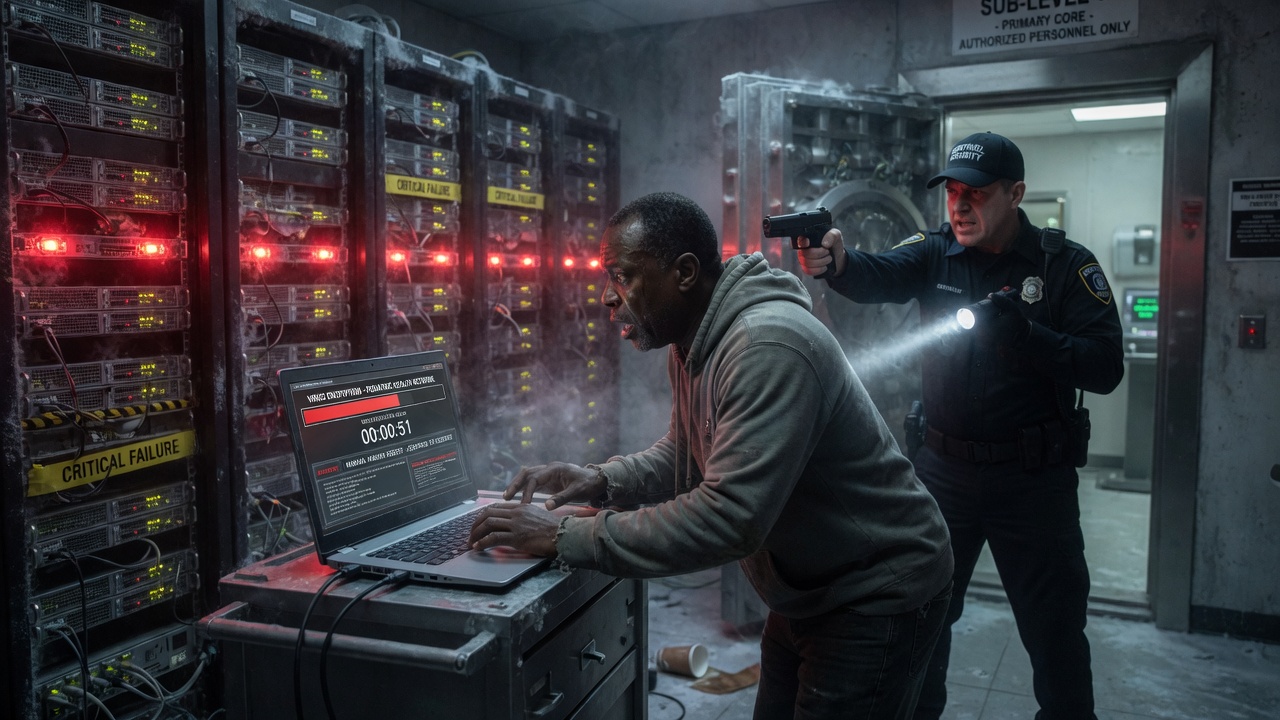
I Was Sixty Seconds Away From Saving Millions Of Lives From A Massive Cyberattack… Until A Security Guard Put A Loaded Gun To My Head And Made The Biggest Mistake Of His Life.”

I’ve spent the last twenty years building digital fortresses for the biggest tech companies in the world, but nothing prepared me for the moment a cold steel barrel was pressed against my temple in my own server room while a countdown to catastrophe ticked away on my screen.
My name is Julian. Forty-eight hours before this nightmare began, I was standing in a sunlit boardroom, shaking hands with the board of directors as they officially named me the new Chief Technology Officer of Sentinel Data Corp.
It was a milestone. A shattered glass ceiling. I was the first Black CTO in the company’s history, taking the helm of a billion-dollar Silicon Valley titan.
But I didn’t care about the money, the stock options, or the corner office with the panoramic view of the bay.
I took the job for one reason, and one reason only: Sentinel Data Corp managed the central backend database for the West Coast Pediatric Health Network.
Our servers handled real-time synchronizations for pediatric intensive care units, emergency life-support monitoring, and the national pediatric organ donor matching registry.
It was the invisible digital heartbeat keeping thousands of critically ill children alive.
Children just like my seven-year-old daughter, Maya.
Maya has been living in a sterilized room at Bay Area Children’s Hospital for eight months, attached to machines whose data streams directly into Sentinel’s mainframes. She is waiting for a heart transplant.
If our network ever went down, the donor matching system would go completely blind. Life-support alerts wouldn’t reach the nurses’ stations. Total chaos would consume the hospitals in a matter of minutes.
That’s why I was in the building late on a Sunday night.
The Silicon Valley headquarters was a massive, modern glass cathedral, completely empty on weekends. The silence usually helped me think.
I was up in my office on the 42nd floor, ignoring the expensive tailored suits my wife had bought me for the new role. Instead, I was wearing my lucky, faded gray college hoodie and a pair of worn-out sneakers.
When it comes to writing code and hunting down system bugs, comfort is my armor. I was just a programmer trying to make sure the fortress was secure.
It was 11:42 PM when the first alarm hit.
It wasn’t a loud siren. It was a silent, terrifying flash of crimson across all four of my massive curved monitors.
My coffee cup froze halfway to my mouth.
I slammed my cup down, the hot liquid spilling over my desk, and my hands flew across the mechanical keyboard.
I pulled up the central defense logs. What I saw made the blood freeze in my veins.
It wasn’t a glitch. It wasn’t a minor breach. It was a massive, coordinated, highly sophisticated zero-day cyberattack.
Someone was inside the house.
Lines of malicious code were cascading down my screen like a digital waterfall. The attackers were using a brute-force algorithm paired with a ghost-protocol I had only ever read about in classified threat-assessment briefings.
They weren’t trying to steal financial data. They weren’t looking for corporate secrets.
They were executing a ransomware lockdown on the Pediatric Health Network matrix.
They were targeting the hospitals.
My heart slammed against my ribs. I typed furiously, trying to initiate the automated lockout procedures to sever the external connection and protect the core data.
ACCESS DENIED.
A cold sweat broke out across my forehead. I tried a backdoor override, a secret admin path I had coded myself just the day before.
ACCESS DENIED.
They had already compromised the administrative layer. They had locked down the upper floors’ network access. From my office on the 42nd floor, I was completely paralyzed.
I checked the system status. The malicious encryption was spreading fast.
Thirty percent of the pediatric network was already corrupted.
I thought of Maya. I thought of the machines beeping next to her bed. If this encryption hit 100%, the hospitals would lose the ability to monitor the vitals of thousands of kids. The donor registry would be wiped clean.
Children would die tonight. Maya could die tonight.
There was only one way to stop it.
I had to physically go down to Sub-Level 4, enter the primary server vault, plug my laptop directly into the master mainframe terminal, and execute a hardline manual reboot and system purge.
It would sever the connection from the inside out, trapping the virus in the outer firewall and saving the core database.
I grabbed my laptop, didn’t even bother to close the screen, and bolted for the door.
I hit the hallway, my sneakers squeaking violently against the polished marble floor. I smashed the button for the elevator.
Nothing happened. The digital display above the doors flickered and died.
The hackers had cut the power to the building’s transport systems to slow down any response.
“Dammit!” I screamed, the sound echoing down the empty, dark hallway.
I ran for the emergency stairwell.
Forty-two flights of stairs.
I threw open the heavy fire door and started bounding down the concrete steps, taking them three at a time. My laptop was clutched tightly against my chest.
My breath came in ragged, burning gasps. The stairwell was dimly lit by emergency backup lights, casting long, frantic shadows against the walls as I descended.
Thirty-five. Thirty. Twenty-five.
My legs felt like lead. My lungs screamed for oxygen. But every time I wanted to slow down, I pictured Maya’s face. I pictured the digital monitors beside her bed going dark.
Fifteen. Ten. Five.
I burst through the door at the ground floor lobby. The massive atrium was pitch black, completely dead. The silence was deafening.
I didn’t stop. I sprinted past the empty reception desk, heading for the restricted elevator bank that led to the subterranean levels.
The sub-levels had their own independent power grid. Thank God.
I swiped my master keycard. The light flashed green, and the heavy metal doors slid open. I hit the button for Sub-Level 4.
The descent felt like an eternity. I opened my laptop, my hands shaking, and began writing the manual override script on the fly.
It had to be perfect. One wrong line of code, and I would lock myself out of the mainframe permanently.
The elevator doors chimed and opened.
Sub-Level 4 was a fortress. The air was thick with the deafening, jet-engine roar of thousands of industrial cooling fans.
I sprinted down the concrete corridor toward the main vault. The biometric scanner was online. I pressed my thumb against the glass and leaned in for the retinal scan.
BEEP. ACCESS GRANTED.
The massive, foot-thick steel door hissed open.
A blast of freezing, fifty-degree air hit me in the face. The server room was the size of a football field, filled with rows upon rows of towering black racks, blinking with thousands of lights.
Usually, the room glowed with a calm, steady neon blue.
Tonight, it was flashing violently with warning reds and aggressive yellows. The system was bleeding out.
I ran to the master control terminal in the center of the room. It was a heavy steel crash cart with a direct hardline into the core mainframe.
I slammed my laptop down onto the metal surface, pulled the thick black ethernet cable from the terminal, and jammed it into the side of my computer.
I hit enter to push my script.
A digital progress bar appeared on my screen, alongside a countdown timer showing the virus’s progression toward the core.
The virus was at 85%.
I had exactly ninety seconds before the entire pediatric network was encrypted and locked forever.
“Come on, come on, come on,” I muttered, my fingers flying over the keys as I compiled the final execution command. My breath plumed in the freezing air. My hands were going numb from the cold, but the adrenaline was keeping me hyper-focused.
Ninety seconds. Millions of records. Thousands of lives. My daughter’s life.
The virus hit 88%.
The timer showed sixty seconds left.
I had the final string of code ready. I raised my finger, ready to strike the ‘Enter’ key and trigger the hard reboot that would save everything.
Then, behind me, the heavy steel door of the vault exploded open.
“FREEZE! GET YOUR HANDS OFF THE CONSOLE!”
A voice, booming and aggressive, cut through the roar of the cooling fans.
I spun around, squinting against a blinding beam of light.
A corporate security officer was standing in the doorway in a tactical stance. His heavy-duty flashlight was pointed directly at my face.
But it wasn’t the flashlight that made my blood run cold.
It was the black, metallic gleam of the 9mm service weapon in his right hand, aimed squarely at my chest.
“I said step away from the servers, now!” the officer screamed, his finger tight on the trigger.
I looked at the screen. Fifty seconds left.
I looked down at myself. I was a Black man in a hoodie, sweating profusely, standing in a restricted, high-security vault at midnight, frantically typing into the master terminal.
He didn’t see the Chief Technology Officer.
He saw a threat. And he had a gun.
CHAPTER 2
The beam of the tactical flashlight hit my eyes like a physical blow.
It was blinding, a brilliant, piercing white halo that washed out the flashing red warning lights of the server vault. I couldn’t see the man’s face behind the glare. I could only see the silhouette of his broad shoulders, the dark navy blue of his Sentinel Data Corp security uniform, and the rigid, unyielding line of his extended arms.
At the end of those arms was a Glock 19. The barrel was steady. It was pointed directly at the center of my chest.
“I said step away from the terminal! Do it now!” the voice roared again.
It was a voice thick with adrenaline, the kind of aggressive, tightly wound shout that warned of an imminent trigger pull. He wasn’t asking. He was commanding, and his finger was already resting heavy on the trigger guard.
My heart hammered against my ribs like a trapped bird. The freezing fifty-degree air of the server room suddenly felt like a furnace. A cold, prickling sweat broke out across my scalp, matting my hair beneath the hood of my gray sweatshirt.
I slowly raised my hands, palms open, turning my head slightly to escape the agonizing glare of the flashlight.
“Okay, okay! My hands are up!” I shouted back, trying to keep my voice steady, trying to project an authority I didn’t feel while staring down the barrel of a loaded gun. “Listen to me very carefully. You need to lower the weapon.”
“Shut your mouth and step away from the servers! Last warning!”
I glanced frantically out of the corner of my eye. The heavy metal crash cart was just inches from my hip. My laptop was sitting open on the steel surface.
The screen was glaring with the aggressive, blood-red interface of the intrusion detection system.
The digital countdown timer was ticking down mercilessly in the top right corner.
*00:00:46*
*00:00:45*
*00:00:44*
Forty-four seconds. That was all that stood between the current moment and total, catastrophic failure of the entire West Coast Pediatric Health Network.
“You don’t understand,” I pleaded, my voice cracking with desperation. I took a half-step sideways, keeping my hands raised, trying to put myself between the guard and the laptop. “I am Julian Vance. I am the Chief Technology Officer of this company. We are under a massive cyberattack right now!”
The guard let out a harsh, barking laugh devoid of any humor. “Yeah, right. And I’m the CEO. Down on the ground. Face down, hands behind your head! Now!”
I stared at him, the reality of the situation crashing over me like a tidal wave of ice water.
He didn’t believe me. And why would he?
He saw a Black man in a faded, oversized hoodie and scuffed sneakers, standing alone in the most secure, restricted vault in the entire building at midnight on a Sunday. I didn’t have my security badge on me. I had left my lanyard, along with my tailored suit jacket and my wallet, up on the forty-second floor when the alarms first went off.
To him, I wasn’t the man who had just been handed the keys to the kingdom. I was an intruder. I was the threat. I was the hacker who had triggered the building’s security protocols.
“Please, you have to look at the screen!” I begged, my eyes darting back to the timer.
*00:00:38*
“The hackers triggered a zero-day exploit! They are executing a ransomware lockdown on the pediatric mainframe! If I don’t hit the enter key on that laptop right now, the entire hospital network goes dark! Children are going to die!”
The guard took a step forward, the heavy soles of his tactical boots thudding against the raised floorboards of the server room. The flashlight beam didn’t waver.
“I don’t care what kind of stunt you’re trying to pull,” he growled, closing the distance between us. “You tripped the silent alarm on Sub-Level 4. You bypassed the elevator lockdown. Now get on the damn ground before I put a bullet in you!”
He didn’t know. He couldn’t know.
The cyberattack had likely scrambled the internal security comms. The silent alarm he mentioned wasn’t me breaking in—it was the system’s automated physical lockdown response to the digital breach. The hackers were sealing the doors to trap anyone outside the vault, to give their malicious code time to execute. My master keycard override had triggered his response team.
He thought he was catching a saboteur in the act. He thought he was saving the company.
He was actually sealing its doom.
*00:00:32*
Thirty-two seconds.
My mind flashed violently away from the freezing server room. For a split second, I wasn’t standing in front of a gun. I was standing in a brightly lit, sterile room at Bay Area Children’s Hospital.
I was looking at Maya.
My sweet, brilliant, seven-year-old girl. She was lying in the center of a massive hospital bed that made her look so small, so fragile. Her skin was pale, almost translucent beneath the harsh fluorescent lights. Wires and clear plastic tubes snaked out from beneath her hospital gown, connecting her to a towering stack of specialized pediatric monitoring equipment.
The machines were her lifeline. They breathed for her when she was too weak. They monitored the failing rhythm of her heart. They injected precise, micro-milligram doses of stabilizing medication directly into her bloodstream based on real-time algorithmic calculations.
And every single piece of data from those machines, every single heartbeat, every single drop of medication, was routed through the exact server rack I was standing in front of.
Sentinel Data Corp didn’t just store files. We provided the active, real-time cloud infrastructure for the hospital’s automated life-support systems. The hospital didn’t have the onsite computing power to run the complex algorithms required for pediatric intensive care. They outsourced it to us.
If this ransomware locked the database, the connection would be severed.
The machines keeping Maya alive wouldn’t just stop recording data. They would freeze. The automated medication pumps would halt. The nurses’ station monitors would go black.
It would be a digital blackout in an intensive care unit. A silent massacre.
And then there was the registry.
Maya had been on the national pediatric heart transplant list for eight agonizing months. Every day, her mother and I waited by the phone, praying for the call that a donor heart had been found.
The matching algorithm—the complex, secure database that paired donor organs with pediatric recipients based on blood type, tissue markers, and critical need—was hosted right here. On these servers.
If the ransomware encrypted that registry, the backup files would be corrupted instantly. The list would be gone. Years of medical records, gone. The only chance my daughter had at a future would be wiped out by lines of malicious code written by faceless extortionists demanding cryptocurrency.
*00:00:26*
Twenty-six seconds.
The adrenaline coursing through my veins shifted from pure terror to a hot, blinding rage. I wasn’t just a CTO defending a corporate asset anymore. I was a father defending his child’s life.
I couldn’t just stand there and let this happen. I couldn’t let a misunderstanding kill my daughter.
“Look at my face!” I screamed over the deafening roar of the server cooling fans. “I am Julian Vance! Call the CEO! Call the head of HR! Call anyone! But right now, you have to let me touch that keyboard!”
The officer was only ten feet away now. I could finally see his face in the ambient red glow of the warning lights.
He was young, maybe late twenties. He had a tight military buzz cut and a jaw tightly clenched with stress. His eyes were wide, darting between my face and my hands. He was terrified. He was just a guy working the graveyard shift who had suddenly been thrust into what he thought was a high-stakes corporate espionage situation.
I saw his nameplate glint in the light. *Officer Miller.*
“Miller, please!” I shouted, using his name in a desperate attempt to humanize the situation. “In twenty seconds, thousands of sick kids are going to lose their life support! My daughter is one of them! Let me hit the override!”
Miller flinched slightly when I used his name, but his training quickly overrode his hesitation. He had a protocol to follow. Intruders in the core vault were not to be trusted. They were to be neutralized and detained.
“I am not going to ask you again,” Miller yelled, his voice cracking slightly. He lowered his stance, squaring his shoulders, preparing to fire. “Get on the ground!”
*00:00:19*
Nineteen seconds.
The progress bar on the laptop screen jumped forward violently. The virus had breached the secondary firewall. It was chewing through the security layers faster than I had calculated.
The red lights in the room began to flash with a frantic, strobing intensity. The cooling fans kicked into overdrive, screaming like jet engines as the servers overheated from the massive influx of malicious traffic.
It was now or never.
I made a choice. It was a choice that could end with a bullet in my chest, but doing nothing would definitely end with a flatline on Maya’s heart monitor.
I dropped my hands and lunged for the crash cart.
“No!” Miller screamed.
The sound of the gunshot didn’t happen. Instead, Miller closed the remaining distance with terrifying speed. He was a big man, built like a linebacker, and he used his entire body weight to intercept me.
Just as my fingertips brushed the plastic casing of the laptop keyboard, Miller hit me.
He slammed into my right shoulder like a freight train. The sheer force of the impact lifted me off my feet. The air was violently driven from my lungs in a sharp, painful gasp.
We crashed hard into the towering black server rack behind the terminal.
The metal groaned and shuddered under our combined weight. Pain exploded down my spine as a sharp metal bracket dug into my lower back.
My hand wildly grasped for the laptop, but Miller’s heavy tactical flashlight swung down, smashing brutally against my forearm.
I cried out in pain, my arm going instantly numb.
Miller grabbed the front of my hoodie with his free hand, bunching the fabric tightly into his fist, and slammed me against the server rack a second time. My head whipped back, the back of my skull connecting solidly with the steel frame.
A burst of white light exploded behind my eyes. For a terrifying second, the room spun out of focus, the deafening roar of the fans fading into a high-pitched ringing in my ears.
“Don’t you move! Don’t you dare move!” Miller was screaming directly into my face.
I could feel his hot breath against my cheek. I could smell the stale coffee and peppermint gum on his breath.
He pinned me against the rack with his body weight, his knee driving hard into my thigh to prevent me from kicking out. He dropped his flashlight, letting it clatter to the metal floor grating, and used his newly freed hand to grab the back of my neck, forcing my head down and sideways against the freezing cold metal of the server chassis.
He shoved the barrel of the Glock 19 directly into the soft flesh right behind my ear.
The metal of the gun was freezing cold. It sent a shockwave of primal terror straight down my spine.
“Give me one reason. Just give me one reason to pull this trigger,” Miller hissed, his voice shaking with a mixture of fear and adrenaline.
I was completely immobilized. My right arm hung uselessly at my side, throbbing with excruciating pain. My left arm was pinned awkwardly between my chest and Miller’s body. The cold steel of the server rack was biting into my cheek.
But I didn’t care about the pain. I didn’t care about the gun against my head.
Through the tangled mess of my own arms and Miller’s bulky security vest, I could see the laptop screen. It had been knocked slightly askew when Miller tackled me, but it was still glowing brightly against the darkness of the room.
The countdown timer was right in my line of sight.
*00:00:12*
Twelve seconds.
“Miller, you have to hit enter!” I screamed, my voice muffled by the metal I was pinned against. I fought frantically against his grip, thrashing my shoulders, trying to break free. “Look at the screen! Look at the timer! Please, God, just look at the screen!”
“Stop resisting!” Miller barked, shoving my head harder against the rack. The front sight of the pistol scraped painfully against my scalp. “I am securing the area! You are under arrest for corporate espionage and trespassing!”
“I am trying to save millions of records!” I sobbed, the tears finally breaking through, mixing with the sweat on my face and freezing against the cold steel. The desperation was tearing me apart from the inside out. I was a father trapped in a nightmare, watching the clock run out on my child’s life while a man who thought he was a hero held me down.
“If I don’t type the override code in ten seconds, the entire database wipes! The hospitals go dark! My daughter dies!”
I screamed the words with every ounce of air left in my lungs. It was a raw, guttural sound of pure parental agony. It echoed violently in the massive vault, cutting through the mechanical roar of the servers.
For a fraction of a second, I felt Miller’s grip loosen. Just a fraction.
Maybe he heard the genuine despair in my voice. Maybe the word ‘daughter’ broke through his tactical training. Out of the corner of my eye, I saw his gaze flick over my shoulder, finally looking past me and focusing on the laptop screen sitting on the crash cart.
He saw the flashing red interface. He saw the massive, undeniable warning banners spreading across the screen like a digital plague: *CRITICAL SYSTEM FAILURE IMMINENT. ENCRYPTION PROTOCOL INITIATED.*
And he saw the timer.
*00:00:08*
*00:00:07*
“What… what is that?” Miller muttered, his voice suddenly losing its aggressive edge, replaced by a deep, hollow confusion. “What did you do to the system?”
“It’s a ransomware attack! I didn’t do it, I’m trying to stop it!” I gasped, feeling the pressure on my neck ease just enough for me to turn my head. “The override script is already compiled! It’s loaded! All you have to do is hit the Enter key! Hit the key, Miller! Do it!”
I practically begged him. I was willing to let him arrest me. I was willing to go to jail. I was willing to take a bullet. I just needed that key pressed.
Miller stared at the screen. He looked at the keyboard. He looked back at me, his eyes wide, his mind clearly racing to process the monumental decision in front of him.
He was a security guard. He wasn’t an IT expert. He had been told to protect the servers from physical threats. Now, a man he believed to be a criminal was telling him to push a button that could either save the company or destroy it completely.
If he hit that key, and I was lying, he would be complicit in the biggest corporate sabotage in history.
If he didn’t hit it, and I was telling the truth…
*00:00:05*
Five seconds.
The red warning lights in the room stopped flashing. They suddenly shifted to a solid, blinding, continuous crimson glare. The mechanical hum of the servers dropped an octave, a deep, ominous vibration that shook the metal floorboards beneath our feet.
The virus had reached the core. It was preparing to execute the final encryption algorithm.
“Miller! My daughter!” I screamed, a horrifying realization washing over me.
He wasn’t going to do it.
I saw it in his eyes. The hesitation. The fear of doing the wrong thing. The corporate conditioning that told him to never trust an unauthorized individual. He couldn’t make the leap of faith.
His face hardened. His training took over once again. He clamped his grip back down on my neck with renewed, brutal force.
“Nice try,” Miller hissed coldly, shoving the barrel of the gun harder into my skull. “Save it for the judge.”
He ripped a pair of heavy plastic zip-ties from his tactical vest.
*00:00:03*
I watched in absolute, paralyzed horror as the timer ticked down.
*00:00:02*
I closed my eyes. I pictured Maya’s face one last time. I pictured her smiling. I pictured her sleeping in her hospital bed.
I pictured the green line on her heart monitor turning to a flat, silent, devastatingly still red line.
*00:00:01*
“Forgive me, Maya,” I whispered into the cold steel.
*00:00:00*
The countdown hit zero.
CHAPTER 3
*00:00:00*
The digital numbers on the screen didn’t just stop. They seemed to burn themselves into my retinas, leaving a ghost image of the two zeros floating in the freezing air between me and the laptop.
There was no explosion. There was no sudden, violent spark of electricity.
Instead, the end of the world sounded like a deep, sickening exhale.
The deafening, jet-engine roar of the thousands of industrial cooling fans inside the massive Sub-Level 4 server vault suddenly changed pitch. It dropped from an aggressive, high-pitched scream to a low, groaning shudder.
The vibrations beneath the metal floorboards died.
The blinding, solid crimson warning lights that had been bathing the room in the color of fresh blood flickered once, twice, and then went completely black.
Total darkness slammed into the vault like a physical wall.
The only light left in the cavernous, football-field-sized room was the cold, harsh glare of my laptop screen sitting on the crash cart, and the thin beam of Officer Miller’s flashlight resting on the floor grating near our feet.
“Target secured,” Miller breathed heavily, his chest heaving against my back. His voice was shaking, but he was trying desperately to sound like a man who had just taken control of a volatile situation. “Hands behind your back. Give them to me now.”
He grabbed my left wrist, twisting it painfully behind my spine.
I didn’t fight him. I didn’t resist.
All the fight had instantly drained out of my body the second that timer hit zero. My muscles turned to water. The agonizing pain in my right arm, where he had struck me with the heavy tactical flashlight, felt completely distant, as if it belonged to someone else.
My mind was entirely gone from that freezing server room.
I was forty miles away, standing in the sterile, brightly lit hallways of Bay Area Children’s Hospital.
In my mind’s eye, I could see it happening in real-time. I could see the exact moment the ransomware payload successfully detonated inside the pediatric network’s core architecture.
I imagined the nurses’ station on the fourth floor—the pediatric intensive care unit. I pictured the massive digital dashboard on the wall, the screen that displayed the vital signs of sixty critically ill children simultaneously.
I saw the glowing green heart rates. The blue oxygen saturation levels. The steady, rhythmic numbers that meant the kids were stable.
And then, I saw the screen freeze.
I saw the numbers stop moving.
I imagined the frantic tapping on the keyboards by the head nurses, thinking it was just a local frozen screen. I imagined the sudden, terrifying realization spreading across their faces as the secondary monitors at the individual bedsides also went completely black.
I pictured Maya’s room. Room 412.
The rhythmic *beep… beep… beep* of her heart monitor suddenly cutting out, replaced by a horrifying, dead silence.
The automated IV pumps, which were calculating and delivering precise, micro-milligram doses of heart-stabilizing medication directly into her frail veins based on real-time server algorithms, would suddenly halt. The machines wouldn’t know what to do without the cloud data telling them her current blood pressure. The safety protocols would trigger a full stop.
She was seven years old. Her heart was failing. She couldn’t survive an hour without those automated micro-adjustments. She might not even survive fifteen minutes.
And then, the darkest thought of all hit me. The transplant registry.
Somewhere out there tonight, a tragedy might have occurred. A tragedy that could have provided a miracle for my little girl. A match might have been found. But without the central database, the hospital had no way to verify the complex tissue markers. The donor window would close. The match would be lost forever in a sea of encrypted, unreadable digital garbage.
“Give me your other hand! Stop flexing!” Miller barked, violently yanking me back to reality.
He dug his knee harder into my thigh, crushing my face against the cold steel of the server chassis. He grabbed my injured right arm, ignoring my sharp gasp of pain, and dragged it behind my back to meet my left wrist.
I felt the thick, heavy-duty plastic of a tactical zip-tie loop around my wrists.
*Zzzzip.*
The sound was sharp, loud, and brutally final in the sudden quiet of the dead server room.
He pulled the plastic tie incredibly tight, cutting off the circulation to my hands almost instantly. The jagged edges of the plastic bit into the sensitive skin of my wrists, drawing a hot prickle of blood.
“Dispatch, this is Officer Miller,” he said loudly, his voice echoing in the darkness. I felt him reach for the heavy radio clipped to his shoulder harness. “I am in the Sub-Level 4 primary vault. I have one suspect detained. I repeat, suspect is in custody. The immediate threat to the hardware has been neutralized. The suspect was attempting to access the main console.”
He waited for a response. The radio simply emitted a sharp burst of dead static.
“Dispatch, do you copy? This is Miller.”
More static. The cyberattack hadn’t just hit the pediatric network; it had severed the internal communications layer of the building to prevent security from coordinating.
Miller let out a frustrated grunt. He finally stepped back, grabbing me by the collar of my hoodie and violently hauling me up to my feet.
My legs were weak. I stumbled, my shoulder slamming into the rack to keep myself upright.
“You’re going to jail for a very, very long time, buddy,” Miller spat, picking up his flashlight from the floor and shining it directly into my face again. “Whatever you were trying to steal, it didn’t work. The system shut itself down. I stopped you.”
I looked at him. Really looked at him.
His chest was puffed out. He had sweat dripping down his temples, but there was a gleam of intense pride in his eyes. He truly believed he was the hero of this story. He believed he had just thwarted a massive corporate espionage plot. He was probably already imagining the promotion, the commendation from the board of directors.
A strange, bubbling sensation started to rise in the back of my throat.
It started as a dry heave, but it quickly morphed into a sound.
It was a laugh.
It started low, a broken, raspy chuckle that scraped against my vocal cords. Then it grew louder. It echoed off the high ceiling of the vault, bouncing off the rows of dead, black servers.
It was a hollow, manic, terrifying sound. It was the laughter of a man whose mind had just been completely shattered by grief and helplessness.
Miller took a step back, the flashlight beam trembling slightly in his grip. The pride in his eyes wavered, replaced by a sudden flash of unease.
“Shut up,” he snapped, his hand dropping instinctively back to the butt of his holstered weapon. “I said shut your mouth! What’s so funny?!”
“You…” I gasped, the laughter turning into a choking sob. Tears were streaming down my face, hot and stinging against the freezing air. “You think you stopped me. You think you saved the system.”
“I did,” he said defensively, though his voice lacked the aggressive certainty it had a minute ago. “You couldn’t hit the button. The servers powered down to protect themselves.”
“They didn’t power down, you idiot,” I whispered, shaking my head slowly. The despair was crushing me, burying me alive. “They went dark because the ransomware payload dropped. The perimeter walls fell. They own the house now.”
I turned my body, gesturing with my chin toward the crash cart.
“Look at the screen, Miller. Look at what you just let happen.”
Miller kept his flashlight trained on me, but his eyes darted over to the laptop.
The digital countdown timer was gone.
In its place, the screen had turned entirely black. A few seconds later, a massive, pixelated skull made of bright green and blood-red code slowly rendered itself in the center of the display.
Below the skull, a horrifying message began to type itself out, letter by agonizing letter.
*YOUR NETWORK HAS BEEN SECURED BY APEX-SYNDICATE.*
*ALL DATABASES ARE CURRENTLY BEING ENCRYPTED WITH MILITARY-GRADE AES-256.*
*DO NOT ATTEMPT TO REBOOT.*
*DO NOT ATTEMPT TO INTERFERE.*
*ANY INTERRUPTION WILL RESULT IN PERMANENT DELETION OF ALL ARCHIVES.*
*PAYMENT INSTRUCTIONS WILL FOLLOW.*
“What… what is that?” Miller breathed, his voice barely a whisper. He slowly walked toward the crash cart, his flashlight beam shaking violently as he read the words on the screen. “That’s… that’s a joke, right? A popup?”
“It’s a ransomware execution protocol,” I said, my voice dead, completely devoid of emotion. “It’s the digital equivalent of a nuclear bomb going off inside a hospital. And you just held my hands behind my back while it detonated.”
Miller stared at the skull. The green light from the screen reflected in his wide, terrified eyes.
“No,” he muttered, shaking his head. “No, you’re the hacker. You brought this in here on that laptop. You were uploading it.”
“My laptop was running an intrusion counter-measure!” I screamed, the sudden rage flaring up inside me again, hot and blinding. I fought against the plastic zip-ties, feeling the jagged edges slice deeper into my wrists, warm blood trickling down to my palms. “I told you! I am Julian Vance! I am the Chief Technology Officer! The script on that screen was an automated purge command! If you had just let me hit the enter key, it would have severed the external connection and walled off the core! But you didn’t! You held a gun to my head!”
Miller stepped back from the laptop as if it were a venomous snake. He was panting now, short, shallow breaths. Panic was finally starting to set in. The absolute certainty he had clung to was dissolving into absolute terror.
He reached for his radio again, his thumb jamming down on the transmit button.
“Dispatch! Dispatch, this is Miller! Come in! Goddammit, someone answer me!”
Nothing but heavy, mocking static.
“They jammed the comms,” I said, my voice dropping back to a defeated whisper. “They own the routers. They own the switches. They own everything.”
Suddenly, a small, secondary window popped up in the bottom corner of my laptop screen.
It wasn’t a warning message. It was a progress bar.
*ENCRYPTION PROGRESS: 2% … ESTIMATED TIME TO COMPLETION: 14 MINUTES.*
I stared at that small bar. My brain, the analytical, engineering part of my brain that had been completely suppressed by pure emotional trauma, suddenly sparked back to life.
*Fourteen minutes.*
Wait.
The payload had detonated at zero. The software locks had engaged. But Sentinel Data Corp managed petabytes of information. Millions upon millions of high-definition medical scans, real-time vital logs, and dense historical registries.
You can’t encrypt petabytes of data instantaneously. The laws of physics and data throughput wouldn’t allow it. The malware had to physically chew through the data, sector by sector, hard drive by hard drive.
It was going to take fourteen minutes for the virus to fully overwrite the core.
The software doors were locked, yes. I couldn’t use the laptop anymore. The keyboard was useless. The digital fail-safes were completely compromised.
But the hardware… the physical machines were still spinning, still processing the malicious commands.
There was another way.
It was the most extreme, catastrophic, “break-glass-in-case-of-emergency” protocol imaginable. It was a failsafe designed only for a localized server fire or a massive electrical surge.
The physical kill switch.
At the base of the primary master rack—the massive, towering chassis located exactly ten feet behind where I was standing—was a manual, heavy-duty industrial breaker lever.
It wasn’t a digital command. It was a giant piece of mechanical copper that physically bridged the main fiber-optic data trunk to the external world.
If I pulled that lever, it would act like a literal guillotine. It would physically sever the data lines from the servers. The connection would be instantly, violently amputated.
It would cause millions of dollars in hardware damage. It would fry solid-state drives. It would corrupt whatever data the virus was currently chewing on.
But it would stop the encryption from spreading to the remaining 98% of the core. It would trap the ransomware in the severed limb and save the rest of the body.
It would save the pediatric registry. It would save the hospital’s active life-support connection, forcing the hospital’s local emergency backup generators to take over immediately without being corrupted by the inbound bad data.
I had fourteen minutes.
I looked at Miller. He was pacing frantically, hitting the side of his radio against his palm, muttering to himself.
“Miller,” I said, my voice sharp and suddenly filled with a dangerous, razor-thin edge of authority.
He stopped pacing and snapped his flashlight back to my face. “Shut up! Just shut up, I need to think!”
“You don’t need to think. You need to listen,” I commanded. I didn’t sound like a suspect anymore. I sounded like the boss. “The data isn’t fully gone yet. It takes time for the virus to write the encryption. We have less than fourteen minutes before it reaches the pediatric registry.”
“I’m not letting you near that keyboard again!” Miller yelled, taking a protective step toward the crash cart.
“I don’t need the keyboard!” I yelled back, leaning forward, ignoring the throbbing pain in my wrists. “Behind me. The massive rack in the center. At the base, there is a red mechanical lever. It’s a hardline sever. If you pull that lever, you physically cut the cables. It stops the attack dead in its tracks.”
Miller stared at me, his eyes wide, sweat dripping off his chin. “You’re lying. You’re trying to trick me into destroying the servers.”
“The servers are already being destroyed!” I roared, the frustration boiling over. “Look at the screen! Look at the skull! If you don’t pull that lever, the company is dead. The hospitals are dead. Thousands of people will die, and their blood will be entirely on your hands! Is that what you want? Do you want to be the man who murdered children tonight?”
My words hit him like physical blows. He flinched, stepping back, his flashlight trembling so hard the beam danced wildly across the ceiling.
He looked at the master rack. He saw the heavy red lever near the floor grating.
He looked back at me.
“I… I can’t,” Miller stammered, shaking his head rapidly. “My orders are to secure the room and wait for backup. I can’t touch the hardware. I’ll be fired. I’ll be arrested.”
“If you don’t pull it, there won’t be a company left to fire you!” I screamed.
Suddenly, a sharp, piercing burst of static exploded from Miller’s shoulder radio, followed by a voice.
It wasn’t the calm, professional voice of the security dispatcher.
It was frantic, hyperventilating, and laced with absolute panic.
*“…Miller! Unit Four, Miller, do you copy?! This is dispatch! Answer me, goddammit!”*
Miller jumped, his hand flying to the radio. He pressed the button with a shaking thumb.
“Dispatch, this is Miller. I’m here. I’m in the Sub-Level 4 vault.”
*“Listen to me very carefully, Miller,”* the dispatcher’s voice cracked over the tiny speaker. *“We just got the internal comms back online on a backup frequency. The entire building is under a massive cyberattack. The CEO is on his way in a helicopter right now.”*
Miller locked eyes with me. All the color drained from his face. He looked like a ghost.
“Dispatch,” Miller said, his voice barely a squeak. “I have… I have a suspect in custody. He was at the main terminal. A Black male, gray hoodie. I stopped him from accessing the system.”
There was a horrifying, three-second pause on the radio. The silence was heavier than the darkness in the room.
When the voice came back, it wasn’t the dispatcher.
It was Richard Sterling, the billionaire CEO of Sentinel Data Corp. And he sounded like a man having a heart attack.
*“Officer Miller, this is Richard Sterling. Did you just say you detained a Black man in a gray hoodie in the primary vault?”*
“Yes, sir,” Miller whispered, his entire body trembling now. “He didn’t have a badge.”
*“You absolute, unbelievable idiot!”* Sterling’s voice roared over the radio so loud it distorted the speaker. *“That is Julian Vance! He is the new Chief Technology Officer! He is the only person on this planet who knows how to stop this attack! If he tells you to burn the building down, you hand him a match! Let him go right now!”*
The radio clicked off, leaving nothing but dead static.
Miller’s hand dropped slowly from his shoulder. The radio slipped from his fingers and clattered onto the metal floor grating.
He stared at me. His mouth opened and closed, but no sound came out. The realization of what he had just done—what he had caused—hit him with the force of a bullet train. He had single-handedly doomed his own company, and he had held a gun to the head of his boss while doing it.
“Cut the ties,” I said, my voice deadly calm.
Miller was completely paralyzed. His eyes were wide, glassy, locked in a state of catatonic shock. He was hyperventilating, staring at his trembling hands as if they were covered in blood.
*ENCRYPTION PROGRESS: 4%*
“Miller!” I shouted. “Snap out of it! Get a knife and cut these zip-ties!”
He didn’t move. He couldn’t move. His brain had simply short-circuited under the weight of his colossal mistake. He dropped to his knees, clutching his head, rocking back and forth on the floor grating.
“Oh god,” Miller whimpered, tears spilling out of his eyes. “Oh my god, what did I do? I’m so sorry. I’m so sorry.”
He was useless. He was completely broken.
I looked at the massive server rack behind me. I looked down at the heavy red manual sever lever sitting near the floor.
My hands were bound tightly behind my back. The thick plastic zip-tie was practically cutting to the bone. My right arm was screaming in agony from the flashlight strike.
But I didn’t need Miller anymore.
I thought of Maya. I thought of the heart monitor.
A primal, terrifying surge of adrenaline flooded my system, completely wiping out the pain, wiping out the cold, wiping out everything except the objective.
I spun around, putting my back to the master server rack.
I dropped into a deep squat, forcing my tied hands down past my waist, past my hips, pushing them as far down my legs as my shoulder joints would physically allow.
The pain in my rotator cuffs was blinding. I felt a muscle tear in my left shoulder, a sharp, searing pop that made me gasp out loud, but I didn’t stop.
I crouched lower, my boots slipping slightly on the metal floor grating.
I maneuvered my bound hands behind my calves, feeling blindly in the dark for the heavy metal of the lever.
My fingers brushed against the cold copper.
“No, wait, wait, what are you doing?!” Miller suddenly screamed, snapping out of his shock just enough to realize what was happening. He scrambled off the floor, reaching out toward me.
“Saving my daughter!” I roared.
I hooked my fingers around the thick red handle.
I closed my eyes, braced my legs, and threw my entire body weight forward.
I pulled the lever with everything I had left in me.
The massive copper switch didn’t move easily. It was designed to require two hands and a lot of force. It ground against its heavy metal housing, resisting me.
“Julian, stop! You’ll destroy the core!” Miller yelled, grabbing my shoulder.
“Get your hands off me!” I screamed, turning my head and throwing my weight violently to the side, throwing him off balance.
I planted my feet wider. I ignored the warm blood running down my fingers. I thought of the steady green line on Maya’s monitor.
With a final, guttural scream of pure, agonizing effort, I threw myself backward.
*CLANG.*
The massive heavy-duty lever slammed downward, locking into the ‘EMERGENCY SEVER’ position.
The result was instantaneous.
Above us, deep inside the towering black racks, a rapid series of violent, explosive *POPS* echoed through the vault, sounding like a string of heavy firecrackers. The massive bundle of thick, black fiber-optic cables that connected the servers to the outside world sparked brilliantly, a flash of blue electricity lighting up the room for a split second before dying out.
The physical data bridge was completely severed.
The laptops screen flickered violently, the mocking skull freezing in place for a fraction of a second before the entire screen turned a solid, dead, static gray.
The servers surrounding us let out a final, dying groan, the internal hard drives violently spinning down to zero.
The room plunged into absolute, deafening silence.
It was over.
I collapsed backward onto the metal floor grating, my lungs burning, my tied hands completely numb and covered in blood. I stared up at the black ceiling of the vault, the darkness pressing down on me.
I didn’t know if I had been fast enough. I didn’t know how much data the virus had corrupted before I pulled the lever.
All I could do was lie there in the dark, bleeding, and pray to a God I hadn’t spoken to in years that my little girl was still breathing.
Then, through the dead silence of the vault, I heard a sound.
It was Miller’s radio. It had crackled back to life.
And someone was crying.
CHAPTER 4
The sound of crying cut through the absolute, heavy silence of the severed vault.
It was a small, tinny sound, distorted by the tiny speaker of the heavy two-way radio lying on the metal floor grating a few feet away from me.
I lay on my back, staring up into the pitch-black void of the massive server room. My chest was heaving, pulling in jagged, painful breaths of the freezing air. My right shoulder throbbed with a sickening, deep-tissue ache where the muscle had torn, and my hands, still bound brutally tight behind my back, were completely numb, slick with my own blood.
But I didn’t care about the pain. I only cared about that sound.
“Miller,” I croaked. My voice was completely destroyed, reduced to a dry, raspy whisper from screaming. “Miller. The radio.”
Officer Miller was still on his knees in the dark. I could hear his ragged, hyperventilating breaths. He was completely broken, shattered by the realization of what his prejudice and blind obedience had just cost.
“Miller!” I barked, summoning every last ounce of command I had left in my battered body. “Pick up the damn radio and put it to my ear. Now.”
I heard the scraping of his boots against the metal grating. He crawled toward me in the dark, a pathetic, defeated shadow. I felt his trembling hands brush against my face as he lifted the heavy radio and held it awkwardly against my cheek.
The crying was still happening. It was a man. He was sobbing uncontrollably.
“Hello?” I rasped into the receiver. “Who is this?”
The crying hitched. There was a moment of heavy static, and then a shaky, wet voice came through.
*”Julian? Oh my god, Julian, is that you?”*
It was Richard Sterling. The billionaire CEO of Sentinel Data Corp. The man who had shaken my hand and welcomed me to the executive board just forty-eight hours ago. He sounded like he was hyperventilating in the back of a moving vehicle.
“It’s me, Richard,” I said, my voice eerily calm now that the adrenaline was beginning to crash. “The core is offline. I had to pull the physical hard-sever. The main fiber-optic trunk is destroyed.”
I waited for the explosion. I waited for him to scream about the millions of dollars of hardware I had just fried, about the catastrophic damage to the company’s infrastructure.
Instead, he let out a loud, breathless sound that was halfway between a laugh and a sob.
*”You did it,”* Richard wept over the radio. *”Julian, you beautiful, brilliant man, you actually did it.”*
My heart stopped. The air in my lungs turned to ice. “The hospital… Richard, what happened to the hospital network?”
*”I’ve had the Chief of Medicine at Bay Area Children’s Hospital on a secure satellite line for the last ten minutes,”* Richard said, his voice trembling with overwhelming relief. *”The second you severed the hardline, the malicious data stream was instantly amputated. The hospital’s automated defense protocols registered a sudden, massive drop in server communication. Because you cut the cord physically instead of trying to fight it digitally, the hospital’s local system didn’t receive the encryption payload.”*
I closed my eyes. A hot, stinging tear leaked out of the corner of my eye and slid down into my hairline.
“The life support?” I whispered.
*”The local emergency generators and localized backup servers took over immediately,”* Richard confirmed. *”The nurses had to do a manual reset on the central dashboards, but the bedside machines never fully powered down. They tripped into localized safety mode. Julian… they’re alive. The pediatric ward is stable. The kids are okay.”*
A heavy, violently trembling sigh left my lips. It felt like a thousand pounds of crushed concrete had been lifted off my chest.
*The kids are okay.*
Maya was okay.
“Julian, listen to me,” Richard’s voice turned urgent. *”I am landing on the roof in three minutes with an armed tactical team and the police. Do not move. We are coming to get you out of there.”*
The radio clicked dead.
I lay there on the cold metal floor. I was bleeding. I was tied up like a common criminal in the basement of my own building. I had just destroyed millions of dollars of enterprise tech.
And it was the greatest moment of my entire life.
I felt a sudden movement next to my head. Miller dropped the radio. He was sitting back on his heels, his face buried in his hands.
“They’re okay,” Miller whispered into his palms, his voice cracking. “Thank God. Oh, thank God.”
He reached out in the dark, his trembling fingers blindly searching for my arms. He found the heavy plastic zip-ties binding my wrists.
“I’m going to cut these,” Miller said, his voice thick with tears. “I’m so sorry, Mr. Vance. I am so, so sorry.”
“Don’t touch me,” I said.
My voice wasn’t loud. It wasn’t angry. It was cold, flat, and absolute.
Miller froze.
“Leave them on,” I told him, staring up at the invisible ceiling. “You put them on me. You don’t get to take them off.”
“Please,” he begged, a pathetic whine escaping his throat. “Please, your hands are bleeding. Let me help you.”
“You did exactly what you wanted to do, Miller,” I said, my words slicing through the dark like razor blades. “You saw a Black man in a hoodie. You saw an oversized sweatshirt and scuffed sneakers, and your brain made a calculation. You didn’t see a threat to the servers. You saw someone who didn’t belong.”
“No, that’s not… I was just following protocol!” he stammered, desperation bleeding into his defense. “It was dark, the alarms were going off—”
“I gave you my name!” I interrupted, my voice finally rising, echoing off the dead servers. “I told you I was the CTO! I told you millions of lives were at stake! I begged you, as a father, to look at the screen! But you didn’t even check! You didn’t even take three seconds to verify. Because in your mind, a man who looks like me could never hold the keys to this kingdom. You were ready to let children die just to prove your own bias right.”
Miller went completely silent. There were no more excuses. He couldn’t hide behind protocol anymore. I had stripped him down to the ugly, uncomfortable truth, and he had to sit there in the dark and look at it.
We stayed like that for what felt like an eternity. The only sound was the drip of condensation from the overhead pipes and the ragged sound of our breathing.
Then, I heard the heavy, booming sound of power tools.
Sparks began to shower near the entrance of the vault. The tactical team was cutting through the magnetic lock of the heavy steel door.
A moment later, the massive door groaned and was violently pried open.
A dozen blinding flashlight beams cut through the pitch-black vault, sweeping frantically across the rows of dead servers before finally converging on the center aisle.
“Freeze! Police! Hands where we can see them!”
I closed my eyes against the harsh glare. Heavy tactical boots thundered across the metal floor grating.
“Down on the ground! Do it now!” an officer screamed.
I heard a scuffle, a grunt of pain, and the sound of Miller being violently tackled and pinned to the floor by the SWAT team. He didn’t fight back. He just let them take him.
“Julian!”
A man in a wrinkled, expensive suit pushed his way through the wall of heavily armed police officers. It was Richard Sterling. His hair was a mess, his face pale and slick with sweat.
He dropped to his knees beside me. When the beam of a police flashlight illuminated my body—the blood pooling under my wrists, the awkward, agonizing angle of my tied arms, the dirt and sweat caked on my face—Richard let out a horrified gasp.
“Jesus Christ,” Richard breathed, his eyes wide with shock. “Medic! Get a medic in here right now! Cut those damn ties off him!”
A tactical officer rushed forward with a heavy combat knife. He carefully slid the blade under the thick plastic binding my wrists and snapped it.
The physical release of pressure was excruciating. As the blood suddenly rushed back into my hands, it felt like my fingers were being submerged in boiling water. I let out a sharp cry of agony, rolling onto my side and curling my knees to my chest as my torn shoulder flared with brilliant, blinding pain.
“Don’t move him, let the paramedics stabilize his shoulder,” Richard ordered the officers.
He leaned down, hovering over me, his face twisted with guilt.
“Julian, I don’t even know what to say,” Richard whispered, his voice shaking. “The security protocols… the guard… I will have him brought up on federal charges. I will personally make sure he never works in this state again. I am so sorry.”
I slowly pushed myself up into a sitting position, gritting my teeth against the pain. I looked past Richard, watching as two heavily armed officers dragged a handcuffed Officer Miller out of the vault. He kept his head down. He never looked back at me.
“He’s a symptom, Richard,” I managed to say, my breathing heavy and labored. “He’s just a symptom of a much larger bug in the system.”
A team of paramedics rushed into the vault with a trauma bag. They quickly wrapped my bleeding wrists in thick white gauze and placed a temporary sling over my torn shoulder, locking my arm tightly against my chest to prevent further damage.
“Sir, we need to get you to an ambulance and transport you to the nearest ER,” the lead paramedic said, shining a penlight into my eyes to check for a concussion.
“No,” I said, shaking my head firmly. I grabbed Richard’s suit jacket with my good hand. “Richard. My daughter. I need to see Maya. Right now.”
Richard didn’t hesitate. He looked at the paramedic. “Wrap him up securely. He’s coming with me in the chopper.”
Ten minutes later, I was sitting in the back of a luxury corporate helicopter, rising high above the Silicon Valley skyline.
Below me, the massive glass headquarters of Sentinel Data Corp was swarming with hundreds of flashing red and blue police lights. It looked like a war zone. The company had suffered a catastrophic blow. It would take months to rebuild the hardware, millions of dollars in crisis management, and an entirely new security protocol.
But as I looked out the window at the dark, sprawling expanse of the Bay Area, I didn’t care about the company’s stock price.
The helicopter banked sharply, heading north toward the hospital.
When we touched down on the helipad at Bay Area Children’s Hospital, the rotor wash was still violently whipping the air as I unbuckled my harness and practically threw myself out the door.
My right arm was uselessly pinned in a sling, and my wrists throbbed beneath the bandages, but my legs carried me faster than they ever had in my life.
I burst through the rooftop access doors and hit the sterile, brightly lit stairwell.
I didn’t wait for Richard or his security detail. I just ran.
I flew down the stairs, bursting onto the fourth floor—the Pediatric Intensive Care Unit.
The ward was a chaotic scene of controlled panic. IT technicians were running back and forth with thick cables, manually hardwiring the localized backup servers into the main nurses’ station. The overhead lights were slightly dimmer than usual, running on the hospital’s emergency generator grid.
But despite the chaos, the one sound I needed to hear was present.
The rhythmic, steady chorus of dozens of life-support monitors beeping in perfect unison.
I stumbled down the hallway, my chest heaving, ignoring the shocked stares of the nurses who saw a battered, bloodied man in a torn hoodie sprinting through their sterile unit.
I reached Room 412.
The door was heavy, solid oak with a thick glass observation pane. I pressed my forehead against the cool glass, my breath fogging up the window.
My wife, Sarah, was sitting in the hard plastic chair next to the bed. She looked exhausted, her eyes red from crying, but she was leaning forward, gently stroking Maya’s hair.
And Maya… Maya was sleeping.
Her small chest was rising and falling in a steady, beautiful rhythm. The digital monitor next to her bed was glowing with a harsh, local-network blue, but the numbers were perfect. Her heart rate was stable. The automated IV drip was functioning smoothly.
She was alive.
I pushed the heavy door open with my good shoulder and stumbled into the room.
Sarah’s head snapped up. When she saw me—the sling, the bandages, the dirt, the sheer exhaustion etched into every line of my face—she covered her mouth with her hand and let out a strangled sob.
“Julian,” she cried, jumping out of the chair and rushing across the room.
She threw her arms around my neck, burying her face into my chest. I wrapped my good arm around her waist, burying my face in her hair. I held her so tight my ribs ached. I breathed in the scent of her lavender shampoo mixed with the sterile hospital antiseptic.
“The alarms went off,” Sarah sobbed into my shirt. “The machines all flickered. The nurses were running everywhere. I thought… I thought we lost her, Julian.”
“She’s safe,” I whispered, pressing a kiss to the top of her head. My voice finally broke, the tears streaming down my face. “I stopped it, Sarah. The network is secure. She’s safe.”
I pulled away gently and walked over to the edge of the bed.
I looked down at Maya. She looked so small, so fragile amidst the tangle of wires and tubes. I reached out with my left hand, my fingers wrapped in white gauze, and gently touched her warm cheek.
She stirred slightly, her brow furrowing in her sleep, but she didn’t wake.
I had given everything tonight. I had sacrificed my body, my pride, and nearly my life. But looking at her sleeping face, I knew I would do it a thousand times over.
“Excuse me, Mr. Vance?”
I turned around.
Standing in the doorway was Dr. Aris, the head of pediatric cardiology. He was an older man with kind eyes and graying hair, dressed in green surgical scrubs. He held a thick, manila folder in his hands.
His face was an unreadable mask of intense emotion.
“Doctor,” I said, instantly stepping away from the bed, my protective instincts flaring up again. “Is something wrong with the local network? Do you need me to look at the servers down here?”
“No, Julian,” Dr. Aris said, shaking his head slowly. He stepped into the room, letting the heavy door click shut behind him. “The local network is stable. You saved us tonight. The hospital administrator told me what you did at the corporate facility. You saved every child on this floor.”
“I was just doing my job,” I mumbled, feeling a sudden wave of exhaustion hit me.
“No, you weren’t,” Dr. Aris said softly. He looked down at the manila folder in his hands, then looked back up at me. “When you pulled that physical sever lever, it triggered a catastrophic communication failure across the entire pediatric matrix.”
My stomach dropped. “I know. It was the only way to stop the ransomware from infecting the local machines.”
“Yes,” Dr. Aris nodded. “But our systems are designed with a very specific, very old failsafe. When the central hospital server detects an imminent, catastrophic sever from the cloud, it executes a ‘snapshot’ command. It grabs the absolute last packet of inbound data resting in the cache and forces an automatic hard-copy printout at the nurses’ station, just to ensure the final transmitted data isn’t lost in the blackout.”
I stared at him, confused. “Okay. What was in the final packet?”
Dr. Aris didn’t say a word. He just slowly opened the manila folder and held out a single, standard piece of printer paper.
My left hand was shaking violently as I reached out and took the paper from him.
The paper was warm. It had just come out of the printer.
It was a standardized, automated form from the National Pediatric Organ Donor Registry.
At the very top of the page, printed in bold, black, pixelated ink, was a single word.
**MATCH.**
Below it, the data fields were filled out.
**RECIPIENT:** Vance, Maya.
**PRIORITY STATUS:** Critical – Level 1.
**DONOR TISSUE MATCH:** 99.8% Compatibility Confirmed.
**STATUS:** Organ in transit. Estimated arrival: 0400 hours.
I stopped breathing.
The paper slipped from my numb fingers, fluttering gently to the linoleum floor.
“The match notification hit our server cache exactly three seconds before you physically destroyed the data bridge,” Dr. Aris said, his voice thick with emotion, tears welling in his own eyes. “If you had hit the keyboard override… it would have taken ten seconds to execute the software purge. The notification would have been caught in the firewall delay and deleted.”
I felt the room start to spin.
“Because you were forced to pull the physical lever… it forced the hard-copy printout,” Dr. Aris continued, stepping forward and placing a reassuring hand on my good shoulder. “Julian. The heart is on a helicopter from Seattle right now. We are prepping Maya for surgery in two hours.”
I couldn’t speak. I couldn’t move. I couldn’t even process the magnitude of what he was saying.
Sarah let out a piercing, beautiful scream of absolute joy. She fell to her knees beside the bed, burying her face in the blankets, sobbing violently, thanking God, thanking the universe, thanking anyone who would listen.
I looked at the piece of paper on the floor.
*Match.*
My mind flashed back to the dark, freezing server vault. I remembered the cold steel of the gun pressed against my skull. I remembered the blinding beam of the flashlight. I remembered Officer Miller screaming at me, calling me an intruder, refusing to let me touch the keyboard.
If Miller had listened to me… if he had lowered his gun and let me type the manual override script… the firewall would have engaged smoothly. It would have blocked all inbound and outbound traffic perfectly.
The match notification would have bounced off the firewall. It would have been lost.
Maya would not have gotten her heart.
The very thing that almost destroyed me—the blind, ignorant prejudice of a man who saw me as nothing more than a stereotype—was the exact catalyst that forced me to take the physical, catastrophic action that ultimately saved my daughter’s life.
It was a terrifying, beautiful, chaotic twist of fate.
I slowly lowered myself into the plastic chair next to Sarah. I reached out with my bandaged, battered hand, intertwining my fingers with hers. We leaned our heads together, crying silently as we watched our beautiful, brilliant little girl sleep.
Sixty seconds.
That’s all it took for my entire world to burn down, and for a new one to be built from the ashes.
I am Julian Vance. I am a father. I am a coder. I am a Black man who wears faded hoodies and scuffed sneakers. And I am the Chief Technology Officer of a billion-dollar company.
Tomorrow, I will have to face the boardroom. I will have to deal with the fallout of the destroyed servers, the police reports, and the rebuilding of our entire digital infrastructure. I will have to ensure that the implicit biases built into our corporate culture are ripped out by the roots, so no one ever has to look down the barrel of a gun in their own office again.
But tonight?
Tonight, I am just a man sitting in a brightly lit hospital room, listening to the most beautiful sound in the entire world.
*Beep… beep… beep…*
The steady, unbroken rhythm of my daughter’s heartbeat, preparing to welcome a brand new life.

About the Author
dream02
A writer passionate about human stories and real-life experiences that inspire and move readers.
 Black
52 min read
Black
52 min read
“I Was The Secret Guest Of Honor At New York’s Most Exclusive Art Gala. But When I Stepped Into The Alley To Call My Mom, The Night Turned Into A Nightmare Of Cold Brick, Handcuffs, And A Desperate Fight For My Life.”
I’ve spent my entire life trying to prove I belong in rooms made of marble and gold, but nothing prepared…
 Black
74 min read
Black
74 min read
I Was Handcuffed On My Own Front Porch After 3 Police Cruisers Surrounded My House—What Happened Next Destroyed My 15-Year Suburban Dream.
Chapter 1 There is a very specific, metallic click that a pair of Smith & Wesson handcuffs makes when the…
 Black
71 min read
Black
71 min read
A Devoted Black Pediatric Nurse Was 2 Blocks From Home When 1 Unjustified Police Stop Ignited A Terrifying Nightmare That Fractured An Entire American Neighborhood.
Chapter 1 The scent of industrial hospital antiseptic was practically baked into Marcus Vance’s skin by the time the dashboard…
Leave a Reply