
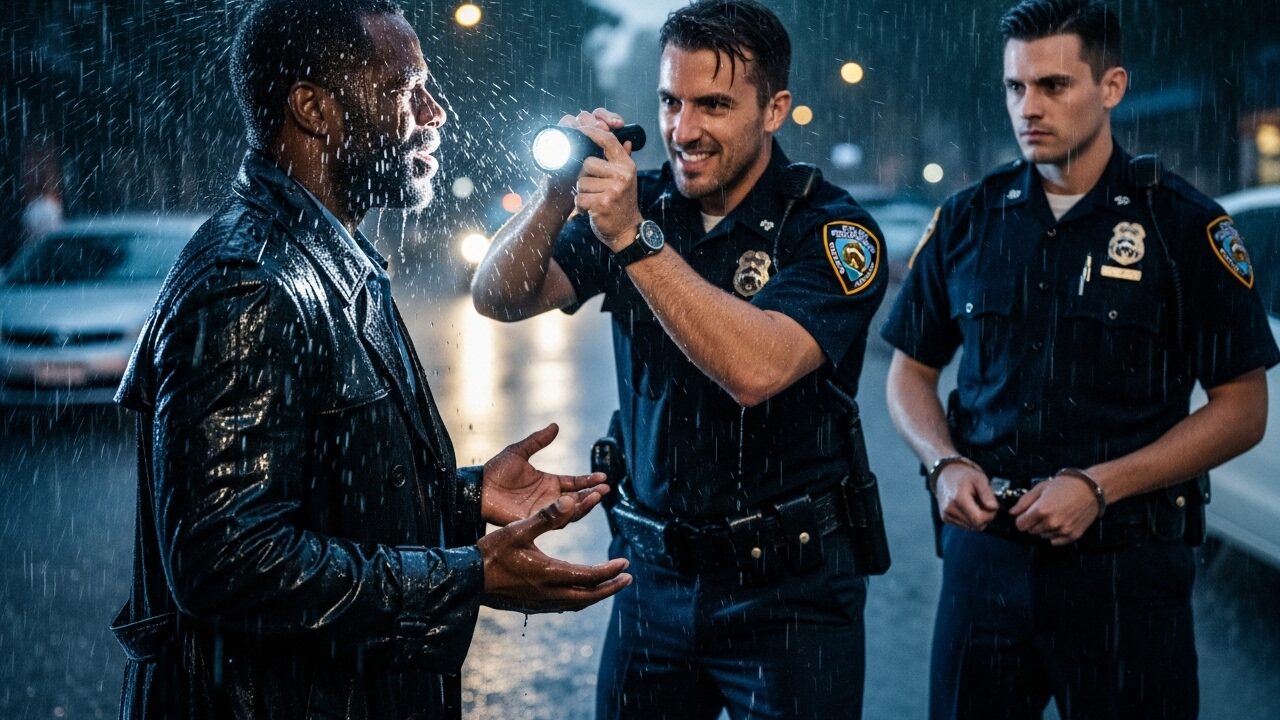
“They Laughed While Kicking My Knees Out in the Mud, Calling Me ‘Boy.’ They Thought I Was Just Another Statistic to Process Before Their Shift Ended. They Had No Idea That the Woman Racing Toward Us in a Government SUV Was the One Person Who Could End Their Careers with a Single Phone Call.”

Chapter 1: The Weight of the Blue Lights
The rain wasn’t just falling; it was punishing the asphalt of Route 42, a cold, needle-like drizzle that blurred the world into a smear of grey and charcoal. I gripped the steering wheel of my 2012 Chevy Silverado—a truck I’d rebuilt with my own two hands, bolt by bolt—and felt the familiar ache in my lower back. At fifty-four, twelve-hour shifts at the shipyard didn’t sit as lightly as they used to. My name is Elias Thorne. To the guys at the yard, I’m the man who can fix a turbine with a paperclip and a prayer. To the world outside those gates, however, I’ve learned that I am often something much simpler, and much more dangerous.
I was three miles from home, already tasting the leftover beef stew Maya had promised was in the fridge, when the blue and red lights exploded in my rearview mirror.
My heart didn’t race. It didn’t pound. It sank. It was a heavy, leaden feeling I’d carried since I was seventeen years old—the quiet, instinctual preparation for a ritual I knew all too well. I didn’t pull over immediately; I waited for a well-lit patch of road near a closed gas station. I knew the rules. Don’t give them a reason to say you were hiding. Don’t give them a reason to say it was dark.
I rolled down all four windows before the truck even came to a complete stop. I turned on the dome light. I placed my hands—large, oil-stained, and trembling only slightly—on the top of the steering wheel.
“Stay calm, Elias,” I whispered to the empty cabin. “Think about Maya. Think about her graduation. Just get home.”
The headlights of the cruiser behind me were blinding, casting a long, distorted shadow of my truck onto the wet pavement. I heard the car doors creak open. Two sets of footsteps. One heavy and rhythmic, the other lighter, faster—the sound of someone with something to prove.
The lighter footsteps reached my driver’s side window first. A flashlight beam cut through the rain, hitting me square in the eyes. I didn’t squint. I didn’t turn away. I stared straight ahead at the dashboard.
“License, registration, and proof of insurance,” a voice snapped. It was young, thin, and edged with an unearned arrogance.
“Officer, my wallet is in my back right pocket,” I said, my voice low and steady, the ‘professional’ voice I used when dealing with the white foremen at the yard. “I am going to reach for it now. Is that alright?”
“Just do it. And keep the other hand where I can see it.”
I moved like I was underwater—slow, deliberate, telegraphed. I handed over the documents. The officer snatched them. He was young, maybe mid-twenties, with a high-and-tight haircut that looked like it had been carved with a protractor. His name tag read Miller. Beside him, leaning against the frame of my truck with a casualness that felt like a threat, was an older man. Henderson.
Henderson didn’t look at my license. He looked at the interior of my truck. He looked at the small, faded photograph of my late wife, Sarah, tucked into the sun visor. He looked at me with a tired, cynical disdain that suggested he’d already decided who I was before I’d even pulled over.
“You know why we pulled you over, Mr. Thorne?” Miller asked, flipping through my registration.
“I don’t, Officer. I was maintaining the speed limit, and my lights are all functional.”
Miller let out a short, sharp laugh that sounded like a bark. He leaned in closer, the smell of cheap peppermint and stale coffee wafting off him. Underneath the peppermint, there was something sharper—the faint, acrid scent of bourbon. My stomach turned. A nervous cop is dangerous; a drinking cop is a landmine.
“You ‘maintain’ whatever you want, but you crossed the yellow line back there about three times,” Miller said. “And you’ve got a tail light that’s flickering. Looks like a safety hazard to me.”
“I checked those lights this morning, Officer. They’re fine.”
“You calling me a liar?” Miller’s voice rose an octave.
“No, sir. I’m just stating a fact.”
Henderson finally spoke. His voice was gravelly, the sound of forty years of cigarettes and disappointment. “Step out of the vehicle, Thorne.”
“Is there a problem, Officer?” I asked, my grip tightening on the steering wheel despite myself.
“The problem is I don’t like your tone,” Henderson said, stepping forward. He was a heavy-set man, his uniform straining against a gut that spoke of a thousand precinct donuts. But his eyes were cold. “And I don’t like the way you’re sitting there like you own the damn road. Get out. Now.”
I opened the door. The cold rain hit me instantly, soaking through my work shirt. As I stepped down, Miller grabbed my arm. He didn’t just lead me; he wrenched me toward the back of the truck.
“Spread ’em. Hands on the tailgate.”
I obeyed. I felt the cold metal of my truck under my palms. I felt the rain running down the back of my neck. And then, I felt the boots.
Miller kicked my feet apart, wider than necessary, causing me to stumble. Henderson laughed—a dry, hacking sound.
“Easy there, Miller,” Henderson chuckled. “Don’t want him to break a hip before we find what he’s hiding.”
“What am I hiding, Officer?” I asked, my face pressed toward the wet metal. “I’m a mechanic. I’m coming home from the yard.”
“Yeah, you all have a ‘job’ when we pull you over,” Miller spat. He started patting me down, his hands rough and invasive. He went through my pockets, tossing my house keys and a pack of gum into the mud. When he reached my front pocket, he pulled out my cell phone.
“Who’s ‘M-Bear’?” he asked, looking at the lock screen. It was a photo of Maya from her law school graduation, beaming in her cap and gown.
“That’s my daughter,” I said, a spark of heat finally breaking through my fear. “Her name is Maya. And I’d appreciate it if you put that phone back.”
Miller looked at the photo, then at me, then back at the photo. He smirked. “Law school, huh? She probably thinks she’s one of the good ones. Probably thinks she can sue her way out of the neighborhood.”
“She’s a District Attorney,” I said, my voice trembling with a mix of pride and terror. “She works for the city. If you call her, she’ll tell you exactly who I am.”
The silence that followed was heavy. Miller looked at Henderson. Henderson’s expression didn’t change, but he shifted his weight. For a second, I thought I saw a flicker of hesitation. But then, the arrogance returned, doubled.
“A DA?” Miller laughed, louder this time. He dropped my phone. It hit the muddy asphalt with a sickening crack. “And I’m the King of England. You think I’m stupid? You think a girl like that comes from a guy like you? You probably stole this phone, Thorne. Probably stole this truck, too.”
“I didn’t steal anything,” I said, trying to turn my head.
Miller slammed his forearm into the back of my neck, pinning my face against the tailgate. “Don’t move! You’re resisting! I felt you tense up! Henderson, he’s resisting!”
“I saw it,” Henderson said calmly, though he hadn’t moved a muscle. He reached for his belt and unclipped his handcuffs.
“Please,” I gasped, the air leaving my lungs. “I’m not doing anything. Just check my ID again. Call the yard. Call the station.”
“Shut up,” Miller hissed in my ear. “You people always have a story. You always have a daughter who’s a doctor or a lawyer or a saint. But at the end of the day, you’re just a guy in an old truck who couldn’t stay in his lane.”
He pulled my arms behind my back. The ratcheting sound of the handcuffs was the loudest thing in the world. They were too tight—intentionally so. The metal bit into my wrists, cutting off the circulation.
“Down on your knees,” Miller commanded.
“It’s mud, Officer. I have bad knees—”
Miller didn’t wait. He kicked the back of my right knee. I collapsed. My jeans soaked up the filthy rainwater. I sat there, cuffed, humiliated, in the dirt of a roadside gas station, while two men with badges laughed at the “Attorney’s father.”
“You know what’s funny, Thorne?” Henderson said, leaning over me, his shadow blotting out the streetlights. “My daughter doesn’t talk to me anymore. She moved to California to be a ‘wellness coach.’ Thinks I’m a dinosaur. Thinks the world is all sunshine and rainbows. And then I see guys like you, and I realize she’s wrong. The world is exactly what I think it is.”
He spit on the ground next to my knee.
“Miller, toss the truck,” Henderson ordered. “I bet there’s something in there. A baggy, a piece… something to make this worth the paperwork.”
“With pleasure,” Miller said, heading for the driver’s side door.
I closed my eyes. I thought about Sarah. I thought about how she used to tell me that my silence was my strength. But as I heard Miller tossing my glove box, throwing my manuals and my daughter’s old school drawings onto the floor, I didn’t feel strong. I felt erased.
I didn’t know then that the GPS on my phone—the one Miller had dropped in the mud—was still active. I didn’t know that Maya, who checked my location every night to make sure I made it home from the late shift, was currently watching a little blue dot hover motionless on Route 42.
And I didn’t know that she was already in her car, her heart racing faster than mine ever could, with a legal ID in her pocket that carried more weight than both of these officers’ badges combined.
I just sat in the rain and waited for the next blow.
Chapter 2: The Echo of a Lifetime
The mud of Route 42 didn’t just feel like dirt and water; it felt like a weight, a physical manifestation of every heavy thing I had ever carried. As I sat there on my knees, my wrists burning in the bite of those steel cuffs, I realized that the rain had a specific sound when you were at the bottom of the world looking up. It wasn’t a pitter-patter. It was a rhythmic thud, like a thousand tiny hammers trying to drive me deeper into the earth.
“Found something!” Miller’s voice rang out from the cab of my truck, sharp and triumphant.
My heart didn’t even jump. It was too tired. I watched through the haze of the downpour as Miller emerged from the driver’s side, holding a small, weathered leather pouch. He looked like a kid who’d just found the golden ticket. He walked over to where Henderson stood over me, his face lit by the strobing blue lights.
“Look at this, Sarge. Hidden right under the seat.”
Henderson took the pouch with a gloved hand. He unzipped it slowly, deliberately, letting the tension build. He pulled out a set of precision calipers, a micrometer, and a small, well-maintained feeler gauge. My tools.
“What is this, Thorne?” Henderson asked, his voice dropping into that low, dangerous register of a man looking for a reason to escalate. “Looks like burglary tools to me.”
“They’re for the shipyard,” I said, my voice cracking slightly from the cold. “I’m a senior turbine technician. Those are precision instruments for measuring tolerances on ship engines. They cost me three weeks’ pay.”
Miller let out a short, mocking whistle. “’Precision instruments.’ That’s a fancy way of saying ‘lock picks’ and ‘shims,’ isn’t it? You use these to get into places you aren’t supposed to be?”
“I use them to make sure the ships our Navy relies on don’t sink in the middle of the Atlantic,” I replied. I shouldn’t have said it. I knew the moment the words left my mouth that I had bruised his ego.
Miller stepped closer, his boot sinking into the mud just inches from my hand. “You got a lot of lip for a guy in the dirt. You think because you work on a boat, you’re better than the men holding the line out here?”
I looked up at him. Really looked at him. Underneath the uniform and the bravado, Miller was hollow. He had the eyes of someone who had never been told ‘no’ until he put on a badge, and now he used that badge to make sure he never heard it again. Henderson, though—Henderson was different. He was the one who worried me. He didn’t have Miller’s frantic energy. He had a stillness, a calculated cruelty that suggested he had seen the worst of humanity and had decided to join its ranks.
“Miller, check the back,” Henderson said, ignoring my explanation. “Check the toolbox in the bed.”
As Miller stomped away, a chime rang out from the gas station behind us. The ‘Open’ sign flickered. A young woman stepped out onto the curb, huddled under a thin hoodie. This was Cassidy Vance. I knew her, though she probably didn’t remember me. I’d helped her change a flat in this very parking lot three months ago. She was twenty-two, working the graveyard shift to pay for community college, and she had the kind of nervous habit of biting her lip that made her look even younger than she was.
She stood there, frozen, her eyes wide as she saw me—a man she knew to be kind—cuffed and kneeling in the mud like a criminal.
“Is… is everything okay?” she called out, her voice barely audible over the wind.
Henderson turned his head. The movement was slow, predatory. “Go back inside, miss. We’re conducting official police business.”
“I… I know him,” Cassidy said, her voice trembling but holding. “That’s Mr. Thorne. He’s a regular. He’s a good man.”
Henderson took a step toward her. He didn’t draw his weapon, but he rested his hand on his belt in a way that was meant to intimidate. “I’m going to say this once. This is an active investigation. If you interfere, I’ll have to take you in for obstruction. Do you want to spend your night in a holding cell, or do you want to stay dry inside?”
Cassidy looked at me. I could see the battle in her eyes—the desire to do the right thing clashing with the primal fear of a system that didn’t care about the truth. I gave her a tiny, almost imperceptible shake of my head. Don’t do it, kid. Don’t let them break you too.
She bit her lip, her eyes brimming with tears, and stepped back inside. The door clicked shut, but I could see her silhouette through the glass, her phone held up to her ear.
“Bitch,” Henderson muttered under his breath, turning back to me.
Suddenly, a loud CLANG echoed from the back of my truck. Miller had thrown my heavy-duty steel toolbox onto the pavement. It hadn’t just fallen; he had dumped it. Hundreds of tools—wrenches, sockets, screwdrivers, parts I had collected over thirty years—spilled into the mud.
“Nothing but junk back here, Sarge!” Miller shouted. He started kicking through the tools, his heavy boots grinding my expensive Craftsman ratchets into the grit. “Wait… what’s this?”
He reached into the pile and pulled out a small, crumpled manila envelope. My heart stopped. I knew exactly what was in that envelope. It wasn’t drugs. It wasn’t a weapon.
Miller walked over, grinning. He opened the envelope and pulled out a stack of cash. It was about four thousand dollars, bound by a thick rubber band.
“Well, well,” Miller said, waving the money in front of my face. “A ‘mechanic’ with four grand in cash tucked away in his toolbox? What’s the matter, Thorne? The shipyard paying under the table, or is this the weekend’s take from the corner?”
“That is for my daughter’s bar exam prep and her first month’s rent on her office,” I said, the words coming out in a rush. “I’ve been saving that for two years. Every overtime hour, every side job. That money is documented. I have the bank receipts in the glove box.”
“I didn’t see any receipts,” Miller said, his smile widening. He looked at Henderson. “Did you see any receipts, Sarge?”
“Not a one,” Henderson said. He reached out and took the money from Miller. He didn’t put it in an evidence bag. He put it in his pocket.
“That’s my daughter’s future!” I yelled, trying to stand up.
Miller’s hand came down hard on my shoulder, shoving me back down. “It’s evidence in a suspected narcotics distribution case now. You can explain it to the judge—if you ever see one.”
The injustice of it hit me like a physical blow. I had worked myself to the bone. I had survived the loss of my wife, the lean years of the recession, and the constant, grinding pressure of being a Black man in a town that preferred me invisible. I had done everything ‘right.’ I had raised a daughter who was the pride of the community. And in ten minutes, these two men were dismantling it all for sport.
I thought about Maya. I remembered the day she got her acceptance letter to Harvard Law. We had sat on the porch of our small house, the same house I had finally paid off last year, and she had cried on my shoulder.
“I’m going to change things, Pop,” she’d told me. “I’m going to make sure the law works for everyone, not just the people with the right names.”
And I had laughed, patting her head. “Just make sure you stay safe, Maya-Bear. The law is a shield, but some people use it like a hammer.”
Now, the hammer was falling on me.
“Get him up,” Henderson said, his voice bored. “We’re taking him in. We’ll tow the truck. Miller, call the yard. Tell them we’ve got a 10-15. Suspicion of DUI, resisting, and possession of proceeds from illegal activity.”
“I’m not under the influence!” I protested. “Take my blood! Do a breathalyzer!”
“We’ll do it at the station,” Miller said, grabbing my arm and hauling me to my feet. He leaned in close, his breath hot against my ear. “And by the time we get there, you’re going to be so ‘stumbly’ that the camera won’t matter. You’re going away for a long time, old man. We need to clear some stats this month, and you just volunteered.”
As they dragged me toward the cruiser, I looked down at the mud. There, lying face-down in the puddle, was my phone. The screen was cracked, but as a car passed by on the highway, its headlights caught the glass. For a split second, I saw a notification glow.
Maya (10:42 PM): Pop, why aren’t you moving? You’re still on 42. Is the truck okay?
Maya (10:44 PM): Pop, I’m calling you. Answer the phone.
Maya (10:46 PM): I’m coming to you. Stay put.
A surge of hope, followed immediately by a wave of pure terror, washed over me. Maya was coming. She was coming into this storm, into this confrontation with two men who were currently high on the adrenaline of their own power. She was a DA, yes. She had power, yes. But out here, on a dark stretch of Route 42, she was just another person who might get in their way.
“Please,” I said, stopping at the door of the cruiser. “My daughter. She’s coming. Just wait for her. She’ll explain everything.”
Henderson laughed as he pushed my head down to get me into the back seat. “I told you, Thorne. We don’t care about your imaginary daughter. We don’t care about your stories. You’re just another name on a sheet.”
He slammed the door. The interior of the cruiser smelled of vinyl, disinfectant, and the lingering scent of Miller’s bourbon. I was trapped in a cage of wire and glass.
Through the window, I watched as Miller began to hitch my truck to the back of the police cruiser with a heavy chain, uncaring that he was scratching the custom paint job I’d spent months perfecting. They were taking everything. My dignity, my money, my vehicle, my freedom.
But then, in the distance, I saw it.
Two bright white LED headlights, far more powerful than the standard yellow beams of the local cars, were tearing down the highway. They weren’t swaying. They weren’t slowing down for the rain. They were moving with a singular, violent purpose.
A black government-issued SUV roared into view, its tires screaming as it drifted across the wet lanes and screeched to a halt, blocking the police cruiser’s path.
Miller stopped what he was doing, his hand going to his holster. Henderson straightened up, shielding his eyes from the high beams.
“Who the hell is this?” Miller yelled.
The door of the SUV swung open. A woman stepped out. She didn’t have an umbrella. She didn’t have a jacket. She was wearing a professional charcoal suit that cost more than Miller’s car, and her face was a mask of cold, concentrated fury.
It was Maya.
And in that moment, as she walked toward the two officers with her badge clipped to her belt and a legal folder gripped in her hand like a weapon, I realized that I wasn’t the one who should be afraid anymore.
Henderson and Miller had spent the last hour treating me like I was nothing. They were about to find out that I was everything to the most powerful woman in the county.
“Get your hands off my father,” Maya’s voice cut through the rain like a gunshot.
Henderson sneered, not yet realizing the cliff he was standing on. “Lady, back off. This is a crime scene. You’re interfering with—”
“I’m Maya Thorne,” she said, stepping into the light, her eyes locking onto Henderson’s with a ferocity that made him take a half-step back. “I am the Lead Senior Prosecutor for this District. And if you don’t unlock that cruiser in the next five seconds, the ‘crime scene’ we’re going to be investigating is the end of your career.”
The silence that followed was broken only by the sound of the rain and the clicking of my truck’s cooling engine. The power dynamic hadn’t just shifted; it had inverted.
But I knew men like Henderson. Men who had been kings of their small hills for too long. They didn’t go down without a fight. And as I watched Henderson’s hand tighten on his belt, I knew Chapter 2 was just the beginning of a war that would leave no one unscarred.
Chapter 3: The Scales of Power
The rain was a cold, grey curtain, but Maya Thorne walked through it like she was forged in fire. I watched from the back of that cruiser, my face pressed against the cold glass, as my daughter became something I had never seen before. To me, she was the little girl who used to hide her peas under her mashed potatoes and cry when she saw a bird with a broken wing. But as she stood under the flickering halogen lights of the gas station, she was a titan.
She didn’t run to me. Not yet. She knew the game. She knew that if she showed too much emotion, these men would use it as a weapon—call her hysterical, call her biased. She stayed ten feet away, her feet planted, her eyes like twin emerald lasers cutting through the gloom.
“Officer Miller. Officer Henderson,” she said, her voice projecting with a clarity that the wind couldn’t touch. “I believe you’re familiar with the District Attorney’s office. I’m the one who decides which of your arrests actually make it to a courtroom. And right now, I’m looking at a scene that isn’t going to make it past a preliminary hearing. In fact, it’s going to end in a civil rights lawsuit that will bankrupt this precinct.”
Miller, the young one, looked like he’d been slapped. He glanced at Henderson, looking for a cue. His hand was still hovering near his holster, a habit of a man who used fear to bridge the gap of his own incompetence.
Henderson didn’t flinch. He was a career shark. He took a slow, deliberate puff of a cigarette he’d lit despite the rain, the cherry glowing a defiant red. “Ms. Thorne,” he said, his voice a low growl. “I don’t care if you’re the Pope. We have a suspect in custody for a suspected DUI, reckless driving, and suspicious activity involving a large sum of undeclared cash. The law applies to everyone. Even your ‘Pop.’”
“You haven’t administered a breathalyzer,” Maya countered instantly. “I’ve been watching your body cams—or at least, I’ll be watching them in an hour when I subpoena the footage. I know you haven’t performed a field sobriety test. And that ‘undeclared cash’ is personal property that was stored in a locked container within a private vehicle. On what grounds did you search that toolbox, Officer? Did my father give consent? Was there a warrant? Or was there ‘plain view’ of a steel box?”
“He was resisting,” Miller piped up, his voice cracking slightly. “He lunged at us.”
I felt a surge of hot, bitter anger. I hadn’t lunged. I hadn’t even stood up straight. I looked at Maya, hoping she could see the lie in his eyes.
Maya turned her gaze to Miller. It was the look a biologist gives a particularly unpleasant specimen. “Officer Miller, you’re twenty-four years old. You’ve been on the force for eighteen months. Your record shows three disciplinary actions for excessive force and one for ‘unprofessional conduct’ during a traffic stop in the Heights. If you lie to me—a lead prosecutor—on a recorded scene, I won’t just have your badge. I’ll ensure you never work in security for a grocery store for the rest of your life.”
She held up her phone. She wasn’t just tracking me; she was recording.
At that moment, another set of lights appeared. A second cruiser pulled in, much slower this time. Out stepped Officer Sarah Jenkins. I knew Sarah. She was a white woman in her late thirties, a mother of two who often bought coffee for the guys at the shipyard when she was on the morning beat. She was one of the ‘good ones,’ or so I’d always told myself. She looked at the scene—the tilted truck, the tools scattered in the mud, me in the back of the car, and Maya standing like a vengeful goddess—and her face paled.
“Henderson? What’s going on?” Sarah asked, her voice cautious. She looked at Maya. “Ms. Thorne? Why are you out here?”
“I’m out here, Sarah, because your partners have my father in handcuffs in the back of a cruiser after assaulting him and illegally searching his vehicle,” Maya said.
Sarah looked at me through the window. Our eyes met for a second. In that moment, I saw her conflict. She knew Henderson was a bully. She knew Miller was a loose cannon. But she also knew the ‘Blue Wall.’ She knew that if she spoke up against them, her life in the precinct would become a living hell.
“He was erratic, Jenkins,” Henderson said, trying to reclaim the narrative. “Suspected 10-31. We found four grand in cash. He couldn’t explain it.”
“I explained it!” I yelled from the back seat, though the glass muffled my voice.
Maya ignored Henderson and stepped toward Sarah. “Sarah, you know me. You know I don’t play games with the law. Look at my father. Look at the mud on his face. Look at his tools—those are his livelihood—thrown in the dirt like trash. Does this look like a professional arrest to you? Or does this look like two men who thought they could break an old Black man because they didn’t think anyone was watching?”
Sarah Jenkins looked at the ground. She looked at the tools. Then, she did something I didn’t expect. She walked over to the mud, picked up a heavy pipe wrench, and wiped the grime off it with her sleeve. She looked at Henderson.
“His truck is a 2012 Chevy, Bill,” Sarah said quietly. “He’s a shipyard tech. They make good money, but they work for it. Four thousand dollars isn’t a drug haul. It’s a savings account.” She turned to Miller. “And Miller, if you didn’t call for a supervisor before putting a man of his age in the dirt, you broke protocol. Again.”
“I don’t need a lecture from you, Jenkins!” Miller snapped.
“No,” Maya interrupted, her voice dropping to a whisper that felt more dangerous than a scream. “You need a lawyer. Because here is what’s going to happen. Sarah, you are going to witness that I am requesting the immediate release of Elias Thorne. You are going to witness that I am documenting the theft of four thousand dollars which is currently in Officer Henderson’s pocket—not an evidence bag. And you are going to witness the fact that Officer Miller is currently under the influence of alcohol while on duty.”
The world seemed to stop. Miller froze. Henderson’s cigarette fell from his lips.
“I smelled it when I walked up,” Maya said, stepping into Miller’s personal space. She was shorter than him, but she seemed to tower over him. “Bourbon. High-end, maybe, but bourbon nonetheless. Sarah, smell him.”
Sarah Jenkins hesitated, then took a step toward Miller. Miller backed away, his face turning a ghostly shade of white.
“I… I had a drink with dinner,” Miller stammered. “It was hours ago.”
“You’re on a midnight shift, Miller,” Maya said. “There is no ‘hours ago.’ You are armed, you are in a state vehicle, and you are currently infringing on the constitutional rights of a citizen while intoxicated. That’s a felony.”
Henderson saw the ship sinking. He was a rat, and rats know when to jump. He reached into his pocket, pulled out the bundle of cash, and tossed it onto the hood of my truck.
“It was for safe keeping,” Henderson said, his voice devoid of its earlier bravado. “We hadn’t logged it yet. Look, Thorne, maybe there was a misunderstanding. The rain, the visibility… it’s a high-crime corridor. We’re all on edge.”
“A misunderstanding?” Maya asked. She finally walked to the cruiser door. She didn’t wait for them to open it. She looked at Henderson until he slowly, begrudgingly, reached out and unlocked the door.
Maya opened the door and reached in. She took my cuffed hands in hers. Her fingers were warm, and they were shaking—not with fear, but with a rage so profound I could feel it vibrating through her skin.
“Keys,” she said to Henderson.
Henderson handed them over. Maya unlocked the cuffs. As the metal fell away, the blood rushed back into my hands with a painful, stinging heat. I stepped out of the car, my legs weak. I almost fell, but Maya caught me. She put my arm around her shoulder, her small frame supporting my bulk.
“You okay, Pop?” she whispered.
“I’m okay, Maya-Bear,” I croaked. “I’m okay.”
But I wasn’t. I looked at my truck—the truck I’d spent years keeping perfect—now hooked to a tow line, its contents spilled in the mud. I looked at the two men who had treated me like a dog. And I looked at Sarah Jenkins, who was standing there with my wrench, a look of profound shame on her face.
“We’re leaving,” Maya said. “Sarah, I expect a full, unredacted report of this incident on my desk by 8:00 AM. If Henderson’s name isn’t on it as the primary supervisor who allowed an intoxicated officer to perform a stop, I will include you in the obstruction charges.”
“Maya, wait,” Henderson said, his voice sounding desperate now. “We can talk about this. No need to blow this up. We’re all on the same team, right? The law-and-order team?”
Maya stopped. She turned her head slowly to look at him.
“My father spent thirty years building things,” she said. “He built ships. He built a home. He built a daughter who believes in the law. You? You spend your life breaking things. You break trust. You break families. You break the very rules you swore to protect because you think the color of your skin and the shape of your badge makes you a god.”
She pointed at the mud.
“Pick up his tools, Officer Henderson.”
Henderson blinked. “What?”
“You heard me. You and Miller. Pick up every single wrench, every socket, every bolt. Clean the mud off them. Put them back in the box. If there is a single scratch on his truck or a single tool missing, I will personally prosecute the theft and vandalism charges. Now. Get. To. Work.”
For a long minute, no one moved. The rain hammered down. Then, slowly, painfully, the ‘great’ Officer Henderson knelt in the mud. He reached out and picked up a screwdriver. Miller followed suit, his hands trembling.
I stood there, leaning on my daughter, watching two men who had tried to erase me spend the next forty-five minutes on their hands and knees in the dirt, cleaning the tools of a man they called ‘boy.’
It was a victory. But as we sat in Maya’s SUV, watching them through the windshield, I saw the look in Maya’s eyes. She wasn’t celebrating. She was mourning. She had seen the ugliness of the world she worked in, and she knew that while she saved me tonight, there were a thousand other fathers who didn’t have a daughter with a badge.
“Maya,” I said softly.
“Don’t, Pop,” she said, her voice breaking. “Don’t tell me it’s okay. It’s not okay. It’s never been okay.”
She put the car in gear and pulled away, leaving the blue lights and the mud behind. But the silence in the car was heavier than the storm outside. We were going home, but the world we were returning to felt different now. The cracks were showing, and the darkness was deeper than I ever imagined.
And Henderson? As he watched our taillights fade, he didn’t look like a man who had learned a lesson. He looked like a man who was counting the days until he could get even.
Chapter 4: The Price of Silence and the Weight of Truth
The drive home was conducted in a silence so thick it felt like a third passenger in the SUV. Maya’s hands were clamped onto the steering wheel at ten and two, her knuckles white against the dark leather. I watched the rain-slicked trees of our suburb blur past, my mind trapped in a loop of the sound of those handcuffs ratcheting shut. Every time I closed my eyes, I felt the grit of the gas station pavement against my cheek.
We pulled into our driveway—a modest, well-kept patch of grass in a neighborhood that worked hard to stay quiet. Maya killed the engine, but she didn’t get out. She just stared at the garage door.
“I’m sorry, Pop,” she whispered. It was the first thing she’d said since we left the gas station.
“For what, Maya-Bear? You saved me.”
“I’m sorry you had to be saved,” she said, her voice cracking. “I’m sorry that thirty years of being a good man, a taxpayer, a father… I’m sorry none of that mattered to them until they saw my badge. It shouldn’t take a DA’s daughter to get a man off the ground.”
I reached over and placed my hand on hers. My wrists were swollen, the skin purple and angry. When she saw them, a single tear tracked through the makeup on her cheek. I didn’t have the words to tell her that this wasn’t her burden to carry, because we both knew that in this country, the burden is shared whether you want it or not.
The next morning, the sun rose with a cold, mocking brightness. I woke up to the smell of coffee and the sound of Maya’s “work voice” coming from the kitchen. She was on her cell phone, her tone sharp and clinical.
“No, Robert. I don’t care about the union’s ‘cooling off’ period. I have Miller on video with slurred speech and a clear scent of alcohol. I have Henderson admitting to holding four thousand dollars in personal funds without a voucher. This isn’t a training issue. It’s a criminal one.”
She was talking to Robert Sterling. I knew the name. He was the District Attorney, Maya’s boss, and a man who had spent forty years navigating the treacherous waters of city politics. Robert was white, old-money, and held a reputation for being “fair but pragmatic”—which was often code for “not making waves.”
An hour later, there was a knock at our door. It wasn’t the police. It was a silver Lexus. Out stepped Robert Sterling. He looked exactly like a DA from a movie—grey hair perfectly swept back, a charcoal suit that looked ironed by a laser, and eyes that had seen too many crime scenes to be easily shocked.
I opened the door, and for a moment, we just looked at each other. There was a profound awkwardness in the air. He saw my bruised wrists. He saw the way I favored my left leg where Miller had kicked me.
“Mr. Thorne,” he said, extending a hand. His grip was firm, but his eyes were shadowed with a genuine, weary regret. “I’m Robert Sterling. I am deeply sorry for the events of last night.”
“Come in, Mr. Sterling,” I said, stepping aside.
Maya joined us in the living room. She didn’t offer him coffee. She sat on the edge of the armchair like a hawk ready to dive.
“I’ve seen the preliminary statements, Maya,” Robert said, sitting on our sofa. He looked around our home—at the photos of Maya’s graduation, the oil paintings Sarah had done before she passed, the bookshelves filled with history and law. He was seeing the “humanity” that Henderson and Miller had chosen to ignore. “Henderson is claiming a ‘high-stress environment’ and ‘misinterpreted movements.’ He’s already got the Union reps drafting a defense.”
“And Miller?” Maya asked.
“Miller is a problem,” Robert admitted, rubbing his temples. “He’s young. His father is a retired Captain in the 4th District. There’s a lot of pressure to let him resign quietly, maybe take a desk job in another county after a six-month suspension.”
Maya stood up so fast the chair creaked. “A desk job? Robert, he was drunk. He assaulted a civilian. He tried to fabricate a drug charge. If I did that, I’d be in a cell. If my father did that, he’d be under the prison.”
Robert sighed, a long, heavy sound. “Maya, I agree with you. But you know how this works. If we go for the throat, the police union will slow-walk every case we have on the docket. They’ll stop testifying. They’ll stop making arrests in the districts we need them most. Is one night of injustice worth a city-wide standstill?”
I watched my daughter. I saw the fire in her, the part of her that wanted to scream. But I also saw the weight of her ambition and her responsibility. She wanted to change the system, but the system was telling her to play ball.
I cleared my throat. Both of them looked at me.
“Mr. Sterling,” I said quietly. “I’m a mechanic. I spend my days looking for the part of the machine that’s broken. Usually, it’s a small gear. Sometimes it’s just a bit of rust. But if you leave that rust there because you’re afraid to take the engine apart, eventually, the whole ship sinks. It doesn’t matter how fast you’re going or how many flags you’re flying. You will sink.”
I looked him straight in the eye.
“Those men didn’t just hurt me. They tried to steal the future I built for my daughter. They tried to take that four thousand dollars—money I earned in twelve-hour shifts in the heat of a shipyard—and turn it into a lie. If you let them walk, you aren’t ‘keeping the peace.’ You’re just letting the rust spread.”
Robert Sterling looked at me for a long time. He looked at his hands, then back at Maya. The pragmatism in his eyes flickered, replaced by something older, something more fundamental.
“I lost a brother to a drunk driver twenty years ago,” Robert said softly, his voice losing its polished edge. “The cop who processed the scene was a friend of the driver. The breathalyzer ‘malfunctioned.’ I went into law because I thought I could stop that from happening again. Somewhere along the way, I started worrying more about the budget and the headlines than the law.”
He stood up and straightened his jacket.
“Maya, file the charges. Aggravated assault, official misconduct, and for Miller, DUI and Falsifying Official Documents. I’ll handle the Union. If they want a war, they can have one. But they won’t have it on the back of a man like Elias Thorne.”
The weeks that followed were a blur of depositions, phone calls, and the heavy, suffocating feeling of being watched. Sarah Jenkins, the officer who had picked up my tools, became the fulcrum of the entire case.
I met her once more, two weeks before the internal hearing. She asked to meet at a diner three towns over, away from the prying eyes of the precinct. She looked tired. There were dark circles under her eyes, and she kept looking at the door every time it opened.
“They’re making my life hell, Elias,” she said, her voice a whisper. “Someone keyed my car. My locker was filled with dead fish. Even the guys I thought were my friends… they won’t sit with me in the breakroom. They call me a ‘rat.’”
“Why do it then, Sarah?” I asked. “You could have just written a standard report. You could have stayed silent.”
She reached into her purse and pulled out a photo. It was two little boys, maybe six and eight, grinning in soccer uniforms.
“My oldest, Leo… he asked me what I did at work the other day. He asked if I caught any bad guys. And I realized that if I didn’t speak up, the ‘bad guys’ were sitting in the car right next to me. I don’t want my boys growing up in a world where they’re afraid of the people who are supposed to protect them. And I don’t want them growing up to be like Miller.”
She looked at me, her eyes brimming with a desperate kind of courage. “I’m going to testify. I’m going to tell them everything. I’m going to tell them Henderson told us to ‘find a reason’ to stop you because you looked ‘out of place.’”
“Thank you, Sarah,” I said.
“Don’t thank me,” she replied. “Just… tell your daughter to win. If she loses this, I’m done. My career is over, and those men will be untouchable.”
The hearing was held in a windowless room in the basement of City Hall. It felt more like a funeral than a legal proceeding. Henderson sat on one side, flanked by three lawyers from the Union. He looked smug, like he knew a secret we didn’t. Miller sat next to him, looking smaller than I remembered, his father—the retired Captain—sitting right behind him, glaring at Maya like she was the criminal.
Maya was brilliant. She didn’t use flowery language. She didn’t lean on emotion. She let the evidence speak. She played the dashcam footage—the part where Miller kicked my knee. She played the audio where Henderson laughed about his daughter not talking to him.
But the “knockout blow” came when she produced a piece of evidence no one expected.
“Officer Miller,” Maya said, standing in front of the rookie. “You claimed in your supplemental report that my father ‘lunged’ at you, which justified the use of force. Correct?”
“Yes,” Miller said, his voice rehearsed. “I felt threatened.”
“And Officer Henderson, you corroborated this in your signed statement?”
“I saw what I saw,” Henderson said, leaning back.
Maya smiled. It was a cold, dangerous smile. “Then perhaps you can explain this.”
She tapped a button on her laptop. A new video appeared on the screens. It wasn’t from a police car. It was grainy, black and white, and angled from high above.
“This is the security footage from the gas station,” Maya said. “The cameras that Officer Henderson told the attendant were ‘broken’ and ‘didn’t need to be checked.’ Luckily, the owner of the station, a Mr. Aris Thorne—no relation, but a man who values the truth—had a secondary cloud-based backup that doesn’t rely on the on-site DVR.”
The video showed the entire stop from the side. It showed me standing still with my hands on the truck. It showed Miller walking up and, without a word, kicking my legs out from under me. There was no lunge. There was no resistance. It was a cold-blooded assault.
The room went silent. I looked at Henderson. For the first time, the smugness was gone. He looked at the screen, then at Miller’s father, who had turned his head away in shame.
“But that’s not all,” Maya said. She played the audio from the gas station’s outdoor intercom, which stayed on during the night shift.
“Just hit him, Miller,” Henderson’s voice rang out through the speakers, clear as a bell. “He’s a nobody. Who’s he gonna tell? Make it look like he resisted. We need the ‘suspicious cash’ to stick so I can pay off that alimony this month.”
The sound of the room’s collective gasp was like a physical wave. Henderson stood up, his chair clattering back. “That’s a fabrication! That’s been edited!”
“It’s a certified digital record, Bill,” Robert Sterling said from the back of the room, his voice booming. “And it’s enough to send you to state prison for Racketeering and Civil Rights violations.”
The aftermath was swifter than I expected. Henderson didn’t just lose his badge; he was indicted on four felony counts. He’s currently awaiting trial, and word is the Union has completely pulled his funding. He’s been forced to sell his house to pay for a private lawyer who doesn’t even like him.
Miller was fired and charged with DUI and Assault. Because of his father’s connections, he got a plea deal—three years’ probation and a permanent ban from law enforcement. It wasn’t the prison time he deserved, but the look on his face when he had to hand over his badge was a payment of its own.
Sarah Jenkins stayed on the force. It wasn’t easy. For a year, she was the pariah. But then, a new Chief was appointed—a woman who had heard about what Sarah did. Today, Sarah is a Sergeant in the Internal Affairs division. She’s the one who watches the watchers.
As for me?
It took me three weeks to get my truck back from the impound lot. It was a mess. The interior had been ripped apart, the seats stained with mud, the custom paint scratched by the tow chains. Maya offered to buy me a new one—a top-of-the-line Silverado with all the bells and whistles.
“No, Maya-Bear,” I told her. “I’m a mechanic. I don’t buy new things just because they’re broken. I fix them.”
I spent a month in the garage. I buffed out every scratch. I re-upholstered the seats. I cleaned every single tool Henderson and Miller had dropped in the mud, oiling them until they shone like silver.
On a warm Saturday evening, Maya came over. She found me sitting on the tailgate of the finished truck, a cold beer in my hand, watching the sunset. My wrists still ached when the weather changed, and my knee would never be quite the same, but the truck… the truck was perfect.
She climbed up and sat next to me, resting her head on my shoulder.
“You did a good job, Pop,” she said.
“We both did,” I replied.
I looked down at the four thousand dollars, which had finally been returned to me. It was sitting in the same manila envelope on the seat of the truck. I picked it up and handed it to her.
“What’s this?” she asked.
“It’s for your new office,” I said. “The one with the big windows. The one where people can come when they think the world has forgotten them.”
She took the money, her eyes filling with tears. She didn’t say thank you. She didn’t have to. She just gripped my hand—the hand that had been cuffed, the hand that had built her life—and we sat there in the quiet of the evening.
The world is still a dark place. The blue lights still flash on Route 42, and there are still men like Henderson patrolling the shadows. But as I looked at my daughter—the woman who had turned the law into a shield for her father—I knew that the darkness hadn’t won.
We had been dragged into the mud, but we hadn’t stayed there. We had risen, and in doing so, we had left the world a little brighter than we found it.
I took a sip of my beer and looked at my tools, lined up in their box, ready for whatever needed fixing next.
END

About the Author
dream01
A writer passionate about human stories and real-life experiences that inspire and move readers.
 Black
67 min read
Black
67 min read
I Watched 2 Officers Beat A Black Teen For 6 Minutes—The One Detail They Missed Cost Them Everything
“Stop resisting!” The scream wasn’t coming from the teenager pinned against the boiling asphalt. It was coming from the 220-pound…
 Black
65 min read
Black
65 min read
A 34-Year-Old Pediatric Nurse Saved 3 Lives Today, But 2 Cops Pinned Him to the Concrete for ‘Looking Suspicious’—What Happened Next Will Break You.
Chapter 1 The concrete of Elm Street tasted like grit, copper, and profound humiliation. Marcus Hayes couldn’t feel his right…
 Black
12 min read
Black
12 min read
“They Loosened The Bolts And Prayed For My Death At 5,000 Feet… But Falling Wasn’t An Option When My Entire Race Was Riding On My Wings.”
I’ve faced death a dozen times in the clouds, but nothing prepared me for the silence that follows when the…
Leave a Reply