
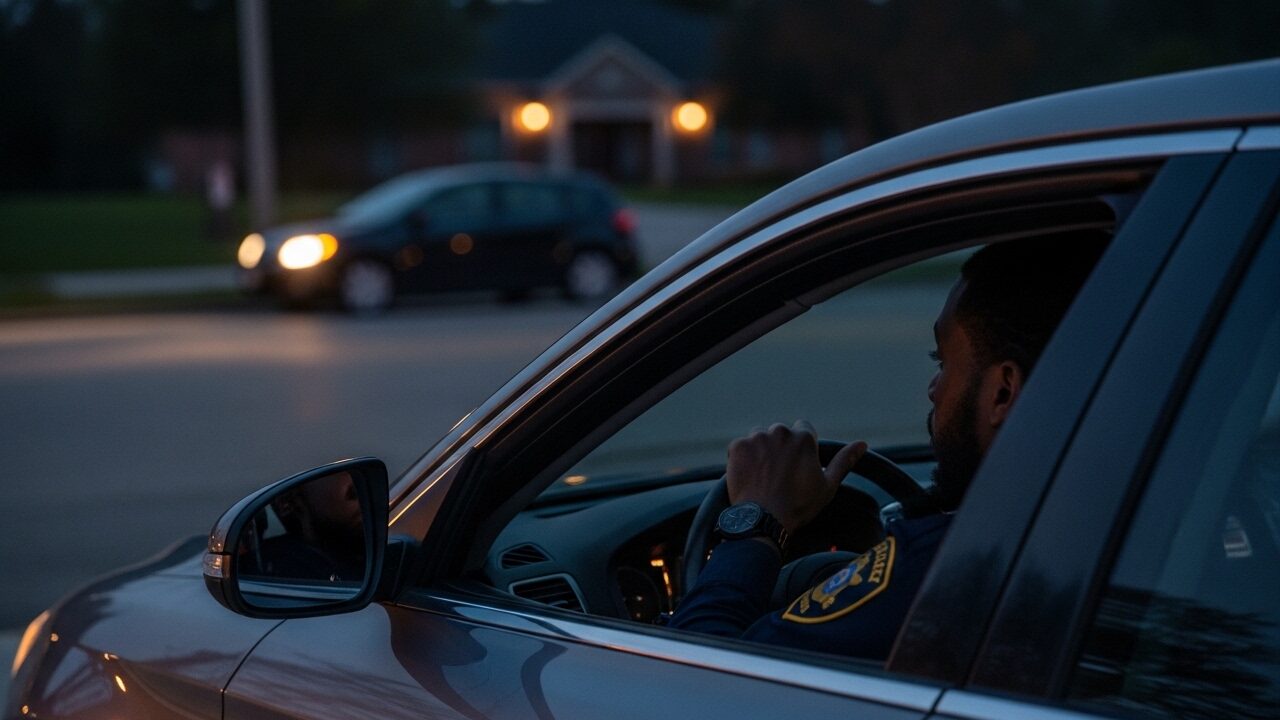
“THEY PULLED ME OVER 3 MILES FROM MY HOUSE. I KEPT MY HANDS ON THE WHEEL AND MY VOICE CALM, BUT THEY WANTED A REACTION. I WAS JUST ANOTHER TARGET UNTIL I MADE THE ONE CALL THAT CHANGED EVERYTHING. THE TRUTH IS DEEPER THAN THE BADGE.”

Late night. Empty road. Blue and red lights in the rearview. We’ve all seen the videos, but you never think it’ll be you—not when you’ve played by every rule in the book. I’m an architect. I design skyscrapers. I pay my taxes. But at 2 AM on a Tuesday, none of that mattered.
The officer didn’t see my degree. He didn’t see the car seat in the back. He saw a Black man in a car he didn’t think I belonged in.
What happened next wasn’t just a “misunderstanding.” It was a trial. A test of my will, my dignity, and my life. But there was one thing Officer Miller didn’t know. He didn’t know who was on the other end of my emergency contact list.
One phone call. That’s all it took to turn the predator into the prey.
This isn’t just a story about a traffic stop. It’s about the secrets we carry and the ghosts that haunt the thin blue line.
Chapter 1: The Silhouette of a Shadow
The hum of the electric motor was the only sound on the desolate stretch of Heritage Oaks Drive. It was 2:14 AM. My eyes were heavy, burning from sixteen hours of staring at blueprints for the new downtown library project. I could almost taste the high-thread-count sheets of my bed. I was less than five minutes from my driveway, in a neighborhood where the lawns are manicured by crews at dawn and the HOA sends letters if your trash can stays out an hour too long.
Then, the world turned blue and red.
My heart didn’t just skip a beat; it slammed against my ribs like a trapped bird. It’s a physical reaction, a generational reflex that no amount of wealth or education can outrun. I’m Marcus Thorne. I am thirty-four years old. I am a partner at Thorne & Associates. And right now, I was a Black man in a $90,000 Lucid Air being shadowed by a Ford Explorer with a light bar that felt like the sun.
I pulled over slowly, making sure my turn signal was clear. I rolled down all four windows—a habit my father taught me when I got my first beat-up Honda at sixteen. “Let them see everything, Marcus,” he’d said, his voice grave. “Don’t give them a reason to imagine a threat that isn’t there.”
I turned off the engine, placed my hands at ten and two on the steering wheel, and waited.
The silence was deafening. I could hear the gravel crunching under the heavy boots of the officers as they approached from both sides. This was the “pincer” move. Standard procedure. High tension.
The flashlight beam hit my side mirror first, then blinded me as it swept across my face. I squinted, keeping my hands glued to the leather.
“License and registration,” a voice barked. It was cold, raspy, the kind of voice that had spent too many years shouting over sirens.
“Officer, I’m going to reach into the center console to get my wallet,” I said, my voice steady despite the adrenaline surging through my veins. “Is that alright?”
“Just do it. Slowly.”
I looked up. The name tag on the officer’s chest read MILLER. He was white, mid-forties, with a face that looked like it had been carved out of granite and then left in the rain. His eyes weren’t just checking for a license; they were scanning the interior of my car with a predatory hunger, looking for a stray seed, a plastic baggie, anything to justify the stop.
On the passenger side was a younger officer. DAVIS. He looked barely old enough to shave. His hand stayed hovered near his holster, his knuckles white. He looked terrified. That was the most dangerous thing in the world—a nervous cop with a point to prove.
“You know why I pulled you over?” Miller asked, snatching my license from my hand.
“I’m not sure, Officer. I was cruise-controlled at thirty-five.”
Miller let out a short, dry laugh that didn’t reach his eyes. “You were ‘weaving.’ Crossed the yellow line back there by the bend. You been drinking tonight, Mr… Thorne?”
“I haven’t had a drink in three years, Officer. I’m coming from my office. You can check the logs at the Thorne & Associates building on 4th.”
Miller leaned in closer. The smell of stale coffee and cheap tobacco drifted off him. “Big shot architect, huh? Nice car. Expensive watch. You must be doing real well for yourself.”
“I work hard,” I replied, my grip tightening on the wheel.
“A lot of people work hard, Marcus. Not all of them drive cars that cost more than my house,” Miller said, his tone shifting into something more sinister—a cocktail of envy and ingrained suspicion. “Step out of the vehicle.”
“Officer, is that necessary? I’ve given you my information—”
“I said step out! Now!”
The sudden roar of his voice shattered the quiet of the suburbs. Davis moved his hand onto his weapon.
I stepped out. The night air was biting, but I felt a heat rising in my neck. I stood by the door, trying to maintain my posture. I’m six-foot-two. To Miller, I wasn’t a professional; I was a physical threat he needed to neutralize.
“Turn around. Hands on the car.”
“On what grounds, Miller?” I asked, the “Officer” dropping from my vocabulary. “You said I was weaving. That’s a citation, not a search.”
“I smell an intoxicant,” Miller lied. The lie was so blatant it made my head spin. “And you’re acting combative. Davis, watch him while I toss the cabin.”
“You don’t have a warrant, and you don’t have my consent,” I said, my heart hammering.
Miller stepped into my personal space, his chest inches from mine. I could see the broken capillaries in his nose, the sheer, unadulterated disdain in his gaze. “I have ‘probable cause,’ Marcus. Now shut your mouth before I add ‘resisting’ to the list of things that are going to ruin your very expensive night.”
I looked at Davis. The kid looked away, his eyes darting to the dark houses surrounding us. Nobody was coming out. In this neighborhood, when people saw police lights, they stayed behind their curtains and thanked God it wasn’t them.
As Miller began to tear through my car—throwing my leather portfolio on the floor, ripping through the glove box—I felt a profound sense of helplessness. I had built a life on the idea that if I was “better,” if I was “more,” I would be safe. I had followed the path. I had climbed the mountain.
But as Miller tossed my daughter’s stuffed rabbit onto the asphalt, I realized that to the man with the badge, I was still just a shadow in the night.
“Hey!” I shouted as he reached for a small, locked metal box under the seat. “That’s private architectural seals and digital drives. You can’t open that!”
Miller turned back, a wicked grin on his face. “What are you hiding, Marcus? Drugs? A piece? You’re getting real nervous all of a sudden.”
“It’s my work!”
“Sure it is.” Miller pulled his handcuffs from his belt. “Davis, secure him. He’s interfering with a lawful search.”
Davis stepped forward, his hands shaking. “Sir, please just put your hands behind your back.”
“This is wrong, Davis,” I whispered, looking the young man in the eye. “You know this is wrong.”
“Shut up!” Miller yelled. “Secure him!”
As the cold steel of the cuffs ratcheted shut around my wrists, a wave of cold fury washed over me. This wasn’t going to end with a ticket. Miller was looking for a win. He was looking to break me.
“I need to make a call,” I said, my voice dropping to a low, dangerous vibration.
“You get your call at the station,” Miller grunted, tossing the rabbit into the dirt again.
“No,” I said. “I have a right to a legal witness for the search of my professional property. It’s in the Ohio revised code. And I suggest you let me make it now, because the person on the other end of this phone is the only reason you might still have a job tomorrow morning.”
Miller stopped. He walked over to me, his face turning a dark shade of purple. He grabbed my collar, pulling me close so I could smell the hate on his breath. “You think you’re special? You think you got friends in high places? You’re in my world now, boy.”
He used the word. He meant to. It was a bullet meant to kill my spirit.
“Make the call,” Miller sneered, reaching into my pocket and pulling out my iPhone. He held it up to my face to trigger the FaceID. “Let’s see who’s coming to save the big-shot architect.”
He hit speakerphone and held the phone out like a trophy.
The dial tone rang once. Twice.
Then, a voice answered. A deep, authoritative voice that sounded tired, but instantly sharp.
“Marcus? It’s 2:30 in the morning. Is everything okay?”
Miller’s smirk didn’t just fade; it vanished. His face went from purple to a ghostly, sickly white. The hand holding the phone began to tremble.
I looked Miller dead in the eye, and for the first time that night, I felt the power shift.
“Not really, Chief,” I said. “I’m on Heritage Oaks Drive. Officer Miller and Officer Davis have me in cuffs. They’re currently tossing my car because they ‘smell something.’ I thought you’d want to know.”
There was a long, terrifying silence on the other end of the line.
“Miller?” the voice on the phone asked. It wasn’t a question. It was a death sentence.
Miller’s voice was a pathetic squeak. “C-Chief? Chief Henderson?”
“Miller,” the Chief of Police said, his voice like rolling thunder. “Don’t you move a goddamn muscle. I’m five minutes away.”
The line went dead.
Miller looked at the phone, then at me, then at his partner. The silence that followed was heavier than the night itself.
Chapter 2: The Weight of the Badge
The silence that followed the click of the phone was heavier than the humid night air. It was the kind of silence that rings in your ears, high-pitched and vibrating with the frequency of a disaster about to happen. Officer Miller looked down at my iPhone as if it were a live grenade he’d forgotten to throw. His hand, which had been so steady and forceful while he was rifling through my daughter’s things, was now visibly shaking.
“Chief Henderson?” Miller whispered, more to himself than to me. The name seemed to physically shrink him. His chest, puffed out moments ago with the bravado of a man who held the keys to my freedom, began to deflate.
Officer Davis, the younger one, looked like he wanted to vanish into the pavement. He stepped back, his hand finally dropping away from his holster. He looked at me, then at Miller, and then at the dark, suburban horizon. He knew what was coming. In the hierarchy of the department, Chief Henderson wasn’t just a boss; he was the sun, and Miller had just spent the last twenty minutes trying to set fire to the world.
“Sit down,” Miller muttered, though the command lacked its previous bite. He pointed toward the curb.
“I think I’ll stand,” I said. My voice was low, like the growl of a storm moving in from the coast. The adrenaline was still there, but the fear had been replaced by a cold, crystalline clarity.
“I said sit down, Thorne!” Miller snapped, trying to reclaim some shred of his crumbling authority. But it was a hollow performance. He knew it. I knew it. Davis knew it.
I looked at the handcuffs cutting into my wrists. I felt the bite of the metal, a reminder of how quickly a life can be stripped of its dignity. “You’re worried about where I sit? You should be worried about how you’re going to explain that ‘smell’ you fabricated to a man who’s known me since I was ten years old.”
Miller paced back and forth in front of my car, his boots crunching on the gravel. He was a man trapped. He looked at my car—the sleek, expensive electric vehicle that represented everything he hated—and then at the mess he’d made. My leather portfolio was splayed open on the asphalt, blueprints for a multi-million dollar library project fluttering in the breeze. My daughter’s stuffed rabbit lay in the dirt, its white fur stained by the oil and grime of the road.
“I didn’t fabricate anything,” Miller hissed, though he wouldn’t meet my eyes. “You were weaving. I saw it. The smell… it could have been something else. An odor from the vents. I was being thorough.”
“Thorough?” I let out a dry, humorless laugh. “You were hunting, Miller. Let’s call it what it is. You saw the car, you saw the neighborhood, and you saw the man behind the wheel, and you decided I was a trespasser in my own life.”
Davis stepped closer, his voice a frantic whisper. “Miller, maybe we should just… maybe we should unhook him. We can say it was a misunderstanding. Before the Chief gets here.”
Miller stopped pacing. He looked at Davis with a mixture of contempt and desperation. “And then what? He’s already talked to him. If we let him go now, it looks like we’re hiding something. We stay the course. We found… we found suspicious behavior. We were doing our jobs.”
I watched them—two men in blue, caught in the gears of a machine they had helped build. Miller was the architect of his own destruction, a man whose bitterness had finally overshot his common sense. Davis was the accomplice, the “good man” who stood by and watched the bad man work, thinking silence was the same thing as innocence.
As I stood there, my mind drifted back to the man on the other end of that phone call.
Chief Elias Henderson wasn’t just a name in a directory to me. To the city of Columbus, he was the first Black police chief in thirty years, a man of iron will and impeccable record. But to me, he was “Uncle Elias.”
The connection went deeper than politics. It was forged in blood and shadow, thirty years ago, on a night much like this one, but in a much darker part of town.
My father, David Thorne, had been a sergeant in the 4th Precinct. He was the kind of cop they don’t make anymore—the kind who knew every kid on the block by name and never drew his weapon unless he absolutely had to. Elias Henderson had been his rookie partner.
I remember the night vividly. I was five years old, sitting on the floor of our cramped living room, playing with a set of wooden blocks. The knock at the door hadn’t been the usual rhythmic rap of my father coming home. It was heavy, rhythmic, and final.
Elias had been the one to tell my mother. He had stood in our doorway, his uniform torn and covered in soot, his face a mask of grief that would never truly leave him. My father had died shielding Elias from a burst of gunfire during a botched warehouse raid.
From that night on, Elias Henderson became a ghost in our house—a guardian who never asked for thanks. He was there for my graduations. He was the one who pulled me aside when I got my first job and told me that because of who I was, I would always have to work twice as hard to be seen as half as good.
“The world won’t see your father’s badge when they look at you, Marcus,” he had told me, his hand heavy on my shoulder. “They’ll see a silhouette. It’s up to you to fill that silhouette with something they can’t ignore.”
I had followed his advice. I had become one of the top architects in the state. I had built glass towers and community centers. I had earned my place in Heritage Oaks. But as I stood on the side of the road with my hands behind my back, I realized that for men like Miller, the silhouette was all that ever mattered.
The sound of an approaching engine broke the silence. It wasn’t the scream of a siren, but the low, powerful rumble of a high-end SUV.
Two headlights rounded the bend, cutting through the darkness like twin searchlights. The vehicle didn’t slow down as it approached; it swung in front of the police cruiser with a sharp, aggressive maneuver that sent gravel flying.
The door of the black Chevy Tahoe swung open before the engine had even fully cut out.
Chief Henderson stepped out.
He didn’t look like a man who had just been woken up at 2:30 AM. He was in a crisp white shirt, slacks, and a leather jacket. His presence was a physical weight that seemed to press down on the entire street. He didn’t look at Miller. He didn’t look at Davis.
He walked straight to me.
He looked at my face, checking for bruises. Then he looked down at my hands. His jaw tightened—a tiny movement, but one that signaled a coming storm.
“Marcus,” he said, his voice low and vibrating. “Are you hurt?”
“I’m alright, Elias,” I said, my voice cracking just a little. The sheer relief of seeing a friendly face was starting to melt the ice of my anger. “My wrists are a bit tight, but I’m okay.”
Henderson didn’t say another word to me. He turned on his heel and faced Miller.
The height difference wasn’t much, but Henderson seemed to tower over the officer. Miller tried to stand at attention, but his knees seemed to be made of water.
“Chief,” Miller began, his voice cracking. “I can explain. We had a suspicious vehicle—”
“Unlock him,” Henderson said. Two words. Quiet. Deadly.
“Sir, procedure dictates—”
“I said,” Henderson stepped into Miller’s space, his face inches from the other man’s, “unlock him. Right. Now.”
Miller fumbled for his keys. The clinking of the metal was the only sound on the street. He reached behind me, and I felt the sweet release of the pressure as the cuffs fell away. I rubbed my wrists, the skin red and raw where the steel had bitten in.
Henderson waited until I had stepped away from the car, until I was standing beside him. Then he turned his gaze to Davis.
“Officer Davis,” Henderson said. “Report.”
The young officer looked like he was about to cry. “Sir… we… Officer Miller initiated the stop. He said the vehicle was weaving. When we approached, he said he smelled… he smelled an intoxicant.”
“Did you smell an intoxicant, Davis?” Henderson asked.
Davis hesitated. He looked at Miller, who was glaring at him with a silent, desperate threat. Then he looked at the Chief.
“No, sir,” Davis whispered. “I didn’t smell anything.”
The silence that followed was visceral. Miller looked like he wanted to strike the boy. Henderson just nodded slowly, a grim smile touching his lips.
“And the search?” Henderson asked, gesturing to the contents of my car strewn across the road. “Did you find the ‘intoxicant’?”
“No, sir,” Davis said, his head hanging low. “We found… we found architectural tools. And a child’s toy.”
Henderson turned back to Miller. The look in his eyes wasn’t just anger; it was a profound, weary disappointment.
“Miller, you’ve been on the force for eighteen years,” Henderson said. “You know every line of the handbook. You also know that this neighborhood is my neighborhood. I live four blocks over. Did you think I wouldn’t recognize a resident’s car? Or did you just not care?”
“I was doing my job, Chief!” Miller finally exploded, his frustration boiling over. “He was being difficult! He was questioning my authority! You know how it is out here—we can’t give an inch or we lose the street!”
“The street?” Henderson repeated the word as if it were a piece of filth. “This is a residential neighborhood, Miller. This man is a citizen. He is a taxpayer. He is a father. And he happens to be the son of a man who gave more to this department than you ever will.”
Miller blinked, confusion momentarily overriding his fear. “What?”
Henderson stepped even closer, his voice dropping to a whisper that felt louder than a shout. “You’re looking at Marcus Thorne. Does the name Thorne ring a bell, Miller? Or were you too busy failing your sergeant’s exams to read the memorial wall in the lobby of the precinct?”
Miller’s eyes widened. He looked at me, then back at Henderson. The realization hit him like a physical blow. The legendary David Thorne. The man whose portrait hung in every station in the city. The martyr of the Columbus PD.
“I… I didn’t know,” Miller stammered. “I thought… the car… the way he spoke…”
“You thought he was someone you could break without consequences,” I said, stepping forward. I picked up my daughter’s rabbit from the dirt and brushed it off. “You thought I didn’t belong here. But the truth is, Miller, you’re the one who doesn’t belong. Not on this force. Not with that badge.”
Henderson looked at Miller’s badge, then up at his face. “Go back to the station, Miller. Both of you. Hand your service weapons and your badges to the desk sergeant. You’re on administrative leave, effective immediately, pending a full internal affairs investigation.”
“Chief, you can’t do this!” Miller shouted. “Over a traffic stop? This is political! You’re protecting your own!”
“I am protecting the integrity of this badge,” Henderson said, his voice like iron. “Something you clearly forgotten how to do. Now move. Before I decide to process the arrest for civil rights violations myself.”
Miller glared at me one last time—a look of pure, unadulterated venom—before stomping back to his cruiser. Davis followed him, looking broken. They pulled away, the blue and red lights finally dying out, leaving the street in a sudden, jarring darkness.
Henderson sighed, a long, heavy sound that seemed to carry the weight of the last thirty years. He turned to me, his posture sagging for the first time.
“I’m sorry, Marcus,” he said. “I’m so damn sorry.”
“It’s not your fault, Elias,” I said, though my hands were still shaking. “It’s just… it’s never-ending, isn’t it?”
“No,” Henderson said, looking out into the night. “It’s not. But tonight, it ends for Miller. Come on. Let’s get your things back in the car. I’ll follow you home.”
We spent the next ten minutes in silence, picking up my life from the asphalt. My blueprints were wrinkled. My portfolio was scratched. The rabbit was stained. It felt like a metaphor for the night—everything was back where it belonged, but nothing was quite the same.
As I climbed back into the driver’s seat, Henderson leaned against my window.
“Marcus,” he said. “There’s something you should know. About Miller.”
“What’s that?”
“He wasn’t just some random cop. He’s been under watch for a while. There have been complaints. But he’s protected by the union, and he’s got friends in the DA’s office. This… what happened tonight… it’s going to be a fight. He’s not going to go quietly.”
“I don’t care,” I said, gripping the steering wheel. “I’m not a five-year-old boy playing with blocks anymore, Elias. I’m ready for a fight.”
Henderson nodded, a flicker of pride in his eyes. “Good. Because Miller has a secret. One that goes back a long way. One that might involve why your father was in that warehouse that night.”
My heart stopped. “What are you talking about?”
Henderson looked around the quiet street, his expression suddenly guarded. “Not here. Get home. Get some sleep. I’ll come by tomorrow afternoon. We have a lot to talk about, Marcus. More than you know.”
He patted the door of the car and walked back to his Tahoe.
I drove the last three miles to my house in a daze. My mind was racing, spinning through the implications of what Elias had just said. My father’s death had always been a closed chapter—a tragedy, but a simple one. A hero died saving his partner.
But as I pulled into my driveway and saw the porch light shining, a beacon of safety in a world that had suddenly become very dangerous, I knew the night wasn’t over.
The traffic stop was just the beginning. The real story was buried in the past, under layers of blue silence and old blood. And Officer Miller, the man who had tried to break me on a dark road, was the key to it all.
I walked into my house, kissed my sleeping wife on the forehead, and tucked the dirty stuffed rabbit into my daughter’s bed. Then I sat in the darkness of my living room, watching the street through the blinds, waiting for the sun to rise on a world that would never look the same again.
Chapter 3: The Ghosts of the 4th Precinct
The sun rose over Columbus not with a celebratory glow, but with a harsh, clinical light that seemed to expose every crack in the sidewalk and every fraying nerve in my body. I hadn’t slept. I sat in my home office, the blueprints for the downtown library spread out before me, but all I could see were the red and blue spots burned into my retinas from the night before.
I’m a man who builds things. I understand structural integrity. I know that if a foundation is off by even half an inch, the entire spire will eventually groan and collapse under its own weight. As I watched the morning joggers pass by my window—mostly white, mostly oblivious to the fact that their neighbor had been held at gunpoint just hours ago—I realized that the foundation of my entire life was shifting.
Maya, my wife, had found the stuffed rabbit on the kitchen island. She didn’t ask questions at first. She just saw my hands, the faint ring of bruised skin around my wrists, and she knew. She’s a pediatric surgeon; she deals with trauma every day, but when it’s in your own kitchen, the professional veneer thins out.
“He was one of Henderson’s men?” she asked, her voice barely a whisper as she poured coffee.
“He was a man with a badge, Maya. In that moment, that’s all that mattered,” I replied. I didn’t tell her about the ‘boy’ comment. I didn’t tell her how close Davis’s finger had been to the trigger. Some things you keep to yourself to keep the house standing.
“Elias is coming over this afternoon,” I added. “He says there’s more to it. Something about my father.”
Maya froze, the carafe mid-air. “Your father? Marcus, that was thirty years ago. What could David possibly have to do with a racist cop in Heritage Oaks?”
“I don’t know. But I’m going to find out.”
While I was drowning in caffeine and old memories, three miles away, in a modest ranch-style house with a peeling porch, Officer Robert Miller was staring at a glass of whiskey. It was 9:00 AM.
Sarah Miller watched her husband from the doorway. She was a thin woman, her face lined with the kind of weariness that comes from twenty years of being married to the job. She was a first-grade teacher, a woman who spent her days teaching children about kindness and “the helpers” in the community.
“Robert, put the glass down,” she said softly.
Miller didn’t look at her. His eyes were fixed on his service weapon, which sat on the coffee table next to his badge. Both felt like lead weights. “Henderson suspended me. In front of that… that kid. In front of a civilian.”
“You pulled over a man for nothing, Robert,” Sarah said, her voice trembling. “I saw the dashcam footage on the news—they’re already leaking snippets. You weren’t ‘doing your job.’ You were looking for a fight.”
Miller slammed his hand on the table, making the glass jump. “You don’t understand! You don’t know what it’s like out there. You see a car like that, a guy like that… it doesn’t fit. My father spent thirty years on the force and never owned a car that nice. I’ve spent eighteen, and I’m still struggling to pay the mortgage on this dump. Then I see him, looking down his nose at me like I’m the dirt on his shoe…”
“He wasn’t looking down his nose, Robert. He was scared for his life!” Sarah walked over, risking his temper, and put a hand on his shoulder. “This bitterness… it’s rotting you. It’s been rotting you since the 4th Precinct days. You’ve never let it go.”
Miller shook her hand off. “The 4th Precinct? You think I can just forget that? I was the one who had to carry Thorne out of that warehouse. I was the one covered in his blood while the department made him a saint and left the rest of us to rot in the shadows.”
“He died, Robert! He died saving people!”
“He died because he was a fool,” Miller hissed, his voice dropping to a low, jagged rasp. “And now his son is driving around like he owns the city while I’m one step away from a disciplinary hearing. I’m not going down for this, Sarah. I’m not letting a Thorne ruin me twice.”
He grabbed his jacket and his keys. He didn’t take the badge, but he tucked the weapon into his waistband.
“Where are you going?” Sarah cried.
“To talk to an old friend,” Miller said. “Someone who remembers how things actually worked before Henderson started playing politics.”
By 2:00 PM, Chief Henderson’s black Tahoe pulled into my driveway. He looked older than he had the night before. The weight of the city, the department, and the secret he was carrying seemed to have added a decade to his gait.
We sat in my backyard, away from the house, the sound of a distant lawnmower providing a thin veil of privacy.
“I went to the archives this morning, Marcus,” Elias said, handing me a manila folder. It looked ancient, the edges yellowed and smelling of dust and damp basements. “I pulled the original file on the warehouse raid. February 14th, 1996.”
I opened it. There were grainy photos of the scene—a dilapidated textile factory on the edge of the Bottoms. My father’s face was in one of the documents, a black-and-white headshot that looked so much like me it made my breath catch.
“The official story,” Elias began, staring at his hands, “is that we received an anonymous tip about a major drug shipment. We went in without waiting for SWAT because we thought there were hostages. We were ambushed. Your father took the brunt of the fire. He was a hero.”
“And the unofficial story?” I asked.
Elias sighed. “I was a rookie. I followed David everywhere. But that night… the tip wasn’t anonymous. It came through a confidential informant handled by a small group of veteran officers. One of those officers was Robert Miller’s father, Bill Miller. And the ‘hostages’? They never existed. It was a setup, Marcus. A hit.”
The world seemed to go silent. “A hit? On my father? Why?”
“Your father was Internal Affairs before he was a Sergeant. He was quiet about it, but he was digging into a kickback scheme involving the police union and a local construction firm. They were skimming millions from city contracts for the new precincts. David had the names. He had the ledgers.”
I looked at the photos of the warehouse. “And Miller? Robert Miller?”
“Robert was a rookie too, just a year ahead of me. But he was his father’s son. That night, Robert was supposed to be on the perimeter. But when the shooting started, he was the first one inside. He was the one who ‘found’ David. And he was the one who claimed the ledgers David was carrying were ‘lost’ in the chaos of the fire that broke out.”
I felt a cold, hard knot form in my stomach. “So Miller’s family has been living off the blood of my father for thirty years.”
“Bill Miller retired a year later with a full pension and moved to Florida. He died five years ago. But Robert… Robert stayed. He stayed and he watched you grow up. He watched you become successful. And every time he saw your name in the paper, it reminded him of the lie his family was built on.”
“That’s why he pulled me over,” I whispered. “It wasn’t just a random stop. He saw my name on the registration and he snapped.”
“He’s dangerous, Marcus,” Elias said, his voice grave. “I’ve started the process to fire him, but the union is already pushing back. They’re claiming ‘officer stress’ and ‘racial profiling accusations as a political weapon.’ And there’s someone else. Someone who was in that warehouse with Bill Miller. Someone who’s still very powerful in this city.”
Before I could ask who, my phone buzzed. It was a restricted number.
I looked at Elias, then answered.
“Hello?”
“You think you’re safe in that ivory tower, don’t you, Marcus?” The voice was distorted, but the cadence was unmistakable. It was the rasp of a man who had spent too many years shouting over sirens.
“Miller?” I said, my heart rate spiking.
“Your father was a rat,” the voice spat. “He thought he was better than everyone else. Just like you. You think you can call the Chief and make me disappear? I’m the one who knows where the bodies are. I’m the one who kept your father’s legacy clean for thirty years. You should be thanking me.”
“You murdered him,” I said, my voice shaking with a rage I didn’t know I possessed.
“I didn’t pull the trigger,” Miller laughed, a sound like glass breaking. “But I watched him die. And I’m going to watch you lose everything. Tell Henderson to stop digging, or the next call won’t be to you. It’ll be to the press. I have the ledgers, Marcus. Your father wasn’t just investigating the corruption. He was part of it. That’s the lie I’ve been keeping.”
“That’s a lie!” I shouted, but the line went dead.
I looked at Elias. His face had gone pale.
“He says he has the ledgers,” I said. “He says my father was dirty.”
Elias stood up, his jaw set. “He’s bluffing. David was the cleanest man I ever knew. But if Miller has those ledgers… he can manufacture anything. We need to find him, Marcus. Before he burns everything down.”
We weren’t the only ones looking for answers.
Detective Greg Vance sat in a dimly lit booth at The Blue Line, a cop bar where the air always smelled of frying oil and regret. Vance was sixty, with hair the color of wood ash and eyes that had seen too many crime scenes. He had been David Thorne’s best friend.
Miller was sitting across from him.
“You’re out of your mind, Bobby,” Vance said, swirling the ice in his glass. “Pulling over Thorne’s kid? In Heritage Oaks? That’s a suicide mission.”
“I need the location of the old lockbox, Greg,” Miller said, ignoring the comment. “The one my father left with you.”
Vance stopped swirling his drink. “That box was supposed to stay buried. Bill told me if anyone ever asked for it—even you—that it meant the end of the world was coming.”
“The end of the world is here,” Miller said, leaning in. “Henderson is coming for me. He’s digging into the warehouse. If he finds out what really happened—what we did—it’s not just me who goes down. It’s the whole legacy. Yours included.”
Vance looked around the bar. A few younger officers were throwing darts in the corner. They didn’t know about the old days. They didn’t know about the “tax” the veterans used to take from the street.
“Your father was a piece of work, Bobby,” Vance sighed. “He loved you, but he was a greedy man. He didn’t just set up Thorne. He recorded the whole meeting where the hit was ordered. That’s what’s in the box.”
Miller’s eyes lit up. “Who ordered it?”
Vance took a long pull of his drink. “You’re not going to like it. It wasn’t some street thug. It was the man who’s currently sitting in the Mayor’s office. The man who was the District Attorney back then. Mayor Lawrence.“
Miller sat back, stunned. The Mayor. The man who had been campaigning on a “tough on crime” platform for decades.
“So,” Miller said, a slow, predatory grin spreading across his face. “I don’t just have a way to save my job. I have a way to own this city.”
“Or a way to get yourself killed,” Vance warned. “Mayor Lawrence doesn’t leave loose ends. He didn’t thirty years ago, and he won’t now.”
“I’m not David Thorne,” Miller said, standing up. “I’m the guy who’s still standing. Give me the key, Greg.”
Vance reached into his pocket and slid a small, rusted key across the table. “God help you, Bobby. Because once you open that box, there’s no going back to being a ‘hero’ cop.”
As the sun began to set, I stood in my daughter’s bedroom, watching her sleep. She looked so peaceful, so untainted by the world outside. I thought about my father. I thought about the lie Miller was trying to tell.
I knew my father wasn’t dirty. I knew it in my bones. But I also knew that in a city built on secrets, the truth is often the first thing to be buried.
My phone buzzed again. A text from an unknown number.
1122 Industrial Way. 10 PM. Come alone, or the ledgers go to the evening news. Let’s finish what our fathers started, Architect.
I looked at the address. It was the warehouse. The same one where my father had died thirty years ago.
I didn’t call Elias. I didn’t tell Maya. I went to the safe in my office and pulled out the one thing I had kept from my father’s belongings—a small, snub-nosed .38 revolver he had carried as a backup.
I wasn’t an architect tonight. I wasn’t a “big shot.” I was a son looking for the truth in a place where only shadows lived.
I walked out of the house, the weight of the past pressing down on me, and drove toward the darkness of the Bottoms.
The structure of my life was about to be tested. And I knew that if the foundation was built on a lie, I wouldn’t be the only one to fall.
Chapter 4: The Architecture of Justice
The Bottoms didn’t look like the rest of Columbus. It was a skeletal remains of an industrial era that had long since breathed its last. Here, the streetlights were either shot out or flickering with a dying, rhythmic buzz that sounded like a heartbeat flatlining. Rain began to fall—not a cleansing rain, but a greasy, cold mist that clung to the windshield of my Lucid.
I pulled up to 1122 Industrial Way. The warehouse was a hulking mass of rusted corrugated metal and shattered glass. It stood like a tombstone. This was where my father, Sergeant David Thorne, had taken his final breath. For thirty years, I had avoided this place. I had built glass towers specifically so I wouldn’t have to look at ruins like this.
I turned off the engine. The silence was absolute, save for the ticking of the cooling motor. I reached into the glove box and pulled out the .38. It felt heavy—not just with lead, but with history. I tucked it into the small of my back, stepped out, and felt the mud of the Bottoms swallow the soles of my designer shoes.
“I’m here, Miller!” I shouted. my voice was swallowed by the cavernous shadows of the loading docks.
A flicker of light appeared in a second-story window. A flashlight beam danced across the ceiling, then disappeared.
I found a side door hanging off its hinges. Inside, the air was thick with the smell of wet rot and old grease. My footsteps echoed, betraying my position with every movement. I climbed the rusted iron stairs, my heart hammering a frantic rhythm against my ribs.
When I reached the upper floor, I saw him.
Robert Miller was sitting on a wooden crate in the center of a wide-open floor. A single camping lantern sat at his feet, casting long, monstrous shadows against the pillars. He wasn’t wearing his uniform. He was in a tattered flannel shirt and jeans, looking like a man who had already lost everything.
In his lap sat a small, rusted metal lockbox. Beside him was his service weapon.
“You came alone,” Miller said, his voice echoing. “I didn’t think you had it in you, Architect. I thought you were all blueprints and lattes.”
“I’m my father’s son, Miller,” I said, stopping ten feet away. “Something you seem to have forgotten about yourself.”
Miller let out a jagged laugh. “Your father. Always back to the Sainted David. You want to see what your father died for? You want to see the ‘legacy’ Henderson is so desperate to protect?”
He flipped the lid of the lockbox. Inside wasn’t just paper. There was an old micro-cassette recorder and a stack of ledger books bound in rotting leather.
“This is the ‘hit list,'” Miller said, tapping the ledgers. “My father, Bill, was the record keeper. He was smart. He knew that in this city, a badge only protects you as long as you’re useful. He kept these as insurance.”
“Insurance against what?”
“Against the men who run the show. You think a bunch of beat cops organized a multi-million dollar kickback scheme on their own? They needed signatures. They needed permits. They needed a District Attorney to look the other way.”
Miller picked up the cassette recorder. “Listen.”
He hit play. The audio was scratchy, filled with the hiss of age, but the voices were clear.
“Thorne is getting too close, Bill. He’s looking at the invoices for the West Side precinct.” That was a younger version of Mayor Lawrence.
“He’s a good cop, Lawrence. He won’t take a bribe,” another voice replied—Miller’s father.
“Then he’s a dead cop. Set up the tip for the warehouse. Make it look like a botched raid. I’ll handle the internal investigation. Just make sure the ledgers he’s carrying disappear.”
The tape ended with a click.
I felt a wave of nausea so strong I had to lean against a pillar. It wasn’t a “mistake.” It wasn’t “bad luck.” My father was executed by the man who currently held the keys to the city.
“Why are you showing me this?” I asked, my voice a ragged whisper. “If you have this, you could have gone to the feds years ago.”
“And end up like your father?” Miller stood up, the lantern light catching the madness in his eyes. “My father was a coward. He took the hush money and ran to Florida. He left me here to play the part of the ‘loyal soldier’ while I watched Lawrence climb the ladder. I’ve spent eighteen years protecting the man who murdered my father’s partner. And for what? To be suspended by Henderson because I pulled over a guy who reminded me of everything I’ll never be?”
“You didn’t protect my father’s legacy, Miller. You participated in his murder every day you stayed silent.”
Miller leveled his gaze at me. “Maybe. But tonight, the silence ends. I’m not giving these to the press, Marcus. And I’m not giving them to the feds. I’m going to use them to burn Lawrence down, and I’m going to take Henderson with him.”
“Henderson? Elias had nothing to do with this!”
“Didn’t he?” Miller sneered. “He was David’s partner. He was there that night. How do you think he became Chief so fast? You think it was just merit? Lawrence promoted him to keep him quiet. Henderson knew, Marcus. He’s known for thirty years that his career was built on your father’s grave.”
The world felt like it was tilting on its axis. Elias? The man who had been a second father to me?
“That’s a lie,” I said, but the doubt was a poison, spreading fast.
“Is it? Ask him yourself,” Miller said, gesturing toward the stairs.
I turned. Standing in the doorway, his silhouette framed by the dim light of the stairwell, was Chief Elias Henderson. He wasn’t alone. Two plainclothes officers stood behind him, their hands on their weapons.
“Elias?” I asked, my voice trembling.
Henderson walked into the light. He looked exhausted. He looked like a man who had been carrying a mountain on his back and was finally ready to let it crush him.
“I told you to go home, Marcus,” Elias said softly. “I told you I’d handle it.”
“Handle it how?” I asked, gesturing to the lockbox. “By making sure the tape never gets out? Is it true, Elias? Did you know?”
Henderson looked at the floor. The silence lasted an eternity. “I didn’t know about the hit before it happened. I swear to you, Marcus. I was a rookie. I was just trying to stay alive. But afterward… Lawrence came to me. He told me that if I went public, they’d frame David as the mastermind. They’d strip his pension. Your mother would have lost the house. You wouldn’t have gone to college. I did it for you, Marcus. I took the promotion to protect your father’s name.”
“You traded the truth for a comfortable lie,” I said, the betrayal cutting deeper than any bullet could. “You let the man who killed him run the city.”
“I’ve spent thirty years trying to make this department better from the inside!” Henderson shouted, his voice cracking. “I’ve done more for this city than David ever could have if he was dead and disgraced!”
“He’s still dead, Elias!” I screamed back. “And he’s disgraced because you let his killers win!”
Miller laughed, a high, hysterical sound. “Look at this. The big-shot architect and the hero Chief. Both of you living on Lawrence’s scraps. Well, I’m done. I’m taking the box, and I’m going to the FBI.”
“I can’t let you do that, Robert,” Henderson said, his voice turning cold, professional. “That box doesn’t just destroy Lawrence. It destroys the department. It destroys everything we’ve built.”
The two officers behind Henderson drew their weapons.
“Elias, no,” I said, stepping between them and Miller. “This isn’t the way.”
“Move, Marcus,” Henderson said. “This is police business.”
“No,” I said, reaching behind me and pulling out my father’s .38. I didn’t point it at him, but I held it steady. “This is family business.”
The tension in the room was a physical cord, stretched to the breaking point. On one side, a corrupt cop seeking a twisted kind of revenge. On the other, a “good” man who had sold his soul for a seat at the table. And in the middle, me—an architect standing in the ruins of his father’s life.
Suddenly, the heavy thud of boots sounded from the loading dock below. Bright tactical lights flooded the room from the windows, blinding us all.
“COLUMBUS PD! DROP YOUR WEAPONS!” a voice boomed through a megaphone.
Henderson froze. Miller scrambled for his gun.
“Don’t do it, Miller!” I yelled.
But Miller was past listening. He grabbed his weapon and fired a blind shot toward the stairs. The return fire was instantaneous and overwhelming. A hail of bullets shattered the pillars and sent splinters of wood flying into the air.
I dove for cover behind a heavy iron press. I heard the sound of glass breaking, the screams of men, and the heavy, final thud of a body hitting the floor.
When the firing stopped, the silence was even more terrifying.
I looked up. Miller was slumped over the crate, his blood staining the ledger books he had tried to use as a shield. He was gone.
Henderson was on his knees, his hands behind his head. The tactical team—led by a young captain I didn’t recognize—moved in, zip-tying the officers Henderson had brought with him.
But it wasn’t the police who walked toward me.
It was Detective Greg Vance. He looked at me, then at the lockbox. He picked it up, checked the contents, and then looked at Henderson.
“You should have listened to David, Elias,” Vance said quietly. “He always said the truth has a way of coming out, no matter how much concrete you pour over it.”
“Who called them, Greg?” Henderson asked, his voice hollow.
Vance looked at me. “I did. When Bobby came to me for the key, I knew he wouldn’t make it through the night. And I knew Lawrence had people watching Henderson. I called the State Bureau of Investigation. They’ve been building a case on Lawrence for two years. They just needed the box.”
The SBI agents swarmed the room, bagging evidence, taking photos. They treated the warehouse like the crime scene it had been for thirty years.
I stood up, my legs shaking. I looked at Elias. He looked at me, pleading with his eyes for some kind of forgiveness. I didn’t give it to him. I couldn’t. He had loved me, yes, but he had loved the power more.
“Marcus,” he whispered as they led him away. “I did it for you.”
“No, Elias,” I said. “You did it for yourself. My father would have rather we been poor and honest than rich on blood money.”
EPILOGUE: THE BLUEPRINT OF TOMORROW
The fallout was a horizontal hurricane that leveled the city’s political landscape.
Mayor Lawrence was arrested at his home three hours later. The ledgers and the tape were more than enough to sink him. The “kickback” scandal became the largest corruption case in Ohio history.
Chief Elias Henderson resigned the next morning and took a plea deal to testify against Lawrence. He’s currently serving ten years in a federal facility. I haven’t visited him.
The Columbus Police Department underwent a massive federal oversight program. Officer Davis, the young kid from the traffic stop, actually stayed on the force. He wrote me a letter six months later, thanking me for standing up that night. He’s part of a new task force focused on community transparency.
As for Robert Miller, he was buried in a quiet ceremony. His wife, Sarah, reached out to me. We met for coffee once. We didn’t talk about the warehouse. We talked about the men our fathers could have been if they hadn’t been swallowed by the system.
I’m still an architect. But I don’t just build glass towers anymore.
I started a foundation called The David Thorne Project. We focus on providing legal aid and support for families who have been victims of police misconduct. We also fund scholarships for kids in the Bottoms, giving them the tools to build a life that doesn’t require a badge or a bribe.
A few weeks ago, I went back to Heritage Oaks. I stood on the spot where Miller had pulled me over. The asphalt was clean. There were no lights, no sirens. Just the quiet of a suburban night.
I looked at my hands. The bruises from the handcuffs were gone, but I could still feel the weight of them. I realized then that justice isn’t a building you finish. It’s a structure you have to maintain every single day. You have to check the foundation. You have to replace the rotted wood. You have to make sure the light can always get in.
I climbed back into my car and drove home. As I pulled into my driveway, I saw my daughter’s stuffed rabbit sitting in the window, clean and white.
I was home. And for the first time in my life, I knew exactly where I belonged.
END

About the Author
dream01
A writer passionate about human stories and real-life experiences that inspire and move readers.
 Black
31 min read
Black
31 min read
“I Thought Getting Straight A’s Would Keep Me Safe. But When The Glaring Spotlight Hit My Back In That Wealthy Neighborhood, I Realized Exactly What They Really Saw.”
I am fifteen years old. I take Advanced Placement Calculus, I play first-chair violin in the school orchestra, and I…
 Black
52 min read
Black
52 min read
“I Was The Secret Guest Of Honor At New York’s Most Exclusive Art Gala. But When I Stepped Into The Alley To Call My Mom, The Night Turned Into A Nightmare Of Cold Brick, Handcuffs, And A Desperate Fight For My Life.”
I’ve spent my entire life trying to prove I belong in rooms made of marble and gold, but nothing prepared…
 Black
71 min read
Black
71 min read
A Devoted Black Pediatric Nurse Was 2 Blocks From Home When 1 Unjustified Police Stop Ignited A Terrifying Nightmare That Fractured An Entire American Neighborhood.
Chapter 1 The scent of industrial hospital antiseptic was practically baked into Marcus Vance’s skin by the time the dashboard…
Leave a Reply