
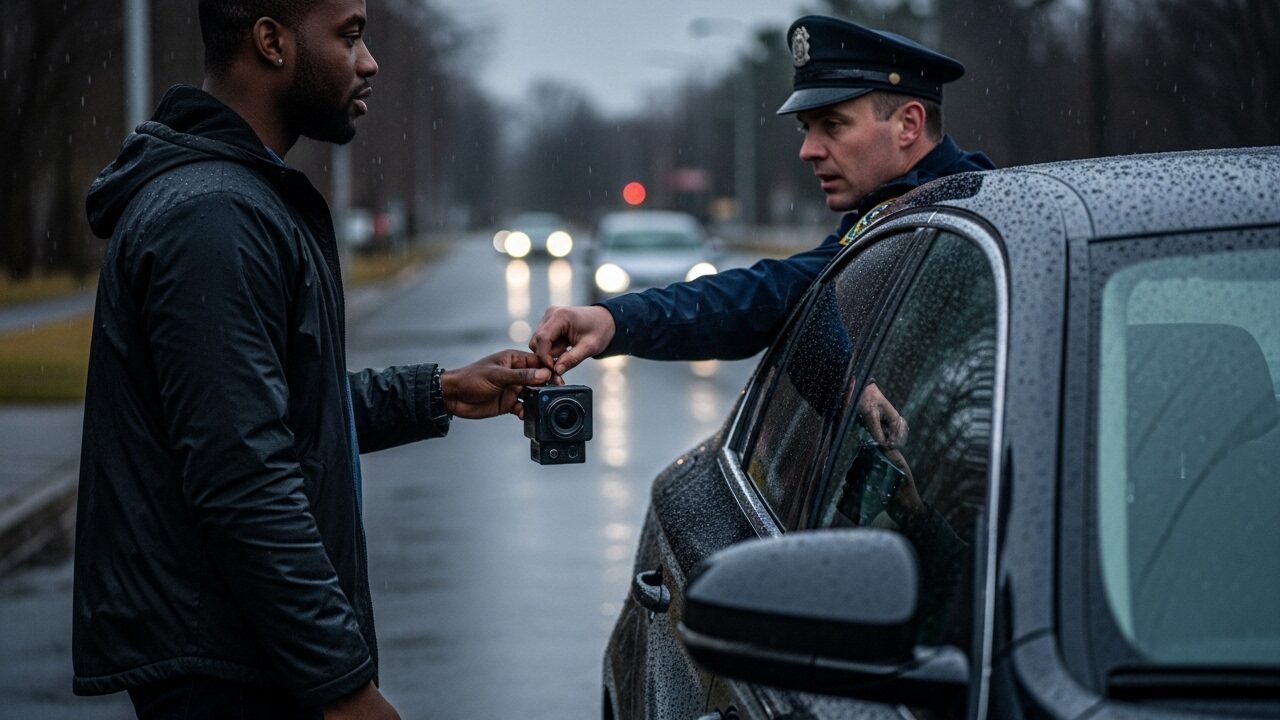
I Was Pulled Over For A “Broken Taillight” On A Dark Road. When The Officer Saw My Face, He Didn’t Ask For My License—He Asked If I Remembered That Night In 1998. What My Hidden Camera Captured Didn’t Just Save My Life; It Uncovered A Secret My City Was Willing To Kill To Protect.

Chapter 1
The rain didn’t just fall that night; it hammered against the windshield of my Audi like it was trying to break through and warn me.
It was 11:47 PM. I remember the clock because I was calculating how many hours of sleep I’d get before my 7:00 AM presentation at the firm. I’m an architect. I build structures designed to withstand pressure, wind, and time. But as I saw those blue and red lights flicker in my rearview mirror, I realized I hadn’t built anything strong enough to protect me from the reality of being a Black man on a lonely stretch of road in Oak Ridge.
My heart didn’t just speed up; it performed a frantic, jagged rhythm against my ribs.
I’m Marcus Thorne. I’ve spent thirty-two years being “one of the good ones.” I have the degree. I have the mortgage. I have the tailored suits. But in the flickering glow of those emergency lights, none of that mattered. I was just a silhouette in a luxury car that “didn’t belong” in this part of town.
I pulled over slowly, making sure my movements were deliberate. I parked under the flickering orange glow of a dying streetlamp.
“Hands on the wheel, Marcus,” I whispered to myself. My voice sounded thin, like paper tearing. “Ten and two. Don’t reach for the glove box. Don’t look annoyed. Just breathe.”
The police cruiser sat behind me, its headlights blindingly bright in my mirrors. I could see the silhouette of the officer through the glare. He didn’t get out right away. He sat there for a long minute—the longest minute of my life—running my plates.
I felt the familiar, cold weight of the “The Talk” my father gave me when I was sixteen. “It doesn’t matter if you’re the President or a janitor, son. When those lights come on, you are a suspect until proven otherwise. Keep your hands visible. Speak with ‘Sir.’ Don’t give them a reason.”
I reached up, my movements agonizingly slow, and tapped a nearly invisible indentation on the plastic housing of my rearview mirror. A tiny green light, no bigger than a pinhead, blinked once.
I had designed this system myself after a “misunderstanding” two years ago. It wasn’t just a dashcam. It was a 360-degree, high-definition internal and external rig that uploaded directly to a private cloud server in real-time. If I disappeared, the footage wouldn’t.
The heavy thud of a car door closing echoed through the rain.
I watched him in the side mirror. He was a big man. White. Mid-fifties. His uniform looked like it had been lived in for a decade—creases where there shouldn’t be, a slight bulge at the midsection. He walked with a heavy, deliberate gait, his flashlight beam cutting through the rain like a lightsaber.
He didn’t go to my window first. He stopped at the back of my car. I heard a dull thud—the sound of a palm hitting my trunk. Then, the sound of glass shattering.
My stomach dropped. He had just broken my taillight.
He stepped up to my driver-side window and rapped on the glass with his heavy flashlight. Clack. Clack. Clack.
I rolled the window down just a few inches. The smell of wet asphalt and cheap tobacco flooded the cabin.
“License and registration,” the officer said. His voice was like gravel in a blender.
“Good evening, Officer,” I said, my voice steady despite the adrenaline. “Is there a problem?”
He didn’t answer. He shined the flashlight directly into my eyes, blinding me. I didn’t squint. I didn’t turn away. I just stared into the white void.
“I said license and registration, boy. Don’t make me ask a third time.”
Boy. The word hung in the air, heavy and sharp.
“It’s in my glove box, Officer. I’m going to reach for it now,” I said clearly.
“Do it slow.”
I moved like I was under water. I retrieved the documents and handed them through the crack in the window. He snatched them. He didn’t even look at the license. He kept the flashlight on my face.
“You’re a long way from the city, Marcus,” he said, reading my name off the card but keeping his eyes on me.
“I was finishing a project at the new library site,” I explained. “I’m heading home to my wife.”
“The library,” he sneered. “Funny. You don’t look like a librarian. You look like someone who’s been scouting the neighborhood.”
“I’m an architect, Officer…?” I trailed off, looking for a badge.
“Officer Miller,” he said, finally lowering the light. But when the light dropped, I saw his face. Truly saw it.
He had a scar that ran from the corner of his left eye down to his jawline. His eyes weren’t just cold; they were haunted. But more than that… there was a flicker of recognition in them. Not the kind of recognition you have for a celebrity. It was the kind of recognition you have for a ghost.
His hand, resting on his belt near his holster, began to shake. Just a tremor, but I saw it.
“You know,” Miller said, leaning in closer, his face inches from mine. The smell of stale coffee was overwhelming now. “You look just like your old man. Same stubborn jaw. Same ‘I’m better than you’ look in the eyes.”
My breath hitched. My father had been dead for twenty years. He died in a “hit and run” that the police never solved. A hit and run that happened three blocks from where we were parked right now.
“You knew my father?” I asked, the fear replaced by a sudden, sharp spike of ice-cold clarity.
Miller’s expression shifted. The aggression remained, but it was joined by something else—desperation.
“I knew a lot of people, Marcus. Some people don’t know when to stay in their lane. Your father was one of them. And it looks like the apple didn’t fall far from the tree.”
“What is this about, Officer Miller? You broke my taillight. I saw you in the mirror.”
The silence that followed was heavy with the sound of the rain. Miller’s face went from pale to a deep, bruised purple. He stepped back and unholstered his weapon, not pointing it at me yet, but holding it at the “low ready.”
“Get out of the car,” he barked. “Now!”
“Officer, I am unarmed and—”
“OUT OF THE CAR! HANDS WHERE I CAN SEE THEM!”
I opened the door. The rain soaked through my silk shirt instantly, chilling me to the bone. I stepped out onto the slick pavement, my hands raised high.
“Turn around. Face the vehicle,” he commanded.
I obeyed. I felt his rough hands slam me against the side of the Audi. The metal was cold. He began to search me, his movements unnecessarily violent. He kicked my legs apart, nearly sending me face-first into the door.
“You think you’re smart, don’t you?” Miller hissed into my ear. “With your fancy car and your big-city job. You think because twenty years have passed, people forget? You think you can just come back here and start poking around?”
“I wasn’t poking around anything,” I gasped as he cinched the handcuffs so tight I felt my fingers go numb. “I was just driving home!”
“Liar!” Miller screamed. He spun me around, grabbing me by the collar. His spit hit my face. “I saw you at the courthouse yesterday. I saw you looking through the archives. Don’t lie to me!”
I hadn’t been to the courthouse. I didn’t even know where the archives were. He was losing it. He was seeing ghosts, and he was projected them onto me.
But then, he stopped. He looked past me, into the interior of the car. His eyes locked onto the rearview mirror.
He saw the pinhead of green light.
The color drained from his face entirely. He didn’t look angry anymore. He looked terrified.
“Is that a camera?” he whispered.
I didn’t answer. I just looked him dead in the eye.
Miller didn’t hesitate. He reached into the car, his massive hand ripping the entire rearview mirror assembly off the windshield with a sickening crack of breaking glass and tearing wires. He held it up like a trophy, then threw it onto the asphalt and crushed it under his heavy boot.
Crunch.
“There,” Miller panted, his chest heaving. “No camera. No witness. Just a resisting suspect and an unfortunate accident.”
He raised his service weapon. This time, he didn’t point it at the ground. He pointed it directly at my chest.
“You’re going to join your father, Marcus. It’s better this way. For everyone.”
The rain blurred my vision, but I didn’t blink. I didn’t beg.
Because Miller didn’t know one thing. The mirror was just the lens. The brain of the system was hidden deep inside the dashboard, behind the climate control vents. And every word he just said—the admission of knowing my father, the threat, the sound of him breaking the equipment—was already sitting on a server five hundred miles away.
And I wasn’t the only one with access to that server.
“You should have checked the headliner, Miller,” I said, my voice eerily calm.
His finger tightened on the trigger. “What did you say?”
“I said… you’re not as good at this as you used to be.”
Just as the hammer of the gun began to move, a second pair of headlights cut through the darkness. A white SUV slowed down as it approached.
An old woman—Mrs. Gable, a local who lived in the farmhouse just up the road—squinted through her windshield. She stopped her car, the light bathing us both in a harsh, judgmental glow.
Miller froze. The mask of the “hero cop” tried to slide back into place, but it was crooked.
“Officer?” the woman called out, rolling down her window. “Is everything alright? That’s the Thorne boy, isn’t it?”
Miller looked at her, then back at me. The barrel of the gun lowered an inch, but his knuckles were white.
This wasn’t just a traffic stop anymore. This was a war twenty years in the making. And the first shot had just been fired.
Chapter 2
The glare of Mrs. Gable’s headlights felt like a spotlight on a stage where the ending hadn’t been written yet. For a heartbeat, the only sound was the rhythmic thwack-thwack of her windshield wipers and the heavy, ragged breathing of Officer Miller. He was a man suspended between two worlds: the one where he could make me disappear into the muddy woods of Oak Ridge, and the one where he had to be the “protector of the peace.”
The barrel of his Glock 17 lowered, but his finger remained glued to the trigger guard. He looked at Mrs. Gable—a woman whose family had probably owned land in this county since before the Civil War—and he saw a witness he couldn’t simply intimidate.
“Everything’s fine, Mrs. Gable!” Miller shouted over the rain, his voice cracking with a forced, terrifying cheerfulness. “Just a routine stop. Mr. Thorne here was speeding and… well, he’s being a bit uncooperative. You head on home now. Roads are slick.”
Mrs. Gable didn’t move. She shifted her old Ford Explorer into park. I could see her silhouette—a small, bird-like woman with a halo of white hair. She knew me. She knew my mother. She’d bought lemonade from me when I was six years old.
“He doesn’t look uncooperative, Miller,” she called out, her voice thin but sharp. “He looks like he’s in handcuffs. And why is your gun out?”
Miller’s jaw tightened so hard I thought his teeth might snap. He stepped toward me, grabbing my bicep with a grip that felt like industrial pliers. He leaned in, his voice a lethal whisper in my ear. “You say one word to her—one word—and I’ll tell the board you reached for my belt. She’s old, Marcus. Her eyes aren’t what they used to be. Who do you think they’ll believe?”
I stayed silent. My heart was a drum in my ears, but my mind was working. The data. The server. I needed to keep him talking, or at least keep him from realizing that the “crushed” camera wasn’t the only eye on him.
“I’m fine, Mrs. Gable,” I called out, my voice surprisingly steady. “Officer Miller is just doing his job. Please, go home. Call my wife, Lena. Tell her where I am.”
The mention of Lena made Miller flinch. He didn’t want names. He didn’t want a paper trail. He wanted a ghost.
“I’ll do that, Marcus,” she said, her voice lingering with doubt. She waited another ten seconds—ten seconds where Miller and I stood locked in a grotesque embrace of predator and prey—before she finally put the car in gear and rolled slowly away.
The moment her taillights vanished around the bend, the mask dropped. Miller didn’t shoot me, but he slammed me face-first into the hood of my Audi. The cold metal bit into my cheek.
“You think you’re protected now?” Miller hissed. He hauled me up and dragged me toward his cruiser. “You’re going to the station. And by the time we get there, you’re going to wish you’d died on this road.”
He threw me into the back of the cruiser. The interior smelled of stale coffee, old upholstery, and a faint, metallic scent that I realized with a shudder was dried blood. The cage—the heavy wire mesh separating the front from the back—was scratched and dented, a testament to the desperate people who had sat where I was sitting now.
As Miller climbed into the driver’s seat, he didn’t pull away immediately. He took out his radio.
“Dispatch, this is Miller. I’ve got one in custody. Code 4. Resisting with violence, suspected DUI, and… let’s add possession with intent. I found a ‘baggie’ during the sweep.”
My blood ran cold. “You’re planting evidence,” I said, my voice echoing in the cramped space.
Miller looked at me through the rearview mirror. His eyes were devoid of anything resembling humanity. “I’m not planting anything, Marcus. I’m just making sure the truth matches the paperwork. In Oak Ridge, the paperwork is whatever I say it is.”
He slammed the car into gear and floored it.
The drive to the Oak Ridge Police Department was a blur of rain-slicked trees and rising dread. I watched the world go by through the reinforced glass, feeling the weight of the handcuffs cutting into my wrists. I started to think about my father, Elias.
Twenty years ago, they told my mother he’d been walking home from the grocery store when a “drunk driver” hit him and kept going. No witnesses. No tire marks. Just a broken man in a ditch. But I remembered the weeks leading up to it. I remembered my father, a quiet man who worked at the local mill, sitting at the kitchen table with a stack of blueprints and a worried expression. He’d found something in the mill’s expansion plans—something about the land the town was built on. He’d been going to the courthouse. Just like Miller thought I had been.
The station was a squat, brick building that looked like a fortress. As we pulled into the secure sally port, the heavy iron gate groaned shut behind us.
Miller dragged me out of the car. He didn’t walk me in; he marched me, his hand constantly twisting my arm to keep me off balance. Inside, the air was thick with the hum of fluorescent lights and the clatter of old keyboards.
“What do we have here, Miller?”
A woman stepped into the hallway. She was younger, maybe late twenties, with blonde hair pulled back into a tight, severe bun. Her uniform was crisp, her boots polished to a mirror shine. Her name tag read: Officer Sarah Jenkins.
“Thorne’s kid,” Miller said, not breaking his stride. “Picked him up on Route 9. Resisting, probable DUI. He’s been sniffing around the archives, Sarah. You know what that means.”
Jenkins looked at me. Her eyes weren’t like Miller’s. They weren’t filled with hate; they were filled with a clinical, detached curiosity. She looked at my suit—a three-thousand-dollar charcoal wool—and then at my face, which was smeared with road grime and blood from where Miller had slammed me into the car.
“An architect from the city?” she asked, her voice cool and professional. “Seems like a lot of trouble for a Saturday night.”
“He’s trouble by blood, Jenkins,” Miller snapped. “Get the intake forms ready. I’m taking him to Box 2.”
“Box 2? For a DUI?” Jenkins frowned. “Standard procedure says—”
“I don’t give a damn what standard procedure says!” Miller roared, turning on her. The violence in his voice was so sudden that Jenkins actually took a step back. “I’ve been on this force longer than you’ve been alive. I know how to handle a Thorne. You do what you’re told, or you can go back to filing traffic tickets in the basement.”
Jenkins went pale. She looked at me, then back at Miller, and gave a stiff nod. “Yes, sir.”
She walked away, but I caught the slight tremor in her hands. She was a “true believer”—the kind of person who joined the force because they believed in the law. But she was starting to see the cracks in the man she was supposed to respect.
Miller shoved me into Box 2. It was a small, windowless interrogation room. A single metal table was bolted to the floor, flanked by two uncomfortable chairs. The walls were a sickly shade of beige, stained with years of cigarette smoke and desperation.
He pushed me into a chair and stepped back, looming over me.
“Now,” Miller said, leaning on the table. “Let’s talk about what you were really doing in my town.”
“I told you,” I said, my voice hoarse. “I’m working on the library project. My firm won the contract. Check my phone. Check my email.”
“I don’t need to check your phone to know you’re a liar,” Miller said. He reached into his pocket and pulled out a small, clear plastic bag. Inside was a white powder. He tossed it onto the table. “Found this under your driver’s seat. That’s a felony, Marcus. Enough to put you away for ten years. Longer, if I find a way to link it to that ‘accident’ your father had.”
My heart skipped a beat. “What does my father have to do with this?”
Miller smiled. It was a slow, oily expression. “Your father was a smart man, Marcus. Too smart. He thought he could change things. He thought he could dig up the bones this town is built on and not get dirty. But bones stay buried for a reason.”
He leaned in so close I could see the broken capillaries in his nose.
“You’ve been asking questions, haven’t you? Someone told you about the mill. Someone told you about the 1998 survey.”
I realized then that Miller wasn’t just a corrupt cop. He was a man consumed by a secret. He was convinced I was there to finish what my father started, even though I didn’t even know what that was. I’d spent twenty years trying to forget Oak Ridge, trying to build a life where I wasn’t defined by a “hit and run” in a small town. But the town hadn’t forgotten me.
“I don’t know what you’re talking about,” I said, and for the first time, it was the absolute truth. “I just wanted to build a library.”
Miller slammed his fist onto the table. The plastic bag of “drugs” jumped. “Don’t play dumb with me! Why were you at the courthouse?”
“I wasn’t!” I shouted back. “I spent the whole day at the construction site with the foreman and three engineers. All of them are White, Miller. All of them will testify that I never left the site. You’re chasing a ghost.”
Miller froze. The logic of my statement seemed to hit him like a physical blow. If I could prove where I was, his “scouting” narrative fell apart. His face contorted, shifting from rage to a frantic, darting fear.
Suddenly, the door opened. A tall, portly man with silver hair and a sharp, expensive suit walked in. Sergeant Bill Vance. He was the man who kept the gears of Oak Ridge turning. He was Miller’s boss, but more than that, he was his protector.
“Miller,” Vance said, his voice deep and melodic, like a preacher’s. “A word.”
Miller looked at me, gave a final, warning glare, and stepped out. The door didn’t close all the way.
I strained my ears.
“What are you doing, Roy?” Vance’s voice was low, but urgent. “Mrs. Gable called the Chief. She says you had a gun to Elias Thorne’s boy’s head.”
“He was resisting, Bill,” Miller hissed. “He’s back. He’s digging. He knows about the mill land.”
“He’s an architect from the city, you idiot!” Vance whispered back. “He’s got lawyers. He’s got friends in the Governor’s office. You can’t just make him disappear like we did his old man.”
Like we did his old man.
The words hit me like a sledgehammer. My father didn’t die in an accident. They killed him. The police—the people sworn to protect the town—had murdered my father because of something he found at the mill. And now, they thought I had found it too.
“I found coke in his car,” Miller said, his voice desperate. “I can make it stick.”
“You found it? Or you put it there?” Vance sighed. “It doesn’t matter. The Gable woman is a problem. We need to handle this quietly. Let him sit here for a few hours. Let him get scared. Then we ‘find’ a mistake in the paperwork and let him go with a warning. We tell him if he ever comes back to Oak Ridge, he won’t make it to the highway.”
“No!” Miller snarled. “He’s got a camera, Bill. In the car.”
My breath caught.
“A camera?” Vance asked.
“I smashed it,” Miller said. “But he said something… something about the headliner.”
Silence followed. I could almost hear them thinking.
“Check the car again,” Vance ordered. “If there’s a recording, find it. Destroy it. And Miller? If you’ve botched this, I can’t help you. The mill project is worth fifty million dollars. No one—not you, and certainly not some city boy—is going to stop it.”
The footsteps faded away.
I sat alone in the room, my hands still cuffed behind my back. My mind was racing. They killed my father. They were planning to ruin me. And they were looking for the “brain” of my camera system right now.
But they were looking in the car.
What they didn’t know was that I wasn’t just an architect. I was a geek who’d spent his teenage years building computers because I didn’t have a father to play catch with.
I looked up at the corner of the room. There was a standard security camera there—a cheap, analog model that probably hadn’t been updated since the 90s. It was pointed at the table.
I shifted in my chair. It was bolted to the floor, but I had a few inches of play. I leaned back, my cuffed hands reaching for the seam of my pants.
Hidden in the lining of my waistband was a small, flat device. It looked like a car key fob, but it was a remote uplink trigger.
I pressed the button three times.
Somewhere, in a high-rise apartment in the city, Lena’s phone would be screaming. An emergency alert would be flashing across her screen, giving her a live feed of everything my system had captured—from the moment Miller hit my trunk to the conversation I just overheard through the door.
And Lena wasn’t just my wife. She was a senior producer for the biggest news network in the state.
I leaned forward, looking directly into the police station’s camera.
“I hope you’re watching, Miller,” I whispered. “Because I’m not my father. I don’t hide. I build.”
The door burst open again. It wasn’t Miller. It was Officer Jenkins. She looked shaken. She held a tablet in her hand.
“Mr. Thorne,” she said, her voice trembling. “I… I just checked the impound logs. And the dashcam footage from Miller’s cruiser.”
“And?” I asked.
“It’s gone,” she whispered. “The last twenty minutes of his shift were manually deleted from the server. But I found something else.”
She turned the tablet toward me. It was a scan of a document.
“I was curious about what Miller meant about ‘the archives,'” she said. “I found this. It’s a soil toxicity report from 1998. Your father’s name is at the bottom. He was the whistleblower.”
I looked at the document. It showed that the land where the new library—and the entire mill redevelopment—was being built was sitting on top of a massive, illegal chemical dump. A dump that the town’s elite, including Vance and Miller, had been paid to cover up for decades. If the truth came out, the “fifty million dollar project” would vanish, and half the town leadership would go to prison.
“Why are you showing me this, Jenkins?” I asked, eyeing her warily. “You’re one of them.”
“I’m a cop,” she said, her eyes flashing with a sudden, fierce anger. “I’m not a murderer. And I’m not a liar. My father was a cop in this town, too. He died of cancer five years ago. He worked at that mill for thirty years.”
She looked at the toxicity report. “This report says the chemicals in that soil cause exactly the kind of cancer he had. They didn’t just kill your father, Marcus. They killed mine, too. And they let him think it was just bad luck.”
A heavy silence filled the room. In that moment, the lines of race and background blurred. We were just two people who had been robbed by the same monster.
“Miller is coming back,” she said, closing the tablet. “He didn’t find the backup in your car. He’s losing his mind. He’s going to try to move you. To a ‘secondary location.'”
We both knew what that meant. A “secondary location” in Oak Ridge was a place people didn’t come back from.
“What are you going to do?” I asked.
Jenkins looked at the door, then back at me. She reached for the key on her belt.
“I’m going to do my job,” she said.
She stepped behind me and unlocked the handcuffs. The relief was instant, but the danger was only beginning.
“My car is out back,” she whispered. “But the gate is locked. Vance has the master override. We have to get to the server room. If we can lock down the footage Miller tried to delete, we can—”
Suddenly, the building’s alarm began to wail. A harsh, electronic shriek that felt like it was peeling the skin off my bones.
“He found it,” Jenkins gasped. “He found the uplink.”
The door to the interrogation room was kicked open. Miller stood there, his face a mask of pure, unadulterated homicidal rage. He wasn’t holding a gun anymore. He was holding a heavy iron pry bar he’d taken from the impound lot.
“Jenkins,” he spat. “Step away from him.”
“Officer Miller, put that down!” Jenkins shouted, drawing her weapon. “I know about the report. I know about the mill.”
Miller didn’t even look at her gun. He looked at me.
“You’re just like him,” Miller said, his voice a low, guttural growl. “Always building things. Always trying to see over the fence. Well, tonight, the fence falls on you.”
He lunged.
Jenkins fired a warning shot into the ceiling, but Miller was a man who had already decided he was dead. He swung the pry bar, catching Jenkins in the shoulder and sending her spinning into the wall. Her gun skittered across the floor.
I didn’t think. I didn’t have time to be an architect. I was a son whose father had been murdered.
I dove for the gun.
Miller’s boot slammed into my ribs, knocking the wind out of me. I rolled, gasping for air, as the iron bar smashed into the metal table exactly where my head had been a second ago.
“You’re not leaving this room, Marcus!” Miller screamed. “Nobody leaves!”
He raised the bar for a final, crushing blow.
But then, the overhead lights flickered and died. The room plunged into darkness, lit only by the red strobe of the alarm system.
Click.
The sound of a door locking.
“What the hell?” Miller yelled into the dark.
From the hallway, a voice boomed over the intercom—a voice I knew. It was Lena.
“Officer Miller,” her voice echoed, calm and cold as a winter morning. “My name is Lena Thorne. I’m currently live-streaming this conversation to three million people. I have the footage of you breaking the car. I have the footage of you planting the drugs. And I have the 1998 soil report.”
The red light of the alarm flashed, illuminating Miller’s face. For the first time, he didn’t look like a threat. He looked like a trapped animal.
“The FBI is six minutes away,” Lena continued. “Drop the weapon, or don’t. It doesn’t matter. You’ve already lost.”
Miller looked at the camera in the corner. He looked at me, shivering on the floor. He looked at Jenkins, who was clutching her shattered shoulder.
He didn’t drop the bar. He turned it toward his own throat.
“I won’t go to jail,” he whispered. “Not for this town.”
“No!” I shouted, reaching out.
But the darkness swallowed the room again, and the only thing I heard was the sound of a man who had finally run out of places to hide.
Chapter 3
The darkness in Box 2 wasn’t just the absence of light; it was a physical weight, thick with the smell of Miller’s sweat and the copper tang of the blood dripping from Sarah Jenkins’ shoulder. The red strobe of the alarm system pulsed like a dying heart, casting long, distorted shadows against the beige walls. Every two seconds, I saw Miller: a broken, hulking silhouette with an iron bar pressed against his own throat. Every two seconds, the world went black again.
“Drop it, Miller,” I said, my voice sounding steadier than I felt. My ribs screamed with every breath, a reminder of the boot he’d buried in my chest. “It’s over. You heard her. The whole world is watching.”
“The world doesn’t know a damn thing about Oak Ridge!” Miller screamed into the dark. “They don’t know what it takes to keep a place like this alive! We were dying, Marcus! The mill was closing, the shops were boarded up. We did what we had to do to bring the money back!”
“By killing my father?” I took a step toward him, hands out. “By poisoning the very people you were supposed to protect? My father found those reports. He wasn’t trying to destroy the town; he was trying to save it from the people who were killing it for a paycheck.”
“He was a nuisance!” Miller spat, his voice cracking. “Vance said he’d handle it. He said it would look like an accident. I was just the driver, Marcus. I was just the man behind the wheel.”
The admission hung in the air, heavier than the iron bar. My father’s death—the central trauma of my life, the void that had shaped my ambition and my isolation—was just a task on a Friday night for this man. A “handling.”
Sarah Jenkins groaned on the floor, her hand fumbling for her radio. “Dispatch… this is Jenkins… I have an officer down… Box 2… suspect is… no, Officer Miller is the threat. Send the State Police. Do not send local units. I repeat, do not send local units.”
Static was her only answer. Vance had likely cut the internal comms.
Outside the heavy steel door, I heard the muffled chaos of a police station in total collapse. Shouting, the sound of heavy boots, and the frantic ringing of phones that no one was answering. The live stream had hit the internet like a tidal wave. In the digital age, a secret that survives twenty years can be dismantled in twenty seconds.
Suddenly, the door to the interrogation room groaned. Someone was trying to override the electronic lock from the outside.
“Miller, open the door!” It was Sergeant Vance. His voice wasn’t the calm, melodic purr of a protector anymore. It was sharp, jagged with panic. “Roy, the Feds are already at the perimeter. They’ve got the gate. We need to move Thorne now!”
Miller didn’t move. He stared at the door, then back at me. The red light flashed. He looked ancient. The fire of his rage had burned out, leaving only the grey ash of a man who realized he was the sacrificial lamb.
“He’s not coming to save you, Roy,” I said softly. “He’s coming to finish the job. If you’re dead and I’m ‘gone,’ he can still spin a story. He can blame the whole thing on a rogue cop who lost his mind.”
Miller’s grip on the pry bar faltered. “I have a pension,” he whispered. “Thirty years. I have a daughter in college.”
“She’s going to find out her father was a murderer, Roy. Unless you do the right thing now.”
The lock clicked. The door swung open, and the hallway’s emergency lights flooded the room. Sergeant Vance stood there, his face pale and slick with rain. He wasn’t alone. Standing behind him was Mayor Thomas Whitaker.
Whitaker was a man who looked like he’d been carved out of expensive soap—smooth, white, and slippery. He was wearing a trench coat over a tuxedo; he’d clearly been at a fundraiser when the world ended. His eyes darted around the room, landing on the camera in the corner, then on me, then on the bleeding Officer Jenkins.
“My God,” Whitaker whispered. “Roy, what have you done?”
“What I did?” Miller laughed, a dry, hacking sound. “I did what you told me to do, Thomas. I kept the Thorne boy quiet. Just like we did in ’98.”
Whitaker’s face went from pale to translucent. “I never told you to do… this. I didn’t know about any violence.”
“The hell you didn’t!” Miller stepped toward the Mayor, the iron bar still in his hand. “You signed the checks for the ‘environmental cleanup’ that never happened. You bought that vacation house in Aspen with the money the mill owners saved on disposal fees. Don’t you dare act like your hands are clean.”
Vance stepped between them, his hand resting on his sidearm. “Enough. Both of you. The FBI is coming through the front door. We have three minutes. Marcus, you’re coming with us. We’re going out the back sally port.”
“I’m not going anywhere with you,” I said, backing up until I hit the cold metal table.
“You don’t have a choice,” Vance said. He drew his weapon—not with the shaking desperation of Miller, but with the cold, calculated precision of a man who had been a predator his entire life. “I can’t stop the footage from being out there, but I can make sure the ‘primary witness’ is too dead to testify to the details. A tragic shootout during an escape attempt. It’s a classic for a reason.”
“You’ll have to shoot me too, Bill.”
We all turned. Sarah Jenkins had pulled herself up, using the wall for support. Her service weapon was in her left hand, shaking, but pointed directly at Vance’s chest.
“Sarah, don’t be a fool,” Vance said, his voice dropping an octave. “Your father was my partner. I looked out for him. I’ll look out for you. Put the gun down.”
“You let my father die of cancer!” she screamed, her voice cracking with the weight of her grief. “You knew the soil was toxic! You knew the water he drank every day at the mill was killing him, and you didn’t say a word because you wanted your cut! You didn’t look out for him. You used him as a shield!”
The tension in the room was a living thing, a wire pulled so tight it was humming.
“Drop the gun, Sarah,” Vance commanded.
“No,” she said.
In that moment, the front of the station erupted. The sound of a flashbang—a deafening CRACK and a wall of white light—echoed through the building. The Feds weren’t knocking.
Vance spun toward the door, distracted for a split second.
I didn’t wait. I lunged at him, tackling him around the waist. We hit the floor hard. The gun went off, the bullet ricocheting off the metal table and shattering the glass of the observation window.
Vance was strong, but I had twenty years of repressed fury fueling my muscles. I pinned his gun arm to the floor, my fingers digging into his wrist.
“It’s over!” I yelled. “It’s over!”
Miller, seeing his world collapse, didn’t join the fight. He did something worse. He walked over to the Mayor, grabbed him by the throat, and shoved him against the wall.
“You’re going down with me, Thomas,” Miller growled. “Every bribe. Every meeting. I kept a ledger. I wasn’t as stupid as you thought.”
Suddenly, the hallway was filled with black tactical gear and the blinding beams of weapon-mounted lights.
“FBI! DROP THE WEAPON! HANDS IN THE AIR!”
Agent Robert Hayes burst into the room. He was a man who looked like he was made of granite, with eyes that had seen every version of human depravity. He took in the scene in a heartbeat: me on top of the Sergeant, the bleeding officer, the cop choking the Mayor.
“Everybody stay exactly where you are!” Hayes roared.
I felt the heavy weight of a boot on my back and the cold steel of a rifle barrel against the base of my skull.
“Hands behind your head! Do it now!”
I obeyed. I felt the zip-ties bite into my wrists. They pulled me off Vance, who was being slammed into the wall by two other agents. Miller was tackled to the ground, the iron bar clattering away. The Mayor was slumped in the corner, sobbing into his silk sleeves.
Agent Hayes knelt down next to Sarah Jenkins. He checked the wound on her shoulder, then looked at her badge.
“Officer Jenkins?”
“Yes,” she wheezed. “The evidence… it’s on the tablet. And the suspect… Marcus Thorne… he’s the one who called it in.”
Hayes looked at me. He didn’t look like a hero; he looked like a man who had a lot of paperwork ahead of him. He signaled to the agents to stand me up.
“Mr. Thorne?”
“Yes,” I said, spitting blood out of my mouth.
“Your wife is on the phone. She’s been patched into our tactical freq for the last ten minutes. She’s been screaming for us to make sure you’re breathing.”
He handed me a headset.
“Marcus?” Lena’s voice was a jagged mess of relief and terror. “Marcus, talk to me.”
“I’m here, baby,” I whispered, my eyes stinging. “I’m here. It’s done.”
“The stream has ten million views, Marcus. The Governor just called for a special session. They can’t hide it anymore. None of it.”
I looked around the room. This tiny, miserable box where they had tried to break me. I looked at Miller, who was being led out in chains, his head bowed. I looked at Vance, who was still trying to maintain his dignity, staring at the floor with a mask of pure hate.
But then, another man entered the room.
David Sterling was my lawyer. He looked like he’d just stepped off a yacht—crisp white shirt, perfectly coiffed hair, and an expression of profound boredom that masked a lethal legal mind. He walked past the FBI agents like they were valet parking attendants.
“Mr. Thorne,” Sterling said, adjusting his glasses. “I trust you haven’t said anything to these gentlemen without me?”
“I think I’ve said enough for one night, David,” I said.
“Good. Because we’re not just suing this department. We’re suing the county, the mill corporation, and every individual in this room whose name ends in a paycheck. I’ve already filed for an emergency injunction to seize all records from the courthouse.”
Sterling looked at Agent Hayes. “Agent, my client is a victim of an attempted extrajudicial execution. I want him processed, released, and placed under federal protection immediately. If I see a single bruise on him that wasn’t there ten minutes ago, I will make your life a bureaucratic nightmare.”
Hayes sighed. “We’re working on it, Counselor. But first, we have a town to dig up. Literally.”
As they led me out of the station, the rain had finally stopped. The air felt different—thinner, colder, but cleaner. The parking lot was a sea of blue and red lights, but these weren’t the lights of a predatory traffic stop. They were the lights of an occupation.
Mrs. Gable was there, standing by the yellow police tape, a thermos in her hand. She saw me and nodded—a small, solemn gesture of acknowledgement. She had done her part. She had been the witness they couldn’t kill.
I looked back at the station. It looked smaller now. Less like a fortress, more like a tomb.
Twenty years ago, my father had died in the dark on a road not far from here. He had died alone, labeled a victim of a “hit and run” by the very men who had run him down. He didn’t get a livestream. He didn’t get a high-powered lawyer. He just got a ditch and a covered-up report.
But as I watched the FBI technicians wheeling out boxes of evidence—boxes that contained the truth about the poison in the ground and the blood on the hands of the “town fathers”—I realized that Elias Thorne hadn’t died in vain. He had left a trail. It had taken two decades for his son to find it, but the trail was finally leading to the light.
“Mr. Thorne?” Agent Hayes approached me. He held a small, charred piece of plastic. It was the remains of my rearview mirror. “We found this. I know Miller smashed it, but our tech team says the internal buffer might have saved the last sixty seconds of the physical impact.”
He looked at the station, then back at me. “Why did you come back here, Marcus? You knew what this town was. You could have stayed in the city and never looked back.”
I thought about the library I was supposed to build. A place of knowledge. A place where the truth is stored on shelves for everyone to see.
“I’m an architect, Agent,” I said. “You can’t build something new on a rotten foundation. I didn’t come back to dig up the past. I came back to make sure the future had something solid to stand on.”
But as Hayes walked away, I felt a cold shiver. The Mayor, the Sergeant, the Officer—they were just the soldiers. The mill redevelopment project was backed by a multi-national conglomerate with resources that made a small-town police department look like a lemonade stand.
I looked at my phone. A message from an unknown number flashed on the screen.
“The ground is deeper than you think, Marcus. Don’t celebrate yet.”
The war wasn’t over. It was just changing fronts.
Chapter 4
The safe house was a non-descript ranch-style home in a suburb two hours away from Oak Ridge. It smelled of lemon pledge and artificial security. I sat at the kitchen table, staring at a lukewarm cup of coffee, while the blue light of the television cast flickering shadows across the room.
On the screen, the world was exploding. Aerial shots of the Oak Ridge Police Department. Clips of the livestream I’d inadvertently hosted. News anchors with grave faces discussed “The Thorne Case” as if it were a national holiday. But inside this house, it was quiet. Too quiet.
Lena sat across from me, her eyes red-rimmed but her spirit unyielding. She hadn’t let go of my hand since we arrived.
“The FBI recovered the ledger Miller mentioned,” she whispered. “Vane and the Mayor are talking. They’re trying to cut deals, Marcus. They’re pointing fingers at the corporation behind the mill redevelopment—Apex Global.”
I rubbed the bridge of my nose. My ribs were taped, and every breath was a sharp reminder of Miller’s boot. “Apex doesn’t cut deals, Lena. They cut ties. That text I got… that wasn’t from a small-town cop. That was a warning from the people who hold the strings.”
The door opened, and Agent Hayes walked in. He looked exhausted. His tie was loosened, and his jacket was gone.
“We’ve got a problem,” Hayes said, skipping the pleasantries. “The toxicity report your father filed in ’98? The original is gone from the courthouse archives. And the digital backup Officer Jenkins found on the station server? Wiped. Remote hack. Someone with high-level access burned the bridge behind them.”
I felt a cold pit in my stomach. “And the livestream?”
“The video of the arrest and the confession is gold for the civil rights case and the murder charges against Miller and Vance,” Hayes said. “But to take down the people who ordered it—to prove the environmental conspiracy—we need the actual data your father died for. Without it, Apex Global can claim they were ‘unaware’ of the soil conditions and blame it on local corruption.”
“I know where it is,” I said.
The room went silent. Lena looked at me, her eyes wide. “Marcus, what are you talking about?”
“The night my father died,” I began, the memory surfacing like a ghost from the depths of a dark lake. “He came home late. He was covered in red clay. He didn’t say much, but he tucked me in and told me that if anything ever happened, I should remember the ‘Foundation of the Old Mill.’ I thought he was talking about work. He was an engineer; he was always talking about foundations.”
I stood up, ignoring the flare of pain in my side. “I spent my life becoming an architect because of him. I studied the blueprints of this county more than anyone. My father didn’t just find a report. He found a sample. A physical piece of evidence that proved the chemicals were being dumped directly into the aquifer. He didn’t trust the courthouse. He buried it where he thought it would be safest: the only place in Oak Ridge he believed was truly his.”
“The old mill,” Hayes breathed.
“No,” I corrected. “The foundation of our old house. The one that burned down six months after he died.”
The drive back to Oak Ridge felt like descending into a grave. We went in a two-car convoy—Hayes and I in an armored SUV, with two other agents following. Lena stayed at the safe house under guard. I couldn’t risk her again.
As we pulled into the outskirts of town, the atmosphere was thick with tension. The “Welcome to Oak Ridge” sign had been spray-painted with the word MURDERERS. The streets were empty, the residents hiding behind drawn curtains. The town was mourning a lie it had lived for twenty years.
We reached the site of my childhood home. It was an overgrown lot now, choked with weeds and the charred remains of a chimney that stood like a tombstone.
“You’re sure about this?” Hayes asked, handing me a heavy-duty flashlight.
“My father built the basement himself,” I said. “He always told me that a house is only as good as what you put in the ground.”
We started digging near the base of the chimney. The rain began to fall again—a soft, persistent drizzle that turned the red clay into a slick, bloody mess. After an hour of grueling work, my shovel hit something hard. Not a rock. Metal.
We cleared the dirt away to reveal a small, airtight Pelican case—the kind used for industrial tools. My father must have bought it just days before he died.
With trembling hands, I flicked the latches. Inside, preserved in vacuum-sealed bags, were three vials of dark, viscous liquid and a handwritten notebook. The notebook was filled with my father’s precise, elegant script—dates, coordinates, and names.
August 14, 1998: Observed three unmarked tankers discharging into the North Basin. Security provided by ORPD. Officer Miller present. Amount of bribe confirmed: $5,000 to the Mayor’s slush fund.
It was all there. The map of the poison. The receipts of the betrayal.
“This is it,” Hayes whispered, looking at the vials. “This is the smoking gun.”
“Not yet,” a voice called out from the darkness.
We spun around. The beams of our flashlights cut through the rain, landing on a figure standing by the edge of the lot.
It wasn’t a cop. It was a man in a perfectly tailored charcoal suit, holding a silenced H&K pistol with the practiced ease of a professional. Behind him, four other men emerged from the shadows, all armed, all wearing tactical gear with no insignias.
Julian Vane. The “fixer” for Apex Global.
“Agent Hayes,” Vane said, his voice as smooth as silk and twice as cold. “I’m afraid I have to ask you to hand over that case. It’s a matter of corporate proprietary information.”
“You’re a long way from the boardroom, Vane,” Hayes said, his hand moving slowly toward his holster.
“Don’t,” Vane warned. “Your backup is currently… occupied. We jammed their comms three miles back. It’s just us, the mud, and the dead.”
Vane looked at me. His eyes were like chips of ice. “Marcus Thorne. You really are your father’s son. Persistent. Principled. And profoundly annoying.”
“You killed him,” I said, my voice thick with a rage that felt older than I was. “You sent Miller to run him down in the street like an animal.”
“I sent a message,” Vane corrected. “Your father chose not to read it. He thought he could stand in the way of progress. This town was a corpse, Marcus. Apex gave it a heart transplant. So what if the blood was a little tainted? People had jobs. The schools had books.”
“The people were dying of cancer!” I shouted. “The children were drinking poison!”
“A necessary overhead,” Vane shrugged. “Now, the case. If you give it to me, I’ll let Agent Hayes live. You, however, have become a liability that even my lawyers can’t manage. But I’ll make sure your wife is taken care of. A generous ‘settlement’ for her loss.”
I looked at the case in my hands. I looked at the vials that held my father’s soul and the town’s sins.
“You think you’ve won because you have guns?” I asked. I felt a strange, terrifying calm settle over me. “That’s the mistake Miller made. He thought he could break me with his hands. You think you can buy me with a threat.”
“I’m not buying you, Marcus. I’m erasing you.”
Vane raised the silenced pistol.
But I wasn’t looking at Vane. I was looking at the old chimney behind him.
“Now!” I yelled.
From the darkness of the ruined basement, a shadow lunged.
It was Officer Sarah Jenkins.
She hadn’t stayed at the hospital. She hadn’t stayed in bed. She had followed us, driven by a ghost of her own. Her arm was in a sling, but her good hand held her service weapon.
CRACK.
She didn’t aim for Vane. She aimed for the gas tank of the generator the agents had brought to light the dig site.
The explosion was small but blinding. In the chaos of the fire and the sudden flash, Hayes drew his weapon and fired. One of Vane’s men went down. The others scrambled for cover.
“Go, Marcus! Get the case to the car!” Hayes screamed.
I ran. I ran through the mud and the thorns, the case clutched to my chest like a child. I could hear the muffled thwip-thwip of silenced rounds hitting the trees around me.
I reached the SUV, but the tires had been slashed. I was trapped.
I looked back. Hayes was pinned down behind a rock. Jenkins was nowhere to be seen. Vane was walking toward me, his face illuminated by the burning generator. He looked like a demon rising from the earth.
“There’s nowhere to go, Marcus,” Vane called out. “Give it up.”
I leaned against the SUV, gasping for air. My ribs felt like they were being crushed by a vise. I looked at the Pelican case.
Then, I looked at my phone. It was still in my pocket.
I remembered what I told Miller. I don’t hide. I build.
I realized I didn’t need to get the case to the FBI. I just needed to get the truth to the world.
I opened the case. I took out my father’s notebook. I flipped to the last page—the page he’d written the day he died.
To my son, Marcus: If you are reading this, it means I failed to change the world, but I didn’t fail to love you. Build something that lasts. Build something true.
I felt a tear slip down my cheek, hot against the cold rain. I took a photo of the page. Then another of the vials. I opened the live-streaming app I had used in the station.
“Ten million people are watching, Vane,” I whispered to the empty air.
I hit ‘Go Live.’
“My name is Marcus Thorne,” I said into the camera, my voice echoing in the dark. “I am standing on the ruins of my childhood home. Twenty years ago, my father was murdered to cover up a crime that is still killing this town. This is the evidence.”
I held up the notebook. I held up the vials.
Vane stepped into the light of the phone’s flash. He stopped. He saw the screen. He saw the viewer count—already climbing into the hundreds of thousands as the notification pings went out across the globe.
“Turn it off,” Vane hissed, his composure finally shattering.
“It’s too late,” I said. “The cloud is already syncing. If you kill me now, you’re doing it in front of the world. You’re not a ‘fixer’ anymore, Julian. You’re a lead story.”
Vane looked at the phone, then at me. The barrel of his gun wavered. For a man like him, visibility was death. He lived in the shadows of shell companies and non-disclosure agreements. This—the raw, unfiltered light of the truth—was his kryptonite.
From the distance, the real sirens began to wail. Not the local police. State Troopers. The National Guard. The Governor had finally seen the writing on the wall—or rather, the video on the screen.
Vane lowered his gun. He looked at the surrounding woods, realized his men had already vanished into the night, and dropped the pistol into the mud.
“You think this changes anything?” Vane asked, his voice a hollow shell. “Apex will survive. They’ll find a scapegoat. They’ll rebuild.”
“Maybe,” I said, standing tall despite the pain. “But they won’t do it here. And they won’t do it with my father’s name in the dirt.”
EPILOGUE
Six months later.
The Oak Ridge library was finally finished. It wasn’t the glass-and-steel monstrosity the city council had originally wanted. It was a low, sturdy building made of local stone and reclaimed wood from the old mill. It felt like it belonged to the earth, rather than being forced upon it.
The soil had been remediated. The “Mill Project” was dead, replaced by a federal environmental cleanup that would take a decade. Apex Global was embroiled in the largest class-action lawsuit in state history.
Officer Miller was serving life without parole for the murder of Elias Thorne. Sergeant Vance had taken a plea deal, testifying against the Mayor and the Apex executives in exchange for a twenty-year sentence.
Sarah Jenkins was no longer a cop. She was the head of the “Thorne Foundation for Environmental Justice.” She still walked with a slight limp in her shoulder, but her eyes were clear.
I stood in the lobby of the library, looking at the plaque near the entrance.
DEDICATED TO ELIAS THORNE. AN ARCHITECT OF THE TRUTH.
Lena walked up beside me, her hand sliding into mine. She was pregnant now. We were going to have a boy. We’d already decided on the name.
“He would have loved this,” she said, leaning her head on my shoulder.
“He did love it,” I said. “He just didn’t get to see the roof go on.”
I looked out the large windows at the town of Oak Ridge. It wasn’t perfect. It was still scarred, still healing. There were people who still hated me for “destroying” the town’s economy, and there were people who looked at me like a savior.
But as the sun began to set, casting a golden glow over the stone walls I had designed, I felt a sense of peace I hadn’t known in thirty years.
I was Marcus Thorne. I was a Black man in America. I had been a suspect, a victim, and a target. But today, I was just a builder.
I had taken the broken pieces of my father’s life and the toxic soil of my hometown, and I had built something that wouldn’t wash away in the rain.
The foundation was finally solid.
END

About the Author
dream01
A writer passionate about human stories and real-life experiences that inspire and move readers.
 Dog Story
46 min read
Dog Story
46 min read
I Watched Two Cops Pull A Bag Of Pills From My Empty Trunk. Then I Made A Call.
Chapter 1 Red and blue lights flashed in my rearview mirror, painting the plush leather interior of my truck in…
 Dog Story
39 min read
Dog Story
39 min read
“I Thought My Elite Law Degree And A $3,000 Suit Made Me Bulletproof. But When Flashing Lights Appeared Behind My Luxury Rental On A Deserted Highway, I Realized Exactly How Fast Everything Can Be Stripped Away.”
I’ve been a defense attorney for over 15 years, standing in front of federal judges, dismantling expert witnesses, and holding…
 Dog Story
2 min read
Dog Story
2 min read
I Was Just Trying To Buy A Birthday Gift For My Mom. When The Store Alarm Went Off, I Thought It Was A Simple Mistake. I Was Dead Wrong. What Followed Was The Most Humiliating 20 Minutes Of My Entire Life.
Chapter 1: The Double Standard The piercing shriek of the security alarm ripped through the quiet murmur of the checkout…
Leave a Reply