
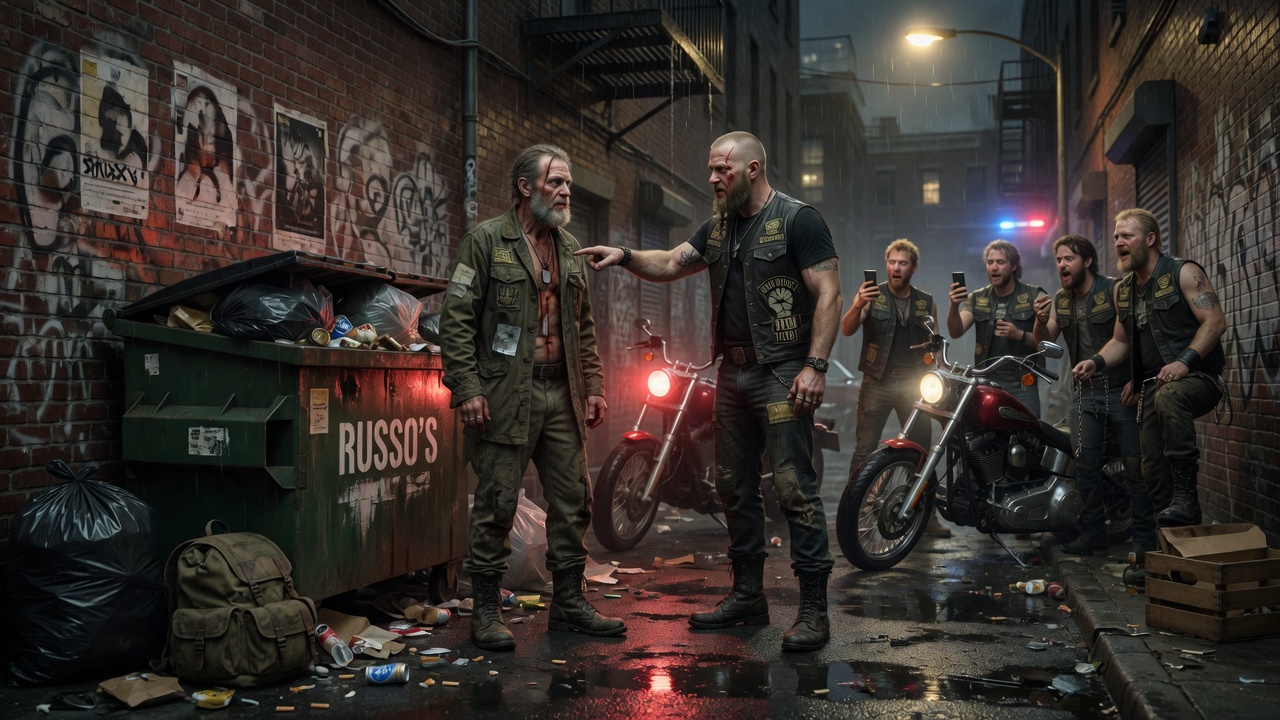
The Iron Gauntlet: They Thought They Cornered a Broken Homeless Veteran in a Dead-End Alley But the Moment He Looked Up, Every Laugh Died

The first thing they did was laugh.
Not talk.
Not threaten.
Not even spit out the usual alleyway garbage men like them liked to throw around when they smelled weakness.
They laughed.
Real loud, too.
The kind of laugh that bounces off brick walls and comes back uglier.
I was kneeling beside a dented green dumpster behind Russo’s Liquor on 11th Street, my hands buried deep in a black trash bag someone had tossed out an hour earlier. I’d found half a sandwich wrapped in wax paper, still dry on one side, and a bruised apple that wasn’t too far gone. That was dinner if nobody bothered me.
Then I heard the engines.
Not one.
Four.
Maybe five.
Heavy bikes. Old-school V-twins. Loud enough to shake the metal lids on the garbage bins and rattle the bottle caps scattered across the pavement. I didn’t need to look up to know who they were. Every neighborhood has a pack of men that feeds on fear. Around here, they called themselves The Iron Gauntlet.
Like the name alone was supposed to make people tremble.
It usually worked.
Just not on me.
I kept my eyes on the bag and finished checking the bottom for anything sealed. A pair of boots stepped into my line of sight. Black leather. Steel toe. Fresh mud on the edges.
Then another pair.
Then another.
“Damn,” one of them said, dragging out the word like he’d just found a raccoon wearing dog tags. “Look what we got here.”
I said nothing.
There was a time in my life when silence was a weapon.
There was also a time when it was the only thing keeping you alive.
I’d learned the difference in places most people only saw in movies.
A chain jingled.
Someone kicked over an empty crate beside me, just because he could. It clattered into the wall and broke apart.
Still I didn’t move.
That was when the laugh came. A whole chorus of it.
“Hey, old man,” another voice said. “You deaf or just stupid?”
I slowly folded the sandwich back up and slid it into the inside pocket of my coat. My fingers were stiff from the cold, but steady. Always steady.
I rose one knee at a time.
My left knee cracked.
My back complained.
The rain from earlier had soaked through the cardboard I’d laid out for myself by the far wall, and the alley smelled like old grease, wet brick, and spoiled beer. I stood anyway and turned to face them.
Five men.
I’d been right.
The one in front was broad across the chest, maybe six-two, beard braided in two points like he thought he was some kind of warlord. He wore a black leather vest with the Iron Gauntlet patch stitched across the back and a ring on each hand thick enough to split skin with a slap. His head was shaved clean, but his eyebrows were pale and nearly gone, which gave him the look of a snake pretending to be human.
The one on his right was younger. Twitchy. Pupils too wide. He kept flexing his jaw like he was grinding powder between his teeth. The other three were the usual mix. Cruel eyes. Cheap intimidation. Men who got brave only in groups.
The big one looked me up and down, taking in the coat, the beard, the busted backpack near the wall, the Army duffel I kept rolled under the cardboard.
Then his eyes landed on the old combat boots on my feet.
Not military issue anymore, but close enough to remind him I hadn’t always belonged in alleys.
“Well,” he said, “I’ll be damned. We got a soldier.”
No reaction.
“Or maybe you just stole the boots off a dead one.”
That got another round of laughter.
I looked at each of them once.
Just once.
Not quick.
Not nervous.
Slow enough to let them feel it.
Face. Hands. Beltline. Boots. Space between us. Alley exit behind them. Fire escape ladder overhead. Broken bottle by the drain. Brick pile near the wall. Oil slick under the right bike tire. One limping slightly. One favoring his left shoulder. One with a hunting knife clipped too high to draw fast.
Habit.
You don’t lose it.
Even when you lose everything else.
The big one noticed my eyes moving.
His grin thinned.
“What?” he said.
I shrugged.
That seemed to bother him more than words would have.
He stepped closer until I could smell whiskey and cigarettes trapped in his beard. “You know who we are?”
“Yes.”
My voice came out rough. Haven’t used it much these last few years. It surprised even me.
The twitchy one smirked. “He talks.”
The leader spread his arms. “Then you know this alley belongs to us.”
“No,” I said.
The grin vanished. “What’d you say?”
I looked past him toward the alley mouth where their motorcycles blocked the streetlight. Chrome gleamed in the puddles. One red headlamp flickered against the wall like a slow pulse.
Then I looked back at him.
“I said no.”
The silence that followed was thin and dangerous.
A siren wailed somewhere far off, fading fast toward downtown. Water dripped from a rusted gutter above us. Somebody in the apartment building across the alley shut a window, probably because they knew what came next and didn’t want their name mixed up in it.
That was the thing about neighborhoods like this.
People saw everything.
They said nothing.
The big one smiled again, but this time it was all teeth and no humor.
“My name’s Mercer,” he said. “Might want to remember it.”
I nodded once. “I won’t.”
The twitchy one barked out a loud “Oh, hell no,” and stepped forward, but Mercer held out an arm to stop him.
Mercer wanted the moment.
Men like him always do.
They don’t just want obedience. They want theater.
He leaned in closer until our faces were only inches apart. “You sleeping back here?”
I didn’t answer.
“You eating from our dumpsters?”
Still nothing.
“You panhandling on our blocks?”
His boys shifted around him, feeding off the rhythm of it. A laugh here. A muttered curse there. One of them cracked his knuckles. Another dragged a boot through a puddle.
Mercer tilted his head. “That means you owe us.”
I almost smiled.
Almost.
Because there it was. The real reason. Not boredom. Not cruelty by accident. Taxation. Tribute. Every weak man with a little territory starts acting like he’s emperor of broken pavement.
“Owe you what?” I asked.
He spread his hands again. “Depends how respectful you feel.”
“I don’t.”
The twitchy one lunged before Mercer could stop him.
Sloppy.
Telegraphed from the shoulder.
He shoved me hard in the chest with both hands.
Most men in my condition would’ve gone down. I’d gone hungry for two days. Slept maybe three hours. My ribs still ached when the weather turned. My left shoulder never healed right after Kandahar. On paper, I was exactly what they thought I was.
Weak.
Finished.
Forgotten.
But balance is not youth.
Balance is training.
My feet shifted half an inch.
That was all.
He hit me and bounced back like he’d shoved a wall.
The confusion on his face made the others go quiet.
He looked down at his hands, then back at me.
I looked at him the way a man looks at rain.
No anger.
No surprise.
Just something passing through.
Mercer’s eyes narrowed.
Now he was paying attention.
That happened to me a lot overseas. People mistook calm for emptiness right up until the second they understood the difference. Sometimes that second came too late.
Mercer tapped the twitchy one on the chest. “Easy, Jase.”
Jase stared at me, breathing hard, more embarrassed than mad now. “He’s playing games.”
“No,” I said. “You are.”
Jase reached for the knife clipped at his waist.
Mercer caught his wrist before he could draw it. “Not yet.”
That word hung in the air.
Not yet.
So that was where we were.
He hadn’t come here just to scare me off. He wanted to make a point. Maybe for his boys. Maybe for the neighborhood. Maybe because men like him feel insulted when someone poor still has dignity left in his spine.
Mercer looked me over one more time, slower this round. Then his eyes dropped to the chain around my neck, barely visible under my coat collar.
Dog tags.
I usually kept them tucked inside. One must’ve slipped out while I was digging through the trash.
He reached toward them.
I caught his wrist before he touched the metal.
The alley froze.
I didn’t grab hard.
Didn’t twist.
Didn’t posture.
I just caught it.
Clean.
Fast.
Like my hand had been waiting there the whole time.
Mercer looked down at my grip.
Then up at me.
For the first time, there was no performance in his face.
Just calculation.
His boys noticed too. The laughter was gone now. Even Jase took one step back.
My fingers tightened enough for Mercer to feel how much strength was still in them.
“Don’t,” I said.
Very soft.
That made it worse.
There’s a kind of voice men fear more than shouting. Quiet certainty. The kind that says the decision is already made.
Mercer slowly pulled his hand back.
I let go.
Nobody moved for a second.
Then Mercer smiled again, but it took effort this time. “You military?”
I stared at him.
He glanced at the tags, then at my boots again. “Army? Marines?”
“Doesn’t matter.”
“It matters if I say it matters.”
I looked at Jase. Then at the others. Then back to Mercer.
“You really want to do this in front of them?”
Mercer’s brow twitched.
The others shifted. Nobody liked what they thought they heard in that sentence.
He tried to laugh it off. “You threatening me, old man?”
“No.”
I let the word settle.
Then I said, “I’m giving you a chance to leave with your pride.”
That was when one of the men behind him muttered, “What the hell?”
Mercer heard him. So did I.
Once doubt enters a group like that, it spreads fast.
Mercer couldn’t let that happen.
He shoved me in the shoulder, harder this time. “You think you’re scary because you got some old tags and a stare?”
I didn’t move.
He shoved again.
I still didn’t move.
Then he hit me.
A quick right hand across the mouth.
Not bad.
Better than Jase.
I tasted blood instantly, copper and salt. My lower lip split against my teeth. My head turned with the hit, and for a moment all I saw was rainwater sliding down red brick.
The alley waited.
Mercer waited.
He expected me to stagger, beg, maybe even swing wild.
That would’ve made it easy.
Instead, I turned my face back toward him and wiped the blood from my mouth with the back of my hand.
Then I looked at the smear on my knuckles.
And something old moved inside me.
Not rage.
Rage is noisy.
This was colder than that.
A door unsealing.
Far away, in a place full of dust and rotor wash and burnt metal, men had once called my name over a radio with panic in their voices. I’d gone where they told me. I’d done what I was trained to do. Afterward, some of those men stopped meeting my eyes.
Not because they hated me.
Because they knew exactly what survival could cost.
I buried that version of myself a long time ago.
Or thought I did.
Mercer mistook my silence for weakness one last time.
He stepped in, face twisted, and jabbed a finger into my chest. “On your knees,” he said. “Maybe I let you keep the boots.”
Behind him, Jase grinned again, relieved that the balance had tipped back his way.
One of the others pulled out a phone.
Probably hoping for a video.
A broken vet getting humiliated by the Iron Gauntlet. Great content for cowards.
I looked at the phone.
Then at the dead-end wall behind me.
Then at the alley mouth.
No clear exit.
Five men.
Maybe armed, maybe not all of them.
Wet ground.
Limited space.
Civilian apartments overhead.
And me with old injuries, bad sleep, low calories, and one promise I’d made to myself years ago that I would never become that man again.
I closed my eyes for half a second.
Just enough to hear another alley.
Another night.
Another man screaming.
Then I opened them.
Mercer saw whatever changed in my face.
His finger slowly lowered from my chest.
He swallowed.
It was tiny.
Almost invisible.
But I saw it.
Same way I saw the first tremor in a rookie before a firefight. Same way I saw the exact second fear stopped being abstract and became personal.
“Who are you?” he asked.
The boys behind him didn’t laugh this time.
Rain dripped off the fire escape.
The red headlamp flickered.
I looked him dead in the eyes and said the words I hadn’t said out loud in years.
“My name is Elijah Cross.”
Something in Mercer’s expression shifted. Maybe the name meant nothing. Maybe it meant something. Maybe it was just the way I said it.
Either way, the alley felt smaller after that.
Jase scoffed, trying to force the mood back. “Who cares what his damn name is?”
I never looked at him.
I kept my eyes on Mercer.
Because he was the only one there with enough instinct to realize they had walked into the wrong dark corner tonight.
He tried to recover. “Elijah Cross,” he repeated, like tasting it. “Supposed to scare me?”
“No,” I said.
Then I glanced at his men.
“It’s supposed to scare them.”
Jase cursed and finally ripped the knife free from his belt.
Mercer barked his name, but too late.
Jase came at me wild, angry, humiliated, desperate to kill whatever fear had just entered the alley.
And the moment I saw the blade catch the red light, I understood something with perfect clarity.
The man I used to be wasn’t dead.
He’d just been hungry.
Read the full story in the comments.
If you don’t see the new chapter, tap “All comments”.
— PHẦN 2 —
AI VIDEO PROMPT
A cinematic urban thriller set in a rain-soaked American city at night. Main character: a homeless Black veteran in his late 40s, lean, weathered face, quiet eyes full of pain and discipline, layered in a worn army jacket and carrying a torn backpack. He stands alone in a dead-end alley behind a closed liquor store, surrounded by a ruthless biker gang called The Iron Gauntlet—heavy leather cuts, chains, rings, tattooed knuckles, motorcycles idling at the alley mouth like growling beasts. The scene begins with a slow push-in on the veteran’s face as he silently stares back at them, unshaken. Wet pavement reflects red neon, flickering streetlights, and headlight beams. Steam rises from sewer grates. Camera style is tense and immersive: low-angle shots of biker boots stepping into puddles, close-ups of clenched fists, chrome handlebars, rain dripping from the veteran’s beard, subtle hand tremor from buried trauma, then absolute stillness. Lighting is moody and high-contrast, mixing cold blue moonlight with dirty yellow streetlamp glow and harsh motorcycle headlights. Emotional tone: suspense, dread, humiliation turning into quiet menace, a man everyone dismissed but should have feared. Include flash-cut memories of war—desert sandstorms, gunfire, a military dog tag, blood on hands, command shouts—without fully revealing the past. Atmosphere should feel raw, realistic, and dangerous, building toward an explosive confrontation. Ultra-detailed, cinematic realism, shallow depth of field, dramatic rain, handheld camera tension, slow-burn pacing, gripping and emotionally heavy.
FACEBOOK CAPTION
The Iron Gauntlet: They Thought They Cornered a Broken Homeless Veteran in a Dead-End Alley — But the Moment He Looked Up, Every Laugh Died / Găng Sắt: Chúng Tưởng Đã Dồn Một Cựu Chiến Binh Vô Gia Cư Vào Ngõ Cụt — Nhưng Khoảnh Khắc Ông Ngẩng Lên, Mọi Tiếng Cười Đều Tắt Lịm
The first thing they did was laugh.
Not talk.
Not threaten.
Not even spit out the usual alleyway garbage men like them liked to throw around when they smelled weakness.
They laughed.
Real loud, too.
The kind of laugh that bounces off brick walls and comes back uglier.
I was kneeling beside a dented green dumpster behind Russo’s Liquor on 11th Street, my hands buried deep in a black trash bag someone had tossed out an hour earlier. I’d found half a sandwich wrapped in wax paper, still dry on one side, and a bruised apple that wasn’t too far gone. That was dinner if nobody bothered me.
Then I heard the engines.
Not one.
Four.
Maybe five.
Heavy bikes. Old-school V-twins. Loud enough to shake the metal lids on the garbage bins and rattle the bottle caps scattered across the pavement. I didn’t need to look up to know who they were. Every neighborhood has a pack of men that feeds on fear. Around here, they called themselves The Iron Gauntlet.
Like the name alone was supposed to make people tremble.
It usually worked.
Just not on me.
I kept my eyes on the bag and finished checking the bottom for anything sealed. A pair of boots stepped into my line of sight. Black leather. Steel toe. Fresh mud on the edges.
Then another pair.
Then another.
“Damn,” one of them said, dragging out the word like he’d just found a raccoon wearing dog tags. “Look what we got here.”
I said nothing.
There was a time in my life when silence was a weapon.
There was also a time when it was the only thing keeping you alive.
I’d learned the difference in places most people only saw in movies.
A chain jingled.
Someone kicked over an empty crate beside me, just because he could. It clattered into the wall and broke apart.
Still I didn’t move.
That was when the laugh came. A whole chorus of it.
“Hey, old man,” another voice said. “You deaf or just stupid?”
I slowly folded the sandwich back up and slid it into the inside pocket of my coat. My fingers were stiff from the cold, but steady. Always steady.
I rose one knee at a time.
My left knee cracked.
My back complained.
The rain from earlier had soaked through the cardboard I’d laid out for myself by the far wall, and the alley smelled like old grease, wet brick, and spoiled beer. I stood anyway and turned to face them.
Five men.
I’d been right.
The one in front was broad across the chest, maybe six-two, beard braided in two points like he thought he was some kind of warlord. He wore a black leather vest with the Iron Gauntlet patch stitched across the back and a ring on each hand thick enough to split skin with a slap. His head was shaved clean, but his eyebrows were pale and nearly gone, which gave him the look of a snake pretending to be human.
The one on his right was younger. Twitchy. Pupils too wide. He kept flexing his jaw like he was grinding powder between his teeth. The other three were the usual mix. Cruel eyes. Cheap intimidation. Men who got brave only in groups.
The big one looked me up and down, taking in the coat, the beard, the busted backpack near the wall, the Army duffel I kept rolled under the cardboard.
Then his eyes landed on the old combat boots on my feet.
Not military issue anymore, but close enough to remind him I hadn’t always belonged in alleys.
“Well,” he said, “I’ll be damned. We got a soldier.”
No reaction.
“Or maybe you just stole the boots off a dead one.”
That got another round of laughter.
I looked at each of them once.
Just once.
Not quick.
Not nervous.
Slow enough to let them feel it.
Face. Hands. Beltline. Boots. Space between us. Alley exit behind them. Fire escape ladder overhead. Broken bottle by the drain. Brick pile near the wall. Oil slick under the right bike tire. One limping slightly. One favoring his left shoulder. One with a hunting knife clipped too high to draw fast.
Habit.
You don’t lose it.
Even when you lose everything else.
The big one noticed my eyes moving.
His grin thinned.
“What?” he said.
I shrugged.
That seemed to bother him more than words would have.
He stepped closer until I could smell whiskey and cigarettes trapped in his beard. “You know who we are?”
“Yes.”
My voice came out rough. Haven’t used it much these last few years. It surprised even me.
The twitchy one smirked. “He talks.”
The leader spread his arms. “Then you know this alley belongs to us.”
“No,” I said.
The grin vanished. “What’d you say?”
I looked past him toward the alley mouth where their motorcycles blocked the streetlight. Chrome gleamed in the puddles. One red headlamp flickered against the wall like a slow pulse.
Then I looked back at him.
“I said no.”
The silence that followed was thin and dangerous.
A siren wailed somewhere far off, fading fast toward downtown. Water dripped from a rusted gutter above us. Somebody in the apartment building across the alley shut a window, probably because they knew what came next and didn’t want their name mixed up in it.
That was the thing about neighborhoods like this.
People saw everything.
They said nothing.
The big one smiled again, but this time it was all teeth and no humor.
“My name’s Mercer,” he said. “Might want to remember it.”
I nodded once. “I won’t.”
The twitchy one barked out a loud “Oh, hell no,” and stepped forward, but Mercer held out an arm to stop him.
Mercer wanted the moment.
Men like him always do.
They don’t just want obedience. They want theater.
He leaned in closer until our faces were only inches apart. “You sleeping back here?”
I didn’t answer.
“You eating from our dumpsters?”
Still nothing.
“You panhandling on our blocks?”
His boys shifted around him, feeding off the rhythm of it. A laugh here. A muttered curse there. One of them cracked his knuckles. Another dragged a boot through a puddle.
Mercer tilted his head. “That means you owe us.”
I almost smiled.
Almost.
Because there it was. The real reason. Not boredom. Not cruelty by accident. Taxation. Tribute. Every weak man with a little territory starts acting like he’s emperor of broken pavement.
“Owe you what?” I asked.
He spread his hands again. “Depends how respectful you feel.”
“I don’t.”
The twitchy one lunged before Mercer could stop him.
Sloppy.
Telegraphed from the shoulder.
He shoved me hard in the chest with both hands.
Most men in my condition would’ve gone down. I’d gone hungry for two days. Slept maybe three hours. My ribs still ached when the weather turned. My left shoulder never healed right after Kandahar. On paper, I was exactly what they thought I was.
Weak.
Finished.
Forgotten.
But balance is not youth.
Balance is training.
My feet shifted half an inch.
That was all.
He hit me and bounced back like he’d shoved a wall.
The confusion on his face made the others go quiet.
He looked down at his hands, then back at me.
I looked at him the way a man looks at rain.
No anger.
No surprise.
Just something passing through.
Mercer’s eyes narrowed.
Now he was paying attention.
That happened to me a lot overseas. People mistook calm for emptiness right up until the second they understood the difference. Sometimes that second came too late.
Mercer tapped the twitchy one on the chest. “Easy, Jase.”
Jase stared at me, breathing hard, more embarrassed than mad now. “He’s playing games.”
“No,” I said. “You are.”
Jase reached for the knife clipped at his waist.
Mercer caught his wrist before he could draw it. “Not yet.”
That word hung in the air.
Not yet.
So that was where we were.
He hadn’t come here just to scare me off. He wanted to make a point. Maybe for his boys. Maybe for the neighborhood. Maybe because men like him feel insulted when someone poor still has dignity left in his spine.
Mercer looked me over one more time, slower this round. Then his eyes dropped to the chain around my neck, barely visible under my coat collar.
Dog tags.
I usually kept them tucked inside. One must’ve slipped out while I was digging through the trash.
He reached toward them.
I caught his wrist before he touched the metal.
The alley froze.
I didn’t grab hard.
Didn’t twist.
Didn’t posture.
I just caught it.
Clean.
Fast.
Like my hand had been waiting there the whole time.
Mercer looked down at my grip.
Then up at me.
For the first time, there was no performance in his face.
Just calculation.
His boys noticed too. The laughter was gone now. Even Jase took one step back.
My fingers tightened enough for Mercer to feel how much strength was still in them.
“Don’t,” I said.
Very soft.
That made it worse.
There’s a kind of voice men fear more than shouting. Quiet certainty. The kind that says the decision is already made.
Mercer slowly pulled his hand back.
I let go.
Nobody moved for a second.
Then Mercer smiled again, but it took effort this time. “You military?”
I stared at him.
He glanced at the tags, then at my boots again. “Army? Marines?”
“Doesn’t matter.”
“It matters if I say it matters.”
I looked at Jase. Then at the others. Then back to Mercer.
“You really want to do this in front of them?”
Mercer’s brow twitched.
The others shifted. Nobody liked what they thought they heard in that sentence.
He tried to laugh it off. “You threatening me, old man?”
“No.”
I let the word settle.
Then I said, “I’m giving you a chance to leave with your pride.”
That was when one of the men behind him muttered, “What the hell?”
Mercer heard him. So did I.
Once doubt enters a group like that, it spreads fast.
Mercer couldn’t let that happen.
He shoved me in the shoulder, harder this time. “You think you’re scary because you got some old tags and a stare?”
I didn’t move.
He shoved again.
I still didn’t move.
Then he hit me.
A quick right hand across the mouth.
Not bad.
Better than Jase.
I tasted blood instantly, copper and salt. My lower lip split against my teeth. My head turned with the hit, and for a moment all I saw was rainwater sliding down red brick.
The alley waited.
Mercer waited.
He expected me to stagger, beg, maybe even swing wild.
That would’ve made it easy.
Instead, I turned my face back toward him and wiped the blood from my mouth with the back of my hand.
Then I looked at the smear on my knuckles.
And something old moved inside me.
Not rage.
Rage is noisy.
This was colder than that.
A door unsealing.
Far away, in a place full of dust and rotor wash and burnt metal, men had once called my name over a radio with panic in their voices. I’d gone where they told me. I’d done what I was trained to do. Afterward, some of those men stopped meeting my eyes.
Not because they hated me.
Because they knew exactly what survival could cost.
I buried that version of myself a long time ago.
Or thought I did.
Mercer mistook my silence for weakness one last time.
He stepped in, face twisted, and jabbed a finger into my chest. “On your knees,” he said. “Maybe I let you keep the boots.”
Behind him, Jase grinned again, relieved that the balance had tipped back his way.
One of the others pulled out a phone.
Probably hoping for a video.
A broken vet getting humiliated by the Iron Gauntlet. Great content for cowards.
I looked at the phone.
Then at the dead-end wall behind me.
Then at the alley mouth.
No clear exit.
Five men.
Maybe armed, maybe not all of them.
Wet ground.
Limited space.
Civilian apartments overhead.
And me with old injuries, bad sleep, low calories, and one promise I’d made to myself years ago that I would never become that man again.
I closed my eyes for half a second.
Just enough to hear another alley.
Another night.
Another man screaming.
Then I opened them.
Mercer saw whatever changed in my face.
His finger slowly lowered from my chest.
He swallowed.
It was tiny.
Almost invisible.
But I saw it.
Same way I saw the first tremor in a rookie before a firefight. Same way I saw the exact second fear stopped being abstract and became personal.
“Who are you?” he asked.
The boys behind him didn’t laugh this time.
Rain dripped off the fire escape.
The red headlamp flickered.
I looked him dead in the eyes and said the words I hadn’t said out loud in years.
“My name is Elijah Cross.”
Something in Mercer’s expression shifted. Maybe the name meant nothing. Maybe it meant something. Maybe it was just the way I said it.
Either way, the alley felt smaller after that.
Jase scoffed, trying to force the mood back. “Who cares what his damn name is?”
I never looked at him.
I kept my eyes on Mercer.
Because he was the only one there with enough instinct to realize they had walked into the wrong dark corner tonight.
He tried to recover. “Elijah Cross,” he repeated, like tasting it. “Supposed to scare me?”
“No,” I said.
Then I glanced at his men.
“It’s supposed to scare them.”
Jase cursed and finally ripped the knife free from his belt.
Mercer barked his name, but too late.
Jase came at me wild, angry, humiliated, desperate to kill whatever fear had just entered the alley.
And the moment I saw the blade catch the red light, I understood something with perfect clarity.
The man I used to be wasn’t dead.
He’d just been hungry.
Read the full story in the comments.
If you don’t see the new chapter, tap “All comments”.
— PHẦN 3 —
CHAPTER 2
Jase came at me like a man who thought anger was the same thing as courage.
That mistake gets people buried.
The knife flashed once under the red headlamp, wild and sloppy, and I moved before the rest of the alley could breathe. My left hand caught his wrist. My right elbow drove straight into his throat. Not hard enough to crush it.
Just hard enough to turn his charge into panic.
His feet slipped on the wet pavement.
The blade scraped sparks off the brick wall beside my head.
Then I twisted.
His wrist popped.
The knife clattered across the alley and spun under Mercer’s boot.
Jase dropped to one knee, gagging, one hand flying to his neck, the other hanging useless from the arm I’d just ruined. He made a sound I’d heard in a hundred places over the years. Shock more than pain. The sound a man makes when his body tells him the truth before his pride can.
Nobody laughed now.
Nobody moved.
The whole alley just stared.
Rainwater dripped from the fire escape in a slow, hollow rhythm.
Mercer looked down at Jase, then back at me, and for the first time all night, his face was honest.
No swagger.
No theater.
Only the animal part of him trying to understand what kind of man could do that in less than a second with half-starved eyes and blood on his mouth.
Jase coughed and reached toward the knife.
I stepped on his hand.
Not hard.
Just enough.
He froze under my boot.
“Don’t,” I said.
That one word hit the alley harder than a shout.
The man with the phone slowly lowered it.
One of the others, a narrow-faced biker with prison ink climbing up his neck, took one cautious step back. He tried to hide it by looking over his shoulder like he was checking the alley mouth, but I saw it.
Mercer saw it too.
And men like Mercer can survive a lot of things.
Fear in themselves is one of them.
Fear in their crew is not.
“Get up,” Mercer snapped at Jase.
Jase glared at me through watering eyes, but he didn’t try to move my foot.
He knew better now.
Mercer’s gaze locked onto mine. “You just made a bad mistake.”
I tilted my head. “No. Your mistake hit me first.”
That landed. I saw it in the twitch at the corner of his jaw.
He bent slowly and picked up Jase’s knife. He held it loosely, like he wanted me to know he had options. Like the blade alone could drag the balance back where he needed it.
Old instinct made me read the knife without meaning to. Fixed blade. Cheap steel. Good point, bad grip. Recently sharpened by somebody impatient. It would slide easy if he thrust.
Mercer turned it once in his hand.
“You got training,” he said.
I said nothing.
“You special forces?”
Still nothing.
He smiled, but there was no warmth in it. “Because I’ve seen vets before. Plenty of ’em. Drunks. Burnouts. Guys missing half their souls, begging for change outside gas stations. But you…”
He trailed off.
His eyes dropped to Jase still kneeling under my boot.
“You’re something else.”
I looked at him a long moment.
Then I stepped off Jase’s hand.
He yanked it back like I’d released him from a trap.
“You should leave,” I said.
Mercer laughed once.
A dry, ugly sound.
“You still think you’re in charge here?”
“No,” I said. “I think you still have time.”
That made the tall one at the back curse under his breath.
The gang felt it now. The alley had changed sides, and none of them knew how to admit it. Men like that don’t just fear violence. They fear uncertainty. They need to know where the edges are. They need to believe they can see the whole board.
But I’d taken that from them the second Jase hit the ground.
Mercer glanced at the apartments above us. A curtain moved in a third-floor window. Someone was definitely watching. Maybe more than one.
He looked back at me and saw what I wanted him to see.
Not bravado.
Not madness.
Just the simple fact that I was already past the point where his usual tricks meant anything.
He lifted the knife a little. “You know what happens when you embarrass a man in front of his people?”
I wiped the last smear of blood from my lip. “Depends what kind of man he is.”
That got under his skin.
He moved fast then. Faster than Jase. Better, too.
He stepped in and slashed, not stabbing, trying to open me from ribs to stomach.
I pivoted.
The blade kissed my coat and sliced canvas.
Nothing more.
Before he could recover, I slammed my palm into his elbow. His arm jolted sideways. I caught his knife wrist with both hands and drove my forehead into his nose.
The crack was wet and ugly.
Mercer stumbled back with a roar, blood pouring instantly between his fingers.
The tall biker came at me from the left.
I saw his shoulder dip first.
Bad signal for him.
I snatched the broken crate lid off the ground and smashed it into his face before his fist ever reached me. Wood exploded. He staggered blind into the wall, swearing, hands over his eyes.
The phone guy rushed next, trying to tackle me low.
That one almost worked.
Almost.
My bad knee buckled as he hit me around the waist, and for one dangerous second I felt my balance slip. Cold fear shot through my ribs. Not of him.
Of age.
Of damage.
Of all the miles my body had already paid for.
He drove me back into the dumpster. Metal boomed behind me. My shoulder lit up with pain so sharp it turned the alley white for a split second.
Then training cut through it.
I hooked my arm under his chin, turned my hips, and used his own momentum to sling him into the dumpster lid. His skull hit metal hard enough to make him sag where he landed.
The fourth biker never fully committed.
Smartest one there.
He pulled a short baton from his vest and circled instead, looking for an angle.
Mercer spat blood onto the ground and came at me again with the knife.
Now it was serious.
Now there was no more pretending this was a lesson, or a tax, or a joke at the expense of a homeless man.
Now it was survival.
I backed toward the wall, forcing them into a narrower line. Mercer in front with the knife. Baton on my right. Jase coughing behind them, one arm useless. Tall one dazed. Phone guy bent over, trying to figure out whether he was going to puke or faint.
Mercer wiped his mouth with the back of his hand and stared at the blood.
Then he looked at me like I’d violated some law of nature.
“What are you?” he whispered.
That question followed me more years than I like to admit.
Not from enemies.
From my own people.
Especially after Al-Qadar.
Especially after the canyon.
Especially after the report got buried and the names got cut out and the official version came back cleaned so neat it almost sounded holy.
I pushed the memory down.
Not now.
Mercer lunged again.
This time he went for the throat.
I trapped his wrist, but he was stronger than I expected. The blade hovered inches from my neck, trembling in the rain. His breath came hot and ragged through broken cartilage. Blood from his nose dripped onto my coat.
The biker with the baton rushed in from the side.
I drove my boot into Mercer’s knee.
He buckled just enough.
The knife slipped wide.
Then I turned him.
Hard.
Mercer crashed into his own man. The baton clipped Mercer’s shoulder instead of my skull. Both of them stumbled. I tore the knife from Mercer’s hand and sent it skidding across the pavement into the gutter.
Now they all froze.
Because that was the moment the math changed.
Empty hands can be brave against one old man.
Empty hands against a man who just disarmed your leader become something else.
The alley got very quiet.
Even the bikes at the mouth sounded farther away.
Mercer straightened slowly, rubbing his shoulder. His face was slick with blood and rain. He didn’t look like a king anymore. He looked like what he really was.
A bully who had finally picked the wrong target.
Then he smiled.
And I knew that smile.
It wasn’t relief.
It wasn’t confidence.
It was recognition.
“You’re Cross,” he said.
I didn’t answer.
But my silence told him enough.
His eyes sharpened in a way they hadn’t before. “I knew I heard that name somewhere.”
Jase coughed behind him. “What the hell is he talking about?”
Mercer never looked away from me.
“There was a story,” he said softly. “Years ago. Some military ghost story. Black operator. Army, maybe. Maybe off-books. Maybe not. Whole unit wiped out in a mountain pass and one man walked back out.”
The baton guy stared. “What?”
Mercer kept talking, almost to himself now. “They said he wasn’t right after that. Said he disappeared. Said anybody who knew the real details either shut up or got buried under classified paper.”
“That’s enough,” I said.
Mercer’s eyes flashed.
There it was.
He had found the edge he wanted.
Not of my body.
Of my past.
“Elijah Cross,” he said, tasting it again. “Jesus Christ.”
The men around him looked at each other, unsure whether to believe him, but the doubt was doing my work for me. Ghost stories are powerful things among violent men. They don’t need facts. Only the possibility that they’re true.
Jase forced himself to his feet, cradling his wrist. “He’s homeless.”
Mercer laughed through the blood. “So what? That’s the best place for a ghost to hide.”
I felt something dark stir in my chest.
Not because he recognized the name.
Because I’d spent years making sure it stayed dead.
The VA didn’t know the truth.
The shelters didn’t know.
The cops who occasionally rousted me out of doorways didn’t know.
To them I was just another worn-out veteran named Eli who kept to himself and never caused trouble.
That anonymity was the closest thing I had left to peace.
Mercer was pulling at it.
Peeling it open.
The tall biker, eyes red from the crate splinters, wiped his face and muttered, “This is crazy.”
He was right.
It was crazy.
But not for the reason he thought.
Because the moment a man drags your buried name into the light, he’s no longer just threatening your body.
He’s threatening the fragile structure you built to keep breathing.
Mercer stepped closer, cautious now. “Tell me something, Cross. How does a man people whispered about end up digging sandwiches out of a dumpster?”
That hit harder than the knife.
Because he said it like a victory.
Like ruin canceled out danger.
Like hunger erased skill.
Like losing everything made a man less lethal.
I looked at him and saw every smiling official who’d shaken my hand before forgetting my name.
Every intake nurse who never looked above my file.
Every person who thanked me for my service while making sure I slept somewhere else.
Rain slid into my split lip.
I tasted rust and memory.
“You wouldn’t understand,” I said.
Mercer spread his arms, grinning through blood. “Try me.”
A woman screamed somewhere near the alley mouth.
All of us turned.
For a split second, nobody moved.
Then I saw her.
Young. Maybe twenty-two. Hoodie soaked through from the rain. Grocery bag busted open at her feet, cans rolling across the street. She stood half in the alley entrance, frozen beside the bikes, staring at the scene.
And beside her—
another biker.
Not one of the five with Mercer.
This one had just stepped off the last motorcycle. Bigger than Mercer. Gray beard. Iron Gauntlet cut with a heavier patch across the chest. Sergeant-at-arms, maybe. Or worse.
His hand was wrapped around the young woman’s arm.
She struggled, but he yanked her harder into the alley.
“Mercer!” he barked. “What the hell is this?”
Mercer blinked, thrown off. “Bishop?”
So the new one had a name too.
Bishop looked from Mercer’s broken nose to Jase’s ruined wrist to the men scattered around the alley. Then his eyes landed on me.
For one long second, he said nothing.
The woman tried to pull free. “Let me go!”
He shoved her toward the wall without even looking at her. “Shut up.”
The sound that came out of her wasn’t anger anymore.
It was fear.
Raw and immediate.
The kind you feel in your teeth.
That sound changed everything.
Because until then, I still had choices.
Painful choices.
Ugly choices.
But choices.
Walk away.
Scare them off.
Disappear before dawn.
Keep my name in the dirt where it belonged.
Then Bishop backhanded the woman so hard she slammed into the brick and dropped to the pavement.
My whole body went still.
Not outwardly.
Inside.
The kind of stillness that comes right before a storm breaks open at sea.
Mercer saw my face and stepped back without knowing why.
The woman looked up from the ground, dazed, one hand to her cheek. Blood mixed with rain at the corner of her mouth.
Bishop pointed at me. “Who’s the bum?”
Mercer didn’t answer right away.
He was staring at me.
Watching something terrible return to life.
Bishop took one step toward the woman again, maybe to grab her, maybe worse.
I don’t know.
He never got the chance.
Because I heard myself speak in a voice I hadn’t used since the war.
Cold.
Precise.
Final.
“Take your hand off her,” I said.
Bishop turned, annoyed more than concerned. “Or what?”
I looked at Mercer.
Then at Jase.
Then at the others.
And I realized none of them mattered anymore.
Not the bikes.
Not the knives.
Not the witnesses in the windows.
Not the years I’d spent trying to stay buried.
There are lines a man can redraw for himself.
And there are lines the world redraws for him.
Bishop smiled, slow and ugly, and reached down for the woman again.
That was when Mercer whispered, almost too low to hear—
“Bishop… don’t.”
But Bishop didn’t know who I was.
And in another two seconds, he was going to find out the hard way.
— PHẦN 4 —
CHAPTER 4
Bishop never understood the moment.
That was the difference between him and Mercer.
Mercer had instinct.
He could smell danger even when he didn’t understand it.
Bishop had power, size, and the kind of confidence violent men build by winning against people who were never a threat to begin with. He thought pain made him important. He thought fear in other people was proof that he mattered.
So when Mercer said, “Bishop… don’t,” Bishop didn’t hear warning.
He heard weakness.
He looked over his shoulder with the slow contempt of a man who had never learned that some names arrive before death does.
Then he smiled.
Not at Mercer.
At me.
At the soaked old vet in the torn coat with blood on his mouth and rain dripping from his beard.
At the homeless man.
The forgotten man.
The man he still thought he understood.
He reached down toward the girl again.
That was when I moved.
I crossed the space between us so fast that for one second Bishop’s face didn’t change.
His mind hadn’t caught up.
That happens in real violence.
People think everything is loud and wild and dramatic.
Sometimes it’s silent.
Sometimes the body understands before the brain.
I caught his wrist mid-reach and drove my other hand into the inside of his elbow.
Hard.
It bent wrong.
A sharp wet pop cut through the alley.
Bishop roared.
Not yelled.
Roared.
The girl scrambled backward across the pavement, slipping in rainwater and rolling cans, crab-walking until her shoulders hit the wall. Good. Away from the center. Away from the angles.
Bishop swung with his free hand.
Heavy.
Fast enough to matter.
I ducked under it and drove my shoulder into his ribs. He staggered, but he was thick through the chest and lower body. Strong. Not trained well, but strong in the way certain men get from lifting iron, brawling often, and never meeting anyone more dangerous than they are.
Until now.
He tried to grab my head and crush it under his forearm.
I pivoted, trapped his good arm, and slammed two short strikes into his throat and jaw.
He fell back against one of the motorcycles, knocking it onto its side in a crash of chrome and sparks.
The alley erupted.
The tall biker lunged at me from the left.
Phone guy rushed from the right.
Jase, stupid enough to still be angry, came forward too, one arm useless, teeth bared like he thought numbers could save him.
Mercer shouted something, but nobody listened.
That happens when a pack panics.
It stops being a group and turns into weather.
I grabbed the fallen bike by the handlebar and heaved.
Not all the way up.
Just enough.
It slammed sideways into the tall biker’s knees and dropped him screaming to the pavement.
Phone guy swung a chain.
I stepped inside it and drove my forehead into his face. I felt cartilage fold. He dropped the chain and collapsed backward into the dumpster, taking the lid with him. Metal thundered through the alley.
Jase came in behind him, wild and stupid, leading with fury instead of balance.
I took his wrist in one hand, his throat in the other, and shoved him hard into the brick wall. His skull hit with a dull crack. Not enough to kill.
Enough to erase the fight from his eyes.
He slid down the wall and stayed there.
Somewhere behind me, Bishop got back up.
I heard it before I saw it. That heavy, ugly breathing men make when pain becomes personal. When humiliation mixes with adrenaline and turns the mind simple.
I turned.
He had a gun.
Black. Compact. Cheap. Probably stolen.
And just like that, the whole alley changed.
The windows above us mattered again.
The girl mattered again.
Every bounce, every line of fire, every inch of wet brick and metal came alive in my head all at once.
Mercer saw it too.
“Bishop!” he barked. “No!”
But Bishop wasn’t hearing him now.
His eyes were on me.
Pure hate.
Pure humiliation.
His left arm hung half-dead, but his right hand held steady enough. Not trained. Not disciplined. Just close enough to be catastrophic in a narrow alley.
That is often the most dangerous kind.
He pointed the gun at my chest.
“You should’ve stayed in the dirt,” he said.
Rain slid off the barrel.
My heartbeat slowed.
That’s the part nobody believes, but it’s true.
When things get that bad, fear stops rushing around and hardens into stillness. The world narrows. Sound thins out. Your body starts choosing for you.
I heard the girl crying softly against the wall.
I heard Mercer breathing through his broken nose.
I heard the faint hiss of one of the motorcycles still running at the alley mouth.
And behind all of it, under all of it, I heard another sound.
Rotor wash.
Radio static.
A medic screaming for a bird that wasn’t coming.
Bishop took one step toward me.
I saw his trigger finger tighten.
Then Mercer moved.
He shoved Bishop’s arm just as the gun fired.
The shot cracked like lightning in a tunnel.
Glass exploded from a second-floor window.
The girl screamed.
Bishop whirled on Mercer with disbelief twisted all over his face. “What the hell are you doing?”
Mercer’s answer came ragged. “You don’t know what this is.”
Bishop swung the gun toward him.
And that was all the opening I needed.
I hit Bishop low and hard.
The shot went off again, this one into the wall, showering us with brick dust.
We slammed to the pavement together.
The gun skidded loose for half a second.
Half a second is plenty if you know what to do with it.
I trapped his wrist, smashed his hand against the pavement once, twice, three times, until his fingers opened. Then I tore the gun free and rolled away.
Now I had it.
I rose into a crouch, two-handed grip, muzzle trained center mass.
And the alley died.
Nobody moved.
Nobody breathed.
Even the rain seemed to hesitate.
Bishop, flat on his back, stared at the barrel pointed at him and finally looked human for the first time. Not tough. Not cruel. Not powerful.
Afraid.
Mercer lifted both hands slowly.
The others stayed where they were. Tall biker on the ground clutching his knees. Phone guy bleeding into the dumpster. Jase slumped against the wall like somebody had unplugged him.
The girl looked from them to me with wide, stunned eyes.
I stood there in the rain, gun steady, chest rising slow.
And God help me, for one terrible second, every old instinct fit back into place like it had been waiting.
The stance.
The sight picture.
The breath.
The math.
This many threats.
This much distance.
This much time.
One shot for Bishop.
One for Mercer if he twitched.
One for the baton guy if he reached.
Clean.
Simple.
Efficient.
There was a time in my life when that decision would’ve been made already.
No hesitation.
No guilt.
No afterward.
Just survival and the cold mechanics of finishing what had to be finished.
I could feel that man standing right behind my eyes.
Ready.
Hungry.
Certain.
The girl made a small sound.
Not a scream.
Not even a word.
Just fear.
And that sound cut deeper than anything else in the alley.
Because it wasn’t only fear of them anymore.
It was fear of me.
I lowered the gun two inches.
Still ready.
Still covering.
But enough to breathe.
Mercer saw it.
He saw the choice.
“You’re not gonna do it,” Bishop spat, blood running from the corner of his mouth. “You ain’t got it in you anymore.”
Mercer turned to him like he wanted to kill him himself.
“Shut up.”
Bishop laughed.
Actually laughed.
Men like him mistake restraint for weakness right up to the moment consequences arrive.
He pushed himself up onto one elbow and looked at me with raw contempt.
“That little girl save your soul, old man?”
The words hit a place I had spent years trying not to touch.
Soul.
I almost laughed myself.
Because whatever I had left of one, it wasn’t whole. Not after Al-Qadar. Not after the canyon. Not after I walked out and other men didn’t. Not after the lies that came later, dressed up like medals and handshakes and paperwork.
I kept the gun on him.
“Stay down.”
He smirked. “Or what?”
Mercer took a step back from him.
That’s when I understood something.
Mercer wasn’t protecting Bishop.
Mercer was protecting himself.
He knew what had happened here. Knew what it would mean if police came and found a dead biker, a beaten crew, shell casings, an armed homeless veteran, and a terrified civilian witness. He knew chaos when he saw it. Knew his club had just stepped into a story they wouldn’t control.
He looked at the girl.
Then at me.
Then at the alley mouth.
His instincts were finally winning over his pride.
“Bishop,” he said quietly, “get up. We’re leaving.”
Bishop stared at him like he’d gone insane.
“The hell we are.”
Mercer’s face hardened. “I said get up.”
Bishop got to one knee, never taking his eyes off me. “You scared of him now?”
Mercer didn’t answer.
That was answer enough.
Bishop smiled then.
Not at me.
At Mercer.
A slow, ugly smile that said he saw weakness and would use it later.
Then he made the mistake that finished the night.
He lunged.
Not at me.
At the girl.
Maybe he thought she was leverage.
Maybe he thought grabbing her would freeze me.
Maybe cruelty was simply the last language he knew.
It didn’t matter.
The gun was already moving before the thought finished in my head.
I fired once.
The shot cracked through the alley and Bishop folded mid-step, dropping hard onto the wet pavement with both hands clutching his thigh. Blood poured fast between his fingers, black in the rain.
He screamed.
That scream bounced off brick and windows and motorcycle chrome and kept going until it sounded like the whole city heard it.
I kept the gun trained on him.
Leg shot.
Clean through the upper thigh, missing the artery by grace or luck or instinct sharpened by too many old nights.
Enough to stop him.
Enough to keep him alive.
Mercer stared at me in horror.
Not because I’d shot Bishop.
Because I’d chosen exactly how.
That kind of control is more frightening than rage.
The girl was crying openly now, but she was alive, untouched, out of his reach.
Sirens wailed in the distance.
Closer this time.
Not passing by.
Coming here.
One of the neighbors had finally made the call.
Good.
Mercer heard them too.
His eyes flicked to the alley entrance. Then back to me. Then to Bishop, writhing on the ground and cursing everybody he had ever met.
Mercer made his decision fast.
He pointed at his men. “Move.”
Nobody argued.
Tall biker dragged himself upright.
Phone guy stumbled away from the dumpster.
Jase pushed off the wall with one good arm and looked at Bishop like he didn’t know whether to help him or hate him.
Mercer grabbed him by the vest and shoved him toward the bikes. Then Mercer looked at Bishop, then at me.
“If we take him, you shoot again?”
“Yes.”
No hesitation.
Mercer believed me.
He nodded once.
Then he did something I didn’t expect.
He left Bishop there.
Just like that.
A man who called himself brother.
A man wearing his patch.
Abandoned in blood and rain the second he became inconvenient.
Bishop realized it too.
His face changed from pain to disbelief. “Mercer!”
Mercer didn’t even turn.
He kicked one of the fallen bikes upright, barked at the others to move, and within seconds engines were roaring again at the alley mouth.
Jase looked back once.
Only once.
I met his eyes.
He looked away first.
Then The Iron Gauntlet peeled out into the wet street and vanished into the night, leaving chrome streaks in puddles and the smell of gasoline hanging in the air like bad memory.
Silence rushed in after them.
Not real silence.
Bishop screaming.
Sirens growing louder.
The girl sobbing against the wall.
But compared to what had filled the alley before, it felt like standing inside a held breath.
I lowered the gun.
My hands had started shaking.
That comes later sometimes.
After.
When there’s no more use for stillness.
The girl stared at me as if she couldn’t decide whether I’d saved her or terrified her more.
Maybe both.
I set the gun on the ground out of reach and slid it away with my boot.
Then I stepped back and raised my empty hands for her to see.
“You’re okay,” I said.
My voice came out rough and old again, less like the man from war and more like the one who slept under cardboard.
“You’re safe now.”
She swallowed hard and nodded, though she didn’t look like she believed the word safe meant anything anymore.
Fair enough.
It rarely does after nights like this.
Sirens screamed at the alley mouth.
Blue and red light spilled in hard and sudden, turning rain into flashing shards. Doors slammed. Commands rang out. Hands up. Step away. Get on the ground.
I did what I was told.
Slowly.
Carefully.
Face in the wet pavement. Hands behind my head. Knees aching. Shoulder burning. Blood drying on my mouth.
Boots surrounded me.
Cops moved past toward Bishop, toward the girl, toward the dropped gun. Questions exploded everywhere at once.
Then somebody grabbed my arm to cuff me and stopped.
His hand hesitated on the sleeve of my coat.
“Wait,” the officer said.
I didn’t move.
He tugged the collar aside and pulled the dog tags free where they had slipped loose again.
I heard the change in his breathing.
Then another voice.
Older.
Closer.
“Roll him over.”
They turned me onto my back.
Rain hit my face.
Patrol lights flashed overhead.
And there, standing above me in a soaked police windbreaker with silver hair plastered to his forehead, was a man I hadn’t seen in seventeen years.
He looked older.
Tired.
But I knew him instantly.
Detective Lenares.
Back when he wasn’t a detective. Back when he was military police attached stateside for a few ugly months after the canyon. Back when he had stood outside a sealed room holding a file that was never supposed to exist.
He stared at me like he was looking at a ghost he’d once buried himself.
“Elijah?”
I shut my eyes for half a second.
So much for staying dead.
When I looked up again, he was still there, rainwater streaming down his lined face, the old shock slowly giving way to something more complicated.
Recognition.
Memory.
Regret.
He crouched beside me while the other officers moved around us.
“What happened to you?” he asked.
There are questions that sound simple but carry the weight of whole lifetimes.
What happened to you.
War happened.
Politics happened.
Cowardice in polished offices happened.
The long collapse afterward happened.
The bottle for a while.
Then the shelters.
Then the streets.
Then forgetting how to answer when people asked who you used to be.
I almost told him none of that.
I almost laughed in his face.
Instead I looked past him toward the wall where the girl sat wrapped now in a patrol blanket, giving her statement through shivering teeth. She glanced over at me once, and this time her eyes held something new.
Not just fear.
Understanding.
Maybe even gratitude.
Then I looked at Bishop being cut out of his vest by paramedics while he cursed everybody in reach.
Then at the blood washing down the alley toward the drain.
Then at my split knuckles, my torn coat, my busted backpack still lying near the cardboard where the night had begun.
And I realized the answer wasn’t buried in one war.
It was buried in every year after.
“I tried to disappear,” I said.
Lenares’ face tightened.
“Looks like the world wouldn’t let you,” he said.
I gave a tired smile that hurt my mouth. “No. Looks like it found me on trash night.”
For the first time all evening, something almost human passed across his face. Not humor exactly. Just recognition of the absurd, brutal truth of it.
He stood and looked around the alley, putting pieces together.
Girl saved.
Gang scattered.
One wounded.
One armed homeless veteran

About the Author
dream02
A writer passionate about human stories and real-life experiences that inspire and move readers.
 Dog Story
47 min read
Dog Story
47 min read
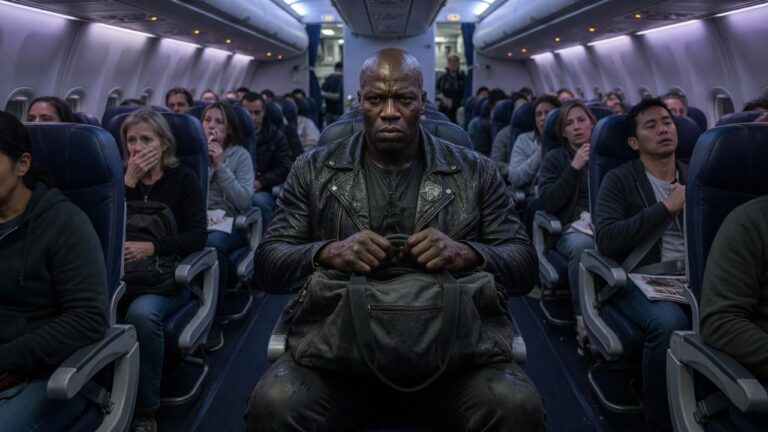
I was the lead flight attendant on Flight 448 when I confronted the 6-foot-4 biker about his shaking duffel—noticing the “restricted” tag, I quietly signaled the captain to lock the cockpit door.
I’ve been a flight attendant for 19 years, working the grueling red-eye shifts out of Chicago, but absolutely nothing could…
 Dog Story
53 min read
Dog Story
53 min read
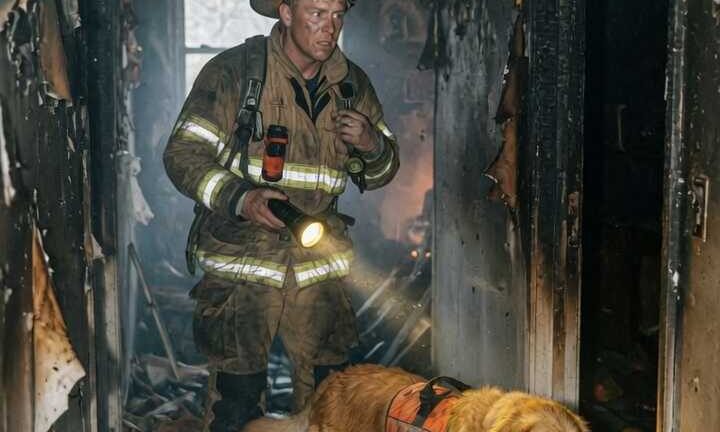
“I Watched A Stray Dog Stand Outside A Smoldering, Burned-Down House For Three Days Straight… When I Finally Broke Protocol And Followed Him Into The Ashes, What I Uncovered In The Basement Changed My Life Forever.”
I’ve been a firefighter in this sleepy upstate New York town for going on seventeen years now, but absolutely nothing…
 Dog Story
34 min read
Dog Story
34 min read
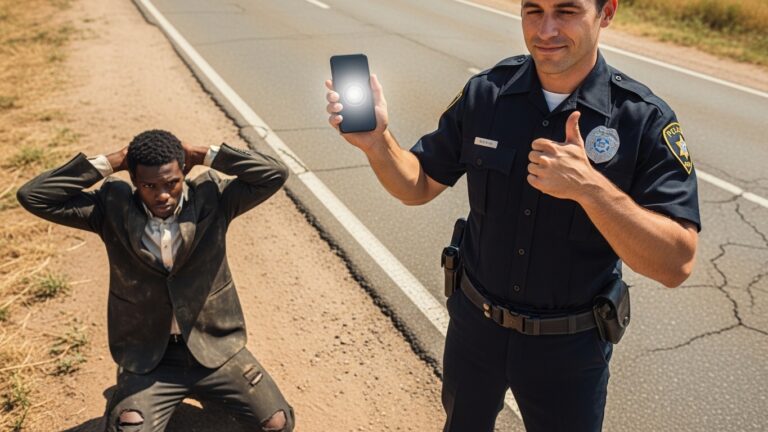
For 45 Minutes, They Mocked A Black Man Kneeling In The Dirt—They Didn’t Know I Was The Federal Attorney Who Just Destroyed Their Entire Department
The gravel bit into my knees, sharp and unforgiving, but I didn’t flinch. I kept my eyes locked on the…
Leave a Reply