
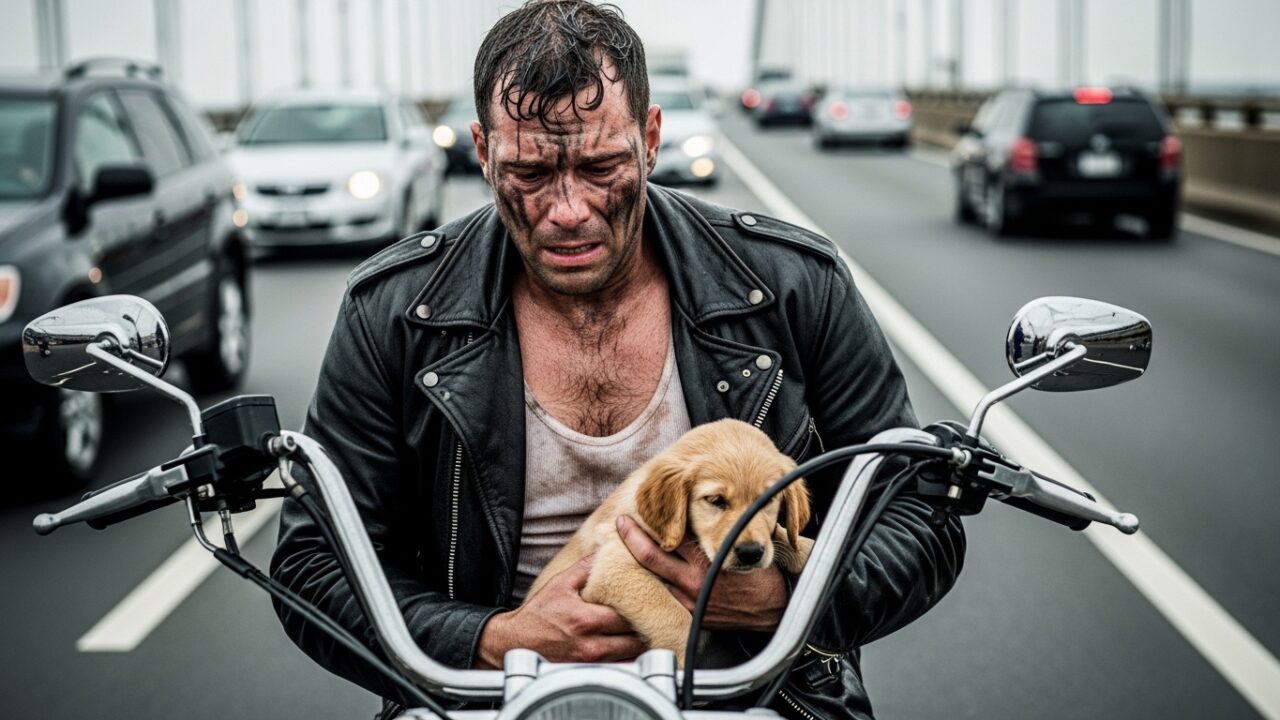

I was the 1 driver stuck in that Monday morning gridlock when the “reckless” biker swerved past 4 lanes of traffic—until I saw the “bundle” he refused to let go.
I’ve been driving these Philadelphia streets for 20 years, and I thought I’d seen every kind of idiot on two wheels. But that morning, the guy on the black chopper was different. He wasn’t just speeding; he was riding like he had a death wish, cutting off SUVs and dodging side mirrors by fractions of an inch.
The air was thick with the sound of angry horns. I leaned on mine, cursing under my breath. “Asshole,” I muttered, watching him wobble as he banked a hard turn near the 5th Street bridge.
Everyone was thinking the same thing: just another adrenaline junkie putting lives at risk for a thrill. We wanted him pulled over. We wanted him in handcuffs.
But then, the traffic slowed to a crawl near the construction zone, and he was forced to stop right beside my driver’s side window.
He was breathing hard, his chest heaving under a jacket that had seen better days. His left hand was white-knuckling the handlebar, but it was his right arm that caught my eye. He wasn’t holding the bike. He was cradling something against his ribs, tucked deep inside the folds of his leather jacket.
I rolled down my window, ready to give him a piece of my mind. “Hey! You’re gonna kill someone riding like—”
The words died in my throat.
He turned his head toward me. His face was streaked with sweat and what looked like grease, but his eyes were brimming with tears. He didn’t look angry. He looked terrified.
“Please,” he rasped, his voice cracking. “I can’t stop. They told me there’s no time.”
At that moment, the bundle shifted. A small, golden head popped out from under his arm. It was a Golden Retriever puppy, no more than eight weeks old. But the puppy wasn’t moving right. Its eyes were rolled back, and its tiny chest was hitching in jagged, desperate gasps.
Then I saw it—the dark, wet stain spreading across the biker’s white shirt underneath his jacket.
He wasn’t riding for a thrill. He was a shield.
CHAPTER 1
The morning started like any other in the city—gray, humid, and suffocating. I was nursing a lukewarm coffee, thinking about the 9:00 AM meeting I was already late for. The line of cars stretched for miles, a sea of red brake lights and frustrated commuters.
When the biker first appeared in my rearview mirror, he looked like a blur of chaos. He was lane-splitting at forty miles per hour while the rest of us were stationary. I watched an old man in a Cadillac swerve to block him, shouting something about “the law.” The biker didn’t even look back. He just hopped the curb, his tires screaming against the concrete, and bypassed the obstruction.
“Typical,” I thought. “He thinks he’s better than the rest of us.”
But as he pulled up next to me at the bottleneck, the reality of the situation hit me like a physical blow. The biker was a big man, probably in his fifties, with a graying beard and rough hands. But he was shaking. His entire body was vibrating with a frantic energy I’d only ever seen in waiting rooms of emergency wards.
The puppy in his arms was barely breathing. I realized then that the “reckless” maneuvers—the curb-jumping, the red-light running, the disregard for his own safety—were calculated risks. Every second he sat in traffic was a second that the life in his arms ebbed away.
“What happened?” I asked, my anger completely evaporated, replaced by a sudden, sharp knot in my stomach.
“Found him… side of the road,” the biker choked out, adjusting his grip. The puppy whimpered, a sound so thin and fragile it barely carried over the idle of the engines. “Hit and run. I think his lung is collapsing. The vet… they said if I’m not there in ten minutes, he’s gone.”
Ten minutes. In this traffic, it was a twenty-minute drive at best.
The biker looked at the sea of cars ahead of him, then back at the small, golden life tucked against his heart. He looked like a man who was ready to fight the entire world with his bare hands if it meant saving that dog.
“Go,” I said, though he couldn’t really hear me over the noise. I pulled my car as far to the left as I could, hitting the shoulder to give him a few extra inches of space.
He nodded at me—a brief, solemn acknowledgment—and kicked the bike into gear. He didn’t care about the cops. He didn’t care about the tickets. He didn’t even care if he went down. He had a mission.
As he roared off, weaving back into the tight gaps between the semi-trucks, I saw a woman in a minivan lean out to scream at him. She didn’t see the puppy. She didn’t see the blood. She only saw the “reckless” biker.
I felt a sudden, burning urge to protect him. I started honking—not at him, but for him. I signaled to the cars ahead, waving my arm out the window, trying to tell them to move, to clear a path, to let the man with the broken angel pass through.
But the city is a cold place. Most people just stared, annoyed by the extra noise.
The biker disappeared around the bend, his taillight a fading spark in the gloom. I sat there, my heart racing, praying to a God I hadn’t spoken to in years. Please let him make it. Please let that little guy live.
Little did I know, the biker’s journey was only beginning, and the secret he was carrying was far heavier than a single injured puppy.
CHAPTER 2
The traffic didn’t let up. If anything, the gridlock tightened like a noose around the city’s throat. I couldn’t get the image of that man’s eyes out of my head—the raw, unfiltered desperation of someone who had reached the end of their rope and decided to swing on it anyway.
Ten minutes later, I managed to crawl past the 5th Street bridge. My heart sank. About half a mile ahead, the sky was filled with the rhythmic, pulsing glow of blue and red lights. A police blockade.
“Damn it,” I whispered, gripping the steering wheel so hard my knuckles turned white.
As I got closer, I saw the black chopper. It was parked haphazardly on the shoulder, leaning precariously on its kickstand. Two patrol cars had it pinned in. My stomach did a slow, sickening roll. I saw the biker, his hands raised, standing by the edge of the guardrail.
Two officers had their Tasers drawn. They were shouting commands, their voices echoing off the concrete barriers.
“Get on the ground! Now!”
The biker wasn’t moving. He wasn’t resisting, but he wasn’t complying either. He was hunched over, his back to the officers, still cradling that white flannel bundle against his chest. He looked like a statue of a fallen soldier, protecting the only thing that mattered in a world gone mad.
“He’s got a dog!” I screamed from my window as I rolled past, but the sirens drowned me out.
I did something impulsive. I pulled my car onto the grass, ignored the “No Parking” signs, and jumped out. I didn’t care about the tickets. I didn’t care if they arrested me too. I had seen the blood on his shirt; I knew that every second these officers spent “following procedure” was a second closer to that puppy’s heart stopping.
“Officer! Wait!” I yelled, running toward the scene.
“Stay back, sir! Get back in your vehicle!” the younger officer barked, his hand twitching near his belt.
The biker turned then. His face was a mask of agony. He ignored the red dots of the Tasers dancing on his chest. He looked at the older officer, a man with a weathered face and a “Miller” name tag.
“He’s dying,” the biker said, his voice strangely quiet amid the chaos. “I don’t care what you do to me. Take the dog. Just take the dog to the clinic. It’s two blocks away. Please.”
He slowly unwrapped the flannel.
The scene went silent. The younger officer lowered his Taser slightly. The puppy was no longer whimpering. It was perfectly still, its golden fur matted with dark, sticky blood. Its tongue was lolling out of the side of its mouth, tinged with a terrifying shade of blue.
Officer Miller stepped forward, his professional mask flickering for a split second. He looked at the biker, then at the dog, then back at the trail of “reckless” complaints that had likely come in over the radio.
“You almost caused three accidents back there, son,” Miller said, though his voice had lost its edge.
“I’d cause a thousand more,” the biker replied, his voice trembling. “I found him in a dumpster behind the warehouse district. Someone… someone tied his legs together and left him there. I heard him crying when I was warming up my bike. He looked at me, and I… I couldn’t let him die in the trash. Not like that.”
I stood there, frozen. The crowd of cars passing by continued to honk, people filming on their phones, likely posting videos of the “crazy biker getting busted.” They had no idea they were witnessing a rescue mission.
Officer Miller looked at the puppy’s shallow, rattling chest. He didn’t ask for ID. He didn’t reach for handcuffs. Instead, he turned to his partner.
“Clear the intersection,” Miller commanded. “Radio ahead to the veterinary hospital on 8th. Tell them we’re coming in hot with a priority casualty.”
The younger officer blinked. “But sir, the protocol for the traffic violations—”
“I said clear the damn intersection!” Miller roared.
Then, the veteran cop looked at the biker. “Follow my lead. If you drop that bike or hit a pedestrian, I’ll personally see you under the jail. You understand?”
The biker didn’t waste breath on words. He just nodded, tucked the puppy back into his jacket, and kicked the chopper into life. The engine growled like a beast awakened.
I watched as the patrol car swung out in front of the motorcycle, sirens screaming a new, urgent song. They tore through the blockade, the biker tucked in the slipstream of the police cruiser, two souls racing against the reaper.
I stayed by my car, watching them disappear into the gray mist of the city. My hands were shaking. I realized then that the biker hadn’t just been saving a dog. He was trying to save himself from the cruelty of a world that would tie a puppy’s legs and throw it in the trash.
But as I turned to get back into my car, I saw something on the ground where the biker had been standing. It was a small, leather wallet, fallen out during the confrontation.
I picked it up and flipped it open, looking for a name to return it to. My breath caught in my throat.
There was no money inside. No credit cards. Just a folded, yellowed newspaper clipping from five years ago and a photograph.
The headline read: “Local Firefighter Loses Wife and Daughter in Arson Tragedy.”
The photo was of the biker, years younger, smiling next to a woman and a little girl. And in the girl’s arms? A large, happy Golden Retriever.
The knot in my stomach tightened. This wasn’t just a random act of kindness. This was a man trying to reach back through time to save the only thing he had left of a life that had been burnt to the ground.
I looked down the road toward the hospital. The sirens were fading. The rain started to fall, cold and persistent.
I knew then that I couldn’t just go to my meeting. I had to know if they made it. I had to know if the universe was going to give this man a win, or if it was going to break him for good.
CHAPTER 3
I ditched the meeting. I didn’t even call my boss. Some things in life are more important than quarterly projections and spreadsheets, and the look in that man’s eyes was one of them. I followed the fading echo of the sirens, weaving through the traffic that was finally beginning to break, my heart hammering against my ribs.
The 8th Street Veterinary Emergency Hospital was a squat, brick building that looked more like a fortress than a clinic. When I pulled into the lot, the scene was still chaotic. The police cruiser was parked diagonally across the entrance, lights still spinning, casting long, rhythmic shadows against the wet pavement.
The biker was standing just inside the glass double doors. He looked smaller now, stripped of the momentum of his ride. His helmet was on the floor, and his leather jacket was splayed open. A team of three vet techs and a surgeon were huddled around a stainless-steel gurney, their hands moving with the practiced, frantic speed of people who fight death for a living.
I stepped inside, the chime of the door sounding unnaturally loud in the tense silence of the waiting room.
Officer Miller was there, too. He had his cap off, wiping sweat from his forehead with a handkerchief. He saw me enter, recognized me from the roadside, and gave a weary nod. He didn’t ask why I was there. In moments like these, everyone knows why they stay. We were all anchored to that tiny, golden heartbeat.
“They took him back to surgery,” Miller whispered, gesturing toward the swinging doors. “Internal bleeding. The kid—the biker—he’s a wreck.”
I looked at the man. He was sitting in a plastic chair, his head in his hands. His shirt was ruined, stained dark by the blood of a creature he didn’t even know an hour ago. I walked over, the weight of the wallet in my pocket feeling like a lead bar.
“I think you dropped this,” I said softly, holding out the leather bi-fold.
He looked up. His eyes were red-rimmed and hollow. He stared at the wallet for a long time before taking it. He didn’t check for cash. He opened it straight to the photograph—the one of the little girl and the Golden Retriever.
“Her name was Sarah,” he said, his voice a ghost of a sound. “The dog was Barnaby. When the house went up… I was on duty at the station. I was the one who got the call. I was the one who drove the truck to my own address.”
He choked back a sob that sounded like breaking glass.
“I couldn’t save them. I couldn’t save any of them. I’ve spent five years wondering why I’m still breathing when they aren’t.” He looked toward the operating room doors. “I heard that puppy screaming from inside that dumpster… and for the first time in five years, I didn’t feel like a ghost. I felt like I had a job to do.”
We sat in silence for what felt like hours. The sterile smell of the clinic—bleach and Floor-Tex—seemed to seep into my skin. Every time the doors swung open, we all jumped. A woman came in with a cat in a carrier; a teenager arrived with a limping beagle. Life went on, but for the three of us in that corner, time had stopped.
Officer Miller bought a round of terrible coffee from a vending machine. We drank it in silence. It tasted like cardboard and desperation.
“You know,” Miller said, looking at the biker. “I should still write you those tickets. Reckless driving, resisting, speeding in a school zone…”
The biker didn’t even flinch. “Do what you have to do, Officer.”
Miller looked at the newspaper clipping in the biker’s lap, then back at his ticket book. With a sigh, he tucked the pen back into his pocket. “The dashcam footage ‘malfunctioned’ during the pursuit. And my partner? He’s got a short memory. But if I ever see you riding like a maniac again without a dying animal in your arms, I’m taking the bike.”
The biker offered a weak, ghost of a smile. “Thank you.”
Suddenly, the surgical doors swung open. A woman in green scrubs stepped out, pulling a surgical mask down from her face. She looked exhausted, her forehead creased with lines of tension.
The biker stood up so fast his chair flipped over. “Is he…?”
The surgeon hesitated, looking from the biker to the cop, then to me. She took a deep breath. “He’s a fighter. The ribs were broken, and one had punctured the lung—that’s why he was struggling to breathe. We’ve stabilized him, drained the fluid, and stitched the lacerations on his legs.”
She paused, and my heart skipped a beat.
“But?” the biker prompted, his voice trembling.
“But he’s lost a lot of blood. The next four hours are critical. He needs to wake up on his own. If he doesn’t…” She didn’t finish the sentence. She didn’t have to.
The biker asked if he could see him. The surgeon nodded and led him back. I stayed in the waiting room with Miller.
“You think he’ll make it?” I asked.
Miller put his hat back on, adjusting the brim. “That dog has the best shield in the city watching over him now. I wouldn’t bet against them.”
I waited. I couldn’t leave yet. I went to the window and watched the rain wash the grime off the city streets. I thought about how many people had honked at that man today. How many people had called him an “asshole” or a “menace.” We spend our lives judging the “reckless” people around us without ever knowing the weight of the cross they are carrying.
An hour passed. Then two.
I was about to give up and head home when I heard a sound from the back hallway. It wasn’t a cry, and it wasn’t a scream.
It was a bark. High-pitched, weak, and unmistakable.
The biker came walking out a moment later. He wasn’t crying anymore. He was glowing. He walked straight up to me and Officer Miller, and for the first time, he looked like a man who had finally come home from a very long war.
“He opened his eyes,” the biker whispered. “He looked right at me, and he licked my hand.”
But as the relief washed over us, a man in a sharp suit walked into the clinic, clutching a legal brief and looking around with an air of cold authority. He walked straight to the reception desk.
“I’m here about the dog found in the warehouse district,” the man said. “The ‘property’ that was removed from my client’s premises.”
My blood ran cold. The rescue wasn’t over. It was just getting complicated.
CHAPTER 4
The atmosphere in the waiting room shifted from relief to ice-cold tension in a heartbeat. The man in the suit—who looked like he’d never stepped foot in a place that didn’t have marble floors—stood there with a smirk that didn’t reach his eyes.
“I represent Vance Logistics,” the lawyer said, tapping his briefcase. “We have security footage of a man trespassing on our private property this morning and removing a ‘security animal.’ We want the property returned immediately to avoid further litigation.”
The biker’s face went pale, then a dangerous shade of red. He stepped forward, his boots heavy on the linoleum. “Security animal? He’s a puppy. He was tied up in a trash bag inside a dumpster on your lot. He was dying!”
The lawyer didn’t blink. “That is an unsubstantiated claim. The animal is registered to the corporation. If you don’t hand him over, we will be filing charges for grand theft and trespassing.”
I felt a surge of pure, unadulterated rage. I’ve lived in this city long enough to know how the big guys roll over the little guys, but this was a new low. I looked at the biker. His hands were shaking again, but this time it wasn’t from fear. It was the look of a man who was about to lose the only piece of light he’d found in five years.
Before the biker could do something that would land him in a cell, Officer Miller stepped in. He didn’t move fast; he just drifted into the space between the biker and the lawyer, his thumbs hooked casually in his utility belt.
“Vance Logistics, huh?” Miller said, his voice deceptively smooth. “The warehouse district on 12th?”
“Exactly,” the lawyer snapped. “Now, if you’ll just assist me in reclaiming—”
“Funny thing about that district,” Miller interrupted, leaning in close. “I know the fire marshal over there. He’s been complaining about the lack of proper waste disposal and… let’s see… animal cruelty statutes in this state are a felony, Counselor. Especially when there’s evidence of ‘premeditated abandonment’ like, say, a tied-up trash bag.”
The lawyer scoffed. “You have no proof the bag came from us.”
“Actually,” I piped up, stepping forward. I didn’t have a badge, but I had a witness statement. “I saw the whole thing. I’m a corporate consultant, and I’ll be happy to testify about the state of that animal when it arrived, and the fact that your ‘client’ clearly intended for it to be crushed in a garbage truck.”
The lawyer looked at me, then at the veteran cop, then at the biker who looked ready to tear the doors off their hinges. He realized he wasn’t in a boardroom; he was in a room full of people who had nothing left to lose.
“This isn’t over,” the lawyer muttered, turning on his heel.
“Actually, it is,” Miller called out as the lawyer reached the door. “Because if I see a single filing from your office, I’m going to personally pull the surveillance tapes from the entire block. And I have a feeling your client wouldn’t like what we find on those tapes. Have a nice day, Counselor.”
The door slammed shut. The silence that followed was heavy, but it was peaceful.
The biker slumped against the wall, sliding down until he was sitting on the floor. He looked at Officer Miller. “Why did you do that? You don’t even know me.”
Miller looked down at him, then at the photo of the little girl in the biker’s wallet. “I’ve been on the force a long time, son. I’ve seen a lot of people break. But I’ve rarely seen someone use their broken pieces to build a shield for something else. You’re a good man. The city needs more of you.”
The vet tech came out then, smiling. “He’s stable enough for a visitor. Just for a minute.”
We followed the biker to the back. There, in a small recovery kennel, lay the golden puppy. He was hooked up to an IV, and his chest was wrapped in white gauze, but his eyes were open—clear, bright, and focused entirely on the man in the leather jacket.
The biker knelt by the kennel and reached through the bars. The puppy let out a tiny, muffled “woof” and rested its chin on the man’s finger.
“What are you going to name him?” I asked softly.
The biker looked at the photo of his daughter one last time before tucking it away. He looked at the puppy, a small survivor who had cheated death just like he had.
“Chance,” the biker said. “Because we both got one today.”
I walked out of that clinic into a city that was still loud, still crowded, and still frustrated. But as I got back into my car, I didn’t care about the traffic. I didn’t care about my missed meeting or my angry boss.
I thought about the “reckless” biker. I thought about how we all judge each other from behind our windshields, never knowing who is carrying a dying puppy, who is grieving a lost family, or who is just trying to find a reason to keep riding.
Sometimes, the person you think is the villain is actually the hero of a story you haven’t read yet.
I started my engine and pulled back into the flow of traffic. For the first time in a long time, I wasn’t just driving. I was watching—really watching—the people around me. And I promised myself that the next time I heard a desperate horn or saw a frantic driver, I’d stop cursing. I’d just move over. Because you never know who is racing to save a soul.
THE END

About the Author
Khánh Nguyễn
A writer passionate about human stories and real-life experiences that inspire and move readers.
 Biker
33 min read
Biker
33 min read
“I Watched The Bank Manager Smile While He Stole An 80-Year-Old Man’s Last Penny… Then The Heavy Doors Swung Open, And A Man In Leather Proved That Justice Doesn’t Always Wear A Suit And A Tie.”
“I Watched Them Rob An 80-Year-Old Man With A Smile… Then The Door Smashed Open And The Real Trouble Walked…
 Biker
61 min read
Biker
61 min read
I Watched The Most Dangerous Biker Gang In The State Surround My Precinct. What They Carried Inside Made Me Drop My Gun And Lock Every Door… The Truth Broke Me.
I’ve worn a police badge for 19 years in one of the toughest, most unforgiving counties in the Midwest, but…
 Biker
11 min read
Biker
11 min read
I Bled For The Brotherhood And Built Their Choppers For A Decade… But What I Found Welded Deep Inside My Dead Father’s Motorcycle Frame Shattered My Reality.
I’ve spent the last ten years breathing gasoline and bleeding motor oil for the Iron Kings Motorcycle Club, but nothing…
Leave a Reply