
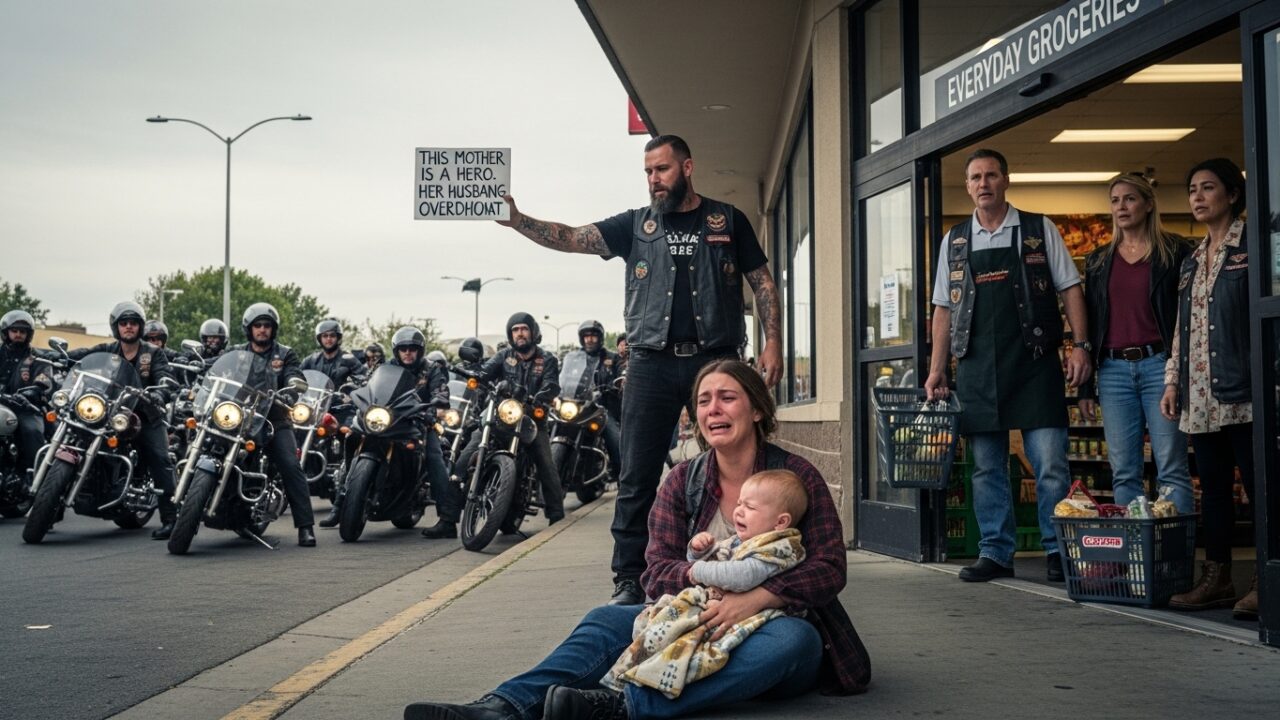
They Threw A Penniless Mother And Her Screaming Baby Out Into The Blistering Heat Because She Was “Disturbing” The Line… Five Minutes Later, Thirty Heavy Engines Rattled The Windows, And The Store Manager Realized His Deadly Mistake.

CHAPTER 1
I’ve spent thirty-two years pulling people out of mangled cars and burning buildings as a city firefighter, but the most sickening display of human cruelty I ever witnessed didn’t happen in a tragedy. It happened in the checkout line of a neighborhood grocery store over a fifteen-dollar can of baby formula.
It was a Tuesday afternoon in mid-July. The kind of oppressive, suffocating summer day in the Midwest where the heat radiating off the asphalt visibly warps the air. I was standing in aisle four at Miller’s Grocery, a cramped, fluorescent-lit establishment that had been a staple in our community for decades. The air conditioning near the front registers had been broken for a week. The air inside felt thick, smelling faintly of overripe peaches, floor wax, and the sour sweat of impatient people.
There were maybe eight of us in line. I was third from the front, holding a basket with a gallon of milk and a loaf of bread. Two spots ahead of me stood a young woman who looked like she was carrying the weight of the entire world on her fragile shoulders.
I later learned her name was Sarah.
She couldn’t have been more than twenty-five, but exhaustion had aged her. Her faded blonde hair was pulled back into a messy, uneven ponytail, strands sticking to the sweat on the back of her neck. She wore a pair of oversized gray sweatpants and a threadbare white t-shirt. But it was her eyes that caught my attention—they were sunken, ringed with heavy, dark purple shadows that spoke of weeks, maybe months, of unbroken sleeplessness.
Strapped to her chest in a cheap, frayed fabric carrier was a baby boy. He was small, his little legs dangling limply, but his lungs were terrifyingly strong.
He was crying. Not a soft, fussy whimper, but a piercing, desperate wail. The kind of primal scream that scrapes against your eardrums and triggers a visceral spike of anxiety in your chest. It wasn’t a cry for attention; it was a cry of pure distress. Hunger. Exhaustion. Heat.
Sarah was trying to soothe him, her movements frantic and deeply practiced. She bounced on her worn-out Converse sneakers. She swayed from side to side. She hummed a lullaby that was barely audible over the shrieks.
“Shh, shh, I know, Leo, I know,” she whispered, her voice cracking. Her hands shook as she rummaged blindly through a battered diaper bag hanging off her shoulder. “Mommy’s got it. Just one minute, baby. Just one minute.”
But the baby didn’t stop. The cries echoed off the low ceiling panels, amplifying in the narrow space between the candy racks and the cash register.
People began to stare.
In America, we like to pretend we are a community-minded society, but put a group of inconvenienced people in a hot room with a screaming child, and you will see how quickly the veneer of civilization peels away.
The woman directly behind Sarah—a woman in her fifties wearing a crisp tennis skirt and holding a bottle of expensive imported wine—sighed loudly. It wasn’t a subtle sigh. It was a weaponized expulsion of air designed to be heard.
“Unbelievable,” the woman muttered under her breath, shifting her weight from one perfectly manicured foot to the other.
A businessman behind me checked his heavy silver watch and aggressively cleared his throat. “Some people have no control over their kids,” he whispered to nobody in particular.
I felt a flush of anger rise in my neck. I wanted to tell them to shut up, to have a shred of decency. I remembered what it was like when my own daughter was an infant, how helpless you feel when they just won’t stop crying and the whole world is watching you fail. I opened my mouth to say something, maybe offer to pay for her items to speed things up, but before the words could leave my throat, the situation escalated.
The cashier, a nervous teenager whose hands were already fumbling with the scanner, looked past Sarah.
“Manager to register one,” the teenager called out over the intercom, his voice squeaking slightly.
A heavy silence fell over the line, punctuated only by the baby’s unrelenting screams.
David, the store manager, emerged from the back office. I knew David. Everyone in the neighborhood knew David. He was a man in his early forties who treated his position at this mid-sized grocery store like he was the CEO of a Fortune 500 company. He wore a perfectly ironed short-sleeve button-down shirt, a tie that was clipped precisely to his placket, and a shiny gold name tag. He was the kind of man who relished the tiny fractions of power he held over others.
He marched to the front of the store, his face set in a rigid mask of professional irritation. He didn’t look at the baby. He didn’t look at Sarah’s shaking hands. He looked only at the disruption of his orderly domain.
“Is there a problem here?” David asked, his voice dripping with condescension.
Sarah looked up, her eyes wide and panicked. “No, sir. No problem. I’m just… I’m just trying to pay. He’s hungry. Once I get the formula, I can feed him, and he’ll stop. I promise.”
She placed a single plastic tub of generic baby formula on the black conveyor belt. Next to it, she dumped a handful of crumpled one-dollar bills, a chaotic pile of quarters, and a few dimes. It was a brutal visual representation of poverty. She was counting pennies to keep her child alive.
David looked at the pile of change, his upper lip curling into a sneer of disgust.
“Ma’am, you are causing a severe disturbance,” David said, crossing his arms over his chest. “My cashiers cannot concentrate, and you are upsetting the regular customers.”
He gestured vaguely toward the line. The woman in the tennis skirt nodded in enthusiastic agreement. I felt sick to my stomach.
“I’m sorry,” Sarah begged, tears finally spilling over her lower lashes, cutting tracks through the exhaustion on her face. “I have the money. It’s exactly fourteen dollars and sixty cents. Please, just let her scan it. I’ll be gone in thirty seconds.”
The baby shrieked louder, arching his little back against the fabric carrier.
“I’m going to have to ask you to step outside,” David said. His voice wasn’t raised, but it carried a finality that felt like a physical blow. “You need to take your child outside and calm him down before you can be permitted to shop here.”
Sarah froze. Her hands hovered over the pile of quarters.
“I… I walked here,” she stammered, her voice dropping to a broken whisper. “It’s two miles from my apartment. It’s ninety-five degrees outside. There’s no shade. Please. I just need his food.”
“Outside,” David repeated. He stepped forward, invading her personal space. He didn’t touch her, but he used his body to corral her away from the register. “This is a private business, ma’am. We have a right to refuse service. You need to leave. Now.”
I should have moved. I should have shoved my way to the front, slammed twenty dollars on the counter, and told David to back off. But I hesitated. I was caught in that paralyzing grip of the bystander effect, a lifetime of societal conditioning telling me not to cause a scene, not to interfere with a manager doing his “job.”
It is a failure I will carry with me to my grave.
Defeated, humiliated, and utterly broken, Sarah blindly swept her crumpled bills and loose change back into her frayed bag. A quarter dropped to the linoleum floor and rolled away. She didn’t chase it.
She turned around, shielding her screaming baby’s head with one hand, and walked toward the exit. The automatic glass doors slid open, letting in a blast of suffocating, oven-like heat, and then slammed shut behind her.
Inside the store, the tension broke. The cashier sighed. The woman in the tennis skirt stepped up to the counter, placing her expensive wine on the belt.
“Finally,” the woman said, offering David a sympathetic smile. “Thank you. You handled that perfectly. People like that just have no respect for others.”
David puffed out his chest, adjusting his tie. “We try to maintain a certain standard here at Miller’s.”
I abandoned my basket on the floor. I couldn’t breathe the air in there anymore. I walked past the register, ignoring David’s questioning look, and pushed through the glass doors into the blinding afternoon sun.
I looked down the sidewalk. Sarah hadn’t made it far.
She had collapsed onto the low concrete curb just a few yards from the entrance. The heat radiating off the pavement was intense enough to burn bare skin. She was sitting with her knees pulled to her chest, rocking back and forth. The baby was still screaming, his face red and slick with sweat. Sarah had buried her face in her hands, her shoulders heaving with massive, silent sobs.
She was completely abandoned. Cast out by a society that demanded quiet at the expense of compassion.
I started walking toward her. I reached into my back pocket for my wallet, intending to go back inside, buy the formula myself, and bring it out to her.
But before I could take five steps, the air changed.
It didn’t happen all at once. It started as a low, deep vibration. I felt it in the soles of my shoes before I heard it. A rhythmic, guttural thrumming that seemed to rise up from the asphalt itself.
I stopped.
Down at the end of the street, where the heat haze blurred the shapes of cars, a line of headlights appeared.
One. Then three. Then ten.
The vibration grew into a mechanical roar. The sound of heavy, unbaffled V-twin engines running in tight formation. It was a deafening, chest-rattling noise that swallowed the sound of the traffic, the wind, and even the baby’s cries.
I watched as a massive convoy of motorcycles turned the corner, rolling slowly, deliberately, toward Miller’s Grocery.
There must have been thirty of them. Huge, customized cruisers gleaming with chrome and matte black paint.
The riders matched the machines. Massive men wearing scuffed leather vests, heavy denim, and combat boots. Their arms were thick with ink, faded tattoos of skulls, wings, and words I couldn’t read from a distance. They wore half-helmets, dark sunglasses masking their eyes. To the average suburban American, this was the ultimate nightmare rolling down Main Street. They looked like violence personified.
Inside the store, the activity stopped dead. I looked back through the large glass windows. The woman with the wine was frozen. David, the manager, had walked out from behind the register, his face pressing against the glass, the color completely draining from his cheeks.
They thought the store was being targeted. They thought a riot was about to break out.
The convoy didn’t pass by.
With military precision, the lead rider raised a single, leather-gloved hand. The entire pack shifted gears, the engines growling as they angled toward the curb.
They parked in a long, unbroken wall of steel and rubber, completely blocking the front of the store. They boxed in the entrance. They boxed in Sarah.
The lead rider kicked down his kickstand with a heavy metallic clack. He cut his engine. One by one, thirty engines died, plunging the street into a sudden, ringing silence that felt heavier than the noise.
The leader swung his leg off his bike. He was a mountain of a man, easily six-foot-four, with a thick, salt-and-pepper beard cascading down his chest. A jagged scar cut through his left eyebrow. His leather cut bore a large patch on the back, but I couldn’t make out the emblem.
He didn’t look at the store. He didn’t look at the terrified faces pressed against the glass.
He walked slowly, his heavy boots crunching on the gravel, straight toward the sobbing mother sitting on the curb.
Inside the store, I saw David grab the telephone off the wall, his hands shaking violently as he dialed 911.
The biker stopped three feet from Sarah. He towered over her. Sarah looked up, her tear-streaked face freezing in absolute terror. She clutched her baby tighter, instinctively pressing her back against the hot brick wall of the store, nowhere to run.
The giant man reached into the inside pocket of his leather vest.
I held my breath. My muscles coiled. I didn’t know what he was pulling out, but I knew that whatever happened next in the next five seconds would change everything, and there was absolutely no turning back.
CHAPTER 2
I watched the giant’s massive, scarred hand disappear into the dark leather of his vest.
Time seemed to dilate, stretching the seconds into agonizing hours. The heat radiating from the brick wall of the grocery store was suffocating, but my blood ran cold. Sarah squeezed her eyes shut and turned her body, curling over her screaming baby in a desperate, futile attempt to act as a human shield. She was waiting for a blow. She was waiting for the violence that the rest of the world had taught her to expect.
Inside the store, David dropped the telephone. It dangled by its coiled cord, swinging back and forth against the wall.
The biker pulled his hand out of his vest.
He didn’t hold a weapon.
In his thick, calloused fingers, he held a chilled, unopened bottle of water. Condensation dripped down the plastic, sparkling in the harsh afternoon sun. With his other hand, he reached into a saddlebag slung over his front shoulder and pulled out a brand-new, sealed bottle of ready-to-feed baby formula.
He didn’t loom over her. With a heavy grunt, the giant man dropped down to one knee, ignoring the blistering heat of the asphalt pressing against his denim jeans. He placed his massive frame between Sarah and the glaring sun, casting a long, cooling shadow over her and the child.
“Breathe, mama,” the biker said.
His voice was a low, gravelly baritone, rough as sandpaper but laced with an unexpected, profound gentleness.
Sarah opened her eyes. She stared at the cold water bottle, then at the formula, her chest heaving. She looked at the man’s face, searching for the catch, the price tag, the hidden threat.
“Take it,” he urged softly, unscrewing the cap of the water bottle and offering it to her. “You’re dehydrated. Your hands are shaking. Drink.”
Sarah reached out with trembling fingers. She took the bottle and brought it to her lips, drinking greedily, water spilling down her chin and soaking into the collar of her threadbare shirt.
The biker expertly popped the seal off the liquid formula. He handed it to her. “Feed the boy.”
Sarah didn’t hesitate. She pressed the bottle to the baby’s lips.
Instantly, the frantic, ear-piercing screams stopped. The silence that followed was absolute, heavy, and profound. The only sound left on the street was the rhythmic, greedy swallowing of a starving infant and the distant hum of highway traffic.
I let out a breath I didn’t realize I had been holding. I felt a hot sting of tears in my own eyes. I was a firefighter. I ran into burning buildings for a living. Yet, I had stood frozen in an air-conditioned grocery store while a mother begged for her child’s next meal. This man, looking like a warlord from a dystopian movie, had done what the rest of us “good, law-abiding citizens” were too cowardly to do.
He reached up and took off his dark sunglasses. His eyes were a pale, piercing blue, nested in deep crow’s feet. He looked tired. Not physically tired, but soul-tired.
“My name is Arthur,” he said, keeping his voice pitched low so only she—and I, standing just a few feet away—could hear. “But the guys call me Bear. Your sister, Rachel, called our dispatch line twenty minutes ago. She said you had to run. She said you didn’t have time to grab your purse or the car keys.”
At the mention of her sister, Sarah’s fragile composure shattered. She let out a choked sob, nodding frantically as she held the bottle for her feeding baby.
“He… he came back early,” Sarah whispered, her voice trembling with a terror that ran bone-deep. “He realized I had been packing a bag. He locked the doors. He took my phone. I waited until he passed out on the couch. I only had the change I kept in the laundry jar. I just ran. I just ran, and I didn’t stop until I got here.”
“I know,” Bear said softly. “Rachel told us everything. He’s driving around looking for you right now in that black Silverado. That’s why we’re here, Sarah. You’re safe now. He’s not getting within a hundred miles of you or this little boy ever again.”
Suddenly, the narrative shifted. The pieces fell into place with sickening clarity.
Sarah hadn’t just been a broke, tired mother. She was a victim of severe domestic abuse making a desperate, terrifying break for freedom. The dark circles under her eyes weren’t just from a fussy baby; they were the hollowed-out look of a woman who slept with one eye open, terrified of the man she lived with. The oversized sweatpants in ninety-five-degree heat weren’t a fashion choice—they were hiding bruises.
And David, the pristine, rule-following manager of Miller’s Grocery, hadn’t just kicked out a nuisance. He had thrown a fleeing victim and her starving baby right back into the hunting ground of her abuser, all because she was fourteen cents short and crying too loud.
“Hey! You!”
The sharp, aggressive voice shattered the quiet.
I turned. David had pushed open the glass doors of the grocery store. He stood on the threshold, refusing to step fully outside, using the sliding doors as a shield. The nervous cashier and the woman in the tennis skirt peered over his shoulders.
David’s face was flushed red, a mix of fear and indignant rage. He pointed a trembling finger at Bear.
“I’ve called the police!” David shouted, his voice cracking slightly as he tried to project authority. “You and your… gang… need to clear off my property right now! You’re intimidating my customers and blocking a fire lane!”
Bear didn’t flinch. He didn’t even look back at David right away. He gently placed a hand on Sarah’s shoulder, giving it a reassuring squeeze.
“Stay here,” Bear told her. “Drink your water.”
Bear stood up. Unfolding his massive frame, he seemed to block out the sun.
Behind him, the rest of the bikers reacted. They didn’t shout back. They didn’t pull weapons or strike threatening poses. They simply stepped off the curb and formed a solid, human wall between Sarah and the grocery store. Thirty men, broad-shouldered and battle-scarred, standing shoulder-to-shoulder in absolute, disciplined silence.
It was infinitely more terrifying than if they had been screaming.
Bear walked slowly toward the store entrance. His heavy boots scraped against the concrete. I took a step back, my heart pounding in my chest, but I couldn’t tear my eyes away.
David retreated a step, the automatic doors threatening to close on him. “Stay back! I mean it! The cops are two minutes away!”
Bear stopped about five feet from David. He looked down at the manager, his pale blue eyes stripping away David’s false sense of superiority.
“You’re the manager?” Bear asked. His voice didn’t need volume to carry authority. It was heavy, like an iron anvil dropping on a wooden floor.
“Yes, I am,” David stammered, puffing his chest out in a pathetic display of bravado. “And I have the right to refuse service to anyone who disrupts my business. That woman was creating a hostile environment.”
“A hostile environment,” Bear repeated slowly, tasting the words. He tilted his head. “Do you know why she was short on cash, David?”
David blinked, caught off guard. “I don’t care. It’s not a charity. She was short. End of story.”
“She was short,” Bear said, stepping one inch closer, causing David to flinch, “because her boyfriend beat her for three days straight. She has cracked ribs under that shirt. She waited until he was drunk enough to pass out, grabbed her kid, and ran for her life. She left her purse, her keys, her ID. She walked two miles in this heat, looking over her shoulder every ten seconds, terrified that his truck was going to pull up and drag her back to hell.”
David’s face paled, but his pride refused to let him back down in front of his customers. “That… that is not my problem. I run a grocery store, not a shelter. There are rules.”
“Rules,” Bear scoffed softly. “She needed fourteen cents. Fourteen pennies to feed a baby who hadn’t eaten since yesterday. And you pushed her out onto the street. You put her back in the open. You put a target on her back.”
“She was disturbing the peace!” the woman in the tennis skirt suddenly chimed in from behind David, her voice shrill and defensive. “We were all very uncomfortable!”
Bear shifted his gaze to the woman. He didn’t say a word to her. He just looked at her. It was a look of such profound, unadulterated disgust that the woman actually took a physical step backward, shrinking behind a display of watermelons.
“We are a motorcycle club,” Bear said, turning his attention back to David. “We ride for an organization called the Guardians of Innocence. We work with the domestic violence shelters in this county. When a woman is trapped, when the system is too slow to get her out, we get the call. We create a physical barrier between the abused and the abuser until a safe house is secured.”
Bear leaned in closer. The smell of exhaust, old leather, and sweat seemed to wash over David.
“We didn’t come here to rob your store, David. We came here because a battered woman was trapped at your register, begging for help, and you treated her like garbage.”
David swallowed hard. His Adam’s apple bobbed in his throat. The smugness was entirely gone, replaced by a creeping, sickening realization of what he had done. He looked past Bear, looking at Sarah. She was still sitting on the curb, the baby quiet now, drinking the formula as tears streamed silently down her bruised cheeks.
For a second, I thought David might apologize. I thought I saw a flicker of humanity break through his corporate, sterile mindset.
But then, the wail of sirens cut through the heavy summer air.
The sound grew louder, bouncing off the brick buildings down the street. Flashing red and blue lights reflected off the chrome tailpipes of the parked motorcycles.
David’s posture instantly changed. The flicker of guilt vanished, replaced by a surge of arrogant relief. The cavalry had arrived. The system was here to protect him and his store from the scary men in leather.
“Well,” David sneered, a cruel, triumphant smile spreading across his face. “You can explain your little charity work to the police. You’re trespassing, you’re illegally parked, and you’re threatening a citizen. You’re all going to jail.”
Two police cruisers skidded to a halt in the middle of the street, blocking the traffic lanes. The doors flew open, and four officers stepped out. Their hands were resting cautiously on their duty belts, eyes scanning the massive wall of bikers, assessing the threat.
The situation was a powder keg. One wrong move, one sudden gesture, and the afternoon was going to end in bloodshed.
David pushed past Bear, stepping confidently onto the sidewalk, waving his arms at the officers.
“Officers! Over here!” David yelled, playing the victim perfectly. “I’m the one who called! These men are terrorizing my store! They’ve surrounded the building and threatened my life!”
The lead officer, a tall, broad-shouldered sergeant with graying temples, locked his eyes on the scene. He looked at David, frantic and pointing. He looked at the thirty silent bikers. And then, he looked at Bear.
My stomach tied itself into a knot. I braced myself for the arrests. I braced myself to watch the police slap cuffs on the only men who had actually done something right today.
But Bear didn’t raise his hands. He didn’t step back.
He just smiled. A slow, knowing smile that made the blood freeze in David’s veins.
“Sergeant Miller,” Bear called out, his deep voice carrying easily over the idling engines of the police cruisers.
The sergeant took his hand off his weapon. His tense posture immediately relaxed.
“Afternoon, Bear,” the sergeant replied, a familiar, weary respect in his voice. “Dispatch said we had a gang riot at the grocery store. Should have known it was just you boys.”
David stopped waving his arms. His mouth dropped open. The triumphant smile slid off his face, replaced by a look of sheer, uncomprehending horror as he realized the one thing he hadn’t accounted for.
The police weren’t here to save him.
CHAPTER 3
David’s mouth opened and closed like a dying fish on a dock. His perfectly ironed manager’s shirt was suddenly stained with dark patches of nervous sweat under the arms.
“You… you know these people?” David stammered, his voice an octave higher than it had been a minute ago. He pointed a trembling finger at the wall of heavily tattooed men. “They’re trespassing! They threatened me!”
Sergeant Miller ignored him completely. He slammed the heavy door of his cruiser shut and strode past the bewildered manager, his boots crunching loudly on the sun-baked asphalt. He walked straight up to Bear, extending a hand. The giant biker took it, their grip firm and familiar.
“We got Rachel’s call right after yours came through the dispatch, Bear,” Sergeant Miller said, his voice dropping into a serious, tactical cadence. “She said Sarah bolted on foot. We had patrol cars sweeping the grid, but you boys beat us here.”
“She didn’t make it far,” Bear replied, his blue eyes hardening. He tilted his head toward the curb.
Sergeant Miller followed his gaze. He saw Sarah, huddled against the brick wall, clutching her baby. He saw the faded bruises on her forearms, the way she flinched even when the wind blew, the sheer terror radiating from her exhausted frame.
The veteran cop’s jaw tightened. A muscle twitched in his cheek. He turned slowly back to David, who was now standing on the sidewalk with his hands hovering awkwardly in the air, realizing his carefully constructed fortress of authority was crumbling to dust.
“You called 911,” Sergeant Miller said to David, his voice dangerously quiet, “and reported a gang-related riot in progress. You said your life was in immediate danger.”
“They… they boxed me in!” David protested, gesturing wildly. “They surrounded the store!”
“They surrounded a victim, David,” Miller snapped, stepping into the manager’s personal space, forcing David to shrink back against the glass doors. “They formed a defensive perimeter because a man with a history of aggravated assault is currently hunting her. And from what I understand, you threw her out onto the street when she begged for help.”
The woman in the tennis skirt, who had been lingering in the doorway to watch the ‘criminals’ get arrested, let out a sharp, audible gasp. Her expensive bottle of wine slipped from her manicured fingers. It hit the concrete and shattered, a dark red puddle expanding across the sidewalk like a morbid omen. Nobody looked at her.
“I didn’t know!” David squeaked, his arrogance entirely replaced by panic. “How was I supposed to know? She was short on cash! She was disturbing the other customers! I have policies to uphold!”
“Your policies almost got a woman killed,” I said.
The words left my mouth before I even realized I had spoken. I stepped forward, pushing past David and the shattered glass. The shame of my own inaction had burned away, leaving only a white-hot, furious clarity.
Sergeant Miller’s hand instinctively dropped to his belt, but he relaxed when he saw me. “Stay back, sir. We have a situation to control.”
“I’m an off-duty firefighter, Engine 42,” I said, pulling my department ID from my wallet and flashing it to the Sergeant. “I’m a certified EMT. Bear said she has cracked ribs. She needs to be assessed right now, and she shouldn’t be moved until we know how bad it is.”
Miller gave a short, curt nod. “Do it.”
I walked over to the curb. Bear stepped aside, allowing me to kneel in front of Sarah. Up close, the damage was even more horrific than it appeared from a distance. The oversized sweatpants and heavy t-shirt weren’t just hiding bruises; they were hiding a battered, broken body.
“Sarah,” I said softly, keeping my hands visible. “My name is John. I’m a paramedic. I need to check your breathing, okay? I’m not going to hurt you.”
She nodded weakly, her eyes darting frantically toward the street. “He’s coming,” she whispered, her teeth chattering despite the ninety-five-degree heat. “He’s going to find me. He promised he would kill me if I ever left.”
“He has to get through us first, mama,” Bear rumbled from behind me. “And that ain’t happening today.”
I placed my hand gently on her back, feeling the shallow, jagged rhythm of her breathing. “Does it hurt when you inhale?”
“Sharp,” she gasped. “On the left side.”
I was about to check her pulse when the radio on Sergeant Miller’s shoulder erupted in a burst of chaotic static.
“Dispatch to unit seven. Be advised, traffic cameras have picked up a black Chevrolet Silverado, license plate Romeo-Tango-Niner… heading eastbound on Elm. He is running red lights. Subject is three blocks from your location and closing fast.”
The street froze.
The air itself seemed to turn to ice.
“He’s here,” Sarah screamed, a primal, gut-wrenching sound that tore through the heavy summer air. She curled herself into a tight ball on the concrete, wrapping her body entirely around her sleeping infant.
The timeline accelerated. The slow, agonizing buildup of the afternoon evaporated into pure, adrenaline-fueled chaos.
Sergeant Miller drew his weapon, holding it at the low ready. “Perimeter!” he shouted to his officers.
But the Guardians of Innocence were already moving.
They didn’t need orders. They operated with the terrifying, silent precision of a military unit.
- The Barricade: Ten bikers immediately grabbed the heavy steel handlebars of their customized cruisers, physically rolling the massive, 800-pound machines onto the sidewalk, creating an impenetrable wall of steel and chrome directly in front of Sarah.
- The Shield Wall: The remaining twenty men, including Bear, stepped out into the street. They locked arms. Thirty massive, leather-clad men forming a human barricade across the asphalt, completely blocking access to the store’s parking lot.
- The Trap: The four police officers fanned out behind the bikers, using the wall of men as cover, their service weapons drawn and ready.
“Stay down!” I yelled to Sarah, throwing my own body over hers, shielding her and the baby with my back. I squeezed my eyes shut, my heart hammering against my ribs like a trapped bird.
Then, we heard it.
The deafening roar of a modified V8 engine tearing down the residential street.
The screech of burning rubber echoed off the brick buildings as a massive, lifted black Silverado took the corner at fifty miles an hour. It fishtailed wildly, hopping the curb, crushing a row of aluminum trash cans before the driver slammed on the brakes.
The truck skidded to a violent halt forty feet from the wall of bikers. The air filled with the acrid, choking stench of burnt rubber and exhaust.
The driver’s side door flew open.
Marcus stepped out.
He was exactly what you would expect a monster to look like. Six-foot-two, heavily muscled, wearing a stained tank top and steel-toed boots. His face was flushed crimson with alcohol and rage. His eyes were wide, manic, and searching.
He looked past the police cruisers. He looked past the bikers. His eyes locked onto the small sliver of Sarah’s gray sweatpants visible behind the motorcycles.
“Sarah!” Marcus roared. It wasn’t a call; it was a demonic bellow of ownership. “Get your ass in the truck right now! You think you can run from me?”
He took a heavy, aggressive step forward. In his right hand, a heavy steel tire iron glinted in the harsh afternoon sunlight.
He thought he was invincible. He had spent years terrorizing a woman smaller and weaker than him, operating in the shadows of a closed apartment door. He was entirely unprepared for what stood before him in the broad daylight.
“Drop the weapon!” Sergeant Miller barked, stepping out from behind the line of bikers, leveling his 9mm pistol directly at Marcus’s chest. “Police! Drop the weapon and get on the ground!”
Marcus froze, finally registering the flashing lights, the drawn weapons, and the wall of thirty heavily armed, unsmiling bikers blocking his path. But the alcohol and the blind rage overrode his survival instincts.
“She’s my property!” Marcus screamed, wildly swinging the tire iron at the air. “She took my kid! I’m taking them back! Get out of my way, you biker trash!”
He charged.
It was a suicidal, idiotic move.
He didn’t make it five steps.
Bear didn’t wait for the police. The giant biker stepped forward, breaking the line. He moved with a terrifying, explosive speed for a man of his size.
Marcus swung the heavy steel iron at Bear’s head. Bear didn’t even flinch. He caught Marcus’s wrist mid-swing with his left hand, the impact making a sickening crack that echoed across the parking lot. Marcus screamed, dropping the iron.
Before the abuser could react, Bear drove his right fist directly into Marcus’s sternum.
The breath violently left Marcus’s lungs in a wet gasp. His eyes rolled back into his head. Bear grabbed him by the front of his stained tank top, lifting the 220-pound man completely off his feet, and slammed him face-first onto the hood of a police cruiser.
The metal crumpled under the impact.
Instantly, three police officers were on him, burying their knees into Marcus’s back, ratcheting heavy steel handcuffs around his wrists.
“Stop resisting! Stop resisting!” an officer shouted, though Marcus was completely limp, gasping for air on the searing hot metal of the hood.
The immediate threat was over in less than ten seconds.
The street plunged back into an eerie, ringing silence, broken only by the crackle of the police radios and Marcus’s muffled groans.
I sat up slowly, my hands shaking. I looked down at Sarah. She was clutching her baby, staring at the man who had tortured her for years, now pinned, helpless, and bleeding on a police car.
A massive, shuddering breath escaped her lips. The invisible chains that had bound her finally snapped. She didn’t cry. For the first time all afternoon, her eyes were clear.
Bear walked back over to the curb. He wiped a streak of Marcus’s blood off his leather vest. He looked at me, then at Sarah.
“He’s gone, Sarah,” Bear said gently. “It’s over.”
I stood up, my legs feeling like lead. I turned my head and looked back at the grocery store.
The sliding glass doors were still open.
David, the woman in the tennis skirt, the businessman, and the nervous teenage cashier were all standing on the threshold, frozen like statues. They had watched the entire violent, terrifying ordeal unfold. They had watched the monster arrive.
And in that moment, the devastating reality of their actions crashed down upon them.
They hadn’t just kicked a nuisance out of a store. They had delivered a victim to her executioner.
David looked at me. His face was the color of ash. His eyes were wide with a sickening, horrifying realization. He looked at the tire iron lying on the pavement. He looked at the heavy steel boots of the abuser.
If Bear hadn’t arrived, if the Guardians of Innocence hadn’t answered that desperate text message, Marcus would have found Sarah sitting alone on that curb.
David had almost facilitated a murder over fourteen cents.
“I…” David choked out, taking a trembling step forward. “I didn’t know. I swear to God, I didn’t know he was coming.”
The woman in the tennis skirt began to weep quietly, staring at the broken glass and spilled wine at her feet. The businessman looked at the ground, deeply ashamed.
Bear turned his massive head. He glared at David, the disgust radiating off him in palpable waves.
“You didn’t need to know he was coming,” Bear said, his voice echoing loudly across the silent street. “You just needed to be a human being for five seconds. And you couldn’t even do that.”
The consequences hadn’t just begun for Marcus. They had begun for everyone who stood in that line. The police had their man, but the true trial of the afternoon was far from over.
CHAPTER 4
The metallic slam of the police cruiser’s door sounded like a gunshot in the quiet afternoon air. It was a heavy, final sound that severed the invisible chain wrapped around Sarah’s neck.
Marcus was in the back seat, his face pressed against the reinforced glass, screaming muffled obscenities that no one cared to hear. The terrifying monster who had ruled her life with a heavy fist and a closed door was now nothing more than a pathetic, bleeding man locked in a steel cage.
I knelt back down beside Sarah on the searing concrete. The adrenaline was beginning to drain from my system, replaced by the sharp, focused clarity of my training.
“Sarah,” I said gently, opening my medical kit. “He’s gone. But I need to look at your side. You said your ribs were hurting.”
She nodded slowly. The frantic, wild terror in her eyes had receded, leaving behind a profound, hollow exhaustion. She carefully shifted the baby, Leo, who had fallen asleep against her chest, oblivious to the violence that had just erupted feet away.
With shaking hands, Sarah lifted the hem of her oversized gray sweatpants and pulled up the edge of her threadbare t-shirt.
A collective, sickening gasp rippled through the small crowd of onlookers gathered by the store’s entrance.
The left side of her torso was a horrifying canvas of violence. Deep, mottled purple and black bruises bloomed across her ribs, transitioning into angry yellow edges. Some of the marks were fresh, raw and swollen, while others were older, layered on top of each other in a timeline of systemic abuse. I gently palpated the area. I could feel the unnatural shifting of bone beneath the skin. At least two ribs were cracked, maybe broken completely.
She had walked two miles in blistering heat, carrying a heavy infant, while every breath felt like shattered glass piercing her lungs. And she had done it all, only to be thrown out like garbage over fourteen cents.
“We need to get you to the ER,” I told her quietly, wrapping a temporary compression bandage around her torso to stabilize the ribs. “You need X-rays.”
“I can’t afford a hospital,” she whispered, panic flaring in her eyes again. “I don’t have insurance. He controlled all the money.”
“It’s covered, sweetheart,” a woman’s voice said.
I looked up. A dusty silver SUV had just pulled up behind the police cruisers, escorted by two more bikers who had broken off from the main pack. A woman who looked like an older, healthier version of Sarah jumped out before the car had even fully stopped in park.
“Rachel,” Sarah cried out, her voice breaking completely.
The two sisters collided on the sidewalk. Rachel dropped to her knees, wrapping her arms carefully around Sarah and the baby, burying her face in Sarah’s shoulder. They held each other and wept—the ugly, loud, desperate tears of people who had been waiting for a death notification and received a miracle instead.
Bear stepped back, giving the sisters space. The giant biker folded his massive arms across his chest, his pale blue eyes watching the street, remaining on guard even though the threat was neutralized.
Behind us, the electric hum of the grocery store’s automatic doors sliding open broke the spell.
David, the store manager, stepped out onto the sidewalk. He was no longer the arrogant king of his fluorescent-lit domain. He looked small, shrunken, and violently pale. The slick veneer of corporate authority had melted completely off him, leaving a terrified, shameful man in its wake.
He was followed closely by the woman in the tennis skirt, who was desperately clutching her expensive leather purse, and the businessman, who was staring fixedly at his own shoes.
David took a hesitant step toward the sisters. He was trembling.
“Ma’am,” David started, his voice a weak, pathetic croak. “Sarah. I… I am so incredibly sorry. I didn’t know. I swear to you, if I had known what you were running from, I never would have—”
“Stop.”
The word wasn’t a shout. It was spoken with a quiet, icy finality that cut right through David’s excuses.
Sarah pulled away from her sister. Slowly, agonizingly, she pushed herself up from the concrete. I reached out to help her, but she waved me off. She needed to stand on her own two feet.
She stood up straight, wincing as her broken ribs shifted, but she didn’t break eye contact with David.
“You didn’t need to know my story,” Sarah said, her voice steady and echoing in the quiet street. “You just needed to see me as a human being. But you didn’t. You saw a nuisance. You saw someone who didn’t fit into your perfect, quiet, air-conditioned world.”
David swallowed hard, taking a step backward. “It’s store policy. I was just trying to keep order.”
“Order,” Sarah repeated, a bitter, humorless laugh escaping her lips. “I was begging you. I told you my baby was starving. I was fourteen cents short. You could have reached into your own pocket. You could have let the cashier scan it. Instead, you pushed me outside. You locked the doors.”
She pointed a trembling finger at the police cruiser down the street, where Marcus was locked inside.
“If these men hadn’t shown up,” Sarah continued, her voice rising, thick with tears but devoid of fear, “he would have found me sitting exactly where you left me. And he would have killed me. He told me he would. And you would have watched it happen through your clean glass windows.”
David looked down. He had nothing left. No policies to hide behind. No rules to justify the rotting decay of his own empathy.
The woman in the tennis skirt suddenly pushed forward, rummaging frantically through her designer handbag. She pulled out a crisp hundred-dollar bill and held it out toward Sarah.
“Here,” the woman said, her voice shrill and desperate. “Please, take this. Buy whatever you need. Buy a whole case of formula. I… I have kids too. I’m sorry I complained.”
Sarah looked at the green paper fluttering in the hot wind. Then she looked at the woman’s face.
“Keep your money,” Sarah said softly. “I needed fourteen cents twenty minutes ago. I don’t need anything from you now.”
The rejection hit the woman harder than a physical slap. She slowly lowered her hand, her face burning crimson with shame. She realized, perhaps for the first time in her privileged life, that money could not buy absolution for a moral failure.
Bear walked over, his heavy boots crunching on the glass from the broken wine bottle. He stood next to Sarah, casting his long, protective shadow over her one last time.
“We’re done here,” Bear said to David and the silent onlookers. “Go back inside. Live with what you almost let happen today.”
He turned his back on them. It was the ultimate dismissal.
The Guardians of Innocence sprang into motion. The wall of steel and muscle disassembled with the same quiet, military precision with which it had formed. Men swung their legs over heavy cruisers. Engines fired to life, a low, synchronized rumble that shook the ground.
Rachel helped Sarah into the passenger seat of the SUV, carefully buckling the baby’s car seat into the back.
Before getting into the driver’s seat, Rachel walked over to Bear. She didn’t say a word. She just threw her arms around the giant biker’s neck, burying her face in his leather vest. Bear awkwardly patted her back with one massive hand.
“We got a safe house lined up three counties over,” Bear told her quietly. “Nobody knows the address but me and the club president. Two of my boys will ride with you all the way to the door, and they’ll sleep on the porch until the court grants the permanent restraining order. You’re safe.”
“Thank you,” Rachel sobbed. “God, thank you.”
I packed up my medical kit and walked over to Sarah’s open window.
“You’re going to make it,” I told her, handing her a card with my personal cell phone number. “If the ribs get worse, or if you just need someone to talk to, you call me.”
Sarah took the card. She looked at me, a small, genuine smile finally breaking through the exhaustion on her face. “Thank you, John. For stepping outside.”
I nodded, though the guilt of my initial hesitation still burned in my chest.
The two police cruisers pulled away first, their sirens silenced, taking Marcus away to a cell where he would stay for a very long time. The SUV pulled out next, sandwiched between two massive Harley-Davidsons.
Then, Bear kicked his bike into gear. The remaining twenty-eight riders followed suit.
The roar of the engines was deafening as they rolled down the street, a tidal wave of leather, chrome, and noise. I watched them until they turned the corner, the sound fading into the distance, leaving the street in a strange, heavy silence.
I turned and looked at Miller’s Grocery.
The automatic doors were closed. The ‘Open’ sign was still buzzing in the window. But something fundamental had broken inside that building, and it could never be repaired.
In the weeks that followed, the story of what happened on that blistering Tuesday afternoon spread through the town like wildfire. The police report became public record. The details of Sarah’s abuse, David’s cruelty, and the biker club’s intervention were passed from neighbor to neighbor.
The consequences were swift and absolute.
Corporate headquarters caught wind of the incident. David was unceremoniously fired three days later. But it wasn’t enough to save the store. The community had seen the true face of the business. People stopped shopping there. The parking lot, once bustling with minivans and sedans, sat empty. Six months later, Miller’s Grocery closed its doors for good, the windows boarded up, a silent monument to the high cost of apathy.
Marcus was denied bail. Faced with the overwhelming evidence, the police testimonies, and the statements from the bikers, his public defender forced him to take a plea deal. He was sentenced to twelve years in a state penitentiary for aggravated assault and domestic terror. He will be an old, broken man by the time he breathes free air again.
As for Sarah, she survived. She relocated to a small town in the northern part of the state. Rachel told me recently that Sarah got a job at a local bakery, and little Leo just took his first steps. The bruises healed. The bones knit back together. She is finally free.
I still drive a fire truck for Engine 42. I still see tragedies every day. But I never forgot that Tuesday afternoon. It fundamentally changed the way I view the world.
We are conditioned to judge people by their covers. We look at a man in a crisp shirt and a tie, and we see authority. We see a pillar of the community. We look at heavily tattooed men in scuffed leather riding loud machines, and we see danger. We see a threat.
But true character is rarely found in the clothes a person wears or the volume of their voice.
Sometimes, the most terrifying monsters wear shiny name tags and hide behind store policies.
And sometimes, the angels sent to save us ride on two wheels, and they arrive not with harps, but with the deafening, earth-shaking roar of heavy engines.
The End

About the Author
Khánh Nguyễn
A writer passionate about human stories and real-life experiences that inspire and move readers.
 Biker
9 min read
Biker
9 min read
I spent a decade burying my violent past under a fake name in the middle of nowhere. Then a bruised, terrified kid showed up on my porch with a secret that brought hell right back to my doorstep.
Chapter 1: The Knock I Spent Ten Years Dreading I knew the exact moment my fake life ended. It sounded…
 Biker
3 min read
Biker
3 min read
I Woke Up To The Sound Of SWAT Battering Down Our Clubhouse Door. The Cops Said We Burned Down The Community Center… But The Real Monsters Were Watching From A Black SUV Across The Street.
I Woke Up To The Sound Of SWAT Battering Down Our Clubhouse Door. The Cops Said We Burned Down The…
 Biker
11 min read
Biker
11 min read
I Bled For The Brotherhood And Built Their Choppers For A Decade… But What I Found Welded Deep Inside My Dead Father’s Motorcycle Frame Shattered My Reality.
I’ve spent the last ten years breathing gasoline and bleeding motor oil for the Iron Kings Motorcycle Club, but nothing…
Leave a Reply