
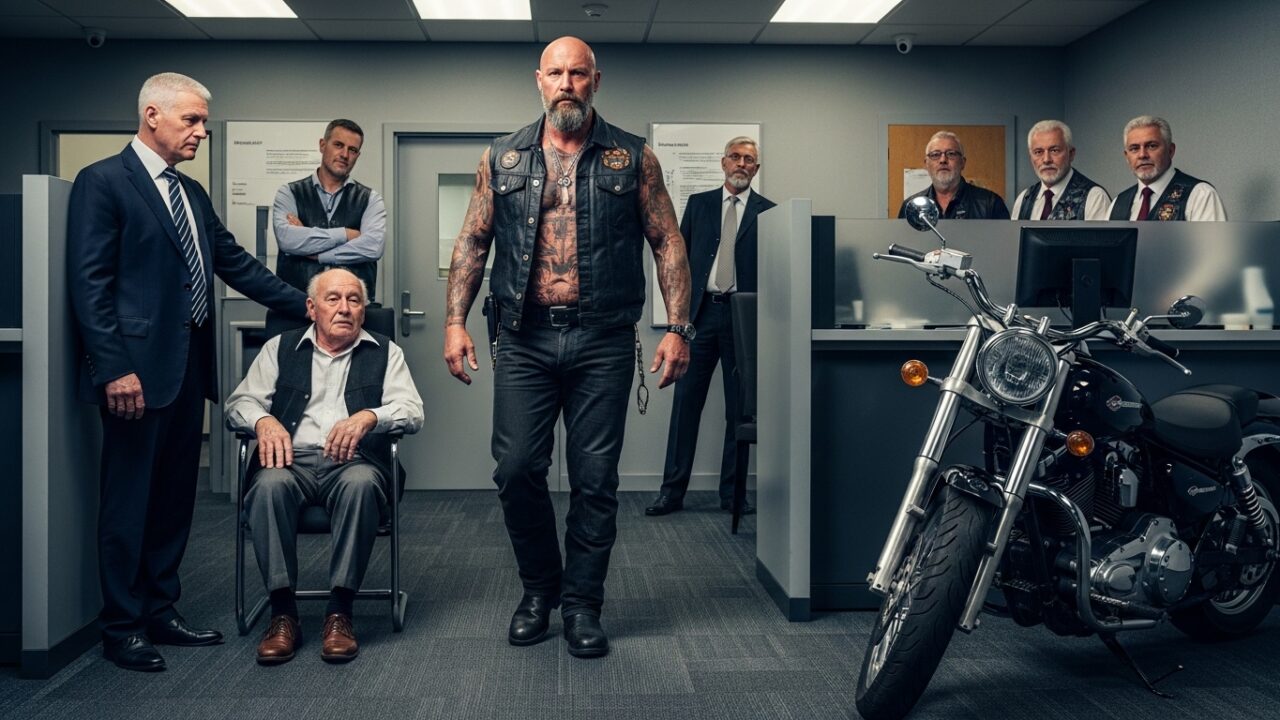
“I Watched The Bank Manager Smile While He Stole An 80-Year-Old Man’s Last Penny… Then The Heavy Doors Swung Open, And A Man In Leather Proved That Justice Doesn’t Always Wear A Suit And A Tie.”

“I Watched Them Rob An 80-Year-Old Man With A Smile… Then The Door Smashed Open And The Real Trouble Walked In.”
I’ve spent twenty years on the road, and if there’s one thing I’ve learned, it’s that the most dangerous predators don’t wear masks—hiding behind a desk and a polite smile is much more effective.
I was standing in line at the First National when I saw him. Arthur. That wasn’t his name yet, just a man in a threadbare suit that smelled like mothballs and heartbreak. He was crying. Not the loud kind, but the quiet, shaking kind that makes your chest tight just watching it.
“That was my retirement,” he whispered to the clerk. “Every cent. They told me it was the government. They said I had to move the money.”
The clerk didn’t even look up from her screen. She just kept tapping away, her voice as cold as a morgue slab. “You authorized the transfer, sir. There’s nothing we can do. Please step aside, you’re holding up the line.”
A woman behind him actually huffed and checked her watch. A man muttered about “senile old fools.”
That’s when I decided I’d had enough of “polite” society. I stepped forward, my boots echoing like a death knell on that fancy marble floor. I saw the security guard reach for his holster. I saw the clerk’s eyes go wide with fear. They thought I was there to rob them.
They had no idea I was there to do something much more terrifying. I was there to tell the truth.
“Lock the transfer,” I said. My voice was low, the kind of low that stops a heart.
“Sir, you can’t be back here—” the manager started, rushing out.
I didn’t blink. “I said, lock the transfer. Or I start talking about the override code you used to bypass the fraud alert ten minutes ago.”
The room went dead silent. The “trouble” had arrived, but it wasn’t the kind they expected.
CHAPTER 1: THE COLD SILENCE OF SECTION B
The air inside the First National Bank didn’t smell like money. It smelled like industrial lavender and the kind of aggressive cleanliness that tries to hide the scent of human fear.
Arthur Penhaligon stood at Window 4, his fingers hooked white-knuckled over the edge of the marble counter. He was eighty-two years old, and for the first time in his life, he felt like a ghost. People were walking around him, through him, and past him as if he were already part of the architecture.
“I don’t understand, Elena,” Arthur whispered. His voice was a thin reed, trembling in the vast, vaulted ceiling of the lobby. “I followed the link. The man on the phone… he knew my middle name. He knew about Martha’s medical bills from three years ago. He said the Social Security office needed to verify the routing to prevent a ‘freeze’.”
Behind the bulletproof glass, Elena Rodriguez tapped a rhythmic, impatient pattern on her keyboard. She was twenty-four, wore a sharp navy blazer, and had the exhausted eyes of someone who had seen too many “preventable” tragedies to care anymore.
“Mr. Penhaligon,” she said, her voice a practiced, flat monotone. “As I’ve explained, the transfer was initiated from your primary device. You provided the two-factor authentication code. Once that money hits a crypto-exchange overseas, it’s gone. The bank is not liable for authorized transfers.”
“Authorized?” Arthur’s chest felt like it was being tightened by a cold iron band. “I didn’t authorize a thief. I authorized… I thought I was protecting it. That’s $142,000. That’s everything. That’s the house repair, the funeral fund… that’s my life, Elena.”
Elena finally looked up. For a second, a flicker of something—pity, maybe guilt—crossed her face. But then she looked at the digital clock on her screen. It was 3:45 PM. Fifteen minutes until her shift ended.
“I’m sorry, sir. There are no more ‘reversals’ possible. I have a line forming behind you. If you want to file a formal grievance, you can take a seat in the lobby and wait for Marcus, the branch manager. But he’s going to tell you the same thing.”
Arthur didn’t move. He couldn’t. His legs felt like they were made of wet cardboard.
Behind him, a woman in a designer yoga outfit let out a long, theatrical sigh. She shifted her weight, checking her gold Apple Watch. “Come on, some of us have lives to get to,” she muttered, loud enough for the whole row to hear.
A man in a business suit behind her nodded in agreement. “He should’ve been more careful. My dad’s the same way. They just give it away and then expect the bank to play hero.”
Arthur turned slightly, his eyes glassy. He looked at the faces of his neighbors—people from his own town—and saw nothing but a wall of indifference. He wasn’t a man to them; he was a “delay.” A “complication.” A “senile old fool” who had failed the modern world’s Darwinian test of digital literacy.
His heart gave a sharp, jagged stutter. He reached for his chest, his breath coming in shallow, ragged gulps. He needed to sit down, but the floor felt like it was tilting at a forty-five-degree angle.
Then, the front doors didn’t just open. They slammed.
The heavy glass and brass doors hit the stoppers with a sound like a gunshot. The entire bank went silent. The security guard, a retired cop named Miller who usually spent his days dreaming of fishing trips, straightened his belt and put a hand on his holster.
A man stepped into the lobby.
He was a mountain of leather and denim. He wore a sleeveless black vest—a “cut”—with a patch on the back that most people in the bank were too scared to read. His arms were covered in ink: a blurred eagle on one forearm, a series of dates on the other. His beard was shot through with grey, and his eyes were hidden behind dark, rectangular sunglasses.
He didn’t look like he belonged in a place with marble floors and lavender scent. He looked like he belonged in a desert storm or a bar fight.
Jax didn’t look at the security guard. He didn’t look at the yoga woman. He walked straight toward Window 4, his heavy engineer boots creating a slow, rhythmic thud… thud… thud… that seemed to sync up with the panicked beating of Arthur’s heart.
“Sir!” Guard Miller called out, stepping forward. “You need to remove those glasses and state your business.”
Jax didn’t stop. He didn’t even turn his head. He stopped two feet behind Arthur.
Arthur felt the heat radiating off the man. He smelled of old leather, cold wind, and high-octane gasoline. He expected to be shoved aside. He expected the “trouble” to finally arrive and finish what the scammers had started.
But Jax didn’t shove him. He placed a massive, calloused hand on Arthur’s trembling shoulder.
“Deep breaths, Pop,” Jax said. His voice wasn’t a growl. It was a low, resonant rumble, like a distant engine. “Don’t let ’em see you shake. That’s what they want.”
Arthur looked up, blinking. “I… I lost it all, son. They took it.”
Jax looked at Elena. Even through the sunglasses, his gaze seemed to pin her to her chair. She stopped typing. Her hands hovered over the keys as if the air had suddenly become electrified.
“You heard the man,” Jax said. “He’s got a problem.”
“I… I already told him,” Elena stammered, her professional facade cracking. “The transaction is finalized. There’s nothing in the protocol for—”
“Forget the protocol,” Jax interrupted. His voice stayed low, but it had a jagged edge now. “The transfer is still in the ‘Pending Settlement’ phase. I know how your backend works. You have a four-hour window for manual fraud intervention before the ledger clears the Fed wire.”
The man in the business suit behind them scoffed. “Hey, buddy. Who do you think you are? You can’t just walk in here and start barking orders at the staff. We’re waiting.”
Jax turned his head slowly. He didn’t move his body—just his neck. He looked at the businessman for three seconds. Three seconds of absolute, terrifying silence.
The businessman turned pale, looked at the floor, and suddenly found his shoes very interesting.
Jax turned back to Elena. “Call Marcus. Tell him The Iron Horse Ledger is in the lobby. Tell him we’re looking at a Flag 7 violation on a senior account.”
Elena’s eyes went wide. She didn’t know what an Iron Horse Ledger was, but she knew the word ‘violation.’ She picked up the internal phone with a shaking hand.
Arthur was staring at Jax, his mouth slightly open. “Who… who are you? How do you know about wires?”
Jax looked down at the old man. For a split second, he lifted his sunglasses. His eyes weren’t those of a criminal. They were the eyes of a man who had seen the inside of a corporate boardroom long before he ever picked up a wrench. They were tired, sharp, and filled with a very specific kind of rage.
“I’m the guy who’s tired of watching people like you get robbed by people in air-conditioned offices,” Jax whispered.
The office door at the back of the bank opened. Marcus Thorne, the branch manager, stepped out. He was a man who spent a lot of money on his hair and even more on his teeth. He had a “problem-solver” smile plastered onto his face, but it didn’t reach his eyes.
“Is there an issue here, gentlemen?” Marcus asked, his voice oily and smooth.
“No issue,” Jax said, stepping forward so he was chest-to-chest with the manager. “Just a correction. You’re going to reverse Mr. Penhaligon’s transfer. Right now.”
Marcus chuckled, a dry, hollow sound. “I’m afraid that’s impossible, Mr…?”
“Jax. Just Jax.”
“Well, Jax. We follow federal guidelines here. The customer gave his credentials. The bank is not a charity. Now, I’m going to have to ask you to leave, or I’ll have Officer Miller escort you out.”
Jax didn’t move. He reached into the pocket of his leather vest and pulled out a small, encrypted tablet. He tapped the screen three times and turned it around so only Marcus could see it.
On the screen was a line of code. A timestamp. And a digital signature.
“This is the override log from ten minutes ago,” Jax said, his voice dropping to a whisper that felt like a razor blade. “Your system flagged this as high-risk fraud. It blocked it. But someone with Manager Credentials entered a manual override to let it through. To keep the branch’s ‘Liquidity Flow’ numbers up for the quarter.”
Marcus’s smile didn’t just fade. It died. His face turned the color of spoiled milk.
“I… I don’t know what you’re talking about,” Marcus stammered.
“I think you do,” Jax said. He leaned in closer, his shadow swallowing the manager. “And if that money isn’t back in this man’s account in the next ten minutes, I’m not calling the police. I’m calling the Internal Audit board. And then, I’m going to call my friends.”
“Friends?” Marcus whispered.
Jax glanced toward the glass front doors.
Three more motorcycles roared to a halt in the parking lot. The sound was deafening, a mechanical growl that shook the very windows of the bank. Three more men, dressed in the same leather, stepped off their bikes. They didn’t rush. They moved with the terrifying confidence of men who knew exactly why they were there.
Jax looked back at Marcus.
“My friends have very little patience for thieves,” Jax said. “Whether they use a gun or a keyboard. Make your choice, Marcus. Because once I walk out those doors without a receipt for this man… there is no coming back.”
Arthur watched as the powerful manager, the man who had just told him he was “not liable,” began to tremble.
The choice was made. The point of no return had been crossed. The bank wasn’t a sanctuary anymore. It was a crime scene, and the bikers were the only ones holding the evidence.
CHAPTER 2: THE SHADOW OF THE LEDGER
The silence in the bank was no longer polite. It was heavy, the kind of silence that precedes a storm.
The three bikers who had just arrived didn’t charge in. They didn’t need to. They moved with a synchronized, chilling calm. One of them, a man they called Grizz—a mountain of a man with a beard that looked like it had survived a forest fire—simply leaned against the heavy glass doors, crossing his massive arms. He didn’t look at the customers; he looked at the security guard, Miller.
Miller, who had been a cop for twenty years before taking this retirement gig, knew a “calculated threat” when he saw one. He didn’t draw his weapon. He knew that the moment he did, the temperature in this room would hit the boiling point, and he was outnumbered four-to-one by men who moved like they’d seen combat.
“Marcus,” Jax said, his voice dropping an octave, “you have nine minutes left. The clock is ticking on a man’s life, and you’re still thinking about your year-end bonus.”
Marcus Thorne tried to reclaim his dignity. He adjusted his silk tie, though his fingers were visibly shaking. “This is highly irregular. You’re harassing my staff. I’ve already alerted the authorities.”
Jax smiled. It wasn’t a friendly expression. It was the smile of a predator watching a rabbit run into a dead end. “Good. I hope you called the FBI’s Cyber Division. Because I’ve already sent them the packet. I’m sure they’ll be very interested in why First National’s override logs show a 400% increase in senior-account transfers this month.”
At the mention of “400%,” Elena, the young clerk, let out a sharp, involuntary gasp. She looked from Jax to her manager. Her face went from professional mask to horrified realization.
“Marcus?” she whispered. “Is that true? The ‘Liquidity Incentives’ you told us to push… were those just…?”
“Be quiet, Elena!” Marcus snapped, his polished exterior finally cracking. “You don’t understand how the macro-economics of a small-town branch work. We need the flow. We need the numbers.”
“You need the blood,” Jax corrected.
He turned his attention back to Arthur, who was still sitting in the chair, looking smaller than he had five minutes ago. The old man’s eyes were fixed on the floor. He looked like a man who had already accepted his execution.
“Arthur,” Jax said, his voice softening. “Look at me.”
The old man slowly lifted his head.
“Why me?” Arthur asked, his voice cracking. “I’m just… I’m just an old man. Why did you stop?”
Jax felt a familiar, jagged pain in his chest. It was a phantom limb of a memory he had tried to bury under thousands of miles of highway. He remembered a kitchen table in Ohio. He remembered his father, a retired steelworker, holding a phone with a cord, sobbing because “the man from the IRS” said he was going to jail if he didn’t pay the back taxes he didn’t actually owe. His father had died of a stroke three weeks later, leaving Jax with a house he couldn’t keep and a debt he didn’t earn.
“Because,” Jax said, “I’m tired of seeing good men disappear into the cracks of a spreadsheet. My name is Jax Miller. My father was David Miller. And ten years ago, a bank manager just like this one told him there was ‘nothing we can do’.”
Jax stood up and walked toward the counter, gesturing for the third biker to come forward. This was Sarah, a woman in her late thirties with a shaved head and a laptop bag slung over her leather jacket. She didn’t look like a biker; she looked like a Silicon Valley defector who had traded her Tesla for a Triumph.
“Sarah,” Jax said. “Open the back door.”
Sarah didn’t hesitate. She pulled a ruggedized laptop from her bag and plugged it into the data port at the base of the customer service desk—a port meant for “diagnostic technicians.”
“Hey!” Marcus screamed, lunging forward. “That’s federal property! You can’t—”
Grizz moved faster than a man his size should. He stepped into Marcus’s path, a wall of muscle and denim. He didn’t touch the manager. He just stood there. The sheer displacement of air was enough to make Marcus stumble back.
“Let the lady work,” Grizz rumbled.
The bank customers were frozen. The yoga woman had dropped her phone. The businessman was sweating. They were watching a heist in reverse.
“I’m in,” Sarah said, her fingers flying across the keys. Her screen was a blur of green and black code. “Jax, he wasn’t lying. There’s a script running on the branch server. It’s a ‘Delay-and-Harvest’ protocol. When a high-value transfer is flagged for fraud, the system is supposed to lock it instantly. This script reroutes the alert to a ‘Manager’s Review’ folder that auto-approves after 60 seconds if not manually denied. It’s designed to look like negligence, but it’s intentional. It’s how they keep the capital in the system long enough to collect the overnight interest.”
The room went cold. This wasn’t just a scam from a call center in another country. It was a harvest. The bank was letting the thieves in, letting them take the money, just so they could hold onto the cash for a few more hours of profit.
“It’s a penny-shaving scheme on a massive scale,” Sarah continued, her voice clinical and cold. “Arthur’s money is currently sitting in a clearing account. It hasn’t left the bank’s internal network yet. Marcus just told him it was gone so he’d go home and give them time to finish the cycle.”
Arthur stood up, his legs shaking but his eyes suddenly sharp with a terrible clarity. “You… you knew? You knew it was still here?”
Marcus was backing away toward his office, his eyes darting toward the security cameras. “It’s not what it looks like. It’s bank policy. I don’t make the rules!”
“You just profit from them,” Jax said. He walked around the counter, ignoring the ‘Staff Only’ sign. He grabbed Marcus by the collar of his expensive suit. He didn’t hit him. He just pulled him close enough that Marcus could see his own terrified reflection in Jax’s sunglasses.
“The money, Marcus. Now. Or Sarah hits ‘Send’ on the entire server log to every news outlet from here to D.C. Your ‘macro-economics’ won’t survive a 6:00 PM lead story about how First National steals from grandfathers.”
Marcus looked at the laptop. He looked at the three bikers standing like sentinels in his lobby. He looked at Arthur, who was no longer a ghost, but a victim who had found a voice.
“Elena,” Marcus croaked, his voice barely audible. “Reverse the Penhaligon transfer. Enter code… Blue-Zero-Nine.”
Elena didn’t hesitate. She didn’t look at Marcus. She looked at Arthur as she pounded the keys. Her face was set in a grim line of defiance.
“Done,” she said. A printer behind her began to hum.
She reached into the tray and pulled out a single sheet of paper. She walked around the glass partition, bypassed the manager, and handed the paper directly to Arthur.
“Your balance, Mr. Penhaligon,” she said, her voice trembling with emotion. “One hundred and forty-two thousand dollars. Plus interest.”
Arthur took the paper. He looked at the numbers. He began to cry, but this time, it was the sound of a man being pulled back from a ledge.
“It’s back,” he whispered. “It’s back.”
Jax let go of Marcus’s collar, giving him a small, contemptuous shove. “You’re lucky, Marcus. If we had come here ten minutes later, I wouldn’t have used a laptop to solve this.”
But the victory felt hollow in Jax’s chest. He knew this was just one branch, one man, one town.
Suddenly, the silence was shattered.
From outside, the wail of sirens began to rise. Not one, not two, but a chorus of them. Blue and red lights began to pulse against the bank’s windows, reflecting off the marble floors like a fever dream.
Marcus’s face transformed. The fear vanished, replaced by a sneering, ugly triumph.
“You see?” Marcus hissed, straightening his tie. “I told you I called the authorities. You broke into a federal institution. You accessed a secure server. You threatened a bank officer. I don’t care about the money anymore. You’re all going to jail for the rest of your lives.”
Jax didn’t look surprised. He didn’t even look worried. He just turned to Grizz and Sarah.
“You got it all?” Jax asked.
Sarah tapped a final key and closed her laptop. “Encrypted and uploaded to the cloud. The evidence of the harvest is permanent.”
Jax turned back to Marcus. “We aren’t the ones the police are coming for, Marcus. We’re just the ones who stayed to make sure you didn’t run.”
The front doors burst open. Armed officers in tactical gear swarmed the lobby.
“Hands in the air! Nobody move!”
Jax raised his hands slowly, a grim smile on his face. He looked at Arthur one last time.
“Go home, Pop,” Jax said. “Take your money and go home.”
But as the police moved in, the twist began to unfold. The lead officer didn’t head for Jax. He headed straight for Marcus.
CHAPTER 3: THE GHOST AUDITORS
The lobby of First National looked like a scene from a war movie. The red and blue lights strobe-flashed against the polished marble, turning the bank into a rhythmic, disorienting nightmare of color. Tactical boots thundered on the floor, and the metallic clack-clack of safety locks being disengaged echoed off the high ceiling.
Marcus Thorne stood behind the counter, his chest puffed out, a hideous, trembling smirk on his face. “Finally!” he shouted, pointing a shaking finger at Jax. “Officers, arrest these men! They’ve breached our servers! They’re threatening the staff! They’re a gang! Look at them!”
The lead officer, a man with a face like weathered granite and a badge that read Special Agent Vance, didn’t even look at Jax. He didn’t look at Grizz or Sarah. He walked straight past the “bikers” as if they were invisible.
Vance stopped in front of the counter. He looked at Marcus’s outstretched finger, then up at Marcus’s sweaty face.
“Marcus Thorne?” Vance asked. His voice was like grinding gravel.
“Yes! Yes, I’m Thorne. I’m the manager. I’m the one who called you. Get them out of here!”
Vance didn’t pull out a pair of handcuffs for Jax. He reached into his tactical vest and pulled out a folded piece of heavy paper. He slapped it onto the marble counter, right over the spot where Arthur’s hand had been trembling moments before.
“This is a federal warrant,” Vance said. “For the seizure of all local servers, transaction logs, and your personal communication devices. You are being detained on suspicion of Racketeering, Wire Fraud, and Conspiracy to Defraud the Elderly.”
The silence that followed was so absolute you could hear the hum of the air conditioning.
Marcus’s smirk didn’t just fade; it disintegrated. His jaw literally hung open. “What? No… no, you have this wrong. They are the ones in leather. They are the ones with the tattoos! I’m the manager! I represent the bank!”
“No,” Jax said, stepping forward. He didn’t sound triumphant. He sounded tired. “You represent a cancer. You thought because you wore a suit, the law wouldn’t look at the numbers. You thought if you hid behind a screen, the blood wouldn’t show. But digital footprints don’t wash away, Marcus.”
Grizz let out a low, rumbling laugh. “The ‘bikers’ didn’t call the cops, Marcus. The auditors did.”
The “Yoga Woman” in the corner gasped, her phone slipping from her fingers and hitting the floor with a plastic thwack. The businessman who had scoffed at Arthur was now backing away, his face a mask of pure, unadulterated shame. The “senile old man” they had judged was the only one standing tall, while the man they had trusted to hold their money was being forced against a wall.
“Who are you people?” Marcus whimpered as an officer spun him around and clicked the steel cuffs shut over his manicured wrists.
Jax pulled a heavy, leather-bound notebook from his vest—the “Ledger” that gave his group its name. “We’re the Iron Horse Ledger. Most of us spent thirty years in the Treasury, the FBI, or Forensic Accounting. We retired, bought bikes, and realized the world was still full of predators like you. So now, we do for free what the government is too slow to do for a paycheck.”
Sarah closed her laptop with a definitive snap. “The ‘government line’ the scammers used? It originated from a VOIP server leased by a shell company. That shell company’s bills were paid by a corporate credit card registered to this branch’s ‘Marketing’ fund. You weren’t just letting the scammers in, Marcus. You were providing the door.”
Arthur walked toward the counter, his steps no longer hesitant. He looked at Marcus—the man who had watched him cry and felt nothing.
“You told me it was my fault,” Arthur said, his voice low and steady. “You told me I was the one who was ‘careless’. You looked me in the eye and lied while you were holding my life in your pocket.”
Marcus couldn’t meet his gaze. He looked at the floor, his face bright red, sweat dripping off the end of his nose onto his expensive silk tie.
“I have a daughter in college,” Marcus whispered. “I needed the commissions. The bank… they put so much pressure on us to hit the numbers…”
“Everyone has pressure, Marcus,” Jax said, stepping between the old man and the thief. “Most people don’t decide to rob their neighbors to solve it.”
Agent Vance looked at Jax and gave a short, curt nod. “We’ll take it from here, Jax. The tech team is outside. They’ll need your mirror-drive of the server logs.”
“Sarah’s already got the encrypted link ready for your server,” Jax replied.
The bank was now a hive of activity. The customers were being ushered out, their names taken as witnesses. The “polite” silence of the bank was replaced by the chaotic energy of justice being served.
As the police led Marcus toward the door, passing through the line of onlookers, a strange thing happened. The people who had been sighing and checking their watches ten minutes ago didn’t look at Marcus with respect or fear anymore. They looked at him with the kind of disgust reserved for something found under a rock.
And then they looked at the bikers.
The businessman stepped toward Grizz. He hesitated, looking at the massive, tattooed man who looked like he could break a tree trunk with his bare hands.
“I… I’m sorry,” the businessman muttered, his voice barely audible. “I thought… I assumed…”
Grizz didn’t even look at him. He just adjusted his vest. “Next time, don’t assume the guy in the suit is the good guy. The devil doesn’t wear horns anymore. He wears a tie and a smile.”
Outside, the air was crisp. The sun was beginning to set, casting long, golden shadows across the asphalt. The four motorcycles stood in a row, chrome gleaming in the fading light.
Arthur followed Jax out onto the sidewalk. The old man looked at the bikes, then at the four men and women who had saved his life. He reached into his pocket and pulled out the receipt—the piece of paper that proved he wasn’t going to die in a cold, empty house.
“Son,” Arthur said, stopping Jax before he could put on his helmet. “I don’t have much. And I know you didn’t do this for money. But I have to ask… why? You don’t know me. I’m just an old man at a bank.”
Jax paused. He looked at the eagle tattoo on his arm, then at the horizon. “My dad worked forty years at the mill. He saved every penny so my mom could have a nice funeral and he could leave me enough to start my own shop. A guy like Marcus called him one Tuesday. Told him his account was compromised. My dad believed him because he was a man of his word, and he thought everyone else was, too.”
Jax’s voice grew thick for a second, then hardened. “He lost $80,000. Not as much as you, but it was his world. He sat in his kitchen for three days without eating. He was too ashamed to tell me. By the time I found out, his heart had given up. The bank said ‘not our problem’. The police said ‘it’s a civil matter’.”
Jax looked Arthur in the eye. “I promised him I’d make it someone’s problem. You weren’t just Arthur Penhaligon today. You were my father. And today, for once, the bad guys didn’t win.”
Arthur reached out and took Jax’s hand. His grip was surprisingly strong. “Thank you, Jax. Thank you for remembering us.”
“Don’t thank me yet, Pop,” Jax said, swinging a leg over his massive Harley-Davidson. “The money is back, but the bank is going to try to bury this. You need to get a lawyer—a real one. I’ll send you a name.”
Jax kicked the engine over. The roar was sudden and violent, a mechanical scream of defiance that seemed to echo through the entire town. Sarah, Grizz, and the others started their bikes, the collective thunder shaking the very ground.
But as Jax went to pull away, he saw something in his rearview mirror that stopped him.
A black SUV with tinted windows had pulled up across the street. Two men in dark suits were watching the bank. They weren’t cops. They weren’t press. They were too still, too focused.
Jax narrowed his eyes. He realized then that Marcus wasn’t the top of the food chain. He was just a mouth. The stomach was much bigger, and it was still hungry.
The consequences weren’t over. They were just beginning.
Jax tapped his helmet, signaling the others. He pointed toward the SUV. Grizz nodded once.
“Go home, Arthur!” Jax yelled over the engines. “Lock your doors. Don’t answer the phone for anyone! We’ll be in touch!”
With a cloud of exhaust and the scream of rubber, the Iron Horse Ledger tore out of the parking lot. They weren’t riding into the sunset. They were riding toward the next fight.
Because the thing about a ledger is that it always has to balance. And there was still a lot of debt left to collect.
CHAPTER 4: THE DEBT IS SETTLED
The porch light of Arthur’s small, white-shingled house flickered, casting long, nervous shadows across the overgrown lawn. Inside, Arthur sat at his kitchen table, the bank receipt smoothed out in front of him. A single lamp hummed in the corner. For the first time in forty-eight hours, he should have felt safe.
But he didn’t. He felt like a man holding a lightning rod in a thunderstorm.
Outside, the quiet of the suburban street was broken by the low, guttural idle of a heavy engine. Arthur peered through the curtains. A black SUV—the same one Jax had spotted—was parked across the street. The engine was off, but the heat shimmering from the hood was visible under the streetlamp.
Two men stepped out. They weren’t wearing police uniforms. They were wearing dark, tailored overcoats. They moved with the surgical precision of “fixers”—the kind of men high-level corporations hire when a “glitch” like Marcus Thorne threatens to become a liability.
Arthur’s heart hammered against his ribs. He reached for his phone, but before his fingers could touch the screen, a shadow blocked the light from the window.
A heavy fist pounded on his front door. Thud. Thud. Thud.
“Mr. Penhaligon,” a voice called out—smooth, professional, and entirely devoid of warmth. “We’re from the regional compliance office. We have some additional paperwork regarding your account. It’s urgent.”
Arthur didn’t answer. He backed into the kitchen, his hand trembling as it hovered over a steak knife on the counter.
“We know you’re in there, Arthur,” the voice continued, dropping the pretense of politeness. “We just want the drive. The one the bikers gave you. Give us the hardware, and we can make sure your pension stays ‘restored’. Don’t make this difficult.”
Arthur realized then that Sarah hadn’t just given him a receipt. She had slipped a small, silver USB drive into his pocket during the chaos. It was the “Insurance.”
The back door of the kitchen suddenly creaked. Arthur spun around, knife raised, a sob catching in his throat.
“Easy, Pop,” a voice whispered.
Jax stepped out of the shadows of the laundry room. He looked different without the sunglasses. His eyes were bloodshot, rimmed with a deep, ancient fatigue. Behind him, Grizz stood like a wall, his hand resting on the hilt of a heavy wrench tucked into his belt.
“You came back,” Arthur breathed, the knife clattering into the sink.
“We never left,” Jax said. He looked at the front door. “Grizz, keep the front quiet. Sarah’s already in their cloud. She’s cutting their comms.”
From the front porch, the “fixer” tried the handle. Finding it locked, he put his shoulder to the wood. The frame groaned.
Jax didn’t move toward the door. Instead, he pulled a chair out and sat down at the kitchen table, right across from where Arthur had been sitting. He picked up a cold cup of coffee and took a sip.
“Arthur,” Jax said calmly. “Go into the hallway. Close the door. No matter what you hear, don’t come out until I say my father’s name.”
Arthur nodded, retreating into the dark hallway.
The front door didn’t just open; it exploded inward. The two men in overcoats stepped into the small living room, their eyes scanning for the old man. They found Jax instead.
The lead fixer stopped, his hand going into his coat. “You. The biker. You’re a long way from the highway.”
“And you’re a long way from the boardroom,” Jax replied, not standing up. “I know who sent you. The holding company in Delaware. The ones who own 40% of First National’s sub-prime debt. You’re here to clean up Marcus’s mess before the ‘Iron Horse’ goes public.”
The fixer pulled a silenced pistol, his face a mask of corporate indifference. “You’re a thief who breached a bank. Nobody is going to miss a gang member who died during a home invasion.”
“Maybe,” Jax said. He leaned back, the chair creaking. “But you should check your phone. Sarah just sent a little gift to your bosses.”
The fixer’s partner pulled out his cell. His face went pale. “Sir… the server. It’s not just the bank files. They’ve got the offshore routing numbers. The ones tied to the ‘Cleaners’ fund.”
“The thing about being a ‘ghost auditor’,” Jax said, his voice turning into a growl, “is that we don’t just find the money. We find the people who hide it. In thirty seconds, those files hit the Department of Justice, the New York Times, and the SEC. Unless…”
“Unless what?” the fixer hissed, his finger tightening on the trigger.
“Unless you walk out that door, get in your car, and tell your bosses that Arthur Penhaligon is dead to them,” Jax said. “That his account is a ghost. That if so much as a telemarketer calls this house in the next twenty years, the ‘Iron Horse’ will ride straight into your CEO’s bedroom.”
The room was a vacuum of tension. Grizz moved into the doorway behind the fixers, his massive frame blocking any hope of an easy exit.
The fixer looked at Jax. He saw a man who had nothing left to lose—a man who had traded a life of comfort for a life of vengeance. He saw the eagle tattoo on Jax’s arm and understood that he wasn’t looking at a criminal. He was looking at a man who was finally, after ten years, settling a debt.
The fixer lowered his weapon.
“The bank will still fail,” the fixer said.
“Good,” Jax replied. “It was built on rotten wood anyway.”
The two men backed out of the house. A moment later, the SUV roared to life and sped away into the night, disappearing like a bad dream.
Silence returned to the house. It was a heavy, healing silence.
Jax stood up and walked toward the hallway door. “David Miller,” he said softly.
The door opened. Arthur stepped out, his face wet with tears. He looked at the shattered front door, then at the two men who had stood in the gap for him.
“Is it over?” Arthur asked.
“For you, it is,” Jax said. He reached into his pocket and pulled out a small, leather-bound card. It was a contact for a law firm. “These people specialize in victim restitution. They’ll handle the rest. You don’t have to go back to that bank ever again.”
Arthur looked at the receipt on the table. “Jax… I can’t… I have to give you something. Half of it. Please. It’s just money, but you saved my life.”
Jax paused at the threshold of the broken door. He looked back at the kitchen table—at the spot where a father and son should have shared a meal, but never got the chance.
“Keep it, Pop,” Jax said, his voice a low rumble that sounded almost like peace. “Buy yourself a dog. A big one. And when you’re sitting on your porch, just remember… there are still people out here who give a damn about the truth.”
Jax stepped out onto the porch. Grizz followed, already pulling a hammer and some nails from his bike’s saddlebag to fix Arthur’s door.
Jax climbed onto his Harley. He didn’t look back. He kicked the engine over, the thunderous roar echoing through the sleepy neighborhood, waking the people who had spent their lives looking the other way.
As he shifted into first gear and pulled away, the wind hitting his face felt cleaner than it had in a decade. The ledger wasn’t just balanced. For the first time since his father died, the book was finally closed.
Arthur stood on his porch, watching the taillights of the bikes fade into the distance. He held the receipt in one hand and the silver USB in the other. He wasn’t a victim anymore. He was a survivor.
And in the quiet of the American night, the roar of the engines lingered—a reminder that sometimes, justice doesn’t come in a suit. Sometimes, it comes in leather, covered in grease, and riding on two wheels.
THE END.

About the Author
Khánh Nguyễn
A writer passionate about human stories and real-life experiences that inspire and move readers.
 Biker
21 min read
Biker
21 min read
Everyone honked at the “reckless” biker, until they saw what he was shielding in his arms.
I was the 1 driver stuck in that Monday morning gridlock when the “reckless” biker swerved past 4 lanes of…
 Biker
29 min read
Biker
29 min read
“They Called Him ‘Hand-Me-Down’ Until The Biker Walked Into The Meeting… The Secret He Revealed In Front Of The Principal Changed This Town Forever.”
CHAPTER 1: THE CRACKS IN THE BLUE The shirt had once been a deep, royal blue, the kind of color…
 Biker
3 min read
Biker
3 min read
I bled for two years to earn my patch in the state’s most notorious motorcycle club. But the night they finally let me behind the steel door, I discovered the sick, twisted lie our brotherhood was built on.
Chapter 1: The Gravel Run My knees slammed into the crushed gravel of the clubhouse driveway. The sharp rocks bit…
Leave a Reply