
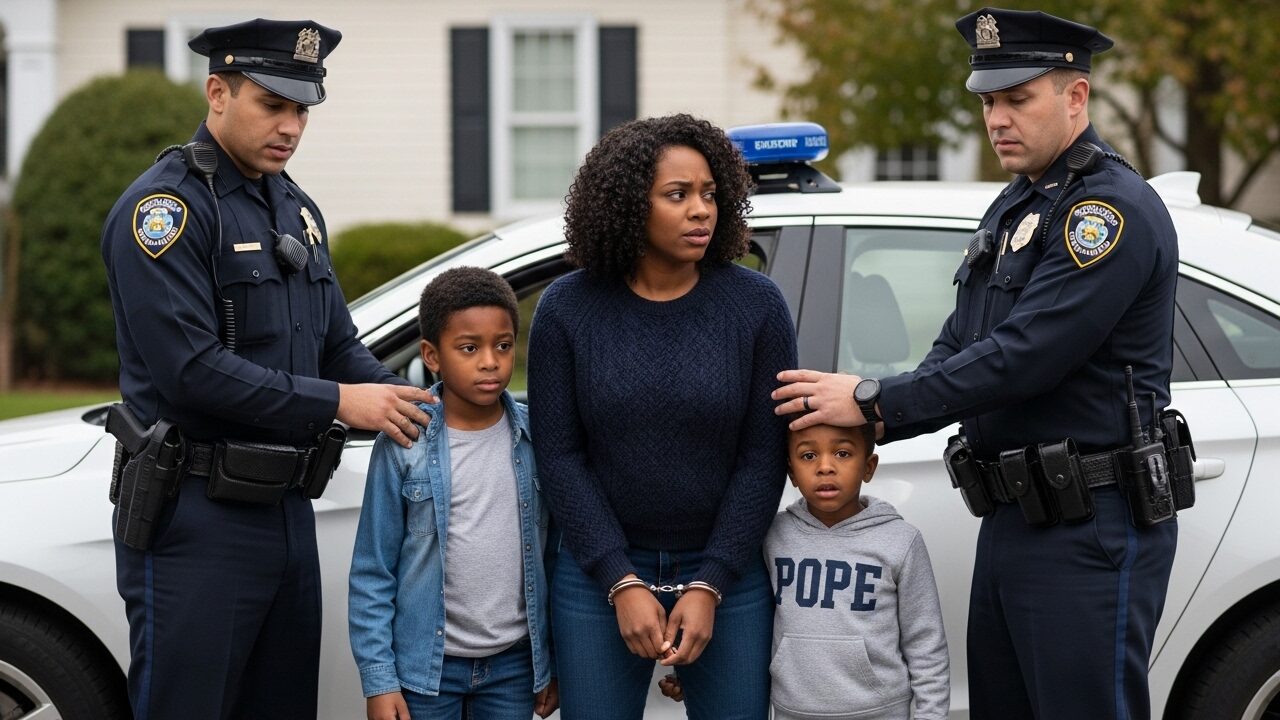
I Was Handcuffed And Shoved Onto The Asphalt For 45 Minutes While My 7-Year-Old Screamed… They Didn’t Know My Real Job.

“Mommy, why is that man holding his gun?”
The question came from the backseat, my 7-year-old son’s voice trembling. I glanced in the rearview mirror. Leo’s eyes were wide, fixed on the flashing red and blue lights painting the interior of our SUV.
“It’s okay, baby,” I said, keeping my voice steady, though my heart was beginning to hammer a heavy, irregular rhythm against my ribs. “Just sit back. Mommy’s going to talk to the officers.”
It was supposed to be a good day. We were driving home from his friend’s birthday party in Oakridge—a notoriously affluent, manicured suburb where the lawns look like golf courses and the police patrol cars always seem to be lingering at the intersections.
I knew the reputation of the Oakridge Police Department. In fact, I knew it better than almost anyone else in the state. I just never expected I would become their next victim while my little boy watched.
I rolled all four windows down, turned off the engine, and placed both of my hands firmly at twelve o’clock on the steering wheel. I didn’t reach for my purse. I didn’t reach for the glove compartment. I knew the drill.
Footsteps crunched on the gravel shoulder. In my side mirror, I saw two officers approaching. The one on the driver’s side, a heavy-set man with a tight buzzcut and a jaw set in a permanent sneer, had his hand resting casually on the butt of his unholstered weapon.
“License, registration, and insurance,” he barked. He didn’t say good afternoon. He didn’t tell me why I was being stopped.
“Officer, my license is in my purse on the passenger seat. My registration is in the glove box,” I said calmly, looking straight ahead. “I need to reach for them.”
He leaned in, his face inches from mine. I could smell stale coffee and peppermint gum. His eyes raked over my hair, my skin, and the interior of my car with undeniable disgust.
“I didn’t ask for a damn itinerary. I said hand them over.”
“I’m just letting you know my movements,” I replied, keeping my tone perfectly neutral. I slowly reached over, grabbed my wallet, and handed him the documents.
He snatched them out of my hand. “Whose car is this?”
“Mine.”
He looked at the registration, then back at me, a smirk playing on his lips. “A 2024 Land Rover? You? What do you do for work?”
“I work for the government,” I said. It wasn’t a lie.
“Right. Welfare office? DMV?” He chuckled, glancing back at his partner, a younger, nervous-looking cop who was shining his flashlight into the backseat, directly into Leo’s eyes.
“Hey!” Leo cried out, raising his small hands to shield his face.
“Please ask your partner to stop blinding my son,” I said, the mother-bear instinct flaring hot in my chest.
The older officer’s demeanor instantly snapped from mocking to hostile. “Step out of the vehicle.”
“For what reason, Officer? I haven’t committed a traffic violation.”
“I said step out of the damn vehicle!” he roared, his hand gripping the handle of his door. “You fit the description of a suspect involved in a string of residential burglaries in this area. Now get out before I pull you out.”
A string of burglaries. The oldest, lazhest excuse in the book.
“Mommy!” Leo screamed.
“It’s okay, Leo! Close your eyes, it’s okay!” I unbuckled my seatbelt and stepped out onto the hot summer asphalt.
Before I could even straighten my posture, the officer grabbed my left arm, twisted it violently behind my back, and slammed my chest against the side of my own car. The metal of the door burned through my thin blouse.
“Stop resisting!” he yelled.
“I am not resisting,” I choked out, the air leaving my lungs.
The cold, unforgiving steel of the handcuffs clicked tightly around my wrists, biting into the skin. He kicked my legs apart and patted me down with an aggressive, humiliating thoroughness right there on the side of a busy suburban road. Cars drove past. People stared. I was a spectacle. A criminal. A threat.
“Mommy! Don’t hurt my mommy!” Leo was hysterical now, unbuckling his car seat and trying to climb toward the window.
“Keep the kid in the car, rookie,” the older cop barked over his shoulder.
He yanked me backward by the chain of the cuffs and shoved me toward the curb. “Sit.”
I sat on the scorching pavement. My wrists throbbed. Sweat dripped down the back of my neck. I listened to the sound of my 7-year-old sobbing uncontrollably inside the car, terrified that these men with guns were going to take his mother away forever.
The officer stood over me, thumbs hooked into his duty belt, looking down at me like I was absolute trash. He thought he had all the power in the world. He thought I was just another Black woman he could humiliate, terrorize, and throw into the system without consequence.
He thought he was invincible.
I looked up at his badge number. Officer D. Miller. Badge 408. I didn’t cry. I didn’t beg. I just stared at his boots, committing every single second of this interaction to memory.
Because what Officer Miller didn’t know—what he couldn’t possibly fathom as he laughed with his partner about my car and my skin color—was that I didn’t work at the DMV.
I am a Senior Covert Investigator for the United States Department of Justice, Civil Rights Division.
And for the last three years, I had been building a massive, airtight federal racketeering and corruption case against him, his captain, and the entire Oakridge Police Department.
He just handed me the smoking gun.
The asphalt was practically boiling. It was mid-July in a state where the humidity wraps around your throat the second you step outside, and sitting on the unshaded curb felt like being pressed onto the surface of a cast-iron skillet. Heat radiated up through the thin fabric of my slacks, searing the backs of my thighs.
But the heat was nothing compared to the sharp, biting agony in my wrists.
Officer Miller had clicked the handcuffs down to the final notch. It’s a deliberate tactic. They teach it in the academy as a means of “securing a non-compliant suspect,” but on the street, it’s just punishment. It’s a way to let you know who owns your body in that exact moment. Every time I took a breath, my chest expanded, shifting my shoulders and pulling the steel tighter against my bone. My fingers were already tingling, the blood flow struggling to make it past the pinch points.
I forced myself to breathe through my nose. In through the nose, out through the mouth. Four seconds in, four seconds out. Tactical breathing. The same breathing I used when I was sitting in a surveillance van at 3:00 AM, waiting for a drug cartel drop.
But I wasn’t in a Kevlar vest. I was in a silk blouse. And my seven-year-old son was ten feet away, trapped in the backseat of a car surrounded by armed men.
“Mommy!” Leo’s voice was raw now, a ragged, high-pitched wail that shredded my heart into ribbons. “Mommy, I want to go home! Please!”
“Shut the kid up, Collins,” Miller barked, not even looking back. He was busy standing over me, his thumbs aggressively hooked into his duty belt. His boots—heavy, black, polished to a mirror shine—were planted just inches from my knees.
He wanted me to look at them. He wanted me to look at him. He wanted the fearful, pleading gaze of a broken woman.
I gave him nothing. I kept my eyes fixed on the front license plate of his cruiser.
Unit 74. I knew Unit 74. I had read over four hundred pages of excessive force complaints specifically citing Unit 74. I knew that Officer David Miller had cost the city of Oakridge over $1.2 million in quiet settlements over the past five years. I knew he targeted Black motorists at a rate 400% higher than the demographic makeup of the surrounding county.
I knew he liked to search vehicles without probable cause, and when he couldn’t find anything, he’d “smell marijuana” to justify a tear-down.
Until today, David Miller was just a name in a Manila folder on my desk in Washington, D.C. A piece of a massive puzzle I was piecing together for the Civil Rights Division.
Now, he was standing over me, his shadow blocking the sun.
“You’re awfully quiet for someone who was so mouthy a minute ago,” Miller sneered. He leaned down, his face coming close enough that I could see the burst capillaries around his nose. “Usually, you people are screaming about your rights right about now. Screaming for a lawyer. Why aren’t you screaming?”
Because I’m not just a lawyer, you arrogant son of a bitch. I thought. I’m the lawyer the federal government sends when local cops forget the Constitution exists.
But I didn’t say that. I couldn’t. If I blew my cover now, if I shouted that I was a DOJ investigator, he wouldn’t believe me. Or worse, he would believe me, panic, and things would escalate to a lethal level. A dirty cop backed into a corner on an empty suburban street is the most dangerous animal on earth. And my son was sitting right there.
“I have nothing to say, Officer,” I said, keeping my voice utterly flat. Monotone. Emotionless. “I am waiting for you to tell me why I was pulled over.”
Miller scoffed, standing back up in a huff. “I told you. Residential burglaries. You fit the profile.”
“A Black woman in a 2024 Land Rover with a child in the backseat is the profile for a cat burglar?”
His jaw tightened. His hand instinctively twitched toward his taser. “Watch your tone. I can add resisting arrest and disorderly conduct to your jacket right now.”
Over by my car, the younger cop—the rookie, Collins—was struggling. He was leaning into the rear open window, trying to talk to Leo.
“Hey, buddy, calm down. Your mom is just talking to my partner,” Collins said, his voice shaky. He looked incredibly young, maybe twenty-three, his uniform hanging a little too loose on his frame.
“Don’t talk to me!” Leo screamed, kicking the back of the passenger seat. “You hurt her! You pushed her!”
“We didn’t hurt her, kid, she’s just… she’s in a time-out,” Collins stammered.
A time-out. Like I was a toddler who threw a tantrum, not a forty-year-old woman violently shoved against hot metal.
“Officer Collins,” I called out. My voice cut through the heavy air, sharp and authoritative.
The rookie physically jumped, his head snapping toward me. “How do you know my name?”
“It’s on your chest,” I said coldly. “Step away from the vehicle. Do not speak to my son. He is a minor, and he is terrified of the firearm strapped to your hip. Step away.”
Collins looked like a deer caught in headlights. He instinctively took a half-step back from the car, his hand hovering nervously near his radio. He had a conscience, somewhere buried under the thin blue line training. I could see the internal conflict in his eyes. He knew this was wrong. He knew it was a bad stop. But he was too terrified of Miller to say a word.
“Hey! Nobody told you to speak!” Miller roared, kicking the sole of my shoe. Hard. It wasn’t a tap. It was a physical strike meant to inflict pain and assert dominance.
A bolt of anger shot through my chest, so hot and fierce it almost blinded me. For a fraction of a second, the mother in me wanted to lunge upward, handcuffs be damned, and tear his throat out.
But the investigator in me took a snapshot of the assault. Unprovoked physical strike. Subject seated and restrained. No threat posed.
“Are you searching my vehicle?” I asked, as Miller turned his back to me and began walking toward my open driver-side door.
“Inventory search,” Miller called back over his shoulder. “Incident to arrest.”
“I am under arrest?”
“You’re detained,” he corrected lazily.
“You cannot inventory a car for a detention,” I said, my voice rising just enough to make sure his body camera—if it was even on—picked up my audio clearly. “I do not consent to any searches of my vehicle.”
“I don’t need your consent, lady. I smell marijuana.”
There it was. The magic words. The golden ticket that corrupt cops use to bypass the Fourth Amendment.
“I don’t smoke,” I said. “And neither does my seven-year-old.”
Miller ignored me. He leaned into my car and began tearing it apart.
I sat on the curb and watched in agonizing silence as this man violated my sanctuary. My car was my safe space. It was the place where Leo and I sang along to the radio on the way to school, where we ate drive-thru fries on road trips, where I took confidential conference calls with the Attorney General’s office.
Miller ripped the center console open. He pulled out my registration, my insurance card, and a handful of drive-thru napkins, tossing them onto the driver’s seat. He moved to the glovebox, popping it open and aggressively rifling through the vehicle manual, a spare pair of sunglasses, and some old receipts.
Finding nothing, he moved to the backseat.
“Mommy!” Leo shrieked again as the large officer crowded his space.
“Get out of his face, Miller!” I shouted, the stoic facade finally cracking. I struggled against the cuffs, trying to get my feet under me. “Do not touch my son! I swear to God—”
“Sit the hell down!” Miller yelled, backing out of the car and pointing a thick finger at me. “Collins, if she stands up, tase her. You hear me? Put her on the ground.”
Collins unclipped his taser, his hands shaking. He pointed the yellow plastic weapon at my chest. The two red laser dots danced frantically across my silk blouse, betraying his trembling hands.
“Ma’am, please,” Collins whispered, his voice cracking. “Just… just stay seated. Please.”
I looked at the young rookie. I looked at the red dots on my chest. If he pulled that trigger, the electric shock would cause my muscles to seize, and with my hands bound behind my back, I would fall face-first onto the concrete. I could shatter my jaw. I could break my neck.
I slowly lowered myself back down onto the curb. I locked eyes with Collins, holding his gaze until he couldn’t take the guilt anymore and looked away, lowering the taser slightly.
I’m going to end your career, too, kid. I thought. You had a chance to stop this, and you chose the badge over what’s right.
Miller had moved to the trunk. He popped the hatch.
My heart skipped a beat.
In the trunk, sitting right next to Leo’s soccer cleats and a spare jacket, was my work briefcase. It was a heavy-duty, reinforced Pelican case. Locked. And inside that case was my DOJ credentials, my federal badge, a loaded Glock 19 sidearm, and a encrypted laptop containing the unredacted, deeply confidential indictment file for the Oakridge Police Department.
If Miller forced that case open, the game was over. My cover would be blown, yes, but more importantly, he would see his own name on a federal charging document. He would know he was looking at twenty years in a federal penitentiary.
A desperate man with a badge and a gun, suddenly realizing he has nothing to lose.
I couldn’t let him open it.
I heard the sound of Miller rummaging through the trunk. I heard the distinct thud of the Pelican case being dragged across the carpeted floor of the SUV.
“Well, well, well,” Miller’s voice echoed from behind the car. He walked around to the curb, carrying my briefcase by the handle. He dropped it onto the pavement right next to my leg. It hit the ground with a heavy, metallic thud.
“What’s in the box, lady?” he asked, a predatory grin spreading across his face.
“Legal documents,” I said. “Client-attorney privileged documents. It is a locked case, and you do not have a warrant. You cannot open it.”
“I told you. I smelled weed. The whole car gets tossed.” He knelt down, pulling a small tactical knife from his pocket, clearly intending to try and pry the reinforced hinges.
“You damage that case, you are committing a federal offense,” I said.
Miller paused. He looked at me, really looked at me, for the first time since he pulled me over. His eyes narrowed, trying to calculate the risk. The confidence in my voice, the absolute lack of standard civilian panic, was starting to confuse him. I wasn’t acting like the people he usually bullied.
“Who the hell are you?” he muttered, almost to himself.
Before I could answer, a woman’s voice called out from the sidewalk across the street.
“Excuse me! Is everything okay here?”
I turned my head. An older white woman in a pastel tennis skirt was standing on the corner, holding the leash of a Golden Retriever. She was squinting at the scene—the flashing lights, the Black woman sitting handcuffed on the curb, the crying child in the car.
Miller stood up, his posture immediately shifting from aggressive predator to concerned public servant. It was a terrifyingly smooth transition.
“Everything is under control, ma’am!” Miller called out, offering a polite wave. “Just a routine traffic stop. We’re handling a non-compliant individual. For your safety, please keep moving.”
The woman looked at me. Her eyes swept over my handcuffs, my position on the ground, and then up to Miller. She didn’t see a terrified mother. She saw what the uniform told her to see. A criminal in her neighborhood.
She tightened her grip on her dog’s leash, gave a curt, approving nod to the officer, and walked away.
She didn’t ask why my son was screaming. She didn’t pull out her phone to record. She just walked away, perfectly content with the illusion of safety Miller was providing her.
The profound isolation of that moment hit me harder than the physical assault. This was Oakridge. This was how the system survived. It wasn’t just the dirty cops; it was the quiet complicity of the people who lived in the pristine houses, the people who preferred not to ask questions as long as the “undesirables” were kept off their streets.
Miller turned back to me, the polite smile vanishing, replaced by a look of sheer venom.
“You think you’re smart,” he hissed, stepping closer. “You think throwing around big words like ‘federal offense’ scares me? I own this town. You’re in my jurisdiction.”
He pulled his radio from his shoulder.
“Dispatch, Unit 74. I need a flatbed to my location. I’m impounding a vehicle.”
My stomach dropped into my shoes.
“You can’t impound my car,” I said, the panic finally bleeding into my voice. “My son is in there! I need to take him home!”
“Your son,” Miller said, leaning in so close I could feel his breath on my cheek, “is going to Child Protective Services. And you’re going to county holding.”
The world tilted on its axis. The heat of the asphalt, the tightness of the cuffs, the glaring sun—it all blurred together into a terrifying rush of adrenaline.
They were going to take Leo.
“No,” I whispered, the mother entirely overpowering the agent. “No, please. Don’t do this. I’ll call someone to pick him up. My husband—”
“Should have thought about that before you resisted,” Miller smiled. A genuine, sickening smile. He had found my breaking point, and he was savoring it.
He keyed his radio again. “Dispatch, 74. Send a unit for a juvenile transport. We have a custodial arrest.”
I closed my eyes, a single tear breaking free and burning a hot trail down my cheek. I heard Leo crying. I heard the crackle of the police radio confirming the tow truck and the CPS unit.
They thought they had won. They thought they had utterly broken me.
I took a deep breath, inhaling the smell of exhaust and melting asphalt. The fear began to recede, replaced by a cold, calculating fury.
Okay, David Miller, I thought, opening my eyes and staring up at him with a gaze so dark it made his smile falter for just a fraction of a second.
You want to arrest me? Arrest me. Take me to your precinct. Put me in front of your captain. Let’s see what happens when you bring a wolf into your own house.
The arrival of the Child Protective Services vehicle didn’t come with sirens. It was a plain, unmarked white Ford Explorer, the kind of aggressively boring car you wouldn’t look at twice in a grocery store parking lot. But as it pulled up behind Miller’s cruiser, its tires crunching on the loose gravel of the shoulder, it felt like a hearse rolling up to my front door.
A woman in a cheap navy-blue pantsuit stepped out. She had a clipboard pressed to her chest and a look of profound, bureaucratic exhaustion on her face. She didn’t look at me—the mother handcuffed on the boiling asphalt. She looked only at Officer Miller, greeting him with a familiar nod. They had clearly done this dance before.
“Got a juvenile for transport, Brenda,” Miller said, leaning casually against his cruiser, twirling my car keys around his index finger. “Mother’s going in for a string of B-and-Es. Unfit environment.”
“Wait,” I gasped, my voice finally cracking under the immense weight of the nightmare. I struggled to push myself upright, my shoulders screaming in protest as the cuffs bit straight down to the bone. “Please. Let me talk to him. Just let me tell him what’s happening!”
Miller glanced down at me, his eyes dead, devoid of anything resembling human empathy. “You gave up your right to parent when you decided to break the law in my town.”
“Let her talk to the kid, Miller,” a quiet voice said.
I snapped my head around. It was Collins. The rookie was standing near the trunk of my impounded SUV, his face pale, sweat pooling under the brim of his uniform cap. His hand was no longer on his taser. It was trembling by his side.
Miller turned on his heel, his bulky frame squaring up to the younger cop. The air between them instantly turned toxic. “Excuse me? Are you giving orders on my scene, boot?”
“No, sir,” Collins stammered, looking at the ground. “Just… the kid is hysterical. It’ll be easier for Brenda to transport him if he’s not fighting. Just logistical, sir.”
Miller stared at him for a long, suffocating moment, asserting dominance through pure, unfiltered intimidation. Finally, he scoffed. “Two minutes. If she tries to run, put her in the dirt.”
Collins stepped forward and grabbed me by the bicep. He wasn’t gentle, but compared to Miller, his grip felt almost apologetic. He hauled me to my feet. My legs were numb from the awkward position and the intense heat of the pavement, and I stumbled, my hip colliding hard with the side of my car.
Collins guided me toward the back door of the SUV. The window was rolled down. Inside, Leo was hyperventilating, his small chest heaving, his face streaked with snot and tears. His favorite blue dinosaur T-shirt was soaked with sweat. When he saw me—handcuffed, disheveled, a bruise already forming on my cheekbone where I’d hit the metal frame earlier—he let out a sound that I will hear in my nightmares for the rest of my life. A raw, guttural keen of pure terror.
“Mommy! What did they do to you? Mommy, please get in the car! Let’s go home!” He strained against his seatbelt, reaching his little hands out the window toward me.
Every instinct in my DNA screamed at me to shatter the window, to tear through the metal, to rip these men apart with my bare hands and shield my cub. The primal rage of a mother is a terrifying thing to suppress. It felt like swallowing battery acid. But I had to swallow it. If I lost my temper, if I gave Miller the excuse he was practically begging for, Leo would watch his mother get beaten, tased, or worse, shot to death on the side of Route 9.
I leaned my head through the window, resting my forehead against Leo’s damp curls. He smelled like vanilla cake and outdoor sweat from the birthday party. God, that party felt like a lifetime ago.
“Listen to me, Leo,” I whispered, keeping my voice steady, injecting every ounce of calm authority I possessed into my tone. “Look at my eyes. Look right at me.”
He sniffled, his wide, panicked brown eyes locking onto mine.
“Have I ever broken a promise to you?” I asked.
He shook his head frantically.
“I am promising you right now, this is a mistake, and I am going to fix it. These people are going to take you to a building with some toys and some TV. You are going to sit there, you are going to be polite, and you are going to wait. Daddy is going to come get you. Do you understand?”
“But where are you going?” he sobbed, his small fingers desperately trying to grab my restricted hands behind my back.
“I have to go do my job, baby,” I whispered. The double meaning was entirely lost on him, but it fortified me. “I have to go do my job. Be brave for me. Like a soldier. Can you do that?”
Before he could answer, the CPS worker opened the opposite door and unbuckled his car seat. Leo screamed, thrashing wildly. “No! I want my mommy! Leave me alone!”
“Time’s up,” Miller barked from behind me. He grabbed the chain connecting my handcuffs and yanked me violently backward. I stumbled away from the window, the metal slicing through the top layer of skin on my right wrist.
I watched, paralyzed, as Brenda physically dragged my screaming, fighting seven-year-old out of the car. He kicked. He bit at the air. He reached for me, crying my name until his voice went hoarse. They loaded him into the back of the white Explorer, and the heavy door slammed shut. The tinted windows hid him from view, but I could still hear his muffled cries beating against the glass.
I stood there on the side of the road, the hot exhaust of the idling tow truck blowing over my legs, and watched the Ford Explorer pull away. It drove down the manicured street, turned left at the country club entrance, and disappeared.
A piece of my soul drove away with it. The emptiness that rushed in to fill the void was instantly replaced by a hatred so pure, so cold, and so absolute, it stopped my tears entirely.
“Alright, let’s go, Rosa Parks,” Miller mocked, shoving me toward the back of his cruiser. “Show’s over.”
He opened the rear door of Unit 74 and practically threw me inside. There was no “watch your head.” The roofline clipped my skull, sending a dizzying starburst of pain behind my eyes, and I landed hard on the molded plastic seat. It was suffocatingly hot in the back. The plexiglass partition separated me from the air conditioning up front. The air smelled intensely of stale sweat, dried urine, and the heavy, metallic tang of fear. How many people had sat in this exact spot, entirely at the mercy of this monster?
How many Black teenagers, how many single mothers, how many working-class fathers passing through this affluent zip code had been thrown into this cage, stripped of their dignity, their rights, their humanity, just because Officer Miller felt like flexing his authority?
I knew the answer. The exact number was 142. That was the number of verified victims I had in my active DOJ file.
I am victim number 143, I thought, staring at the scarred plexiglass in front of me. And I am going to be your last.
The doors slammed shut up front. Miller and Collins got in.
“Good stop, kid,” Miller said, slapping the steering wheel as he threw the cruiser into drive. “Got a prime suspect, got the impound, got the kid in the system. Captain’s gonna love this.”
Collins didn’t reply right away. I could see the back of his neck; it was flushed bright red. “Miller… we didn’t find any stolen property in the vehicle. The B-and-E suspects were supposedly driving a silver sedan. She’s in a black SUV.”
“Doesn’t matter,” Miller dismissed with a wave of his hand, turning up the AC. “She was uncooperative. Furtive movements. I smelled weed. Plus, look at her car, Collins. A Black woman driving a hundred-thousand-dollar imported rig through Oakridge? She’s a mule for someone, or she’s boosting them. We’ll find the dirt when we crack that lockbox she’s so defensive about.”
“But what if she’s really a lawyer? She said those were privileged documents.”
Miller let out a loud, booming laugh. “A lawyer? Her? Did you see her? She’s probably a paralegal at some strip-mall ambulance chaser’s office. Even if she is, who cares? It’s our town. It’s our court. Let her try and complain to internal affairs. She’ll just be another loudmouth nobody.”
I sat in the sweltering back seat, my hands going numb, a trickle of blood drying on my wrist, and I simply listened. Every word out of his mouth was a confession. It was a textbook demonstration of the exact systemic rot I had been tasked by the Attorney General to eradicate. Deprivation of rights under color of law. 18 U.S.C. Section 242. Conspiracy to interfere with civil rights. 18 U.S.C. Section 241. Unlawful seizure. Racial profiling.
I wasn’t just sitting in the back of a police car. I was sitting inside a moving crime scene, and the perpetrators were graciously providing me with a verbal transcript of their motives.
The drive to the precinct took fifteen minutes. We pulled into the subterranean sally port of the Oakridge Police Department. The heavy steel garage doors rolled down behind us, sealing us in the concrete bunker. The harsh fluorescent lights buzzed overhead like angry hornets.
Miller got out, yanked my door open, and hauled me out by the arm. My legs were stiff, and I stumbled, my knee scraping against the concrete.
“Walk,” he barked, marching me toward the heavy metal security doors leading into the booking area.
Collins followed silently behind us, carrying my locked Pelican briefcase.
The booking area was a sensory assault. It was a large, open room with peeling linoleum floors, a long, raised booking desk encased in bulletproof glass, and a row of steel benches bolted to the wall. The air was thick with the smell of cheap coffee, ammonia, and body odor. Three other officers were milling about, laughing loudly about a golf tournament.
When Miller dragged me through the door, the laughter stopped. Eyes shifted to me. Not with alarm, not with curiosity, but with the casual, detached boredom of predators watching a fresh carcass being dragged into the den.
“Look what the cat dragged in, Dave,” a heavy-set desk sergeant, whose name tag read Smitty, drawled from behind the glass. “What’s the catch of the day?”
“Got us a live one, Smitty,” Miller grinned, pushing me toward the fingerprinting station. “Resisting, disorderly, suspected B-and-E ring. Refused to identify properly on scene.”
“I gave you my driver’s license and registration the moment you asked for it,” I said. My voice was calm, contrasting sharply with my disheveled appearance.
“Shut your mouth!” Miller slammed his hand down on the metal table next to me, the sound echoing like a gunshot through the room. “You speak when spoken to in here.”
He turned back to the sergeant. “She’s got an attitude problem. We had to impound her rig and ship her kid off to CPS.”
A murmur went through the room. None of the officers looked disgusted. None of them looked concerned that a seven-year-old had just been forcibly separated from his mother on a Saturday afternoon over a completely fabricated charge. They just nodded. Business as usual in Oakridge.
“Take off her cuffs for the print scanner,” Smitty ordered, clicking his mouse.
Miller grabbed my arms, shoving me against the wall before unlocking the cuffs. When the metal finally sprang open, the relief was instantaneous but brief. Deep, angry purple grooves were carved into my wrists. My skin was torn on the right side, a slow trickle of blood staining the cuff of my silk blouse. I slowly brought my arms forward, wincing as the blood rushed back into my fingers with a violent, painful tingling sensation.
“Empty your pockets. Take off your jewelry,” Miller commanded, tossing a plastic property bin onto the table.
I reached into my pocket and pulled out my lip balm and a crumpled receipt, tossing them in. Then, with shaking fingers, I reached up to my neck and unclasped the small, gold locket my husband Mark had given me for our anniversary. I dropped it into the bin.
Next was my left hand. I stared at my wedding band. It was a simple, elegant platinum ring. Taking it off felt like stripping away the last piece of my humanity, the last connection to the world outside this concrete hell.
“Hurry up,” Miller snapped.
I slid the ring off and placed it next to the locket.
“Now the purse,” Smitty said.
Miller took my purse—which he had retrieved from the front seat of my car—and dumped the contents entirely onto the metal table. Makeup, keys, tampons, a half-eaten pack of gum, and my wallet spilled out in a chaotic mess. It was an intentional humiliation, meant to expose the most mundane, private aspects of my life to a room full of armed men.
Miller snatched my wallet and flipped it open. He pulled out my driver’s license and tossed it into the tray. Then he started pulling out my credit cards, sneering.
“Amex Platinum? Chase Sapphire?” He held them up, looking at Collins. “Told you. This chick is running a major fraud ring or fencing stolen goods. No way she’s pulling this kind of plastic on a legal salary.”
He was so arrogant, so deeply entrenched in his own racist stereotypes, that he didn’t even bother to look in the hidden zipper pocket of the wallet. If he had, he would have found my secondary, unshielded DOJ badge. But he didn’t. He saw what he expected to see: a criminal pretending to be wealthy.
“Step up to the wall. Toes on the line,” Smitty ordered over the intercom.
I walked over to the painted white line on the floor. A harsh light snapped on, blinding me.
“Look at the camera. Stop scowling. You’re not scaring anyone,” Smitty droned.
Click. The flash went off.
I was officially in the system. A mugshot. A booking number. I, a senior federal investigator, was now a documented inmate in the very jail I was preparing to dismantle. The irony was almost poetic, but the burning rage in my chest left no room for poetry. I could only think of Leo. Was he crying in a sterile waiting room? Was he asking for his dad?
“Put her in Interview Room 2,” a new voice commanded.
I turned my head. A man in a tailored grey suit had entered the booking area. He had slicked-back hair, a sharp jawline, and the cold, dead eyes of a shark. The silver badge clipped to his belt identified him as a Detective.
But I didn’t need the badge to know who he was.
Detective Thomas Vance. The orchestrator of the Oakridge Narcotics unit. The man who had personally signed off on 40 fraudulent search warrants in the last two years, resulting in the wrongful convictions of dozens of minorities. He was Miller’s direct supervisor when it came to the “off-the-books” operations. He was the number two target on my federal indictment.
“Vance,” Miller nodded respectfully. “Got a runner here. Sourced her to the Oak-tree neighborhood B-and-E’s.”
Vance looked me up and down. His gaze was far more intelligent and calculating than Miller’s brute-force stare. He noticed the tailoring of my slacks. He noticed the lack of track marks, the clear skin, the steady, unbroken eye contact I maintained with him. He knew immediately that I didn’t fit the profile of a junkie burglar.
“Bring her box,” Vance said quietly, gesturing to my locked Pelican case sitting on the floor next to Collins. “Put her in Room 2. I want to have a chat.”
Miller grabbed my upper arm, his fingers digging into my bicep, and marched me down a long, narrow hallway. The walls were painted a nauseating institutional green. The air grew colder the deeper we went into the precinct.
He shoved me through a heavy wooden door into Interview Room 2. It was a classic setup: a steel table bolted to the floor, two rigid metal chairs, a mirrored window on one wall, and a camera tucked into the upper corner.
“Sit,” Miller ordered.
I sat in the chair furthest from the door. My wrists throbbed relentlessly. I folded my hands on the cool steel of the table, focusing on my breathing.
A moment later, Vance walked in, followed by Collins carrying the Pelican case. Collins looked physically ill. He placed the heavy black case on the table directly between me and Vance, then stepped back, leaning against the doorframe.
Vance didn’t sit down immediately. He walked a slow circle around the table, studying me.
“You’re a long way from home,” Vance said, looking at a printed copy of my driver’s license he held in his hand. “An address in D.C.? What brings you to our quiet little suburb?”
“I was driving home from a child’s birthday party,” I said, my voice eerily calm. The adrenaline had leveled out, replaced by a hyper-focused, lethal clarity.
“Is that right?” Vance chuckled, pulling out the chair opposite me and sitting down. He placed his hands on the table. “Officer Miller here tells me you were uncooperative. Says he smelled narcotics in your vehicle. And now, you have a locked, heavy-duty security case sitting in the back of your trunk. You know how that looks to me?”
“I know exactly how it looks to you, Detective Vance,” I said.
Vance’s eyes narrowed slightly. “I didn’t give you my name.”
“I heard Officer Miller call you Vance in the booking area,” I lied smoothly. I knew his name, his home address, his bank routing numbers, and the name of his mistress. But I wasn’t ready to pull the pin on that grenade just yet.
“Right,” Vance said, leaning back. “Well, here’s the situation. You are facing several serious felony charges. Assault on a police officer—”
“I never touched him,” I interjected smoothly. “He struck me while I was seated.”
“—Resisting arrest, possession of suspected narcotics, and child endangerment,” Vance continued seamlessly, ignoring my correction. “Now, I’m a reasonable man. I don’t want to see a mother lose her kid to the foster system. That’s a tragedy. So, we can do this the easy way, or the hard way.”
He tapped his manicured finger against the hard plastic shell of my Pelican case.
“You give me the combination to this box. If there’s nothing illegal in here, we drop the resisting charges to a misdemeanor, we process you for a traffic violation, and you can go pick up your kid before dinner. You refuse, and I go to a judge, get a warrant to drill this lock, and whatever I find inside—even if it’s just a misplaced joint—I will use to bury you under the jail. And your son stays in state custody.”
It was extortion. Clear, undeniable, textbook extortion. They were using my child as a bargaining chip to bypass my Fourth Amendment rights and force a search.
I looked at Vance. Then I looked at Miller, who was standing by the two-way mirror, a smug, victorious grin plastered across his face. Finally, I looked at Collins, the rookie. He was staring at the floor, gnawing on his lower lip, absolutely paralyzed by the corruption he was witnessing.
They thought they held all the cards. They thought I was a desperate, terrified mother who would do anything to get her child back.
And they were right. I would do anything to get my child back.
But I wasn’t just a mother.
I let a long, heavy silence fill the room. The hum of the air conditioner felt deafening. I looked down at my bare left hand, at the faint tan line where my wedding ring used to be. Then, I slowly looked up, meeting Vance’s dead shark eyes.
I didn’t cry. I didn’t plead. I leaned forward, resting my forearms on the table, closing the physical distance between us.
“Detective,” I said, my voice dropping an octave, losing all the feigned submissiveness I had been projecting since the side of the road. “Before we discuss this briefcase, I am invoking my right to a phone call.”
Vance raised an eyebrow, amused by my sudden shift in tone. “A phone call? Who are you going to call? A D.C. lawyer? They can’t help you here, sweetheart. You’re in Oakridge.”
“I’m not calling a lawyer,” I said, my eyes locking onto his with an intensity that finally made his smug smile falter. “And I highly suggest you let me make it. Because the clock is ticking, Detective. And you are holding a bomb that is about to level this entire building.”
The silence in Interview Room 2 stretched out, thick and heavy, like the air right before a thunderstorm violently breaks. The fluorescent light directly above the steel table flickered slightly, emitting a low, electrical hum that seemed to amplify the tension.
Detective Thomas Vance stared at me. The condescending, practiced smirk that had been plastered on his face since I arrived slowly dissolved. He wasn’t a complete fool like Miller. He was a survivor. He had spent two decades navigating the dirty underbelly of municipal corruption, and his survival instincts were sharper than a razor. He was looking for a tell—a twitch of the eye, a tremor in the lip, any sign that I was bluffing.
He found absolutely nothing.
Miller, however, lacked that predatory intelligence. “A phone call?” he scoffed, pushing off the wall and stepping toward the table. “You think you’re in a goddamn movie, lady? You’ll get your phone call after you’re booked into general population and after I crack this box open.”
“Stand down, Dave,” Vance murmured, not taking his eyes off me.
“Tommy, come on, she’s stalling,” Miller argued, his face flushing with impatient anger. “She’s a nobody trying to buy time. Let me just take the pry bar to the hinges. I’ll have it open in ten seconds.”
“I said stand down,” Vance snapped, the authority in his voice cracking through the room like a whip. Miller snapped his jaw shut, glaring at me with raw, unfiltered hatred.
Vance leaned back in his chair, folding his hands over his stomach. He was calculating the odds. A Black woman, driving a high-end luxury vehicle, entirely unfazed by physical intimidation, casually threatening to bring down the precinct, and carrying a locked, reinforced Pelican case she claimed held privileged documents. It didn’t fit the profile of a drug mule. It didn’t fit the profile of a burglar. It was an anomaly, and anomalies terrified men like Vance.
“You want a phone call?” Vance said softly. “Fine. But you make it on speaker. Right here. And if you dial anyone other than an attorney, if you try to warn an accomplice to dump evidence, the deal is off the table, and I will personally see to it that your kid is bouncing around the foster system until he’s eighteen.”
“Bring me the phone,” I said.
Vance nodded to Collins. The rookie, looking like he was about to vomit, practically scrambled out of the room. He returned thirty seconds later with a heavy, black desk phone attached to a long extension cord, plugging it into the wall jack near the door. He placed the phone on the steel table between Vance and me.
“Dial,” Vance commanded.
My hands were still cuffed behind my back. I looked at the keypad, then back up at Vance. “I can’t exactly dial with my hands secured, Detective.”
Vance let out a sharp, humorless exhale. “Collins, dial the numbers she gives you. Put it on speaker.”
I closed my eyes for a fraction of a second, pulling up the secure, ten-digit number I had memorized on my first day at the Department of Justice. It was the direct line to the Deputy Assistant Attorney General for the Civil Rights Division, a man named Robert Sterling. It bypassed all switchboards. It bypassed all secretaries. It was the red phone.
“Area code 202,” I said, my voice steady.
Collins punched the numbers, his finger trembling on the keypad.
“555,” I continued. “8194.”
Collins hit the final digit and pressed the speaker button. The phone began to ring. It was a loud, hollow, echoing ring that filled the small interrogation room.
One ring. Two rings. Three rings.
Vance leaned forward, his eyes locked on the speaker. Miller crossed his arms, smirking again. He was sure this was a bluff. He was sure some confused receptionist at a strip-mall law firm was about to pick up.
On the fourth ring, the line clicked open.
There was no “Hello.” There was no “Law office.” There was only a sharp, crisp, instantly recognizable voice of a man who commanded thousands of federal agents.
“Sterling,” the voice said. It was blunt, alert, and strictly business.
“Sir, it’s Code Black-Bird,” I said clearly, projecting my voice toward the microphone. “Authorization designation Alpha-Seven-Niner. The timeline has been drastically accelerated.”
The silence on the other end of the line was absolute for exactly two seconds. In Washington D.C., I knew Robert Sterling was violently sitting up in his chair, waving frantically for his tactical coordinators.
“Agent,” Sterling’s voice came back, stripped of all pleasantries. “Report your status and location.”
The blood completely drained from Detective Vance’s face. He knew that tone. He knew military, federal, undeniable authority when he heard it. The smirk vanished from Miller’s face, replaced by a slack-jawed look of profound confusion.
“I am currently in custody at the Oakridge Police Department holding facility,” I stated, my eyes locked dead onto Vance. “I was subjected to an unlawful traffic stop, excessive force, false arrest, and illegal seizure of my vehicle by Officer David Miller, Badge 408. My seven-year-old son was forcibly separated from me and taken by a local CPS unit under false pretenses. I am currently sitting across from Detective Thomas Vance. They are actively attempting to extort me to open my federal casefile.”
“Understood,” Sterling said, his voice dropping to a terrifying, lethal calm. “Are you injured?”
“Minor lacerations from the handcuffs. Nothing critical. But my cover is burned, and my child is in their system. I need an immediate extraction and full tactical execution of the sealed indictments. Now.”
“The warrants were signed by a federal judge yesterday afternoon, Agent. We were planning the raid for Tuesday morning. We are moving it up to right now. The FBI field office in your sector is already spinning up. ETA to your location is under ten minutes. Do not provoke them. Do not attempt to secure the premises yourself. Wait for the breach.”
“And my son?” I asked, the mother in me finally letting a sliver of desperation bleed through the agent’s armor.
“I have a US Marshals unit dispatching to the county CPS building as we speak. They will secure your boy. No one is taking your son. Just hold the line.”
“Holding the line,” I said.
“Godspeed, Agent. Sterling out.”
The line clicked dead, replaced by the droning hum of the dial tone.
Nobody moved. Nobody breathed. The interrogation room was so silent you could hear the blood rushing in your own ears.
Collins was the first to react. The young rookie took three massive steps backward, pressing his spine completely flat against the closed wooden door, looking at me with eyes so wide they threatened to roll out of his head. He looked like a man who had just realized he was standing on a landmine, and he had already heard the click.
Miller swallowed hard. “Tommy…” he whispered, his voice cracking like a terrified teenager’s. “Tommy, what the hell was that? Who did she just call? Was that… was that a prank?”
Vance didn’t answer him. The detective was staring at my Pelican case sitting on the table. His mind, trained by decades of manipulating the system, was desperately trying to process the catastrophic reality of what he had just heard. “Agent,” he whispered, the word tasting like poison on his tongue. He slowly dragged his eyes up to meet mine. “You’re a fed.”
“I am a Senior Covert Investigator for the United States Department of Justice, Civil Rights Division,” I said, letting every single word land like a hammer blow. “And you, Detective Vance, are the primary target of a three-year federal racketeering and corruption investigation.”
“Bullshit!” Miller suddenly roared, stepping forward, his hand instinctively dropping to the handle of his holstered firearm. It was pure, primal panic. “It’s a setup! She’s lying! She’s a goddamn street mule trying to run a game on us!”
“Shut up, Dave!” Vance screamed, a sound of such genuine terror that it actually stopped Miller in his tracks.
Vance stood up. His hands were shaking. He reached for the Pelican case.
“The combination is 0-4-0-8,” I said calmly. “Officer Miller’s badge number. I thought it was fitting when I set it this morning.”
Vance’s trembling fingers punched the four digits into the analog dial. Click. Click. Click. Click. He popped the heavy metal latches. They snapped open with a sound like a guillotine dropping.
Slowly, agonizingly, Vance lifted the lid.
I didn’t need to see inside to know what he was looking at. Nestled in the custom-cut tactical foam was my gold DOJ shield, gleaming under the harsh lights. Next to it was my fully loaded, department-issued Glock 19 sidearm. And resting on top of it all was a four-inch-thick, red-tabbed binder stamped with the Seal of the Department of Justice.
Written across the front in bold, black letters: UNITED STATES DISTRICT COURT – INDICTMENT: OAKRIDGE POLICE DEPARTMENT. Defendants: Thomas Vance, David Miller, Captain Richard Hayes, et al.
Vance stared at the binder. He stared at his own name printed on federal charging documents. The color completely drained from his face, leaving his skin an ashen, sickly grey. He looked like a corpse that had just been pulled from a river.
“Three years,” I said softly, the silence of the room amplifying my voice. “For three years, I have lived in this county. I have audited your arrest reports. I have tracked your illegal seizures. I have followed the money you extorted from marginalized neighborhoods directly into your offshore accounts, Thomas. I have the sworn testimonies of 142 victims you and your men falsely imprisoned. You built an empire on the backs of people you thought were too poor, too uneducated, and too dark-skinned to fight back.”
I leaned forward, my cuffed hands pulling painfully at my shoulders, but I didn’t care. The pain was nothing compared to the absolute, euphoric rush of justice.
“You thought I was just another Black woman you could humiliate and throw away,” I whispered. “You picked the wrong car, Miller.”
Miller backed away from the table, his breath coming in short, ragged gasps. He looked at the federal badge, then at the indictment binder, then at me. The reality was finally piercing through his thick skull. He wasn’t just losing his job. He was going to federal prison. For decades. Where men like him—corrupt, abusive, racist cops—were hunted for sport.
“Tommy, what do we do?” Miller panicked, his eyes darting frantically around the room. “Tommy, we gotta do something! We can’t let her leave! We gotta destroy that file!”
“It’s a digital copy, you absolute moron!” Vance exploded, slamming his hands down on the table. “That’s just a hard copy! The DOJ has everything! It’s over! It’s completely over!”
“No!” Miller shouted, drawing his weapon.
“Miller, don’t!” Collins screamed, finally finding his voice. The rookie drew his own weapon, pointing it directly at his senior officer’s chest. “Drop the gun, Dave! Drop it right now!”
“Are you insane, kid?!” Miller yelled, pointing his gun at Collins, then violently sweeping it toward me. “If she walks out of here, our lives are over! I’m not dying in a federal pen! I’ll kill her and say she grabbed my gun! I’ll say she resisted!”
“Dave, I swear to God, put the gun down!” Collins was sobbing now, the heavy pistol shaking violently in his hands. “The FBI is coming! You can’t shoot your way out of a federal indictment!”
I sat perfectly still. My heart was pounding against my ribs like a trapped bird, but I did not break eye contact with Miller. I stared straight down the dark, hollow barrel of his service weapon. I refused to let the last thing he saw be my fear.
“Go ahead, David,” I said, my voice shockingly steady. “Pull the trigger. Add murder of a federal agent to your jacket. You’re already looking at twenty-five to life. Why not go for the needle?”
Before Miller could make the catastrophic decision, a sound echoed from outside the room.
It started as a low rumble, a vibration you could feel in the soles of your feet. Then, the distinct, ear-piercing shriek of heavily armored vehicles locking their brakes on the asphalt outside. Multiple sirens wailed, instantly cutting off, plunging the exterior of the building into chaotic noise.
Then came the sound of the metal security doors in the booking area being violently breached.
CRASH.
“FBI! NOBODY MOVE! HANDS IN THE AIR! HANDS ON THE DESKS!”
The thunderous roar of dozens of heavily armed federal agents flooding the precinct echoed down the hallway. The sheer volume of the tactical assault was deafening. I could hear the local cops out in the bullpen screaming in confusion, the sound of bodies being thrown against the walls, weapons clattering to the floor.
“Federal agents! Secure the perimeter! Where is the holding block?!”
Miller lowered his gun. His arms went entirely limp, the weapon dangling by his side as if it weighed a thousand pounds. He looked at the door, his eyes empty, his soul completely crushed under the weight of his own hubris.
Vance slowly sank back into his chair. He didn’t run. He didn’t fight. He just put his head in his hands and stared blankly at the floor. He was a dead man breathing.
Footsteps thundered down the hallway toward Interview Room 2. Heavy, tactical boots.
The wooden door was violently kicked open, the heavy frame splintering inward.
Three men in olive-drab tactical gear, wearing heavy Kevlar vests emblazoned with massive yellow FBI letters, flooded into the tiny room. Their M4 rifles were raised, sweeping the room with blinding tactical lights.
“DROP THE WEAPON! DROP IT NOW!” the lead agent roared, his laser sight painting a bright red dot directly on the bridge of Miller’s nose.
Miller dropped the gun. It clattered against the linoleum. He fell to his knees, lacing his fingers behind his head, entirely surrendering to the inevitable. Collins immediately holstered his weapon, raised his hands to the ceiling, and pressed his face against the wall, sobbing in sheer relief that he hadn’t had to pull the trigger.
Behind the SWAT team, a tall, broad-shouldered man in a dark suit walked into the room. He had silver hair and a face that looked like it had been carved out of granite. It was Special Agent in Charge Harrison. We had been working this case together for three years.
Harrison took one look at me—handcuffed to the chair, my blouse wrinkled, my cheek bruised, a thin trail of dried blood running down my hand from the cuffs—and his eyes darkened with a quiet, lethal fury.
He holstered his sidearm and walked straight over to me. He didn’t say a word to the local cops. He reached into his pocket, pulled out a universal handcuff key, and slid it into the metal restraints binding my wrists.
Click. Click.
The steel jaws popped open.
I let out a long, shuddering breath as my arms fell to my sides. The pain was excruciating. My shoulders screamed, and my fingers felt like they were on fire as the blood rushed back into the restricted veins. I slowly rubbed my raw, torn wrists, looking down at the deep purple indentations the metal had left behind.
“Are you okay?” Harrison asked quietly, his voice gentle, contrasting sharply with the chaos outside the room.
“I will be,” I said, my voice raspy. “My son, Harrison. Leo.”
“Marshals have him,” Harrison said immediately, pulling out a walkie-talkie. “They intercepted the CPS vehicle three blocks from here. He’s safe. He’s with Agent Reynolds. They’re bringing him to the perimeter right now.”
A profound, staggering wave of relief washed over me. It was so intense my knees actually buckled for a second. Harrison caught my arm, steadying me. I closed my eyes, a single, hot tear finally escaping and tracking down my dusty cheek. My baby was safe. The nightmare was over.
But the job wasn’t.
I opened my eyes and looked at the men who had put me through hell.
I stood up. I was battered, exhausted, and my wrists were bleeding, but as I walked around the steel table, I felt taller than I ever had in my life. I reached into the Pelican case, picked up my gold DOJ badge, and clipped it to my belt.
I walked over to where Officer David Miller was kneeling on the floor. An FBI tactical agent had his knee pressed firmly into the back of Miller’s neck, forcing his cheek against the dirty linoleum.
I squatted down so that my face was inches from his. He looked up at me. There was no arrogance left in his eyes. There was no superiority. There was only the naked, trembling terror of a bully who had finally met a bigger monster.
“You asked me earlier what I do for a living,” I said softly, my voice cold and hard as diamond. “I dismantle corrupt institutions. I lock up predators who hide behind badges. And I make sure that men like you never get to terrorize another family again.”
I stood up and looked at the FBI agent holding him down. “Cuff him. Tightly.”
The sound of the ratcheting steel handcuffs locking around Miller’s wrists was the sweetest sound I had ever heard. It was the sound of justice. It was the sound of closure for 142 victims who had been denied it for years.
I turned to Vance. He was already being pulled to his feet by two agents, his hands secured behind his back. He refused to look at me. He kept his eyes locked on the floor, his jaw tight.
“Take them to the federal courthouse holding cells in the city,” I ordered Harrison. “Do not process them here. I want them in federal lockup. And secure Collins. He didn’t pull the trigger, but he’s complicit. We’ll use him to testify against the captain.”
“Yes, ma’am,” Harrison nodded.
I walked out of Interview Room 2. The booking area was unrecognizable. Over forty local Oakridge police officers were lined up against the wall, disarmed, looking utterly bewildered as federal agents seized their computers, filed through their evidence lockers, and boxed up their physical files. The impenetrable fortress of corruption had fallen in less than five minutes.
I walked through the heavy steel doors and out into the subterranean garage. The oppressive heat of the summer day felt like a warm embrace. The flashing red and blue lights of the local cruisers had been entirely replaced by the strobing tactical lights of heavily armored FBI BearCats and black SUVs.
And there, standing by the command tent, was a black SUV with its doors open.
A female US Marshal was kneeling on the ground, holding the hand of a little boy in a sweat-stained blue dinosaur T-shirt.
“Leo!” I screamed, breaking into a run. My legs ached, my chest burned, but I sprinted across the concrete garage faster than I ever had before.
Leo’s head snapped up. His eyes widened. “Mommy!”
He broke away from the Marshal and ran toward me. I dropped to my knees on the hard concrete, throwing my arms open. He slammed into my chest, wrapping his small, sticky arms around my neck so tightly I could barely breathe. He buried his face in my shoulder, sobbing violently, his little body shaking against mine.
“I got you, baby,” I wept, crushing him to my chest, burying my face in his damp curls. “I got you. Mommy’s here. I told you I’d fix it. I told you.”
“They took me, Mommy,” he cried, his voice muffled against my neck. “The lady took me away. I was so scared.”
“I know, baby. I know,” I whispered, kissing the top of his head over and over again. “But they are never, ever going to hurt us again. The bad guys are gone. I promise you.”
We sat there on the concrete floor of the sally port for a long time, holding each other in the center of the flashing lights and the chaos of the federal raid. The federal agents respectfully gave us a wide berth, giving a mother and son the space they needed to heal the horrific wound that had been inflicted upon them.
When I finally pulled back, I wiped the tears from his cheeks. “Are you ready to go home?” I asked softly.
He sniffled, nodding his head. “Yeah. Can Daddy make pancakes?”
I let out a wet, choked laugh. “Daddy can make a mountain of pancakes.”
I stood up, holding his small hand tightly in mine. I looked back at the precinct one last time. Officers Miller and Vance were being marched out of the building in handcuffs, flanked by heavy tactical teams. They were shoved into the back of a federal transport van. They looked small. They looked pathetic. They were no longer the kings of Oakridge. They were just criminals.
As we walked toward the unmarked DOJ vehicle waiting to take us home, I looked down at my throbbing wrists. The bruises would take weeks to fade. The scars might last forever.
But I didn’t care. Because I knew that tonight, in the affluent, manicured neighborhoods of Oakridge, a Black mother could drive home from a birthday party without looking in her rearview mirror in terror.
The system was broken. But today, I had taken a sledgehammer to it.
[END OF FULL STORY]

About the Author
dream01
A writer passionate about human stories and real-life experiences that inspire and move readers.
 Black
52 min read
Black
52 min read
“I Was The Secret Guest Of Honor At New York’s Most Exclusive Art Gala. But When I Stepped Into The Alley To Call My Mom, The Night Turned Into A Nightmare Of Cold Brick, Handcuffs, And A Desperate Fight For My Life.”
I’ve spent my entire life trying to prove I belong in rooms made of marble and gold, but nothing prepared…
 Black
43 min read
Black
43 min read
“They Laughed While Kicking My Knees Out in the Mud, Calling Me ‘Boy.’ They Thought I Was Just Another Statistic to Process Before Their Shift Ended. They Had No Idea That the Woman Racing Toward Us in a Government SUV Was the One Person Who Could End Their Careers with a Single Phone Call.”
Chapter 1: The Weight of the Blue Lights The rain wasn’t just falling; it was punishing the asphalt of Route…
 Black
12 min read
Black
12 min read
“They Loosened The Bolts And Prayed For My Death At 5,000 Feet… But Falling Wasn’t An Option When My Entire Race Was Riding On My Wings.”
I’ve faced death a dozen times in the clouds, but nothing prepared me for the silence that follows when the…
Leave a Reply