
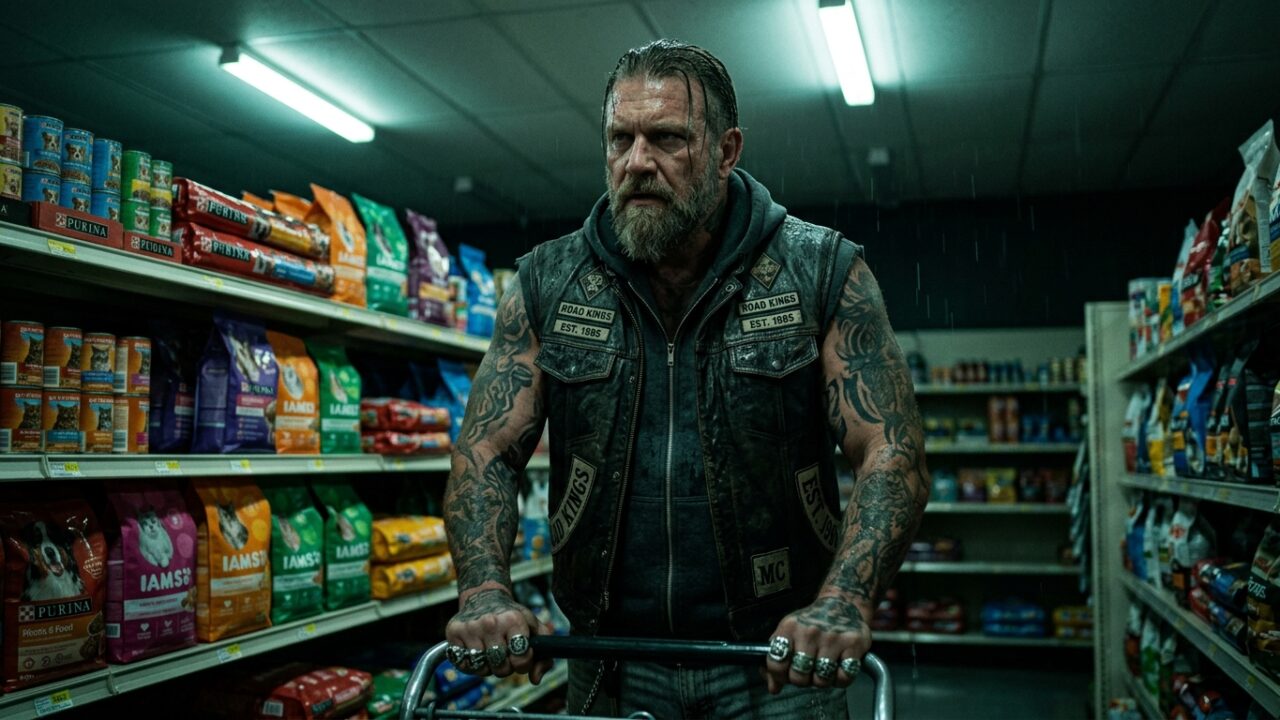
I tracked a 6-foot-4 biker through aisle 7 for twenty minutes—but when I noticed the “breathing lump” under his leather vest, I quietly locked the main doors and keyed my radio.

I’ve been a retail security officer for 14 years, but nothing prepared me for what was moving inside that biker’s leather vest.
It was a miserable Tuesday night in late November. The kind of night where the rain doesn’t just fall; it assaults the glass doors of the supermarket in heavy, freezing sheets. Most sane people were at home, curled up in front of their televisions with a warm cup of coffee. The store was practically a ghost town. Only a few late-night stragglers were wandering the aisles, their shopping carts squeaking against the polished linoleum floors.
I was up in the “crow’s nest,” a small, dimly lit security office perched above the customer service desk. The room constantly smelled of stale coffee and ozone from the wall of monitors. From up there, I had a God’s-eye view of the entire floor. Over the years, I’ve developed a sixth sense for trouble. You do this job long enough, and you stop seeing people as customers; you start seeing patterns. The nervous twitch, the darting eyes, the overly bulky coats worn indoors. I thought I had seen every trick in the book. I thought I knew exactly how every petty thief operated.
Then he walked in.
The automatic doors slid open, and the freezing wind howled through the vestibule, bringing him with it. He was massive. At least six-foot-four, with shoulders so broad he had to turn slightly sideways to get past the promotional display near the entrance. He was dripping wet. Rain ran in rivulets down a thick, graying beard that covered half his chest.
He wore heavy, mud-caked engineer boots that left dark, wet prints on the pristine floor. Dark denim jeans, faded white thermal shirt, and over it all, a heavy, black leather cut. The vest was worn, cracked with age, and adorned with the kind of patches you don’t buy at a mall kiosk. He looked rough. He looked like a man who solved problems with his hands, a man who lived outside the polite boundaries of normal society.
My eyes immediately locked onto him. Every alarm bell in my head started ringing. I leaned forward in my cheap office chair, the springs groaning in protest, and brought up camera four to track his movement.
Usually, when someone comes in looking like they just rode through a hurricane, they make a beeline for the cheap beer or the pharmacy aisle. But this guy was different. He didn’t look angry, and he didn’t look drunk. He looked… anxious.
His massive head swiveled left, then right. His eyes, shadowed beneath a heavy brow, darted toward the cash registers, then up toward the ceiling domes where our cameras were housed. He was looking for blind spots.
“Alright, big guy,” I muttered to myself, tapping my pen against the desk. “What are you hunting for?”
He started down Aisle 3—baking goods and spices. Not exactly a hotbed for high-value theft. But he didn’t look at the shelves. He kept his hands stuffed deep into the pockets of his jeans, his massive shoulders hunched inward. He was walking with a strange, unnatural stiffness, protecting his chest.
I switched to camera seven. He turned the corner, his boots squelching softly. He was moving toward the back of the store. Aisle 7. Pet supplies.
Now, pet food is a weird aisle for theft. Occasionally, you get someone trying to slip a small bottle of flea medication into their pocket, but mostly, it’s bulky items. You can’t exactly hide a twenty-pound bag of kibble under a shirt.
I watched him stop in front of the premium dog food section. He stood there for a long time, just staring at the cans. The brightly colored labels reflected in the harsh fluorescent lighting. His massive, calloused hand reached out, hovering over a can of expensive, high-protein puppy formula.
But he didn’t pick it up. Instead, he looked over his shoulder again. The aisle was completely empty. It was just him, the rows of dog food, and me, watching him from fifty feet above.
That’s when I saw it.
He unzipped the top few inches of his leather vest. He looked down at his chest, his rough, weathered face softening for just a fraction of a second. Then, lightning fast, his hand darted to the shelf. He grabbed two small, expensive cans of soft puppy food and shoved them deep inside the heavy leather of his jacket.
My heart rate spiked. This was it. A textbook concealment.
I reached for my radio, pressing the button on the side. “Davis,” I whispered into the mic. “I’ve got a male, mid-fifties, heavy build, biker attire. Just concealed merchandise in Aisle 7. I’m heading down. Meet me near the front registers. Do not engage until I am present.”
“Copy that, boss,” Davis’s voice crackled back through the earpiece. Davis was a good kid, but he was young. Twenty-two, fresh out of college, and a little too eager to prove himself. Against a guy this size, Davis would be swatted away like a fly. I couldn’t let this turn into a physical altercation on the sales floor.
I grabbed my keys, locked the office door behind me, and took the back stairs down to the warehouse area. I moved quickly but quietly, navigating the maze of cardboard bales and pallets of overstock until I reached the swinging doors that led back out onto the sales floor.
I stepped out, adjusting my tie, trying to look casual. I fell into step a few aisles over, pacing him. Through the gaps in the shelving, I could see his massive frame moving toward the front of the store. He was walking faster now. The deed was done, the adrenaline was pumping, and he wanted out.
He bypassed the cash registers completely. He didn’t even glance at the self-checkout. He was making a straight line for the sliding glass doors leading out into the freezing storm.
I picked up my pace, intercepting him just as he stepped onto the rubber mat that triggered the doors.
“Excuse me, sir,” I said, projecting my “command voice.” Firm, authoritative, but not aggressively hostile. Yet.
He stopped dead in his tracks. The automatic doors slid open with a soft whoosh, letting in a blast of icy wind that whipped at his leather vest. He didn’t turn around right away. I could see the muscles in his thick neck cord under the skin. He was calculating his options. Flight, or fight. With a guy this size, both were terrifying prospects.
“Can I help you?” he rumbled. His voice was incredibly deep, like rocks grinding together at the bottom of a well. He slowly turned to face me. Up close, he was even more intimidating. There was a faded scar running through his left eyebrow, and his knuckles were white with tension.
“I’m the security manager here, sir,” I said, keeping my hands resting loosely on my belt, nowhere near my cuffs, trying to keep the situation de-escalated. “I need you to step back inside for a moment.”
“I ain’t bought nothing,” he said, his eyes narrowing into cold slits. “Just leaving.”
“I know you haven’t bought anything,” I replied, holding his gaze. “But I need to ask you about the items you placed inside your jacket in Aisle 7.”
A heavy silence fell between us. The only sound was the howling wind outside and the faint, tinny pop music playing over the store’s speakers. Davis had moved up behind me, hovering nervously near the shopping carts, looking like a deer caught in the headlights of a semi-truck.
The biker took a half-step toward me. It was an intimidation tactic. I didn’t flinch, though my stomach was tying itself in knots.
“You’re making a mistake, man,” he growled, his voice dropping an octave.
“No mistake, sir. I watched you on camera. I need you to come to the office, or we can handle this right here. But you aren’t leaving until I see what’s in the jacket.”
He stared at me for a long, agonizing moment. I was bracing myself for a punch that would probably break my jaw. I shifted my weight, ready to hit my panic button.
But the punch never came.
Instead, a profound look of exhaustion washed over his face. The aggressive posture melted away, leaving him looking strangely defeated. He let out a long, heavy sigh that rattled in his chest.
“You don’t understand,” he whispered, the gravel in his voice cracking.
Before I could respond, the heavy leather of his vest shifted. It wasn’t the wind. The movement came from inside the jacket.
Right over his heart, the thick fabric bulged outward, pushing against the zipper. And then, I heard it. A tiny, muffled sound that made the blood freeze in my veins.
The sound was impossibly small. It was a fragile, high-pitched whimper that barely cut through the howling wind and the heavy rain hammering against the sliding glass doors behind us.
It didn’t sound like a threat. It sounded like something dying.
I froze. The adrenaline that had been surging through my veins just a second ago hit a brick wall. My right hand, which had been hovering nervously near the radio on my belt, slowly dropped to my side.
Davis, standing a few feet behind me, let out a sharp, confused breath. “Boss? What was that?”
The massive biker didn’t answer him. He didn’t even look at us. All of his attention, all of his focus, was directed downward at his own chest. The heavy, silver skull rings on his fingers caught the harsh, cold glare of the store’s overhead lights as he reached up.
His movements were painstakingly slow. For a man who looked like he could tear a telephone pole out of the ground, he grasped the heavy brass zipper of his leather vest with terrifying gentleness.
He pulled the zipper down about six inches. The worn leather parted.
“Look,” the biker whispered, his deep, gravelly voice cracking in a way that made my chest tighten. “I know how this looks. But you gotta understand. I didn’t have time.”
He reached a massive, grease-stained hand inside the dark cavern of his jacket. His thick fingers, scarred from years of riding and wrenching on heavy machinery, disappeared into the folds of his thermal shirt. When his hand emerged, he was cradling something against his chest.
At first, in the stark, unflattering light of the supermarket vestibule, I couldn’t comprehend what I was looking at. It was just a lump of shivering, wet darkness.
Then, the lump moved. A tiny, pathetic nose poked out from between the man’s massive thumbs.
It was a puppy.
But calling it a puppy felt like an insult to healthy dogs everywhere. This poor creature looked more like a drowned rat. It was entirely black, coated in a thick, foul-smelling mixture of mud, motor oil, and freezing rain.
It was so small it fit entirely within the palm of the biker’s hand. And it was starving.
Even from three feet away, I could see the brutal, heartbreaking topography of its ribcage protruding through its matted fur. Its stomach was completely sunken in. It was shivering so violently that it made the biker’s massive hand shake with it.
Its eyes were squeezed shut, glued together by some kind of infection or grime, and it let out another weak, raspy whimper, instinctively pressing its freezing little body against the radiating heat of the man’s chest.
“Jesus Christ,” Davis muttered from behind me, all of his nervous bravado instantly evaporating.
I stood there, completely stunned, staring at the tiny animal and then up into the face of the giant holding it.
The hardened, intimidating mask of the 1%er was completely gone. The deep lines on his face weren’t carved by anger; they were etched by profound exhaustion and a desperate, frantic kind of worry. The rainwater dripping from his graying beard mixed with something else. He was looking at me with eyes that were entirely bloodshot, pleading silently.
“I found him about twenty miles back, on Interstate 84,” the biker said, his voice trembling as he carefully tucked the puppy back against his thermal shirt to shield it from the icy draft coming through the doors. “Someone tossed him out. In a taped-up shoe box. In the fast lane.”
He swallowed hard, his Adam’s apple bobbing in his thick neck. “I saw the box get clipped by a semi. I pulled over. I almost got hit three times running out there to grab it. When I opened it… he was the only one still breathing.”
My stomach dropped into my shoes. I have seen a lot of terrible things in my fourteen years of retail security. I’ve seen desperation, I’ve seen addiction, I’ve seen malice. But the casual cruelty of throwing a litter of puppies onto a highway in a freezing rainstorm made a cold, hard rage ignite in the pit of my stomach.
“I tried to find a vet clinic,” the biker continued, the words spilling out of him rapidly now, like a dam breaking. “But it’s almost midnight. Everything out here is closed. My bike broke down in the lot across the street. The rain shorted out the electrical. He was freezing. He was going into shock. I didn’t know what else to do. He needs food right now, or he ain’t gonna make it through the hour.”
With his free hand, he reached into his deep jeans pocket and pulled out a battered, oil-stained leather wallet attached to a heavy steel chain. He flipped it open. It was completely empty. No cash, no cards. Just a faded photograph and a motorcycle registration.
“I’m flat broke, man,” he said, looking me dead in the eye. The shame in his voice was palpable, a heavy, crushing thing. “I blew my last twenty bucks on gas two towns over. I came in here because I saw the lights. I grabbed the cans because I figured I could deal with the cops later. But right now… right now this little guy just needs to eat.”
He looked down at his chest again. The puppy let out a faint sigh and seemed to go dangerously still.
“Please,” the giant man whispered to me, the ultimate surrender of his pride. “Arrest me. Call the cops. Do whatever you gotta do. I’ll sit in the back of the squad car all night. Just… let me feed him first. Please.”
Every protocol, every training manual, every rule I had ever enforced in this store vanished from my mind.
Technically, a crime had been committed. Concealment of merchandise with intent to deprive the store of its value. It was a black-and-white policy. You stop them, you detain them, you call law enforcement. Zero tolerance.
But as I stood there in the freezing draft, looking at a man society had labeled an outlaw risking his freedom for a dying, nameless animal, the lines between right and wrong shifted dramatically.
I looked at the cameras above us in the ceiling domes. The unblinking eyes of corporate policy recording everything.
I took a deep breath.
“Davis,” I said, my voice steady and quiet.
“Yeah, boss?”
“Go to Aisle 4. Get a stack of those cheap fleece blankets. The softest ones we have. Then go to the break room and turn the space heater on high.”
Davis didn’t hesitate. He didn’t ask questions. He spun on his heel and sprinted back into the store.
I turned back to the biker. I reached out and gently pushed his wallet back down his leg, signaling him to put it away.
“I don’t know what you’re talking about, sir,” I said, looking him in the eye. “I didn’t see anyone steal anything tonight.”
He blinked, visibly confused. The massive shoulders tensed slightly, unsure if this was a trick.
“My name is Marcus,” I said, extending my hand.
He hesitated for a fraction of a second before shifting the puppy slightly and taking my hand. His grip was like a vice, rough as sandpaper, but incredibly careful. “They call me Bear.”
“Well, Bear,” I said, gesturing toward the back of the store. “Our break room is a lot warmer than this vestibule. And it just so happens I bought two cans of premium puppy food on my lunch break that I accidentally left on the table in there. If you want to come back and help me clean up the mess, I’d appreciate it.”
A profound wave of relief washed over Bear’s face. The harsh, aggressive lines of his features completely softened. For a second, I thought the giant man might actually break down and cry. He gave a single, stiff nod, unable to force any more words past the lump in his throat.
“Right this way,” I said.
I led him away from the front doors, away from the prying eyes of the few remaining customers, and guided him toward the back warehouse doors. As we walked, the squeak of my rubber-soled shoes and the heavy thud of his muddy engineer boots echoed through the quiet store.
We passed through the heavy double doors into the employee-only area. It was a stark contrast to the bright sales floor. The lighting was dimmer, the concrete floors were scuffed, and the air smelled of cardboard and floor wax.
I keyed the code pad to the employee break room and pushed the door open.
Davis was already inside. He had pushed two folding tables together to create a makeshift examination table. He had laid out three thick, fleece blankets, creating a soft, warm nest right in front of a glowing orange space heater.
“Set him down here,” Davis said, his voice quiet and completely devoid of the usual bravado.
Bear walked over to the table. He stood there for a moment, looking at the clean, brightly colored blankets, then looked down at his filthy, oil-stained hands and the muddy puppy. He seemed terrified of ruining the clean space.
“It’s fine, Bear,” I assured him gently. “We can wash them. Put him down by the heat.”
Slowly, Bear unzipped his leather cut completely. He carefully extracted the tiny, shivering lump of fur and placed him onto the center of the fleece blankets.
Under the bright, unforgiving fluorescent lights of the break room, the puppy looked even worse. He was dangerously emaciated. His breathing was incredibly shallow, a rapid, weak fluttering in his chest. His paws were raw, and there was a deep, ugly scrape across his hind leg.
Bear immediately reached into his jacket pocket and pulled out the two small cans of puppy food he had taken. He set them on the table, his massive hands trembling slightly.
“He’s too weak to chew,” Bear muttered, staring down at the cans in frustration. “He couldn’t even lift his head in the truck. I don’t know how to get it into him.”
“Hold on,” I said. I jogged over to the break room cabinets. We didn’t have much, but I knew we kept some basic first-aid and random supplies. I ripped open a drawer and found what I was looking for: a small, plastic medicine syringe left over from when one of the cashiers had to give her child liquid Tylenol.
I ran to the sink, washed the syringe out with blazing hot water, and brought it back to the table.
“Open the can,” I told Bear.
He popped the pull-tab on the expensive meat paste. The rich smell filled the small room instantly. At the scent of the food, the tiny black puppy let out a pathetic, desperate whine, its nose twitching weakly, but it still didn’t have the strength to lift its heavy head.
“Mix it with a little warm water from the coffee maker,” I instructed Davis. “We need to make it a slurry.”
Working together, the three of us—a hardened biker, a middle-aged security guard, and a fresh-out-of-college kid—created a makeshift intensive care unit in the back of a grocery store.
Davis mixed the food into a warm, soupy paste in a paper coffee cup. I loaded the plastic syringe.
“You do it,” I said, handing the syringe to Bear. “He knows your scent. He trusts you.”
Bear took the tiny plastic tube between his massive, calloused fingers. He looked terrified. The man who had likely ridden through hell and back, who had survived God knows what on the road, looked completely paralyzed by the fear of hurting this fragile creature.
“Gently,” I coached him, leaning in close. “Just a drop on his tongue first to let him taste it. Don’t force it down his throat, or he’ll choke.”
Bear knelt beside the table, bringing his face level with the puppy. He reached out with his left hand, his thick fingers gently stroking the muddy fur on the puppy’s tiny head.
“Hey there, little fighter,” Bear whispered, his voice impossibly soft. “Time to eat. Come on now. You made it this far. Don’t quit on me now.”
He brought the tip of the syringe to the corner of the puppy’s mouth and slowly pushed the plunger, letting a single drop of the warm, meaty liquid fall onto the dog’s tongue.
For a terrifying three seconds, absolutely nothing happened. The puppy just lay there, eyes closed, breathing shallowly.
I held my breath. Davis was gripping the edge of the table so hard his knuckles were white.
Then, a tiny pink tongue flicked out.
It weakly licked the drop of food. Then, it licked again.
A small, frantic noise—a mix of a swallow and a whimper—came from the puppy’s throat. It tried to lift its head, its eyes still glued shut, blindly searching for the source of the food.
“That’s it,” Bear choked out, a sudden, wet sheen appearing in his bloodshot eyes. “That’s a good boy.”
Slowly, painstakingly, drop by drop, Bear fed the puppy. It took over twenty minutes to get a quarter of the slurry into the tiny dog’s stomach. We didn’t dare give him more, afraid his starving system would go into shock.
But that small amount of warm food, combined with the intense heat of the space heater, worked a small miracle.
The violent shivering finally stopped. The puppy’s breathing deepened, becoming slower and more rhythmic. With a heavy sigh, the tiny black lump curled into a tighter ball on the fleece blanket, burying its muddy nose under its own paws, and fell into a deep, exhausted sleep.
The silence in the break room was deafening, broken only by the humming of the vending machine in the corner.
Bear slowly stood up. He looked down at his hands, covered in a mix of dog food, engine grease, and mud. He walked over to the break room sink and turned on the tap, washing his hands in silence.
I pulled out one of the plastic chairs and sat down, the adrenaline finally leaving my system, leaving me feeling hollowed out and exhausted.
Bear dried his hands on a paper towel and walked back over to the table. He stood looking down at the sleeping puppy for a long time.
“I owe you,” Bear finally said, not looking away from the dog. “Both of you. If you had called the cops… animal control would have taken him. They would have thrown him in a cold cage at the pound. In this condition, he wouldn’t have made it to morning.”
“You don’t owe me anything,” I said quietly.
Bear turned to look at me. The harsh overhead light cast deep, tired shadows across his scarred face. “I’ve been on the road a long time, Marcus. People look at this jacket, they look at my face, and they make up their minds about who I am before I even open my mouth. They expect me to be a monster.”
He reached out and gently rested two massive fingers on the sleeping puppy’s back, feeling the steady rise and fall of its breathing.
“But out there on the highway tonight,” Bear continued, his voice barely a whisper, “the person who tossed a box of babies out the window of a moving car… they were probably driving a nice sedan. Probably wearing a suit. Probably on their way home to a warm house.”
He looked back up at me, his eyes burning with a quiet, intense sorrow.
“I’ve done a lot of bad things in my life,” Bear said. “But I couldn’t drive past that box. I just couldn’t.”
I nodded slowly. The heavy badge pinned to my chest felt strangely meaningless in that moment. The rulebook I had memorized over fourteen years felt entirely inadequate.
“So, what happens now?” Davis asked softly from the corner of the room.
Bear looked at the puppy, then toward the window at the back of the break room, where the rain was still violently lashing against the glass.
“My bike is dead,” Bear said, the harsh reality of his situation returning. “I have no money for a tow, no money for a room, and I can’t take him back out into that storm.”
He looked at me, pride completely stripped away. “I know I’m pushing my luck, man. You already saved my hide once tonight. But is there any way… is there anywhere I can just sit with him until the sun comes up? I’ll stay out of sight. I swear it.”
I looked at Bear. I looked at the fragile life he had saved at the risk of his own freedom. And I made a decision that could very well cost me my job.
I looked at Bear. I looked at the fragile life he had saved at the risk of his own freedom. And I made a decision that could very well cost me my job, my pension, and my reputation.
“Listen to me very carefully,” I said, my voice dropping to a low, serious register. The humming of the break room refrigerator suddenly seemed deafening in the silence. “Technically, by store policy, I am required to detain you, call the local authorities, and wait for a squad car. If my district manager found out what I am about to do, I wouldn’t just be fired. I’d be prosecuted for aiding and abetting.”
Bear didn’t blink. He just gave a slow, solemn nod. He understood the stakes. He was a man who lived outside the lines, but he understood the concept of a code.
“But,” I continued, taking a slow breath, “I’ve been in this business a long time. I’ve stopped hundreds of thieves. Teenagers stealing electronics, organized rings clearing out cosmetics, desperate people taking baby formula. I know the difference between malice and necessity.”
I turned to Davis. The young security guard was staring at me, his eyes wide. This wasn’t in any manual I had ever trained him on.
“Davis,” I said, keeping my tone perfectly even. “Did you see this man conceal any merchandise on the sales floor tonight?”
Davis looked at me, then looked at the massive biker, and finally down at the tiny, mud-caked puppy sleeping on the makeshift fleece bed. A slow, knowing smile crept onto the kid’s face.
“No, boss,” Davis said firmly, his voice completely clear of its usual nervous hesitation. “I didn’t see a thing. Must have been a glitch in the camera feed. Rain probably shorted out a wire.”
“Exactly,” I said. I turned back to Bear. “Follow me. And keep him quiet.”
I led Bear out of the brightly lit employee break room and deeper into the labyrinth of the supermarket’s back-end warehouse. The warehouse was a massive, cavernous space that smelled faintly of cardboard, bleach, and old produce. The lighting back here was motion-activated, so we walked in a pool of yellow illumination that followed us down the concrete aisles between towering steel racks of overstock.
“Where are we going?” Bear whispered, his heavy boots making a soft scuff-scuff sound against the polished cement. He held his leather jacket securely against his chest, cradling the sleeping puppy like it was made of spun glass.
“Camera blind spot,” I replied. “Corporate is cheap. They only installed surveillance over the high-shrink areas—electronics lock-up, the delivery bays, and the manager’s office. They never bothered wiring the old maintenance corridors.”
We navigated past a wall of crushed cardboard bales and a fleet of idle pallet jacks until we reached a heavy metal door painted a dull, industrial gray. A faded yellow sign read: ELECTRICAL / BOILER ROOM – AUTHORIZED PERSONNEL ONLY.
I pulled out my master ring of keys, found the heavy brass one, and unlocked the deadbolt. The door protested with a loud, metallic screech that made Bear flinch, his hand instinctively tightening over the bulge in his jacket to protect the dog’s ears.
I flipped the switch inside. A single, caged bulb flickered to life, casting long, stark shadows across the room. It wasn’t pretty. The room was narrow and cramped, dominated by a massive, humming industrial boiler and walls lined with heavy gray electrical panels. The air was thick and smelled of ozone and hot metal. But it was incredibly warm. It was at least eighty degrees in here, a stark contrast to the freezing, rain-swept world outside.
“It’s not the Ritz,” I said, stepping inside and clearing some old maintenance logs off a heavy wooden workbench in the corner. “But it’s out of sight. The night stocking crew never comes back here, and the heat from the boiler will keep both of you from freezing.”
Bear stepped into the small room. He looked around, taking in the humming pipes and the dusty floor. He didn’t complain. To a man who had been riding through a freezing storm on a dead motorcycle, this cramped, dusty utility room was a palace.
“It’s perfect,” Bear rumbled softly. He walked over to the workbench. I had grabbed the fleece blankets from the break room, and I quickly arranged them into a thick, soft nest on the scarred wood.
Bear unzipped his jacket with agonizing care. The puppy was still deep in an exhausted sleep, its tiny chest rising and falling in a fragile, shallow rhythm. Bear lowered the dog onto the blankets. The intense ambient heat of the boiler room seemed to wrap around the animal immediately. The puppy let out a long, shuddering sigh and stretched its hind legs out, burying its nose deeper into the fleece.
For the first time all night, Bear’s massive shoulders physically dropped. The crushing tension that had been radiating off him since he walked through the front doors finally seemed to break. He leaned heavily against the concrete wall, sliding down until he was sitting on an overturned plastic milk crate.
He rested his elbows on his knees and buried his face in his massive, scarred hands. He let out a breath that sounded like a tire losing air.
“Hey,” I said gently, leaning against the doorframe. “You did good. You got him out of the storm. He’s got food in his belly. He’s warm. The rest is just waiting.”
Bear looked up. In the harsh, yellow light of the caged bulb, he looked ten years older than when I first saw him on the surveillance monitor. The aggressive, intimidating aura of the 1%er biker was entirely gone. He just looked like a profoundly tired man.
“I don’t know why I did it, Marcus,” Bear said, his voice dropping to a gravelly whisper. He stared at the concrete floor, his heavy silver rings clinking faintly as he wrung his hands together. “I’m supposed to be at a chapter meeting two states over by tomorrow morning. I’m supposed to be handling business. I ain’t supposed to be playing nursemaid to a mutt I found on the shoulder of the interstate.”
I didn’t say anything. I just let him talk. Sometimes, people in high-stress situations just need a valve to release the pressure.
“I saw the box hit the guardrail,” Bear continued, his eyes unfocused, reliving the moment. “It was taped shut with duct tape. Heavy duty stuff. Whoever threw it wanted to make sure whatever was inside didn’t get out. I pulled the bike over. The rain was coming down so hard it felt like buckshot hitting my helmet. I walked back down the shoulder. Cars were flying past at eighty miles an hour, throwing sheets of dirty water over me.”
He paused, swallowing hard. “I found the box. It was crushed on one side. I pulled out my knife and cut the tape. There were four of them in there.”
My stomach tightened. I had assumed as much, but hearing it confirmed made the rage flare up again.
“Three of them were already gone,” Bear said, his voice cracking violently. He closed his eyes, squeezing them tight as if trying to block out the memory. “The impact, or the cold… I don’t know. But they were gone. And then, at the very bottom of the pile, I saw a tiny patch of black fur twitch. He was buried under his brothers and sisters, trying to find warmth.”
Bear looked up at me, his eyes shining with unshed tears. “I reached in and pulled him out. He was so cold, Marcus. It was like holding a piece of ice. He let out this tiny squeak… it didn’t even sound like a dog. It sounded like a bird with a broken wing. And right then, in the middle of that storm, with semi-trucks trying to blow me off the highway, I knew I wasn’t going to let him die.”
He looked over at the workbench, where the tiny black lump was sleeping peacefully in the bright fleece.
“I grew up in the foster system,” Bear said quietly, out of nowhere. “Bounced around from house to house in South Philly. Most of those places… they didn’t want a kid. They wanted the state check. I spent a lot of nights sleeping in cold garages, locked out because I ate too much or talked too loud. I know what it feels like to be thrown away. I know what it feels like to be freezing in the dark, wondering if anyone is going to come looking for you.”
He reached out and gently laid a single, massive finger on the puppy’s back. “Nobody came for me. But I came for him.”
The profound silence of the boiler room stretched between us, filled only by the rhythmic, mechanical thumping of the machinery. I looked at the biker, with his faded tattoos and rough exterior, and realized I was looking at one of the best men I had met in a very long time.
“He’s going to make it, Bear,” I said softly. “You got to him in time.”
For the next two hours, the warehouse was dead quiet. Davis held down the front desk, monitoring the cameras, while I spent most of my time standing watch outside the heavy metal door of the boiler room, occasionally stepping in to check on them.
Around 3:00 AM, the puppy woke up.
It wasn’t a sudden awakening. He just started to squirm in the blankets, letting out a series of high-pitched, reedy whines. Bear was instantly on his feet, hovering over the workbench like an anxious giant.
“What’s wrong with him?” Bear asked, panic immediately edging into his voice. “Is he too hot? Is he choking?”
I stepped into the room and peered closely at the dog. The puppy was blindly dragging himself across the fleece, his nose sniffing frantically at the air.
“He’s not choking,” I smiled, feeling a massive wave of relief. “He’s looking for seconds.”
I grabbed the remaining half-can of puppy food we had brought from the break room. We mixed up another slurry with some warm water from my thermos. This time, we didn’t even need the plastic syringe. Bear put a small dollop of the meat paste on the tip of his finger, and the puppy practically attacked it.
He ate with a frantic, desperate energy, his tiny pink tongue working furiously. It was messy. Within minutes, Bear’s fingers were coated in dog food, and the puppy’s snout was completely covered in a sticky brown mask.
Bear was laughing. It was a deep, rumbling sound that seemed to start in his chest and echo off the concrete walls. “Slow down, little man! You’re gonna make yourself sick. Slow down.”
Watching this massive, intimidating outlaw gently wiping puppy food off a tiny dog’s nose with a paper towel was one of the most surreal and heartwarming things I had ever witnessed.
By 3:30 AM, the puppy had eaten another quarter of the can, urinated on a newspaper I had laid out (which we considered a massive victory for his internal organs), and fallen back into a deep, contented sleep. Bear sat back on the milk crate, looking exhausted but victorious.
“We’re in the clear,” I said, checking my watch. “My shift ends at 6:00 AM. The storm is supposed to break around 5:00. Once the sun comes up, I’ll pull my truck around to the back loading dock. We can load you and the pup up, and I’ll drive you to an emergency vet clinic a few towns over. My treat.”
Bear looked at me, completely overwhelmed. “Marcus… I…”
“Don’t worry about it,” I interrupted, holding up a hand. “Consider it a professional courtesy.”
Everything felt perfectly handled. The crisis was averted. The secret was safe. I felt a profound sense of pride in how Davis and I had managed the situation. We had done the right thing, even if it meant breaking the rules.
But in my fourteen years of retail security, I should have known better. I should have known that the moment you let your guard down, the moment you think you have everything under control, is exactly when the floor falls out from under you.
It happened at 4:15 AM.
I was standing in the main warehouse aisle, leaning against a pallet of paper towels, sipping cold coffee from my thermos. Bear and the puppy were secured in the boiler room.
Suddenly, the heavy metal swinging doors that led from the warehouse to the front sales floor burst open.
Davis came sprinting through. His face was entirely drained of color. He looked like he had just seen a ghost. He skidded to a halt in front of me, gasping for air, his eyes wide with absolute terror.
“Boss,” Davis hissed, his voice trembling so violently he could barely get the words out. “Boss, you need to hide them. Now.”
I instantly dropped my thermos. It hit the concrete floor, shattering the plastic lid and sending cold coffee pooling around our shoes. “What’s wrong? Did the cops show up for the bike?”
“Worse,” Davis choked out, pointing frantically back toward the sales floor. “It’s Pritchard.”
My blood turned to ice.
David Pritchard was the Regional District Manager. He was a ruthless, ambitious corporate shark known for his zero-tolerance policies and his habit of firing store managers on a whim. He was notoriously paranoid about internal theft, and his favorite tactic was performing unannounced, middle-of-the-night audits on 24-hour stores.
“Are you sure?” I demanded, my mind racing. “Why the hell would he be here at four in the morning during a severe storm warning?”
“I saw his black Mercedes pull into the fire lane,” Davis said, panic escalating. “He’s already inside. He’s walking the perimeter. He asked where you were. I told him you were doing a routine warehouse patrol. He said he’s coming back here to ‘inspect the receiving bays’.”
The receiving bays.
To get to the receiving bays, Pritchard would have to walk directly past the old electrical boiler room.
“Listen to me,” I said, grabbing Davis by the shoulders to stop him from hyperventilating. “Go back out there. Intercept him in Aisle 10. Tell him you found a water leak from the roof near the pharmacy. Keep him occupied for exactly three minutes. Go!”
Davis nodded frantically and sprinted back through the swinging doors.
I spun around and sprinted for the back corridor. My heart was hammering against my ribs like a trapped bird. If Pritchard found a non-employee in the back warehouse—let alone a heavily tattooed biker harboring a stolen, unregistered animal—he wouldn’t just fire me. He would press criminal trespassing and theft charges against Bear, and he would have the puppy thrown into a county kill shelter before breakfast.
I reached the boiler room and yanked the heavy metal door open.
Bear jumped to his feet, sensing the immediate shift in the atmosphere. “What is it? What’s wrong?”
“Corporate inspection. The district manager is here,” I said, keeping my voice to a frantic whisper. “He’s coming back here right now.”
Bear’s eyes widened. He immediately reached for his heavy leather jacket. “I’ll make a run for it. Out the back emergency exit. If the alarm goes off, tell him I broke in.”
“You can’t,” I snapped, grabbing his arm. “The back emergency doors are on a delayed 15-second magnetic lock. If you hit that bar, the alarm will scream, and the police are automatically dispatched. There’s no time.”
“Then where do I go?” Bear asked, looking around the tiny, cramped room. There were no closets, no drop ceilings, no places for a six-foot-four giant to hide.
I stepped fully into the room, my eyes frantically scanning the walls. My gaze landed on the massive, humming industrial boiler. Behind the boiler, wedged between the scalding hot metal casing and the concrete wall, was a narrow maintenance gap. It was incredibly tight, maybe eighteen inches wide, shrouded in dark, heavy shadows.
“There,” I pointed. “Behind the boiler. Squeeze in there and do not move. Do not breathe loudly. I’m going to lock this door from the outside and stand guard.”
Bear didn’t hesitate. He grabbed the puppy, wrapping the tiny dog securely inside the thick fleece blanket, and tucked him tight against his chest. He turned sideways and began to wedge his massive frame into the narrow gap behind the burning hot machinery.
“It’s hot back here, Marcus,” Bear hissed, wincing as his shoulder brushed against the metal casing.
“I know. Just endure it. Keep the dog quiet. If he makes a single sound, we are all going to jail.”
I grabbed the empty dog food cans, the paper towels, and the plastic syringe, shoving them deep into my own pockets to hide the evidence. I took one last look at Bear. He was entirely swallowed by the shadows behind the boiler, completely invisible.
“Quiet,” I mouthed.
I stepped out of the room, pulled the heavy metal door shut, and slid my brass key into the deadbolt. Click.
I took three steps away from the door, pulled a small clipboard out from under my arm, and began intensely examining a stack of broken pallets, trying to look like a man deeply engrossed in a routine inventory check.
Ten seconds later, the sharp, authoritative clack-clack-clack of expensive leather dress shoes echoed down the concrete corridor.
I turned around, adopting my best look of mild surprise.
David Pritchard stepped into the yellow pool of warehouse lighting. He was a tall, unnervingly thin man in a perfectly tailored charcoal suit that looked completely out of place in a dusty grocery warehouse. His hair was slicked back, and his cold, calculating eyes immediately locked onto me.
“Marcus,” Pritchard said smoothly, his voice devoid of any warmth. “Working hard, I see.”
“Mr. Pritchard,” I said, giving a polite nod. “I wasn’t expecting you tonight. The roads are terrible.”
“Theft doesn’t take a snow day, Marcus,” Pritchard replied, stepping closer, his eyes constantly scanning the shadows. “And neither do I. We’ve had a spike in shrink across the district. I’m doing random perimeter checks.”
He walked right past me, stopping directly in front of the heavy gray door of the boiler room.
My heart completely stopped. I stopped breathing.
Pritchard reached out and placed his hand flat against the cold metal of the door. He stood there for a second, looking at the faded yellow AUTHORIZED PERSONNEL ONLY sign.
“I noticed something strange on the front camera feeds when I logged into the remote server an hour ago,” Pritchard said quietly, his back still turned to me.
“Is that so?” I managed to say, praying my voice didn’t shake.
“Yes,” Pritchard said, slowly turning his head to look at me over his shoulder. His eyes were like chips of dirty ice. “I saw a very large man in a leather vest enter the store. I saw him walk to the pet food aisle. But strangely, I never saw him leave.”
The silence in the warehouse became deafening.
“And yet,” Pritchard continued, taking a step toward me, “when I walked the sales floor just now, he was nowhere to be found. The front doors have been locked since midnight. He didn’t exit. So, tell me, Marcus…”
Pritchard reached out and grabbed the heavy brass handle of the boiler room door.
“…where exactly is he?”
Pritchard’s hand gripped the heavy brass handle of the boiler room door.
Time seemed to completely stop. The rhythmic, mechanical thudding of the industrial boiler inside the room felt like it was syncing up with my own hammering heartbeat. The harsh fluorescent lights of the warehouse buzzed above us, casting long, warped shadows across the concrete floor.
“Mr. Pritchard,” I said, stepping forward, my voice a desperate, tight wire. “There’s a high-voltage issue in there. Maintenance explicitly told us to keep it locked until the morning crew arrives. It’s a liability.”
It was a weak lie, and we both knew it.
Pritchard didn’t even look at me. His eyes, cold and flat like dirty ice, remained fixed on the faded yellow warning sign on the door. A smug, predatory smile crept across his thin lips. He lived for this. He lived for the moment he caught an employee in a lie. It was a power trip, pure and simple.
“A liability, Marcus?” Pritchard murmured smoothly. “Or a cover-up?”
He turned the handle.
The deadbolt, which I had just locked, was still engaged. The handle refused to budge.
Pritchard rattled it once, violently. Then he turned his head slowly to look at me, extending an open, expectant palm.
“The master key, Marcus. Now.”
My mind raced through a dozen different catastrophic scenarios. If I refused, I was fired on the spot for insubordination, and he would just call the police to break the door down anyway. If I gave him the key, he would find Bear—a massive, intimidating biker with a criminal aesthetic—hiding in the dark with stolen merchandise and an unauthorized animal.
Either way, the fragile sanctuary we had built for that dying puppy was about to be violently torn apart.
With a hand that was visibly shaking, I unclipped the heavy ring of brass keys from my belt. The metal jingled loudly in the quiet warehouse. I placed the master key into Pritchard’s pristine, manicured hand.
Pritchard didn’t hesitate. He slid the key into the lock.
Click.
The sound echoed through the cavernous space like a gunshot. Pritchard pushed the heavy gray door open.
Immediately, a wave of sweltering, ninety-degree heat rolled out into the cool warehouse air, carrying the smell of hot metal, ozone, and wet dog.
Pritchard stepped into the doorway, his custom leather dress shoes clicking sharply on the dusty floor. He didn’t walk all the way in. He stood on the threshold, his eyes scanning the cramped, dimly lit space.
From my angle behind him, I could see exactly what he saw.
He saw the overturned milk crate. He saw the brightly colored fleece blankets spread out on the scarred wooden workbench. He saw the empty, pull-tab cans of premium puppy food, the crumpled paper towels stained with brown slurry, and the plastic medicine syringe.
The evidence of our makeshift veterinary clinic was impossible to deny.
Pritchard let out a slow, cynical laugh. It was a dry, hollow sound.
“Well, well, well,” Pritchard said, his voice dripping with venomous satisfaction. “A little homeless shelter, built right here on company property. Tell me, Marcus, do you charge them rent, or is this just a charitable tax write-off you run during your shift?”
He took another step inside, his eyes narrowing as he peered into the deep, heavy shadows behind the massive industrial boiler.
“I know you’re in here,” Pritchard barked, his ‘command voice’ echoing off the concrete walls. “Come out right now with your hands where I can see them, or I am having the police drag you out in handcuffs.”
For three agonizing seconds, there was absolute silence, save for the hum of the machinery.
Then, the shadows behind the boiler moved.
Bear didn’t sneak out. He didn’t cower. He stepped out into the harsh, yellow light of the caged bulb with the slow, deliberate momentum of a freight train.
He had to duck slightly to clear the overhanging pipes. Covered in sweat, soot, and road grime, his massive six-foot-four frame seemed to swallow all the oxygen in the tiny room. His heavy leather cut hung open, revealing the thick, muscular expanse of his chest. His scarred face was set in a mask of absolute, unyielding stone.
Tucked safely against his ribs, wrapped securely in a clean fold of the fleece blanket, was the tiny black puppy.
The sheer, overwhelming physical presence of the man caught Pritchard completely off guard. The arrogant corporate shark physically flinched, stumbling backward a half-step until his shoulder hit the doorframe. The color drained from Pritchard’s face, his eyes widening in primal, instinctual fear.
But Pritchard was a man built on ego, and his fear quickly mutated into furious, self-righteous anger.
“You,” Pritchard spat, pointing a trembling finger at Bear. “You’re the vagrant from the camera feed. You’ve been hiding in my store. Stealing my merchandise.”
He spun around to face me, his face turning a mottled, furious red. “You are completely out of your mind, Marcus! You are harboring a dangerous criminal! You’re fired. Hand over your badge. You are done in this industry. I’ll make sure you never work security again.”
“He didn’t do anything wrong,” Bear’s voice rumbled, so deep it vibrated in the floorboards. It wasn’t a threat; it was a simple statement of fact.
Pritchard whipped his head back toward Bear. “Shut your mouth, you piece of trash! You are going to a federal penitentiary.”
Bear didn’t even blink. He looked at Pritchard the way a lion might look at a yapping chihuahua. He slowly raised his massive, grease-stained hand, gently cupping the back of the puppy’s head to protect its ears from Pritchard’s screaming.
“The dog was dying,” Bear said quietly, holding Pritchard’s furious gaze. “Someone threw him on the interstate. He was freezing to death. We brought him in here to warm him up. The food costs four dollars. I’ll mail you a check tomorrow.”
“You’ll mail me a check from a jail cell!” Pritchard screamed, completely losing his composure. He reached into his tailored suit jacket and pulled out his sleek smartphone. His fingers stabbed frantically at the screen.
“Mr. Pritchard, stop,” I pleaded, stepping forward, abandoning all pretense. “Please. Look at the animal. He won’t survive a trip to the city pound right now. Just let him walk out the back door. Call the police on me. I don’t care. Let the dog go.”
“I don’t give a damn about a stray mutt!” Pritchard snarled, pressing the phone to his ear. “Yes, 911? I am the regional manager at the Super-Mart on Highway 9. I need immediate police assistance. I have a hostile, violent trespasser who has barricaded himself in the back warehouse, and a rogue employee who is aiding him. Yes, he is massive. He looks armed.”
My heart plummeted into my stomach. He looks armed.
That phrase changed everything. In America, telling a 911 dispatcher that a six-foot-four biker covered in tattoos “looks armed” guarantees a massive, aggressive police response. They wouldn’t send a community patrol car; they would send officers ready for a shootout.
“You lying coward,” I hissed at Pritchard.
Pritchard just smiled, a cruel, triumphant smirk. “Ten minutes, Marcus. The police are ten minutes away. I suggest you both get comfortable.”
He stepped out of the boiler room and pulled the heavy metal door shut, standing squarely in front of it to block our exit.
Inside the sweltering room, the air grew incredibly heavy. I looked at Bear. I expected him to be frantic. I expected him to look for a weapon, or try to bust down the door.
Instead, Bear just let out a long, exhausted sigh. He walked slowly back to the overturned milk crate and sat down. He carefully unwrapped the top layer of the fleece blanket. The tiny puppy, warmed by Bear’s body heat and the boiler, was sleeping deeply, its tiny chest rising and falling in a steady, healthy rhythm.
Bear looked down at the dog, a profound sadness swimming in his bloodshot eyes.
“I’m sorry, Marcus,” Bear whispered, gently stroking the pup’s ears with a single, massive finger. “I dragged you down with me. You threw away a fourteen-year career for a guy you met two hours ago.”
“I didn’t throw it away,” I said, leaning back against the hot concrete wall, running a hand over my tired face. “I spent fourteen years protecting corporate profits. Tonight, I actually protected something that mattered. I don’t regret it.”
We sat in silence for what felt like an eternity. The heat of the boiler room was suffocating. Outside the heavy door, we could hear the faint, muffled sound of Pritchard pacing the concrete floor, probably rehearsing his statement for the police.
Then, it started.
First, the faint wail of a siren in the distance, cutting through the howling wind of the dying storm. Then another. And another.
Red and blue lights began to pulse frantically through the high, frosted windows of the warehouse, painting the walls in frantic, strobing colors. We could hear the heavy thud of car doors slamming in the loading dock outside.
“They’re here,” Bear said quietly. He didn’t stand up. He just pulled the puppy a little tighter against his chest. “Let me do the talking, Marcus. Tell them I threatened you. Tell them I forced you to open the door.”
“I’m not doing that,” I said firmly.
The heavy metal door swung open violently.
Pritchard stood in the doorway, practically glowing with smug victory. Behind him stood three police officers. Two were young, their hands resting nervously on their holstered weapons, their eyes wide as they took in the dimly lit warehouse.
The third officer was a massive, broad-shouldered veteran with silver hair and a heavy, waterproof tactical jacket. His name tag read: SGT. MILLER.
“There he is, officers!” Pritchard shouted, pointing a dramatic finger at Bear, who was still sitting calmly on the milk crate. “That is the man! He broke in, he stole merchandise, and he threatened my life! Arrest him!”
Sergeant Miller stepped into the doorway. His hand rested casually on his utility belt. His sharp, highly trained eyes swept the room. He took in the makeshift bed, the empty dog food cans, me standing against the wall, and finally, the massive biker sitting in the corner.
Miller’s eyes locked onto Bear.
The tense, aggressive posture of the veteran police officer instantly vanished. The hard lines of his face dissolved into an expression of utter, profound confusion. He took his hand off his belt and let out a long, incredulous breath.
“Arthur?” Sergeant Miller said, his voice echoing loudly in the small room. “What in God’s name are you doing sitting behind a boiler in a grocery store?”
Pritchard froze. The smug smile slid off his face like wet mud. He looked from the police sergeant to the biker, completely bewildered.
Bear looked up from the milk crate. A slow, tired smile touched the corners of his mouth.
“Hey, Jim,” Bear rumbled casually, like he was bumping into an old friend at a coffee shop. “Rough night out there.”
“Rough night?” Sergeant Miller practically barked, stepping fully into the room and pulling off his rain-soaked cap. “Your wife has been calling the precinct in a panic for three hours! We found your chopped Harley abandoned on the shoulder of Route 84. We thought you got hit by a semi, you stubborn old mule!”
“Bike drowned out in the flash flood,” Bear explained calmly. “Electrical system is fried. Couldn’t get a signal on my phone.”
“Excuse me!” Pritchard shrieked, his voice cracking with panic and outrage. “What is going on here? Do you know this criminal?”
Sergeant Miller turned to face the district manager. The look of friendly exasperation on the cop’s face vanished, replaced by a cold, hardened glare that could cut glass.
“Criminal?” Miller repeated, his voice dangerously low. “Mr. Pritchard, is it?”
“Yes! I am the regional manager—”
“I don’t care if you’re the Pope,” Miller interrupted, stepping into Pritchard’s personal space, forcing the thin man to back up. “Do you have any idea who you are pointing your finger at?”
Pritchard stammered, his eyes darting frantically. “He… he’s a vagrant! A biker gang member!”
Miller let out a harsh, barking laugh that held zero humor.
“This ‘vagrant’,” Miller said, gesturing toward Bear, “is Arthur Pendleton. He owns three of the largest commercial auto-repair garages in the tri-state area. And that ‘biker gang’ you’re talking about is the Iron Brotherhood. Last month, their chapter raised fifty thousand dollars for the Police Athletic League. And when they aren’t fixing cars or raising money for kids, they run the largest, privately-funded, no-kill animal rescue sanctuary in the county.”
The silence that followed was absolute.
I stared at Bear. The massive, intimidating outlaw with the scarred face and the heavy silver rings suddenly looked very different. The rough exterior wasn’t the mark of a criminal; it was the armor of a man who spent his life pulling broken things out of the wreckage—whether those things were cars, or people, or tiny, dying animals.
Pritchard’s mouth opened and closed like a dying fish. His entire worldview, his entire rigid corporate reality, was crumbling around him.
“But… but he stole!” Pritchard finally sputtered, clinging desperately to his rulebook. “He concealed merchandise! He took dog food! It’s on camera!”
“I spent my last fifty bucks on gas three towns back,” Bear interjected quietly, finally standing up. He looked down at the tiny, black puppy sleeping peacefully in his arms. “I saw a litter of puppies thrown out of a moving car on the interstate. This little guy was the only one left breathing. He was going into shock. I didn’t have time to find an ATM, Jim.”
Sergeant Miller looked at the puppy. The hardened cop’s face softened entirely. He reached out and gently stroked the puppy’s head.
“You pulled him off the highway?” Miller asked softly.
“Yeah,” Bear nodded. “He was freezing. Marcus here,” Bear gestured to me, “he risked his job to help me get him warm and get some food in him. We were just waiting for the storm to break so we could get him to my chapter’s veterinary clinic.”
Miller turned slowly back to Pritchard. The look of absolute disgust on the sergeant’s face was a beautiful thing to witness.
Miller reached into his own uniform pocket, pulled out his leather wallet, and extracted a crisp five-dollar bill. He stepped forward and slapped the bill hard against Pritchard’s expensive suit chest.
“There’s your four dollars for the dog food, Pritchard,” Miller growled, his voice vibrating with barely contained anger. “Keep the change. If you ever call my precinct again and tell my dispatchers that a civilian is ‘armed and hostile’ just because you don’t like how they look, I will personally arrest you for filing a false police report and misuse of the 911 emergency system. Do we understand each other?”
Pritchard, pale and visibly trembling, didn’t say a word. He just clutched the five-dollar bill, gave a jerky, terrified nod, and practically sprinted away down the warehouse corridor, disappearing into the shadows.
The two younger officers behind Miller were visibly grinning.
Miller turned back to me. “You’re Marcus?”
“Yes, sir,” I said, standing up straight.
“Good work tonight, son,” Miller said, offering me a firm handshake. “Takes guts to do the right thing when the wrong thing is easier.”
He turned back to Bear. “Come on, Arthur. I’ve got my squad SUV out back. It’s got heavy-duty heaters. I’ll give you and the little guy a police escort straight to your vet clinic. Then you can call your poor wife.”
Bear smiled, a genuine, warm expression that completely transformed his face. “Thanks, Jim.”
Bear turned to me before he walked out. He shifted the puppy slightly, reaching out his massive right hand.
“You ever get tired of working for guys like Pritchard, Marcus,” Bear said, gripping my hand with crushing, sincere strength, “you come see me. The Iron Brotherhood is always looking for guys who know how to stand their ground.”
“I might just take you up on that, Bear,” I smiled, feeling a profound weight lift off my shoulders.
I watched them walk out of the warehouse. The giant, heavily tattooed biker, flanked by three police officers, carrying a tiny, mud-caked puppy wrapped in pink fleece.
Six months later, I walked through the massive steel gates of the Iron Brotherhood Sanctuary.
I wasn’t wearing a cheap polyester security uniform anymore. I was wearing a comfortable polo shirt with the sanctuary’s logo stitched over the heart. When I quit the supermarket the very next morning—leaving Pritchard my badge and a highly explicit letter of resignation on his desk—Bear had kept his word. He hired me as the head of logistics and security for his entire rescue operation.
As I walked across the sunlit gravel courtyard, a massive, thunderous bark echoed from the main garage.
Bounding toward me, kicking up dust and moving with incredible, clumsy speed, was a dog.
He wasn’t a tiny, shivering lump of mud anymore. He was an absolute unit of a dog—a sprawling, sixty-pound mix of Mastiff and Labrador retriever, with a coat as black and shiny as fresh motor oil.
He hit me like a furry torpedo, nearly knocking me off my feet, his massive tail wagging so hard his entire back half shook. He licked my face relentlessly.
“Down, Midnight! Give the man some space!”
Bear walked out of the garage, wiping grease off his hands with a rag. He looked exactly the same—imposing, rough around the edges, and intimidating to anyone who didn’t know him. But when he looked at the massive black dog, his eyes completely softened.
“He still remembers you, Marcus,” Bear laughed, tossing the rag aside and crouching down to vigorously rub Midnight behind the ears.
“I’d hope so,” I smiled, scratching the dog’s chest. “I bought his first meal.”
I looked at Midnight, healthy, strong, and wildly loved. Then I looked at Bear, the outlaw who saved him. I thought back to that freezing, miserable night in the supermarket, the terror, the risk, and the profound, unexpected humanity I found hiding behind a leather vest.
Sometimes, you don’t know who the real heroes are until the storm hits. And sometimes, the toughest men carry the most fragile things.

About the Author
giấc mơ04
A writer passionate about human stories and real-life experiences that inspire and move readers.
 Dog Story
53 min read
Dog Story
53 min read
The Iron Gauntlet: They Thought They Cornered a Broken Homeless Veteran in a Dead-End Alley But the Moment He Looked Up, Every Laugh Died
The first thing they did was laugh. Not talk. Not threaten. Not even spit out the usual alleyway garbage men…
 Dog Story
12 min read
Dog Story
12 min read
“My Husband’s Chair Sat Empty For 3 Years… But What I Brought Home From The Shelter That Tuesday Saved My Life.”
I was 74, living alone in a house that had grown far too quiet, waiting for the days to simply…
 Dog Story
45 min read
Dog Story
45 min read
I watched the 7-year-old boy scream daily at the Oak Street bus stop—until I noticed his “random” shrieks perfectly mirrored the fresh skid marks, prompting me to quietly lift my phone and hit record.
I’ve been a high school counselor for twenty-eight years, dealing with every kind of childhood crisis, behavioral issue, and silent…
Leave a Reply