
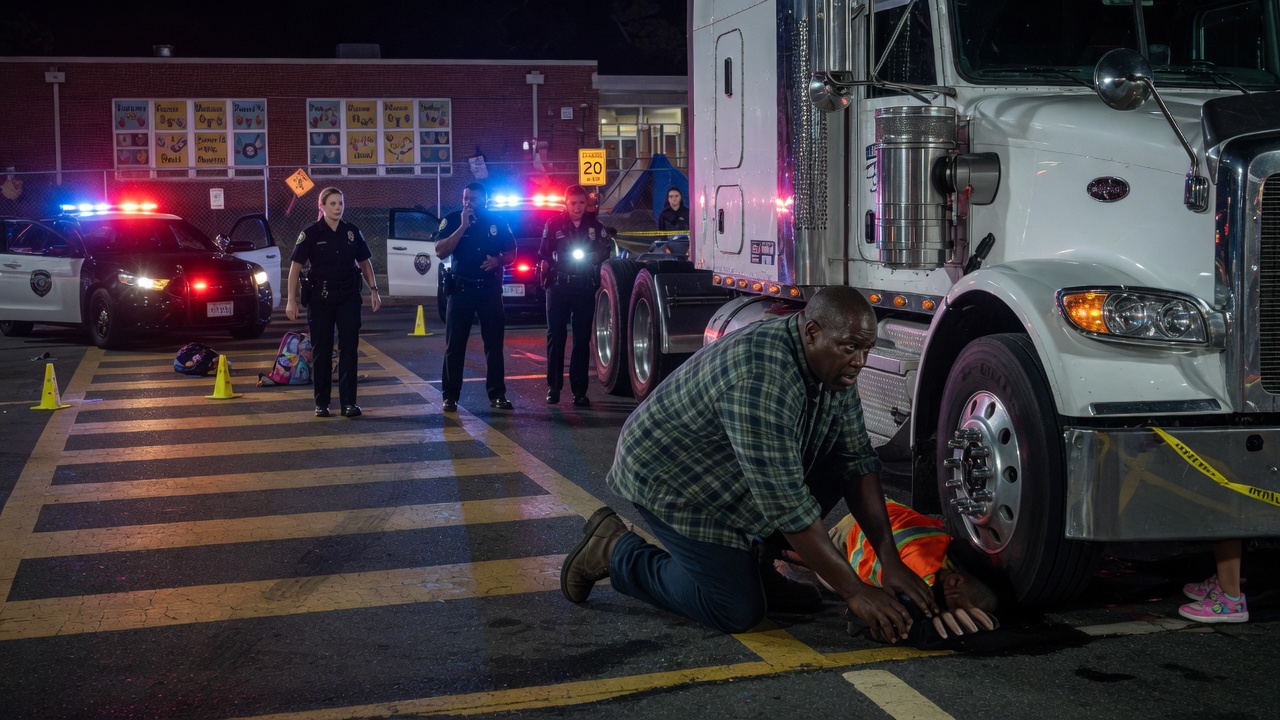
I’ve driven an 18-wheeler for 22 years, but when 6 squad cars boxed me in outside the elementary school—I heard the “wet gasping” near my tires and slowly dropped to my knees.

I’ve logged over two million miles behind the wheel of a big rig, but absolutely nothing in those 22 years prepared me for the sickening thud that echoed under my tires on a quiet Tuesday morning.
My name is Marcus. For over two decades, my life has been measured in white highway lines, the smell of diesel exhaust, and cold cups of gas station coffee. Driving a machine that weighs 80,000 pounds fully loaded changes the way you look at the world. You learn to anticipate danger before it happens. You know that you can’t stop on a dime. You command a rolling freight train, and you respect the devastating power of it every single second you hold that steering wheel.
It was just past 11:15 AM. A massive, multi-vehicle pileup on Interstate 95 had forced all heavy commercial traffic to detour through a sleepy, picturesque town called Oakhaven.
It was the kind of town where nothing bad ever happens. The streets were lined with massive oak trees shedding their bright orange autumn leaves, and the sidewalks were spotless.
I was exhausted. I was on the final leg of a grueling four-day haul, fighting the heavy weight of my eyelids. All I wanted was to deliver my freight and get home.
As I rolled down Elm Street, I saw the flashing yellow lights ahead.
‘School Zone. Speed Limit 15.’
I downshifted, letting the engine brake roar quietly as my speed dropped to a crawl. The local elementary school sat just off the main road. I could see the playground equipment through the chain-link fence. The recess bell hadn’t rung yet, but the eerie quiet of the empty playground always put me on edge when I drove through these areas. Kids are unpredictable. They don’t understand that a semi-truck has blind spots big enough to hide a house.
I kept my eyes scanning left, right, left again.
I was barely doing ten miles an hour.
Then, it happened.
It was just a flash. A matted, dirty brown blur darted out from behind a thick row of decorative hedges completely obscuring my right-side view. It didn’t look before crossing. It just shot directly into the road, straight into my lane.
My heavy work boot slammed the brake pedal to the floor.
The violent hiss of compressed air exploded into the quiet morning. The entire cab shuddered violently as the massive tires locked up, screeching and burning rubber into the pristine suburban asphalt.
But physics is a cruel master. Even at ten miles an hour, 80,000 pounds carries terrifying momentum.
I felt the dull, heavy impact.
It wasn’t a loud crash. It was a soft, sickening thud against the heavy steel of my front bumper, followed by a terrible scraping sound that made my stomach drop into my boots.
My truck finally lurched to a violent halt, sitting diagonally across the painted lines of the school crosswalk.
For three agonizing seconds, there was dead silence in the cab. The only sound was the deep, rumbling idle of my diesel engine.
I couldn’t breathe. My hands were gripping the steering wheel so hard my knuckles were pure white.
Oh God.
The thought hit me like a physical blow to the chest. Was it a kid?
Panic, cold and sharp, flooded my veins. I threw the parking valves out with a loud POP, practically kicking my door open. I didn’t even use the steps. I leaped from the high cab, my boots hitting the pavement hard, and sprinted to the front of the grill.
I dropped to my knees, dreading what I was about to find.
There, lying in a terrifyingly still heap just inches from my massive right front tire, was a dog.
It was a scruffy, overgrown Golden Retriever mix. It was filthy, its ribs visible through matted fur, completely lacking a collar. A stray.
A wave of intense, dizzying relief washed over me that it wasn’t a child—but it was instantly replaced by a deep, crushing sorrow. I love dogs. After losing my own Golden, Buster, a few years ago to old age, I couldn’t bear the sight of an animal in pain.
I crawled closer on the asphalt, ignoring the sharp rocks digging into my knees.
There was a frightening amount of blood pooling on the white paint of the crosswalk. The dog wasn’t moving. Its eyes were half-open, glazed over, staring blankly at the underside of my truck.
I reached out with a trembling hand and gently touched its side.
That’s when I heard it.
A terrible, ragged, “wet gasping” sound coming from its chest. It was the sound of lungs fighting a losing battle. The dog was still alive, but it was slipping away fast.
Back when I had Buster, I had taken a specialized canine first aid course. I learned how to handle emergencies, hoping I’d never actually have to use it. Now, that old training clicked into my brain like a heavy switch.
I pressed two fingers against the inside of the dog’s hind leg, feeling for the femoral artery. The pulse was there, but it was weak, erratic, and fading by the second.
Then, the breathing stopped completely.
The dog’s chest fell still.
“No, no, you don’t,” I muttered out loud, my voice tight with adrenaline. “You don’t die on me today, buddy. Come on.”
I quickly aligned the dog’s head and neck to open the airway. I placed my large, calloused hands right over the widest part of its chest, stacking my palms just like I was taught.
I locked my elbows and started pushing.
One, two, three, four…
I pressed down hard, compressing the chest, trying to manually force the blood to keep pumping to its brain. I leaned down, closed the dog’s mouth tightly with both hands, placed my mouth over its nose, and blew two sharp breaths, watching the chest rise slightly.
Back to compressions.
I was completely laser-focused. I blocked out the entire world. I didn’t care about my delayed freight. I didn’t care about the cold wind. I was pouring every ounce of my energy into this broken animal lying on the cold street.
I didn’t realize how much noise I was making. I didn’t realize how bizarre the scene looked from the outside.
I certainly didn’t notice the first police cruiser pull up.
Because of my massive truck blocking the road, and the thick bushes lining the sidewalk, my view of the street was completely cut off.
But to anyone driving up, all they saw was an 80,000-pound 18-wheeler illegally parked directly on a school crosswalk, heavy black tire marks on the road, and a very large Black man crouched on the ground, frantically doing something out of sight.
The first siren didn’t just wail; it screamed. It blared so loud and so close it made me physically jump.
I kept my hands on the dog’s chest, turning my head sharply.
A local police cruiser had skidded to a halt just twenty feet away. Before the tires even stopped rolling, the door flew open.
“Hey! You!” a loud, authoritative voice barked over the PA system.
I couldn’t stop. If I stopped compressions, this dog was gone forever.
One, two, three, four…
I kept pushing.
Then came the sound of more sirens. Multiple sirens. Approaching fast from all directions.
Within sixty seconds, the street was absolute chaos. Two more cruisers screeched to a halt behind my trailer. Another one pulled up onto the grass in front of the school. Flashing red and blue lights began to bounce wildly off the chrome of my truck and the brick walls of the elementary school.
“Driver! Step away from the front of the vehicle immediately! Show me your hands!”
The voice was closer this time. It was filled with that specific, sharp tension that tells you a police officer thinks they are walking into a highly dangerous, unpredictable situation.
I was a stranger in a small town. I was an imposing guy. I was in a school zone.
And I wasn’t obeying a direct order from law enforcement.
“I can’t!” I yelled back over my shoulder, my voice straining as I continued the heavy chest compressions. “He’s dying!”
I don’t think they heard me over the idling rumble of my diesel engine and the wailing sirens.
“I said step away from the vehicle and put your hands where I can see them! Right now!”
I heard the unmistakable, chilling sound of a heavy police belt shifting, and the metallic click of a holster snap being undone.
The hair on the back of my neck stood up. My heart hammered against my ribs like a trapped bird. Every survival instinct in my body screamed at me to throw my hands in the air, to step back, to comply immediately so I could go home to my family.
But beneath my palms, I felt the faintest, weakest little flutter against the dog’s ribs.
A heartbeat.
If I walked away now, the dog died. If I stayed, things were about to escalate into a terrifying misunderstanding.
The heavy, crunching footsteps of boots on asphalt were moving toward me. Fast.
“Last warning! Step back!”
“Last warning! Step back and show me your hands!”
The voice tore through the cold morning air, amplified and distorted by the cruiser’s PA system, but carrying a sharp, unmistakable edge of panic.
My heart was hammering so hard in my chest that I could feel it in my teeth. The adrenaline was a tidal wave, making my vision narrow into a tight, focused tunnel.
I was trapped in a nightmare.
To my left, the massive, gleaming chrome grill of my 18-wheeler loomed like a three-story steel building. To my right, a row of thick, manicured hedges blocked any escape route onto the school lawn. And directly behind me, the flashing red and blue lights of three separate police cruisers were painting the quiet suburban street in chaotic, strobing colors.
I couldn’t see the officers, but I could hear them.
I heard the heavy slam of car doors. I heard the sharp, frantic static of police radios squawking indecipherable codes.
And most terrifying of all, I heard the heavy, rhythmic crunch of tactical boots advancing slowly across the asphalt.
They were fanning out. They were treating my truck like a barricade, and me like an active, imminent threat.
“Driver! If you do not comply immediately, we will use force!”
The command hit me like a physical blow. I am a fifty-two-year-old Black man. I’ve spent my entire life learning the rules of survival in situations exactly like this. When the flashing lights come on, you freeze. You keep your hands at ten and two on the steering wheel. You move slowly. You announce every single action before you take it. You say ‘Yes, sir’ and ‘No, sir’. You do whatever it takes to ensure the officer feels safe, so that you can go home to your wife and your kids.
Every single instinct in my brain, forged over decades of lived experience, was screaming at me to throw my hands in the air.
Stand up. Step back. Surrender.
My muscles actually twitched with the urge to obey. The fear was a cold, heavy weight sitting right at the base of my spine. I knew exactly how dangerous this was. I was a very large, broad-shouldered stranger crouching behind the tires of an illegally parked semi-truck in a school zone, refusing a direct order.
From their perspective, I could be hiding a weapon. I could be tampering with something dangerous. I could be a threat to the children inside that brick building just fifty yards away.
But I couldn’t stop.
Beneath my stacked, calloused palms, I felt it again.
Thump… thump.
It was the faintest, weakest little flutter you could possibly imagine. It felt like a dying moth trapped inside a paper bag. But it was there.
A heartbeat.
The scruffy, bloodied Golden Retriever mix lying on the cold pavement beneath me was still fighting.
The dog’s ribs felt incredibly fragile beneath my heavy hands. The matted, dirty brown fur was soaked with dark crimson blood, pooling on the bright white paint of the crosswalk. Its eyes were completely rolled back, showing only the whites, and its tongue was hanging limply from the side of its jaw.
If I took my hands away, even for ten seconds to turn around and explain myself, that fragile little flutter would stop forever.
I knew it with absolute certainty. The pressure I was applying to the animal’s chest was the only thing artificially pumping oxygenated blood to its brain.
I thought about my own dog, Buster.
I lost Buster three years ago. He was a purebred Golden, the sweetest soul I had ever known. When his heart started failing, my wife and I spent thousands on vet bills, doing everything we could to buy him just a few more months. When the end finally came, I sat on the floor of the vet’s office, holding his heavy head in my lap, feeling utterly powerless as the light slowly faded from his warm brown eyes.
I promised myself that day, as I walked out of that clinic with an empty collar in my hands, that I would never again stand by helplessly while an animal suffered.
I didn’t care if I was exhausted. I didn’t care about the delayed freight in my trailer.
And right now, God help me, I didn’t care about the guns pointed at my back.
One, two, three, four…
I locked my elbows, leaned the weight of my shoulders over the dog’s chest, and pushed. Hard.
“I can’t!” I screamed at the top of my lungs, my voice tearing in my throat. I didn’t dare turn my head. I kept my eyes locked on the dog’s ribcage. “Please! He’s dying! I’m doing compressions!”
The roar of my truck’s heavy diesel engine was deafening. The cooling fan had just kicked on with a sound like a jet engine, easily drowning out my desperate shouts.
“Hands! Show me your hands NOW!”
The voice was terrifyingly close now. Maybe ten feet away.
I could hear the officer’s breathing. I could hear the adrenaline in his voice. It was tight, wavering on the edge of panic. That is the most dangerous sound in the world—a terrified man with a loaded weapon.
I felt the sudden, stinging bite of the cold autumn wind whipping around the front of my truck.
I leaned down, ignoring the slick puddle of blood soaking into the knees of my faded denim jeans. I clamped both of my hands tightly around the dog’s snout, sealing its jaws shut. I took a deep, ragged breath of the diesel-scented air, placed my mouth completely over the dog’s cold, wet nose, and blew.
I watched the dog’s chest expand slightly.
I pulled back, took another breath, and blew again.
Two rescue breaths. Thirty compressions.
That was the rhythm. That was the training.
I slammed my hands back onto the dog’s chest and started pumping again.
One, two, three, four, five…
“Do not move another inch!” the officer roared. “I am drawing my weapon!”
The metallic shuck of a sidearm being drawn from a kydex holster echoed off the brick wall of the school. It is a sound you feel in your gut before you even hear it.
Time seemed to slow down to an agonizing crawl.
Every single detail of the world snapped into terrifying, hyper-realistic focus.
I could see the individual grains of sand embedded in the asphalt. I could see the tiny, erratic twitches of the dog’s back leg. I could smell the overpowering, coppery scent of fresh blood mixed with hot rubber and engine oil.
I was sweating profusely. Thick drops of perspiration rolled down my forehead, stinging my eyes, blinding me. My shoulders burned with lactic acid. Pumping the chest of a seventy-pound dog takes an incredible amount of physical force, and I had been doing it non-stop for nearly three minutes.
“I have my hands on his chest!” I yelled, my voice cracking, desperate to make them understand. “It’s a dog! I hit a dog! I’m trying to save him!”
I still didn’t turn around. I couldn’t break the rhythm.
Twenty-seven, twenty-eight, twenty-nine, thirty.
I leaned down again to give another rescue breath.
As my face neared the pavement, a shadow fell over me.
The officer had finally rounded the massive front tire of my truck. He was standing right over my shoulder.
I froze.
My mouth was hovering an inch above the bloody snout of the stray dog. My hands were planted firmly on its chest.
For one terrifying second, I waited for the heavy weight of a knee to slam into my back. I waited for the cold steel of handcuffs. I waited for the deafening crack of a gunshot.
The silence was absolute, save for the rumbling truck.
I slowly, agonizingly, turned my head to look over my right shoulder.
The officer standing above me was incredibly young. He couldn’t have been more than twenty-five. He was pale, his eyes wide and panicked, staring down at me with an expression of pure, unadulterated shock.
He had his service pistol drawn, held in a tight two-handed grip, pointed directly at my chest.
His hands were visibly shaking.
I looked up at him. I didn’t raise my hands. I just looked him dead in the eye.
“Please,” I whispered, the word barely escaping my lips. “He’s fading.”
The young officer’s eyes darted from my face, down to my blood-soaked hands, and finally rested on the broken, bleeding body of the golden retriever pinned beneath my knees.
I saw the exact moment his brain processed the scene.
I saw the rigid, combat-ready tension instantly drain from his shoulders. The fear in his eyes melted away, replaced by a sudden, sickening wave of comprehension.
He saw the thick black tire marks skidding across the crosswalk. He saw the massive steel bumper of my truck. He saw my chest heaving with exhaustion, my flannel shirt soaked in sweat and grime.
He didn’t see a threat. He saw a man desperately trying to undo a tragedy.
“Oh, my God,” the officer breathed, his voice barely a whisper over the engine noise.
He immediately lowered his weapon, pointing the muzzle safely at the asphalt. He took a hasty step backward, his face flushing a deep, embarrassed crimson.
“Dispatch, this is Unit 4,” he practically shouted into the radio mic clipped to his shoulder, his voice completely changed. The authoritative bark was gone, replaced by urgent panic. “Stand down on the 10-32. I repeat, stand down. Subject is not a threat. We need an emergency vet unit at the elementary school right now. I have a civilian performing CPR on a severely injured canine. Hurry!”
He holstered his weapon with a loud click and immediately dropped to his knees right beside me on the cold, bloody pavement.
“Keep going,” the young officer said, his voice trembling slightly as he reached out and placed two fingers against the dog’s neck, searching for a pulse. “Don’t stop, man. Keep pushing.”
I didn’t need to be told twice.
I threw my weight back over the dog’s chest and resumed the compressions.
One, two, three, four…
“Is there a pulse?” I grunted, my arms feeling like they were filled with lead.
The officer pressed his fingers deeper into the dog’s fur, his eyes closed in concentration.
Behind us, I heard the rapid thud of more boots approaching. The other officers had finally rounded the truck, their weapons drawn, ready for a fight.
“Hold fire! Hold fire!” the young officer kneeling next to me screamed over his shoulder, waving one arm frantically in the air. “Put your weapons away! It’s an injured dog!”
I heard the collective, stunned gasp of the arriving officers. I heard the confused murmurs, the sudden clattering of guns being holstered, and the heavy sighs of adrenaline crashing down into relief.
But I ignored them all. My entire universe was reduced to the space between my hands and the broken ribs of the animal beneath me.
“Do you feel a pulse?” I asked again, my voice frantic.
The young officer opened his eyes and looked at me. His face was pale, and a single bead of sweat rolled down the side of his cheek.
“It’s there,” he whispered, his eyes widening in disbelief. “It’s faint… but I feel it. You’re keeping him alive.”
I let out a ragged, shaking breath that sounded more like a sob.
Don’t die, I silently begged the dog. Not today. Not under my tires.
“Sir,” the officer said, his voice suddenly thick with emotion. “I am… I am so incredibly sorry. I thought…”
“I know what you thought,” I cut him off, panting heavily as I continued to pump the chest. “It doesn’t matter right now. Just help me.”
“What do you need me to do?” he asked, leaning in closer, completely ignoring the blood soaking into his crisp, blue uniform pants.
“When I say switch,” I gasped, the physical exhaustion finally catching up to me. My vision was starting to blur at the edges. “You take over compressions. Two hands. Right here. Hard enough to press the chest down two inches. Understood?”
“Understood,” he nodded firmly, his hands hovering over mine, ready to take the burden.
The flashing red and blue lights continued to bounce off the chrome of my truck, but they no longer felt threatening. They felt like a beacon.
We were no longer a suspect and a cop. We were just two men kneeling in the street, fighting a desperate, losing battle against time and physics, trying to pull a forgotten stray back from the brink of death.
“Ready,” I grunted, my arms burning.
“Ready,” the officer replied, his hands poised.
“Switch!”
“Switch!”
The word tore from my throat, raw and desperate.
The young officer slid his hands into position the exact millisecond I pulled mine away. He locked his elbows, threw his weight forward, and began to pump the dog’s chest.
One, two, three, four.
I collapsed backward onto the cold asphalt, my legs giving out completely.
The physical toll of continuous, high-intensity CPR is something nobody can truly prepare you for. It is violent, exhausting work. My shoulders burned as if acid had been poured into the joints. My chest heaved, sucking in ragged breaths of air thick with the smell of my truck’s hot diesel exhaust and the sharp, coppery scent of fresh blood.
My hands were shaking so violently I couldn’t even ball them into fists. They were covered in dark, sticky crimson. The knees of my faded denim jeans were soaked through.
I sat there on the school crosswalk, a fifty-two-year-old, 250-pound truck driver, completely utterly spent.
“Am I doing it right?” the young officer gasped, his face pale, sweat beading on his forehead. “Is this enough pressure?”
“Push harder,” I rasped, forcing myself up onto my knees again to watch his form. “You have to compress the chest by at least two inches or the blood won’t reach the brain. Don’t worry about breaking ribs. Ribs can heal. Just keep the blood moving.”
The officer nodded, a look of grim determination settling over his young features. He pushed harder, finding the heavy, grueling rhythm.
Around us, the chaotic scene was finally beginning to stabilize, though the tension in the air was still thick enough to cut with a knife.
Three more police cruisers were parked at jagged angles across the intersection, their lightbars throwing blinding flashes of red and blue across the massive chrome grill of my 18-wheeler. Half a dozen officers had established a perimeter.
I could hear the sharp, disjointed static of their shoulder radios.
“Dispatch, be advised, we have a 10-50 property damage with severe injury to an animal. No human casualties. Suspect is… correction, the driver of the commercial vehicle is rendering aid. We need ETA on animal control or an emergency vet, code three.”
A heavy-set officer with sergeant’s stripes on his sleeves approached us. He kept one hand resting near his duty belt—an old habit, I figured—but his weapon was holstered. His eyes scanned the black skid marks my 80,000-pound rig had left on the pavement, then moved to the front bumper of my truck, and finally rested on the blood pool beneath the young officer’s knees.
“Jesus,” the sergeant muttered, looking down at the broken golden retriever mix.
“He darted out,” I said, my voice hollow, pointing a trembling, blood-stained finger toward the thick row of decorative hedges lining the sidewalk. “He came right out of the bushes. I was only doing ten miles an hour. I swear to God. I hit the brakes, but I couldn’t stop in time. He just… he went right under the bumper.”
The sergeant looked at me. Really looked at me. He saw the sheer, unadulterated devastation in my eyes. He saw a man who had driven two million miles without so much as a parking ticket, completely broken by the sight of a dying street dog.
“Take a breath, driver,” the sergeant said, his voice surprisingly gentle. “Nobody is accusing you of anything. I can see the skid marks. I can see the blind spot from those hedges. Just let Miller work.”
Miller. That was the young officer’s name.
Miller was fading. I could see it.
CPR is a marathon that feels like a sprint. You can only maintain the required force for a few minutes before your muscles simply give out. Miller’s compressions were getting shallower. His elbows were starting to bend.
“He’s losing his rhythm,” I told the sergeant, pushing myself closer to the dog.
“I’m fine,” Miller grunted, his face turning red. “I got him.”
“No, you don’t,” I said gently, leaning in. “You’re exhausted, son. You’re doing great, but he needs full pressure. We have to switch back.”
Miller looked like he wanted to argue, but his arms were shaking just as badly as mine had been. He gave a sharp nod.
“On three,” I said, positioning my hands right next to his, ready to slide in. “One. Two. Three. Switch.”
I took over the chest compressions. The familiar, sickening crunch of the dog’s ribcage echoed under my palms.
One, two, three, four, five…
“Where is the vet?” I yelled over the deafening roar of my idling truck engine. “How long?”
“Dispatch says there’s a mobile emergency unit coming from the county shelter,” the sergeant yelled back, checking his watch. “They’re fighting the same detoured traffic you were. Five minutes out. Maybe ten.”
Ten minutes.
The words hit me like a physical blow. Ten minutes is an eternity when a heart isn’t beating on its own.
“He doesn’t have ten minutes,” I ground out, leaning down to deliver another rescue breath over the dog’s bloody snout. “He barely has two.”
I felt the cold autumn wind bite through my sweat-soaked flannel shirt.
I looked at the dog’s face. The poor thing was a mess. Mud and burrs were tangled in his matted brown fur. He looked like he had been living on the streets for months, scrounging for garbage, fighting for every single meal. He had survived the freezing nights, the passing cars, the cruel reality of being a stray.
He survived all of that, just to end up crushed beneath the tires of my freightliner.
“You fight,” I whispered to the dog, my tears finally mixing with the sweat on my face and dropping onto his fur. “You hear me? You don’t give up. I’m not giving up on you.”
I poured every last ounce of my remaining strength into my shoulders. I blocked out the flashing lights. I blocked out the sound of the police radios.
I didn’t even notice the crowd starting to form.
Because we were parked directly in front of the elementary school, the commotion had drawn attention. The recess bell hadn’t rung, but teachers and administrative staff had stepped out onto the front steps of the brick building. Some parents who had been dropping off late students were lingering on the sidewalks behind the police tape the officers were hastily stringing up.
I could hear the faint, muffled sounds of gasps and whispers. I could see the reflection of cell phone camera lenses catching the police lights.
They were filming us.
They were filming a massive Black truck driver and a suburban police department desperately trying to save the life of a nameless, collarless stray dog in the middle of a school crosswalk.
“Sir,” Officer Miller said, crouching back down next to me. He had caught his breath. He reached out and placed his fingers against the dog’s femoral artery again.
I held my breath, pausing compressions for exactly two seconds so he could feel for a pulse.
Miller’s eyes widened.
“I feel it,” he said, his voice cracking with shock. “It’s stronger. It’s actually stronger.”
Before I could even process the relief, the dog’s body suddenly convulsed.
It wasn’t a large movement, just a sharp, terrifying jerk of its hind legs. Then, incredibly, the dog’s chest rose on its own.
A horrible, rattling, wet gasp escaped the dog’s throat.
Blood bubbled from its nose, but it was breathing. It was actually breathing.
“He’s back!” I yelled, pulling my hands away as if the fur had suddenly caught fire. “He’s breathing! Turn him on his side! Keep his airway clear!”
Miller and I carefully rolled the heavy, limp animal onto his right side, allowing the blood pooling in his mouth to drain onto the asphalt rather than choking him.
The dog’s eyes were still rolled back, and he was completely unconscious, but the slow, agonizing rise and fall of his ribcage was the most beautiful thing I had ever seen in my fifty-two years on this earth.
“He’s alive,” the sergeant muttered, staring at the animal in disbelief. He looked at me, shaking his head. “I’ll be damned. You brought him back.”
“He’s not out of the woods,” I warned, my hands still hovering over the dog protectively. “He has massive internal injuries. If that vet isn’t here in the next…”
A new sound pierced the chaotic noise of the idling truck and the police radios.
It was a siren, but it was different from the police wails. It was a high-pitched, European-style two-tone siren, cutting through the crisp autumn air with absolute urgency.
A large, white, modified SUV with flashing green and amber lights came tearing around the corner of Elm Street, completely bypassing the police barricade by driving halfway up onto the school’s manicured front lawn.
The vehicle slammed into park, and the doors flew open before it had even fully stopped rocking.
A woman in dark green surgical scrubs and a heavy fleece jacket sprinted out, carrying a massive red trauma bag. Behind her, a younger man in similar scrubs pulled a rigid plastic stretcher from the back of the SUV.
“I’m Dr. Evans! County Emergency Vet!” the woman shouted, dropping to her knees right in the puddle of blood across from me. She didn’t hesitate. She didn’t care about the mess. She immediately pulled a small penlight from her pocket and flashed it into the dog’s eyes.
“Pupils are sluggish but responsive,” she fired off, entirely in her element. She grabbed a stethoscope, shoved the earpieces in, and pressed the bell against the dog’s chest, right where my hands had been seconds ago.
The silence among us was deafening as we waited for her verdict.
“Heart rate is thready. Lung sounds are wet. Suspect a tension pneumothorax or massive pulmonary contusions,” Dr. Evans said rapidly, turning to her assistant. “We need him on oxygen, right now. And get an IV line ready, large bore. He’s crashing.”
She looked up at me. Her eyes took in my massive frame, my sweat-drenched face, and my blood-soaked hands.
“Did you do CPR?” she asked, her voice sharp and focused.
“Yes, ma’am,” I croaked, my throat completely dry. “About six minutes of compressions. Two rescue breaths every thirty.”
“You saved his life, driver,” she said, not mincing words. “If you hadn’t pumped his chest, he would have been dead before I even got the dispatch call. But he is bleeding out internally. We have to move him immediately.”
The assistant rushed over with a small green oxygen tank and a canine mask, securing it over the dog’s bloody muzzle. The soft hiss of pure oxygen was a beautiful sound.
“On the board!” Dr. Evans commanded.
Officer Miller, the assistant, and I all grabbed a section of the dog.
“One, two, three, lift!”
We hoisted the heavy, broken animal onto the rigid plastic stretcher. Dr. Evans immediately began strapping him down to prevent any further spinal injury during transport.
“Okay, let’s go! Let’s go!” she yelled.
They lifted the stretcher and practically ran toward the back of the white SUV.
I stumbled to my feet, my legs wobbling like jelly, and followed them a few steps. I watched as they slid the stretcher into the brightly lit back of the veterinary vehicle.
Dr. Evans jumped into the back with the dog, immediately reaching for IV bags and syringes. The assistant slammed the back doors shut, ran to the driver’s seat, and threw the SUV into gear.
The green and amber lights flashed wildly, the siren wailed again, and the vehicle tore off down the street, disappearing around the corner in a matter of seconds.
And just like that, they were gone.
I stood there in the middle of the street, completely alone in a crowd of police officers.
The silence that followed was jarring. The only sound left was the deep, rhythmic, indifferent rumble of my 80,000-pound truck’s diesel engine.
I slowly looked down at my hands.
The adrenaline that had been keeping me upright for the last ten minutes suddenly evaporated, completely leaving my system in a single, terrifying rush.
I felt cold. Freezing cold.
The reality of my situation finally crashed down over my head like an ocean wave.
I looked at my rig. It was parked illegally across a school crosswalk. Thick black skid marks marred the pavement. A massive puddle of blood stained the white painted lines.
I was hours behind on my freight delivery. My dispatcher was probably losing their mind. I was a massive liability standing in a suburban town.
But as I stood there, shivering in the cold autumn wind, staring at the spot where the dying dog had been lying just moments before, I felt a heavy hand clap onto my shoulder.
I turned around.
It was Officer Miller. The young cop who had pointed a loaded gun at my chest just fifteen minutes ago.
His uniform was ruined. He was covered in dirt and the same dark blood that stained my hands. He looked just as exhausted and shaken as I felt.
He didn’t say a word. He just stood next to me, looking down at the empty, blood-stained pavement, and let out a long, shuddering breath.
Then, the sergeant walked over. He held a small, plastic evidence bag in his hand. Inside the bag was a frayed, filthy piece of nylon webbing.
“I found this tangled in the bushes where he darted out,” the sergeant said quietly, holding the bag up to the light.
I squinted at it.
It was a collar. It was broken, the plastic buckle snapped completely in half, which is why it must have fallen off when the dog pushed through the thick branches.
Dangling from the frayed nylon was a tarnished, cheap metal tag.
“It’s barely readable,” the sergeant said, his voice thick with an emotion I couldn’t quite place. “But I can make out a name.”
I felt my heart skip a beat in my chest.
“What does it say?” I asked, my voice barely a whisper.
The sergeant wiped a smear of dirt off the metal tag with his thumb.
“It says his name is Buster.”
The name “Buster” hung in the air like a ghost.
I felt a chill that had nothing to do with the October breeze. I stared at that tarnished silver tag in the sergeant’s hand, my mind reeling. My own Buster—my loyal, gray-muzzled shadow—had been gone for three long years. I still had his old leather collar tucked away in my top dresser drawer at home, next to my grandfather’s watch.
To hear that name now, in this moment, felt like a message from the universe. It felt like I wasn’t just saving a stray; I was being given a second chance to say a goodbye I wasn’t ready for three years ago.
“Hey,” Officer Miller said, snapping me out of my daze. He placed a steady hand on my arm. “You’re gray as a ghost, Marcus. Sit down before you fall down.”
He led me over to the side of my truck. I leaned my back against the massive, cold fuel tank and slid down until my rear hit the pavement. I didn’t care about the grease. I didn’t care about the dirt. I just needed to feel the earth beneath me.
The scene around us was finally beginning to wind down. Two of the police cruisers turned off their sirens, leaving only the rhythmic, silent pulse of the blue lights reflecting off the school windows. The crowd of onlookers was being ushered back by a female officer, though I could still see people filming from their porches across the street.
The Sergeant walked over and handed me a bottle of water he’d grabbed from his car. I took it with hands that were still caked in dried blood.
“Drink,” he ordered. Then he looked at my truck. “You’re blocked in here for a while, Marcus. We’ve got to file the accident report, and since it’s a school zone, my captain is going to want everything by the book. But listen to me—I’m going to make sure the report reflects that you were well under the speed limit and that the animal darted from a blind spot. You did everything right.”
“Is he going to make it?” I asked, my voice cracking. I didn’t care about the report. I didn’t care about my CDL points.
“Dr. Evans is the best we’ve got,” the Sergeant replied. “If anyone can sew him back together, it’s her. Miller, stay with him. I’m going to go talk to the school principal.”
The Sergeant walked away, leaving me alone with the young officer who, just twenty minutes prior, had been ready to pull the trigger on me.
Miller sat down on the curb a few feet away. He took off his peaked cap and wiped his forehead with his sleeve. He looked younger without the hat—hardly older than my oldest son.
“I’m sorry, Marcus,” Miller said quietly, looking at his boots. “About the gun. About… everything. When we got the call, it was ‘suspicious vehicle, school zone, erratic behavior.’ In today’s world, we have to assume the worst. It’s a hell of a way to live, but that’s the job.”
I looked at him. The anger I should have felt wasn’t there. All I felt was a profound, weary sadness. “I know, Officer. I’ve lived in this skin for fifty-two years. I know how the world looks at me before I even open my mouth. I just… I just couldn’t let that dog die. I’ve seen enough death on these highways.”
Miller nodded slowly. “My first week on the job, I had to put a deer down that had been hit by a car. It broke me. Seeing you out there… breathing for that dog… it reminded me why I wanted to wear the badge in the first place. To protect things. Not just to point guns.”
We sat in silence for a long time. The school’s HVAC system hummed, and in the distance, I could hear the faint sound of children’s laughter from inside the building. Life was moving on, oblivious to the life-and-death struggle that had just unfolded on the crosswalk.
About forty-five minutes later, Miller’s radio chirped.
“Unit 4, be advised. Emergency Vet Unit 1 just checked in.”
Miller grabbed his mic so fast he nearly dropped it. “Unit 4, go ahead. What’s the status on the canine?”
There was a long pause. My heart stopped. I held my breath, praying to a God I hadn’t spoken to in years.
“Doctor Evans reports the patient is stable. He’s in surgery now for a ruptured spleen and a broken hip, but his vitals are holding. She says to tell the driver… he gave the dog a fighting chance.”
I let out a sound that was half-laugh, half-sob. I covered my face with my dirty hands and just let the tears come. I wasn’t embarrassed. I was just so incredibly relieved.
“He’s gonna make it, Marcus,” Miller said, a wide, genuine grin breaking across his face.
The rest of the afternoon was a blur of paperwork and logistics. The police helped me back my rig out of the tight school zone and onto a wider side street where I could safely park. They didn’t give me a ticket. In fact, the Sergeant personally called my dispatcher to explain the “emergency delay,” ensuring I wouldn’t lose my job for the late delivery.
Before I climbed back into my cab, Miller walked up to me. He handed me a small piece of paper with a phone number on it.
“That’s the county shelter’s direct line,” he said. “The Sergeant and I… well, we decided to cover the surgery deposit. We’re calling it a ‘community safety fund’ expense. If he pulls through and nobody claims him… well, a dog named Buster deserves a home, don’t you think?”
I looked at the number, then up at the school where the blood was already being washed away by a janitor with a garden hose.
“He’s a stray, Miller,” I said softly. “He’s lived his whole life with nothing.”
“Not anymore,” Miller replied.
Two weeks later, I was back on the road. I had a haul taking me through Oakhaven again.
I pulled my truck into the gravel lot of the County Animal Hospital. I was nervous. I was wearing my best clean flannel and I’d spent twenty minutes scrubbing the diesel grease out from under my fingernails.
When I walked into the waiting room, Dr. Evans was there. She recognized me immediately. She didn’t say a word; she just gestured for me to follow her to the back.
In a large, sunlit kennel at the end of the hall, a dog was lying on a thick fleece bed. He was shaved in several places, and a bright blue cast was on his back leg. A patchwork of surgical staples ran along his side.
He looked up as the door opened.
He didn’t bark. He didn’t growl. He just stared at me with those deep, soulful amber eyes.
I knelt down, my joints creaking, and reached out a hand.
The dog struggled to his feet, wincing slightly as he shifted his weight. He limped forward, his tail giving one slow, hesitant wag. He walked right up to me and rested his heavy, warm head in the palm of my hand.
He leaned his weight against my chest, a long, deep sigh escaping his lungs. It was the same sigh my Buster used to give me every night before he went to sleep.
“He’s been waiting for you,” Dr. Evans said quietly from the doorway.
I looked at the scruffy, broken, beautiful animal. I looked at the “Buster” tag I had polished until it shone, now attached to a brand-new, sturdy leather collar.
“I’m not leaving you behind this time, buddy,” I whispered into his ear.
I carried him out to my truck. It took some doing, but I managed to hoist him up into the passenger seat of the 18-wheeler. I’d spent the morning clearing out the clutter, laying down a soft foam mattress right next to my seat.
As I climbed into the driver’s side and fired up the massive diesel engine, the dog didn’t flinch at the roar. He just curled up on his bed, rested his chin on his paws, and watched me with total, unwavering trust.
I shifted the heavy transmission into gear and released the air brakes with a loud hiss.
For twenty-two years, I had traveled these roads alone. I had millions of miles behind me and nothing but the radio for company. But as I pulled out onto the highway, heading toward the horizon, I realized the road didn’t look so lonely anymore.
I had 80,000 pounds of freight behind me, a clear road ahead, and a co-pilot named Buster by my side.
And for the first time in a long, long time, I felt like I was finally heading home.

About the Author
giấc mơ04
A writer passionate about human stories and real-life experiences that inspire and move readers.
 Dog Story
47 min read
Dog Story
47 min read
I was the lead flight attendant on Flight 448 when I confronted the 6-foot-4 biker about his shaking duffel—noticing the “restricted” tag, I quietly signaled the captain to lock the cockpit door.
I’ve been a flight attendant for 19 years, working the grueling red-eye shifts out of Chicago, but absolutely nothing could…
 Dog Story
39 min read
Dog Story
39 min read
“I Thought My Elite Law Degree And A $3,000 Suit Made Me Bulletproof. But When Flashing Lights Appeared Behind My Luxury Rental On A Deserted Highway, I Realized Exactly How Fast Everything Can Be Stripped Away.”
I’ve been a defense attorney for over 15 years, standing in front of federal judges, dismantling expert witnesses, and holding…
 Dog Story
39 min read
Dog Story
39 min read
I Caught A Bleeding Girl Trying To Steal My Harley In An Empty Alleyway… What I Forced Her To Do Next Haunts Me To This Day.
I’ve lived entirely outside the law for over a decade, running with a crew that doesn’t forgive, doesn’t forget, and…
Leave a Reply