
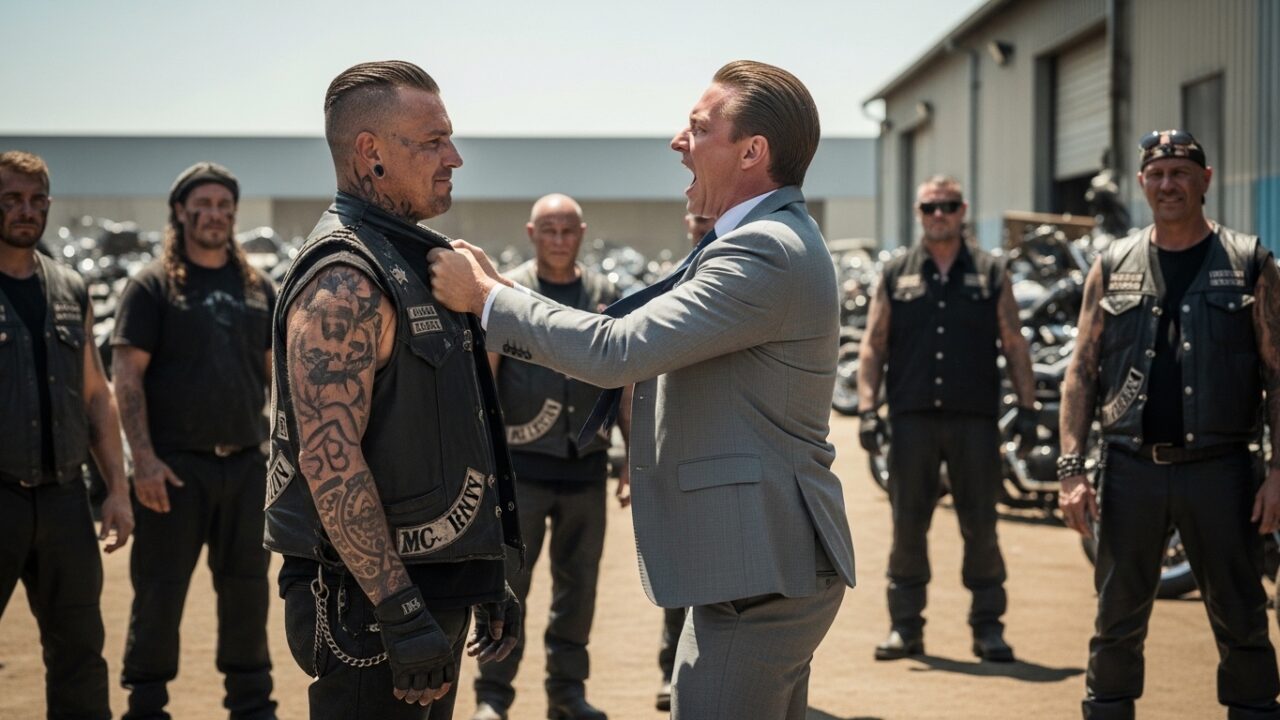
They Offered Us Millions To Sell Our Small-Town Scrapyard. We Said No. Then I Found A Taped-Up Black Trash Bag Dumped At Our Gates… And What Was Inside Started The Most Brutal War This Town Has Ever Seen.

I’ve worn the leather cut of the Iron Hounds Motorcycle Club for twenty-two years, living by a code the rest of the world has long forgotten.
I’ve seen bar fights, rivalries, and the darkest corners of this country.
But absolutely nothing in my entire life prepared me for what I found bleeding inside a heavy-duty trash bag on a rainy Tuesday morning.
To understand how we got to that horrific morning, you need to understand Oakhaven, Pennsylvania.
We aren’t a town you’ll find on any tourist map.
Oakhaven is a place built on steel, sweat, and coal, and when the mills shut down in the late nineties, the rest of the country forgot we even existed.
The government didn’t come to save us. The billionaires on Wall Street didn’t care.
The only people who stepped up to keep this town breathing were the Iron Hounds.
Yeah, we look rough. We ride loud bikes, we have tattoos covering our necks, and we don’t exactly play by polite society’s rules.
But twenty years ago, our President, a mountain of a man we call “Bear,” took every cent the club had and bought the old, abandoned rail-yard on the edge of town.
We turned it into a massive scrapyard and the biggest auto-repair facility in the county.
We didn’t do it to get rich. We did it to survive.
Today, that scrapyard employs over a hundred and fifty locals.
If you live in Oakhaven, odds are your dad, your brother, or your son puts food on the table because of the Iron Hounds.
We sponsor the local Little League. We buy the winter coats for the elementary school kids.
When the local diner was about to go under, we fixed their plumbing for free and ate there every single day until they were back in the black.
We aren’t a gang. We are the immune system of this town.
And the heart of our whole operation was Tommy’s little girl, Lily, and her dog, Buster.
Tommy is our lead diesel mechanic. He’s a single dad, working sixty hours a week just to keep a roof over his head.
Lily is seven years old, sweet as pie, but she was born completely deaf.
Because Tommy couldn’t afford specialized childcare, Lily spent every day after school at the scrapyard, sitting in the office coloring pictures of motorcycles.
Last year, the club pooled our money together and bought Lily a trained service dog.
A golden retriever mix named Buster.
Buster wasn’t just a dog; he was Lily’s ears, her protector, and the unofficial mascot of the Iron Hounds.
He wore a custom leather collar with our club logo stamped into it.
Whenever you heard engines revving, you’d see Buster trotting through the yard, a big goofy smile on his face, making sure Lily was safe.
He was the best thing about our gritty, grease-stained lives.
Everything changed three weeks ago.
It started on a Wednesday. The sky was the color of bruised iron, threatening rain but never quite delivering.
I was in the main garage, elbow-deep in the transmission of an old Peterbilt, when the yard suddenly went dead silent.
I wiped my hands on a rag and stepped outside.
Three sleek, black Mercedes G-Wagons were rolling slowly through our front gates, their tires crunching loudly against our cheap gravel.
They looked like alien spaceships in a town where a ten-year-old Ford truck is considered a luxury.
The doors opened, and five men stepped out.
They weren’t wearing leather or denim. They were wearing suits that cost more than most of my guys make in a year.
The man leading them had perfectly slicked-back hair, an expensive watch, and a smile that didn’t reach his cold, dead eyes.
“Who’s in charge of this… facility?” he asked, looking around with blatant disgust, as if the very air in our town was infecting his lungs.
Bear stepped out of the office, crossing his massive arms over his chest. “I am. What do you want?”
The suit handed Bear a glossy business card. “My name is Richard Vance. I represent Nexus Dynamics. We’re a global technology infrastructure firm.”
“Never heard of you,” Bear grunted.
“You will,” Vance smiled thinly. “We are building the largest AI data center on the East Coast. And we’ve decided that this specific valley is the perfect location for it.”
“Good for you,” I chimed in, walking up next to Bear. “Build it somewhere else. This is our land.”
Vance chuckled, a dry, patronizing sound. “I don’t think you understand, gentlemen. We aren’t asking for a small plot. We are buying the entire valley. We’ve already purchased the old municipal land to the north. But your… scrapyard… is sitting right in the middle of our projected cooling grid.”
He snapped his fingers, and one of his goons handed him a thick manila folder.
“We are prepared to offer you four million dollars for the deed to this property. You have forty-eight hours to vacate.”
Four million dollars.
For a second, the yard was completely silent. That was life-changing money.
But Bear didn’t even blink. He didn’t even look at the folder.
“No,” Bear said.
Vance’s fake smile faltered. “I’m sorry?”
“I said no,” Bear rumbled, his voice like grinding stones. “You buy this yard, you tear it down. What happens to my mechanics? What happens to the crane operators? What happens to the truck drivers who haul our scrap?”
“With four million dollars, I’m sure you could all retire comfortably,” Vance countered, losing his patience.
“Yeah, maybe the five guys in the club,” Bear said. “But what about the other hundred and fifty families who rely on this place to eat? We don’t sell out our town so some tech billionaires can build servers. Get off my property.”
Vance stared at Bear for a long, uncomfortable moment.
The mask of the polite businessman completely melted away, revealing the ruthless corporate shark underneath.
“You’re making a catastrophic mistake,” Vance said quietly. “Nexus Dynamics doesn’t take no for an answer. Progress doesn’t ask permission from dinosaurs playing dress-up on motorcycles.”
He leaned in closer. “We will take this land. We can do it the easy way, and you walk away rich. Or we do it the hard way, and you lose absolutely everything.”
I stepped forward, getting right in Vance’s face. “Are you threatening us in our own yard?”
Vance just smirked, turned around, and got back into his Mercedes.
As the SUVs peeled out, throwing gravel everywhere, little Lily ran out of the office, holding onto Buster’s collar.
Buster barked furiously at the retreating vehicles, sensing the bad blood in the air.
“It’s okay, boy,” Tommy said, scooping his daughter up. “Just some suits passing through.”
But they weren’t just passing through.
The nightmare started the very next morning
I’ve worn the leather cut of the Iron Hounds Motorcycle Club for twenty-two years, living by a code the rest of the world has long forgotten.
I’ve seen bar fights, rivalries, and the darkest corners of this country.
But absolutely nothing in my entire life prepared me for what I found bleeding inside a heavy-duty trash bag on a rainy Tuesday morning.
To understand how we got to that horrific morning, you need to understand Oakhaven, Pennsylvania.
We aren’t a town you’ll find on any tourist map.
Oakhaven is a place built on steel, sweat, and coal, and when the mills shut down in the late nineties, the rest of the country forgot we even existed.
The government didn’t come to save us. The billionaires on Wall Street didn’t care.
The only people who stepped up to keep this town breathing were the Iron Hounds.
Yeah, we look rough. We ride loud bikes, we have tattoos covering our necks, and we don’t exactly play by polite society’s rules.
But twenty years ago, our President, a mountain of a man we call “Bear,” took every cent the club had and bought the old, abandoned rail-yard on the edge of town.
We turned it into a massive scrapyard and the biggest auto-repair facility in the county.
We didn’t do it to get rich. We did it to survive.
Today, that scrapyard employs over a hundred and fifty locals.
If you live in Oakhaven, odds are your dad, your brother, or your son puts food on the table because of the Iron Hounds.
We sponsor the local Little League. We buy the winter coats for the elementary school kids.
When the local diner was about to go under, we fixed their plumbing for free and ate there every single day until they were back in the black.
We aren’t a gang. We are the immune system of this town.
And the heart of our whole operation was Tommy’s little girl, Lily, and her dog, Buster.
Tommy is our lead diesel mechanic. He’s a single dad, working sixty hours a week just to keep a roof over his head.
Lily is seven years old, sweet as pie, but she was born completely deaf.
Because Tommy couldn’t afford specialized childcare, Lily spent every day after school at the scrapyard, sitting in the office coloring pictures of motorcycles.
Last year, the club pooled our money together and bought Lily a trained service dog.
A golden retriever mix named Buster.
Buster wasn’t just a dog; he was Lily’s ears, her protector, and the unofficial mascot of the Iron Hounds.
He wore a custom leather collar with our club logo stamped into it.
Whenever you heard engines revving, you’d see Buster trotting through the yard, a big goofy smile on his face, making sure Lily was safe.
He was the best thing about our gritty, grease-stained lives.
Everything changed three weeks ago.
It started on a Wednesday. The sky was the color of bruised iron, threatening rain but never quite delivering.
I was in the main garage, elbow-deep in the transmission of an old Peterbilt, when the yard suddenly went dead silent.
I wiped my hands on a rag and stepped outside.
Three sleek, black Mercedes G-Wagons were rolling slowly through our front gates, their tires crunching loudly against our cheap gravel.
They looked like alien spaceships in a town where a ten-year-old Ford truck is considered a luxury.
The doors opened, and five men stepped out.
They weren’t wearing leather or denim. They were wearing suits that cost more than most of my guys make in a year.
The man leading them had perfectly slicked-back hair, an expensive watch, and a smile that didn’t reach his cold, dead eyes.
“Who’s in charge of this… facility?” he asked, looking around with blatant disgust, as if the very air in our town was infecting his lungs.
Bear stepped out of the office, crossing his massive arms over his chest. “I am. What do you want?”
The suit handed Bear a glossy business card. “My name is Richard Vance. I represent Nexus Dynamics. We’re a global technology infrastructure firm.”
“Never heard of you,” Bear grunted.
“You will,” Vance smiled thinly. “We are building the largest AI data center on the East Coast. And we’ve decided that this specific valley is the perfect location for it.”
“Good for you,” I chimed in, walking up next to Bear. “Build it somewhere else. This is our land.”
Vance chuckled, a dry, patronizing sound. “I don’t think you understand, gentlemen. We aren’t asking for a small plot. We are buying the entire valley. We’ve already purchased the old municipal land to the north. But your… scrapyard… is sitting right in the middle of our projected cooling grid.”
He snapped his fingers, and one of his goons handed him a thick manila folder.
“We are prepared to offer you four million dollars for the deed to this property. You have forty-eight hours to vacate.”
Four million dollars.
For a second, the yard was completely silent. That was life-changing money.
But Bear didn’t even blink. He didn’t even look at the folder.
“No,” Bear said.
Vance’s fake smile faltered. “I’m sorry?”
“I said no,” Bear rumbled, his voice like grinding stones. “You buy this yard, you tear it down. What happens to my mechanics? What happens to the crane operators? What happens to the truck drivers who haul our scrap?”
“With four million dollars, I’m sure you could all retire comfortably,” Vance countered, losing his patience.
“Yeah, maybe the five guys in the club,” Bear said. “But what about the other hundred and fifty families who rely on this place to eat? We don’t sell out our town so some tech billionaires can build servers. Get off my property.”
Vance stared at Bear for a long, uncomfortable moment.
The mask of the polite businessman completely melted away, revealing the ruthless corporate shark underneath.
“You’re making a catastrophic mistake,” Vance said quietly. “Nexus Dynamics doesn’t take no for an answer. Progress doesn’t ask permission from dinosaurs playing dress-up on motorcycles.”
He leaned in closer. “We will take this land. We can do it the easy way, and you walk away rich. Or we do it the hard way, and you lose absolutely everything.”
I stepped forward, getting right in Vance’s face. “Are you threatening us in our own yard?”
Vance just smirked, turned around, and got back into his Mercedes.
As the SUVs peeled out, throwing gravel everywhere, little Lily ran out of the office, holding onto Buster’s collar.
Buster barked furiously at the retreating vehicles, sensing the bad blood in the air.
“It’s okay, boy,” Tommy said, scooping his daughter up. “Just some suits passing through.”
But they weren’t just passing through.
The nightmare started the very next morning
CHAPTER 2
The drive to Doc Halloway’s clinic took exactly seven minutes, but it felt like seven lifetimes.
I had Buster wrapped in an old, oil-stained moving blanket, laid out on the passenger seat of my beat-up Chevy Silverado.
I kept one hand on the steering wheel, pushing the truck to eighty miles an hour down the slick, winding backroads of Oakhaven, while my other hand rested gently on Buster’s chest.
I just needed to feel his heartbeat. It was shallow. Erratic. Like a failing engine sputtering on its last drops of gas.
“Stay with me, buddy,” I whispered, the words catching in my throat. “You gotta stay for Lily. She needs you. You hear me?”
Buster let out a low, rattling exhale. His blood was soaking through the thick blanket, pooling onto my passenger seat.
Doc Halloway wasn’t a regular veterinarian. He was a retired combat medic who had served two tours in Fallujah before coming back to Oakhaven to run a quiet animal clinic on the edge of the county line.
More importantly, Doc was a friend of the Iron Hounds.
He didn’t ask questions. He didn’t call the cops when one of our guys showed up at 3:00 AM with a broken jaw or a deep laceration from a bar fight.
I slammed the brakes, sliding into his gravel driveway, laying on the horn.
Before the truck even fully stopped, the front door of the clinic flew open. Doc stood there in his pajamas, holding a shotgun, his eyes squinting against the pouring rain.
When he saw my truck, he lowered the weapon.
“Doc!” I screamed, kicking my door open and scooping Buster into my arms. “I need you! Now!”
Doc didn’t hesitate. He took one look at the blood soaking my leather cut and immediately turned back inside.
“Trauma room, back left! Go!” he barked, his military training instantly taking over.
I carried the heavy, limp dog down the sterile white hallway and laid him gently on the cold steel examination table.
Doc flipped on the glaring overhead surgical lights. When the bright light hit Buster, the reality of what those corporate monsters had done became fully visible.
It wasn’t just a beating. It was torture.
His front left leg was fractured in at least two places. Three of his ribs were caved in. His beautiful golden face was bruised and swollen, and a deep laceration ran across his right flank.
Doc sucked in a sharp breath. “Christ almighty. Was he hit by a semi-truck?”
“Worse,” I growled, my hands shaking as the adrenaline began to mix with a pure, concentrated rage. “He was hit by men in suits.”
Doc didn’t ask anything else. He moved with lightning speed, grabbing clippers, IV bags, and vials of medication.
“Hold his head still,” Doc ordered, sliding a needle into Buster’s uninjured front leg. “I’m putting him under. He’s in shock. If I don’t stabilize his heart rate and stop the internal bleeding, he won’t make it to sunrise.”
I held Buster’s massive, heavy head, pressing my forehead against his wet fur. I stayed there, whispering to him, until his breathing slowed and his eyes closed under the anesthesia.
Just as Doc started stitching the deep gash on Buster’s side, the heavy clinic door burst open behind us.
It was Tommy.
He was wearing a grease-stained undershirt and sweatpants. He had clearly jumped straight out of bed the second he heard my radio call.
Bear, our President, was right behind him, his massive frame filling the doorway.
Tommy froze. His eyes locked onto the steel table.
For a man who spent his life wrestling thousand-pound diesel engines, Tommy suddenly looked incredibly small.
“No,” Tommy gasped, the color draining from his face completely. “No, no, no.”
He rushed to the table, his knees buckling slightly before he caught himself on the steel edge. He reached out with trembling, calloused hands, hovering them over Buster as if terrified that even touching him would cause more pain.
“Who did this?” Tommy’s voice was a ragged, horrific whisper. He looked up at me, tears streaming down his face. “Who did this to my daughter’s dog?!”
I reached into my pocket and pulled out the laminated note I had found tied to Buster’s collar.
I handed it to Bear.
Bear took it. He read the typed words: “This was just the dog. Next time, it’s the deaf girl. Sign the papers.” I watched the temperature in the room plummet.
Bear didn’t yell. He didn’t scream. He didn’t punch a wall.
Instead, a terrifying, dead silence washed over him. His jaw locked. The muscles in his thick neck bulged. His dark eyes turned into absolute voids.
Anyone who has ever been in a warzone knows that the loud guys aren’t the ones you need to worry about.
It’s the quiet ones. The ones who go perfectly, methodically still when the violence arrives.
“Tommy,” Bear said, his voice deep, flat, and devoid of any emotion.
Tommy looked at him, wiping his face.
“Where is Lily right now?” Bear asked.
“She’s asleep at my house. My mom is watching her.”
Bear turned to me. “Call Jax and Chibs. Tell them to get to Tommy’s house. They are to pack bags for Lily and Tommy’s mother. They are moving to the safe house up in the mountains. Two full-patch members armed with AR-15s are to be posted on that cabin 24/7. No one gets within a mile of that little girl. Understood?”
“Done,” I said, already dialing my phone.
Bear looked back at Tommy. “Your daughter is safe. Doc is going to save your dog. You hear me? Buster is going to live.”
Tommy nodded, choking back a sob.
Bear turned his massive head toward me, and the look in his eyes made the hairs on my arms stand up.
“Call Church,” Bear ordered. “Every single member of the Iron Hounds. In the Chapel. One hour.”
The “Chapel” is what we call the soundproof basement beneath the main office at the scrapyard.
We hadn’t held a real “Church” meeting down there in over three years.
For the last two decades, we had tried so hard to be legitimate. We paid our taxes. We filed our permits. We built a business that kept Oakhaven alive.
We had buried our violent past. We had locked away the guns, the black books, and the underworld connections. We wanted to be businessmen, not outlaws.
But as I looked around the large, heavy oak table, illuminated by a single hanging overhead light, I knew the businessmen were dead.
Twenty-four full-patch members of the Iron Hounds sat in the dimly lit basement.
The air was thick with cigarette smoke, the smell of damp leather, and an electric, crackling tension.
No one was speaking. Every man at the table had already heard about Buster. Every man knew about the threat against a seven-year-old deaf girl.
Bear sat at the head of the table. He picked up his wooden gavel and struck it once against the oak wood.
Bang. The sound echoed off the concrete walls like a gunshot.
“Church is in session,” Bear said, his voice echoing in the quiet room.
He didn’t give a grand speech. He didn’t need to. He simply took the laminated note and tossed it into the center of the table.
It slid across the wood and stopped in the middle, perfectly visible to everyone.
“That note was left on Buster’s bleeding body outside our gates at 2:00 AM,” Bear stated. “It was left by Nexus Dynamics. The corporate suits who want our land.”
He leaned forward, placing his massive hands flat on the table.
“For twenty years, we played by their rules. We built something good here. We kept this town breathing. And when they couldn’t buy us out, they didn’t take us to court.”
Bear’s eyes narrowed into slits of pure hatred.
“They tortured a dog. They threatened a little girl. A child under the protection of this patch.”
A low, collective rumble of anger moved through the room. Men shifted in their seats, knuckles turning white as they gripped the edges of the table.
“They think because we wear grease on our hands and live in a forgotten town, that we are peasants. They think they can crush us like insects and we’ll just roll over and die,” Bear continued.
He stood up. He looked every single man in the eye.
“They don’t know who we used to be. And they don’t know what we are capable of.”
Bear pointed a heavy finger at the note.
“I am officially calling for a club vote. Are we selling the yard?”
“No,” twenty-four voices answered in unison, a chorus of absolute defiance.
“Are we going to the police?” Bear asked.
“No,” the room echoed.
“Then we are at war,” Bear declared. “And in this war, we don’t hold back. We don’t play defense. We are going to bleed Nexus Dynamics so badly they will wish they never heard the name Oakhaven.”
He struck the gavel one more time.
“All in favor of total retaliation?”
Twenty-four fists slammed into the oak table at the exact same time. The impact shook the floorboards above us.
It was unanimous.
Bear looked at me. As his Sergeant at Arms, I was the man responsible for club security and club violence.
“Get the books,” Bear ordered me. “We’re going hunting.”
We couldn’t just march into a glass skyscraper in Philadelphia and start shooting.
Nexus Dynamics had an army of lawyers and a private security force that rivaled small militaries. If we fought them in the open, we’d all end up in federal prison, and they’d get our land anyway.
If we were going to win, we had to fight them in the shadows. We had to hit them where corporate empires are the most vulnerable: their supply chains.
I spent the next forty-eight hours in the clubhouse with a pot of black coffee, three laptops, and two of our youngest members who knew their way around the dark web and encrypted communications.
We didn’t just dig into Nexus Dynamics. We dug into their contractors, their logistics companies, and their construction schedules.
Because we ran the largest auto repair and heavy-duty towing facility in the county, we knew every trucker who rolled through the tri-state area. We knew the weigh station operators. We knew the guys who drove the snowplows.
Our network was invisible, but it was massive.
By Thursday night, we found our golden ticket.
Nexus Dynamics wasn’t just planning to build an AI data center; they were incredibly behind schedule on another project down south. To appease their wealthy investors, Richard Vance had authorized a massive, high-risk logistics move.
To jumpstart the Oakhaven facility, they were secretly trucking in forty million dollars’ worth of highly specialized, proprietary server cooling units.
They were bringing them in at night, bypassing the standard rail yards to avoid union inspectors.
They were moving them in three unmarked, reinforced semi-trucks, escorted by two private security SUVs.
And their route took them directly through the Blackwood Pass.
Blackwood Pass was a treacherous, winding, two-lane mountain highway that sat twenty miles outside of Oakhaven. It had no cell service, no streetlights, and steep drop-offs on either side.
It was our backyard.
I presented the intel to Bear. He smiled. It was the first time I’d seen him smile since Buster was hurt.
“They want to play dirty in the dark?” Bear said, tossing the printed logistics route onto the desk. “Let’s show them what lives in the dark.”
Friday night. 1:00 AM.
The rain had stopped, but a thick, heavy fog had rolled into the Blackwood mountains, reducing visibility to less than fifty feet.
The air was freezing, biting through my heavy leather jacket.
I was sitting in the driver’s seat of our largest, fifty-ton Peterbilt heavy-duty wrecker. It was painted matte black. We had killed all the headlights.
Next to me in the passenger seat was Jax, holding a suppressed, short-barreled shotgun across his lap.
Parked parallel to me, entirely blocking the two-lane road, was our second fifty-ton wrecker, driven by Bear.
Behind us, hidden in the dense treeline, were fifteen Iron Hounds on their motorcycles, engines cut, waiting in total silence.
We were a ghost fleet waiting in the fog.
My encrypted two-way radio crackled. It was our spotter, stationed three miles down the mountain.
“Convoy is approaching the pass,” the radio hissed. “Three eighteen-wheelers. Two blacked-out SUVs. They’re moving fast. Five minutes out.”
“Copy that,” I replied. I looked over at Jax. He racked the pump of his shotgun.
I reached forward and flipped the master switch on the wrecker’s dashboard, activating the heavy floodlights we had rigged to the grill.
Bear did the same.
Suddenly, a wall of blinding white light cut through the dense fog, illuminating a quarter-mile stretch of the wet asphalt in front of us.
We waited.
Four minutes later, we heard the deep, rumbling growl of heavy diesel engines echoing off the mountain walls.
Out of the mist, the lead private security SUV appeared.
The driver hit the brakes so hard the SUV hydroplaned, fishtailing wildly before coming to a screeching halt just fifty feet in front of our blockade.
Behind the SUV, the three massive semi-trucks slammed their brakes, their air-horns blaring into the night, their trailers locking up and sliding on the wet road.
The rear security SUV nearly rear-ended the last truck.
The convoy was trapped. Blocked by a hundred tons of steel in the front, and completely boxed in by the narrow mountain walls on the sides.
I kicked my door open and stepped out into the freezing fog. Bear stepped out of his rig at the same time.
From the treeline, fifteen motorcycle engines roared to life simultaneously.
The sound was deafening. It sounded like a pack of mechanical wolves howling in the night. The bikers rolled out of the woods, completely surrounding the convoy, their headlights cutting through the mist, illuminating the panicked faces of the truck drivers.
The doors of the lead SUV flew open.
Four private security contractors stepped out. They were wearing tactical gear, plate carriers, and holding assault rifles.
These weren’t rent-a-cops. These were highly paid mercenaries.
“Move these vehicles right now!” the lead contractor screamed, raising his rifle and aiming it directly at my chest. “This is a private corporate convoy! You are committing a federal felony! Move the trucks or we will open fire!”
He thought he had the upper hand. He thought we were just some local thugs looking to hijack a cargo load of flat-screen TVs.
I didn’t flinch. I took a slow drag of my cigarette, exhaled a cloud of smoke into the cold air, and flicked the butt onto the wet pavement.
“Look up, hero,” I said calmly.
The contractor frowned, confused. He glanced up toward the steep, rocky ridges overlooking the narrow pass.
Suddenly, four high-powered red laser sights cut through the fog, locking directly onto the chests and foreheads of the four mercenaries.
We didn’t just bring shotguns. We had four of our guys, all former military snipers, positioned on the high ground with scoped hunting rifles.
The contractor froze. He swallowed hard, realizing instantly that they had driven perfectly into a fatal kill-box.
“Drop the rifles,” Bear commanded, his voice booming over the rumble of the idling trucks. “Drop them now, or you die on this mountain.”
The mercenaries looked at each other. They were getting paid a lot of money by Nexus Dynamics, but nobody gets paid enough to die in a ditch in Pennsylvania.
Slowly, the lead contractor lowered his weapon and placed it on the asphalt. The other three followed suit.
“Smart boys,” I said.
I signaled our guys. Jax and five other Hounds rushed forward. They zip-tied the mercenaries and the truck drivers, pulled their cell phones, and sat them down by the guardrail.
We didn’t hurt them. We weren’t monsters. We were professionals.
“What are you doing?” the lead contractor spat, struggling against the plastic ties. “You have no idea what’s in those trailers! You steal that cargo, the FBI will hunt you down to the ends of the earth!”
“We aren’t stealing anything,” I smiled, pulling a heavy steel chain from the back of my wrecker.
Our certified CDL drivers jumped into the cabs of the three Nexus trucks. They shifted the gears and slowly began to reverse the massive rigs, turning them around in the narrow pass with expert precision.
In less than ten minutes, we had hijacked forty million dollars of corporate assets without firing a single shot.
“Tell Richard Vance we said hello,” I told the contractor as I climbed back into my wrecker.
We left the mercenaries and the drivers on the side of the road with their SUVs. They’d have a long, cold walk down the mountain to find a landline.
We drove the three semi-trucks back to our scrapyard in Oakhaven.
By 3:00 AM, the massive gates of the Iron Hounds facility were locked tight.
The yard was illuminated by harsh, yellow industrial lights. The rain had started again, washing over the sleek white trailers of the Nexus trucks.
Bear stood in the center of the yard. The entire club was gathered around.
“Open them up,” Bear ordered.
I took a pair of heavy bolt cutters and snapped the security padlocks off the back of the first trailer.
I threw the heavy metal doors open.
Inside, sitting on reinforced shock-absorbing pallets, were rows of matte-black, state-of-the-art AI server cooling units. They looked like something out of a science fiction movie. Glass, chrome, and blinking standby lights.
It was exactly what we were looking for. The lifeblood of their new data center.
“Beautiful,” Jax whistled, looking at the cargo. “We could fence this stuff on the black market for millions. It’d set the club up for life.”
Bear walked up to the back of the trailer. He looked at the forty million dollars’ worth of tech sitting in front of him.
He didn’t look at the money. He looked down at the spot on the asphalt where Buster had bled.
“No,” Bear said coldly. “We don’t want their money.”
He turned toward the back of the yard, where our massive, hydraulic car crusher stood. It was a beast of machinery, capable of flattening a Ford F-150 into a metal pancake in under two minutes.
Bear pointed at the trailer.
“Unload every single server.”
We spent the next hour using forklifts to pull the heavy, expensive units out of the trucks. We lined them up in front of the massive jaws of the crusher.
I climbed into the operator’s booth of the crusher and fired up the hydraulic engines. The machine roared to life, shaking the ground beneath us.
“Put it in,” Bear commanded.
Jax and Tommy used a forklift to drop the first row of servers into the crushing bay.
I pulled the heavy steel lever.
The massive steel ceiling of the crusher descended.
The sound was incredible. Glass shattered. High-grade titanium buckled. Microchips and cooling fans exploded under thousands of pounds of hydraulic pressure.
We didn’t stop.
For two hours, we fed forty million dollars’ worth of cutting-edge technology into the crushing jaws of our junkyard machine. We pulverized it until it was nothing but useless, twisted cubes of plastic and metal.
We destroyed their timeline. We destroyed their investors’ money. We destroyed their leverage.
When the sun finally began to rise over Oakhaven, painting the sky in bruised purples and grays, the yard was quiet again.
Sitting in the center of the yard were three massive cubes of crushed, destroyed servers.
Bear walked up to the cubes. He pulled a can of red spray paint from his jacket.
Across the side of the crushed, forty-million-dollar metal, he painted four large words:
OAKHAVEN IS CLOSED. BITCH. We loaded the crushed cubes onto flatbed tow trucks, drove them right into the center of the neighboring town where Nexus Dynamics had set up their temporary corporate headquarters, and dumped them directly onto the front lawn of their building.
The war hadn’t just started.
We had just drawn first blood. And Richard Vance was about to learn exactly why you never, ever threaten the family of an Iron Hound.
CHAPTER 3
Dumping forty million dollars of crushed, twisted metal onto the front lawn of a corporate headquarters is a loud statement.
We wanted them to hear us. We wanted them to know that Oakhaven wasn’t just going to roll over and die.
But when you punch a multi-billion-dollar giant in the mouth, you have to be prepared for the giant to hit back.
The morning after we dumped the destroyed servers, the entire county was swarming with police.
Local news vans lined the streets of the neighboring town. Helicopters circled overhead like vultures. The footage of those three massive, pulverized cubes of cutting-edge technology was playing on every single news channel in the state.
Nexus Dynamics tried to spin it. Richard Vance went on live television, wearing a crisp, perfectly tailored navy suit, looking grave and concerned.
He didn’t mention the hostile takeover of our land. He didn’t mention the torture of a seven-year-old’s service dog.
Instead, he stood in front of the microphones and painted us as domestic terrorists.
“Nexus Dynamics is trying to bring thousands of high-paying jobs and critical technological infrastructure to this struggling region,” Vance lied to the cameras, his face a mask of fake sympathy. “Unfortunately, a local, violent motorcycle gang has decided to stand in the way of progress. They hijacked our supply lines. They destroyed millions of dollars of private property. We are working closely with state and federal authorities to ensure these criminals are brought to justice.”
I turned the television off in the scrapyard office.
Bear was sitting behind his heavy oak desk, cleaning his customized M1911 pistol. He didn’t even look up at the screen.
“Let them talk,” Bear grumbled, snapping the slide of the pistol back into place. “Words don’t win wars.”
We knew the police were coming. But we also knew we were protected.
The local sheriff, a guy named Miller, had grown up in Oakhaven. We played high school football together. When his wife got sick with cancer five years ago, the Iron Hounds paid for her chemotherapy when his insurance company refused to cover it.
Sheriff Miller knew exactly who we were, and he knew exactly what Nexus Dynamics was doing.
When the state troopers and the FBI field agents arrived at our gates with search warrants that afternoon, Miller made sure it was a circus of bureaucratic red tape.
They tore our scrapyard apart. They brought in K-9 units, forensic teams, and heavy machinery inspectors. They interviewed every single mechanic and tow truck driver.
They found absolutely nothing.
The three semi-trucks we had hijacked were already chopped into a thousand unrecognizable pieces and melted down in our industrial smelter. The mercenaries we had tied up on the mountain couldn’t identify us because of the fog and the blinding floodlights.
Legally, we were ghosts.
By sunset, the authorities had to pack up their gear and leave our property, completely empty-handed.
We had won the battle. But the war was just shifting into a much darker gear.
Richard Vance wasn’t an idiot. When the legal route failed, he realized that he couldn’t beat us through the justice system.
So, he decided to starve our town to death.
It started on Monday morning.
Oakhaven relies on two main access highways for everything. Food, fuel, medical supplies.
Suddenly, construction crews wearing Nexus Dynamics hardhats set up massive, concrete roadblocks on both highways.
They claimed it was an “emergency infrastructure repair” authorized by a judge who, conveniently, sat on the board of a charity funded by Nexus.
They essentially put our entire town under a medieval siege.
The local grocery store ran out of fresh produce in two days. The gas stations dried up by Wednesday. Delivery trucks were turned around at the roadblocks.
Vance was trying to turn the citizens of Oakhaven against the Iron Hounds. He wanted the town to blame us for their suffering. He wanted the locals to march up to our gates and demand that we sell the scrapyard so they could feed their families.
He severely underestimated the grit of working-class people.
When the diner down the street ran out of meat and bread, Bear opened up the club’s emergency reserves. We had deep freezers packed full of venison from hunting season, and massive stockpiles of dry goods we kept for hurricane emergencies.
We loaded up our pickup trucks and delivered food to every single house in Oakhaven.
Our mechanics started siphoning fuel from the wrecked cars in the yard, refining it, and giving it out for free so people could drive to work.
When a corporate suit from Nexus drove into town with a megaphone, offering a thousand dollars cash to anyone who would sign a petition demanding the Iron Hounds leave town, an eighty-year-old grandmother named Mrs. Higgins walked up to his car and threw a hot cup of black coffee directly onto his expensive windshield.
The town didn’t break. We stood shoulder to shoulder.
Oakhaven was a family. And you don’t turn your back on family.
But the stress was eating away at all of us. No one was sleeping. We were running patrols around the scrapyard perimeter twenty-four hours a day, heavily armed.
The only bright spot in that entire miserable week was Buster.
I drove Tommy down to Doc Halloway’s clinic late Thursday night.
The rain was beating against the windows of the clinic, but inside, the room felt warm for the first time in days.
Buster was awake.
He looked terrible. He had a massive cast on his front leg, thick bandages wrapping his ribs, and his golden face was still bruised and shaved in patches where Doc had put in stitches.
But when Tommy walked into the recovery room, Buster’s ears perked up.
He couldn’t stand. He could barely lift his head. But his tail began to thump against the metal examination table.
Thump. Thump. Thump. Tommy broke down. He dropped to his knees, burying his face in Buster’s neck, sobbing uncontrollably.
“I’m so sorry, buddy,” Tommy cried, kissing the top of the dog’s head. “I’m so sorry I wasn’t there.”
Buster just let out a soft whine, weakly licking the tears off Tommy’s face.
Doc Halloway leaned against the doorframe, sipping a mug of black coffee. He looked exhausted, but he gave me a tight nod.
“He’s a fighter,” Doc said quietly. “His vitals stabilized yesterday. He’s got a long road of physical therapy ahead of him, and he might always walk with a limp. But he’s going to live.”
I felt a massive weight lift off my chest. “Thank you, Doc. Seriously. Put whatever you need on the club’s tab.”
“No tab,” Doc replied, his eyes hardening. “Just make sure the bastards who did this don’t ever walk again.”
“Count on it,” I promised.
Tommy pulled out his cell phone. He opened up a secure video chat application and called the safehouse up in the mountains.
The screen flickered, and then Lily’s face appeared.
She was sitting on a plaid couch in the cabin. When she saw Buster on the screen, her eyes went wide.
Because she was deaf, she couldn’t hear Tommy’s voice, but she started signing rapidly with her hands, tears welling up in her eyes.
Is he okay? Is my dog okay? she signed, her tiny hands shaking.
Tommy held the phone up so Buster could see the screen. Buster let out a happy bark, his tail thumping even harder.
Tommy smiled, his face still wet with tears, and signed back to his daughter.
He is strong. He loves you. He will come home soon. Lily pressed her hand against the screen of the phone, crying and smiling at the same time.
It was a beautiful moment. It was the reason we were fighting.
But that moment of peace was shattered exactly three hours later.
I was back at the scrapyard, drinking a lukewarm beer in the office, when the encrypted emergency radio clipped to my belt exploded with static.
It was a frequency we only used for life-or-death emergencies.
“Base, this is Echo-One! Base, come in!”
It was Jax. He was one of the two heavily armed members guarding Lily and Tommy’s mother at the mountain safehouse.
His voice was panicked. He was breathing hard, and in the background, I could hear a sound that made my blood freeze solid.
The sharp, cracking pop-pop-pop of suppressed automatic gunfire.
“Jax! Sitrep! What’s happening?” I yelled into the radio, sprinting out of the office and kicking Bear’s door open.
Bear was on his feet instantly.
“They found us!” Jax screamed over the radio. “Nexus hit squads! At least a dozen of them! They came up through the back trails! Chibs is hit! We are pinned down inside the cabin!”
“Are Lily and the grandmother safe?” Bear roared into my radio.
“We barricaded them in the bathroom!” Jax fired a burst from his AR-15, the sound deafening through the speaker. “But they’re moving up on the porch! They have breaching gear! We can’t hold them off forever! You have ten minutes before they take the house!”
“Hold the line, brother. We are coming,” I said.
I dropped the radio. Bear and I didn’t say a word to each other. We didn’t need to.
We sprinted across the wet gravel of the yard, grabbing our tactical vests and heavy weaponry from the club armory.
We didn’t take the motorcycles. The mountain roads were too slick with mud and rain. We jumped into my black Chevy Silverado.
Bear grabbed the heavy steel handle above the passenger door.
“Drive,” he growled.
I slammed the truck into drive, stomped the gas pedal to the floor, and tore out of the scrapyard gates.
The drive up the mountain usually took twenty minutes. I did it in eight.
I pushed the Silverado past its breaking point, drifting around the tight, dangerous switchbacks of the mountain pass, the tires screaming against the wet asphalt.
My heart was hammering against my ribs like a jackhammer.
They went after the girl. The absolute cowards went after a deaf seven-year-old child.
If they touched one hair on Lily’s head, I was going to tear Richard Vance apart with my bare hands.
We hit the dirt logging road that led up to the cabin. I cut the headlights. We were driving in pitch blackness, relying on the faint moonlight cutting through the pine trees.
“Stop here,” Bear ordered.
We were a quarter-mile down the hill from the cabin. We couldn’t drive any closer without alerting the tactical squad to our arrival.
We bailed out of the truck. The rain was coming down in sheets again, turning the forest floor into a slippery, muddy nightmare.
I racked the bolt of my M4 carbine. Bear pumped his customized tactical shotgun.
We moved up the hill through the dense brush, moving like ghosts in the dark.
As we got closer, the smell of gunpowder and burning wood filled the damp air.
Through the trees, the cabin came into view.
It was a bloodbath.
The front windows of the cabin were completely shattered. The wooden siding was chewed to pieces by high-caliber bullet holes.
I saw muzzle flashes lighting up the dark woods.
There were ten men dressed in black tactical gear, wearing night-vision goggles. They were moving with military precision, bounding from tree to tree, laying down suppressing fire on the front door of the cabin.
On the porch, pinned behind a thick cord of stacked firewood, was Jax.
He was bleeding heavily from his left shoulder, but he was still firing his rifle, holding the line with everything he had.
Chibs was lying on the floor inside the doorway, unconscious, his leg bound with a makeshift tourniquet.
The mercenaries were preparing to breach. Two of them were moving up the wooden stairs of the porch, holding a heavy steel battering ram.
They were going for the bathroom. They were going for Lily.
“Take the left flank,” Bear whispered, his voice cold as ice. “I take the right. No survivors.”
I nodded. I moved silently through the mud, flanking the mercenaries from the blind side.
I lined up the illuminated crosshairs of my optic on the chest of the mercenary holding the back of the battering ram.
I squeezed the trigger.
The heavy 5.56 round hit him square in the side, bypassing his ceramic armor plates. He dropped like a sack of concrete.
The element of surprise was ours.
Before the rest of the squad could even turn to face my direction, Bear stepped out from behind a massive oak tree on the right flank.
He didn’t use an optic. He just aimed from the hip.
The roar of his 12-gauge shotgun shattered the night. The blast caught two mercenaries perfectly, sending them flying backward into the mud.
Chaos erupted.
The Nexus hit squad completely panicked. They were used to intimidating unarmed civilians and fighting cornered mechanics. They weren’t prepared to be flanked by men who had fought in the worst gang wars on the East Coast.
“Contact left! Contact right!” the squad leader screamed, firing blindly into the dark woods.
I moved up, firing in controlled, precise bursts. I dropped another man as he tried to throw a flashbang grenade onto the porch. The grenade detonated in the mud, blinding half his own team.
Jax realized what was happening. Despite his shattered shoulder, he stood up from behind the firewood and laid down a massive wall of covering fire, pinning the remaining mercenaries against the treeline.
We had them trapped in a crossfire.
Within sixty seconds, the firefight was over.
Nine mercenaries were down in the mud, either dead or bleeding out.
The squad leader, realizing he was the last man standing, dropped his rifle and threw his hands into the air, screaming for mercy.
Bear didn’t shoot him. He walked up to the squad leader, grabbed him by the throat of his tactical vest, and slammed him against the side of the cabin with enough force to crack the wood.
I ignored them. I sprinted up the porch stairs, stepping over the shattered glass and splintered wood.
“Jax, you good?” I yelled, checking my brother’s wound.
“Flesh wound. Went clean through,” Jax gritted his teeth, holding his shoulder. “Check on the girl.”
I ran into the cabin. The living room was destroyed. Bullet holes riddled the furniture.
I made it to the hallway bathroom. The wooden door was locked from the inside.
“Lily! Mrs. Higgins! It’s me!” I yelled, banging on the door.
I heard the sound of heavy furniture being dragged across the floor.
The door slowly creaked open.
Tommy’s mother stood there, clutching a heavy iron fireplace poker. She was shaking violently, her face pale with terror.
Behind her, tucked into the bathtub beneath a pile of blankets, was Lily.
Because she was deaf, Lily hadn’t heard the explosions. She hadn’t heard the gunfire or the screams.
But she had felt the vibrations of the bullets hitting the walls. She had seen the plaster falling from the ceiling.
She was curled into a tight ball, clutching her coloring book against her chest, crying silently.
I dropped my rifle. I fell to my knees, reached into the bathtub, and pulled her into my arms.
She buried her face into my leather vest, her tiny body trembling like a leaf in a hurricane.
I held her tight, stroking her hair.
“You’re safe,” I whispered, even though she couldn’t hear me. “You’re safe now. I promise.”
I stayed there on the bathroom floor for ten minutes, until she finally stopped shaking.
When I finally walked back out onto the front porch, the rain was washing the blood off the wooden boards.
Jax had bandaged his shoulder. Chibs was awake, sitting against the wall, smoking a cigarette despite the bullet hole in his leg.
Bear was standing in the muddy yard.
Kneeling in front of him was the mercenary squad leader. His hands were zip-tied behind his back. His night-vision helmet was gone, revealing a terrified, bleeding face.
Bear held a massive, rusted pair of industrial bolt cutters in his hands. He rested the heavy steel jaws against the mercenary’s kneecap.
“I’m going to ask you one question,” Bear said, his voice terrifyingly calm. “And if you lie to me, you will never walk again. How did you find this cabin?”
The mercenary swallowed hard, staring at the bolt cutters.
“We… we paid a local,” the mercenary stammered, tears mixing with the rain on his face. “A guy from the diner. He recognized the trucks heading up the mountain a few days ago. We gave him ten grand for the location.”
Bear closed his eyes for a second. The betrayal stung. Someone in our own town had sold out a child.
“Next question,” Bear said, tightening his grip on the heavy tools. “What was the plan? You capture the girl, and then what?”
“Leverage!” the mercenary cried out. “Vance wanted leverage! He’s losing his mind. The investors are threatening to pull the funding after you destroyed the servers. He needed the deed to the scrapyard by tomorrow morning, or his whole company goes bankrupt.”
Bear leaned in closer. “And what happens tomorrow morning?”
The mercenary hesitated. Bear squeezed the handles of the bolt cutters just a fraction of an inch.
“Okay! Okay!” the man screamed. “Vance bought a federal judge! At 6:00 AM tomorrow, a private military contractor force of over a hundred men is descending on Oakhaven. They have a fabricated eminent domain order claiming your scrapyard is a toxic environmental hazard. They are coming to forcibly evict your entire club. Anyone who resists will be shot under the guise of resisting federal authority.”
I felt a cold chill run down my spine.
A hundred heavily armed men. Legal cover. They were coming to wipe Oakhaven off the map.
“Where is Vance right now?” I asked, stepping off the porch.
“He’s… he’s at the regional airport. Ten miles south,” the mercenary choked out. “He’s sitting in his private jet on the tarmac. He’s coordinating the assault from there. He’s not leaving until he watches your scrapyard burn to the ground.”
Bear stepped back. He lowered the bolt cutters.
He looked at me. The fire in his eyes was absolute.
“Jax, Chibs, get the women back to the clubhouse. Lock the steel blast doors,” Bear ordered.
He turned to the rest of the dark, rainy forest.
“They want to burn our home? They want to use private armies and private jets to crush us?”
Bear cracked his massive knuckles.
“Call the rest of the club. Tell them to meet us at the runway. We’re going to the airport.”
This wasn’t about land anymore. This wasn’t about money.
This was about blood. And by the time the sun came up, Richard Vance was going to drown in his own arrogance.
CHAPTER 4
The rain had finally stopped, leaving behind a thick, freezing mist that clung to the Pennsylvania asphalt like a shroud.
It was 3:15 AM.
We had less than three hours before a private army of a hundred heavily armed mercenaries descended on our town, legally authorized to wipe Oakhaven off the map.
I stood in the muddy driveway of the mountain cabin, wiping a mixture of rain and blood from my face.
Bear was already on the encrypted radio, his deep voice cutting through the silent forest. He wasn’t yelling. He was speaking with the cold, calculated precision of a commanding general directing a final strike.
He mobilized every single full-patch member, every prospect, and every trusted mechanic who knew how to handle a firearm.
“We meet at the junction of Route 9 and the old county line,” Bear commanded into the radio. “Bring the heavy wreckers. Bring the bolt cutters. Bring everything.”
I threw our tactical gear into the back of my black Chevy Silverado.
Jax and Chibs had already loaded the women into Jax’s SUV and were tearing down the mountain toward the fortified clubhouse.
Bear climbed into the passenger seat of my truck. He looked exhausted, his leather vest soaked in mud and gunpowder residue, but his eyes were burning with an unholy fire.
“Drive,” Bear said.
I shifted the truck into gear and we flew down the mountain.
The drive to the rendezvous point took twenty minutes. The roads were completely empty. The entire world felt dead, except for the roaring engine of my Silverado.
When we pulled up to the Route 9 junction, the mist was illuminated by dozens of headlights.
Thirty members of the Iron Hounds were waiting. They sat on their rumbling Harley-Davidsons, their engines idling in a deep, rhythmic growl that vibrated in my chest.
Behind the motorcycles were our two massive, fifty-ton Peterbilt heavy-duty wreckers, painted matte black, looking like prehistoric beasts in the fog.
Tommy was driving the lead wrecker. He had left the clubhouse the second he knew his daughter was safe. He wanted blood just as badly as we did.
I stepped out of the truck. Bear walked to the center of the junction.
Thirty bikers cut their engines simultaneously. The silence that followed was deafening.
“Listen up,” Bear’s voice boomed in the cold air. “At 6:00 AM, Nexus Dynamics is sending a hundred private military contractors to our gates. They have a fake federal order. They are coming to take our homes, our business, and our town.”
Bear pointed a thick, calloused finger to the south.
“Richard Vance, the billionaire pulling the strings, is sitting in a private jet at the regional airport ten miles from here. He’s safe. He’s warm. He’s waiting to watch Oakhaven burn.”
Bear looked around the circle of men. These were men who had bled together, starved together, and built a life out of scrap metal and sheer willpower.
“We do not play defense anymore,” Bear roared. “We are going to that airport. We are going to rip that billionaire out of his leather seat, and we are going to show him what happens when you threaten the family of an Iron Hound. Are you with me?!”
Thirty fists shot into the air. Thirty voices screamed in absolute, terrifying unison.
“Let’s ride,” Bear said.
Oakhaven Regional Airport was a tiny, single-runway facility mostly used by crop dusters and local executives who didn’t want to drive to Philadelphia.
It was surrounded by a ten-foot chain-link fence topped with barbed wire.
At 4:00 AM, the perimeter was completely dark. The only lights came from the small terminal building and the floodlights illuminating the tarmac.
Sitting in the dead center of the tarmac, looking like a sleek white shark, was a massive Gulfstream G650 private jet.
The jet’s auxiliary power was running. I could hear the high-pitched whine of the turbines spinning up.
Vance knew his hit squad had failed. He had lost contact with the mercenaries at the cabin, and like the coward he was, he was preparing to flee the state before the local police could put the pieces together.
He was going to escape to a penthouse in New York and let his lawyers and his private army handle the dirty work at 6:00 AM.
“He’s prepping for takeoff,” I said into the two-way radio, staring through a pair of binoculars from a ridgeline overlooking the airport.
“Not tonight, he isn’t,” Bear’s voice crackled back from the cab of the lead Peterbilt wrecker.
“Take the grid down,” I ordered.
Three of our guys had already shimmied up the main utility poles outside the airport perimeter. With a few heavy swings of insulated bolt cutters, they severed the main power lines.
The entire airport plunged into absolute darkness. The runway lights died. The terminal went black.
The only light left was the blinking red collision beacons on Vance’s Gulfstream.
“Go! Go! Go!” I yelled into the radio.
Bear didn’t bother with the gate padlock.
He dropped the Peterbilt wrecker into gear, stepped on the gas, and slammed the fifty-ton beast directly into the ten-foot chain-link fence.
The steel fence tore open like wet tissue paper. The massive truck roared onto the tarmac, its tires smoking, closely followed by the second wrecker and thirty roaring motorcycles.
We swarmed the tarmac like a mechanized cavalry.
The two private security SUVs parked next to the Gulfstream instantly flipped on their high beams. Four heavily armed bodyguards stepped out, raising their weapons.
But they were completely outmatched.
Before they could even aim, thirty Iron Hounds circled them, trapping them in a blinding vortex of motorcycle headlights. We drew our weapons, aiming from the saddle of our bikes.
“Drop them!” I screamed, stepping off my bike with my AR-15 leveled at the chest of the head bodyguard. “Drop the weapons right now, or you die on this runway!”
They were surrounded by thirty furious men with nothing left to lose. The bodyguards slowly lowered their rifles and kicked them across the wet concrete.
Inside the cockpit of the Gulfstream, the pilot panicked.
He ignored the power outage. He ignored the men on the runway. He throttled the jet’s engines up to maximum power, the deafening roar of the jet turbines shaking the concrete beneath our boots.
The massive plane began to lurch forward, trying to initiate an emergency, blind takeoff to save the billionaire inside.
“Tommy!” Bear roared over the deafening sound of the jet engines. “Stop that plane!”
Tommy was behind the wheel of the second fifty-ton Peterbilt wrecker.
His face was a mask of pure, unadulterated rage. He was thinking about his deaf daughter hiding in a bathtub. He was thinking about his golden retriever bleeding on a steel table.
Tommy slammed his foot on the accelerator.
The massive black wrecker shot forward, intercepting the path of the moving jet.
Tommy didn’t just block it. He deployed the wrecker’s massive hydraulic rear boom—the thick steel arm used for towing semi-trucks.
He whipped the rear of the truck around with expert precision, slamming the heavy steel boom directly into the Gulfstream’s front landing gear.
The sound was catastrophic.
Aviation aluminum screamed as it tore apart. The massive impact snapped the jet’s front landing strut completely in half.
The nose of the multi-million-dollar Gulfstream slammed violently into the concrete tarmac, throwing sparks thirty feet into the air as the plane ground to a violent, screeching halt.
The jet turbines choked on the debris, sputtered, and died with a heavy, mechanical whine.
The plane was dead. Vance was trapped.
“Secure the perimeter!” Bear ordered, stepping out of his truck with his customized 12-gauge shotgun.
I grabbed a heavy steel crowbar from my saddlebag. Bear and I walked up to the side of the crippled jet.
The hydraulic stairs had jammed when the nose collapsed.
I jammed the crowbar into the seal of the luxurious main cabin door, put my entire body weight into it, and wrenched the heavy door open.
Bear and I stepped inside the cabin.
The contrast was jarring. The interior of the Gulfstream was a masterpiece of white leather, polished mahogany, and crystal decanters.
And standing in the center of it, covered in mud, grease, and the blood of his mercenaries, was Bear. He looked like the grim reaper incarnate.
Huddled in the very back of the luxury cabin, clutching a satellite phone, was Richard Vance.
His perfect, slicked-back hair was a mess. His expensive navy suit was wrinkled. His face was pale, his eyes wide with a terror he had clearly never experienced in his sheltered, privileged life.
He dropped the phone. It clattered against the mahogany floorboards.
“Stay back,” Vance stammered, holding his hands up, his voice trembling so badly he could barely form the words. “I… I have money. I can write you a check right now. Ten million dollars. Twenty million. Just name your price and walk away.”
Bear didn’t say a word. He walked slowly down the aisle of the jet.
He grabbed Vance by the lapels of his thousand-dollar suit and effortlessly lifted the billionaire entirely off his feet, slamming him against the polished wooden bulkhead of the cabin.
Crystal glasses shattered off the counters.
“You think this is about money?” Bear whispered, his voice vibrating with a terrifying, primal fury. “You sent armed men to a cabin where a seven-year-old girl was sleeping.”
“I didn’t!” Vance cried, tears streaming down his face. “I didn’t know about the girl! The contractors went rogue!”
I pulled out my cell phone and hit play on a video.
It was the mercenary squad leader, kneeling in the mud outside the cabin, explicitly stating that Vance had ordered the hit to gain leverage.
I held the phone up so Vance could hear his own hired killer giving him up.
Vance’s face drained of all remaining color. He knew he was caught.
“I’ve got this video securely uploaded to three different offshore servers,” I said coldly. “I’ve also got the squad leader tied up in the back of my truck, ready to testify to the FBI for a plea deal.”
Bear leaned his face inches from Vance’s terrified eyes.
“You are going to prison for the rest of your pathetic life,” Bear growled. “But before you do, you are going to fix what you broke.”
Bear dropped Vance onto the plush white leather sofa.
“Open your laptop,” Bear commanded.
Vance scrambled, his shaking hands grabbing his silver laptop from the table. He fumbled with the password twice before finally unlocking it.
“You have an army of a hundred men staging ten miles from my town,” Bear said, checking his watch. “It is 4:45 AM. You are going to call your commander and completely stand down the operation. If a single armed contractor steps foot in Oakhaven, I will throw you out of this plane and let my club handle you.”
Vance didn’t hesitate. He pulled up his encrypted communications app and initiated a video call.
A man in military fatigues answered the screen. “Mr. Vance? We are locked and loaded for the 6:00 AM breach.”
“Abort,” Vance choked out, his eyes darting toward the barrel of Bear’s shotgun. “Abort the operation. Immediately. Disband the teams and fall back. The contract is terminated.”
“Sir? Are you sure? We have the staging area secured—”
“I said abort the damn mission!” Vance screamed hysterically.
The contractor nodded slowly. “Copy that. Standing down.”
The call ended. Vance looked up at us, breathing heavily. “It’s done. They’re gone. Please, let me go.”
“We aren’t finished,” I said, stepping forward. I pulled a thick stack of legal documents from my leather cut and slammed them onto the mahogany table.
We had forced one of the corporate lawyers we kept on retainer to draft them up three hours ago.
“This is a binding legal transfer of the deed for the municipal land you purchased north of the scrapyard,” I explained, tapping the paper. “You are transferring ownership of that land to the township of Oakhaven, in perpetuity. For zero dollars.”
Vance stared at the papers in disbelief. “That land cost me twelve million dollars. You’re stealing it.”
Bear racked the slide of his shotgun. A red shotgun shell ejected onto the pristine carpet.
“I’m not asking,” Bear said.
Vance picked up a gold-plated pen with trembling fingers and signed his name on every single page. He notarized it with his digital corporate seal.
“Next,” I said, dropping a second document on the table. “This is a formal, permanent withdrawal of your eminent domain claim against the Iron Hounds Scrapyard. You are signing away your right to ever pursue this land again, and admitting that your environmental claims were entirely fabricated.”
Vance swallowed hard and signed that document too.
He was completely broken. We had stripped him of his army, his land, and his leverage in less than twenty minutes.
“I signed it,” Vance whispered, dropping the pen. “You have everything. What are you going to do to me?”
Bear looked down at the pathetic billionaire.
He could have killed him. Hell, half the club outside would have happily buried Vance under the runway.
But Bear was smarter than that. Killing Vance would turn him into a martyr. It would bring the full weight of the federal government down on Oakhaven.
Leaving him alive, humiliated, and facing decades in federal prison was a much worse punishment for a man with a massive ego.
“We are going to leave you exactly where you belong,” Bear said, turning his back on Vance. “In the dirt.”
I took a set of heavy-duty plastic zip-ties and secured Vance’s wrists behind his back. I tied his ankles together.
We dragged him out of the luxurious cabin, down the jammed stairs, and dropped him unceremoniously onto the cold, wet concrete of the runway.
I tossed the cell phone containing the mercenary’s confession right next to his face.
“Local police are on their way,” I told him, looking down at his ruined suit. “I suggest you start thinking about a good lawyer. You’re going to need one.”
We walked away.
I climbed back onto my motorcycle. Bear climbed back into the heavy wrecker.
We left the destroyed Gulfstream jet and the tied-up billionaire on the tarmac, surrounded by the flashing red lights of the airport beacons.
We rode back to Oakhaven as the sun finally began to rise.
The drive back was different.
The heavy, suffocating tension that had hung over our town for weeks was completely gone.
As we rolled down the main highway, I saw the massive concrete roadblocks being loaded onto flatbed trucks. The construction crews, realizing their corporate boss was going down, were packing up and fleeing.
The siege was over.
When we pulled through the massive steel gates of the Iron Hounds Scrapyard, the entire town was waiting for us.
Mechanics, waitresses, school teachers, and grandmothers. Hundreds of people were packed into the yard, cheering as our bikes roared in.
They knew what we had done. They knew we had gone into the dark to save them.
I parked my bike and shut off the engine.
Tommy jumped out of his wrecker and sprinted through the crowd.
Standing on the porch of the main office was Lily.
She ran down the wooden steps, throwing her arms around her father’s neck, burying her face in his grease-stained shirt. Tommy held her so tightly I thought he might crack her ribs, sobbing into her hair.
And limping slowly down the stairs behind her, his tail wagging a slow, steady rhythm, was Buster.
He still had his heavy cast. He still had his bandages. But his eyes were bright, and he let out a loud, happy bark when he saw Tommy.
I walked over and knelt in the gravel.
Buster limped over to me and pressed his heavy, golden head against my chest, licking the dirt and sweat off my cheek.
I wrapped my arms around his thick neck, closing my eyes.
“Good boy,” I whispered. “You’re a good boy.”
Bear stood on the porch, looking out over the crowd, looking out over the mountains of scrap metal and the people who called this place home.
He didn’t give a speech. He didn’t ask for a thank you.
He just smiled, walked into the office, and started brewing a pot of black coffee. There were engines that needed fixing. There was work to be done.
It’s been six months since that rainy night at the airport.
Richard Vance is currently sitting in a federal holding cell, awaiting trial for hiring a private hit squad, racketeering, and corporate espionage. The government seized Nexus Dynamics’ assets, and the company completely collapsed.
The municipal land that Vance transferred to the town was turned into a massive, state-of-the-art public park. We built a brand-new playground for the kids, and we named it “Buster’s Park.”
Buster still walks with a slight limp in his front left leg.
But every single afternoon, when Lily gets off the school bus, Buster is right there waiting for her at the scrapyard gates. He wears a brand-new, custom-made leather collar with the Iron Hounds logo stamped in gold.
We aren’t heroes. We never claimed to be.
We are rough around the edges. We settle our disputes with our fists. We live by a code that most of the modern world doesn’t understand.
But if you ever drive through Pennsylvania and find yourself lost on a dark mountain highway, looking at a rusted scrapyard sitting in the valley below…
Know that you are looking at the safest town in America.
Because Oakhaven belongs to the Iron Hounds.
And God help anyone who tries to take it from us.

About the Author
dream00
A writer passionate about human stories and real-life experiences that inspire and move readers.
 Biker
44 min read
Biker
44 min read
I Thought They Were Coming To Tear My House Down When I Heard The Engines… But When The Man With The Scar On His Face Knelt Down To My Son, I Realized The Real Monsters Weren’t The Ones Wearing Leather.
I’ve been a patch-wearing member of the Iron Souls for seventeen years, but nothing in my life of violence prepared…
 Biker
8 min read
Biker
8 min read
I Tracked My Stolen Motorcycle To An Abandoned Warehouse On Route 95… What Was Hidden Inside Broke Me
I’ve been building and riding motorcycles for 15 years, but nothing prepared me for the sickening terror I felt when…
 Biker
11 min read
Biker
11 min read
I Bled For The Brotherhood And Built Their Choppers For A Decade… But What I Found Welded Deep Inside My Dead Father’s Motorcycle Frame Shattered My Reality.
I’ve spent the last ten years breathing gasoline and bleeding motor oil for the Iron Kings Motorcycle Club, but nothing…
Leave a Reply