
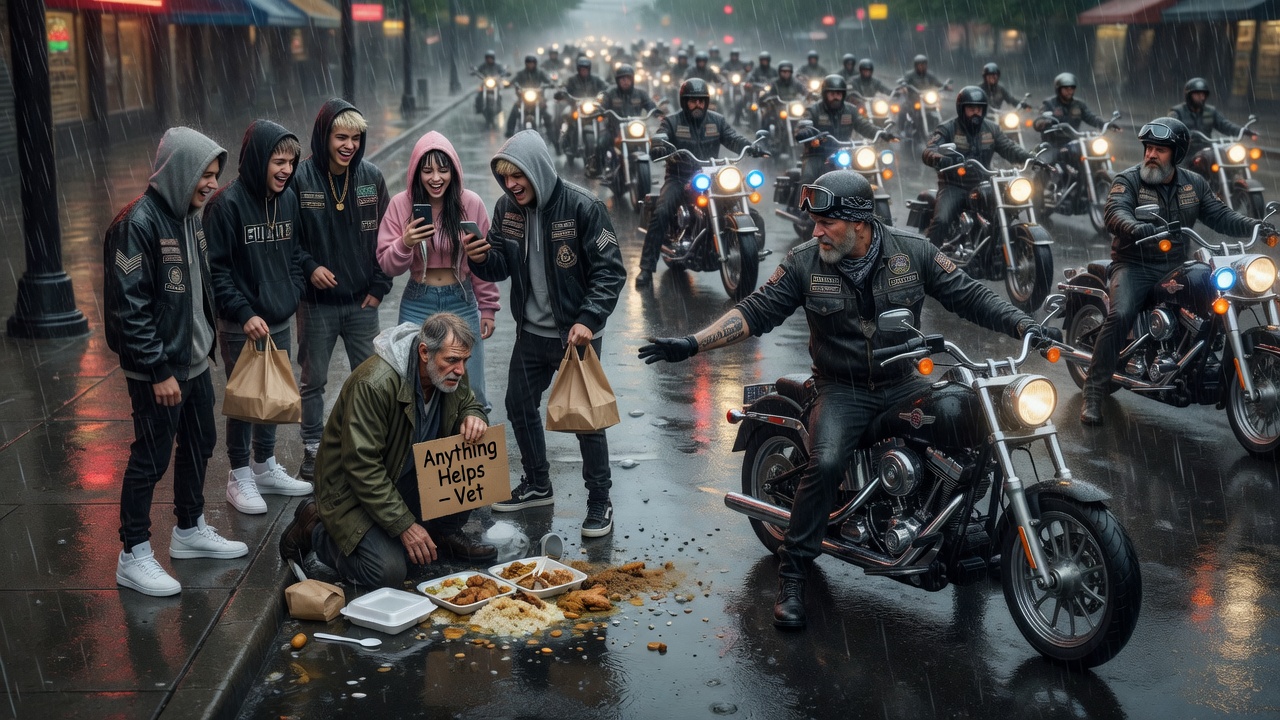
“The Tray Hit The Concrete And The Laughter Started… But When Those Fifty Engines Roared At Once, The Silence Was Deafening. I Was Just A Man In A Leather Vest, Until I Made The Choice To Defend The One Person The World Decided To Forget.”

“I’ve been riding these streets for twenty years, but nothing prepared me for the sound of a plastic tray hitting the pavement and the cruel laughter that followed.”
It was a Tuesday, the kind of afternoon where the rain doesn’t really fall—it just hangs in the air like a cold, wet blanket over the city. I was pulled over near the 4th Street park, checking a loose strap on my saddlebag, when I saw him.
His name was Elias. I didn’t know that then. To the rest of the world, he was just “the guy on the bench.” He was sitting there, nursing a small plastic tray of soup and a roll of bread he’d probably waited three hours in line for at the mission. He looked at that food like it was a king’s feast.
Then they showed up. Three kids, couldn’t have been older than seventeen. Clean clothes, expensive sneakers, and hearts made of dry rot. They weren’t looking for money. They were looking for a performance.
One of them walked by and, with a casual flick of his wrist, swiped the tray right out of Elias’s hands.
The sound was what got me. It wasn’t loud, but in the sudden silence of the park, that crack of plastic on concrete sounded like a gunshot. The soup—Elias’s only meal—slid into the gutter, mixing with the rainwater and the oil stains.
And then, they laughed.
“Oops,” the tall one said, his voice dripping with a mock-pity that made my blood turn to ice. “Guess you dropped it, Grandpa. You should be more careful.”
Another kid kicked the bread. He didn’t just move it; he kicked it into a puddle of stagnant water.
Elias didn’t scream. He didn’t fight back. He just sat there, his thin, shaking hands still hovering in the air where the tray had been. He looked at the ground, and for a second, I saw his shoulders slump in a way that told me he wasn’t just losing his lunch—he was losing the last shred of his will to exist.
He knelt down. Painfully. His old knees hit the wet concrete with a thud that I felt in my own chest. He started trying to scoop the soaked bread out of the puddle.
“Hey, Grandpa,” the leader said, stepping closer, his shadow looming over the old man. “You still hungry? You want us to find you some more ‘floor-soup’?”
That was the moment.
I didn’t think. I didn’t plan. I just stood up. I’m not a small man, and the leather vest I wear carries a lot of history, none of it particularly gentle. As I walked toward them, I felt the familiar weight of the world on my shoulders, but this time, it felt like fire.
“What are you doing, man?” one of the kids asked, his voice cracking as I stepped into his personal space.
I didn’t answer him. Not yet. I looked at Elias, still on his knees, and then I looked at the tray.
I bent down and picked it up. It was empty. Just a piece of trash now. I turned to the boy with the expensive sneakers and the hollow chest.
“Pick it up,” I said. My voice was low, the kind of quiet that usually comes before a storm.
“What?” the kid snapped, trying to find his courage in front of his friends. “You threatening us? You can’t do nothing.”
“I didn’t ask you to talk,” I repeated, stepping closer until he had to crane his neck to see my eyes. “I said… pick… it… up.”
The crowd started to gather. People were pulling out phones. I heard a woman whisper, “Someone call the police, those bikers are going to hurt those boys.”
They didn’t see the man on his knees. They only saw the “dangerous” guy in leather.
I took out my phone and sent one single text to a group chat that hasn’t been silent in fifteen years. Then, I sat down on the bench next to Elias.
“It’s okay,” I told him. He was trembling so hard I thought he’d break. “You’re not eating off the floor today.”
The boys were still there, emboldened by the growing crowd and the security guard jogging toward us from the pharmacy. They thought they had won. They thought I was just one man with a bike and a grudge.
Then, the ground started to shake.
It started as a low hum, a vibration in the soles of our boots. The teenagers looked around, confused. The security guard stopped in his tracks.
From three different blocks, the sound converged. It wasn’t traffic. It wasn’t sirens. It was the synchronized roar of fifty heavy-duty engines, moving like a single heartbeat.
When the first line of bikes rounded the corner and began to circle the park, the laughter didn’t just stop. It evaporated.
You see, they thought they were bullying a man who had nobody. They forgot that on these streets, some of us still remember what it means to be a brother.
What happened next was something this town will never forget.
CHAPTER 1: The Sound of Breaking
The sound of plastic hitting wet concrete is sharper than you’d think. It’s not a thud. It’s a crack—a brittle, hopeless sound that echoes off the brick walls of the pharmacy and dies in the grey mist of a Tuesday afternoon.
I was standing twenty feet away, tightening a loose strap on my Softail’s saddlebag, when it happened. I didn’t see the hand that did it, but I felt the impact in my gut. I looked up, and there it was: a cheap white plastic tray lying upside down in a puddle. The vegetable soup—thin, watery, and probably the only warm thing that man would feel all day—was bleeding into the gutter, swirling with the rainbow slick of motor oil and rainwater.
The laughter came a second later. It was high-pitched, jagged, and entirely too loud for the somber mood of the street.
“Oops,” a voice said. “Butterfingers.”
I stood up slowly, my joints popping. I’m forty-two, but some days, especially the rainy ones, I feel eighty. I looked at the trio standing on the sidewalk. They were young—maybe seventeen, maybe nineteen—wearing hoodies that cost more than my first bike and sneakers that had never seen a day of hard work. The leader, a tall kid with a buzz cut and a sneer that looked like it had been surgically attached to his face, was looking down at the man on the bench.
The man was Elias. I didn’t know his name then, but I knew his face. Everyone who frequented this corner of the city knew his face. He was a permanent fixture of the 4th Street park, a man made of shadows and silence. He was thin—the kind of thin that makes you wonder if his bones are made of glass—with a beard the color of dirty snow and eyes that always seemed to be looking at something a hundred miles away.
Elias didn’t say anything. He didn’t even look up. He just sat there, his hands still shaped like they were holding the tray, his fingers trembling in the cold air. He looked at the spilled soup, and for a terrifying moment, I thought he was going to cry. But he didn’t. He just slumped. It was the slump of a man who had been hit so many times by life that he’d forgotten how to brace for the impact.
“Hey, Grandpa,” the buzz-cut kid said, stepping closer. “I think you dropped your lunch. You gonna clean that up? It’s littering, you know. Someone could slip.”
His two friends chuckled, shifting their weight like they were waiting for a show.
Nearby, a woman named Sarah, who I knew worked at the Saint Jude mission down the block, stopped dead in her tracks. She was clutching a stack of flyers to her chest, her face pale. She looked at the boys, then at Elias, then at me. Her eyes were pleading. Do something, they said. Please.
But the rest of the street was different. A businessman in a tan trench coat glanced over, frowned, and immediately checked his watch, quickening his pace. A woman pushing a stroller steered it into the street to avoid the confrontation. This was the city’s unwritten code: if it doesn’t bleed on you, it isn’t your problem.
I felt a familiar heat rising in my chest. It was an old heat, something I usually kept buried under layers of grease, exhaust fumes, and the quiet routine of running my small repair shop. It was the heat of a man who had spent three years in the sandbox of Iraq, watching things break that could never be fixed. It was the heat of a man who had watched his younger brother, Leo, die in a dusty alleyway because I wasn’t fast enough to pull him back.
I’ve spent fifteen years trying to outrun that heat. But today, the rain was too cold, and the laughter was too sharp.
I didn’t plan it. I just moved.
My boots hit the pavement with a heavy, rhythmic thud. I didn’t rush. I didn’t shout. I just walked until I was standing between the boys and the bench. I’m six-foot-two and I don’t smile much. My leather vest is scuffed, and my knuckles are scarred from a lifetime of wrenches slipping off bolts.
The laughter died instantly.
The leader, the one with the buzz cut, blinked. He had to look up to meet my eyes. He tried to keep the sneer, but I could see the twitch in his jaw. “What’s your problem, old man?” he asked, his voice a little thinner than it had been ten seconds ago.
I didn’t look at him. I looked at Elias. The old man was finally looking up, his eyes wide and clouded with a mixture of confusion and terror. He wasn’t afraid of the boys anymore; he was afraid of me. He was afraid of the conflict. He was afraid of being the reason the world got loud again.
“I’m sorry,” Elias whispered, his voice like dry leaves. “I’ll clean it up. I didn’t mean to…”
“Don’t,” I said. The word came out like a low growl.
I bent down. My knees protested, a sharp reminder of a roadside IED that had sent a piece of shrapnel into my femur back in ’06. I reached into the puddle and picked up the cracked plastic tray. I stood back up, the grey water dripping from the edges onto my boots.
I turned to the buzz-cut kid. I held the tray out.
“Pick up the rest,” I said.
The kid laughed, but it was a nervous sound. He looked at his friends, looking for backup. They were both staring at the ground, suddenly very interested in the laces of their shoes.
“You’re kidding, right?” the kid said. “It’s trash. Let the city janitor handle it. Or let the hobo do it. It’s his mess.”
“I said,” I repeated, stepping into his personal space, “pick… it… up.”
The air between us grew thick. I could smell the expensive cologne he was wearing, and underneath it, the sour scent of fear. He looked at the tray, then at my face. He was trying to decide if I was a bluff.
“You can’t touch me,” he hissed, his voice dropping. “My dad is an attorney. You lay a hand on me, and I’ll own that shitty bike of yours before the sun goes down.”
It was a classic line. The shield of the privileged. I’d heard it a thousand times in a dozen different ways.
“I’m not going to touch you,” I said quietly. “But you’re going to pick up that bread. You’re going to apologize to this man. And then you’re going to go back into that deli you just came out of, and you’re going to buy him a hot meal. A real one.”
The kid’s face turned a mottled red. “Screw you.”
He tried to push past me. It was a mistake. I didn’t hit him, but I didn’t move either. He hit my chest like he’d run into a brick wall. The impact sent him stumbling back, and he tripped over his own expensive sneakers, landing hard on his backside—right in the middle of the spilled soup.
The irony would have been funny if the situation wasn’t escalating so fast.
“Assault!” he screamed, his voice cracking into a high-pitched wail. “You saw that! He assaulted me!”
People were stopping now. Phones were being pulled out. I saw Sarah reaching for her own phone, her face a mask of worry. The security guard from the CVS across the street was already halfway across the road, his hand resting on his belt.
“Hey! Break it up!” the guard yelled. He was an older guy, maybe sixty, with a badge that looked like it came from a cereal box, but he had a radio and a job to do. “I saw that! You pushed the kid!”
“He didn’t push him,” Sarah shouted, stepping forward. “The boy was harassing the old man!”
“I don’t care who started it!” the guard snapped, looking at me with a mixture of professional duty and personal distaste. Most people see a guy in leather and they’ve already written the ending of the story. “You, big guy. Move your bike and get out of here before I call the real cops.”
I looked at the kid, who was now standing up, wiping soup off his designer jeans. He was grinning. He knew he’d won. He had the law, the “audience,” and the status. I was just a biker causing trouble.
I looked at Elias. He had shrunk back into himself, trying to disappear into the wood of the park bench. He looked humiliated. He looked like he wanted the earth to swallow him whole.
That was the moment I realized that if I left now, nothing would change. The kids would come back. Elias would go hungry. And another piece of the world would rot.
I reached into my pocket and pulled out my phone.
“You’re calling your lawyer?” the buzz-cut kid mocked. “Go ahead. Tell him you’re a loser.”
I didn’t answer. I opened a group chat. It’s a chat that doesn’t get used much, mostly for birthdays or to announce when a brother has passed away. The name of the group was The Iron Remnants.
I typed four words and a location: 4th and Main. Now.
I hit send.
“I’m not leaving,” I said, looking at the security guard. I walked over to the bench and sat down next to Elias. I took my wallet out, pulled out two fifty-dollar bills, and set them on the bench between us.
“What are you doing?” the guard asked, sounding genuinely confused.
“I’m waiting,” I said.
“Waiting for what?” the kid asked, his bravado returning.
I looked at my watch. “For the world to get a lot louder.”
I knew what I was doing. I was escalating a playground dispute into a potential riot. I was bringing the heat down on my shop, my club, and myself. There was no going back. Once the Remnants arrived, the police would be here in force. There would be questions, background checks, and trouble I didn’t need.
But as I sat there in the rain, I felt Elias’s hand—thin as a bird’s wing—touch my sleeve.
“You shouldn’t stay,” he whispered. “They’ll hurt you too.”
I looked at him, and for the first time in fifteen years, I didn’t see a stranger. I didn’t see a “homeless man.” I saw my brother Leo. I saw all the people I couldn’t save.
“Let them try, Elias,” I said.
In the distance, a low rumble began. It was faint at first, like the sound of a coming storm over the mountains. But it didn’t fade. It grew. It was the sound of a hundred cylinders firing in unison. It was the sound of steel and brotherhood.
The buzz-cut kid stopped laughing. He looked toward the end of the block.
The first bike, a blacked-out Street Glide, rounded the corner. Then two more. Then five.
The choice was made. The line was drawn. And the rain was just getting started.
CHAPTER 2: The Weight of the Patch
The rumble didn’t just reach the street; it claimed it.
It started as a vibration in the soles of my boots, a low-frequency hum that made the rainwater in the gutters dance. Then came the thunder. It wasn’t the chaotic, screaming sound of sportbikes. It was the heavy, rhythmic beat of American iron—V-twins firing in a synchronized pulse that sounded like the heartbeat of a giant.
One by one, they rounded the corner of 4th and Main. They moved in a staggered formation, a wall of chrome and matte black that seemed to push the very air in front of them. These weren’t kids on toys. These were men and women who treated their machines like extensions of their own bodies.
Leading the pack was Preacher. He was sixty-five, with a beard that reached his chest and eyes that had seen the fall of Saigon. He wasn’t a man of God, despite the nickname; he just had a way of making people listen when he spoke. Behind him was Big Mike, a former firefighter who could lift a bike off a pinned rider without breaking a sweat, and Cass, a woman who had spent twenty years as a trauma nurse before the road became her only home.
They didn’t stop in a mess. They pulled up to the curb and parked in a perfect, disciplined line, blocking the entire lane of traffic. Kickstands went down in unison—a series of metallic clacks that sounded like rifles being chambered.
The silence that followed was heavier than the noise.
The buzz-cut kid, whose name I’d heard his friends mutter as Caleb, had stopped gloating. He stood there, his expensive sneakers soaked in soup, his eyes darting from one leather-clad figure to the next. The “assault” he had been screaming about suddenly seemed very small in the shadow of thirty veteran bikers.
Preacher dismounted, his joints creaking as loudly as his leather. He didn’t look at Caleb. He didn’t look at the crowd. He walked straight to me.
“Jax,” he said, his voice a gravelly rasp. “You sounded urgent.”
“The old man was eating,” I said, nodding toward Elias. “These kids thought it was a game to put his meal in the gutter.”
Preacher turned his head slowly, looking at Caleb. He didn’t growl. He didn’t threaten. He just looked. It was the kind of look a wolf gives a rabbit—not out of anger, but out of a simple understanding of the food chain.
“That’s a shame,” Preacher said. “We don’t like to see people go hungry. Especially not one of our own.”
“One of yours?” Caleb spat, trying to find his voice again. He looked at the growing crowd, looking for support. “He’s a vagrant! He was littering! My dad is Richard Vance. He’s the district attorney’s primary donor. You people need to move these… these death machines before the police get here.”
As if on cue, the wail of a siren cut through the air. Two cruisers pulled up, lights flashing blue and red against the wet brick walls. The security guard, who had been looking increasingly nervous, practically ran toward the lead car.
Out stepped Officer Miller. He was a good cop—one of the few left who still walked the beat and knew the names of the shopkeepers. He looked at the bikes, then at the bikers, then at me. He sighed, a long, weary sound.
“Jax,” Miller said, adjustng his belt. “I had a feeling I’d see you in the middle of this. What are we doing here, man? You’re blocking a city artery.”
“Officer!” Caleb shouted, stepping forward. “That man assaulted me! He pushed me into the dirt! Look at my clothes! And these… these thugs are threatening me!”
Miller looked at Caleb, then at the soup on the ground, then at Elias, who was still trembling on the bench. Miller had been on this beat for ten years. He knew Elias.
“Is that right, Elias?” Miller asked softly. “Did Jax here assault this young man?”
Elias looked at me, then at the ground. His voice was a thin whisper. “He… he was just trying to help. The boy… the boy took my tray.”
“Help?” Caleb’s father suddenly appeared.
He hadn’t been there a moment ago, but Richard Vance was the kind of man who materialized whenever there was a threat to his kingdom. He was dressed in a charcoal suit that probably cost more than my shop’s monthly rent. He stepped out of a black Mercedes parked at the corner, his face a mask of controlled fury.
“Officer Miller,” Vance said, his voice booming with the authority of a man who bought and sold city council members. “My son called me. He said he was being harassed by a gang of bikers while trying to report a public nuisance. I expect arrests. Now.”
The tension in the air shifted. This wasn’t just about a spilled tray of soup anymore. It was about the system. It was about the people who owned the street versus the people who lived on it.
Preacher stepped forward, but I put a hand on his arm. This was my fight.
“Mr. Vance,” I said, stepping toward him. “Your son didn’t report a nuisance. He created one. He targeted a man who couldn’t fight back because he thought it was funny. He didn’t just spill the food; he mocked the hunger.”
Vance looked at me with pure disdain. “And who are you? Some grease monkey with a hero complex? Look at this man,” he pointed a manicured finger at Elias. “He’s a drain on the city. He’s eyesore. My son was doing this neighborhood a favor by reminding him he isn’t welcome here.”
The crowd gasped. Sarah, the woman from the mission, stepped forward, her face flushed with anger. “He’s a human being, Richard! He was a teacher! He taught history at the high school for thirty years before his wife died and the medical bills took everything!”
The revelation hit the air like a physical blow. The “vagrant” wasn’t a ghost. He was a neighbor.
Elias flinched at the mention of his wife. He looked at his hands, his eyes shimmering with a sudden, sharp pain. “I just… I just wanted the soup,” he whispered. “It had carrots. Annie used to put carrots in the soup.”
Caleb laughed. A short, cruel burst of sound. “Who cares? He’s a loser now. Daddy, tell them to get these bikes out of here.”
I felt the heat in my chest move to my throat. I looked at Miller. “Are you going to let this stand, Miller? You know the law. You know what happened here.”
Miller looked torn. He looked at Vance, the man who could end his career with a phone call, and then he looked at Elias, the man who had nothing left to lose.
“I have to clear the street, Jax,” Miller said, his voice low. “The bikes have to move. If you don’t move them, I have to call for tow trucks. And I have to take a statement about the ‘pushing’ incident.”
“You do that,” I said. “But first, we’re going to finish what we started.”
I turned to the Remnants. “Brothers! Sisters!”
They all looked at me.
“This man, Elias, was a teacher,” I shouted, my voice echoing off the buildings. “He taught our kids. He lived in our houses. And today, the ‘fine citizens’ of this city decided he wasn’t worth a five-dollar meal. They decided his dignity was something they could kick into the gutter.”
I pulled out my wallet again. I took out every bill I had—about three hundred dollars. I walked over to the bench and dropped it into Elias’s lap.
“That’s for dinner,” I said.
Then, something happened that I didn’t expect.
Preacher walked over. He took off his heavy leather vest—the one with the Iron Remnants patch on the back. This wasn’t just clothing; to us, the patch is sacred. It’s earned with blood and time. He draped it over Elias’s thin, shivering shoulders.
“You’re cold, teacher,” Preacher said. “Wear this. Nobody touches a man wearing that patch. Not in this city. Not today.”
Big Mike stepped up next. He reached into his saddlebag and pulled out a thermos of coffee, handing it to Elias. One by one, the bikers began to dismount and walk toward the bench. They weren’t fighting. They were forming a circle.
A human wall of leather and muscle, surrounding a broken man on a park bench.
Richard Vance was turning purple. “This is an illegal assembly! Miller, do your job! Arrest them!”
“On what grounds, Richard?” Miller asked, his voice suddenly steady. He looked at the circle of bikers. “They aren’t hitting anyone. They aren’t shouting. They’re just… sitting in a park. Since when is sitting in a park a crime?”
“They’re blocking the sidewalk!” Caleb yelled.
“The sidewalk is clear,” Sarah said, stepping into the circle next to Big Mike. “And we’re not going anywhere.”
More people from the crowd started to move. A young couple who had been watching from a distance walked over and placed a bag of sandwiches on the bench. An old man with a cane hobbled over and shook Elias’s hand.
The “nuisance” was becoming a movement.
But I saw the look in Richard Vance’s eyes. It wasn’t fear. It was a cold, calculating malice. He leaned into his son and whispered something, then pulled out his phone and made a call.
“You think you’re heroes?” Vance looked at me, a cruel smile playing on his lips. “You’re just playing dress-up. By tomorrow morning, the mission will be evicted from this block for ‘code violations.’ And your little shop, Jax? I know exactly where it is. I hope your insurance is paid up.”
He turned to Caleb. “Come on. We’re leaving. Let them rot with their trash.”
As they walked toward the Mercedes, Caleb turned back and kicked the last piece of Elias’s bread—the piece I’d missed—into the sewer grate. He smirked at me, a silent promise that this wasn’t over.
The Mercedes roared to life and sped away, splashing a wave of dirty water over the line of motorcycles.
The circle stayed silent for a long time.
Elias looked down at the leather vest on his shoulders. He ran a trembling hand over the embroidered patch—a skull entwined with a wrench and a rose.
“Why?” he asked, his voice cracking. “Why would you do this for me? I’m nobody.”
I knelt down in front of him. I thought of Leo. I thought of the way my brother had looked in that alley, his eyes asking me the same question as the life drained out of him. Why couldn’t you save me?
“Because you’re not nobody, Elias,” I said. “And because some of us are tired of watching the world break things just because it can.”
But as the Remnants began to pack up, Preacher leaned in close to me.
“Jax,” he whispered. “Vance wasn’t lying. He’s got the keys to this city. We just kicked a hornet’s nest with a very short fuse.”
I looked at the wet pavement, where the soup had finally washed away, leaving only a faint stain.
“I know,” I said. “But sometimes, you have to burn the nest to save the tree.”
I didn’t know then how right Preacher was. I didn’t know that by midnight, my shop would be in flames, or that the secret Elias was carrying—the real reason he was on that bench—was about to change everything we thought we knew about the Vance family.
The war had just begun.
CHAPTER 3: The Ghost in the Machine
The smell of burnt oil is something you never forget. It’s heavy, metallic, and sticks to the back of your throat like a layer of tar. But when that smell is mixed with the scent of seasoned oak and the melting rubber of twenty high-performance tires, it becomes a funeral pyre.
I saw the glow before I turned the corner of 12th Street. It wasn’t a soft light. It was an angry, pulsing orange that tore through the midnight rain.
“No,” I whispered, twisting the throttle of my Softail.
I skidded to a halt in front of Iron & Ink Customs. My shop. My life. The fire was roaring out of the broken front windows, licking the brickwork with hungry tongues. The “Open” sign I’d hand-painted ten years ago was melting, the letters curling into a blackened snarl.
“Jax! Stay back!”
I felt a pair of massive arms wrap around my chest. It was Big Mike. He was covered in soot, his face streaked with sweat and tears. Behind him, two fire trucks were already screaming into the lot, their hoses snaking across the wet pavement like giant pythons.
“Gabe,” I choked out, fighting Mike’s grip. “Is Gabe inside?”
Gabe was my nineteen-year-old apprentice. He lived in the loft upstairs. He was a kid who could fix a carburetor blindfolded and had a heart too big for a city this cold.
“He’s out,” Mike said, his voice straining. “He jumped from the back window. He’s with the paramedics, Jax. He’s alive, but… the shop is gone, man. It’s all gone.”
I stopped fighting. My muscles went limp, and Mike let me go. I stood there, drenched in rain and the spray from the hoses, watching my history evaporate. My tools—wrenches I’d inherited from my father, specialty lathes I’d spent five years saving for—were melting into slag. The bikes I was building, the custom frames, the memories of every late night spent trying to drown out the ghosts of Iraq… all of it was ash.
I looked down at the sidewalk. In the flickering light of the fire, I saw a small, charred piece of white plastic. A food tray.
The message was clear. Richard Vance hadn’t just made a phone call; he’d sent a demolition crew.
“He thinks this stops it,” a voice rasped behind me.
I turned. Preacher was standing there, leaning against his bike. His leather vest—the one he’d given to Elias—was gone, replaced by a simple denim jacket. His eyes were cold, reflecting the inferno.
“He just made it official,” I said, my voice sounding like I’d swallowed glass. “Where’s Elias?”
“Safe,” Preacher replied. “We moved him to the basement of the Saint Jude mission. Sarah’s with him. But Jax… the old man is talking. And you need to hear what he’s saying.”
The basement of the Saint Jude mission smelled of floor wax and old hymnals. It was a stark contrast to the burning chaos I’d just left.
Elias was sitting on a folding chair, wrapped in Preacher’s leather vest. He looked smaller than he had in the park, his face pale and drawn. Sarah was sitting next to him, holding his hand. When I walked in, covered in soot and smelling of smoke, Elias’s eyes filled with tears.
“I’m so sorry,” he whispered. “I knew he’d do it. I should have told you to stay away. I’m a curse, Jax. Everyone who touches me ends up broken.”
I sat down on a crate across from him. “My shop was just wood and metal, Elias. They can burn the building, but they can’t burn the truth. Now, tell me. Why does Richard Vance hate you so much?”
Elias took a shaky breath. He looked at the floor, his fingers tracing the stitches on the Iron Remnants patch.
“Twenty-two years ago,” Elias began, his voice hollow. “I wasn’t on a bench. I was the Chairman of the City Planning Commission. And Richard Vance’s father, Silas, was a man with a vision and no conscience. He wanted to build the Vance Plaza—the massive skyscraper that sits on the waterfront now.”
I nodded. Everyone knew the Plaza. It was the crown jewel of the city.
“But the land they wanted wasn’t empty,” Elias continued. “It was a low-income housing district. Five hundred families lived there. Silas Vance offered me a million dollars to sign off on a ‘structural hazard’ report that would allow the city to condemn the buildings and evict everyone without compensation.”
“And you refused,” I guessed.
“I did more than refuse,” Elias said, a spark of his old self flaring in his eyes. “I gathered proof. I found the bank records showing the bribes Silas had paid to the mayor and the DA. I had the ledger, Jax. I had everything.”
“What happened?” Sarah asked softly.
“The night I was supposed to take the files to the state attorney, my house caught fire,” Elias said. He closed his eyes, his face contorting in pain. “My wife, Annie… she was trapped in the bedroom. I tried to reach her, but the smoke… the heat…”
He stopped, his breath hitching. The silence in the basement was suffocating.
“The files burned with her,” Elias whispered. “At least, that’s what the Vances thought. But they didn’t stop there. They framed me for the fire. They said I’d done it for the insurance money to cover my gambling debts—debts they had manufactured. I spent ten years in state prison. By the time I got out, I had no home, no career, and no Annie. I was a ghost. And Richard… Richard grew up watching his father destroy me. He learned that if you have enough money, you can delete a human being from existence.”
I felt a cold rage settling into my bones. This wasn’t just a bully in a park. This was a monster wearing a tailored suit.
“You said the Vances thought the files burned,” I said, leaning forward. “Does that mean they didn’t?”
Elias looked at me, a strange, haunted look in his eyes. He reached into the inner pocket of Preacher’s vest and pulled out a small, tarnished silver locket. He opened it, revealing a faded photo of a smiling woman with bright red hair.
“The files were on a microfilm reel,” Elias said. “I’d hidden it inside the false bottom of Annie’s jewelry box. When I went back to the ruins of the house after I was released from prison… I found the box. Most of the jewelry was gone, looted by scavengers. But the box itself was buried under a collapsed floorboard. I managed to pry the bottom open.”
He held up a tiny, circular piece of film, no bigger than a coin.
“This is why I stayed on that bench,” Elias said. “I didn’t have the strength to fight them. I didn’t have the money for a lawyer. I just wanted to be near the park where Annie and I used to walk. I thought if I stayed quiet, if I stayed invisible, they’d leave me alone. But when your friend put that vest on me… Richard saw the ghost coming back to life. He saw a man with a family again. And he realized that as long as I’m alive, his empire is built on sand.”
“We need to get that film to the press,” I said, standing up. “Now.”
“It’s not that easy,” Preacher warned, checking his watch. “The local papers are owned by Vance’s cronies. The police are in his pocket. If we walk into a station with this, it’ll disappear before the ink is dry.”
“Then we go bigger,” I said. “There’s an investigative team in Chicago. They’ve been looking into the Vance Foundation for years. If we can get this to them, it’s over.”
“Chicago is three hundred miles away,” Big Mike said. “And I guarantee you, Vance has every exit from this city watched. Look.”
He pointed to a small television in the corner of the room. It was the midnight news. My face was on the screen, along with a grainy photo of the Iron Remnants logo.
“Police are seeking information on Jaxson Miller and members of the ‘Iron Remnants’ motorcycle gang in connection with an arson attack on a local repair shop and the kidnapping of a vulnerable elderly citizen…”
“Kidnapping?” Sarah gasped. “They’re spinning it!”
“Of course they are,” I said. “He’s turning the city against us. He’s making us the villains so he can play the savior.”
Just then, the heavy steel door at the top of the stairs groaned. We all froze.
Thud. Thud. Thud.
“Open up!” a voice boomed. It wasn’t Officer Miller. It was a voice I didn’t recognize—hard, professional, and dangerous. “We have a warrant for the search of these premises. Open the door now, or we breach!”
“They’re here,” Preacher said, his hand moving to the heavy chain he kept on his belt.
“The back exit leads to the alley,” Sarah whispered, her eyes wide with fear. “There’s a freight elevator, but it’s slow.”
“Mike, take Sarah and Elias to the elevator,” I commanded. “Preacher, you and I are going to give them a reason to look the other way.”
“Jax, your shop…” Elias started, grabbing my arm.
“The shop is gone, Elias,” I said, looking him dead in the eye. “But you’re still here. And Annie’s truth is still here. That’s all that matters now.”
We moved fast. Mike ushered Elias and Sarah toward the back, the old man clutching the silver locket like a talisman. Preacher and I headed for the stairs.
The door burst open just as we reached the landing. Three men in tactical gear—not police, but private security—stepped through the smoke of the flashbang they’d just tossed. They were carrying heavy-duty tasers and batons.
“Down on the ground!” the lead man shouted.
I didn’t go down. I went forward.
The first man swung his baton, but I’d spent three years dodging shrapnel in Fallujah; a plastic stick wasn’t going to stop me. I caught his wrist, twisted, and heard the satisfying pop of a dislocated joint. I drove my shoulder into his chest, sending him flying back into his partner.
Preacher was a blur of silver hair and denim. He moved with a brutal, practiced efficiency, using his heavy boots to sweep the third man’s legs out from under him.
“Go!” Preacher yelled, shoving me toward the back. “I’ll hold the stairs!”
I ran. My heart was hammering against my ribs like a trapped bird. I reached the freight elevator just as the gates were closing. Mike pulled me inside.
“Where’s Preacher?” Elias cried out.
“He’s coming,” I lied.
The elevator groaned as it descended to the alley level. When the doors opened, the cold night air hit us. But we weren’t alone.
Two black SUVs were idling at the end of the alley, their headlights cutting through the rain. Men were piling out, and I saw the glint of steel in their hands.
“Get in the van!” a voice shouted.
It was Gabe. My apprentice. He was sitting in the driver’s seat of my old Ford Econoline, his face bandaged and his hands shaking, but his eyes were steady.
“Gabe! What are you doing here?” I yelled as we piled into the back.
“You taught me never to leave a man behind, Boss,” the kid said, slamming the van into gear.
The tires screeched as we tore out of the alley, narrowly missing the lead SUV. A hail of bullets shattered the back window of the van, glass spraying over us like diamonds.
“Everyone down!” I shouted, throwing my body over Elias.
As we swerved onto the main road, I looked back through the broken window. The mission was surrounded. And in the distance, I could see the glow of my shop, still burning, a monument to the man I used to be.
The hunt was on. Richard Vance had the money, the law, and the power.
But we had a microfilm reel, a fifty-year-old locket, and fifty engines roaring in the night.
“Where to, Jax?” Gabe yelled over the wind.
I looked at Elias, who was holding the silver locket to his chest, his eyes fixed on the road ahead.
“Chicago,” I said. “We’re taking this all the way to the top.”
But as we hit the highway, a realization chilled me more than the rain. I looked at the locket in Elias’s hand. The photo of Annie. There was something in her eyes—something familiar.
I grabbed the locket. “Elias… where did Annie grow up?”
Elias looked at me, confused. “A small town upstate. Why?”
I looked at the back of the photo. In tiny, elegant script, it said: Annie Vance, 1978.
The blood drained from my face.
“Elias,” I whispered. “Annie wasn’t just your wife. She was Richard Vance’s sister.”
The twist wasn’t just about money. It was about a brother who had murdered his own sister to protect a fortune—and a father who had let him do it.
The silence in the van was deafening. The war had just become personal in a way I never could have imagined.
CHAPTER 4: The Last Mile
The road to Chicago felt like a descent into the heart of a storm that had started two decades ago.
The van rattled as Gabe pushed it past eighty, the engine screaming in protest. Inside, the air was thick with the scent of copper from the broken window and the cold, sharp realization that the monster we were fighting wasn’t just a corrupt businessman—he was a man who had sacrificed his own blood on the altar of a skyscraper.
Elias sat in the back, his fingers tracing the edges of the silver locket. He looked older than the city itself. The revelation that his wife, Annie, was Richard Vance’s sister had drained the last of his strength.
“He knew,” Elias whispered, his voice barely audible over the wind. “Silas Vance, her father, he never approved of us. A lowly city planner and his socialite daughter. But Richard… Richard was the one who saw the profit in her death. He didn’t just let the fire happen, Jax. He made sure the doors were locked from the outside.”
I looked at the microfilm reel in my palm. It was so small. A tiny circle of plastic that held the weight of a hundred lives.
“We’re almost to the state line, Boss,” Gabe said, his voice trembling. He kept glancing at the rearview mirror. “Those SUVs… they’re gaining. They aren’t letting us go.”
I looked back. Three sets of high-intensity LEDs were slicing through the rain, closing the gap. They weren’t trying to hide anymore. They were coming for the kill.
“Pull over at the Miller’s Bridge rest stop,” I said.
“What? Jax, we’ll be trapped!” Gabe cried.
“They have faster cars, Gabe. They’ll pit-maneuver us into a ditch before we hit the city limits. We stop on our terms. We make our stand where the ground is solid.”
I pulled out my phone and sent one last message to the Iron Remnants group chat. One word: Bridge.
As Gabe slammed the van into the rest stop, the tires skidded on the slick pavement. We ground to a halt beneath the towering steel girders of the bridge. The three black SUVs roared in seconds later, forming a semicircle, trapping us against the railing of the bridge. Below us, the river was a churning black abyss.
The doors of the SUVs opened. Six men in tactical gear stepped out, but this time, they were led by Richard Vance himself. He had traded his charcoal suit for a heavy raincoat, but his face still held that look of untouchable arrogance.
“Give me the film, Jax,” Vance shouted over the roar of the rain. “You’ve lost everything. Your shop is a pile of ash. Your name is on every ‘Most Wanted’ list in the state. Don’t make me add ‘murderer’ to your resume.”
I stepped out of the van, holding the locket in one hand and the microfilm in the other. I looked at the men behind him. They were holding suppressed rifles. This wasn’t a negotiation; it was an execution.
“You killed your sister, Richard,” I said, my voice steady. “You locked the door. You watched your father’s legacy burn so you could build yours on top of her bones.”
Vance’s face twitched. For a second, the mask slipped, and I saw the hollow, rotting core of the man. “Annie was a mistake. She chose a loser over her family. She was a liability. Just like this old man.”
He pointed a finger at Elias, who was stepping out of the van, still wearing Preacher’s leather vest.
“It’s over, Richard,” Elias said. His voice wasn’t a whisper anymore. It was clear. It was the voice of the Chairman he used to be. “The truth doesn’t burn as easily as a house.”
“Kill them,” Vance said. His voice was cold, flat. No emotion. Just a business decision.
The men raised their rifles. I felt the familiar tightening in my chest—the same feeling I’d had in that alley in Iraq when I knew I couldn’t save Leo. I closed my eyes for a split second, waiting for the crack of the shots.
Instead, I heard a different sound.
A low rumble. A vibration that shook the very foundation of the bridge.
From the dark end of the highway, fifty headlights suddenly cut through the mist. It looked like a wall of fire approaching.
The Iron Remnants didn’t just arrive; they invaded. They roared onto the rest stop, thirty, forty, fifty bikes deep. They didn’t stop. They rode straight into the semicircle of SUVs, forcing the gunmen to dive for cover.
Preacher was at the lead, his bike sliding to a halt inches from Vance’s Mercedes. He hopped off, a heavy iron chain wrapped around his fist. Behind him, Big Mike and twenty other brothers formed a line of leather and steel.
“You’re out of your jurisdiction, Mr. Vance,” Preacher said, his eyes burning.
Vance looked around, his bravado finally crumbling. He saw the phones. Not just one or two, but dozens. The bikers were livestreaming. Thousands of people were watching the “dangerous gang” stand guard over an old man.
“You think this saves you?” Vance hissed, looking at me. “I have the DA. I have the judges.”
“You had them,” a new voice said.
A black sedan pulled up behind the bikers. Two men in suits stepped out, holding badges. They weren’t local cops. They were FBI.
“Richard Vance,” the lead agent said. “We’ve been intercepting your communications for the last six hours. Between the arson of the repair shop and the attempted kidnapping, we have enough to hold you. And as for the microfilm…”
I walked over and handed the agent the reel.
“It’s all in there,” I said. “Twenty years of ghosts waiting to go home.”
The agents moved in. Vance’s “security” dropped their weapons. They knew when the payroll had dried up. As the handcuffs clicked onto Vance’s wrists, he looked at me, his eyes filled with a pure, venomous hate.
“You destroyed a billion-dollar empire for a bowl of soup,” he spat.
I looked at Elias, who was standing tall, the rain washing the soot and the shame from his face. He looked at the locket in his hand, then up at the sky.
“No, Richard,” I said. “I did it for the man who was worth more than your whole city.”
The Aftermath
The sun rose over the city four hours later, a pale, watery light that turned the smoke from my shop into a soft grey mist.
I sat on the tailgate of the van, a cup of lukewarm coffee in my hand. My shop was gone. My bank account was empty. I’d probably be tied up in legal battles for the next three years. But for the first time since I’d come home from the war, the heat in my chest was gone.
Elias walked over and sat next to me. He wasn’t wearing the leather vest anymore; he’d folded it neatly and placed it on the seat of Preacher’s bike. He was wearing a clean coat Sarah had brought him.
“What will you do now, Jax?” he asked.
I looked at the charred remains of my life across the street. “Start over, I guess. I still have my tools. Most of them, anyway. And I have the brothers.”
Elias reached into his pocket and pulled out a small, heavy key.
“Before the fire… before everything… I owned a small garage on the south side. It was Annie’s favorite place. She used to paint there while I worked on my old Mustang. I kept the taxes paid all these years, hoping that one day… well.”
He placed the key in my hand.
“It’s not much. But it’s yours. A gift from a ghost.”
I looked at the key, then at the old man. “I can’t take this, Elias.”
“You saved my life, Jax. More importantly, you saved my name. Let me help you build something that isn’t made of ash.”
I gripped the key tight. “Thank you, teacher.”
Elias smiled. He looked toward the park, where the sun was hitting the benches. “I think I’d like to go get some breakfast. Somewhere with a table. And real plates.”
“I know just the place,” I said.
As we walked toward the bikes, the Iron Remnants began to pull out, one by one. The roar of the engines was different now. It wasn’t a threat. It was a celebration.
I hopped on my Softail, the engine turning over with a steady, reliable beat. I looked at the spot where the tray had hit the concrete. The soup was gone. The rain had washed it all away.
The world is a broken place. It’s full of people who want to kick you while you’re down and men who think they can buy their way out of the dark. But as I watched Elias climb into Sarah’s car, his head held high, I realized something I’d forgotten in the dust of Iraq.
You don’t save the world all at once. You save it one tray at a time. You save it by standing in the rain when everyone else is running for cover.
I kicked the bike into gear and followed the line of leather jackets toward the horizon.
The shop was gone. But the brotherhood?
That was just getting started.
The End.

About the Author
Khánh Nguyễn
A writer passionate about human stories and real-life experiences that inspire and move readers.
 Biker
30 min read
Biker
30 min read
“I Thought He Was A Predator Lunging For My Son At Recess… But When He Reached Into His Vest, I Realized How Wrong I Was About The Monster.”
“I Thought He Was A Predator Lunging For My Son At Recess… But When He Reached Into His Vest, I…
 Biker
19 min read
Biker
19 min read
“The Bus Driver Kicked My Son Into The Cold Over A Two-Dollar Debt… But He Didn’t Realize Who Was Watching From The Shadows Of The Highway.”
“I’ve been a school bus driver for 12 years, but I never expected to be hunted down by a pack…
 Biker
9 min read
Biker
9 min read
“I Finally Earned The Brotherhood’s Sacred Patch After A Year Of Hell. But When I Walked Into The Clubhouse Basement Uninvited… I Realized We Weren’t A Motorcycle Club. We Were A Slaughterhouse.”
I’ve shed blood, broken bones, and sacrificed a year of my life to earn my place in this brotherhood. But…
Leave a Reply