
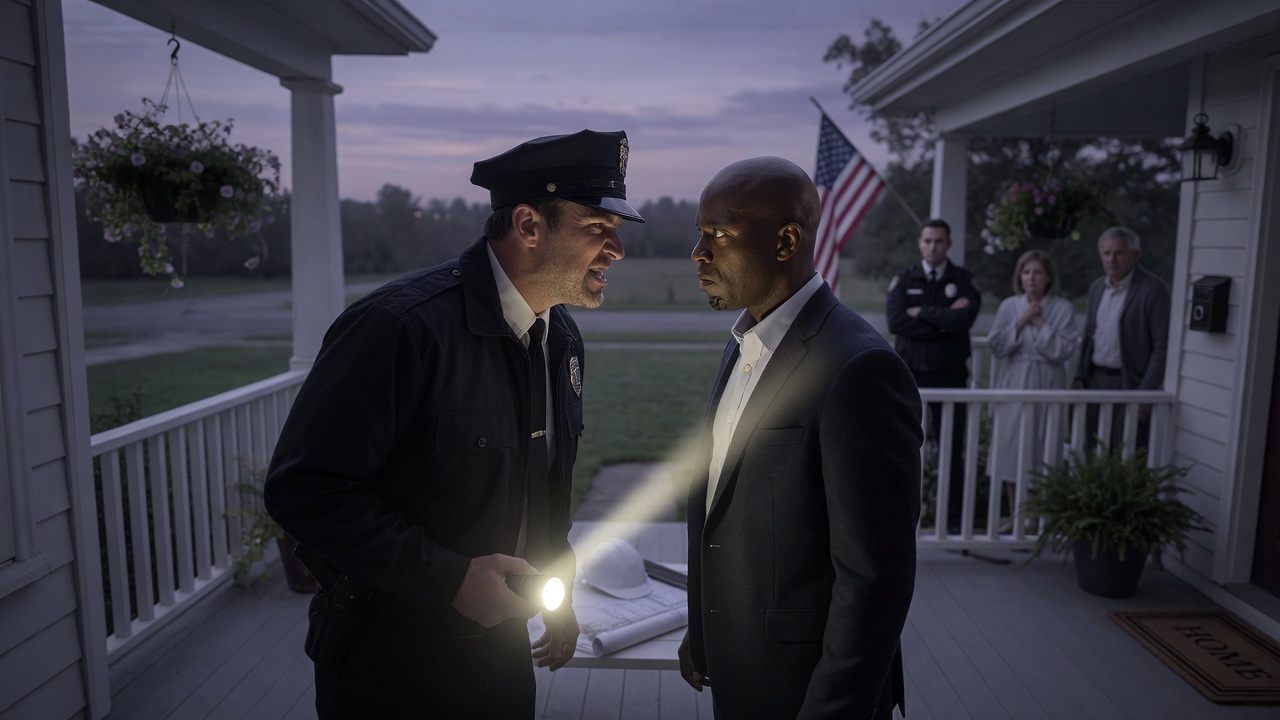
I Finally Built My Dream Home In The Most Exclusive, Heavily Guarded Gated Community In The State. But A Simple Evening Search Turned Into A Standoff On My Own Front Porch That Shattered My Reality Forever.

I’ve spent my entire life designing safe havens for other people, but absolutely nothing could have prepared me for the sheer terror I felt standing on my own front porch with a police flashlight blinding my eyes.
My name is Marcus. I am an architect. For the last fifteen years, I’ve poured my blood, sweat, and tears into my firm, working eighty-hour weeks to provide a life for my family that my parents could only dream of.
Two months ago, that dream culminated in moving into Oak Creek Estates.
Oak Creek is the kind of neighborhood where the lawns look like they were cut with nail scissors. The kind of place with wrought-iron gates, a 24/7 security booth, and a pristine, artificial lake in the center.
It is also the kind of neighborhood where my wife, my seven-year-old daughter Chloe, and I are the only Black family for miles.
I knew there would be an adjustment period. I noticed the lingering stares when I checked my mail. I saw the way curtains twitched when I pulled my car into the driveway of the ultra-modern, glass-and-steel home I had designed from scratch.
But I told myself it was just curiosity. I told myself that success was the ultimate equalizer.
I was wrong. Dead wrong.
It happened on a Tuesday evening. The golden hour had just broken, painting the manicured neighborhood in a warm, deceptively peaceful amber light.
I was in my home office reviewing blueprints when I heard the heart-wrenching sound of my daughter crying.
I rushed into the living room to find Chloe sobbing uncontrollably. The back patio door was slightly ajar.
Buster was gone.
Buster was a clumsy, three-month-old golden retriever mix we had rescued just a week prior. He was Chloe’s best friend, her shadow. And somehow, he had slipped through the crack in the door and wandered out into the massive, unfamiliar neighborhood.
“I’ll find him, baby. I promise,” I told her, grabbing a heavy-duty nylon leash with a thick metal clasp from the hook by the door.
I stepped out into the evening air. The warmth of the day was rapidly evaporating, replaced by a cool, creeping twilight.
The neighborhood was dead silent. The kind of agonizing silence that makes your own heartbeat sound like a drum in your ears.
I started jogging down the pristine sidewalk, whistling softly and calling Buster’s name.
As I moved further from my house, the amber light faded into a bruised, muted purple. The perfectly symmetrical trees lining the street began to look like towering shadows, closing in on me.
I had been jogging and searching for about fifteen minutes when I felt it.
That primal, unsettling feeling of eyes burning into the back of your neck.
I slowed my pace. The only sound was the rhythmic squeak of my running shoes on the asphalt and the soft jingle of the metal clasp on the leash in my hand.
Then, I heard the low, electric hum of a golf cart approaching from behind.
I stepped off the asphalt and onto the edge of the grass to let it pass. But it didn’t pass.
The cart swerved sharply, cutting off my path on the sidewalk. The tires tore into the perfectly manicured turf.
Before I could even process what was happening, a blinding beam of halogen light hit me directly in the face.
I raised my arm to shield my eyes, temporarily blinded. The light was so intense it burned.
“What are you doing out here?” a harsh, grating voice demanded from behind the glare.
It was Gary. I recognized his voice from the homeowners’ association meeting. He was the self-appointed head of the neighborhood watch, a man who treated his volunteer position like he was guarding the gold at Fort Knox.
“I’m looking for my dog,” I said, trying to keep my voice calm and even. I squinted, trying to make out his face behind the blinding light. “He got out about twenty minutes ago. Have you seen a golden retriever puppy?”
Gary didn’t lower the flashlight. In fact, he stepped out of the golf cart and moved closer.
“I asked you what you’re doing in this neighborhood,” Gary repeated, his tone thick with suspicion and hostility.
“I live here, Gary,” I replied, forcing a polite smile I didn’t feel. “I’m Marcus. We met briefly at the HOA meeting last month. I designed the modern house on the corner of Elm and Maple.”
“Nobody lives in that house yet,” Gary snapped back instantly. “The construction just finished.”
“We moved in two weeks ago,” I said, my patience beginning to thin. My daughter was at home crying over her puppy, and I was standing here debating my own existence with a man shining a spotlight in my eyes.
“I know everyone in Oak Creek, buddy,” Gary said, his voice dripping with condescension. “And I don’t know you. Now, I’m going to ask you one more time. What are you doing walking around looking into people’s yards?”
“I am looking for my family’s puppy,” I stated firmly, my voice dropping an octave. I lowered my hand and held up the nylon leash to show him.
The second the streetlamp caught the heavy metal clasp of the leash, the entire atmosphere shattered.
Gary violently flinched backward. He dropped the flashlight. It hit the concrete with a loud crack, the beam spinning wildly before settling on the grass.
“He’s got a weapon!” Gary screamed into a walkie-talkie clipped to his chest. “Suspect is armed! Send PD now! Oak Creek Boulevard, near the south gate!”
My heart stopped.
The blood drained from my face, replaced by a cold, prickling wave of absolute terror.
“Gary, it’s a dog leash!” I yelled, dropping it to the ground instantly. The metal clattered against the pavement. I raised both my hands high in the air, my palms facing completely open. “Look! My hands are empty! It’s a leash!”
“Stay right where you are! Don’t you take another step!” Gary barked, backing away and reaching into his jacket. I couldn’t see what he was grabbing, and my mind immediately went to the worst-case scenario.
I was a Black man standing in a wealthy White neighborhood in the dark. The neighborhood watch had just told dispatch I was armed. I knew exactly how this story usually ended.
“I’m not moving,” I said, my voice trembling despite my best efforts to control it. “I am standing still. I live at 402 Maple Drive. My name is Marcus Vance.”
The agonizing silence returned, broken only by Gary’s heavy breathing and the distant, terrifying sound of a siren cutting through the night air.
The siren grew louder. Fast. Too fast.
Within ninety seconds, the high-pitched wail was deafening. The squeal of tires echoed down the boulevard.
A police cruiser tore around the corner, jumping the curb and screeching to a halt just ten feet away from me. The headlights blinded me all over again.
The doors flew open before the car was even fully in park.
“Show me your hands! Get your hands where I can see them!” a voice boomed from behind the driver’s side door.
“My hands are up!” I shouted back, my arms stretching so high my shoulders ached. “I live here! I am completely unarmed!”
“He dropped a weapon on the ground!” Gary yelled from the safety of his golf cart. “He was casing houses!”
Two officers advanced, their hands resting ominously on their holsters. The flashing red and blue lights painted the manicured trees and perfectly paved roads in alternating colors of panic.
“Turn around and face away from me!” the lead officer commanded.
I slowly, deliberately turned my back to them. I was trying to remember every rule of survival I had ever been taught. No sudden movements. No loud noises. Obey every command.
“I am turning around,” I narrated my own actions. “I am turning around now.”
“Get on your knees!”
I sank to the cold asphalt. The gravel bit into my bare skin through my running shorts.
“I have ID in my right pocket,” I called out, staring straight ahead at the impeccably clean street. “My house is exactly two blocks away. My daughter is inside.”
An officer grabbed my arms, wrenching them behind my back. The cold steel of handcuffs ratcheted tightly around my wrists, pinching my skin.
I was hyperventilating. I was a respected architect, a father, a husband. I had designed the very streets these men were arresting me on. And yet, none of it mattered. In the dark, in this neighborhood, I was just a threat.
They hauled me to my feet.
“Let’s go verify this address,” the officer muttered, grabbing me by the bicep and marching me down the street.
Gary followed closely behind in his golf cart, a smug, satisfied silence radiating from him.
Every step back toward my house felt like a mile. The cruiser crawled alongside us, its lights flashing against the pristine facades of the million-dollar homes I had walked past just an hour ago.
We finally reached the corner of Elm and Maple.
There it was. My home. The beautiful, asymmetrical glass-and-cedar masterpiece I had spent two years designing.
The lights were on inside. Through the massive front window, I could see the living room.
My heart hammered violently against my ribs.
I saw my wife, Sarah, pacing the floor.
And then, I saw the front door slowly begin to open.
“Stop,” I whispered, panic rising in my throat. I tried to pull away from the officer’s grip. “Please. My family is in there. Let me talk to them first. Don’t do this in front of my daughter.”
“Keep moving,” the officer commanded, shoving me forward toward the stone path leading to my own front porch.
We reached the steps. The porch lights flicked on, illuminating the scene in harsh, unforgiving detail.
The heavy mahogany front door swung wide open.
But it wasn’t my wife stepping out onto the porch.
It was my seven-year-old daughter, Chloe.
And what she was holding in her tiny arms made my blood run entirely cold.
CHAPTER 2
The heavy mahogany front door swung wide open, the hinges entirely silent. I had designed it that way. I had overseen every single millimeter of this house’s construction, obsessing over the details to create a sanctuary of absolute peace for my family.
But as the warm, golden light of our hallway spilled out onto the dark, cold porch, my sanctuary shattered into a million jagged pieces.
It wasn’t my wife, Sarah, stepping out into the chaotic night.
It was my seven-year-old daughter, Chloe.
She looked so incredibly small. She was wearing her favorite oversized pink pajamas, the ones covered in tiny, faded yellow stars. Her bare feet curled against the cold, custom cedar planks of the porch floor—the same planks I had spent three excruciating weeks sourcing from a specialty lumberyard to ensure our home was absolutely perfect.
Her dark curls were messy, framed by the harsh, unforgiving glare of the police cruiser’s strobe lights reflecting off the massive glass windows behind her.
She stood there, frozen, her large brown eyes blinking rapidly as she tried to process the nightmare unfolding on her front lawn. She saw the flashing red and blue lights. she saw the strange men in dark uniforms.
And then, her eyes found me.
She saw her father, her protector, the man who checked under her bed for monsters every single night, standing on the gravel walkway with his arms violently twisted behind his back, held captive by two police officers.
“Daddy?” her small, trembling voice called out, barely carrying over the low rumble of the police cruiser’s engine.
But it wasn’t the confusion in her voice that made the blood freeze in my veins. It wasn’t the tears welling up in her eyes.
It was what she was holding in her tiny hands.
She wasn’t holding Buster, the lost puppy I had gone out to find.
She was holding my industrial laser-measuring tool.
It was a piece of equipment I used every single day on active construction sites. It was heavy, encased in thick, matte-black rubber for durability, with a prominent, metallic silver lens barrel at the front. It had a pistol-style grip so I could hold it steady when calculating distances across large empty lots.
To Chloe, it was just another one of Daddy’s fascinating gadgets that she wasn’t supposed to touch. She must have grabbed it from my home office desk while searching for the dog, perhaps thinking the red laser pointer could help her see in the dark yard.
But in the shadowed darkness of our front porch…
Under the frantic, sweeping beams of the police flashlights…
Bathed in the erratic, strobing colors of the sirens…
It looked exactly like a compact handgun.
Time didn’t just slow down; it stopped entirely. The universe contracted until nothing existed except the black rubber grip in my little girl’s hands and the twitching fingers of the men standing next to me.
“Hey! Drop it!” the officer holding my left arm suddenly screamed.
His voice was a deafening, guttural roar of pure panic. The sound ripped through the quiet neighborhood like a physical shockwave.
Before my brain could even fully process the words, I felt his grip on my bicep release.
Out of the corner of my eye, I saw the terrifying, unmistakable silhouette of his right hand dropping to his hip. I heard the thick leather of his holster creak.
Clack.
The sound of the thumb-break safety snapping open. It was a small, mechanical noise. Barely a whisper compared to the sirens. But in that moment, it was the loudest, most devastating sound I had ever heard in my entire life. It was the sound of my world ending.
“Weapon! She’s got a weapon! Drop it right now!” the second officer yelled, stepping back and angling his body, his own hand flying to his waist.
Chloe flinched violently. She didn’t understand. She was seven years old. She had never been yelled at by a stranger in her life, let alone by men in armor standing on her lawn.
Instead of dropping the heavy measuring tool, her tiny fingers clamped tighter around the black rubber grip in sheer terror. She took a small, uncertain step forward toward the edge of the porch, raising her hands defensively to shield her eyes from the blinding flashlights.
She was lifting the black, pistol-shaped object right toward the officers.
“NO!”
The scream tore from my throat with a raw, primal force I didn’t know I possessed. It didn’t even sound like a human voice. It sounded like an animal being torn apart.
Adrenaline, pure and blinding, flooded my system. Every instinct I had as a father, every biological imperative to protect my offspring, hijacked my muscles.
I didn’t care that I was handcuffed. I didn’t care that I was surrounded by armed men who already viewed me as a threat.
I violently twisted my torso, throwing my entire body weight sideways to break the remaining officer’s grip on my arm. The steel of the handcuffs bit deep into the delicate skin of my wrists, grinding against the bone, but I couldn’t feel the pain. I couldn’t feel anything but the desperate, suffocating need to get between the metal barrels of those guns and my little girl.
“It’s a tape measure! It’s a laser pointer! She’s a child!” I shrieked, lunging forward with my shoulders angled, trying to position myself directly in their line of sight.
“Get down! Get on the ground!” the first officer roared, his service weapon now fully drawn and leveled in a two-handed grip.
The black barrel of his gun was pointed squarely at my front porch. Pointed straight at the pink pajamas with the yellow stars.
I threw myself onto the gravel path, landing hard on my knees, purposely placing my own body right in the center of the walkway, blocking their view of the porch. If they were going to pull the trigger, the bullet was going to have to go through me first.
“Don’t shoot!” I begged, my voice cracking, tears streaming down my face, mixing with the sweat and the dirt. “Please, God, I’m begging you! Look at her! She’s seven years old! It’s a tool! I’m an architect! It’s a laser measure!”
Chloe was sobbing now. A high-pitched, hysterical wailing that cut right through my soul. She dropped the heavy black tool. It hit the cedar planks of the porch with a hollow, plastic thud, bouncing once before sliding to a stop near the edge of the steps.
It didn’t sound like a gun dropping. It didn’t sound like metal. It sounded exactly like what it was: a piece of plastic and rubber.
But the guns didn’t lower.
The officers were breathing heavily, their adrenaline peaking, their training locking them into a state of combat readiness. They were frozen in an aggressive stance, their eyes darting between me on the ground and the sobbing child on the porch.
“Keep your hands where I can see them!” the officer yelled at Chloe.
He was yelling at a first-grader to show her hands.
“Leave her alone!” I screamed, thrashing against the handcuffs, the metal slicing deeper into my wrists. Blood began to trickle down my hands, warm and sticky. “She’s just a baby! Sarah! SARAH!”
Suddenly, the front door was pushed open wider.
My wife, Sarah, sprinted out onto the porch. She had been in the back of the house, probably searching the guest rooms for the puppy. She was wearing her soft gray sweatpants and a college t-shirt.
She stopped dead in her tracks, taking in the impossible, horrifying tableau in front of her.
Her husband, handcuffed, bleeding, kneeling in the dirt of their own front yard.
Her daughter, crying hysterically, paralyzed with fear at the edge of the porch.
And two police officers, their service weapons drawn and aimed directly at her family.
For a split second, Sarah’s face went completely blank with shock. Then, a mother’s instinct took over.
She didn’t hesitate. She didn’t freeze. She threw herself entirely over Chloe, wrapping her body around our daughter, burying Chloe’s face into her chest to shield her from the lights, the yelling, and the guns.
“What are you doing?!” Sarah screamed at the top of her lungs, her voice trembling with an explosive mixture of terror and absolute rage. “Put your guns down! Are you insane? She’s a little girl! We live here!”
“Ma’am, step away from the object on the floor!” the officer commanded, though his voice wavered slightly. The sight of a mother shielding her child seemed to crack the armored shell of his panic, just a fraction.
“It’s a measuring tape!” Sarah screamed back, pointing furiously at the black object resting on the cedar planks. “You are pointing a gun at a first-grader over a measuring tape! Call your supervisor right now! Get your supervisor here immediately!”
The tension in the air was so thick it was suffocating. The silence that followed Sarah’s screaming was agonizing.
I stayed on my knees, my breath coming in ragged, shallow gasps. I stared at the dark barrel of the gun still pointed in our general direction. I was waiting for the loud crack. I was waiting for the unimaginable.
Slowly, agonizingly slowly, the officer in front lowered his weapon. He didn’t holster it, but he pointed the muzzle toward the perfectly manicured grass.
He reached up with his left hand and clicked on a high-powered tactical flashlight mounted to his shoulder, aiming the concentrated beam directly at the porch.
The bright white circle of light illuminated the dropped object perfectly.
In the harsh glare, there was no mistaking it. It had bright yellow warning stickers on the side. It had a digital LCD screen on the top. It was blatantly, obviously, undeniably a construction tool.
The officer let out a long, shaky exhale. He holstered his weapon. The click of the gun snapping back into the leather holster was a sound of salvation, yet it brought me no comfort. The damage was already done. The line had been crossed, and my reality had been permanently altered.
The second officer followed suit, securing his firearm and taking a step back, suddenly looking very uncomfortable in his heavy uniform.
Gary, the neighborhood watchman, had pulled his golf cart up to the edge of my driveway during the chaos. He sat there in the driver’s seat, his mouth hanging slightly open, staring at the scene unfolding. He didn’t look triumphant anymore. He looked pale.
“Jesus Christ,” the first officer muttered under his breath, running a hand over his face. He stepped forward toward me, his demeanor entirely shifted. The aggressive, adrenaline-fueled predator was gone, replaced by a man suddenly realizing the massive, catastrophic mistake he had just made.
“Hey, buddy,” he said, his voice softer, attempting a calming tone that made me violently nauseous. “I’m gonna help you up now, okay? Just take it easy.”
He reached down and grabbed me by the shoulder, hoisting me to my feet. My legs felt like lead. My knees were scraped raw from hitting the gravel, and my wrists burned with a fiery, sharp pain.
“Take these off,” I demanded, my voice eerily calm, a dead, flat tone that frightened even me. I didn’t yell. I didn’t scream. I just stared a hole directly through his skull. “Take the handcuffs off. Now.”
“Sir, we need to clear this up first—” the second officer started to say, stepping forward with his notebook out.
“Take them off!” Sarah shrieked from the porch, standing up but keeping Chloe tightly pressed behind her legs. “He hasn’t done anything wrong! He was looking for our dog!”
The first officer swallowed hard. He looked at me, looked at my bleeding wrists, and then looked at the massive, multi-million dollar house behind me. He looked at the custom landscaping, the expensive cars in the driveway, and the terrified mother and child on the porch.
He finally realized exactly where he was, and exactly who he had just assaulted.
He pulled a small silver key from his belt and stepped behind me. I felt the cold metal of the cuffs loosen, the agonizing pressure releasing from my bones. The heavy steel bracelets fell away, dangling from his hands.
I brought my arms forward, wincing as the blood rushed back into my numb hands. My wrists were bruised a deep, angry purple, with several deep cuts where the metal had dug into my skin.
I didn’t rub them. I didn’t look at the officers.
I walked straight past them, my shoes crunching on the gravel path. I walked up the three custom cedar steps I had designed to welcome guests. I walked over the black laser measure still lying on the floor.
I fell to my knees on the porch and wrapped my arms around my wife and my daughter. Chloe buried her face in my neck, her small hands grabbing fistfuls of my shirt, her tiny body trembling so violently it felt like she was having a seizure.
“I got you, baby,” I whispered into her messy curls, tears finally breaking free and tracking down my face. “Daddy’s right here. You’re safe. You’re okay.”
But as I held my family on the porch of our dream home, staring out at the flashing police lights reflecting off the perfectly manicured lawns of Oak Creek Estates, I knew it was a lie.
We weren’t safe.
We had done everything right. I had gone to the best schools. I had built a thriving business. I had bought into the most exclusive, heavily guarded gated community in the state to ensure my family would never have to worry about the dangers of the world.
I had built a fortress.
But I had forgotten the most terrifying truth of all.
When you look like me, it doesn’t matter how high you build the walls, how expensive the gates are, or how perfectly cut the grass is.
The threat isn’t outside the gates trying to get in.
The threat is already inside.
I slowly turned my head and looked back toward the street. The officers were standing by their cruiser, talking in hushed, nervous tones, occasionally gesturing toward my house.
And then I looked at Gary.
He was still sitting in his golf cart at the end of my driveway. The flashing lights cast harsh, shifting shadows across his face. He wasn’t looking at the officers. He was looking right at me.
There was no apology in his eyes. There was no regret.
There was only a cold, hard stare that delivered a very clear, unspoken message.
You don’t belong here.
I tightened my grip around my daughter, a new kind of coldness settling deep into my bones. The immediate danger had passed, but the real nightmare was just beginning.
Because I wasn’t just going to pack up and leave. I wasn’t going to let them win. I had built this house, and I was going to stay in it.
Even if it meant going to war with the entire neighborhood.
And as I sat there on the cold wood of my porch, comforting my sobbing child, a new, chilling thought suddenly pierced through the adrenaline and the trauma.
In all the chaos, the screaming, the guns, and the terror…
We still hadn’t found the puppy.
CHAPTER 3
I stayed on my knees on the cold cedar planks of my front porch long after my wife, Sarah, had gently pulled Chloe inside.
The heavy mahogany door clicked shut behind them, sealing my family back inside the fortress I had built. But the illusion of safety was permanently broken. I could still hear Chloe’s muffled, hysterical sobbing echoing through the foyer. Every jagged breath she took felt like a physical knife twisting deep into my ribs.
Outside, the neighborhood was suffocatingly quiet, save for the low, rumbling idle of the police cruiser parked aggressively on my front lawn.
I slowly pushed myself up to my feet. My muscles felt like they were filled with wet cement. The adrenaline crash was hitting me in rolling waves, leaving behind a cold, violent nausea. I looked down at my hands. The deep, raw indentations from the steel handcuffs were already bruising a dark, ugly purple against my skin. Small beads of blood were drying in the cool night air.
I turned my head and looked back toward the street.
The two officers were standing by the hood of their cruiser. The flashing red and blue strobe lights had been turned off, leaving only the harsh, blinding white beams of their headlights cutting across my meticulously landscaped yard.
They were talking in hushed, hurried tones. One of them had a radio pressed to his shoulder, his eyes darting nervously toward my house every few seconds.
They were scared.
They weren’t scared of me anymore. They were scared of the multi-million dollar house behind me. They were scared of the custom architecture, the imported luxury cars in the driveway, and the massive, catastrophic liability they had just created. They had drawn their service weapons on a seven-year-old child holding a tape measure on her own front porch in one of the wealthiest zip codes in the county.
And they knew exactly how bad it looked.
I took a deep, shaky breath, letting the cold air fill my lungs, and walked slowly down the three cedar steps.
My shoes crunched against the gravel pathway. The sound was loud in the dead silence of Oak Creek Estates. As I approached the cruiser, both officers stopped talking immediately. They stood up straighter, adjusting their heavy duty belts, trying to project an aura of authority that had completely evaporated ten minutes ago.
“Sir,” the first officer started, stepping forward and raising his hands in a gesture that was supposed to look placating but just felt condescending. He was the one who had drawn his gun first. I committed his face to memory. He was young, maybe late twenties, with a tight buzzcut and a nervous tick in his jaw. “Listen, we need to talk about what just happened here.”
“There is absolutely nothing to talk about,” I said. My voice was eerily calm, a flat, dead monotone that surprised even me. I didn’t yell. I didn’t raise my voice. I just stared right through him. “I want your badge numbers. Both of them. And I want your supervisor here. Right now.”
“Sir, you have to understand this from our perspective,” the second officer chimed in, stepping around the hood of the car. He was older, heavier, with a thick mustache that twitched as he spoke. He was trying to use the ‘reasonable man’ voice. “We get a frantic call from the neighborhood watch. Dispatch says there’s a suspect casing houses, armed with a weapon, acting erratically. It’s dark. You matched the description. We were responding to a high-risk threat.”
“A high-risk threat?” I repeated, my voice dropping an octave, the suppressed rage finally beginning to leak through the cracks. “I was walking down the sidewalk in athletic shorts and a t-shirt, holding a nylon dog leash. I am a forty-two-year-old architect. I built this house. I built the house on the corner you drove past. And you drew a firearm on my seven-year-old daughter.”
“It was dark,” the younger officer repeated defensively, his face flushing a deep, angry red. “She had a dark object in her hands that resembled a firearm. In a high-stress, low-visibility environment, we are trained to eliminate the threat. We followed procedure. Once we identified the object was not a weapon, we stood down. Nobody got hurt.”
“Nobody got hurt?” I laughed, a harsh, bitter sound that held zero humor. I held up my wrists, thrusting them directly into the beam of their headlights so they could see the raw, bleeding skin. “You assaulted me on my own property. You dragged me through the dirt. You terrorized my wife. You aimed a loaded gun at a first-grader in pink pajamas. If she had sneezed, if she had dropped that tape measure a second too late, you would have murdered my little girl on my front porch.”
The young officer swallowed hard, his Adam’s apple bobbing in his throat. He looked away, unable to meet my eyes.
“Look, Mr. Vance,” the older officer said, consulting his notepad where he had clearly just run my name through their database. “We apologize for the misunderstanding. Truly. It’s a terrible situation. But the neighborhood watch called it in as a weapons charge. We had to respond accordingly. It’s better to be safe than sorry.”
“Safe for who?” I asked, stepping closer until I was mere inches from the older officer’s face. I could smell the stale coffee and wintergreen mints on his breath. “Because my family doesn’t feel very safe right now. And I guarantee you, neither does my lawyer.”
The mention of a lawyer did exactly what I knew it would do. The older officer’s jaw tightened. The young officer shifted uncomfortably on his feet.
Before they could spew any more rehearsed PR garbage, the low, heavy rumble of a massive SUV engine broke the silence.
A black police Ford Explorer turned the corner of Maple Drive, moving significantly slower and more cautiously than the first cruiser had. The headlights swept across the manicured lawns before coming to a stop right behind the patrol car.
A heavy-set man in a crisp white uniform shirt stepped out. He had silver hair, a thick neck, and a gold badge pinned to his chest. A Sergeant.
He took one look at the scene—the bleeding homeowner, the panicked rookie officers, the massive, ultra-modern house, and the neighborhood watch golf cart still idling a block away—and I saw his shoulders physically drop. He knew he had a massive problem on his hands.
“Sergeant Miller,” the older officer said quickly, stepping away from me to intercept his boss. “We responded to a 10-32 call from the neighborhood watch. Suspect with a weapon. We arrived on scene, detained the individual, but it turned out to be a misunderstanding. The weapon was a construction tool.”
Sergeant Miller didn’t look at his officers. He looked at me. He walked past them, his heavy black boots crunching loudly on the gravel, and stopped a respectful distance away.
“Mr. Vance?” he asked, his voice low and gravelly.
“Yes,” I replied, crossing my arms over my chest, ignoring the stinging pain in my wrists.
“I am Sergeant Miller. I’m the shift supervisor for this district,” he said, taking off his uniform hat and holding it in his hands. It was a calculated move. A sign of respect meant to de-escalate the homeowner who could clearly afford to sue the city into bankruptcy. “I want to personally apologize for what happened here tonight. This is not the standard of service we strive for in Oak Creek.”
“Your officers held my family at gunpoint,” I said simply, refusing to let him control the narrative. “They handcuffed me without asking a single question. They ignored me when I told them I lived here. And they pointed a loaded gun at my seven-year-old child.”
“I am aware of the details, sir. I was listening to the radio chatter,” Sergeant Miller said, his face a carefully constructed mask of professional sympathy. “I have already ordered these officers to stand down and return to the station. There will be a full internal review of this incident. I promise you that.”
“A review,” I repeated dryly. “And what about Gary?”
I pointed a finger down the street. The golf cart was still parked near the community stop sign. Gary was sitting in the driver’s seat, watching the interaction like it was a reality television show.
“The neighborhood watch?” Miller asked, turning to look at the golf cart.
“The man who lied to dispatch,” I corrected him. “The man who told your officers I was an armed suspect casing houses. He initiated a false police report that nearly got my family killed. What are you going to do about him?”
Sergeant Miller sighed, a long, tired sound. “Mr. Vance, Mr. Gary is the registered head of the HOA security committee. He believed he saw a weapon. He acted on what he perceived to be a threat. In the dark, a metal dog leash can catch the light…”
“Don’t do that,” I interrupted, my voice slicing through the cold air like a razor blade. “Do not stand on my property and defend that man. He didn’t see a weapon. He saw a Black man in a wealthy neighborhood, and he wanted me gone. He weaponized your officers to do it.”
The Sergeant didn’t argue. He just looked at me with a sad, knowing expression that made me sick to my stomach. He knew I was right. Everyone standing on that street knew I was right. But the system was designed to protect Gary, and to criminalize me.
“I will be filing a formal complaint tomorrow morning,” I stated, my tone leaving absolutely no room for debate. “With the police department, with the city council, and with the HOA board. Now, get off my property.”
Miller nodded slowly. He put his hat back on. “Have a good night, Mr. Vance.”
“Get off my property,” I repeated, louder this time.
The officers didn’t say another word. They climbed back into their vehicles, the heavy doors slamming shut in unison. The engines revved, and the cruisers slowly pulled away, their tail lights bleeding red into the darkness.
As they passed Gary’s golf cart at the end of the street, they didn’t stop. They didn’t roll down their windows to speak to him. They just kept driving, leaving Oak Creek Estates in a heavy, suffocating silence.
Gary sat there for another ten seconds, staring down the street at me. Even from a block away, I could feel the hostile, toxic energy radiating from him.
Then, he slowly pressed the accelerator. The electric hum of the golf cart whined into the night as he turned the corner and disappeared into the labyrinth of manicured lawns.
I was finally alone.
I turned back toward my house. The massive floor-to-ceiling glass windows glowed with a warm, inviting light. It looked like something out of an architectural magazine. A masterpiece of modern design.
But right now, it just looked like a giant, glass cage.
I walked up the steps and pushed the front door open.
The house was dead silent. I walked through the foyer, past the custom floating staircase I had designed, and into the massive, open-concept kitchen.
Sarah was sitting at the massive marble island. She had a first aid kit open on the counter. She looked up when I walked in, her eyes red and puffy from crying.
“Where is she?” I asked softly.
“She’s in her room,” Sarah whispered, her voice trembling. “She won’t talk. She won’t stop crying. Marcus, she’s terrified. She thinks the police are coming back to take you away.”
I closed my eyes, a fresh wave of agony washing over me. I walked over to the kitchen island and sat on one of the heavy, brushed-steel barstools.
Sarah stood up and moved behind me. She took a bottle of antiseptic from the first aid kit and a clean white washcloth. Without saying a word, she gently took my hands and began to clean the raw, bloody cuts around my wrists.
The stinging pain of the alcohol was sharp, but I didn’t flinch. I just stared blankly at the dark granite countertops.
“We’re leaving,” Sarah said quietly, her voice thick with unshed tears. “I’m packing a bag right now. We are going to a hotel downtown. We’re going to call a realtor in the morning.”
I looked up at her. “Sarah, no.”
“Yes, Marcus!” she suddenly exploded, her voice echoing off the high ceilings. She dropped the bloody washcloth onto the counter. “They pointed a gun at our daughter! A gun! On our front porch! I don’t care how much this house cost. I don’t care how long you worked on it. We are not safe here! These people hate us!”
“If we leave, they win,” I said, my voice rising to match hers. “If we pack up and run into the night, Gary wins. He gets exactly what he wants. He scares the Black family out of the neighborhood.”
“I don’t care about Gary!” Sarah screamed, tears streaming down her face. “I care about Chloe! I care about you! I thought you were going to die on that grass, Marcus. I thought I was going to watch my husband bleed out on the lawn while our daughter watched. I am not doing this. I am not living like this.”
She buried her face in her hands, her shoulders shaking with heavy, racking sobs.
I stood up and wrapped my arms around her, pulling her tightly against my chest. She cried into my shirt, gripping the fabric of my back like she was afraid I was going to disappear.
“I know,” I whispered into her hair, my own tears silently falling. “I know. I am so sorry. I am so incredibly sorry.”
We stood there in the middle of our perfect, multi-million dollar kitchen, holding each other, entirely broken. The dream we had worked fifteen years to build had turned into a nightmare in a matter of twenty minutes.
After a long time, Sarah pulled away. She wiped her eyes, her expression hardening into a look of absolute maternal resolve.
“I am going to go sit with Chloe,” she said quietly. “Lock the doors. Set the alarm system to stay. I don’t want anyone getting near this house tonight.”
She turned and walked down the hallway toward the bedrooms.
I stood alone in the kitchen for a moment, the silence of the house pressing down on me like a physical weight. I walked over to the security panel mounted on the wall. I punched in the code, and the system chimed, a robotic voice announcing that the perimeter was armed.
I leaned against the wall, taking a deep, shuddering breath. I needed a shower. I needed to wash the dirt and the blood and the smell of the police officers off my skin. I needed to sleep and wake up and pretend this was all a horrible dream.
But as I stood there in the quiet hallway, a sudden, horrifying realization struck me like a physical blow to the chest.
In the chaos. In the screaming. In the terror of the guns and the flashing lights.
We had completely forgotten why I went outside in the first place.
I walked quickly down the hall and gently pushed open the door to Chloe’s bedroom.
The room was bathed in the soft, purple light of her galaxy projector. She was curled up into a tiny ball in the center of her massive bed, clutching her favorite stuffed bunny so tightly her knuckles were white. Sarah was lying next to her, gently stroking her hair.
Chloe’s eyes were wide open, staring blankly at the wall. When she heard the door open, she flinched violently.
“It’s just me, baby,” I said softly, staying near the door so I didn’t crowd her. “It’s Daddy.”
She didn’t speak, but she slowly turned her head to look at me. Her large brown eyes were filled with an ancient, exhausting trauma that no seven-year-old should ever have to carry.
“Daddy?” her small voice rasped, raw from crying.
“Yes, sweetheart?”
“Did you find Buster?”
The question hung in the air, heavy and devastating.
My heart completely shattered. Buster. The clumsy, three-month-old golden retriever puppy. The reason I had grabbed the leash. The reason I had walked out into the dark. The reason my family had almost been destroyed.
He was still out there.
“Not yet, baby,” I whispered, fighting back a fresh wave of tears. “But I will. I promise you, I will.”
Chloe just nodded slowly, burying her face back into her mother’s chest. She didn’t have the energy to cry anymore. She was completely broken.
I backed out of the room and gently pulled the door shut.
I stood in the hallway for a long time, staring at the hardwood floor.
My wife wanted to leave. My daughter was traumatized. The police had shown me exactly what they thought my life was worth. Any sane man would have locked the doors, packed a bag, and waited for the morning sun to escape.
But I couldn’t do it.
I couldn’t look my daughter in the eyes tomorrow morning and tell her that the men with the guns had won. I couldn’t tell her that we lost her best friend because her father was too afraid to go back outside.
I walked into my home office. I bypassed the sleek, modern desk lamps and opened the bottom drawer of my filing cabinet. I reached past the architectural blueprints and the property deeds, and pulled out a heavy-duty, military-grade tactical flashlight. It was made of solid aircraft aluminum, heavy enough to be used as a club, and emitted a beam of light so powerful it could blind a man from a hundred yards away.
It wasn’t a weapon. But it felt like armor.
I walked back down the hallway, bypassing the kitchen, and headed straight for the front door.
I punched the code into the security panel, ignoring the robotic voice warning me that the perimeter was breached.
I pulled the heavy mahogany door open and stepped back out into the cold, creeping night.
The neighborhood was completely dark now. The golden hour was gone, replaced by a suffocating, ink-black darkness. The manicured lawns looked like dark, rolling oceans. The identical, symmetrical trees looked like silent sentinels waiting in the shadows.
It didn’t look like a neighborhood anymore. It looked like a hunting ground.
I gripped the heavy aluminum flashlight in my right hand, my knuckles turning white. I clicked the button on the back, and a blinding, blindingly bright beam of pure white light cut through the darkness, illuminating the pristine asphalt of Maple Drive.
I didn’t jog this time. I walked slowly, deliberately, my head on a swivel. Every shadow looked like a golf cart. Every distant rustle of the wind sounded like a police siren. My heart hammered violently against my ribs, pumping a toxic mixture of leftover adrenaline and fresh, cold terror through my veins.
“Buster!” I called out, my voice echoing loudly off the massive, silent houses. “Buster! Come here, boy!”
I walked for twenty minutes. I checked the artificial lake in the center of the community. I checked the pristine, empty playground near the north gate. I checked the dark, wooded perimeter that separated Oak Creek Estates from the state highway.
Nothing. Not a sound. Not a collar jingle. Not a paw print on the manicured grass.
It was as if the puppy had just vanished into thin air.
I was standing at the intersection of Oak and Elm, two blocks away from my house, when a sickening, terrifying thought suddenly crept into the back of my mind.
It was a thought so paranoid, so deeply cynical, that I almost pushed it away immediately. But after what had happened on my front porch an hour ago, paranoia felt like the only logical survival strategy.
I thought about Gary.
I thought about how quickly he had appeared on the street when I was looking for the dog. I thought about the smug, satisfied look on his face when the police had me in handcuffs. I thought about the way his golf cart had sped away without a single word of apology.
Gary lived three streets over, on the edge of the neighborhood, near the unfinished construction lots. His house was notorious in the HOA for having the largest, most heavily fenced-in backyard in the entire community.
I turned off my flashlight.
The sudden darkness was blinding, but I let my eyes adjust. The pale glow of the moon offered just enough light to see the outlines of the houses.
I started walking toward Gary’s street.
I didn’t call the dog’s name anymore. I moved as quietly as I possibly could, sticking to the shadows near the edge of the sidewalks, my running shoes making barely a sound on the concrete.
I felt like a criminal. I felt like exactly what the police had accused me of being. A man creeping through a wealthy neighborhood in the dark. But I didn’t care. I needed to know.
I turned the corner onto Willow Creek Lane. Gary’s house was at the very end of the cul-de-sac. It was a massive, sprawling colonial with perfectly trimmed hedges and a six-foot-tall, solid white vinyl privacy fence surrounding the entire property.
The house was completely dark. No porch lights. No interior lights. Just a silent, imposing structure at the end of the road.
I crept closer, moving off the sidewalk and onto the damp grass of the adjacent empty lot. I approached the side of his property, keeping low, my heart hammering so loudly I was terrified it would wake the neighbors.
I reached the tall white vinyl fence. I pressed my back against the smooth plastic, holding my breath, listening into the dead silence of the night.
For a long time, there was absolutely nothing. Just the wind rustling through the trees and the distant hum of the highway.
I closed my eyes, feeling a wave of exhaustion wash over me. I was being crazy. The trauma of the evening was making me paranoid. Gary was a racist, horrible man, but he wasn’t a cartoon villain. He didn’t steal my puppy. Buster was probably just lost in the woods.
I pushed off the fence, ready to turn around and walk back to my shattered family.
But just as I turned my body, I heard it.
It was faint. So incredibly faint it was barely a vibration in the air. But it was there.
A high-pitched, desperate whimper.
I froze instantly. The blood rushed entirely out of my head, leaving me dizzy.
I pressed my ear directly against the cold, hard plastic of the vinyl fence, shutting my eyes tightly to concentrate every ounce of my focus on the sound.
Whimper. Scratch. Whimper.
It was coming from the other side of the fence. Inside Gary’s locked, heavily secured backyard.
And it wasn’t just any dog. I knew that sound. I had spent the last week waking up to that exact sound at three in the morning when the puppy needed to go out.
It was Buster.
My breath caught in my throat. The sheer, terrifying reality of the situation crashed over me like a tidal wave of ice water.
Gary hadn’t just stumbled upon me looking for a dog. He had found the dog wandering the neighborhood earlier that evening. He had taken the puppy, locked him in his massive, impenetrable backyard, and then drove his golf cart out into the dark to wait.
He waited for the frantic Black homeowner to come out looking for his pet. He waited for me to be isolated, in the dark, panicked and vulnerable.
He hadn’t made a mistake. He had set a trap.
And I had walked right into it.
The low, frantic whimpering continued from the other side of the fence, accompanied by the distinct sound of tiny paws scratching desperately against the thick plastic.
I stepped back from the fence, looking up at the six-foot barrier. The rage that had been simmering inside of me all night finally boiled over, thick and blinding and absolute.
I didn’t care about the HOA. I didn’t care about the neighborhood watch. And God help me, I didn’t care if he called the police again.
I gripped the heavy tactical flashlight tightly in my hand, my jaw set so hard my teeth ached.
I walked to the heavy wooden side gate of Gary’s fence. It was secured with a thick, heavy steel padlock.
I raised the heavy aluminum flashlight high above my head, the metal glinting in the pale moonlight, and prepared to do whatever it took to get my daughter’s dog back.
CHAPTER 4
I raised the heavy aircraft-grade aluminum flashlight high above my head. The metal felt cold and heavy in my grip. My heart was pounding so hard against my ribs that it felt like it was trying to break through my chest.
I didn’t think about the neighborhood watch. I didn’t think about the homeowners’ association rules, or the property lines, or the fact that I was a Black man standing in the dark at the edge of a wealthy White man’s property.
I only thought about my daughter, crying herself to sleep, completely broken by the terror of this night.
I brought the heavy base of the flashlight down onto the thick steel padlock with every single ounce of strength I had left in my body.
CLANG.
The sound of metal violently striking metal echoed through the dead-silent cul-de-sac like a gunshot. The impact sent a painful, vibrating shockwave all the way down my arm, rattling my teeth.
The padlock didn’t break. It just bounced against the heavy wooden gate.
From the other side of the fence, Buster let out a sharp, terrified yelp, followed by more frantic scratching. He heard me. He knew I was there.
“I’m coming, buddy,” I whispered through clenched teeth, my breath pluming in the cold night air. “I’m right here.”
I adjusted my grip on the flashlight. My hands were slick with sweat, and the raw, bleeding cuts on my wrists from the police handcuffs screamed in agonizing pain. I ignored it. I raised my arm again, higher this time, pivoting my hips to put my entire core into the swing.
CLANG.
Another deafening crack. This time, I heard a satisfying metallic crunch.
I struck it again. And again.
CLANG. CRACK. SNAP.
On the fourth hit, the heavy steel U-bar of the padlock fractured completely, the internal locking mechanism shattering under the blunt force. The heavy metal body of the lock fell into the damp grass with a dull thud.
I dropped the flashlight to my side, my chest heaving, my lungs burning as I gasped for air. I reached out and pulled the heavy iron latch up.
I pushed the wooden gate open. It creaked loudly on its hinges, a sound that seemed entirely too loud in the suffocating quiet of the neighborhood.
I stepped into Gary’s backyard.
It was massive. It was a sprawling, perfectly manicured expanse of artificial turf, expensive patio furniture, and a high-end outdoor kitchen. It was pitch black, shadowed by the towering privacy fence.
I clicked my tactical flashlight back on, keeping the beam low to the ground so it wouldn’t shine into the house’s windows. The bright circle of white light swept across the dark grass.
It swept past a stone fire pit. It swept past a line of perfectly trimmed hedges.
And then, the beam caught a flash of gold.
“Buster,” I breathed out.
He was at the far corner of the yard, near a heavy wooden tool shed.
He wasn’t just wandering around the yard. He hadn’t just accidentally slipped through an open gate.
He was tied up.
Somebody had taken a thick, yellow nylon tow rope—the kind you use to pull a car out of a ditch—and wrapped it tightly around Buster’s collar. The other end of the heavy rope was tied in a complex, professional-grade knot around the thick, immovable base of a heavy iron lamppost.
The puppy had only about two feet of slack. He had been pulling against it so hard that he was choking, coughing and whimpering in the dark.
This wasn’t a mistake. This wasn’t a concerned neighbor securing a lost animal for the night.
This was a kidnapping. It was a calculated, malicious trap.
I ran across the cold artificial turf, dropping to my knees right next to the lamppost. I dropped my flashlight onto the grass and reached out with both hands.
Buster instantly threw himself at me, burying his wet nose into my chest, his tail wagging so hard his entire back half was vibrating. He was whining, licking the dirt and the dried blood off my hands. He was trembling violently, terrified by the cold and the dark.
“I got you, boy. I got you,” I whispered, my voice breaking. Tears hot and fast spilled over my eyelashes.
I reached for the thick yellow rope, my fingers desperately working at the tight knot. But whoever had tied this knew what they were doing. It was a slip knot, pulled incredibly tight by the puppy’s frantic struggling. It felt like trying to untie solid rock.
My raw, bleeding fingers slipped against the slick nylon. I gritted my teeth, ignoring the stinging pain in my wrists, and pulled harder.
Suddenly, the darkness of the yard vanished.
CLICK. CLICK. CLICK.
Three massive, high-powered halogen floodlights mounted to the roof of Gary’s house violently snapped on all at once.
The intense, blinding white light flooded the entire backyard, turning the dead of night into harsh, unforgiving high noon. The sudden brightness was like a physical blow. I threw my arm over my eyes, completely blinded.
“Get your hands off my property,” a voice boomed from the patio.
It was a harsh, gravelly voice. It didn’t sound panicked. It didn’t sound surprised. It sounded completely calm. It sounded satisfied.
I slowly lowered my arm, blinking rapidly as my eyes adjusted to the searing light.
Gary was standing on his elevated stone patio, about thirty feet away from me. He was wearing a heavy flannel robe over his clothes.
And he was holding a pump-action shotgun.
The long, dark double-barrel was leveled squarely at my chest. His finger was resting dangerously close to the trigger. The porch lights glinted off the cold, oiled steel of the weapon.
“Gary,” I said. My voice was eerily steady. I didn’t recognize my own tone. It was the voice of a man who had absolutely nothing left to lose.
“You broke my gate, Marcus,” Gary said loudly, stepping down the first stone stair of the patio. He racked the shotgun. The mechanical CHUK-CHUK sound of a shell loading into the chamber echoed off the tall privacy fences, sealing my fate. “You trespassed on my private property in the middle of the night. You smashed my lock. You are a violent intruder.”
The pieces fell into place with a sickening, horrifying clarity.
Gary hadn’t just stolen my dog to be cruel.
He had stolen my dog, locked him in the yard, and then initiated the police encounter on the street. When the police failed to arrest me, when they let me go back to my beautiful, expensive house, Gary moved to plan B.
He knew I would come looking for the puppy. He knew that if I heard the whimpering, I would enter his yard to get my family’s pet.
And in the state we lived in, Castle Doctrine was absolute law. A homeowner had the legal right to use lethal force against an intruder on their property after dark.
He didn’t just want me out of the neighborhood. He wanted me dead. And he had set it up so that the law would completely protect him.
Tomorrow morning, the news would report that a neighborhood watch captain shot a violent trespasser who had broken his gate in the middle of the night. My life, my career, my family—it would all be erased by a single shotgun shell and a legally protected lie.
“You stole my daughter’s dog,” I said, staying perfectly still on my knees next to the terrified puppy. I didn’t raise my hands. I didn’t cower. I just stared directly into the black barrels of the shotgun.
“That dog was running loose,” Gary sneered, taking another step closer. “It was a nuisance. I secured it. And then a violent criminal broke onto my property to steal it. That’s the story the police are going to hear.”
“The police were just at my house, Gary,” I said, my voice dropping lower, cutting through the cold air. “They know exactly who I am. Sergeant Miller knows exactly who I am.”
“Sergeant Miller knows you’re an agitated, aggressive man who hates authority,” Gary countered, a twisted, victorious smile spreading across his face. “He saw you screaming at his officers. He saw the blood on your hands. When he finds your body in my yard, he won’t be surprised at all. You people always think you can just take whatever you want.”
You people. There it was. The ugly, naked truth stripped of all its HOA polite neighborhood watch disguises. It was never about property values. It was never about security. It was about a man who could not stomach the idea that I had built a better life than he had.
I looked down at the heavy tactical flashlight resting on the artificial grass right next to my knee.
I had a choice to make.
I could beg. I could plead for my life. I could turn my back, leave the dog, and try to run, praying he missed his shot.
But I thought about Chloe on the porch. I thought about the guns pointed at her. I thought about the fact that if I ran now, I would spend the rest of my life running.
I slowly let go of Buster’s rope.
“Don’t move,” Gary warned, his grip tightening on the stock of the shotgun.
I didn’t listen. I slowly, deliberately stood up to my full height. I was six foot two, and I hadn’t spent fifteen years on active construction sites without building a solid frame. I squared my shoulders, staring down the barrel of the gun.
“Shoot me, then,” I said.
Gary flinched. Just a fraction of an inch, but I saw it. He wasn’t expecting defiance. He was expecting fear. He was expecting the stereotype he had built in his head.
“I said stay down!” Gary yelled, his voice cracking slightly, the absolute control of the situation slipping from his grasp.
“If you’re going to shoot me, Gary, do it,” I challenged him, taking one slow, deliberate step forward. “But you better make sure you kill me with the first shot. Because if you don’t, I am going to take that gun out of your hands and I am going to beat you to death with it.”
“Stop walking!” he screamed, aiming the barrel directly at my face. His hands were visibly shaking now. The reality of taking a human life was suddenly very different from the fantasy he had plotted in his head.
“Shoot me!” I roared, the pent-up rage, trauma, and terror of the entire night finally exploding out of me. I took another step. I was only fifteen feet away from him now. “Pull the trigger, you coward! Do it! Let the whole neighborhood hear it!”
“I have the right!” Gary stammered, backing up a step, his heels hitting the edge of the stone patio. “This is my property!”
“And I am an unarmed man looking for a puppy!” I yelled back, refusing to stop, refusing to break eye contact. “You think the police won’t see the tow rope? You think they won’t see the broken lock? You think you’re smart enough to cover up a murder in a neighborhood lined with ring cameras?”
He hesitated. For one split second, the barrel of the shotgun dipped.
That was all the opening I needed.
I didn’t lunge at him. I reached down to my side, into the pocket of my athletic shorts, and pulled out my cell phone.
I held it up high, the screen glowing brightly in the harsh floodlights.
“I’ve been on the phone with my wife for the last ten minutes,” I said, my voice dripping with cold, absolute venom. It was a complete lie, but Gary didn’t know that. “She heard me break the lock. She heard me find the dog. She heard you rack the shotgun. And she heard you confess to trapping me.”
Gary’s face drained of all color. He looked like a ghost. He stared at the small black rectangle in my hand as if it were a live grenade.
“And,” I continued, pressing my advantage, taking one final step closer, “she is currently on the other line with Sergeant Miller. He never left the neighborhood, Gary. I asked him to stay.”
As if the universe itself was waiting for its cue, the silence of the night was suddenly, violently shattered.
The deafening, high-pitched wail of police sirens erupted from the street directly in front of Gary’s house. It wasn’t just one car. It sounded like three.
The heavy, authoritative crunch of boots hitting gravel echoed from the driveway.
Gary spun his head toward the front of his house, panic completely consuming him. “No,” he whispered, stepping backward, the shotgun dropping so it pointed at the ground. “No, no, no, this is my property…”
“Police! Open the gate! Drop the weapon!” a voice roared from the other side of the tall privacy fence. It was Sergeant Miller.
I had been right. Miller wasn’t an idiot. He had seen the golf cart. He knew the neighborhood watch was out of control. And when his officers had nearly killed a seven-year-old over a false report, he knew his entire career was on the line. He had parked down the street, waiting to see what Gary would do next. And he had heard the padlock break.
“Drop the gun, Gary,” I said quietly, watching the older man’s entire world collapse in real time.
Gary looked at me, his eyes wide, terrified, and incredibly small. He wasn’t the powerful master of the neighborhood anymore. He was just a pathetic, hateful old man holding a gun he was too afraid to use.
He slowly knelt down and placed the heavy shotgun onto the stone patio. He raised his hands, shaking violently, and stepped backward.
Seconds later, the heavy wooden gate I had broken was kicked open entirely. Three officers swarmed into the backyard, their weapons drawn, their tactical flashlights sweeping the yard.
They bypassed me completely. They rushed straight for the patio.
“Get on the ground! Face down! Hands behind your back!” the officers screamed, grabbing Gary roughly by the shoulders and slamming him down onto the cold, hard stone of his own expensive patio.
I watched as the heavy steel handcuffs were ratcheted tightly around Gary’s wrists. I watched his face contort in pain and humiliation as he was dragged to his feet by the very officers he had tried to weaponize against me.
Sergeant Miller walked into the yard slowly. He looked at the shattered padlock on the grass. He looked at the shotgun resting on the stone. He looked at the thick yellow tow rope tied around the puppy’s neck.
Then, he looked at me.
He didn’t say a word. He didn’t have to. The grim, disgusted look on his face said everything.
He gestured to one of the younger officers. The officer jogged over, pulled a sharp tactical knife from his belt, and sliced cleanly through the thick yellow nylon rope.
Buster was free.
The puppy immediately darted toward me, hiding behind my legs, trembling but safe. I reached down and scooped the heavy, clumsy thirty-pound ball of golden fur into my arms. He licked the side of my face, his tail thumping weakly against my chest.
“Mr. Vance,” Sergeant Miller finally spoke, his voice heavy with exhaustion. “Are you injured?”
“No,” I replied smoothly, ignoring the burning pain in my wrists and the throbbing ache in my shoulder from breaking the lock. “I’m just taking my dog home.”
“We’ll need a statement tomorrow,” Miller said, watching as his officers marched Gary out of the gate. Gary was completely silent, his head hung low in defeat. “He’s being charged with grand larceny, filing a false police report, and aggravated assault with a deadly weapon. Given the circumstances, I’ll be recommending the District Attorney look into hate crime enhancements.”
“You do whatever you have to do, Sergeant,” I said. “I’ll be at my house. The one I built.”
I turned my back on him. I didn’t wait for permission to leave. I carried Buster out through the broken gate, walking past the flashing lights of the police cruisers parked in Gary’s driveway.
I walked the three blocks back to my house. The neighborhood was quiet again, but this time, it was a different kind of quiet. It wasn’t the suffocating, hostile silence of a hunting ground. It was the silence of a battle won.
When I reached the corner of Elm and Maple, I saw my house.
The massive glass windows were still glowing warmly in the night. The architectural lines I had spent years obsessing over looked stronger and more beautiful than ever.
As I walked up the custom stone pathway, the front door flew open before I even reached the porch.
Sarah rushed out, tears streaming down her face, still wearing her gray sweatpants. Behind her, peeking out from the doorway, was Chloe. She was still holding her stuffed bunny, her eyes wide.
“Marcus,” Sarah sobbed, running down the steps and throwing her arms around me and the puppy. She buried her face in my shoulder, her body shaking with relief. “I thought… I heard the sirens again… I thought…”
“I’m okay,” I whispered, holding my wife tightly with one arm while supporting Buster with the other. “I’m okay. We’re okay.”
I gently pulled away and knelt down on the cedar planks of the porch, right in the same spot where I had been handcuffed just two hours prior. I lowered the puppy to the ground.
Buster let out a happy little bark and immediately tackled Chloe, knocking her down onto the soft wood, licking her face frantically.
For the first time all night, I heard my daughter laugh.
It was a small, fragile sound, but it was the most beautiful sound in the entire world. It cut through the trauma, the fear, and the darkness like a beacon of pure light.
Sarah knelt next to me, resting her head on my shoulder as we watched our daughter reunite with her best friend.
“Are we still leaving?” Sarah asked softly, her voice barely above a whisper.
I looked at the heavy mahogany door. I looked at the imported cedar planks under my feet. I looked out at the street, where the flashing lights in the distance were finally fading away as they took Gary to a holding cell.
“No,” I said, my voice strong, steady, and resolute.
I wrapped my arm around my wife, pulling her close.
“We’re not going anywhere. We are right where we belong. And if anybody else has a problem with it, they know exactly where to find me.”
I stood up, picked up my daughter in one arm, grabbed the puppy’s leash in my other hand, and walked my family back inside.
I closed the heavy mahogany door, and locked it.
Not to keep the world out.
But to protect the kingdom I had built within.

About the Author
dream02
A writer passionate about human stories and real-life experiences that inspire and move readers.
 Dog Story
3 min read
Dog Story
3 min read
They told me he was a monster. The needle was drawn, the paperwork signed, and I was seconds away from ending this “violent” dog’s life. But when I leaned in for the final injection, my stomach dropped. What I saw changed everything I thought I knew about animals.
Chapter 1: The Pink Juice I had the pink liquid drawn up in the syringe. Three CCs of sodium pentobarbital.…
 Dog Story
47 min read
Dog Story
47 min read
“You Don’t Belong Here,” The Officer Sneered At The Black Homeowner. Then I Pulled Out The Deed And His Face Went Pale.
The moment the heavy, authoritative fist pounded against my custom mahogany front door, I knew exactly what was happening. I…
 Dog Story
29 min read
Dog Story
29 min read
“I Was Brutally Beaten And Left For Dead By A Masked Biker On A Deserted Highway… But The Sickening Secret I Found In The Ditch Beside Me Turned My Terror Into Absolute Rage.”
I’ve run the exact same stretch of Miller Road every single evening for three years, but absolutely nothing prepared me…
Leave a Reply