
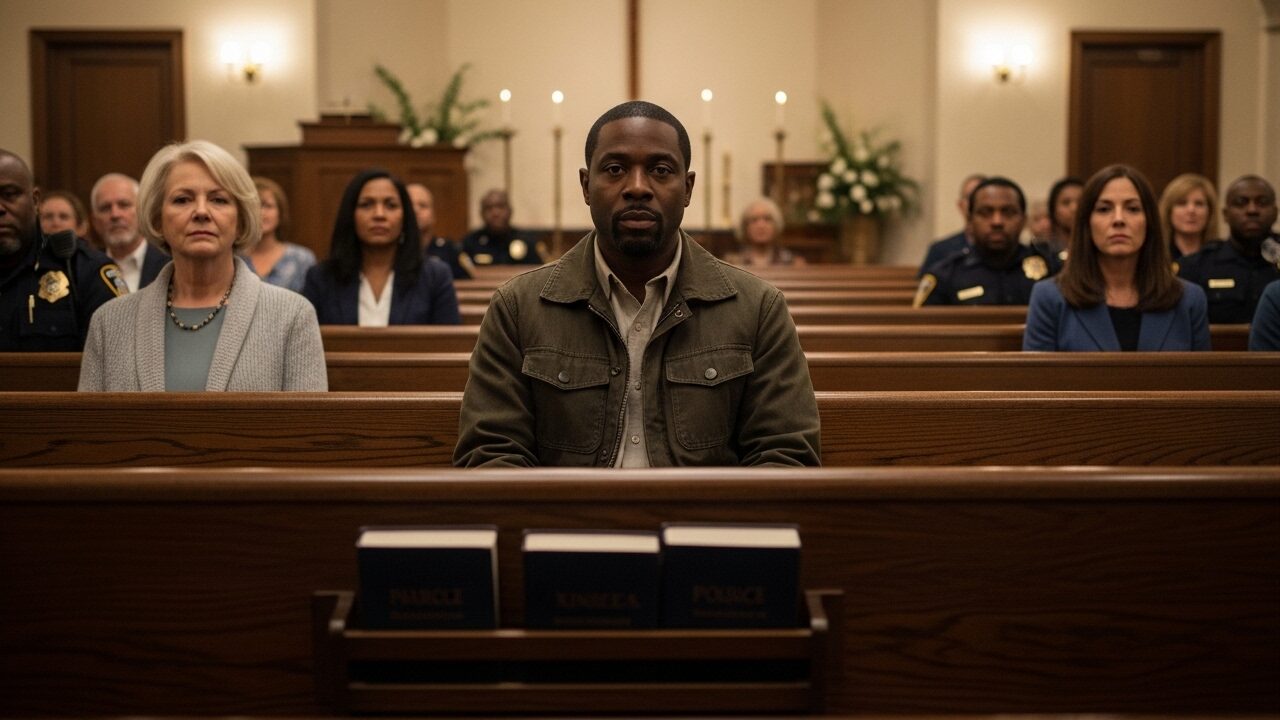
3 Police Officers Dragged A Quiet Black Man From A Wealthy Church After 1 Woman Complained — But The Pastor’s 3-Word Confession Shattered Their World

Chapter 1
The stained glass windows of Grace Fellowship Church cast long, fractured prisms of crimson and gold across the polished oak floors. It was a beautiful Sunday morning in Oak Creek, one of the most affluent, aggressively manicured suburbs in the state.
Here, the lawns were cut with geometric precision, the driveways were lined with European luxury SUVs, and Sunday service was as much a social exhibition as it was a spiritual gathering.
Marcus Vance sat in the very last pew, nearest the heavy oak doors.
He was a forty-two-year-old Black man with tired eyes, broad shoulders, and a quiet stillness about him that usually made people feel safe. Today, however, he was a ghost haunting a space that clearly didn’t want him.
He was wearing his best suit—a charcoal two-piece he hadn’t worn since his wife’s funeral three years ago. It was a little loose on him now. The weight loss had been gradual, a slow erosion of his physical self that mirrored the hollowing out of his soul.
In his hands, he gently turned a slightly crinkled program from the morning’s service. His fingers, calloused from years of working as a heavy-machinery mechanic, trembled just a fraction.
He hadn’t come here to cause a scene. He hadn’t come here to make a statement.
He had come because today, May 14th, would have been Sarah’s fortieth birthday. And Sarah, before the illness took her, had loved the sound of a pipe organ. She had seen a flyer for Grace Fellowship’s renowned choir and organist years ago, and she used to joke that one day, when they saved up enough money to buy a car that didn’t break down every twenty miles, they would drive out to Oak Creek just to hear it.
They never made that drive.
So, Marcus made it for her. He took three different buses from the city, walked two miles from the transit station in dress shoes that pinched his heels, and slipped into the back of the church just as the prelude began.
He closed his eyes, letting the deep, resonant vibration of the organ wash over him. For the first time in thirty-six months, the agonizing tightness in his chest began to loosen. He could almost smell her perfume. He could almost feel her hand slipping into his.
But the peace was fragile, and in Oak Creek, it was decidedly brief.
Three rows ahead of Marcus sat Eleanor Sterling.
Eleanor was a sixty-eight-year-old woman whose entire identity was built on the foundation of her late husband’s real estate fortune and her status within the Grace Fellowship community. She was on the flower committee, the bake sale committee, and the building fund committee.
To Eleanor, the church was not a hospital for the broken; it was a museum for the righteous. And she viewed herself as its primary curator.
Eleanor shifted in her seat. The hair on the back of her neck had been prickling for the last ten minutes.
She turned her head slightly, her diamond earrings catching the light, and cast a sidelong glance over her shoulder.
Her eyes locked onto Marcus.
Immediately, her jaw tightened. The congregation of Grace Fellowship was exclusively white, exclusively wealthy, and strictly bound by unwritten social codes. Marcus violated every single one of them just by breathing the air.
He wasn’t wearing a designer suit. He didn’t have the relaxed, entitled posture of the men Eleanor knew. And, most glaringly to her, he was a Black man sitting alone in a neighborhood he had no apparent business being in.
Eleanor leaned over to her friend, Margaret, whispering behind a manicured hand.
“Do you see him?” Eleanor hissed, her voice a sharp hiss that cut through the soft murmur of the congregation.
Margaret blinked, turning to look. “Who? The gentleman in the back?”
“Gentleman?” Eleanor scoffed quietly. “He looks like a vagrant. How did he even get in here? The ushers are usually so good about filtering out… wanderers.”
“He’s just sitting there, Eleanor,” Margaret said nervously, not wanting to cause a fuss. “Maybe he’s visiting.”
“Nobody ‘visits’ Oak Creek from the city unless they want something,” Eleanor muttered.
Her heart rate began to climb. It wasn’t fear, exactly; it was a deep, ingrained indignation. She felt a territorial rage. This was her church. Her sanctuary. She paid thousands of dollars a year in tithes to ensure that the realities of the outside world—the poverty, the grit, the people who didn’t ‘belong’—stayed firmly outside the stained glass.
Eleanor stood up. She smoothed down her tailored wool skirt, picked up her designer purse, and marched toward the back of the church.
Marcus opened his eyes as a shadow fell over him.
He looked up to see a woman glaring down at him. Her face was powdered, her expression pulled tight into a mask of polite hostility.
“Can I help you?” Eleanor asked.
The tone wasn’t an offer of assistance. It was a demand for justification.
Marcus blinked, pulling himself out of the memory of his wife. He offered a small, polite smile. “No, ma’am. Just enjoying the music. Thank you.”
He looked back toward the altar, hoping she would take the hint. She didn’t.
“Are you waiting for someone?” Eleanor pressed, taking a half-step closer. Her voice was rising, drawing the attention of the people in the last few rows. Heads began to turn. “Because this is a private congregation. We don’t usually have… walk-ins.”
Marcus felt the familiar, heavy weight of the moment settle onto his shoulders. It was a weight he had carried his entire life in America. The sudden scrutiny. The automatic assumption of guilt. The requirement to explain his existence in spaces that were deemed ‘too nice’ for him.
He kept his voice low, gentle, trying to de-escalate. “The sign outside said ‘All are welcome,’ ma’am. I just wanted to hear the service.”
“Yes, well, the sign is meant for our community,” Eleanor said, the word ‘community’ dripping with thinly veiled implication. “I think you might be more comfortable at a church in your own neighborhood. You’re making people here very uneasy.”
Marcus looked around. The only person who looked uneasy was her. But as he scanned the pews, he saw the faces turning toward him. White faces. Some looked curious, some looked concerned, but most looked defensive.
A familiar heat rose in his chest, a mixture of profound sorrow and exhausted anger. Today was about Sarah. He wasn’t going to let this woman ruin it.
“I’m not bothering anyone, ma’am,” Marcus said softly. “I’m just going to sit here, listen to the sermon, and then I’ll leave.”
Eleanor’s eyes narrowed. He was defying her. In her church.
“I’m going to have to ask you to leave. Now,” she demanded.
“I have a right to be here to pray,” Marcus replied, his voice firming up just a fraction, though he remained seated, his hands open and visible on his lap.
Eleanor didn’t say another word. She spun on her heel, walked straight out the heavy oak doors, and pulled her smartphone from her purse.
Ten minutes later, the soft prelude of the organ was abruptly shattered by the crackle of a police radio in the church foyer.
Officer David Miller and Officer Brian Jenkins walked through the heavy wooden doors.
Miller, twenty-nine years old, had been on the Oak Creek force for three years. He was a good cop, a guy who genuinely wanted to help people, but he knew exactly what policing in this town meant: keeping the rich residents happy and making sure the ‘element’ stayed out.
Jenkins, older and more cynical, already had his hand resting on his utility belt.
Eleanor was waiting for them in the narthex, practically vibrating with righteous energy.
“Thank God you’re here,” she whispered loudly, pointing a manicured finger through the glass doors into the sanctuary. “He’s still there. He refused to leave when I asked him nicely.”
Miller looked through the glass. He saw a Black man in a suit, sitting quietly by himself in the back row, holding a program.
“What exactly is he doing, ma’am?” Miller asked, furrowing his brow. “Is he causing a disturbance? Did he threaten you?”
“He’s trespassing!” Eleanor hissed. “He doesn’t belong here. Look at him! He’s casing the place. We have solid gold candlesticks on the altar, Officer. I felt extremely threatened by his aggressive tone.”
Miller sighed internally. He had responded to a dozen calls from Eleanor Sterling over the years. Suspicious vehicles (delivery drivers). Suspicious persons (landscapers). But the law was the law, and if the property representative wanted someone trespassed, they had to handle it.
“Alright, ma’am. We’ll speak to him,” Jenkins said, pushing open the doors.
The heavy thud of the officers’ boots echoed loudly against the oak floors, completely disrupting the hushed reverence of the room. The music faltered. The choir director looked back.
Two hundred heads swiveled to watch as the two uniformed officers, hands resting near their weapons, marched down the center aisle and flanked the last pew.
Marcus saw them coming.
His heart plummeted into his stomach. The air in his lungs suddenly felt thin. He gripped the edges of the church program so tightly the paper tore.
Not today, he thought. Please, God, not today.
“Sir,” Officer Jenkins said, his voice loud, carrying authority that demanded total submission. “Stand up.”
Marcus slowly turned his head. He looked at the two officers. He looked at the sea of white faces staring at him, judging him, assuming the worst about him. He saw Eleanor standing near the back doors, a smug look of triumph on her face.
“Officers,” Marcus said, his voice steady despite the rapid pounding of his heart. “I’m just attending the service.”
“The management here wants you to leave,” Jenkins said. “So you need to get up and walk outside with us right now.”
“It’s a church,” Marcus pleaded quietly, looking at Miller, hoping to find a shred of empathy in the younger cop’s eyes. “It’s open to the public. Today is my late wife’s birthday. I just wanted to hear the organ. That’s all. I haven’t done anything wrong.”
Officer Miller hesitated. He looked at Marcus. The man’s eyes were bloodshot, swimming with a grief so profound it made Miller uncomfortable. This wasn’t a criminal. This was a man in mourning.
Miller took a breath to speak, maybe to try and negotiate a compromise, but Jenkins stepped forward, invading Marcus’s personal space.
“I’m not going to ask you again, buddy,” Jenkins barked, his patience gone. “You’re trespassing. Stand up, or we’re going to make you stand up.”
The entire church was dead silent. The tension was a living, breathing thing in the room.
Marcus felt the humiliation burning his skin like acid. He was a forty-two-year-old man. A taxpayer. A grieving widower. And he was being treated like a feral animal in the house of God.
Slowly, deliberately, Marcus stood up. He was tall, six-foot-two, and as he rose to his full height, Jenkins instinctively unclipped his handcuffs.
“Turn around,” Jenkins ordered.
“I’m leaving,” Marcus said, his voice thick with emotion. “You don’t need to put hands on me.”
“Turn around and put your hands behind your back!” Jenkins shouted, escalating the situation instantly. He reached out and grabbed Marcus’s arm, twisting it forcefully.
Marcus gasped in pain, stumbling forward slightly. “Hey! I said I’m leaving!”
“Stop resisting!” Jenkins yelled, slamming Marcus face-first into the beautiful, polished oak of the pew. The thud echoed like a gunshot through the silent church.
Women gasped. A child started crying.
Miller rushed in, grabbing Marcus’s other arm, operating purely on training and adrenaline, even though a voice screaming in his head told him this was completely wrong.
“I’m not resisting!” Marcus cried out, his face pressed against the cold wood, tears finally spilling from his eyes. Tears of pain, tears of humiliation, and tears of profound sorrow that he couldn’t even give his wife this one, simple gift.
Click. The cold steel of the handcuff clamped down ruthlessly on his left wrist.
Eleanor watched from the back, nodding in satisfaction. The system was working exactly as it was designed to.
Jenkins wrenched Marcus’s right arm back to secure the second cuff.
“You’re making a mistake,” Marcus choked out, struggling to breathe against the wood. “Please…”
“Save it for the judge,” Jenkins sneered.
They hauled Marcus up roughly, his hands pinned behind his back. His suit jacket was bunched up, his dignity stripped away bare in front of an audience of strangers.
“Let’s go,” Jenkins said, shoving Marcus toward the aisle.
They had taken three steps toward the exit, dragging a silent, weeping Marcus between them, when the heavy side door near the altar violently banged open.
A man in a clerical collar and flowing robes sprinted out, his face pale, his chest heaving as if he had run a mile.
It was Pastor Thomas Evans.
He was fifty-five, a pillar of the Oak Creek community, a man whose gentle sermons were broadcast on local television.
He took one look at the scene unfolding in the center aisle—the police officers, the handcuffs, the Black man with his head bowed in defeat—and let out a visceral, horrifying scream.
“STOP!”
The word ripped from the Pastor’s throat with such ferocious volume that Officer Jenkins froze in his tracks.
Pastor Evans didn’t walk. He sprinted down the aisle, practically shoving parishioners out of the way, his eyes locked on Marcus.
Officer Miller put up a hand. “Pastor Evans, it’s alright, we have the situation under control. This man was trespassing—”
“Take them off,” Pastor Evans gasped, stopping two feet from the officers. His hands were shaking uncontrollably. He looked at Marcus, his face crumbling into an expression of absolute devastation.
“Excuse me?” Jenkins said, confused.
Pastor Evans turned to the officers, tears streaming down his face, his voice breaking so loudly it carried to the very back row where Eleanor Sterling stood frozen.
“I said take the handcuffs off him immediately!” the Pastor roared, his voice filled with a terrifying mixture of rage and overwhelming grief.
He pointed a trembling finger at Marcus, looking around at his silent, shocked congregation.
“This man,” Pastor Evans choked out, his voice dropping to a harsh, ragged whisper that carried through the dead silence of the sanctuary. “This man gave me his heart.”
Chapter 2
The silence that followed Pastor Thomas Evans’s agonizing cry was not merely the absence of sound. It was a suffocating, physical weight that descended upon the sanctuary of Grace Fellowship Church. It was the kind of silence that rings in the ears after a bomb detonates, heavy with shock, confusion, and the sudden, terrifying realization that the world as they knew it had just violently shifted on its axis.
Two hundred members of the congregation sat frozen in the oak pews. No one coughed. No one whispered. Even the crying child had been hushed into a whimpering standstill. The air, thick with the scent of expensive perfume, polished wood, and old money, seemed to suddenly evaporate, leaving everyone gasping for breath.
At the center of this frozen tableau stood Officer Brian Jenkins, his hand still gripping the cold steel chain connecting the handcuffs behind Marcus Vance’s back. Jenkins’s face, usually set in a mask of cynical, unquestioned authority, had gone completely slack. His jaw hung open slightly. He blinked, looking from the weeping Pastor back down to the Black man he had just shoved face-first into the holy woodwork.
“What did you say?” Jenkins asked, his voice losing its harsh, commanding edge, replaced by a hollow uncertainty.
Pastor Thomas didn’t answer him right away. He couldn’t. The fifty-five-year-old clergyman, usually a beacon of composed, articulate grace, was physically trembling. He took a stumbling step forward, his clerical robes swishing softly against the floorboards. His face was flushed, tears carving wet paths down his pale cheeks. He bypassed the officers entirely, his eyes fixed only on Marcus.
Marcus remained bent over, his broad shoulders hunched, his chest heaving as he struggled to process the surreal nightmare he was trapped in. The sharp, burning pain in his left wrist where the metal bit into his skin was grounded in reality, but the words the Pastor had screamed felt like a hallucination born of his own profound grief.
This man gave me his heart.
“Pastor,” Officer David Miller started, his voice shaking slightly. He stepped forward, his hands raised in a placating gesture. He was twenty-nine, an age where the absolute certainty of his badge was just beginning to crack under the weight of real-world nuance. Right now, staring at the raw devastation on the Pastor’s face, Miller felt a sickening churn in his stomach. His training told him to secure the scene. His conscience screamed that they had just committed a profound atrocity. “Sir, please step back. This man was trespassing. We were called by—”
“Take them off,” Thomas interrupted, his voice low, vibrating with a dark, unfamiliar anger that startled everyone who knew him. He turned to Miller, his eyes flashing with a fierce, protective fire. “Take those handcuffs off him right this second, or so help me God, I will have your badges by tomorrow morning.”
Jenkins bristled, his defensive instincts kicking back in. “Now hold on a minute, Pastor. You can’t just interfere with police business. The property manager—”
“I am the spiritual head of this church, Officer!” Thomas roared, his voice echoing off the vaulted ceilings and the stained glass windows. “This is a sanctuary! It is a house of healing, not a precinct! You have dragged a grieving, innocent man from the pews of my church like a criminal! Take. Them. Off.”
Miller didn’t wait for Jenkins to argue. He could feel the eyes of the entire congregation on his back. He could feel the judgment, the sudden, terrible shift in the room’s energy. He quickly stepped around Jenkins, grabbing the older officer’s arm.
“Give me the keys, Brian,” Miller muttered, his voice tight.
“He resisted,” Jenkins hissed under his breath, leaning in close. “We’re on bodycam, Dave. Don’t backtrack now.”
“Give me the damn keys, Brian,” Miller repeated, his voice dropping an octave, his eyes locked on his partner’s. “Look at him. Just look at him.”
Jenkins hesitated, his jaw tight, but the furious, tear-streaked face of the beloved town Pastor was too much of a liability to ignore. With a sharp, angry exhalation, Jenkins fumbled at his belt, unclipped the small silver key, and shoved it into Miller’s chest.
Miller approached Marcus slowly, almost apologetically. “Sir,” he said softly, keeping his voice down so only Marcus could hear. “I’m going to take these off now. Just hold still.”
Marcus didn’t speak. He couldn’t. His throat felt as though it had been packed with dry sand. He slowly stood up straighter, allowing Miller to access his wrists.
Click. Click. The heavy steel jaws released. The sudden rush of blood back into Marcus’s hands was a painful, throbbing burn, but it was nothing compared to the agony in his chest. He slowly brought his arms forward, rubbing the deep, angry red indentations on his wrists. He looked down at the floor, unable to meet the eyes of the hundreds of white faces staring at him. He felt stripped bare. He had put on his best suit to honor his dead wife, and he had been treated like a stray dog.
Before Marcus could take a step toward the exit, Pastor Thomas was there.
The clergyman didn’t offer a handshake. He didn’t offer a polite, pastoral word of comfort. He threw his arms around Marcus’s broad shoulders and pulled him into a desperate, crushing embrace.
Thomas buried his face in Marcus’s shoulder, openly sobbing. “I’m sorry,” Thomas choked out, his voice muffled against the charcoal wool of Marcus’s suit. “I am so, so sorry. God forgive us. God forgive me.”
Marcus stood rigidly for a moment, completely overwhelmed. He was a mechanic from the South Side. He was a man who worked with his hands, who lived quietly, who had spent the last three years drowning in the silence of an empty apartment. To be embraced so fiercely by a wealthy, white stranger in the middle of an affluent suburb was jarring.
But then, beneath the layers of the Pastor’s robes, beneath the soft cotton of his shirt, Marcus felt it.
Thump-thump. Thump-thump.
It was a strong, steady rhythm. The beat of a healthy, living heart pressing against Marcus’s own chest.
A choked gasp escaped Marcus’s lips. His eyes widened, suddenly swimming with hot, blinding tears. His hands, still trembling and bruised from the metal cuffs, slowly came up. He didn’t push the Pastor away. Instead, his large, calloused hands gently returned the embrace, gripping the back of Thomas’s robes as a dam broke inside his soul.
He closed his eyes, and for a fleeting, beautiful, devastating second, he wasn’t standing in Grace Fellowship Church surrounded by hostility. He was back in his tiny kitchen in the city, holding Sarah from behind as she cooked, pressing his ear to her back, listening to the very same rhythm.
It’s her, Marcus thought, his mind fracturing under the weight of the moment. She’s still here.
A collective gasp rippled through the congregation. From her vantage point in the very back row, near the heavy oak doors, Eleanor Sterling stood completely paralyzed.
Her manicured hands were clamped tightly over her designer purse. Her heart was hammering a frantic, terrified rhythm against her ribs.
This man gave me his heart.
The words echoed in her mind, over and over, refusing to compute. How could that be? Thomas had received a heart transplant three years ago. The entire church had prayed for him. They had held vigils, raised money, and celebrated the miracle of the anonymous donor who had saved their beloved leader from end-stage heart failure.
Eleanor stared at the Black man weeping in the arms of their Pastor.
No, Eleanor’s mind screamed, her defense mechanisms scrambling to build a wall against the incoming tide of guilt. No, it can’t be. He’s just a man. He doesn’t belong here. He didn’t look like a donor. He looked dangerous.
She looked at her friend, Margaret, who was standing beside her. Margaret’s face was pale, her hand covering her mouth in horror. Margaret slowly turned to look at Eleanor, and for the first time in their thirty-year friendship, the look in Margaret’s eyes was not one of admiration or agreement. It was sheer, unadulterated disgust.
“Eleanor,” Margaret whispered, her voice trembling. “What did you do?”
“I… I was protecting the church,” Eleanor stammered, her voice thin and reedy. She straightened her spine, desperately clinging to her self-righteousness. “He was acting suspicious. He didn’t introduce himself. How was I supposed to know?”
“He was just sitting there,” Margaret replied, her voice breaking. “He was just sitting in the pew, Eleanor.”
Up at the front, Pastor Thomas finally pulled back from the embrace. He kept his hands firmly on Marcus’s shoulders, looking up into the taller man’s tear-streaked face.
“Mr. Vance,” Thomas said, his voice thick with emotion. He knew the name. He had learned it only a year ago, when the donor registry had finally permitted the exchange of identities, provided both parties consented. Thomas had written letters, but Marcus had never replied. Thomas had understood; the grief was too heavy. “You came.”
“Today… today is her birthday,” Marcus whispered, his voice cracking. He wiped his face with the back of his bruised hand. “She loved the organ. She always wanted to hear the one you have here. I just… I just wanted to sit in the back. I wasn’t going to bother anyone.”
The words struck Thomas like a physical blow. He turned his head, surveying his congregation. The people he shepherded. The people he preached love, tolerance, and grace to every single Sunday. He saw the guilt on some faces. He saw the shock on others. And then his eyes found Eleanor Sterling standing by the back doors.
Thomas’s expression hardened. The sorrow in his eyes morphed into a cold, piercing disappointment that cut through the cavernous room.
“Service is cancelled,” Thomas announced, his voice carrying clearly without the need for a microphone.
A murmur of shock erupted, but Thomas cut it off with a sharp raise of his hand.
“I said, service is cancelled,” he repeated, his voice booming with authority. “There is no worship to be found in this room today. There is no grace here. Go home. Look at yourselves in the mirror. Ask yourselves what it is you truly believe in, because whatever God you are worshipping today, it is not the one who commands us to love our neighbor.”
He didn’t wait for a response. He gently took Marcus by the elbow. “Come with me, please. Let’s get you out of here.”
Marcus nodded numbly, letting the Pastor lead him away from the altar, toward the side door that led to the private administrative wing of the church.
As they walked past the two police officers, Officer Miller took a step back, unable to meet Marcus’s eyes. Jenkins stood rigidly, his face flushed red, arms crossed defensively over his chest.
Once the heavy wooden door clicked shut behind them, the atmosphere in the sanctuary instantly deteriorated into chaos. Voices erupted. People stood up, arguing, crying, demanding answers.
Deacon Robert “Bob” Harrison, a sixty-year-old corporate lawyer with a shock of silver hair and a meticulously tailored navy suit, immediately moved into action. Bob was the chairman of the church board. He viewed Grace Fellowship not just as a spiritual center, but as a multi-million-dollar non-profit organization that required careful brand management. And right now, the brand was bleeding out on the polished oak floors.
Bob pushed his way through the bewildered parishioners, marching straight toward Officers Jenkins and Miller.
“Officers,” Bob said, his voice a smooth, authoritative baritone designed to command boardrooms. “I am Deacon Harrison. I represent the church’s legal and administrative board. Let’s step outside, shall we? We need to clear this up immediately before this escalates.”
“There’s nothing to clear up, sir,” Officer Miller said sharply, his own guilt making him angry. “We responded to a call from a representative of this property claiming a trespasser was hostile. We acted on false information.”
“Now wait just a minute,” Eleanor’s voice shrilled over the rising din. She was marching down the aisle, her face a mask of panicked indignation. “I did not give false information! I told you I felt threatened. And I did! It is not a crime to feel unsafe!”
Jenkins pointed a finger at Eleanor. “Lady, you told dispatch he was casing the joint. You said he refused to leave and was becoming aggressive. The guy was sitting quietly with a church program in his hand.”
“He refused my request to leave!” Eleanor countered, her voice rising an octave. She looked at Deacon Bob for support. “Bob, you know how things are. We’ve had a string of car break-ins in the south lot last month. We have to be vigilant. I was protecting the congregation.”
Bob held up a hand, rubbing his temples. He could see the body cameras on the officers’ chests blinking with a red recording light. “Eleanor, please. Stop talking.”
“I will not stop talking!” Eleanor cried, feeling the social fabric of her life tearing at the seams. “I am a founding member of the building committee! My husband paid for those stained glass windows! I have every right to question who is in this building!”
“Eleanor,” Margaret said softly, having followed her friend down the aisle. “Stop. Just stop. You didn’t ask him who he was. You didn’t welcome him. You looked at the color of his skin, you looked at his worn-out suit, and you decided he was a criminal.”
“That is a lie!” Eleanor gasped, pressing a hand to her pearls. “I don’t see color! I see behavior! It’s about decorum, Margaret!”
“He was praying, Eleanor,” Margaret said, tears finally spilling over her cheeks. “He was listening to the music. And you called armed men to drag him away.”
Outside the church doors, under the bright, unforgiving Sunday sun, Officer Miller walked quickly toward the patrol SUV. Jenkins followed close behind.
“Where are you going?” Jenkins demanded. “We have to write the report. We need statements.”
“I need a minute, Brian,” Miller snapped, throwing his police radio onto the passenger seat. He leaned against the side of the vehicle, running a hand over his face. He felt physically sick.
“Hey, don’t put this on us,” Jenkins said defensively, leaning in close. “We did our job. We got a call, we responded. The guy didn’t comply with a lawful order to vacate private property. That’s resisting. It’s by the book.”
“By the book?” Miller laughed, a harsh, bitter sound. He turned to face his partner. “We just assaulted a widower in a church, Brian. We threw him face-first into a pew because an old racist white woman didn’t like the cut of his suit. And we didn’t even ask questions. We just marched in there and played her private security force.”
“We didn’t know who he was!” Jenkins argued.
“That’s exactly the point!” Miller yelled, his voice echoing across the pristine, manicured lawns of Oak Creek. “It shouldn’t matter who he was! What if he wasn’t the guy who saved the Pastor’s life? What if he was just a Black guy who wanted to hear the organ? Does that make it okay? Do we only treat people like human beings if they’ve literally sacrificed their own flesh and blood for someone important?”
Jenkins fell silent. He looked away, his jaw working as he stared at the expensive cars lining the parking lot. He didn’t have an answer. For the first time in his twenty-year career, the ironclad armor of ‘protocol’ felt paper-thin.
Meanwhile, inside the quiet sanctuary of the Pastor’s private study, the chaos of the church faded into a muffled hum.
The room was lined with floor-to-ceiling bookshelves, smelling of old paper and peppermint tea. Soft sunlight filtered through a small window, catching the dust motes dancing in the air.
Marcus sat heavily in a worn leather armchair. He felt completely drained. The adrenaline that had spiked when the police grabbed him had crashed, leaving him feeling hollowed out and violently shaking. His wrists throbbed in time with his heartbeat.
Pastor Thomas was rushing around the room, pouring a glass of water from a small pitcher with trembling hands.
The door to the study burst open.
Claire Evans, the Pastor’s wife, rushed into the room. She was a woman in her early fifties, elegant and kind-faced, though right now, her eyes were wild with panic. She had been in the children’s Sunday school wing when the commotion started, and a frantic usher had just told her that Thomas had cancelled the service and was crying in his study.
“Thomas! What happened? Are you hurt?” Claire demanded, rushing to her husband, her hands immediately flying to his chest, checking the invisible lines of his surgery scars through his clothes. Three years had passed, but the trauma of nearly losing him meant she lived in a constant state of hyper-vigilance.
“I’m fine, Claire. I’m physically fine,” Thomas said gently, taking her hands in his. He turned her around to face Marcus, who was sitting quietly in the chair, staring down at the glass of water in his hands.
Claire stopped. She looked at the large Black man in the rumpled suit. She saw the deep, angry bruises forming on his wrists. She saw the profound, bottomless sorrow in his eyes.
“Claire,” Thomas said, his voice breaking. “This is Marcus. Marcus Vance.”
The name hung in the quiet air of the study.
Claire’s breath hitched. Her hand flew to her mouth. She knew that name. She had prayed for that name every single night for the last three years. She had written it on the first page of her Bible.
Marcus Vance. Husband of Sarah Vance. The woman who died so Thomas could live.
The polished, composed exterior of the Pastor’s wife shattered instantly. Claire didn’t care about propriety. She didn’t care that they were strangers. She fell to her knees right there on the Persian rug in front of Marcus’s chair.
“Oh, God,” Claire sobbed, reaching out to grasp Marcus’s large, bruised hands in her own. She pressed her forehead against his knuckles, her tears wetting his skin. “Oh, Mr. Vance. I am so sorry. I am so, so sorry for what they did to you today. And I… I never got to thank you.”
Marcus stared down at the woman weeping at his feet. The surrealness of the situation was almost too much to bear. Three years ago, he had been sitting in a sterile, freezing waiting room at County General Hospital. The doctor’s words still echoed in his nightmares: Massive aneurysm. Brain dead. No chance of recovery. He remembered the woman from the organ procurement organization. She had been gentle, but the question she asked felt like a knife twisting in his gut. Sarah was an organ donor, Mr. Vance. Would you like to honor her wishes?
In the darkest, most agonizing moment of his entire life, Marcus had signed his name on a clipboard, effectively ending his own world so that someone else’s could continue. He hadn’t known who the recipient was. He hadn’t cared. He just knew Sarah would have wanted it. She was a kindergarten teacher. She spent her life giving to others.
“Please, ma’am. You don’t have to do that,” Marcus said softly, gently trying to pull his hands away, uncomfortable with her kneeling. “Get up. Please.”
Thomas stepped forward, gently helping his weeping wife to her feet. He pulled up a wooden chair and sat directly across from Marcus.
“Marcus,” Thomas began, leaning forward, resting his elbows on his knees. “I wrote to you. A year ago, when the registry finally allowed contact. I sent a letter. I wanted to meet you. I wanted to look you in the eye and thank you for my life.”
Marcus looked away, staring out the small window at the manicured lawns. “I got it,” he admitted, his voice rough. “I got the letter. I read it. But… I couldn’t.”
“I understand,” Thomas said softly. “I do.”
“You don’t,” Marcus corrected him, looking back with a sudden, raw intensity. “You don’t understand, Pastor. Every time I thought about meeting you, I felt like I was going to suffocate. Because looking at you means accepting that she’s really gone. It means looking at the man who gets to wake up every morning, who gets to grow old with his wife, because I have to sleep in an empty bed.”
Claire let out a small, heartbreaking sob, covering her face with her hands.
“I wasn’t angry at you,” Marcus clarified, his voice softening, seeing the pain on their faces. “I was just… broken. I’m still broken. But today was her birthday. And she always loved the organ. She loved the choir music. I thought… I thought maybe if I just came and sat in the back, I could feel close to her. I didn’t know you were the Pastor here. I didn’t know this was your church.”
“It’s God’s church,” Thomas said bitterly, rubbing his face. “Or at least, it’s supposed to be. What happened out there today, Marcus… it is an indictment on me. On my leadership. I have failed these people. I have let them build a country club in the name of Christ, and I was too comfortable to stop them.”
Marcus shook his head slowly. “It’s not just your church, Pastor. It’s the world. I’m a big Black man in a cheap suit in Oak Creek. The police were just doing what that woman asked them to do. They were keeping the neighborhood clean.”
“It’s completely unacceptable,” Claire said fiercely, wiping her eyes, a sudden fire igniting in her tone. “Eleanor Sterling is a bitter, prejudiced woman, and we have turned a blind eye to her behavior for years because her family writes large checks. But this? Calling the police on a grieving man? Having you physically assaulted in the sanctuary?” She looked at her husband. “Thomas, we cannot let this go.”
“I won’t,” Thomas vowed, his eyes dark with determination. “But right now, the only thing that matters is you, Marcus. Are you injured? Do you want me to call a doctor? Do you want to press charges against the department?”
Marcus looked down at his wrists. The bruising was purple and ugly, a physical manifestation of a much deeper, older wound. He thought about the police officers. He thought about the screaming woman. He thought about the indignity of being pinned to the wood of the pew.
He could sue. He could go to the media. He could burn this entire pristine suburb to the ground with a single phone call to the local news.
But as he sat there, listening to the quiet, steady beating of the heart in Thomas’s chest, a profound exhaustion washed over him. He was so tired of fighting. He was tired of being angry. He just missed his wife.
“I don’t want to press charges,” Marcus said quietly.
Thomas looked stunned. “Marcus, they assaulted you. They violated your civil rights.”
“I know,” Marcus said, looking up, his dark eyes tired but resolute. “But bringing a lawsuit isn’t going to fix what’s wrong with that woman out there. Punishing two cops isn’t going to make your congregation suddenly love their neighbors. It’s just going to make them defensive. It’s going to make them circle the wagons.”
Marcus leaned forward, resting his forearms on his knees, his hands clasped together.
“You want to thank me for Sarah’s heart?” Marcus asked, his voice steady, commanding a sudden, intense authority in the small room.
Thomas nodded silently.
“Then fix your house,” Marcus said. “You stand up on that pulpit next Sunday, and you look those people in the eye, and you tell them the truth about what happened today. You tell them who they really are. Because if you let them sweep this under the rug, if you let them pretend this was just a ‘misunderstanding,’ then my wife died to save a coward.”
The words hit Thomas with the force of a freight train. He sat back in his chair, the breath knocked out of him. He looked at Marcus, really looked at him. He saw a man who possessed a quiet, towering strength that made Thomas feel incredibly small.
For years, Thomas had preached about carrying crosses and enduring trials. But here was a man who lived it, who walked through the fire every single day, and who was now asking Thomas to do the hardest thing a leader could do: confront his own people with their darkest sins.
“You’re right,” Thomas whispered, his voice trembling but laced with a new, ironclad resolve. “You’re absolutely right.”
A sharp knock on the study door broke the heavy silence.
“Thomas? It’s Bob,” Deacon Harrison’s voice came through the heavy wood, tight and anxious. “I’ve sent the police away for now, but we need to talk. The board is gathering in the conference room. Eleanor is threatening to pull her funding, and the rumor mill is spinning out of control. We need a statement.”
Thomas looked at the door, then looked back at Marcus. The Pastor’s face hardened. The gentle, diplomatic clergyman who had catered to the wealthy elite of Oak Creek was gone, replaced by a man who was finally ready to use the second chance at life he had been given.
“Tell them to wait,” Thomas called out, his voice sharp and commanding. “I will speak to the board when I am finished tending to my guest.”
He turned back to Marcus, a sad, apologetic smile touching his lips. “Marcus, would you stay for a little while longer? My wife makes a terrible cup of tea, but it’s quiet in here. We can sit. You can tell us about Sarah.”
Marcus hesitated. He looked at Claire, who gave him a tearful, encouraging nod. He looked at the window, at the bright, hostile world outside. And then he listened, once again, to the faint, steady rhythm in the room.
“Okay,” Marcus said softly. “She… she was a teacher. She loved kids. And she had the loudest laugh you ever heard.”
As Marcus began to speak, the tension in the room finally began to ebb. Outside the door, a storm was brewing, a reckoning that would tear Grace Fellowship Church apart. But inside the study, two broken men sat together, bound by the heart of a woman who was still teaching them how to love.
Chapter 3
The executive boardroom of Grace Fellowship Church was designed to intimidate. Located in the administrative wing, far from the stained glass and the altar, it looked less like a space for spiritual discernment and more like the war room of a Fortune 500 company. The walls were paneled in rich, dark mahogany. A massive, twenty-foot conference table carved from a single slab of walnut dominated the center of the room. High-backed leather chairs lined the table, and on the far wall, a row of oil portraits depicted the founding pastors—a stern, unsmiling procession of wealthy white men whose financial contributions had built the church from the ground up.
Deacon Robert “Bob” Harrison stood at the head of the table, his phone pressed tightly to his ear. He was pacing, the soft leather of his Italian loafers making no sound on the thick, Persian carpet. Bob was a man who traded in control. As a senior partner at Oak Creek’s most ruthless corporate litigation firm, he spent his weekdays managing multi-million-dollar mergers and burying PR disasters. He viewed his role as Chairman of the Church Board in exactly the same light. Grace Fellowship was a brand. It had a demographic, a donor base, and an image to maintain.
Right now, that image was standing on the edge of a cliff, teetering precariously in the wind.
“Yes, I understand the optics, Chief,” Bob said into the phone, his voice a low, soothing baritone that entirely masked the frantic spiking of his blood pressure. He was speaking to the Oak Creek Chief of Police, a man he played golf with every second Saturday. “I know Miller’s bodycam was running. That’s exactly why we need to contain this before the footage gets requested by some hungry local reporter. It was a miscommunication. An unfortunate lapse in protocol on both sides. Let’s not escalate this into a civil rights circus.”
Bob listened for a moment, pinching the bridge of his nose. “I appreciate that, Chief. I’ll speak to the Pastor. We will handle the congregation internally. Just keep your officers quiet. Thank you.”
He ended the call and tossed the phone onto the polished walnut table with a sharp clatter. He let out a long, ragged exhale and looked around the room.
Four other board members were seated at the table, all of them wearing expressions that hovered somewhere between outrage and sheer panic. But the focal point of the room’s anxiety was Eleanor Sterling.
Eleanor sat rigid in her chair, her back perfectly straight, her hands clasped so tightly on the table that her knuckles were bone-white. She had reapplied her lipstick, but the pristine mask of the wealthy suburban socialite was cracking. Her eyes were wide, darting defensively between the board members. She looked like a cornered animal wearing Chanel.
“He’s overreacting,” Eleanor stated, her voice tight and defensive, breaking the heavy silence. “Thomas is entirely overreacting. Canceling the service? Yelling at the police in front of the entire congregation? It was utterly humiliating.”
“Humiliating for who, Eleanor?” asked Richard Davis, the church treasurer, a quiet man in his sixties who looked visibly nauseated. “You called the police on a Black man who was sitting in a pew reading a bulletin. Do you have any idea the kind of liability you’ve opened us up to? If he sues—”
“Let him sue!” Eleanor snapped, slamming a manicured hand flat against the wood. “I have the best lawyers in the state. My husband’s estate can bury him in paperwork until the end of time. I will not be made the villain here! I was protecting this institution! We have a security protocol for a reason!”
“Eleanor, stop,” Bob said, holding up a hand. He walked over to his chair and sat down heavily, leaning his elbows on the table. He fixed her with a cold, calculating stare. “There was no security threat, and you know it. You panicked because someone from outside the bubble walked in, and you used the police as your personal concierge service to remove him. And to make matters infinitely worse, the man you had thrown face-first into a pew happens to be the widower of the woman whose heart is currently beating inside our Pastor’s chest.”
The words hung in the air, grotesque and unavoidable.
“I couldn’t have known that,” Eleanor whispered, her voice finally losing some of its venom, replaced by a thin, reedy tremor of actual fear. “How could I have known?”
“It doesn’t matter what you knew,” Bob said harshly. “What matters is what the public is going to see if this gets out. ‘Wealthy White Church Assaults Black Organ Donor.’ Do you see that headline, Eleanor? It writes itself. It’s a national news story. The building fund will dry up overnight. The community outreach programs will be boycotted. We will be picketed. We will be a pariah.”
“So what do we do?” asked a younger board member, a tech executive named Sarah who was furiously typing notes on an iPad. “We need a PR strategy. Do we issue an apology?”
“We don’t do anything publicly unless we are forced to,” Bob instructed, slipping effortlessly into his crisis-management mode. “First, we need to muzzle Thomas. He’s emotional. He’s compromised. He feels indebted to this man, which is understandable, but he cannot be allowed to air dirty laundry from the pulpit. I will draft a statement for him to read next Sunday. Something vague about ‘community understanding’ and ‘grace in the face of misunderstanding.'”
“And what about the man?” Richard asked. “Marcus Vance.”
“I will reach out to Mr. Vance personally,” Bob said smoothly. “I’ll offer him a private apology on behalf of the board. I’ll offer to cover any medical expenses for his injuries, and perhaps we can make a substantial, quiet donation to a charity of his choice. In exchange for a non-disclosure agreement, of course.”
Eleanor scoffed, a bitter, defensive sound. “You’re going to pay him off? You’re rewarding him for coming in here and disrupting—”
The heavy mahogany doors of the boardroom swung open with a violent crash.
The sound was so sudden, so forceful, that Eleanor physically jumped in her chair. Bob shot to his feet.
Pastor Thomas Evans stood in the doorway.
He was alone. He had shed his flowing clerical robes, standing now in just his black trousers and a plain grey button-down shirt. His face was pale, his eyes red-rimmed from crying, but there was a terrifying, absolute stillness about him. The gentle, diplomatic shepherd who had spent a decade coddling these exact people was completely gone. In his place stood a man who looked like he had just walked through a furnace and realized he was fireproof.
“Thomas,” Bob said, recovering his composure instantly, forcing a warm, deeply fake smile. “Come in, please. Have a seat. We were just discussing how to best handle this unfortunate situation.”
Thomas didn’t move. He stood in the doorway, his eyes slowly scanning the room, lingering on the expensive suits, the iPads, the oil paintings on the wall. Finally, his gaze locked onto Eleanor.
Eleanor tried to hold his stare, but the sheer, blistering condemnation in the Pastor’s eyes forced her to look away. She stared down at her hands, her throat working as she swallowed hard.
“There is no situation to handle, Bob,” Thomas said. His voice wasn’t raised. It was unnervingly quiet, carrying a cold, heavy authority that commanded total silence. “There is only a sin to confess.”
Bob’s smile faltered. He stepped around the table, approaching Thomas with his hands raised in a placating gesture. “Thomas, I know you’re upset. We are all deeply disturbed by what happened. But we need to look at this rationally. We need to protect the church.”
“Protect the church?” Thomas echoed, stepping fully into the room and letting the heavy doors swing shut behind him. The click of the latch sounded like a vault sealing. “Protect it from what, Bob? From the truth? From the fact that we have built an exclusionary fortress that actively repels the very people Christ commanded us to serve?”
“That’s not fair,” Eleanor blurted out, unable to help herself. Her pride was a reflex. “We donate thousands of dollars to the inner-city missions every year. We sponsor that soup kitchen downtown!”
Thomas turned his piercing gaze to her. He walked slowly toward the table, his footsteps heavy.
“You write checks, Eleanor,” Thomas said, his voice dripping with sorrow and disgust. “You write checks to keep them downtown. You pay for the privilege of never having to look them in the eye. But today, one of them walked into your pristine sanctuary. He came seeking peace on the anniversary of his wife’s death. And because his skin was dark, and his suit was worn, you treated him like a contagion.”
“He was acting suspiciously!” Eleanor cried, tears of frustration springing to her eyes. “You weren’t there, Thomas! You didn’t see him!”
“I saw enough,” Thomas fired back, finally raising his voice, the sound cracking like a whip in the confined space. “I saw two armed police officers pinning a grieving man to a pew. I saw my congregation sitting by and watching it happen. And I saw you, Eleanor, standing in the back, looking satisfied.”
He leaned over the table, resting his fists on the polished walnut, bringing his face inches from hers.
“The heart beating in my chest right now,” Thomas whispered, his voice trembling with a ferocious, righteous anger, “belonged to his wife. A Black woman. A woman who spent her life teaching children in a neighborhood you wouldn’t dare drive through with your windows down. Her blood is pumping through my veins. So tell me, Eleanor. Am I suspicious? Should you call the police on me?”
Eleanor gasped, shrinking back into her chair, pressing a hand to her mouth. She squeezed her eyes shut, a single tear escaping and ruining her immaculate makeup.
“Okay, that’s enough,” Bob intervened, stepping between them, his corporate fixer persona hardening into something colder. “Thomas, you are crossing a line. We are a board. We employ you. We expect you to act in the best interests of this organization.”
Thomas slowly stood up straight, turning to face the Deacon. “You’re right, Bob. You do employ me. And for ten years, I have been an excellent employee. I have preached comfortable sermons that didn’t challenge your stock portfolios. I have smiled at your galas. I have turned a blind eye to the quiet, polite racism that permeates every single row of those pews because I didn’t want to upset the tithing schedule.”
Thomas took a deep breath, his hand instinctively going to his chest, resting over his heart.
“But I died three years ago,” Thomas said quietly. “I was on my deathbed. And I was given a second chance at life at the cost of another man’s entire world. I am not going to waste it playing country club chaplain anymore.”
“What exactly are you saying, Thomas?” Richard asked nervously from the end of the table.
“I am saying,” Thomas enunciated clearly, looking at each of them in turn, “that there will be no PR spin. There will be no non-disclosure agreements. There will be no quiet payouts.”
Bob’s face flushed red. “Thomas, be reasonable. If you don’t let us manage this, the media will tear this church apart. Is that what you want? To destroy everything we’ve built?”
“If what we have built is a monument to our own vanity and prejudice, then yes, Bob. I want it torn down,” Thomas said unflinchingly. “Next Sunday, I am going to stand in that pulpit. And I am going to tell the congregation exactly what happened today. I am going to name the sin. I am going to call for absolute, total repentance.”
“You can’t do that,” Eleanor whispered, her eyes wide with terror. “You will ruin me in this town. You will ruin my family’s name.”
“You ruined it yourself, Eleanor,” Thomas replied, without a shred of pity. “I am just refusing to cover it up.”
Bob crossed his arms, his jaw set in a hard line. The polite veneer was completely gone now. This was a hostile negotiation.
“If you do this, Thomas,” Bob warned, his voice low and dangerous, “the board will call an emergency vote. We will terminate your contract. You’ll be out on the street by Monday morning.”
Thomas smiled. It was a sad, tired, but remarkably peaceful smile. It was the smile of a man who had suddenly realized that the chains binding him were made of paper.
“You can fire me right now if you want, Bob,” Thomas said simply. “But if you do, I will walk straight out those front doors, I will call the local news station, and I will give them an exclusive interview. I will tell them that Grace Fellowship Church fired their Pastor because he objected to the racially motivated assault of his organ donor’s husband in the sanctuary.”
Bob froze. The blood drained from his face. He was a master of legal leverage, and he recognized immediately that he had just been checkmated. The PR fallout from Thomas’s threat would be apocalyptic.
“You’re blackmailing us,” Bob hissed.
“I’m giving you a choice,” Thomas corrected him. “You can face the truth internally, as a congregation, and pray to God that we can find some kind of genuine redemption. Or you can fire me, and the whole world will see exactly what this church is made of. The choice is yours. But the cover-up ends today.”
Thomas didn’t wait for an answer. He turned on his heel and walked out of the boardroom, leaving the door wide open behind him.
Fifteen miles away, the landscape had entirely changed.
The manicured lawns and sweeping driveways of Oak Creek had long since faded in the rearview mirror of the city bus. Here, the concrete was cracked, the buildings were pressed tightly together, and the air smelled of exhaust fumes and hot asphalt.
Marcus sat in the very back corner of the bus, his head resting against the vibrating, smudged glass of the window.
He was physically exhausted. Every muscle in his body ached, the adrenaline crash leaving him feeling hollowed out and heavy. He looked down at his lap. His hands were resting palms up. The bruises around his wrists had darkened into angry bands of purple and black. They throbbed in time with the rhythmic bumping of the bus tires over the pothole-ridden streets.
He thought about the chaotic hour he had just spent. After Thomas had left the study to confront the board, Claire Evans had stayed with him. She had wept, she had apologized a dozen times over, and she had insisted on driving him home.
Marcus had politely but firmly refused. He didn’t want to sit in a luxury car driven by a wealthy white woman, making small talk while his wrists throbbed from the handcuffs her community had placed on him. He just wanted to go back to his reality. He wanted to disappear back into the anonymity of the city.
He had slipped out the side door of the administrative wing, cutting across the perfectly landscaped grass to avoid the lingering clusters of parishioners in the parking lot. He had walked the two miles back to the transit center, feeling the hostile, suspicious stares of the Oak Creek residents from their passing SUVs.
Now, sitting on the bus, the reality of what had happened was beginning to settle over him like a suffocating blanket.
He had met the man.
For three years, Marcus had aggressively avoided thinking about the recipient of Sarah’s heart. It was too abstract, too painful. He had convinced himself that Sarah was just gone. Dust and ashes.
But today, he had felt her heartbeat. He had pressed his chest against another man’s chest, and he had felt the powerful, unmistakable rhythm of his wife’s life sustaining a total stranger.
A choked sob caught in Marcus’s throat. He pressed the heels of his hands into his eyes, ignoring the stinging pain in his wrists.
“Why, Sarah?” he whispered aloud, the sound lost under the roar of the bus engine. “Why did it have to be there? Why did it have to be them?”
It felt like a cosmic joke. The cruelest irony the universe could concoct. His beautiful, radiant, endlessly compassionate wife—a woman who had spent her life advocating for the marginalized, who bought winter coats for her students out of her own meager paycheck—had given her heart to the leader of a community that treated her husband like garbage.
The bus lurched to a halt at his stop. Marcus stood up slowly, his joints stiff. He stepped down onto the crowded, noisy sidewalk of his neighborhood. A siren wailed in the distance. Two teenagers were arguing loudly outside a bodega. It was chaotic, loud, and rough around the edges.
It was home. And for the first time all day, Marcus didn’t feel like a trespasser.
He climbed the three flights of stairs to his apartment. The key stuck in the lock, just like it always did. He shoved the door open and stepped into the dim, quiet space.
The apartment was small, impeccably clean, and deeply lonely. Photographs of Sarah were everywhere. Sarah at graduation. Sarah laughing on a beach. Sarah holding a neighbor’s baby.
Marcus took off his suit jacket, tossing it over the back of a kitchen chair. He walked into the bathroom and turned on the cold water. He splashed his face, staring at his reflection in the mirror. He looked old. He looked worn down.
He dried his face and walked into the bedroom. He sat on the edge of the bed—Sarah’s side. The side he never slept on.
He closed his eyes and tried to summon the memory of the embrace in the church. He tried to remember the physical sensation of the heartbeat beneath the Pastor’s robes.
“I met him today, baby,” Marcus whispered to the empty room. “The Pastor. Thomas.”
He let out a shaky breath, a tear finally escaping and tracing a hot path down his cheek.
“He seems like a good man. He was crying. His wife was crying. They were so grateful.” Marcus paused, swallowing hard against the lump in his throat. “But the people there… the people in his church… they didn’t want me there, Sarah. They put me in handcuffs. On your birthday.”
He buried his face in his hands, letting the grief wash over him. He wasn’t angry anymore. The anger had burned itself out, leaving only a vast, echoing sadness.
“I told him to fix his house,” Marcus murmured into the quiet room. “I told him he owes you that much. I don’t know if he will. People like that… they don’t like to change. They like things exactly the way they are.”
Marcus lay back on the bed, staring up at the water stain on the ceiling. He was exhausted down to his bones. But as he closed his eyes, for the first time in three years, the silence in the apartment didn’t feel entirely empty.
Somewhere across the city, fifteen miles away, his wife’s heart was still beating. And because of what happened today, Marcus knew that it was about to start a war.
The week that followed was an exercise in psychological warfare within the affluent borders of Oak Creek.
The rumor mill in Grace Fellowship Church operated with terrifying efficiency. By Monday morning, everyone knew the basics: Eleanor Sterling had called the cops on a Black man, the cops had gotten rough, and the Pastor had lost his mind and cancelled the service.
By Tuesday, the devastating twist had leaked—courtesy of a panicked Margaret, who had told her sister, who had told her tennis group. The Black man was the organ donor’s husband.
The congregation fractured instantly.
A small, vocal minority, mostly younger families, were horrified. They flooded the church office with emails demanding an apology be issued to the man, calling Eleanor’s actions racist and inexcusable.
But the majority of the congregation—the older, wealthier, more entrenched members—circled the wagons around Eleanor. They engaged in spectacular mental gymnastics to justify the unjustifiable.
It was a misunderstanding, they whispered over lattes at the country club. The police escalated it, not Eleanor. How was she supposed to know who he was? He looked out of place. He should have introduced himself to an usher. It’s really his own fault for sneaking into the back like that.
Eleanor herself had retreated into her 8,000-square-foot mansion, refusing to answer the door or the phone. The silence of her massive house felt oppressive, accusing.
On Wednesday evening, she poured herself a generous glass of expensive scotch and sat in her flawlessly decorated living room. She stared at the phone. She had tried to call Margaret five times over the last three days. Margaret hadn’t answered.
Finally, Eleanor dialed again. It rang four times.
“Hello?” Margaret’s voice was cold, clipped.
“Margaret, please,” Eleanor said, her voice cracking, the facade of pride crumbling into desperation. “Please don’t do this. You are my oldest friend. I need you right now. Everyone is looking at me like I’m a monster.”
There was a long, heavy silence on the line.
“Eleanor,” Margaret finally said, her voice heavy with sorrow. “I love you. We’ve been friends for thirty years. But I was standing right next to you. I saw your face when you looked at that man. You didn’t see a threat. You saw someone you thought was beneath you. You saw someone who offended your aesthetic.”
“That’s not true!” Eleanor sobbed, gripping the glass of scotch tightly. “I was scared!”
“You weren’t scared, Eleanor. You were offended,” Margaret corrected gently but firmly. “And you used the police to punish him for making you uncomfortable. And I… I stood there and let you do it. I didn’t stop you. That makes me just as guilty.”
“Margaret, please—”
“I can’t talk to you right now, Eleanor,” Margaret said, her voice breaking. “I need to figure out how to live with myself. And you need to figure out how to live with what you’ve done.”
The line went dead.
Eleanor lowered the phone, staring blankly at the wall. For the first time in her life, her money, her status, and her ZIP code could not protect her from the ugly truth of her own reflection. With a sudden, violent sob, she threw the crystal glass across the room. It shattered against the stone fireplace, raining expensive scotch and sharp shards across the Persian rug.
While Eleanor spiraled, Pastor Thomas Evans was fighting his own battle inside the church walls.
Deacon Bob Harrison did not give up easily. He spent the entire week running a sophisticated pressure campaign. He sent Thomas spreadsheets showing projected deficits if the major donors pulled their pledges. He had the senior partners from his law firm casually drop by the church office to remind Thomas of the morality clauses in his employment contract.
On Thursday afternoon, Bob walked into Thomas’s study and placed a prepared document on the desk.
“It’s a compromise, Thomas,” Bob said smoothly, looking perfectly composed in a charcoal pinstripe suit. “A joint statement. We acknowledge that mistakes were made. We commit to hiring a diversity consultant for the usher team. We apologize for the ‘unintended distress’ caused to Mr. Vance. It’s a win-win. You get your moral high ground, and the church doesn’t implode.”
Thomas looked down at the paper. It was a masterpiece of corporate double-speak. It apologized without admitting guilt. It addressed the symptoms without ever touching the disease.
Thomas slid the paper back across the desk. “No.”
Bob sighed, leaning on the desk. “Thomas, you are committing career suicide. You are going to blow up this church over one incident.”
“It’s not one incident, Bob,” Thomas said, looking up, his eyes weary but resolute. “It’s a culture. It’s a culture of exclusion and pride that we have cultivated for decades. We worship our comfort, not God. If this church implodes because we finally tell the truth, then it deserves to fall.”
“And what about your wife?” Bob asked, his tone dropping, a subtle, vicious pivot to personal leverage. “What about Claire? You’re going to drag her through the mud? You’re going to lose your parsonage? Your health insurance? You’re a man with a transplanted heart, Thomas. You need top-tier medical care. You want to risk that over a crusade?”
The threat hung in the air, cold and undeniable.
Before Thomas could answer, the door to the study opened. Claire Evans walked in. She had been standing in the hallway, listening.
She walked past Bob without looking at him and stood beside her husband’s chair. She placed a hand firmly on Thomas’s shoulder.
“Bob,” Claire said, her voice calm and remarkably steady. “You are not welcome in this office right now. Please leave.”
Bob blinked, surprised by the steel in the usually soft-spoken woman’s voice. “Claire, be reasonable. I’m trying to protect your family.”
“You are trying to protect your country club,” Claire corrected, her eyes flashing. “My husband’s heart belongs to a woman who knew what it meant to sacrifice for others. If we lose the house, we lose the house. If we lose the insurance, we’ll figure it out. But we are not going to lose our souls to protect Eleanor Sterling’s ego. Get out.”
Bob looked from Claire’s determined face to Thomas’s silent, unyielding expression. He realized, finally, that he had lost. There was no leverage left.
“You’re making a terrible mistake,” Bob sneered, abandoning the polite facade. “You’re going to stand up there on Sunday and commit arson. Don’t expect us to help you put out the fire.”
He turned and stormed out of the office, slamming the door.
Thomas reached up and covered Claire’s hand with his own. His hand was trembling.
“Are you sure about this, Claire?” Thomas whispered, the fear finally bleeding through his resolve. “He’s right. They will fire me. We’ll have nothing.”
Claire moved around the chair and knelt beside him, just as she had knelt before Marcus on Sunday. She rested her head against his chest, listening to the strong, steady thump of Sarah’s heart.
“We have everything that matters, Thomas,” Claire whispered, tears shining in her eyes. “You promised Marcus you would fix your house. It’s time to start cleaning.”
Friday and Saturday passed in a blur of agonizing preparation.
Thomas sat at his desk, staring at a blank computer screen. He threw away three different drafts of his sermon. The theological platitudes he usually relied upon felt like ashes in his mouth. He couldn’t preach about abstract forgiveness. He couldn’t preach about theoretical love.
He had to preach about the bleeding, ugly reality of what had happened on his own floorboards.
He thought about Marcus. He thought about the deep, purple bruises on the man’s wrists. He thought about the unbearable grace it took for Marcus to sit in that chair and say, I don’t want to press charges. Just fix your house.
On Saturday night, well past midnight, the words finally began to pour out of him. They weren’t born of theology; they were born of a broken heart. He wrote with a furious, prophetic urgency, tears staining the legal pad he was drafting on. He didn’t write to comfort. He wrote to perform surgery.
Sunday morning broke over Oak Creek with a bright, mocking cheerfulness. The sky was a brilliant, cloudless blue. The manicured lawns sparkled with morning dew.
The parking lot of Grace Fellowship Church was full twenty minutes before the service started.
But the atmosphere was entirely different. There was no cheerful chatter in the foyer. There was no polite mingling over coffee. People walked into the sanctuary with their heads down, their expressions tight and guarded. The tension in the room was a physical weight, thick enough to suffocate.
Eleanor Sterling was not there. Her pew, the third row on the left, sat conspicuously empty.
Deacon Bob Harrison sat in the front row, his arms crossed, his face a mask of stone. The entire board sat around him, a silent blockade of power and money waiting for the axe to fall.
In the back row, near the heavy oak doors, Officer David Miller walked in. He was off duty. He was wearing plain clothes—a simple sweater and jeans. He didn’t sit down. He stood against the back wall, his hands in his pockets, his eyes fixed on the altar. He had spent the entire week unable to sleep, haunted by the sound of Marcus hitting the wood. He had come to see if the Pastor had the courage to do what Miller himself hadn’t been able to do: stand up to the people who wrote his paycheck.
At exactly 10:00 AM, the organ began to play. It was a somber, heavy hymn, devoid of the usual triumphant flair.
Pastor Thomas Evans walked out from the side door.
He was wearing his clerical robes, the white collar stark against the black fabric. He walked slowly, his posture unnaturally straight. He didn’t look at the congregation. He walked directly up the steps to the heavy wooden pulpit.
He set his notes down. He gripped the edges of the pulpit with both hands. He looked out over the sea of faces—two hundred wealthy, insulated, terrified people.
He let the silence stretch. He let it pull tight until it was almost unbearable.
Then, Thomas took a deep breath, leaned into the microphone, and spoke the words that would shatter Grace Fellowship Church forever.
“Last Sunday,” Thomas’s voice echoed through the cavernous sanctuary, clear and unyielding, “we crucified Christ on the back pew of this church.”
Chapter 4
The echo of Pastor Thomas Evans’s words struck the vaulted ceiling of Grace Fellowship Church and rained down on the congregation like shattered glass.
Last Sunday, we crucified Christ on the back pew of this church.
The silence that followed was absolute, a suffocating vacuum that pulled the oxygen from the lungs of every single person in the room. In the front row, Deacon Bob Harrison’s face turned a mottled, dangerous shade of crimson. His jaw clenched so tightly that the muscles bulged beneath his skin, his knuckles turning white as he gripped the armrests of his oak pew. Beside him, the rest of the board sat frozen, their eyes wide with a mixture of horror and fury.
But Thomas didn’t look at them. He looked past the expensive suits, past the pearl necklaces, past the calculated, curated perfection of Oak Creek. He looked at the empty space in the very back row where Marcus Vance had been tackled to the floor.
“We like to believe,” Thomas began, his voice dropping from a booming echo to a conversational, razor-sharp edge, “that if Jesus were to walk into this sanctuary today, we would recognize Him. We tell ourselves that we would offer Him the best seat in the house. We sing hymns about welcoming the stranger, about washing the feet of the weary. We pride ourselves on our benevolence. We print our annual charitable giving numbers in glossy brochures.”
He stepped out from behind the heavy wooden pulpit, leaving his prepared notes untouched. He walked slowly down the three carpeted steps to stand on the floor, level with the first row of pews.
“But the truth is much darker, isn’t it?” Thomas asked, his eyes scanning the faces of the people he had shepherded for a decade. “The truth is that our hospitality comes with terms and conditions. Our love is strictly geographically bound. We want the aesthetics of faith without the discomfort of practice. We want a God who validates our stock portfolios, not one who commands us to empty our pockets for our neighbor.”
A low murmur rippled through the middle section of the sanctuary. A woman in a designer hat leaned over and whispered frantically to her husband. Bob shifted his weight, his eyes darting toward the sound booth at the back of the room, silently ordering the technician to cut the microphone. The technician, a twenty-year-old college student named Liam, stared back at Bob, his hand hovering over the mute button, paralyzed by the sheer gravity of the moment. Liam slowly pulled his hand away.
“Last Sunday,” Thomas continued, his voice steady but laced with a profound, vibrating sorrow, “a man walked through those heavy oak doors. His name is Marcus Vance. He is a mechanic. He lives fifteen miles from here, in a neighborhood most of you actively ensure your GPS avoids. He was wearing a suit that was too big for him because grief has eaten away at his body for the last three years. He did not come here to ask for money. He did not come here to disrupt. He came here because his wife, Sarah, used to dream of hearing our pipe organ.”
Thomas paused, the silence in the room so deep you could hear the soft whir of the air conditioning vents.
“May 14th was her fortieth birthday,” Thomas said, his voice cracking just a fraction. He pressed a hand flat against his own chest. “But Sarah didn’t make it to forty. Because three years ago, she suffered a massive, fatal aneurysm. And in the darkest, most agonizing hour of Marcus Vance’s entire life, while his world was collapsing into ash, he signed a piece of paper that allowed doctors to harvest his wife’s organs so that strangers might live.”
Tears began to spill openly in the pews. In the fourth row, a young mother covered her mouth with both hands, her shoulders shaking with silent sobs.
“One of those strangers,” Thomas whispered into the microphone, the sound carrying with devastating clarity, “was me.”
A collective gasp swept through the room. Even though the rumor had circulated all week, hearing it spoken aloud, from the pulpit, by the man standing before them, made it undeniably, horribly real.
“The heart currently beating inside my chest belonged to a thirty-six-year-old Black woman who taught kindergarten in a Title I public school,” Thomas declared, his voice rising, gathering a fierce, prophetic storm. “Her blood pumps through my veins. Her sacrifice is the only reason I have breath in my lungs to speak to you right now. And when the man who loved her—the man who gave away his own flesh and blood so I could stand here today—came to this church seeking a moment of peace to honor her memory, what did we do?”
Thomas pointed a trembling, accusatory finger toward the back of the room.
“We looked at the color of his skin. We looked at the fraying cuffs of his jacket. And we decided he was a threat to our pristine environment. We decided he didn’t belong in our country club. One of our members called armed police officers to have him removed. And the rest of you?” Thomas’s eyes swept over the silent, horrified crowd. “The rest of you sat in these beautiful, expensive pews and watched as a grieving widower was thrown face-first into the wood. You watched him get handcuffed. And you did nothing.”
“That’s enough!”
The shout cracked like a gunshot.
Deacon Bob Harrison was on his feet. His face was a mask of pure, unrestrained rage. He stepped out into the center aisle, pointing a finger at Thomas.
“You are out of line, Pastor,” Bob boomed, his corporate-lawyer baritone designed to crush opposition. “You are using this pulpit to launch a personal attack on a member of this congregation who is not even here to defend herself. You are trying to destroy this church over a tragic misunderstanding!”
“It was not a misunderstanding, Bob!” Thomas fired back, meeting the Deacon’s fury with an immovable, righteous wall of absolute conviction. “It was the natural, inevitable result of the culture we have built here! We built walls disguised as stained glass. We engineered an environment so hostile to anyone who doesn’t look like us, think like us, or earn like us, that a Black man quietly reading a program is treated like an active shooter!”
“Turn off the microphone!” Bob yelled over his shoulder to the sound booth. “Liam, turn it off now!”
Liam shrank back in his chair, his hands raised in surrender, refusing to touch the board.
Bob turned back to Thomas, his chest heaving. “This service is over. We will not be subjected to a guilt trip from a man who is clearly suffering a mental breakdown. The board will convene immediately.” He looked out at the congregation. “I apologize for this display, everyone. Please, go home. We will handle this.”
Bob expected the room to immediately obey. He expected the wealthy, compliant flock to stand up, smooth their skirts, check their watches, and quietly exit the uncomfortable situation, leaving the messy business of terminating the Pastor to him.
He was wrong.
No one moved.
Instead, from the middle of the sanctuary, a woman stood up.
It was Margaret. Eleanor’s closest friend. The woman who had stood silently by the doors while the police dragged Marcus away.
She was trembling visibly. She clutched her leather-bound Bible to her chest as a shield. She didn’t look at Bob. She looked straight at Thomas.
“Pastor,” Margaret called out, her voice shaky but carrying across the vast room. “You… you told him we would fix our house.”
Thomas nodded slowly, tears welling in his eyes. “I did, Margaret. I promised him.”
Margaret swallowed hard, a tear tracing a path through her expensive makeup. She turned to face the congregation. She looked at the faces she had known for thirty years—women she had played bridge with, men she had served on committees with.
“I was standing right there,” Margaret confessed, her voice breaking. “I saw him. I saw his face when they put the handcuffs on him. He was crying. He told the officers it was his wife’s birthday. And I just stood there. I was more worried about causing a scene than I was about a human being being assaulted in the house of God.”
She turned back to Thomas, her posture straightening, a sudden, tragic dignity settling over her. “I don’t want to be this kind of person anymore, Pastor. I don’t want to belong to a church where this is allowed to happen.”
“Margaret, sit down,” Bob ordered, his voice tight with panic as he realized he was losing control of the narrative. “You are hysterical.”
Margaret ignored him completely. She stepped out of her pew into the center aisle. But she didn’t walk toward the exit. She walked down to the front of the church, to the open space before the altar, and she stood beside Pastor Thomas.
A ripple of shock went through the room.
Then, near the back doors, another figure moved.
Officer David Miller pushed off the wall. He wasn’t in uniform, but his posture—the rigid, defensive stance of a cop—had entirely melted away. He looked exhausted. He looked like a man who had stared into the abyss of his own complicity and couldn’t unsee it.
He walked down the center aisle, his boots making a soft, rhythmic thud against the wood. He bypassed Bob without a glance. He walked up to Thomas and stopped, his hands shoved deep into his pockets.
“I put the cuffs on him,” Miller said, his voice rough, addressing the congregation rather than the Pastor. He turned to face the pews. “My partner and I. We walked in, we saw a Black man, we took the word of a wealthy white woman without asking a single question, and we assaulted him. I knew it was wrong the second I touched him. I felt it in my gut. But I did it anyway, because in Oak Creek, you keep the residents happy. That’s the real job.”
Miller looked down at his feet, then back up, his jaw set. “I resigned from the force this morning. I handed in my badge. Because I refuse to enforce the borders of this bubble anymore.”
He turned and stood on the other side of Thomas.
The dam broke.
A young couple in the third row stood up, grabbing their toddler’s hand, and walked down to the front.
The youth pastor, a twenty-five-year-old kid in a flannel shirt, stepped out of his pew and joined them.
An elderly man who had been a member of Grace Fellowship for forty years, relying on a wooden cane, slowly made his way down the aisle, tears streaming down his weathered face.
One by one, family by family, the fractured conscience of Grace Fellowship Church manifested physically in the room. They didn’t represent the majority—perhaps thirty people in total out of the two hundred present. But as they stood at the front of the sanctuary, a silent wall of repentance behind their Pastor, the power dynamic in the room irrevocably shifted.
Deacon Bob Harrison stood alone in the center aisle, trapped between the silent majority sitting stubbornly in their pews and the mutiny standing at the altar.
“This is a disgrace,” Bob spat, his voice trembling with impotent rage. He looked at Thomas, his eyes filled with pure venom. “You are fired, Thomas. Effective immediately. You have until noon tomorrow to vacate the parsonage, or I will have you trespassed just like your friend.”
“You don’t need to fire me, Bob,” Thomas said calmly, reaching out and taking his wife Claire’s hand as she walked up to join him at the altar. He looked at the massive, beautiful stained glass windows, the polished wood, the gold candlesticks. It was breathtaking. And it was completely dead.
“I resign,” Thomas said. His voice was light, suddenly free of the suffocating weight he had carried for a decade. He looked at the thirty people standing with him. “The church isn’t the building. The church is the people. And God is no longer in this building.”
Thomas turned his back on Bob Harrison. He turned his back on the empty, gorgeous architecture. Holding his wife’s hand, he walked down the center aisle, the small group of defectors falling into step behind him.
They walked past the silent, staring faces of the remaining congregation. They walked past the empty pew where Eleanor Sterling usually sat. They pushed open the heavy oak doors, stepping out into the blinding, unfiltered light of the Sunday morning sun, leaving the wealth, the prestige, and the poison of Oak Creek behind them.
Five miles away, in the sprawling, terrifying quiet of her 8,000-square-foot home, Eleanor Sterling sat on the edge of her perfectly made bed.
She hadn’t gone to church. She hadn’t left the house in a week. She was wearing a silk robe, her hair unstyled, the dark circles under her eyes making her look ten years older than her sixty-eight years.
Her phone buzzed on the nightstand. It was a text message from Richard Davis, the church treasurer.
Thomas resigned. Took about thirty people with him. Bob says we’ll start the search for a new pastor on Monday. It’s a mess, Eleanor. You should probably stay away for a while.
Eleanor stared at the screen until the words blurred together.
She had won. The “threat” was neutralized. The Pastor who had dared to hold up a mirror to her soul was gone. The church was back in the control of people who understood the unwritten rules of their society.
She was safe.
So why did it feel like she was suffocating?
Eleanor stood up and walked down the grand, sweeping staircase of her home. The silence was deafening. There were no children’s voices. Her husband was dead. Her friends were no longer returning her calls.
She walked into the living room, her bare feet stepping carefully around the dark stain on the Persian rug where she had shattered her glass of scotch days earlier. She looked around at the museum of her life. The expensive art. The antique furniture. The sheer, aggressive accumulation of wealth that was supposed to insulate her from the ugliness of the world.
Instead, it had turned her into the ugliness.
She remembered the look in the Black man’s eyes when the police shoved him into the pew. It wasn’t anger. It was a profound, exhausted sorrow. It was the look of a man who was utterly unsurprised that the world was breaking his heart again.
Eleanor sank to her knees in the middle of the vast, empty room. She curled her arms around her stomach, rocking back and forth as a low, guttural wail tore its way out of her throat. It was the sound of a woman realizing that she had traded her humanity for a gated community, and that the gates had locked her inside a prison of her own making.
She wept until her throat was raw, completely alone, protected from everything except the terrifying truth of who she really was.
Six months later.
The November wind howling off the city streets was biting and cruel, whipping discarded newspaper wrappers against the chain-link fence of the East Side Community Center.
The building was a low, squat cinderblock structure that had seen better days. The paint was peeling, the heating system clanked ominously, and the smell of industrial bleach permanently lingered in the hallways.
Inside the gymnasium, seventy folding metal chairs were arranged in a semi-circle.
It was a far cry from the polished oak and stained glass of Grace Fellowship Church. Here, the acoustics bounced harshly off the cinderblock walls. There was no pipe organ; only a second-hand keyboard plugged into a portable amp, played by a teenager with purple hair who lived in the apartments across the street.
But the room was warm. It was alive.
Pastor Thomas Evans stood in the center of the folding chairs. He wasn’t wearing a robe. He was wearing a simple sweater and dark jeans. He looked older—the stress of the last six months, the loss of his salary, the chaotic scramble to move his family into a small rental apartment in the city had taken a toll.
But his eyes were brighter than they had ever been.
The congregation sitting in the metal chairs was a chaotic, beautiful mosaic. Margaret sat in the front row, holding a sleeping infant that belonged to a young, exhausted single mother sitting next to her. Officer David Miller—now working construction while he put himself through night school to become a social worker—was setting up the coffee station in the back, laughing with the youth pastor.
There were people from Oak Creek sitting side-by-side with people from the surrounding neighborhood. It was messy. It was uncomfortable sometimes. There were arguments over budget, over outreach, over how to blend two entirely different worlds.
But there was no fear.
Thomas smiled as the teenager on the keyboard finished a slightly out-of-tune rendition of “Amazing Grace.”
“Welcome,” Thomas said, his voice easily carrying across the small gymnasium without a microphone. “I know the coffee is terrible today. David burned the second pot, so drink at your own risk.”
A ripple of genuine, easy laughter went through the room.
“We are talking today about the concept of sanctuary,” Thomas continued, pacing slowly in the center of the circle. “For a long time, I thought a sanctuary was a place that kept the world out. A place where we could hide from the brokenness of the streets, the brokenness of each other, and pretend everything was fine.”
Thomas stopped, his gaze falling to the worn linoleum floor.
“I learned the hard way that a true sanctuary isn’t a fortress. It’s a hospital. And hospitals are messy. They are filled with bleeding people. They are filled with pain. But they are also the only places where true healing can begin. A sanctuary is only holy if the doors are broken off their hinges, so that anyone, no matter what they look like, no matter what they are carrying, can walk inside and know they will not be turned away.”
As Thomas spoke, the heavy metal door at the back of the gymnasium groaned open, letting in a blast of freezing city air.
Heads turned.
Marcus Vance stood in the doorway.
He was wearing a heavy canvas work coat, his hands shoved deep into his pockets. He looked around the room, taking in the cinderblock walls, the folding chairs, the mismatched group of people.
He looked at Thomas.
Thomas stopped speaking. His breath caught in his throat. He hadn’t seen Marcus since that terrible Sunday in his study six months ago. He had texted him once to tell him about the resignation, but Marcus hadn’t replied. Thomas had understood. The wound was too deep.
But here he was.
Marcus slowly walked into the room, letting the heavy door pull shut behind him. The room was dead silent, but this time, it wasn’t a silence of hostility. It was a silence of absolute reverence.
Margaret stood up from her chair. She didn’t say a word. She just looked at Marcus, tears immediately welling in her eyes, and offered a small, trembling nod of profound respect.
David Miller stepped out from behind the coffee table. He stood up straight, his hands falling to his sides, meeting Marcus’s gaze. The former officer didn’t offer excuses. He just offered a look of deep, abiding sorrow and an unspoken plea for forgiveness.
Marcus paused, acknowledging them both with a slow, heavy dip of his chin. The bruises on his wrists had long since faded, but the invisible scars remained. Yet, looking around this broken-down gymnasium, seeing the wealthy suburbanites sitting shoulder-to-shoulder with the city locals, Marcus saw the undeniable proof of his own pain’s harvest.
He walked down the center aisle between the folding chairs until he reached Thomas.
“Pastor,” Marcus said, his deep voice rumbling quietly in the space between them.
“Marcus,” Thomas breathed, tears instantly spilling over his eyelashes. “You came.”
“It’s cold out there,” Marcus replied, a tiny, ghost of a smile touching the corner of his mouth. “And I heard the coffee was terrible.”
A choked, tearful laugh escaped Claire Evans from the front row.
Marcus looked around the room once more. He looked at the peeling paint, the mismatched chairs, the absolute lack of pretense.
“It’s not much to look at,” Thomas whispered, almost apologetically. “We don’t have an organ. We don’t have stained glass.”
Marcus turned his dark, weary eyes back to Thomas. He reached out, and with a gentle, deliberate motion, placed his large, calloused hand flat against the center of Thomas’s chest.
Beneath the wool of the Pastor’s sweater, Marcus felt it.
Thump-thump. Thump-thump.
The rhythm was strong. It was steady. It was the absolute, undeniable proof of a life that refused to end.
Marcus closed his eyes, and the final, crushing weight of his three-year grief seemed to fracture, letting in a blinding, agonizing, beautiful light. The anger, the humiliation of Oak Creek, the endless, hollow nights in his empty apartment—all of it was eclipsed by the sheer, staggering reality of the heartbeat beneath his palm.
Sarah wasn’t just surviving in this man’s chest. She had torn down a fortress. She had broken the chains of prejudice. She had birthed this messy, beautiful, broken room into existence.
Marcus opened his eyes. The tears were falling freely now, tracing clean lines through the dust on his cheeks. He didn’t wipe them away.
He looked at Thomas, the man whose life had cost him everything, and for the first time in three years, Marcus Vance felt a profound, overwhelming sense of peace.
“You don’t need the stained glass, Pastor,” Marcus whispered, his voice thick with a devastating, triumphant joy as the congregation wept in the silence around them. “The house is fixed.”
END

About the Author
dream01
A writer passionate about human stories and real-life experiences that inspire and move readers.
 Dog Story
41 min read
Dog Story
41 min read
I directed a 12-man SWAT unit cornering a suspect in the crowded mall—but catching a “frantic, rhythmic twitch” vibrating his heavy coat, I quietly lowered my weapon and ordered the snipers to disengage.
I’ve been a tactical police commander for 14 years, but nothing prepared me for the freezing terror of what was…
 Dog Story
11 min read
Dog Story
11 min read
I’ve patrolled the downtown platform for 12 years, but when that kid breached the “restricted zone” at 6:02 PM, I tackled him—only to see the “trembling shadow” on the tracks.
CHAPTER 1 I’ve spent twenty-two years in uniform, most of them under the flickering, fluorescent hum of the New York…
 Dog Story
54 min read
Dog Story
54 min read
“I Ruthlessly Screamed At A Bruised, Terrified Girl And Chased Her Out Of My Biker Bar Into A Freezing Storm. Everyone Thought I Was A Complete Monster, But What I Saw On Her Neck Meant We Only Had Minutes To Live.”
I’ve owned a rough biker dive on the edge of the Nevada county line for fifteen long years, but absolutely…
Leave a Reply