
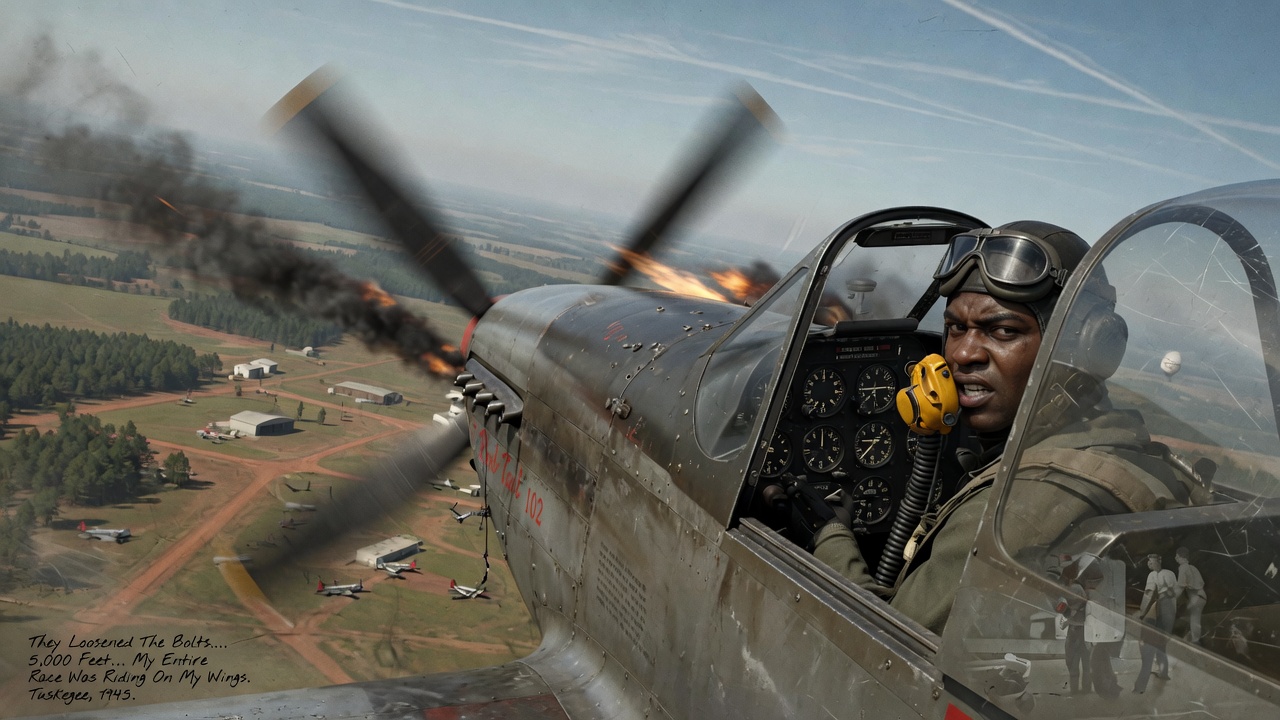
“They Loosened The Bolts And Prayed For My Death At 5,000 Feet… But Falling Wasn’t An Option When My Entire Race Was Riding On My Wings.”

I’ve faced death a dozen times in the clouds, but nothing prepared me for the silence that follows when the men you’re supposed to call brothers-in-arms decide you’re better off as a smear on the Alabama dirt.
It was 1943 at Moton Field, and the air was thick with the smell of Georgia pines and the stench of a quiet, burning hatred. I was the top cadet in my class. I could make a P-51 Mustang dance in a dogfight before most men could even find the landing gear. But in the eyes of the white mechanics and the base instructors, I wasn’t a pilot. I was an “experiment” they were desperate to see fail.
For weeks, things had been “vanishing.” My flight logs would go missing right before an inspection. My fuel would come back cloudy with sediment. I’d find bolts on my engine cowling turned just a quarter-turn loose—enough to vibrate out at high altitude, but not enough to notice on a pre-flight walkaround. They weren’t just trying to fail me; they were trying to kill me.
The morning of my final evaluation was unnervingly quiet. Major Miller, a man who looked at me like I was a stain on his pristine flight line, stood by the hangar with a clipboard. He didn’t say a word as I climbed into the cockpit of ‘Red Tail 102.’ I saw two mechanics—guys I’d seen whispering behind the barracks—exchange a look. One of them actually spat on the ground and grinned.
I should have known then.
I taxied out, the Merlin engine roaring like a caged beast. As I cleared the treeline and hit 5,000 feet, the world felt perfect. For a moment, up there, the segregation and the “Colored Only” signs didn’t exist. It was just me and the sky.
Then, the vibration started.
It began as a low hum in my floorboards, then escalated into a bone-shaking shudder. The RPMs plummeted. Fire spat from the exhaust ports, and then, with a sound like a gunshot, the engine seized. The propeller slowed, feathered, and stopped.
I was a mile up in a three-ton piece of falling metal.
My hand instinctively went to the canopy release. I could jump. My parachute was packed. I could save my life. But as I looked down at the tiny white dots of the hangars below, I realized exactly what would happen. Miller would write in his report that a “Negro pilot panicked and lost an aircraft.” They’d use my “cowardice” to shut down the Tuskegee program. Thousands of men behind me would never get their chance because I chose to live.
I took my hand off the release. “Not today,” I whispered to the dead engine. I pushed the nose down to maintain airspeed, the wind whistling through the canopy like a funeral dirge. I was flying a coffin, and the men who broke it were waiting for me to crash.
FULL STORY: CHAPTER 2
The ground was rushing up to meet me at a speed that defied logic. In a dead-stick landing, you only get one shot. There is no “go-around,” no second chance to throttle up if you misjudge the distance. You are a glider made of lead, and the physics of gravity are a judge that doesn’t take bribes.
As I banked the Mustang toward the main strip, my mind became a frantic calculator. Airspeed: 120 knots. Altitude: 1,500 feet. Distance to the threshold: three miles. I could see the fire trucks starting to roll out from the station near the tower, their red lights flashing like tiny, mocking sirens. They expected a fireball. They were already preparing the hoses to wash what was left of me off the tarmac.
“Come on, Julian,” I hissed through gritted teeth, my voice echoing in the silent cockpit. “Don’t let them have the satisfaction.”
I looked out at my wings. The P-51 was a masterpiece of engineering, but right now, it felt like a betrayal. I thought about my father back in Chicago, a man who had spent thirty years hauling luggage for white travelers at Union Station so I could have the tuition for flight school. I thought about the “Lonely Eagles”—the boys back at the barracks who shared a single pack of cigarettes and whispered about the day we’d finally get to fly over Europe. If I died here, their dreams died with me.
The wind was screaming over the canopy now. At 800 feet, I saw them.
A group of mechanics and instructors had gathered on the edge of the runway. Among them was Sergeant Higgins, the man I’d seen tampering with a toolbox near my plane at 0400 hours that morning. He wasn’t looking at the sky with concern. He was leaning against a fuel truck with his arms crossed, a look of smug anticipation on his face. He wasn’t waiting for a rescue; he was waiting for a spectacle.
Suddenly, the plane bucked. A pocket of thermal air hit the tail, and for a terrifying second, the nose dipped toward the treeline. I fought the stick, my muscles burning. Without the engine’s torque to stabilize the airframe, the controls felt heavy and unresponsive, like trying to steer a ship through wet cement.
“Gear down,” I commanded myself.
I reached for the lever. Clunk-thud. The landing gear locked into place, but the extra drag acted like a giant hand slapping the plane backward. My airspeed dropped instantly. 100 knots. 90 knots.
I was going to undershoot the runway. I was going to hit the perimeter fence and flip the aircraft into the swamp.
In that moment of pure, crystalline terror, I did the one thing the manual told you never to do. I retracted the flaps slightly to reduce drag, trading stability for a few more yards of glide. The plane felt like it was walking on a tightrope. One wrong twitch of my thumb and the wing would stall, dropping me like a stone.
I crossed the fence with less than ten feet to spare. The shadows of the pine trees flickered across the cockpit floor. I held my breath, waiting for the impact.
Screech.
The tires hit the asphalt. Not a bounce, not a skip—just a brutal, bone-jarring connection. I stood on the brakes, the smell of burning rubber filling the cabin as the Mustang skidded down the center line. I steered with the rudder pedals, fighting to keep the heavy nose from swinging and ground-looping the plane.
The aircraft finally came to a halt exactly sixty yards in front of the tower.
Silence returned, heavier than before. My heart was hammering against my ribs so hard I thought it might crack a bone. I sat there for a long minute, my hands still frozen on the controls, the sweat stinging my eyes. I was alive. The plane was intact.
I reached up, unlatched the canopy, and slid it back. The humid Alabama air rushed in, smelling of swamp water and spent oil. I stood up in the cockpit, pulled off my leather flight helmet, and looked directly at the group of men standing by the fuel truck.
Higgins wasn’t smirking anymore. His jaw had dropped, and he looked like he’d just seen a ghost rise from the grave. Major Miller was walking toward me, his face a mask of unreadable stone.
I didn’t wait for him to reach the plane. I hopped down from the wing, my boots hitting the ground with a definitive thud. I didn’t stumble. I didn’t shake. I walked straight up to the Major, snapped a perfect military salute, and spoke in a voice that didn’t tremble.
“Sir, Cadet Vance reporting. Aircraft 102 suffered total engine failure at five thousand feet. I’ve brought the equipment back for a full investigation.”
Miller looked at me, then at the silent engine, then back at me. “Investigation, Cadet?”
“Yes, sir,” I said, my eyes burning into his. “I suspect the spark plugs were fouled. Manually. I’d like the maintenance logs impounded immediately.”
The air around us turned to ice. Out of the corner of my eye, I saw Higgins start to slowly back away toward the hangar. He knew the game was up. I hadn’t just survived; I had turned his trap into a noose.
But I didn’t know yet that the real fight hadn’t even begun. The sabotage was just the opening move in a conspiracy that went much higher than a few crooked mechanics.
FULL STORY: CHAPTER 4
The brig at Moton Field was a concrete box that smelled of damp earth and failure. I sat on the edge of the cot, the tiny shard of celluloid tucked hidden inside the lining of my flight suit. Every hour, the heavy steel door would slide open, and a different officer would walk in to tell me the same thing: “Sign the confession, Vance. Say you sabotaged the engine yourself because you were afraid of the final exam, and we’ll let you go home with a dishonorable discharge. Fight it, and you’ll spend twenty years breaking rocks.”
They thought they knew my breaking point. They thought a Black man from the South Side of Chicago would fold the moment the weight of the US Army came down on his neck. What they didn’t understand was that I had been fighting for air my entire life.
On the third morning, the door didn’t open for an interrogator. It opened for Colonel Noel Parrish, the base commander. He was a man caught between two worlds—the rigid, segregated brass of the Air Corps and the reality of the incredible pilots he was training.
“Vance,” he said, waving the guards away. “You’ve caused a hell of a mess. Washington is calling. The press is sniffing around. They want to know why my best cadet is in a cage.”
I stood up, snapping to attention despite my exhaustion. “Sir, I’m in this cage because I found what Sergeant Higgins left in my fuel line. They arrested me before I could bring it to you.”
Parrish looked at me for a long time. “Higgins has a clean record. You’re a cadet with everything to lose. Why should I believe you?”
“Because, sir,” I said, stepping forward into the sliver of light from the high window, “if I wanted to fail, I would have jumped. I would have let that Mustang—a fifty-thousand-dollar piece of machinery—smash into the woods. I brought it back. I risked my life to save the plane. Does that sound like a man trying to sabotage his own program?”
I reached into my suit and pulled out the tiny, jagged piece of plastic. I held it out on my trembling palm. “This was wedged in the selector valve. Check the ID badge Higgins was wearing yesterday. The corner will be missing.”
The silence in the cell was absolute. Parrish took the shard, held it up to the light, and sighed. It was the sound of a man realizing he had to choose between the easy lie and the hard truth.
Two hours later, I was released. I wasn’t given an apology. I wasn’t given a parade. But as I walked across the tarmac toward the barracks, I saw Sergeant Higgins being led toward a Jeep by two MPs. He wasn’t wearing his cap. He looked small. He looked like the coward he had always been.
The “investigation” was quietly closed. The “Pilot Error” report was burned.
A week later, our graduation ceremony was held on the scorching hot runway. There were no cameras from the big newspapers, no politicians from D.C. It was just us, the mechanics who hadn’t betrayed us, and the planes.
When I marched up to receive my silver wings, Major Miller was the one who had to pin them on my chest. His hands were shaking slightly. He wouldn’t look me in the eye. As he pressed the metal backing into the fabric of my uniform, I leaned in just enough so only he could hear me.
“Thank you, Major,” I whispered. “For the extra practice. It’s going to make shooting down the Luftwaffe look easy.”
He stiffened, his face turning a deep, angry shade of red, but he saluted. He had no choice. I was an officer of the United States Army Air Forces.
That evening, as the sun dipped below the Alabama horizon, painting the sky in shades of bruised purple and gold, we stood by our planes. We had painted the tails of our Mustangs a bright, defiant red. It was a warning to the enemy across the ocean, but more than that, it was a reminder to the men on our own soil.
We weren’t just flying for a country; we were flying for a future where a man wasn’t judged by the color of his skin at five thousand feet. We were the Red Tails. We had survived the sabotage at home, and now, we were ready for the war in the sky.
As I climbed into my cockpit for the last time before deployment, I ran my hand over the cold metal of the dashboard. I was Julian Vance, a pilot who refused to fall. And from that day on, the world would know that while they could loosen our bolts and contaminate our fuel, they could never break our will to fly.

About the Author
dream00
A writer passionate about human stories and real-life experiences that inspire and move readers.
 Black
74 min read
Black
74 min read
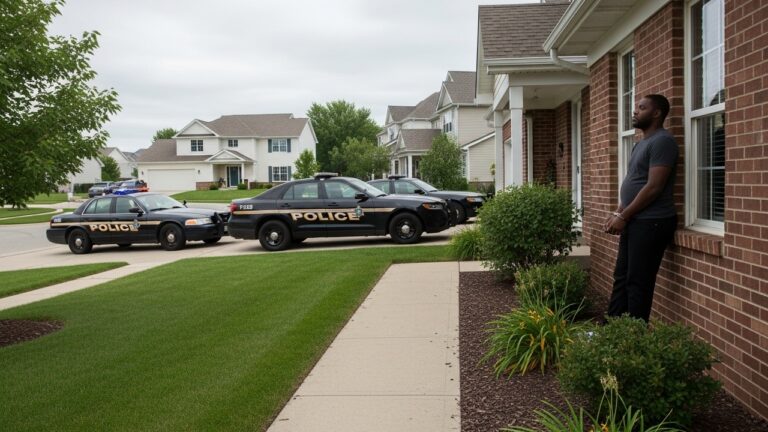
I Was Handcuffed On My Own Front Porch After 3 Police Cruisers Surrounded My House—What Happened Next Destroyed My 15-Year Suburban Dream.
Chapter 1 There is a very specific, metallic click that a pair of Smith & Wesson handcuffs makes when the…
 Black
28 min read
Black
28 min read
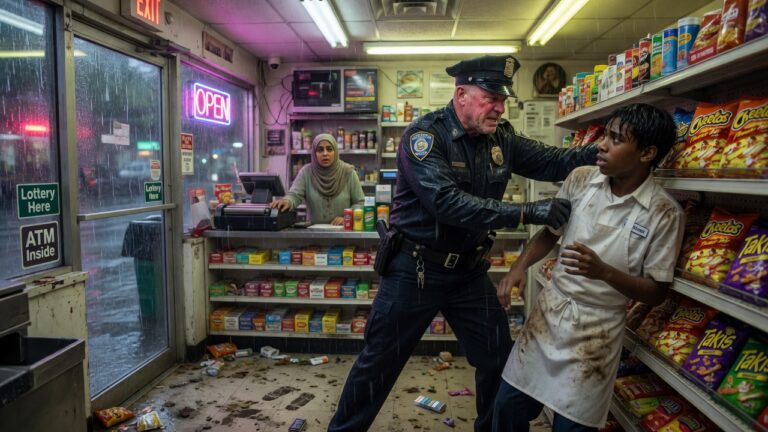
“I Was Exhausted After Scrubbing Grills For 10 Hours. But When That Officer Blocked The Only Exit In A Cramped Convenience Store At 2 AM, I Realized The Real Nightmare Had Just Begun.”
I work at a 24-hour diner on the edge of town. For minimum wage, I spend ten grueling hours standing…
 Black
2 min read
Black
2 min read
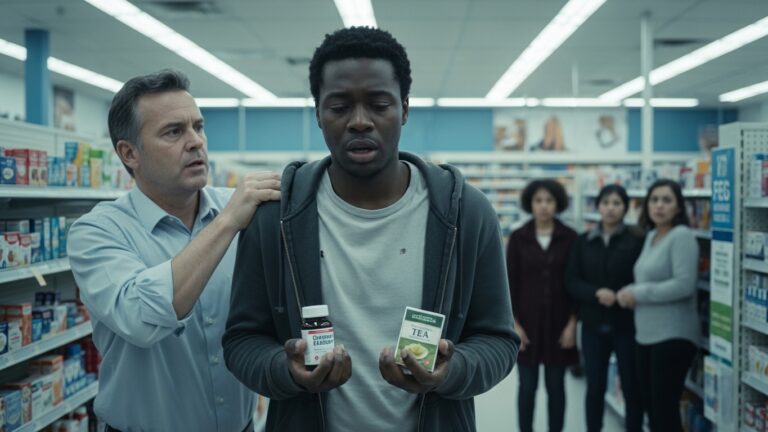
I Just Needed Two Things From The Pharmacy. I Didn’t Grab A Basket. What Happened Next Still Makes My Blood Boil.
Chapter 1: The Invisible Tag The bell above the glass door chimed, and a blast of overly conditioned air hit…
Leave a Reply