
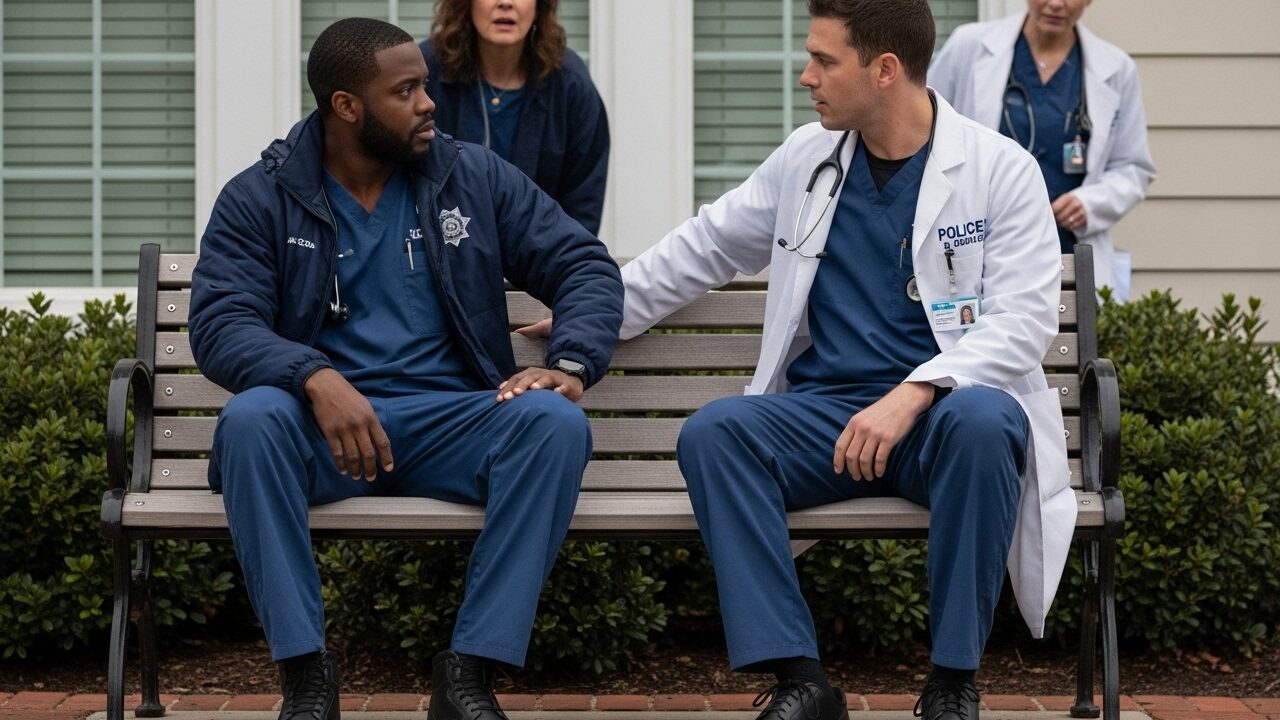
A 34-Year-Old Pediatric Nurse Saved 3 Lives Today, But 2 Cops Pinned Him to the Concrete for ‘Looking Suspicious’—What Happened Next Will Break You.

Chapter 1
The concrete of Elm Street tasted like grit, copper, and profound humiliation.
Marcus Hayes couldn’t feel his right shoulder anymore. The 220-pound weight of Officer Thomas Vance was driving his knee directly into the space between Marcus’s shoulder blades.
“Stop resisting! Keep your hands flat!” Vance barked, his voice cracking with an adrenaline-fueled panic that terrified Marcus more than the physical pain.
“I’m not resisting,” Marcus rasped, his cheek pressed so hard against the rough asphalt that he felt the skin peeling away. “My hands are flat. I’m a nurse. My ID is in my left pocket.”
“Shut your mouth!” the second officer, a younger man named Miller whose hands were visibly shaking, yelled as he fumbled for his cuffs.
It was 8:14 PM on a Tuesday. Exactly forty-two minutes earlier, Marcus had been performing CPR on a four-year-old boy named Leo in the ICU of Mercy General, three blocks away.
Marcus was thirty-four, a Black American man who had spent the last decade of his life working pediatric trauma. He had seen things that would break most men. He had held sobbing mothers. He had washed the blood off his hands more times than he could count.
Tonight, he was wearing his light blue hospital scrubs, though he had thrown a grey hoodie over them to block the sudden October chill.
He had stopped at the bus stop bench on Elm Street—a quiet, manicured neighborhood of restored Victorians—just to rest his legs for five minutes. His back ached. His arches were screaming.
He had pulled out his phone to text his seven-year-old daughter, Maya: Daddy’s coming home, sweetie. Leave the porch light on.
That was his crime. Existing. Breathing. Sitting on a wooden bench in a zip code where his skin color was immediately processed as a threat by the woman watching from the bay window of house number 402.
Clara Jenkins, sixty-eight, had lived on Elm Street for forty years. Her husband had passed away three years ago, leaving her alone with an oversized house, a Fox News subscription, and a creeping, irrational fear of the outside world.
When Clara looked out her window and saw a Black man in a hoodie sitting on the bench in the twilight, her chest tightened. She didn’t see the exhaustion in his posture. She didn’t see the stethoscope peeking out of his pocket.
She saw the shadow of every terrifying news story she had consumed over the last decade. She picked up her phone. She dialed 911.
“There’s a man loitering outside my house. He’s looking at the cars. He looks… suspicious. Yes, African American. Dark clothing. Please hurry, I’m terrified.”
Three minutes later, the cruiser’s lights flashed, painting the quiet street in violent strokes of red and blue.
Marcus hadn’t even looked up when the car pulled over. He assumed they were responding to a noise complaint or a traffic violation. He hit ‘send’ on the text to his daughter.
“Hey! Hands out of your pockets! Now!”
The voice cut through the quiet night like a gunshot.
Marcus blinked, looking up from his screen. Officer Vance was already out of the cruiser, his hand resting menacingly on the butt of his service weapon. Officer Miller was flanking him, a flashlight blinding Marcus in the eyes.
“Officer, I’m just—”
“I said hands out of your pockets! Stand up slowly!” Vance commanded.
Vance was a fifteen-year veteran of the force. He wasn’t a monster in his own mind. In his mind, he was a protector. But his training, his environment, and his own unexamined biases had wired his brain to see danger where there was none. A recent string of car break-ins in the area had him on edge. The dispatcher had said “suspicious.” Vance’s brain filled in the rest.
Marcus slowly stood up, raising his hands, his phone still in his right palm.
“Drop the phone!” Miller yelled.
“It’s just my phone, man. I was texting my daughter,” Marcus said, his voice deep, calm, trying to de-escalate the situation exactly as he did with frantic patients in the ER.
He slowly lowered his hands to place the phone on the bench.
That was the mistake. The downward movement.
“He’s reaching!” Vance yelled.
Before Marcus could process the words, a body slammed into him. The force knocked the wind completely out of his lungs. He was thrown forward, crashing into the pavement.
His phone shattered against the curb.
Now, with the asphalt biting into his face and a knee crushing his spine, Marcus felt a cold, paralyzing terror wash over him.
It wasn’t the fear of arrest. It was the primal, historical fear of a Black man in America realizing that in this exact second, his life meant absolutely nothing to the men holding him down.
If he twitched, he could die. If he breathed too heavy, he could die. If he spoke, he could die.
“I’m not fighting you,” Marcus whispered into the dirt, tears of pure frustration and pain stinging the corners of his eyes. “Please. I save kids for a living. I’m just trying to go home to mine.”
Up in the bay window of house 402, Clara Jenkins watched the violent takedown. Her hand fluttered to her throat. She had expected them to ask him questions. She had expected them to tell him to move along.
As the streetlights illuminated the scene, Clara saw the grey hoodie slide up, revealing the light blue hospital scrubs underneath. She saw the plastic hospital ID badge skitter across the pavement, reflecting the harsh blue and red lights.
A sickening knot formed in her stomach.
What have I done?
Down on the street, Officer Miller snapped the steel cuffs shut around Marcus’s wrists. They were agonizingly tight, biting into the bone.
“Got him secured,” Miller breathed heavily.
Vance stayed on top of Marcus for another ten seconds, asserting dominance, letting the adrenaline run its course. Then, he finally grabbed Marcus by the back of his shirt and hauled him upward to his knees.
Marcus’s lip was bleeding. His scrubs were torn at the shoulder, revealing dark skin scraped raw and bleeding from the pavement.
He looked up.
Neighbors were stepping out onto their porches. White faces, bathed in the glow of the police lights, staring at him. Some held up their phones, recording. Some looked horrified. Others looked validated, as if a dangerous criminal had just been taken off their pristine streets.
Marcus looked directly at Officer Vance. He didn’t yell. He didn’t curse.
He just looked at the man who had just stripped him of his dignity in less than sixty seconds.
“I was just tired, man,” Marcus said, his voice breaking. “I was just so tired.”
Vance looked at the bloody lip. He looked down at the St. Jude’s hospital badge lying on the concrete, the smiling face of Marcus Hayes, RN, looking back up at him.
For a fraction of a second, the absolute certainty in Officer Vance’s eyes shattered.
But it was too late to go back now.
Chapter 2
The backseat of a police cruiser is not designed for human comfort. It is an environment engineered entirely for containment, a rigid, unforgiving space constructed of hard plastic, slick vinyl, and a heavy steel mesh partition that separates the captive from the captors. For Marcus Hayes, the physical discomfort of the space was eclipsed only by the suffocating, heavy blanket of his own disbelief.
He sat awkwardly, his torso twisted to alleviate the agonizing pressure on his right shoulder socket. The steel handcuffs bit mercilessly into his wrists with every bump in the road. His hands, usually so steady, so precise when inserting a microscopic IV line into the fragile, translucent vein of a premature infant, were now numb, tingling with a terrifying loss of circulation.
Outside the window, the affluent, tree-lined streets of Elmwood gave way to the harsher, commercial glow of the downtown district. Streetlights flickered past, casting rhythmic, strobe-like shadows across Marcus’s face. He could taste the metallic tang of his own blood where his teeth had cut into his inner lip during the takedown. His cheek burned with a dull, throbbing heat from the friction of the rough asphalt.
He closed his eyes, leaning his head back against the cold glass. The adrenaline that had flooded his system—the primal, chemical response to a violent threat—was beginning to recede, leaving behind a cold, hollow exhaustion.
Just breathe, he told himself. It was the exact same phrase, the exact same cadence, he had used hours earlier with little Leo.
The memory hit him with the force of a physical blow. Just four hours ago, Marcus had been standing in the pediatric ICU, the harsh fluorescent lights beating down on the sterile white tiles. Leo, a four-year-old with severe asthma compounded by a vicious respiratory infection, had coded. The monitors had screamed their high-pitched, terrifying warning. Marcus had climbed onto the bed, his knees on either side of the tiny boy’s fragile ribcage, and began the rhythmic, desperate compressions. One, two, three, four. He remembered the feeling of the child’s sternum yielding beneath the heels of his hands, the sheer, terrifying fragility of human life. He had brought Leo back. He had stood there, sweating, shaking slightly, as the doctor established a stable airway. He had held the boy’s weeping mother, a young woman named Sarah, who had buried her face in his scrubs, her tears soaking through the light blue fabric to his skin.
“You saved him,” she had sobbed into his chest. “You saved my baby.”
Now, those same scrubs were torn at the shoulder, stained with his own blood and the dirt from the street. The hands that had pulled a child back from the precipice of death were locked behind his back like a violent criminal’s. The cognitive dissonance was staggering, a psychological whiplash that left Marcus feeling entirely unmoored from reality. He was a healer. He was a father. He paid his taxes, he went to church on Sundays, he coached his daughter’s little league soccer team. He had spent his entire adult life doing everything “right,” playing by the unspoken rules of a society that demanded Black men be twice as good just to be considered half as worthy.
And yet, none of it mattered. The degrees, the title, the scrubs, the intrinsic goodness of his daily life—all of it was instantly vaporized the moment Clara Jenkins looked out her window and saw only a shadow, only a threat, only a Black man in a hoodie.
In the front seat, the atmosphere was suffocatingly tense. Officer Miller, the younger of the two, drove in absolute silence, his knuckles white as he gripped the steering wheel at ten and two. He kept his eyes locked straight ahead, purposefully avoiding the rearview mirror.
Beside him, Officer Thomas Vance sat rigidly in the passenger seat. The heavy, protective vest felt tighter than usual across his chest. In his thick, calloused hands, he turned over the small rectangle of plastic he had retrieved from the street.
Mercy General Hospital. Marcus Hayes, RN. Pediatric Trauma.
The smiling face on the ID badge stared back at Vance. It was a warm, open smile. The kind of smile you would want to see if you woke up terrified in a hospital bed.
Vance swallowed hard, a dry, painful click in his throat. He shifted his weight, the leather of his duty belt creaking loudly in the quiet cab. He was a fifteen-year veteran of the force. He prided himself on his instincts. He had a wife, two teenage sons, a mortgage in the suburbs. He believed, down to his marrow, that he was the thin blue line standing between order and chaos.
When the dispatch had crackled over the radio—Suspicious individual, male, Black, dark clothing, casing vehicles on Elm Street, caller sounds extremely distressed—Vance’s mind had immediately snapped into a familiar, heavily grooved track. There had been three armed carjackings in the neighboring district in the past month. The neighborhood watch was breathing down the precinct’s neck. The pressure from the Captain was immense.
When he pulled up and saw the figure standing by the bench, hands moving downward, the training took over. Action beats reaction. You neutralize the threat before the threat neutralizes you.
But now, staring at the plastic badge, a deeply uncomfortable sensation was beginning to gnaw at the edges of Vance’s consciousness. A creeping, insidious doubt.
“You didn’t have to hit him that hard,” Miller said softly, his voice barely audible over the hum of the cruiser’s engine.
Vance’s head snapped toward the younger officer, his jaw tightening defensively. “Excuse me?”
Miller didn’t look away from the road. “I had him covered. He was putting his phone down. I saw the screen light up.”
“He dropped his hands, Miller. You know the drill. Hands go out of sight, you assume a weapon,” Vance snapped, his voice louder than necessary, filling the small space with an aggressive, defensive energy. “We don’t take chances. Not in the dark. Not when they don’t comply immediately.”
“He was complying, Tom,” Miller countered, a slight tremor in his voice. “He was putting the phone down because I told him to drop it.”
“He didn’t drop it, he reached down,” Vance argued, his thumb tracing the edge of the hospital ID. He shoved the badge into his breast pocket, out of sight, out of mind. “You let your guard down for one second out here, you end up a picture on the precinct wall. You want your wife getting that flag folded up? Because I sure as hell don’t.”
Miller fell silent, his jaw working as he chewed on his lower lip. He was only two years out of the academy. He still believed in the rulebook, still believed that right and wrong were clearly defined lines. But as he glanced in the rearview mirror and met the exhausted, bloodshot eyes of the nurse in the backseat, those lines blurred into a murky, terrifying grey.
“Just drive,” Vance muttered, staring out the passenger window at the passing city blocks, trying to ignore the sickening feeling settling in the pit of his stomach.
Five miles away, on the quiet, manicured curve of Elm Street, the flashing red and blue lights had vanished, leaving the neighborhood submerged once again in its tranquil, affluent darkness.
Inside house number 402, Clara Jenkins sat perfectly still in her heavy floral armchair. The television, usually blaring the evening news commentary, was muted. The silence in the large, empty house was oppressive, pressing against her eardrums.
Her hands, thin and spotted with age, trembled slightly where they rested in her lap. Her knuckles were pale.
She kept replaying the scene in her mind, a horrific, looping film reel. The sudden, violent slam of the bodies. The sickening sound of flesh and bone hitting the concrete. The way the man’s hood had fallen back, revealing a face not twisted in criminal malice, but contorted in pure, bewildered agony.
And then, the blue scrubs.
Clara squeezed her eyes shut, trying to block out the image, but it was burned onto her retinas. She had seen nurses in those exact scrubs every day for a month when her late husband, Arthur, was dying of pancreatic cancer. Those people had been her lifeline. They had brought Arthur water, adjusted his pillows, held Clara’s hand when she wept in the cold, sterile hallways.
“I save kids for a living. I’m just trying to go home to mine.”
The man’s voice, raw and broken, echoed in her living room.
Clara reached for her phone on the side table. Her fingers fumbled awkwardly with the screen until she found the contact she needed. She pressed the icon and lifted the phone to her ear, her heart hammering a frantic, uneven rhythm against her ribs.
The phone rang twice before a voice answered. “Mom? It’s nine-thirty your time. Is everything okay?”
“Emily,” Clara breathed, her voice cracking instantly. “Emily, I think… I think I made a terrible mistake.”
In Seattle, two thousand miles away, Emily sat up in her bed, her maternal instincts instantly flaring. “What’s wrong? Are you hurt? Do you need me to call an ambulance?”
“No, no,” Clara said quickly, tears finally breaching her lower lashes and spilling down her wrinkled cheeks. “I called the police, Emily. There was a man… he was sitting on the bench across the street. He had a hood pulled up. He was just sitting there in the dark.”
“Okay,” Emily said slowly, cautiously. “And?”
“He looked dangerous, Em. He was wearing dark clothes, he was… he was African American, and he just kept looking at his hands, looking around. I got scared. You know about the break-ins on Henderson Avenue.”
Emily let out a long, heavy sigh. It was a sigh Clara recognized well—the sound of her daughter’s liberal, progressive patience wearing profoundly thin. “Mom. You called the cops on a Black man for sitting on a bench?”
“It wasn’t just sitting!” Clara protested, though her voice lacked its usual defensive fire. “It was dark! He looked suspicious!”
“Mom, we’ve talked about this. You watch too much of that damn news channel. It makes you paranoid. What happened?”
Clara swallowed a sob. “The police came. Two officers. They yelled at him. And then… Emily, it was so fast. They tackled him. They threw him face-first onto the cement. I heard his head hit. They handcuffed him.”
“Jesus Christ, Mom,” Emily whispered, the horror evident in her tone.
“But that’s not… that’s not the worst part,” Clara choked out, the guilt finally overwhelming her, wrapping around her throat like a vice. “When they pulled him up… his jacket fell open. He was wearing hospital scrubs, Emily. He had a hospital ID. He was a nurse. He yelled that he was just a nurse trying to go home to his daughter.”
Silence stretched over the line. It was a heavy, condemning silence that made Clara feel incredibly small, incredibly foolish, and overwhelmingly old.
“Mom,” Emily finally said, her voice dropping an octave, losing all its warmth. “Do you realize what you could have done? You could have gotten that man killed. Over absolutely nothing.”
“I was just trying to keep the neighborhood safe,” Clara whispered, a pathetic, fragile defense.
“No,” Emily corrected sharply. “You were reacting to your own prejudice. You saw a Black man and you assumed the worst. I want you to sit there and really think about what you just set into motion. That man has a family. He was probably exhausted. And now he’s in a police car because you were scared of a shadow.”
“Emily, please…”
“I have to go, Mom. I can’t talk to you right now. I’m too angry.”
The line clicked dead. Clara slowly lowered the phone to her lap. She looked around her beautiful, safe living room, with its Persian rugs and antique lamps. It felt entirely devoid of warmth. She was safe from the imaginary monster outside, but she was entirely defenseless against the crushing realization of the monster she harbored within herself.
The Central Precinct of the 4th District smelled of floor wax, stale coffee, and the unique, sour scent of human anxiety. It was a chaotic, brightly lit purgatory where the worst moments of people’s lives were processed through paperwork and bureaucratic indifference.
Marcus was hauled out of the cruiser by Vance. The officer’s grip on Marcus’s bicep was tight, unnecessarily forceful, as if he were trying to physically suppress his own creeping guilt.
“Keep moving. Eyes forward,” Vance ordered as they walked through the heavy double doors into the booking area.
The harsh fluorescent lights assaulted Marcus’s eyes, making his head pound with a vicious rhythm. He shuffled forward, his shoulders slumped, the fire in his torn shoulder flaring with every step.
Behind the high booking desk sat Sergeant O’Malley. O’Malley was a large, balding man in his late fifties, a thirty-year veteran who had seen every conceivable variation of human stupidity and tragedy walk through those doors. He was typing methodically on a keyboard, a half-eaten powdered donut resting on a napkin beside him.
“What do we got, Vance?” O’Malley asked without looking up, his voice a low, gravelly rumble.
“Resisting arrest, failure to comply, disturbing the peace,” Vance rattled off quickly, a little too quickly.
O’Malley finally looked up. His eyes, heavily bagged and cynical, swept over Marcus. He took in the torn, bloody grey hoodie. The scraped cheek. The split lip.
Then, his eyes dropped lower. He saw the light blue fabric peeking through the torn jacket. He saw the distinctive, reinforced stitching of medical scrubs. O’Malley stopped typing.
“Empty his pockets,” O’Malley instructed, his eyes never leaving Marcus’s face.
Miller stepped forward. He reached into Marcus’s front left pocket and pulled out a wallet, a set of keys with a small, pink plastic Disney princess keychain, and a stethoscope.
Miller placed the stethoscope on the metal counter. The heavy metal chest piece clinked loudly in the quiet room.
O’Malley stared at the medical equipment. Then he looked at Vance. “Where’s his ID?”
Vance hesitated for a fraction of a second, a micro-expression of profound discomfort crossing his face. He reached into his own breast pocket and pulled out the plastic badge, sliding it across the metal counter.
O’Malley picked it up. He read the name. He looked at the hospital logo. He looked back at Marcus.
“You a nurse, son?” O’Malley asked, his tone shifting entirely. The rough, dismissive edge was gone, replaced by a cautious, assessing neutrality.
“Yes, sir,” Marcus answered. His voice was hoarse, raspy from being choked out on the pavement. “Pediatric trauma. Mercy General.”
O’Malley slowly turned his gaze to Vance. The silence in the booking area suddenly felt highly pressurized, like the air before a severe thunderstorm.
“You brought in a pediatric nurse for disturbing the peace?” O’Malley asked, his voice dangerously quiet. “A guy in scrubs with a stethoscope?”
“He was loitering in a residential neighborhood, Sarge,” Vance said, his posture stiffening, the defensive wall slamming back into place. “Caller said he was casing cars. When we approached, he refused to show his hands and made a sudden movement toward his waistband. He resisted. We used standard takedown procedure.”
Marcus closed his eyes. He made a sudden movement toward his waistband. The absolute, terrifying ease with which the lie slipped from the officer’s mouth chilled Marcus to the bone. It was the magic phrase. The universal get-out-of-jail-free card for excessive force.
“I was putting my phone on the bench,” Marcus said, keeping his voice steady, refusing to yell, refusing to give them the ‘angry Black man’ stereotype they desperately needed to justify their violence. “I was texting my daughter to leave the porch light on. Officer Miller told me to drop the phone. I bent down to put it on the wood. That’s when he tackled me.”
O’Malley looked at Miller. The younger officer swallowed hard, his eyes darting down to the floor, refusing to meet the Sergeant’s gaze.
That micro-reaction was all O’Malley needed to see. He had been a cop long enough to recognize the difference between a righteous bust and a catastrophic screw-up. This was a screw-up of monumental proportions.
“Take the cuffs off him,” O’Malley ordered.
“Sarge, he’s not processed yet—” Vance started to protest.
“I said take the damn cuffs off him, Vance!” O’Malley barked, his voice echoing off the cinderblock walls, making a few officers at nearby desks look up in surprise.
Vance’s jaw clenched so tight a muscle ticked visibly in his cheek. He stepped behind Marcus, shoved a key into the metal locks, and unceremoniously yanked them off.
The sudden rush of blood back into Marcus’s hands was agonizing. He let out a sharp hiss of pain, bringing his arms forward slowly, cradling his right wrist with his left hand. The skin around his wrists was bruised a deep, angry purple, the metal having nearly broken the skin.
“Mr. Hayes,” O’Malley said, his tone softening considerably. “I’m going to put you in a holding room. Not a cell. An interview room. I’m going to get a medic in here to look at that shoulder and your face. And I’m going to let you make a phone call.”
Marcus nodded slowly. He didn’t say thank you. He had nothing to be thankful for.
Miller escorted Marcus down a short hallway and opened the door to a small, windowless room with a metal table and two chairs. “I’ll get you some water,” Miller muttered softly, avoiding eye contact, before shutting the door.
Alone in the room, the silence rushed in, deafening and absolute. Marcus sank into one of the hard plastic chairs. The adrenaline was completely gone now, leaving him shivering uncontrollably.
He leaned forward, resting his elbows on his knees, and buried his face in his bruised hands.
For the first time since the lights had flashed on Elm Street, he let the tears come. They weren’t tears of sadness; they were tears of profound, existential exhaustion. He was so tired. Tired of the shifts. Tired of the death. But mostly, tired of the heavy, invisible armor he had to wear every single day just to navigate the world. He was tired of smiling non-threateningly in elevators. Tired of keeping his hands visible in stores. Tired of modulating his voice to ensure he never sounded aggressive.
He had played by every rule, and he was still sitting in a police interrogation room, bleeding and broken.
A few minutes later, the door opened. O’Malley stepped in, carrying a plastic cup of water and a desk phone with a long cord. He set them both on the table.
“Medic is on the way. You have a free line,” O’Malley said gently. He paused at the door, looking at the torn scrubs. “For what it’s worth, Mr. Hayes… I’m sorry.”
Marcus didn’t look up. He just stared at the phone.
When the door clicked shut, he picked up the receiver and dialed the number he knew by heart. It rang three times.
“Hello?” The voice was bright, energetic, a stark contrast to the sterile room. It was his younger sister, Elena. She lived a few blocks away from Marcus and often watched Maya when he pulled double shifts.
“El,” Marcus croaked out, his voice cracking on the single syllable.
“Marcus? What’s wrong? You sound terrible. Are you still at the hospital? Maya’s already in her pajamas, she refused to go to sleep until you got home. She drew you a picture of a dinosaur.”
The mention of his daughter’s name shattered the last remaining wall of his composure. A heavy, wracking sob tore its way out of his throat, completely unbidden. He pressed his hand hard over his mouth, trying to muffle the sound, his shoulders shaking violently.
“Marcus?!” Elena’s voice spiked with instant panic. “Marcus, talk to me! What happened? Are you hurt? Where are you?”
“I need you to go to the house,” Marcus managed to whisper, fighting through the tightness in his chest. “I need you to stay with Maya.”
“Why? Where are you?”
“I’m at the 4th District Precinct, El,” Marcus said, the words tasting like ash in his mouth. “I got arrested.”
“Arrested? For what?! You were just at work!”
“I don’t know,” Marcus whispered, staring at his bruised wrists resting on the cold metal table. The pink Disney princess keychain, returned from his pockets, sat a few inches away. “I was just sitting on a bench. I was just trying to go home.”
He closed his eyes, leaning his head forward until his forehead rested against the cool steel of the table.
“Tell her… tell Maya to turn the porch light off, El. Daddy’s not coming home tonight.”
Chapter 3
The precinct medic, a forty-six-year-old EMT named David Cole, had the weathered, heavily lined face of a man who had spent two decades patching up the collateral damage of midnight in the city. He walked into the interrogation room carrying a battered orange trauma kit, expecting the usual: a drunk with a split eyebrow, a domestic dispute with bruised knuckles, or a junkie going through the messy, violent early stages of withdrawal.
Instead, he found Marcus Hayes.
David stopped just inside the heavy metal door, the latch clicking shut behind him with a heavy, final thud. The room was aggressively lit by a single, caged fluorescent bulb that buzzed with a low, constant frequency. Beneath it, Marcus sat perfectly still, his large frame hunched forward, staring at a blank patch of cinderblock wall.
David’s eyes immediately locked onto the torn blue fabric visible beneath the ruined grey hoodie. He recognized the heavy-duty stitching, the specific shade of ceil blue. He recognized the exhaustion settling into the man’s posture—it was the same bone-deep fatigue David felt at the end of a seventy-two-hour shift.
“I’m David,” the EMT said softly, keeping his voice carefully modulated, instinctively recognizing the severe signs of clinical shock. He pulled up the second metal chair, placing his kit on the table. “I need to take a look at your shoulder and your face. Is it alright if I touch you, Mr. Hayes?”
Marcus didn’t turn his head. His eyes, completely devoid of their usual warmth, remained fixed on the wall. “Are you going to ask me if I reached for my waistband?”
The question was delivered flatly, without a trace of anger, which somehow made it infinitely worse. David paused, his hand hovering over the clasp of his medical kit. He had heard the whispers out in the bullpen. A bad bust. A pediatric nurse. Vance had lost his temper again.
“No,” David said quietly. “I’m just going to clean the gravel out of your cheek before it gets infected.”
Marcus finally blinked, the spell breaking slightly. He gave a slow, minute nod.
David snapped on a pair of blue nitrile gloves. The sound, a sharp snap of latex, caused Marcus to flinch violently, his breath hitching in his chest. David immediately held his hands up, palms open. “Sorry. Sorry, I should have warned you. It’s just gloves.”
“I know,” Marcus whispered, closing his eyes tightly. “I wear them every day. I know what they sound like. I’m sorry.”
“Don’t apologize,” David murmured. He reached into his kit and pulled out a sterile saline wipe. “I’m going to clean the laceration on your face first. This is going to sting.”
As David carefully dabbed away the dried blood and asphalt grit from Marcus’s cheekbone, he studied the man’s face. He saw the deep, dark circles under his eyes, the unmistakable mark of the night shift. He saw the way Marcus’s jaw was clenched tight, fighting a battle to keep the pain entirely internal.
“You work at Mercy General?” David asked, trying to keep the patient grounded with casual conversation, a basic trauma response technique.
“Pediatric ICU,” Marcus answered, his voice a low rasp.
“That’s a tough floor,” David noted, moving to the split lip. “I bring kids in there sometimes. You guys do miracles.”
“We try,” Marcus said. A profound, hollow silence stretched between them for a moment. “I had a four-year-old code tonight. Asthma exacerbation, severe respiratory distress. We pushed epi. I did chest compressions for six minutes before we got a rhythm. I broke his ribs. You know how it feels when a kid’s ribs give way under your hands?”
“Like stepping on dry twigs,” David said softly, his own chest tightening at the memory of similar calls.
“Yeah,” Marcus breathed, a single tear escaping the corner of his eye and cutting a clean line through the dust on his cheek. “Like dry twigs. I saved his life. And then I walked outside, sat on a bench, and a cop put his knee exactly where I was putting my hands on that little boy.”
David stopped wiping. He looked down at the blood-soaked gauze in his hand, suddenly feeling entirely complicit, somehow stained by the uniform he wore, even if it was just an EMT patch. He swallowed hard, disposing of the wipe in a biohazard bag.
“Let’s look at that shoulder,” David said, his voice thicker now. “Take off the hoodie. Slowly.”
Marcus unzipped the ruined sweatshirt. When he tried to pull his right arm out of the sleeve, he let out a sharp, involuntary gasp of pure agony. His shoulder was locked.
“Okay, stop, stop,” David instructed, quickly producing a pair of trauma shears from his kit. “I’m cutting it. Don’t move.”
David slid the blunt edge of the shears under the grey fabric and cut cleanly through the shoulder seam. He peeled the heavy cotton away, exposing the torn hospital scrubs underneath. He cut through those as well.
When the shoulder was finally exposed, David drew in a sharp breath through his teeth.
The acromioclavicular joint was severely swollen, the skin a mottled, terrifying canvas of dark purple and black. The collarbone was visibly displaced, pressing hard against the skin from the inside. It wasn’t just a bruise. It was a severe dislocation, and highly likely, a torn rotator cuff.
David gently pressed his gloved fingers against the swelling. Marcus groaned, his entire body going rigid.
“I’m sorry,” David said, stepping back. He looked Marcus directly in the eyes. The EMT’s expression was grim, stripped of all bedside manner. “Mr. Hayes, I’m going to be straight with you. Your shoulder is dislocated, and given the mechanism of injury, I suspect you have significant soft tissue damage. Probably a torn labrum or rotator cuff.”
Marcus stared at him, the clinical terminology washing over him, translating instantly into devastating reality. He knew exactly what those injuries meant. He knew the recovery time. He knew the physical therapy.
“I can’t lift patients with a torn cuff,” Marcus said, his voice dropping to a terrifyingly calm whisper. “I can’t perform CPR.”
David didn’t answer. He didn’t offer a hollow reassurance. He just began prepping a heavy fabric sling.
“If I can’t do my job,” Marcus continued, staring at his ruined shoulder, “I lose my insurance. If I lose my insurance, I can’t pay for Maya’s braces. I can’t make the mortgage. They didn’t just hit me, David. They broke my hands. They broke my life.”
David secured the sling around Marcus’s neck, carefully supporting the dead weight of the arm. “I’m requesting an immediate transfer to the ER. You need an MRI, tonight. And frankly, you shouldn’t be in this building.”
“Will they let me go?” Marcus asked.
David packed up his kit, the metallic click of the latch echoing loudly. “I don’t know,” the medic admitted, his voice heavy with disgust. “But I’m going to go out there and raise hell until they do.”
Outside the holding room, the atmosphere in the bullpen had shifted from chaotic bureaucracy to a tense, suffocating quiet.
Captain Richard Sterling had arrived.
Sterling was fifty-two, a man who wore his uniform impeccably tailored and his ambition on his sleeve. He was a political animal, heavily favored to become the next Deputy Chief, provided his district maintained its glossy, low-crime facade. He did not like surprises, and he especially abhorred PR nightmares involving civil rights violations in affluent zip codes.
Sterling stood behind the high desk, his arms crossed over his chest, listening as Sergeant O’Malley briefed him in hushed, urgent tones.
“He’s a pediatric nurse, Rich,” O’Malley growled, leaning in so the patrol officers at the surrounding desks couldn’t hear. “Clean record. Not even a parking ticket. He was sitting on a bench texting his kid. Vance came in hot, tackled him to the pavement, and claims the guy reached for his waistband. But I’m telling you, I looked at Miller. The kid is terrified. He knows it’s a bad shoot, or a bad tackle, whatever you want to call it.”
Sterling rubbed his temples, a headache already blooming behind his eyes. “Where is the bodycam footage?”
O’Malley grimaced. “That’s the other problem. Vance claims his camera got dislodged in the scuffle. It shut off right before the takedown. Miller’s camera caught the audio, but the angle is completely obscured by Vance’s back.”
“Convenient,” Sterling muttered bitterly. He looked across the room to where Officer Thomas Vance and Officer Chris Miller were sitting at a pair of isolated desks, separated from the rest of the shift.
Vance was drinking coffee from a styrofoam cup, staring straight ahead with an expression of rigid, aggressive defiance. Miller was staring at his own hands, his knee bouncing rapidly up and down under the desk in a nervous, uncontrollable rhythm.
“Call Greg Harrison,” Sterling ordered, referencing the precinct’s union representative. “Get him down here. I want Vance and Miller separated, and I want their preliminary reports on my desk in ten minutes. If Vance crossed the line, I’m not going down with him.”
“And the nurse?” O’Malley asked.
“What are the charges Vance filed?”
“Resisting arrest, failure to comply, and assaulting a police officer,” O’Malley read from the intake form, shaking his head. “Vance claimed Hayes threw an elbow during the takedown.”
Sterling sighed heavily. The ‘assaulting an officer’ charge was the poison pill. Once that was on the paperwork, the department was backed into a corner. If they dropped the charges entirely, it was an admission of a false arrest, opening the city up to a massive, multi-million dollar civil rights lawsuit. If they proceeded, they were ruining an innocent man’s life to cover a bad cop’s mistake.
“We can’t release him on an assault charge without a judge,” Sterling said, the cold calculus of the system overriding any sense of moral decency. “Book him. Process him. Put him in holding.”
O’Malley stared at his Captain, absolute disgust rolling off him in waves. “Rich, you put that man in a cell tonight, you’re going to destroy him. You know Vance is lying.”
“I don’t know anything, O’Malley!” Sterling snapped, his voice rising just enough to turn a few heads in the bullpen. He quickly lowered his volume. “I know what the paperwork says. We follow the procedure. If the investigation clears the nurse, fine. But right now, we follow the book. Process him.”
Before O’Malley could argue further, the heavy glass doors of the precinct lobby buzzed open.
Clara Jenkins walked in.
She looked entirely out of place in the grimy, chaotic environment of the police station. She was wearing a perfectly pressed tan trench coat over her silk pajamas, her silver hair brushed neatly into place, a string of pearls still resting against her collarbone. She clutched a leather designer handbag tightly against her chest like a shield.
She walked past a weeping woman smelling of cheap gin and a teenager in handcuffs, her eyes wide, her breath shallow. She approached the front desk, her hands trembling violently as she placed them on the scratched laminate counter.
O’Malley stepped away from the Captain and walked over to the counter. “Can I help you, ma’am?”
“I… I need to speak to whoever is in charge,” Clara said. Her voice, usually so commanding in neighborhood association meetings, was paper-thin, vibrating with suppressed panic. “My name is Clara Jenkins. I live at 402 Elm Street. I made a 911 call earlier this evening.”
O’Malley’s posture immediately stiffened. He exchanged a quick, loaded glance with Captain Sterling, who stepped forward, suddenly extremely interested.
“I’m Captain Sterling, Mrs. Jenkins. What can we do for you?”
Clara looked at the two men, her eyes darting between their badges. “I made a terrible mistake,” she blurted out, the words rushing past her lips as if they were burning her throat. “The man outside my house. The man the officers arrested. I want to take it back. I want to cancel the call. You have to let him go.”
Sterling’s expression instantly smoothed out into a mask of polite, professional detachment. “Mrs. Jenkins, I understand you’re upset. But you can’t ‘cancel’ a 911 call once an arrest has been made.”
“But he didn’t do anything!” Clara pleaded, her voice rising, drawing the attention of the surrounding officers. She didn’t care about decorum anymore. The image of the bloody scrubs was haunting her. “I thought he was breaking into cars. But he was just sitting there! He was a nurse! I saw his badge on the street. I was scared, and I overreacted, and your officers… they hurt him! They threw him to the ground for absolutely no reason!”
“Ma’am, please lower your voice,” Sterling said, stepping closer to the counter, his tone carrying a subtle, authoritative warning. “Our officers responded to your report of a suspicious, potentially dangerous individual. When they arrived, the suspect resisted lawful orders.”
“He did not resist!” Clara cried out, slamming her manicured hand against the counter. “I was watching from my window! The whole time! They told him to drop his phone, he bent over to put it down, and they tackled him! Like an animal! He didn’t fight back, he didn’t run. They just hurt him!”
The silence in the bullpen was deafening. Every officer in the room had stopped typing.
In the corner, Officer Vance’s head snapped up, his face draining of color. Officer Miller closed his eyes, his breathing growing shallow and rapid.
Captain Sterling stared at Clara Jenkins, the political calculus in his brain completely short-circuiting. The primary witness—the caller herself—was contradicting the arresting officer’s report in the middle of a crowded precinct. The blue wall of silence was completely useless against a wealthy, white, sixty-eight-year-old widow who was having a crisis of conscience.
“Mrs. Jenkins,” Sterling said, his voice dropping to a harsh whisper. “I need you to come into my office. Now.”
“No,” Clara refused, planting her feet. The lifetime of entitlement that usually shielded her was suddenly turned against the institution she had called for protection. “I am not going into a back room so you can hush this up. I want to see him. I want to apologize to him. And I want you to let him go back to his daughter.”
“It doesn’t work that way,” O’Malley said gently, stepping in to intercept before Sterling lost his temper. “Ma’am, once an officer alleges assault, the state picks up the charges. It’s out of your hands. It’s out of ours, until a judge sees it.”
Clara stared at the burly Sergeant, the reality of the monstrous, unfeeling machine she had activated finally crushing down on her. “You mean… even if I tell the truth, even if I admit I was wrong… you’re still going to lock him in a cage?”
“Yes, ma’am,” O’Malley said softly. “That’s exactly what it means.”
Clara stumbled back a step, her hand flying to her mouth to stifle a sob. She looked around the precinct, at the men with guns on their hips, at the heavy metal doors leading to the holding cells. She had called them to feel safe. But looking at them now, she realized she had never been in any danger. The only dangerous element on Elm Street tonight had been her own unchecked fear, weaponized by a badge.
Down the hall, inside the men’s locker room, the air was thick with the smell of cheap cologne and sweat.
Officer Chris Miller stood in front of a scratched mirror, gripping the edges of the porcelain sink so hard his knuckles were stark white. He was breathing heavily, panic completely overriding his system.
The door swung open, and Greg Harrison, the union representative, walked in. Harrison was a bulldog of a man, wide-shouldered, with a thick neck and eyes entirely devoid of empathy. He chewed aggressively on a piece of gum.
“Alright, kid, listen up,” Harrison barked, locking the door behind him. “I just talked to Vance. We got a situation. The captain is breathing down our necks, and the old lady who called it in is currently throwing a fit in the lobby claiming Vance used excessive force.”
Miller looked at Harrison in the mirror, his eyes wide, terrified. “She saw it.”
“It doesn’t matter what she thinks she saw,” Harrison said sharply, stepping closer, dominating Miller’s personal space. “She was in a window, in the dark, sixty feet away. She didn’t see the suspect’s hands. Vance did. Vance says the suspect made a sudden, aggressive movement toward his waistband, consistent with drawing a weapon. Vance initiated a tactical takedown to secure the suspect and protect his partner. Which is you.”
Miller swallowed hard, his throat dry as bone. “He… he was just putting his phone on the bench, Greg. I told him to drop it. He was complying.”
Harrison stopped chewing. The atmosphere in the bathroom instantly turned lethal.
“Listen to me very carefully, Chris,” Harrison said, his voice dropping to a low, dangerous growl. He stepped up until he was inches from Miller’s face. “You’ve been on the job for two years. You got a baby coming in four months. You got a mortgage. You really want to be a rat? You really want to go against a decorated fifteen-year veteran because you got cold feet on a standard takedown?”
“It wasn’t standard,” Miller whispered, tears of sheer stress welling in his eyes. “He was a nurse. He wasn’t fighting.”
“He assaulted an officer!” Harrison hissed, tapping a thick finger against Miller’s chest, right over his badge. “He fought back. That’s the report Vance is writing. That is the report I expect you to corroborate. Because if you go out there and contradict your partner, you’re not just hanging Tom out to dry. You’re committing career suicide. Nobody in this precinct will ride with you. Nobody will back you up when you call for help. You will be a ghost in a blue uniform, and they will find a reason to fire you before your wife even goes into labor. Do you understand me?”
Miller stared at the union rep, feeling the absolute weight of the corrupt, unyielding brotherhood pressing down on his chest, suffocating his morality. He thought of his pregnant wife. He thought of the crippling debt they were already in.
Then he thought of Marcus Hayes, bleeding on the concrete, whispering, I just want to go home to mine.
“What do I write?” Miller asked, his voice breaking, his soul fracturing right down the middle.
“You write exactly what Vance writes,” Harrison said, patting Miller hard on the cheek, a condescending gesture of victory. “The suspect was non-compliant. The suspect made an aggressive movement. You feared for your safety. Keep it simple. Stick to the script.”
Back in the holding area, the heavy metal door of the interrogation room swung open again.
Marcus looked up, expecting the medic, or perhaps the Sergeant to haul him away to a cell. Instead, a tall, sharply dressed white man in his late thirties walked in, carrying a leather briefcase. His eyes were cold, analytical, taking in the room and Marcus’s injured state in a fraction of a second.
Behind him stood Elena, Marcus’s sister. Her eyes were red and swollen from crying, but her jaw was set with a fierce, uncompromising determination.
“Marcus,” Elena gasped, rushing forward, her hands hovering over him, terrified to touch him and cause more pain. She saw the makeshift sling, the swollen cheek, the blood drying on his scrubs. “Oh my god. Oh my god, what did they do to you?”
“I’m okay, El,” Marcus lied softly, using his good arm to grab her hand and squeeze it. “Is Maya asleep?”
“Yes. She’s safe,” Elena said, her voice shaking violently. She turned to the man standing behind her. “Marcus, this is William Taggart. He’s a civil rights attorney. A friend of a friend at the hospital called him.”
William Taggart stepped forward, offering a brief, professional nod. He didn’t offer a platitude. He didn’t say he was sorry. He pulled out a legal pad and a pen.
“Mr. Hayes. I’m going to be straight with you,” Taggart began, his voice crisp and fast-paced. “I just spoke with the desk sergeant. They are formally charging you with resisting arrest, failure to comply, and felony assault on a police officer.”
Marcus felt the air completely leave his lungs. “Assault? I didn’t touch them. I didn’t even raise my voice.”
“I believe you,” Taggart said smoothly, pulling a chair out and sitting down. “But you need to understand the mechanics of what is happening right now. They brutalized you. They injured your shoulder, which, given your profession, threatens your livelihood. The arresting officer knows he screwed up. The only way he justifies sending you to the hospital with a torn rotator cuff is if you were actively fighting him.”
“So they’re lying to cover their tracks,” Marcus said, the bitter, agonizing reality settling over him like a heavy shroud.
“Exactly,” Taggart confirmed, his pen tapping lightly against the legal pad. “They are going to close ranks. The blue wall will go up. They will claim you made a threatening gesture, and that you struck the officer during the takedown. Because if you didn’t, they are liable for millions, and the officer loses his badge. They are going to try to crush you to save themselves.”
“Can we fight it?” Elena asked, her voice bordering on desperate. “There has to be a camera. A bodycam. Something.”
“I already asked,” Taggart said, his expression darkening. “The primary officer’s camera allegedly malfunctioned right before the incident. The secondary officer’s angle is obstructed. And it gets worse.”
Taggart leaned forward, looking directly into Marcus’s eyes.
“The District Attorney in this county is up for re-election in three months. He relies heavily on police union endorsements. If the police push these charges, the DA will prosecute them to the fullest extent to appease the union. They will threaten you with five to ten years in state prison, hoping to terrify you into taking a plea deal for a misdemeanor. Because if you plead guilty to anything, you waive your right to sue them civilly. It makes the whole mess disappear.”
Marcus stared at the cold, metal table. He thought of Maya, sleeping in her bed, surrounded by her stuffed animals, waiting for a father who was currently being fed into a meat grinder by a system designed to consume him.
He had spent his whole life trying to be invisible to this machine. He wore scrubs instead of hoodies when he could. He spoke perfectly articulated English. He drove precisely the speed limit. He smiled politely at white women in elevators. He did everything the world demanded of a Black man to prove he wasn’t a monster.
And it hadn’t mattered. The moment the uniform decided he was a threat, his humanity was erased.
“What do we do?” Marcus asked, his voice barely a whisper, echoing in the sterile room.
“We fight,” Taggart said, his eyes narrowing with a predatory intensity. “I am going to get you out of here on bail tomorrow morning. Then, we are going to war. But I need you to know right now, Marcus… they are going to drag your name through the mud. They will look into your past, your finances, your medical records. They will try to paint you as an angry, unstable man. This is going to be the hardest fight of your life.”
Marcus slowly turned his head to look at his ruined right arm, hanging uselessly in the sling. The pain was a constant, blinding white fire in his shoulder. He thought of the four-year-old boy whose chest he had compressed. He thought of the life he had saved, just hours before his own was destroyed.
He looked back at the lawyer. The exhaustion in Marcus’s eyes was gone, replaced by something entirely different. It was a cold, hard, unyielding resolve.
“Let them try,” Marcus said.
Chapter 4
The physical therapy clinic smelled of sterile alcohol wipes, hot rubber mats, and the sharp, metallic tang of human exertion. It was eight o’clock on a freezing January morning, exactly ninety-two days since the asphalt of Elm Street had torn Marcus Hayes’s life down to the studs.
“Alright, Marcus. Let’s try the wall crawls again. Just to the point of resistance, not to the point of agony,” said Dr. Aris Thorne, a no-nonsense physical therapist who had spent her career putting shattered athletes and car crash victims back together.
Marcus stood facing the blank, white wall. He was wearing a loose grey t-shirt, the fabric hanging limply over his right side where the muscle mass had visibly atrophied. His right arm, freed from the heavy brace only three weeks prior, felt like it belonged to a corpse. It was entirely disconnected from his brain’s commands, a dead, throbbing weight attached to a joint held together by three titanium anchors and months of agonizing scar tissue.
He raised his right hand, his fingertips pressing against the cool drywall. Slowly, painfully, he began to walk his fingers upward, resembling a spider dragging a crushed limb.
One inch. Two inches.
A dull, grinding ache started deep within the socket. He ignored it. He focused on the wall, visualizing the monitors in the pediatric ICU. He visualized the weight of a child in his arms.
Three inches.
The ache suddenly flared into a blinding, white-hot spike of pure nerve pain. It felt like someone had driven a heated railroad spike directly through his collarbone. Marcus let out a sharp, guttural hiss, his knees buckling slightly. His hand slipped off the wall, and his arm dropped uselessly to his side, sending a sickening jolt of agony all the way up into his jaw.
He leaned his forehead against the drywall, his chest heaving, sweat beading at his hairline despite the chilled air conditioning of the clinic.
“Okay. Stop. We’re done with that for today,” Aris said gently, stepping in to support his elbow. “You got higher than last Tuesday, Marcus. That’s progress.”
“Progress,” Marcus spat the word out like it was poison. He kept his forehead against the wall, refusing to turn around, refusing to let her see the tears of pure, unadulterated frustration welling in his eyes. “I need a hundred and sixty degrees of vertical extension to pass the occupational health physical to get back on the floor. I’m barely hitting ninety. I can’t even reach the top shelf of my kitchen cabinets, Aris. How the hell am I supposed to reach a crash cart defib?”
Aris didn’t offer a hollow platitude. She just handed him a towel. “It’s been three months since the surgery, Marcus. You suffered a Grade III AC joint separation and a massive rotator cuff tear. The human body is a machine, and your machine was broken violently. It takes time.”
“I don’t have time,” Marcus whispered, wiping his face.
Time was a luxury he could no longer afford. The hospital, bound by union rules and liability policies, had placed him on unpaid medical leave once his accrued sick days ran out. Worker’s compensation had denied his claim because his injury hadn’t occurred on the job. The state of the criminal case—three pending felony charges that hung over his head like a guillotine—meant no other medical facility would even look at his resume.
He was drowning. The legal fees, even with William Taggart working on a contingency for the eventual civil suit, were bleeding his meager savings dry. The mortgage was two months past due. He had canceled Maya’s gymnastics classes, lying to his seven-year-old daughter that the gym was closed for repairs. Every time the mail arrived, it was a new collection notice, a new medical bill, a new reminder of how thoroughly Officer Thomas Vance had destroyed his existence in sixty seconds.
But the financial ruin wasn’t the worst part.
The worst part was the fear.
It was a cold, insidious poison that had seeped into his marrow. Before October, Marcus had navigated the world with the cautious, calculated awareness required of every Black man in America. But now, that caution had mutated into a crippling, clinical paranoia.
If he was driving and saw a patrol car in his rearview mirror, his heart rate would instantly spike to a hundred and forty beats per minute. His palms would sweat so heavily they slipped on the steering wheel. He had stopped going for evening walks. He flinched when the doorbell rang. He was a prisoner in his own skin, trapped in a society that had explicitly demonstrated his life held absolutely zero inherent value to the people sworn to protect it.
He finished his session, icing his shoulder for twenty minutes in a silent, agonizing meditation, before walking out into the bitter winter air. He climbed into his ten-year-old Honda Civic, starting the engine just to get the heater running.
His phone buzzed on the passenger seat. It was William Taggart.
“Yeah, Will,” Marcus answered, his voice flat.
“Are you sitting down?” Taggart’s voice was uncharacteristically tight, missing its usual polished, rapid-fire cadence.
“I’m in the car. What is it? Did the DA offer a plea again?” The District Attorney’s office had been relentlessly aggressively, offering to drop the felony assault charge if Marcus pled guilty to misdemeanor resisting arrest. It was a trap. A plea meant he could never sue the city, and it meant a criminal record that would instantly revoke his nursing license. He had refused every time, but the pressure was becoming unbearable.
“No plea,” Taggart said. He paused, and Marcus could hear the sound of pages turning over the line. “We just got the sworn deposition schedule. We are deposing the neighborhood watch caller, Clara Jenkins, tomorrow. But that’s not the headline.”
“What is?”
“I just got a call from a burner phone,” Taggart said, his voice dropping to a low, intense hum. “It was Officer Chris Miller. He wants to talk. Off the record. Tonight.”
Marcus stopped breathing. The winter wind howled against the windshield of the Civic, but inside the car, all sound ceased. Officer Miller. The younger cop. The one whose hands had been shaking. The one who had snapped the cuffs onto his bleeding wrists.
“Talk about what?” Marcus finally managed to say, his voice cracking.
“I don’t know,” Taggart admitted. “But cops don’t call civil rights attorneys on burner phones to chat about the weather. He’s cracking, Marcus. The blue wall has a fissure. Be at my office at eight tonight. We’re meeting him at a neutral location.”
At 8:15 PM, a torrential, freezing rain was sweeping through the city, turning the streets into slick, black mirrors reflecting the neon signs of downtown.
Inside a dimly lit, largely empty diner on the outskirts of the industrial district, Marcus sat in a cracked vinyl booth across from William Taggart. A lukewarm cup of black coffee sat untouched in front of him. His right arm rested in his lap, a dull throb radiating from the joint in time with his heartbeat.
The bell above the diner door jingled softly.
Marcus looked up.
Chris Miller walked in. He looked terrible. He was in plainclothes—a dark jacket and jeans—but he carried himself with the heavy, exhausted slouch of a man carrying a physical burden. He had lost weight. Deep, bruised shadows hung under his eyes, and he hadn’t shaved in days. He looked like a ghost haunting his own life.
Miller spotted them in the back booth. He hesitated for a fraction of a second, his eyes meeting Marcus’s, before he forced himself to walk over. He slid into the booth next to Taggart, keeping the table between himself and the man he had helped arrest.
For a long, suffocating minute, nobody spoke. The only sound was the clatter of silverware from the kitchen and the relentless drumming of rain against the windowpane.
Marcus stared at Miller. He felt a sudden, violent surge of rage rise in his chest, so hot and sharp it made his vision swim. This was the man who had held the flashlight in his eyes. This was the man who had watched Vance crush his spine and had done absolutely nothing to stop it.
“Why are you here?” Marcus asked. His voice wasn’t loud, but the sheer, concentrated venom in it made Miller physically recoil.
Miller looked down at his trembling hands, resting on the Formica table. “My wife is six months pregnant,” he whispered, his voice hoarse, as if he hadn’t spoken in days. “We just found out it’s a boy. We were painting the nursery this weekend.”
Taggart leaned forward, his lawyer instincts instantly kicking in, recognizing the emotional vulnerability. “Congratulations, Officer Miller. What does that have to do with Mr. Hayes?”
Miller swallowed hard, his Adam’s apple bobbing sharply. He finally looked up, bypassing Taggart, looking directly into Marcus’s eyes.
“I couldn’t paint,” Miller choked out, a tear suddenly breaking loose and tracking down his unshaven cheek. “I was holding the roller, and my hands started shaking so badly I dropped it on the floor. My wife asked me what was wrong. She thought I was sick. I looked at her… and I realized I’m going to be a father. I’m going to have to look a little boy in the eye and teach him right from wrong. I’m going to have to tell him to be brave. To stand up for people.”
Miller wiped his face roughly with the back of his sleeve, taking a shuddering breath.
“I can’t do that,” Miller said, his voice breaking entirely. “I can’t be a father to that boy knowing I stood in a precinct locker room and let a union rep bully me into signing a false police report that ruined an innocent man’s life.”
The silence that followed was absolute. Taggart slowly, carefully reached into his briefcase and placed a small, digital audio recorder on the table. He didn’t turn it on yet. He just let it sit there.
“You signed a false report,” Taggart repeated quietly, cementing the statement.
“Vance lied,” Miller said, the words rushing out of him now, a dam breaking under impossible pressure. “He lied about everything. The camera didn’t malfunction. Vance manually switched his bodycam off when he stepped out of the cruiser because he was pissed off we had to respond to a rich neighborhood noise complaint. He wanted to go in hot to scare you off the block.”
Marcus felt the air leave his lungs. It was exactly what he had known in his bones, but hearing the truth spoken aloud by the man who had worn the badge sent a shockwave of profound, dizzying vindication through his system.
“And the takedown?” Taggart pressed, his eyes narrowed like a hawk locked onto prey.
“You didn’t resist, Mr. Hayes,” Miller said, shaking his head rapidly. “You didn’t reach for your waistband. You didn’t throw an elbow. I told you to drop the phone. You were complying. You bent down to put it on the bench, and Vance blind-sided you. He panicked. He saw a Black man moving in the dark, and he overreacted. And when he realized you were a nurse, when he saw the badge, he knew his career was over if he didn’t justify the force. So he made up the assault.”
“And you went along with it,” Marcus said, his voice dropping to a terrifyingly quiet register. “You watched him tear my shoulder out of the socket. You watched him bleed me on the concrete. And you went back to the station and you signed your name to a lie that could have sent me to prison for ten years. Why?”
Miller flinched as if he had been struck. “Because I was terrified,” he whispered, shame radiating from him in palpable waves. “Greg Harrison, the union rep… he pinned me in the bathroom. He told me if I contradicted Vance, I was dead to the department. He told me I’d be fired, blacklisted, that my pregnant wife would lose her health insurance. I was a coward, Mr. Hayes. I chose my family’s safety over your life. And I have hated myself every single second of every single day since.”
Marcus stared at the young, broken officer. He wanted to scream. He wanted to reach across the table with his good arm and wrap his fingers around Miller’s throat. He wanted Miller to feel a fraction of the agony he had felt trying to crawl up a blank wall just to regain the ability to lift his own daughter.
But as Marcus looked at Miller’s trembling hands, he didn’t see a monster. He saw a weak, frightened cog in a machine designed to grind human beings into dust. Miller was part of the sickness, yes. But the real disease was the system that had forced a young man to choose between his livelihood and his soul.
“I don’t forgive you,” Marcus said, his voice hard, uncompromising. “You don’t get my absolution to make yourself feel better. You broke me.”
Miller nodded, accepting the condemnation. “I know.”
Taggart pushed the digital recorder to the center of the table and pressed the red button.
“Officer Miller,” Taggart said smoothly, “are you willing to state everything you just told us in a sworn, videotaped affidavit? Are you willing to testify under oath that Officer Thomas Vance falsified a police report and committed perjury, and that the union representative intimidated a witness?”
Miller looked at the red light of the recorder. It was a tiny, glowing dot. Pressing that button, speaking into that microphone, meant the end of his career. It meant the end of his life in the city. He would be labeled a rat, a traitor. He would have to move. He would have to start over completely.
He thought of his unborn son. He thought of the blood on Marcus’s scrubs.
Miller leaned forward, bringing his mouth inches from the microphone.
“My name is Officer Christopher Miller, badge number 8942,” he began, his voice steadying, finding a profound, tragic courage in the ashes of his cowardice. “And I am here to report a crime committed by my partner.”
The next morning, at ten o’clock, the atmosphere inside the sprawling, glass-walled conference room of Taggart & Associates was suffocatingly tense.
Sitting at the head of the long mahogany table was Clara Jenkins.
She looked smaller than she had in the precinct. The intervening three months had aged her a decade. The pristine, untouched arrogance of her affluent life had been entirely stripped away, replaced by a deep, hollowed-out exhaustion. She wore a simple dark sweater, her hands clasped tightly together on the polished wood.
To her right sat a highly paid defense attorney provided by the city, a sharp-featured man named Robert Vance—no relation to the officer, just a coincidental irony of the bureaucratic machine. He was there to protect the city’s interests, which meant doing everything in his power to discredit her.
Across the table sat William Taggart. And beside Taggart, rigid and silent, sat Marcus Hayes.
When Marcus had walked into the room, Clara had physically gasped, her hand flying to her mouth. She hadn’t seen him since the night of the arrest. Seeing him now—the dark circles under his eyes, the heavy medical brace stabilizing his right shoulder, the subtle, defensive hunch of his posture—hit her with the force of a physical blow.
The videographer adjusted the camera tripod. The court reporter positioned her hands over the steno machine.
“We are on the record,” Taggart announced, his voice slicing through the heavy silence. “Deposition of Clara Jenkins, in the matter of the State versus Marcus Hayes, and the pending civil litigation of Hayes versus the City Police Department.”
Taggart spent the first twenty minutes establishing the basics. Her address, her history in the neighborhood, her eyesight.
“Mrs. Jenkins,” Taggart finally said, leaning forward, steepling his fingers. “On the night of October 14th, you placed a 911 call. You stated there was a suspicious individual loitering outside your home, casing vehicles. Is that correct?”
“Yes,” Clara said quietly.
“And what, exactly, made the individual appear suspicious to you?”
The city’s attorney, Robert, immediately held up a hand. “Objection, calls for speculation. Mrs. Jenkins is not a law enforcement expert.”
“She can testify to her own state of mind, Robert,” Taggart countered without missing a beat. “Answer the question, Mrs. Jenkins. What made him suspicious?”
Clara looked across the table at Marcus. Marcus met her gaze entirely unblinking. He didn’t look angry. He looked exhausted. He looked like a man who was tired of being a ghost in his own life.
“Nothing,” Clara whispered. Her voice trembled, but she forced herself to keep looking at Marcus. “He wasn’t doing anything suspicious. He was just sitting on the bench.”
“Then why did you call the police, Mrs. Jenkins?” Taggart asked gently.
Clara took a shaky breath, the tears she had promised herself she wouldn’t cry finally breaching her lashes. “Because I was afraid. Because I am an old woman who watches too much television, and I saw a Black man in a hooded sweatshirt in my neighborhood, and I allowed my own prejudice and my own irrational fear to convince me he was a monster. I called the police because of his skin color. That is the truth.”
The court reporter’s fingers flew across the keys, immortalizing the devastating admission. The city attorney’s face turned the color of week-old ash.
“Mrs. Jenkins, I caution you against making inflammatory statements about your own motives,” Robert interrupted sharply.
“I am under oath, am I not?” Clara snapped, a sudden flash of her old, authoritative fire returning, but this time directed at the men trying to silence her. “I am telling the truth. I ruined this man’s life because of my own bigotry.”
“Let the record reflect the witness’s statement,” Taggart said smoothly, a shark smelling blood in the water. “Mrs. Jenkins, let’s move to the arrival of the police. Did you observe the interaction between Officer Vance and Mr. Hayes?”
“I saw the entire thing from my bay window. I had a clear line of sight under the streetlights,” Clara said firmly.
“Did Mr. Hayes resist arrest?”
“No.”
“Did he make a sudden, aggressive movement toward his waistband?”
“No,” Clara said, her voice rising in conviction. “The younger officer told him to drop his phone. Mr. Hayes bent down slowly, keeping his hands visible, to place the phone on the bench. As soon as he bent forward, the older officer violently tackled him to the ground. Mr. Hayes did not fight back. He didn’t even yell until he was pinned to the concrete.”
“Objection!” Robert barked. “The witness was sixty feet away behind a pane of glass at night. She could not possibly have seen the granular details of the suspect’s hand movements.”
Clara turned her head, locking eyes with the city attorney. “I saw enough to know those men acted like thugs. I saw enough to see a man in medical scrubs begging for his life. I saw enough to know that your department is lying.”
She turned back to Marcus. She ignored the lawyers. She ignored the camera.
“Mr. Hayes,” Clara said, her voice breaking into a fractured sob. “I know an apology cannot heal your shoulder. I know it cannot give you back the safety I stole from you. But I am so profoundly, deeply sorry. I see you. I see what I did to you. And I will sit in every courtroom, in front of every judge, and I will tell them exactly what happened until they listen.”
Marcus looked at the weeping, shattered woman across the table. He felt a strange, profound emptiness. He didn’t feel the cathartic release he had expected. Her guilt didn’t fix his arm. Her awakening didn’t erase his trauma. She was a woman who had burned down a house, and was now crying over the ashes.
“Thank you for your honesty today, Mrs. Jenkins,” Marcus said softly. It wasn’t forgiveness. It was an acknowledgment. It was all he had left to give.
Seventy-two hours later, the dam broke.
William Taggart walked into the office of the District Attorney with a manila envelope. Inside the envelope was the sworn affidavit of Clara Jenkins, completely dismantling the police narrative. But the true weapon of mass destruction was the thumb drive containing the hour-long video confession of Officer Chris Miller.
Taggart didn’t negotiate. He dictated.
He informed the DA that if the criminal charges against Marcus Hayes were not dismissed with prejudice within twenty-four hours, the video of Officer Miller exposing the systemic corruption, perjury, and witness intimidation by the police union would be sent to the Department of Justice, the New York Times, and every local news affiliate in the state.
The capitulation was absolute, terrifying in its swiftness.
The machine that had spent three months trying to grind Marcus into dust suddenly shifted gears, desperate to protect itself from the blast radius.
By Friday afternoon, the felony charges against Marcus were dropped.
By Monday morning, Officer Thomas Vance was placed on unpaid administrative leave, pending a federal investigation by the FBI for civil rights violations and perjury. Greg Harrison, the union rep, was forced into early, disgraced retirement.
Officer Chris Miller resigned from the force. He packed up his pregnant wife, left the city, and moved to a small town three states away. He had lost his career, but as he drove away from the city limits, he felt the crushing, suffocating weight lift from his chest. He had saved his soul.
Six months later, the City Council, terrified of the impending civil trial that would publicly broadcast the rot within their police department, authorized a multi-million dollar settlement. It was a staggering amount of money. Generational wealth. Enough to pay off the medical bills, the mortgage, Maya’s college tuition, and leave Marcus financially secure for the rest of his natural life.
The media called it a massive victory. A triumph of justice.
But as Marcus sat in his living room, staring at the cashier’s check resting on his coffee table, he didn’t feel victorious.
He lifted his right arm. He could raise it to about a hundred and ten degrees now. The physical therapy was working, slowly, brutally. But the joint clicked and popped with every movement. A deep, ugly, purple scar ran across his collarbone, a permanent, physical reminder of the violence inflicted upon him.
He would never work in the pediatric ICU again. He couldn’t perform the physical demands of trauma care. He had accepted a position as a clinical instructor at the university nursing program. He was still a healer, but he was removed from the front lines, relegated to the classroom. The money replaced his income, but it couldn’t replace the profound, spiritual fulfillment he had felt pulling a child back from the brink of death.
He had survived the system. But the system had taken its toll.
The front door opened, breaking Marcus out of his reverie. Maya came bursting into the house, her backpack bouncing against her shoulders, her hair in messy braids. Elena followed behind her, carrying a bag of groceries.
“Daddy!” Maya squealed, dropping her backpack and running across the living room.
Marcus stood up, his heart immediately lightening, the heavy shadows of his trauma retreating to the corners of the room. He braced his stance and caught his daughter as she leaped into his arms.
He used his left arm to hold her primary weight, his right arm resting gently around her back. It twinged with pain, but he ignored it. He buried his face in her hair, breathing in the scent of strawberries and outside air.
“Hey, sweetie,” Marcus murmured, kissing the top of her head. “How was school?”
“Good! I painted a picture of a rocket ship,” she said, pulling back to look at him with bright, innocent eyes. She noticed the check on the table. “What’s that?”
“It’s just a piece of paper, baby,” Marcus said softly.
He looked over at Elena. She smiled at him, a deep, knowing smile of relief. The nightmare was legally over. The bills were paid. The threat of prison was gone.
But as Marcus looked out the front window of his house at the fading evening light, the residual anxiety hummed low in his blood. The settlement didn’t change the color of his skin. It didn’t change the way the world looked at him when he walked into a store, or when he drove down a dark road. The armor he wore was heavier now, lined with lead and paranoia.
He set Maya down gently. “Hey, Maya,” he said, his voice thick with an emotion she was too young to fully understand.
“Yeah, Dad?”
Marcus walked over to the front door. He reached out with his left hand and flicked the switch. The golden glow of the porch light spilled out onto the front steps, illuminating the darkness, pushing back the shadows of the street.
He had spent his whole life trying to be invisible to a world that saw him as a threat. He had almost died for the crime of sitting in the dark. He wasn’t going to hide anymore. He wasn’t going to let the terror win. He was bruised, he was scarred, and he was profoundly changed, but he was still breathing.
“Leave the light on,” Marcus said, turning back to his daughter with a slow, unbreakable smile. “Daddy’s home.”
END

About the Author
dream01
A writer passionate about human stories and real-life experiences that inspire and move readers.
 Black
2 min read
Black
2 min read
I Walked Into The Store With A Receipt And A Box In My Hands. Five Minutes Later, I Was Surrounded By Security, Fighting To Prove I Wasn’t A Criminal. What Happened At That Counter Still Makes My Blood Boil.
Chapter 1: The Long Walk to Register Four I just wanted my ninety-eight dollars back. That was it. It was…
 Black
45 min read
Black
45 min read
“THEY PULLED ME OVER 3 MILES FROM MY HOUSE. I KEPT MY HANDS ON THE WHEEL AND MY VOICE CALM, BUT THEY WANTED A REACTION. I WAS JUST ANOTHER TARGET UNTIL I MADE THE ONE CALL THAT CHANGED EVERYTHING. THE TRUTH IS DEEPER THAN THE BADGE.”
Late night. Empty road. Blue and red lights in the rearview. We’ve all seen the videos, but you never think…
 Black
28 min read
Black
28 min read
“I Was Exhausted After Scrubbing Grills For 10 Hours. But When That Officer Blocked The Only Exit In A Cramped Convenience Store At 2 AM, I Realized The Real Nightmare Had Just Begun.”
I work at a 24-hour diner on the edge of town. For minimum wage, I spend ten grueling hours standing…
Leave a Reply