
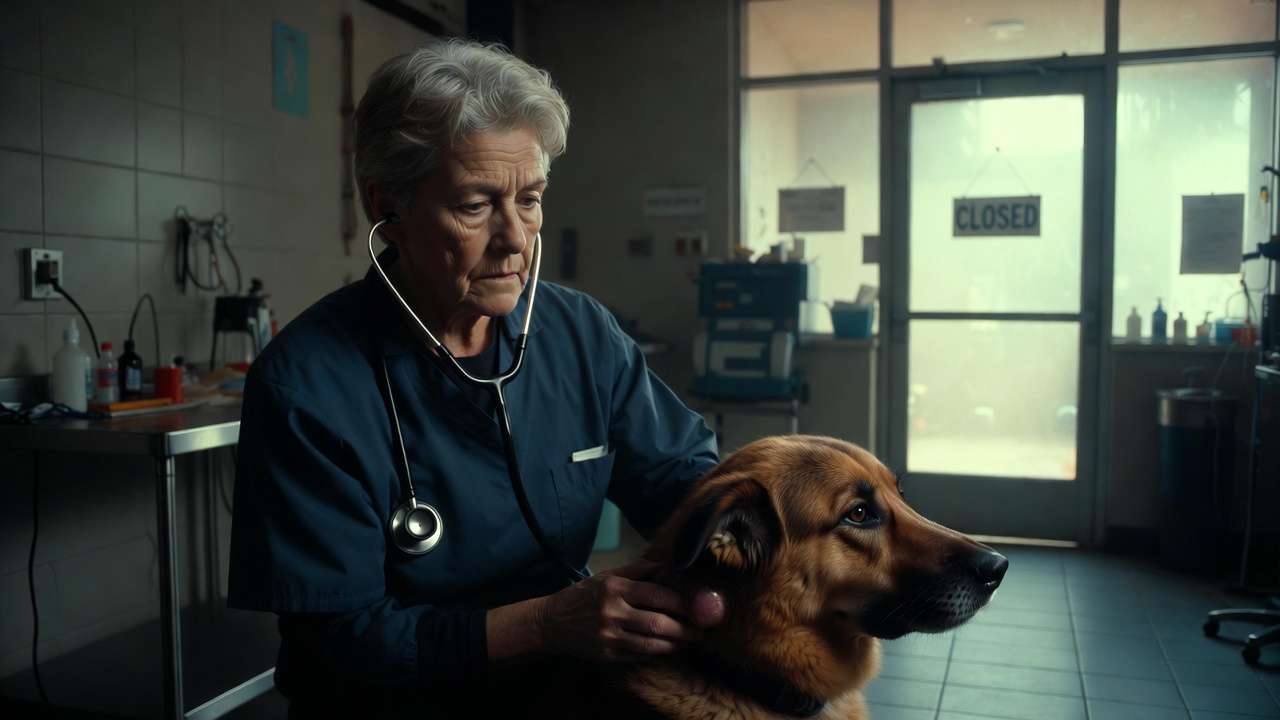
I was the senior vet on duty when they brought in a “feral” 8-year-old German Shepherd for euthanasia—but tracing the odd lump behind its ear made me quietly lock the clinic doors.

I’ve been an emergency veterinary surgeon for 14 years, handling everything from midnight traumas to heartbreaking goodbyes, but absolutely nothing prepared me for the sickening realization that washed over me when I parted the matted fur on that shivering dog’s neck.
The rain was coming down in sheets that night. It was a Tuesday, just past 11:45 PM.
My clinic, situated on the edge of the downtown district, was normally quiet around this time. The only sound was the low, steady hum of the fluorescent lights and the rhythmic drumming of rain against the reinforced glass of the lobby doors.
I was finishing up my charting, rubbing my exhausted eyes, just looking forward to the end of my shift.
Then, the emergency buzzer blared.
I hurried to the front to see an animal control truck parked haphazardly across the curb, its yellow lights flashing rhythmically in the downpour.
Two city animal control officers burst through the double doors. I knew them vaguely. Smitty and Miller.
They smelled of stale black coffee, cheap wet wool, and an arrogance that immediately set my teeth on edge.
Between them, at the end of a heavy-duty catch pole, was a dog.
“Got a live one for you, Doc,” Smitty sneered, wiping the rain from his forehead. “Needs to be put down. Immediately.”
I looked down at the animal. It was a German Shepherd mix, maybe around eight years old.
The poor creature was absolutely drenched, completely covered in thick mud, matted leaves, and what smelled like motor oil.
But what struck me wasn’t the filth. It was the dog’s demeanor.
According to the rigid, heavy catch pole looped tightly around its neck, it was supposed to be a dangerous, feral beast.
But the dog wasn’t growling. It wasn’t thrashing or bearing its teeth.
It was pressed flat against the cold linoleum floor of my waiting room, shaking so violently that I could hear its claws rattling against the tiles. Its amber eyes were wide, darting around the bright room in sheer, unadulterated terror.
“What’s the situation?” I asked, keeping my voice level, though my stomach was already tying itself in knots.
“Stray. Rabid. Aggressive,” Miller barked out, slapping a soaked clipboard onto my reception desk. “Belongs to that crazy old homeless guy who lives under the 4th Street overpass. The one with the shopping carts.”
“It bit someone?” I asked, examining the paperwork. It was a court-ordered euthanasia mandate, signed by a night magistrate. It claimed severe aggression and public endangerment.
“Bit a jogger,” Smitty claimed, though he wouldn’t meet my eyes. “And when we went to take it, the dog snapped at me. The old man went ballistic, too. Fought us tooth and nail in the mud. Cops had to hold him back while we bagged the mutt.”
Smitty chuckled, a cruel, grating sound. “Old timer was crying like a baby. Screaming that the dog was his only family. Pathetic.”
A surge of hot anger flared in my chest, but I pushed it down. I had a job to do. I was bound by the legal paperwork sitting in front of me.
“Bring him into Exam Room Two,” I instructed, my voice tight.
I walked ahead of them, my mind racing. I hate these cases. The ones where human cruelty or negligence dictates the fate of an innocent animal.
I opened the heavy wooden door to the exam room, the bright surgical lights reflecting off the stainless steel table in the center.
“Lift him up,” I said.
The officers practically dragged the shivering dog by the neck loop, hoisting him roughly onto the cold metal table. The dog let out a soft, heartbreaking whimper.
“Alright, back off. Give me some space,” I snapped at the officers.
Smitty rolled his eyes. “Careful, Doc. He’s a biter.”
“Just wait by the door,” I replied coldly.
They stepped back, leaning against the counter, crossing their arms and whispering to each other, occasionally letting out low, mocking laughs.
I turned my attention to the dog. I approached slowly, keeping my hands visible, lowering my posture to appear less threatening.
“Hey there, buddy,” I whispered softly. “It’s okay. I’m not going to hurt you.”
I expected him to flinch away. I expected a low rumble in his chest.
Instead, the dog did the exact opposite.
As I gently laid my hand on his mud-caked shoulder, the large shepherd leaned his entire body weight into my touch. He pressed his wet, cold nose against my scrubs, letting out a long, shuddering sigh.
This was not a feral dog. This was not a vicious, rabid animal.
This was a deeply traumatized, deeply loved pet who was terrified out of his mind.
I glanced over my shoulder at the two men snickering by the door. Disgust washed over me. I knew exactly what happened. The homeless man was an easy target. The dog was an easy target.
But the paperwork was signed. Refusing a magistrate’s order could cost me my license and my clinic.
With a heavy heart, I walked over to the medical cabinet.
I unlocked the secure drawer and pulled out a fresh syringe. I uncapped a vial of sodium pentobarbital—the bright pink liquid that stops the heart in seconds.
As I drew the thick, pink fluid into the syringe, my hands were shaking. I’ve performed this procedure hundreds of times, but this felt wrong. It felt like murder.
“Make it quick, Doc. We go off shift in twenty minutes,” Miller called out, tapping his watch.
I ignored him. I walked back to the table, holding the syringe behind my back to hide it from the dog’s view.
I needed to find a vein. Given the thick, matted mud covering his forelegs, a standard cephalic vein injection would be nearly impossible. I would have to go for the jugular vein on the neck.
“I need to shave a small patch of fur,” I muttered, mostly to myself, grabbing the electric clippers.
I gently placed my left hand behind the dog’s large ears, intending to hold his head steady.
As I ran my fingers through the thick, greasy fur at the scruff of his neck, I felt something.
It wasn’t a tick. It wasn’t a mat of dirt.
It was a hard, distinct lump embedded deep within the fur, right against the skin.
I paused. A microchip? No, it was entirely the wrong shape and far too large.
“What’s the holdup?” Smitty asked impatiently, stepping away from the wall.
“Nothing. Just thick fur,” I lied smoothly.
My heart began to beat a little faster. I set the clippers down and used both hands to gently pry apart the dense layers of mud and hair at the base of the dog’s skull.
The dog whimpered again, but stood perfectly still for me.
I brushed away a clump of dried dirt, revealing a thick, dark piece of fabric hidden flush against the skin. It was a collar. But it had been deliberately hidden, stitched tightly into the dog’s fur so it couldn’t be seen from the outside.
Why would someone do that?
I dug my fingers deeper, tracing the heavy nylon of the hidden collar. Attached to it was a small, heavy metal box.
It was a heavy-duty GPS tracker. The expensive kind. The kind used for hunting dogs or high-value security animals.
A homeless man living under a bridge would not have a $500 hidden GPS tracker surgically fastened into his dog’s fur.
But that wasn’t what made my blood run cold.
Next to the tracker, bolted securely to the nylon, was a thick, custom-engraved titanium plate.
I pulled a small penlight from my chest pocket and clicked it on, shining the beam directly onto the metal plate.
I had to wipe away a smear of grease with my thumb to read the words etched into the titanium.
When I read the three lines of text, the air in the room completely vanished.
My vision blurred. A loud ringing started in my ears, drowning out the sound of the rain and the low chatter of the officers behind me.
I stared at the engraved words, my mind violently rejecting what I was seeing.
The syringe full of lethal pink fluid slipped from my trembling fingers, clattering loudly against the stainless steel tray.
“Hey! Watch it!” Miller barked, startled by the noise. “You drop that stuff, you’re paying for it!”
I didn’t answer him. I couldn’t speak.
Slowly, deliberately, I let the dog’s fur fall back into place, concealing the hidden collar.
I took a deep breath, trying to steady the violent shaking of my hands.
I turned around, pasting a perfectly calm, professional look onto my face.
“I need a different gauge needle,” I said quietly. “This one is defective. Give me one second.”
Without waiting for their response, I stepped out of the exam room and pulled the heavy door shut behind me.
The moment the latch clicked, I reached down and turned the deadbolt.
I locked them inside.
Then, I walked straight to my front desk, picked up the landline, and dialed 911
I was the senior vet on duty when they brought in a “feral” 8-year-old German Shepherd for euthanasia—but tracing the odd lump behind its ear made me quietly lock the clinic doors.
I’ve been an emergency veterinary surgeon for 14 years, handling everything from midnight traumas to heartbreaking goodbyes, but absolutely nothing prepared me for the sickening realization that washed over me when I parted the matted fur on that shivering dog’s neck.
The rain was coming down in sheets that night. It was a Tuesday, just past 11:45 PM.
My clinic, situated on the edge of the downtown district, was normally quiet around this time. The only sound was the low, steady hum of the fluorescent lights and the rhythmic drumming of rain against the reinforced glass of the lobby doors.
I was finishing up my charting, rubbing my exhausted eyes, just looking forward to the end of my shift.
Then, the emergency buzzer blared.
I hurried to the front to see an animal control truck parked haphazardly across the curb, its yellow lights flashing rhythmically in the downpour.
Two city animal control officers burst through the double doors. I knew them vaguely. Smitty and Miller.
They smelled of stale black coffee, cheap wet wool, and an arrogance that immediately set my teeth on edge.
Between them, at the end of a heavy-duty catch pole, was a dog.
“Got a live one for you, Doc,” Smitty sneered, wiping the rain from his forehead. “Needs to be put down. Immediately.”
I looked down at the animal. It was a German Shepherd mix, maybe around eight years old.
The poor creature was absolutely drenched, completely covered in thick mud, matted leaves, and what smelled like motor oil.
But what struck me wasn’t the filth. It was the dog’s demeanor.
According to the rigid, heavy catch pole looped tightly around its neck, it was supposed to be a dangerous, feral beast.
But the dog wasn’t growling. It wasn’t thrashing or bearing its teeth.
It was pressed flat against the cold linoleum floor of my waiting room, shaking so violently that I could hear its claws rattling against the tiles. Its amber eyes were wide, darting around the bright room in sheer, unadulterated terror.
“What’s the situation?” I asked, keeping my voice level, though my stomach was already tying itself in knots.
“Stray. Rabid. Aggressive,” Miller barked out, slapping a soaked clipboard onto my reception desk. “Belongs to that crazy old homeless guy who lives under the 4th Street overpass. The one with the shopping carts.”
“It bit someone?” I asked, examining the paperwork. It was a court-ordered euthanasia mandate, signed by a night magistrate. It claimed severe aggression and public endangerment.
“Bit a jogger,” Smitty claimed, though he wouldn’t meet my eyes. “And when we went to take it, the dog snapped at me. The old man went ballistic, too. Fought us tooth and nail in the mud. Cops had to hold him back while we bagged the mutt.”
Smitty chuckled, a cruel, grating sound. “Old timer was crying like a baby. Screaming that the dog was his only family. Pathetic.”
A surge of hot anger flared in my chest, but I pushed it down. I had a job to do. I was bound by the legal paperwork sitting in front of me.
“Bring him into Exam Room Two,” I instructed, my voice tight.
I walked ahead of them, my mind racing. I hate these cases. The ones where human cruelty or negligence dictates the fate of an innocent animal.
I opened the heavy wooden door to the exam room, the bright surgical lights reflecting off the stainless steel table in the center.
“Lift him up,” I said.
The officers practically dragged the shivering dog by the neck loop, hoisting him roughly onto the cold metal table. The dog let out a soft, heartbreaking whimper.
“Alright, back off. Give me some space,” I snapped at the officers.
Smitty rolled his eyes. “Careful, Doc. He’s a biter.”
“Just wait by the door,” I replied coldly.
They stepped back, leaning against the counter, crossing their arms and whispering to each other, occasionally letting out low, mocking laughs.
I turned my attention to the dog. I approached slowly, keeping my hands visible, lowering my posture to appear less threatening.
“Hey there, buddy,” I whispered softly. “It’s okay. I’m not going to hurt you.”
I expected him to flinch away. I expected a low rumble in his chest.
Instead, the dog did the exact opposite.
As I gently laid my hand on his mud-caked shoulder, the large shepherd leaned his entire body weight into my touch. He pressed his wet, cold nose against my scrubs, letting out a long, shuddering sigh.
This was not a feral dog. This was not a vicious, rabid animal.
This was a deeply traumatized, deeply loved pet who was terrified out of his mind.
I glanced over my shoulder at the two men snickering by the door. Disgust washed over me. I knew exactly what happened. The homeless man was an easy target. The dog was an easy target.
But the paperwork was signed. Refusing a magistrate’s order could cost me my license and my clinic.
With a heavy heart, I walked over to the medical cabinet.
I unlocked the secure drawer and pulled out a fresh syringe. I uncapped a vial of sodium pentobarbital—the bright pink liquid that stops the heart in seconds.
As I drew the thick, pink fluid into the syringe, my hands were shaking. I’ve performed this procedure hundreds of times, but this felt wrong. It felt like murder.
“Make it quick, Doc. We go off shift in twenty minutes,” Miller called out, tapping his watch.
I ignored him. I walked back to the table, holding the syringe behind my back to hide it from the dog’s view.
I needed to find a vein. Given the thick, matted mud covering his forelegs, a standard cephalic vein injection would be nearly impossible. I would have to go for the jugular vein on the neck.
“I need to shave a small patch of fur,” I muttered, mostly to myself, grabbing the electric clippers.
I gently placed my left hand behind the dog’s large ears, intending to hold his head steady.
As I ran my fingers through the thick, greasy fur at the scruff of his neck, I felt something.
It wasn’t a tick. It wasn’t a mat of dirt.
It was a hard, distinct lump embedded deep within the fur, right against the skin.
I paused. A microchip? No, it was entirely the wrong shape and far too large.
“What’s the holdup?” Smitty asked impatiently, stepping away from the wall.
“Nothing. Just thick fur,” I lied smoothly.
My heart began to beat a little faster. I set the clippers down and used both hands to gently pry apart the dense layers of mud and hair at the base of the dog’s skull.
The dog whimpered again, but stood perfectly still for me.
I brushed away a clump of dried dirt, revealing a thick, dark piece of fabric hidden flush against the skin. It was a collar. But it had been deliberately hidden, stitched tightly into the dog’s fur so it couldn’t be seen from the outside.
Why would someone do that?
I dug my fingers deeper, tracing the heavy nylon of the hidden collar. Attached to it was a small, heavy metal box.
It was a heavy-duty GPS tracker. The expensive kind. The kind used for hunting dogs or high-value security animals.
A homeless man living under a bridge would not have a $500 hidden GPS tracker surgically fastened into his dog’s fur.
But that wasn’t what made my blood run cold.
Next to the tracker, bolted securely to the nylon, was a thick, custom-engraved titanium plate.
I pulled a small penlight from my chest pocket and clicked it on, shining the beam directly onto the metal plate.
I had to wipe away a smear of grease with my thumb to read the words etched into the titanium.
When I read the three lines of text, the air in the room completely vanished.
My vision blurred. A loud ringing started in my ears, drowning out the sound of the rain and the low chatter of the officers behind me.
I stared at the engraved words, my mind violently rejecting what I was seeing.
The syringe full of lethal pink fluid slipped from my trembling fingers, clattering loudly against the stainless steel tray.
“Hey! Watch it!” Miller barked, startled by the noise. “You drop that stuff, you’re paying for it!”
I didn’t answer him. I couldn’t speak.
Slowly, deliberately, I let the dog’s fur fall back into place, concealing the hidden collar.
I took a deep breath, trying to steady the violent shaking of my hands.
I turned around, pasting a perfectly calm, professional look onto my face.
“I need a different gauge needle,” I said quietly. “This one is defective. Give me one second.”
Without waiting for their response, I stepped out of the exam room and pulled the heavy door shut behind me.
The moment the latch clicked, I reached down and turned the deadbolt.
I locked them inside.
Then, I walked straight to my front desk, picked up the landline, and dialed 911.
My hand was shaking so violently that I fumbled the desk phone twice before I managed to punch in the three digits.
9-1-1.
I pressed the plastic receiver hard against my ear, ducking down behind the high reception counter.
The clinic was dead silent, save for the relentless drumming of the rain against the front windows and the low, rhythmic hum of the vaccine refrigerator behind me.
My lungs felt completely empty. I couldn’t seem to draw a full breath. Every instinct in my body was screaming at me to run out the back door, get into my car, and drive as fast as I could.
But I couldn’t leave that dog.
Not after what I had just read.
“911, what is your emergency?” The dispatcher’s voice was calm, professional, and female.
“I… I need police immediately,” I whispered, my voice cracking. I pressed my hand over my mouth, terrified that the men locked in Exam Room Two might hear me. “I’m the head veterinarian at the Oak Creek Animal Hospital on 4th and Elm. I have two men locked in an exam room. They claim to be city animal control.”
“Okay, sir. Are you in immediate physical danger? Are there weapons involved?”
“I don’t know,” I breathed, my eyes darting toward the heavy wooden door down the hallway. “But they brought in a dog. A German Shepherd. They had a magistrate’s order for immediate euthanasia. They said it belonged to a homeless man and attacked a jogger.”
“Sir, this line is for life-threatening emergencies. If this is a dispute over animal control jurisdiction—”
“No! Listen to me!” I hissed, squeezing my eyes shut. “I was prepping the dog for the injection. I found a hidden collar stitched into the dog’s fur. Underneath the mud. There was a heavy-duty GPS tracker and a custom-engraved titanium plate.”
The line went quiet for a fraction of a second. “What did the plate say, sir?”
I closed my eyes, the three lines of text burned perfectly into my retinas. I recited them word for word.
“Line one: I BELONG TO EMMA HARPER, AGE SEVEN. ABDUCTED OCTOBER 12TH.”
I heard the dispatcher take a sharp intake of breath.
“Line two,” I continued, tears of sheer adrenaline pricking my eyes. “GPS TRACKER EMBEDDED. DO NOT SURRENDER THIS ANIMAL.”
I swallowed hard, my throat feeling like sandpaper.
“Line three: IF I AM FOUND WITH ANYONE ELSE, THEY ARE HER CAPTORS.”
The silence on the other end of the line was deafening. I could hear the faint, rapid clicking of a keyboard, but the dispatcher didn’t speak for what felt like an eternity.
“Dispatcher?” I whispered frantically. “Are you there?”
“Sir, what is your exact name?” Her voice had changed completely. The standard, bored operator tone was gone. It was replaced by a sharp, urgent intensity.
“Dr. Thomas Evans.”
“Dr. Evans, I need you to stay exactly where you are and keep your voice as low as possible. Do not hang up this phone.” The rapid typing in the background grew louder. “I am dispatching every available unit to your location. We are treating this as an active hostage situation. The Amber Alert for Emma Harper has been active for four days. The FBI is the lead agency.”
A wave of nausea washed over me. Four days. A seven-year-old girl.
“The two men,” I whispered, peeking over the edge of the reception desk. The hallway leading to Exam Room Two was still empty. The door was still shut. “They had official city uniforms. They had a signed court order.”
“Dr. Evans, I am looking at the city registry right now. The night shift for municipal animal control ended at 9:00 PM. All city trucks are securely logged at the municipal lot. There are no animal control officers on duty in your district tonight.”
The ground seemed to tilt beneath my knees.
They weren’t animal control.
They were the men who took her. Or, at the very least, they were hired by the men who took her.
And I had almost done exactly what they wanted.
I had almost killed the dog.
If I had pushed that plunger, the dog’s heart would have stopped. They would have taken the “rabid stray’s” body away in a black bag, incinerated it, and destroyed the GPS tracker along with it. The only physical link to a missing seven-year-old child would have vanished into thin air.
“Dr. Evans,” the dispatcher’s voice brought me back to reality. “Are the men still secured?”
“Yes,” I breathed. “Exam Room Two has a solid core oak door. It’s reinforced with steel hinges because we deal with large, aggressive breeds. I flipped the deadbolt from the outside.”
“And the dog?”
My stomach plummeted. The phone almost slipped from my sweaty grip.
“The dog is in the room with them.”
“Sir, are there cameras in that room?”
“Yes. Closed-circuit. For liability and monitoring anesthesia recovery.”
“I need you to pull up the feed. Tell me exactly what they are doing right now. Police are three minutes out. Run silent, no sirens.”
I stayed crouched, crab-walking the few feet to my office computer terminal behind the main counter. I reached up blindly, my fingers searching for the power button on the monitor.
The screen flickered to life, casting a pale, bluish glow over my face.
I clicked the mouse, bringing up the grid of security cameras. Waiting room. Kennel. Surgical suite.
Exam Room Two.
I maximized the window, holding my breath.
The black-and-white feed was perfectly clear. The bright surgical lights in the room illuminated every horrifying detail.
Smitty and Miller were standing by the door.
At first, they just looked annoyed. I watched as Miller, the taller of the two, reached for the doorknob. He turned it. It didn’t budge.
He jiggled it harder. Still nothing.
He turned and said something to Smitty. On the silent feed, I couldn’t hear the words, but I could read the irritation in his body language. He probably thought I had accidentally locked it, or the latch was stuck.
Smitty stepped forward, pushing Miller aside. He grabbed the handle with both hands and gave it a violent yank.
The heavy oak door didn’t give a millimeter.
That was when the atmosphere in the room shifted. I watched it happen in real-time through the pixelated screen.
The arrogant, bored demeanor of the “city workers” vanished. Their shoulders tensed. Their posture straightened. They suddenly looked like entirely different men—predators who had just realized they were inside a cage.
Smitty turned around, scanning the room.
His eyes swept over the stainless steel counters, the glass medical cabinets, and finally, the center table.
My dropped syringe was still lying there, a small puddle of bright pink liquid pooling on the metal tray.
Smitty walked over to the table. He picked up the syringe, inspecting it.
Then, he looked down at the dog.
The German Shepherd was still pressed flat against the table, shaking. It hadn’t moved an inch.
I watched, completely paralyzed, as Smitty reached out his thick, gloved hand. He placed it roughly on the back of the dog’s neck. Right where I had been working.
Through the monitor, I saw him part the muddy fur.
He found the collar.
“Oh, God,” I whispered into the phone, tears finally spilling over my cheeks. “He found it. He’s looking at the tag.”
“Dr. Evans, stay with me,” the dispatcher ordered. “What is he doing now?”
Smitty read the titanium plate.
I watched his face contort in absolute fury. He slammed his fist down onto the metal table, the impact making the heavy steel structure vibrate. The dog flinched violently, letting out a silent yelp on the monitor, scrambling backward until its hind legs slipped off the edge of the table.
Miller rushed over. Smitty pointed furiously at the dog’s neck, then pointed a rigid finger at the locked door.
They knew.
They knew I had read the tag. They knew I had left to call the cops.
“They know I locked them in,” I told the dispatcher, my voice shaking uncontrollably. “They’re going for the door.”
On the screen, Miller took three steps back, raised his heavy black work boot, and kicked the solid oak door with everything he had.
THUD.
The sound echoed down the hallway of my clinic, a terrifying, heavy boom that rattled the glass in the reception windows.
I dropped the phone to the floor, instinctively covering my head with my arms, as if the door were right next to me.
THUD.
He kicked it again.
“Dr. Evans! Talk to me!” the dispatcher’s voice crackled from the phone on the floor.
I scrambled to pick it up. “They’re trying to kick the door down. It’s solid oak, but the frame… I don’t know how long the frame will hold.”
“Police are less than two minutes away. Do you have a secure room you can lock yourself in?”
“I… I can go into the surgical suite. It has a steel door.”
“Go there now, sir. Leave the phone line open, but put it in your pocket if it’s wireless. Is it wireless?”
“Yes.”
“Go.”
I stood up, my legs feeling like lead. I took one last look at the monitor before abandoning the front desk.
What I saw made me freeze entirely.
Miller had stopped kicking the door. He was rubbing his shoulder, shaking his head at Smitty. The door was too strong. They weren’t going to break it down with brute force before the cops arrived, and they clearly knew it.
Smitty was pacing the room like a caged tiger. He looked up at the ceiling.
He looked directly into the security camera.
Even through the grainy black-and-white feed, his eyes were terrifying. Cold, dead, and entirely devoid of panic. He wasn’t scared of being caught. He was calculating his next move.
He raised his hand and pointed a finger directly at the camera lens. At me.
Then, he reached down to his right ankle.
He pulled up the leg of his waterproof pants and unclasped a heavy, dark object from an ankle holster.
It was a combat knife. The blade had to be at least seven inches long, serrated at the back.
He didn’t walk toward the door.
He walked toward the terrified German Shepherd cowering in the corner of the room.
“No,” I choked out, the word tearing itself from my throat.
“Dr. Evans? What’s happening?”
“He has a knife. He’s going to cut the tracker out of the dog. Or he’s going to kill the dog to get it.”
My mind raced. If they cut the tracker out, they could flush it down the exam room sink. They could claim I was a crazy vet who locked them in for no reason. Without the physical evidence, the police might not have enough probable cause to hold them, especially if they had fake badges and paperwork.
Worse, if they killed that dog, Emma Harper’s only lifeline would die on my linoleum floor.
I couldn’t just hide in the surgical suite. I couldn’t just sit in the dark and wait.
“Dr. Evans, do not engage. I repeat, do not engage the suspects. You are not armed.”
“I can’t let him kill the dog,” I said, my voice suddenly devoid of the tremor that had plagued it for the last ten minutes. A strange, cold clarity washed over me.
“Sir, listen to me—”
I set the phone down on the desk.
I looked around the reception area. My eyes landed on the fire alarm pull station on the wall near the front entrance.
If I pulled it, the sirens would be deafening. The strobe lights would flash. But it wouldn’t stop the man in the room with the knife.
I looked back at the monitor.
Smitty was advancing on the dog. The poor animal was pressed into the corner, bearing its teeth for the first time, letting out a silent, desperate snarl.
Miller had grabbed the heavy catch pole from the floor and was maneuvering to loop it around the dog’s neck to hold it still for Smitty.
I needed a distraction. Something immediate. Something inside that specific room.
My eyes darted to the intercom system built into the base of the monitor.
Exam Room Two had a two-way speaker mounted on the wall, mainly used to page vet techs when hands were full.
I slammed my finger down on the ‘TALK’ button for Room Two.
I leaned closely into the microphone, taking a deep breath. I made my voice as deep, authoritative, and terrifying as I possibly could.
“Drop the knife, or I flood the room with Isoflurane gas.”
On the monitor, both men froze instantly.
Smitty halted his advance, the knife hovering a foot away from the dog. He looked wildly up at the ceiling speaker.
“I have complete control over the ventilation in that room,” I lied through my teeth, my thumb still depressing the intercom button. “You are in an airtight surgical containment unit. Isoflurane is a severe anesthetic. At high concentrations, it will render you unconscious in twelve seconds. It will cause permanent neurological damage in thirty.”
It was complete nonsense. Isoflurane is delivered through a highly precise vaporizer machine attached to a breathing tube, not through the air vents. And the room certainly wasn’t airtight.
But these men weren’t veterinarians. They were thugs.
“The police are pulling up to the building right now,” I continued, my voice echoing through the small speaker in their room. “If you touch that dog, I will hit the purge valve. You will both drop to the floor, and you will wake up in a prison hospital. Put the knife down and back away into the center of the room.”
I watched the monitor, my heart threatening to crack my ribs.
Miller looked terrified. He dropped the catch pole with a loud clatter and took a hurried step away from the dog, covering his mouth and nose with his sleeve.
“He’s bluffing!” Smitty yelled, his voice bleeding faintly through the heavy door down the hall. But he didn’t move toward the dog. He looked nervously at the air conditioning vent set into the ceiling tile above him.
“Ten seconds,” I said into the mic. “Nine. Eight.”
I reached over to my desk lamp and knocked it onto the floor. It shattered with a loud pop.
Through the intercom, it sounded exactly like a heavy mechanical switch being thrown.
“Gas is engaged,” I said coldly. “Hold your breath.”
Miller panicked. He rushed to the center of the room, dropping to his knees, burying his face in his hands.
Smitty hesitated for one more agonizing second. He looked at the dog, then at the vent, then at his partner.
With a furious scream of frustration, he hurled the combat knife across the room. It bounced harmlessly off the stainless steel sink and clattered onto the floor, far away from the dog.
Smitty retreated to the center of the room, glaring at the camera, covering his mouth with his jacket collar.
I let go of the intercom button and slumped against the desk, my entire body soaked in cold sweat.
It worked. I had bought a few precious minutes.
But as I watched them on the screen, waiting for the imaginary gas to hit them, a new sound cut through the silence of the clinic.
It wasn’t a police siren.
It was the heavy crunch of tires on the gravel in the alleyway behind my clinic.
My private staff entrance.
I frowned, picking the phone receiver back up from the desk. “Dispatcher? Did you send units to the back alley?”
“No, sir,” the voice crackled back. “The first cruisers are just turning onto Elm Street. They are approaching your front entrance now.”
The blood drained from my face.
If the police were at the front… who was pulling into the alley?
Suddenly, the clinic was plunged into absolute, pitch-black darkness.
The low hum of the vaccine fridge died. The fluorescent lights overhead cut out. The security monitor screen went dead, taking the only view of Exam Room Two with it.
Someone had just cut the main power line to the building from the outside box.
I was entirely in the dark.
And from the back hallway, near the staff entrance, I heard the distinct, metallic sound of a lock being picked.
They weren’t just two men.
They had backup. And the backup had just arrived.
The metallic click of the back door unlocking echoed through the pitch-black clinic like a gunshot.
Then came the unmistakable, slow creak of the heavy steel hinges swinging inward.
I stood frozen behind the reception desk. The phone receiver was still pressed to my ear, but the line was completely dead. The clinic used a modern VoIP phone system. When the power was cut, the internet went down, taking my only lifeline to the 911 dispatcher with it.
I was completely alone in the dark.
The rain hammered against the front windows, but inside, the silence was suffocating.
I crouched lower, my knees aching against the cold linoleum floor. I strained my ears, trying to filter out the sound of the storm outside.
Footsteps.
Heavy, deliberate, wet footsteps stepping onto the tile of the back hallway.
There were at least two of them. Maybe three.
A sharp beam of white light suddenly sliced through the darkness, illuminating the far wall of the corridor. They had heavy-duty tactical flashlights. The beams danced erratically across the framed anatomical posters and glass cabinets, casting long, monstrous shadows across the floor.
“Smitty?” a deep, gravelly voice called out in a harsh whisper. “Miller? Where are you idiots?”
They weren’t police. Police would have announced themselves. Police would be coming through the front.
These men were the cleanup crew.
My heart hammered against my ribs so violently I was terrified they would hear it. My breathing was ragged and shallow. I pressed both hands over my mouth, forcing myself to take slow, silent breaths through my nose.
“Check the kennels,” another voice muttered from the back. “Find the dog. We don’t have time for this.”
“What about the vet?” the first voice asked.
“If he’s in the way, put him to sleep,” came the cold, indifferent reply.
A chill shot down my spine, freezing the blood in my veins. They were willing to kill me without a second thought.
I needed to hide. The surgical suite was only twenty feet away. It had a solid steel door that locked from the inside. I could run, lock myself in, and hide under the operating table until the police broke down the front doors.
It was the smart thing to do. It was the only logical choice for survival.
But as I prepared to crawl away, my mind flashed back to the custom titanium plate stitched into the dog’s fur.
I BELONG TO EMMA HARPER, AGE SEVEN. ABDUCTED OCTOBER 12TH.
If I hid, they would find Exam Room Two. They would break the lock or force Smitty and Miller to open it. They would kill the German Shepherd, dig the GPS tracker out of its neck, and vanish out the back door long before the police managed to breach my reinforced front windows.
If they got that tracker, Emma Harper might never be found.
A seven-year-old girl was sitting in the dark somewhere, terrified, waiting for someone to find her. That dog was her only hope.
I couldn’t hide.
I slowly reached down and unlaced my leather work shoes. I slipped them off, leaving them under the desk. In just my socks, my footsteps would be completely silent.
I knew this building better than anyone. I had bought this clinic fourteen years ago. I had spent countless nights pacing these hallways, checking on sick animals, memorizing every single creaking floorboard and squeaky hinge.
They had flashlights, but I had the dark.
I crawled out from behind the reception desk, keeping my body low to the ground. The flashlight beams were currently sweeping through the kennel area in the back left wing.
Exam Room Two was down the right wing hallway.
I had to get to the dog first.
I moved swiftly, sliding along the wall, my hands trailing against the familiar textured wallpaper to keep my bearings.
The darkness was disorienting, but my muscle memory took over. I counted my paces. Five steps past the water cooler. Turn right at the x-ray room.
I reached the heavy oak door of Exam Room Two.
I pressed my ear against the wood. Inside, I could hear the faint sound of panicked breathing. It was Smitty and Miller. They were still inside, trapped in the dark, still terrified of the imaginary anesthetic gas I had threatened them with.
“Do you hear that?” Miller’s muffled voice trembled from the other side of the door. “Someone’s out there.”
“Shut up,” Smitty hissed. “Keep your face covered. Don’t breathe the air.”
They were completely neutralized by their own panic. But that wouldn’t last forever.
The real problem was the men coming from the back.
I looked down the dark hallway. The glow of the flashlights was getting brighter. They were finishing their sweep of the kennels. They would be turning into this corridor in less than thirty seconds.
I reached into my scrubs pocket and pulled out my master key.
My hands were shaking so badly I dropped it. The small metal key hit the linoleum with a sharp clink.
“What was that?” one of the intruders barked from the other room.
The flashlight beam swung wildly, illuminating the intersection of the hallway just a few feet away from me.
I dropped to my knees, frantically patting the floor in the dark. My fingers brushed cold metal. I snatched the key, holding my breath.
I inserted the key into the deadbolt of Exam Room Two. I didn’t turn it yet. Turning it would make a loud, heavy clicking sound.
I waited.
The flashlight beam slowly swept past my hallway. The heavy footsteps moved toward the surgical suite. They had taken a wrong turn.
It bought me exactly ten seconds.
I gripped the key tightly and turned it. Click.
I pushed the heavy oak door open just enough to slip inside, then quickly pulled it shut behind me, plunging myself into the pitch-black exam room with the two thugs and the dog.
“Who’s there?!” Smitty yelled, his voice muffled by his own jacket.
I didn’t answer. I dropped to my hands and knees and crawled under the stainless steel examination table.
It smelled heavily of wet fur, mud, and intense fear.
In the absolute darkness, I reached my hand out blindly.
A low, vibrating growl rumbled just inches from my face. It was the German Shepherd. He was backed into the farthest corner under the cabinets, terrified by the sudden darkness and the screaming men.
“Hey buddy,” I whispered, my voice barely audible over the sound of the rain outside. “It’s me. The doctor.”
The growling stopped.
I moved closer, keeping myself low and unthreatening. I extended my hand, letting him sniff my fingers.
A cold, wet nose pressed against my palm. Then, a rough, warm tongue licked my wrist.
Even after everything he had been through—the mud, the catch pole, the violent men—this incredible animal still recognized kindness. He remembered that I hadn’t hurt him.
“We have to go,” I whispered, sliding my arm around his thick, muddy neck.
I felt the heavy bulge of the GPS tracker hidden in his fur. I gripped the nylon collar securely.
“Who is that?!” Miller panicked, stumbling blindly in the dark. He crashed into a glass cabinet, sending a jar of cotton swabs shattering to the floor.
“It’s the vet!” Smitty roared. “Grab him!”
I didn’t have time to be quiet anymore.
“Come on, boy!” I urged the dog.
I surged to my feet, keeping a tight hold on the dog’s collar. The shepherd stayed glued to my side, his heavy body pressing against my leg for comfort.
I lunged for the door, threw it open, and practically dragged the dog out into the hallway.
“Hey!” Smitty shouted, lunging blindly toward the sound of the opening door.
I slammed the heavy oak door shut right in his face. I heard a satisfying crunch and a howl of pain as the heavy wood caught him straight in the nose.
I didn’t bother locking it. We just ran.
“They’re in the hallway!” one of the intruders yelled from the surgical suite.
Two blinding beams of light suddenly whipped around the corner, trapping me and the dog in the middle of the corridor.
I shielded my eyes, completely blinded.
“Stop right there!” a voice commanded. I heard the terrifying, mechanical clack of a handgun slide being racked back.
I froze. The dog pressed against my legs, letting out a fierce, protective bark at the men with the lights.
Through the glare of the flashlights, I could make out the silhouette of a massive man pointing a semi-automatic pistol directly at my chest.
“Let go of the dog,” the man said smoothly, his voice devoid of any emotion. “Walk away, Doc. This isn’t your business.”
“He’s a stray,” I lied, my voice trembling but defiant. “You have no claim to him.”
“I’m not asking,” the man said, taking a step forward. “I’m telling you. Drop the collar and step back, or I put a bullet in your head and take him anyway.”
My mind raced. We were trapped. The front lobby was twenty feet behind me, but the reinforced doors were locked from the inside. I couldn’t outrun a bullet.
The dog let out another low, dangerous growl, stepping slightly in front of me, shielding my body with his own.
The man raised the gun, aiming it directly at the dog’s head. “Fine. We only need the collar anyway.”
“No!” I screamed, throwing myself over the animal.
Suddenly, the entire lobby behind me exploded in a blinding array of flashing red and blue lights.
The storm outside was suddenly drowned out by the deafening wail of multiple police sirens. The flashing emergency lights pierced through the front windows, casting wild, colorful strobes all the way down the dark hallway.
The intruder flinched, momentarily distracted by the explosion of police lights.
“Cops!” the second intruder yelled, dropping his flashlight. “They’re at the front! Move! Back door!”
The man with the gun hesitated for a fraction of a second. He looked at me, then at the front doors, where heavy, frantic pounding had just started.
“Police! Open up!” a voice boomed from a megaphone outside.
The intruder cursed loudly. He lowered his weapon, turned on his heel, and sprinted down the back hallway toward the staff exit, his partner right behind him.
I collapsed against the wall, clutching the muddy German Shepherd so tightly my arms ached.
“We’re here!” I screamed toward the front lobby, even though they couldn’t hear me through the reinforced glass.
I scrambled to my feet, the dog right beside me. We ran into the lobby, bathed in the frantic red and blue lights flashing from the five police cruisers parked on my lawn.
Officers were swarming the front entrance, shining flashlights through the glass, trying to pry the heavy double doors open.
I practically fell into the front door, my hands shaking uncontrollably as I fumbled with the deadbolt.
I threw the lock open and pushed the heavy glass doors outward.
A dozen police officers poured into the lobby, guns drawn, tactical flashlights blinding me all over again.
“Hands! Let me see your hands!” an officer screamed.
I threw my hands in the air, dropping to my knees. The dog sat calmly right beside me, refusing to leave my side.
“I’m the doctor!” I yelled over the chaos. “I’m Dr. Evans! The men who called themselves animal control are in Exam Room Two! Two more just ran out the back alley exit!”
“Units to the alley! We have runners!” a sergeant barked into his radio.
Four officers sprinted past me, guns raised, heading straight for the back hallway. Two more moved cautiously toward the closed door of Exam Room Two.
A female officer holstered her weapon and rushed over to me. She dropped to her knees, grabbing my shoulders.
“Dr. Evans? Are you hurt? Did they touch you?”
“I’m fine,” I gasped, the adrenaline finally crashing, leaving me weak and dizzy. “I’m fine. But the dog…”
I looked down at the muddy, exhausted German Shepherd. He was resting his heavy head on my knee, his amber eyes looking up at the officer with quiet intelligence.
“Where is it?” the officer asked, her voice tight with anticipation.
I gently parted the matted fur at the back of the dog’s neck. I showed her the thick nylon collar, the embedded GPS tracker, and the engraved titanium plate.
The officer leaned in, shining her shoulder light onto the metal.
She read the words.
I saw her jaw clench. She reached up to the radio microphone on her shoulder.
“Dispatch, this is Unit 4. We have secure custody of the animal. I have visual confirmation of the GPS tracker and the ID tag.”
She paused, looking down at the dog with a mixture of awe and profound sadness.
“Get the FBI task force on the line immediately,” she commanded. “Tell them to start pinging this tracker’s history. We’re going to find her.”
Here is the final chapter of the story.
Chapter 4: The Breadcrumbs
The next two hours turned my quiet, rain-swept veterinary clinic into an active federal command center.
The storm outside continued to rage, but inside, the atmosphere was a whirlwind of controlled, tactical chaos. The flashing red and blue lights of the cruisers outside painted the lobby in a frantic, pulsating glow.
Officers in heavy tactical gear secured the perimeter, their radios crackling with terse, urgent updates. The two men who had fled out the back door had vanished into the maze of downtown alleyways, but the police had established a five-block containment perimeter. Smitty and his partner, the two men I had trapped in the exam room, were hauled out in heavy steel handcuffs, their faces pale and completely silent.
They didn’t look like arrogant city workers anymore. They looked like men who realized their lives were entirely over.
Through it all, the German Shepherd refused to leave my side.
I sat on the edge of a bench in the waiting room, a shock blanket draped over my shoulders, shivering despite the warmth of the clinic. The dog sat directly at my feet, leaning his heavy, mud-caked body against my shins. Every time an officer walked past too quickly, a low rumble would start deep in the dog’s chest, stopping only when I placed a reassuring hand on his head.
“You did good, buddy,” I whispered, gently running my thumb over his large, scarred ears. “You did so good.”
At exactly 1:15 AM, three unmarked black SUVs tore into the parking lot, coming to a screeching halt directly on the front lawn.
The heavy glass doors swung open, and four people in dark suits and windbreakers bearing the bright yellow letters “FBI” strode into the lobby. They moved with a terrifying, absolute authority that made the local police instantly step aside.
The lead agent, a tall, sharp-featured woman with graying hair and piercing blue eyes, walked directly over to me.
“Dr. Evans?” she asked, her voice calm but layered with immense pressure. “I’m Special Agent Reynolds. I’m the lead investigator on the Emma Harper abduction case. I need to see the animal.”
I nodded numbly, parting the thick, matted fur at the base of the dog’s neck once more.
Agent Reynolds dropped to one knee. She clicked on a penlight, illuminating the custom titanium plate and the heavy black GPS module stitched tightly into the nylon collar.
For a long moment, she just stared at the engraved words. I watched her jaw clench, a muscle feathering in her cheek.
“Get the tech team in here now,” Reynolds barked over her shoulder, not taking her eyes off the collar. “Bring the mobile extraction unit. And get a signal jammer active around this building. If this tracker has a remote wipe function, I do not want whoever is holding that remote to realize we have it.”
Within seconds, a technician carrying a heavy, ruggedized metal briefcase hurried into the lobby. He set it down on my reception desk, flipping it open to reveal a complex array of cables, monitors, and forensic software.
“Doctor,” Agent Reynolds said, standing back up and looking me dead in the eye. “I need you to remove that collar. But you must not sever the connection to the battery unit, and you must not damage the internal antenna. Can you do that?”
“Yes,” I said, my professional instincts finally cutting through the fog of adrenaline. “I need my surgical scissors from the back.”
“An agent will escort you,” she replied immediately.
With an armed federal agent walking two steps behind me, I went back into the sterile, brightly lit surgical suite. I grabbed my finest surgical shears and a medical tray.
Returning to the lobby, I knelt beside the dog. “Easy, boy. Just going to take this off.”
The dog sat perfectly still, letting out a long, exhausted sigh.
With agonizing care, I snipped the thick, black thread that had been used to sew the hidden collar flush against the dog’s skin. It was crude, hurried work—done by someone desperate. It took me three full minutes of delicate cutting to finally free the heavy nylon strap.
I placed the muddy, soaked collar onto the silver medical tray and handed it to the FBI technician.
“Okay, let’s see what we have,” the tech muttered, plugging a specialized data cable directly into a hidden port on the side of the GPS unit.
Agent Reynolds stood over his shoulder, her arms crossed tightly. I stayed seated on the bench, my hand resting firmly on the shepherd’s neck.
“It’s a military-grade hunting tracker,” the tech explained, his fingers flying across his keyboard. “Highly encrypted. The battery died two days ago. That’s why the live signal vanished off our grid.”
“Can you pull the local storage data?” Reynolds asked, her voice dangerously low. “It has to have a route history.”
“Bypassing the encryption now,” the tech replied.
The tension in the clinic was thick enough to choke on. The local police officers stood in absolute silence. The only sounds were the howling wind outside and the frantic, rhythmic tapping of the technician’s keyboard.
“I’m in,” the tech suddenly announced.
A collective breath was drawn in the room.
On his laptop screen, a high-resolution satellite map of our county popped up. A chaotic web of red, blue, and yellow lines covered the screen, mapping out the dog’s movements over the past week.
“Filter it,” Reynolds ordered. “Show me the last active location before the battery died.”
The tech hit a few keys. The chaotic web of lines vanished, leaving only a single, solid red line.
“Tracing backward from the moment the battery died,” the tech said, his eyes tracking the red line on the screen. “The battery died under the 4th Street overpass. That’s where the homeless man must have found him.”
“Where did the line start?” Reynolds pressed, leaning closer to the screen.
The tech zoomed out on the map. The red line trailed away from the downtown area, stretching far out into the rural, heavily wooded county limits, almost forty miles away.
The red line ended abruptly at a large, isolated patch of green on the map.
“Got it,” the tech said, his voice tightening. “The signal originated from a heavily wooded area off County Road 9. It looks like an abandoned logging facility. The dog stayed in that exact perimeter for three days before breaking out and running toward the city.”
Agent Reynolds straightened up. Her eyes were completely cold, locked onto the coordinates on the screen.
“That’s the holding location,” she stated.
She immediately reached for the radio clipped to her vest.
“All tactical units, this is Command. We have a confirmed target location. Scramble the Hostage Rescue Team. Get air support in the sky now. We are moving on an isolated logging compound off County Road 9. Lethal force is authorized if the target is in immediate danger. Move out.”
The Raid
The next hour was the most agonizing period of my entire life.
The FBI and the heavily armed tactical units poured out of my clinic, their black SUVs tearing off into the rain-soaked night, leaving only a skeleton crew of local officers to secure the building.
I remained sitting on the lobby bench, staring blankly at the floor. The German Shepherd, completely exhausted, had finally curled up into a tight ball at my feet and fallen into a deep, heavy sleep.
Agent Reynolds had left a spare radio receiver on the reception desk, tuned to the encrypted tactical frequency, so the remaining officers could monitor the raid.
I listened to the static, my heart pounding in my throat.
“Hawk-One is in the air. We have thermal imaging on the target structure. Three heat signatures inside.”
“Ground units are in position. Perimeter is locked.”
I closed my eyes, imagining the dark, wet woods, the silent approach of the tactical teams, the terrible uncertainty of what they might find inside that abandoned facility.
“Breaching in 3, 2, 1…”
A loud burst of static cut through the radio, followed by the muffled, distant sound of heavy doors being blown open.
Then, chaos. Shouting. The sharp, terrifying pop of automatic gunfire echoing through the transmission.
The officers in my lobby gripped their weapons, their knuckles turning white.
The radio went dead silent for two agonizing minutes.
I looked down at the sleeping dog. He twitched in his sleep, letting out a soft, dreaming whimper. He had run forty miles through a storm, fighting through mud, starvation, and animal control, carrying a metal plate that was far heavier than its physical weight.
Suddenly, the radio crackled back to life.
It was the heavy, breathless voice of a tactical commander.
“Command, this is Alpha Team. Building is secure. Two suspects are down. One in custody.”
There was a brief pause. The silence felt heavy enough to crush bone.
“We have the package,” the voice came back, thick with emotion. “I repeat, we have Emma. She is alive. She is unharmed. Requesting medical evac immediately.”
A massive, collective sigh of relief washed through the clinic. One of the local officers actually let out a cheer, wiping tears from his eyes.
I collapsed back against the wall, burying my face in my hands. The immense, crushing weight of the night finally lifted off my shoulders. I was crying, openly and freely, the tears mixing with the dried mud on my scrubs.
I reached down and buried my hands in the thick fur of the German Shepherd’s neck.
He had done it.
He had saved her.
The Aftermath
Two days later, the sun was finally shining over the city.
The local news was a wall-to-wall frenzy. The story had broken wide open. The men who had abducted Emma Harper were part of a highly organized, heavily funded ransom ring. They had targeted her wealthy family, demanding an astronomical sum for her safe return.
They had meticulously planned every detail, except for one unpredictable variable: the family dog.
When the kidnappers grabbed Emma from her backyard, the family’s eight-year-old German Shepherd, “Bear,” had fiercely attacked them. In the chaos, they couldn’t risk shooting the dog and alerting the neighbors, so they threw the dog into the back of their van along with the girl, planning to kill him later in the woods.
But Emma’s father was an avid hunter. Bear always wore a heavy-duty, military-grade GPS collar hidden deep in his fur for off-the-grid trips.
While locked in a dark room at the logging compound, seven-year-old Emma, showing a level of bravery and brilliance that baffled federal agents, found a piece of sharp scrap metal. She scratched those three desperate lines into the blank titanium ID plate on Bear’s collar.
Then, she managed to pry open a rotted wooden board covering a ground-level window. The hole was far too small for her to escape, but just big enough for a dog.
She pushed Bear out into the storm, begging him to go home.
Bear ran. He ran until his paws bled. He ran until the GPS battery died. He collapsed under a highway overpass, where a homeless man, seeking shelter from the rain, found him. The man shared his meager food with the dog, trying to keep him warm, entirely unaware of the priceless cargo the dog carried.
When the kidnappers realized the dog was gone, they panicked. They used city connections to hire corrupt municipal workers—Smitty and Miller—to find the dog and destroy the collar before anyone could pull the data.
They almost succeeded. They tracked the homeless man down, brutally attacked him, and dragged Bear to my clinic under the guise of an official euthanasia mandate.
They thought they had won.
But they underestimated the quiet, unbreakable bond between a frightened animal and the people who choose to help it.
The Reunion
The clinic waiting room was packed, but it was entirely silent.
I stood behind the reception desk, freshly showered, wearing clean scrubs.
The glass doors opened, and Agent Reynolds walked in. Behind her was a wealthy-looking couple, their faces pale and drawn, but their eyes shining with an indescribable light.
And holding her father’s hand was a small, blonde seven-year-old girl. Emma.
She looked fragile, but she was smiling.
I walked out from behind the desk. I didn’t say a word. I just turned and opened the door to the back kennels.
Bear walked out.
He was completely transformed. My staff had spent three hours washing, grooming, and treating his wounds. His coat was shiny and thick, his amber eyes bright and alert.
The moment Bear saw the little girl, the entire world seemed to stop.
He let out a sound I had never heard a dog make before—a sharp, high-pitched cry of pure, unadulterated joy. He bounded across the slippery linoleum floor, completely ignoring his sore paws, and threw his massive weight toward the family.
Emma dropped her father’s hand and fell to her knees.
Bear crashed into her, knocking her backward, his tail wagging so hard his entire body shook. He licked her face, her hands, her hair, letting out happy, frantic whines.
Emma wrapped her small arms tightly around the massive dog’s neck, burying her face in his clean fur, sobbing uncontrollably.
“I missed you, Bear,” she cried, holding onto him like he was the only solid thing left in the world. “I knew you would find help. I knew it.”
Her parents fell to the floor beside them, wrapping their arms around their daughter and their dog, a tangled mass of tears and overwhelming gratitude.
I stood in the doorway, a tight lump forming in my throat. I had been a veterinarian for fourteen years. I had seen death, tragedy, and the worst of human nature.
But watching that little girl hold her dog, I knew I would never question my purpose again.
Before they left, Emma’s father walked over to me. He didn’t offer a handshake. He pulled me into a tight, crushing hug.
“You gave me my life back, Doctor,” he whispered, his voice cracking. “Whatever you need. For the rest of your life. You just call me.”
I smiled, pulling back. “I just read a tag, sir. Bear did all the heavy lifting.”
As they loaded Bear into the back of their luxury SUV, I saw another figure standing awkwardly near the edge of the parking lot.
It was the homeless man. He had a bandage over his eye, but he was watching the reunion with a soft, quiet smile.
Emma’s father noticed him too. He walked over to the man, shaking his hand, pulling a thick envelope from his coat pocket and pressing it into the man’s hands. The news later reported that the family set the man up in a furnished apartment and offered him a job at their company warehouse, thanking him for keeping Bear safe under the bridge.
I watched the SUV pull away, the taillights disappearing into the bright, sunny afternoon.
I turned back to my clinic. It was quiet again.
I walked behind the reception desk, picking up the small, engraved titanium plate that now sat in a glass frame next to my computer monitor.
I BELONG TO EMMA HARPER.
I ran my thumb over the scratched letters, a small smile playing on my lips.
Then, the emergency buzzer at the front door blared.
I set the frame down, took a deep breath, and walked out to the lobby. There was always another life to save.
Would you like me to adjust the pacing, add more details to a specific scene, or help you craft another prompt for a different story?
End

About the Author
giấc mơ04
A writer passionate about human stories and real-life experiences that inspire and move readers.
 Dog Story
48 min read
Dog Story
48 min read
As a 12-year animal control officer, I seized a homeless man’s dog from the park—but feeling the heavy, “government-issued” tracker hidden under its collar, I quietly locked the truck doors and radioed dispatch.
I’ve been a county animal control officer for exactly 12 years, but absolutely nothing prepared me for the truth hidden…
 Dog Story
77 min read
Dog Story
77 min read
2 White Officers Drew Their Guns On A Black Driver Speeding At 3 AM—But The 1 Discovery In His Front Seat Left Them Speechless
Chapter 1 The flashing red and blue lights didn’t just reflect in Marcus’s rearview mirror; they seemed to ignite the…
 Dog Story
47 min read
Dog Story
47 min read
“You Don’t Belong Here,” The Officer Sneered At The Black Homeowner. Then I Pulled Out The Deed And His Face Went Pale.
The moment the heavy, authoritative fist pounded against my custom mahogany front door, I knew exactly what was happening. I…
Leave a Reply