
“I Responded To A Terrifying ‘Dog Attack’ Call On A Suburban Route… But When I Reached For The Vicious Animal’s Collar, I Saw What Was Actually In Its Jaws.”

I’ve been an Animal Control Officer for twelve years, and let me tell you, you think you’ve seen it all.
You think you’ve seen every level of human negligence and animal unpredictability.
But absolutely nothing could have prepared me for the call that came across my radio on a blistering Tuesday afternoon, or what I found waiting for me at the end of Elmwood Drive.
It was the middle of July. The kind of oppressive, suffocating heat that makes the asphalt shimmer and the air taste like exhaust.
I was sitting in my idling truck, drinking a lukewarm coffee and filling out paperwork for a routine stray pickup, when the radio cracked to life.
“Unit 4, we have a Code 3. Priority emergency. Elmwood Drive, near the cul-de-sac.”
Sarah, our dispatcher, usually had a voice like smooth jazz. Calm, collected, utterly unbothered.
But right then, her voice was pitched up, tight with panic.
“Report of an aggressive canine. Large mixed breed. A postal worker is down. I repeat, postal worker is down. Caller states the dog has him pinned near the curb.”
My blood ran cold.
In this line of work, a “worker down” call is the nightmare scenario. It means the situation has already escalated from a threat to a mauling.
I slammed my coffee into the cupholder, hit the sirens, and threw the truck into drive.
My tires squealed against the pavement as I tore out of the parking lot, my heart hammering against my ribs like a trapped bird.
The drive felt like it took hours, even though it was only four miles away.
My mind was racing through the protocol. Get the catch pole. Assess the dog’s body language. Secure the victim. Stop the bleeding.
I’ve seen what a terrified, aggressive dog can do to a human body. It’s not something you ever get used to.
I turned the corner onto Elmwood Drive, the sirens cutting through the quiet, manicured lawns and sprinkler systems of the affluent suburb.
I killed the sirens as I approached the cul-de-sac to avoid agitating the dog further.
That’s when I saw the mail truck.
It was parked haphazardly, half on the curb, the door wide open.
A canvas mailbag was spilled onto the grass, white envelopes and magazines scattered across the hot pavement like fallen leaves.
And then, I saw him.
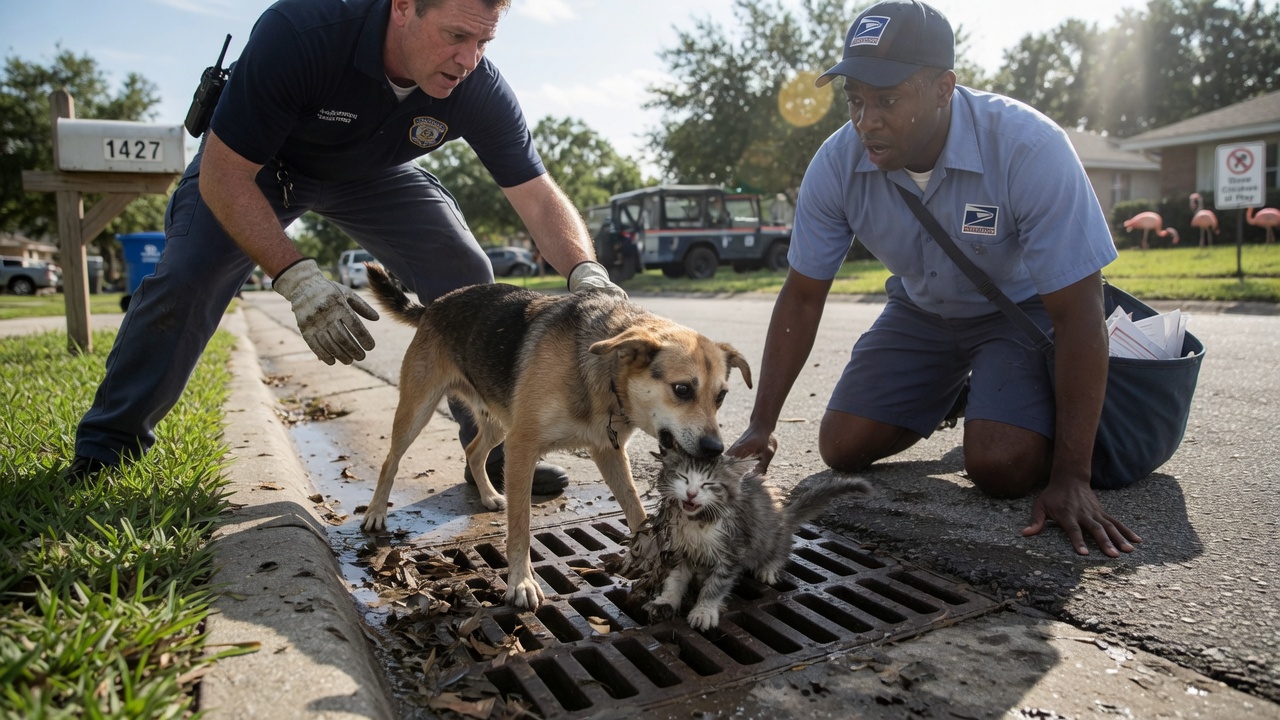
About twenty feet from the truck, kneeling on the scorching asphalt right next to a heavy iron storm drain, was the mail carrier.
He was a younger Black man, his light blue uniform soaked in sweat and dirt.
He wasn’t moving. He was frozen, his shoulders hunched, his hands hovering uselessly in the air.
Standing directly over him, practically pressed against his side, was the dog.
It was a large, scruffy mixed breed—maybe a shepherd-terrier mix. Wire-haired, muscular, and frantic.
The dog was pacing in tight, erratic half-circles, its paws scraping frantically against the iron grate of the storm drain.
Every muscle in its body was coiled tight with tension.
I slammed the truck into park and grabbed my thick leather gloves and my rigid catch pole.
I stepped out into the blinding heat.
The silence of the neighborhood was deafening, broken only by the low, continuous sounds coming from the dog.
It wasn’t a standard aggressive bark. It was a chaotic mix of sharp whines, heavy panting, and deep, guttural noises.
“Hey,” I called out, keeping my voice low, authoritative, and steady. “Animal Control. Don’t move. Keep your hands exactly where they are.”
The mail carrier, whose nametag read ‘Marcus’, didn’t even turn his head. He was staring down at the grate.
“Please,” Marcus whispered, his voice trembling so violently I could barely hear him over the crunch of my boots on the asphalt. “Please, hurry. He’s got it.”
He’s got it.
Those words sent a spike of pure ice through my veins.
I gripped the catch pole tighter, advancing slowly. Ten feet. Eight feet.
I was trying to read the dog. Usually, an attacking dog is hyper-focused on the victim, ears pinned back, hair raised, teeth bared in a snarl.
But this dog was ignoring Marcus entirely.
Its entire focus was directed straight down into the dark, narrow slits of the storm drain.
Six feet.
I could see the dog’s jaw now.
It was clamped down hard, its head wedged uncomfortably close to the hot iron.
I couldn’t see what was in its mouth, but I could see the muscles in the dog’s neck straining, locking its jaw in place.
Four feet.
I dropped the catch pole.
It clattered softly against the pavement. The pole is good for distance, but it creates panic. If this dog was actively biting down on something—or someone’s hand—the loop of the pole might cause it to thrash and rip whatever was in its mouth to shreds.
I needed to do this with my hands. I needed to control the head.
I took a deep breath, the smell of hot tar and wet fur filling my lungs.
“Okay, buddy,” I murmured to the dog, stepping right up next to Marcus. “Let’s just take it easy.”
I squatted down. The heat radiating from the street was intense.
The dog didn’t snap at me. It didn’t even look at me. It just kept whimpering, its body shaking with a frantic, desperate energy, its jaws still locked tight into the darkness of the grate.
I reached my heavy, leather-gloved hand out.
I aimed straight for the scruff of its neck, right above the collar.
My hand hovered in mid-air, just an inch away from the dog’s wiry fur.
My heart was beating so loud I thought the dog would hear it.
I braced myself for the bite. I braced myself for the struggle.
I leaned in to see exactly what this vicious animal had locked in its teeth before I grabbed it.
I peered through the heavy iron bars of the drain.
And then, I saw it.
I stopped breathing. My hand froze completely still in the air.
What I saw in the shadows of that storm drain changed everything.
“I Responded To A Terrifying ‘Dog Attack’ Call On A Suburban Route… But When I Reached For The Vicious Animal’s Collar, I Saw What Was Actually In Its Jaws.”
I’ve been an Animal Control Officer for twelve years, and let me tell you, you think you’ve seen it all.
You think you’ve seen every level of human negligence and animal unpredictability.
But absolutely nothing could have prepared me for the call that came across my radio on a blistering Tuesday afternoon, or what I found waiting for me at the end of Elmwood Drive.
It was the middle of July. The kind of oppressive, suffocating heat that makes the asphalt shimmer and the air taste like exhaust.
I was sitting in my idling truck, drinking a lukewarm coffee and filling out paperwork for a routine stray pickup, when the radio cracked to life.
“Unit 4, we have a Code 3. Priority emergency. Elmwood Drive, near the cul-de-sac.”
Sarah, our dispatcher, usually had a voice like smooth jazz. Calm, collected, utterly unbothered.
But right then, her voice was pitched up, tight with panic.
“Report of an aggressive canine. Large mixed breed. A postal worker is down. I repeat, postal worker is down. Caller states the dog has him pinned near the curb.”
My blood ran cold.
In this line of work, a “worker down” call is the nightmare scenario. It means the situation has already escalated from a threat to a mauling.
I slammed my coffee into the cupholder, hit the sirens, and threw the truck into drive.
My tires squealed against the pavement as I tore out of the parking lot, my heart hammering against my ribs like a trapped bird.
The drive felt like it took hours, even though it was only four miles away.
My mind was racing through the protocol. Get the catch pole. Assess the dog’s body language. Secure the victim. Stop the bleeding.
I’ve seen what a terrified, aggressive dog can do to a human body. It’s not something you ever get used to.
I turned the corner onto Elmwood Drive, the sirens cutting through the quiet, manicured lawns and sprinkler systems of the affluent suburb.
I killed the sirens as I approached the cul-de-sac to avoid agitating the dog further.
That’s when I saw the mail truck.
It was parked haphazardly, half on the curb, the door wide open.
A canvas mailbag was spilled onto the grass, white envelopes and magazines scattered across the hot pavement like fallen leaves.
And then, I saw him.
About twenty feet from the truck, kneeling on the scorching asphalt right next to a heavy iron storm drain, was the mail carrier.
He was a younger Black man, his light blue uniform soaked in sweat and dirt.
He wasn’t moving. He was frozen, his shoulders hunched, his hands hovering uselessly in the air.
Standing directly over him, practically pressed against his side, was the dog.
It was a large, scruffy mixed breed—maybe a shepherd-terrier mix. Wire-haired, muscular, and frantic.
The dog was pacing in tight, erratic half-circles, its paws scraping frantically against the iron grate of the storm drain.
Every muscle in its body was coiled tight with tension.
I slammed the truck into park and grabbed my thick leather gloves and my rigid catch pole.
I stepped out into the blinding heat.
The silence of the neighborhood was deafening, broken only by the low, continuous sounds coming from the dog.
It wasn’t a standard aggressive bark. It was a chaotic mix of sharp whines, heavy panting, and deep, guttural noises.
“Hey,” I called out, keeping my voice low, authoritative, and steady. “Animal Control. Don’t move. Keep your hands exactly where they are.”
The mail carrier, whose nametag read ‘Marcus’, didn’t even turn his head. He was staring down at the grate.
“Please,” Marcus whispered, his voice trembling so violently I could barely hear him over the crunch of my boots on the asphalt. “Please, hurry. He’s got it.”
He’s got it.
Those words sent a spike of pure ice through my veins.
I gripped the catch pole tighter, advancing slowly. Ten feet. Eight feet.
I was trying to read the dog. Usually, an attacking dog is hyper-focused on the victim, ears pinned back, hair raised, teeth bared in a snarl.
But this dog was ignoring Marcus entirely.
Its entire focus was directed straight down into the dark, narrow slits of the storm drain.
Six feet.
I could see the dog’s jaw now.
It was clamped down hard, its head wedged uncomfortably close to the hot iron.
I couldn’t see what was in its mouth, but I could see the muscles in the dog’s neck straining, locking its jaw in place.
Four feet.
I dropped the catch pole.
It clattered softly against the pavement. The pole is good for distance, but it creates panic. If this dog was actively biting down on something—or someone’s hand—the loop of the pole might cause it to thrash and rip whatever was in its mouth to shreds.
I needed to do this with my hands. I needed to control the head.
I took a deep breath, the smell of hot tar and wet fur filling my lungs.
“Okay, buddy,” I murmured to the dog, stepping right up next to Marcus. “Let’s just take it easy.”
I squatted down. The heat radiating from the street was intense.
The dog didn’t snap at me. It didn’t even look at me. It just kept whimpering, its body shaking with a frantic, desperate energy, its jaws still locked tight into the darkness of the grate.
I reached my heavy, leather-gloved hand out.
I aimed straight for the scruff of its neck, right above the collar.
My hand hovered in mid-air, just an inch away from the dog’s wiry fur.
My heart was beating so loud I thought the dog would hear it.
I braced myself for the bite. I braced myself for the struggle.
I leaned in to see exactly what this vicious animal had locked in its teeth before I grabbed it.
I peered through the heavy iron bars of the drain.
And then, I saw it.
I stopped breathing. My hand froze completely still in the air.
What I saw in the shadows of that storm drain changed everything.
CHAPTER 2
My hand hung suspended in the thick, humid air.
Just an inch from the coarse fur of the dog’s neck, my fingers were curled and ready to grab, to forcefully pull this “dangerous” animal away from its victim.
But my brain had completely short-circuited.
My eyes were trying to process the impossible scene hidden within the dark, rusted shadows of the storm drain.
It wasn’t a piece of the mail carrier’s uniform.
It wasn’t a human hand or foot.
It wasn’t a piece of trash.
Clamped securely, yet impossibly gently, between the dog’s powerful jaws was a tiny, motionless ball of matted gray fur and black mud.
It was a kitten.
And it was barely larger than the palm of my hand.
The dog wasn’t attacking. The dog was saving a life.
I dropped to both knees, the searing heat of the asphalt burning straight through the thick fabric of my uniform pants.
I leaned my face closer to the heavy iron grate, ignoring the smell of stagnant water, decaying leaves, and hot rust.
The situation was far worse than I initially realized.
The storm drain didn’t just drop down a foot or two. This was a deep, primary drainage offshoot. Through the narrow slits, I could see a sheer drop of at least ten feet into a dark, concrete abyss where a steady stream of runoff water was flowing rapidly.
The kitten was dangling right over that drop.
It must have fallen through the wide gaps in the grate, tumbling down until it managed to catch its tiny claws on a rusted crossbar just a few inches below street level.
And this stray dog—this frantic, terrified, mixed-breed mutt that someone had called 911 to report as a vicious monster—had shoved its snout through the heavy iron bars to grab the kitten before it fell to its death.
The dog had the kitten firmly by the scruff of its neck, instinctively knowing the safest way to hold a feline without crushing it.
But the dog’s head was wedged.
The gap between the iron bars was just wide enough for the dog to force its snout in, but the angle was terrible. The iron was pressing hard against the dog’s cheekbones and the bridge of its nose.
I could see raw, bleeding scrapes on the dog’s muzzle where it had frantically rubbed against the sharp metal trying to get a better grip.
The dog was whining—that high-pitched, desperate sound I had heard earlier. It wasn’t aggression. It was pure distress.
“Oh my god,” I breathed out, the realization washing over me like a bucket of ice water.
I slowly lowered my leather-gloved hand and gently, reassuringly, rested it on the dog’s trembling back.
The dog didn’t flinch. It didn’t snap. It just let out a long, shuddering exhale through its nose, as if to say, Finally. Someone is helping me.
I looked over at Marcus, the mail carrier.
He was still kneeling there, tears cutting tracks through the dust on his cheeks. His chest was heaving.
“He… he wouldn’t let me leave,” Marcus stammered, his voice cracking. “I parked the truck. I was walking up to the mailbox at that white house. He just came out of nowhere.”
Marcus wiped his face with the back of a trembling hand, his eyes wide with leftover adrenaline.
“He was barking like crazy. He ran right up to me. I thought… I mean, look at him. He’s big. He’s a stray. I thought I was getting mauled. I dropped my bag and froze. It’s what they teach us to do.”
I nodded slowly, keeping my hand flat and steady on the dog’s back, letting the animal know I was a friend.
“But he didn’t bite you,” I said softly.
“No,” Marcus shook his head. “He grabbed the cuff of my pants. Just a little nip, and he pulled. He pulled me toward the street. Then he ran to this drain and started crying. Just crying and clawing at the metal.”
Marcus looked down at the grate, his expression a mix of awe and profound guilt.
“I tried to reach down,” Marcus whispered. “I saw the little cat. I tried to stick my hand through the bars, but my arm is too thick. I couldn’t reach it. The kitten started slipping. It was crying, man. It was making this tiny, awful sound.”
Marcus took a deep, ragged breath.
“Then the kitten slipped off the bar. It started to fall. And the dog just… lunged. He jammed his whole face into the grate and caught it in mid-air. He caught it before it dropped.”
I looked back down into the drain.
The muscles in the dog’s jaw were visibly quivering. It takes an immense amount of strength and control for a dog to lock its jaw with just enough pressure to hold a fragile animal, but not enough to puncture the skin.
But the dog was exhausted.
It was over ninety degrees outside. The sun was beating down directly on the back of the dog’s dark, coarse coat. The asphalt was baking them both from below.
The dog was panting heavily through its nose, drops of saliva pooling around the edges of the iron bars.
It couldn’t hold on much longer.
“How long?” I asked, my voice tight with urgency. “How long has he been holding the kitten like this?”
“I don’t know,” Marcus panicked. “Ten minutes? Fifteen? A woman driving a silver SUV stopped when she saw me on the ground. She rolled her window down and asked if I was okay. I couldn’t even speak, I was so focused on trying to help the dog. She must have seen the dog standing over me and called the police.”
That explained the 911 call. A passing driver saw a large dog standing over a grounded postal worker. They assumed the absolute worst.
They saw a monster.
They completely missed the miracle.
“Okay,” I said, snapping into full professional mode. The shock was over. Now, we had to work.
“Marcus, listen to me. I need your help. We have to get this grate off.”
I looked at the heavy iron square. It was a standard municipal storm drain cover. Solid cast iron. Easily weighing over a hundred and fifty pounds.
Worse, it had been sitting in this exact spot for years. The edges were sealed shut with a thick layer of rust, hardened dirt, and melted street tar.
“We can’t just pull the dog up,” I explained quickly. “If we startle him, or if we pull him back, he might accidentally open his mouth. He’s fatigued. If he loses his grip even for a fraction of a second, that kitten is gone. It’s dropping straight into the water.”
“What do we do?” Marcus asked, shifting closer, the fear of the dog completely evaporating from his eyes.
“We lift the whole grate. Together. With the dog still attached to it.”
I stood up, my knees aching from the hot pavement.
“Stay right here. Keep talking to him. Soft voice. Tell him he’s a good boy. Keep him calm.”
I sprinted back to my Animal Control truck.
I threw open the heavy utility doors on the side of the bed. My hands were flying past the catch poles, the tranquilizer darts, the muzzles, the thick leather gauntlets.
I didn’t need tools to subdue a beast. I needed tools to move a mountain.
I grabbed my heavy-duty crowbar, a pair of thick industrial work gloves, and a large bottle of emergency saline wash.
I slammed the metal doors shut and ran back to the drain.
Marcus was doing exactly what I asked. He was leaning close to the dog’s ear, whispering softly.
“You’re a good boy. You’re a hero, buddy. Just hold on. We’re getting you out. We’re getting the baby out.”
The dog’s tail gave one, weak, agonizingly slow thump against the hot asphalt.
It heard him. It understood.
I dropped to the ground and jammed the wedged end of the crowbar into the tiny seam between the iron grate and the concrete housing.
“Stand back,” I warned Marcus.
I pushed my entire body weight down onto the crowbar.
Nothing.
The grate didn’t budge a single millimeter. The rust and tar held it fast like concrete glue.
Panic started to bubble up in my chest.
If I couldn’t pry the grate loose, I would have to call the fire department. But that would take at least ten to fifteen minutes. The sirens would terrify the dog. The loud hydraulic tools would cause a panic.
And looking at the violent trembling running through the dog’s front legs, we didn’t have fifteen minutes. We didn’t even have five.
“Damn it,” I grunted, repositioning the crowbar to a different corner.
I pushed again. My boots slipped on the loose gravel. The heavy iron mocked my effort.
The dog let out a sharp, pathetic whine. Its head slipped down half an inch, its nose scraping brutally against the rusty metal.
The kitten dangled lower, its tiny back legs kicking weakly in the empty air above the rushing water.
“He’s losing his grip!” Marcus yelled, his hands hovering frantically over the dog.
“Hold him!” I shouted. “Grab his collar! Take the weight off his neck, but DO NOT pull him backward! Just support his head!”
Marcus didn’t hesitate.
Ten minutes ago, he thought this dog was going to rip his throat out. Now, he reached right down into the danger zone.
He slid his hands under the dog’s heavy neck, gripping the fraying nylon collar, and gently lifted upward just enough to relieve the pressure of the dog’s head hanging into the grate.
The dog groaned in relief, its jaw remaining fiercely clamped onto the kitten.
I looked at the crowbar. I looked at the iron grate.
“Marcus, I need you to keep holding him. I’m going to hit the bar. It’s going to make a loud noise. Keep him steady.”
“I got him,” Marcus said, his jaw set in pure determination.
I lifted my heavy steel-toed work boot.
I brought my heel down on the end of the crowbar with every ounce of strength I had in my body.
CLANG.
The sharp sound of metal striking metal echoed down the quiet suburban street.
The dog flinched, its body tensing hard against Marcus’s hands, but it didn’t let go.
I looked at the seam.
A tiny, hairline crack had appeared in the rust.
“Yes,” I hissed.
I stomped on the crowbar again.
CLANG.
The crack widened. A chunk of hardened street tar chipped off and fell into the drain.
“Again!” Marcus urged, sweat pouring off his forehead and dripping onto his uniform shirt.
I kicked the bar a third time, shifting all my weight onto my heel.
CRACK.
With a sickening screech of rusted metal, the heavy iron grate popped upward about half an inch.
The seal was broken.
I threw the crowbar to the side and grabbed the edge of the iron grate with both gloved hands.
The metal was hot enough to brand cattle. Even through the thick industrial leather, I could feel the blistering heat radiating into my palms.
“Okay, Marcus. When I lift, the grate is going to come up. The dog’s snout is stuck between the bars. You have to guide the dog upward with the grate. If the grate comes up and the dog stays down, we’ll break his neck.”
Marcus swallowed hard, his eyes locked on mine. “Guide him up. Got it.”
“On three.”
I positioned my feet, squatting low to use my legs. My back screamed in protest.
“One.”
The dog let out another whimpering groan, a sound of absolute physical failure.
“Two.”
I tightened my grip, the rusty edges digging into my fingers.
“Three. LIFT!”
I roared as I drove my legs upward.
The iron grate weighed a ton. It resisted, snagging on the concrete lip. My muscles burned, my vision swimming with black spots from the immense strain and the suffocating heat.
“Come on!” Marcus yelled, pulling upward on the dog’s collar, keeping the animal perfectly aligned with the rising metal bars.
With a horrific scraping sound, the grate cleared the housing.
I staggered backward, holding the massive square of iron up in the air.
Marcus moved with us, taking careful, shuffling steps, practically carrying the front half of the dog’s body while its snout remained wedged in the suspended metal.
We moved away from the gaping, dangerous hole in the street, stepping onto the solid, safe concrete of the sidewalk.
“Okay,” I gasped, my arms trembling violently under the weight of the iron. “Set it down. Slowly.”
I lowered the grate onto the grass, letting it rest at an angle so the dog wasn’t crushed.
We were on solid ground. The hole was behind us.
But the nightmare wasn’t over.
The dog’s snout was still completely jammed between the thick iron bars.
And the kitten was still clamped in its jaws.
“He’s not letting go,” Marcus panicked, dropping to his knees beside the dog. “Why isn’t he letting go?”
I fell to my knees next to them, my chest heaving, my uniform completely soaked through with sweat.
I looked closely at the dog’s face.
Its eyes were rolled back slightly, showing the whites. Its breathing was shallow and rapid. The muscles in its jaw were locked in a rigid, terrifying spasm.
“He’s in tetany,” I realized, a cold dread washing over me.
“What? What does that mean?”
“His muscles have locked up,” I explained quickly, pulling off my heavy work gloves to get bare-hand dexterity. “He’s been clenching his jaw for so long, under so much stress and heat, that the muscles have cramped and seized. He physically can’t open his mouth.”
The dog’s body was shutting down. The heroic effort had taken everything it had.
If we didn’t get its jaw open soon, the dog would go into shock, and the delicate kitten held between those locked teeth would be crushed as the muscle spasms intensified.
We had moved them away from the edge of the cliff.
But we were still entirely out of time.
CHAPTER 4
Thirteen. Fourteen. Fifteen.
The rhythm of the compressions became the only thing anchoring me to reality.
The sweltering July heat was beating down on the back of my neck, but I felt ice-cold inside.
My vision narrowed until the only thing I could see was the dusty, wire-haired ribcage beneath my bruised and battered hands.
Sixteen. Seventeen. Eighteen.
“Breathe!” I screamed at the dog, my voice cracking, echoing off the silent brick walls of the expensive houses surrounding the cul-de-sac.
I paused the chest compressions for a fraction of a second.
I clamped my hands around the dog’s massive muzzle, sealing his lips shut with my palms, and pressed my mouth directly over his large, leathery black nose.
I blew a long, forceful breath of air directly into his nostrils, watching his heavy chest manually inflate under my chest.
I pulled away and immediately went back to the compressions.
Nineteen. Twenty. Twenty-one.
My shoulders were burning. The muscles in my lower back were screaming in absolute agony from lifting the heavy iron storm grate earlier, and now they were locked in agonizing spasms of their own.
I didn’t care.
I blocked out the pain. I blocked out the heat.
I blocked out the sound of Marcus sobbing quietly behind me, cradling the tiny, muddy kitten that was still letting out weak, raspy cries.
Twenty-two. Twenty-three. Twenty-four.
“You don’t get to quit,” I growled, sweat dripping from my eyelashes and splashing onto the dog’s motionless shoulder. “You fought too hard. You are not dying in the dirt today.”
I leaned my entire upper body weight into the next compression, pressing the heel of my hand deep into the dog’s cardiac cavity.
I felt the horrific, unnatural squish of his internal organs pushing against the pressure.
I was brutalizing him. I knew I was. But gentle CPR is completely useless on a large breed dog. You have to push hard enough to manually squeeze the heart against the spine to force the blood to circulate.
Twenty-five. Twenty-six.
Suddenly, my hand slipped.
The dog’s body convulsed.
It wasn’t a weak, subtle twitch. It was a violent, full-body spasm that practically threw my hands off his chest.
I fell back onto my knees, my heart stopping in my own chest.
The dog’s back legs kicked out wildly, scraping across the dry asphalt.
His massive jaw snapped shut, then fell open again.
And then, he took a breath.
It wasn’t a normal breath. It sounded like a massive, rusted vacuum cleaner turning on. It was a deep, wet, ragged inhalation that seemed to pull all the surrounding air into his lungs.
His entire body shuddered, and a horrific coughing fit seized him.
Foul-smelling, pink-tinged foam bubbled out of the corners of his mouth, spilling onto the grass.
“Turn him!” I yelled, my paralysis breaking instantly. “Get him on his stomach! He’s going to aspirate!”
Marcus didn’t hesitate. He gently placed the muddy kitten into the deep side pocket of his mail carrier bag, leaving the flap wide open, and lunged forward.
Together, we grabbed the massive dog by his thick scruff and his heavy hips, physically rolling his seventy-pound body from his side onto his stomach.
I propped his head up, pointing his snout slightly downward so the fluid could drain from his airway.
The dog was coughing, gagging, and shivering violently despite the ninety-degree heat.
But his eyes were open.
They were completely bloodshot, glassy, and unfocused, but they were open.
“He’s back,” Marcus choked out, a massive, brilliant smile breaking through the dirt and tear tracks on his face. “You brought him back!”
“He’s not out of the woods yet,” I shot back, already scrambling to my feet. “He’s in profound hypovolemic shock. His core temp is probably pushing a hundred and eight degrees. If we don’t cool him down and get IV fluids in him immediately, his organs are going to cook themselves from the inside out.”
I sprinted toward my idling Animal Control truck.
“Marcus! I need you to lift his back end! We’re putting him in the cab, not the back box! It’s too hot back there!”
I threw open the passenger side door of my heavy-duty truck.
I blasted the air conditioning to the absolute maximum setting, aiming all the vents toward the passenger seat.
I grabbed an emergency foil thermal blanket from my medical kit—usually used for keeping animals warm, but just as effective at trapping the cold air from the AC vents around a hyperthermic animal.
I ran back to the dog.
He was trying to lift his head, but his neck muscles simply refused to support the weight. His head kept bobbing and dropping back into the grass.
“Easy, buddy,” I soothed, sliding my arms completely under his heavy chest, locking my hands together beneath his sternum.
Marcus mirrored my position, sliding his arms under the dog’s hips and lower belly.
“On three,” I commanded. “One. Two. Three. Lift!”
We hoisted the massive, dead weight of the dog into the air.
He groaned loudly, a sound of pure misery, but he didn’t try to bite. He didn’t even try to struggle. He just let us carry him, surrendering completely to our hands.
We waddled awkwardly across the scorching asphalt, my boots slipping on the scattered mail from Marcus’s dropped bag.
We reached the open passenger door of my truck.
“Slide him in, back legs first,” I directed.
Marcus carefully pushed the dog’s heavy hindquarters onto the floorboard, while I guided his broad chest and head onto the passenger seat.
I draped the silver foil blanket loosely over his back, tucking the edges in so the icy air blasting from the dashboard vents would circulate directly over his overheated body.
“The kitten!” Marcus suddenly gasped, realizing he had left his mailbag on the lawn.
He turned and sprinted back across the yard.
He scooped up the heavy canvas bag, cradling the pocket where the tiny survivor was tucked away, and ran back to my truck.
“Get in,” I told Marcus, pointing to the jump seat in the extended cab behind the passenger seat. “Hold the kitten. Keep an eye on the dog’s breathing. If he stops panting, or if his gums go white again, you yell at me.”
Marcus didn’t argue. He climbed into the cramped back seat, pulling the door shut behind him.
I ran around the hood of the truck and practically threw myself into the driver’s seat.
I slammed the truck into drive, hit the sirens, and flipped the emergency lights on.
I didn’t care that Animal Control wasn’t technically an ambulance. I didn’t care about the speed limit.
I grabbed the radio mic as I mashed the gas pedal to the floor.
“Unit 4 to Dispatch. Code 3 in progress. Sarah, are you there?”
The radio clicked immediately. “Unit 4, this is Dispatch. Status?”
Sarah’s voice was still tight, expecting the worst.
“Status is two patients en route to Blue Ridge Emergency Vet. One canine, severe hyperthermia, tetany, and post-cardiac arrest. One feline neonate, hypothermia, near-drowning, and crush trauma. Call ahead. Tell them to have a crash cart and an ice bath ready at the door.”
There was a half-second of dead air as Sarah processed the information.
“Wait,” Sarah’s confused voice crackled over the speaker. “I thought the dog attacked a postal worker?”
I looked in my rearview mirror.
I saw Marcus, the postal worker in question, sitting in the back of my truck.
He had one hand gently stroking the muddy, ruined fur of the tiny kitten resting in his lap.
His other hand was reaching forward, gently resting on the head of the massive, terrifying stray dog that was currently fighting for its life on my passenger seat.
The dog leaned his heavy head into Marcus’s hand, seeking the comfort of the man he had just risked everything to save.
“Negative, Dispatch,” I said into the mic, a hard lump forming in my throat. “The dog didn’t attack anyone. The dog is a hero. Clear the intersections. I’m coming in hot.”
“Copy that, Unit 4. Intersections cleared. The vet is waiting for you.”
I dropped the mic and focused on the road.
The drive was an absolute blur of blaring sirens, flashing red and blue lights, and the deafening roar of the truck’s engine.
I was taking corners so fast the tires were squealing in protest.
Every few seconds, I would reach my right hand out and press two fingers against the side of the dog’s neck, checking for that steady, rhythmic thumping of his pulse.
It was fast. It was erratic. But it was there.
“Hang on,” I kept whispering. “Just hang on.”
We pulled into the parking lot of the Blue Ridge Emergency Veterinary Clinic on two wheels, the heavy suspension of the truck bouncing as I hopped the curb and slammed on the brakes right in front of the glass double doors.
Before I even had the truck fully in park, the doors blew open.
A team of four vet techs and a veterinarian sprinted out, pushing a heavy stainless steel gurney.
I kicked my door open and jumped out.
“We need hands!” I yelled, pulling the passenger door open.
The medical team swarmed the truck.
They didn’t hesitate or show fear when they saw the size and breed of the dog. They saw a patient in critical condition.
Two techs grabbed the thermal blanket, using it as a makeshift stretcher to slide the dog’s dead weight out of the cab and onto the metal gurney.
“Core temp?” the vet, a tall woman named Dr. Evans, demanded as they started rolling the gurney toward the doors.
“Unchecked, but high,” I rattled off quickly, jogging alongside them. “Seized in a storm grate for at least twenty minutes. Full masseter tetany. Coded in the field. Two minutes of CPR before spontaneous circulation returned. He aspirated some fluid.”
“Get him to trauma one. Start a double wide-bore IV, push cold saline, and pack his groin and armpits with ice,” Dr. Evans ordered her team, her voice a calm, commanding force in the chaos.
As they blew through the front doors with the dog, Marcus climbed out of the back of the truck.
He was holding the kitten in the palm of both hands.
The tiny creature was shivering so violently it looked like it was vibrating.
Another tech, a younger guy with brightly tattooed arms, rushed over with a small, heated towel.
“I’ve got the baby,” the tech said softly, wrapping the warm towel around the filthy, mud-soaked kitten.
Marcus reluctantly handed the kitten over, his hands hovering in the air as the tech rushed away down a different hallway.
Suddenly, the adrenaline dump hit me.
The crisis was over. My hands were empty.
My knees instantly turned to water.
I stumbled backward, catching myself against the side of my truck, sliding down until I was sitting on the hot pavement of the parking lot.
My breathing was shallow and frantic. My hands were shaking so badly I couldn’t even make a fist.
I looked down at myself.
My uniform was completely destroyed. It was soaked in sweat, stained with black street tar, coated in dog hair, and smeared with the pink, foamy blood the dog had coughed up.
Marcus walked over and slid down the side of the truck next to me.
He looked just as bad. His blue postal uniform was ruined, his pants torn at the knees, his face a mess of dirt and dried tears.
We sat there on the asphalt, in the blazing afternoon sun, entirely silent.
There was nothing left to say. We had done everything humanly possible.
Now, all we could do was wait.
The next three hours were the longest of my entire life.
Marcus and I eventually moved into the air-conditioned waiting room, much to the alarm of the clean, well-dressed pet owners sitting in the lobby with their perfectly groomed poodles and golden retrievers.
We looked like we had just survived a war zone.
We drank terrible, burnt coffee from small styrofoam cups and stared at the swinging double doors leading to the treatment area.
Marcus told me about his life. He told me he had just transferred to this route a month ago. He told me he had always been terrified of large dogs because he was bitten badly as a child.
“I looked at him,” Marcus said quietly, staring into his coffee cup. “When he ran at me today, I looked at him and I saw a monster. I saw every stereotype, every bad memory I ever had.”
He shook his head slowly.
“I was so wrong. He had a better heart than most people I know.”
I just nodded, my eyes glued to the double doors.
Finally, just as the sun was starting to set outside, painting the waiting room in long, orange shadows, Dr. Evans walked through the doors.
She looked exhausted. She had a smear of blood on her green scrubs and her hair was sticking to her forehead.
Marcus and I both stood up instantly.
“How are they?” I asked, my voice tight.
Dr. Evans let out a long, heavy sigh, and then, a small, tired smile touched the corners of her mouth.
“They’re tough,” she said, crossing her arms. “Both of them.”
Marcus let out a massive, shuddering breath, dropping his head into his hands.
“The dog is stable,” Dr. Evans continued, looking at me. “His core temperature hit 107.5. Another degree and his brain would have literally started to melt. He has rhabdomyolysis—severe muscle breakdown from the tetany—so we’re flooding his kidneys with fluids to flush the proteins out. He has a cracked rib from your CPR.”
She pointed a finger at me. “Which, by the way, saved his life. Excellent work in the field.”
I swallowed hard, nodding. “What about the jaw? The nose?”
“His jaw is heavily bruised but not broken. The soft tissue damage on his snout is gnarly. He’ll have a nasty scar across the bridge of his nose for the rest of his life. But he’s resting comfortably. He’s on heavy pain meds and a cooling mat.”
“And the kitten?” Marcus asked quickly, looking up.
Dr. Evans’ smile widened.
“That little guy is a miracle. A four-week-old male. He was profoundly hypothermic and swallowed some nasty water, but his lungs sound clear now. We washed him off. Turns out, he’s not black and gray. He’s a solid, bright orange tabby.”
She chuckled softly. “He’s currently screaming his head off in the incubator, demanding food. He’s going to be just fine.”
The relief that washed over me was a physical weight lifting off my chest.
I felt like I could finally breathe again.
“Can we see them?” Marcus asked, his voice full of hope.
“Just the dog, for now. The kitten needs to stay in the incubator,” Dr. Evans said, gesturing for us to follow her.
We walked through the swinging doors, leaving the quiet, clean waiting room behind, and entered the chaotic, bright, clinical world of the ICU.
We walked past rows of stainless steel cages, the beeping of IV monitors and the low hum of oxygen concentrators filling the air.
At the very back of the room, in the largest floor run, lay the hero.
He was resting on a thick, blue cooling pad. An IV line was taped securely to his shaved front leg, pumping clear fluids into his system.
The raw, red scrape across his nose had been cleaned and treated with soothing ointment.
He looked incredibly small and fragile without his frantic, tense energy.
As we approached the chain-link door of the run, the dog’s ears twitched.
He slowly opened his heavy, exhausted eyes.
He looked past Dr. Evans. He looked past me.
His eyes locked directly onto Marcus.
And slowly, agonizingly, the dog’s tail began to thump against the floor.
Thump. Thump. Thump.
Marcus fell to his knees in front of the cage, pressing his face against the cool metal grating. Tears were streaming down his face again, but this time, he didn’t try to hide them.
“Hey, buddy,” Marcus whispered, pushing his fingers through the chain link.
The massive dog let out a soft, rattling sigh and pushed his wet nose against Marcus’s fingers, closing his eyes in absolute contentment.
“Did you scan him?” I asked Dr. Evans quietly, watching the beautiful scene unfold. “Does he have a microchip? An owner?”
Dr. Evans shook her head. “No chip. No collar tags. He’s severely underweight, and judging by the calluses on his elbows and the state of his teeth, he’s been living on the streets for a very long time. He’s a stray.”
A stray.
A forgotten, discarded animal that society had deemed a nuisance, a threat, a monster.
And yet, when a tiny, helpless creature was falling into the dark, this forgotten monster was the only one who threw himself into the abyss to catch it.
Marcus pulled his hand away from the cage and looked up at me.
There was a fierce, unshakeable determination in his eyes.
“No, he’s not,” Marcus said firmly, his voice steady and clear.
“He’s not a stray anymore.”
I looked at Marcus, then down at the massive, scarred dog, and a huge, genuine smile spread across my face.
The story didn’t end there, of course.
The paperwork took a few days. The medical recovery took weeks.
But three months later, I was driving my Animal Control truck through that exact same affluent suburban neighborhood.
The July heat had faded into a crisp, cool autumn afternoon.
I turned the corner onto Elmwood Drive, slowing down as I passed the infamous storm drain.
And there, walking up the sidewalk, was Marcus.
He was wearing his pristine blue postal uniform, his heavy canvas bag slung over his shoulder.
Walking perfectly in stride right beside him, completely off-leash, was a massive, wire-haired shepherd mix.
The dog looked incredible. His coat was shiny and thick, his ribs were completely hidden beneath layers of healthy muscle, and he wore a bright red, heavy-duty collar with a shiny gold tag that read: HERO.
Across the bridge of his nose, a stark, white scar stood out against his dark fur—a permanent badge of honor.
I rolled my window down and honked the horn.
Marcus turned, a massive smile breaking across his face. He waved enthusiastically.
Hero stopped, sitting perfectly at Marcus’s side, his tail wagging a million miles an hour.
“How’s the little guy?” I yelled out the window.
“Fat and lazy!” Marcus laughed, patting his thigh. Hero instantly nudged his hand for a pet. “He rules the house. Hero here is terrified of him!”
I laughed, shifting the truck back into drive.
As I drove away, I looked in my rearview mirror one last time.
I saw a man who had conquered his deepest fears.
I saw a dog who had finally found the loving pack he so desperately deserved.
And I remembered the tiny, orange miracle waiting for them both at home.
In my twelve years as an Animal Control Officer, I’ve seen the absolute worst of what this world has to offer. I’ve seen cruelty, neglect, and unimaginable darkness.
But every time I put on this uniform, every time I face down a situation that looks terrifying and hopeless, I remember that day on Elmwood Drive.
I remember that sometimes, the things that scare us the most are just screaming for help.
And sometimes, if you look past the teeth, the dirt, and the scars…
You find a hero waiting in the shadows.

About the Author
dream02
A writer passionate about human stories and real-life experiences that inspire and move readers.
 Dog Story
54 min read
Dog Story
54 min read
I managed the corner cafe and kicked the same 6-foot homeless biker out for 14 days straight—until I saw the “trembling” shape on the alley camera, and quietly locked the front doors.
I’ve been the general manager of the Sunrise Roast coffee shop in downtown Seattle for nine years, but nothing prepared…
 Dog Story
49 min read
Dog Story
49 min read
I Was Pulled Over For A “Broken Taillight” On A Dark Road. When The Officer Saw My Face, He Didn’t Ask For My License—He Asked If I Remembered That Night In 1998. What My Hidden Camera Captured Didn’t Just Save My Life; It Uncovered A Secret My City Was Willing To Kill To Protect.
Chapter 1The rain didn’t just fall that night; it hammered against the windshield of my Audi like it was trying…
 Dog Story
34 min read
Dog Story
34 min read
For 45 Minutes, They Mocked A Black Man Kneeling In The Dirt—They Didn’t Know I Was The Federal Attorney Who Just Destroyed Their Entire Department
The gravel bit into my knees, sharp and unforgiving, but I didn’t flinch. I kept my eyes locked on the…
Leave a Reply