
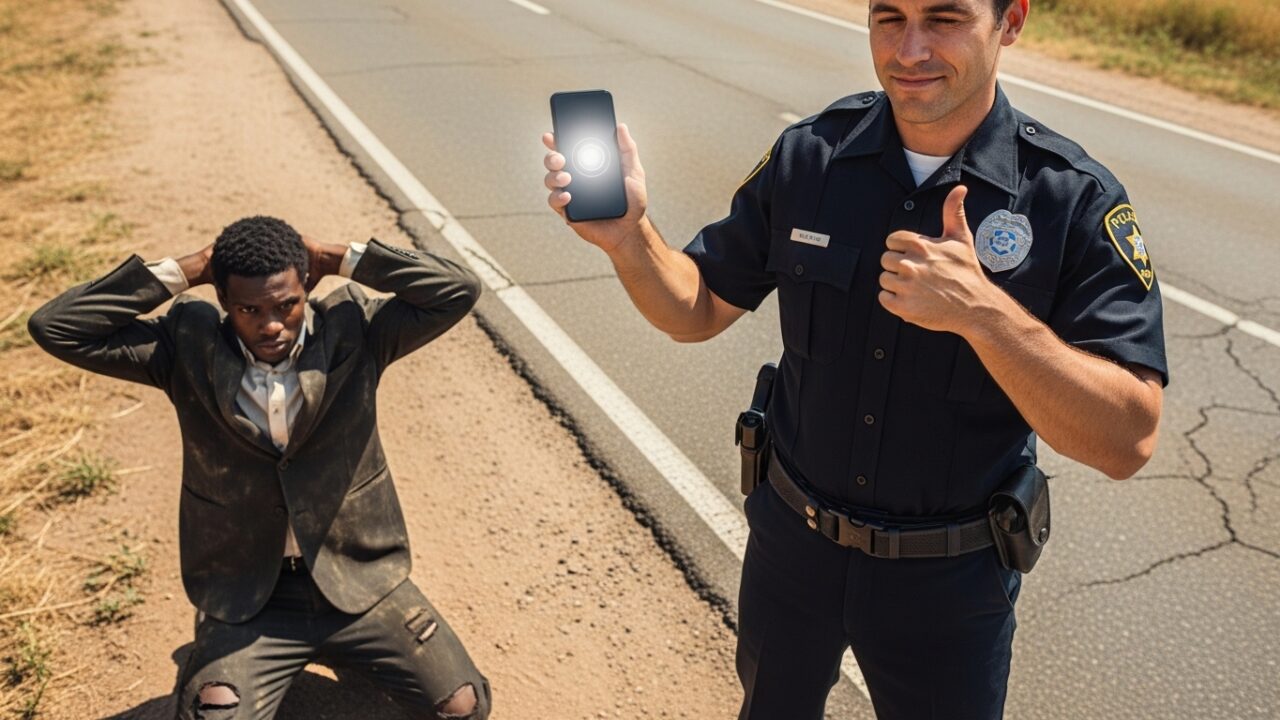
For 45 Minutes, They Mocked A Black Man Kneeling In The Dirt—They Didn’t Know I Was The Federal Attorney Who Just Destroyed Their Entire Department

The gravel bit into my knees, sharp and unforgiving, but I didn’t flinch.
I kept my eyes locked on the cracked asphalt of Highway 11. The mid-July Georgia sun was beating down on the back of my neck, but the heat radiating from Officer Hayes was worse. It was a suffocating, aggressive heat—the kind that comes from a man who thrives on having absolute power over someone he views as less than human.
“Look at him,” Hayes sneered, his voice dripping with that thick, lazy drawl. I could hear the crunch of his heavy boots as he paced around me. “Dressed up in a little suit, pretending to be somebody. What’s the matter, boy? Your dark skin absorbing too much heat in that cheap wool?”
I said nothing. I just kept my hands locked behind my head, fingers interlaced exactly how he had ordered.
I am a Black man. I am forty-two years old, standing six-foot-two, and in the eyes of the Oakridge Police Department, my skin color alone was probable cause. I knew the drill. Every Black man in this county knew the drill.
But I wasn’t just a Black man. And I wasn’t just the pastor of the small, struggling Grace Baptist Church on the East Side, which is exactly what my worn-out clerical collar and the Bible on my passenger seat suggested.
I was Marcus Thorne. And I was waiting.
“I asked you a question,” Hayes barked. The toe of his boot suddenly jammed into my ribs. Not hard enough to break anything, but hard enough to send a sharp jolt of pain through my side. Hard enough to show off for his partner, a nervous twenty-something rookie named Miller who was standing by the cruiser, shifting his weight from foot to foot.
“Leave him be, Hayes. We ran his plates, he’s clean,” Miller mumbled, his voice tight. He looked sick. He had the eyes of a kid who had joined the force to do good, only to realize he had been recruited into a state-sanctioned gang.
“Shut up, Miller. You gotta learn how these people work,” Hayes snapped, leaning down until I could smell the stale coffee and wintergreen chewing tobacco on his breath. “They smile. They play the good Christian. But underneath, they’re all the same. Grifters. Thugs.”
Hayes reached down and grabbed the collar of my suit jacket—a $3,000 bespoke Italian wool suit that I purposefully wore wrinkled today. He yanked me backward, throwing me off balance so I sprawled onto the dirt shoulder.
“You praying down there, Reverend?” Hayes laughed, a harsh, grating sound. “Why don’t you pray for some lighter skin? Maybe God’ll wash you clean and keep you out of my jurisdiction.”
My jaw clenched. The humiliation burned hotter than the sun, a familiar, agonizing fire in my chest. The urge to snap back, to stand up, to look him dead in his arrogant eyes and tell him exactly who I was, almost overwhelmed me.
But I breathed in the hot, dusty air. I tasted the grit in my teeth. Hold the line, Marcus, I told myself. Let them dig the grave. Hand them the shovel.
Because what Officer Hayes didn’t know—what he couldn’t possibly fathom as he stood there laughing at a Black man in the dirt—was that three hours ago, I wasn’t at a church.
Three hours ago, I was sitting in the United States District Court in downtown Atlanta.
And I wasn’t just sitting there. I was officially filing a 240-page federal lawsuit. A sprawling, airtight civil rights and RICO case targeting systemic racial profiling, evidence planting, and corruption.
The primary defendant? The Oakridge Police Department.
The name cited in 47 different sworn affidavits of police brutality? Officer Thomas Hayes.
“Get back on your knees,” Hayes growled, kicking the back of my thigh. “I didn’t tell you to lie down.”
I slowly pushed myself back up to a kneeling position. My pants were torn. My knee was bleeding.
Then, my cell phone, sitting on the roof of my car where Hayes had tossed it, lit up. The screen glowed brightly.
Hayes paused. He walked over to my car and picked up the phone. He squinted at the caller ID.
“Well, well, well,” Hayes muttered, an ugly smirk spreading across his face. “Who is ‘Judge Caldwell’? You got some fake contacts in here to make yourself look important, Reverend?”
Hayes didn’t wait for an answer. He swiped the screen, answered the call, and put it on speakerphone, clearly intending to humiliate me further in front of whoever was on the line.
“Hello?” Hayes said, mocking a polite, professional tone. “The Reverend is a little tied up in the dirt right now. Can I take a message?”
The voice that came through the speaker was cold, sharp, and carried the weight of the federal bench.
“This is the Honorable Judge Robert Caldwell of the Federal District Court. To whom am I speaking, and why are you in possession of Lead Counsel Thorne’s phone?”
Hayes’s smirk froze. The wintergreen tobacco suddenly looked like it was going to make him choke.
The silence that followed Judge Caldwell’s voice was thicker than the Georgia humidity.
For three agonizingly long seconds, the only sound on Highway 11 was the steady hum of the police cruiser’s engine and the distant caw of a crow. Officer Thomas Hayes stood frozen, my phone gripped in his thick hand, his mocking smile replaced by a slack-jawed look of utter incomprehension.
“I asked you a question,” the judge’s voice crackled through the speaker again, sharper this time. “Who am I speaking to, and where is Mr. Thorne?”
You could almost see the gears grinding in Hayes’s head as he tried to process what was happening. A Black man in a dusty suit, driving a ten-year-old sedan, kneeling in the dirt… he wasn’t supposed to have a federal judge on speed dial. It didn’t fit the narrative Hayes had built his entire miserable life around.
So, his brain did the only thing it knew how to do: it rejected reality.
“Nice try, buddy,” Hayes sneered, his voice trembling just a fraction of an inch before he masked it with bravado. He looked down at me, his eyes narrowing into hateful slits. “You got your little buddy on a prank app? What is this, some kind of YouTube stunt? You recording me, boy?”
Before the judge could say another word, Hayes’s thumb jammed the red ‘End Call’ button. He tossed the phone onto the trunk of my car with a loud clatter.
“You think you’re smart,” Hayes hissed, stepping closer. The faint scent of fear was now mixing with the wintergreen tobacco. He was angry now. Not just power-tripping angry, but humiliated angry. And a humiliated cop with a badge and a gun is the most dangerous animal on the planet. “You think playing games with me is gonna get you out of a ticket? You just bought yourself a ride downtown.”
“Hayes, wait,” Miller interrupted, stepping forward. The young rookie was pale, his hands nervously hovering near his duty belt. “Did you hear that guy’s voice? What if that really was a judge? We don’t have anything on him. His tags are good. Let’s just give him a warning and walk away.”
Hayes whipped around, pointing a thick, calloused finger at his partner’s chest. “You shut your mouth, Miller! I’m the senior officer here. You see what he’s doing? He’s resisting. He’s being uncooperative. He’s trying to intimidate an officer of the law with fake phone calls. Turn around!” he barked at me. “Hands behind your back!”
I didn’t argue. I didn’t say a single word. I just slowly lowered my arms and placed them behind my back.
I felt the cold, unforgiving steel of the handcuffs bite into my wrists. Hayes clamped them down hard. One click too tight. Then two clicks too tight. The metal pinched my nerves, sending a sharp, shooting pain all the way up to my elbows. It was a deliberate, petty act of cruelty—a physical reminder of who was in charge.
“Get up,” he grunted, grabbing me by the bicep and hauling me to my feet. My knees were scraped raw from the gravel, but I stood tall. I looked down at him. At six-foot-two, I had a good three inches on him.
For a split second, looking into my eyes, Hayes hesitated. He was searching for the fear. He was looking for the panic, the desperation, the pleading that he was so used to seeing when he slapped the cuffs on a Black man on a lonely stretch of highway.
He found absolutely nothing.
My heart was beating a steady, calm rhythm against my ribs. I wasn’t scared. I was executing a plan.
For three years, I had lived and breathed the Oakridge Police Department. Three years of covertly meeting with terrified witnesses in diner parking lots at 2 AM. Three years of tracking down former inmates who had been beaten in holding cells off-camera. Three years of forensic accountants tracing seized cash that conveniently never made it into the evidence locker.
We had them. My team and I had compiled a mountain of evidence so insurmountable that the FBI had practically begged to jump in on the federal indictment. I knew exactly who Officer Thomas Hayes was before he even flipped his lights on. I knew he had six excessive force complaints buried by his captain. I knew he targeted older sedans driven by minorities on the first of the month.
I didn’t drive down Highway 11 by accident today. I drove down it because the statistics we gathered proved Hayes ran this specific speed trap every Tuesday between 1 PM and 3 PM. I came fishing. And the fish had swallowed the hook, the line, and the sinker.
“Keep walking,” Hayes shoved me toward the back of the cruiser.
He didn’t gently guide my head down as I got in. He pushed me hard, forcing me to awkwardly fold my tall frame into the cramped, hard plastic backseat. The door slammed shut, trapping me in the sweltering, airless cage.
Through the plexiglass divider, I watched Hayes and Miller argue outside my car. Miller was gesturing wildly, shaking his head. Hayes was red-faced, pointing aggressively at Miller, then at my car, then back at Miller. Finally, Hayes snatched the keys from my ignition, threw them at Miller, and ordered him to wait for a tow truck.
Hayes got into the driver’s seat of the cruiser. The suspension groaned under his weight. He adjusted his mirror so he could look at me.
“You’re awfully quiet back there, Reverend,” he mocked, putting the car in drive. “No more fake judges to call? No more prayers to save you?”
“I don’t need to pray for myself, Officer Hayes,” I said quietly, my voice perfectly level. It was the first time I had spoken directly to him since he pulled me over.
He chuckled, a dark, raspy sound. “Oh yeah? Who you praying for then?”
“I’m praying for you,” I replied, staring directly into his eyes through the rearview mirror. “Because by the time we reach the station, your life as you know it is going to end.”
Hayes’s smile vanished. His knuckles turned white on the steering wheel. He hit the gas, the cruiser lurching forward onto the highway, tires squealing against the asphalt.
“We’ll see about that, tough guy,” he spat. “We’ll see how much you talk when I get you in the booking room.”
I leaned back against the hard plastic, ignoring the throbbing pain in my wrists. I watched the Georgia pines blur past the window.
Take me to the station, Hayes, I thought. Take me right to the center of the web. Because what Hayes didn’t know was that Judge Caldwell hadn’t just been calling to check in. He was calling to confirm that the federal marshals had successfully breached the front doors of the Oakridge Police Precinct exactly five minutes ago.
We weren’t driving to a jail cell. We were driving into a federal raid. And I had a front-row seat.
The back of an Oakridge Police Department cruiser is designed to strip a man of his humanity before he ever reaches a jail cell.
There is no fabric, only hard, molded plastic that offers zero grip and zero comfort. The windows are heavily tinted and barred, turning the midday Georgia sun into a suffocating, greenhouse heat. The air conditioning never reaches the back. It’s intentional. It’s a psychological pressure cooker meant to break your spirit, to make you sweat, to make you feel like an animal trapped in a cage.
As Officer Thomas Hayes slammed his foot on the gas, sending the Crown Victoria hurtling down the two-lane blacktop of Highway 11, I was thrown against the plastic door panel. The steel handcuffs, ratcheted down to the bone, gnawed violently into my wrists. A sharp, electric pain shot up my forearms, but I forced my face into a mask of absolute stone. I had spent three years preparing for this exact moment. I wasn’t going to give him the satisfaction of a grimace.
“You like the ride, Reverend?” Hayes’s voice crackled through the metal grate of the plexiglass divider. He was staring at me in the rearview mirror, his eyes crinkling with sadistic amusement. “We got a special cell waiting for you downtown. Let’s see how long that fake suit stays clean when you’re sleeping on concrete next to the junkies.”
I didn’t answer him. I just kept my eyes locked on the back of his thick, sunburned neck.
I looked at the rolls of fat spilling over his uniform collar, at the faded tribal tattoo peeking out from his sleeve, and I saw everything wrong with this town. I didn’t just see a racist cop; I saw a symptom of a deeply diseased system.
For thirty minutes, as the pine trees blurred past the window, I didn’t see the highway. I saw the faces of the people who had sat in this exact seat before me.
I saw Elijah Jenkins, a nineteen-year-old honors student who had been pulled over by Hayes on this very stretch of road two years ago. Elijah had a busted taillight. By the time Hayes and his buddies were done with him, Elijah had a shattered orbital bone, three broken ribs, and a felony resisting arrest charge that cost him his college scholarship. I remembered sitting in Elijah’s living room, watching his mother weep as she traced the scars on her son’s face, knowing that the internal affairs division had cleared Hayes of all wrongdoing within forty-eight hours.
I saw Marcus ‘Pops’ Henderson, a sixty-year-old grandfather who ran the corner store on 4th Street. He had called the police to report a robbery. Hayes responded to the call, decided Pops wasn’t answering questions fast enough, and threw the elderly man face-first onto the pavement, dislocating his shoulder.
I saw the single mothers who had their cash seized under bogus civil asset forfeiture laws. I saw the young men who were terrified to walk down their own streets. I saw a community held hostage by a badge.
They thought they were untouchable. They thought because Oakridge was a small speck on the map, far away from the cameras of Atlanta or Washington D.C., that the federal government would never look their way. They thought the Black community here was too poor, too uneducated, and too terrified to fight back.
They were wrong.
They didn’t know that when I took over the pulpit at Grace Baptist Church, it was a cover. A carefully constructed operational base. I had resigned from my position as a senior partner at one of the most ruthless civil rights litigation firms in Chicago. I had moved to Oakridge, traded my tailored Italian suits for threadbare clerical collars, and started preaching on Sundays.
But from Monday to Saturday, I was building a guillotine.
Operating out of the church’s damp basement, under the guise of “community outreach counseling,” I had been secretly interviewing victims. I had smuggled in forensic accountants to trace the flow of cash from the precinct’s evidence locker to the private offshore accounts of the Chief of Police. I had cultivated confidential informants inside the dispatch center. I had gathered dashboard camera footage that had supposedly been “corrupted.”
And I had taken all of it—thousands of pages of undeniable, blood-stained evidence—and drafted a federal RICO (Racketeer Influenced and Corrupt Organizations) indictment. I wasn’t just suing the city for money. I was charging the entire Oakridge Police Department as a criminal enterprise. It was the legal equivalent of a nuclear strike.
And Officer Thomas Hayes was Defendant Number Two.
“Hayes, slow down,” Miller’s voice wavered from the passenger seat. The rookie was practically vibrating with anxiety. He kept checking his side mirror, his face pale and slick with sweat. “I’m telling you, man, something doesn’t feel right. That phone call… what if that was really a judge? We didn’t even run his ID properly. We just grabbed him.”
“Are you gonna wet your pants, Miller?” Hayes sneered, whipping the steering wheel to aggressively pass a logging truck, forcing oncoming traffic to swerve onto the shoulder. “I swear to God, they are breeding you rookies soft these days. The guy was running his mouth. He was acting suspicious. He reached for something in his pocket. That’s all the sergeant needs to hear. We book him for obstruction, let him rot for the weekend, and by Monday, he’ll be begging to plead out.”
“He didn’t reach for anything!” Miller protested, his voice cracking. “He was totally compliant! You threw him in the dirt!”
“He reached. For. His. Pocket.” Hayes’s voice dropped to a low, venomous growl. He shot a terrifying glare at Miller. “Are you calling me a liar, rookie? Because if you are, we can pull this car over right now and have a chat about your future in this department.”
Miller swallowed hard. He looked down at his lap, his shoulders slumping in defeat. “No, sir.”
“Good boy. Now shut up and learn how real police work is done.”
I sat in the back, the heat radiating off my skin, and let a cold, dark satisfaction wash over me. Keep talking, Hayes, I thought. Keep digging. My tie was askew, my knees were bleeding through my trousers, and my arms were numb from the shoulders down. By all appearances, I was just another broken Black man caught in the jaws of the system.
But I knew something they didn’t.
I knew that exactly two hours ago, the Federal District Judge had unsealed my 240-page indictment. I knew that the United States Department of Justice had quietly mobilized a joint task force.
As we hit the city limits, the landscape shifted from sprawling pine forests to the decaying industrial outskirts of Oakridge. Boarded-up factories gave way to neglected neighborhoods, then to the slightly more polished downtown district.
Hayes turned the cruiser onto Elm Street, heading straight for the precinct.
“Welcome home, Reverend,” Hayes mocked, turning up the police radio.
But there was no chatter on the radio. It was dead silent. Usually, the Oakridge dispatch was a constant stream of domestic calls, traffic stops, and petty complaints. Today, there was nothing but static.
Miller noticed it too. He reached out and tapped the console. “Dispatch, this is Unit 4. You copy?”
Silence.
“Unit 4 to dispatch, do you copy?”
More silence.
“Maybe the tower is down again,” Hayes muttered, though a tiny flicker of annoyance crossed his face. He didn’t like things being out of his control.
We rounded the final corner, and the Oakridge Police Department came into view. It was a brutalist concrete building, an ugly block of authoritarian architecture sitting in the middle of town.
But as we pulled into the employee parking lot at the rear of the building, the cruiser abruptly slammed on its brakes.
The lot was completely full. But it wasn’t filled with the usual assortment of personal pickup trucks and marked patrol cars.
It was packed with fleet-issued, matte-black Chevrolet Suburbans. There were at least a dozen of them, parked haphazardly, boxing in the other vehicles.
“What the hell is this?” Hayes muttered, his brow furrowing. He put the car in park and leaned forward, squinting through the windshield. “Did the Mayor call a press conference or something? Nobody told me about a detail today.”
Miller’s breathing hitched. “Hayes… look at the plates.”
They were federal government plates.
“Feds?” Hayes scoffed, though his voice lacked its usual booming confidence. “Probably just some ATF audit on the armory. Captain said they were coming next month. Bastards must have showed up early to try and catch us slipping.”
Hayes turned around to look at me, a cruel smirk plastered on his face. He was trying to project power, but I could see the tiny muscle jumping in his jaw.
“Looks like it’s a busy day at the office, Reverend. All the more reason to get you locked in a cage quickly. Let’s go.”
Hayes popped the locks and stepped out of the cruiser. The blast of hot Georgia air flooded the backseat as he yanked my door open. He reached in, grabbed me by the collar of my suit jacket, and hauled me out of the car. My legs were stiff and cramped from the awkward position, and my boots hit the pavement heavily.
“Move,” he commanded, shoving me toward the heavy steel back doors of the precinct.
Miller scrambled out of the passenger side, looking like he was walking to his own execution. He kept his distance, his eyes darting nervously toward the black SUVs.
Every step toward that door was excruciating. The cuffs dug deeper, scraping against bone. But I kept my head high, my posture rigidly straight. I was walking into the belly of the beast, but I was the one holding the leash.
Hayes punched his code into the keypad by the door. The red light flashed green. He yanked the door open and shoved me inside.
“Keep your mouth shut, look at the floor, and don’t speak unless I tell you to,” Hayes hissed in my ear as we entered the dimly lit hallway that led to the bullpen.
We rounded the corner, and Hayes opened his mouth to yell for the booking sergeant.
“Hey Barnes, I got a loudmouth who needs a—”
Hayes’s voice died in his throat.
The bullpen of the Oakridge Police Department was a large, open room that usually buzzed with the toxic, locker-room energy of thirty armed men who thought they owned the world.
Right now, it looked like a war zone frozen in time.
There were no officers sitting with their feet up on desks. There was no laughter.
Instead, there were over fifty heavily armed federal agents wearing olive-drab tactical vests with “FBI” and “US MARSHAL” emblazoned across their backs in bold yellow letters. They were everywhere.
They were pulling files out of filing cabinets and dumping them into heavy plastic bins. They were unscrewing hard drives from desktop computers. They were tearing down the corkboards.
But the most shocking sight was the local police officers.
Every single Oakridge cop in the room—detectives, patrolmen, the desk sergeant—was sitting on the floor, their hands zip-tied behind their backs. They were lined up against the wall like prisoners of war.
Over by the holding cells, Captain Mercer, the man who had overseen a decade of terror in this county, was pinned against the metal bars. A massive federal marshal was reading him his Miranda rights while another agent thoroughly searched his pockets. Captain Mercer, a man who commanded absolute fear, was crying. Actual tears were streaming down his face as his badge was ripped from his chest.
The air in the room was electric, heavy with the devastating reality of absolute, unmitigated ruin.
Hayes stopped so fast I almost bumped into him. His grip on my arm went completely slack.
He stood there, frozen, his mouth slightly open, his eyes wide with a terror so profound it seemed to short-circuit his brain. He slowly turned his head, looking at his colleagues on the floor. He looked at his Captain weeping. He looked at the federal agents swarming the room.
For a terrifying, beautiful moment, the bully realized the playground had been demolished.
“What… what’s going on here?” Hayes whispered. It was a pathetic, small sound. The voice of a broken man.
A tall man in a sharp grey suit, who had been standing by the shift commander’s desk reviewing a stack of paperwork, slowly turned around. He had silver hair, a neatly trimmed beard, and the cold, dead eyes of a career federal prosecutor. This was Special Agent in Charge, David Vance.
Agent Vance looked at Hayes. Then, his eyes shifted to me.
He saw my torn suit. He saw the bleeding scrape on my knee. He saw my hands cuffed tightly behind my back.
Agent Vance’s expression hardened into something terrifying. The entire room suddenly went deathly quiet. Even the agents boxing up the files stopped moving. Fifty pairs of eyes turned to look at Officer Hayes and the Black man he had in handcuffs.
Agent Vance slowly walked across the room. He didn’t look at Hayes. He walked right past him, stepping directly in front of me.
“Mr. Thorne,” Agent Vance said, his voice echoing in the silent room. “Are you injured?”
“I’m fine, David,” I replied evenly, my voice calm and steady. “Just a little tight around the wrists.”
Hayes let out a confused, choked gasp. He looked back and forth between me and the Special Agent in Charge of the FBI. “Mr… Mr. Thorne? What are you… he’s a suspect! He was resisting! He’s a local preacher…”
Agent Vance finally turned to look at Hayes. The disgust on the FBI agent’s face was palpable.
“Officer Thomas Hayes,” Vance said, his voice dripping with icy contempt. “You are currently holding the lead federal civil rights attorney for the plaintiffs in United States v. The City of Oakridge. Mr. Thorne is the man who drafted the 240-page RICO indictment that just authorized me to dismantle your entire department.”
Hayes physically stumbled backward. His face drained of all color, turning a sickly, ashen gray. His knees buckled slightly, and he had to grab the edge of a nearby desk to keep from collapsing.
Behind him, Miller, the rookie, dropped to his knees, put his hands behind his head, and began sobbing hysterically, repeating, “I didn’t do anything, I told him to let him go, I told him!”
“Take these cuffs off him,” Agent Vance barked at Hayes. “Right now.”
Hayes couldn’t move. He was paralyzed, his brain trapped in a loop of apocalyptic realization.
“I said, TAKE THE CUFFS OFF HIM!” Vance roared, his voice shaking the windows.
Two US Marshals immediately stepped forward, their hands resting on their sidearms.
Hayes’s hands were shaking violently as he fumbled for the keys on his duty belt. It took him three tries to get the small metal key into the lock. His breath was coming in shallow, ragged gasps. He smelled like pure, unadulterated fear.
Click. The left cuff fell away.
Click.
The right cuff fell away.
I brought my arms forward. The skin around my wrists was bruised and bleeding, deeply indented from the metal. I slowly rubbed my wrists, feeling the blood rush back into my hands.
I stood to my full height, towering over Hayes, who was now shrinking back against the desk, looking like a cornered rat.
I reached into the inside pocket of my ruined suit jacket. Hayes flinched, instinctively reaching for his gun, but two Marshals instantly drew their weapons, pointing the red laser sights directly at his chest.
“Don’t even think about it,” a Marshal warned.
I slowly pulled out a thick, folded stack of legal papers. It was a copy of the federal indictment.
I looked at Officer Hayes. The arrogant, untouchable god of Highway 11 was gone. In his place was just a terrified, pathetic man who was about to spend the rest of his life in a federal penitentiary.
I stepped forward, closing the distance between us until I was inches from his face. I could see the sweat beading on his forehead. I could see his eyes darting frantically, looking for an escape that didn’t exist.
“You asked me earlier if I was praying,” I said softly, making sure only he could hear the absolute finality in my voice. “I told you I was praying for you.”
I pressed the thick stack of papers hard against his chest.
“Consider your prayers answered, Officer.”
The heavy stack of federal indictment papers hit Officer Thomas Hayes’s chest with a dull thud, but to him, it must have felt like a firing squad.
He didn’t grab them. He let the 240 pages of his own destruction slip from his uniform shirt and scatter across the scuffed linoleum floor of the bullpen. The crisp white sheets, stamped with the blue seal of the United States District Court, blanketed the space between my scuffed boots and his polished ones.
For a second, the only sound in that chaotic, heavily armed room was the rustle of paper settling on the ground.
Then, reality finally crashed down on Thomas Hayes.
“No,” he whispered, shaking his head frantically. His eyes darted toward the exit, then to the Marshals, then back to me. The cruel, lazy drawl he’d used to mock me on the highway was entirely gone, replaced by a high, reedy panic. “No, this is a mistake. I didn’t—I’m a decorated officer! I’m the senior patrolman! You can’t do this!”
“You’re right, Thomas,” Agent David Vance said, stepping forward, his voice a smooth, cold blade. “You’re not just a patrolman. According to our wiretaps and financial audits, you were Captain Mercer’s primary bagman. You ran the highway seizures. You orchestrated the evidence tampering. You’re the one who beat a teenager half to death to protect a kickback scheme. You aren’t just a dirty cop. You’re the linchpin of a federal racketeering enterprise.”
Vance nodded to the two US Marshals standing nearby. “Cuff him. Use his own.”
I stepped back, giving them room. The physical satisfaction of watching a bully get broken is a fleeting, shallow thing, but I would be lying if I said I didn’t savor the poetry of that moment.
The Marshals grabbed Hayes. He didn’t fight back; all the fight had drained out of him the moment he realized his badge was suddenly a liability rather than a shield. They grabbed the very same steel Smith & Wesson handcuffs he had ratcheted down onto my wrists twenty minutes ago.
Click. Click.
“Thomas Hayes, you are under arrest for conspiracy to violate civil rights, racketeering, evidence tampering, and wire fraud,” one of the Marshals recited, spinning Hayes around roughly. “You have the right to remain silent…”
As they read him his rights, Hayes looked over his shoulder at me. His face was slick with sweat, his eyes wide and pleading. The absolute arrogance, the racist vitriol, the god complex—it had all evaporated, leaving nothing but a terrified, small man.
“Mr. Thorne,” he choked out, his voice cracking. “Please. I got a wife. I got kids. You’re a man of God, right? You’re a pastor. Show a little mercy.”
I looked at him. I thought about the sweltering heat of Highway 11. I thought about the gravel biting into my knees. I thought about him laughing as he told me to pray for lighter skin.
“I am a man of faith, Officer,” I said quietly, my voice carrying over the din of the busy bullpen. “But today, I am a man of the law. And the law doesn’t offer forgiveness. It demands restitution.”
I turned my back on him. I didn’t need to see him marched away. The sound of his boots dragging across the floor was enough.
“Get him processed and put him in Holding Cell A,” Vance ordered. “Keep him separated from the Captain. They’ll be turning on each other before the sun goes down.”
As they hauled Hayes away, Vance turned to me. The hard, federal prosecutor mask softened just a fraction. He reached out and gently grasped my forearm, looking at the deep, purple grooves etched into my wrists where the metal had bitten into my flesh. The skin was broken, oozing a thin line of blood onto the cuff of my ruined dress shirt.
“You took a hell of a risk today, Marcus,” Vance said softly. “The plan was for us to breach the precinct while you were safe in Atlanta. You didn’t need to put yourself on his radar. He could have shot you on that highway, and there wouldn’t have been a damn thing I could do about it.”
I looked down at my hands. They were trembling, just slightly. The adrenaline that had armored me for the last three hours was finally beginning to recede, leaving behind the aching, hollow exhaustion of a three-year war.
“I had to, David,” I replied, my voice thick with an emotion I had suppressed for far too long. “I had to know. I had to look him in the eyes when he thought he had all the power. I had to feel exactly what Elijah Jenkins felt. What Pops Henderson felt. I couldn’t just drop a nuke from a high-rise office in Atlanta. I had to stand in the blast radius with the people who have been living in it their whole lives.”
Vance nodded slowly, understanding the unspoken weight of my words. As a white man, he could prosecute the law. But as a Black man, I had to carry the burden of the reality.
“Paramedics are out back,” Vance said, gesturing toward the rear exit. “Go get those wrists looked at. Your team is waiting in the mobile command center. The press embargo lifts in exactly forty-five minutes. When the national media gets wind of this, Oakridge is going to be the center of the universe.”
I nodded, slowly making my way through the bullpen.
The precinct was entirely under federal control now. The evidence lockers were being emptied into secure transport vehicles. Hard drives were being bagged and tagged. The local officers, the ones who hadn’t been directly implicated in the RICO charges but had stood by and watched the rot spread, were being stripped of their weapons and escorted out the front doors, their careers permanently ended.
I walked past the holding cells. Captain Mercer was sitting on a metal bench in Cell B. The man who had run this county like a medieval warlord looked shrunken, his uniform shirt untucked, his eyes staring blankly at the concrete floor.
In Cell A, separated by a thick concrete wall, sat Thomas Hayes. He was hunched over, his face buried in his handcuffed hands, his shoulders shaking with silent sobs.
I didn’t stop to gloat. I kept walking, pushing open the heavy steel doors and stepping out into the late afternoon Georgia air.
The heat was beginning to break, giving way to a cool, evening breeze. A row of federal command vehicles was parked in the alleyway. A young EMT rushed over as soon as he saw me, guiding me to the back of an ambulance.
As he cleaned the gravel from my bleeding knees and wrapped my bruised wrists in cold compresses, I pulled my burner phone from my pocket. It was the one I used to communicate with the victims during my undercover work.
I scrolled down to a contact labeled ‘M. Jenkins.’
I pressed call. It rang twice.
“Hello?” a soft, tired voice answered. It was Elijah’s mother.
“Mrs. Jenkins,” I said, my voice catching slightly in my throat. “It’s Marcus Thorne.”
There was a pause on the line. She knew what today was. She knew what was supposed to happen.
“Marcus?” she whispered, her voice trembling. “Did… did you get them?”
I looked up at the sky. The clouds were bruised purple and gold, catching the last light of the sun.
“We got them, Ma’am,” I said, a single tear finally breaking free and tracking through the dust on my face. “We got all of them. Captain Mercer. Officer Hayes. They’re in federal custody. They are never going to put a badge on again.”
A ragged, heavy sob echoed through the phone. It was the sound of three years of repressed terror and grief finally being released. I listened to her cry, the sound breaking my heart and mending it all at the same time.
“Thank you,” she wept. “Oh, dear God, thank you. Elijah… my boy can finally walk down the street.”
“Tell Elijah he doesn’t have to look over his shoulder anymore,” I told her softly. “It’s over.”
When I hung up, I sat on the bumper of the ambulance and just breathed.
For three years, I had worn the collar of a struggling pastor. I had driven a beat-up sedan. I had absorbed the suspicious glares, the whispered slurs, the casual, terrifying harassment that came with being a Black man in a town owned by corrupt men with badges. I had swallowed my pride, buried my anger, and allowed men like Thomas Hayes to believe they were superior.
I did it because arguing with a corrupt cop on the side of the road doesn’t change the system. It just gets you killed.
If you want to kill a monster, you don’t fight it in the dirt. You drag it into the light. You drown it in paperwork, in sworn testimonies, in federal indictments. You dismantle the machine that feeds it.
Forty-five minutes later, I stood in front of a battery of microphones and television cameras hastily assembled on the steps of the federal courthouse in Atlanta.
I wasn’t wearing my torn, dusty suit. I had changed into a fresh, immaculate charcoal two-piece. My tie was perfectly knotted. My posture was unyielding.
I looked out at the flashing cameras, at the reporters shouting questions, at the nation that was about to see the ugly, undeniable truth of Oakridge, Georgia.
“Today,” I spoke into the microphones, my voice steady, carrying the weight of thousands of silent victims, “the United States Department of Justice, in conjunction with my legal team, has surgically dismantled a criminal syndicate operating under the guise of law enforcement.”
I paused, looking directly into the primary broadcast camera. I knew that somewhere, in a holding cell, Thomas Hayes might be watching.
“They believed that because we were quiet, we were weak. They believed that a badge was a license for brutality, and that the color of a man’s skin was a predetermined conviction.”
I raised my hands, resting them on the podium. The white bandages wrapped around my wrists were clearly visible under the cuffs of my suit—a stark, undeniable visual of the price that had been paid.
“But true power does not shout from the side of a highway,” I concluded. “True power works in the shadows. It builds a case. It waits. And when it finally strikes, it does not leave a single stone standing.”
The road to justice is long. It is exhausting. It will leave you bleeding on the asphalt, praying for strength while men laugh at your pain.
But if you hold the line. If you keep your head down and do the work.
Eventually, you get to hand them the shovel.
And you get to watch them dig their own graves.
[END OF FULL STORY]

About the Author
dream01
A writer passionate about human stories and real-life experiences that inspire and move readers.
 Dog Story
46 min read
Dog Story
46 min read
I Was Handcuffed In Front Of My Own House For “Looking Suspicious”—Then The Police Captain Walked In And Went Pale.
Chapter 1 The metal of the handcuffs was freezing. That was the very first thing that registered in my mind…
 Dog Story
48 min read
Dog Story
48 min read
I’ve been a night-shift courier for 9 years, but when the estate guard raised his baton—I heard a “frantic scraping” inside the supercar’s engine block and quietly dropped my scanner.
I’ve been driving late-night delivery routes for nearly a decade, but absolutely nothing prepared me for the sickening sounds echoing…
 Dog Story
60 min read
Dog Story
60 min read
“For 45 Minutes, Two Cops Humiliated A Black Veteran—They Had No Idea 2 Million People Were Watching Live”
The red and blue lights cut through the December frost on my windshield like a knife. It was 2:14 AM.…
Leave a Reply