
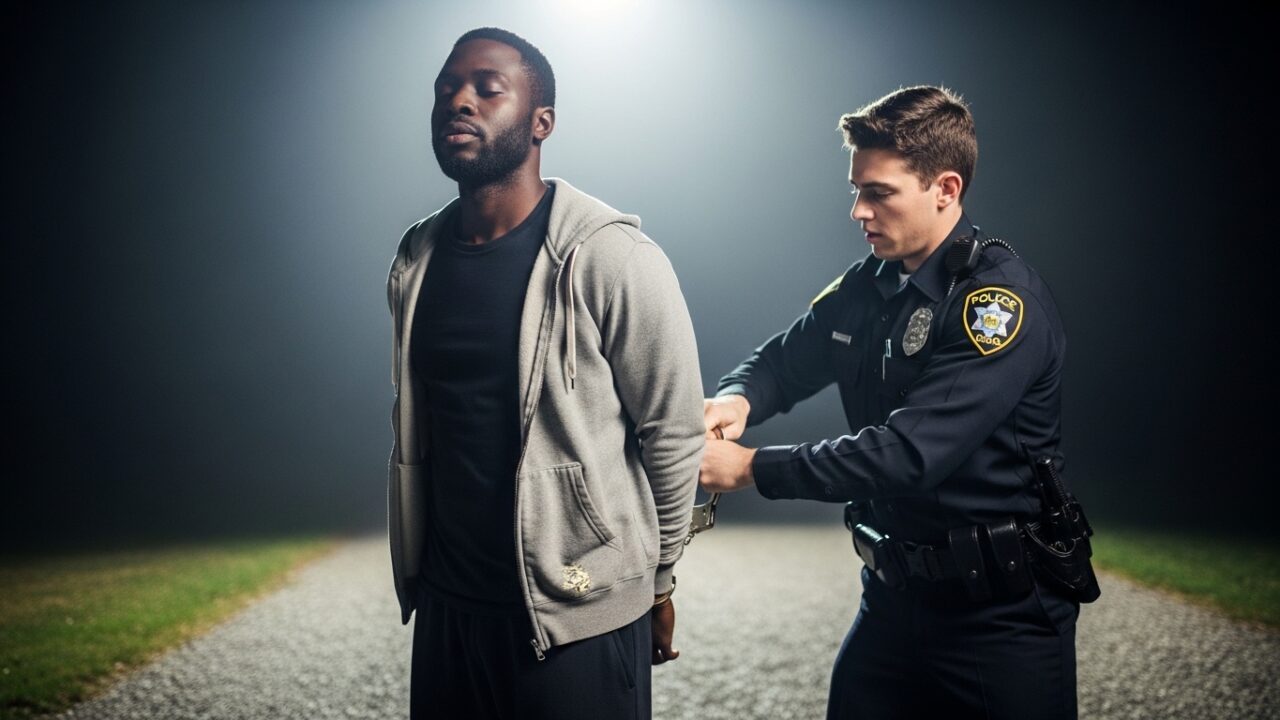
I Was Handcuffed In Front Of My Own House For “Looking Suspicious”—Then The Police Captain Walked In And Went Pale.

Chapter 1
The metal of the handcuffs was freezing.
That was the very first thing that registered in my mind as the steel teeth ratcheted tight around my wrists, biting into my skin. Not the humiliation. Not the burning anger in my chest. Just the biting, unforgiving cold of the metal.
I’ve lived in Oakridge Estates for exactly three weeks. It’s the kind of neighborhood where the lawns look like golf courses, the driveways are lined with imported cobblestone, and the price tags on the houses require a lot of zeroes. I earned my place here. I bought my five-bedroom, colonial-style home in cash. But on a brisk Tuesday night at 10:30 PM, none of that mattered.
Because I am a Black man. And I was wearing a hoodie.
I had just finished a five-mile run. My muscles were burning, my lungs were pumping the crisp autumn air, and I was covered in sweat. I was wearing an old, faded grey UCLA hoodie and dark running pants. As I cooled down, I walked up my own driveway, my sneakers crunching softly against the gravel, and stopped at my mailbox at the edge of the street to pull out a stack of envelopes.
That’s when the cruiser rolled up.
There was no siren. Just the sudden, blinding beam of a police spotlight cutting through the darkness, hitting me dead in the face.
I froze. I didn’t drop the mail. I didn’t reach for my pockets. I am forty-two years old, and I have lived in America my entire life. I know the rules. Keep your hands visible. Don’t make sudden movements. Breathe. Keep your voice steady.
The driver’s side door swung open, and the heavy thud of combat boots hit the asphalt.
“Step away from the mailbox and keep your hands where I can see them!” a sharp, aggressive voice barked.
I squinted through the glare. Officer Hayes. I could read the silver nameplate on his chest as he strutted into the halo of the light. He was young, maybe late twenties, with a tight buzz cut and a hand resting casually, yet purposefully, on the butt of his sidearm. His partner, an older, heavier guy named Officer Briggs, got out of the passenger side, hanging back but watching me with dead, cynical eyes.
“Evening, officers,” I said, my voice calm and even. I took exactly one step back from the mailbox. “Is there a problem?”
“I said hands where I can see them,” Hayes snapped, closing the distance between us. He didn’t see a homeowner. He didn’t see a resident. He saw a threat. He saw a stereotype. “What are you doing out here?”
“Getting my mail,” I replied, holding up the stack of white envelopes in my left hand.
Hayes let out a short, dismissive scoff. “Right. Getting the mail. At ten-thirty at night. You live here, buddy?”
The word buddy dripped with that specific kind of condescension I had known my whole life. The kind that tells you immediately that you are presumed guilty of just existing.
“I do,” I said. “I moved in three weeks ago. This is my house.” I nodded toward the large, warmly lit colonial behind me.
Briggs flashed his flashlight over the house, then back to me, his expression skeptical. “Got any ID on you?”
“Not on me, no. I was just on a run. My wallet is inside, on the kitchen counter. If you’ll allow me, I can go inside and get it.”
“Yeah, that’s not happening,” Hayes said quickly, stepping into my personal space. I could smell stale coffee and peppermint gum on his breath. “We got a call about a suspicious individual matching your description snooping around properties. Peeking into mailboxes.”
I let out a slow, controlled breath. Snooping. I glanced across the street. The curtains in the second-story window of the Gable residence twitched. Mrs. Gable. The neighborhood watch captain who had smiled tightly at me when I introduced myself last week.
“I am not snooping,” I said, locking eyes with Hayes. “I am standing at the end of my own driveway. I am holding my own mail.”
“Turn around,” Hayes commanded.
“Officer, this is entirely unneces—”
“I said turn around!” Hayes yelled, his voice echoing off the quiet, manicured lawns of Oakridge Estates. He unclipped his handcuffs. “Turn around and interlace your fingers behind your head. Now.”
For a split second, the anger flared so hot inside me I thought I might choke on it. The sheer disrespect. The absolute certainty in his eyes that I was a criminal. I wanted to scream. I wanted to ask him if he’d ever ask a white man in a polo shirt to turn around for checking his own mail.
But I didn’t. I clamped down on my ego. I looked at Hayes, really looked at him, and made a decision.
I wasn’t going to fight him here on the lawn. I was going to let him dig his own grave.
I turned around. I laced my fingers behind my head.
Hayes grabbed my wrists with unnecessary force, yanking them down to the small of my back. The cold steel snapped shut around my skin. Click, click, click.
“You’re making a massive mistake,” I said quietly, staring straight ahead at my own front door.
“Save it,” Hayes sneered, patting down my sweatpants. Finding nothing but a house key. “You’re coming down to the station until we figure out who you really are.”
“Okay,” I whispered. A cold, dark smile crept onto my face, hidden by the night shadows. “Let’s go to the station.”
He shoved me toward the back of the cruiser. I ducked my head and slid onto the hard plastic seat. As the doors slammed shut, locking me in the claustrophobic, cage-like back seat, Hayes turned to his partner and laughed.
“Thought he could lie his way out of it,” Hayes muttered from the front seat as he put the car in drive. “Classic.”
I leaned my head back against the glass and closed my eyes. I didn’t say a single word for the entire twenty-minute ride to the 12th Precinct.
I stayed dead silent.
Because Officer Hayes was right about one thing. They were about to find out exactly who I really was.
Chapter 2
The back of a police cruiser is designed to strip away your humanity.
I know this because I’ve spent the last fifteen years of my life working adjacent to law enforcement. I’ve read thousands of arrest reports. I’ve watched hundreds of hours of dashcam and bodycam footage. I know the exact dimensions of the molded plastic seats. I know they are intentionally angled to make you slide forward, so that your cuffed hands dig painfully into your spine.
I know the smell, too. It’s a distinct, nauseating cocktail of industrial bleach, stale sweat, dried vomit, and sheer, undeniable panic.
But knowing about it and sitting in it are two entirely different universes.
As Officer Hayes navigated the winding, tree-lined streets of Oakridge Estates, heading toward the main highway, I focused on my breathing. In through the nose. Out through the mouth. The cuffs were too tight. The metal was biting into my radial bone every time the cruiser hit a bump. My shoulders ached from the unnatural angle.
Up front, on the other side of the scratched plexiglass divider, Hayes and Briggs were having a casual conversation.
They weren’t talking about me. They weren’t talking about the fact that they had just kidnapped a man from his own front yard.
They were talking about baseball.
“I’m just saying, the bullpen is trash this year,” Hayes said, tapping his fingers against the steering wheel to the rhythm of some song only he could hear. “If they don’t trade for a closer before the deadline, we’re out in the first round. Guaranteed.”
“You worry too much, kid,” Briggs replied, his voice a low, gravelly rumble. He had an unlit cigar wedged between his teeth. He was staring out the passenger window, watching the multi-million dollar homes roll by. “It’s a long season. They’ll figure it out.”
I sat in the dark, caged like an animal, listening to two men debate sports while my fundamental civil rights were being trampled into the floorboards.
That was the part that burned the most. The absolute, terrifying banality of it all. To them, destroying a Black man’s dignity wasn’t a heart-pounding event. It wasn’t a high-stress situation. It was just Tuesday. It was a minor inconvenience between innings.
I looked out the window. We were passing the neighborhood clubhouse. The tennis courts were dark, but the streetlights illuminated the meticulously manicured hedges. I thought about the day I closed on my house. I thought about the pride I felt, handing over the cashier’s check.
I had grown up in a neighborhood where the sound of police sirens was a lullaby. My mother worked two jobs just to keep the lights on. I clawed my way out of that life. I got the scholarships. I pulled the all-nighters in the law library while my peers were out partying. I graduated top of my class at Georgetown. I became a federal prosecutor. I spent over a decade building a reputation as one of the most relentless, razor-sharp legal minds in the district.
I did everything “right.” I played by their rules. I bought the nice house in the nice neighborhood. I wore the right suits. I spoke with the right cadence.
But tonight, in my faded UCLA hoodie and sweatpants, none of those degrees mattered. The law degree hanging in my study didn’t act as a shield. The six-figure bank account didn’t make me bulletproof.
Tonight, Mrs. Gable looked out her window, saw a Black man in a hoodie standing near a mailbox, and her brain immediately screamed: Intruder. Threat. Criminal. And Hayes and Briggs had answered the call with eager, unquestioning obedience.
“Hey,” Hayes called out, suddenly glancing at me through the rearview mirror. His eyes met mine in the reflection. “You awfully quiet back there, buddy. Usually, you guys are screaming about your rights by now. Threatening to sue the department. Why so quiet?”
You guys. The microaggression hung in the air, heavy and toxic.
I held his gaze in the mirror. I didn’t blink. I didn’t raise my voice.
“I have nothing to say to you, Officer,” I replied, my tone flat, cold, and entirely devoid of fear. “I am waiting until we reach the station.”
Hayes chuckled, a dry, mocking sound. He shook his head. “Tough guy, huh? The silent treatment. I love the silent treatment. Makes the paperwork easier.”
“Leave him be, Hayes,” Briggs muttered, finally showing a tiny shred of common sense. “Just get us to the barn so I can grab a coffee.”
The rest of the ride passed in silence. The transition from the affluent suburbs to the gritty, concrete-heavy district where the 12th Precinct was located felt like crossing a border into another country. The streetlights flickered here. The storefronts had metal grates pulled down over the windows.
When we finally pulled into the secured lot behind the precinct, the heavy steel gate rolling shut behind us with a loud, definitive CLANG, my heart rate spiked for a fraction of a second.
This was the danger zone.
As a prosecutor, I knew the statistics. I knew what happened to Black men in police custody, away from the cameras, away from the public eye. The sally port—the enclosed garage where they transfer prisoners—is where the “accidents” happen. It’s where suspects “trip” and hit their heads on door frames.
The cruiser jerked to a halt. Hayes threw it into park and killed the engine.
He got out, walked around to my door, and yanked it open. The harsh, fluorescent lights of the garage flooded the backseat, blinding me temporarily.
“Out,” Hayes barked, grabbing my bicep and pulling me forward.
I didn’t resist, but I didn’t help him either. I stepped out, my legs stiff from the awkward seating position. My bare hands were freezing.
“Walk,” he commanded, shoving me slightly between my shoulder blades.
I walked. I kept my head high. I didn’t shuffle. I didn’t look down at the oil-stained concrete. I walked with the exact same posture I used when I paced in front of a jury box during a closing argument. Shoulders back. Spine straight.
We entered the back doors of the precinct. The smell hit me immediately—stale coffee, ozone from the copy machines, and unwashed bodies. The booking area was a chaotic hive of activity. Telephones were ringing off the hook. Two uniformed officers were wrestling a drunk man into a holding cell. A sex worker was arguing loudly with a desk clerk about her confiscated purse.
Nobody paid any attention to us. I was just another body entering the system. Another piece of inventory.
Hayes marched me up to the main booking desk. It was a high, wooden counter surrounded by bulletproof glass. Behind it sat a heavy-set sergeant with a receding hairline and dark bags under his eyes. His nameplate read: SGT. KOWALSKI.
Kowalski didn’t even look up from his computer monitor as we approached. He just sighed, a deep, world-weary sound.
“What do we got, Hayes?” Kowalski asked, his fingers clacking lazily on a greasy keyboard.
“Suspicious person. Prowling,” Hayes said, his chest puffing out slightly. “Caught him snooping around the mailboxes over in Oakridge. Refused to ID himself.”
That was a lie. I hadn’t refused to ID myself. I had told them my ID was in my house, twenty feet away, and they refused to let me get it. But I didn’t correct him. Not yet. Never interrupt your enemy when he is making a mistake.
Kowalski finally looked up. He looked at me, then at my bare wrists cuffed behind my back, my sweat-stained hoodie, my running shoes. He looked bored.
“Name?” Kowalski asked, staring directly at me.
“Marcus,” I said smoothly.
“Last name?”
“I am invoking my right to remain silent until I speak with a ranking officer,” I said. My voice carried across the noisy room, clear and authoritative. Several cops nearby paused their conversations and looked over.
Kowalski blinked. He stopped typing. He leaned forward, squinting through the smudged bulletproof glass.
“Excuse me?” Kowalski said, his tone shifting from bored to annoyed. “You’re invoking what?”
“You heard me, Sergeant,” I said. “I am not answering any booking questions. I am not providing my last name. I am not signing anything. I want to speak to the shift commander. Now.”
Hayes barked out a laugh and shoved my shoulder again. “Listen to this guy. Thinks he’s on Law & Order. You don’t get to make demands here, buddy. You give the Sergeant your name, or you go sit in the cage until you feel like remembering it.”
I turned my head slowly and looked at Hayes. The temperature in my eyes must have dropped to absolute zero, because his smug smile faltered for a microsecond.
“I am not your buddy,” I said softly, but the danger in my voice was unmistakable. “And I strongly suggest you take these cuffs off me before your Captain walks through those doors.”
“Oh, we got a tough guy,” Hayes sneered, recovering his bravado. “He knows the Captain. Probably washed his car once.”
Kowalski sighed and rubbed his temples. “Look, John Doe. I don’t have time for this game. It’s late. We’re understaffed. Just give me your name so I can process you for the misdemeanor prowling, and maybe you get a desk appearance ticket and walk out of here in two hours. You keep playing games, you’re sleeping on concrete.”
“I prefer the concrete,” I replied without missing a beat.
Kowalski stared at me for a long, hard moment. He was older. He had been on the job a long time. He was trying to read me. I could see the gears turning in his head. He was looking at my posture. He was listening to my vocabulary. I wasn’t acting like a panicked prowler. I wasn’t acting like a career criminal who knew the ropes either. I was acting like a man who owned the room.
And that made Kowalski uncomfortable.
But not uncomfortable enough to stop the train.
“Fine,” Kowalski snapped. “Put him in Holding Cell 3. Let him cool off. We’ll run his prints through AFIS when he decides to cooperate.”
Hayes grabbed my arm roughly. “Let’s go, counselor.”
He marched me away from the desk, down a narrow, brightly lit hallway lined with heavy steel doors. We stopped in front of Cell 3. It was a ten-by-ten concrete box with a stainless steel toilet in the corner and a wooden bench bolted to the wall. The air inside was freezing.
Hayes unlocked the cuffs, but only so he could force me to take off my shoelaces and the drawstring from my hoodie. Standard suicide prevention protocol. He made me empty my pockets—which only contained my single house key. He tossed the key into a plastic bin.
“Turn around,” he ordered.
I complied. He took the cuffs off my wrists entirely. The rush of blood back into my hands felt like pins and needles. I rubbed my wrists, feeling the deep, red indentations in my skin.
“Enjoy the suite,” Hayes mocked. He stepped out and slammed the heavy steel door shut. The deadbolt slid into place with a sickening, final THUD.
I was alone.
I walked over to the wooden bench and sat down. The concrete walls seemed to close in on me. For the first time since the lights hit me in my driveway, the adrenaline began to fade, leaving behind a cold, hollow knot in my stomach.
I looked at my hands. They were trembling slightly. Not from fear. From absolute, unadulterated rage.
I was a Senior Assistant United States Attorney. My office was in the federal building downtown. I led the Organized Crime and Gang Task Force. I had put cartel bosses and corrupt politicians behind bars. The Mayor knew my first name. The Chief of Police had shaken my hand at a charity gala three months ago.
And right now, I was sitting in a piss-stained holding cell because a white woman got scared of a shadow, and two rookie cops decided my skin color was probable cause.
I leaned my head back against the cold concrete block wall and closed my eyes.
I didn’t panic. I didn’t yell for a lawyer.
Because I didn’t need a lawyer. I needed to look at the clock.
I opened my eyes and looked through the small, reinforced glass window of the cell door. I could just barely see the digital clock on the wall at the far end of the hallway.
It read 11:42 PM.
I smiled. A real, genuine smile.
The 12th Precinct was commanded by Captain David Vance. Vance was a hard-nosed, old-school cop. But more importantly, Vance was the primary police liaison for my federal task force. We had spent the last six months working a massive, multi-agency wiretap operation targeting a fentanyl ring.
Captain Vance and I spoke on the phone almost every single day. We had coffee every Thursday morning to discuss warrants.
And I knew, for a fact, that Captain Vance was a workaholic who always, always came down to the precinct at midnight to personally review the night shift’s arrest reports before heading home.
It was 11:42 PM.
Officer Hayes thought he had caught a common thief. Officer Hayes thought he had all the power.
He had exactly eighteen minutes left of his career.
I stretched my legs out, crossed my ankles, and got comfortable on the hard wooden bench.
I could wait.
Chapter 3
The clock on the far wall of the corridor was a cheap, digital model with glowing red numbers. It was the only thing I had to focus on.
11:45 PM.
Fifteen minutes. That was all that separated the reality Officer Hayes thought he lived in from the devastating truth that was about to crush him.
The holding cell was a sensory deprivation chamber designed to break your spirit before you ever saw a judge. The temperature was purposely kept hovering around sixty degrees—cold enough to make your muscles cramp and your teeth chatter, especially when you were wearing nothing but thin, sweat-soaked running clothes. The walls were painted a dull, institutional cinderblock grey, peeling in the corners and scratched with the desperate, jagged fingernail carvings of a thousand men who had sat on this exact wooden bench before me. Initials. Dates. Gang signs. Prayers.
I traced one of the carvings with my numb fingertip. Lord help me. I leaned my head back against the freezing concrete and let the silence of the cell wash over me. The adrenaline that had spiked in my driveway was entirely gone now, replaced by a cold, calculating clarity. This was the state of mind I lived in when I was in the middle of a high-stakes cross-examination. It was a terrifyingly calm place where emotions were shut off, and only logic, facts, and strategy remained.
In my fifteen years as a federal prosecutor, I had built my entire existence around one foundational concept: the armor of respectability.
When I was sixteen, my mother sat me down at our scratched formica kitchen table. She was exhausted from a double shift at the hospital, still wearing her light blue scrubs. She looked me dead in the eyes and gave me “The Talk.” Not the talk about the birds and the bees. The talk that every Black parent in America eventually has to give their son.
“Marcus,” she had said, her voice heavy with a fear I didn’t fully understand yet. “You do not have the luxury of being average. You do not have the luxury of making a mistake. When you walk out of this house, the world is going to look at your skin and make a decision about you before you even open your mouth. You have to speak better, dress sharper, and work twice as hard just to get half the respect. And if the police ever stop you… you swallow your pride. You say ‘Yes, sir’ and ‘No, sir.’ You survive. Do you hear me? You survive.”
I took her words to heart. I built an impenetrable fortress around myself. I went to Georgetown Law. I learned to speak with the crisp, measured cadence of the Ivy League. I bought three-piece Tom Ford suits that cost more than my mother’s first car. I drove a German sedan. I moved into Oakridge Estates, a neighborhood where the median income was in the top one percent of the state.
I thought I had bought my way out of the danger zone. I thought I had achieved a level of status that made me immune to the indignities suffered by the men I grew up with.
But sitting here, shivering on a wooden slab, staring at my laceless running shoes, the brutal reality hit me like a physical blow.
The suit was just a costume. The house was just a zip code. The law degree was just a piece of paper.
Take away the Tom Ford suit and replace it with a faded UCLA hoodie. Take away the leather briefcase and replace it with a handful of mail. Suddenly, I wasn’t Marcus Thorne, Senior Assistant United States Attorney. I was just a “suspicious individual.” I was a threat. I was an animal to be caged.
It took exactly three minutes for Officer Hayes to strip away forty-two years of my hard work and reduce me to a stereotype.
11:48 PM.
Footsteps echoed down the hallway. Heavy, arrogant, and unhurried.
I didn’t move. I kept my eyes fixed on the blank wall opposite my bench. A moment later, Officer Hayes’s face appeared in the small, wire-reinforced glass window of my cell door. He was holding a styrofoam cup of coffee, the steam fogging up the glass.
“How we doing in there, buddy?” Hayes asked, his voice muffled by the thick steel door. “Starting to remember your name yet? Getting a little chilly?”
I slowly turned my head and looked at him. I didn’t say a word. I didn’t glare. I just looked at him with the empty, detached gaze of a man studying a bug under a microscope.
Hayes took a sip of his coffee, a smug grin plastered across his face. “You know, we checked the perimeter of the house you were loitering at. Beautiful place. Real expensive. The homeowner wasn’t answering the bell. Probably asleep. Good thing Mrs. Gable called us when she did, huh? Who knows what you would’ve walked away with. Packages? Amazon deliveries? You guys always go for the easy grab.”
You guys. There it was again.
“You’re a rookie, aren’t you, Hayes?” I finally spoke, my voice low and smooth, carrying effortlessly through the gaps in the door seal.
Hayes frowned, lowering his coffee cup. “What did you say to me?”
“I asked if you’re a rookie,” I repeated, shifting my weight on the hard bench, crossing my legs with casual authority. “Actually, no, you’re not a rookie. You’ve been on the force for what… three years? Four? You still have the aggressive swagger of a guy who thinks the badge makes him a god, but you’re old enough to know better. You’re trying too hard. You’re overcompensating. Briggs, your partner, he knows the score. He’s tired. But you? You’re hungry to prove you’re an alpha.”
Hayes’s jaw tightened. He stepped closer to the glass, his face turning red. “Listen to me, you piece of garbage—”
“No, you listen to me, Officer Hayes,” I interrupted, my tone slicing through his bravado like a scalpel. I didn’t raise my voice. I didn’t need to. “In my experience, guys like you skip the details. You’re so eager to put hands on someone, so eager to feel powerful, that you don’t follow procedure. Tell me, Hayes… did you run the plates on the Mercedes parked in the driveway of the house?”
Hayes blinked. The question caught him off guard. “What does that have to do with anything? It’s not your car.”
“Did you run the plates?” I asked again, tilting my head slightly.
“I don’t need to run the plates to know a prowler when I see one,” Hayes scoffed, though his voice lacked the absolute certainty it had five minutes ago.
“If you had run the plates,” I continued softly, “you would have seen they are registered to the homeowner. And if you had checked the property tax registry—which any competent officer would do before arresting a man standing on his own property—you would have the homeowner’s name. You see, Hayes, your arrogance is your Achilles’ heel. You didn’t investigate. You reacted. And that reaction is going to cost you everything.”
Hayes stared at me through the glass. For a fleeting, glorious second, I saw it. The tiny, microscopic seed of doubt taking root in his eyes. He swallowed hard.
“You’re full of crap,” Hayes muttered. He backed away from the door, pointing a finger at the glass. “You sit there and freeze. I’m going to go process your John Doe paperwork. We’ll see how smart you sound in front of the magistrate tomorrow.”
He turned and walked away, his footsteps noticeably faster, slightly more frantic than before.
I smiled, letting my head rest back against the wall.
11:53 PM.
Seven minutes.
Meanwhile, out at the main booking desk, the seeds I had planted were beginning to sprout.
Sergeant Kowalski was a twenty-year veteran of the department. He had survived two heart attacks, three police chiefs, and a divorce. He didn’t care about being a hero; he cared about his pension, his blood pressure, and getting through his shift without a lawsuit.
As the chaotic noise of the precinct buzzed around him, Kowalski sat at his computer, chewing on the end of a cheap plastic pen. He was staring at the blank incident report Hayes had just initiated.
Suspect: John Doe. Charge: Prowling / Loitering. Location: 4420 Willow Creek Lane, Oakridge Estates.
Kowalski paused. He rubbed his tired eyes. Something was itching at the back of his brain. The guy in Cell 3… he wasn’t acting right.
Usually, when Hayes dragged in some poor guy off the street for a nuisance charge, the suspect was either screaming, crying, drunk, or high. They begged for a phone call. They threatened to sue. They cursed.
But the Black guy in the grey hoodie? He hadn’t done any of that. He had spoken to Kowalski with the crisp, commanding articulation of a college professor. He had demanded the shift commander, not as a desperate plea, but as a rigid procedural right. And he had looked Kowalski dead in the eye without a single ounce of fear.
Kowalski had seen thousands of criminals. This guy didn’t fit the profile.
“Hey, Hayes,” Kowalski called out as the younger officer emerged from the holding hallway, looking a little flush. “Come here.”
Hayes jogged over, leaning on the high wooden counter. “Yeah, Sarge?”
“This John Doe you brought in,” Kowalski grunted, tapping his thick finger against the monitor. “You said you found him snooping around mailboxes in Oakridge?”
“Yeah. Mrs. Gable called it in. We rolled up, he was standing at the end of the driveway at 4420 Willow Creek. Had a handful of mail. Claimed he lived there, but refused to show ID.”
Kowalski frowned. “He refused, or he didn’t have it on him?”
“He didn’t have it,” Hayes admitted, shifting his weight uncomfortably. “Said it was inside the house. I wasn’t about to let a suspect go inside a house he was probably trying to burgle to get a fake ID.”
Kowalski stopped chewing his pen. He looked at Hayes, a deep, sinking feeling settling into his gut. “You grabbed a guy off a driveway, holding mail for that specific address, and you didn’t let him prove he lived there?”
“Sarge, come on,” Hayes scoffed, rolling his eyes. “Look at the guy. He was wearing an old sweat-suit. Nobody who looks like that lives in Oakridge Estates. Those houses go for two mil, minimum. He was a porch pirate. I made a solid collar.”
Kowalski didn’t say anything. He turned back to his computer. His fingers, thick and calloused, flew across the keyboard. He minimized the police reporting software and opened the county tax assessor’s public database.
“What are you doing?” Hayes asked, leaning over the glass.
“I’m doing the job you should’ve done before you slapped cuffs on a stranger,” Kowalski muttered. He typed in the address. 4420 Willow Creek Lane. He hit Enter.
The screen loaded for a agonizing three seconds. Then, the property record appeared.
Property Address: 4420 Willow Creek Lane, Oakridge Estates. Owner of Record: Marcus Thorne. Sale Date: October 12th.
Kowalski stared at the name. Marcus Thorne. The suspect in the cell had given his first name as Marcus.
“Okay, so the homeowner’s name is Marcus,” Hayes said, reading over Kowalski’s shoulder. He forced a laugh, though it sounded incredibly brittle. “So what? The prowler probably read the name off a piece of mail and used it. Guy’s a liar.”
“Maybe,” Kowalski whispered. His mouth was suddenly very dry.
He highlighted the name “Marcus Thorne” and pasted it into the state DMV database. If the homeowner had recently updated his address, his driver’s license photo would be in the system.
He hit Search.
A profile popped up. Kowalski clicked on the photo attachment.
A high-resolution, full-color driver’s license photo filled the center of the screen. It showed a Black man in his early forties. Clean-shaven, sharp jawline, wearing a tailored navy blue suit and a conservative silk tie. He was looking at the camera with an expression of absolute, terrifying confidence.
It was the man in Holding Cell 3.
The exact same man. Without the hoodie.
Kowalski felt the blood drain from his face. The air in his lungs vanished. He felt like he had just swallowed a handful of crushed glass.
“Oh, sweet mother of God,” Kowalski breathed, his voice barely a whisper.
“What?” Hayes asked, squinting at the screen. “Is that him? Okay, so he owns the house. Big deal. He was acting suspicious. He didn’t have ID on him. It’s a misunderstanding. We let him out, apologize, no harm done.”
Kowalski wasn’t listening to Hayes. His eyes were locked on the employer information listed at the bottom of the DMV profile. Because when you work for the federal government in a high-security capacity, your DMV records are flagged with your agency.
Right below Marcus Thorne’s address, in bold red letters, was the flag: U.S. DEPARTMENT OF JUSTICE. SENIOR ASST. U.S. ATTORNEY.
Kowalski’s hands started to shake. He slowly turned his head to look at Hayes. The veteran sergeant looked like he was about to vomit.
“Hayes,” Kowalski croaked. “Do you know who that is in there?”
“Yeah, Marcus Thorne. The homeowner. I get it, Sarge, I made a mistake—”
“Shut up!” Kowalski hissed, slamming his hand down on the desk so hard the coffee cups rattled. Several nearby officers jumped and looked over. Kowalski leaned in close to the glass, his eyes wide with sheer, unadulterated panic. “That man in Cell 3 is Marcus Thorne. He is the Senior Federal Prosecutor for this district. He runs the Organized Crime Task Force. He’s the guy who put the Romanelli crime family in federal prison last year.”
Hayes froze. The color instantly vanished from his cheeks. His mouth opened, but no sound came out.
“You didn’t arrest a porch pirate, Hayes,” Kowalski whispered, his voice trembling with terror. “You abducted a federal prosecutor from his own front lawn. You cuffed him. You threw him in a cage. And you refused to let him get his ID.”
Hayes took a step back, his hands hovering over his duty belt like he didn’t know what to do with them. “No… no, that can’t be right. He was wearing sweatpants… he was just standing there…”
“He was getting his mail, you stupid son of a bitch!” Kowalski grabbed his own hair, pulling it in frustration. “He’s a lawyer! He’s the lawyer that our Captain reports to every single day for the federal wiretap cases! He has the power to subpoena this entire department. He can drag us in front of a grand jury. He can destroy my pension. He can put you in federal prison for civil rights violations!”
“I… I didn’t know,” Hayes stammered, the arrogant swagger completely shattered, replaced by the pathetic whimpering of a boy who realized he had just stepped on a landmine. “We have to let him out. Right now. I’ll go unlock the door. I’ll apologize.”
“You don’t go near that door!” Kowalski snapped. “If you go near him, he’s going to memorize your badge number and make it his life’s mission to ruin you. We need the Captain. We need to wake up the Captain right now—”
Kowalski reached for the heavy black landline phone on the desk.
But before his hand could touch the receiver, the heavy, reinforced glass doors at the front of the precinct violently swung open.
A gust of cold autumn air swept through the lobby. The chaotic noise of the booking area instantly died down. The officers wrestling the drunk man stopped. The desk clerks sat up straight.
A man walked in.
He was in his late fifties, wearing a sharp charcoal trench coat over a tailored suit. He had silver hair cut with military precision, and a face that looked like it had been carved out of granite. His eyes were cold, sweeping the room with an authority that commanded absolute, unquestioning silence.
It was Captain David Vance.
11:58 PM.
He was early.
Vance walked across the linoleum floor, his hard-soled dress shoes clicking loudly in the sudden quiet of the room. He didn’t look at the junior officers. He walked straight toward the booking desk, peeling off his leather gloves.
“Evening, Kowalski,” Vance said, his voice a deep, gravelly baritone that demanded respect.
“C-Captain,” Kowalski stuttered, springing up from his chair so fast he knocked his pen onto the floor. “You’re… you’re here.”
“I am,” Vance said, stopping at the desk. He looked at Kowalski, then glanced at Hayes, who was standing frozen like a statue, sweating profusely despite the cool air in the room. Vance’s eyes narrowed slightly. He possessed the instinct of a bloodhound; he could smell fear in a room. And right now, the booking desk reeked of it.
“Is there a problem here, Sergeant?” Vance asked slowly, leaning against the counter.
“No, sir. Well. Yes, sir,” Kowalski stammered, frantically trying to minimize the window on his computer screen, but his hand was shaking too much to control the mouse. “Just… a complicated intake, Captain.”
Vance didn’t like stuttering. He reached over the counter, grabbed the computer monitor, and physically turned it toward himself.
He looked at the screen. He saw the DMV photo.
For three agonising seconds, there was absolute silence. The only sound in the entire precinct was the hum of the fluorescent lights.
Vance stared at the high-definition photo of Marcus Thorne. Then, he looked at the flag at the bottom of the screen. U.S. DEPARTMENT OF JUSTICE. Slowly, deliberately, Captain Vance let go of the monitor. He turned his head and looked at Sergeant Kowalski. The expression on the Captain’s face wasn’t anger. It wasn’t rage.
It was pure, unadulterated horror.
“Kowalski,” Vance said, his voice dropping an octave, sounding like rocks grinding together. “Why is Marcus Thorne’s profile open on your booking terminal?”
Kowalski swallowed a lump the size of a golf ball. He pointed a trembling finger down the hallway toward the holding cells.
“Because… because Officer Hayes brought him in, sir. About twenty minutes ago.”
Vance stopped breathing. He physically stopped moving. He turned his gaze toward Hayes.
Hayes looked like he was going to pass out. “Captain, I swear to God, I didn’t know who he was. We got a call about a prowler. He was wearing a hoodie. He was acting suspicious—”
“A hoodie,” Vance whispered. The words tasted like ash in his mouth. “You arrested the lead federal prosecutor for the United States government… because he was wearing a hoodie.”
“He wouldn’t show ID!” Hayes pleaded, his voice cracking. “He was belligerent!”
“Where is he?” Vance demanded, his voice suddenly exploding into a terrifying roar that shook the glass windows.
“Cell 3, sir,” Kowalski squeaked.
Vance didn’t say another word. He didn’t take off his coat. He didn’t grab his coffee.
He turned on his heel and began marching down the hallway toward the holding cells. His footsteps were no longer measured; they were hurried, frantic.
Inside Cell 3, I heard the commotion. I heard the roar of the Captain’s voice echoing down the concrete corridor.
I looked at the digital clock on the wall.
12:00 AM.
Midnight.
I took a deep breath, adjusted my posture on the wooden bench, and waited for the door to open.
The reckoning had arrived.
Chapter 4
The heavy, rhythmic thud of Captain David Vance’s dress shoes echoing down the concrete corridor sounded like a countdown.
Thud. Thud. Thud. With every step he took toward Holding Cell 3, the chaotic ambient noise of the 12th Precinct seemed to evaporate, sucked into a vacuum of impending doom. I didn’t move from my position on the wooden bench. I kept my legs crossed, my spine perfectly straight, and my breathing slow and measured. The biting cold of the cell had seeped into my bones over the last half hour, but I didn’t let a single shiver break my composure. I was the master of this room now. The power dynamic had shifted the exact moment Vance saw my photograph on that monitor.
The footsteps stopped abruptly outside my door.
Through the wire-reinforced glass, I saw Captain Vance’s face. He looked ten years older than he had at our morning coffee meeting two days ago. The color had completely drained from his cheeks, leaving his skin a sickly, ashen grey. His jaw was clenched so tight I could see the muscles twitching beneath his ears. He didn’t look like a commanding officer in that microsecond; he looked like a man staring down the barrel of a loaded shotgun.
Behind him, hovering like a terrified ghost, was Officer Hayes. The arrogant swagger was gone. The smug, frat-boy smirk that had been plastered on his face while he threw me into the back of his cruiser had been entirely erased. He looked small. He looked like a child who had just realized he had broken something irreplaceable and expensive.
A heavy ring of keys jangled. The deadbolt engaged with a loud, metallic CLACK.
The heavy steel door swung open, screeching slightly on its hinges.
Vance stepped into the cell. He didn’t say a word at first. He just looked at me. He looked at my bare wrists, still bearing the deep, red, angry indentations of the handcuffs. He looked at my shoeless feet. He looked at the thin, sweat-soaked UCLA hoodie that his men had deemed sufficient probable cause to strip me of my constitutional rights.
“Marcus,” Vance breathed, his voice barely a whisper. It was a sound stripped of all its usual gravelly authority, hollowed out by pure, unadulterated shame. “My God. Marcus, I… I don’t even have the words.”
I didn’t stand up. I didn’t smile. I let the silence stretch, letting the gravity of the situation crush the oxygen out of the tiny room. I looked at Vance, then slowly shifted my gaze to Hayes, who was standing in the doorway, physically trembling.
“You don’t need words, David,” I said, my voice smooth, cold, and echoing with the precise, clipped diction of a federal prosecutor addressing a hostile witness. “Your officers have already done plenty of talking for you tonight.”
Vance swallowed hard. He turned to Hayes, his eyes blazing with a sudden, violent fury that made the younger officer flinch backward.
“Get the keys,” Vance barked, his voice suddenly roaring back to life, echoing off the cinderblock walls. “Get his shoelaces. Get his property. Now! Move, goddammit!”
Hayes practically tripped over his own boots as he scrambled back down the hallway toward the booking desk.
Vance turned back to me, taking a step closer, holding his hands out in a placating gesture. “Marcus, I am so deeply, profoundly sorry. This is a catastrophic failure of procedure. A massive misunderstanding. I will personally see to it that the officers involved are disciplined. We are going to wipe this off the books. No record. No nothing. You can walk out of here right now, and I will personally drive you home.”
I looked at him. I looked at a man I considered a colleague, a man who thought he could sweep fifteen years of my hard-fought dignity under the rug with a quick apology and a ride home.
“A misunderstanding,” I repeated softly, letting the word roll around on my tongue like poison. I slowly uncrossed my legs and stood up. Even without my shoes, I was an inch taller than Vance, and I used every fraction of that height to loom over him. “David, a misunderstanding is when you accidentally take someone else’s umbrella at a restaurant. A misunderstanding is writing down the wrong date for a meeting.”
I took a step forward, forcing Vance to hold his ground or step back. He held his ground, but I could see the sweat forming on his brow.
“What happened tonight,” I continued, my voice dropping an octave, becoming a lethal, quiet weapon, “was an armed kidnapping under the color of law. Your men approached me on my own property. They detained me without reasonable articulable suspicion. They arrested me without probable cause. They ignored my repeated statements regarding my identity and residence. They subjected me to unlawful search and seizure, violating my Fourth Amendment rights. And they did it all simply because a Black man in a hoodie didn’t fit their narrow, prejudiced view of what an Oakridge Estates homeowner looks like.”
Vance closed his eyes for a second, rubbing his temples. “Marcus, please. You know me. You know this department. We do good work together. Don’t do this. Don’t nuke the bridge over one idiot rookie making a bad call.”
“One idiot rookie?” I asked, raising an eyebrow. I let out a sharp, humorless laugh. “Do not insult my intelligence, David. Officer Hayes didn’t invent this behavior in a vacuum. He learned it. He was emboldened by a culture that permits it. He looked at me and saw prey, because your system taught him that men who look like me are always prey.”
Hayes came sprinting back down the hallway, clutching my house key and the laces from my running shoes in his shaking hands. He stopped in the doorway, breathing heavily, holding the items out like a pathetic offering to a furious god.
“Mr. Thorne,” Hayes stammered, his voice cracking violently. “I… I am so sorry, sir. I didn’t know who you were. If I had known you were a federal prosecutor, I swear to God I never would have—”
“Stop,” I commanded.
The word sliced through the air like a guillotine blade. Hayes’s mouth snapped shut.
I walked slowly toward the door. I didn’t reach for my property. I stopped six inches from Hayes’s face. I could smell the stale coffee on his breath, mixed with the sour, acrid scent of his own terror. He was looking up at me, his eyes wide, silently begging for mercy.
Mercy was not on the menu tonight.
“That is exactly the problem, Officer Hayes,” I said, my voice so quiet he had to strain to hear it over the pounding of his own heart. “You shouldn’t have to know I’m a federal prosecutor to treat me like a human being.”
Hayes swallowed, a tear of absolute panic forming in the corner of his eye.
“If I were a janitor,” I whispered, leaning in closer, “if I were a high school teacher, or a mechanic, or an unemployed man just trying to get his mail… my constitutional rights would be exactly the same. You didn’t apologize because you realized you violated the law. You apologized because you realized you violated me, and you know I have the power to destroy you.”
I reached out and slowly, deliberately, plucked my shoelaces and my house key from his trembling hands.
“And I will,” I added softly.
Vance stepped forward, inserting himself between me and his officer. “Marcus, listen to me. I will suspend him. Pending a full internal affairs investigation. I will strip his badge tonight. Just… let’s take a breath. Let’s step into my office.”
I knelt down on the cold concrete floor and methodically threaded the laces back into my running shoes. I took my time. I tied double knots. I stood back up and adjusted my hoodie. The physical transformation from ‘prisoner’ back to ‘prosecutor’ was complete.
“There will be no internal affairs investigation, Captain,” I said, walking past him out of the cell. “Because Internal Affairs investigates policy violations. What happened tonight was a federal crime.”
Vance hurried after me as I walked down the long, bright hallway back toward the booking area. The entire precinct had ground to a halt. Every single police officer, desk clerk, and civilian in the room was staring at us in stunned, breathless silence. They had seen the Captain running. They knew something catastrophic had happened.
“Marcus, what are you talking about?” Vance pleaded, his heavy footsteps echoing behind me.
I stopped in the middle of the bullpen. I turned around to face him, making sure my voice carried to every corner of the room. I wanted every cop in the building to hear this.
“Title 18, United States Code, Section 242,” I announced clearly, my voice ringing out like a judge delivering a sentence. “Deprivation of Rights Under Color of Law. It is a federal felony for any person acting under color of law to willfully deprive a person of a right or privilege protected by the Constitution or laws of the United States.”
Kowalski, sitting at the booking desk, audibly gasped.
“Tomorrow morning, at 8:00 AM,” I continued, locking eyes with Vance, “I am opening a formal Department of Justice civil rights investigation into the 12th Precinct. I will be issuing subpoenas for all dispatch audio, body camera footage, dash camera footage, and arrest records for the past five years. I will be seeking a federal consent decree to oversee your department’s training and patrol practices.”
“Marcus, you can’t do that,” Vance said, his voice trembling with genuine despair. “It’ll bankrupt the city. It’ll tear the department apart. Over one arrest?”
“It’s never just one arrest, David,” I said coldly. “Tonight, it was me. Tomorrow, it’s a kid who doesn’t know how to articulate his rights, who gets panicked, who makes a sudden movement, and ends up with a bullet in his chest on his own driveway. I am not doing this to punish you. I am doing this to pull this rot out by the roots before it kills someone.”
I turned and looked at Hayes, who was leaning against the wall near the hallway, looking like he was about to physically collapse.
“As for you, Officer Hayes,” I said. “You have two choices. You can resign your commission by sunrise, surrender your peace officer certification permanently, and find a new career. Or, my office will indict you by Friday, and I will personally see to it that you spend the next five years in a federal penitentiary.”
I didn’t wait for his answer. I didn’t need to. The broken, empty look in his eyes told me everything I needed to know. He was done. His career was over.
I turned back to the glass doors of the lobby.
“Keep your ride, Captain,” I threw over my shoulder without looking back. “I’ll take an Uber.”
I pushed through the heavy doors and stepped out into the freezing midnight air.
The Uber ride back to Oakridge Estates took exactly twenty-two minutes. I sat in the back of the silent Honda Civic, watching the city lights blur past the window. My phone, which had been returned to me from the precinct’s property lockup, was buzzing non-stop in my pocket. Emails from Vance. Missed calls from the precinct desk. I ignored all of them.
When the car pulled up to the entrance of my neighborhood, the driver glanced at me in the rearview mirror.
“Which house, sir?” he asked politely.
“Just drop me here at the front gates, please,” I replied. “I need the walk.”
I paid him, tipped him heavily, and stepped out onto the pristine, imported cobblestone of Oakridge Estates. The air was crisp and clean here. The streetlights cast warm, welcoming glows over the massive, silent houses.
I walked the half-mile to my house slowly, letting the events of the night finally settle into my bones. The anger was still there, burning like a low, steady coal in my chest, but it was no longer consuming me. It had been forged into a weapon.
As I turned onto Willow Creek Lane, I saw my house in the distance. The porch light was still on, just as I had left it.
But as I got closer, I noticed something else.
Across the street, at the Gable residence, the second-story window was dark. But the faint, flickering blue light of a television screen illuminated the silhouette of a person standing behind the sheer curtains, watching the street.
Mrs. Gable.
The woman who had picked up the phone. The woman who had seen a Black man in a hoodie and decided, without a shred of evidence, that her life, her property, her pristine little world was under attack.
I stopped at the end of my driveway. The exact spot where I had been handcuffed two hours ago.
I looked up at her window.
I knew she could see me. I knew she had probably been watching the street ever since the police cruiser drove away with me in the back seat, feeling smug, feeling vindicated, feeling safe.
But then, the twist of the knife.
Three days ago, sitting in my office at the federal building, I had signed off on a massive subpoena dump for a white-collar embezzlement case. The target was a prominent local real estate developer who had been defrauding investors out of millions, funneling the money through offshore accounts to maintain a lavish lifestyle he couldn’t actually afford.
The developer’s name was Richard Gable.
Mrs. Gable’s husband.
When she looked out her window tonight and called the police on the “suspicious Black man,” she thought she was cleaning up her neighborhood. She had absolutely no idea that the man she had just tried to terrorize was the lead federal prosecutor actively dismantling her husband’s life. She didn’t know that by Friday morning, FBI agents wearing dark windbreakers would be kicking in her beautiful mahogany front door, seizing her assets, freezing her bank accounts, and dragging her husband out in handcuffs for a crime that actually carried a twenty-year mandatory minimum.
She had tried to use the police as a weapon against my skin color.
I was going to use the full, crushing weight of the United States federal government against her reality.
I stood at the end of my driveway in the freezing autumn air, wearing my faded UCLA hoodie, the red marks still fresh on my wrists.
I didn’t yell. I didn’t make a scene.
I just looked up at her window, right through the sheer curtains, right into the flickering blue light. I raised my hand, gave her a slow, deliberate wave, and walked up my driveway to my front door.
I unlocked it, stepped inside my beautiful, quiet home, and closed the door behind me.
I had a lot of paperwork to draft in the morning.
[END OF FULL STORY]

About the Author
dream01
A writer passionate about human stories and real-life experiences that inspire and move readers.
 Dog Story
38 min read
Dog Story
38 min read
I Walked Onto The Biggest Stage In America At 8 Years Old. The Hostile Crowd Threw Trash And Screamed At Me To Leave… What Happened When I Finally Opened My Mouth Broke Every Adult In The Room.
Chapter 1 I’ve been on this earth for exactly eight years, but absolutely nothing prepared me for the terrifying roar…
 Dog Story
43 min read
Dog Story
43 min read
I Pulled His Daughter From The Burning Wreckage At 3 AM… Then He Looked The Police In The Eye And Said I Was The One Who Kidnapped Her. They Didn’t See My Uniform. They Didn’t See My Medkit. They Only Saw My Skin And A Story They Already Wanted To Believe. But That Night, I Left My Body-Cam Running.
Chapter 1 The rain in Clear Creek doesn’t just fall; it punishes. It’s that cold, mid-October Appalachian rain that turns…
 Dog Story
43 min read
Dog Story
43 min read
They Tried To Frame A Quiet Man With 2 Ounces Of Powder—They Never Guessed Who He Dialed 15 Minutes Later
Chapter 1 The red and blue lights flashing in my rearview mirror shouldn’t have made my chest tight. I was…
Leave a Reply