
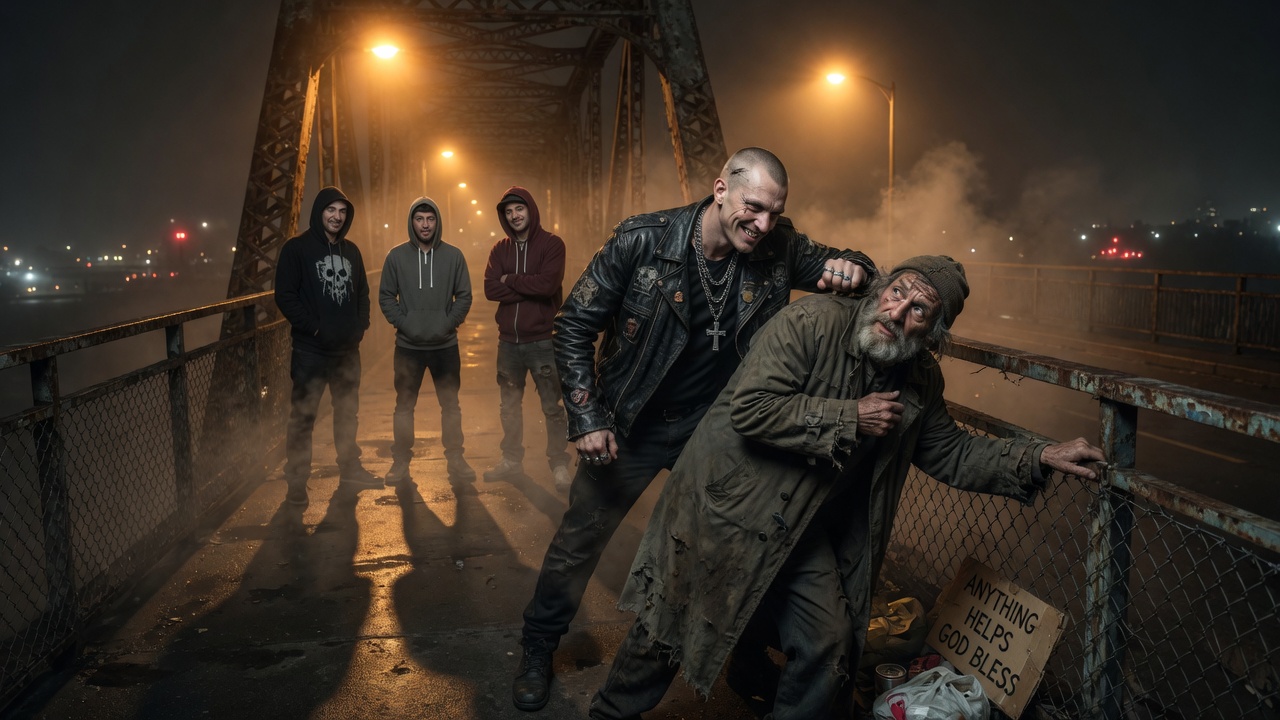
Shadows of the Asphalt: They Thought They Had Cornered a Helpless Beggar on an Empty Bridge—But by the Time the Leader Realized He’d Been Played, There Was No Way Back / Bóng Tối Trên Mặt Đường: Chúng Tưởng Đã Dồn Một Gã Ăn Xin Vào Đường Cùng Trên Cây Cầu Hoang—Nhưng Khi Tên Cầm Đầu Nhận Ra Mình Bị Dắt Mũi, Mọi Lối Thoát Đều Đã Biến Mất

I knew they were following me before I heard the first laugh.
That’s the thing about being invisible for so long. People stop hiding what they are around you. They think because your coat is torn and your beard is wild and your hands shake from cold, you don’t notice the way tires slow behind you. The way whispers pass between men who smell trouble and decide tonight is as good a night as any to make some of their own.
I was halfway across the old Mercer Bridge when I saw their headlights spill across the wet steel beams ahead of me, long and white and hungry. The bridge had been half-condemned for years. Most folks used the bypass now. Only truckers cutting time, drunks with bad judgment, and people like me ever walked it after dark.
The river below looked like black oil.
The wind slapped hard against my face, carrying the stink of rust and rain and gasoline. I kept one hand on the handle of my shopping cart and the other tucked inside my coat, warm against my ribs. Not because I was scared.
Because I didn’t like wasting motion.
Their engine dropped to a crawl behind me.
Then came the horn. One sharp blast.
I didn’t turn around.
Another laugh. Louder this time. Young. Mean. The kind of laugh that only comes from a man who has never been made to bleed for it.
“Yo!” somebody shouted. “Bridge troll! You deaf?”
I kept walking.
My cart squealed with every turn of the wheel, one bent axle whining against the steel grating underfoot. Blankets. Bottles. A cracked thermos. A pair of gloves I found two weeks ago. A canvas bag tied shut with rope. That bag seemed to interest them most, though they didn’t know it yet.
The truck rolled closer.
It was a black pickup, old and lifted, headlights bright enough to make my shadow stretch skinny and warped across the road in front of me. Five of them inside from what I could tell. Music pulsing low. Bass heavy enough to shake the bridge rails.
The passenger window lowered.
A face leaned out. Pale skin. Neck tattoos. Boy couldn’t have been older than twenty-three.
“You hear me, old man?”
Still I walked.
That got under his skin fast.
“Maybe he’s stupid,” another voice said.
“No,” a third one answered, almost cheerful. “He hears us. Look at his shoulders.”
That one was paying attention.
Good.
I finally stopped near the midpoint of the bridge where the overhead light had burned out years ago. Darkest stretch on the whole span. The city behind me was a smear of gold in the mist. The far side ahead was nothing but a dead industrial road and a row of boarded warehouses.
No homes.
No businesses.
No witnesses anyone would count.
I turned slow, like I had all the time in the world.
The truck idled ten feet away. Steam lifted from the hood. The windshield wipers dragged back and forth over a light rain that had started again, each squeak sounding like a warning.
There were five of them, just like I guessed.
The driver was the loud one, the leader. Thick shoulders. Short dark hair buzzed close on the sides. Cocky jaw. A baseball bat laid across his lap like he thought that made him a king. He had the kind of face that had probably gotten smiles from girls and fear from boys his whole life, and he’d mistaken both for respect.
Next to him was the tattooed one who’d shouted first.
In the back were two more, one skinny and twitchy, the other broad and quiet, eyes heavy-lidded like he was less drunk than the rest and not happy about being there.
And in the middle seat, barely visible under the cab light, was the fifth.
He didn’t grin.
He watched.
I looked at each of them, one by one, long enough to make it uncomfortable.
The leader smirked first. “There he is.”
I said nothing.
He opened his door and climbed out with the bat resting on one shoulder. Rain tapped softly against the metal. His boots hit the bridge with a hard clank. The others followed except the quiet one in back, who stayed seated for a second too long before stepping out last.
“Thought maybe you were dead on your feet,” the leader said. “You walk like roadkill.”
I studied him and let the silence stretch.
The tattooed kid snorted. “Look at his cart, Mason. Dude’s carrying his whole kingdom.”
So Mason.
Good to have a name.
Mason took two slow steps closer. “What’s your name, old man?”
I let the wind answer for me.
He tilted his head. “You mute?”
“No,” I said.
The sound of my own voice surprised them. It always did. Deep. Steady. Not cracked the way they expected.
Mason smiled wider. “So you can talk.”
“When it matters.”
The skinny one laughed too hard at that, like he didn’t know whether it was funny or threatening and wanted to pretend he did.
Mason spun the bat once in his hand. “Here’s what matters. We’re bored. You’re here. That makes you entertainment.”
I glanced past him at the pickup. Mud caked the wheel wells. Rear plate half bent. One tail light cracked. Rope in the bed. Gas can. Toolbox. Nothing unusual, except for the fresh dent on the passenger fender and the thin strip of blue paint scraped across it.
Police blue.
Interesting.
My eyes went back to Mason. “That all I am?”
“For now.”
He took another step, close enough that I could smell beer and mint gum over wet leather. “Maybe you got cash. Maybe you got pills. Maybe you got something worth carrying around in that little cart.”
His friends fanned out in a loose half circle, blocking the width of the bridge. Amateur move. Looks intimidating from a distance. Gives away nerves up close.
I rested both hands on the cart handle.
“Maybe I do,” I said.
That made them all go still for half a beat.
Most men in my position would beg by then. Or run. Or spit. Fear has patterns. They were waiting for one.
I gave them none.
Tattoo Neck grinned. “Hear that? He’s got a surprise.”
Mason’s eyes narrowed just a little. “You joking with me?”
“No.”
Rain thickened, pattering against the truck roof, ticking along the bridge railings. Somewhere below us the river slapped the pylons in a dull, rhythmic thud.
Mason tapped the end of his bat against one front wheel of my cart. “Open the bag.”
“No.”
The grin stayed on his face, but the corners tightened. “That wasn’t a request.”
“I know.”
The quiet one, the broad one from the back seat, shifted his weight. He looked from me to Mason and back again. He was the first to sense the shape of something he didn’t understand.
Mason brought the bat up, laid it across the top of my cart, and leaned in. “I don’t think you understand where you are.”
I looked over his shoulder at the dark stretch of bridge behind them. Then at the empty road ahead. Then down through the grating where the river moved black and cold beneath our feet.
“I understand exactly where I am.”
Something in the way I said it made the twitchy kid stop smiling.
Mason caught it too.
He tried to laugh it off. “You hear this guy?”
Nobody answered fast enough.
So Mason hit my cart.
Not hard. Just a sharp crack with the bat against the side panel, enough to rattle the bottles and send one rolling loose under the wheel. The noise rang out across the bridge like a gunshot.
“Open it,” he said again.
I looked down at the dent he’d made.
Then back up at him.
“You ever been on a hunt, Mason?”
He blinked. “What?”
“A real one,” I said. “Not five on one. Not this.” I nodded at the others. “I mean the kind where the thing you’re chasing knows the woods better than you do.”
Tattoo Neck scoffed. “Man, what is this, homeless Yoda?”
But Mason didn’t laugh this time.
He stared at me like he was trying to solve a math problem he didn’t like.
“I asked you a question,” I said.
His jaw flexed. “Yeah. I’ve hunted.”
“No,” I said softly. “You’ve carried a weapon into safe places.”
The rain kept falling.
The bridge suddenly felt smaller.
Skinny Kid muttered, “Mason, let’s just take the bag and bounce.”
There it was. Fear, touching the edges.
Mason heard it, and because boys like him can smell disrespect quicker than blood, he snapped without looking back. “Shut up, Eli.”
Eli.
Another name.
Mason stepped right up to me until the tip of his bat pressed against my chest. “You think you’re clever?”
I looked at the bat, then at his hands.
Clean nails except for grease at the edges. Scrape across the knuckles, recent. Two fingers swollen. Hit something hard tonight or got hit back.
“You’re angry,” I said.
His friends shifted uncomfortably.
Mason barked a laugh. “Wow. What gave it away?”
“Not at me.”
That landed.
His eyes changed. Not much. Just a little hard shine, like a door closing somewhere inside.
Tattoo Neck spoke up fast, trying to rescue the mood. “He’s psycho, bro.”
“No,” I said. “I’m observant.”
Mason’s nostrils flared. He pushed the bat harder into my chest. “And what do you observe?”
I met his eyes.
“That you started tonight looking for somebody weaker than you.”
Nobody moved.
I kept going.
“That didn’t work out.”
The quiet one looked at Mason.
Eli swallowed.
Mason’s smile disappeared.
“You don’t know a damn thing about me,” he said.
“Your truck says you sideswiped a squad car or a security vehicle in the last twelve hours.” I nodded toward the scrape on the fender. “Your hand says somebody fought back. Your people are nervous, which means this isn’t your first stop tonight. It’s your last. That means you’re trying to fix a feeling.”
Tattoo Neck let out a short, involuntary “What the hell?”
I never looked away from Mason.
“You lost face somewhere,” I said. “Now you need to take it back.”
The wind tore across the bridge so hard it made Eli grab his hoodie.
Mason took a slow breath. “You some kind of cop?”
I almost smiled.
“No.”
He searched my face, maybe looking for the twitch that would tell him I was bluffing. “Then how you know all that?”
“Because men like you are easy.”
That did it.
He swung.
Fast. Wild. All shoulder.
I saw it before the muscles even fully committed. I twisted just enough that the bat missed my ribs and slammed into the cart handle instead, sending pain vibrating up his swollen fingers. He cursed and stumbled half a step.
I still didn’t touch him.
That was the part that really frightened the others.
The part where I could have hit back and didn’t.
Mason recovered quick and raised the bat again, but this time the quiet one moved.
“Yo,” he said sharply. “Mason.”
Not loud. Not dramatic. But firm.
Mason shot him a furious look. “What?”
The broad kid hesitated. “This is dumb.”
Tattoo Neck snapped, “Dumb? He’s just some bum.”
“No,” the broad kid said. “He ain’t acting like one.”
I watched Mason hear that.
Humiliation is a dangerous thing in a young man. It makes him choose between backing down and becoming monstrous. Most choose monstrous.
Mason chose it with a grin.
“You know what?” he said, never taking his eyes off me. “You’re right. We are hunting.”
He stepped backward and spread his arms like a ringmaster. “New game.”
Eli looked sick already. “Mason—”
“Shut up.”
Mason pointed the bat toward the far end of the bridge. “You get to run.”
Tattoo Neck whooped instantly, relieved to have the script back. “There we go.”
Mason kept talking. “You make it to the other side before we catch you, you keep your precious bag. Maybe your cart too. Maybe I even let you walk.”
“And if I don’t?” I asked.
He smiled again, and this time it was uglier.
“Then we throw your junk in the river and see if you bounce.”
The others laughed, except the broad one.
I glanced at the dark road ahead. Then back behind me. Then at each of them in turn.
“You really want to do this here?”
Mason spread his hands. “Scared of heights?”
“No.”
“Then run.”
I stood there another second, letting the rain soak through my hat, bead on my beard, drip from the bridge cables in silver threads.
Then I nodded once.
“Fine.”
Mason seemed almost disappointed by how easy that came. “Fine?”
“Your game,” I said. “Your rules.”
He grinned big now, victory flooding back into him. “That’s what I thought.”
I reached into my coat very slowly.
Every one of them tensed.
I pulled out a cheap pocket watch. Scratched face. Cracked leather strap. Dead thing to most people.
Not dead to me.
I checked the time.
11:17 p.m.
Then I slid it back into my pocket.
Tattoo Neck laughed. “What, you got curfew?”
I looked at Mason. “You should’ve kept driving.”
His smile twitched again. “And you should start running.”
I took one hand off the cart and untied the rope around the canvas bag. I didn’t open it. Just loosened the knot.
Mason noticed.
“You leaving that behind?” he asked.
“No,” I said. “I’m making sure it opens fast.”
That should have sounded like nonsense.
Instead it hung there between us, heavy as iron.
Mason covered the feeling with anger. “Go.”
I started walking first, pushing the cart toward the far side of the bridge.
They laughed.
They followed.
I could hear them behind me, boots scraping wet pavement, muttered jokes, Mason occasionally slapping the bat against his leg. They expected panic any second now. A sprint. A stumble. Pleading.
Instead I kept a measured pace.
The far end of the bridge stayed about a hundred yards away, swallowed in fog and broken sodium light. To the right, the railing was patched with chain-link where sections had rusted out. To the left, old maintenance alcoves cut into the steel framework every forty feet. Most were too shallow to hide in. But hide was never the point.
I counted my steps.
Twenty-three.
Twenty-four.
Twenty-five.
“Come on!” Mason shouted from behind. “I said run!”
I turned my head slightly. “You’ll know when I do.”
Tattoo Neck cackled. “This dude’s crazy.”
The broad one said nothing.
At step thirty-six, I saw it.
A faint red blink in the dark above the third light pole on the north side. Tiny. Easy to miss if you weren’t looking for it.
Still there.
Good.
At step forty, I smelled diesel on the wind from the industrial road ahead.
Also good.
At step forty-four, I heard the distant rumble.
Not thunder.
Engine brakes.
Heavier than a pickup.
Mason didn’t hear it yet.
I stopped beside an old emergency call box welded to the railing, rusted open years ago. One of its metal panels hung bent like a peeled fingernail.
I turned around fully.
The gang spread again, slower this time.
Mason looked annoyed. “Why’d you stop?”
“Because the game changed.”
His grin came back instantly. “No, old man. It didn’t.”
“Yes,” I said. “It did.”
He took a step closer. “You think talking makes you scary?”
“No.”
Another step.
“What then?”
I looked past him to the truck.
To the bridge entrance.
To the darkness they believed they controlled.
Then I said the one thing that made all five of them go still.
“When you crossed onto this bridge, who do you think you interrupted?”
For a second, nobody breathed.
Even the rain felt quieter.
Tattoo Neck forced a laugh. “Interrupted what?”
I ignored him.
Mason’s eyes searched my face again, harder this time. “What are you talking about?”
I reached up and touched the rusted call box with two fingers.
“Tell me something,” I said. “Didn’t it seem strange to you?”
He frowned. “What?”
“That a man like me walked onto a dead bridge in the rain at this hour.”
Eli’s voice came out thin. “Mason…”
I kept my eyes on Mason.
“That I stopped right in the middle instead of turning around when I heard your truck.”
The broad one looked toward the far end of the bridge.
He heard it then.
The rumble.
Low.
Growing.
Mason heard it a beat later.
His face tightened, but pride held him in place. “So what?”
I gave him the first real smile of the night.
Small.
Tired.
Terrible.
“So,” I said, “now I know for sure you’re exactly as reckless as you look.”
The truck engine behind them coughed once in idle.
Ahead of us, beyond the fog, two huge yellow lights slowly rose into view at the far mouth of the bridge.
Not a pickup.
Not a car.
A semi.
And it was coming straight toward us.
Read the full story in the comments.
If you don’t see the new chapter, tap “All comments”.
— PHẦN 2 —
CHAPTER 2
The second those lights broke through the fog, every sound on that bridge changed.
The boys heard the semi before they understood what it meant. The deep growl of its engine rolled through the steel under our feet and came up through our boots like a warning from the river itself. The whole bridge seemed to vibrate.
Mason turned first.
His bat dropped a little in his hand.
The others followed his gaze, squinting into the glare as the truck came closer, huge and slow and unstoppable, its headlights washing the rusted railings in hard yellow light.
For one heartbeat, nobody said anything.
Then Eli cursed under his breath.
“What the hell is that?”
The broad one, the quiet one, stepped back instinctively and looked over his shoulder toward their pickup at the mouth of the bridge. They had parked it crooked, half blocking the lane behind them when they rolled up on me. It hadn’t mattered when they thought the bridge belonged to them.
It mattered now.
The semi hit its horn.
The blast was so loud it split the air open.
Eli jumped.
Tattoo Neck slapped both hands over his ears and shouted something I couldn’t hear over the noise.
Mason’s face hardened again, but it was forced now. You could see him trying to drag control back into his body by sheer pride.
“It’s one truck,” he snapped. “Move to the side.”
He said it like that solved everything.
But the bridge was narrow. Too narrow for a semi to squeeze past a pickup that was angled wrong and still leave room for five idiots and a shopping cart. The maintenance lane on either side was barely shoulder-wide. One bad move in slick rain, one panicked shove, and somebody was going over the rail.
The semi leaned on the horn again, closer this time.
The sound shook the old steel beams overhead.
Mason turned on me, eyes wild now in the light. “You set this up?”
I didn’t answer.
That was answer enough.
Tattoo Neck spun toward him. “Bro, what is he talking about? Did he call somebody?”
I laughed once.
Not loudly.
Didn’t need to be.
It was the wrong sound in the wrong moment, and all five of them felt it.
Mason pointed the bat at me with a hand that was no longer as steady as he wanted it to be. “You think this is funny?”
“No,” I said. “I think you’re behind schedule.”
The broad one looked at me, then at the semi, then at the rusted call box beside my shoulder. His expression changed first. Not full fear yet. Just the beginning of it. The part where a man realizes the world is larger than his mood.
Mason caught him looking and got angrier.
“Stop staring at him and move the damn truck!”
He barked that at Tattoo Neck and Eli, but neither of them moved right away. They were all watching the semi barrel closer through the rain, headlights high, grill massive, trailer ghosting behind it like a wall.
The horn blared again.
Now the driver of the semi flashed his lights.
He could see the obstruction. He could see the pickup. He could see bodies on the bridge. But he wasn’t stopping. Maybe he couldn’t. Maybe he didn’t want to. On a wet grade with that much weight, stopping wasn’t a clean decision.
It was a prayer.
Tattoo Neck ran first.
He sprinted toward the pickup, boots slipping on the wet metal strips embedded in the road. Eli followed, all nervous limbs and panic. The broad one hesitated half a second, then went after them.
That left Mason and me standing in the broken glow of the dead light.
He moved closer instead of running.
That told me everything about him.
He’d rather win than survive.
“You think I’m scared of you?” he shouted.
I looked at the semi lights reflecting in his eyes.
“No,” I said. “I think you’re scared of looking scared.”
That hit harder than the horn.
His face twisted.
He rushed me.
Not with the bat this time. With his shoulder lowered and his free hand reaching for my coat like he wanted to drag me down and make me smaller with his own body.
I stepped sideways at the last second and turned my cart hard across his path.
His shin slammed into the bent axle.
He howled and pitched forward, barely catching himself with one hand before his face hit the wet steel. The bat skidded out of his grip and clanged away, spinning toward the rail.
I still didn’t touch him.
He scrambled back up, limping now, soaked and furious and suddenly very aware that his friends were ten yards away and not coming back to help him.
The semi’s horn exploded again.
I glanced past him.
Tattoo Neck had reached the truck and was yanking at the passenger door. Eli ran around to the driver’s side, waving both arms at the broad one, shouting at him to get in.
But the pickup didn’t move.
I had guessed right.
Dead battery? No.
Transmission jam? Maybe.
But what I’d really been betting on was simpler than that.
Panic.
The kind that makes hands forget what they’ve done a thousand times.
The semi was almost on us now. I could see the individual slats in the grill. Water spraying from the tires. The driver was fighting the wheel, trying to hold center over the slick line of steel plates.
And the boys had finally realized they’d boxed themselves into a coffin.
Mason followed my eyes and understood it too.
He looked at his truck.
Then at the approaching semi.
Then back at me.
“What did you do?” he demanded.
The rain ran off the brim of my knit cap and down my cheek like tears. “Not enough,” I said.
That was when he finally saw it.
Not the semi.
Not the pickup.
Me.
Really saw me.
Saw the way I stood. The way I never rushed. The way my breathing hadn’t changed since they first rolled up behind me. The way I’d guided every word between us like I was laying wire in the dark.
His face drained a shade paler.
“You knew we’d stop here,” he said.
I said nothing.
“You knew.”
The river pounded below.
Behind him, Eli was in the truck now, turning the key over and over. Nothing. Headlights flickered once. Died. Tattoo Neck cursed and slammed both palms on the dash. The broad one yanked at the driver’s door and shouted for them to get out of the lane.
The semi hit the horn one long furious time.
Mason looked back again.
Then he made the first smart choice of the night.
He left me and ran for the truck.
I wrapped both hands around my cart and pulled it into the maintenance recess on the left side of the bridge, where the steel cut inward just enough to give me shelter from what came next. The cart wheels screamed. Metal scraped concrete. My shoulder burned with the effort.
I got clear just as Mason reached the pickup.
He jerked open the rear door and screamed at the others to move.
The broad one didn’t get in. He backed away from the truck entirely, hands up, slipping toward the right-side railing to flatten himself against it.
That saved him.
Eli stayed in the driver’s seat one second too long.
The semi driver finally committed. He swerved left to miss the broad one, braked hard, and the trailer fishtailed on the wet steel with a scream so sharp it made my teeth ache.
The impact wasn’t a full hit.
It was worse.
The front corner of the semi clipped the pickup’s rear end just enough to spin it sideways. Metal folded. Glass burst outward in a glittering wave. The pickup slammed into the bridge rail, bounced, and twisted broadside. Eli’s scream got cut off by the crush of steel.
Tattoo Neck came flying out the passenger side and hit the pavement shoulder-first, rolling almost to Mason’s boots.
Mason jumped backward, arms shielding his face.
The broad one dropped flat against the rail and covered his head.
The semi finally came to a shuddering stop ten yards past the wreck, trailer jackknifed across both lanes, engine roaring like a wounded thing. Steam and smoke poured into the rain. The horn died.
And all at once, the bridge fell into a silence so violent it felt louder than the crash.
Nobody moved.
Rain hissed on hot metal.
The pickup’s hazard lights blinked weakly once.
Twice.
Then went dark.
I stayed where I was, half hidden in the maintenance cutout, one hand on the call box, watching.
Mason lowered his arms slowly. His chest heaved. His mouth hung open like he couldn’t believe the world had touched him back.
Tattoo Neck groaned from the pavement and curled onto one side, clutching his shoulder.
The broad one pushed himself up against the railing and stared at the wreck, too stunned to blink.
Then from inside the crumpled truck came a sound I’ll never forget.
A wet, choking gasp.
Eli was still alive.
Mason heard it too.
He stumbled toward the driver’s side, limping hard now, and grabbed the twisted door handle with both hands. “Eli!”
No response.
He pulled again. The metal shrieked but didn’t give.
Tattoo Neck sat up, blood running from his forehead into one eye. “Mason…”
Mason ignored him. “Eli! Answer me!”
That was the first time I heard the boy’s real voice. Not swagger. Not posturing. Just terror stripped clean.
The semi driver’s door opened with a slam.
A big man in a reflective jacket climbed down, one boot at a time, breathing hard and swearing into the rain. He held a flashlight in one hand and a phone in the other.
“What the hell is wrong with you people?” he roared.
His beam cut across the wreck, across Tattoo Neck on the ground, across Mason yanking at the crushed driver’s door, then finally landed on me in the recess with the cart.
He paused.
I gave him a tiny nod.
Recognition flashed across his face so quickly the gang didn’t catch it.
But Mason did.
He turned.
His whole body went still.
The trucker pointed at the wreck. “I’m calling state police and EMS now. Nobody move.”
Mason stared at me.
Then at the trucker.
Then back at me.
He understood enough to get dangerous again.
“You know him,” he said.
The trucker’s flashlight stayed trained on the truck, but Mason had already seen too much. The man’s jaw tightened.
Tattoo Neck heard it too. “What?”
Mason took a limping step away from the pickup. “He knows him.”
The trucker barked, “Back away from that vehicle.”
Mason didn’t listen. His eyes were locked on me with a hatred that had changed shape. It wasn’t humiliation anymore. It was betrayal. The kind idiots feel when they realize the trap wasn’t random.
I stepped out of the recess at last.
The trucker tensed, but I raised one hand without looking at him. Wait.
Mason saw that too.
His face went dead.
“Who are you?” he asked.
Rain dripped off his chin. Blood from a cut near his temple mixed with the water and ran down his neck. He looked younger suddenly. Not softer. Just more unfinished. Like all the cruelty had always been trying to hide how thin the walls were underneath.
Behind him, Eli coughed again from inside the wreck.
The broad one shouted, “Mason, help me get him out!”
But Mason was still staring at me.
“You heard me,” he said. “Who are you?”
I walked slowly toward him until there were only a few feet between us again.
Close enough for the trucker to shout if I made one wrong move.
Close enough for Mason to smell the rain and river and old wool on me.
“Does it matter?” I asked.
“Yes.”
“Why?”
“Because none of this was supposed to happen.”
I looked over his shoulder at Eli trapped in the cab, at Tattoo Neck trying to stand with one useless arm, at the broad one bracing himself against the bent rail, at the semi driver barking into his phone for paramedics.
Then I looked back at Mason.
“That,” I said quietly, “is the first honest thing you’ve said tonight.”
His breathing got rougher. “You wanted us here.”
“Wanted?” I said. “No.”
He frowned, not understanding.
I leaned a little closer.
“I knew you’d choose here.”
The words seemed to hollow him out.
He took a step back.
“Why?”
Because men like you always choose the place that feels empty.
Because you mistake isolation for ownership.
Because you only know how to perform cruelty when you think no one bigger is coming.
Because I’ve spent enough nights watching predators circle to know exactly when one is dumb enough to circle the wrong thing.
But I didn’t say all that.
I just said, “Because you’re predictable.”
His face twisted again.
For a second, I thought he’d swing at me barehanded. Thought he’d make one last desperate grab to put me on the ground and prove to himself he still existed.
Instead, he looked toward the far end of the bridge.
Red and blue flashes had started bleeding through the fog.
State troopers.
Closer than he wanted.
Tattoo Neck saw them and panicked. “Mason!”
The broad one shouted from the wreck, “Forget him, call somebody, do something!”
Eli made a sound inside the pickup that didn’t sound fully human anymore.
The semi driver swore again and ran toward the cab with a fire extinguisher and a pry bar.
Mason looked at the police lights.
Then at me.
Then past me to the dark river.
I saw the thought move across his face before he did it.
Run.
He pivoted and bolted toward the side of the bridge, limping hard but fast enough. Not toward the road. Toward the chain-link repair section on the left railing where the rust had eaten the bolts thin.
He thought he could climb down the maintenance ladder welded below it.
There was no ladder anymore.
It had been cut away last winter after two kids tried to use it and one nearly drowned.
I knew that.
He didn’t.
“Mason!” Tattoo Neck screamed.
Too late.
Mason hit the rail, grabbed the top, and threw his weight over in one frantic motion.
The chain-link patch ripped free with a shriek of metal.
For one split second his body hung there in space, all momentum and shock and disbelief.
Then his hands caught one remaining support strut.
His whole body slammed against the side of the bridge, boots kicking over black water forty feet below.
Tattoo Neck lost his mind.
The broad one stumbled back from the wreck and stared.
The trucker spun at the sound and swore so hard it echoed off the steel.
I was already moving.
I reached the torn railing and dropped flat to my stomach, one arm shooting over the edge. Mason clung with both hands to the narrow strut, face white with terror now, all performance gone. Rain slicked the metal. His boots scraped uselessly against empty air.
He looked up at me.
At last, finally, he looked exactly the way he’d wanted me to look when this started.
Helpless.
Except now it was real.
“Don’t,” he gasped.
I stared down at him.
“Don’t let go,” I said.
His eyes widened.
Below us, the river churned black and cold.
Behind us, sirens screamed closer.
And above the whole bridge, like judgment finally arriving, the first red and blue lights spilled through the rain.
— PHẦN 3 —
CHAPTER 4
By the time the first pale ribbon of morning showed up behind the warehouses, I had already lived through three different nights inside the same one.
The bridge was gone from me physically, but it stayed in my bones.
I could still feel the wet steel beneath my knees.
Still hear Mason’s breath tearing itself raw as he hung over the river.
Still hear the sound that came out of him when he realized the person holding his life in place was the same man he had chosen for sport less than twenty minutes earlier.
It wasn’t a scream.
It wasn’t even a word.
It was the sound a person makes when his idea of the world dies before his body does.
That sound stayed with me all the way to County General.
The state troopers had reached us just after I flattened myself over the broken railing and caught Mason by the wrist. The angle was bad. My shoulder had lit on fire the second his weight yanked against it. The metal edge bit into my ribs. The rain turned everything slicker by the second.
One trooper dropped beside me immediately, grabbed my belt with both hands, and another locked onto my coat from behind. Mason kept slipping. His left hand lost purchase and swung free in the air while the right stayed trapped in mine.
His eyes had gone huge and white.
Not angry anymore.
Not proud.
Not even human for a second there.
Just terrified.
I remember looking down at him and thinking how young he suddenly was. Cruel, stupid, dangerous, yes. But young in the ugliest possible way. Unfinished. A boy who had spent too many years mistaking fear for power and never once imagining what it would feel like when the world put his own body on the line.
He kept saying the same thing.
“Please.”
Over and over.
Not “I’m sorry.”
Not “Help me.”
Just “Please.”
As if the word itself could fill in all the missing pieces of a life that had led him to that exact moment.
The troopers hauled him up in one violent, desperate pull. His chest hit the bridge first, then his hip, then his knees. He collapsed in a shivering heap on the wet pavement and wrapped both arms around the steel grating like he thought gravity had become personal.
One trooper rolled him over and cuffed him right there while he cried and cursed and shook.
The other looked at me like he wanted to ask a hundred questions and didn’t know which one could possibly come first.
I didn’t give him one.
I got back to my feet, grabbed my cart, and turned toward the wrecked pickup.
That was where the real work was.
Eli was still trapped inside.
The broad kid had finally told us his name while paramedics were cutting the door.
Darnell.
Funny thing was, Darnell had been the first one that night to understand something was wrong. He hadn’t had the courage to stop it, but he’d felt the shape of it. You could see that from the way he hovered near the rescue, trying to help and staying out of the medics’ way at the same time, shaking so hard he could barely keep his hands still.
Tattoo Neck’s name turned out to be Ricky. He had a separated shoulder, a split scalp, and more panic than blood in him. He cried almost as much as Mason once the cops started pulling them apart and asking questions.
Funny how fast meanness drains out of a body when flashing lights show up.
The semi driver, Frank, moved like a man who had seen worse things and hated that this would join the list. Big hands. Barrel chest. Gray in the beard. Reflective jacket soaked dark with rain. He kept giving statements between helping the paramedics, then glancing at me like he was checking to make sure I was still there.
I stayed close to the truck until they got Eli free.
He made it out alive.
Barely.
Collapsed lung. Broken femur. Ribs gone bad on the left side. Face cut up by glass. The kind of injuries that change how a young man sleeps for the rest of his life, if he’s lucky enough to keep sleeping.
When they loaded him into the ambulance, he grabbed my sleeve.
I hadn’t expected that.
His hand was cold and trembling and spotted with blood.
He looked like a child then. Not because of his age. Because pain strips all the fake layers off a person. Shows you the helpless little thing underneath that had been hiding behind noise and swagger and cruelty.
His lips moved twice before anything came out.
“Why?”
Just that.
Why.
I looked down at him on that stretcher with oxygen pushed under his nose and rainwater still dripping from his hair and I understood that he wasn’t asking why the crash happened.
He was asking why I’d done any of it.
Why I hadn’t run.
Why I’d stayed.
Why I’d helped pull Mason up.
Why I was standing there at all instead of vanishing into the night like a ghost story.
The paramedic told him not to talk.
But his eyes stayed on mine.
So I answered.
“Because ending isn’t the same as teaching.”
He stared at me like the words hurt worse than his ribs.
Then the paramedics lifted him into the ambulance and the doors shut.
I watched the red lights disappear through the rain.
Then the adrenaline finally loosened its grip on me.
My legs went weak so fast I had to sit down on the rear step of a trooper’s cruiser before the bridge tilted sideways. My hands started shaking. My bad shoulder throbbed. My back felt like somebody had pounded it with a tire iron. The cold came in next, mean and thorough.
That’s when one of the younger troopers approached with a blanket and a paper cup of coffee.
He was careful in the way people get around wounded dogs and bomb technicians.
“Sir,” he said, “EMS wants to check you out.”
I took the coffee.
“Then they can walk over here.”
He almost smiled.
Didn’t, though.
Too much had happened.
They took me to County General an hour later mostly because the shoulder was swelling and Frank wouldn’t stop arguing until they did. I rode in the back of a utility van with a deputy who knew better than to fill the silence.
At the hospital, everything turned bright and chemical and too warm.
Nurses cut my coat sleeve open.
Doctors pressed fingers into bruises I hadn’t met yet.
Someone asked if I had next of kin.
I told them everybody who should’ve buried me already had their chance.
They wrote something down after that and stopped asking.
I was in an exam room when Detective Lena Ortiz found me just after dawn.
I knew it was her before she opened the curtain all the way.
Footsteps.
Pause.
Measured breath.
Then the soft scrape of a pen against a notepad cover, like she always tapped once before bad conversations.
Lena was older than when I’d last seen her in person. More silver at the temples. More gravity in the mouth. Same eyes, though. Sharp enough to peel paint.
She stepped in wearing a dark suit under a rain shell, badge clipped at the belt, hair tied back tight. She took one look at me in the hospital gown with my arm in a sling and just stood there.
For a second neither of us said anything.
Then she exhaled through her nose and shook her head.
“You look terrible.”
“You always did know how to make a reunion special.”
That got the ghost of a smile out of her.
It disappeared fast.
She dragged the visitor chair closer and sat facing me, knees apart, elbows on thighs. Not casual. Never casual. Lena only looked relaxed when she wanted someone else to forget she wasn’t.
“I got a trooper call at 1:06 a.m.,” she said. “Single-vehicle obstruction. Semi collision. Multiple suspects. Possible attempted robbery. Then the trooper says a homeless man on scene asked whether the old North River camera feed had finally been repaired.”
I sipped coffee that had gone lukewarm and bitter.
Lena kept going.
“No homeless man asks that.”
“Maybe I’m a curious citizen.”
“No.” Her eyes fixed on mine. “You’re Caleb Mercer.”
I let that sit between us.
After a few seconds, she added, softer, “And last I heard, Caleb Mercer was dead.”
So there it was.
The name.
The one I hadn’t heard said out loud in almost three years.
Funny how your own name can feel like a key to a house that burned down.
I looked past her at the curtain track.
“They declared the wrong thing,” I said. “Wouldn’t be the first time.”
She studied me for a while. “I went to your funeral.”
“You and six others.”
“Eight.”
I nodded once. “Good turnout.”
There are jokes people tell because they’re funny.
Then there are jokes people tell because the alternative is to start ripping stitches out with their teeth.
Lena knew the difference.
She set the notepad aside. “You want to tell me where you’ve been?”
“No.”
She accepted that quicker than most would have.
“Okay,” she said. “Then tell me why you were on that bridge.”
I looked down at my coffee cup.
A foam ring clung to the inside just above the surface. My hand was finally steady enough to notice little things again.
“When was the camera fixed?” I asked.
“Three weeks ago.”
I nodded. “Good.”
She leaned back and crossed her arms. “Caleb.”
I met her eyes.
“I wasn’t there for them,” I said.
“Then for who?”
“For whoever came after.”
That answer landed because Lena had known me before the beard, before the coat, before the cart, before the long disappearing act. She had known me when I still used ties and courtroom voices and slept in an actual bed between shifts. She had known me before grief hollowed me out and made me allergic to walls.
So when I said that, she understood more than I wanted her to.
She rubbed her chin once. “You’ve been watching the bridge.”
“Yes.”
“How long?”
“Long enough.”
“Why there?”
“Because predators love dead places.”
Her face didn’t move, but something in her eyes did. She believed me. Maybe not all of it. But the important part.
North River Bridge had become a favorite spot the last couple years for the kind of men who liked abandoned spaces and powerless targets. Beatings. Muggings. Two assaults the city never solved because the victims couldn’t identify faces in the dark and nobody cared enough to repair the cameras until a councilman’s nephew got jumped nearby.
I had known the pattern before city hall did.
Patterns were what I had left.
Lena asked, “Did you know those boys?”
“No.”
“Did you target them specifically?”
“No.”
“But you expected somebody.”
“Yes.”
She was quiet a moment. Then: “Frank says you signaled him with a flashlight from the bridge approach around 12:50.”
“Twice,” I said. “Low beam. Agreed pattern.”
“Agreed with who?”
“With Frank.”
Her eyebrow went up. “You and the semi driver had a plan.”
“Contingency.”
“That is not better.”
I almost smiled. “It worked.”
She leaned forward again, annoyance cracking through her professionalism. “A kid nearly died.”
“Because they chose violence in front of two tons of consequences.”
“That is a courtroom answer.”
“It used to be.”
Lena sat back again and stared at me.
There it was.
The old life, tugging at the edge.
I had once been the man they called when cases got complicated. I had once taken witness statements at 3 a.m., then stood in court at 9 and made juries believe in order. I had once worn clean shirts and chased monsters through paperwork and procedure because that was the civilized version of the hunt.
Then my wife died on a road she never should’ve been driving alone.
Then my son followed six months later with a needle and a silence no hospital could reverse.
Then civilization started sounding like a room full of people clearing their throats while the building burned.
So I stepped out of it.
Or fell.
Depends who tells the story.
Lena knew all of that, even the parts we never said.
“That bridge,” she said quietly, “is where Daniel was hit.”
I closed my eyes.
There it was.
The truest thing in the room.
My son Daniel had not died there. He’d died later, in a hospital bed under fluorescent light, with his body failing in stages after the car crash that broke his spine and opened the door to all the pain that came after. But the wreck itself had started on North River Bridge when a crew of local punks boxed his car in for laughs, filmed him trying to squeeze past, then scattered before patrol arrived. Daniel swerved. Hit the rail. Survived the crash. Didn’t survive the years that followed.
No charges stuck.
No names held.
No lesson landed.
Just another thin file.
Another ruined life.
Another bridge the city forgot until someone richer got scared.
I opened my eyes again.
Lena’s voice softened. “You never stopped going back there.”
“No.”
“You think these boys were the same group?”
“No. Too young.” I swallowed once. “But same species.”
She looked down at her hands. “Caleb…”
“I didn’t want them dead.”
“Did you want them afraid?”
That question hung between us like a blade.
I could have lied.
Instead I told the truth.
“Yes.”
She nodded like she’d expected no other answer. “And now?”
I looked at the rain streaking the hospital window beyond the curtain gap.
The city outside was waking up. Nurses changing shifts. Delivery trucks at loading docks. Coffee brewing in apartments over shops. All those people moving through a world where they still believed the worst thing about the dark was not seeing clearly.
“Now,” I said, “one of them will wake up every night hearing the river under him.”
Lena didn’t write that down.
Good.
Some truths don’t belong in reports.
We talked another hour. Or maybe it only felt that long. Hospital time moves strangely. She asked for details. I gave her enough. Not everything. Never everything.
Frank had been hauling late freight through the industrial corridor for years. He knew the bridge. Knew me by sight from nights I spent watching from the old toll shack. A month ago, after one ugly incident too slow for police and too fast for victims, I’d asked him a question over diner coffee.
If I flashed low beam twice from the north approach, would he take the bridge at reduced speed and lay on the horn before entry?
That was all.
Not strike anybody.
Not trap anybody.
Just become larger than the boys expected the world to be.
Frank had called me insane.
Then he’d said yes.
Lena pinched the bridge of her nose when I told her that part. “You realize how bad that sounds.”
“Most truth does.”
“Caleb.”
“What?”
“You don’t get to become weather just because the law disappointed you.”
I looked at her for a long time after that.
Then I said, “I didn’t become weather.”
Her eyes narrowed.
“I became a mirror.”
We both sat very still.
Because she understood that too.
By noon, the story had started spreading.
Bridge incident.
Gang assault interrupted.
Truck collision.
Unnamed transient involved.
I heard snippets from nurses outside the room, each version cleaner and dumber than the truth.
No article mentioned the years hanging over that bridge like mold.
No article mentioned Daniel.
No article mentioned how many men go looking for helplessness because they cannot bear the emptiness in themselves.
By late afternoon, Ortiz came back with a paper bag and dropped it on the bed beside me.
Inside was my pocket watch, my knit cap, my gloves, and the canvas bag from the cart.
She had left the bag tied.
I looked up at her.
She shrugged. “Property release.”
“You read it?”
“No.”
“You wanted to.”
“Yes.”
I untied the rope slowly.
Inside the canvas bag were not weapons. Not cash. Not pills.
Just files.
Old case copies in plastic sleeves.
Printouts.
Photographs.
City maintenance requests.
Maps.
Dates.
Statements.
A whole paper skeleton of the bridge and the things that had happened on it and around it over the years. Every complaint no one chased. Every blurry image. Every dead camera note. Every report that stopped one inch short of care.
Lena looked at the stack and let out a breath.
“You really did build a ghost office.”
“In a cart.”
“You always were dramatic.”
I held up one photo from years ago. Bent rail. Black skid marks. Daniel’s car after the crash. Most of the frame was shadow and rain and broken light.
Lena looked away first.
“Why carry this around?” she asked.
“Because forgetting is how places get hungry.”
She didn’t answer that.
A little before she left, she stood at the foot of my bed and studied me again the way she had when she first walked in.
“What are you going to do now?” she asked.
I thought about that.
There was a real answer, and there was the answer you give someone who still lives among systems.
“I’m getting discharged tonight,” I said.
“That’s not an answer.”
“It’s the next thing.”
“Where will you go?”
I almost told her I didn’t know.
But that wouldn’t have been true.
I had known since the moment the sun started pushing gray through the warehouse windows.
“There’s another stretch under the East Freight overpass,” I said. “Three incidents in six weeks. No cameras.”
Lena closed her eyes for a moment.
When she opened them again, she looked tired in a way sleep wouldn’t fix.
“You cannot keep doing this.”
“Maybe.”
“You could actually come back, Caleb.”
“To what?”
She had no good answer.
Work?
Home?
Routine?
The old life had already buried me once.
So she stepped closer instead and put a folded card on the blanket near my hand.
New number.
Direct line.
No speech attached.
Just that.
Then she looked at the files, at the sling, at the coffee cups, at the beard and the scars and all the ruins I had made into a person.
“I’m not asking you to stop seeing what you see,” she said quietly. “I’m asking you to remember you’re still one of the people seeing it.”
That almost got me.
More than the bridge.
More than Mason.
More than hearing Daniel’s name in a bright hospital room with the blinds half open.
I looked away first.
Lena nodded once, like she knew that was the closest thing to thanks she’d get, and walked out.
I was discharged after dark.
Bruised ribs. Strained shoulder. Mild concussion. A list of instructions nobody expected me to follow.
Frank was waiting outside smoking half a cigarette under the ambulance canopy. He looked at my sling, grunted, and handed me a coffee without asking.
We stood there in the damp evening while the city moved around us.
“You’re famous now,” he said.
“Tragic.”
He chuckled once. “Trooper says those boys are talking.”
“Of course they are.”
“Mason too.”
I looked out at the rain-dark parking lot. “What’s he saying?”
Frank flicked ash into the gutter. “Depends who he’s talking to. To cops, he says you lured them. To the medic, he asked if you were some kind of angel.”
That got a real laugh out of me, short and ugly.
Frank shook his head. “You laugh, but he looked pretty convinced.”
“Men like him always need the world to become magic before they admit it fought back.”
Frank finished his cigarette, crushed it under his boot, and asked, “Need a ride?”
I looked toward the street beyond the lot.
Buses hissing.
Sirens far off.
Lights in the wet pavement.
The city breathing through another night.
“Yeah,” I said. “Part of the way.”
He drove me east in silence mostly. Freight district. Closed machine shops. Chain-link yards. Graffiti fading under new layers. The places that look empty to people who only value what can be sold.
When we reached the old East Freight overpass, I tapped the dash.
“Here.”
Frank pulled over by a gravel shoulder and put the truck in park. He glanced through the windshield at the columns disappearing into shadow.
“You sure?”
“No.”
He snorted. “That’s the first sane thing you’ve said in two days.”
I opened the door, climbed down carefully with the sling tight across my chest, and pulled my cart from the back. Frank had somehow gotten it fixed enough to roll again. Bent, uglier than before, but usable.
Story of my life.
Before I shut the door, he said, “Caleb.”
I leaned back in.
“If you flash low beam twice again,” he said, “find a different damn bridge.”
I smiled.
“No promises.”
He drove off shaking his head.
I stood there alone under the overpass with the cart, the canvas bag, the bruises, the coffee still warm in one hand, and the city spread around me like a wound that never really closes.
Above me, trucks rolled overhead in long thunderous passes.
To my left, a shopping cart fire burned low in a barrel near a concrete pillar.
To my right, darkness pooled between stacked pallets and drainage ditches.
I listened.
That was all I ever really did.
Listened to the shape of a place.
To fear.
To hunger.
To the tiny changes in air that tell you when cruelty thinks it’s unobserved.
After a while, I took Lena’s card from my pocket and looked at it under the yellow glow of a failing streetlight. Her name. Her number. Clean black type on white stock.
A bridge back to something.
Maybe.
I

About the Author
dream02
A writer passionate about human stories and real-life experiences that inspire and move readers.
 Dog Story
53 min read
Dog Story
53 min read
The Iron Gauntlet: They Thought They Cornered a Broken Homeless Veteran in a Dead-End Alley But the Moment He Looked Up, Every Laugh Died
The first thing they did was laugh. Not talk. Not threaten. Not even spit out the usual alleyway garbage men…
 Dog Story
12 min read
Dog Story
12 min read
“My Husband’s Chair Sat Empty For 3 Years… But What I Brought Home From The Shelter That Tuesday Saved My Life.”
I was 74, living alone in a house that had grown far too quiet, waiting for the days to simply…
 Dog Story
47 min read
Dog Story
47 min read
“I Walked Into The Smoldering Ruins Of A Nursery… The Burned Dog Sitting By The Empty Crib Was Hiding Something That Broke Every Man On My Crew.”
I’ve been a firefighter for twenty-four years, and I’ve been a Fire Chief for the last nine. I thought I…
Leave a Reply