
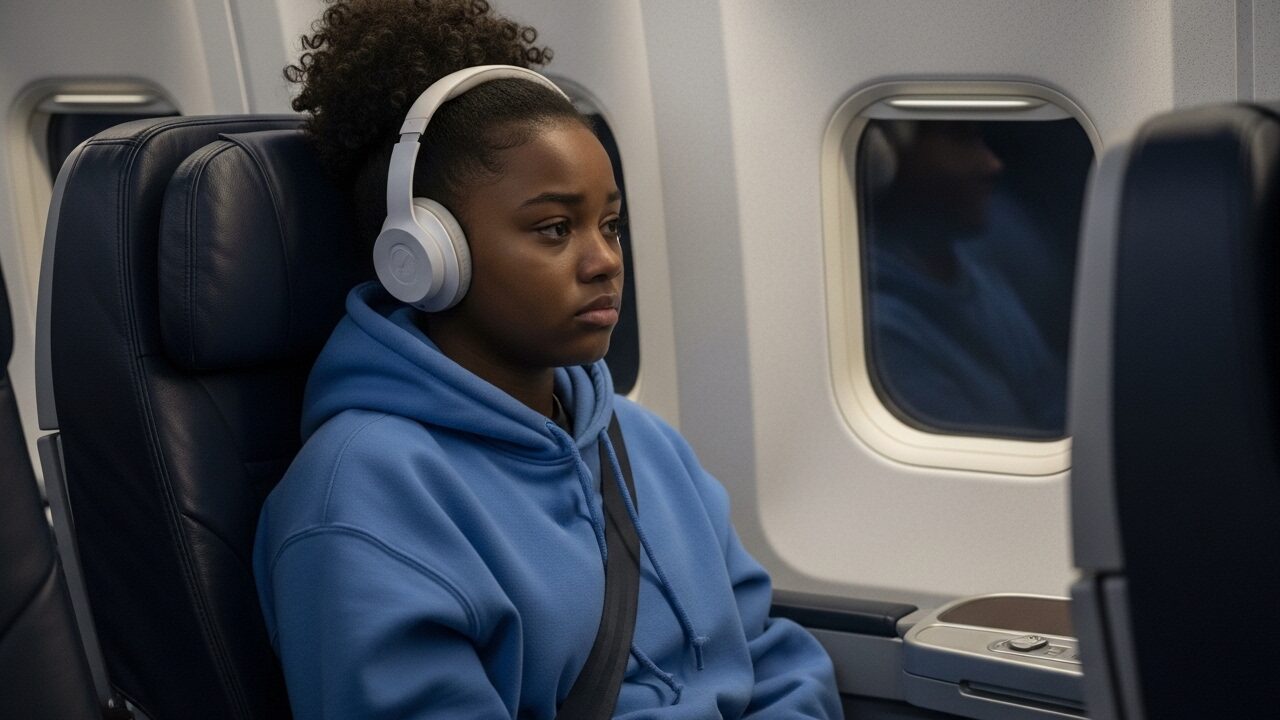
30,000 Feet in the Air, They Handcuffed a Quiet, Grieving Black Teen for Sitting in First Class—Never Guessing Her Father Owned the Airline

Chapter 1
The click of the heavy steel handcuffs was the loudest sound Maya had ever heard.
It didn’t matter that the twin jet engines of the Boeing 777 were roaring outside the cabin windows, or that two hundred passengers were murmuring in a collective, breathless hush.
To seventeen-year-old Maya Hayes, that sharp, metallic clack echoed like a gunshot inside her skull.
The cold metal bit violently into her thin wrists. The rough, aggressive hands pinning her arms behind her back belonged to a man twice her size, his breathing heavy and erratic with adrenaline.
Her cheek was pressed hard against the pristine, faux-leather bulkhead of the first-class cabin.
Through the blur of hot, terrified tears, all she could see was the graphite from her dropped sketchpad dusting the navy blue carpet, mixing with the crushed remains of the charcoal pencil she had been using to draw her mother’s face.
“Please,” Maya whispered. Her voice was trembling so violently she barely recognized it. “Please, I didn’t do anything. My dad… my dad is waiting for me.”
“Stop resisting, miss. Do not make this harder than it has to be,” a deep, authoritative voice barked near her ear.
It was Air Marshal David Miller, his grip tightening.
“I’m not resisting!” Maya sobbed, a profound, suffocating panic rising in her chest. She was a straight-A student. She played the cello. She had never even had detention. Now, she was being treated like a terrorist in front of a cabin full of affluent strangers who stared at her with a mix of horror, pity, and thinly veiled judgment.
Just three hours earlier, the world had felt heavy, but normal.
The sprawling glass terminal of JFK International had been a blur of rushing commuters and stale coffee.
Maya had walked through it like a ghost. She wore a massive, faded gray hoodie—the one her mother used to wear on Sunday mornings before the cancer took her away six months ago. The fabric still held the faintest, ghostly trace of vanilla and lavender, and Maya kept her nose buried in the collar, desperately trying to hold onto the scent.
She was a Black teenager navigating a sea of tailored suits and designer luggage in the priority security line. She kept her head down, her thick natural curls pulled into a messy bun, her eyes hidden behind oversized, noise-canceling headphones.
She was flying home to Los Angeles to live permanently with her father, Marcus.
Marcus Hayes was a man of intense focus and staggering wealth, a self-made titan in the private equity world who had recently pulled off a multi-billion-dollar acquisition that the public didn’t even fully know about yet.
But to Maya, he was just a grieving man who didn’t know how to talk to his daughter anymore.
He had booked her the first-class ticket, hoping the luxury would offer her some comfort.
He had no idea it would paint a target on her back.
Standing near the front of the cabin as the passengers boarded was Eleanor Vance.
Eleanor, fifty-two years old and thirty years into her career as a flight attendant, was having a terrible day in a terrible decade.
Her sensible navy pumps pinched her swollen feet. Her uniform felt tighter than it had a year ago. Just that morning, she had received an email from her lawyer confirming that her ex-husband was successfully fighting for a larger share of her already decimated pension.
Eleanor felt entirely out of control of her own life.
Over the years, she had developed a rigid, obsessive need for order in her cabin. The airplane was the only place left on earth where Eleanor had absolute authority. She prided herself on being the gatekeeper of the first-class section, a self-appointed judge of who belonged and who didn’t.
When Eleanor saw the wealthy white businessmen in their Brioni suits, she offered warm, practiced smiles. She knew their type. She respected their unspoken power.
But when Maya Hayes shuffled down the jet bridge and stepped onto the aircraft, Eleanor’s practiced smile tightened into a thin, bloodless line.
Eleanor saw a young Black girl. She saw the baggy, faded hoodie. She saw the worn-out canvas sneakers. She saw the way Maya kept her head down, avoiding eye contact.
To Eleanor’s deeply ingrained, unexamined biases, Maya didn’t look like grief. Maya looked like trouble. She looked like someone trying to sneak into a cabin she couldn’t possibly afford.
“Excuse me,” Eleanor said loudly, stepping directly into the aisle to block Maya’s path.
Maya didn’t hear her. The volume on her headphones was turned all the way up, blasting a melancholic classical cello piece to drown out the overwhelming anxiety of the crowded plane. Maya simply stepped to the side, trying to politely maneuver around the flight attendant to reach Seat 2A.
Eleanor’s face flushed. To her, this wasn’t a distracted teenager; this was a deliberate act of profound disrespect.
“Excuse me, miss!” Eleanor snapped, reaching out and grabbing Maya’s forearm.
Maya flinched violently. The sudden, uninvited physical contact sent a jolt of pure adrenaline through her system. She ripped her headphones off, her large brown eyes wide with alarm. “I’m sorry?”
“I need to see your boarding pass,” Eleanor demanded, her voice carrying a sharp, condescending edge that made several passengers in the first-class cabin turn their heads.
Maya swallowed hard, her heart beginning to race. “I… I already scanned it at the gate.”
“I don’t care what you did at the gate,” Eleanor replied, crossing her arms. “I need to see it now. You’re in the first-class cabin. Coach is further back.”
Sitting in Seat 2B, right next to Maya’s assigned window seat, was Richard Sterling.
Richard was sixty years old, a highly successful hedge fund manager with a silver mane of hair and a Patek Philippe watch that cost more than a suburban home.
Richard was exhausted. He spent his life making ruthless financial decisions, but in his personal life, he was a coward. Ten years ago, he had chosen a massive corporate merger over attending his only daughter’s wedding. They hadn’t spoken since.
When he looked at Maya, standing nervous and trembling in the aisle, he saw a ghost of the teenage daughter he had pushed away. He saw her vulnerability.
Richard cleared his throat, shifting uncomfortably in his plush leather seat. “Excuse me, ma’am,” he said mildly to Eleanor. “I believe she’s just trying to get to her seat.”
Eleanor shot Richard a tight, customer-service smile that didn’t reach her eyes. “I am simply following airline security protocols, sir. We have to ensure everyone is in their ticketed area.”
She turned her sharp gaze back to Maya. “The boarding pass. Now.”
Maya’s hands were shaking as she fumbled in the pocket of her hoodie. She pulled out her phone, but her palms were sweating so much the biometric scanner wouldn’t recognize her fingerprint. She typed in her passcode incorrectly. Once. Twice.
“I’m locked out,” Maya whispered, tears of frustration stinging the corners of her eyes. “Just give me a second.”
Eleanor’s patience, already paper-thin, completely shattered. She felt a surge of vindicated triumph. She knew it. The girl was lying.
“That’s it,” Eleanor said, her voice dropping to a harsh, commanding register. “Grab your bags. You need to come to the front of the aircraft right now. We’re getting the gate agent.”
“No, wait, my seat is right there!” Maya pleaded, pointing to 2A. “My dad bought this ticket. My name is Maya Hayes. You can check the manifest!”
“Do not raise your voice at me!” Eleanor escalated, taking a step toward the terrified teenager.
The perceived loss of control triggered something dark and spiteful in Eleanor. In her mind, she wasn’t harassing a grieving child; she was protecting the integrity of her cabin from an unruly, entitled delinquent.
“If you do not comply immediately, I will call the Air Marshal,” Eleanor threatened.
“Please, just look at the manifest!” Maya begged, her voice cracking. She took a step back, instinctively pulling her sketchpad tightly to her chest like a shield.
Eleanor misread the sudden movement. Or perhaps, she chose to misread it.
“We have a situation in First Class!” Eleanor yelled down the aisle toward the galley. “I need security assistance immediately! Uncooperative passenger!”
Richard Sterling half-stood from his seat, his face pale. “Now hold on a minute, there’s no need for that. She’s just a kid…”
But Richard’s voice was weak. He was afraid of making a scene. He was afraid of being delayed. He sank back down into his seat, guilt gnawing at his stomach as he watched the tragedy unfold, completely paralyzed by his own lifelong habit of avoiding confrontation.
From the front row of the economy cabin, Air Marshal David Miller sprang into action.
David was thirty-eight, a former Marine who had done two tours in Afghanistan. Since returning home, his life had slowly unraveled. His severe PTSD had cost him his marriage, and just last week, a judge had severely limited his visitation rights with his five-year-old son, citing his “unpredictable temper.”
David was a man drowning in failure, desperate for a clear-cut mission where he could be the hero. Where he could prove he was capable of protecting people.
When he heard Eleanor’s frantic shout, his training overrode his common sense. He surged through the curtain separating the cabins, his eyes scanning for a threat.
What he saw was Eleanor Vance, a white woman in a uniform, looking visibly shaken and pointing a trembling finger at a young, agitated Black teenager in a bulky hoodie.
Racial bias is rarely a conscious, cartoonish villainy. More often, it is a deadly, silent algorithm running in the background of the brain, filling in the blanks of a chaotic situation with deeply ingrained stereotypes.
David’s brain made a split-second, disastrous calculation.
He didn’t see a terrified high school student holding a sketchbook. He saw a physical threat to the flight crew.
“Federal Air Marshal! Step away from the flight attendant!” David roared, closing the distance in three massive strides.
“I didn’t do anything!” Maya screamed, pure terror seizing her throat. She stumbled backward, bumping hard into Richard’s seat. Her sketchpad slipped from her sweaty grip, the pages fluttering open, charcoal pencils spilling across the aisle.
“Hands where I can see them! Now!” David commanded.
“They are! They are!” Maya sobbed, holding her hands up, trembling uncontrollably.
“She refused to show her ticket and became aggressive,” Eleanor stated, her voice shaking with adrenaline, completely distorting the reality of the last three minutes.
That was all the justification David needed. He moved with brutal, practiced efficiency.
He grabbed Maya’s right arm, twisting it behind her back with a sudden, agonizing force that made her shriek in pain. He slammed her forward against the bulkhead wall.
“Stop! You’re hurting me!” Maya cried out, her cheek smashing against the faux leather.
“Do not resist!” David yelled, his knee pressing heavily into the back of her thigh to keep her immobilized.
Richard Sterling closed his eyes, his hands gripping his armrests until his knuckles turned white, unable to watch the violent subjugation of a child, yet too cowardly to physically intervene.
Eleanor stood back, her chest heaving, a sickening mix of horror and self-righteous vindication washing over her. She had regained control of her cabin.
The heavy steel handcuffs came out.
Clack. The metal bit into Maya’s right wrist.
Clack. Her left wrist was locked in.
Maya Hayes, honor roll student, grieving daughter, was now heavily restrained, treated like a violent felon in the middle of a commercial airliner.
She hung her head, her tears soaking into the carpet, her mother’s fading scent in the hoodie her only comfort in a world that had suddenly turned vicious and cold.
“My dad,” Maya gasped out, her voice a broken, hollow whisper. “You have no idea who my dad is.”
David scoffed, checking the tightness of the cuffs. “I don’t care if your dad is the President of the United States, kid. You don’t threaten flight crew on my plane.”
But Marcus Hayes wasn’t the President.
He was the man who had just finalized the paperwork to buy Meridian Airlines.
And right now, he was sitting in his Los Angeles office, tracking Flight 402 on his private monitor, waiting to welcome his only daughter home.
He had no idea that in less than four hours, he was going to burn this entire airline to the ground.
Chapter 2
The sheer, agonizing humiliation of it burned worse than the metal biting into her skin.
Maya lay slumped sideways against the bulkhead, her cheek pressed against the rough, scratchy fabric of the cabin wall. The Boeing 777 continued its ascent, the angle of the climb pushing her weight awkwardly against her bound wrists. Her shoulders screamed in protest, a dull, throbbing ache radiating down her arms, but she didn’t dare shift her weight. She didn’t dare move.
Every time she twitched, Air Marshal David Miller, who was now standing like a sentinel at the edge of the first-class galley, rested his hand instinctively on his hip.
The first-class cabin, usually a sanctuary of clinking champagne flutes and muted, polite conversation, had transformed into a sterile, suffocating tomb. The silence was absolute, save for the hum of the engines. No one was speaking, but Maya could feel their eyes. Two dozen pairs of eyes—mostly white, mostly affluent, entirely silent—were fixed on her.
She wasn’t a girl to them anymore. She was a spectacle. A cautionary tale. A disruption.
A tear tracked slowly down her cheek, leaving a cold trail before soaking into the collar of her mother’s oversized gray hoodie. The scent of vanilla and lavender was still there, but now it was masked by the acrid, metallic smell of her own fear-sweat and the stale, recycled airplane air.
Mom, Maya thought, her chest hitching in a silent, jagged sob. Mom, I don’t know what to do. I’m scared.
She closed her eyes, trying to transport herself away from the pain in her wrists and the burning shame in her chest. She thought of her mother, Angela. Angela had been a force of nature, a brilliant architect with a laugh that could fill an auditorium. When the pancreatic cancer had struck, it had moved with terrifying speed, stripping Angela of her vitality in less than six months.
Before she died, Angela had held Maya’s hand in the sterile, beeping hospital room and whispered, “Don’t let the world make you small, baby. You take up space. You hear me? You take up your space.”
But right now, crumpled on the floor of a commercial jet, handcuffed like a criminal for simply trying to sit in a seat her father bought for her, Maya had never felt smaller. She felt microscopic. She felt erased.
In Seat 2B, Richard Sterling stared blankly at the seatback screen in front of him. The screen was playing a muted nature documentary, a mother polar bear leading her cubs across a fracturing ice floe, but Richard wasn’t seeing any of it.
His heart was hammering against his ribs in a chaotic, irregular rhythm. The scotch he had ordered before takeoff was sitting on his tray table, untouched, the ice completely melted.
Richard was a master of the universe. In his glass-walled corner office in Manhattan, he controlled billions of dollars. He decimated rival companies, liquidated assets, and fired thousands of people with the stroke of a Montblanc pen, never losing a wink of sleep. He was renowned for his ice-cold nerve.
But here, watching a terrified seventeen-year-old Black girl being subjected to brutal, unjustified force, the great Richard Sterling was entirely paralyzed.
The image of Maya’s dropped sketchpad haunted him. When she had fallen backward, the pad had flipped open, landing near his Italian leather loafers. Before Eleanor had kicked it aside, Richard had seen the drawing. It was a charcoal portrait of a woman. The shading was exquisite, the eyes rendered with such profound, aching love that it had physically knocked the breath out of Richard’s lungs. It looked like the girl. It was her mother. He was sure of it.
He knew he should have intervened. When the flight attendant started raising her voice, he should have stood up. He should have used his deep, booming baritone—the one he used to terrify junior analysts—to de-escalate the situation. He should have demanded the flight attendant check the manifest.
But he hadn’t. He had offered a weak, pathetic mumble, and then he had folded.
Why? Because Eleanor was wearing a uniform? Because the Air Marshal had a badge? No, Richard knew the dark, ugly truth. It was because avoiding the mess was easier. It was the same cowardice that had kept him from attending his daughter Sarah’s wedding in Tuscany. He had convinced himself that a critical board meeting required his presence, but the reality was, he was terrified of facing his ex-wife, terrified of confronting the emotional wreckage he had caused his family.
He had chosen the path of least resistance then, and he was choosing it now.
He glanced down at Maya. She was trembling, small tremors wracking her frame. Her wrists were starting to swell around the tight metal of the cuffs, the skin puffing up into an angry, reddish-purple.
Do something, a voice screamed inside his head. You gutless old man, do something.
Richard raised a trembling hand, hovering his finger over the flight attendant call button. He imagined himself pressing it. He imagined Eleanor marching over, her face tight with that polite, toxic aggression. He imagined demanding the cuffs be removed.
But then David Miller shifted his weight, his heavy boots squeaking against the floorboards. The sound snapped Richard back to reality.
His finger retreated. He picked up his watery scotch and took a long, burning swallow, hating himself more than he had ever hated anyone in his sixty years of life.
Behind the curtain in the first-class galley, Eleanor Vance was leaning heavily against the stainless steel counter, her eyes closed, her breathing ragged.
She grabbed a plastic cup, filled it with ice water, and downed it in one gulp. Her hands were shaking so violently she dropped the cup, and it clattered loudly into the small sink.
She stared at her reflection in the small, smudged mirror above the beverage cart. She looked terrible. Her foundation was caking in the deep lines around her mouth, her blonde hair, usually sprayed into a helmet of perfection, was slightly frizzy. Her eyes looked frantic.
I did the right thing, she repeated to herself, a desperate, silent mantra. I maintained protocol. She was non-compliant. She was aggressive.
But the rationalization tasted like ash in her mouth.
Eleanor wasn’t a monster. If you had asked her, she would have indignantly claimed she didn’t have a racist bone in her body. She donated to charity. She watched documentaries. She smiled at everyone.
But bias doesn’t always announce itself with slurs and burning crosses. It lives in the quiet, snap judgments. It lives in the benefit of the doubt—who gets it, and who doesn’t.
When a white teenager in a hoodie had boarded her flight a month ago, looking lost and distracted, Eleanor had gently placed a hand on his shoulder, smiled warmly, and asked, “Lost, honey? Let’s check your ticket.” She had assumed he was confused.
When Maya boarded, wearing a similar hoodie, looking equally distracted, Eleanor’s brain didn’t calculate “confused teenager.” It calculated “threat.” It calculated “insubordination.” It calculated “someone trying to take something she hasn’t earned.”
Eleanor squeezed her eyes shut, trying to push away the memory of the girl’s terrified, tear-streaked face.
She lied, Eleanor told herself fiercely, gripping the edge of the counter until her knuckles blanched. She wouldn’t show the pass. She reached into her pocket. She could have had a weapon. In this day and age, you can’t be too careful. I have to protect my cabin.
She needed this to be true. She needed Maya to be the villain. Because if Maya wasn’t the villain—if Maya was just a scared, grieving kid who couldn’t get her phone to unlock—then Eleanor was something unspeakable.
Her phone buzzed in her apron pocket. It was a text from her lawyer regarding the alimony hearing.
Judge is leaning toward granting Paul the 40% cut of the pension. We need to prepare for the worst.
Eleanor let out a sharp, breathless gasp, slamming her fist against the steel counter. Her life was a free-fall. Her husband had left her for a woman twenty years younger. Her finances were in ruins. Her youth was gone.
This airplane was her kingdom. It was the only place she had power. And she had defended it.
She smoothed down her navy blue skirt, adjusted her nametag, and took a deep breath, plastering the tight, professional mask back onto her face. She pulled back the curtain and stepped back into the cabin, refusing to look down at the floor where Maya lay.
“Ladies and gentlemen, we apologize for the brief disruption,” Eleanor announced, her voice perfectly modulated, chillingly calm. “Beverage service will commence momentarily.”
A few rows back, Air Marshal David Miller stood with his arms crossed over his chest, his jaw clenched tight.
He was riding the dangerous, jagged edge of an adrenaline crash. His heart was still beating a staccato rhythm against his ribs, but the immediate rush of action was fading, leaving behind a cold, hollow paranoia.
He stared at the back of Maya’s head. She was so still. Too still.
David’s mind was a haunted house of combat memories and domestic failures. He had spent years in Fallujah, wired to detect threats in a fraction of a second. A twitch of a hand, a bulky jacket, an averted gaze—these were the things that kept you alive in a warzone.
But this wasn’t a warzone. It was a luxury cabin at thirty thousand feet.
Yet, when Eleanor had screamed, David’s brain hadn’t processed the context. His amygdala had hijacked his prefrontal cortex. He had reacted with the lethal, overwhelming force he had been trained to use.
She’s secured, he thought, trying to steady his breathing. The threat is neutralized.
He thought about his son, Leo. Five years old. Blond hair, bright blue eyes. The judge had looked at David with such undisguised disgust during the custody hearing.
“Mr. Miller, your military service is commendable, but your inability to regulate your emotional responses makes you an unstable presence in your son’s life. Supervised visitation only.”
The words echoed in David’s skull, a constant, agonizing loop. He wasn’t unstable. He was protective. He was a sheepdog surrounded by wolves, and no one else could see the danger.
He had to believe he was right today. He had to believe this girl was a legitimate danger. If he had just body-slammed and handcuffed an innocent high school student over a boarding pass dispute, then the judge was right. Then his ex-wife was right. Then he really was just a broken, violent man who belonged in a cage.
“Hey,” a quiet, hesitant voice broke through his thoughts.
David snapped his gaze to the left. It was a young woman in Seat 3A, a tech executive type in a crisp white blouse. She was looking at Maya, her face pale.
“Excuse me, officer,” the woman whispered, leaning toward the aisle. “Is she… is she okay? She’s crying. Her wrists look really bad. Maybe you could just loosen them a little?”
David felt a sudden, irrational surge of anger. How dare this civilian question him? How dare she undermine his authority?
“Ma’am, please face forward and remain in your seat,” David ordered, his voice flat, devoid of any warmth. “This is a federal security matter. Do not interfere.”
The woman shrank back into her seat, suitably chastised.
David turned his attention back to Maya. “Hey. Kid,” he said, keeping his voice low so only she could hear. “Stop the waterworks. It’s not going to change anything. You sit quiet until we land at LAX, and then Airport Police will take you off. Understand?”
Maya didn’t answer. She couldn’t. Her throat was completely closed off, sealed by panic and despair. She just let her eyes fall shut, praying for the flight to end. Praying for her father.
Two thousand miles away, the Los Angeles sun was beating down on the tarmac of LAX.
Inside the sprawling, glass-enclosed executive terminal of Meridian Airlines, the air conditioning was humming silently. The VIP suite smelled of expensive coffee, fresh orchids, and the crisp tang of aviation fuel from the runway outside.
Marcus Hayes stood by the floor-to-ceiling window, looking out at the glittering metal birds taking off and landing in a perfectly choreographed ballet of commerce.
Marcus was forty-five, tall, impeccably dressed in a tailored charcoal suit that moved with his athletic frame. He had the kind of quiet, absolute authority that didn’t require shouting. Men in boardrooms routinely folded under his calm, steady gaze. He was a man who moved markets, who bought and sold legacy corporations before his morning espresso.
But right now, he was just a father watching a dot on a flight tracker app.
Flight 402. Estimated Time of Arrival: 2 Hours, 15 Minutes.
Marcus sighed, running a hand over his close-cropped hair. He turned away from the window and looked at the leather armchair in the center of the room. Sitting on the chair was a small, exquisitely wrapped box. Inside was a set of antique, silver-plated cello strings he had flown in from Vienna. A welcome-home gift for Maya.
A sharp pang of guilt hit him right in the chest, stealing his breath.
He hadn’t been there enough. When Angela was sick, Marcus had buried himself in his work. He had convinced himself that paying for the best experimental treatments, the private suites, the round-the-clock specialists was how he showed his love. He had flown to London to close a deal while Angela was going through her third round of chemo.
He thought he had time. He thought his money could buy a cure.
It couldn’t.
And when Angela passed, Marcus found himself completely unmoored, staring at a daughter who looked exactly like her mother, holding a grief he didn’t know how to fix. Maya had retreated into her music, into her oversized hoodies, into a silent, impenetrable shell. She had asked to stay in New York with her aunt to finish out her junior year, and Marcus, paralyzed by his own grief and inability to connect, had let her.
But no more.
That was why he had orchestrated the biggest, most aggressive move of his career.
Meridian Airlines was a legacy carrier, an iconic American brand that had been hemorrhaging money due to terrible management. For the past eight months, Marcus and his private equity firm, Hayes Capital, had been quietly, ruthlessly acquiring a controlling stake.
The ink on the final merger documents had dried at 3:00 AM this morning. It was the most closely guarded secret on Wall Street. On Monday morning, the press release would drop. The current CEO would be ousted. Marcus Hayes would be the sole owner and Chairman of the Board of Meridian Airlines.
He hadn’t done it for the portfolio. He had done it because Angela had always loved to travel. She had always complained about how soulless flying had become. Marcus was going to rebuild this airline into something magnificent, and when she was old enough, he was going to put Maya on the board. It was a legacy. A way to bind them together.
The heavy mahogany door to the VIP suite opened, and Thomas, his Chief of Staff, walked in. Thomas was a brilliant, sharply dressed man in his thirties who practically lived attached to his tablet.
“Marcus,” Thomas said, his tone professional but warm. “The cars are positioned at the private gate. As soon as Flight 402 touches down, Airport Ops will route the aircraft to our tarmac. We’ll have Maya off the plane before the general public even unbuckles their seatbelts.”
Marcus nodded, a small, tight smile playing on his lips. “Good. Make sure her favorite snacks are in the SUV. The salt and vinegar chips. Not the healthy ones, the terrible ones.”
Thomas smiled. “Already done, sir. Oh, and I just got off the phone with the interim CEO’s office. They are requesting a preliminary transition meeting for tomorrow morning at 8:00 AM.”
Marcus’s eyes hardened, the warm father vanishing, replaced by the corporate titan. “Tell them 10:00 AM. Tomorrow morning is about Maya. My daughter comes first. They can wait.”
“Understood.” Thomas tapped on his tablet. “Flight is cruising over the Midwest now. Smooth air. She should be having a very comfortable trip.”
Marcus turned back to the window, staring out at the runway, a heavy, hopeful warmth spreading through his chest.
“She needs this,” Marcus murmured to himself. “We need this. A fresh start.”
He looked at his watch. A Patek Philippe, a gift from Angela on their tenth anniversary.
Two hours. He imagined Maya sitting in the spacious first-class seat, drinking sparkling water, maybe sketching in that book she carried everywhere, safe and cared for by the staff of the airline he now owned.
He had absolutely no idea that his daughter was currently lying on the floor of that very aircraft, her wrists bruised and bleeding, being treated like an animal by the very employees whose paychecks he now controlled.
If he had known, the titan of Wall Street wouldn’t have waited for the plane to land. He would have torn the sky apart to get to her.
At thirty thousand feet, the agony was becoming unbearable.
Maya had lost feeling in her right hand. The metal cuff had pinched a nerve, and a terrifying, cold numbness was creeping up her forearm. She tried to wiggle her fingers, but they felt like dead, heavy sausages.
Her bladder was aching. She had drank a large bottle of water before boarding, and the sheer terror of the last hour had accelerated her body’s response.
She opened her eyes. David Miller was still there, leaning against the galley wall, reading a magazine he had picked up from a vacant seat.
“Excuse me,” Maya rasped. Her throat was incredibly dry. She sounded like she had been screaming for hours.
David didn’t look up from the page. “Quiet.”
“Please,” Maya begged, her voice cracking. She hated how pathetic she sounded. She hated that she was begging this man for basic dignity. “I need… I need to use the restroom. Please. My wrists are completely numb, and I really have to go.”
David slowly lowered the magazine. He looked down at her with a gaze devoid of any human empathy. He saw a prisoner trying to manipulate the guard.
“You’re not moving,” David said flatly.
“I’m not lying!” Maya sobbed, a fresh wave of tears spilling over her cheeks. “I’m in so much pain. Just let me use the bathroom. You can stand right outside the door. Please.”
Eleanor, who had been organizing the beverage cart, stepped out from the galley. She looked down at Maya with a sneer of utter contempt.
“Actions have consequences, young lady,” Eleanor said, her voice dripping with venom. “You chose to cause a violent disturbance. You lost your privileges when you assaulted a federal officer.”
“I didn’t assault anyone!” Maya cried out, thrashing slightly against the floor, the injustice of the lie burning her alive. “I was just standing there! You attacked me!”
“Watch it,” David warned, stepping forward and looming over her, his hand resting on the handcuffs locked to his belt. “Keep yelling, and I’ll gag you. Do you want to be gagged for the rest of the flight?”
Maya froze. The threat hung in the air, heavy and violent. She squeezed her eyes shut, biting down hard on her lower lip to stifle her own sobs, tasting the metallic tang of blood. She was entirely at their mercy.
In Seat 2B, Richard Sterling heard the entire exchange.
He heard the girl begging. He heard the terrifying, cold indifference of the flight attendant and the blatant physical threat from the Air Marshal.
Richard felt physically sick. His stomach churned, and a cold sweat broke out across his forehead. He looked at the girl’s hands. He could see from his angle that her right hand was turning a pale, sickly shade of grey. Circulation was being cut off.
She’s a child, Richard thought. A little Black girl in a hoodie, and they are treating her like she’s a terrorist armed with a bomb.
Richard slowly unbuckled his seatbelt. The metallic click seemed incredibly loud in the quiet cabin.
He placed his hands on the armrests and pushed himself up. His knees felt weak, trembling with an alien cocktail of fear and long-overdue righteousness.
“Excuse me,” Richard said. His voice was shaky at first, but he cleared his throat, channeling the boardroom titan he knew he could be. “Excuse me, Officer.”
David Miller turned, his eyes narrowing. “Sir, I told everyone to remain seated.”
Richard stepped fully into the aisle. He stood at six-foot-two, his tailored suit giving him an air of formidable wealth.
“I am aware of what you said,” Richard replied, his voice gaining strength, resonating through the cabin. “But I have been sitting here for an hour watching this. This young woman is clearly in physical distress. Her hand is losing circulation. She needs to use the lavatory, and those cuffs need to be loosened immediately.”
Eleanor rushed forward, her polite mask slipping completely. “Sir, sit down! You are interfering with a federal matter!”
“I am intervening in a human rights violation, Eleanor,” Richard shot back, having read her nametag earlier. He looked directly at David. “I am Richard Sterling. I am the CEO of Sterling Capital Management. I have a team of the most ruthless corporate lawyers in New York on retainer. If you do not loosen those cuffs and let this child use the restroom right now, I will make it my personal mission in life to ensure you are not only fired, but bankrupt.”
The cabin was dead silent. A few passengers from the rows behind peeked over their seats, eyes wide.
David’s jaw clenched so hard a muscle ticked visibly in his cheek. He stepped closer to Richard, closing the distance until they were chest-to-chest. David was younger, stronger, and armed.
“Mr. Sterling,” David said, his voice dropping to a dangerous, gravelly whisper. “I don’t give a damn about your lawyers or your money. I am in command of the safety of this aircraft. This suspect was aggressive and non-compliant. If you take one more step forward, I will consider you an active threat to this flight, and you will be on the floor next to her.”
Richard held David’s gaze. For a terrifying second, Richard wanted to back down. He wanted to sit back in his plush seat, order another scotch, and let the world burn.
But then he looked down at Maya. She was looking up at him, her large brown eyes wide with a mix of shock and a desperate, fragile hope.
It was the exact same look his daughter Sarah had given him years ago when she asked him if he would walk her down the aisle, before he had broken her heart.
Richard didn’t back down. He stood his ground.
“Do it, then,” Richard said softly. “Arrest me. Put me on the floor. Let every passenger on this plane watch you assault a sixty-year-old man for asking you to let a child go to the bathroom.”
David hesitated. The tactical calculation in his brain suddenly shifted. Assaulting a Black teenager in a hoodie was one thing; systemic bias provided a lot of cover for that. But brutally taking down a wealthy, elderly white billionaire in a Brioni suit? That was a career-ending move. That was front-page news.
Eleanor sensed the shift in the power dynamic. She grabbed David’s arm.
“David, don’t,” she whispered frantically. “He’s not worth it. We land in an hour. Just… just leave it.”
David glared at Richard for a long, hateful moment. Then, he took a step back.
“Fine,” David spat. He looked down at Maya. “You want to use the bathroom? Get up.”
Maya tried to move, but her legs were cramped, and with her arms pinned behind her, she couldn’t get any leverage. She struggled, her sneakers slipping against the carpet.
Richard immediately knelt down, ignoring the sharp pain in his arthritic knees. “Here,” he said gently, his voice incredibly soft. “Let me help you.”
He placed a steadying hand under Maya’s shoulder and helped her stand. She swayed dangerously, her face pale, her whole body trembling.
“Thank you,” Maya whispered, her voice barely audible.
“Don’t thank me,” Richard said, his eyes filled with a deep, profound sorrow. “I should have done this an hour ago. I am so sorry.”
David grabbed Maya roughly by the bicep, pulling her away from Richard. “Alright, move. And no funny business.”
He marched her toward the first-class lavatory. He unlocked one of the cuffs, freeing her right hand, but kept the left one secured, anchoring the other end to the heavy metal handle of the galley compartment door.
“You have two minutes,” David ordered. “Door stays cracked.”
Maya didn’t argue. She slipped into the tiny bathroom, pulling the door closed as much as the chain would allow. She looked at her right wrist. It was raw, bleeding slightly, the skin severely bruised.
She turned on the tiny faucet and splashed cold water on her face. She looked at herself in the mirror. Her eyes were red and swollen, her hair a mess. She didn’t look like herself. She looked like a victim.
“Don’t let the world make you small, baby.”
Her mother’s voice echoed in her mind again. But this time, it wasn’t a comfort. It was a cruel reminder of how utterly she had failed.
She rested her forehead against the cool mirror and let out a silent, wrenching sob. She just wanted her dad. She just wanted to be safe.
Outside, the seatbelt sign chimed loudly.
“Ladies and gentlemen,” the pilot’s voice crackled over the intercom. “We have begun our initial descent into Los Angeles International Airport. Flight attendants, please prepare the cabin for arrival.”
Maya wiped her face with a harsh paper towel. The nightmare was almost over. She was going to see her dad.
She stepped out of the bathroom. David immediately grabbed her arm, roughly re-securing the handcuff to her right wrist behind her back.
“Back to the floor,” he ordered.
As Maya was forced back down against the bulkhead, the plane hit a patch of turbulence, shaking violently.
In Los Angeles, Marcus Hayes checked the flight tracker one last time.
Status: Landing.
He grabbed his suit jacket and walked out to the waiting SUV, a smile on his face, completely unaware of the explosive, devastating storm he was about to unleash on the tarmac.
Chapter 3
The descent into Los Angeles International Airport was a jarring, turbulent nightmare.
For the passengers in the first-class cabin, the bumps and sudden drops were an annoyance, a reason to grip their armrests and anxiously check the time on their designer watches. For Maya Hayes, bound and forced to sit on the floor against the unforgiving bulkhead, every shift in altitude was a fresh wave of physical agony.
Her shoulders were screaming, the joints pulled to their absolute limit by the unnatural angle of the heavy steel handcuffs. The numbness that had started in her right hand had now crept all the way up to her elbow, leaving her arm feeling like a dead, heavy block of ice attached to her body. She had stopped crying; she simply didn’t have the energy left. The tears had dried on her cheeks, leaving her skin feeling tight and salty. Her chest heaved with shallow, erratic breaths. She was withdrawing deep into herself, a survival mechanism kicking in to detach her mind from the terrifying reality of her body.
She kept her eyes squeezed tightly shut, imagining the gentle, rhythmic motion of her cello bow gliding across the strings. Up bow. Down bow. Vibrato. She played Bach’s Cello Suite No. 1 in her mind, focusing on the deep, resonant imaginary notes, trying to drown out the whine of the Boeing 777’s engines and the heavy, rhythmic breathing of Air Marshal David Miller standing right beside her.
“Final approach,” David muttered, checking his watch. He nudged Maya’s sneaker with the toe of his heavy tactical boot. “Listen up, kid. When the plane stops, you don’t move a muscle until I tell you. Airport Police are going to board. You do exactly what they say, and maybe you won’t spend the night in lockup. You try any of that aggressive crap you pulled earlier, and they will put you face-down on the tarmac. Understand?”
Maya didn’t nod. She didn’t speak. She just kept playing the cello in her mind. Up bow. Down bow. A few feet away, Eleanor Vance was moving through the cabin with frantic, nervous energy, collecting the last of the plastic cups and discarded napkins. Her practiced, customer-service smile was plastered onto her face, but it was brittle, threatening to crack with every step.
She avoided looking at the front bulkhead. She entirely avoided making eye contact with Richard Sterling in Seat 2B.
Eleanor’s mind was racing, furiously building her defense, cementing the lie in her own head until it felt like the absolute truth. She was unruly. She refused to identify herself. She made a sudden movement. The Air Marshal made the call, not me. I simply followed protocol. I protected the cabin. She needed the Airport Police to board quickly. She needed them to drag the girl away in handcuffs so the narrative would be finalized. Once the girl was in police custody, she was officially a criminal, and Eleanor was officially the victim. It was the only way this ended without Eleanor facing a disciplinary board. The thought of losing her job—losing her pension entirely, right when her ex-husband was trying to take half of what was left—sent a spike of pure, unadulterated panic straight through her heart.
“Cabin is secure for landing,” Eleanor announced into the intercom, her voice remarkably steady despite the chaotic storm raging in her chest. She strapped herself into the jump seat near the front door, directly across from where Maya was slumped on the floor.
Eleanor stared straight ahead, refusing to look down.
In Seat 2B, Richard Sterling was staring out the window as the sprawling, concrete grid of Los Angeles rushed up to meet them. The afternoon sun was blindingly bright, reflecting off the ocean in the distance.
Richard felt a heavy, suffocating weight pressing down on his chest. It was the familiar, toxic weight of profound regret. He had spoken up, yes. He had forced the Air Marshal to let the girl use the restroom. But it wasn’t enough. It was a half-measure, a tiny band-aid on a gaping, bleeding wound of injustice.
He looked at his hands. They were trembling. He was a billionaire. He was a titan of industry. He had the power to ruin the airline, to ruin the flight attendant, to ruin the Air Marshal. But power was useless if you didn’t have the courage to wield it when it mattered most.
What am I going to do when those doors open? Richard thought, panic rising in his throat. Am I going to let the police drag her away? Am I going to just grab my briefcase, walk through the terminal, and pretend this never happened?
That was what he had done his entire life. He had walked away from the messy, emotional collisions. He had walked away from his ex-wife’s tears. He had walked away from his daughter Sarah’s desperate pleas for him to attend her wedding.
He reached into his jacket pocket and pulled out his phone, holding it tightly. As soon as they had a signal on the tarmac, he was going to call his lead attorney. He wasn’t going to walk away this time. He couldn’t save his relationship with his own daughter, but maybe, just maybe, he could save this one.
The plane hit the runway with a heavy, jarring thud. The engines roared as the thrust reversers deployed, throwing everyone forward against their seatbelts.
Maya let out a sharp, involuntary cry as the deceleration threw her weight forward against her bound, numb arms. Pain flared like a white-hot lightning bolt across her shoulders.
“Stay still!” David barked, grabbing her shoulder to pin her back against the wall.
The aircraft slowed, transitioning from a terrifying metal missile to a lumbering, heavy machine taxiing off the main runway.
Usually, the pilot would come over the intercom to welcome the passengers to Los Angeles, reciting the local time and weather. But the intercom remained silent for a long, uncomfortable minute.
When the captain’s voice finally clicked on, he sounded confused.
“Uh, ladies and gentlemen, welcome to LAX. We apologize for the delay in the announcement. We have been instructed by ground control to deviate from our assigned gate at Terminal 4. We are currently being routed to a remote stand on the west side of the airfield. Please remain in your seats with your seatbelts fastened. We are not entirely sure of the reason for the diversion, but we will update you as soon as we have more information.”
Eleanor frowned, unbuckling her jump seat harness. “A remote stand? Why would they route us to a remote stand? We’re a wide-body jet, we need the jet bridge.”
David stood up, moving to the small window set into the heavy front exit door. He peered out at the tarmac passing by.
His brow furrowed in deep confusion.
They weren’t taxiing toward the main terminals. They were moving entirely away from the commercial hub of LAX, rolling past massive cargo hangars and empty stretches of concrete. They were heading toward the private aviation sector, a secluded area of the airport reserved for chartered jets, foreign dignitaries, and billionaires.
“This isn’t right,” David muttered, his tactical instincts flaring. He had requested Airport Police to meet them at the gate for a prisoner transfer. Airport Police operated out of the main terminals. They didn’t do transfers on the private VIP tarmac.
“What do you see?” Eleanor asked, walking over to him, her voice laced with sudden anxiety.
“No black-and-whites,” David said, his eyes scanning the approaching concrete apron. “No police cruisers. Just… black SUVs.”
The massive 777 finally rolled to a complete stop, the engines spooling down into a low, dying whine.
Outside the window, David saw a fleet of five pristine, blacked-out Cadillac Escalades parked in a rigid, militaristic semi-circle on the tarmac. Standing around the vehicles were men in sharp, tailored suits, many of them wearing earpieces.
“Is it a VIP flight?” Eleanor asked, her voice trembling slightly. “Did we have a politician on board we didn’t know about?”
“I don’t know,” David said, his hand resting instinctively on his holster. The adrenaline that had faded was suddenly rushing back, cold and sharp. This didn’t look like a police response. This looked like a private security detail. A very, very expensive private security detail.
A mobile, heavy-duty stair car was slowly driving across the tarmac, aligning itself with the front door of the aircraft.
“Alright,” David said, turning back to Maya. “Get up.”
Maya didn’t move. She couldn’t. Her legs were cramped, and her spirit was utterly broken.
“I said get up!” David snapped, reaching down and grabbing her roughly by the bicep, hauling her to her feet. Maya swayed dangerously, crying out in pain as the movement pulled at her bound wrists. She slumped against the wall, barely able to support her own weight.
“David, be careful,” Eleanor hissed, suddenly hyper-aware of the strange, silent men in suits waiting outside. “Just… just hold her here until they open the door.”
Inside the VIP suite overlooking the private tarmac, Marcus Hayes had watched his newly acquired Boeing 777 pull up to the stand.
He was smiling. The deep, heavy grief that had sat in his chest for six months felt momentarily lighter. Maya was here. They were going to go home, they were going to order entirely too much takeout, and he was going to try, desperately, to be the father she needed.
He picked up the small, velvet-lined box containing the antique cello strings. He adjusted the cuffs of his Tom Ford suit, ran a hand over his hair, and turned to Thomas, his Chief of Staff.
“Have the cars ready to roll the second she’s down the stairs,” Marcus said. “I don’t want her waiting in the heat.”
“Everything is prepped, sir,” Thomas replied, checking his tablet. “The ground crew has secured the stairs. The door should be opening now.”
“Let’s go get my daughter,” Marcus said, stepping out of the air-conditioned VIP suite and out into the blazing, humid Los Angeles heat.
He walked across the tarmac, flanked by his two massive personal security directors, men who had previously protected foreign heads of state. They walked toward the mobile stairs just as the heavy, white door of the aircraft was pushed open from the inside.
At the top of the stairs stood Eleanor Vance, wearing her brightest, most artificial smile.
“Welcome to Los Angeles,” Eleanor called out, her voice loud and falsely cheerful, though her eyes were frantically scanning the men in suits, searching for anyone in a police uniform.
Marcus didn’t even look at her. He started walking up the metal stairs, his eyes focused on the dark interior of the cabin, looking for the familiar shape of his daughter’s oversized gray hoodie.
He reached the fifth step.
Then, he saw her.
Time seemed to fracture, slowing to an agonizing, microscopic crawl. The ambient noise of the airport—the distant roar of jets, the hum of the ground equipment, the wind off the Pacific—all of it completely vanished.
Marcus stopped dead on the stairs.
He saw the faded gray hoodie. He saw the thick, beautiful natural curls pulled into a messy bun.
But she wasn’t walking toward him. She was being physically held up by a large, aggressive-looking white man wearing a tactical vest.
Maya’s head was hanging down, her chin resting on her chest. Her face was stained with tears, her expression a mask of pure, absolute devastation.
And then, Marcus saw her hands.
They were wrenched forcefully behind her back, secured by heavy, thick steel handcuffs. Her wrists were swollen, the skin an angry, bruised purple. Her right hand was hanging limply, completely gray and devoid of circulation.
The velvet box slipped from Marcus’s hand.
It hit the metal stairs with a sharp clack. It bounced, tumbling down the steps, the lid snapping open. The priceless, antique silver cello strings spilled out onto the dirty tarmac, unraveling like delicate spiderwebs in the harsh sunlight.
Marcus didn’t blink. He didn’t breathe.
A sound escaped his throat—a low, guttural, entirely primal sound of a father witnessing his child being tortured. It wasn’t the sound of a billionaire CEO. It was the sound of a predator realizing its cub was caught in a trap.
The blood drained completely from Marcus’s face, leaving him looking like a statue carved from cold, white marble. But his eyes—his eyes were burning with a dark, terrifying, apocalyptic fury.
He took the remaining stairs two at a time, his large frame suddenly moving with the terrifying speed and violence of a collapsing building.
At the top of the stairs, David Miller saw the massive man charging upward. David’s training kicked in, but it was the wrong training for the wrong situation. He didn’t see a father; he saw a threat breaching his aircraft.
“Halt! Federal Air Marshal! Stay back!” David roared, throwing his hand out, resting his other hand on his weapon.
Marcus Hayes didn’t slow down. He didn’t even acknowledge David’s existence as a human being. He reached the top platform of the stairs, entirely ignoring the shouted commands.
“Dad?”
The word was a broken, raspy whisper. Maya lifted her head. Her large, terrified brown eyes locked onto her father.
The moment she saw him, the last remaining thread of her composure snapped. The dam broke. A sound of pure, unadulterated heartbreak tore from her throat, a sobbing wail that echoed across the tarmac and sent shivers down the spines of the security men waiting below.
“Dad!” Maya cried, struggling weakly against David’s grip, trying desperately to move toward her father. “Dad, please! They hurt me! Please!”
“Hey! I said back off!” David yelled, roughly shoving Maya backward against the bulkhead to clear his path, stepping directly in front of Marcus.
That was his fatal mistake.
Marcus didn’t yell. He didn’t curse. He moved with a cold, terrifying precision.
Before David could even blink, Marcus’s hand shot forward, his large, powerful fingers wrapping entirely around David’s throat.
David choked, his eyes widening in absolute shock as Marcus slammed him backward with bone-crushing force against the heavy metal doorframe of the aircraft. The impact rattled the side of the plane.
“Take your hands off my daughter,” Marcus said.
His voice wasn’t a shout. It was a low, vibrating growl that barely carried over the wind, yet it was the most terrifying sound David had ever heard. It was the sound of absolute, unrestrained power promising violence.
Eleanor screamed, stumbling backward into the galley, her hands flying to her mouth in horror. “Security! Security! He’s attacking an officer!”
Within seconds, Marcus’s two massive personal security directors had surged up the stairs. They didn’t draw weapons, but they moved with lethal efficiency. One of them grabbed David’s arms, pinning them instantly, while the other stepped between the door and Eleanor, creating an impenetrable wall of muscle.
Marcus released David’s throat, immediately dropping to his knees on the floor of the aircraft, completely ignoring the immaculate fabric of his suit.
“Maya,” Marcus gasped, his voice finally breaking. “Maya, baby. I’m here. I’m right here.”
He reached around her back, his large hands gently touching the cold, brutal steel of the handcuffs. He saw the deep, bleeding grooves in her skin. He saw the gray, lifeless color of her fingers.
Tears—hot, furious tears—spilled over Marcus’s eyelashes. He had conquered Wall Street. He had bought airlines. He had amassed more wealth than a thousand lifetimes could spend. But right now, looking at the mutilated wrists of his only child, he felt entirely, utterly powerless.
He stood up slowly. The sorrow vanished, entirely replaced by a cold, calculating wrath.
He turned to look at David, who was currently pinned against the wall by the security detail, gasping for breath, his face red with rage and humiliation.
“Give me the key,” Marcus said, extending an open palm.
“You are assaulting a federal officer!” David spat, struggling violently against the men holding him. “You’re going to federal prison! Both of you! She assaulted a flight attendant!”
“She is seventeen years old,” Marcus said, his voice dropping to a freezing whisper. “She weighs a hundred and ten pounds. She is grieving her dead mother. And you handcuffed her like a terrorist.”
Marcus took a step closer, towering over the struggling Air Marshal. “I will ask you one last time. Give. Me. The. Key.”
“Go to hell!” David snarled. “Airport Police are on their way. You’re done.”
“No,” a deep, booming voice echoed from inside the cabin. “You are done.”
Everyone turned.
Stepping out from the first-class cabin, his silver hair perfectly coiffed, his jaw set in a line of grim determination, was Richard Sterling.
Richard walked toward the front door, looking completely out of place in the chaotic scene, yet carrying an aura of absolute authority. He stopped right next to Marcus, looking at the devastated teenager on the floor, and then looking directly at David and Eleanor.
“My name is Richard Sterling,” he announced, his baritone voice ringing clear and steady. “I was in Seat 2B. I witnessed the entire event from beginning to end.”
Eleanor’s face went completely white. She realized, with a sudden, sickening drop in her stomach, that the billionaire she had tried to placate was now turning against her.
“Sir,” Eleanor stammered, stepping forward. “Sir, please tell them. She was unruly. She refused to show her pass. She was a threat.”
“You are a liar,” Richard said bluntly, not raising his voice, but lacing the words with absolute contempt.
He turned to Marcus. “Mr. Hayes, I presume?”
Marcus, his chest heaving, managed a curt nod. “I am.”
“Mr. Hayes, your daughter did absolutely nothing wrong,” Richard said, speaking loudly so every passenger straining to listen in the cabin could hear. “She was polite. She was terrified. She couldn’t unlock her phone to show her boarding pass. This flight attendant profiled her, harassed her, and escalated the situation out of pure, unadulterated malice. And this man—” Richard pointed a shaking, furious finger at David. “—this man used excessive, brutal force on a child who was not resisting. He tortured her. And I sat there and let it happen for an hour before I said anything. And for that, I will spend the rest of my life apologizing to you and your daughter.”
Maya looked up at Richard through her tears. The man who had been too afraid to stop it was now standing in front of her father, burning his own reputation to the ground to save hers.
David scoffed, trying to regain his footing, though the security guards held him tight. “It doesn’t matter what you saw, old man. I am the supreme authority on this aircraft. I made a tactical decision. And you,” he glared at Marcus, “you are trespassing on a secure tarmac. When the police get here, you are going in cuffs right next to her.”
Marcus Hayes looked at David. The anger in Marcus’s eyes suddenly vanished, replaced by a look of profound, chilling pity. It was the look a man gives to an insect right before he steps on it.
Marcus slowly reached into the inner pocket of his suit jacket. He pulled out his phone.
He didn’t dial 911. He scrolled to his favorites list and pressed a single button. The phone was on speaker.
It rang once.
“Director,” Marcus said calmly.
“Marcus,” a sharp, professional voice answered immediately. It was the Regional Director of the FBI for the West Coast. “Tell me everything went smoothly. Congratulations on the acquisition.”
“It didn’t go smoothly, Bill,” Marcus replied, his eyes locked dead onto David Miller’s face. “I’m standing on my tarmac right now. An Air Marshal named…” Marcus leaned in, looking at David’s badge. “…David Miller. He has violently assaulted my seventeen-year-old daughter. She is currently restrained and injured. He is refusing to release her.”
A heavy, terrifying silence fell over the line.
“I’m dispatching a tactical unit and an ambulance to your location right now, Marcus. Do not let that man leave the aircraft. Is your security holding him?”
“They are.”
“Good. I’m calling the head of the Federal Air Marshal Service personally. Miller’s badge is gone. We’ll be there in three minutes.”
Marcus hung up the phone. He slipped it back into his pocket.
David had stopped struggling. The color had completely drained from his face. The reality of what had just happened was crashing down on him like a collapsing building. The Regional Director of the FBI? Congratulations on the acquisition?
“Acquisition?” Eleanor whispered, her voice trembling violently. She looked at Marcus, really looked at him for the first time. The tailored suit. The private tarmac. The security detail.
“Who… who are you?” Eleanor asked, her breath catching in her throat.
Marcus Hayes took a slow, deliberate step forward until he was standing just inches from Eleanor.
“My name is Marcus Hayes,” he said softly, clearly. “I am the CEO of Hayes Capital. And as of three o’clock this morning, I am the sole owner and Chairman of the Board of Meridian Airlines.”
The words hit Eleanor like a physical blow. She staggered backward, her hand grabbing the edge of the galley counter to stop herself from collapsing.
She hadn’t just harassed a teenager. She had brutally profiled, humiliated, and orchestrated the assault of the sole heir to the entire airline. She had attacked the boss’s daughter.
“No,” Eleanor gasped, tears of absolute panic welling in her eyes. “No, that’s… I didn’t know. Sir, I didn’t know! She was wearing a hoodie, she wouldn’t show the pass, I thought…”
“You thought she didn’t belong,” Marcus finished for her, his voice dripping with venom. “You looked at my daughter, you looked at the color of her skin, and you decided she didn’t belong in your cabin.”
Marcus turned his gaze back to David, who was now trembling visibly, the tough-guy facade entirely shattered.
“You want to talk about authority, Miller?” Marcus said softly. “You are standing on an airplane that I own. Parked on a tarmac that I lease. And you have put your hands on the only thing in this world that I care about.”
Marcus gestured to his security director holding David’s right arm. “Take his keys.”
The security director didn’t hesitate. He forcefully reached to David’s belt, unclipped the heavy ring of keys, and handed them to Marcus.
David didn’t resist. He was entirely broken. He thought about his son. He thought about the judge’s warnings about his temper. It was over. He wasn’t just losing his job; he was going to federal prison. He had ruined his own life because he couldn’t see past his own bias and his own desperate need for control.
Marcus knelt down beside Maya. His hands were shaking as he inserted the small key into the heavy metal lock on her right wrist.
Click. The cuff sprang open.
Maya let out a sharp, agonizing cry as the blood rushed violently back into her numb, grey hand. The pain of the returning circulation was excruciating, like a thousand needles stabbing into her skin.
Marcus moved quickly to her left wrist, unlocking it.
Click.
The heavy metal cuffs fell away, clattering loudly onto the floor of the aircraft.
Maya’s arms fell limply to her sides, completely useless. She sat there for a second, staring at the deep, purple bruises banding her wrists, the skin broken and bleeding in several places.
“Maya,” Marcus whispered, his voice thick with tears. “I’m so sorry. I’m so sorry I wasn’t here.”
He opened his arms.
Maya didn’t hesitate. She threw herself forward, collapsing entirely into her father’s chest. She buried her face in the expensive wool of his suit jacket and screamed.
It wasn’t a cry of pain anymore. It was the release of an hour of absolute, suffocating terror. It was the agonizing grief of missing her mother, compounded by the horrifying realization of how cruel the world could be. She sobbed with an intensity that shook her entire body, her tears soaking instantly through Marcus’s shirt.
Marcus wrapped his massive arms around her, pulling her tightly against him, burying his face in her thick curls. He closed his eyes, letting his own tears fall freely into her hair.
“I’ve got you,” Marcus choked out, rocking her back and forth gently on the floor of the plane, completely ignoring the stunned passengers watching from the cabin. “I’ve got you, baby. Nobody is ever going to touch you again. I swear to God, I will burn the whole world down before I let anyone hurt you again.”
In the background, the wail of police sirens began to echo across the tarmac, growing louder and more urgent by the second. The flashing red and blue lights reflected off the polished aluminum of the aircraft engine.
Richard Sterling stood quietly by the door, watching the father and daughter hold each other. He felt a tear slide down his own cheek. He pulled out his phone and scrolled to a contact he hadn’t called in three years.
Sarah. He pressed dial. He didn’t know if she would answer. He didn’t know if she would ever forgive him. But watching Marcus Hayes protect his daughter, Richard knew he couldn’t spend another day being a coward. He had to try.
The sirens stopped right at the base of the stairs.
Heavy footsteps pounded up the metal steps. Six heavily armed federal agents, accompanied by local paramedics, stormed the entrance of the aircraft.
“FBI! Nobody move!” the lead agent shouted.
Marcus didn’t look up. He just kept holding his daughter, rocking her back and forth, holding her together as the world around them finally, violently corrected itself.
The nightmare was over. The reckoning had just begun.
Chapter 4
The invasion of the aircraft was swift, precise, and entirely devoid of the chaotic, unhinged aggression that had characterized Air Marshal David Miller’s reign of terror.
Six federal agents poured through the front door, their dark suits and tactical vests a stark contrast to the bright, artificial lighting of the first-class galley. They didn’t shout unnecessary commands. They moved with the cold, coordinated efficiency of an apex predator neutralizing a threat.
“Step away from him,” the lead agent ordered, gesturing to Marcus’s security detail who were still pinning David against the bulkhead.
The security men immediately stepped back, their hands raised to show compliance. They had done their job; the perimeter was secure.
David Miller slumped slightly as the physical pressure was removed, gasping for air, his throat bruised from Marcus’s initial grip. He looked up, his eyes darting frantically between the agents. He recognized the lead agent—a man named Kincaid, a seasoned veteran from the Los Angeles field office.
“Kincaid, listen to me,” David started, his voice a desperate, gravelly plea. “This is a massive misunderstanding. The suspect was non-compliant. The father breached a secure tarmac—”
“Shut your mouth, Miller,” Kincaid said, his voice flat, completely devoid of professional courtesy. He stepped forward, grabbing David’s left arm with a grip that offered no illusion of brotherhood. “You are stripped of your weapon, your badge, and your federal authority, effective immediately.”
Another agent stepped behind David, grabbing his right arm.
“Hands behind your back,” the second agent commanded.
David froze. The instruction echoed in his mind, a terrifying mirror of the exact words he had screamed at Maya just an hour earlier. He looked down at the floor, where Maya was still buried in her father’s chest, her small frame shuddering with residual sobs. He looked at the heavy steel handcuffs lying discarded on the navy blue carpet.
“Kincaid, please,” David whispered, the last remnants of his tough-guy facade crumbling into pathetic dust. “I have a son. If you arrest me, I lose my visitation. I lose everything. Don’t do this.”
“You should have thought about your son before you tortured a child,” Kincaid replied coldly.
Clack. The heavy steel handcuffs bit into David’s wrists. The sound was identical to the one that had haunted Maya, but this time, it was the sound of a violent man facing the absolute, unyielding wall of consequence.
David squeezed his eyes shut as he was marched toward the exit, the reality of his ruined life crashing down on him. He wasn’t a sheepdog protecting the flock. He was the wolf. And he had just been put down.
A few feet away, Eleanor Vance was hyperventilating.
She had retreated into the tiny space of the forward galley, wedging herself between the beverage carts, trying to make herself as small as possible. Her perfect, sprayed blonde hair was clinging to her sweaty forehead. Her pristine uniform felt like a straitjacket.
An agent approached her, a small notepad in hand. “Eleanor Vance?”
“I didn’t touch her,” Eleanor blurted out, her voice pitching into a hysterical shriek. She threw her hands up defensively. “I never laid a hand on her! It was the Air Marshal! He made the call! I just asked for a boarding pass! That’s my job! I was doing my job!”
“Ma’am, calm down,” the agent said, his tone entirely unsympathetic.
“You can’t arrest me!” Eleanor sobbed, the tears ruining her heavy foundation, cutting tracks through the makeup. “I’ve been flying for thirty years! My pension—I need my pension! My husband took everything, please, you can’t take this from me!”
“Nobody is arresting you right this second, Ms. Vance,” the agent said, pulling out a pair of zip-ties, just in case. “But you are being detained for questioning in a federal civil rights investigation. You will be escorted to an interrogation room at the field office. Grab your personal belongings.”
Eleanor let out a wretched, hollow wail. She looked past the agent, locking eyes with Richard Sterling, who was standing quietly near the door.
“Tell them!” Eleanor begged Richard, her voice cracking with desperation. “Tell them I was just following protocol!”
Richard looked at her. There was no anger left in his eyes, only a profound, chilling pity. “You followed your prejudice, Eleanor,” Richard said softly. “And it led you exactly where you belong.”
Eleanor collapsed against the aluminum cart, weeping uncontrollably as two agents gently but firmly took her by the arms and led her off the aircraft. The kingdom she had ruled with such toxic, petty authority was officially gone.
On the floor of the cabin, Marcus Hayes was completely oblivious to the arrests. The only thing in his universe was his daughter.
“Mr. Hayes?” a gentle female voice interrupted.
Marcus looked up. Two paramedics had crouched down beside him. They carried a bright orange trauma bag, and their expressions were a mix of professional focus and deep, human empathy.
“We need to look at her wrists, sir,” the female paramedic said softly.
Marcus nodded, his jaw clenched tight. He gently pulled back from Maya, though he kept one large hand resting protectively on the back of her neck, his thumb stroking her messy curls.
“Maya, sweetheart,” Marcus whispered, his voice thick with unshed tears. “Let the doctors look at your hands. It’s okay. You’re safe now.”
Maya sniffled, keeping her eyes cast downward. She slowly lifted her arms, presenting her battered wrists to the paramedics.
The female paramedic sucked in a sharp breath through her teeth when she saw the damage. The deep, purple grooves cut into the delicate skin of Maya’s wrists were horrific. The metal had ground into the bone, breaking the skin in several places where dried blood had formed dark, ugly crusts.
“Okay, honey, I’m going to be very gentle,” the paramedic said, pulling out sterile saline wipes and a small penlight. “Can you wiggle your fingers for me?”
Maya tried. Her left hand responded slowly, the fingers twitching with a painful stiffness. But her right hand—the one that had borne the brunt of her weight when she fell against the bulkhead—was barely moving.
“It burns,” Maya whimpered, a fresh tear sliding down her cheek. “It feels like it’s on fire, but I can’t really feel my fingers. It’s like static.”
Marcus’s chest tightened, a fresh wave of homicidal rage washing over him. He looked toward the door where David Miller had just been taken, his hands balling into massive fists.
“It’s nerve compression,” the male paramedic murmured to his partner, jotting notes on a clipboard. “Likely temporary neuropraxia from the extreme pressure, but we need an orthopedic consult to rule out permanent damage to the radial nerve.”
“We’re going to wrap these up to prevent infection, Maya,” the female paramedic said, working quickly and gently with gauze and medical tape. “And then we’re going to take you to the hospital to get those nerves checked out. You’re being very brave.”
“I have a private medical team waiting at Cedars-Sinai,” Marcus interjected, his voice firm, regaining a fraction of his CEO persona. “My security will follow the ambulance.”
“Of course, Mr. Hayes,” the paramedic nodded.
As they finished bandaging her wrists, Richard Sterling stepped forward. He had waited patiently, refusing to leave the aircraft until he knew the girl was being cared for.
Marcus stood up, extending a hand to Richard.
“Mr. Sterling,” Marcus said, his voice gravelly and deeply sincere. “I don’t know the full extent of what happened before I got on this plane. But I know you stood up for her. You put your name and your reputation on the line against a federal officer to protect my little girl.”
Richard shook Marcus’s hand. His grip was firm, but his eyes were filled with sorrow.
“Don’t thank me, Marcus,” Richard said, shaking his head slowly. “I sat there for almost an hour and did nothing. I watched them dehumanize her, and I drank a scotch because I was too much of a coward to cause a scene. I only spoke up when I thought she was going to lose her hand.”
Richard looked down at Maya, who was watching him with wide, exhausted eyes.
“I am so incredibly sorry, Maya,” Richard said, his voice breaking. “You deserved better from the adults in this room. You deserved an advocate. And I failed you for far too long.”
Maya looked at the billionaire. She saw the genuine anguish in his face. She managed a tiny, almost imperceptible nod. “You stopped him,” she whispered. “Thank you.”
Richard closed his eyes, a single tear escaping. He looked back at Marcus. “If you need a witness for the civil suit, for the criminal trial, for the press… you have my private cell. I will testify to everything. I will bury them with you.”
“I appreciate that, Richard,” Marcus said.
Richard turned and walked toward the exit of the plane. He didn’t wait for his expensive luggage. He didn’t wait for the airline staff to escort him. He walked down the metal stairs and out onto the sun-baked tarmac, breathing in the thick Los Angeles air like a man who had just been released from a cage.
He pulled his phone from his pocket. He looked at the screen.
Sarah.
He pressed dial. He held the phone to his ear, his heart hammering against his ribs harder than it did during billion-dollar negotiations.
It rang three times. Then, it clicked to voicemail.
“Hi, this is Sarah. I can’t get to the phone right now. Leave a message.”
Richard swallowed hard. He closed his eyes, blocking out the flashing lights of the police cruisers.
“Sarah… it’s Dad,” Richard said, his voice trembling uncontrollably. “I know you don’t want to hear from me. I know I have no right to call. But I was just on a flight. And I saw something. I saw a young girl get hurt… because a man was too focused on his own rigid need for control, and because the people around her were too cowardly to stop it.”
He paused, a sob catching in his throat.
“It made me realize what a monster I’ve been. I sacrificed you, my beautiful daughter, for a boardroom. I stayed away from your wedding because I was afraid of the mess I made. I have been a coward my entire life, Sarah. I’m not asking for your forgiveness. I don’t deserve it. But I am calling to tell you that I love you. I have always loved you. And I am so, so terribly sorry.”
He ended the call. He stood on the tarmac alone, an old man with more money than God, weeping for the years he could never buy back. But for the first time in a decade, Richard Sterling felt a tiny, fragile spark of peace in his chest. He had finally told the truth.
The next seventy-two hours were a blur of sterile hospital rooms, legal briefings, and earth-shattering corporate warfare.
At Cedars-Sinai Medical Center, the top neurologists on the West Coast examined Maya’s wrists. The diagnosis was severe compressive neuropathy. The nerves weren’t permanently severed, but they were deeply traumatized. It would take weeks of intense physical therapy before she could hold a pencil properly, let alone press down on the thick, unforgiving strings of her cello.
Marcus never left her side. He slept in the uncomfortable plastic chair in her private suite, ignoring the frantic calls and emails from Wall Street. He fed her ice chips, he adjusted her pillows, and he sat for hours just watching her breathe, terrified that if he blinked, she would be back on the floor of that airplane.
On Monday morning, while Maya was finally sleeping deeply, aided by pain medication, Marcus stepped out into the hospital hallway.
He pulled out his tablet and joined a secure video conference.
The screen flickered to life, displaying the faces of the twelve men and women who constituted the executive board of Meridian Airlines. They were sitting around a massive mahogany table in a Chicago high-rise, looking incredibly nervous. They had received the news of the finalized acquisition, but the rumors of what had happened on the tarmac in LA had already started to leak through backchannels.
“Good morning, Marcus,” the interim CEO, a man named Henderson, began with a forced, sweaty smile. “We are thrilled to welcome you to the Meridian family. We have prepared a comprehensive transition deck—”
“Shut up, Henderson,” Marcus said. His voice wasn’t raised, but it carried a lethal, icy frequency that instantly silenced the room.
Marcus wasn’t wearing his usual tailored suit. He was wearing a wrinkled black t-shirt, his eyes bloodshot, his face shadowed with stubble. He didn’t look like a private equity titan. He looked like an executioner.
“I am not interested in your transition decks,” Marcus said, staring directly into the camera lens. “I am interested in the culture of a company that trains its flight attendants to racially profile teenagers, and empowers its Air Marshals to act like paramilitary thugs.”
The board members exchanged panicked, terrified glances.
“Marcus, the incident on Flight 402 is highly regrettable,” Henderson stammered, pulling at his collar. “We are already drafting a public apology. It was a failure of protocol by a rogue employee—”
“It was not a failure of protocol,” Marcus interrupted, his voice dropping to a dangerous whisper. “It was the result of your protocol. It is the result of a corporate culture that prioritizes the comfort of your affluent white passengers over the basic humanity of everyone else. You created the environment that allowed Eleanor Vance to look at my Black daughter and decide she was a threat.”
Marcus leaned closer to the camera. “I didn’t buy this airline to manage it, Henderson. I bought it to dismantle the rot inside of it. So, grab a pen. Here is my first official act as Chairman of the Board.”
The room in Chicago was dead silent.
“Every single one of you is fired,” Marcus stated, the words hitting like a physical blow. “Effective immediately. Your severance packages are revoked pending a full, independent civil rights audit of this company’s training programs. If my lawyers find even a shred of systemic bias in your manuals, I won’t just fire you. I will personally fund the class-action lawsuits that will bankrupt you.”
“You can’t do that!” one of the board members gasped. “The optics—the stock price will plummet!”
“I don’t give a damn about the stock price,” Marcus snarled. “I own the stock. And I will burn this entire company to the ash before I let another child experience what my daughter experienced on Friday.”
He terminated the call without another word.
That afternoon, the press release hit the wires. But it wasn’t the standard corporate acquisition announcement. Marcus’s PR team released a blistering, deeply personal statement detailing the exact events of Flight 402.
The story exploded. It didn’t just go viral; it ignited a cultural firestorm.
News networks looped the leaked cell phone footage taken by economy passengers, showing the terrifying moment David Miller threw the young, grieving girl against the wall. They showed the photos of Maya’s bruised, bleeding wrists.
The public outrage was swift and merciless. Protests organized at airports across the country. #BoycottMeridian trended worldwide, until people realized the man who just bought the airline was the father of the victim, and he was actively destroying the old guard.
David Miller was indicted on federal charges of felony assault under color of law, civil rights violations, and child endangerment. His bail was denied. He sat in a federal holding cell, staring at the concrete wall, realizing he would never see his son grow up.
Eleanor Vance was fired with cause. Her pension, already contested, was frozen indefinitely pending the outcome of the federal investigation and the massive civil lawsuit Marcus Hayes filed against her personally. She was forced to sell her home to pay for her defense attorneys.
The reckoning was absolute.
But for Marcus and Maya, the legal victories and corporate bloodletting offered very little comfort in the quiet, dark hours of the night.
Four weeks later.
The sprawling, ultra-modern mansion perched on the cliffs of Malibu was silent, save for the rhythmic crashing of the Pacific Ocean against the rocks below.
Maya sat on the edge of her massive, ridiculously comfortable bed. The room Marcus had designed for her was beautiful—walls of glass overlooking the water, expensive art, a reading nook bathed in sunlight. But it still felt like a hotel room. It didn’t feel like home. Home was a cramped apartment in New York with her mother. Home was the smell of vanilla and lavender.
Maya looked down at her wrists. The bandages were gone. The scabs had healed into thin, silvery scars, but the deep, yellow-green bruising still lingered beneath the skin like a stubborn shadow.
She wore a pair of soft, loose pajamas. She hadn’t worn a hoodie since the flight. Marcus had quietly taken the faded gray sweatshirt and locked it away in a cedar chest, unable to bear the sight of the bloodstains on the cuffs.
Maya reached out with her right hand, attempting to pick up a charcoal pencil from her nightstand. Her fingers trembled violently. The nerve damage was healing, but her fine motor skills were a wreck. The pencil slipped from her grasp and clattered to the hardwood floor.
A heavy, suffocating wave of frustration washed over her. She buried her face in her hands, letting out a ragged sigh. She couldn’t draw. She couldn’t play her cello. She felt entirely useless, trapped in a body that had betrayed her, in a world that terrified her.
A gentle knock echoed on the heavy oak door.
“Come in,” Maya said softly, wiping her eyes.
Marcus walked in. He looked exhausted. The corporate war he had waged over the last month had aged him five years. But when he looked at Maya, his eyes softened entirely.
He was carrying two mugs of hot tea and a familiar, velvet-lined box.
He set the mugs on the nightstand and sat on the edge of the bed, keeping a respectful distance, hypersensitive to her need for physical space since the assault.
“Hey, kiddo,” Marcus said gently. “How are the hands feeling today?”
“They’re fine,” Maya lied, looking away, staring out at the dark ocean. “Physical therapy is just… frustrating.”
Marcus sighed. He knew she was lying. He knew she woke up screaming twice a week, her brain trapped in the loop of the airplane cabin. He knew the trauma was a slow-acting poison.
“I have something for you,” Marcus said, picking up the velvet box. He held it out to her.
Maya hesitated, then slowly took it. She opened the lid.
Inside, meticulously re-coiled and polished, were the antique silver cello strings.
“I bought these for you the day you flew in,” Marcus explained, his voice thick with emotion. “I dropped them on the tarmac when I saw… when I saw what they were doing to you. One of the security guys found them later.”
Maya ran her thumb over the cold, smooth metal of the thickest C-string. Tears pricked her eyes.
“I can’t play, Dad,” Maya whispered, a sob catching in her throat. “My fingers won’t press down hard enough. I tried yesterday while you were at work. I couldn’t even hold the bow. I can’t do anything.”
Marcus felt a sharp, agonizing pain in his chest. He moved closer, wrapping an arm around her shoulders, pulling her gently against his side. This time, she didn’t stiffen. She leaned into him, resting her head on his shoulder.
“Maya, listen to me,” Marcus said, his voice deep and rumbling against her ear. “I have spent my entire life building things. Acquiring things. I thought that if I had enough money, enough power, I could put a wall around you and your mother. I thought I could buy safety.”
He paused, swallowing hard, fighting back his own tears.
“When Mom got sick, I ran away. I hid in my office because I couldn’t fix it. And when I couldn’t fix her, I tried to fix your grief by buying you a first-class ticket. I put you on that plane alone because I was too much of a coward to fly to New York and face you, and face the fact that she was gone.”
Maya looked up at him, surprised by his raw, unfiltered honesty. She had never heard her father speak like this. He was always the invincible CEO.
“I failed you, Maya,” Marcus wept, the tears finally falling freely, soaking into the fabric of her pajamas. “I left you unprotected in a world that looks at a beautiful, grieving Black girl and sees a threat. I am so incredibly sorry.”
Maya reached up with her trembling, bruised hand, and wiped a tear from her father’s cheek.
“You didn’t do this to me, Dad,” Maya said softly, her voice gaining a surprising, fragile strength. “That awful woman did. That man did. You saved me. You ran up those stairs and you stopped it.”
“I should have been there sooner,” Marcus insisted, his voice breaking.
“You’re here now,” Maya said, resting her hand on his chest, feeling the steady, reassuring thud of his heart. “That’s what matters. You’re here now.”
They sat in silence for a long time, listening to the ocean, the massive, unspoken chasm between them finally beginning to close. The tragedy hadn’t broken them; it had violently shattered the artificial walls they had built around themselves, forcing them to rebuild something real.
“I want to try,” Maya said suddenly.
Marcus looked down at her. “Try what, baby?”
“The strings,” Maya said, looking at the velvet box. “I want to string my cello. I might not be able to play a full song. But I want to hear what they sound like.”
Marcus smiled, a genuine, luminous smile that reached his tired eyes. “Okay. Let’s do it.”
He walked over to the corner of the room, unzipping the heavy carbon-fiber case that held Maya’s cello. He brought the beautiful, polished wooden instrument over to the bed.
For the next hour, they sat together on the floor. Marcus did the heavy pulling, carefully threading the antique silver strings through the pegs, while Maya guided them, teaching him how to tune them, her trembling fingers finding a slow, determined rhythm.
It was a meticulous, delicate process. It required patience. It required teamwork.
When the final string was in place and tuned, Marcus handed Maya her bow.
Maya took a deep breath. She positioned the cello between her knees. She gripped the neck with her left hand, wincing slightly as the pressure aggravated the healing nerves. She held the bow in her right hand, her grip shaky, lacking its usual confident grace.
She closed her eyes. She didn’t picture the airplane. She didn’t picture the handcuffs.
She pictured her mother’s smile. She pictured the way Angela used to hum while she drafted architectural blueprints.
“Don’t let the world make you small, baby. You take up space.”
Maya pressed the bow against the thick, silver C-string.
She pulled.
The sound that erupted from the cello wasn’t perfect. Her hand trembled, causing the bow to stutter slightly against the silver, creating a raspy, imperfect note.
But beneath the imperfection, the tone of the antique strings was magnificent. It was deep, rich, and profoundly resonant. It vibrated through the floorboards, filling the massive, empty room with a warm, undeniable life.
It was the sound of grief. But it was also the sound of survival.
Maya opened her eyes. She looked at her father, who was sitting on the floor watching her, tears streaming down his face, a look of absolute, unadulterated awe in his eyes.
Maya smiled, her bruised hands finding the strength to pull the bow one more time, letting the music wash away the shadows.
The world had tried its absolute hardest to make Maya Hayes small, to silence her, to break her spirit on the floor of a commercial jet. But as the rich, defiant music echoed out into the dark California night, it was abundantly clear: they had failed.
END

About the Author
dream01
A writer passionate about human stories and real-life experiences that inspire and move readers.
 Dog Story
51 min read
Dog Story
51 min read
I’ve spent 14 years commanding airport security, cornering a man clutching a heavily bleeding backpack—but spotting the “quivering” zipper, I silently signaled my team to draw their weapons.
I’ve been an airport security supervisor for 14 years, handling everything from panicked smugglers to high-profile threats, but absolutely nothing…
 Dog Story
54 min read
Dog Story
54 min read
“I Ruthlessly Screamed At A Bruised, Terrified Girl And Chased Her Out Of My Biker Bar Into A Freezing Storm. Everyone Thought I Was A Complete Monster, But What I Saw On Her Neck Meant We Only Had Minutes To Live.”
I’ve owned a rough biker dive on the edge of the Nevada county line for fifteen long years, but absolutely…
 Dog Story
53 min read
Dog Story
53 min read
“I Watched A Stray Dog Stand Outside A Smoldering, Burned-Down House For Three Days Straight… When I Finally Broke Protocol And Followed Him Into The Ashes, What I Uncovered In The Basement Changed My Life Forever.”
I’ve been a firefighter in this sleepy upstate New York town for going on seventeen years now, but absolutely nothing…
Leave a Reply