
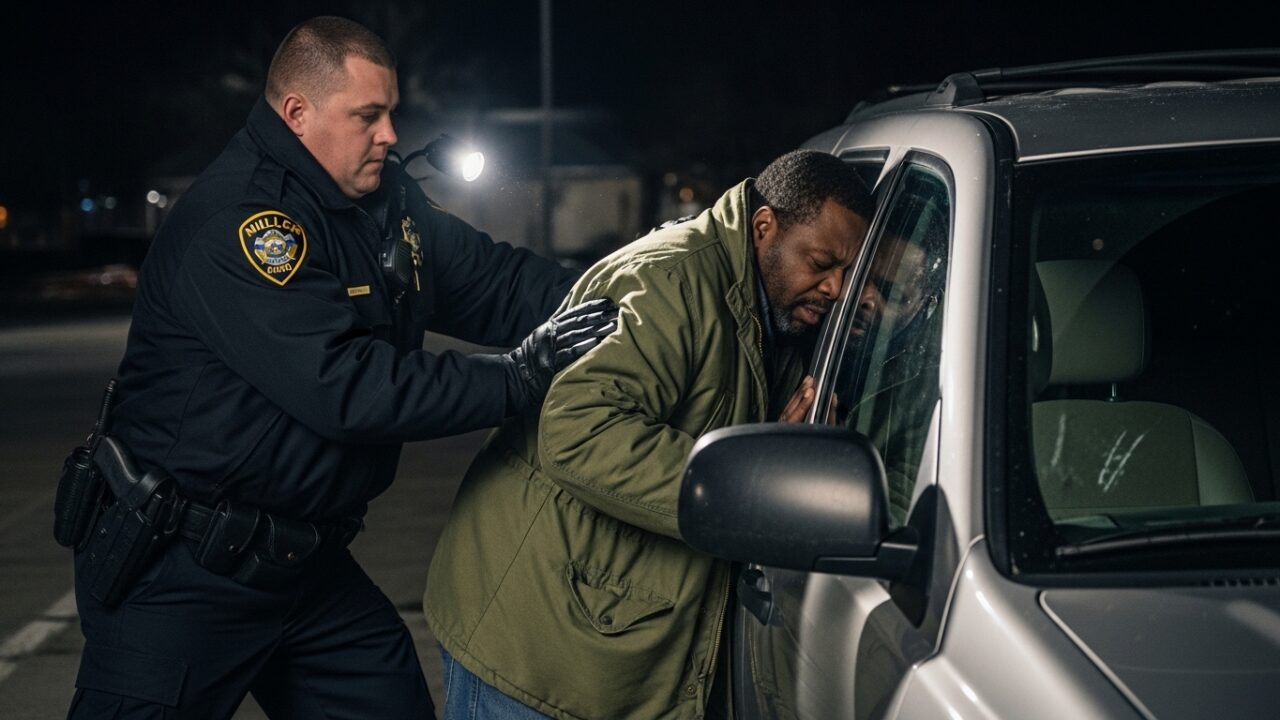
“For 45 Minutes, Two Cops Humiliated A Black Veteran—They Had No Idea 2 Million People Were Watching Live”

The red and blue lights cut through the December frost on my windshield like a knife.
It was 2:14 AM. I knew the time because the dashboard clock of my beat-up 2004 Ford Explorer was the only thing in my life that still worked perfectly.
When you’re a 52-year-old Black man sleeping in your car in a high-end suburban strip mall, you learn to sleep with one eye open. You learn to make yourself invisible. You park under the broken streetlights. You don’t play the radio. You try not to exist.
But tonight, being invisible wasn’t enough.
THWACK. THWACK. THWACK.
The heavy metal of a police-issue flashlight hit my driver’s side window so hard I thought the glass would shatter inward and blind me. My heart hammered against my ribs, a familiar, sickening rhythm.
“Roll it down! Let’s go!” a voice barked from the dark.
I fumbled with the keys, turning the ignition just enough to roll down the window. A blast of freezing air hit my face, immediately followed by the blinding white beam of a flashlight aimed directly at my eyes.
“Hands where I can see ’em,” the officer commanded. I raised my hands slowly, resting them on the top of the steering wheel. My knuckles were ash-dry and trembling from the cold.
“Got some ID?” The flashlight dropped slightly, illuminating my dark skin, my worn-out green Army jacket, and the exhaustion etched deep into my face.
“Yes, officer. It’s in my front pocket. I’m going to reach for it slowly,” I said, keeping my voice carefully steady, completely devoid of any edge. I knew the rules of this game. One wrong twitch, one sigh of frustration, and I was a threat.
“Just get it out,” a second voice chimed in from the passenger side. Younger. More eager.
I slowly pulled out my wallet and handed over my ID. Officer Number One—a broad-shouldered guy with a tight jaw and the nameplate ‘MILLER’—snatched it from my fingers. He shined his light on the plastic, then back at my face.
“Marcus,” Miller said, rolling my name around in his mouth like it tasted bad. “What are you doing here, Marcus? This is private property. Not a campground for deadbeats.”
“I was just resting, sir,” I replied. “I always move before the stores open at 6:00 AM. I don’t leave any trash. I don’t bother anyone.”
“You’re bothering me,” Miller sneered. “Get out of the car.”
“Officer, please, I have my DD-214 in the glovebox. I’m a veteran. I just fell on some hard times. It’s 15 degrees out here—”
“Did I ask for your life story?” Miller’s hand instinctively rested on the grip of his taser. “Step out of the vehicle. Now.”
I opened the door and stepped out into the biting winter wind. I didn’t even have my boots laced up, just thick wool socks on the freezing asphalt.
The younger cop, Davis, walked around the back of my SUV, shining his light into the rear windows where all my worldly possessions were neatly stacked in plastic bins.
“Look at this junk, man,” Davis laughed. “Looks like a rolling garbage can. Hey Miller, think it smells worse inside or outside?”
I stood by my door, arms crossed tightly over my chest to keep from shivering. I stared straight ahead at the brick wall of the ‘Tech Haven’ electronics store I was parked behind. I focused on a small, blinking red light mounted on the wall above the loading dock. Focus on the light. Don’t look at them. Don’t give them a reason.
“Spread ’em,” Miller barked, grabbing my shoulder and forcefully spinning me around to face the side of my car. He kicked my legs apart, much harder than necessary.
He began to pat me down, his hands roughly checking my pockets. “You got any needles on you? Any weapons? Crack pipes?”
“No, sir. Nothing like that.”
“We’ll see,” Miller grunted. “Davis, toss the car. Let’s see what our war hero is hiding.”
My chest seized. “Please, don’t,” I begged, my composure finally slipping. “Everything I own is in there. My medical records, my discharge papers, my photos of my daughter. Please, I know exactly where everything is.”
“Shut your mouth!” Miller shoved my face into the cold, wet metal of the roof. The pain shot through my cheekbone. “You don’t tell us how to do our jobs.”
I listened in agonizing silence as Davis opened my trunk. I heard the sound of plastic bins being ripped open. I heard the thud of my folded clothes hitting the dirty pavement. I heard the distinct sound of a glass picture frame shattering.
A tear, hot and stinging, rolled down my cheek and froze against the car roof.
I had served my country. I had bled in foreign sand. And now, I was being treated worse than a stray dog in a suburban parking lot, entirely because of how I looked and what I didn’t have.
They were having the time of their lives. They thought they were the kings of the world, teaching a lesson to a man who didn’t matter in the dead of night.
They thought it was just the three of us out there in the dark.
But I kept my eyes locked on that little red blinking light on the brick wall. I didn’t know it yet, but that little red light was a 4K resolution camera. And it wasn’t a security feed going to an empty room.
It was a promotional livestream for Tech Haven’s new line of ultra-HD outdoor streaming equipment. It was broadcast live on YouTube, 24 hours a day, 7 days a week.
And right now, someone on the internet had just posted a link to it on Reddit.
The cold of the car roof was a living, breathing entity. It didn’t just chill my skin; it bit into my flesh, sinking its teeth all the way down to the bone. My cheek was mashed against the frosted metal of my Ford Explorer, and with every breath I took, a tiny cloud of white vapor plumed into the freezing air, only to be immediately snatched away by the biting December wind.
Officer Miller’s heavy, leather-gloved hand remained firmly planted between my shoulder blades, pressing my chest flat against the vehicle. The angle was awkward, straining my rotator cuffs—shoulders that had carried eighty-pound rucksacks across the unforgiving deserts of Fallujah twenty years ago, now screaming in protest under the weight of a local cop with a chip on his shoulder.
“Don’t move,” Miller hissed, his voice right next to my ear. I could smell the stale coffee and wintergreen tobacco on his breath. “You so much as twitch, and I’m taking you to the ground. You understand me, Marcus?”
“Yes, sir,” I managed to say, my voice tight and muffled against the roof. “I’m not moving. I’m completely compliant.”
I had learned the hard way that compliance didn’t guarantee safety, but it was the only card I had left to play. When you look like me—a six-foot-two Black man in a weathered, oversized military surplus jacket, with a graying beard and the unmistakable scent of someone who hasn’t seen a warm shower in a week—you are rarely afforded the benefit of the doubt. In the eyes of men like Miller, I wasn’t a citizen. I wasn’t a veteran who had served two tours. I was a nuisance. A statistical probability. A smudge on the pristine, affluent landscape of their suburban patrol route.
Behind me, the symphony of my destruction continued.
Rip. Crash. Thud. Officer Davis was tearing through my life. My Explorer wasn’t just a car; it was my home, my storage unit, my safety deposit box, and my sanctuary. Every single thing I owned in this world was packed into the rear cab. It was organized. It had to be. When you live in a vehicle, chaos is the enemy of sanity. I had three plastic bins: one for dry food and utensils, one for my clothes, and one for my important documents and personal keepsakes.
“Man, this guy is a pack rat,” Davis’s voice echoed from the open trunk, followed by a wet, hacking laugh. “Hey, Miller, you think this guy is hoarding trash to build a nest?”
“Probably,” Miller grunted, leaning a fraction more of his body weight onto my spine. “Careful where you stick your hands, Davis. These people always have dirty needles tucked away. Prick yourself, and you’ll be on antiretrovirals for a year.”
“I’m wearing my puncture-proofs, don’t worry,” Davis replied, his voice muffled as he leaned deeper into my car. “Whoa, look at this.”
I heard the distinct, agonizing sound of plastic snapping. It was the lid of my third bin—the blue one. The one that held my life before the bottom fell out.
“Please,” I whispered, the word escaping my lips before I could stop it. “Please, officer. That’s my personal paperwork. My medical records.”
Miller’s hand seized the scruff of my jacket, yanking me backward just an inch before slamming my face back down against the icy roof. My lip caught against my teeth, and I tasted the sudden, sharp metallic tang of blood.
“Did I say you could speak?” Miller growled, his tone dropping an octave, losing the casual cruelty and replacing it with something far more dangerous. “You speak when spoken to. You’re a guest in my town, Marcus, and right now, you’re overstaying your welcome.”
I closed my eyes, focusing on the pain in my lip to keep from crying out. I swallowed the blood. I took a slow, jagged breath through my nose.
Control. Maintain control. It was a mantra I had learned in basic training, reinforced under sniper fire in the Middle East. Panic kills. Anger kills. Silence and endurance were my only armor. But the armor was cracking.
“Hey, we got a reader here,” Davis announced, his boots crunching on the frost-covered asphalt as he walked around to the side of the car, holding something up to the harsh glare of the parking lot lights. “Look at this, Miller. The Meditations of Marcus Aurelius. Real intellectual we got here.”
He tossed the book onto the ground. I heard its spine crack against the pavement. That book had been a gift from my old platoon sergeant, a man who had died in a Humvee rollover in ’06. I had read it cover to cover a dozen times. Its pages were soft, warped by humidity and age, filled with my handwritten notes in the margins. Now, it was lying open in a puddle of dirty, frozen slush.
“Probably stole it from the public library,” Miller scoffed.
“Oh, man, and look at this,” Davis said, his voice suddenly shifting to a tone of mocking sympathy. “We got a family man.”
My blood ran completely cold. Colder than the wind. Colder than the metal against my face.
“Don’t,” I breathed, a quiet, desperate plea that was instantly lost in the wind.
I knew exactly what he was holding. It was a silver, brushed-metal frame, slightly tarnished around the edges. Inside was a 5×7 photograph of my daughter, Maya. She was seven years old in the picture, wearing a bright yellow sundress, her hair in two perfect, bouncy puffs, holding a giant blue ribbon she had won at a school science fair. It was taken six years ago. Before the layoffs. Before my PTSD flared up so badly I couldn’t hold down a job. Before my wife, God rest her soul, passed away from ovarian cancer, leaving me drowning in medical debt that eventually consumed our house, our savings, and my stability.
Maya was living with my sister in Atlanta now. She thought I was traveling for work. She thought I was doing okay. The lie tasted like ash in my mouth every time I called her from a borrowed phone, but I couldn’t bear to let her know her father was sleeping in parking lots, washing his face in gas station sinks. That picture was my anchor. It was the only thing that kept me from driving my car into a concrete bridge abutment on the nights when the darkness inside my head got too loud.
“Aww, she’s cute,” Davis said, though his voice lacked any genuine warmth. “Looks a little too well-dressed to be yours, buddy. Sure you didn’t swipe this from a house you burgled?”
“That’s my daughter,” I said, my voice trembling. Not from the cold, but from a terrifying, volcanic rage that was threatening to erupt from my chest. I pushed up slightly against Miller’s hand. “Put it back. Please. It’s glass.”
“I told you to shut your mouth!” Miller roared.
He didn’t just shove me this time. He hooked his foot behind my ankle and kicked my leg out from under me. With my hands resting on the roof and my balance violently disrupted, I collapsed hard onto the asphalt. My knees hit the ground first, sending a shockwave of pain up my femurs, followed by my shoulder and the side of my head.
I gasped for air as the wind was knocked out of me. The pavement was brutal, covered in tiny, sharp rocks and salt pellets used to melt the ice. They ground into my cheek and the palms of my hands.
“Oops,” Davis chuckled from above me. “Clumsy.”
I looked up, my vision blurring slightly from the impact. Davis was standing over me. He looked at the picture frame in his hand, then looked down at me. A lazy, cruel smile spread across his young, clean-shaven face. He didn’t drop the frame. He tossed it.
He tossed it casually over his shoulder, like a piece of garbage.
Time seemed to slow down as I watched the silver frame arc through the air. It hit the ground near the rear tire of my car. The sound was distinct, sharp, and final. The glass shattered into a hundred jagged pieces, glittering like cruel diamonds under the harsh security lights. The photo of Maya in her yellow dress slipped out, landing face up in the dirty slush.
A sound tore from my throat—a guttural, ragged noise that didn’t even sound human. It was the sound of a man watching his last piece of a soul being trampled. I scrambled forward on my hands and knees, ignoring the pain, reaching desperately for the photo before the slush could soak through the paper and ruin her smiling face.
“Get back here!” Miller yelled.
Before I could reach the photo, a heavy black boot stepped squarely onto the picture. Miller ground his heel into the paper, pushing Maya’s face deep into the wet dirt and salt.
“You move when I tell you to move,” Miller spat, standing over me, his hand hovering over his holster. “You want to play games, Marcus? We can play games.”
I stared at his boot. I stared at the edge of the yellow dress peeking out from under the thick rubber tread. I felt my hands balling into fists. I felt the military training kicking in, calculating the distance to his knee, the angle of his jaw, the time it would take to disable him before Davis could draw his weapon. It would take exactly three seconds. I could hurt him. I could hurt him badly.
But I would die.
If I raised a hand to a police officer in this empty, dark parking lot, I would be shot dead. They would claim I resisted. They would claim I reached for a weapon. The news would report a “homeless man with a history of mental illness involved in a fatal altercation with police.” Maya would grow up knowing her father died like a rabid dog in the dirt.
So, I unclenched my fists. I let the freezing slush soak through the knees of my thin jeans. I surrendered.
“Please,” I whispered to the ground, my spirit completely broken. “I’m sorry. I won’t move.”
“That’s what I thought,” Miller said smugly. He finally removed his boot from the ruined photograph. “Now get up. Put your hands on the brick wall. We’re going to do a proper search.”
I slowly pushed myself up. My joints ached, and a thin stream of blood trickled down my chin from my busted lip. I limped over to the brick wall of the Tech Haven electronics store, placing my hands against the rough, freezing masonry.
Right below a small, blinking red light.
What I didn’t know—what Miller and Davis couldn’t possibly fathom in their arrogant bubble of power—was that we were not alone.
Two miles away, in a cluttered, dark bedroom illuminated only by the glow of three massive computer monitors, a twenty-two-year-old college dropout named Tyler was eating cold pizza and moderating a Discord server. Tyler was an insomniac, a creature of the night who spent his hours surfing the weirdest, most obscure corners of the internet.
Earlier that week, Tech Haven, a national electronics retailer trying to compete with Best Buy, had launched a massive marketing campaign for their new “Sentinel Pro 4K Night-Vision Outdoor Streaming Camera.” To prove how powerful the camera was, the corporate marketing team had installed one on the back exterior wall of every flagship store in the country and set them to livestream 24/7 on YouTube and Twitch.
The idea was to show off the crystal-clear resolution, the unparalleled low-light sensors, and the hyper-sensitive directional microphones. They wanted customers to see that even in the pitch black of night, the Sentinel Pro could capture a raccoon eating from a dumpster in stunning 4K detail.
Most of the streams had zero viewers. They were just boring static shots of empty loading docks and parking lots.
But Tyler, bored out of his mind at 2:00 AM, had been clicking through random live feeds on a directory site. He stumbled onto “Tech Haven Cam #42 – Chicago Suburbs.”
For the first few minutes, Tyler had just watched the snow blow across the empty asphalt. He was about to click away to watch someone speedrun a video game when a beaten-up Ford Explorer pulled into the frame, parking directly under the camera.
Tyler watched idly as the lights of a police cruiser flashed into view a few minutes later. He watched the cops get out. He watched the interaction begin.
Because the Sentinel Pro had military-grade audio processing, Tyler didn’t just see the harassment; he heard every single word.
He heard the crack of the flashlight against the glass. He heard my polite, terrified voice. He heard Miller’s sneering insults.
Tyler stopped eating his pizza. He leaned closer to his monitor.
When Miller slammed my head onto the roof of the car, Tyler hit the “Record” button on his streaming software.
When Davis began tearing my life apart, throwing my belongings into the snow, Tyler opened his Discord server, which had over 50,000 members, mostly gamers and night-owls.
He typed: @everyone You guys need to get in here right now. Cops are abusing a homeless guy live on this corporate promo cam. This is insane. He dropped the YouTube link.
Within sixty seconds, the viewer count on the YouTube stream jumped from 1 to 400.
In the chat box on the side of the stream, messages started trickling in. User_Gamer99: wtf is this? is this real? NightHawk: whoa, did that cop just slam his head? SaltyPretzel: Bro, he’s just complying. Why are they doing that to his car?
Then, the camera captured the moment with the picture frame. The ultra-HD lens picked up the glint of the silver frame as Davis tossed it. The directional mic picked up the heartbreaking crack of the glass, followed by my ragged scream. It captured Miller’s boot grinding my daughter’s face into the dirt.
The internet did what the internet does best: it exploded.
The viewer count skyrocketed. 400 became 4,000 in a matter of minutes as the link was rapidly cross-posted to Reddit’s r/PublicFreakout, r/Bad_Cop_No_Donut, and Twitter.
xXx_Sniper_xXx: THIS MAKES ME SICK. SOMEONE CALL THE POLICE ON THE POLICE. MamaBear88: That poor man. That was a picture of a child! He stepped on a picture of his kid! JusticeNow: Does anyone know what city this is? Look at the sign on the door!
Internet sleuths immediately went to work. Within two minutes, someone had identified the exact location based on the ‘Tech Haven’ store number painted on the loading dock doors. They pulled up the local police department’s information.
DarkWebDecoy: It’s the Oakridge precinct in Illinois. Here’s their non-emergency dispatch number: (555) 867-5309. LIGHT THEM UP.
While I stood shivering against the brick wall, feeling the icy masonry pull the last bits of heat from my body, the live chat was scrolling so fast it was a blur of text. 15,000 viewers. Then 50,000.
High-profile streamers with millions of followers, seeing the viral trend on Twitter, began “raiding” the channel, bringing their entire audiences with them.
The viewer count ticked over 500,000.
And Miller and Davis had absolutely no idea.
Back in the parking lot, my reality was confined to the agonizing pain in my frozen fingers and the relentless cruelty of the two men behind me.
“Take off the jacket,” Miller commanded, stepping up directly behind me.
I froze. “Officer, it’s fifteen degrees out here. I just have a thin flannel underneath. I’ll freeze.”
“I said take off the damn jacket,” Miller barked, drawing his taser and pressing the plastic muzzle directly against the base of my spine. “You think I’m going to pat down a thick, oversized military coat? You could have a machete hidden in there for all I know. Strip it off. Now.”
My hands were shaking so violently I could barely work the zipper. My fingers were numb, thick, and unresponsive. It took me three tries to get the zipper down. I slid the heavy green canvas off my shoulders. The wind immediately cut through my thin, worn-out flannel shirt like a barrage of icy razors. My entire body went into a violent, uncontrollable spasm of shivering.
I dropped the jacket to the floor.
“Now the flannel,” Miller said.
“What?” I gasped, turning my head slightly. “You can’t—you can’t do this. That’s not a search, that’s torture. Please, I’ll freeze to death.”
“Are you resisting, Marcus?” Miller’s thumb clicked the safety off the taser. The mechanical sound was loud in the quiet night. “Because if you’re resisting a lawful search, I’m going to light you up, and then you’ll really be shaking.”
Tears streamed down my face, freezing before they even reached my chin. Humiliation burned hotter than the cold. I was a fifty-two-year-old man. A father. A veteran. And I was being forced to strip in a freezing parking lot for the sheer amusement of two sadists with badges.
I unbuttoned the flannel with clumsy, frostbitten fingers. I let it fall. I was now standing in a tattered, gray undershirt. My dark skin erupted in goosebumps. My breath came in short, ragged gasps. I was rapidly approaching hypothermia.
Miller stepped up and patted down my jeans, his hands rough and intrusive. He reached up and yanked something from my neck. The thin metal chain snapped, biting into the skin at the back of my neck.
He stepped back, holding my military dog tags up to his flashlight.
“Look at this, Davis,” Miller sneered, reading the stamped metal. “Marcus Johnson. US Army. Blood type O-Positive. What’d you do, Marcus? Buy these at a surplus store to get a discount at Denny’s?”
“I served… four years,” I chattered, my teeth clicking together so hard my jaw ached. “10th Mountain… Division. Two tours.”
“Yeah, right,” Miller laughed, tossing the dog tags into the slush next to my ruined photograph. “If you were a real soldier, you wouldn’t be a pathetic bum living in a garbage can. Real veterans have discipline.”
The hypocrisy of his words was staggering, but I was too cold to process the anger. My core temperature was plummeting. I hugged my arms around my chest, trying to preserve whatever heat I had left. I leaned my forehead against the freezing brick wall.
Just let it end, I prayed silently. Just let them get bored and leave.
“Hey, jackpot!” Davis yelled from the car.
I turned my head. Davis was holding up a small, orange plastic cylinder. A prescription pill bottle.
“Got him, Miller,” Davis said, practically jogging over, a look of triumphant glee on his face. “Found the stash.”
“What is it?” Miller asked, stepping away from me to examine the bottle.
“It’s… wait,” Davis squinted at the label. “Sertraline? Prazosin?”
“That’s my VA medication,” I pleaded, taking a shaky step away from the wall. “Please. It’s for my PTSD and night terrors. I need those. It took me six months to get that prescription filled at the VA clinic.”
Miller looked at the bottle, then looked at me. A malicious glint appeared in his eyes. He didn’t care what the label said. He only cared about the power he held in his hands. The power to break me down to absolutely nothing.
“Looks like contraband to me,” Miller said smoothly. “Labels can be faked. Street dealers put fentanyl in everything these days.”
“No!” I yelled, stepping toward him, a surge of desperate adrenaline overriding the freezing cold. “That’s my medicine! If I don’t take it, I—”
“BACK UP!” Miller roared, dropping the bottle and shoving me violently in the chest with both hands.
My feet slipped on the icy asphalt, and I went down hard again, this time landing on my back. The impact knocked the wind out of me completely. I lay there, staring up at the dark, starless sky, gasping like a fish out of water.
Miller stood over the orange pill bottle. With deliberate, agonizing slowness, he raised his heavy boot.
“Oops,” Miller said softly.
He brought his heel down on the bottle. Crack. The safety cap popped off. He ground his boot back and forth, twisting his weight into it. The small white and blue capsules burst open, mixing their powdery contents with the dirty, salty, frozen slush of the parking lot.
My lifeline. Gone. Months of navigating the bureaucratic nightmare of the Veterans Affairs healthcare system, destroyed in a single second by a man who simply enjoyed the sound it made.
“Contraband disposed of,” Miller announced to Davis. “Write that down in the log.”
Davis chuckled nervously, taking out a small notebook. Even he seemed slightly taken aback by the blatant destruction of clearly labeled prescription medication, but he wasn’t going to cross his senior officer.
I rolled onto my side, curling into a fetal position. I was so cold I couldn’t feel my toes or my fingers anymore. A deep, heavy lethargy was settling over my brain. It would be so easy to just close my eyes. To let the cold take me. At least in sleep, I wouldn’t have to look at their faces. I wouldn’t have to see my daughter’s picture ruined in the dirt.
Above me, the little red light on the Sentinel Pro camera blinked steadily.
Blink. Blink. Blink. Two million people were watching.
Two million people had just watched a police officer destroy a homeless veteran’s psychiatric medication on live, high-definition video.
In the Oakridge precinct, five miles away, the nightmare was just beginning for the police department. The sole 911 dispatcher on duty, a woman named Brenda, was pouring herself a cup of coffee when her switchboard lit up.
It wasn’t one call. It wasn’t ten.
Every single line on the board flashed red simultaneously. The system, designed to handle maybe a dozen simultaneous emergency calls in their quiet suburb, immediately crashed, rebooted, and flashed red again.
Brenda slammed her coffee down and grabbed her headset. “911, what is your emergency?”
“Are you seeing what your pigs are doing behind the Tech Haven right now?!” a frantic, angry voice yelled through the line. “I’m watching it live on YouTube! They’re torturing a homeless man!”
Brenda blinked, confused. “Ma’am, I need a location—”
The line dropped, overwhelmed by the sheer volume of incoming calls. Brenda hit the next flashing button.
“Arrest Officer Miller and Officer Davis immediately!” a man with a thick British accent shouted. “We have it all on video! You absolute bastards!”
Brenda’s heart dropped. She looked up at the wall monitors where they kept the local news feeds. She quickly opened a browser window and typed in what the callers were screaming about.
When the YouTube feed loaded on her screen, Brenda gasped, putting her hand over her mouth.
She saw Marcus Johnson, a veteran, lying half-naked in the freezing slush, curled in a ball, shivering violently. She saw Officer Miller standing over him, laughing, adjusting his duty belt. She saw the chat box scrolling so fast it looked like a waterfall of pure, unadulterated public fury.
The viewer count read: 2,145,892.
Brenda grabbed her radio mic, her hands shaking. She switched to the emergency all-units broadcast frequency.
“Dispatch to Unit 4-Bravo. Miller. Davis. What is your 20? Come in, Unit 4-Bravo!”
In the parking lot, Miller’s radio crackled loudly on his shoulder.
“Dispatch to Unit 4-Bravo. I repeat, what is your status? Acknowledge immediately!”
Miller sighed, rolling his eyes at Davis. He reached up and keyed his mic. “4-Bravo. We’re on scene at the Tech Haven on Route 9. Investigating a suspicious vehicle. Code 4, dispatch. Everything is under control. No need to yell.”
“Unit 4-Bravo,” Brenda’s voice came back, tight with panic, shaking with an urgency that made Miller’s smile instantly vanish. “Cease all action immediately. The Chief of Police is being woken up. The Mayor is being called. You have to stop.”
Miller frowned, exchanging a confused look with Davis. “Stop what, dispatch? We’re just doing a routine check on a vagrant.”
There was a long pause on the radio. When Brenda spoke again, her voice wasn’t just panicked; it was filled with absolute horror and pity.
“Miller… look at the brick wall behind you. Look up.”
The radio clipped to Officer Miller’s shoulder crackled again, spitting out static that sounded unnaturally loud in the dead, freezing quiet of the parking lot.
“Unit 4-Bravo,” Dispatcher Brenda’s voice echoed, stripped of all its usual professional detachment. It was trembling. It was terrified. “Miller… look at the brick wall behind you. Look up.”
I was lying on my side in the salted slush, my knees pulled tightly to my chest. The cold had stopped feeling like a sharp bite and had morphed into a heavy, suffocating blanket. My fingers and toes were entirely numb, and a dangerous, warm sleepiness was beginning to pull at the edges of my consciousness. But even through the haze of impending hypothermia, I heard the shift in the dispatcher’s voice. It wasn’t a warning. It was a death sentence.
Miller froze. His heavy boot, still hovering inches above the crushed remnants of my PTSD medication, slowly lowered to the asphalt.
He turned his head. His neck moved stiffly, like a rusty hinge, until he was facing the towering brick facade of the Tech Haven store. He tilted his head back.
Officer Davis, sensing the sudden, unnatural plunge in the atmosphere, stopped writing in his notepad. “Miller? What is it? What’s dispatch talking about?”
Miller didn’t answer. He just stared.
Above my head, about twelve feet up the wall, the Sentinel Pro 4K camera sat mounted on a sleek metal bracket. It was a state-of-the-art piece of machinery, matte black, with a cluster of infrared sensors surrounding a massive, unblinking glass lens. And right above the lens, a tiny, cherry-red LED light pulsed with a steady, rhythmic heartbeat.
Blink. Blink. Blink.
“What is that?” Davis asked, his voice cracking slightly as he walked over to stand beside his partner. He squinted up at the wall. “Is that a security camera? Man, who cares? It’s a private corporate lot. We have jurisdiction to clear vagrants. They don’t check those tapes unless a window gets smashed.”
Miller raised a trembling, gloved hand and pressed the button on his shoulder mic. “Dispatch,” he croaked, his voice suddenly hollow, stripped of all its previous arrogant swagger. “It’s a security camera. So what? We’re conducting a standard Terry stop and property search.”
“Miller, you idiot, listen to me!” Brenda screamed over the radio, entirely dropping protocol. Her voice echoed loudly across the empty asphalt, bouncing off the brick walls. “It’s not a closed-circuit tape! It’s a promotional livestream! It’s broadcasting directly to YouTube!”
The silence that followed was so absolute, so heavy, it felt like the air pressure in the parking lot had suddenly dropped.
“What… what do you mean, live?” Miller stammered, the radio shaking in his grip.
“I mean there are currently two point six million people watching you right now, Miller!” Brenda’s voice was hysterical. “They saw the car. They saw the picture frame. They saw you make him strip. They saw the pills. The station’s switchboard just melted down. The Governor’s office is calling the Chief on his cell. The FBI field office in Chicago just tweeted about it. You are on the front page of every social media platform on earth.”
The flashlight slipped from Davis’s hand. It hit the frozen ground with a sharp crack, the beam rolling crazily across the snow, illuminating the scattered, tragic debris of my life—the shattered glass of Maya’s photo, the torn clothing, the crushed orange pill bottle.
“Oh my God,” Davis whispered. The blood drained from his face so fast he looked like a ghost under the harsh sodium lights. “Oh my God. Oh my God.”
“Stand down immediately,” Brenda ordered, her voice trembling. “Do not touch him again. Do not speak to him. The Chief is three minutes out with a convoy. State troopers are en route. The press is already listening to our scanners. Miller, if you do one more thing, you are going to federal prison.”
The radio clicked off.
I lay in the freezing slush, a violent shiver wracking my half-naked body. I didn’t fully understand what YouTube or a livestream was—I hadn’t owned a smartphone in three years—but I understood the absolute, unadulterated terror radiating from the two men standing over me.
The monsters who, just sixty seconds ago, possessed the power of life and death over me, were suddenly shrinking. The impenetrable armor of their badges was melting away, exposing two terrified, cowardly bullies who had just been caught with their hands in the devil’s cookie jar.
Miller’s chest heaved. He looked down at his own hands, then at the camera, then down at me. The sadistic gleam in his eyes had been entirely replaced by the wide-eyed panic of a cornered rat.
“Davis,” Miller hissed, his voice a frantic, breathless whisper. “Pick up the stuff. Pick it up now!”
“Are you insane?!” Davis shrieked, backing away, holding his hands up as if the very air around my car was radioactive. “I’m not touching anything! Two million people, Miller! They saw everything! My career is over! My life is over!”
“I said pick it up!” Miller lunged forward, grabbing Davis by the collar of his uniform jacket. “We have to make it look like—like we were helping him! Like it was a misunderstanding!”
“Helping him?!” Davis shoved Miller away, a hysterical, panicked laugh tearing from his throat. “You stepped on his kid’s picture! You crushed his meds! You made him strip in fifteen-degree weather! How do you spin that, Miller? Tell me how you spin that!”
Miller was hyperventilating now. The reality of his absolute destruction was crashing over him in real-time. He turned to me.
Suddenly, the monster vanished, replaced by a grotesque, desperate caricature of a public servant. He dropped to his knees in the slush beside me, reaching out with shaking hands.
“Hey, hey there, buddy,” Miller said, his voice artificially sweet, a sickeningly fake tone of deep concern that made my stomach churn. “Come on now, let’s get you off the cold ground, huh? That’s not safe. Here, let me help you with your jacket.”
He reached for my arm.
Even freezing to death, even with my brain moving at a fraction of its normal speed, I knew exactly what was happening. He wanted the camera to see him acting like a savior. He wanted to muddy the waters.
I found a reserve of strength deep within my shivering core. I pulled my arm back, refusing to let him touch me. I looked him dead in the eye.
“Don’t,” I choked out, my teeth chattering violently. “Don’t touch me.”
“Marcus, please,” Miller begged, and there were actual tears welling up in his eyes now. Tears of self-pity. Tears of terror. “Look, we got off on the wrong foot. I was just doing a security check. I’m sorry about the stuff. I’ll buy you new pills. I’ll buy you a new frame. Just… just stand up and put your coat on. Please.”
He reached for the heavy green military jacket he had forced me to drop. He tried to drape it over my freezing, bare shoulders.
“Get away from him!”
The voice didn’t come from the radio. It came from the darkness of the parking lot.
Miller and Davis both snapped their heads around, their hands instantly dropping to their holsters out of pure reflex.
A lifted, black Dodge Ram pickup truck had just careened into the parking lot, blowing past a stop sign and slamming on its brakes about thirty yards away. The doors flew open. A massive guy in a Carhartt jacket and a baseball cap jumped out. He wasn’t armed with a gun. He was armed with an iPhone, held horizontally, the flash glaring brightly in the dark.
“I see you!” the man roared, storming across the asphalt. “I live two blocks away! I was watching the stream! Back the hell away from him right now!”
“Sir, step back!” Miller yelled, trying to summon his authoritative cop voice, but it cracked pathetically. “This is an active police investigation!”
“Investigation my ass!” the man yelled, not slowing down for a second. He pointed his phone directly at Miller’s face. “You’re a domestic terrorist! The whole internet is watching you, you piece of garbage! You made a veteran strip in the snow! I’ve got a hundred thousand followers on TikTok watching this live right now from my end. Try something! I dare you!”
Before Miller could even process the civilian’s arrival, the squeal of tires echoed from the main road. A battered Honda Civic jumped the curb, tearing across the frozen grass and sliding to a halt next to the truck. Four teenagers piled out, all of them wielding smartphones like weapons, all of them screaming at the cops.
“Leave him alone!” a young girl in a puffy coat shrieked.
“We got you on 4K, pig!” one of the boys yelled.
Then came a minivan. Then a Prius.
It was like watching a magic trick. The lonely, desolate, silent parking lot where I was supposed to die a quiet, invisible death was suddenly flooding with headlights. The internet wasn’t just watching anymore. The internet had mobilized. People who lived in the surrounding neighborhoods, people who were awake at 3:00 AM doom-scrolling, had recognized the Tech Haven store.
They weren’t coming to riot. They were coming to witness. They were coming to form a human shield around a man they had never met.
Within five minutes, there were over forty civilians swarming the area, completely encircling my Ford Explorer. Every single one of them had a camera glowing in the dark. The collective glare of a hundred smartphone flashes illuminated the crime scene better than the police cruiser’s headlights.
“Somebody get him a blanket!” a woman screamed, pushing her way to the front of the crowd. “He’s freezing! He’s going to die out here!”
“Back up! All of you, back up!” Davis was crying now, actual tears streaming down his young face as he unholstered his taser, pointing it aimlessly at the crowd. He was shaking so badly he could barely stand. “Interfering with a police officer! I’ll arrest all of you!”
“Do it!” the man in the Carhartt jacket roared, stepping right into the laser sight of Davis’s taser. “Tase me on three million screens, you coward! Do it!”
Davis broke. He dropped the taser, backed up against the side of the police cruiser, and slid down to the ground, putting his head between his knees and sobbing hysterically.
Miller stood in the center of the ring of civilians, turning in slow circles. He was trapped. There was no shadow left to hide in. The badge on his chest, which he had used as a shield to commit acts of pure cruelty, was now a blinding beacon of his own guilt.
Then, the wailing started.
It started as a faint, high-pitched whine in the distance, but it grew rapidly, multiplying until it sounded like a pack of metal wolves descending on the suburb.
Red and blue strobes painted the sky over the commercial district.
Through the entrance of the strip mall, a motorcade erupted. But it wasn’t the local Oakridge PD cruisers. It was a fleet of heavy, unmarked black SUVs, flanked by six Illinois State Police interceptors. They swarmed the lot, tires smoking on the frost, surrounding the civilian cars, surrounding Miller’s cruiser.
The doors flew open, and state troopers in tactical gear poured out, but they didn’t aim their weapons at the crowd. They aimed them directly at Officer Miller.
“Hands in the air! Hands in the air right now!” a State Trooper screamed over a bullhorn.
From the lead black SUV, a man in a dark suit stepped out. He was older, with silver hair and a face contorted into a mask of absolute, unbridled fury. This was Chief Henderson, the head of the Oakridge Police Department. He looked like a man who had just watched his entire legacy burn to the ground on live television. Because he had.
Chief Henderson didn’t walk; he stomped across the asphalt, shoving past a group of teenagers who immediately shoved their phones in his face.
“Chief Henderson! Care to comment on your officers torturing a homeless man?” a kid yelled.
Henderson ignored them. He marched straight up to Miller.
“Chief, listen, it’s not what it looks like,” Miller pleaded, his hands raised in the air, his voice cracking. “We were just—”
SMACK.
The sound echoed sharply over the murmur of the crowd. Chief Henderson hadn’t said a word. He had simply backhanded Miller across the face with enough force to spin the heavy-set officer around.
The crowd gasped, then a cheer went up.
“You stupid, arrogant son of a bitch,” Henderson spat, his voice shaking with a rage so profound it was terrifying. “You didn’t just ruin your life tonight. You brought the entire Department of Justice down on my city.”
Henderson turned to the State Troopers. “Disarm them. Both of them. Strip them of their badges. Cuff them and put them in the back of the state units. I don’t want them in my cars.”
Troopers swarmed Miller and Davis. They didn’t use the gentle, professional courtesy usually reserved for fellow officers. They slammed Miller against the hood of his own cruiser, roughly tearing his service weapon from his belt, ripping the silver badge from his chest, and ratcheting heavy steel handcuffs onto his wrists.
“You’re hurting my shoulder!” Miller cried out.
“Shut your mouth, you disgrace,” the trooper hissed in his ear.
Through all of this, I was still on the ground. The crowd had pushed forward, but the state troopers had formed a perimeter around me. The biting cold had finally won. My vision was tunneling, turning black at the edges. The sound of the sirens, the screaming crowd, the Chief’s fury—it all sounded like it was happening underwater.
Suddenly, a massive, incredibly warm weight was thrown over me.
“I got you, brother. I got you.”
I forced my eyes open. It was the massive guy in the Carhartt jacket. He had pushed past the troopers and thrown a thick, heavy wool emergency blanket over my shivering body. He knelt beside me in the slush, ignoring the cold entirely. He carefully wrapped the blanket around my shoulders, tucking it under my chin.
“Paramedics are thirty seconds out,” the man said, his voice surprisingly gentle for someone who had just been screaming at cops. “Just hang on, okay? You’re safe now. I promise you, you’re safe. Millions of people are watching your back right now.”
I looked at him, my lips blue, my jaw locked tight from the shivering. I wanted to say thank you, but I couldn’t make my mouth form the words.
A moment later, an ambulance tore into the parking lot, its siren blaring a deafening warning as it hopped the curb to get as close to me as possible. Two paramedics leaped out before the rig even fully stopped, carrying a stretcher and an orange trauma bag.
They rushed to my side, pushing the civilian back gently.
“Sir, can you hear me?” a female paramedic asked, shining a penlight into my eyes. “We’ve got severe hypothermia. Heart rate is erratic. Let’s get him on the board and into the rig. Move, move, move!”
They lifted me with practiced efficiency onto the stretcher. As they hoisted me up, the thick blanket fell away slightly. The crowd pressed in tighter. The state troopers were struggling to hold them back.
“We love you, man!” someone yelled from the crowd.
“Thank you for your service!” another voice cried out.
As they wheeled me toward the back of the ambulance, the sea of people parted. Standing right by the open doors of the rig was Chief Henderson. He looked physically ill, his face pale and sweating despite the freezing temperature.
He took a step toward my stretcher, holding his hands up placatingly.
“Mr. Johnson,” Chief Henderson said, his voice dripping with an apology that felt a million miles deep and entirely hollow. “Mr. Johnson, on behalf of the city, on behalf of this department, I cannot express my absolute horror. Those men do not represent us. We are going to make this right. The city will replace everything. We will put you in a hotel tonight. Just… please, let us take care of you.”
I lay strapped to the stretcher, a thick heated blanket finally starting to thaw the ice in my veins. I looked at the Chief of Police. I looked past him, at Miller and Davis being shoved into the back of a State Police cruiser, their heads bowed, their careers and freedom vanishing into the dark.
I looked at the brick wall. The little red light on the Sentinel Pro camera was still blinking.
I didn’t smile. I didn’t yell. I didn’t offer the Chief of Police any forgiveness, because he wasn’t really apologizing to me. He was apologizing to the camera. He was apologizing to the three million people holding his city by the throat.
I turned my head away from the Chief, looking up at the paramedic who was strapping an oxygen mask over my face.
“My daughter’s picture,” I whispered, my voice raspy and broken, but loud enough for the closest smartphones to catch. “They stepped on my daughter’s picture.”
The paramedic swallowed hard, nodding. “We’ll get it, sir. We’ll make sure it comes with you.”
As the ambulance doors slammed shut, cutting off the flashes of the cameras and the screams of the crowd, I closed my eyes. The cold was finally retreating. The nightmare was over.
But as the ambulance sped away toward the hospital, I had absolutely no idea that the real twist of the night hadn’t even happened yet. The internet hadn’t just gotten two dirty cops arrested.
They had started digging into who I was. And they had found a secret I had buried twenty years ago in the desert of Iraq.
The transition from the absolute, bone-shattering edge of death to the sterile safety of a hospital room is not a peaceful one. You don’t just wake up feeling refreshed. You wake up feeling like every cell in your body has been put through a meat grinder and then set on fire.
The first thing I registered was the steady, rhythmic beep-beep-beep of a heart monitor. The second was the heavy, suffocating weight of three heated thermal blankets pinning me to a stiff mattress.
I tried to open my eyes, but my eyelids felt like they were glued shut with grit. When I finally forced them apart, the harsh fluorescent lights of the intensive care unit stabbed into my retinas. I groaned, a dry, ragged sound that tore at my throat.
“Take it easy, Mr. Johnson. Don’t try to move yet.”
A face swam into my blurred vision. It belonged to a nurse, maybe in her late thirties, with kind eyes and a tired smile. Her nametag read Elena.
“Water,” I croaked. It was a pathetic, broken sound.
Elena was quick. She slipped a small plastic straw past my cracked, swollen lips. The cold water hit the back of my throat like a miracle. I drank greedily until she gently pulled it away.
“Not too fast,” she warned softly, adjusting the IV line running into the back of my hand. “Your core temperature dropped to 92 degrees. You were about twenty minutes away from your organs shutting down entirely. You have frostnip on your toes and fingers, a mild concussion, and some severe bruising on your ribs and face. But you’re going to live, Marcus.”
I closed my eyes, letting the reality wash over me. I was alive. I was warm.
Then, the memories hit me like a physical blow. The freezing parking lot. The flashlight blinding me. Officer Miller’s sadistic smile. The sound of the glass shattering.
My eyes snapped open, panic seizing my chest. “My daughter. Her picture. They crushed her picture.”
“We have it,” Elena said immediately, placing a comforting hand on my shoulder. “The paramedics brought the frame in a plastic evidence bag. The glass is gone, and the picture is a little stained from the salt and snow, but her face is perfectly intact. We have it in the lockbox for you.”
I let out a shuddering breath, a single tear escaping the corner of my eye and tracking down into my graying beard. The anchor held.
“How… how long have I been out?” I asked, my voice still raspy.
“About fourteen hours,” Elena said. She hesitated, looking toward the door of the private room, then back at me. Her expression shifted from professional medical concern to something resembling sheer awe. “Marcus… do you have any idea what happened while you were asleep?”
I shook my head slowly. “The cops… they arrested those two cops. The Chief of Police was there. The internet called them.”
Elena let out a short, incredulous laugh. “Marcus, the internet didn’t just call them. The internet went to war for you.”
She picked up a tablet resting on the bedside table and tapped the screen a few times. She held it up so I could see it.
It was the front page of a major national news website. The headline took up half the screen in bold, screaming letters:
NIGHTMARE IN OAKRIDGE: POLICE OFFICERS CAUGHT ON LIVE STREAM TORTURING HOMELESS VETERAN. NATION DEMANDS JUSTICE.
Below the headline was a screenshot from the Tech Haven camera. It was the exact moment Officer Miller had his boot pressed down on my shattered medication bottle, while I lay in the snow, stripped to my undershirt. Seeing it from the outside, seeing how incredibly vulnerable and pathetic I looked, made my stomach churn.
“It’s everywhere,” Elena said softly. “Every major news network. CNN, Fox, MSNBC. It’s the number one trending topic worldwide on Twitter. The viewer count on that livestream hit nearly four million before the platform shut it down. The Oakridge Police Department’s website was crashed by a DDoS attack within an hour. The Mayor’s office phone lines are dead.”
I stared at the screen, my mind unable to process the scale of it. For seven years, I had been completely invisible. I was the guy people rolled up their windows to avoid at intersections. I was the ghost sleeping in the shadows of their strip malls. And now, four million people had watched me bleed.
“They arrested them, right?” I asked, a surge of anxiety tightening my chest. “They’re in jail?”
“Denied bail,” Elena confirmed, her voice hardening with satisfaction. “The FBI field office in Chicago took over the investigation at 5:00 AM. They’re charging them with federal civil rights violations, assault under the color of law, and a laundry list of state felonies. They are in federal custody, Marcus. They can’t hurt you anymore.”
A knot in my chest that I had been carrying for years—a knot of fear, of humiliation, of knowing that my dark skin and my poverty made me a target—finally, slowly, began to loosen.
But Elena wasn’t done. She swiped to a different tab on the tablet. It was a GoFundMe page.
“When people saw the officers destroy your medication and your belongings, a young man who was moderating a gaming community started this,” Elena explained. “He set the goal at ten thousand dollars to help you buy a new car and replace your things.”
I looked at the number on the screen. I blinked. I blinked again, assuming the concussion was messing with my vision.
The number wasn’t ten thousand.
It was $2,140,500.
Two million dollars. “People are angry, Marcus,” Elena whispered, her eyes shining with unshed tears. “But more than that, they are heartbroken. They saw a man who served his country being treated worse than dirt. And they wanted to fix it.”
I couldn’t speak. I couldn’t breathe. Two million dollars. It was an abstract concept. It meant a house. It meant I could pay off the mountain of medical debt my wife’s cancer had left behind. It meant I didn’t have to lie to Maya anymore. It meant I could bring my little girl home.
I buried my face in my hands and sobbed. I wept with the force of a man who had been holding his breath for a decade. Elena didn’t say anything; she just stood there and let me break down, handing me tissues when I finally gasped for air.
“There’s… there’s something else, Marcus,” Elena said, her voice dropping to a very serious register once I had calmed down. “The internet didn’t just donate money. They started digging. They took the name off your dog tags when the officer read them aloud. They cross-referenced it with military databases. They pulled up unclassified after-action reports from 2004.”
My heart stopped. The blood turned to ice in my veins.
“No,” I whispered. “No, no, no.”
There is a box in the deepest, darkest corner of my mind. A box wrapped in heavy chains, buried under miles of psychological concrete. It is the box where Fallujah lives. It is the box where the sand is always burning, where the smell of cooked diesel and copper blood never fades.
“They found the Ambush of Route Tampa,” Elena said gently.
I closed my eyes, but it didn’t help. The hospital room faded.
Iraq. 2004. The convoy was moving through a narrow urban canyon when the IED hit the lead Humvee. It wasn’t just an explosion; it was the world ending in fire and deafening noise. I was in the third vehicle. RPGs rained down from the rooftops. The air was thick with smoke and screaming.
The lead Humvee was a twisted, burning cage of metal. The gunner was dead. The driver was dead. But the commanding officer, a young, green First Lieutenant on his first tour, was trapped in the passenger seat, screaming as the flames licked at his uniform. I didn’t think. Training didn’t tell me to do it. Insanity did. I broke cover, running sixty yards through an absolute hail of insurgent crossfire. Bullets kicked up the dirt around my boots. A piece of shrapnel from a secondary explosion tore through my left thigh, but I didn’t feel it until hours later. I reached the burning vehicle, jammed my rifle barrel into the warped door frame to pry it open, and dragged the screaming Lieutenant out by his tactical vest. I carried him on my back, limping through the fire, back to our lines. He lived. He was medevaced out the next day with severe burns, but he lived.
I was supposed to get a Silver Star. But a week later, back at the FOB, a white Captain from a different company called me a racial slur over a dispute about rationing water. The trauma, the exhaustion, the utter lack of sleep—it all boiled over. I broke the Captain’s jaw in three places. The military doesn’t care if you’re a hero if you assault a superior officer. Especially if you look like me. The incident with the Lieutenant was quietly scrubbed from the main citations. I was given a General Discharge Under Honorable Conditions. I kept my VA benefits, but I lost my career, my medals, and my pride. I was sent home with a broken leg and a broken mind, left to navigate the civilian world with untreated PTSD.
“They found the witness accounts from the other soldiers,” Elena continued, bringing me back to the hospital room. “The guys in your platoon who saw you pull that Lieutenant out of the fire. They’ve been posting on Reddit. They’ve been telling the world what you really did over there. Marcus, you’re a hero.”
“I’m not a hero,” I said bitterly, staring at the ceiling. “I’m a guy who hit an officer and got thrown out like garbage. The military didn’t want me, and apparently, the Oakridge Police Department didn’t either.”
“Well,” a deep, commanding voice came from the doorway. “Someone wants you.”
I turned my head. Standing in the doorway of my hospital room were three men. Two of them I recognized immediately from the news footage the night before.
The man in the middle, looking incredibly uncomfortable in a cheap suit, was Mayor Thomas of Oakridge. To his left, looking like a dead man walking, was Chief Henderson. Both of them looked pale, exhausted, and terrified.
But it was the third man who commanded the room. He was tall, dressed in an impeccably tailored charcoal suit that probably cost more than my car. He had silver hair at his temples, a sharp, aristocratic jawline, and a presence that sucked the oxygen out of the room. He walked with a slight, almost imperceptible limp.
He didn’t look at the Mayor. He didn’t look at the Chief. He walked straight past them, straight up to the side of my bed.
He looked down at me. I looked up at him.
Underneath the expensive suit, underneath the twenty years of aging and the polished veneer of extreme wealth, I saw the face. I saw the young, terrified First Lieutenant screaming in the burning Humvee.
“Specialist Johnson,” the man said. His voice was thick with emotion, threatening to crack.
“Lieutenant Vance,” I whispered, the name floating up from the locked box in my mind.
Richard Vance. After recovering from his burns, he had left the military, used his family’s money, and started a tech company. A company that specialized in high-definition optics and streaming equipment.
A company called Tech Haven.
“I spent five years trying to track you down after I got out,” Vance said, his hands gripping the metal railing of the hospital bed so tightly his knuckles turned white. “The brass classified the incident reports because of your court-martial. They wouldn’t give me your forwarding address. They told me you were a lost cause. I hired private investigators. Nothing.”
He paused, swallowing hard, fighting back the tears that were shining in his eyes.
“And then last night,” Vance continued, his voice dropping to a harsh, shaking whisper, “my Chief Marketing Officer calls me at 3:00 AM. He tells me there’s a viral situation on one of our promotional camera feeds. He tells me to pull it up. I log on… and I watch two filthy, racist pigs torturing a homeless man in the parking lot of my own damn store.”
Vance turned his head slowly, locking eyes with Mayor Thomas and Chief Henderson. The look on Vance’s face was not just anger. It was the cold, calculating wrath of a billionaire who was about to destroy a city.
The Mayor flinched. Chief Henderson looked at the floor.
“And then,” Vance turned back to me, his voice softening. “Then the cop read your dog tags. Marcus Johnson. 10th Mountain. I recognized the jacket. I recognized the man who walked into literal hell to drag me out when everyone else thought I was dead.”
Vance reached out and placed his hand gently over mine. “You saved my life, Marcus. I have everything I have—my company, my wife, my children—because you didn’t leave me to burn in that sand.”
I couldn’t speak. The sheer, impossible coincidence of it all was overwhelming. Out of all the parking lots in all the suburbs in America, I had chosen to sleep behind the flagship store of the man whose life I had saved twenty years ago. And his camera had saved mine.
“Mr. Johnson,” Mayor Thomas stepped forward, clearing his throat nervously. He was sweating profusely. “We… the city of Oakridge is deeply, profoundly sorry for the abhorrent actions of those two rogue individuals. We want to make this right. We are prepared to offer an immediate, tax-free settlement of five hundred thousand dollars, pending your signature on a standard non-disclosure agreement regarding the systemic nature of—”
“Shut your mouth, Thomas,” Vance snapped without even looking at him. The sheer authority in his voice made the Mayor snap his jaws shut audibly.
Vance slowly turned to face the two politicians.
“You aren’t offering him a settlement,” Vance said, his voice dropping to a dangerous, icy register. “You are trying to buy his silence before the DOJ rips your police department down to the studs. You let a culture of unchecked, racist brutality fester in your precinct, and last night, it exploded on a global stage.”
“Mr. Vance, please,” Chief Henderson pleaded, stepping forward. “We have fired them. They are facing federal charges. We are taking internal steps—”
“You’re not taking steps, Henderson. You’re taking a fall,” Vance interrupted. “My lawyers—the best corporate and civil rights litigators money can buy in this country—filed a massive civil rights lawsuit against the City of Oakridge, the Police Department, and you personally, two hours ago. We aren’t suing for a half a million. We are suing for fifty million dollars.”
The Mayor swayed on his feet, looking like he might actually faint. “Fifty million? You’ll bankrupt the city!”
“Then you better start holding bake sales,” Vance said ruthlessly. “Furthermore, the Tech Haven corporation is officially pulling all of its stores, warehouses, and tax revenue out of this county. I am personally funding the campaigns of anyone running against you in the next election. By the time I am done, Thomas, you won’t be able to get a job managing a fast-food restaurant in this state.”
Vance pointed a finger at the door. “Get out of his room. You don’t get to breathe the same air as this man. Get out.”
The Mayor and the Chief didn’t argue. They turned and practically fled from the room, the door clicking shut behind them.
The silence that followed was heavy, but it wasn’t cold. It was the silence of a storm breaking, leaving behind a washed-clean world.
Vance let out a long breath, his shoulders dropping slightly. He turned back to me, pulling a chair up to the side of the bed and sitting down. He looked at me, not with pity, but with profound respect.
“The internet raised two million dollars for you overnight,” Vance said softly. “I matched it this morning. You have four million sitting in a trust account, completely tax-free, managed by a fiduciary who answers only to you. Your medical debts are gone. I bought them and erased them.”
I stared at him, the numbers losing all meaning in my head. “Why?” I managed to ask. “You didn’t have to do all this. The cops are in jail. That was enough.”
Vance smiled, a sad, knowing smile. “Because for twenty years, I got to live the American Dream, and you had to live the American Nightmare. Because the country failed you. Because I failed to find you. This isn’t a gift, Marcus. This is back pay. This is a debt owed.”
He reached into the breast pocket of his suit and pulled out a small, flat box wrapped in dark blue velvet. He placed it on my chest.
“I couldn’t get the Pentagon to reverse the court-martial in twelve hours,” Vance said, his voice thick with emotion again. “That might take a few months of me yelling at Senators. But I had a replica made. Based on the original unclassified citation.”
With trembling hands, I opened the box. Resting on the black satin was a Silver Star medal. The metal gleamed under the hospital lights.
The tears came again, hot and fast. I didn’t try to stop them this time. I had spent so long burying my pride, burying my past, convincing myself that I was nothing more than the garbage men like Miller said I was. Looking at that medal, I finally felt the heavy, suffocating armor of shame crack and fall away completely.
“There’s one more thing,” Vance said, standing up and checking his watch. “I sent my private jet to Atlanta this morning.”
My breath caught in my throat. I looked toward the door.
“The internet moves fast, Marcus,” Vance smiled. “But a Gulfstream moves faster.”
The door to the hospital room slowly opened.
Standing there in the hallway, holding the hand of my sister, was a thirteen-year-old girl. She was taller than I remembered. The bouncy puffs of her hair from the photograph had been replaced by long, neat braids. She was wearing a heavy winter coat, her eyes wide and terrified as she looked at the tubes and machines hooked up to me.
“Maya,” I choked out, pushing myself up against the pillows, ignoring the agonizing flare of pain in my ribs.
“Dad?” she whispered, her voice trembling.
She let go of her aunt’s hand and walked slowly into the room. She looked at the bruises on my face. She looked at the bandages on my hands.
“I’m sorry,” I sobbed, reaching out toward her. “I’m so sorry I lied. I’m so sorry I wasn’t there. I just… I couldn’t let you see me like this.”
Maya didn’t care about the tubes. She didn’t care about the bruises. She practically threw herself across the hospital bed, wrapping her arms around my neck and burying her face into my shoulder. She was crying so hard she was shaking.
“I don’t care, Daddy,” she sobbed into my hospital gown. “I don’t care about any of it. You’re alive. You’re here.”
I wrapped my arms around her, holding my little girl for the first time in six years. I buried my face in her hair, breathing in the scent of her, feeling a piece of my soul that had been dead for a decade suddenly burst back to life.
I looked over Maya’s shoulder. Richard Vance was standing near the window, quietly wiping his eyes with a handkerchief. He caught my eye and gave a small, firm nod.
We were even. The debt was paid in full.
SIX MONTHS LATER
The summer air in Georgia is thick, warm, and heavy with the scent of pine needles and sweet tea.
I sat on the wraparound porch of a beautiful, four-bedroom house sitting on ten acres of wooded land outside of Atlanta. The wood of the rocking chair creaked gently as I pushed back and forth. I was wearing a clean, crisp polo shirt and comfortable slacks. My beard was neatly trimmed. The physical bruises from that night in December had faded entirely, though some of the mental ones still required weekly therapy sessions to manage.
The sound of laughter echoed from the backyard. Maya was out there, running around with a golden retriever puppy we had adopted two weeks ago.
I picked up the iPad resting on the small table next to my chair.
The news cycle had moved on, as it always does, but the shockwaves of the “Tech Haven Incident” were permanent.
Former Officers Miller and Davis had taken plea deals to avoid a lengthy federal trial. They were currently serving ten and seven years, respectively, in a federal penitentiary. Chief Henderson had been forced into early, disgraced retirement without his pension. The Oakridge Police Department was currently under a sweeping federal consent decree, completely overhauled by the Department of Justice.
The $50 million civil lawsuit was still tied up in court, but Vance’s lawyers assured me it was a guaranteed win. Not that it mattered. The GoFundMe money, carefully invested, meant Maya’s college was paid for, the house was paid off, and I would never have to worry about the cold again.
I tapped open an email. It was from the Pentagon. After months of aggressive lobbying by Tech Haven’s legal team and several powerful Senators whose campaigns Vance funded, my military record had been officially reviewed and corrected. My honorable discharge was fully restored, and the Silver Star was officially entered into the congressional record.
I set the iPad down and picked up a glass of iced tea.
I looked out over the green lawn, watching my daughter throw a tennis ball for the dog.
For seven years, I was a ghost. I allowed the world to convince me that because of the color of my skin, my bank account balance, and the demons in my head, I didn’t deserve to exist in the light.
Two men thought they could strip away the last shreds of my dignity in the dark, confident that no one would ever care about a broken, homeless Black man. They thought they had all the power.
But they forgot one crucial detail.
In a world that refuses to see you, sometimes all it takes is a single camera to make you undeniably, permanently visible.
They tried to bury me in the dark. They didn’t know they were doing it on a stage with two million spotlights.
[END OF FULL STORY]

About the Author
dream01
A writer passionate about human stories and real-life experiences that inspire and move readers.
 Dog Story
8 min read
Dog Story
8 min read
We swore a blood oath at ten years old to always have each other’s backs. But when millions of dirty dollars and a woman with dead eyes entered our clubhouse, I learned the hardest lesson of my life: brotherhood has a price tag.
Chapter 1: The Duffel Bag on the Oak Table I knew Boone and I were going to bleed before the…
 Dog Story
78 min read
Dog Story
78 min read
3 Police Officers Dragged A Quiet Black Man From A Wealthy Church After 1 Woman Complained — But The Pastor’s 3-Word Confession Shattered Their World
Chapter 1 The stained glass windows of Grace Fellowship Church cast long, fractured prisms of crimson and gold across the…
 Dog Story
35 min read
Dog Story
35 min read
I cornered the 17-year-old tattooed transfer student behind the condemned gym for dealing—but the “evidence” inside her heavy duffel bag made me quietly lock my office door and reach for my phone.
I’ve been the Vice Principal at Oak Creek High for 22 years, dealing with every kind of troubled teenager imaginable,…
Leave a Reply