
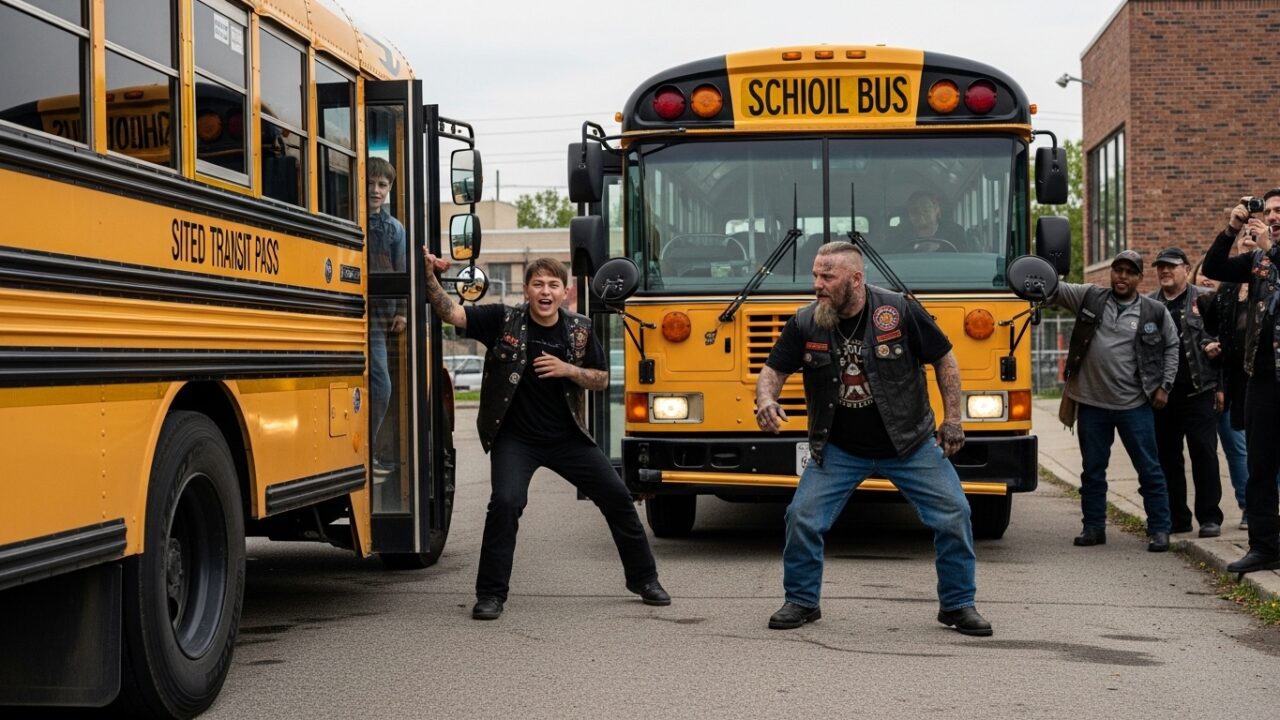
“The Bus Driver Kicked My Son Into The Cold Over A Two-Dollar Debt… But He Didn’t Realize Who Was Watching From The Shadows Of The Highway.”

“I’ve been a school bus driver for 12 years, but I never expected to be hunted down by a pack of motorcycles on a Tuesday morning.”
It started over a $2 bus pass. Ethan is only ten. He’s the kind of kid who keeps his head down and his jacket zipped to hide the holes in his shirt. When he stepped onto my bus that morning, his hands were shaking. He didn’t have his pass. He had a crumpled note from his mom promising to pay Friday.
I followed the rules. I told him to get off. “No pass, no ride,” I said. It’s the policy. I closed the doors and drove away, leaving him standing on the edge of Route 42—a road where people drive 60mph and there isn’t a sidewalk for miles.
I thought that was the end of it. Until I saw the chrome reflecting in my mirror.
A lone biker was tailing me. He wasn’t just riding; he was hunting. He surged forward, cutting me off, forcing 40 tons of yellow steel to a grinding halt. I was terrified. The kids were screaming. I reached for my radio to call the police, thinking this was the end.
The man got off his bike. He didn’t have a weapon. He had a phone. And when he looked me in the eye, I realized the monster wasn’t the man in the leather vest.
It was me.
CHAPTER 1: THE WEIGHT OF A PLASTIC CARD
The air in rural Ohio during late October doesn’t just feel cold; it feels heavy. It’s a damp, bone-deep chill that turns your breath into ghosts. Ethan stood at the edge of the driveway, his oversized backpack pulling at his narrow shoulders. He was ten, but he carried the silence of a man who had already learned that the world didn’t owe him any favors.
His mother, Sarah, had kissed his forehead that morning with eyes that looked like they hadn’t seen sleep in a week. “I’ll have the money by Friday, Ethan. Just show Mr. Henderson this note. He’s a good man. He’ll understand.”
The yellow bus appeared through the fog, a lumbering beast with squealing brakes. The doors hissed open. Ethan climbed the steps, the heat from the interior hitting his face like a localized miracle.
“Pass,” Mr. Henderson said. He didn’t look up. He was staring at a clipboard.
“I… I don’t have it today, sir,” Ethan whispered. He reached into his pocket and pulled out the scrap of notebook paper. “My mom wrote this. She said Friday—”
Henderson finally looked up. His eyes weren’t mean; they were just exhausted. They were the eyes of a man who had been told “Friday” a thousand times by a thousand people who never delivered. “Rules are rules, kid. No pass, no ride. Step back down.”
“But it’s cold,” Ethan said, his voice cracking. “And my mom already left for the diner. I can’t get back in the house.”
“Not my problem,” Henderson replied, his voice flat. “I’ve got forty other kids to get to school. Get off the bus.”
A few kids in the back started to snicker. A girl in the third row looked away, embarrassed for him. Ethan felt the heat in his cheeks—a different kind of heat than the bus heater. It was the burning sting of public shame. He stepped back down into the gravel.
The doors hissed shut. The bus pulled away, spewing a cloud of black diesel smoke that Ethan inhaled until he coughed.
He was alone. Route 42 stretched out in both directions—a gray ribbon of asphalt flanked by dead cornfields and deep ditches. There were no sidewalks. The speed limit was fifty-five, but nobody did fifty-five.
Ethan started to walk, hugging his backpack to his chest. He didn’t cry. Crying was for kids who had someone to hear them.
He didn’t notice the low rumble at first. It blended in with the wind. But then, a flash of chrome caught the morning light. A massive Harley-Davidson slowed down near the shoulder. The rider looked like a nightmare carved out of leather and denim. A thick beard, arms covered in faded ink, and a vest that had seen better decades.
The biker flipped up his visor. His eyes were sharp, scanning the boy, then the disappearing yellow bus on the horizon.
“Hey, kid,” the man growled. “Where’s your ride?”
Ethan flinched. “I… I couldn’t go. I didn’t have a ticket.”
The biker looked at the road—the narrow shoulder, the speeding trucks, the dangerous curve ahead. Then he looked at the boy’s broken zipper and shivering frame.
“He left you here? Right here?”
Ethan nodded.
The biker didn’t say another word. He slammed his visor down. The engine roared, a deafening, violent sound that made Ethan jump. The bike didn’t turn around toward town. It surged forward, the back tire kicking up gravel as it tore after the bus.
Ethan watched as the red taillight disappeared into the fog. He didn’t know if the man was going to help him or make everything much, much worse. All he knew was that for the first time that morning, someone had actually seen him.
CHAPTER 2: THE ROAR OF JUSTICE
The yellow bus was a sanctuary of controlled chaos until the sound started. It wasn’t the usual rumble of a passing semi-truck; it was a rhythmic, aggressive thrum that vibrated through the floorboards and into the seats.
Bill Henderson gripped the steering wheel, his eyes darting to the oversized side mirror. A black dot was growing larger at a terrifying rate. It was a biker, leaning low over his handlebars, cutting through the morning mist like a jagged blade.
“Is that guy chasing us?” a kid yelled from the back.
Bill didn’t answer. He watched the biker pull into the left lane, even with the driver’s window. The man didn’t look like a vigilante; he looked like a force of nature. He raised a gloved hand and pointed forward, then swerved sharply in front of the bus.
Bill slammed on the brakes. The bus jolted, tires screaming against the asphalt, sending backpacks sliding forward. “Crazy son of a…” Bill hissed, his heart hammering against his ribs. He opened the window to shout, but the biker had already kicked his kickstand down and was walking toward the bus doors.
“Open the door!” the biker shouted. His voice was a gravelly baritone that cut through the idling engine.
“I’m calling the cops!” Bill yelled back, fumbling for his radio. “You can’t stop a school vehicle on a state route!”
“Call ’em,” the biker said, stepping up to the glass doors. He didn’t look angry—he looked focused. “But you’re going to open this door and tell me why you left a ten-year-old kid to walk on a road with no shoulder in twenty-eight-degree weather.”
The children inside were silent now. The usual bus-ride chatter had died a sudden death. They watched the man in the leather vest, his face weathered by wind and time, standing his ground against the massive yellow machine.
Bill’s hand stayed on the radio, but he didn’t press the button yet. He saw the “Safety Marshal” patch on the man’s vest. “He didn’t have a pass. It’s the district policy, pal. If I let one kid slide, I have to let them all slide. My job is on the line.”
“Your job,” the biker repeated, his eyes narrowing. “That kid is out there alone. I just passed a semi doing sixty-five. If that boy slips into the ditch or a driver gets distracted by a text, your ‘policy’ is going to be written in blood. You think the district is going to back you then?”
Bill felt a bead of sweat roll down his temple despite the cold. He looked at the empty seat near the front where Ethan usually sat.
“I have a schedule,” Bill muttered, though the conviction was draining from his voice.
“I’m not moving my bike until that kid is on this bus,” the biker said. He leaned against the door, crossing his massive arms. “And I’ve got all day. But I don’t think my brothers do.”
As if on cue, a second rumble began to echo from the distance. Then a third. From over the crest of the hill, three more motorcycles appeared, their headlights piercing the fog like the eyes of predators. They didn’t speed; they rode in a tight, disciplined formation, eventually pulling up behind the bus, effectively boxing it in.
Cars began to back up behind the procession. A woman in a suburban SUV rolled down her window, filming the scene with her phone. “What’s happening?” she screamed. “Is he hurting the kids?”
“He’s saving one!” the lead biker roared back at her without looking away from Bill.
The tension was a physical weight. Bill looked at the row of bikers behind him, then back at the man at the door. He knew he was technically in the right—the handbook was clear. But looking at the cold, grey horizon where he had left Ethan, “right” felt incredibly wrong.
The lead biker’s phone chirped. He looked at it, then held the screen up to the bus window. It was a photo of Ethan, standing by the side of the road, looking small and terrified. Below it was a text from a contact labeled ‘Sarah’: “Please, I’m stuck at work, I can’t get to him. Please help my boy.”
“His mother is terrified,” the biker said, his voice dropping to a low, dangerous level. “Now, are you going to be the guy who followed the rules, or the guy who did the right thing?”
Bill’s finger finally left the radio. His shoulders slumped. With a heavy sigh and a hiss of hydraulics, he pulled the lever. The doors swung open.
“Get out of the way,” Bill said, his voice shaking. “I’m going back for him.”
The biker didn’t smile. He just nodded and stepped back. “I’ll escort you. Just so nobody gets ‘confused’ about why a school bus is making a U-turn on a highway.”
The motorcycles roared to life in unison. It wasn’t a riot. It was a motorcade.
CHAPTER 3: THE BROTHERHOOD OF THE SHADOWS
The U-turn was slow and agonizing. Bill Henderson swung the massive steering column, the tires crunching over the gravel shoulder as the bus pivoted back toward the stretch of road where he’d abandoned a child. Behind him, the four bikers didn’t leave. They stayed in a diamond formation, their headlights cutting through the rising fog like searchlights.
Ethan was still there.
He hadn’t made it more than half a mile. He was sitting on his backpack against a rusted fence post, his hands tucked deep into his armpits to keep them from numbing. When the bus roared back into view, followed by the thunder of the motorcycles, the boy stood up, his eyes wide with a mixture of hope and terror.
The bus hissed to a stop. The lead biker, whom the others called Jax, didn’t wait for the doors to open. He hopped off his Harley while it was still idling and walked over to Ethan.
“Told you we’d get you a ride, kid,” Jax said. He reached into his vest and pulled out a heavy, fleece-lined flannel shirt. It was three sizes too big for Ethan, but as the man draped it over the boy’s shoulders, the shivering stopped almost instantly.
“Is… is Mr. Henderson mad?” Ethan whispered.
Jax looked at the bus, then back at the boy. “Mr. Henderson is having a long overdue conversation with his conscience. Get on.”
But as Ethan stepped toward the bus, the morning air was split by a new sound. The high-pitched, urgent wail of a police siren.
Two cruisers from the Ohio State Patrol screamed up the opposite lane, their blue and red lights turning the gray fog into a strobing nightmare. They skidded to a halt, blocking the road ahead of the bus.
“Everybody stay where you are!” an officer shouted over the loudspeaker.
The woman in the SUV from earlier had stayed on the line with dispatch. Her report had been frantic: A gang of bikers has hijacked a school bus. They’re surrounding the children. Send everyone.
Three officers stepped out, hands hovering near their holsters. To them, the scene looked like a hostage crisis. A line of rough-looking men in leather, a stopped school bus, and a small boy being “handled” by a giant with tattooed knuckles.
“Get away from the boy!” Officer Miller shouted, his voice tight. He was young, maybe twenty-five, and his adrenaline was red-lining.
Jax didn’t flinch. He didn’t even raise his hands—not yet. He just stood in front of Ethan, shielding him with his body. “He’s cold, Officer. Put the hardware away before you scare the kids on the bus.”
“I said step away!” Miller took a step forward, his hand unclipped the strap on his holster.
The other bikers didn’t move toward the cops, but they didn’t retreat either. They stood by their machines, silent and immovable. The tension was a frayed wire about to snap. Inside the bus, the children were pressed against the windows, some of them crying now, thinking they were about to witness a shootout.
Bill Henderson scrambled out of the bus, his hands high in the air. “Wait! Wait! It’s not what it looks like!”
Miller didn’t lower his guard. “Bill? What’s going on? We got a call that you were under attack.”
“I wasn’t under attack,” Bill said, his voice cracking with a sudden, sharp clarity. “I was being an idiot. This man… he stopped me because I left that kid on the highway. I broke the protocol for safety, not him.”
The officers looked from Bill to Jax, then to Ethan, who was swallowed up in the biker’s massive flannel shirt.
Jax finally reached into his pocket—slowly, deliberately. The officers tensed. He pulled out a small, laminated card and tossed it onto the hood of the nearest cruiser.
Miller picked it up. His brow furrowed. “Guardian Angels?”
“We’re a chartered group,” Jax said, his voice calm but iron-hard. “Most of us are veterans. Some of us are retired cops. We ride for kids who don’t have a voice. We heard about Ethan’s mom struggling with the district. We were already planning on checking in. Today, I just happened to be behind the bus when the ‘rules’ took priority over a human life.”
The officer looked at the card, then at his partner. The ‘Guardian Angels’ were a known entity—a group of bikers who escorted children to court for abuse cases or stood guard at funerals to protect grieving families. They weren’t a gang; they were a shield.
The second officer, an older man named Sgt. Vance, walked over to Ethan. He knelt down and looked at the boy’s scuffed shoes and the note still clutched in his hand. Vance sighed and looked at Bill.
“Bill, you know the law. If I write this up as a reckless abandonment of a minor, you lose your CDL. Today.”
Bill looked down at the asphalt. The weight of his choices finally crushed him. “I was just doing what the supervisor told me. They said if we didn’t tighten up the budget, people would lose their routes.”
“The budget doesn’t cover a child’s life,” Vance snapped.
Suddenly, a loud crackle came over the police radio. It was the dispatcher. “Units on Route 42, we’ve got a massive influx of calls. Apparently, there’s a video live-streaming on Facebook. People are losing their minds. They’re saying the school district is kicking poor kids off buses.”
Jax looked at the woman in the SUV. She was still holding her phone up, but her expression had changed. She wasn’t filming a crime anymore; she was filming a revolution.
“It’s already out there,” Jax said to the officers. “And it isn’t going away. You can arrest us for obstructing traffic if you want. But the world is watching how you treat this boy.”
Sgt. Vance looked at the cameras, then at the line of bikers who hadn’t moved an inch. He looked at Jax. “How many more of you are there?”
Jax checked his watch. “In this county? About fifty. And they’re all heading to the school board office right now.”
The shift in power was absolute. The “policy” hadn’t just been broken—it had been incinerated. But the real twist was yet to come. Because as the police began to clear the road, Jax’s phone buzzed again. It wasn’t Ethan’s mom this time.
It was the school principal. And she wasn’t calling to thank him. She was calling to tell him that Ethan wasn’t just being kicked off the bus for a ticket. He was being expelled.
CHAPTER 4: THE VESTS IN THE FRONT ROW
The school board meeting was usually a sleepy affair—five bureaucrats in a wood-paneled room discussing bus maintenance and cafeteria menus. But tonight, the air was electric. Outside, the low, rhythmic thrum of fifty idling engines vibrated through the brick walls of the district office.
Jax sat in the front row. He didn’t have a protest sign. He didn’t need one. He just sat there in his grease-stained leather vest, his arms crossed, a silent sentinel for the boy sitting next to him. Ethan looked tiny in the plush auditorium chair, still wearing Jax’s oversized flannel shirt like a suit of armor.
At the podium stood Superintendent Miller, a man whose expensive silk tie looked like a noose under the fluorescent lights.
“The decision stands,” Miller said, his voice thin. “Ethan Miller’s expulsion isn’t just about the bus pass. It’s about a pattern of… instability. His mother has missed three consecutive payments for school fees. We have a waitlist of families who can pay. We have to maintain the integrity of our charter.”
A low growl—not from a motorcycle, but from the men in the front row—rippled through the room.
Sarah, Ethan’s mom, stood up from the back. Her voice was trembling, but it didn’t break. “I missed those payments because my shifts were cut at the diner. I’m a single mother trying to keep a roof over his head. You’re punishing a ten-year-old because his mother is poor?”
“We are following the bylaws, Ms. Miller,” the Superintendent replied, checking his watch. “The board has a responsibility to the taxpayers.”
Jax stood up. He didn’t wait to be recognized.
“I’ve spent twenty years in the service and ten years on the road,” Jax said, his voice filling every corner of the room. “I’ve seen a lot of things. I’ve seen men hold ground against impossible odds, and I’ve seen cowards hide behind pieces of paper. Tonight, I’m looking at the latter.”
“Sir, you are out of order,” Miller snapped.
“I’m just getting started,” Jax countered. He reached into his vest and pulled out a heavy manila envelope. He tossed it onto the board’s table. “That’s the live-stream data from this morning. Two million views. People from California to Maine are watching this meeting right now on their phones. They saw a bus driver leave a kid on a highway. And now they’re watching you try to kick him out of school for being ‘unstable’.”
Jax leaned over the table, his eyes locking onto Miller’s. “But that’s not why I’m here. Open the envelope.”
Miller hesitantly opened it. His face went from annoyed to ghostly pale in seconds.
“That,” Jax said, “is a certified check for ten thousand dollars. It covers Ethan’s fees, his lunch debt, and a pre-paid bus pass for every kid in this district who’s currently on the ‘late’ list. It was raised in three hours by the people you call ‘thugs’ out in that parking lot.”
The room went dead silent.
“Now,” Jax continued, “you have two choices. You can take the money, reinstate the boy, and let us all go home. Or, you can keep this expulsion on the books. And tomorrow morning, those fifty bikes outside? They’ll be five hundred. And we won’t be sitting in the front row. We’ll be filing a class-action lawsuit for child endangerment based on what happened on Route 42.”
The board members looked at each other. They looked at the cameras in the back of the room—phones held up by parents who were finally realizing that “policy” was just a word used by people too scared to lead.
The Superintendent’s hand shook as he reached for his gavel. He looked at Ethan. The boy wasn’t looking at the board; he was looking at Jax. For the first time in a long time, the boy didn’t look like he was waiting for the world to hit him. He looked like he belonged.
Clack.
“The expulsion is rescinded,” Miller whispered. “The debt is cleared.”
The room didn’t erupt in cheers. It was a quiet, heavy victory.
Outside, the cool night air hit them. Sarah hugged Jax so hard her knuckles turned white. “I don’t know how to repay you,” she sobbed.
Jax looked down at Ethan, who was staring at the line of motorcycles, the chrome gleaming under the streetlights. “You already did,” Jax said. “You raised a kid who knows how to walk tall even when he’s alone. We just made sure he didn’t have to do it anymore.”
Jax swung a leg over his Harley. He didn’t offer a dramatic goodbye. He just nodded to the boy.
“See you at the bus stop tomorrow, Ethan. We’ll be riding behind you. Just in case.”
As the engines roared to life in a thunderous symphony, Ethan watched the red taillights fade into the distance. He realized then that heroes don’t always wear capes or uniforms. Sometimes, they wear scuffed leather, smell like gasoline, and speak in the language of a roaring engine.
Being protected doesn’t always look gentle at first—but it always leaves you safer than before.
The End

About the Author
Khánh Nguyễn
A writer passionate about human stories and real-life experiences that inspire and move readers.
 Biker
9 min read
Biker
9 min read
“I Finally Earned The Brotherhood’s Sacred Patch After A Year Of Hell. But When I Walked Into The Clubhouse Basement Uninvited… I Realized We Weren’t A Motorcycle Club. We Were A Slaughterhouse.”
I’ve shed blood, broken bones, and sacrificed a year of my life to earn my place in this brotherhood. But…
 Biker
44 min read
Biker
44 min read
I Moved Into This Dump To Forget My Past, But When I Heard My Neighbor’s Belt Hit The Floor, The Biker In Me Woke Up… What I Found Behind His ‘Private’ Door Wasn’t Just Sin—It Was A Death Warrant Signed By The City’s Elite.
I’ve been a police officer for 17 years, but nothing prepared me for what I found inside that black trash…
 Biker
33 min read
Biker
33 min read
“I Watched The Bank Manager Smile While He Stole An 80-Year-Old Man’s Last Penny… Then The Heavy Doors Swung Open, And A Man In Leather Proved That Justice Doesn’t Always Wear A Suit And A Tie.”
“I Watched Them Rob An 80-Year-Old Man With A Smile… Then The Door Smashed Open And The Real Trouble Walked…
Leave a Reply