
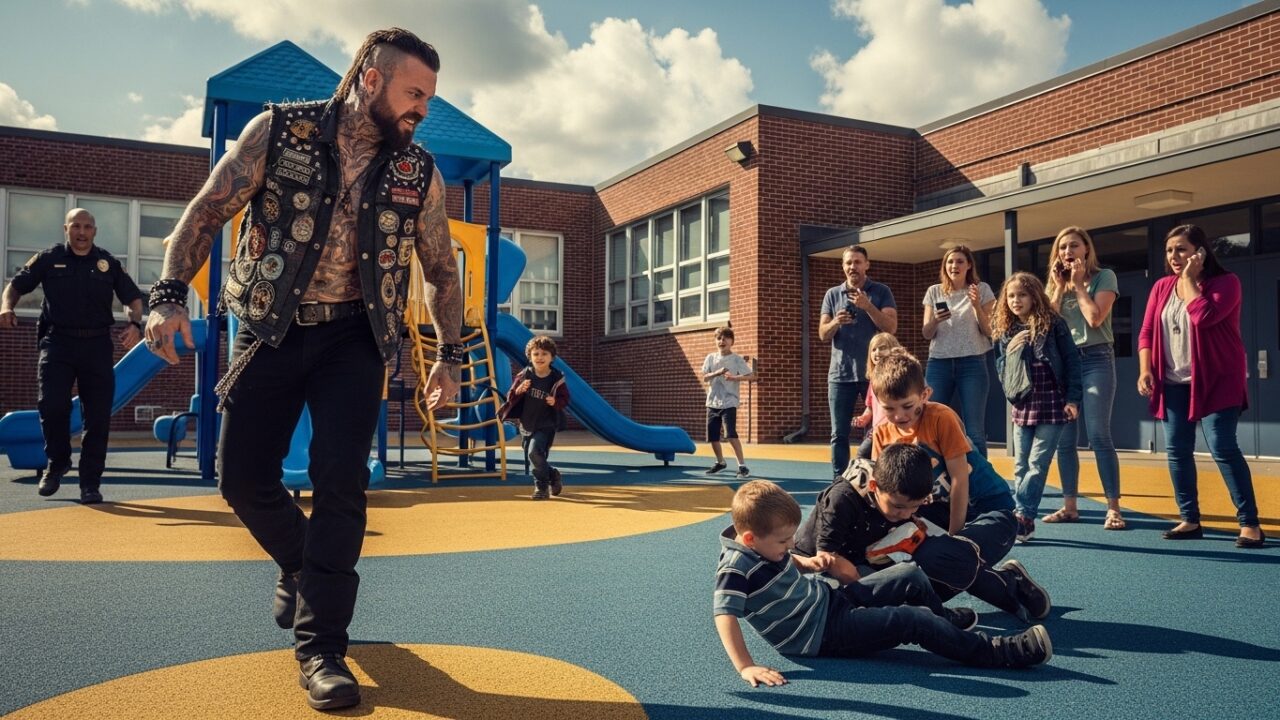
“I Thought He Was A Predator Lunging For My Son At Recess… But When He Reached Into His Vest, I Realized How Wrong I Was About The Monster.”

“I Thought He Was A Predator Lunging For My Son At Recess… But When He Reached Into His Vest, I Realized How Wrong I Was.”
I’ve been a school counselor for twelve years, but nothing prepared me for the day a 1200cc Harley roared to a halt at our front gates.
It was recess. The air was filled with the usual shrill laughter and the scent of freshly cut grass. But in a far corner of the playground, the atmosphere was different. Cold. Suffocating. Little Leo, a quiet ten-year-old with eyes too big for his face, was backed against the chain-link fence. Three older boys were circling him, phones out, recording his trembling hands like they were filming a nature documentary on a dying animal.
“Say it,” one of them jeered. “Say you’re a loser.”
The teachers were busy discussing their weekend plans. The parents waiting at the gate were scrolling through Facebook. No one noticed the boy’s soul breaking.
Until the thunder arrived.
The biker didn’t wait for permission. He didn’t sign in at the front desk. He kicked the gate open with a metallic clang that silenced every child on that playground. He was a mountain of a man—inked skin, heavy boots, and a face that looked like it had been carved from granite.
When he stormed toward the group of kids, a mother screamed, “He’s got a gun!”
Panic erupted. I ran forward, my heart hammering against my ribs, ready to shield Leo. The biker reached the boy, his massive shadow swallowing Leo whole. The crowd held its breath as the man’s hand went inside his leather vest. We expected a weapon. We expected a tragedy.
But what he pulled out didn’t draw blood. It drew the truth—a truth so ugly it made every adult in that yard want to sink into the earth.
He didn’t come to hurt a child. He came because we had failed to protect one.
CHAPTER 1: The Shadow and the Thunder
The sound of a backpack hitting the dirt shouldn’t be that loud. But in the vacuum of a playground where everyone is looking and no one is watching, it sounds like a gunshot.
Leo stood frozen. His sneakers, two sizes too big and scuffed at the toes, felt like they were glued to the asphalt of the Oak Ridge Elementary playground. Around him, the world was a blur of bright primary colors—red slides, yellow swings, blue skies—but his world had narrowed down to the three faces in front of him.
“Pick it up, Leo,” Jax said. Jax was twelve, a head taller, and wore the kind of confident smirk that only comes from knowing the adults in the room are on your side. He held his iPhone 15 Pro Max like a weapon, the triple lenses staring at Leo like the eyes of a spider. “Pick it up with your teeth. Let’s see if you’re really the dog everyone says you are.”
The other two boys, Miller and Sam, snickered. They moved in closer, a tactical pincer movement they’d learned from video games and perfected on the weak.
Leo’s throat felt like it was full of dry wool. He looked toward Mrs. Gable, the teacher on duty. She was thirty yards away, laughing at something another parent had said, her back turned to the “quiet corner” of the yard. Leo knew the rules. If he cried, it got worse. If he ran, they’d catch him at the bus stop. If he told, he was a “snitch,” and in this town, that was a social death sentence.
“I… I just want my bag,” Leo whispered.
“What was that? I can’t hear you over the sound of how much of a loser you are,” Jax laughed, shoving Leo’s shoulder.
It wasn’t a hard shove. Not the kind that leaves a bruise. It was the kind that erodes a soul—the “just joking” kind that parents and teachers ignore because it’s not “real” violence. Leo stumbled back, his spine hitting the cold diamond-pattern of the chain-link fence.
Then, the world changed.
A low, guttural growl vibrated through the fence. It started as a hum in Leo’s shoulder blades and quickly escalated into a roar that drowned out the school bell.
Every head in the playground turned.
A matte-black Harley-Davidson screamed to a halt just inches from the curb outside the fence. The rider didn’t look like he belonged within a mile of a school zone. He was a wall of black leather and denim. His arms, thick as Leo’s waist, were covered in a tapestry of fading ink—skulls, eagles, and words in Latin. He didn’t take off his sunglasses.
He didn’t even put the kickstand down properly before he was off the bike.
“Oh my God,” a mother near the gate gasped, clutching her daughter’s hand. “Is that… is he coming in here?”
The biker didn’t ask. He didn’t look for a buzzer. He grabbed the handle of the heavy iron gate and yanked. The lock, which was supposed to keep “strangers” out, groaned and gave way under the sheer mechanical force of his pull.
He stepped onto the playground.
The silence was absolute. The screams of children playing tag died mid-air. The teachers froze. The biker’s boots—heavy, steel-toed, caked in road dust—hit the pavement with a rhythmic thud… thud… thud.
He wasn’t looking at the teachers. He wasn’t looking at the terrified parents. His eyes, hidden behind dark lenses, were locked on the corner where three bullies stood over one small boy.
“Hey!” Mr. Henderson, the gym teacher, finally found his voice. He was a big man, used to being the Alpha in a room of ten-year-olds, but his voice went up an octave. “Sir! You can’t be here! This is private property!”
The biker didn’t even blink. He didn’t slow down.
Jax, the ringleader, dropped his phone. The bravado that had fueled him seconds ago evaporated, leaving behind a pale, shaking child. He and his friends scrambled back, tripping over the very backpack they had just kicked.
The biker stopped three feet from Leo.
Up close, he smelled like gasoline, old leather, and peppermint. He was terrifying. He looked like the villain in every movie Leo wasn’t allowed to watch. The man looked down at Leo, then at the dirt-stained backpack, then at the three boys cowering nearby.
“You okay, kid?” the biker asked. His voice was a deep, gravelly rumble that seemed to come from the earth itself.
Leo couldn’t speak. He just stared at a silver ring on the man’s thumb—a Spartan helmet.
“I asked you a question,” the man said, his voice softening just a fraction, though his posture remained a threat to everything else in the yard. “Did they touch you?”
“Stay away from them!” A woman—Jax’s mother, Sarah—came charging forward. She was a prominent member of the PTA, always dressed in expensive athleisure. “Don’t you dare speak to my son! I’m calling the police right now! You’re a predator! I see what you’re doing!”
She reached out to grab the biker’s arm, her face contorted in a mask of righteous fury.
The biker turned his head. Just a slight tilt.
“I’d get your hand off me, lady,” he said, his voice dangerously low. “Before you regret the choice.”
Sarah recoiled as if burned. “He’s threatening me! Did you hear that? He’s threatening a parent!”
The playground was now a powder keg. Mr. Henderson was on his radio, calling for the “SRO”—the School Resource Officer. Parents were ushering their children toward the building, their eyes filled with judgment and fear.
The biker looked at the circle of adults closing in on him. He looked at the teacher who had ignored Leo for months. He looked at the mother who defended a bully.
Then, he reached his hand into the heavy inner pocket of his leather vest.
“He’s got a gun!” someone screamed.
Leo saw the man’s fingers grip something dark. The boy closed his eyes, waiting for the sound of the end. He didn’t know why this man had come, but he knew that once this happened, there was no going back. The biker had made his choice. He had crossed the line to stand next to the kid no one wanted to see.
And now, the world was going to break.
CHAPTER 2: The Paper Trail of Silence
The playground was a frozen tableau of suburban terror. Sarah, Jax’s mother, was still screaming, her voice reaching a pitch that made the birds in the nearby oaks scatter. Mr. Henderson had his hand hovering over his belt, a reflex from his days as a reserve deputy, his eyes fixed on the biker’s vest.
The biker’s hand didn’t come out fast. It didn’t come out with the jagged motion of someone drawing a weapon.
It came out with a heavy, weathered leather folder.
He didn’t toss it. He didn’t drop it. He stepped forward—ignoring the gasps and the frantic “Stay back!” from the teachers—and held it out toward Mrs. Gable. His movements were slow, deliberate, and possessed a terrifyingly calm gravity.
“Open it,” the biker said.
Mrs. Gable looked at the folder as if it were an unexploded bomb. Her hands trembled as she took it. Sarah lunged forward, trying to snatch it away. “Don’t listen to him! He’s a criminal! Look at him! He’s probably high!”
The biker shifted his weight. He didn’t touch Sarah, but his mere presence acted like a physical barrier. He was a mountain that refused to be moved by the wind of her hysteria.
“I said open it, ma’am,” the biker repeated. This time, there was a jagged edge to his voice, the sound of a man who had spent too much time watching the wrong people win.
Mrs. Gable opened the folder.
Inside wasn’t a manifesto or a threat. It was a meticulously organized ledger of failure.
The first page was a color photograph of Leo’s back, taken three weeks ago. It showed a purple, yellow, and deep-red bruise in the shape of a sneaker print, right between his shoulder blades. Below the photo was a date, a time, and a copy of an email sent from a Gmail account—martha.clark82@gmail.com—to the school’s principal.
Subject: Incident Report – Leo Clark. Third time this month.
Mrs. Gable’s eyes widened. She flipped the page.
Another photo. This one was of Leo’s favorite drawing book, the pages torn out and soaked in what looked like toilet water. Attached was a printed screenshot of a Facebook message sent to the school’s “Bully Hotline.”
No response, was written in red ink at the bottom of the page.
“What is this?” Mrs. Gable whispered, her voice failing her.
“That’s my sister’s life for the last six months,” the biker said. He finally reached up and pulled off his sunglasses. His eyes weren’t the eyes of a predator. They were bloodshot, weary, and burning with a cold, righteous fire. “That’s Martha’s life. She’s working two shifts at the diner just to keep this kid in ‘the good school.’ The school where the parents are ‘involved.’ The school that promised her Leo would be safe.”
He stepped closer to the teacher, his shadow falling over her like a shroud.
“My name is Silas,” he said. “I’m Leo’s uncle. And I’ve spent the last four hours at the police station and the district office because my sister was too scared to do it herself. She was afraid that if she pushed too hard, people like her“—he gestured vaguely toward Sarah—”would make sure Leo was expelled for ‘causing trouble.'”
Sarah’s face went from a frantic red to a ghostly, mottled white. “That’s… that’s all fabricated. My Jax is an honor student. He’s a victim of this kid’s… his weirdness! He’s just reacting to Leo’s behavior!”
Silas turned his gaze on Sarah. He didn’t yell. He didn’t need to. “I saw the video, Sarah. The one your son posted to his ‘Private Story’ on Snapchat yesterday. The one where he held Leo’s head over the sink in the boys’ locker room while your friends laughed about how much he looked like a drowned rat.”
The silence that followed was different now. It wasn’t the silence of fear; it was the silence of a secret being dragged into the harsh, midday sun.
The other parents, who had been huddled together in a defensive circle against the “intruder,” began to murmur. They looked at Sarah. They looked at Jax, who was currently trying to hide behind a trash can, his face buried in his hands.
“I didn’t… I didn’t know about that,” one mother whispered, pulling her child further away from Jax.
“The school knew,” Silas said, his voice rising now, carrying across the entire yard. “I have the receipts. I have the delivery confirmations for twelve emails sent to the Principal’s office. I have the logs of the phone calls Martha made that were never returned. You all saw a man on a bike and thought ‘danger.’ But you’ve been standing next to the real danger every morning at the drop-off line.”
Leo was still clutching the back of Silas’s vest. His small fingers were white-knuckled, gripping the rough denim as if it were the only thing keeping him on the planet. For the first time in a year, the weight on his chest felt like it might actually be liftable.
“Sir,” Mr. Henderson said, his voice much softer now, though he still looked uneasy. “The police are on their way. You broke the gate. You entered school grounds without authorization. Regardless of the… the situation, there are protocols.”
Silas let out a short, dry bark of a laugh. It sounded like sandpaper on wood.
“Protocols? You want to talk to me about protocols? Where were the protocols when my nephew came home with a split lip? Where were the protocols when he started waking up screaming because he dreamt of what was waiting for him at recess?”
Silas reached into his vest again. This time, no one screamed.
He pulled out a second folder. This one was thinner.
“This is the restraining order,” Silas said, handing it to the gym teacher. “Not against the school. Against Jax Miller and his father. Signed by a judge forty-five minutes ago. It states that Jax is to remain fifty feet away from Leo at all times. Since this is a public school and you clearly can’t enforce your own rules, the law is going to do it for you.”
Just then, the sirens began to wail in the distance. The blue and red lights danced against the brick walls of the school building as two squad cars pulled into the bus lane.
Sarah looked at the police cars and then back at Silas. A desperate, ugly smirk flickered on her lips. “Good. Let them come. You’re a felon, aren’t you? I can see it in your face. You’re going to jail for this. You can’t just come onto a school campus and intimidate people!”
Silas looked down at Leo. He reached out and placed a massive, calloused hand on the boy’s head.
“Maybe,” Silas said to Sarah. “But before they take me, every parent in this yard is going to see exactly what kind of monster you’ve been raising. And they’re going to see exactly how much this school was paid to look the other way.”
He looked at Mrs. Gable, who was still holding the first folder as if it were a mirror showing her something she hated about herself.
“The police aren’t here for me, lady,” Silas said, his voice dropping back into that terrifyingly calm rumble. “I called them myself. I told them there was an ongoing assault on a minor in progress.”
He looked at the gate as the officers stepped out of their cars.
“And I’m not leaving until the right person is in handcuffs.”
CHAPTER 3: The Thin Blue Line and the Heavy Black Leather
The dust from the gravel parking lot hadn’t even settled when the first squad car door slammed shut.
Officer Miller was a man who looked like he had been forged from the same iron as the local statues—gray at the temples, eyes like flint, and a belt that creaked under the weight of seventeen years on the force. He stepped onto the playground, his hand resting instinctively on his belt, not on the holster, but near it. He’d seen the biker, seen the crowd of hysterical parents, and heard the frantic dispatch call about a “dangerous intruder.”
But as he got within ten feet, Miller stopped. His eyes narrowed, moving from the massive, tattooed frame of Silas to the little boy clinging to his vest.
“Silas?” Miller’s voice was a low, rough growl. “What the hell are you doing on a school playground, man? You know better than to kick in a gate in broad daylight.”
The crowd went silent. The “recognition” was the first crack in the narrative Sarah Miller had been weaving. This wasn’t a random predator. This was someone the law knew by name.
“I’m doing your job, Miller,” Silas said, his voice flat, devoid of the heat that usually got men arrested. “Since the SRO here seems to have a problem seeing things that happen right under his nose.”
He pointed a finger at the School Resource Officer, a younger man named Davis, who was standing awkwardly by the swings. Davis looked like he wanted to be anywhere else.
“Officer!” Sarah shrieked, stepping into Miller’s line of sight. “This man is threatening us! He’s scaring the children! He practically assaulted my son and forced his way onto campus. He has some… some folders full of lies, trying to frame Jax for ‘bullying’ because his own nephew is a social misfit!”
Miller didn’t look at Sarah. He looked at Silas. “You want to tell me why I shouldn’t cuff you right now for trespassing and destruction of property?”
“Because,” Silas said, stepping aside so Leo was visible to the officer. “If you do, you’ll be doing it in front of about fifty witnesses who are about to find out why the Oak Ridge PD has ignored three separate police reports filed by Martha Clark over the last six months.”
Miller’s expression shifted. The flint in his eyes grew colder, but the target changed. He looked at Officer Davis. “Davis? We have reports on file for this kid?”
Davis cleared his throat, his face turning a blotchy red. “Sir, there were… incidents. But Principal Sterling handled them internally. He said they were ‘behavioral misunderstandings’ between minors. Nothing that rose to the level of a criminal referral.”
“Behavioral misunderstandings?” Silas let out a short, jagged laugh. He reached into his vest—everyone flinched again, a reflex they couldn’t help—and pulled out a small, ruggedized thumb drive. He held it up between two fingers like a trophy.
“I didn’t just come here with paper, Miller. I came with the cloud.”
“Give that to me,” a new voice commanded.
Principal Sterling had finally emerged from the main office. He was a man who smelled of expensive cologne and desperation, his suit perfectly pressed even as the world around him began to smell like exhaust and scandal. He walked with the practiced stride of a man who was used to being the smartest person in the room.
“Mr… Silas, is it?” Sterling said, stopping a safe five feet away. “You are currently in violation of a dozen school safety protocols. Whatever ‘evidence’ you think you have is irrelevant. You have endangered these children by your presence. Officer Miller, please, remove this man so we can return to our educational schedule.”
Silas didn’t move. He looked at Sterling with the kind of pity a hunter has for a trapped animal.
“The educational schedule where kids learn how to waterboard each other in the locker room, Sterling?” Silas asked. “The thumb drive has the metadata from the school’s guest Wi-Fi. It shows Jax Miller—your star donor’s son—uploading videos of my nephew to a private server. Videos where your ‘SRO’ is visible in the background, staring at his phone while a ten-year-old gets his ribs kicked in.”
The murmur from the parents turned into a roar of disbelief. The focus shifted from Silas’s leather vest to Sterling’s expensive silk tie.
“That’s a lie!” Sarah yelled, though her voice lacked its previous conviction. She looked at her son, Jax, who was now crying—not the cry of a victim, but the panicked sob of a bully who realized the shield of his father’s name had finally shattered.
“It’s not a lie,” a voice piped up from the crowd.
It was a woman named Beth, a quiet mother who usually stayed in the background. She stepped forward, her face pale but determined. “My son told me about the videos. He was too scared to say anything because Jax told him he’d get him expelled. He said his dad ‘owns’ the school board.”
“That is enough!” Sterling shouted, his composure finally snapping. “This is not a trial! This is a playground!”
“No,” Miller said, his voice cutting through the noise like a knife. “This is a crime scene. Davis, get the Principal and the Millers into the office. Now.”
“You can’t be serious,” Sterling stammered. “Miller, do you know who—”
“I know exactly who,” Miller said, stepping into Sterling’s personal space. “And I know Silas. He was a Sergeant in the 75th Rangers before he ever put on that vest. He’s got more integrity in his left pinky than you’ve got in your entire administration. If he says there’s a video, there’s a video. And if that video shows my officer ignoring a crime, then Davis is going to have a very long talk with Internal Affairs.”
The shift in the air was physical. The parents who had been calling for Silas’s head were now looking at the school building with a new, dark suspicion. The “predator” wasn’t the man on the bike. The predator was the system they had trusted to keep their children safe.
Silas looked down at Leo. The boy’s grip on his vest had loosened slightly. Leo was looking at Officer Miller, then at the Principal being led away, his eyes wide with a shock that was slowly turning into something else. Hope.
“You’re not going to jail, Uncle Silas?” Leo whispered.
Silas knelt down, his heavy boots crunching on the asphalt. He ignored the police, the parents, and the sirens. He looked his nephew in the eye. “Not today, kid. Today, the adults have to answer the questions.”
But the twist wasn’t over.
As Miller began to usher the crowd away, a black SUV roared into the school’s circular drive, silver-plated rims gleaming. A man in a tailored charcoal suit stepped out—Jax’s father, Thomas Miller, the man whose name was on the school’s new athletic wing. He didn’t look worried. He looked livid.
“What is this circus?” Thomas demanded, walking straight toward Miller. “I just got a call from my wife saying some vagrant is harassing my son.”
He looked at Silas with pure, unadulterated disgust. “You. I don’t know what kind of shake-down you’re running, but you picked the wrong family. I’ll have you in a cell by dinner and your ‘nephew’ in a foster home by the end of the week.”
The parents gasped. It was a naked display of power, the kind that usually worked in a small town like this.
Silas stood up slowly. He seemed to grow taller, his shadow stretching across the pavement until it touched Thomas Miller’s polished shoes.
“Thomas,” Silas said softly. “I was hoping you’d show up. Because there’s one more thing on that thumb drive.”
Thomas sneered. “I don’t care about your little home movies.”
“It’s not a home movie,” Silas said. “It’s a recording of the phone call you made to the Principal last month. The one where you told him that if the ‘Clark kid’s’ mother didn’t stop complaining, you’d make sure her lease at the diner wasn’t renewed. You see, Thomas, my sister records all her calls. Legal in this state, as long as one party knows.”
The color drained from Thomas Miller’s face so fast it was like someone had pulled a plug. The arrogance vanished, replaced by a raw, naked fear.
“That’s… that’s hearsay,” Thomas stammered.
“No,” Silas said, stepping closer. “That’s witness tampering. And extortion. And I think Officer Miller here would love to hear the high-definition version.”
Silas turned to the crowd of parents. “This is the man you let run your school board. This is the man who decided which of your kids mattered and which ones were ‘disposable.'”
The silence that followed was broken only by the sound of a single pair of handcuffs clicking open. But they weren’t for Silas.
Officer Miller looked at Thomas, then at the Principal, then back at Silas.
“I’m going to need that drive, Silas,” Miller said.
“Take it,” Silas said, handing it over. “But make sure it doesn’t ‘get lost’ in evidence. Because I’ve already sent a copy to the local news and the District Attorney.”
The fallout had only just begun. Silas reached down and picked up Leo’s dirt-stained backpack. He brushed it off with a hand that had seen war and peace, and handed it back to the boy.
“Let’s go, Leo,” Silas said. “I think you’ve had enough ‘education’ for one day.”
As they walked toward the gate, the crowd of parents parted like the Red Sea. No one shouted. No one pointed. Some looked away in shame. Others looked at Leo with a sudden, painful realization of what they had allowed to happen in their silence.
But as Silas reached his bike, he felt a hand on his shoulder. It was the gym teacher, Mr. Henderson.
“I… I should have seen it,” Henderson said, his voice thick with regret. “I’m sorry.”
Silas didn’t shake his hand. He didn’t nod. He just looked at him. “Seeing it is easy. Doing something about it is the hard part. Try doing both next time.”
He swung his leg over the Harley and pulled Leo up behind him.
“Hold on tight, kid,” Silas said.
The engine roared to life—a sound that, minutes ago, had signaled a threat. Now, as the bike pulled away from the school, it sounded like a victory lap.
But the real consequences were waiting at home. Martha was waiting. And the town of Oak Ridge was about to wake up to a reality that no amount of donor money could fix.
CHAPTER 4: The Sound of the Road Home
The vibration of the Harley was the only thing Leo could feel. It wasn’t the shaking of fear anymore; it was the steady, rhythmic pulse of a machine that didn’t care about school boards, wealthy donors, or the social hierarchy of a small town. To the bike, and to the man driving it, the world was simple: you either kept moving forward, or you got left in the dust.
They pulled into the driveway of a small, weather-beaten ranch-style house on the outskirts of Oak Ridge. The grass was neatly trimmed, but the paint was peeling around the window frames—the telltale sign of a home where the mortgage was paid on time, but there was nothing left over for the “extras.”
Martha was already on the porch. She was still wearing her uniform from the diner—a faded blue apron and sensible non-slip shoes. Her face was a pale mask of terror. She had seen the missed calls. She had heard the rumors already flying through the town’s frantic text chains.
Silas cut the engine. The sudden silence was heavy.
Leo slid off the back of the bike, his legs slightly wobbly. He didn’t wait for his uncle to speak. He ran. He collided with his mother’s waist, burying his face in the starch-smelling apron. Martha gripped him so hard her knuckles turned white, her eyes locked on her brother.
“Silas, what did you do?” she whispered, her voice trembling. “They’re saying you attacked a teacher. They’re saying you’re going to prison. They’re saying the Millers are going to sue us for everything we don’t have.”
Silas dismounted slowly, his joints popping. He looked at his sister—the woman who had stayed behind to care for their dying parents while he was jumping out of planes in places the map ignored. He felt a pang of guilt, sharp and cold. He had brought the war to her front door.
“I didn’t attack anyone, Martha,” Silas said, leaning against the chrome of his bike. “I just turned the lights on. The cockroaches are the ones doing all the screaming.”
He walked up the porch steps and handed her the dirt-stained backpack. “Leo’s okay. He’s more than okay. He’s the bravest person in this zip code, and it’s about time people started acting like it.”
Martha looked down at Leo, pulling back to see his face. For the first time in months, Leo wasn’t looking at the ground. His eyes were red-rimmed, yes, but they were clear. “Uncle Silas showed them the video, Mom. He showed them what Jax did.”
The next seventy-two hours were a blur of sirens, lawyers, and the kind of local news coverage that usually only happened when a tornado touched down.
The thumb drive Silas handed to Officer Miller was a pipe bomb dropped into the heart of Oak Ridge. The “Private Story” videos were bad enough—graphic evidence of systematic psychological and physical abuse—but it was the recorded phone call from Thomas Miller that changed everything. By the next morning, the District Attorney had opened a grand jury investigation into “Official Misconduct” and “Witness Tampering.”
Principal Sterling was placed on administrative leave by noon. By sunset, he had resigned.
The Millers didn’t go down quietly. Thomas tried to use his influence, calling every favor he had ever earned in the county. But in the age of the internet, a rich man’s influence has a shelf life. The video Silas had leaked to the regional news went viral. It wasn’t just about bullying anymore; it was a symbol of every “average” family who had ever been stepped on by a “legacy” family.
A week later, the diner where Martha worked was busier than it had ever been. People didn’t just come for the coffee; they came to leave hundred-dollar tips for “the mother who fought back.” They came to shake Silas’s hand—though he usually stayed in the shadows of the back booth, nursing a black coffee and looking like he’d rather be anywhere else.
But the real change happened at the school.
It was Monday morning. The first day back after “The Incident.” The school had hired a new interim principal, a no-nonsense woman from the city who had already cleared out half the administrative staff.
Martha pulled her old sedan into the drop-off line. Her hands were shaking on the steering wheel. “You don’t have to go in today, Leo. We can wait another week.”
Leo looked out the window. A black motorcycle was parked just outside the school gates, leaning on its kickstand. Silas was sitting on it, arms crossed, his sunglasses reflecting the morning sun. He wasn’t doing anything. He was just… there. A silent sentry.
Behind him, five other bikes were lined up. Men and women in leather vests—members of Silas’s club, the “Iron Guardians”—stood in a quiet row. They weren’t shouting. They weren’t protesting. They were just making sure that every kid who walked through that gate knew someone was watching.
“I’m okay, Mom,” Leo said. He grabbed his new backpack—a gift from Silas, reinforced with heavy-duty straps and a Spartan helmet patch on the front.
Leo opened the door and stepped out.
The playground was quiet as he approached the gate. A group of boys—some who had been Jax’s “friends” and some who had just been silent bystanders—stopped talking as Leo walked past.
In the old days, Leo would have hunched his shoulders. He would have looked at his shoes. He would have tried to become invisible.
But today, Leo kept his head up. He felt the weight of the backpack, and he heard the distant, low idle of the Harley engines behind him. He looked at the boys. He didn’t glare. He didn’t smirk. He just acknowledged them with a short, sharp nod—the same nod Silas had given the officer.
One of the boys, a kid named Toby who had never spoken to Leo before, stepped forward.
“Hey, Leo,” Toby said, his voice hesitant. “Nice bag.”
“Thanks,” Leo said.
They walked into the building together.
Outside, Silas watched until the school doors closed. He pulled on his leather gloves, the Velcro snapping in the quiet morning air. One of the other riders, a bearded man known as ‘Tank’, pulled up alongside him.
“You think it’ll stick?” Tank asked, gesturing toward the school.
Silas kicked the stand up. He looked at the pristine brick building, the playground where the “quiet corner” was now filled with kids playing a fair game of kickball, and the spot where the iron gate had been repaired.
“The school? Maybe not,” Silas said, his voice a low rumble. “But the kid? He knows now.”
“Knows what?”
Silas turned his engine over, the roar echoing off the suburban houses, a sound that no longer felt like a threat, but like a promise.
“He knows that being alone is a choice the world makes for you,” Silas said, snapping his visor down. “But having a family is a choice you make for the world.”
He twisted the throttle, and the Iron Guardians pulled away in a perfect staggered formation. They didn’t look back. They didn’t need to. The dust they left behind eventually settled, but the ground they had stood upon would never be the same again.
For Leo, the world was still big, and sometimes it was still loud. But as he sat in his classroom, he realized he wasn’t listening for the sound of laughter anymore.
He was listening for the thunder. And he knew that if the thunder ever came back, it wouldn’t be coming for him—it would be coming for him.
THE END.

About the Author
Khánh Nguyễn
A writer passionate about human stories and real-life experiences that inspire and move readers.
 Biker
2 min read
Biker
2 min read
I thought we buried the truth in the Nevada desert ten years ago. But last night, an anonymous text proved some ghosts don’t stay dead. What I saw on that screen might cost me my life.
Chapter 1: The Burner The prepaid phone in my bottom desk drawer hadn’t made a sound in eight years. When…
 Biker
8 min read
Biker
8 min read
I Rode Into The Town That Covered Up My Wife’s Murder. The Corrupt Cops Thought They Got Away With It… But They Didn’t Know Hell Was Coming For Them On Two Wheels.
Chapter 1: The Smell of Burnt Oil and Rain The vibration of the modified V-twin engine traveled up my heavy…
 Biker
7 min read
Biker
7 min read
My Club President Sent A Hit Order From Inside A Maximum-Security Prison. When I Kicked Down The Door To Execute It, What I Found Shattered Every Code I Ever Lived By.
I’ve been the lead enforcer for the most feared outlaw motorcycle club on the West Coast for 17 years, burying…
Leave a Reply