
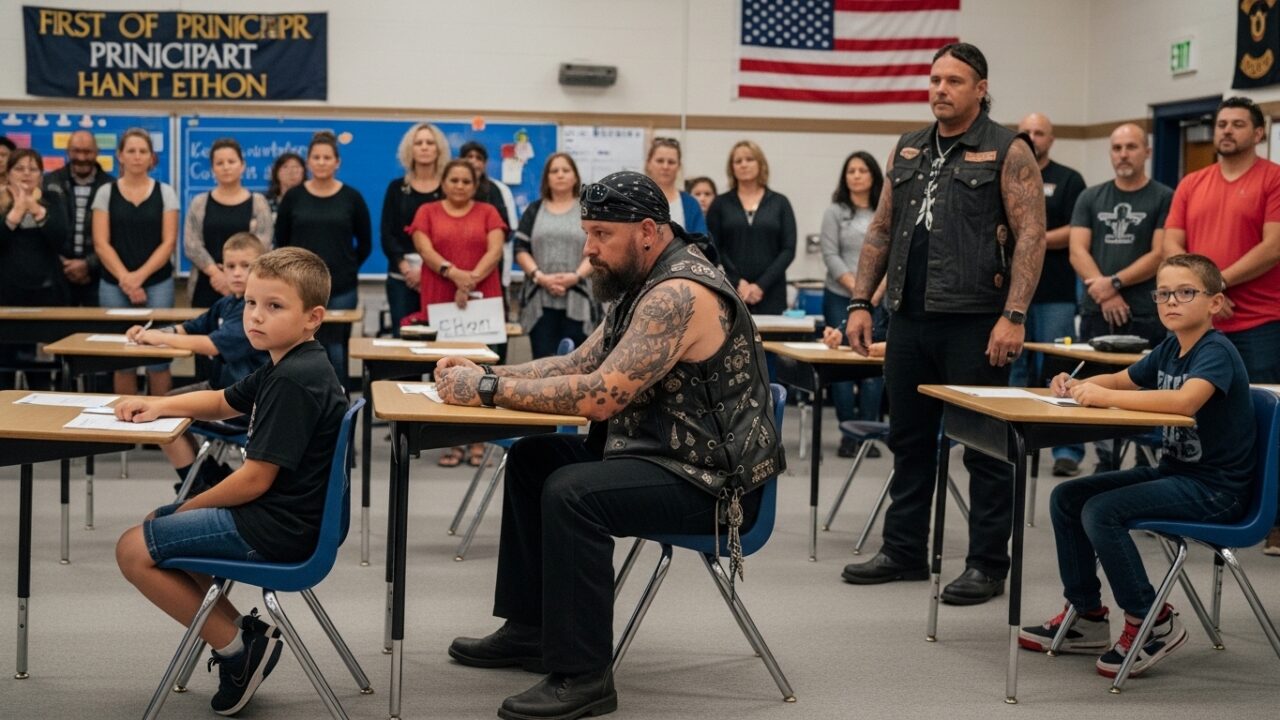
“The Principal Demanded Every Parent Stand Beside Their Child On Opening Day. When I Saw The 8-Year-Old Boy Sitting Completely Alone In The Third Row, My Heart Sank… Then The Gym Doors Slammed Open.”

CHAPTER 1
The sound of three hundred metal folding chairs scraping simultaneously against polished hardwood is not a loud noise, but it is a heavy one. It is the sound of a community moving as one. It is the sound of belonging.
Inside the stifling heat of the Oak Creek Elementary School gymnasium, the air smelled of floor wax, cheap floral perfume, and nervous morning coffee. It was Opening Day. The banner strung above the wooden stage sagged slightly in the middle, spelling out WELCOME BACK, FAMILIES in bright, optimistic red lettering.
Principal Evelyn Gable stood at the podium, adjusting the microphone with manicured fingers. She was a woman who valued order above all things. Her pale yellow suit was perfectly pressed, her smile practiced and fixed. To her, this assembly wasn’t just a morning greeting; it was a photo opportunity for the district newsletter. It was about presenting a flawless image of suburban unity.
“This is a special day,” Principal Gable’s voice echoed through the crackling PA system, dripping with artificial warmth. “A day we share with the people who support us the most. A day we share with family. I’d like to ask all our parents, grandparents, and guardians to please stand and place a hand on your child’s shoulder. Let them know you are right behind them this year.”
The scraping of the chairs followed.
Fathers in crisp polo shirts stood up, chuckling as they ruffled their sons’ hair. Mothers in neat summer dresses rose, their phones already angled to capture the perfect, sunlit selfie. Arms wrapped around small shoulders. The room swelled with a collective, physical manifestation of love and security. Everyone had someone.
Everyone except the boy in the third row, aisle seat.
Ethan did not stand. He couldn’t. The instruction was for parents to stand, and Ethan did not have one present. He was eight years old, drowning in a faded, oversized plaid shirt that had clearly been washed a hundred times too many. His sneakers were scuffed at the toes, the laces frayed and knotted awkwardly. Between his feet sat a navy blue backpack, sagging and empty, save for a few crumpled folders.
While the rest of the gym rose around him like a rising tide, Ethan remained seated. His feet dangled a few inches above the floor. He pressed his knees together and folded his small hands tightly in his lap. His knuckles were pale.
He didn’t look around. He didn’t search the crowd with hopeful eyes. He had learned a long time ago that waiting quietly hurt significantly less than hoping loudly. Hope was a dangerous thing in Ethan’s world. It was the sound of a car slowing down outside his window, only to speed up and drive away. It was the promise of a weekend visit that ended in a disconnected phone number. Today was just another lesson in a curriculum he already knew by heart: he was on his own.
A few feet away, leaning against the cinderblock wall, stood Ms. Sarah Miller. It was her third year teaching second grade. She held a stack of homeroom rosters to her chest, her fingers gripping the paper tightly. She saw Ethan. She saw the gaping, horrific empty space around him. The mother in the row behind Ethan was purposefully leaning away, shielding her own daughter as if Ethan’s isolation were a contagious disease.
Sarah’s chest tightened. Her instinct screamed at her to walk over, to stand behind the boy, to place a hand on his trembling shoulder. But her eyes darted to Principal Gable on the stage. Gable had strictly instructed the staff to remain at the perimeter during the ceremony to “allow the families their private moment.” Sarah needed this job. She had student loans. She had rent. She swallowed hard, shifting her weight from one foot to the other, choosing compliance over compassion. It was a choice she would deeply regret before the hour was over.
“Look at him,” a father in the second row whispered to his wife, not bothering to lower his voice enough. “Where are his people? It’s Opening Day, for God’s sake.”
“I heard he’s with a foster family across town,” the wife murmured back, her eyes full of pity but her posture rigid. “Such a shame. It brings the whole mood down.”
Ethan heard them. He always heard them. He fixed his gaze on a dark scuff mark on the floorboards, counting the seconds in his head. One, two, three. If he just breathed shallowly enough, maybe he would disappear.
Then, the heavy double doors at the back of the gym opened.
It wasn’t a dramatic kick. It wasn’t an explosive entrance. But the doors swung wide, pulling the heavy, humid morning air from the parking lot into the air-conditioned room. The sudden shift in air pressure caused the Welcome Back balloons to violently sway.
A man stepped into the threshold.
He did not look like he belonged at Oak Creek Elementary. He stood over six feet tall, his shoulders broad and thick, casting a long, intimidating shadow across the entrance mat. He wore heavy, scuffed steel-toed boots, faded denim jeans coated in a thin layer of road dust, and a thick black leather vest over a sleeveless gray shirt. His arms were a canvas of dark, dense tattoos—skulls, eagles, and heavy gothic lettering that spoke of a life lived far outside the manicured lawns of this suburb. A pair of pitch-black aviator sunglasses hid his eyes, reflecting the harsh fluorescent lights of the gym.
He was a biker. A ghost from a different world intruding on a suburban sanctuary.
The whispers closest to the doors stopped instantly, replaced by a tense, suffocating silence that began to ripple forward row by row.
“What is he doing here?” a mother gasped, pulling her purse closer to her chest.
“Is the door locked? Who let him in?”
Principal Gable’s practiced smile vanished. She gripped the edges of the podium, her knuckles turning white. She tapped the microphone, a sharp, screeching sound piercing the air. “Excuse me,” she said, her voice trembling slightly beneath its authoritative tone. “Sir? Can I help you?”
The biker did not answer her. He didn’t even look at the stage. He stood at the back of the room, slowly scanning the sea of standing families. He wasn’t looking for trouble, but he carried the air of a man who knew exactly how to handle it if it found him.
His head stopped turning. His hidden gaze locked onto the third row.
Onto the empty space. Onto the small boy staring at his shoes.
The biker began to walk.
His heavy boots hit the hardwood floor with a rhythmic, undeniable thud. Thud. Thud. Thud. The sound cut through the murmurs. As he walked down the center aisle, the parents closest to him instinctively took half-steps backward, pulling their children behind them. The smell of old leather, motor oil, and spearmint gum trailed behind him.
By the gym doors, Officer Davis—a sixty-year-old school security guard who usually spent his days breaking up playground scuffles and directing traffic—unclipped the safety strap on his radio. He placed his right hand firmly on his duty belt, his heart rate spiking. He stepped away from the wall, following the biker down the aisle.
The biker reached the third row. He stopped.
He looked down at the empty metal folding chair beside Ethan. Without a word, he reached out with a massive, heavily tattooed hand, picked up Ethan’s sagging backpack, and gently set it on the floor.
Then, he sat down.
The springs of the cheap chair groaned under his weight. He planted his boots firmly on the floor, rested his thick forearms on his knees, and stared straight ahead at the stage.
The entire gymnasium seemed to stop breathing.
Ethan’s eyes widened. He slowly turned his head, his small neck craning to look at the mountain of leather and ink sitting mere inches from him. He had never seen this man before in his life.
The biker didn’t turn his head, but he sensed the boy’s gaze. He leaned slightly to the left, his voice a low, gravelly rumble that barely carried past the two of them.
“You okay, kid?”
Ethan didn’t know how to answer. His throat felt tight. He just gave a small, jerky nod.
“Good,” the biker said flatly. “Breathe.”
On the stage, Principal Gable was losing control of her perfect event. Her face flushed an angry, embarrassed red. “Excuse me!” she barked into the microphone, the feedback whining sharply. “Sir in the third row! This is a closed event for students and their immediate guardians! You need to identify yourself!”
The biker didn’t flinch. He didn’t stand up. He just sat there, taking up space, filling the void that had been threatening to swallow Ethan whole.
Officer Davis finally reached the row. He leaned in, trying to project authority, though his voice cracked slightly. “Alright, buddy. That’s enough. You need to come with me right now. You’re trespassing.”
The biker slowly turned his head to look at the security guard. He didn’t remove his sunglasses. The reflection of Officer Davis’s nervous face stared back at him.
“I’m sitting in a chair,” the biker said quietly.
“You don’t have a kid here,” Davis retorted, his hand hovering over his radio. “You’re making people uncomfortable. Get up.”
“The boy’s seat was empty,” the biker replied, his tone chillingly calm. “Now it’s not. Move along.”
“I am going to call the police,” Principal Gable warned from the stage, her voice echoing loudly. The murmurs in the crowd escalated into full-blown panic. A few fathers in the front row puffed out their chests, looking as though they might intervene, but none took a step forward.
Ms. Miller watched from the wall, her hand covering her mouth. She saw Ethan. For the first time all morning, the boy wasn’t looking at the floor. He was looking at the man beside him. His shaking had stopped.
“Last warning,” Officer Davis snapped, pulling his radio from his belt. “Get up, or I’m calling dispatch.”
The biker let out a slow, heavy breath. He reached a hand inside his thick leather vest.
Gasps erupted from the bleachers. “He’s got something!” a woman screamed.
Officer Davis took a massive step back, fumbling with his radio. “Hey! Hands where I can see them!”
The biker’s hand emerged. He wasn’t holding a weapon.
He was holding a heavily scratched, thick black smartphone.
Without breaking his seated posture, he tapped the screen once. He lifted the phone to his ear. The silence in the gym was so absolute, so suffocating, that every person in the room could hear the faint, hollow ring from the earpiece.
Someone picked up on the other end.
The biker spoke exactly two words.
“I’m here.”
He waited for a beat.
“Yes.”
He hung up the phone and slipped it back into his vest. He returned his hands to his knees, sitting squarely beside the eight-year-old boy. He didn’t look at Officer Davis. He didn’t look at Principal Gable. He looked at Ethan.
“Just watch the stage, kid,” he murmured.
Officer Davis raised the radio to his mouth to call for backup. But before he could press the button, a new sound began to bleed into the gymnasium.
It started as a low vibration. A distant, heavy thrumming that vibrated through the soles of everyone’s shoes.
It wasn’t a siren. It wasn’t police cars.
It was the deep, guttural roar of heavy engines.
And it wasn’t just one. It sounded like a dozen. Then two dozen. The low frequency rumbled through the floorboards, rattling the glass in the gym doors. The sound grew louder, closer, more organized, like a thunderstorm rolling directly into the school parking lot.
Principal Gable froze at the podium. Officer Davis slowly lowered his radio, his eyes wide as he stared at the gym doors.
Because whatever was about to walk through those doors to answer the biker’s call… was not something they could simply ask to leave.
CHAPTER 2
The rumbling did not stop. It deepened.
It was a heavy, mechanical growl that vibrated through the floorboards, traveling up the metal legs of the folding chairs and into the bones of every parent sitting in the Oak Creek Elementary gymnasium. The cheerful, air-conditioned atmosphere evaporated, replaced by a suffocating, instinctual tension. The colorful Welcome Back balloons tied to the bleachers seemed to tremble against the sound waves.
Outside, beyond the heavy double doors and the frosted glass windows, the shadows shifted.
Principal Gable’s voice caught in her throat. She gripped the edges of her wooden podium so tightly her acrylic nails threatened to snap. She had planned for speeches, for polite applause, for a photographer from the local gazette to snap pictures of smiling, affluent families. She had not planned for an invasion.
Officer Davis, the aging school security guard, stood frozen at the end of the center aisle. His hand remained glued to his radio, but he didn’t press the button. He was vastly out of his depth, and the sheer volume of the engines told him that backup wouldn’t arrive fast enough anyway.
Then, the engines cut out.
Not one by one. All at once. A synchronized, deliberate silence that was somehow more terrifying than the roar had been.
The heavy gym doors swung open again. The bright morning sunlight poured into the room, blinding the parents in the back rows. Silhouetted against the glare stood a wall of figures.
They didn’t storm in. They didn’t shout. They moved with a chilling, practiced discipline.
A woman stepped over the threshold first. She looked to be in her early fifties, with sharp, weathered features and thick gray hair pulled back into a tight, no-nonsense braid. She wore a heavy black leather jacket over a faded gray tank top. Silver chains hung from her belt, clinking softly against her denim jeans as she walked.
Behind her, they followed. Five. Ten. Fifteen of them.
Men with thick beards and arms like tree trunks. Women with tattooed knuckles and cold, assessing eyes. They wore denim, steel-toed boots, and heavy leather vests. They smelled of hot asphalt, high-octane fuel, and worn leather—a raw, gritty scent that completely overwhelmed the smell of the school’s floor wax and vanilla perfumes.
The parents in the back rows immediately shrank away. A father in a pastel pink polo shirt, who just moments before had been loudly complaining about the “foster kid bringing down the mood,” now pulled his knees tightly together, refusing to make eye contact as a massive man with a scarred cheek walked past him.
The gray-braided woman stopped at the top of the center aisle. She didn’t look at Principal Gable. She didn’t look at Officer Davis. She slowly scanned the room, her eyes darting from face to face, calculating, counting.
Finally, she stopped. “Is this where the parents sit?” she asked.
Her voice wasn’t loud, but it carried perfectly through the dead silent gym.
No one answered. The suburban crowd was paralyzed by their own assumptions.
The woman didn’t wait for permission. She nodded once to the group behind her. Slowly, methodically, they began to filter into the rows. They didn’t crowd the aisles. They didn’t block the exits. They simply found the empty folding chairs scattered around the room and sat down.
But they didn’t just sit anywhere.
They gravitated toward the third row. They filled the empty seats in front of Ethan. They filled the empty seats behind him. The gray-braided woman sat directly across the aisle from the boy, her posture rigidly straight.
In less than sixty seconds, the glaring, shameful void that had surrounded the eight-year-old boy was gone. Ethan was now sitting in the dead center of a human fortress.
The biker who had arrived first—the massive man with the aviator sunglasses sitting directly beside Ethan—didn’t even turn his head to acknowledge them. He just kept his hands resting on his knees, staring at the stage.
Ethan’s breath hitched in his throat. He looked at the gray-braided woman. She offered him a small, almost imperceptible nod, then turned her cold gaze toward the stage.
Standing by the cinderblock wall, Ms. Sarah Miller felt her heart pounding against her ribs like a trapped bird. As a second-grade teacher, she had access to the student files. She knew why Ethan was sitting alone. She knew the darkness that this boy carried in his oversized, thrift-store backpack.
The parents whispering around her didn’t know the truth. They only saw a dirty kid who didn’t fit into their perfect neighborhood. They didn’t know about Rachel, Ethan’s biological mother.
Sarah remembered reading the police report in Ethan’s file, a document that had made her physically sick to her stomach. Rachel was an addict. Two years ago, she had locked a six-year-old Ethan in a hallway closet from the outside, wedging a chair under the doorknob, so she could go on a three-day bender without being bothered. Ethan had survived in the pitch black, drinking condensation from a leaky pipe behind the drywall, until a neighbor finally heard his faint, hoarse scratching against the wood.
That was who had broken Ethan. A mother who saw him as an inconvenience.
And the system that was supposed to save him wasn’t much better. His current foster father, Greg Henderson, was a man who openly admitted he only took in kids for the state stipend. Greg hadn’t even bothered to park the car this morning. Sarah had watched through the window as Greg’s pickup truck slowed down just enough for Ethan to jump out onto the curb, before speeding away.
Ethan had been abandoned by every adult who was supposed to protect him. He was conditioned to expect pain, rejection, and isolation. He had learned to make himself invisible because, in his world, being noticed meant being hurt.
But right now, he was the most noticed person in the room. And for the first time in his life, the adults surrounding him weren’t looking at him with pity, disgust, or malice. They were looking outward, acting as a shield between him and a world that had always been cruel.
“Excuse me!” Principal Gable finally found her voice. It was shrill, teetering on the edge of hysteria. “You cannot be in here! This is a private school assembly! I am demanding that you leave immediately!”
The gray-braided woman casually crossed her legs. “It’s a public school, ma’am. Paid for by taxpayers. We’re just here to support the youth.”
“You are intimidating the families!” Gable shrieked, gesturing wildly at the pale, terrified parents clutching their children. “Officer Davis, remove them!”
Officer Davis swallowed hard. He took a hesitant step forward. “Alright, folks. You heard the Principal. You’ve made your point, whatever it is. It’s time to clear out.”
The biker sitting next to Ethan slowly turned his head. He lowered his aviator sunglasses just enough to look Officer Davis dead in the eye. “We ain’t breaking any laws, Officer. We’re sitting quietly. Enjoying the program. Why don’t you let the lady finish her speech?”
“I am calling the police!” a father in the front row suddenly yelled, standing up. He was a tall man, wearing a golf visor and an expensive watch. “This is outrageous! My daughter is terrified! You thugs need to get the hell out of our school!”
The atmosphere in the gym snapped from tense to explosive.
The biker next to Ethan didn’t raise his voice, but the sudden shift in his posture made the angry father freeze. The massive man leaned forward, his forearms resting on his thighs. “Sit down,” he rumbled.
“Don’t you tell me to—”
“I said, sit down,” the biker repeated, his voice dropping an octave, carrying a dangerous, razor-sharp edge.
The father looked around for support, but the other parents were shrinking back. He slowly sank back into his chair, his face flushed with humiliated rage.
Sirens wailed in the distance. Principal Gable had evidently triggered the silent alarm under her podium.
Within two minutes, the wail of sirens grew deafening, cutting out abruptly in the parking lot. The heavy gym doors burst open for the third time that morning. Four local police officers jogged into the room, hands resting defensively on their duty belts, their eyes sweeping the chaotic scene.
“What is going on here?” the lead officer, a thick-necked sergeant named Miller, barked as he strode down the aisle.
Principal Gable practically ran off the stage. “Sergeant! Thank God! These… these gang members trespassed! They stormed the building! They’re terrorizing the children!”
Sergeant Miller stopped at the edge of the third row. He looked at the bikers. He looked at the gray-braided woman. Then, his eyes landed on the massive man sitting next to Ethan.
Miller’s aggressive posture faltered for a fraction of a second. “Marcus?” he said, his voice laced with confusion.
The biker beside Ethan pushed his sunglasses back up the bridge of his nose. “Morning, Sergeant.”
“What the hell are you doing here, Marcus?” Miller demanded, though his hand moved slightly away from his taser. “You know you can’t just roll into an elementary school unannounced.”
“I walked through an unlocked door, Sergeant,” Marcus replied calmly. “Sat in an empty chair. Last I checked, loitering laws don’t apply to a school gymnasium during an open-door community event.”
“They are a disruption!” Principal Gable cried out. “Look at the parents! Look at the children! They are scared!”
Marcus slowly turned his head toward the principal. “They ain’t scared of us, lady. They’re scared of their own shadows. They’re scared because we don’t look like them. But you want to talk about a disruption?”
Marcus pointed a thick, calloused finger down at Ethan. The boy flinched slightly, but Marcus’s hand stopped mid-air, ensuring he didn’t make any sudden movements toward the child.
“This boy,” Marcus said, his voice echoing off the high ceilings. “This eight-year-old boy was sitting here completely alone. While every single one of these perfect, smiling parents stood up and wrapped their arms around their kids, they left this one sitting in the dirt. They looked right at him, saw he had nobody, and they turned their backs.”
The silence in the gym was deafening. The truth of his words hung in the air, ugly and undeniable. Several parents in the surrounding rows suddenly found their shoes very interesting.
“You talk about family,” Marcus continued, his voice dripping with disgust. “You hang a banner up there. But the second a kid doesn’t fit into your perfect little picture, you pretend he doesn’t exist. You let him drown.”
Ms. Miller, standing by the wall, felt tears prick the corners of her eyes. She gripped her clipboard so tightly her fingers ached. He was right. Every word of it was right. She had stood there and done nothing. She had let the fear of her boss override her duty to her student.
“That is not your concern!” Principal Gable snapped defensively, though her face burned bright red. “He is a ward of the state. His foster father was unable to attend. That does not give you the right to hold my assembly hostage!”
“He ain’t a ward of the state today,” the gray-braided woman spoke up, her voice slicing through the tension. “Today, he’s with us.”
Sergeant Miller ran a hand over his face, clearly caught between the law and a situation that was spiraling out of control. “Look, Marcus. You know I respect what you guys do. I really do. But you’re scaring the civilians. You need to take your people and go outside. Now. Before I have to start writing citations.”
Marcus didn’t move. “Cite me for what, exactly? Sitting in a chair?”
“For disturbing the peace, trespassing, creating a public nuisance,” Sergeant Miller listed, his tone hardening. “Don’t push me on this. Get up. All of you.”
The four police officers stepped closer, forming a physical barrier between the bikers and the stage. The tension in the room was so thick it was hard to breathe. The parents were holding their breath, waiting for the violence they were certain was about to erupt.
Ethan’s small hands began to shake again. He had seen police before. He remembered the flashing red and blue lights outside his mother’s apartment. He remembered the shouting, the broken glass, the feeling of being yanked by the arm and shoved into the back of a cold cruiser.
Police meant things were getting worse. Police meant he was in trouble.
He instinctively curled inward, making himself smaller, pressing his arms against his stomach.
Marcus felt the boy trembling. He looked down. He saw the sheer panic in the eight-year-old’s eyes—a panic that was entirely too old for a child’s face.
The biker’s jaw tightened. The anger in his eyes shifted into something deeper, something profoundly sorrowful.
“Alright,” Sergeant Miller said, unclipping his handcuffs. “I warned you. Stand up and put your hands behind your back.”
The gray-braided woman looked at Marcus. The fifteen other bikers tensed, waiting for the order. They were ready to go to jail. They were ready to be dragged out of the building. They had made their choice the moment they rolled into the parking lot.
Marcus looked from the handcuffs, to the terrified parents, and finally back to Ethan.
The boy was looking up at him, tears finally pooling in his wide, frightened eyes. Ethan reached out, his tiny, trembling fingers grazing the edge of Marcus’s heavy leather vest.
“Please,” Ethan whispered, his voice cracking. “Don’t fight. It’s my fault.”
Marcus’s breath hitched. That phrase. It’s my fault. It was the anthem of the abused child. The deeply ingrained belief that the pain inflicted upon them was somehow earned.
Marcus slowly raised his hands, keeping them open and visible. He didn’t look at the police.
“We ain’t fighting, kid,” Marcus said softly.
Then, Marcus stood up.
He didn’t surrender to the police. He didn’t turn around. Instead, he reached into the inner pocket of his vest.
“Hands where I can see them!” Sergeant Miller shouted, drawing his taser. The other officers followed suit, aiming the red laser dots directly at Marcus’s chest.
Screams echoed from the bleachers. Principal Gable ducked behind the podium.
“Don’t shoot!” Ms. Miller screamed from the wall, finally breaking her silence, dropping her clipboard as she rushed forward.
Marcus didn’t flinch. He slowly pulled his hand out of his vest. He wasn’t holding a weapon. He wasn’t holding a phone.
He was holding a folded, crumpled piece of lined notebook paper.
He held it out toward Sergeant Miller.
“I’m not trespassing, Sergeant,” Marcus said, his voice completely devoid of anger, replaced by a heavy, devastating solemnity. “I have a written invitation.”
Sergeant Miller frowned, keeping his taser aimed, but cautiously reached out with his free hand and took the paper. He unfolded it.
As the police officer read the messy, childish handwriting on the page, the color completely drained from his face. He lowered his weapon, his eyes widening in shock as he looked from the paper, down to Ethan, and then back to the tattooed giant standing before him.
The secret was out. And the consequences of it were about to change the lives of everyone in that room.
CHAPTER 3
The silence in the gymnasium was no longer just quiet; it was a physical weight. It pressed down on the chests of the three hundred parents, suffocating the last remnants of their suburban outrage.
Sergeant Miller’s thumb hovered over the safety switch of his taser. The red laser dot, which had been resting squarely on Marcus’s chest, dipped down until it painted a bright, vibrating circle on the polished hardwood floor.
Miller’s eyes tracked across the crumpled, wide-ruled notebook paper. The handwriting was jagged, pressing so hard into the cheap paper in some places that the pencil lead had torn through. It was written in blue crayon and dull pencil, the unmistakable, clumsy scrawl of a child trying desperately to be neat.
Miller swallowed hard. His Adam’s apple bobbed in his thick throat. The blood drained completely from his face, leaving a sickening, grayish pallor behind.
“Sergeant?” Principal Gable hissed from behind her wooden podium, her voice tight with panic. “Sergeant Miller, what is it? Is it a threat?”
Miller didn’t answer her. He slowly lowered his taser, securing it back into its holster with a loud, final click. He didn’t look at the principal. He didn’t look at the crowd of terrified parents. He looked straight into Marcus’s dark, impassive eyes, and then, very slowly, his gaze drifted down to the eight-year-old boy sitting between them.
“Where…” Miller started, his voice cracking. He cleared his throat and tried again. “Where did you get this, Marcus?”
“It showed up in the mail slot at the clubhouse on Tuesday,” Marcus answered, his voice a low rumble. “Addressed to ‘The Loud Motorcycles on 4th Street’.”
“Sergeant, I demand to know what is on that paper!” Principal Gable shouted, stepping out from behind the podium, her yellow suit suddenly looking garish and absurd against the gravity of the room. “These men are trespassing! Arrest them!”
Miller turned his head slowly. The look he gave the principal was so full of raw disgust that she physically recoiled.
“They aren’t trespassing, Evelyn,” Sergeant Miller said, his voice deadly quiet, carrying across the gym without the need for a microphone. He held up the crumpled piece of paper. “They were invited.”
“By whom?” she scoffed, gesturing wildly. “I certainly didn’t invite a biker gang to my school!”
“By him,” Miller said, pointing a thick finger at Ethan.
The entire room seemed to inhale at once. A collective gasp rippled through the bleachers. The father in the pastel pink shirt, who had been screaming for the police two minutes ago, slumped back into his chair as if he had been struck.
Ms. Sarah Miller, standing by the cinderblock wall, pressed her hands to her mouth, tears finally spilling over her eyelashes and cutting hot tracks down her cheeks.
“Read it,” Marcus commanded softly. It wasn’t a request.
Sergeant Miller hesitated. He looked at the paper, his hands trembling slightly. He had seen a lot of terrible things in his fifteen years on the force. He had seen car wrecks, domestic violence, the absolute worst of human nature. But the innocent desperation in this jagged handwriting hit him harder than a physical blow.
He held the paper up to the fluorescent lights and began to read aloud. His voice echoed through the vast, silent gymnasium.
“Dear loud motorcycles,” Miller read, his voice wavering on the first line. “My name is Ethan. I am 8 years old. I live in the yellow house with the dead grass on Elm Street. On Friday, my school has a Family Day. The principal said we need to bring our parents to stand behind us so we look like a team.”
Miller paused, taking a shaky breath. The gym was so quiet you could hear the hum of the air conditioning unit on the roof.
“My mom is gone,” Miller continued, the words dropping like stones into the quiet room. “And my new foster dad, Greg, says it’s stupid and he won’t waste his gas to come. Last year, I was the only kid who had to sit down. Everyone looked at me. It made my stomach hurt.”
In the third row, Ethan squeezed his eyes shut. He pulled his knees up to his chest, trying to make himself as small as humanly possible. He had never intended for the letter to be read out loud. He had just wanted someone, anyone, to stand in the empty space.
Sergeant Miller wiped his mouth with the back of his hand, his eyes shining. He read the final paragraph.
“I saw you guys ride by my street. You look really big and scary, and nobody messes with you. I don’t have a lot of money. I have three dollars from finding cans. If I give it to you, can just one of you come to my school and stand behind my chair? Just until the clapping stops. You don’t even have to talk to me. I just don’t want to be invisible again. Please.”
Miller stopped. He slowly folded the paper.
The silence that followed was absolute devastation.
It wasn’t the silence of fear anymore. It was the silence of profound, crushing shame.
The parents who had whispered, the mothers who had pulled their daughters away, the fathers who had puffed out their chests—they all sat frozen, staring at the floor, staring at their hands. The ugly truth of their pristine suburban bubble had been violently ripped open. They had looked at a drowning child and complained that his splashing was ruining their view.
“Three dollars,” Marcus said, his voice slicing through the heavy air.
The massive biker reached into the front pocket of his denim jeans. He pulled out his hand and opened his massive palm. Sitting in the center of his calloused, tattooed hand were three crumpled, dirty one-dollar bills.
“He hired us,” Marcus said, looking directly at Principal Gable. “Paid in full. We’re his security detail for the morning. We fulfilled the contract.”
Principal Gable stared at the three dollar bills, her mouth opening and closing like a fish out of water. Her carefully constructed image, her perfect newsletter photo, was completely destroyed. “I… I didn’t know,” she stammered, shrinking backward.
“You didn’t care to know,” the gray-braided woman—Roxanne—spoke up from across the aisle. She stood up, her silver chains clinking in the quiet room. She pointed a finger at the stage. “You put on a show about family, but you only mean your kind of family. The ones that look good on camera. You knew this boy was in the system. You knew his situation. And you still forced him to sit in the middle of this room and be a spectacle of his own trauma.”
“That is entirely unfair!” Gable protested, though her voice lacked any real authority now. “I am trying to foster a community—”
“You’re fostering a pageant,” Ms. Sarah Miller suddenly yelled.
Every head snapped toward the cinderblock wall.
The second-grade teacher stepped forward, dropping her clipboard to the floor with a loud clatter. She had spent three years biting her tongue, afraid of losing her job, afraid of making waves. But looking at Ethan, surrounded by heavily tattooed bikers who had shown more humanity in ten minutes than the school had shown in a year, something inside her finally snapped.
“Sarah, step back,” Principal Gable warned, her eyes flashing with a desperate, petty anger.
“No,” Sarah said, her voice shaking but her posture rigid. She walked straight down the aisle, stopping right in front of the stage. She looked at the parents, then at the principal. “I brought this up to you on Tuesday, Evelyn. I asked if Ethan could sit with the staff so he wouldn’t be alone. You told me it would ‘disrupt the visual flow’ of the assembly. You told me to leave him in his assigned seat.”
Gasps erupted from the parents. The shame in the room instantly morphed into directed anger toward the stage.
Principal Gable’s face turned a sickening shade of gray. “Miss Miller, you are suspended pending a review—”
But before the principal could finish her threat, the heavy gym doors at the back of the room violently slammed open for the fourth time that morning.
The impact echoed like a gunshot.
A man stormed into the gymnasium. He wasn’t a biker. He wore stained khaki work pants and a faded gray t-shirt stretched over a protruding beer belly. He was sweating profusely, his face flushed red with rage. He smelled faintly of stale beer and cheap cigarettes, a sour odor that immediately preceded him down the aisle.
It was Greg Henderson. Ethan’s foster father.
“Where is he?!” Greg bellowed, his voice grating and harsh. He marched down the center aisle, completely ignoring the police officers, the parents, and the tense atmosphere. He was blinded by his own anger. “I get a damn phone call at work from the school saying the police are here because of my kid? Do you know how much trouble you’ve caused me, you little freak?!”
Ethan flinched so violently he almost fell out of his chair. He threw his hands over his head, a purely instinctual reaction of a child expecting a physical blow.
Greg reached the third row, glaring at Ethan. “Get your bag,” he snapped. “We’re leaving. And you’re gonna pray the state doesn’t hear about this, or I’m sending you to a group home tonight.”
Greg lunged forward, reaching out to grab Ethan by the collar of his shirt.
His hand never made it.
A massive, leather-clad arm shot out, catching Greg by the wrist. The grip was like an iron vise.
Greg gasped, his forward momentum jarring to a halt. He looked up, his angry expression morphing into sudden, sheer terror as he realized exactly who he was trying to reach past.
Marcus slowly stood up.
At six-foot-four and two hundred and eighty pounds, the biker towered over Greg Henderson. Marcus didn’t let go of Greg’s wrist. He slowly twisted it, just enough to make the abusive foster father grimace in pain.
“You touch that boy,” Marcus whispered, his voice vibrating with a terrifying, contained violence, “and I will break every bone in your hand.”
“Hey!” Greg yelled, trying to pull away, but Marcus’s grip was immovable. “Let go of me! I’m his legal guardian! Officers, arrest this maniac! He’s assaulting me!”
Greg looked toward Sergeant Miller, expecting the police to rush in and tackle the biker.
But Sergeant Miller didn’t move. None of the four officers moved. They stood perfectly still, their hands resting loosely on their belts, their faces blank. They had all heard the letter. They had all seen Ethan flinch.
“Did you hear me?!” Greg panicked, his voice pitching higher as the other fifteen bikers in the room slowly stood up from their folding chairs.
The sound of fifteen bikers standing at once was a chorus of shifting leather, clinking chains, and heavy boots scraping against wood. They didn’t draw weapons. They didn’t shout. They simply moved into the aisle, forming a solid, impenetrable wall of denim and muscle between Greg Henderson and the eight-year-old boy.
Roxanne stepped out of the row, crossing her arms over her chest, staring at Greg with a look of pure, unadulterated disgust. “You must be the guy who thinks a kid’s dignity isn’t worth a tank of gas.”
“Who the hell are you people?!” Greg stammered, finally managing to yank his wrist out of Marcus’s grip. He stumbled backward, realizing how horribly outmatched he was.
“We’re his family,” Marcus said, stepping entirely out of the row, blocking Ethan from Greg’s view. “And we’re terminating your guardianship.”
“You can’t do that!” Greg sneered, though he took another step back. “You’re a bunch of street trash! The state pays me to house him! He comes with me!”
“The state,” Sergeant Miller finally spoke up, stepping forward, his voice cold and authoritative, “is going to be having a very long conversation with you, Mr. Henderson.”
Greg spun around to face the cops. “Are you kidding me? They’re the criminals! Look at them! He just threatened me!”
“I didn’t hear a threat,” Sergeant Miller lied smoothly, looking at his fellow officers. “Did you boys hear a threat?”
The three other cops shook their heads in unison. “Not a thing, Sarge,” one of them replied.
“I did, however, see you aggressively lunge at a minor in a public space,” Miller continued, pulling out his handcuffs. “And considering the complaint of gross neglect filed in this letter, I think we need to take a ride down to the precinct to discuss the living conditions at your residence. And the fact that you smell like a brewery at nine in the morning.”
Greg’s face went pale. “Now wait a minute—”
“Hands behind your back,” Miller ordered, stepping into Greg’s space.
The gym was dead silent as the metal cuffs ratcheted around Greg Henderson’s wrists. The parents watched in stunned awe as the man who had abandoned the boy was marched out of the room by the police, while the men who looked like criminals stood guard over the child.
The world had entirely flipped on its axis.
Marcus turned back around. He looked down at the empty chair, and then at Ethan.
The boy was no longer crying. He was staring at Marcus, his small mouth slightly open in disbelief. He had spent his entire life learning that monsters were real. They lived in his house. They locked him in closets. They yelled at him.
But today, he learned something else.
He learned that sometimes, the monsters fight for you.
“Come on, kid,” Marcus said, holding out his massive, tattooed hand. “Let’s get you out of here.”
The consequences had arrived. The facade of the school was broken, the abusive home was exposed, and a new reality was about to begin. Ethan looked at the outstretched hand, taking a deep breath before making the choice that would change the rest of his life.
CHAPTER 4
Ethan looked at the massive, scarred hand extended toward him.
For eight years, hands had been things that pushed him away, grabbed him in anger, or simply let him go when things got too difficult. He had never been offered a hand as a choice. He hesitated for a fraction of a second, his small chest rising and falling rapidly. He looked up at Marcus. The biker’s face was unreadable beneath his dark sunglasses, but the posture of his body wasn’t aggressive. It was patient.
Ethan slowly uncurled his fingers from his lap. He reached out and placed his tiny, pale hand into Marcus’s heavy, calloused palm.
Marcus’s fingers closed gently around the boy’s hand. The physical contrast was jarring—a hand built for gripping steel and throwing punches, holding the fragile, trembling fingers of a forgotten child.
“Alright,” Marcus rumbled quietly. “Let’s walk.”
Marcus turned. The wall of fifteen bikers parted seamlessly, creating a wide, protective corridor down the center aisle of the gymnasium.
Ethan stepped away from the cheap metal folding chair. He didn’t look back at it. As they walked down the aisle, the sound of Marcus’s heavy steel-toed boots echoed alongside the soft, shuffling steps of Ethan’s frayed sneakers. The other bikers fell into step behind them, a silent, imposing rear guard.
The parents in the bleachers did not make a sound. There were no more whispers. There was no more judgment. The self-righteous indignation that had filled the room twenty minutes ago had been completely hollowed out by the agonizing truth of Ethan’s letter. They simply watched, their faces pale, as the men and women they had mentally condemned as criminals safely escorted a vulnerable child out of the room.
Principal Evelyn Gable stood utterly alone behind her wooden podium. Her perfect event was shattered. The local newspaper photographer, who had been hiding near the soundboard, slowly lowered his camera, realizing the story he was about to submit was not the one the school district wanted. Gable’s hands gripped the edges of the podium, her knuckles white, as she watched the consequences of her vanity walk out the double doors.
Ms. Sarah Miller didn’t stay by the wall.
As the last biker passed through the doors, the second-grade teacher bent down, picked up her clipboard, and threw it forcefully into the nearby trash can. The loud plastic thud made several parents jump. She didn’t care. She turned on her heel and marched out of the gym, the heavy doors swinging shut behind her, cutting off the stagnant air of the assembly.
Outside, the bright morning sunlight was a stark contrast to the heavy atmosphere of the gym. The heat of the asphalt radiated upward.
Sergeant Miller was already near his cruiser, placing a handcuffed and swearing Greg Henderson into the back seat. The officer slammed the door shut, cutting off the abusive foster father’s string of profanities, and let out a long, exhausted sigh.
Marcus led Ethan toward the line of heavy, chrome-plated motorcycles parked near the curb. The bikers didn’t mount their bikes. They formed a loose semi-circle around the boy, creating a physical barrier between him and the street.
Roxanne, the woman with the gray braid, unzipped a leather saddlebag on her bike. She pulled out a cold bottle of water and a slightly crushed granola bar. She crouched down to Ethan’s eye level, her chains clinking softly.
“Here,” she said, her voice surprisingly gentle. She cracked the seal on the water bottle and handed it to him. “Drink it slow.”
Ethan took the bottle with both hands. He took a small sip, his wide eyes darting between the faces of the people surrounding him. They looked rough. Some had deep scars. Almost all of them had ink climbing up their necks or down their arms. But no one was yelling. No one was rushing him.
Sergeant Miller walked over, adjusting his duty belt. His expression was heavy with bureaucratic reality.
“Marcus,” the sergeant started, keeping his voice low so Ethan wouldn’t hear. “You know how this plays out. Henderson is going to lockup. But I have to call Child Protective Services. The boy can’t go with you. It’s the law.”
Marcus crossed his thick arms over his chest. He looked down at Ethan, who was carefully opening the granola bar wrapper. “I know the law, Sergeant. But the system is what put him with that drunk in the first place. I’m not leaving him alone in an office waiting room until some overworked social worker throws him into a group home.”
“I don’t have a choice,” Miller insisted, though his tone was sympathetic. “Dispatch is already sending a state worker.”
“Then we wait,” Marcus said simply.
The sound of quick, determined footsteps approached them. Sarah Miller practically jogged across the parking lot, her chest heaving as she reached the group. The bikers shifted, turning their heads to assess the newcomer, but Marcus held up a hand, signaling them to stand down.
Sarah stopped in front of Sergeant Miller, completely ignoring the imposing figures around her.
“He is not going to a group home,” Sarah said, her voice breathy but entirely firm.
Sergeant Miller frowned. “Miss Miller, you’re his teacher. You don’t have custody.”
“I am a licensed emergency foster placement,” Sarah fired back, pulling her phone from her pocket. “I finished my state certification three months ago. I’ve been waiting for a placement. I know his file. I know his dietary needs. I know his reading level. I am an approved, background-checked state resource, and I am requesting immediate temporary placement of Ethan Davis due to emergency removal.”
Ethan looked up from his water bottle. He recognized Ms. Miller. She was the teacher who always gave him an extra carton of milk at lunch and pretended it was an accident.
Marcus slowly lowered his sunglasses, looking at the young teacher with a new level of respect. “You willing to take that on?” he asked, his voice a low rumble.
Sarah looked at Marcus. She didn’t shrink away from his size or his scars. “I sat in that gym and did nothing for twenty minutes because I was afraid of my boss,” she said, her voice trembling slightly with residual adrenaline. “I’m not doing nothing anymore. He stays with me.”
Sergeant Miller ran a hand over his short hair, letting out a breath. “I’ll call the social worker. Have them meet us at your house instead of the precinct. It’ll make the paperwork faster.”
The transition was not immediate, and it was not easy. The real world rarely offers clean, cinematic endings without a heavy cost.
The consequences of that Friday morning swept through Oak Creek like a wildfire. By Monday, the local newspaper had published the story. The photographer had captured a single, devastating image: the massive, heavily tattooed Marcus sitting in the tiny folding chair beside Ethan, while the rest of the community stood with their backs turned.
The public backlash was swift and merciless. The school district switchboard was flooded with angry calls from all over the county.
Principal Evelyn Gable was placed on immediate administrative leave. Two weeks later, faced with overwhelming pressure and an impending district investigation into her handling of vulnerable students, she quietly submitted her resignation. Her obsession with maintaining a perfect image had ultimately destroyed her career.
Greg Henderson did not fare any better. The police search of his home revealed conditions far worse than neglect. Facing multiple charges of child endangerment and fraud regarding the state stipends, he accepted a plea deal that carried a mandatory state prison sentence. He would not be taking in any more children.
As for Sarah Miller, she faced a brief disciplinary hearing for her outburst. However, the parents who had been in the gym that day—many motivated by their own lingering guilt—flooded the school board with letters of support for her. The board quietly dropped the review. Sarah kept her job, and more importantly, she kept Ethan.
Healing, however, is a slow, grueling process.
Ethan did not magically recover from years of abandonment just because he had a new bedroom. There were nights when he woke up screaming, convinced he was locked in the dark closet of his mother’s apartment. There were days when he hoarded food in his backpack, terrified that the refrigerator would suddenly be empty. He still flinched when doors closed too loudly.
But he was no longer fighting those battles in the dark.
Sarah was there, sitting by his bed with a reading lamp on, waiting out the night terrors with him. She was patient. She was consistent. She proved, day by grueling day, that she was not going to disappear.
And he had backup.
The bikers did not simply ride away into the sunset and forget about the boy who had hired them for three dollars.
Every other Wednesday afternoon, the low, mechanical rumble of heavy engines would vibrate down Elm Street. The neighbors would peek through their blinds as Marcus, Roxanne, or one of the others pulled into Sarah’s driveway. They never overstayed their welcome. Sometimes they dropped off a pizza. Sometimes Marcus just sat on the porch steps with Ethan, showing him how to polish the chrome on a spare motorcycle mirror. They didn’t push him to talk. They just offered their presence—a constant, heavy reminder that he was protected.
Months passed. The humid heat of late summer bled into the crisp, cool air of autumn.
It was the second week of November. Oak Creek Elementary was hosting its annual Fall Showcase in the same gymnasium.
The atmosphere was entirely different this time. The new interim principal was a practical, warm man who didn’t care about perfectly aligned chairs or photo opportunities. The room was loud, chaotic, and genuinely happy.
Sarah Miller sat in the fourth row, a camera resting in her lap. She wore a comfortable sweater, her eyes fixed on the stage where the second graders were lining up for their choir performance.
Ethan stood in the middle of the risers. He was wearing a dark blue button-down shirt that actually fit him, tucked into clean jeans. His face had filled out, losing the hollow, sunken look of chronic hunger. He was holding a sheet of lyrics, his hands steady.
Before the music started, the music teacher asked the students to wave to their families in the crowd.
Children immediately began scanning the bleachers, their faces lighting up as they spotted their mothers, fathers, and grandparents. Hands waved enthusiastically.
Ethan looked out into the crowd. He found Sarah immediately. She smiled warmly and gave him a small, encouraging wave. Ethan smiled back.
But his eyes didn’t stop there. He looked past the front rows. He looked toward the heavy double doors at the back of the gymnasium.
Standing against the back wall, leaning casually against the cinderblocks, was a mountain of a man. Marcus wore his heavy leather vest over a flannel shirt. His arms were crossed over his chest. He didn’t wave. He didn’t smile. He just gave Ethan one slow, deliberate nod.
Ethan nodded back, his chest swelling with a feeling he had never known before this year. It was the feeling of taking up space in the world and knowing you had a right to be there.
The music started. Ethan took a deep breath and began to sing.
He didn’t look down at his shoes. He didn’t try to make himself invisible. He stood tall under the bright fluorescent lights, his voice joining the chorus of his classmates.
He was no longer the boy who waited for the disappointment. He was no longer the broken kid sitting alone while the world stood up around him. The deep, agonizing void that had defined his early childhood had been filled—not by blood relatives, not by a perfect suburban system, but by a young teacher who found her courage, and a group of rough, tattooed strangers who knew the value of showing up.
When the song ended, the crowd erupted into applause.
Ethan didn’t flinch at the loud noise. He smiled. He looked at the rows of folding chairs stretching across the gym floor. He knew, with the absolute, unshakeable certainty of a child who had finally been seen, that his seat would never be empty again.
The End

About the Author
Khánh Nguyễn
A writer passionate about human stories and real-life experiences that inspire and move readers.
 Biker
9 min read
Biker
9 min read
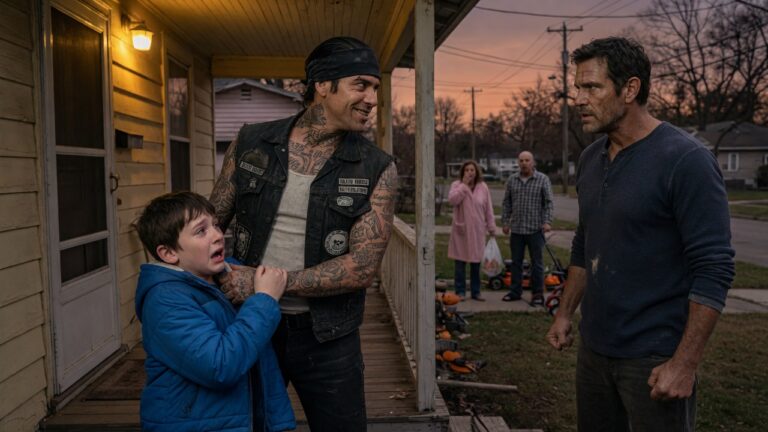
I spent a decade burying my violent past under a fake name in the middle of nowhere. Then a bruised, terrified kid showed up on my porch with a secret that brought hell right back to my doorstep.
Chapter 1: The Knock I Spent Ten Years Dreading I knew the exact moment my fake life ended. It sounded…
 Biker
19 min read
Biker
19 min read
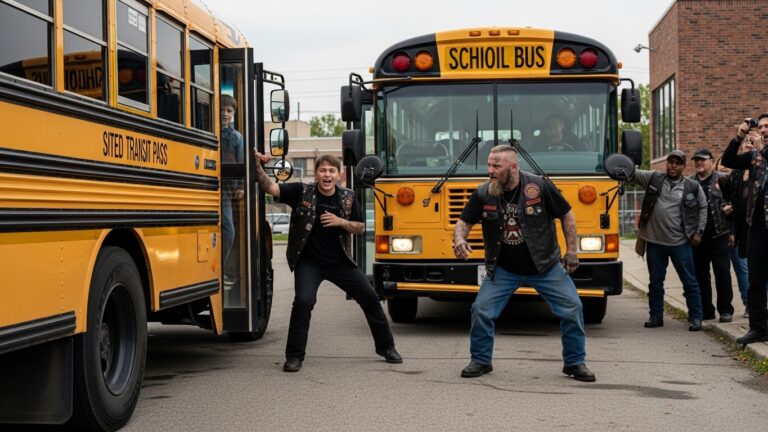
“The Bus Driver Kicked My Son Into The Cold Over A Two-Dollar Debt… But He Didn’t Realize Who Was Watching From The Shadows Of The Highway.”
“I’ve been a school bus driver for 12 years, but I never expected to be hunted down by a pack…
 Biker
20 min read
Biker
20 min read
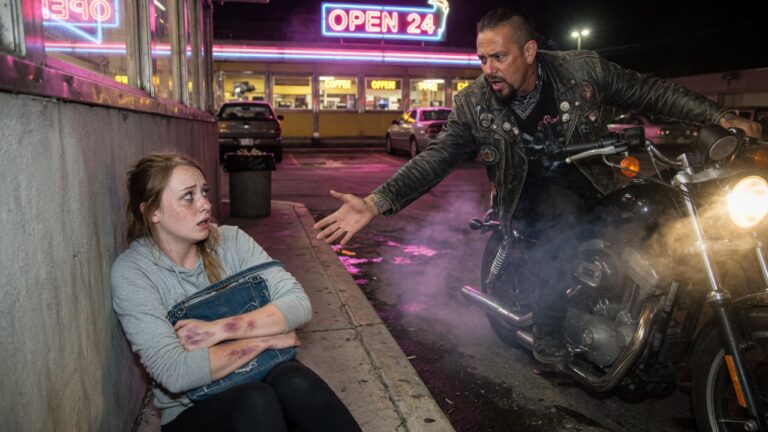
“I Was Stranded At A Neon-Lit Diner At 2 AM, Bleeding And Running For My Life. When The Biker Cornered Me For My Bag, I Knew I Was Out Of Options… But What Happened Next Shattered My Reality.”
I’ve survived things in my twenty-four years that would break most people, but nothing prepared me for the sheer, paralyzing…
Leave a Reply