
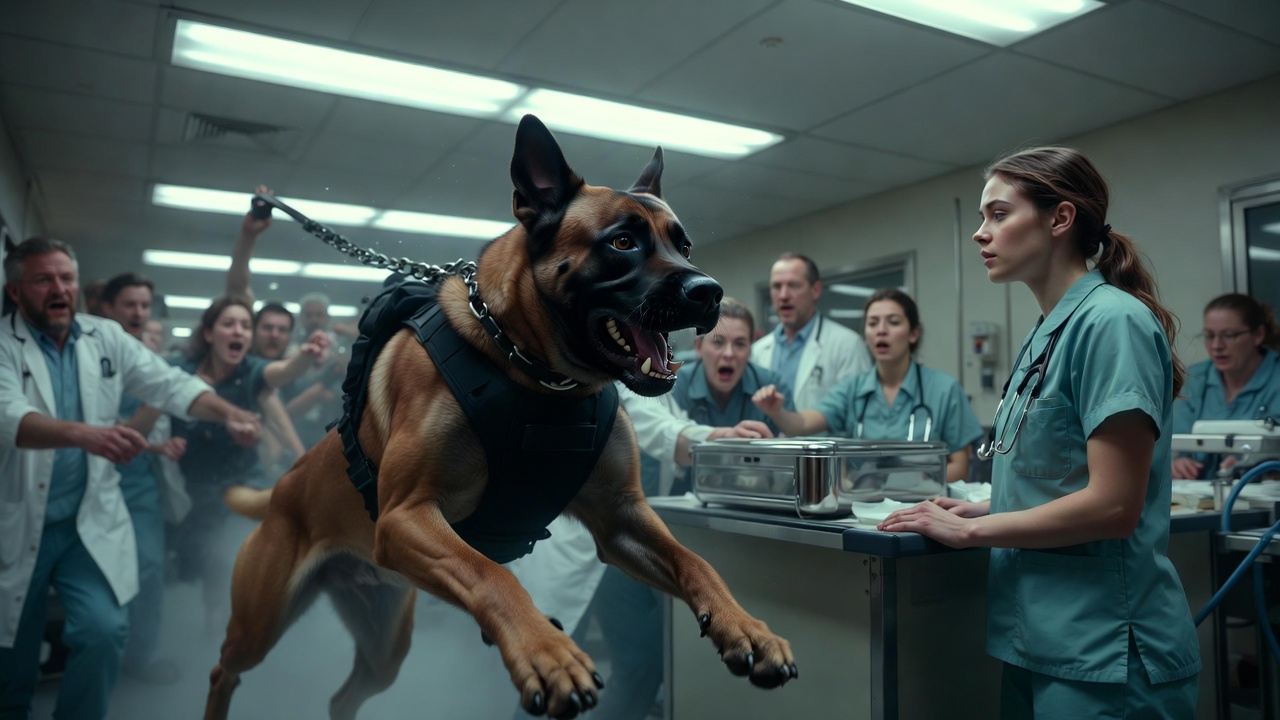
I’ve managed the midnight trauma ward for 22 years, but when the agitated police Malinois bypassed the bleeding suspect, locked eyes with our quiet new nurse, and adopted a “suppression” posture—I quietly triggered the lockdown.

I’ve been an ER trauma doctor in downtown Chicago for twenty-two years, but nothing in my two decades of treating gunshot wounds, multi-car pileups, and city-wide blackouts prepared me for the terrifying silence that fell over Trauma Bay 1 when that heavy steel leash snapped.
When you work the graveyard shift at a Level 1 trauma center, your baseline for what constitutes a “crazy night” is fundamentally broken. You get used to the adrenaline. You get used to the metallic tang of blood hanging in the sterilized air, the rhythmic, electronic beeping of heart monitors, and the frantic squeal of ambulance gurneys hitting the automatic doors.
You learn to read the room. You learn to read people.
But I couldn’t read Nurse Sarah.
Sarah had transferred to our unit exactly three weeks ago. On paper, she was perfectly average. A thirty-something woman with a quiet demeanor, a flawless resume from a small community hospital out in the Midwest, and a tendency to blend perfectly into the background. She was assigned to triage, the front lines of the ER, where the chaos usually hits first.
Most new nurses in triage last about a month before the stress cracks them. They get overwhelmed by the screaming addicts, the crying mothers, the sheer volume of human misery that washes up on our shores between midnight and dawn.
Sarah didn’t crack. In fact, she didn’t seem to react at all.
I started noticing the little things during her second week. When a massive, 250-pound intoxicated man threw a metal IV pole across the waiting room, shattering the glass of the vending machine, everyone ducked. Every doctor, security guard, and patient hit the deck.
Sarah didn’t even blink.
She stood there, perfectly still, evaluating the trajectory of the flying metal with cold, calculating eyes. She didn’t scream. Her breathing didn’t change. She just watched, assessed, and then calmly walked over to sedate the man while three burly security guards struggled to hold him down.
She moved with an unsettling, fluid efficiency. There were no wasted movements. She kept her hair tied back in a tight, regulation-style bun, and she always wore long-sleeved scrubs, even when the heating system in the hospital broke and the ER felt like a sauna.
I’d catch her sometimes, standing by the double doors of the ambulance bay, just staring out into the dark parking lot. Her posture was always perfectly straight, her hands clasped lightly in front of her. She looked less like a nurse waiting for a patient, and more like a soldier standing post.
I asked her once, over a lukewarm cup of breakroom coffee, where she had worked before the community hospital.
She looked at me with eyes that seemed a hundred years old. “Around,” she said softly. “I traveled a lot.”
That was it. End of conversation.
I brushed it off. We all have our ghosts. In the ER, you don’t pry into people’s pasts as long as they can push a syringe of epinephrine and keep a patient breathing.
But then came the night of the blizzard.
It was a Tuesday, right in the dead of February. The snow was coming down in thick, blinding sheets, shutting down the interstate and turning the city streets into ice rinks. The ER was packed with the usual winter casualties—slip and falls, frostbite, hypothermia.
We were understaffed, exhausted, and running on fumes.
At 2:14 AM, the main emergency radio on the charge desk crackled to life.
“County General, this is Unit 4-Alpha. We are inbound. Code 3. Officer involved shooting. Two patients. One suspect, multiple GSWs to the chest. One officer, laceration to the arm. We are bringing the K9. I repeat, the K9 is in the vehicle and highly agitated.”
The room tightened. The words “officer involved shooting” always change the atmosphere, but bringing an agitated police dog into a crowded emergency room was a recipe for an absolute nightmare.
“Clear Bay 1 and Bay 2!” I shouted, the fatigue instantly vanishing from my system. “Get a massive transfusion protocol ready! Security, I need you at the doors now to secure the perimeter!”
The ER exploded into coordinated motion. Gowns were tied, gloves snapped onto hands, and trauma shears were pulled from pockets.
I glanced over at the triage desk. Sarah was there, organizing a tray of chest tubes. She heard the radio call. I watched her hands. They didn’t shake. She just methodically aligned the plastic packaging, completely undisturbed by the rising panic around her.
Two minutes later, the automatic doors blew open.
The cold air rushed in, bringing with it the smell of ozone, wet snow, and fresh copper.
A swarm of blue uniforms flooded the lobby. They were shouting, pushing a gurney covered in blood. The suspect was on it, pale, gasping for air, his chest covered in red-soaked gauze.
Right behind him was Officer Davis. He was clutching his left arm, blood seeping through his fingers. But it wasn’t the bleeding officer that drew everyone’s attention.
It was the beast on the end of his leash.
It was a Belgian Malinois. Massive. At least ninety pounds of pure, coiled muscle. These aren’t pets. They are highly trained, biological weapons. They are fur missiles designed to run down armed suspects and tear them to the ground.
This one was wearing a heavy black Kevlar vest. And he was completely losing his mind.
The dog—whose name tag read “Titan”—was spinning, lunging, and barking with a deafening, terrifying ferocity. The smell of blood, the screaming people, and the blinding lights had pushed the animal into a state of sensory overload.
“Get him back! Get the dog back!” one of the attending physicians yelled, pressing himself flat against the wall as Titan snapped his jaws inches from the doctor’s leg.
“I can’t!” Officer Davis grunted, slipping on the slick linoleum floor. His injured arm was useless, and he was trying to hold the heavy leather leash with one hand. The dog was dragging him forward. “He’s too riled up! The suspect hit him during the scuffle!”
Titan’s barks were echoing off the tile walls, drowning out the heart monitors. The dog’s eyes were wide, fixated on the bloody suspect on the gurney. He wanted to finish the job. He was pulling with such force that the thick leather leash was groaning.
“Davis, tie him to the structural pillar!” a sergeant yelled, rushing forward to help.
They managed to drag the thrashing Malinois toward a thick concrete pillar near the triage desk. Davis quickly wrapped the heavy leather leash around the concrete and clipped the heavy steel carabiner back onto the leash itself, securing the dog.
“Get into Bay 2, Davis, now!” I ordered, pointing to the empty room.
Davis stumbled away, leaving Titan tied to the pillar.
The dog didn’t calm down. If anything, being restrained made him more frantic. He was throwing his entire body weight against the leash, leaping into the air, his claws scrabbling frantically against the floor tiles. The sound of his jaws snapping shut sounded like a heavy steel trap closing.
Everyone gave the pillar a wide, thirty-foot berth. Patients in wheelchairs were rolling themselves backward in terror. Nurses were hiding behind the protective glass of the registration desk.
We focused on the suspect in Bay 1. We had to crack his chest. It was a bloody, desperate fight to find the bleeding artery. For ten minutes, the entire world shrank down to the size of that trauma bay, the only soundtrack being the terrifying, relentless barking of the Malinois echoing from the lobby.
And then, a sound cut through the chaos.
It wasn’t a bark. It wasn’t a scream.
It was a sharp, distinct CRACK.
Like a gunshot.
I looked up from the patient’s chest, my hands slick with blood, and looked through the glass walls of the trauma bay.
The heavy steel carabiner on Titan’s leash had snapped. The metal had literally sheared in half under the immense, repeated force of the ninety-pound dog throwing himself against it.
The leash fell to the floor, limp.
A collective gasp sucked all the oxygen out of the emergency room.
Titan froze. He shook his massive head once, realizing there was no longer any tension on his collar.
He was loose.
A highly trained, fully agitated, blood-scented police K9 was completely unconstrained in a crowded hospital lobby.
“Don’t move!” the police sergeant bellowed, his hand instinctively dropping to his holstered weapon. “Nobody move a muscle!”
But human nature is a powerful thing. A young medical student near the vending machines panicked. He dropped his clipboard and bolted for the exit.
That was all it took. The sudden movement triggered the dog’s prey drive.
Titan pivoted. His muscles bunched up, his claws finding purchase on the linoleum, and he launched himself forward. But he didn’t go for the running medical student. He didn’t go toward Trauma Bay 1 where the suspect was bleeding.
He turned his massive head, his ears pinning flat against his skull, and zeroed in on the triage desk.
Sarah was standing there.
She was entirely alone. She had stepped out from behind the protective glass to restock a cart just before the leash broke. Now, she was completely exposed in the middle of the hallway.
Titan let out a low, guttural growl that vibrated in my chest from thirty feet away. He lowered his head, broke into a dead sprint, and charged directly at her.
“Sarah, run!” I screamed, breaking protocol, dropping my instruments, and slamming my hand against the glass wall of the trauma bay.
The dog was closing the distance terrifyingly fast. Twenty feet. Ten feet.
Officers were drawing their weapons, but they couldn’t fire. There were too many people behind the dog, too much risk of a ricochet. We were forced to watch, completely helpless, as a ninety-pound weapon barreled toward a quiet nurse who didn’t stand a chance.
I braced myself for the horrific impact. I braced myself for the screaming, the tearing of fabric, the blood.
But Sarah didn’t run.
She didn’t scream. She didn’t throw her hands up to protect her face.
Instead, as the massive Malinois launched itself into the air, jaws wide open, aiming straight for her chest, Sarah did something that made the hair on the back of my neck stand up.
She stepped into the charge.
She dropped her center of gravity, squared her shoulders, and raised her left arm in a highly specific, rigid blocking angle. At the exact same millisecond, she didn’t yell. She didn’t scream for help.
She hissed a single, sharp word in a language I didn’t recognize. It sounded guttural. German, maybe, or Dutch.
The effect was instantaneous and completely unnatural.
Mid-air, inches from tearing into her shoulder, Titan’s eyes widened. He physically twisted his body, aborting the attack mid-flight. He crashed onto the linoleum at her feet, sliding sideways into a row of metal chairs with a loud crash.
The entire emergency room held its breath. The silence was heavier than lead.
Titan scrambled to his feet. But he didn’t attack again.
The terrifying, bloodthirsty beast looked up at Sarah. He tucked his tail slightly. He let out a soft, high-pitched whine.
Sarah stood over him, her posture completely transformed. The quiet, background nurse was gone. She radiated an aura of absolute, terrifying authority.
She pointed a single finger at the floor next to her boot and snapped another harsh, foreign command.
Titan, the dog that had just required three grown men to restrain, immediately dropped his belly to the freezing floor, crossed his front paws, and pressed his snout against her shoe, shaking slightly.
He had submitted. Instantly. Completely.
I looked at the police sergeant outside my glass window. His gun was still drawn, but his jaw had practically hit the floor. He was staring at Sarah with a mixture of profound confusion and deep, unmistakable fear.
Because what we had just witnessed wasn’t a lucky escape. It wasn’t a miracle.
It was dominance.
Sarah slowly reached down, her hand steady, and grasped the broken leather collar. As her long sleeve pulled back, I finally saw what she had been hiding under those scrubs for the past three weeks.
Thick, jagged, purple burn scars snaking up her arm, framing a faded, black ink tattoo of a very specific, classified military insignia.
I stepped backward, my hand blindly reaching for the silent alarm under the charge desk. Because the realization hit me like a physical blow.
Whoever Sarah was, she wasn’t just a triage nurse from a small town in the Midwest.
And she definitely wasn’t hiding from something.
She was hiding in plain sight.
The silence in the emergency room was absolute. It was the kind of heavy, suffocating quiet that only exists in the aftermath of a near-fatal disaster. The relentless beeping of the heart monitors in Trauma Bay 1 seemed completely swallowed by the sudden vacuum of sound in the hallway.
No one breathed. No one moved.
Thirty seconds ago, this lobby was a war zone of screaming nurses, panicking patients, and shouting police officers. Now, the only sound was the soft, rhythmic panting of Titan, the ninety-pound Belgian Malinois.
The dog was still pressed flat against the cold linoleum tiles, his massive front paws crossed perfectly in front of him. His chin rested gently on the toe of Sarah’s left boot. The terrifying, bloodthirsty beast that had just snapped a heavy steel carabiner through sheer force of will looked up at our quiet triage nurse with eyes full of utter devotion.
And fear.
I stood behind the glass of the trauma bay, my hands still suspended over the bleeding suspect on the table, my surgical gloves slick with red. I couldn’t tear my eyes away from the scene in the hallway.
Sergeant Miller, a thirty-year veteran of the Chicago Police Department with a chest like a barrel and a face carved out of granite, was frozen about fifteen feet away. His service weapon was still drawn, the barrel trembling slightly as it pointed at the floor. He looked from the dog, up to Sarah, and back down to the dog.
His brain simply couldn’t process the math of what he was seeing. None of us could.
“Ma’am,” Sergeant Miller finally rasped, his voice sounding dry and gravelly. He swallowed hard, trying to regain his command presence. “Step away from the K9. Slowly.”
Sarah didn’t even look at him.
She kept her gaze fixed downward, studying the animal at her feet. The fluorescent lights overhead cast harsh shadows across her face, highlighting the sharp angle of her jaw. The aura she projected wasn’t just calm; it was a terrifying, suffocating wall of authority.
Slowly, deliberately, she lowered herself into a deep, balanced crouch. It wasn’t the clumsy squat of a tired nurse. It was a tactical, perfectly centered movement. She kept her left arm extended, the sleeve of her scrub top pushed up just far enough to reveal the bottom edge of that jagged, purple burn scar.
And the tattoo.
From my vantage point behind the glass, I couldn’t make out the exact details of the ink, but I saw Sergeant Miller’s eyes widen as he caught a glimpse of it. Whatever that black, faded symbol was, it hit the seasoned cop like a physical blow. His posture stiffened. The weapon in his hand dipped lower, almost as if he were suddenly afraid of holding a gun in her presence.
“He’s blown his drive,” Sarah said. Her voice was low, smooth, and stripped of any identifiable accent. It didn’t carry through the room like a shout, but somehow, every single person in the ER heard it perfectly. “He’s in sensory overload. The lights, the smell of cordite from the shooting, the blood. You brought an unsecured, actively defensive asset into an echo chamber.”
She wasn’t talking like a nurse. She was giving a tactical assessment.
“Ma’am, that dog is police property,” Sergeant Miller tried again, taking half a step forward. “His handler is down in Bay 2. He’s highly dangerous, and I need you to step back so animal control can—”
Sarah’s head snapped up.
Her eyes locked onto Miller’s. From thirty feet away, I saw the Sergeant literally flinch.
“If you bring a catch-pole near this animal right now,” Sarah said, her voice dropping an octave, “he will interpret it as a lethal threat. He will kill the person holding it, and you will be forced to shoot him on this hospital floor. Is that the paperwork you want to fill out tonight, Sergeant?”
Miller opened his mouth, then closed it. The seasoned cop, a man I had seen scream down violent gang members in this very waiting room, was completely paralyzed by a woman who weighed maybe a hundred and thirty pounds soaking wet.
Sarah didn’t wait for his answer. She turned her attention back to Titan.
She reached her bare hand forward. Everyone in the lobby tensed. I felt my own heart hammer against my ribs. A dog in that state of agitation could snap a human wrist like a dry twig.
But Titan didn’t bite. He didn’t even growl. He let out another soft, high-pitched whine and leaned his massive head into her palm.
Sarah ran her fingers expertly over his skull, down his powerful neck, and along his flanks, checking for injuries with the practiced speed of a combat medic. She found a deep laceration near his shoulder, likely from the scuffle with the suspect.
She murmured something to the dog. Again, it was in that harsh, guttural language. German. It had to be German. The command words used for top-tier military and police dogs. But she wasn’t just using the words; she possessed the pitch, the inflection, and the absolute dominance that the animal instantly recognized and respected.
“Doctor!”
The frantic scream shattered my trance.
It was Nurse Jenkins, standing on the other side of the operating table in Trauma Bay 1. “Doctor, we’re losing him! Pressure is dropping! 60 over 40 and falling! We have a massive hemorrhage in the left pleural cavity!”
Reality crashed back over me like a bucket of ice water. The suspect. The gunshot wound. The man dying on my table.
I tore my eyes away from Sarah and the dog. “Push another unit of O-negative!” I barked, my medical training overriding my shock. “Give me a scalpel, now! We need to crack his chest. I need to clamp the aorta or he bleeds out in the next sixty seconds!”
For the next fifteen minutes, the world outside Trauma Bay 1 ceased to exist.
It was a blur of blood, screaming monitors, and desperate, physical labor. My hands were deep inside the suspect’s chest cavity, fighting a losing battle against a torn artery. The smell of copper and iodine filled the small room, thick and nauseating. We clamped, we suctioned, we pumped him full of adrenaline and packed red blood cells.
Every second was a fight. The monitor flatlined twice. Twice, we dragged him back from the absolute brink.
Finally, miraculously, the rhythmic, electronic beep stabilized. The bleeding slowed. The color began to seep back into the monitors.
“Vitals are holding,” Jenkins gasped, wiping a streak of sweat from her forehead with a bloody forearm. “Pressure is coming up. 90 over 60. He’s stabilizing.”
“Get him packaged for the OR,” I ordered, my voice hoarse. “Call general surgery and tell them they have a bleeder coming up right now. Do not waste a second.”
I stepped back from the table, my knees suddenly shaking with the adrenaline crash. I stripped off my blood-soaked gown, tearing it at the shoulders, and tossed it into the biohazard bin. I peeled off my gloves, my hands trembling so violently I could barely grab the latex.
I turned and looked through the glass wall of the trauma bay, expecting to see the lobby still frozen in a state of armed standoff.
But the hallway was empty.
Sergeant Miller was standing by the triage desk, talking frantically into his radio. The other officers had holstered their weapons and were establishing a perimeter around the entrance.
But Sarah was gone. And so was the ninety-pound killing machine.
I pushed through the heavy glass doors of the trauma bay, the cold air of the lobby hitting my sweat-soaked scrubs.
“Sergeant,” I said, my voice sharp. “Where is my nurse?”
Miller turned to look at me. His face was pale, his eyes wide and uncertain. The authoritative swagger he usually carried was completely gone.
“She… she took him,” Miller stammered, pointing a thick finger down the corridor toward the unused psychiatric holding rooms. “She just unclipped his heavy vest, stood up, and told him to heel. And the dog just… followed her. Like she was his goddamn shadow. Doc, that dog is trained to kill on command. He doesn’t heel for anyone but his assigned partner.”
“Where did she take him?” I demanded.
“Room 4,” Miller said. “The isolated observation room. She said she needed to dress a laceration on the dog’s shoulder and that the animal needed a ‘dark, quiet space to de-escalate.’ She locked the door from the inside.”
I stared at the heavy wooden door of Room 4 at the end of the hallway. It was meant to hold violent psychiatric patients. The door was solid core, reinforced steel, with a tiny, shatterproof window at the top.
“And you just let her?” I asked, incredulous. “You let a civilian walk away with a highly volatile police K9?”
Miller let out a short, humorless laugh. He stepped closer to me, lowering his voice so his patrol officers wouldn’t hear.
“Doc, you didn’t see what I saw,” he whispered, his eyes darting toward Room 4. “When she squatted down… her sleeve pushed up. I saw her ink.”
“I saw it too,” I said. “Looked like a faded military tattoo. So what? She served. Half the nurses in this city are former military medics.”
“Not with that ink, they aren’t,” Miller said, his voice dropping to a harsh whisper. He wiped a hand over his mouth, visibly shaken. “I did four tours in Afghanistan with the Rangers before I joined the force. I know military ink. I know the standard issue stuff, and I know the stuff that the guys in the shadows wear.”
He leaned in closer, and I could smell the stale coffee and cold sweat on his breath.
“That insignia on her forearm? It’s not standard military. It’s a specific, classified unit marker. You don’t get that tattoo unless you’ve operated at the absolute highest, darkest levels of Tier One Special Mission Units. We’re talking the kind of ghosts that don’t officially exist. The kind of people who get dropped behind enemy lines to handle things the government will deny ever happened.”
A cold chill ran down my spine, settling heavily in my gut.
“You’re telling me my quiet triage nurse, the one who organizes gauze pads by color, is some kind of black-ops assassin?” I asked, my logical, medical mind desperately trying to reject the absurdity of the idea.
“I’m telling you,” Miller said grimly, “that whoever that woman in Room 4 is, she’s vastly overqualified to be taking blood pressure readings in a downtown ER. And she definitely knows how to handle a weaponized animal better than anyone in my department.”
I looked back down the hallway. The door to Room 4 remained firmly shut.
I needed to know. I couldn’t just stand there while this massive, terrifying mystery sat right in the middle of my emergency room.
Without another word to the Sergeant, I turned and walked quickly toward the main nurses’ station. I bypassed the charge nurse, slipped behind the counter, and logged into the hospital’s secure HR database on the main terminal.
My fingers flew across the keyboard as I typed in her name.
Sarah Jenkins. Triage RN.
Her file popped up instantly. I scrolled past her basic information, her address, her emergency contacts. I went straight to her employment history and background check.
Everything looked perfect. Almost too perfect.
She had a nursing degree from a respectable state college in Ohio. Five years of employment at a small community hospital in a town I had never heard of. Her references were impeccable. Her background check was spotless. No criminal record, no military service listed, no gaps in her employment history.
It was the most boring, unremarkable file I had ever seen in my twenty-two years as a department head.
“It’s a ghost file,” a voice suddenly whispered behind me.
I jumped, spinning around in my rolling chair.
Standing there, leaning casually against the doorframe of the breakroom, was Detective Russo. He was a homicide detective who frequently caught the cases that rolled through our trauma doors. He had arrived quietly while I was in surgery, no doubt called in for the officer-involved shooting.
Russo took a sip from a styrofoam cup of hospital coffee, his dark eyes fixed on my computer screen.
“I ran her plates when I pulled up,” Russo said softly, keeping his voice down. “Saw her car in the employee lot. I always run plates when I’m bored. The registration traces back to an LLC in Delaware. The LLC traces back to a P.O. Box in Virginia. The P.O. Box is owned by a holding company that doesn’t exist.”
He pointed a finger at the screen.
“That background check? It’s a beautifully constructed piece of fiction. Someone with a lot of power and a lot of clearance built that identity for her. It’s designed to pass any standard civilian scrutiny. But if you dig even an inch below the surface, the whole thing turns to smoke.”
I stared at Russo, my heart hammering a chaotic rhythm against my ribs.
“Why?” I asked, my voice barely a croak. “Why would someone like that be hiding as a triage nurse in a Chicago ER?”
Russo took another sip of his coffee, his expression grim.
“Usually, when ghosts like her hide in plain sight,” he said quietly, “they aren’t just hiding. They’re waiting.”
Before I could ask him what she was waiting for, a loud, metallic clatter echoed from the far end of the hallway.
We both turned.
The heavy steel door of Room 4 had just swung open.
Sarah stepped out into the harsh fluorescent light of the corridor. Her scrubs were stained with a few fresh drops of blood from the dog’s wound. She looked perfectly calm, her face completely unreadable.
Right beside her, walking perfectly at her heel, was Titan.
The massive, terrifying police dog wasn’t wearing a leash. He wasn’t wearing his tactical vest. He was walking completely unrestrained, his ears relaxed, his eyes focused entirely on Sarah’s left leg. He moved when she moved. He stopped when she stopped.
She walked slowly down the long hallway, heading straight for the main nurses’ station where Russo and I were standing.
The few remaining police officers in the lobby instinctively put their hands on their holsters, but they parted to let her through, clearly terrified of both the woman and the beast at her side.
She stopped directly in front of the counter. Titan sat instantly, pressing his heavy flank against her shin.
Sarah looked at me. Her eyes, which I had always thought were just a dull, unremarkable brown, now looked like chips of flint. Cold. Hard. Calculating.
“Doctor,” she said, her voice perfectly level. “The animal’s laceration has been cleaned, sutured, and bandaged. He is stable and no longer a threat.”
I swallowed hard, trying to find my voice. I was the head of this department. I was the boss. But in that moment, I felt like a child standing before a four-star general.
“Sarah,” I started, my voice trembling slightly. “What… who are you?”
She didn’t blink. She didn’t look away. She just stared at me with that ancient, heavy gaze.
“I’m your triage nurse,” she said softly.
Then, she leaned slightly over the counter, closing the distance between us. I could smell the sharp tang of iodine on her skin.
“But I think,” she whispered, her voice so low only Russo and I could hear it, “we have a much bigger problem tonight than a broken leash.”
She slowly raised her right hand and pointed a single, blood-stained finger toward the automatic doors of the ambulance bay.
“Because the men who shot your suspect,” she said, her eyes darkening, “didn’t finish the job. And they just pulled into your parking lot to make sure he doesn’t survive the night.”
I stared at her finger. It was stained with a smear of dried blood, pointing dead straight at the thick glass of the ambulance bay doors.
For a fraction of a second, my brain refused to process her words. I was a doctor. My reality was governed by heart rates, blood pressure, and surgical procedures. My reality did not include military assassins hunting a patient in my emergency room.
But then I looked past her shoulder, through the heavy double doors, and out into the freezing Chicago night.
The snow was coming down in thick, blinding sheets now, swirling violently under the amber glow of the parking lot streetlamps. The wind was howling, rattling the reinforced glass.
And sliding silently through that blizzard, completely ignoring the designated emergency vehicle lanes, were two massive, matte-black SUVs.
They had no headlights on. No running lights. They moved like shadows across the slick, snow-covered pavement, pulling up parallel to the ambulance loading dock with a terrifying, predatory smoothness.
Four men stepped out into the storm.
They weren’t wearing police uniforms. They weren’t paramedics. They were dressed in heavy, dark tactical gear, moving with an eerie, synchronized precision that sent a deep, primal chill straight down my spine. I didn’t need to be a military expert to recognize the long, matte-black weapons slung across their chests.
They were suppressed rifles.
“Sergeant Miller!” I yelled, spinning around to face the veteran cop. But the words barely left my mouth before Sarah moved.
She didn’t run. She didn’t panic. She simply flowed into action with that same unnatural, terrifying fluid efficiency I had seen earlier.
“Down!” Sarah barked, her voice cracking like a whip through the silent lobby.
She hit the master override button behind the triage desk. Instantly, the heavy, steel lockdown shutters began to drop over the main entrance and the pharmacy windows. A loud, rhythmic alarm began to blare throughout the hospital.
“They have suppressors and thermal optics,” Sarah said, her voice completely devoid of fear. She was already moving toward the trauma bays, her eyes scanning the ceiling, the air vents, the structural pillars. “The glass won’t stop those rounds. Get everyone on the floor. Now.”
Sergeant Miller finally snapped out of his shock. He drew his weapon and began screaming at the remaining nurses and patients, shoving them behind the heavy concrete structural pillars and overturning metal waiting room chairs to create makeshift barricades.
“Code Silver! Code Silver!” Jenkins, my charge nurse, screamed into the hospital intercom, her voice trembling with terror. “Armed intruders in the ER! Lock down all units!”
I stood frozen near the nurses’ station, my mind desperately trying to catch up to the nightmare unfolding in front of me.
“Doctor.”
Sarah’s voice was right next to my ear. I hadn’t even seen her move.
“Where is the suspect?” she asked. Her eyes were locked onto mine, completely completely calm. “The man you just operated on. Where is he?”
“Trauma Bay 1,” I stammered, pointing a shaking finger toward the glass-walled room. “He’s stabilized, but he’s critical. He needs to go up to the main OR for surgery. If we don’t move him, he’ll bleed out internally.”
“He doesn’t go to the OR,” Sarah said flatly. “The elevators are a fatal choke point. If they have a team outside, they have someone watching the stairwells and elevator shafts. We move him into the deepest part of this floor. Where is the most secure room in this wing?”
I forced my panicked brain to think. The ER was designed for access, not security. Every room had glass doors. Every hallway was a straight line.
“The old radiology suite,” I finally gasped out. “Down the east corridor. It’s behind two sets of lead-lined doors. They use it for storage now. There are no windows.”
“Good,” Sarah said. She reached down and gave a single, sharp hand signal.
Titan, the massive Belgian Malinois, instantly snapped to attention at her side. The dog was completely silent, his ears pinned back, his eyes locked onto the front entrance. He understood the assignment. He knew they were being hunted.
Suddenly, a loud, metallic THUD echoed from the ambulance bay doors.
They were attaching something to the reinforced glass.
“Move!” Sarah ordered, shoving me hard toward Trauma Bay 1.
A split second later, a deafening explosion shattered the air.
The reinforced glass of the ambulance bay doors didn’t just break; it completely vaporized. A massive shockwave ripped through the lobby, blowing out the overhead fluorescent lights and sending a shower of deadly glass shards raining down across the waiting room.
The ER plunged into darkness.
Three seconds later, the emergency backup generators kicked in, bathing the hallway in a sickly, dim red glow.
Through the smoke and the swirling snow blowing in from the shattered entrance, I saw them. Four figures stepping over the twisted metal frame of the doors. They moved with absolute, terrifying silence. No shouting. No commands. Just the quiet, methodical sweeping of their rifle barrels.
“Get him on a transport gurney!” I screamed at Jenkins as I sprinted into Trauma Bay 1.
Jenkins was already there, tears streaming down her face, frantically disconnecting the suspect from the wall monitors and hooking him up to portable oxygen and battery-powered IV pumps.
“He’s too unstable!” Jenkins cried, her hands shaking so badly she could barely squeeze the IV bag. “If we move him, the internal clamping might fail!”
“If we leave him here, they’re going to put a bullet in his head and ours!” I yelled back, grabbing the heavy metal frame of the gurney. “Push!”
We slammed through the glass doors of the trauma bay, pushing the heavy gurney out into the red-lit hallway.
“East corridor!” I yelled over the blaring lockdown alarms. “Go! Go!”
Behind us, in the main lobby, the unmistakable, muffled thwip-thwip-thwip of suppressed gunfire started.
Sparks flew from the concrete pillars as Sergeant Miller and his two patrol officers returned fire with their standard-issue sidearms. The sound of their unsuppressed 9mm pistols was deafening in the enclosed space, echoing like cannons.
“Fall back! Fall back to the surgical wing!” Miller roared, laying down covering fire.
We pushed the gurney as hard as we could, the wheels squealing loudly against the slick linoleum. Every second felt like an hour. The dim red emergency lights cast long, terrifying shadows against the walls.
I glanced over my shoulder.
Sarah was not running with us.
She had stayed behind at the intersection of the main lobby and the east corridor. She was crouching behind an overturned medical supply cart, completely unarmed. Titan was right beside her, perfectly still, blending into the shadows like a ghost.
“Sarah!” I screamed. “What are you doing?!”
She didn’t answer. She didn’t even look at me. She was watching the tactical team advancing through the smoke.
We reached the heavy, double doors of the east corridor. I threw my weight against them, pushing them open so Jenkins could shove the gurney through.
Just before the doors swung shut, I saw one of the assassins break away from the main group in the lobby. He moved with incredible speed, flanking Sergeant Miller’s position and heading straight toward the corridor where Sarah was waiting.
He raised his suppressed rifle, the red dot optic scanning the dark hallway.
He never saw the dog.
Sarah didn’t shout a command. She didn’t make a sound. She simply tapped Titan twice on the shoulder and pointed.
The ninety-pound Malinois launched himself from the shadows. He didn’t bark. He didn’t growl. He hit the assassin center-mass with the force of a freight train.
The man let out a muffled grunt as the air was forced from his lungs. The heavy rifle clattered to the floor. Before the assassin could even reach for his sidearm, Titan’s jaws clamped down on the man’s forearm with a sickening crunch of bone.
The man thrashed, pulling a combat knife from his vest with his free hand, blindly slashing upward at the dog.
But Sarah was already there.
She moved in the dim red light with a terrifying, lethal grace. She stepped inside the man’s guard, grabbed his wrist holding the knife, and twisted. A sharp, violent snap echoed down the hallway.
The man dropped the knife. Before he could scream, Sarah drove her knee upward into his chest, then delivered a brutal, precise strike to the side of his neck.
The assassin crumpled to the floor, completely unconscious.
It took less than four seconds.
“Keep moving, Doctor!” Sarah’s voice echoed down the hall, cold and commanding. “They know where you are now. Get behind the lead doors!”
I slammed the heavy corridor doors shut and locked them, my hands covered in sweat and my patient’s blood.
We were in the east wing now. The hallway was narrow, lined with old, unused patient rooms and storage closets. At the very end of the hall stood the heavy, solid-steel doors of the old radiology suite.
“Almost there,” I gasped, my lungs burning as I helped Jenkins push the gurney.
The suspect on the table let out a weak, agonizing groan. The monitor beeped frantically. His blood pressure was tanking again. The movement was tearing his internal sutures apart.
“We’re losing him,” Jenkins sobbed, squeezing the portable IV bag desperately. “He’s bleeding out again!”
“Just ten more feet!” I yelled.
We reached the radiology doors. I swiped my master keycard. The heavy magnetic lock clicked, and I heaved the massive lead-lined door open.
We pushed the gurney inside the pitch-black room and slammed the door shut behind us. I threw the heavy manual deadbolt, plunging us into total darkness.
The silence inside the lead-lined room was absolute. We couldn’t hear the alarms. We couldn’t hear the gunfire. It was like being sealed inside a tomb.
I fumbled in my pocket, pulling out my small penlight. I clicked it on, holding it between my teeth so I could use both hands.
The narrow beam of light illuminated the suspect’s pale, sweaty face. His lips were blue.
“Clamp,” I ordered Jenkins, my voice trembling. “Open the emergency kit. I have to go back into his chest right now, or he dies on this table.”
In the cramped, freezing darkness of the abandoned radiology suite, using only a tiny penlight and a portable medical kit, I cut the man’s chest open again.
My hands, which had been shaking uncontrollably moments before, suddenly steadied. The surgeon’s instinct took over. The terror of the assassins outside faded into the background, replaced by the immediate, desperate need to stop the bleeding.
For ten agonizing minutes, the only sound in the room was the ragged breathing of Jenkins, the weak, erratic beep of the portable monitor, and the wet, squelching sounds of my hands working inside the patient’s chest cavity.
I found the bleeder. I clamped it. I packed the wound with trauma gauze and secured the dressing.
“He’s holding,” I whispered, spitting the penlight out of my mouth. “He’s stable.”
I slumped against the cold concrete wall, completely exhausted, wiping the sweat and blood from my forehead.
Jenkins slid down the wall next to me, burying her face in her hands and crying silently.
We were safe. The lead doors were impenetrable. Nobody could get in without the master keycard or a heavy breaching charge. All we had to do was wait for the Chicago Police SWAT team to arrive and clear the building.
But as I sat there in the dark, a terrible thought crept into my mind.
The assassins had cut the power. They had jammed the communications. They had completely isolated the hospital.
They weren’t just going to give up and walk away.
Suddenly, the heavy, solid-steel door of the radiology suite vibrated.
It wasn’t a knock. It was a deep, resonant thud, like someone throwing a heavy weight against the metal.
Jenkins gasped, clapping a hand over her mouth to muffle her scream.
I scrambled to my feet, grabbing a heavy metal oxygen tank from the corner of the room, gripping it like a baseball bat. I stepped in front of the gurney, positioning myself between the door and my patient.
Another thud. Heavier this time.
Then, a sound that made the hair on my arms stand up.
A slow, metallic scraping sound against the heavy manual deadbolt on the other side of the door.
Someone wasn’t trying to break the door down.
Someone was picking the lock.
The heavy steel bolt groaned as it began to slide backward.
“No,” I whispered, gripping the oxygen tank so tightly my knuckles turned white. “No, no, no.”
The deadbolt clicked.
The handle slowly began to turn.
I raised the heavy metal tank above my head, ready to swing at whoever stepped through that frame. I was a doctor. I had taken an oath to save lives. But right now, I was going to cave a man’s skull in to protect my patient.
The heavy lead door slowly groaned open, swinging outward into the dark hallway.
I held my breath. I braced my legs.
But no one stepped inside.
The doorway was completely empty.
I lowered the oxygen tank slightly, peering out into the pitch-black corridor. “Hello?” I whispered, my voice shaking.
A low, familiar sound came from the darkness near the floor.
It was a soft, high-pitched whine.
I clicked my penlight back on and aimed it at the doorway.
Titan was sitting there.
The massive police dog was covered in blood—none of it his own. He was panting heavily, his tongue lolling out of the side of his mouth.
He looked up at me, blinked once, and then turned his head, looking down the dark hallway.
He let out another soft whine, nudging something with his snout.
I aimed the beam of my penlight past the dog, illuminating the floor of the corridor.
Lying there, dragged silently all the way down the hall, were the bodies of the remaining three assassins. They were heavily bound with thick medical zip-ties, their weapons stripped, completely incapacitated.
And standing over them, leaning casually against the wall with a bloody combat knife resting lightly in her hand, was Sarah.
Her scrubs were torn. She had a deep cut above her left eye, bleeding down the side of her face. But her breathing was perfectly even.
She looked at me, her brown eyes completely devoid of emotion.
“The perimeter is secure, Doctor,” Sarah said quietly. “You can take your patient to the OR now.”
I stared at the three men lying on the floor of the east corridor.
My penlight flickered, casting long, erratic shadows across their tactical gear. These weren’t street thugs. They wore sterile, matte-black plate carriers with no identifying patches. Their faces were obscured by balaclavas, but I could see the precise, brutal efficiency with which they had been dismantled.
One had a compound fracture of the humerus, his arm bent at an impossible angle. Another was unconscious, a massive, dark bruise already forming along the side of his neck where Sarah had struck him. The third was bleeding from a deep dog bite on his thigh, his eyes wide with a mixture of pain and absolute, primal terror.
They were bound at the wrists and ankles with heavy-duty medical zip-ties—the thick plastic kind we use for violent psychiatric holds.
And standing over them was my triage nurse.
Sarah wiped the edge of the blood-stained combat knife on the pant leg of the unconscious man at her feet. She didn’t look tired. She didn’t look like she had just survived a close-quarters fight against heavily armed military operatives.
She looked like she was simply taking out the trash.
“The perimeter is secure, Doctor,” she repeated, her voice perfectly flat. She slid the combat knife into a makeshift sheath fashioned out of a tourniquet strapped to her thigh. “The local SWAT teams are three minutes out. You need to move your patient to the main OR now. The immediate threat is neutralized.”
Titan let out a low rumble in his chest, pressing his heavy head against her knee. She absentmindedly stroked the dog’s ears, her eyes never leaving mine.
I was paralyzed. My hands, still covered in my patient’s blood, felt like they belonged to someone else.
“You…” I stammered, my voice cracking in the freezing, dark hallway. “You took down a tactical hit squad. With a dog and a stolen knife.”
“They were sloppy,” Sarah replied dismissively. She reached into the pocket of her torn scrub top and pulled out a heavy, encrypted tactical radio. It was flashing with a silent, red LED light. “They relied too heavily on their thermal optics and suppressed weapons. They expected panicked civilians. They didn’t expect anyone to close the distance.”
She tossed the heavy radio to me. I caught it clumsily against my chest, smearing it with blood.
“Give that to whoever is in charge of the federal response team when they arrive,” she instructed. “Tell them the strike team was contracted. Eastern European, likely ex-Spetsnaz operating freelance out of a shell company in Virginia. The radio has their extraction coordinates.”
“Federal response team?” I echoed, my mind spinning. “Sarah, what is happening? Who is this man on my table?”
Sarah finally looked past me, her dark eyes settling on the pale face of the suspect I had just saved.
“His name is David Vance,” she said softly. “He’s not a gangbanger, and he’s not a drug runner. He’s a forensic accountant for the Department of Defense. Three days ago, he downloaded thirty terabytes of encrypted data proving that a very specific, very powerful private military contractor was double-billing the Pentagon and funneling the excess weapons to black-market buyers in Syria.”
The pieces of the nightmare suddenly slammed together in my head.
The officer-involved shooting wasn’t a standard patrol gone wrong. It was a hit. The contractors had tracked Vance down. They had tried to execute him on the street, disguised as a routine traffic stop. When that failed and he was brought to my ER, they sent the cleanup crew.
“And you?” I asked, my voice barely a whisper. “Are you DOD?”
A ghost of a smile, cold and incredibly sad, flickered across Sarah’s face.
“I don’t exist, Doctor,” she said.
Before I could ask another question, the heavy, muffled sound of shattering glass and booming voices echoed from the main lobby.
“CHICAGO POLICE! SWAT! DROP YOUR WEAPONS! SHOW ME YOUR HANDS!”
The cavalry had finally arrived.
“Go,” Sarah ordered, stepping back into the deeper shadows of the corridor. “Take Vance to the OR elevators. Do not stop. Do not let anyone who isn’t wearing a badge near him.”
“Wait,” I said, taking a step toward her. “Where are you going? The police are going to want to talk to you. You saved our lives. You saved the hospital.”
Sarah shook her head slowly. The red emergency lights cast deep, hollow shadows beneath her eyes. I realized then how exhausted she actually was. The adrenaline was fading, and the immense, crushing weight of whoever she really was was settling back onto her shoulders.
“I can’t be here when the suits arrive,” she said. “My presence here was… off the books. A favor to an old friend who asked me to keep an eye on Vance until he could testify. If they find me, I won’t be leaving this hospital.”
She looked down at the massive police dog sitting faithfully at her side.
“What about Titan?” I asked. “Officer Davis is going to be looking for his partner.”
“Titan’s original handler died in a raid in Kandahar four years ago,” Sarah said quietly. “He was reassigned to the Chicago PD because they thought he could be rehabilitated for patrol work. They were wrong. He’s a Tier-One assault asset. He blew his drive tonight because he remembered the smell of a real firefight.”
She knelt down, bringing her face level with the dog’s massive jaws. She pressed her forehead against his. Titan closed his eyes, letting out a soft, heartbreaking sigh.
“He’s a good boy,” she whispered. “But his war is over.”
She stood up, gave a final, sharp hand signal, and pointed down the hallway toward the rear utility exit.
Titan didn’t hesitate. He turned and trotted away into the darkness, his claws clicking softly against the linoleum. He didn’t look back.
Sarah looked at me one last time.
“You’re a good doctor,” she said. “Forget my face.”
Then, she turned and melted into the shadows, following the dog. She made no sound. In the blink of an eye, the hallway was empty, leaving me alone with Nurse Jenkins, a bleeding whistleblower, and three incapacitated assassins.
Ten seconds later, the corridor was flooded with blinding white tactical lights.
“Hands! Let me see your hands!” a SWAT officer roared, sprinting toward us with his rifle raised.
I dropped the bloody radio and threw my hands into the air, the penlight clattering to the floor. “I’m a doctor!” I screamed. “I have a critical patient! He needs the OR right now!”
The next four hours were a blur of absolute, orchestrated chaos.
We rushed Vance up to the surgical floor. A team of trauma surgeons was waiting. They took over, wheeling him through the double doors under the glaring lights of Operating Room 3. I collapsed against the scrub sink, my legs finally giving out. I sat on the cold tile floor, staring at my blood-caked hands, unable to process the violence I had just witnessed.
By the time the sun began to peek over the Chicago skyline, casting a pale, gray light through the hospital windows, the ER had been completely locked down.
It was no longer a hospital. It was a federal crime scene.
Sergeant Miller found me in the breakroom around 6:00 AM. I was nursing my third cup of black coffee, staring blankly at the wall.
“Doc,” Miller said softly, pulling out a chair and sitting across from me. He looked ten years older. His uniform was covered in drywall dust and dried blood.
“Did they make it?” I asked hoarsely. “Did Vance survive?”
Miller nodded heavily. “He’s in the ICU. Heavily sedated, but stable. You saved his life, Doc.”
“No,” I said, shaking my head. “Sarah saved his life. Sarah saved all of us.”
Miller leaned forward, resting his elbows on the table. He looked around the empty breakroom, lowering his voice to a hushed whisper.
“Doc, listen to me very carefully,” he said, his eyes intense. “There is no Sarah.”
I frowned, my exhausted brain struggling to comprehend. “What are you talking about? She’s been working triage for three weeks. She took down those guys in the hall. You saw her ink. You saw what she did to the dog.”
“I didn’t see anything,” Miller said flatly. “And neither did you.”
He reached into his jacket pocket and pulled out a small, heavy silver coin. He slid it across the table. It stopped directly in front of my coffee cup.
It was a challenge coin.
It bore no military insignia. No national flag. Just a completely blank, smooth surface on one side, and a deeply engraved, ancient-looking compass rose on the other.
“Ten minutes after the SWAT team secured the building, five black Suburbans pulled into the ambulance bay,” Miller explained, his voice tight. “A dozen guys in cheap suits and expensive haircuts walked in. They flashed credentials I’ve never even heard of. They took absolute jurisdiction over the scene.”
Miller picked up the coin and turned it over in his fingers.
“They confiscated the tactical gear off the guys in the hallway. They scrubbed the hospital’s security servers, wiped every camera feed from the last month. They even took the hard drives from the HR department.”
A cold knot formed in my stomach. “They’re erasing her.”
“They already did,” Miller said. “I spoke to the nursing director ten minutes ago. She has no memory of hiring a woman named Sarah Jenkins. Her personnel file is gone. Her payroll records are gone. The car she drove here is gone from the employee lot.”
He looked at me, a profound sense of awe and terror mixed in his eyes.
“Whoever those guys in the suits are, they’re cleaning up her mess. They pulled me aside, handed me this coin, and told me that the official report will state that the assassins were subdued by the Chicago SWAT team during a tactical breach. The dog, Titan, will be reported as killed in action during the initial shootout in the lobby.”
“They’re going to say the dog died?” I asked, my chest tightening.
“It’s the only way to explain his disappearance,” Miller said softly. “Officer Davis is devastated, but the suits promised him full honors and a massive pension bump to keep his mouth shut.”
Miller stood up, buttoning his duty jacket.
“You’re a civilian, Doc. But you’re smart. You know what happens when people start asking questions about ghosts. Let it go. She did what she came to do, and she left. Be grateful you’re breathing.”
He turned and walked out of the breakroom, leaving me alone in the quiet hum of the hospital.
I sat there for a long time, staring at the bottom of my coffee cup.
The hospital was rebuilt over the next few months. The shattered glass was replaced. The blood was bleached from the linoleum. The bullet holes in the concrete pillars were filled and painted over.
David Vance recovered and was quietly transferred to a secure federal medical facility. He testified before a closed congressional committee, and three months later, the CEO of a massive defense contracting firm was indicted on eighty counts of treason and fraud.
Life in the ER returned to its normal, chaotic rhythm.
The overdoses, the car crashes, the flu season—it all washed back in, burying the memory of that terrifying, violent night under a mountain of mundane human suffering. The new triage nurses came and went, complaining about the hours, breaking down under the stress, completely unaware of the phantom who had once stood at their desk.
But I never forgot.
Sometimes, when I’m working the graveyard shift and the ER is quiet for a few precious minutes, I find myself staring out the reinforced glass of the ambulance bay doors.
I look out into the dark parking lot, where the snow falls silent and heavy against the amber streetlights.
I think about the terrifying, fluid efficiency of a woman who moved like a shadow. I think about a ninety-pound weapon of war suddenly turning into a devoted, gentle protector at the sound of a single, guttural command.
And I remember the undeniable truth I learned that night.
The world is not safe. It is protected by systems we pretend to understand, and walls we believe are solid. But the real line between us and absolute, violent chaos isn’t held by the police, or the military, or the laws we write on paper.
Sometimes, the only thing standing between the innocent and the dark is a monster.
A monster who wears blue scrubs, works the triage desk, and knows exactly how to fight back in the dark.

About the Author
giấc mơ04
A writer passionate about human stories and real-life experiences that inspire and move readers.
 Dog Story
9 min read
Dog Story
9 min read
I Walked Into What Should Have Been A Routine Wellness Check In A Quiet Suburb… But The Heartbreaking Way A Trembling Golden Retriever Blocked The Basement Door Broke Me As A Man.
I’ve been a police officer in upstate New York for nineteen years, but absolutely nothing prepared me for the chilling…
 Dog Story
24 min read
Dog Story
24 min read
As a corner pharmacist for 15 years, I watched the city’s most feared biker purchase 4 “pediatric IV” tubes—noticing the strange residue on his knuckles, I quietly locked the pharmacy doors and dialed dispatch.
I’ve been a licensed pharmacist in this exact neighborhood for nineteen years, but absolutely nothing in my near two decades…
 Dog Story
30 min read
Dog Story
30 min read
I pulled into the gas station just as 3 teenagers violently snatched a homeless man’s terrier—but noticing the fresh “bait” tag zip-tied to its neck made me quietly reach for my heavy wrench.
I’ve been riding heavy motorcycles across this country for the better part of twenty years, but nothing prepared me for…
Leave a Reply