
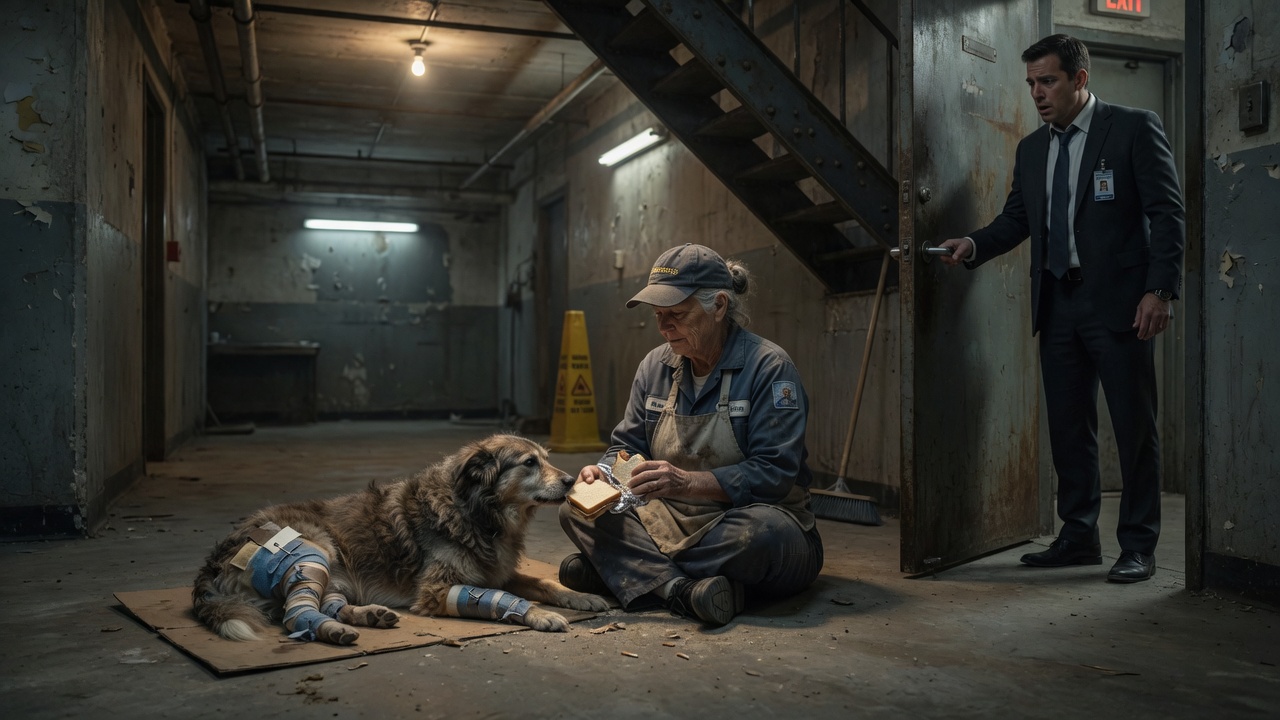
I managed a high-rise office for 12 years, but when my 62-year-old janitor vanished into the “restricted” sub-basement at exactly 12:00 PM for 43 straight days—I quietly locked the stairwell door behind me.

I’ve managed commercial properties in downtown Chicago for over a decade, but absolutely nothing could have prepared me for the gut-wrenching scene I found hiding in the shadows of the lower basement.
In my line of work, you see a lot of strange things. You deal with disgruntled tenants, corporate executives who think they own the world, and employees trying to cut corners.
You learn to be tough. You learn to enforce the rules.
But Helen was never a problem.
Helen was our lead cleaning staff member on the day shift. She was sixty-two years old, with tired eyes, deeply calloused hands, and a quiet demeanor that made her almost invisible to the wealthy lawyers and bankers who walked our marble floors.
She showed up at 5:30 AM every single morning. She never called in sick. She never complained when someone spilled coffee on a freshly mopped floor.
She just put her head down and worked. I respected her immensely for it.
Our building management company was incredibly strict. We used a digital keycard system that tracked every employee’s movement. It was designed to maximize efficiency and catch anyone taking unauthorized breaks.
I didn’t like the system, but it was my job to enforce it.
About two months ago, a red flag popped up on my daily security report.
Helen was taking an unauthorized break. Every single day, precisely at 12:00 PM.
Now, normally, an employee taking a lunch break at noon is perfectly fine. But Helen wasn’t going to the breakroom. She wasn’t going outside to get some fresh air.
Her keycard was swiping at the heavy, reinforced steel door leading down to Sub-Basement C.
Sub-Basement C was a “restricted” zone. It was a massive, damp, concrete cavern that housed the building’s main boiler systems and heavy machinery.
There were no offices down there. No trash cans to empty. No floors to mop.
It was pitch black, extremely loud, and frankly, dangerous. Employees were strictly forbidden from going down there without a maintenance escort.
At first, I thought it was a glitch in the system. But the log was undeniable.
Day 1. Day 2. Day 14. Day 30.
Exactly at noon, Helen swiped her card, disappeared for forty-five minutes, and then swiped back out.
Corporate protocol dictated a clear warning. I called her into my office.
She sat across from my heavy mahogany desk, her hands folded neatly in her lap. She looked exhausted, as she always did, but there was a strange tension in her shoulders.
“Helen,” I started, keeping my voice professional. “The keycard logs show you’re spending your lunch hour in the sub-basement. You know that’s a restricted area. It’s an insurance liability.”
She didn’t look away. She just stared at my desk.
“I apologize, Mr. Davis,” she said softly. Her voice was raspy. “I’ll try to be faster.”
“Faster isn’t the point, Helen. You can’t go down there at all. If corporate sees this, I have to formally write you up. And if it continues, I have to dock your pay.”
I expected her to argue. I expected her to give me an excuse. Maybe she was taking naps down there. Maybe she was hiding from the security cameras to use her phone.
Instead, she looked up at me, and her eyes were filled with a quiet, desperate resolve.
“I understand the rules, sir,” she said. “Dock my pay if you have to. But I have to go down there.”
That chilled me to the bone.
Helen was a woman who lived paycheck to paycheck. I knew she took the bus two hours each way just to get to this job.
Why would she willingly sacrifice a portion of her desperate income just to sit in a dark, freezing boiler room for forty-five minutes?
I didn’t want to fine her. I hated doing it. But the corporate system automatically triggered the penalty on her next paycheck.
I thought the financial hit would stop her. It didn’t.
Day 35. Day 40. Day 43.
The logs kept showing the same thing. 12:00 PM. Sub-Basement C.
My frustration turned into a cold, creeping suspicion. Was she stealing something? Was she hiding something illegal down there?
The building had strict security protocols, and if an employee was involved in something dangerous, it would cost me my career.
On the 44th day, I decided I couldn’t ignore it anymore.
At 11:55 AM, I left my office. I didn’t tell security. I didn’t check the cameras. I went straight to the stairwell that led down to the restricted zone.
I waited in the shadows on the ground floor. The stairwell was silent, save for the distant, rhythmic hum of the city traffic outside.
Exactly at noon, the heavy metal door creaked open.
Helen stepped inside. She didn’t look around. She didn’t notice me hiding behind the electrical panel.
She was carrying her small, plastic lunch cooler, and something else—a heavy, black trash bag that looked partially full.
My heart started pounding against my ribs. What was in the bag?
She swiped her card at the Sub-Basement door. The green light flashed, and she slipped inside, pulling the door shut behind her.
I gave her a two-minute head start. Then, I pulled my master keycard from my pocket.
My hands were actually shaking. I felt like a detective walking into a crime scene. I had no idea what I was about to find, but my mind was racing with the worst possible scenarios.
I swiped my card. The lock clicked.
I opened the door as quietly as humanly possible and slipped into the darkness.
The air instantly dropped ten degrees. It smelled like wet concrete, old oil, and rust. The only light came from a few flickering, caged bulbs spaced thirty feet apart along the ceiling.
The hum of the massive boilers vibrated through the floorboards, vibrating up through my shoes.
I walked slowly, pressing my back against the damp wall, trying to make absolutely zero noise.
I could hear her footsteps echoing somewhere in the distance, deep in the maze of pipes and massive metal tanks.
I followed the sound.
After about two minutes of creeping through the shadows, the footsteps stopped.
I heard the rustling of the black plastic bag.
I held my breath. I crept around the massive steel corner of Boiler Number 4, peering into a small, dead-end alcove hidden far from the main walkway.
What I saw made my blood run entirely cold, and then, a second later, broke my heart into a million jagged pieces.
Helen was sitting on the freezing concrete floor. She had laid down an old, folded blanket from the black trash bag.
But she wasn’t alone.
From the darkest corner of the alcove, a shadow began to move.
I heard a low, raspy whimper.
It wasn’t a person. It wasn’t stolen goods.
Dragging itself painfully out of the darkness was a dog.
It was a scruffy, dirty, golden-retriever mix. But the way it moved made me gasp silently.
The dog was using only its front paws, pulling its entire body weight forward. Its hind legs were completely paralyzed, dragging uselessly behind it on the rough concrete.
Helen didn’t look scared. She smiled. It was the first time I had ever seen her smile.
“I know, I know, buddy,” she whispered, her voice echoing softly over the hum of the machinery. “I’m sorry I’m late.”
She unzipped her small lunch cooler. She took out her sandwich—a meager, cheap bologna sandwich that I knew was supposed to be her only meal for a nine-hour shift.
She broke it perfectly in half.
She placed the larger half onto a small piece of cardboard and slid it toward the injured dog.
The dog devoured it instantly, its tail thumping weakly against the floor.
I stood there, frozen in the shadows, realizing that I had just docked the pay of a woman who was starving herself to keep an injured, abandoned animal alive in the freezing basement of a corporate skyscraper.
But as I watched her stroke the dog’s matted head, I noticed something else in the corner. Something that made me realize this situation was far, far worse than a simple stray dog.
There was a faded, torn collar lying on the ground.
And attached to it was a heavy, industrial zip-tie—the exact same kind our building’s construction crew used for the upper-level renovations.
This dog hadn’t wandered down here by accident.
Someone in my building had done this to him. And they had left him in the restricted zone to die.
I stood completely paralyzed in the freezing shadows of the sub-basement. My breath caught in my throat, forming faint, white clouds in the damp air.
My eyes were glued to that heavy, industrial zip-tie.
It wasn’t just any piece of plastic. In my twelve years of managing commercial real estate, you learn the exact specifications of the materials your contractors use. You have to, for insurance purposes.
This specific zip-tie was a three-quarter-inch, high-tensile nylon strap with a distinct neon-orange locking mechanism.
It was exclusively ordered by the heavy demolition crew currently gutting the 44th floor of our high-rise.
My mind started spinning, connecting dots I never wanted to connect.
Sub-Basement C required a Level 4 clearance keycard. Only building management, senior maintenance staff, and the foremen of the construction crews had that kind of access.
This dog hadn’t wandered in off the rainy streets of Chicago.
Someone with a high-level security clearance had deliberately dragged this paralyzed animal down into the restricted zone, tied him to a heavy iron pipe to ensure he couldn’t drag himself to safety, and left him in the pitch black to starve.
A wave of pure, unfiltered nausea washed over me. I had to press my hand against the freezing concrete wall just to steady myself.
The humming of the massive boilers suddenly felt deafening.
In the alcove, Helen was still softly murmuring to the dog. She was gently stroking his matted, dirt-caked fur as he licked the last crumbs of the bologna sandwich off the piece of cardboard.
He looked up at her with eyes that were clouded with pain, yet so overwhelmingly grateful it made my chest ache.
I couldn’t stay hidden any longer. I had to do something.
I took a slow, deep breath, trying to calm the aggressive trembling in my hands. I stepped out from behind the massive steel corner of Boiler Number 4.
My leather dress shoes scraped against the rough concrete floor. It was a tiny sound, but in that cavernous echo chamber, it cracked like a gunshot.
Helen gasped.
She spun around so fast she knocked over her plastic lunch cooler. The dog let out a weak, terrified whimper and tried to drag himself backward, his paralyzed hind legs scraping violently against the floor.
Helen threw her body over the dog, instinctively shielding him from me.
“Please!” she cried out, her voice cracking with pure terror. “Please, Mr. Davis! Don’t call animal control! Please!”
Seeing this sixty-two-year-old woman cowering on the wet floor, using her own frail body to protect a broken animal from me, broke whatever professional composure I had left.
I felt a hot tear slip down my cheek. I quickly wiped it away.
“Helen,” I said, keeping my voice as incredibly soft and low as I could. I raised both my hands, palms open, to show I wasn’t a threat. “Helen, it’s okay. I’m not going to call anyone.”
She was hyperventilating, her chest heaving under her faded blue uniform. Her deeply calloused hands were shaking as she gripped the dog’s dirty fur.
“You’re going to fire me,” she sobbed, tears streaming down her wrinkled face, cutting through the basement dust on her cheeks. “I know I broke the rules. I know I did. But if you call the city pound, they’ll put him to sleep. They won’t even try to fix him, Mr. Davis. Look at him. He’s broken. They kill the broken ones.”
I took another slow step forward, then slowly sank to my knees on the filthy concrete. I didn’t care about my expensive suit. I didn’t care about building protocols.
“I’m not going to fire you, Helen,” I whispered. “I swear to God, I am not going to fire you. I’m going to cancel that pay deduction the second I get back to my desk.”
She looked at me, her eyes wide with disbelief. She didn’t trust me yet. Why would she? I was the strict, corporate enforcer who had threatened her job just two days ago.
“How long?” I asked, gesturing to the dog. “How long has he been down here?”
Helen sniffled, gently wiping the dog’s nose with the sleeve of her uniform. “Forty-three days,” she whispered.
My stomach dropped. Forty-three days. She had been coming down here, every single day, for over a month.
“I found him my second week on the day shift,” Helen continued, her voice trembling. “I was told to bring some heavy duty trash bags down to the maintenance lockbox. When I walked past this alcove, I heard a noise. I thought it was a rat. We have big ones down here.”
She paused, looking down at the golden-retriever mix. The dog had stopped trembling and was resting his chin heavily on Helen’s knee, his amber eyes watching me warily.
“I shined my flashlight,” she said, her voice dropping to a harsh whisper. “He was tied to that drainage pipe over there. With that thick plastic strip.”
She pointed to the faded collar and the heavy, neon-orange zip-tie lying on the floor.
“He was just a skeleton, Mr. Davis. Just bones and dirty fur. He had chewed his own paws raw trying to get loose. His back legs… they were completely crushed.”
I felt a surge of hot, violent anger rising in my chest.
“Someone hit him?” I asked, my voice tight.
Helen shook her head slowly. “No. I grew up on a farm, Mr. Davis. I know what a car accident looks like. Cars break bones in a certain way. This wasn’t a car.”
She gently lifted the dog’s back leg. Even in the dim light of the caged bulbs, I could see the unnatural, horrific angles.
“Someone took a heavy pipe to his back,” she said, her voice deadpan, hollowed out by the horror of her own realization. “They shattered his spine on purpose. And then they tied him down here so nobody would ever hear him scream.”
The basement felt suddenly like a tomb. The air was suffocating.
I looked at the dog. He wasn’t old. Despite the dirt and the severe malnutrition, he had the soft, rounded face of a dog barely out of his puppy years. Maybe two years old, at most.
“Why didn’t you come to me, Helen?” I asked gently. “Why didn’t you tell someone?”
She looked up at me, a flash of defensive anger in her tired eyes.
“Tell who? The police? The security guards who laugh and drink coffee while people sleep on the freezing streets outside? You think they care about a paralyzed stray dog?”
She wasn’t wrong.
“I couldn’t afford a real veterinarian,” she continued, her voice breaking again. “I make fourteen dollars an hour, Mr. Davis. My rent is twelve hundred. I barely have enough to eat myself. If I took him to a clinic, they would demand money I don’t have, or they’d confiscate him and euthanize him immediately because of his spine.”
She looked back down at the dog.
“So, I did the only thing I could do. I brought down old blankets. I started splitting my lunch with him. I bring him fresh water in my thermos. I… I clean up his messes. He can’t walk, so he just drags himself. I bathe him with wet rags when I can.”
I stared at her. This sixty-two-year-old woman, exhausted, overworked, financially drowning, had been secretly acting as a full-time hospice nurse for an abused animal in the darkest, most terrifying part of our building.
She had risked her job, her only source of income, to sit in the freezing cold for forty-five minutes a day just so this dog wouldn’t die completely alone.
“Does he have a name?” I asked quietly.
“Barnaby,” she whispered, a tiny, fragile smile touching her lips. “He looks like an old neighbor I used to have. Scruffy but sweet.”
“Hello, Barnaby,” I said, slowly extending my hand.
The dog flinched initially, pulling his head back. But he didn’t growl. He just watched my hand. I kept it perfectly still, letting him smell my scent.
After a agonizing thirty seconds, Barnaby slowly leaned forward. His wet, cold nose touched my knuckles. He let out a soft sigh and rested his chin against my hand.
He was so warm, yet I could feel every single bone under his skin.
Right then and there, a massive paradigm shift happened in my brain. My corporate responsibilities, the strict building codes, the fear of my regional director—all of it evaporated.
I was no longer just the property manager. I was deeply, irrevocably involved.
“Helen,” I said, my voice hardening with a new resolve. “We can’t keep him down here anymore. The winter is coming. The sub-basement drops below freezing in January. He won’t survive it.”
Panic flared in her eyes again. “But we can’t take him to a shelter! They’ll—”
“I know,” I interrupted. “I’m not taking him to a shelter. I know a private veterinary specialist. A friend from college. He runs an independent clinic in the suburbs. He owes me a favor. A very big favor.”
Helen stared at me, her mouth slightly open.
“But we have a major problem,” I said, standing up and dusting off my suit pants. “We can’t just carry a paralyzed dog through the main lobby. The building has over a hundred security cameras. If corporate sees me carrying a dog out of the restricted zone, they won’t just fire me. They’ll launch an investigation. They’ll find out you were involved.”
I paced back and forth in the small alcove. The gears in my head were turning at a million miles an hour.
“And worse,” I said, stopping to look at the neon-orange zip-tie. “Whoever did this to Barnaby is still in this building. They have Level 4 clearance. They are extremely violent, and they are hiding in plain sight.”
Helen shrank back against the wall, clutching Barnaby closer. “You think it’s one of the workers?”
“I know it is,” I said darkly. “That zip-tie belongs to the demolition crew on the 44th floor. The crew led by a foreman named Marcus Thorne.”
I knew Marcus. He was a massive, intimidating guy with a notorious temper. He bullied his crew, he constantly yelled at my security staff, and he had a reputation for being ruthless.
“If whoever did this finds out Barnaby is still alive,” I warned, “and that we are sneaking him out… they might panic. People like that, people who can shatter a dog’s spine and leave him in the dark to die… there’s no telling what they’d do to cover their tracks.”
We needed a plan. A flawless, airtight plan.
“Okay,” I said, crouching back down. “Here is what we are going to do. Tonight, after the building clears out at 9:00 PM, I am going to disable the security cameras in the service elevator.”
Helen’s eyes widened. Tampering with the security cameras was an immediate, fireable offense. It was technically a federal offense depending on what bank leases we were violating.
“You’re going to bring the large, rolling laundry cart down here,” I continued. “The heavy canvas one we use for the executive gym towels. We pad the bottom with fresh blankets. We put Barnaby inside, cover him up, and wheel him straight to my SUV in the underground parking garage.”
“Will it work?” Helen whispered, her voice shaking.
“It has to,” I said. “But until 9:00 PM tonight, everything has to look exactly normal. You have to go back upstairs. You have to finish your shift. Do not act suspicious. Do not look at the construction crew if you pass them in the halls.”
Helen nodded slowly. She reached down and kissed the top of Barnaby’s head. “I’ll be back for you, buddy,” she whispered. “I promise.”
I helped Helen to her feet. She looked exhausted, but for the first time since I’d met her, there was a glimmer of real hope in her eyes.
I watched her walk back into the darkness of the sub-basement, heading for the stairwell.
Once she was gone, I looked down at the heavy, neon-orange zip-tie still resting on the concrete.
I picked it up. It felt heavy in my hand.
I was going to save Barnaby tonight. But that was only step one.
Step two was finding out exactly who on Marcus Thorne’s crew was a psychopath. And I was going to make sure they lost everything.
I slipped the zip-tie into my suit pocket, turned around, and began the long walk back up to the light. I had to prepare for a very dangerous night.
The elevator ride back up to the main lobby felt like it took three lifetimes.
My heart was hammering against my ribs so hard I could hear it echoing in my own ears. I kept my hand buried deep in my right suit pocket, my fingers tightly curled around that heavy, neon-orange zip-tie.
It felt like a piece of radioactive evidence.
When the elevator doors finally chimed and slid open onto the gleaming marble of the ground floor, I stepped out into a completely different world.
Everything was pristine. The air smelled of expensive, subtle citrus air freshener. Wealthy executives in custom-tailored suits were briskly walking past me, holding artisan coffees, completely oblivious to the horrific reality buried directly beneath their polished leather shoes.
I walked straight to the management suite, locked the heavy glass door of my private office, and closed the motorized blinds.
I collapsed into my leather chair and stared at the digital clock on my desk.
It was 1:15 PM.
I had nearly eight hours to kill before the building emptied out. Eight hours to sit with the knowledge that a man who could deliberately crush a dog’s spine was currently working just forty-four floors above my head.
My hands were still trembling as I pulled out my phone. I needed to set the extraction plan in motion.
I couldn’t just take Barnaby to a normal 24-hour emergency clinic. If they saw the extent of his injuries, the industrial zip-tie marks, and his severe malnutrition, state law would mandate they file a police report for extreme animal cruelty.
An official police report meant a paper trail. A paper trail meant corporate would get involved. If corporate found out I had a rogue, paralyzed dog in the sub-basement, Helen would be fired instantly, she would lose her pension, and the dog would likely be surrendered to city animal control and euthanized before sunset.
I needed someone completely off the books. Someone who didn’t ask questions to bureaucrats, but who actually got things done.
I scrolled past my usual contacts and dialed a number I hadn’t called in almost three years.
It belonged to Jaxson.
We had played football together in college before he dropped out to join the military as a combat medic. When he came back stateside, the corporate world didn’t suit him. He went back to school, got his veterinary license, and opened a gritty, independent clinic on the south side of the city.
But Jax wasn’t your typical suburban veterinarian.
He was the founding president of a local motorcycle club—a tight-knit brotherhood of mechanics, veterans, and rough-hewn guys who dedicated their entire existence to rescuing abused animals. They specialized in extracting bait dogs from fighting rings and pulling forgotten animals out of horrific situations where law enforcement refused to go.
The phone rang three times before a gruff voice answered over the loud, rhythmic thumping of heavy bass and clinking metal.
“Davis. You’re alive,” Jax’s deep, gravelly voice echoed through the speaker. “To what do I owe the pleasure? You finally need me to rescue you from a boring board meeting?”
“Jax. I need a massive favor,” I said. My voice cracked slightly, betraying my panic. “And I need it completely off the books. No police. No state registry.”
The background noise on his end instantly went dead silent. The joking tone vanished from his voice.
“Talk to me,” he commanded.
“I have a dog. A golden mix, maybe two years old. He’s been trapped in the sub-basement of my commercial high-rise for forty-three days.”
I took a shaky breath and forced myself to say the next part out loud.
“Someone shattered his spine, Jax. His back legs are completely paralyzed. They tied him to a boiler pipe with an industrial construction tie and left him in the pitch black to starve to death.”
Silence hung heavily on the line. For a terrifying second, I thought the call had dropped.
Then, I heard the sharp, unmistakable sound of a heavy metal tool box slamming shut.
“Forty-three days?” Jax asked, his voice dangerously low. “How is he not dead?”
“One of my cleaning staff,” I explained. “A sixty-two-year-old woman. She’s been sneaking down there every lunch hour, giving him half her sandwich and wiping him down with wet rags. She’s been risking her job every single day.”
Jax let out a low, heavy exhale. “That’s a hell of a woman.”
“I need to get him out, Jax. But the guy who did this… he’s a foreman on a demolition crew working in my building right now. If he catches wind that the dog is alive, or that we are moving him, things will get violent.”
“What time are we moving him?” Jax didn’t even hesitate. He didn’t ask about payment. He didn’t ask about the risk.
“9:00 PM,” I said. “The building should be mostly empty. I’m going to tamper with the security feed on the freight elevator and bring him down to the underground loading dock in a canvas laundry cart.”
“Copy that,” Jax said firmly. “I’ll be parked in the alleyway right outside the loading dock doors at 8:45 PM. I’m bringing the medical transport van. And Davis?”
“Yeah?”
“I’m not coming alone. I’m bringing two of my brothers. Just in case your demolition guy decides to take a late shift and get in our way.”
“Thank you, Jax.”
“Don’t thank me yet. Just get the boy to the dock.”
He hung up.
I spent the next six hours in a state of hyper-vigilance. Every time the phone rang, I jumped. Every time someone walked past my frosted glass door, my muscles locked up.
At 4:00 PM, I logged into the building’s master security terminal on my computer.
I pulled up the feed for the 44th floor.
The screen flickered, showing a wide-angle view of a massive, gutted corporate floor. Exposed wires hung from the ceiling. Drywall dust coated the camera lens.
And there, standing in the center of the debris, was Marcus Thorne.
He was a giant of a man, easily six-foot-four, with thick, heavily tattooed arms and a permanent scowl etched into his face. He was screaming at one of his drywallers, violently pointing a heavy steel crowbar at a framing error.
Looking at the sheer, aggressive violence in his body language, a cold shiver ran violently down my spine.
I thought about the neon-orange zip-tie in my pocket. I thought about the heavy pipe Helen mentioned.
It didn’t take a detective to figure out what happened. Barnaby had probably wandered onto the active construction site looking for food. He probably got in Thorne’s way. And Thorne, instead of calling animal control, decided to exact a twisted, psychotic punishment.
I watched the screen until Thorne disappeared off-camera. I memorized his face. I memorized the logo on his hard hat.
I was going to destroy his life. But first, I had a dog to save.
At 6:30 PM, the daytime corporate workers began flooding out of the building. The lobby was a sea of moving bodies.
By 8:00 PM, the building was eerily quiet. Only the night-shift security guards and a handful of late-night cleaning crews remained.
At 8:30 PM, I left my office.
I took the stairs down to the ground floor maintenance closet. I unlocked it with my master key and pulled out one of the heavy, industrial canvas laundry carts used by the executive fitness center. It was deep, lined with thick plastic, and rolled quietly on heavy rubber casters.
I grabbed six clean, folded bath towels from the shelf and padded the entire bottom of the cart, making a soft, deep nest.
At 8:45 PM, I stepped into Freight Elevator B.
This was the most dangerous part of the plan. I pulled out my master security tablet. My hands were sweating so badly the touchscreen kept slipping.
I accessed the central camera feed overrides. I found the IP address for Freight Elevator B and the camera covering the Sub-Basement C hallway.
With three quick taps, I initiated a ten-minute digital loop. The security desk in the lobby would just see an empty elevator and an empty basement hallway playing on repeat.
If they noticed the time stamp freezing, I was completely ruined.
I hit the button for the sub-basement. The massive elevator lurched downward.
When the doors opened, the freezing, damp air hit my face instantly. The smell of rust and old oil was overpowering.
I pushed the heavy laundry cart down the dimly lit concrete corridor. The wheels squeaked faintly, echoing into the cavernous dark.
I reached the heavy steel door to the restricted zone. I swiped my card. The light flashed green.
I pulled the door open and wheeled the cart inside.
“Helen?” I whispered into the darkness.
“Over here,” a trembling voice replied from the shadows.
I navigated around the massive, humming boilers until I reached the dead-end alcove.
Helen was sitting on the freezing floor, her arms wrapped tightly around Barnaby. The dog looked up at me, his amber eyes catching the dim light of the caged bulbs. He recognized me. He let out a tiny, soft “boof” and thumped his tail weakly against the concrete.
“It’s time,” I whispered.
Helen’s face was streaked with fresh tears. She was terrified.
“I’ll help you lift him,” I said, wheeling the cart directly next to them. “We have to be fast, but we have to be incredibly careful with his back.”
Helen nodded. She slid her arms under Barnaby’s front chest, while I carefully, delicately slid my hands under his paralyzed hindquarters.
He felt so incredibly fragile. His ribs pressed sharply against my palms.
As we lifted him, Barnaby let out a sharp, high-pitched yelp of pain.
My heart stopped. The sound echoed loudly off the concrete walls. I froze, terrified that a security guard making rounds might have heard it through the floorboards.
We waited for ten agonizing seconds. Nothing but the hum of the machinery.
We gently lowered him into the deep canvas cart. He sank into the soft pile of clean bath towels. Helen immediately draped another blanket over the top of the cart, leaving just a small gap for him to breathe.
To anyone walking past, it just looked like a cart full of dirty gym laundry.
“Okay,” I whispered, looking at Helen. “You go back up to the lobby. Clock out normally. Go home. I will call you the second he is safe.”
“Please keep him safe, Mr. Davis,” she pleaded, gripping my sleeve. “Please.”
“I swear my life on it,” I told her.
She turned and hurried out of the restricted zone.
I took a deep breath, gripped the heavy metal bar of the laundry cart, and began pushing.
I wheeled it out of the sub-basement, down the concrete hall, and back into Freight Elevator B.
I hit the button for the underground loading dock.
The elevator began to rise. My eyes were glued to the digital floor indicator.
Sub-Basement. Ground. Lobby.
The elevator bypassed the lobby and continued up to the ground-level loading bay.
The doors slid heavily open.
I pushed the cart out into the dimly lit, cavernous loading dock. The massive corrugated metal bay doors were rolled shut for the night, save for one small pedestrian exit door at the far end of the bay.
I was halfway across the concrete floor when the door to the maintenance office suddenly swung open.
My blood froze instantly in my veins.
Stepping out of the office was one of Marcus Thorne’s demolition workers. He was covered in white drywall dust, wearing heavy steel-toed boots and a neon yellow safety vest.
He froze when he saw me. His eyes darted from my expensive suit down to the heavy canvas laundry cart.
“Hey,” the worker said, his voice echoing loudly in the empty bay. “What are you doing down here? Night crew usually handles the gym laundry.”
I tightened my grip on the handle of the cart. My knuckles turned completely white.
Inside the cart, I heard Barnaby shift slightly. The blanket rustled.
The worker’s eyes narrowed. He took a slow step toward me.
“And since when does the property manager push his own carts?” he asked, a nasty, suspicious sneer forming on his face. He reached into his toolbelt, casually resting his hand on a heavy framing hammer. “You got something in there, boss?”
He took another step forward. He was only ten feet away.
I had to think fast. If he pulled that blanket back, if he saw the paralyzed dog his boss had tortured, neither Barnaby nor I were making it out of this loading dock.
I pulled my shoulders back, channeling every ounce of corporate authority I had spent twelve years building.
“I am conducting a spot-audit of the night staff’s equipment protocols,” I lied, my voice cold, sharp, and dripping with aggressive condescension. “And I don’t recall authorizing your crew to be in the building past 8:00 PM without paying the mandatory after-hours security premium.”
The worker stopped in his tracks. The threat of financial penalty to his boss made him hesitate.
“We had to finish pulling wire on 44,” he muttered defensively.
“I don’t care what you were doing,” I snapped, taking a step toward him to establish dominance. “If you aren’t off this property in exactly three minutes, I am logging a formal violation and charging Thorne Construction a three-thousand-dollar penalty fee on tomorrow’s invoice. Get out.”
The worker glared at me, his jaw tight. He looked at the cart one last time, clearly still suspicious, but he wasn’t willing to risk his paycheck over it.
“Whatever, suit,” he spat. He turned around, grabbed his hard hat, and walked toward the exit stairwell.
I didn’t exhale until the heavy fire door slammed shut behind him.
I practically sprinted the rest of the way to the pedestrian exit door. I shoved it open with my shoulder and pushed the cart out into the dark, rain-slicked alleyway behind the building.
The cold night air hit me like a physical wave.
Idling quietly in the shadows at the end of the alley was a massive, matte-black Mercedes Sprinter van.
The moment I stepped out, the van’s side doors slid open violently.
Three men stepped out into the rain.
They were massive. All three wore heavy leather cuts over dark hoodies. The patches on their backs read “IRON HOUNDS M.C.” in weathered white lettering.
Jax was in the lead. He looked exactly the same as he did in college, just broader, with a thick beard and tattoos climbing up his neck.
He didn’t say a word. He jogged over to the cart, the heavy chains on his boots clinking against the wet pavement.
The two other bikers fanned out seamlessly, instantly securing the perimeter of the alley, scanning the fire escapes and the street corners with quiet, military-level precision.
Jax reached the cart and gently pulled back the blanket.
When he saw Barnaby, Jax’s tough, hardened exterior cracked instantly.
“Jesus Christ,” Jax whispered, his voice thick with raw emotion.
Barnaby looked up at the giant biker. He didn’t cower. He didn’t hide. He just let out a soft whine and tried to lick Jax’s heavy leather glove.
“I got you, buddy,” Jax said softly, leaning into the cart. “I got you. Nobody is ever going to hurt you in the dark again.”
Jax reached in. With an incredible gentleness that completely betrayed his intimidating size, he scooped the paralyzed dog out of the laundry cart.
Barnaby leaned his head heavily against Jax’s chest, seemingly realizing that he was finally, truly safe.
“His spine is shattered, Davis,” Jax said, his voice turning deadly serious as he felt the dog’s back. “And he’s severely dehydrated. But his heart rate is steady. The old woman kept him alive. It’s a literal miracle.”
“Can you fix him?” I asked, my voice shaking in the cold rain.
Jax looked at me. “I can’t un-break his back. He’ll never walk on four legs again. But I can stop the pain. I can get him a custom wheelchair. And my club… we’ll make sure he lives like a king for the rest of his life.”
Jax turned and carried Barnaby toward the waiting van. One of the bikers immediately hopped into the back, pulling out an IV bag and sterile medical blankets, transforming the back of the van into a rolling trauma bay.
Jax gently laid Barnaby onto the padded stretcher. He turned back to me before climbing in.
“You did good today, Davis,” Jax said, the rain dripping off his beard. “You saved a soul.”
“Jax, wait,” I said, stepping closer to the van.
I reached into my suit pocket. I pulled out the heavy, neon-orange zip-tie. I held it out in the rain.
Jax’s eyes dropped to the heavy plastic. He recognized exactly what it was. The tool of the torture.
“The man who did this,” I said, my voice dead calm, devoid of any fear or hesitation. “His name is Marcus Thorne. He runs a demolition crew on the 44th floor of my building.”
Jax stared at the zip-tie. A dark, terrifying shadow crossed his face. The two other bikers stepped closer, their eyes locked on the orange plastic.
“Is that so?” Jax asked, his voice dropping an octave.
“I’m going to ruin him legally,” I said. “I’m going to pull his contracts. I’m going to make sure he never works in commercial real estate again.”
Jax slowly nodded, a grim, dangerous understanding passing between us.
“You handle the paperwork, Davis,” Jax said quietly, pulling the van doors shut. “We’ll handle the rest.”
The engine roared to life. The black van pulled out of the alley and disappeared into the Chicago night, taking Barnaby to a new life.
I stood alone in the cold rain for a long time.
Then, I turned around and walked back into the high-rise. I didn’t go back to my office.
I walked straight to the main elevators. I swiped my master keycard.
I pressed the button for the 44th floor.
It was time to pay Marcus Thorne a visit.The digital display above the heavy steel elevator doors blinked in a slow, methodical rhythm, counting the floors as I ascended into the heights of the skyscraper.
I was entirely alone in the massive glass-paneled car, staring at my own reflection in the polished brass panels. I didn’t look like a property manager anymore. My expensive Italian silk tie was pulled loose and completely ruined by the rain. My suit jacket was covered in damp, white dog hair and smelled sharply of rust, wet concrete, and old oil.
I didn’t care.
A cold, methodical anger had entirely replaced the adrenaline in my veins. It was a terrifyingly calm sensation. For twelve years, I had played the corporate game. I had smiled at arrogant executives, bowed to regional directors, and enforced petty, soulless rules to protect the bottom line of a billion-dollar real estate conglomerate.
But tonight, the corporate mask was completely gone.
The elevator slowed, the massive cables groaning softly in the dark shaft.
The doors slid open with a soft, pneumatic hiss. The air that hit my face was dry, stale, and choked with the metallic taste of drywall dust and ozone.
Floor 44 was a hollowed-out concrete shell. The demolition crew had spent the last three weeks tearing out every single interior wall, leaving behind a massive, cavernous expanse of raw concrete, exposed steel girders, and dangling bundles of electrical wire that looked like severed arteries hanging from the ceiling.
The only illumination came from a few high-wattage, yellow construction lamps clamped to the steel pillars, casting long, jagged, monstrous shadows across the debris-littered floor.
I stepped out of the elevator. My leather dress shoes crunched loudly against a thick layer of plaster dust and scattered screws.
The floor was supposed to be completely empty. The night security sweep was scheduled for midnight. But I knew the foreman’s schedule. I knew the way these heavy-duty crews operated. The grunts went home at eight, but the foreman always stayed late on Fridays to process the payroll sheets and sign the weekly disposal manifests.
I walked slowly through the maze of plastic sheeting and stacked pallets of heavy industrial framing studs. The silence up here was completely different from the terrifying, heavy silence of the sub-basement. Up here, it was the silence of a graveyard.
Through the thick, translucent plastic sheeting draped across the northern perimeter, I saw a faint, flickering light.
It was coming from the temporary foreman’s office—a makeshift room built out of unpainted plywood and heavy tarps right in the center of the demolition zone.
I didn’t try to hide my footsteps. I wanted him to hear me coming. I wanted him to wonder who the hell was walking onto his restricted job site at ten o’clock at night.
I pushed through the heavy plastic sheeting.
Marcus Thorne was sitting behind a makeshift desk constructed from two sawhorses and a heavy interior door. He was a massive, heavily muscled man in his late forties, wearing a faded gray thermal shirt pulled tight over his broad shoulders. His thick arms were covered in faded, sprawling tattoos, and his hands were the size of dinner plates.
He was leaning back in a cheap folding chair, a thick cigar clamped between his teeth, scrolling through his phone while an open laptop glowed on the desk in front of him.
When he heard the plastic rustle, he snapped his head up. His dark eyes locked onto me, instantly narrowing with hostile suspicion.
He didn’t recognize me at first. I rarely left the management suite on the ground floor, and when I did, I was flanked by two building security officers and an insurance auditor. I was just a suit to him. A nuisance.
“The hell are you doing up here?” Thorne barked, his voice a deep, gravelly rumble that echoed off the bare concrete walls. He didn’t stand up. He just glared at me. “This is a hard-hat zone, buddy. No unauthorized personnel. Get back to the elevator before I throw you down the shaft.”
I stepped fully into the harsh yellow light of the office. I didn’t say a word. I just stared at him, analyzing the sheer, unapologetic arrogance radiating from his massive frame.
This was the man who had dragged a helpless animal into the pitch black. This was the man who had raised a heavy steel pipe and intentionally shattered a dog’s spine.
I felt a sudden, violent urge to pick up the heavy framing hammer resting on the corner of his makeshift desk. It took every ounce of professional restraint I had spent a decade cultivating to keep my hands at my sides.
“I asked you a question, suit,” Thorne growled, finally dropping his feet from the desk and leaning forward, his massive shoulders tensing. “Who the hell are you, and who gave you clearance to be on my floor?”
“I don’t need clearance, Marcus,” I said. My voice was dangerously quiet, barely louder than a whisper, but it cut through the dusty air like a razor blade. “I am the clearance.”
I reached into my ruined suit jacket and pulled out my heavy, solid-brass master keycard. It was the only card in the building embossed with the silver corporate crest. The card that controlled every single electronic lock, security camera, and freight elevator in the sixty-story tower.
I tossed it onto the plywood desk. It landed with a heavy, metallic thud right next to his laptop.
Thorne looked down at the crest. The hostile scowl on his face faltered for a fraction of a second. He finally recognized who I was.
“Mr. Davis,” Thorne said, his tone shifting slightly, losing a bit of its aggressive edge but retaining a heavy layer of disrespect. “The property manager. You’re up late. We passed our safety inspection on Tuesday. What’s the problem?”
“The problem, Marcus, is your access logs,” I said, stepping closer to the desk until I was towering over him.
“Access logs?” He scoffed, leaning back in his chair again, trying to feign boredom. “My guys clock in and clock out. We hit our targets. If there’s a payroll dispute, talk to my union rep.”
“I don’t care about your payroll,” I said coldly. “I care about the Level 4 security door leading down to Sub-Basement C. The restricted heavy-machinery zone.”
Thorne froze. It was a microscopic physical reaction, but I saw it. The muscles in his thick neck suddenly went rigid. The cigar clamped in his teeth stopped smoking. His eyes darted quickly to the heavy canvas flap of his makeshift office door, as if calculating the distance to the exit.
“I don’t know what you’re talking about,” Thorne said, his voice dropping an octave, trying to sound completely unbothered. “My crew doesn’t go down to the sub-basement. We’re doing demo on 44. Why the hell would we go down to the boilers?”
I leaned down, placing both my hands flat on his makeshift desk, bringing my face just inches from his.
“That is exactly the question I’ve been asking myself for the past three hours,” I lied seamlessly. “Why would a heavy demolition foreman, a man making six figures on a corporate contract, use his master security card to access the deepest, darkest, most restricted corner of my building forty-three days ago?”
The color slowly began to drain from Thorne’s weathered face. The arrogant swagger was rapidly evaporating, replaced by the cold, creeping realization that he was caught.
“You’ve got the wrong guy,” he muttered, breaking eye contact and staring at his laptop screen. “System must be glitching. Your security software is garbage anyway.”
“The system doesn’t glitch, Marcus. It records the exact employee ID number attached to the magnetic strip. It recorded you going down there at 11:45 PM on a Tuesday. It recorded you staying down there for exactly fourteen minutes. And it recorded you coming back up.”
I paused, letting the silence stretch out, letting the weight of my words crush him.
“But that’s not the worst part,” I continued softly. “The worst part is what I found tied to the main drainage pipe behind Boiler Number 4.”
Thorne didn’t move a single muscle. He was barely breathing. His massive chest was completely still.
“A heavy, high-tensile, neon-orange zip-tie,” I whispered. “The exact proprietary brand ordered specifically by Thorne Construction for the electrical conduit framing on this floor. I have the supply manifests in my office.”
Thorne slowly dragged his eyes back up to meet mine. The mask was completely off now. I wasn’t looking at a tough construction foreman anymore. I was looking into the dead, empty eyes of a complete psychopath.
“Look, you corporate pencil-pusher,” Thorne said, his voice dropping to a terrifying, guttural hiss. He slowly stood up from his chair. He was a good six inches taller than me and outweighed me by eighty pounds of solid muscle. He deliberately stepped around the desk, towering over me, trying to use his sheer physical mass to intimidate me into silence.
“Animals wander onto active job sites all the time,” Thorne whispered, stepping so close I could smell the stale coffee and tobacco on his breath. “They’re a safety hazard. They get into the wiring. They carry diseases. A guy’s gotta protect his crew. If a stray mutt gets in the way of a five-million-dollar renovation, you deal with it. You toss it in the trash and you move on. Nobody cares about a street rat.”
I didn’t step back. I didn’t flinch. I held my ground, staring straight up into his lifeless eyes.
“You didn’t just deal with it, Marcus. You didn’t just call animal control. You took a steel pipe and you deliberately shattered a living creature’s spine. And then you dragged him into the freezing dark and tied him down so he could slowly starve to death in agonizing pain.”
Thorne let out a dark, humorless chuckle. “Prove it. You think the cops are gonna run DNA on a plastic zip-tie over a stray dog? You think a judge is gonna care? You have no witnesses. You have nothing but a corporate access log. I’ll just say I was inspecting the main water valves for the demo. It’s my word against yours, suit. And I have the best union lawyers in the city.”
He smirked, confident that he had won. Confident that the bureaucratic machine would protect him.
“You’re absolutely right,” I said calmly, slowly unbuttoning my ruined suit jacket. “The police probably wouldn’t care. The union would probably protect you. The legal battle would take years, and you’d probably walk away with a minor fine.”
Thorne crossed his massive arms over his chest, looking down at me with supreme, mocking satisfaction. “So, what are we doing here, Davis? You came all the way up here to give me a moral lecture? Go back to your spreadsheets.”
“I didn’t come up here to give you a lecture,” I said, picking up my master keycard from the desk. “I came up here to inform you of your immediate termination.”
Thorne laughed out loud. “You can’t fire me. I don’t work for you. I work for Thorne Construction.”
“Thorne Construction’s master contract with this property management firm has a strict, zero-tolerance moral turpitude and site-safety clause,” I recited, reciting the legal jargon with chilling precision. “As of three minutes ago, I logged into the central network and revoked every single security credential associated with your company. Your keycards are dead. Your freight elevator access is dead. Your company trucks are currently locked out of the underground loading bay.”
Thorne’s laugh died in his throat. His arms dropped to his sides.
“You’re terminating a five-million-dollar demolition contract over a stray dog?” he asked, genuine shock bleeding into his voice. “Your board of directors will crucify you! They’ll sue you for breach of contract!”
“Let them,” I said. “I’ll tie up the payment escrow in civil litigation for the next five years. I’ll report your entire crew to the state licensing board for unauthorized access to restricted mechanical zones. I will bleed your company so dry with legal injunctions that you won’t be able to afford the gas in your pickup truck, let alone a union lawyer.”
Thorne’s face turned a violent shade of purple. The veins in his thick neck bulged. He took a heavy step toward me, his massive fists clenching tight. I knew he was contemplating hitting me. I knew he could probably kill me right there on the empty floor.
“You think you can ruin my life over a mutt?” he roared, the sound echoing terrifyingly through the empty concrete shell.
“I’m not finished,” I said, my voice cutting through his rage like a knife.
I took a slow step forward, closing the distance until our chests were almost touching. I looked deep into his eyes, letting him see the absolute, unwavering conviction in my soul.
“I didn’t call the police, Marcus,” I whispered, dropping my voice to a dark, conspiratorial register. “I didn’t take the dog to the city pound. I called a private extraction team. Men who specialize in dealing with animal abusers outside the confines of the law.”
Thorne narrowed his eyes, confusion mixing with his rage. “What the hell are you talking about?”
“I gave the dog to the Iron Hounds Motorcycle Club,” I said slowly, articulating every single syllable.
The reaction was instantaneous.
Every ounce of color completely vanished from Marcus Thorne’s face. He looked like he had just been struck by lightning. In this city, everyone in the construction trades knew who the Iron Hounds were. They knew they weren’t just guys who liked to ride bikes on the weekends. They were a massive, highly organized, completely ruthless brotherhood. And everyone knew their absolute, fanatical devotion to rescuing abused animals.
They were the men the police called when a dog fighting ring was too dangerous to raid.
“You gave them…” Thorne stammered, his voice suddenly completely hollow.
“They have the dog,” I confirmed quietly. “And I gave them the neon-orange zip-tie. I gave them a copy of your security logs. They have your full name, Marcus. They have the license plate number of your silver Ford F-150. And they have the home address of your company headquarters.”
Thorne actually took a physical step backward. His massive shoulders slumped. The sheer, primal terror radiating from his body was palpable. He knew the corporate world couldn’t hurt him physically. But he knew the street could.
“You… you told them who I am?” he whispered, his eyes wide with genuine panic.
“I told them everything,” I said. “The president of the charter told me they would handle the rest. He told me to tell you… to keep looking over your shoulder.”
I wasn’t completely lying. Jax had said they would handle it. But the sheer psychological terror I was inflicting on this monster was the most satisfying thing I had ever done in my entire professional career.
“Now,” I commanded, my voice echoing with total authority. “You have exactly two minutes to pack up your personal belongings. My security team is waiting in the lobby. They will escort you off the property. If you ever set foot within a thousand yards of this building again, I won’t call the police. I’ll just call the Hounds.”
Thorne didn’t argue. He didn’t yell. He didn’t threaten me.
He moved like a man walking to the gallows. He silently grabbed his heavy winter coat, shoved his laptop into a battered canvas bag, and walked past me toward the elevators. His hands were shaking.
I watched the elevator doors close, sealing him inside. I stood alone in the dark, dusty expanse of the 44th floor for a long time, listening to the distant, muffled hum of the city traffic below.
The nightmare in the sub-basement was over.
The fallout over the next few weeks was massive, chaotic, and entirely worth it.
When the corporate board found out I had unilaterally terminated Thorne Construction, there was an absolute firestorm. I was called into endless emergency meetings. I was threatened with lawsuits. I was screamed at by the regional vice president.
But I didn’t back down. I pulled the security footage of Thorne’s unauthorized access. I pulled the safety violation logs. I buried the board in so much bureaucratic red tape and liability threats regarding the restricted machinery zone that they eventually caved.
Thorne Construction was quietly blacklisted from bidding on any commercial property managed by our conglomerate in the state of Illinois. The financial hit bankrupted Thorne’s small company within three months.
I never saw Marcus Thorne again. But a few weeks after the incident, I heard through the union grapevine that he had hastily packed up his house, sold his truck for cash, and moved entirely out of state, terrified of shadows and loud motorcycles.
As for Helen, I pulled every string I had.
I manipulated the payroll system. I officially reclassified her job title from “Day-Shift Janitor” to “Lead Facilities Coordinator.” The title change came with a completely different pay scale.
When Helen opened her next paycheck and saw a forty percent raise, full corporate health benefits, and a matching pension plan, she marched directly into my office, tears streaming down her face, and hugged me so tight I thought my ribs were going to crack.
She didn’t have to take the two-hour bus ride anymore. She moved into a small, clean apartment in a much safer neighborhood, just twenty minutes from the high-rise.
But the best part of the entire ordeal didn’t happen in the corporate office. It happened six months later, on a bright, crisp Sunday afternoon in late April.
I drove my SUV out to the deep suburbs, far past the city limits, until the concrete gave way to rolling green pastures and dense forests.
I pulled onto a long, gravel driveway leading up to a massive, sprawling farm property surrounded by heavy iron fencing.
The sign above the gate read: IRON HOUNDS SANCTUARY.
I parked next to a line of polished, heavy cruiser motorcycles. As soon as I stepped out of the car, I was hit by the smell of woodsmoke, fresh grass, and roasting barbecue.
Jax walked out of the massive converted barn, wiping grease off his hands with a red shop rag. He was wearing his heavy leather cut over a white t-shirt, grinning from ear to ear.
“Davis!” he bellowed, walking over and pulling me into a massive, bone-crushing hug. “Look at you. Still wearing the expensive shoes to a farm.”
“Good to see you, Jax,” I laughed, clapping him on the broad back. “How are the new residents?”
“Why don’t you come see for yourself?” he said, gesturing toward the sprawling, fenced-in pasture behind the barn.
I followed him around the building. Dozens of massive, terrifying-looking bikers in full leather cuts were sitting around picnic tables, drinking beers, laughing, and throwing tennis balls.
And running among them, playing in the deep green grass, were over fifty rescued dogs of every shape, size, and breed. Pitbulls with cropped ears, missing legs, and scarred faces. Greyhounds pulled from the tracks. Old, blind golden retrievers.
It was absolute chaos, and it was the most beautiful thing I had ever seen.
Sitting on a wooden bench under a massive oak tree, holding a paper plate full of barbecue, was Helen. She looked ten years younger. The deep lines of exhaustion had vanished from her face. She was laughing brightly, talking to a massive biker with a full face tattoo who was gently feeding a piece of sausage to a tiny, three-legged Chihuahua.
“Helen comes out every Sunday,” Jax said softly, standing next to me. “She bakes cookies for the guys. They treat her like the Queen of England. I think halfway through the club would take a bullet for her.”
“I don’t doubt it,” I smiled.
Then, I heard a sound.
It was a strange, rhythmic clicking noise. Click-whir. Click-whir.
I looked toward the center of the yard.
Barreling across the grass, moving faster than half the dogs on four legs, was Barnaby.
He looked absolutely incredible. His scruffy, dirt-caked fur was gone. He had been bathed, groomed, and brushed until his golden coat shone brilliantly in the afternoon sun. He had gained at least fifteen pounds of healthy, solid muscle.
But the most amazing part was his back half.
Jax and his mechanics had built Barnaby a custom, state-of-the-art mobility wheelchair. It was constructed from lightweight, aircraft-grade aluminum, painted matte black with tiny silver flames detailed on the wheel guards. It had heavy-duty, off-road pneumatic tires and a padded, ergonomic harness that held his paralyzed spine perfectly straight and comfortable.
He was an absolute rocket.
“Barnaby!” I called out, dropping to one knee in the grass.
He stopped so fast his back wheels skidded in the dirt. His amber eyes locked onto me. His ears perked up.
He remembered me.
He let out a joyous, high-pitched bark and launched himself forward, his front legs churning up the grass, the wheels of his custom chair spinning wildly behind him.
He crashed directly into my chest, knocking me backward into the soft grass.
I laughed out loud, throwing my arms around his warm, solid body as he relentlessly licked my face, his tail wagging so hard it shook the entire wheelchair frame. He wasn’t the broken, terrified skeleton hiding in the dark anymore. He was a vibrant, fiercely loved animal.
Helen walked over, wiping a tear of joy from her eye. Jax stood nearby, smiling quietly behind his heavy beard.
I sat there in the grass, letting the sun warm my face, holding the dog that had completely changed my life.
I had spent twelve years building a career based on following the rules, enforcing the corporate bottom line, and turning a blind eye to the things that didn’t fit neatly onto a spreadsheet.
I had risked my entire livelihood, my reputation, and my safety to break every single protocol I was sworn to uphold.
And as Barnaby rested his heavy, golden head happily against my shoulder, I knew with absolute, unshakable certainty… I would do it all over again in a heartbeat.

About the Author
giấc mơ04
A writer passionate about human stories and real-life experiences that inspire and move readers.
 Dog Story
35 min read
Dog Story
35 min read
I cornered the 17-year-old tattooed transfer student behind the condemned gym for dealing—but the “evidence” inside her heavy duffel bag made me quietly lock my office door and reach for my phone.
I’ve been the Vice Principal at Oak Creek High for 22 years, dealing with every kind of troubled teenager imaginable,…
 Dog Story
59 min read
Dog Story
59 min read
I brought my 8-year-old retired K9 partner to our trusted clinic for his 9 AM checkup—but when I noticed the “hazardous” tag on his empty kennel, I quietly locked the lobby doors.
I’ve been a sworn police officer for over 18 years, serving on the K9 unit for the last decade, but…
 Dog Story
19 min read
Dog Story
19 min read
The Boy Who Walked Forward
There is a kind of courage that announces itself — that stands tall, clenches its fist, makes a sound that…
Leave a Reply