

There is a kind of courage that announces itself — that stands tall, clenches its fist, makes a sound that can be heard across a field.
And then there is the other kind.
The one that doesn’t know it is courage because it hasn’t stopped to consider the alternative. The one that lives in the body before it lives in the mind, that moves its feet before the heart has been consulted, that jumps a fence in a single motion and lands in the dirt of an arena before anyone — including the boy himself — has fully registered what just happened.
The boy is ten years old. He doesn’t know the word for what he is about to do. He does it anyway.
Contents
- I. The Bull
- II. The Envelope
- III. The Jump
- IV. The Laughter
- V. The Silence
- VI. David and the Distance
- VII. The Bull’s Eyes
- VIII. What the Boy Knows
- IX. The Hand
- X. The Silence After
- XI. What the Boy Takes Away
I. The Bull
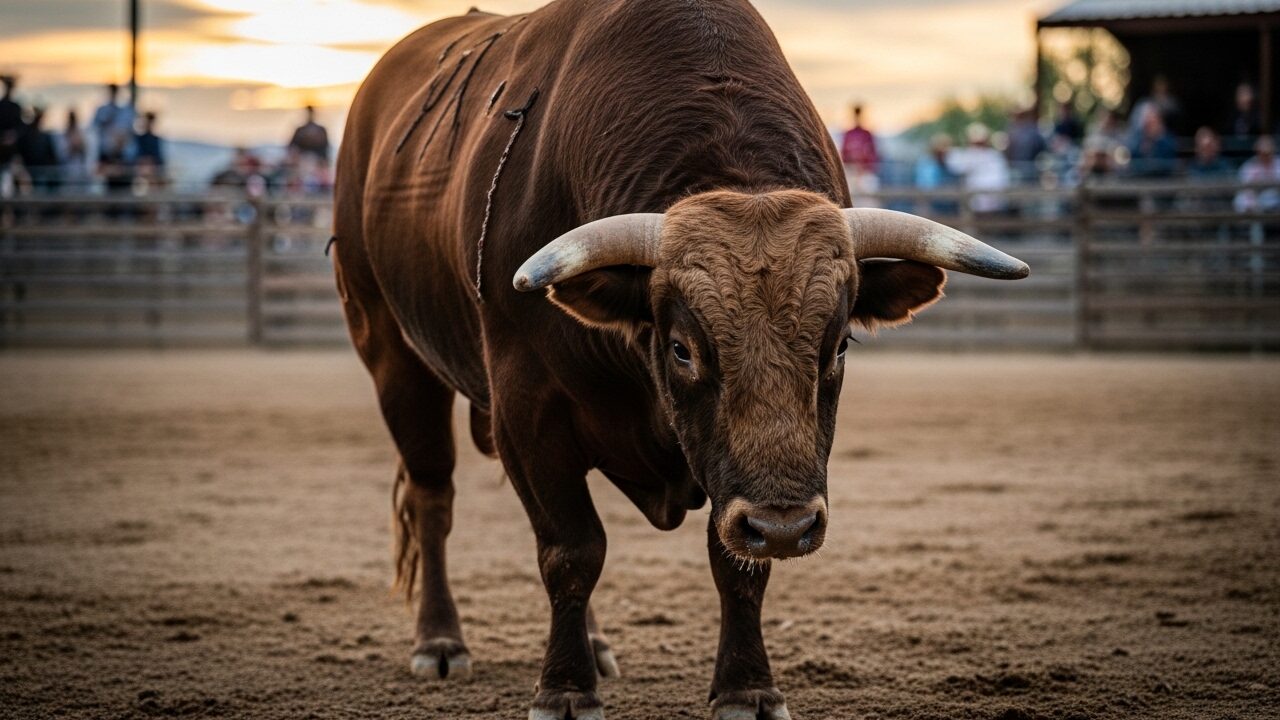
First, the bull.
Because the bull is the beginning of the story in the way that darkness is the beginning of every story about light — not the point, but the condition. The context. The thing that determines the scale of everything that follows.
He comes out of the gate the way certain things come out — not gradually, not with warning, but as a sudden total fact, half a ton of muscle and fury announcing itself to the world as something not to be approached, existing outside the category of things that can be reasoned with or politely asked to reconsider.
The earth speaks before he does.
The vibration travels up through the soles of the feet and the legs of the wooden fences and the bones of everyone watching — a low, steady thunder that is not quite sound and not quite sensation but something in between, the physical language of something massive in motion. And then the dust explodes — it doesn’t rise, it explodes, each hoof strike detonating the dry earth into clouds that swirl sideways and upward, catching the midday sun and turning golden for a second before falling.
And then he becomes visible. Black and enormous and absolutely certain.
His eyes have no doubt in them. This is what everyone who has ever been near a bull knows about them and cannot fully explain — the eyes. Not the horns, not the hooves, not their mass. The eyes. Because the eyes are the place where you look for negotiation, the possibility of a different outcome, some sign that the situation is more fluid than it seems.
There is no negotiation in those eyes. There is only forward.
The crowd behind the wooden fence goes quiet in the particular way crowds go quiet when they are watching something they understand, on some deep animal level, falls outside the ordinary operations of the world. Not the silence of boredom. The silence of held breath. The silence of people who have stopped producing sound because all available attention has been redirected to the only point in the universe that matters right now.
The bull charges. The earth shakes. The dust rises like golden smoke under the harsh midday sun.
II. The Envelope
The man in the white shirt has held the envelope for eleven years.
Not literally. The envelope in his hand today is new — crisp, white, sealed. But the idea of the envelope, the weight of what it represents, the specific combination of money and challenge and theater upon which he has built his reputation — that has been with him for a long time.
He is a man who understands something most people only half-understand: that what people fear most is not danger. It is looking afraid of danger in front of others. That the envelope is not really about the money. The money is simply the metric — the way to make the challenge quantifiable, to give the crowd a number to attach to a question that is actually about something much older and more fundamental than money.
Who among you is not afraid? He raises the envelope.
His voice carries the way voices carry when they have been trained by years of exactly this — of standing before crowds and demanding attention and receiving it, of understanding that authority is not a quality you are given but a performance you sustain, moment to moment, in the space between what you say and what people choose to believe about you.
“Whoever manages to calm this bull… will win ONE MILLION DOLLARS!”
The crowd reacts the way crowds always react to this combination of impossibility and money — with the particular thrilled horror of people who want to believe something is possible while simultaneously being absolutely certain it is not. Laughter that is also fear. Shock that is also delight. The pleasant vertigo of being shown the edge of something without being asked to cross it.
No one moves toward the arena.
This is expected. This is, in fact, the point. The challenge is not meant to be accepted. The challenge is meant to demonstrate — every time it is offered and refused — the nature of what is being challenged. The bull is not a solvable problem. It is a fact. It is a statement about what the world contains and what human beings are sensibly afraid of.
The man lowers the envelope slightly, already composing his face into the expression of concluded theater.
And then, at the fence, a boy puts his hands on the top rail.
III. The Jump
He doesn’t think about it.
This is the most important thing to understand — not that he thought about it and decided, not that he weighed the risk and found it acceptable, not that he made a calculation and reached a conclusion. He did none of those things. All of that takes time, and the time between seeing the envelope and his hands on the fence is not enough time for any of those things.
He just goes.
The jump is clean — two hands on the top rail, a shift of weight, legs following, a single fluid motion that carries him from one side of the fence to the other as if the fence were a suggestion rather than a barrier. He lands in the arena dirt, and dust rises around his sneakers, and for a moment he is standing in his own little cloud while the bull is at the other end of the arena, and every single person who can see what just happened stops making any sound.
He is wearing a dusty gray t-shirt. Jeans worn at the knees. He is ten years old.
He looks at the bull for a moment. The bull looks back at him. And then the boy starts walking.
IV. The Laughter
The men with hats start laughing first.
This is important — not the laughter itself, but who laughs, and why, and what that laughter is made of. They are not cruel men, most of them. They are men who have spent their lives around bulls, who understand on a cellular level what it means to be in an arena with an animal like this, who have the specific knowledge that makes the sight of a ten-year-old boy walking toward a charging bull not brave but simply, obviously, catastrophically incorrect.
They laugh because they know.
And what they know is: this ends badly. It ends badly quickly, and the only variable is exactly how, and the boy walking toward the bull with that calm face and those dusty shoes doesn’t know what they know. When you are watching someone proceed with absolute confidence toward something you know will destroy them, the first response — before horror, before intervention, before anything else — is usually laughter.
The laughter is the sound of the gap between the boy’s certainty and their knowledge.
But then something happens that stops the laughter. The boy keeps walking.
He walks the way people walk when they know where they are going. Not the hesitant shuffle of someone who is afraid and trying not to show it. Not the acted swagger of someone who wants to be seen as brave. The walk of someone who is simply moving from where he is to where he is going, without any particular emotion about the distance between those two points.
The bull watches him. And the bull — the bull doesn’t charge. The laughter dies.
V. The Silence
The crowd behind the fence goes quiet in stages.
First the men who were laughing — their laughter fading as the laughable thing fails to happen, as the boy keeps walking and the bull keeps watching and the dust keeps settling and the catastrophe continues not to occur. They stop laughing the way you stop talking when you realize mid-sentence that you’ve said the wrong thing — abruptly, with a kind of inner reassessment happening behind the eyes.
Then the rest of the crowd — the ones holding their breath, the ones looking away, the ones who had already decided they didn’t want to see what was about to happen — notice the silence first, and they look up, and they see the boy still walking and the bull still not charging and something starting to shift in the air of the arena for which they have no word.
And then absolute silence.
The kind that is not the absence of sound but its own presence — an active silence, a silence with weight and texture, the silence of a thousand people choosing all at once to stop making any noise because what is happening before them has surpassed the category of things to which noise is an appropriate response.
The boy is halfway across the arena. His face is calm.
His face is the most extraordinary thing in all of this — more extraordinary than the bull’s stillness, more extraordinary than the crowd’s silence, more extraordinary than the fact that a ten-year-old boy is walking across an arena toward a half-ton animal that has spent the last several minutes demonstrating its complete willingness to destroy whatever is within reach.
His face is calm because he has not yet learned that this should be impossible. He hasn’t been given the information that would make him afraid.
Or he has been given it, and something in him — something that lives beneath the level of information, in the part of the body where the oldest knowledge is stored — evaluated it and found it insufficient reason to stop.
He keeps walking.
VI. David and the Distance
There is a painting that doesn’t exist yet — someone should paint it — of this exact moment seen from above.
The arena, oval and dusty, the harsh midday sun hammering everything into sharp-edged shadows. The crowd a ring of faces at the fence, all turned inward, all frozen. The bull at one end — massive, dark, absolutely still now in a way that is somehow more alarming than the charge, the stillness of something trying to understand what it sees.
And in the middle of the arena, crossing the space between them, a little boy in a gray t-shirt.
The distance between them is closing.
From above, you can see it shrinking with every step, you can see the boy getting bigger relative to the bull or the bull getting bigger relative to the boy — it depends on which one you’re looking at, and most people are looking at both, their eyes darting back and forth between the two poles of the situation, trying to spot the moment when something shifts, when the bull decides, when the boy stops, when the thing that is going to happen finally happens.
This is the moment of David and Goliath.
But here is what is rarely said about David and Goliath: David didn’t know he was going to win. That is the entire point of the story. If David had known — if he had been given some guarantee, some divine assurance that the stone would fly true and the giant would fall — it wouldn’t be a story about courage. It would be a story about certainty, which is a much less interesting story and demands much less of its protagonist.
David picked up the stone without knowing. The boy crosses the arena without knowing.
This is what courage really is — not the absence of fear, not the presence of certainty, but the decision to move forward in the specific and terrible absence of both.
VII. The Bull’s Eyes
At some point — and no one watching can pinpoint exactly when, because it happens gradually and then all at once, the way all the most important things happen — the bull’s eyes change.
Not the body. The body remains where it is, massive and dark and present the way the sun is present, the way gravity is present — as an undeniable condition of the immediate environment. The hooves are still. The breath still comes in great visible snorts through flared nostrils, the muscles still coiled with the potential for everything they were doing a few minutes ago.
But the eyes change.
What was in them before — the forward, the absolute unquestioning forward, the eyes of something that has only one mode and that mode is pursuit — something in that begins to shift. Not exactly to softness. Not to gentleness. Something more neutral than either. The eyes of something that, for the first time in this encounter, is not entirely sure what it is seeing.
The boy is close now.
Close enough that the crowd at the fence can clearly see his face, and what they see there — what they have been seeing for the entire length of this walk but are only now beginning to fully process — is the absence of the thing that should be present. The thing that should be on every face that gets this close to this particular animal. The thing every single person watching has felt since the bull first came through the gate and the earth began to shake.
Fear. It is not there.
Not the performance of bravery — not someone trying to look unafraid. The genuine, simple, unremarkable absence of fear, the way you can tell when someone genuinely doesn’t taste the bitterness you do, not because they are hiding it, but because they aren’t experiencing it. The boy is not experiencing fear. Something in his nervous system, something in the deep animal part of him that is supposed to receive the information this situation is providing and translate it into the appropriate response — something in that system is running a different calculation, arriving at a different result.
The bull is looking at him. The boy is looking at the bull.
Between them — nothing. No barrier. No weapon. No visible strategy to anyone watching. Just a boy in a dusty gray t-shirt, standing under the midday sun, looking at an animal that just demonstrated to a whole crowd exactly what it is capable of.
And one of them is afraid. It isn’t the boy.
VIII. What the Boy Knows
He knows one thing that no one else in the arena knows.
Not a secret, exactly. Not information that was given to him and withheld from others. Something more particular than that — a way of seeing, a way of receiving the world, that comes from a specific kind of life lived in specific proximity to animals. The knowledge that lives in the hands before it lives in the head. The understanding that the oldest part of every animal — including the massive, dark animal currently looking at him with those enormous changed eyes — responds not to the size of what approaches it, not to the noise made by what approaches it, but to something much simpler and much harder to fake.
What is in your body when you move toward it. What you carry in your chest, in your breath, in the way your weight settles into each step.
The bull has been charging because everything that approached it today was afraid. And fear is information — the most honest information there is, the kind that cannot be acted out, that leaks through every pore and registers in the air between bodies before a word is spoken or a gesture is made. Everything that got close to this bull today was afraid, and the bull read that fear the way it reads everything — directly, without interpretation, without the layers of history and context that humans wrap around the data their senses give them.
Fear means threat. Threat means charge.
But the boy is not afraid. And in the absence of fear, the bull has no instruction.
It is standing in a situation for which its nervous system has never received a map — something approaching it that is small and slow and carries nothing in its body that reads as a threat, nothing that activates the ancient circuit that produces forward, forward, destroy. It is standing there with all its power and all its mass and all its absolute certainty, looking at a ten-year-old boy in a dusty gray t-shirt, and for the first time today, it is unsure.
The boy reaches out his hand.
IX. The Hand
The hand is small.
This is the detail that breaks the crowd — not the walk, not the calm face, not even the bull’s stillness. The hand. Because the hand is the moment when the abstract — the courage, the spectacle, the David and Goliath geometry of it all — becomes concrete. Specific. A small human hand, the hand of a ten-year-old boy, reached out toward the face of an animal that, minutes ago, was turning the earth into thunder.
The hand is steady. The bull lowers its head.
Not aggressively — not the dip that precedes a charge, the gathering of momentum, the coiling whose shape the crowd already knows. A different lowering. Slower. Tentative in a way that this animal hasn’t shown any tentativeness at any other point this afternoon. The lowering of something that is going to allow, very carefully, a thing it doesn’t entirely understand.
The hand touches the bull’s muzzle. The crowd makes no sound.
They cannot make a sound. The mechanism that produces sound has been suspended, along with breathing and blinking and the ordinary physical processes of bodies that have remembered they are bodies and not just witnesses. They aren’t watching a trick. They aren’t watching a performance. They are watching something that shouldn’t be possible based on the information they were given — the charge, the shaking earth, the raised envelope — happening anyway, in silence, in the midday dust.
The bull breathes. In. Out. The boy’s hand rests on its face. And the bull stays still.
X. The Silence After
For a long moment — longer than anyone can agree upon later, because time does strange things when the ordinary rules of the possible have been suspended — nothing else happens.
The boy and the bull. The dust settling. The sun.
And then, from somewhere in the crowd, a sound begins. Not a word. Not exactly a cheer. Something older than either — the sound humans make when they have witnessed something that exceeds their current understanding of what humans can do, the involuntary vocal expression of a boundary being moved, of a map being redrawn in real time.
It grows.
The man in the white shirt is standing with the envelope still in his hand and his mouth slightly open and an expression on his face that he has never had to compose before because nothing in his years of theater and challenges and crowds has prepared him for the need to compose it — the expression of someone who offered a million dollars as an impossibility and is now standing before proof that he was wrong about what is impossible.
He looks at the boy. The boy is not looking at him.
The boy is looking at the bull — at the enormous dark face under his small hand, at the eyes that are different now than they were at the beginning of the afternoon, at the breath coming slow and even and no longer sounding like something preparing to destroy.
He is ten years old. He still doesn’t know what he has done. He only knows that the bull is calm.
XI. What the Boy Takes Away
He will carry this the rest of his life.
Not the money — although the money will come, and it will change things, and the changes will matter in ways both visible and invisible, practical and strange. Not the story — although the story will be told and retold until it becomes the kind of story that stops being about a specific boy and a specific bull and becomes instead a story about what is possible, the kind people tell their children when they want to say something true about courage that they cannot say any other way.
What he will carry is simpler than either.
He will carry the knowledge — unlearned, untaught, but proven in the dirt of an arena under the midday sun — that the thing everyone else was certain of wasn’t true. That the bull wasn’t unstoppable. That the distance was crossable. That the thing in his chest that didn’t feel fear when every other chest in the arena felt it wasn’t naivety or ignorance or the reckless stupidity of someone who didn’t understand danger.
It was the truth about him.
The specific and unrepeatable truth of who he was — of what his nervous system was built for, of what capacity lived in him that he didn’t choose and couldn’t fully explain, of the particular way he was made that allowed him to walk across an arena no one else would enter and reach the other side with his hand on the face of something that, moments before, was nothing but destruction.
He is ten years old. He jumped a fence. He walked forward. He reached out his hand.
And the bull — the unstoppable, unchargeable, million-dollar bull — exhaled slowly under that hand, and stayed still, and was calm.
The man in the white shirt walks across the arena. He stands in front of the boy. He extends the envelope. The boy takes it.
He still doesn’t know what a million dollars means. He only knows that the bull is calm.
And he knows — the way you know things that happen in your body before they happen anywhere else — that he will spend the rest of his life walking toward things that other people stand still in front of.
Not because he isn’t afraid. Because he hasn’t yet learned what he is supposed to be afraid of. And by the time he learns, it will be too late. He will already know what the other side looks like.
END

About the Author
dream01
A writer passionate about human stories and real-life experiences that inspire and move readers.
 Dog Story
48 min read
Dog Story
48 min read
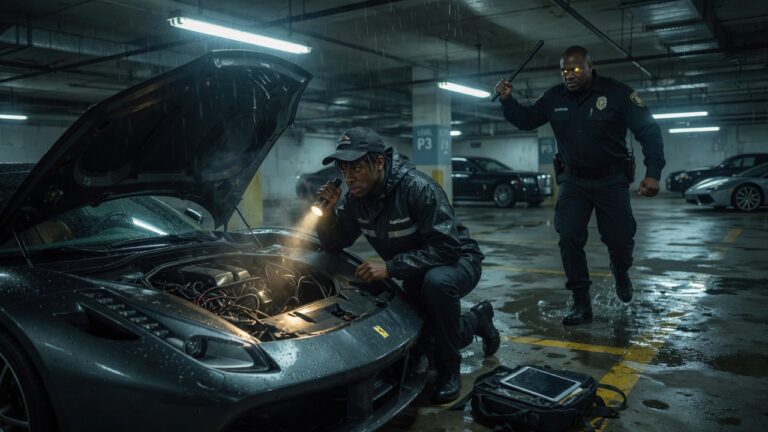
I’ve been a night-shift courier for 9 years, but when the estate guard raised his baton—I heard a “frantic scraping” inside the supercar’s engine block and quietly dropped my scanner.
I’ve been driving late-night delivery routes for nearly a decade, but absolutely nothing prepared me for the sickening sounds echoing…
 Dog Story
75 min read
Dog Story
75 min read
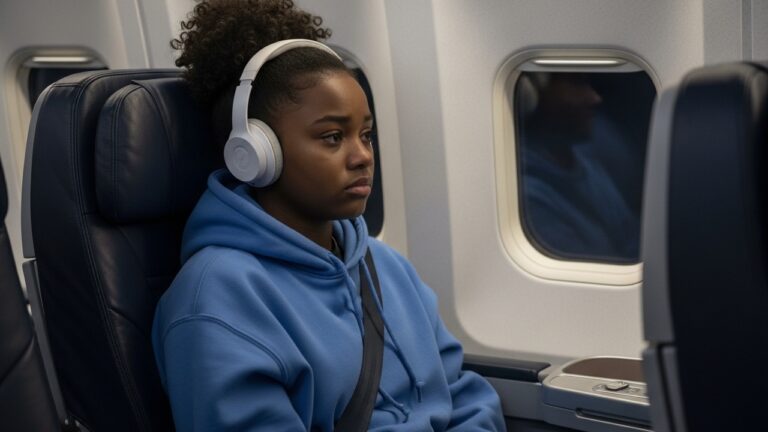
30,000 Feet in the Air, They Handcuffed a Quiet, Grieving Black Teen for Sitting in First Class—Never Guessing Her Father Owned the Airline
Chapter 1 The click of the heavy steel handcuffs was the loudest sound Maya had ever heard. It didn’t matter…
 Dog Story
11 min read
Dog Story
11 min read
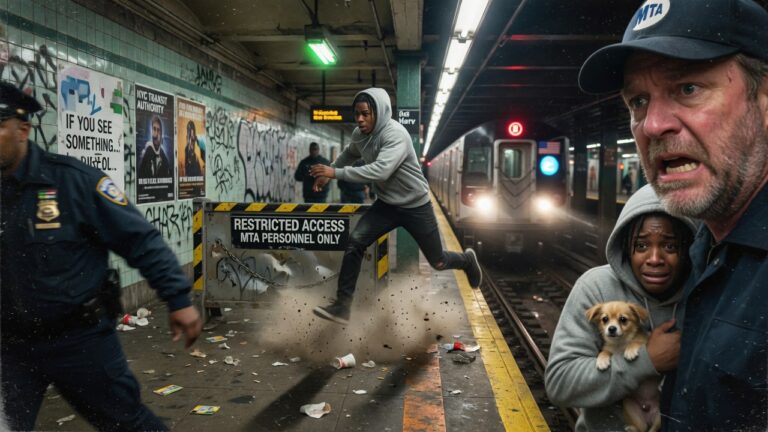
I’ve patrolled the downtown platform for 12 years, but when that kid breached the “restricted zone” at 6:02 PM, I tackled him—only to see the “trembling shadow” on the tracks.
CHAPTER 1 I’ve spent twenty-two years in uniform, most of them under the flickering, fluorescent hum of the New York…
Leave a Reply