
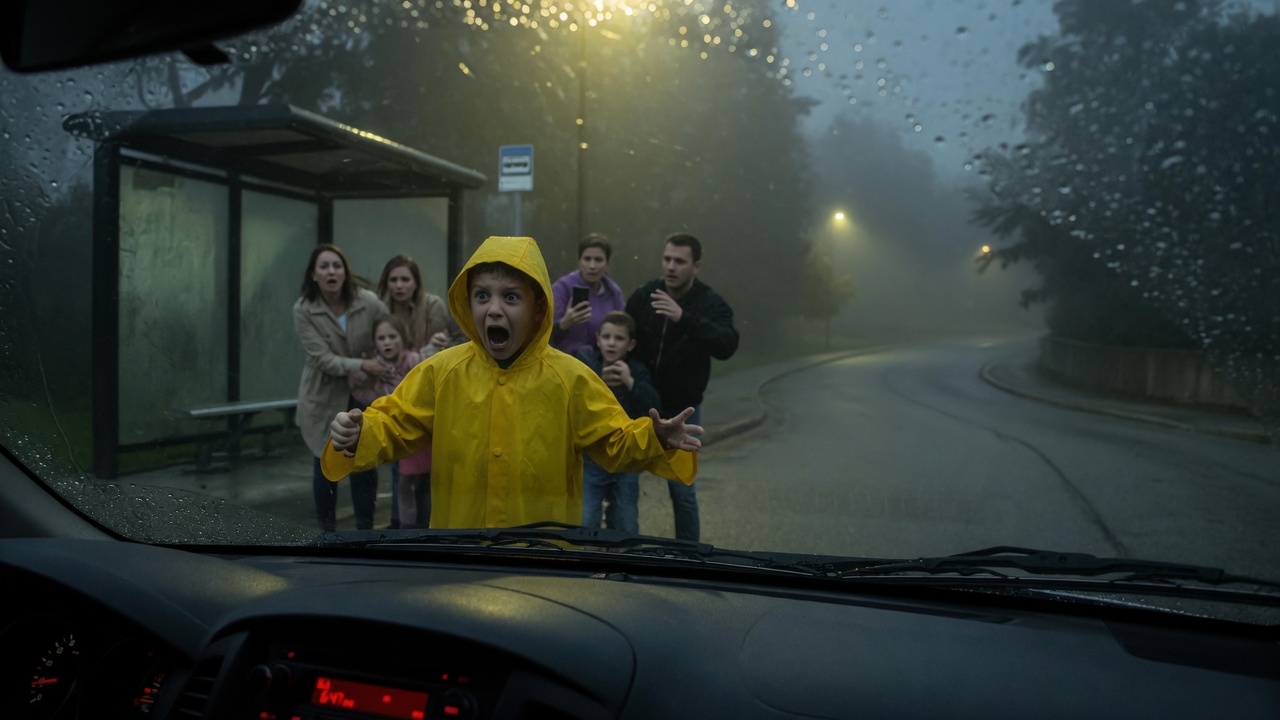
I watched the 7-year-old boy scream daily at the Oak Street bus stop—until I noticed his “random” shrieks perfectly mirrored the fresh skid marks, prompting me to quietly lift my phone and hit record.

I’ve been a high school counselor for twenty-eight years, dealing with every kind of childhood crisis, behavioral issue, and silent trauma you can imagine, but absolutely nothing prepared me for the sickening reality behind the sounds I heard every single morning at 7:15 AM.
My name is Arthur. I live in a quiet, manicured suburban neighborhood called Oakridge. It’s the kind of place where the lawns are perfectly edged, the houses are painted in inoffensive shades of gray and beige, and everyone’s darkest secrets are kept strictly behind heavy linen curtains. I retired three years ago, and since then, my morning routine has been unshakable. I wake up, brew a strong pot of black coffee, and sit in my parked Buick in the driveway to read the news on my tablet before the neighborhood fully wakes up.
My driveway offers a clear, unobstructed view of the neighborhood bus stop at the corner of Elm and Oak.
For the past three months, that bus stop had become a theater of immense cruelty and quiet, suburban tension.
It all centered around a seven-year-old boy named Leo.
Leo and his mother had moved into the rental house two doors down at the end of the summer. He was a small boy, always swallowed up by an oversized, bright orange winter coat, regardless of the actual temperature outside. Within a week of the school year starting, the entire neighborhood knew that Leo was severely autistic.
He didn’t speak to the other children. He didn’t play with the fallen autumn leaves or trade trading cards like the other boys his age.
Instead, Leo screamed.
And I don’t mean a child’s tantrum. I don’t mean the whining of a kid who didn’t get his way. I mean a visceral, throat-tearing, blood-curdling shriek that sounded like a wild animal caught in a steel trap.
Every single morning, exactly at 7:15 AM, just as the yellow school bus was scheduled to round the blind curve at the bottom of the hill, Leo would completely melt down.
From the comfort of my car, I watched the daily spectacle. Leo would suddenly break away from his exhausted-looking mother, run to the very edge of the sidewalk, plant his feet firmly on the concrete, and begin to scream at the top of his lungs. He would flail his arms wildly, his small hands curled into tight fists, punching the empty morning air.
The reaction from the rest of the neighborhood was swift and merciless.
Oakridge is a community of appearances, and Leo was shattering the peace. I watched the other mothers—the ones clutching their insulated coffee cups and dressed in pristine workout gear—visibly recoil. They would shoot daggers at Leo’s mother, whispering behind their hands, their faces twisted in a mixture of pity and intense irritation.
“It’s just bad parenting,” I heard Mrs. Higgins from across the street loudly declare to another mother one morning while I was walking out to get my mail. “If she can’t control him, she shouldn’t subject our kids to that… episode every morning. My daughter is terrified of him.”
And they did pull their children away. Day by day, the invisible circle around Leo and his mother grew wider. The other kids were instructed to stand at the far end of the bench, huddled together, casting nervous glances at the small boy in the orange coat who seemed to be fighting invisible demons.
Leo was completely ostracized. He was labeled the “problem child,” the “danger,” the broken thing that was ruining the neighborhood’s perfectly scripted morning routine.
I am ashamed to admit it now, but for a long time, I did nothing.
With my decades of experience in counseling, I should have walked over. I should have offered a kind word to his mother, who always looked like she was one heavy sigh away from completely shattering. I should have known better than to accept the neighborhood’s shallow narrative. But retirement had made me passive. I sat in my warm car, sipping my coffee, watching the tragedy unfold like a silent movie, assuming, like everyone else, that the loud noises of the approaching bus were simply triggering a sensory overload.
I thought I knew exactly what I was looking at. I was so arrogant in my professional assumptions.
But then came the morning of November 12th.
It was a Tuesday. The weather had turned unusually bitter overnight, dropping a thick, blinding fog over the neighborhood. The kind of fog that swallows streetlights and dampens sound, making the whole world feel small and claustrophobic.
I was sitting in my Buick, the engine idling to keep the heater running. The windows were slightly fogged around the edges. Down at the corner, the bus stop looked like a hazy, gray painting.
The parents were huddled together under umbrellas, trying to stay out of the biting dampness. At the far edge of the concrete pad, standing dangerously close to the curb, was Leo.
It was 7:14 AM.
The fog was so thick that the bottom of the hill—the sharp, blind curve where the bus always appeared—was completely invisible. You couldn’t see more than twenty feet down the road.
Right on schedule, at 7:15 AM, Leo snapped into his routine.
He pulled out of his mother’s gentle grasp, marched to the absolute edge of the curb, and planted his boots. His little body tensed up like a coiled spring. And then, he let out a scream that was so loud, so filled with raw, unadulterated panic, that it pierced right through the thick glass of my car windows.
It was louder than usual. More desperate.
I watched Mrs. Higgins roll her eyes dramatically and literally drag her daughter ten feet further away. Leo’s mother, looking utterly defeated, stepped forward, her hands out in a placating gesture, trying to coax him back.
But Leo wasn’t just flailing today.
As I watched him through the windshield, my counselor instincts—dormant for years—suddenly flared to life. The hair on the back of my neck stood up.
I leaned forward, my coffee sloshing over the rim of my mug, burning my knuckles. I didn’t care. I wiped the condensation off the glass with the sleeve of my robe and squinted.
Something was incredibly wrong.
When a child has a sensory meltdown, they typically try to block out the world. They cover their ears. They squeeze their eyes shut. They curl inward, trying to make themselves as small as possible to escape the overwhelming stimuli.
Leo wasn’t doing any of that.
His eyes were wide open. They were fixed, unblinking, staring with laser-like intensity into the impenetrable gray wall of fog down by the blind curve.
And his arms… he wasn’t just flapping them. He was thrusting his palms outward.
He was pushing.
He was making a universally recognized, desperate gesture for something to stop.
My heart began to pound a slow, heavy rhythm against my ribs. I looked at the other parents. They were entirely focused on Leo, their faces twisted in judgment, annoyed by the noise. None of them were looking at where Leo was pointing. None of them were looking at the road.
I turned off my car radio. The silence inside the cabin was suddenly deafening, broken only by the muffled, rhythmic shrieks of the little boy outside.
I reached into my pocket, my hands trembling slightly, and pulled out my smartphone.
I told myself I was doing it to document a behavioral anomaly. A piece of professional curiosity. Maybe something I could gently show his mother later to help diagnose his specific triggers.
But deep down, in the pit of my stomach, a dark, cold dread was pooling.
I rolled down my passenger window just a crack. The freezing, damp air rushed in, carrying the raw, tearing sound of Leo’s voice.
I opened the camera app. I switched it to video mode.
I pressed the red circle to record.
Through the digital zoom of my phone’s screen, I focused entirely on Leo. I zoomed in on his face. The terror in his eyes was so profound, so absolute, it made my breath catch in my throat. He was a boy staring at a monster that no one else could see.
What are you looking at, Leo? I whispered into the empty car. What is it?
I panned the camera away from him, tracking his line of sight down the foggy street, toward the treacherous, invisible curve at the bottom of the hill.
Through the lens, I saw something I hadn’t noticed with my naked eye.
Down near the edge of the asphalt, just where the fog was thickest, there were fresh, dark tire marks on the wet road. Deep, black gashes in the concrete that veered sharply toward the drainage ditch.
And then, I heard it.
Underneath the sound of Leo’s frantic screaming, coming from deep within the wall of white fog, was a low, mechanical growl.
It wasn’t the heavy, rhythmic rumble of the diesel school bus.
It was the high-pitched, erratic whine of a smaller engine, revving far too high, moving far too fast for the weather conditions. Someone was flying blindly up the hill, right toward the curve.
My blood ran completely cold.
Leo wasn’t having a meltdown.
He wasn’t overwhelmed by the noise of the bus.
He was trying to scream loud enough to act as a human siren. He was trying to warn us.
I dropped my phone into my lap, my fingers fumbling blindly as I slammed my hand against the master lock switch on my car door, the loud clack echoing in the cabin. I didn’t know what was about to come out of that fog, but I knew, with absolute, terrifying certainty, that this seven-year-old boy was the only one in the neighborhood who saw it coming.
The loud, definitive clack of my car door locking echoed in the small, insulated cabin of my Buick, sounding like a gunshot in the tense silence.
For a fraction of a second, I just sat there, my hand hovering over the lock, my heart hammering a frantic rhythm against my ribcage.
I was sixty-five years old. My knees ached when the barometer dropped, my lungs didn’t handle the cold like they used to, and I had spent the last three years avoiding anything that resembled conflict or danger.
I had earned my quiet retirement. I had spent twenty-eight years as a high school counselor, absorbing the trauma, the tears, and the violent outbursts of thousands of broken teenagers. I had given my pound of flesh to the world.
But as I sat there, listening to the agonizing, raw terror in little Leo’s voice outside, a ghost from my past swam up from the depths of my memory.
His name was David. He was a sophomore I had counseled in 1998.
David used to throw heavy wooden chairs across my office. He would scream, tear down my bulletin boards, and spit at the security guards. The entire faculty had labeled him a lost cause, a violent delinquent who needed to be expelled before he hurt someone.
It took me six months of patient, agonizing work to realize David wasn’t just angry. He was terrified.
He was acting out, making himself the loudest, most dangerous thing in the room, so that Child Protective Services would be forced to investigate his home—a home where his younger sister was in terrible danger.
David had been trying to sound an alarm the only way a traumatized kid knew how. And we, the educated, rational adults, had almost expelled him for it. We had almost missed the warning completely.
I looked through my fogged windshield at Leo.
He was standing on the very edge of the curb, a tiny beacon in a bright orange coat, swallowed up by the heavy, oppressive gray mist of the November morning.
His arms were still thrust out, palms facing the blind curve. He wasn’t crying. There were no tears on his face. This wasn’t a meltdown of sorrow or frustration.
This was a desperate, calculated act of warning.
And then, the sound from the fog grew louder.
It was no longer just a distant, mechanical whine. It had morphed into a savage, guttural roar.
I know engines. My father was a mechanic, and I spent my teenage years up to my elbows in grease. The sound tearing through the fog wasn’t the heavy, lumbering diesel engine of a yellow school bus.
It was a high-performance, over-tuned engine of a sports car or a modified truck. And the driver was shifting gears, accelerating hard up the hill.
They were going incredibly fast. Much too fast for a twenty-five mile-per-hour suburban zone, and fatally fast for a morning where visibility was reduced to less than twenty feet.
The driver was flying completely blind.
I didn’t think anymore. The paralyzing grip of my comfortable retirement shattered in an instant.
I grabbed the handle of my car door and shoved it open.
The damp, freezing November air hit me like a physical blow, stealing the breath from my lungs. I left the keys in the ignition, left the engine running, and stumbled out of the Buick, my heavy leather boots hitting the wet concrete of my driveway.
“Hey!” I shouted, my voice cracking with age and sudden exertion. “Hey, get back from the road!”
I don’t know who I was shouting at. I was shouting at the parents. I was shouting at Leo’s mother. I was shouting at the fog itself.
Down at the corner of Elm and Oak, a mere fifty yards away, the oblivious theater of suburban life was still playing out.
Through the mist, I could see Mrs. Higgins. She was holding an insulated, stainless-steel coffee tumbler, her face pinched in an ugly mask of disdain. She was practically dragging her young daughter by the wrist, moving further away from Leo, treating him like a contagious disease.
None of them heard the engine.
None of them were paying attention to the road.
They were so consumed by their annoyance, so blinded by their prejudice against the “problem child” in the orange coat, that their survival instincts had completely shut off.
“Move!” I screamed again, breaking into a stiff, painful jog down the slope of my lawn. The wet grass was slick beneath my boots, and I nearly lost my footing twice.
Leo’s mother, Sarah, was the only one who seemed to register my voice. She turned her head toward me, her eyes wide, dark circles of exhaustion framing them. She looked bewildered, caught between trying to wrangle her screaming son and trying to figure out why the old, quiet man from house number 42 was suddenly charging across his lawn like a madman.
“Arthur?” she called out, her voice trembling. “Arthur, what is it?”
Before I could answer, the fog at the bottom of the hill began to glow.
It wasn’t the soft, amber, familiar glow of school bus headlights.
It was a blinding, piercing, aggressive blue-white light. The kind of aftermarket LED headlights that cut through darkness like a surgical scalpel.
The roar of the engine reached a deafening crescendo. The sound echoed off the manicured lawns and brick facades of the houses, bouncing around the neighborhood until it sounded like it was coming from everywhere at once.
Suddenly, the collective trance of the bus stop broke.
Mrs. Higgins stopped mid-sentence, her mouth falling open. The other parents whipped their heads around, their umbrellas dropping slightly as the unnatural, blinding light sliced through the thick mist.
They finally realized the school bus wasn’t coming. Something else was.
“Get away from the curb!” I bellowed, my lungs burning, the cold air tasting like copper in the back of my throat.
But it was too late to calmly move away.
The vehicle materialized out of the fog like a nightmare pulling itself into reality.
It was a massive, pitch-black pickup truck, lifted high off the ground, its grill a terrifying wall of chrome and aggressively angled metal.
And it was completely out of control.
The driver had hit the blind curve going at least sixty miles per hour. The moment the heavy, oversized tires hit the patch of wet autumn leaves and the thin layer of black ice that had formed near the drainage grate, physics took over.
I heard the horrific, ear-splitting screech of rubber failing to find traction. It was a violent, screaming sound that seemed to tear the very fabric of the morning apart.
The massive black truck didn’t make the turn.
Instead, the rear end kicked out violently to the right, sending the entire vehicle into a massive, uncontrolled drift. The front wheels jerked wildly as the driver clearly panicked, overcorrecting and slamming on the brakes.
It was the worst thing they could have done.
The truck locked up. Two and a half tons of steel and glass became a deadly, unguided missile, sliding sideways up the hill, completely at the mercy of momentum.
And it was sliding directly toward the bus stop.
Pandemonium erupted on the corner of Elm and Oak.
The perfectly manicured suburban peace shattered into pure, primal chaos.
Mrs. Higgins let out a blood-curdling scream and dropped her coffee. The stainless-steel tumbler hit the concrete with a sharp clatter, dark liquid exploding across the pavement. She grabbed her daughter by the shoulders and practically threw them both backward into the wet, muddy hedges lining the sidewalk.
The other parents scattered like frightened animals. Umbrellas were tossed into the wind. Children screamed in terror as their mothers and fathers grabbed them by their jackets, their backpacks, dragging them away from the concrete pad and onto the safety of the elevated lawns.
It was a stampede of pure, panicked survival.
Within two seconds, the area around the bus stop was completely cleared.
Except for two people.
Leo, and his mother, Sarah.
Sarah had lunged for Leo the moment the truck burst through the fog. She threw her arms around his small waist, her boots slipping frantically on the damp concrete as she tried to pull him backward, away from the curb.
But Leo fought her.
With a strength that defied his small, seven-year-old frame, he dug his heavy winter boots into the crack of the sidewalk. He twisted his body, fighting his mother’s frantic grip, refusing to yield a single inch.
“Leo, come on! Please!” Sarah shrieked, tears of absolute terror streaming down her face. She was pulling so hard the fabric of his bright orange coat was stretching tight across his chest.
But Leo was immoveable.
He didn’t look at the sliding truck. He didn’t look at his terrified mother.
His eyes were locked intensely on a specific spot in the road, right near the edge of the deep concrete drainage ditch, about twenty feet ahead of where the truck was currently skidding.
He thrust his small hands out again, his palms facing the oncoming wall of black metal.
He let out one final, deafening scream. A sound that wasn’t panic, but a desperate, furious command.
Stop.
I was halfway across my neighbor’s lawn, my heart pounding so hard I could feel it in my teeth. Time had dilated, stretching the seconds into hours. Everything was moving in agonizing slow motion.
Through the blinding glare of the truck’s headlights, through the spray of water and crushed leaves being violently kicked up by the skidding tires, I finally followed Leo’s unwavering gaze.
I finally saw what he was pointing at.
I finally saw the reason for three months of morning screams.
Lying in the gutter, partially obscured by a pile of wet, rotting maple leaves, was a shape.
It was brown. It was matted with dirt and dark, wet patches that looked horribly like blood.
It was a dog.
A large, golden retriever mix, wearing a faded red nylon collar.
It was lying flat on its side, completely paralyzed. Its chest was rising and falling in rapid, shallow, terrified breaths. One of its hind legs was bent at an unnatural, sickening angle, trapped awkwardly beneath the heavy iron grate of the drainage ditch.
It must have been hit by a car during the night, dragged itself to the edge of the road, and collapsed, unable to pull itself to safety.
It had been lying there in the freezing rain, suffering in silence, completely invisible to the busy parents clutching their coffees and checking their emails.
Completely invisible to everyone. Except Leo.
Because Leo noticed everything.
While the rest of the neighborhood viewed his autism as a deficit, a lack of social awareness, they failed to realize that his brain didn’t filter the world the way ours did.
We filtered out the “unimportant” details to focus on our daily routines. Leo took everything in. Every cracked leaf, every subtle shift in temperature, every hidden shape in the shadows.
He had seen the dog.
For days, maybe weeks, he had seen something wrong near that curve, or perhaps he had only seen the dog this morning. But his screams weren’t meltdowns of sensory overload.
They were alarms.
He knew the bus—and any other car—would sweep tightly around that blind curve, its heavy tires passing mere inches from the gutter where the helpless animal lay trapped.
He had been screaming at the road, screaming at the fog, trying to build an invisible wall of sound to protect the broken creature in the gutter. He was trying to warn the drivers. He was trying to be the hero that the adults were too blind to be.
And now, the massive black truck was sliding sideways, its rear bumper hurtling directly toward the exact spot where the dog lay trembling.
The trajectory was fatal. There was no way the truck would miss it.
The dog lifted its head weakly, its eyes catching the glare of the blinding LED lights. It let out a pathetic, soft whimper that cut through the roaring engine and the screeching tires.
In that split second, Leo realized his screams weren’t working. The monster of metal and glass wasn’t stopping.
And so, the seven-year-old boy in the oversized orange coat did the bravest, most terrifying thing I have ever witnessed in my sixty-five years of life.
With a sudden, violent jerk, Leo slipped out of his mother’s grasp. The bright orange fabric slipped through Sarah’s fingers.
She fell backward onto the wet concrete with a cry of despair.
Freed from her hold, Leo didn’t run to safety.
He stepped off the curb.
He stepped directly onto the wet, slick asphalt of the road, placing his tiny body squarely between the massive, out-of-control truck and the injured dog in the gutter.
“NO!” I roared, a sound torn from the very bottom of my soul.
I didn’t think about my bad knees. I didn’t think about my age, or my retirement, or the danger.
I hit the concrete sidewalk at a full sprint, my boots pounding against the pavement.
The truck was less than thirty feet away, sliding fast.
The smell of burning rubber and atomized rainwater filled the air, choking me. The blinding white light washed over Leo, turning his orange coat into a brilliant, glowing target.
He stood there, perfectly still, his arms spread wide like a tiny, fragile shield.
He was staring death straight in the grill, refusing to blink, refusing to let the broken animal behind him die alone.
I lunged forward, throwing my arms out, praying to a God I hadn’t spoken to in years that my old, tired legs could carry me fast enough to push him out of the way before the steel crushed us both.
I didn’t feel my heavy leather boots leave the wet pavement.
There was no conscious thought, no calculated geometry of distance and speed. There was only a primal, explosive surge of adrenaline that erased the arthritis in my knees and the stiff ache in my lower back. I was sixty-five years old, but in that fragmented, agonizing second, my body remembered how to move.
The massive black grill of the pickup truck was a wall of chrome and blinding LED light, consuming my entire field of vision. It was sliding sideways, completely out of control, a two-and-a-half-ton sledgehammer of steel hurtling toward a seven-year-old boy in a bright orange coat.
Leo stood perfectly still. He was a tiny, unmoving anchor in a world that had violently spun off its axis. His arms were still outstretched, shielding the broken animal in the gutter behind him.
I hit Leo at full speed.
I didn’t grab him; there was no time for finesse. I dropped my shoulder and tackled him around his small waist, wrapping my thick winter coat around his fragile frame just a fraction of a second before the truck reached the curb.
The impact of my dive carried us both backward, launching us off the slick edge of the sidewalk and tumbling violently into the steep, muddy embankment of the drainage ditch.
As we went airborne, the world erupted into a deafening, catastrophic roar.
The truck didn’t hit us. But it missed by a margin so terrifyingly small that the violent rush of air displaced by the massive vehicle actually tore my flat cap from my head.
I heard the agonizing, metallic shriek of the truck’s heavy suspension collapsing as the oversized rear tire slammed brutally into the high concrete curb. The sound of steel grinding against cement sent a shower of sparks flying into the thick, freezing fog.
My shoulder hit the icy, muddy bottom of the ditch with a sickening thud. I wrapped my arms tighter around Leo, burying his head against my chest, curling my own body over him to form a human shell as a storm of debris rained down on us.
Chunks of shattered concrete, jagged pieces of chrome, and a thick spray of freezing, dirty water showered over my back.
Above us, the truck’s momentum violently snapped it back in the other direction. The massive vehicle vaulted partially over the curb, tearing through the wet, manicured hedges of the corner house, before finally slamming nose-first into a thick, ancient oak tree with a concussive boom that rattled my teeth.
And then, a sudden, heavy silence fell over the intersection of Elm and Oak.
It was a terrifying, suffocating quiet, broken only by the sharp, pressurized hiss of the truck’s ruptured radiator spewing thick white steam into the morning air.
For ten agonizing seconds, I didn’t move. I couldn’t.
I lay perfectly still in the freezing mud, my eyes squeezed shut, waiting for the searing pain of a crushed limb or a shattered spine. I waited for the darkness.
But the darkness didn’t come.
Instead, I felt something small and frantic squirming against my chest.
It was Leo.
I slowly opened my eyes, my vision blurred by muddy water and sheer shock. My chest heaved, pulling in ragged, painful gasps of freezing air. My right shoulder throbbed with a dull, heavy agony, but I was breathing. I was alive.
I loosened my grip, rolling slightly onto my side to check the boy. “Leo,” I gasped, my voice a raspy whisper. “Leo, are you okay? Are you hurt?”
I expected tears. I expected the visceral, ear-piercing shrieks that the entire neighborhood had come to associate with him. I expected a child completely broken by the overwhelming sensory violence of a near-death car crash.
I was wrong again.
Leo didn’t cry. He didn’t even look at me.
The very second I released the pressure around his waist, the little boy scrambled frantically on his hands and knees through the freezing muck. His bright orange coat was smeared with thick, black sludge. He slipped on the wet leaves, his small hands sinking into the freezing water pooling at the bottom of the ditch.
He crawled right past me, ignoring the hissing wreckage of the truck looming just inches above us.
He was moving toward the heavy iron grate.
I pushed myself up onto my good elbow, gritting my teeth against the sharp pain radiating down my arm. I turned my head, following the muddy trail of the boy’s orange coat.
There, wedged awkwardly between the sharp concrete lip of the gutter and the heavy iron bars of the storm drain, was the golden retriever.
The dog was covered in a mix of mud, engine oil, and dark, drying blood. Its chest heaved in rapid, shallow tremors. It was a picture of pure, helpless agony.
Leo didn’t hesitate.
This boy, who couldn’t bear to look his own mother in the eye, who recoiled from the touch of other children, reached out his small, bare hands.
He didn’t flinch. He didn’t scream.
He gently, almost reverently, laid his tiny, muddy palms on the dog’s trembling, bloody flank.
“Okay,” Leo whispered.
It was the first time I had ever heard him speak a word. It wasn’t a scream. It wasn’t a shriek. It was a soft, surprisingly steady voice.
“Okay. Stop now. Okay.”
The golden retriever, a large, powerful animal that was clearly in immense pain, could have easily snapped at him. An injured, terrified dog is incredibly dangerous.
But as Leo’s small hands settled on its fur, a profound, almost impossible shift happened.
The dog let out a long, ragged exhale. The frantic, terrified rolling of its eyes slowed. It lowered its heavy head, resting its chin weakly against the cold concrete, leaning the weight of its battered body into the boy’s small, comforting touch.
Leo simply knelt there in the freezing water, stroking the muddy fur, completely oblivious to the chaos and destruction surrounding them. He had done his job. He had stopped the monster. He had saved the creature no one else could see.
“LEO!”
The desperate, tearing scream shattered the quiet of the morning.
I looked up toward the edge of the ditch.
Sarah, Leo’s mother, was sliding down the steep, muddy embankment. She didn’t care about her clothes. She didn’t care about the sharp brambles tearing at her hands.
She hit the bottom of the ditch and practically threw herself at her son. She grabbed Leo by the shoulders, pulling him violently against her chest, burying her face in his muddy neck. She was sobbing hysterically, a deep, guttural wail of absolute terror and profound relief.
“You’re alive, oh my god, you’re alive,” she sobbed, rocking him back and forth, her hands frantically patting his arms, his legs, searching for broken bones. “Leo, never do that again! Never, never do that!”
Leo allowed himself to be hugged for exactly three seconds before he stiffened. He firmly, but gently, pushed his mother’s arms away.
He turned right back to the injured dog, placing his hands back on its flank.
Sarah froze, her hands hovering in the air. She looked down at the bloody, mangled animal her son was fiercely protecting. The realization of what had just happened washed over her pale face.
She looked at the tire tracks violently carved into the curb. She looked at the hissing, crumpled mass of black steel resting against the oak tree just a few feet away. And then, she looked at the dog.
Her hands flew to cover her mouth. She choked back a fresh wave of sobs, finally understanding the agonizing truth behind three months of morning screams.
“Oh, Leo,” she whispered, her voice breaking. “Oh, my sweet, brave boy.”
I slowly pushed myself up to a sitting position, leaning my back against the cold, wet concrete of the drainage wall. My breathing was starting to normalize, but the adrenaline crash was hitting me hard. My hands were shaking uncontrollably.
Above us, on the safety of the sidewalk, the rest of the neighborhood was finally reacting.
The wall of fog was illuminated by the flashing hazard lights of the wrecked truck. The heavy, oppressive silence was broken by the sound of doors opening and frantic, overlapping voices.
I looked up at the edge of the curb.
Standing there, peering down into the ditch, was a row of pale, utterly horrified faces.
Mrs. Higgins was at the front. She was no longer clutching her coffee. Her expensive, pristine workout jacket was smeared with mud from when she had thrown herself into the hedges.
She was staring down at us. She was staring at Leo, the “problem child” she had spent weeks openly despising, kneeling in the freezing mud, gently stroking the head of a dying dog.
She looked at the fresh, deep gouges the truck’s tires had ripped into the exact spot where she had been standing just sixty seconds ago.
If Leo hadn’t screamed… If Leo hadn’t forced that truck to swerve wildly by stepping into the road… the vehicle wouldn’t have locked up and drifted into the tree. It would have plowed straight through the intersection. Straight through the bus stop. Straight through Mrs. Higgins and her daughter.
I watched the color drain completely from her face. Her lips trembled. The arrogant, judgmental sneer that usually rested on her features had been wiped away, replaced by a look of crushing, devastating shame.
She realized, along with every other parent standing on that curb, that the autistic boy they had ostracized and mocked had just saved all of their lives.
“Don’t just stand there staring!” I suddenly roared, my counselor’s voice—the one I used to break up fights in the high school cafeteria—tearing out of my throat with unexpected force.
The parents flinched, snapping out of their collective shock.
“Call 911!” I barked, pointing a muddy finger at Mrs. Higgins. “We need an ambulance. And we need an emergency vet. Tell them a dog is trapped in the storm drain. Move!”
Mrs. Higgins didn’t argue. She didn’t roll her eyes. She scrambled frantically for her phone, her hands shaking so badly she dropped it twice on the wet pavement before dialing.
I turned my attention to the wrecked truck.
The driver’s side door suddenly groaned, the crumpled metal protesting loudly. The door pushed open, swinging loosely on a bent hinge.
A figure stumbled out into the fog.
It wasn’t a hardened criminal or a drunk driver. It was a kid.
He couldn’t have been older than nineteen. He was wearing a backwards baseball cap and a thin hoodie. His face was stark white, completely devoid of blood, and a thin stream of red trickled down from a cut on his forehead where he had clearly struck the steering wheel.
He stumbled around the front of his smoking truck, his legs shaking violently. He looked at the massive dent in his front bumper. He looked at the torn-up earth.
And then, he looked down into the ditch.
He saw me, covered in mud, leaning against the wall. He saw Sarah, kneeling and crying. And he saw Leo, his hands covered in blood, protecting the golden retriever.
The teenager’s knees completely buckled.
He collapsed right there on the wet grass, burying his face in his hands, and began to sob uncontrollably. It was the harsh, ugly crying of someone who had just looked over the edge of a cliff and realized how close they came to falling in.
“I didn’t see him,” the kid wailed, his voice cracking, rocking back and forth on the grass. “The fog was so thick. I was just trying to get to work. I didn’t see him. I swear to God, I didn’t see him.”
I knew he hadn’t. The fog was a gray wall. His speed was reckless, incredibly stupid, but it wasn’t malicious. He was a dumb kid who made a terrible mistake and was now facing the terrifying weight of the consequences.
I slowly forced myself to stand up. My joints screamed in protest, and my bad shoulder throbbed with a sharp, burning heat. I ignored it.
I waded through the icy sludge at the bottom of the ditch, moving past Sarah, and knelt down carefully beside Leo.
I didn’t touch the boy. I knew better than to crowd him now.
Instead, I looked closely at the dog.
The animal was in bad shape. Its breathing was labored, and the unnatural angle of its hind leg told me it was clearly broken, possibly in multiple places. But its eyes were clear. It wasn’t fading. It was holding on.
I slowly reached my hand out, mirroring Leo’s movement, and gently rested two fingers against the side of the dog’s neck, feeling for a pulse. It was rapid, but strong.
“You did good, Leo,” I said quietly, keeping my voice low and steady. “You did incredibly good. You saved him.”
Leo didn’t look up. He kept his eyes fixed firmly on the dog’s muddy fur. But for a brief, fleeting moment, the frantic tension in his small shoulders seemed to relax just a fraction.
“He’s scared,” Leo whispered, his voice barely audible over the hissing radiator.
“I know,” I replied softly. “I know he is. But he’s not alone anymore. You made sure of that.”
In the distance, the sharp, piercing wail of police sirens began to cut through the thick, muffled air of the fog. The flashing red and blue lights began to paint the gray morning, reflecting off the wet pavement and the windows of the silent houses.
Help was finally coming.
I looked up at the edge of the ditch. The neighborhood parents were no longer huddled far away in self-preservation. They had crept closer to the edge, standing in the rain, looking down at the muddy, bloody scene below.
They weren’t looking at a nuisance anymore. They were looking at a boy who possessed a brand of courage and clarity that none of them could even begin to comprehend.
As the first squad car pulled sharply onto Elm Street, illuminating the wreckage with its heavy spotlight, I realized that my quiet, peaceful retirement was officially over.
And as I sat in the freezing mud, watching this incredible seven-year-old boy comfort a broken animal, I couldn’t help but feel profoundly grateful for it.
The thick, blinding gray fog that had swallowed the neighborhood of Oakridge was suddenly violently violently pierced by a chaotic strobe of aggressive red and blue lights.
The wail of the sirens, which had been a distant, muffled hum just moments ago, escalated into a deafening, chest-rattling roar as the first two police cruisers aggressively jumped the curb at the end of Elm Street.
They were followed seconds later by the massive, rumbling bulk of a fire engine, its heavy air horn blasting a deep, concussive warning that shook the remaining autumn leaves from the trees.
The cavalry had arrived. But for the small, shivering group of us clustered at the bottom of the muddy drainage ditch, the flashing lights felt like they belonged to a completely different world.
Down in the freezing muck, time had essentially stopped.
I was still sitting with my back pressed against the freezing concrete wall, my right arm hanging completely useless and throbbing with a sickening, hot agony at my side. My heavy winter coat was soaked through with freezing water, mud, and engine coolant.
But I didn’t take my eyes off Leo.
The seven-year-old boy in the ruined, muddy orange coat was still kneeling in the freezing water. His small, bare hands were firmly, gently planted on the chest of the bloody golden retriever.
He hadn’t flinched when the massive fire engine hit its air horn. He hadn’t reacted to the blinding floodlights that the emergency responders were currently rigging up on the sidewalk above us.
His entire universe was narrowed down to the steady, shallow rising and falling of the injured dog’s ribcage.
“Okay,” Leo whispered again, a rhythmic, incredibly soothing mantra. “Okay. Stay. Okay.”
The dog let out a ragged, trembling sigh, its eyes locked onto the little boy’s face. There was a profound, unspoken understanding passing between the two of them—two creatures who understood what it meant to be utterly terrified and completely ignored by the world.
“Sir! Sir, don’t move your neck!”
A loud, authoritative voice snapped me out of my trance.
Heavy boots came sliding down the steep, slippery embankment of the ditch. Two paramedics in bright neon-yellow trauma jackets hit the bottom of the muddy trench, their heavy medical bags clattering against the concrete.
One of them, a broad-shouldered man with a graying mustache, immediately dropped to his knees beside me, his hands reaching out to stabilize my head.
“I’m fine,” I croaked, coughing violently as the freezing air hit the back of my throat. “It’s just my shoulder. I dislocated it when I dove. Check the boy. And the driver of the truck.”
“Other units are with the driver,” the paramedic said firmly, keeping his hands on my shoulders. “We need to get you stabilized. You took a massive hit.”
The second paramedic, a younger woman with an intense, focused expression, turned her attention to Leo and the dog.
She took one step toward them, reaching out to gently touch Leo’s shoulder.
“Hey, buddy,” she said softly. “Let’s get you out of the cold, okay? We’ve got you.”
The moment her gloved hand made contact with his bright orange jacket, Leo reacted violently.
He didn’t scream, but his entire body went rigid. He recoiled, pulling his shoulders up to his ears, his face twisting into a mask of pure panic. He threw his arms over the dog in a fiercely protective, territorial gesture, his eyes darting frantically toward the paramedic.
Sarah, who was huddled on the mud just a few feet away, let out a panicked gasp. “Please, don’t grab him! He’s autistic, he doesn’t handle touch well, please!”
The female paramedic immediately froze, holding her hands up in a universally placating gesture. “Okay. Okay, I’m sorry. I’m stepping back.”
I took a deep, agonizing breath, fighting through the wave of nausea rising from my dislocated shoulder. I forced myself to tap into the twenty-eight years of crisis counseling I thought I had left behind in my office.
“Leo,” I said. My voice wasn’t loud, but it was deep, calm, and incredibly steady. It cut through the chaotic noise of the radios and the shouting police officers above us.
Leo’s frantically darting eyes slowly locked onto mine.
“They aren’t here to hurt him, Leo,” I said, keeping my tone perfectly even. “They are the helpers. You did your job. You stopped the truck. You kept him safe. But now, the dog needs the helpers. He needs medicine so his leg stops hurting.”
Leo looked at the dog’s unnaturally bent hind leg, trapped beneath the heavy iron grate. He looked down at the dark, thick blood staining the water around his knees.
Then, he looked back at me.
“Medicine,” Leo echoed softly.
“Yes,” I nodded slowly, fighting a grimace of pain. “Medicine. But the helpers can’t give him the medicine if you are blocking them. You have to let them work. Can you do that for me, Leo? Can you let the helpers step in?”
For five agonizing seconds, the boy didn’t move. The flashing red and blue lights illuminated the intense, devastating internal struggle playing out on his small face.
And then, with a slow, trembling motion, Leo pulled his hands away from the dog’s chest.
He didn’t run to his mother. He didn’t run away. He simply stood up, taking exactly two steps backward in the freezing mud, giving the paramedics the space they needed.
“Good boy,” I breathed, letting my head fall back against the cold concrete. “Incredibly good boy.”
The next twenty minutes were a blur of coordinated, professional chaos.
An emergency animal rescue unit arrived on the scene. I watched, mesmerized, as a veterinarian in heavy protective gear slid down into the ditch. She spoke to the dog in low, murmuring tones, swiftly administering a sedative injection before she and the paramedics carefully used hydraulic spreaders to lift the heavy iron grate off the dog’s shattered leg.
When they finally loaded the unconscious, heavily bleeding golden retriever onto a specialized canvas stretcher and hoisted it up the embankment, Leo watched every single movement with laser-like focus.
Only when the dog was safely loaded into the back of the heated animal control vehicle did Leo finally turn around.
He looked at his mother.
Sarah was standing at the edge of the mud, trembling violently, her face stained with tears and dirt. She looked utterly broken, a woman who had just realized how incredibly close she had come to losing her entire world.
Leo walked slowly toward her.
He didn’t speak. He didn’t offer a dramatic embrace. But he did something that I knew, from months of observation, was incredibly rare for him.
He reached out his small, muddy hand, and tightly gripped the fabric of his mother’s wet coat.
Sarah let out a choked sob, falling to her knees in the mud and wrapping her arms around him, completely ignoring the dirt, the cold, and the audience of first responders.
Up on the sidewalk, the atmosphere among the neighborhood parents had undergone a profound, seismic shift.
The comfortable, arrogant bubble of Oakridge had been violently popped.
As the paramedics finally strapped me onto a backboard and carefully hauled me up the muddy embankment toward a waiting ambulance, I got a clear view of the crowd.
They hadn’t gone back inside their warm, perfectly decorated houses. They were standing on the wet pavement, huddled together under the flashing police lights, looking completely shell-shocked.
I saw the nineteen-year-old driver of the truck sitting on the back bumper of an ambulance, a foil thermal blanket wrapped around his shaking shoulders. A police officer was speaking to him, but the kid looked like a ghost. He kept looking at the deep tire gouges in the curb, the tears streaming silently down his pale face.
He knew. He knew he had almost killed a child.
But it was the faces of the neighborhood mothers that struck me the most.
Mrs. Higgins was standing closest to the police tape. Her expensive, pristine workout clothes were ruined. Her hair was plastered to her face by the freezing drizzle that had replaced the heavy fog.
As Sarah carefully led Leo up the embankment, surrounded by paramedics, Mrs. Higgins took a tentative step forward.
The arrogant sneer was completely gone. The judgmental whispers were silenced.
Mrs. Higgins looked at the little boy in the muddy orange coat. She looked at the blood on his small hands.
“Sarah,” Mrs. Higgins choked out, her voice trembling so badly it cracked.
Sarah stopped. She pulled Leo slightly behind her, a deeply ingrained, defensive instinct flaring up. She had spent three months enduring this woman’s loud complaints, her dirty looks, her blatant ostracization.
“Sarah, I…” Mrs. Higgins started, raising a shaking hand to her mouth. The tears spilled over, mixing with the rain on her cheeks. “I didn’t see. We didn’t see the dog. We were so angry about the noise… we didn’t look.”
She took a ragged, sobbing breath, looking directly into Sarah’s exhausted, tear-filled eyes.
“He was trying to save us,” Mrs. Higgins whispered, the crushing weight of her own guilt finally breaking her. “He was trying to protect my daughter. And I called him a monster. I am so… I am so profoundly sorry. I am so sorry.”
Sarah didn’t say anything. She didn’t offer immediate forgiveness, because immediate forgiveness in a situation like that is a lie. But the hard, defensive lines around her eyes softened just a fraction.
She gave Mrs. Higgins a single, slow nod.
It was an acknowledgment. An ending of the war that had raged silently at the bus stop for months.
“Come on, Leo,” Sarah whispered softly. “Let’s go home and get warm.”
As the ambulance doors closed on me, sealing me inside the warm, brightly lit cabin, I let out a long, shuddering breath. The paramedic inserted an IV into my good arm, but I barely felt the needle.
I felt more alive in that cramped, sterile box than I had in three years of comfortable, quiet retirement.
The next few weeks were a period of massive, uncomfortable adjustment for the neighborhood of Oakridge.
I spent two days in the hospital. My shoulder was severely dislocated, and I had a hairline fracture in my collarbone from the impact of hitting the concrete ditch. But I refused surgery, opting for a heavy brace and aggressive physical therapy.
I wasn’t going to spend a month lying in a bed. I had things to do.
The first thing I did when I got home was walk down the street, my arm in a heavy sling, and knock on the door of house number 46.
Sarah answered. She looked incredibly tired, but there was a new lightness in her eyes. A heavy, dark cloud of anxiety seemed to have finally lifted from her shoulders.
“Arthur,” she smiled warmly, stepping aside to let me in. “Please, come in. I was going to bring over a casserole, but Leo…”
She trailed off, pointing toward the living room.
I walked in.
Lying in the center of a plush, expensive-looking dog bed in the middle of the living room rug was the golden retriever.
His right hind leg was heavily casted and pinned with external fixators. A large patch of fur on his side had been shaved to stitch up a deep laceration. He looked battered, exhausted, and incredibly thin.
But he was alive.
And sitting cross-legged right next to the dog bed, a small, worn picture book in his lap, was Leo.
He wasn’t screaming. He wasn’t flailing. He was quietly, meticulously reading a story about dinosaurs, pointing to the pictures and showing them to the dog.
Every few minutes, the dog would let out a soft, contented sigh, and gently rest its heavy, scarred muzzle on Leo’s knee.
“His name is Echo,” Sarah said softly, standing beside me in the doorway. “The vet scanned him for a microchip. He belonged to a family a few towns over. They dumped him in the woods a month ago when they moved. He’s been surviving on scraps and garbage ever since.”
I felt a tight, hard knot of anger form in my chest at the thought of someone abandoning that beautiful animal to die in the cold.
“The surgery bills were astronomical,” Sarah continued, her voice thick with emotion. “I couldn’t afford them. I was going to have to let the animal shelter take him, and they told me… they told me he likely wouldn’t be adopted with his injuries.”
She wiped a tear from her cheek.
“But then, I got a knock on my door the day after the accident,” she said. “It was Mrs. Higgins. And Mr. Miller. And half the parents from the bus stop.”
I raised my eyebrows in surprise. “What did they want?”
“They handed me an envelope,” Sarah smiled, a genuine, radiant smile. “They pooled their money. They covered the entire vet bill. Every single cent of the surgery, the medications, the physical therapy. Mrs. Higgins told me that Echo belonged with the boy who saved his life.”
I looked back at Leo.
He was gently stroking Echo’s soft ears. The frantic, terrified energy that used to radiate from the boy was completely gone.
He had found his purpose. He had found a creature in this loud, confusing, terrifying world that made perfect sense to him. And in return, Echo had found the fierce, unyielding protector he had been denied his whole life.
It has been six months since the morning of the blind fog.
The heavy winter snows have melted, making way for the bright, warm sunshine of late spring. The trees on Elm and Oak are green and vibrant again.
My shoulder still aches when it rains, and I can’t lift my right arm above my head anymore. It’s a permanent reminder of the day my retirement officially ended.
I don’t sit in my idling Buick and read the news anymore.
Every morning, at exactly 7:10 AM, I put on my flat cap, grab my travel mug of black coffee, and walk down to the corner bus stop.
The atmosphere there is completely unrecognizable.
The invisible circle of isolation has vanished. The children don’t huddle at the far end of the bench anymore.
Instead, they crowd around a large, slightly limping golden retriever who happily accepts scratches behind the ears and accepts dropped pieces of toast with zero complaints.
And standing right in the middle of the chaos, holding tightly to a thick leather leash, is Leo.
He doesn’t wear the oversized orange coat anymore. He doesn’t need the armor.
He still doesn’t talk much to the other children. He still avoids loud noises, and he still occasionally covers his ears when the diesel engine of the school bus groans around the curve.
But he doesn’t scream.
He doesn’t have to scream to warn us anymore.
Because we finally learned how to open our eyes. We finally learned that the boy we thought was broken was actually the only one among us who was truly paying attention.
Leo taught an entire neighborhood of arrogant, self-absorbed adults that true courage doesn’t roar. It doesn’t look like a movie star.
Sometimes, courage looks like a seven-year-old autistic boy standing his ground against a two-ton wall of metal, refusing to let the world ignore a dying dog.
And as I watch Leo step onto the yellow school bus every morning, with Echo sitting faithfully on the curb waiting for him to come back, I know that I am witnessing a miracle.
Not a miracle of divine intervention.
But a miracle of observation. A miracle of a boy who saw a tragedy that the rest of the world was too busy to notice, and decided, with absolute certainty, to make it stop.

About the Author
giấc mơ04
A writer passionate about human stories and real-life experiences that inspire and move readers.
 Dog Story
8 min read
Dog Story
8 min read
I Thought Upgrading My Family’s Life Meant We Had Finally Made It. But What I Found Frozen At The End Of A Heavy Steel Chain In Our New Backyard Broke Me As A Man.
“I Thought Upgrading My Family’s Life Meant We Had Finally Made It. But What I Found Frozen At The End…
 Dog Story
54 min read
Dog Story
54 min read
Two Officers Tossed A Bag Of White Powder Into My Mercedes At 2 AM… They Had No Idea Who They Just Framed.
The flashing red and blue lights hit my rearview mirror at exactly 2:14 AM. I was two blocks away from…
 Dog Story
46 min read
Dog Story
46 min read
I Was Handcuffed In Front Of My Own House For “Looking Suspicious”—Then The Police Captain Walked In And Went Pale.
Chapter 1 The metal of the handcuffs was freezing. That was the very first thing that registered in my mind…
Leave a Reply