
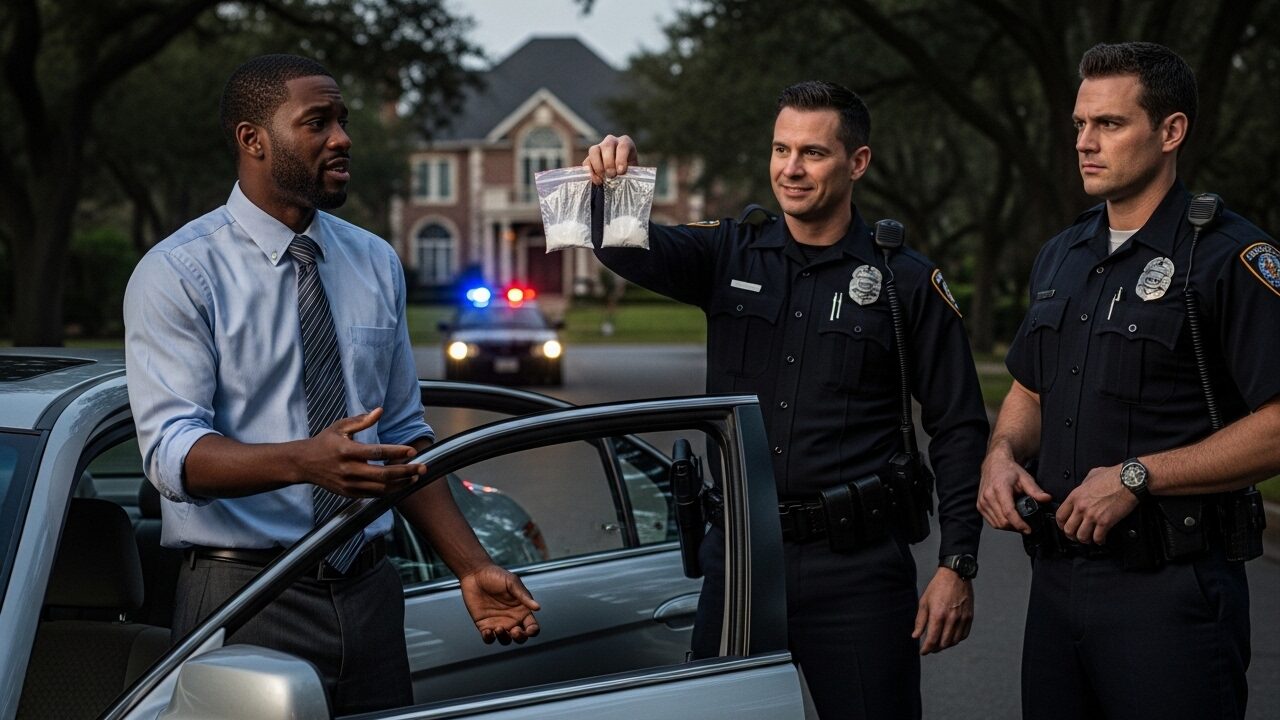
They Tried To Frame A Quiet Man With 2 Ounces Of Powder—They Never Guessed Who He Dialed 15 Minutes Later

Chapter 1
The red and blue lights flashing in my rearview mirror shouldn’t have made my chest tight. I was going 35 in a 35. Both my taillights were working. My registration was paid up for the next two years.
I’m a 34-year-old senior network architect. I wear button-down shirts, I pay my taxes, and my idea of a wild Friday night is arguing about server configurations on Reddit.
But I’m also a six-foot-two Black man driving a late-model sedan through Oak Creek—the kind of gated, manicured neighborhood where the homeowners’ association measures your grass with a ruler.
It was 9:15 PM. I was just trying to get home from a 12-hour server migration.
I pulled over slowly, killing the engine, rolling down all four windows, and placing both hands flat on the steering wheel at ten and two. It’s a routine I was taught when I was sixteen. It’s a routine I shouldn’t need, but one I execute flawlessly every time.
In the side mirror, I watched the officer approach. He didn’t walk; he swaggered. Hand resting casually on his holster.
“License and registration,” he said. He didn’t say good evening. He didn’t tell me why he stopped me. His flashlight beam hit me right in the eyes, blinding me, before drifting down to scan the spotless interior of my car.
“It’s in the glove compartment,” I said, keeping my voice steady, flat, and devoid of anything that could be mistaken for ‘attitude.’ “I’m going to reach for it now.”
His partner, a younger guy with a nervous energy, was already shining his light into my backseat.
“You live around here, buddy?” the first officer asked. His name tag read MILLER. He said ‘buddy’ the way you’d say it to a stray dog sniffing around your trash cans.
“No, sir. I work at the tech campus down on Route 9. Just passing through on my way home.”
Miller took my ID, looked at it, looked at me, and then handed it to his partner. “Run him.”
I waited. Five minutes. Ten minutes. The night air was chilly, but I was sweating. I knew what they were doing. They were looking for a reason. Any reason.
When Miller came back, his demeanor had changed. The casual swagger was gone, replaced by a tight, predatory energy.
“Step out of the vehicle.”
“Officer, why did you pull me over?” I asked, my hands still gripping the steering wheel.
“Your left tire crossed the yellow line back by Elm Street. Step out of the car. Now.”
I stepped out. The asphalt was cold under my shoes.
“We’re going to conduct a quick search of the vehicle,” Miller said. It wasn’t a question.
“I don’t consent to a search,” I stated clearly. I knew my rights.
Miller smiled. It was a thin, cold smile that didn’t reach his eyes. “I smell marijuana, sir. That gives me probable cause. Stand over there by the hood.”
There was no marijuana. I haven’t smoked anything in my life. But I knew arguing on the side of a dark road was a losing game. I stood by the hood, my heart hammering against my ribs, watching them tear through my car. They tossed my gym bag onto the road. They pulled the lining out of my trunk.
Then, I heard it.
“Well, well, well. Look what we have here.”
Miller stood up from the passenger side, holding a small, clear plastic bag containing a substantial amount of white powder.
My stomach plummeted. The air left my lungs.
“That’s not mine,” I said, my voice finally cracking. “I’ve never seen that before in my life.”
The younger cop, the partner, looked at me with a mixture of pity and disgust. “Save it. We find this stuff in cars like yours all the time.”
Cars like mine. He meant people like me.
“Turn around and put your hands behind your back,” Miller snapped, already unhooking his cuffs. “You’re under arrest for possession with intent to distribute.”
As the cold steel clicked around my wrists, biting into my skin, the humiliation washed over me. Cars were driving by now. Oak Creek residents peering out of their expensive SUVs, seeing exactly what they expected to see: a Black man in handcuffs on the side of the road.
They thought they had me. They looked at my quiet demeanor, my skin, and they saw an easy mark. A statistic. Somebody who would take a plea deal just to make it go away.
They shoved me into the back of the cruiser.
“I want my phone,” I said quietly. The panic was receding, replaced by a cold, sharp clarity.
Miller scoffed from the front seat. “You’ll get your phone call at the station, buddy.”
“I need my phone now,” I repeated, staring at the back of his head. “I need to make one call.”
Miller laughed, a harsh, grating sound. “Who you gonna call? Your dealer? Your mama?”
“Neither,” I said.
I looked at the dashboard of the cruiser. I memorized the unit number. I looked at Miller’s badge number.
They didn’t know who I was. They didn’t know what I did for a living. And they certainly didn’t know who was going to answer the number I was about to dial.
<Chapter 2>
The back of a police cruiser smells exactly the way you think it does. It’s a sickening cocktail of stale sweat, cheap institutional vinyl, and the lingering, metallic tang of pure fear. I was intimately acquainted with that smell now. The hard plastic bench offered zero support, and with my hands cuffed behind my back, every bump in the poorly paved roads of Oak Creek sent a sharp, agonizing jolt up through my shoulders.
I kept my eyes fixed on the steel mesh separating me from the front seat. Through it, I could see the backs of their heads. Officer Miller, the architect of my current nightmare, was driving. His posture was relaxed, one hand draped casually over the top of the steering wheel, his head bopping slightly to some classic rock station playing softly on the radio. He looked like a man driving home from a successful fishing trip, not a man who had just dismantled another human being’s life for sport.
Beside him sat Officer Davis. The younger cop. The one with the twitch in his jaw.
Davis hadn’t said a word since they shoved me into the back. He kept his eyes glued to the passenger-side window, watching the dark, manicured lawns of the affluent neighborhood blur past. He was rigid. The nervous energy I had sensed on the side of the road had calcified into a heavy, suffocating guilt. He knew. He had seen Miller pull that little baggie of white powder from his own tactical vest before pretending to fish it out from under my passenger seat. Davis saw it all, and he said absolutely nothing. In many ways, his silence was a sharper betrayal than Miller’s overt malice. Miller was the predator; Davis was the enabler who held the cage door open.
“We got a good one tonight, didn’t we, kid?” Miller said, breaking the silence. His voice was loud, booming over the radio, clearly meant for me to hear. “Two ounces. That’s distribution weight. Mandatory minimums on that kind of weight are going to put our friend back there away for a very long time.”
Davis cleared his throat, a dry, raspy sound. “Yeah. Good bust.”
“You gotta learn to trust your instincts, Davis,” Miller continued, turning onto the main arterial road that led out of the subdivision and toward the precinct. “I saw him driving, saw the way he was gripping the wheel. Looked nervous. You learn to read the signs. It’s a sixth sense.”
It was a masterclass in gaslighting. He was already rehearsing his testimony, building the narrative he would feed to the district attorney. He was framing a thirty-four-year-old Black man who had spent his entire evening migrating database servers, and he was doing it with the casual ease of a man ordering a cup of coffee.
I didn’t speak. I didn’t yell. I didn’t protest my innocence to the back of their heads. I knew the rules of the game I had just been forced into. Anger, in this situation, is a luxury I could not afford. Anger gets you a “resisting arrest” charge. Anger gets you a “stop resisting” beatdown in the dark parking lot of a police station. Anger gets you killed.
Instead of getting angry, I got analytical.
My mind, trained by over a decade in complex network architecture, began treating the situation like a catastrophic system failure. I was evaluating the variables, mapping the nodes, and identifying the weak points in their firewall.
Variable one: The drugs. Two ounces of powder. They would test it, and it would undoubtedly pop positive for cocaine or fentanyl. They wouldn’t plant baking soda. Variable two: The location. A dark stretch of road, minimal witnesses. Variable three: The cameras.
My eyes drifted to the small, black dome of the dashcam mounted near the rearview mirror. Was it on? Was it recording audio? The red indicator light was noticeably dark. Miller had probably killed it the moment he decided I was his target for the night. And their body cameras? I hadn’t heard the distinct double-beep that usually signals a body cam activating when they approached my car.
They thought they had created a perfect vacuum. A black box where their word was absolute law, and my word was just the desperate lie of a cornered criminal.
I let my mind drift away from the cruiser, thinking about my father. He was a retired postal worker who had grown up in Chicago during the 60s. When I bought my first car—a beat-up Honda Civic—he didn’t just give me the keys. He gave me ‘The Talk.’ Not the talk about the birds and the bees, but the talk that every Black father in America has to give his son.
“Keep your hands visible, Marcus. Don’t reach for anything without telling them first. Say ‘yes, sir’ and ‘no, sir.’ You swallow your pride, you swallow your anger, and you do whatever it takes to make it home alive. You can fight them in the courtroom, but you cannot fight them on the street.”
I had followed his rules perfectly tonight. I had executed the code flawlessly. And it hadn’t mattered. The system was rigged. The code was corrupted from the inside.
The cruiser took a sharp right, pulling into the gated sally port of the Oak Creek Police Department. The heavy steel door rolled down behind us with a loud, metallic clatter, sealing us in the brightly lit concrete bunker.
Miller killed the engine. The silence was heavy and oppressive.
He unbuckled his seatbelt, turned around, and looked at me through the mesh. The arrogant smirk was back, plastered across his face.
“End of the line, buddy,” Miller said. “Welcome to the real world.”
He stepped out, and Davis followed suit. They walked around to the back. The door swung open, and the cold air of the garage hit me.
“Out,” Miller barked, grabbing my arm just above the bicep. His grip was unnecessarily tight, his fingers digging into the muscle. He hauled me out of the car. My legs were stiff, and I stumbled slightly as my feet hit the concrete.
“Watch your step,” Davis muttered, reaching out instinctively to steady me, then pulling his hand back just as quickly as if he’d touched a hot stove. Miller shot him a warning glare.
“I got him, Davis. Just grab the evidence bag from the front.”
They marched me toward the heavy steel doors leading into the booking area. Every step felt surreal. I watched the toes of my dress shoes scuffing against the painted concrete floor. I thought about the meeting I had scheduled for 9:00 AM the next morning. I was supposed to be presenting a massive cybersecurity overhaul to a regional bank’s board of directors. Now, I was about to be fingerprinted.
The booking area was a harsh, unforgiving space. Fluorescent lights buzzed angrily overhead, casting a sickly pallor over everything. The air smelled of Pine-Sol and stale coffee. Behind a high desk sat a heavy-set sergeant with a graying mustache, aggressively typing with two index fingers on a keyboard that looked like it hadn’t been replaced since 1998.
“What do we got, Miller?” the desk sergeant asked without looking up.
“Possession with intent,” Miller announced, his chest puffed out slightly. He guided me to the counter and shoved me forward. “Two ounces of powder. Traffic stop turned into a goldmine. Guy was acting squirrelly. Smelled marijuana, did a search, hit the jackpot.”
The sergeant finally looked up. His tired eyes scanned me from head to toe. He saw the tailored shirt, the slacks, the lack of tattoos, the clean shave. For a fraction of a second, I saw a flicker of doubt cross his face. It didn’t fit the profile. But the blue wall is thick, and routine is a powerful sedative. The doubt vanished, replaced by bored bureaucratic indifference.
“Alright. Empty your pockets. Take off the belt, take off the shoelaces.”
Miller uncuffed me. As the pressure released, fire shot through my wrists. I rubbed them instinctively, looking down at the deep red indentations the metal had left behind.
“Pockets. Now,” Miller snapped.
Slowly, methodically, I emptied my pockets onto the metal counter. My wallet. My keys. My security badge for the tech campus. And finally, my phone. A sleek, top-of-the-line smartphone, encased in a heavy-duty black case.
Miller snatched the phone off the counter immediately.
“Nice hardware,” Miller sneered, turning it over in his hands. “Probably bought with the proceeds, huh? How many burner phones you got hidden at home?”
“That is my personal device. I need to make a call,” I said. My voice was calm, almost dangerously quiet. I didn’t sound like a man who was terrified; I sounded like a man who was executing a sequence.
“You’ll get your call when we’re done processing you. You’re on our time now,” the sergeant grunted, tossing a plastic bin onto the counter. “Put the belt and laces in here.”
I unbuckled my leather belt and slid it out of the loops. I bent down and untied my dress shoes, pulling the laces free. It’s a deliberate psychological tactic, a way to strip a person of their dignity and autonomy before locking them in a cage. You feel small. You feel broken. Standing there in a police station with your pants sagging and your shoes flopping off your feet, you stop feeling like a citizen and start feeling like property.
Davis was standing near the wall, holding the evidence bag. The two ounces of powder. He was staring at it. I watched his reflection in the reinforced glass of the booking desk. He looked physically ill.
“Officer Davis,” I said softly, not turning my head, just speaking loud enough for him to hear.
He flinched. Miller spun around, glaring at me.
“Hey! You don’t speak unless spoken to,” Miller barked.
I ignored Miller. I kept my eyes on Davis’s reflection. “You have a choice right now. You know exactly what happened on that road. You know what he did.”
“Shut your mouth!” Miller stepped into my personal space, his face inches from mine. I could smell the stale tobacco on his breath. “You think you can play mind games with my rookie? You’re a drug dealer. You’re dirt. Nobody is going to believe a word you say.”
I held Miller’s gaze. I didn’t blink. I let him see the absolute, chilling certainty in my eyes. I wasn’t just a guy he pulled off the street. I was a structural engineer of information. I built systems that tracked millions of data points a second. I designed security protocols that kept corporate espionage at bay. Miller was playing checkers in a dark alley, and I was playing three-dimensional chess on a supercomputer.
“I’m not playing games,” I said evenly. “I’m stating a fact. And I want my phone call. Now. By law, you are required to allow me to contact legal counsel upon being processed.”
The desk sergeant sighed, clearly annoyed by the friction. He had paperwork to do, and he didn’t want a civil rights complaint landing on his desk on a Thursday night.
“Just give him the damn phone, Miller. Let him make his call so I can lock him up and finish this incident report.”
Miller scowled, his jaw tightening. He hated giving up even an ounce of control. But he knew better than to argue with the desk sergeant over procedure in front of the cameras. Oh yes, the cameras in the booking area were definitely rolling.
He tossed my phone onto the counter. It hit the metal with a heavy thud.
“You get one call. Five minutes. Then you’re in the holding cell until morning,” Miller said, taking a step back and crossing his arms. He nodded toward the wall where an old, heavy payphone hung, encased in metal. “Use the landline.”
“I don’t know the number by heart,” I lied smoothly. “I need my contact list.”
Miller rolled his eyes. “Fine. Use your cell. But put it on speaker. We monitor all calls made from the booking area.”
“That’s fine,” I said.
I picked up my phone. The screen illuminated, recognizing my face, and unlocked instantly. My thumb hovered over the screen.
My heart rate, which had been remarkably steady, finally began to accelerate. Not out of fear, but out of anticipation. The adrenaline was finally finding a productive channel.
They thought I was going to call a public defender. Or a bail bondsman. Or my weeping mother. They expected me to beg for help, to sound desperate, to solidify the narrative they had constructed.
What they didn’t know—what they couldn’t possibly fathom as they looked at my skin and made their shallow, arrogant assumptions—was the specific nature of my career. I wasn’t just a network architect. I was the Chief Systems Administrator for the entire Tri-County Municipal Communications Grid. I designed the VoIP infrastructure that this very police department ran on. I built the secure servers that housed their data.
And more importantly, I owned a specific, unlisted emergency protocol number. A number I had coded myself, designed for absolute catastrophic systemic breaches. A ‘dead man’s switch’ for the network.
When dialed, this number didn’t just ring a phone. It initiated a cascade protocol. It instantly locked down the internal server drives of the Oak Creek Police Department, preventing any deletion or alteration of dashcam or bodycam footage. It triggered an automated distress signal to the Department of Justice’s regional oversight committee, pinging their internal affairs division with a high-priority digital audit alert.
And, for good measure, the call routed directly to the personal cell phone of Marcus Vance Sr.—my father, yes, but also the former President of the regional NAACP chapter and a man who played golf every Sunday with the State Attorney General.
I tapped the phone icon. I opened the dialer.
I didn’t go to my contacts. I didn’t search for a name. I manually typed out a sequence of ten digits. It looked like a standard local number, but it was a phantom node in the network.
Miller leaned against the wall, a smug, satisfied grin on his face. He was enjoying this. He was waiting for the panic in my voice. Davis was still staring at the floor, looking like he wanted to sink right through it.
I hit the green call button. I tapped the speaker icon.
The digital ringing tone echoed loudly in the sterile booking area.
Ring.
Miller chuckled. “Come on, drug dealer. Let’s see who’s awake.”
Ring.
I kept my eyes locked on Miller. I watched the confident smirk resting on his lips. I memorized the way the harsh fluorescent light hit the badge on his chest. I wanted to remember exactly how he looked in this specific microsecond of his life. Because it was the last microsecond he would ever have where he thought he was untouchable.
On the third ring, the line clicked open.
There was no “hello.” There was no sleepy voice answering the phone.
Instead, a sharp, synthetic, automated voice blasted through the speaker of my phone, echoing off the concrete walls of the police station with absolute, terrifying clarity.
“CRITICAL OVERRIDE ACTIVATED,” the robotic voice announced. “PROTOCOL SIERRA-7 INITIATED. ALL DEPARTMENTAL SERVER LOGS SECURED AND COPIED TO EXTERNAL OVERSIGHT SERVERS. AUDIO AND VISUAL SURVEILLANCE LOCKED. THIS IS A LEVEL ONE FEDERAL AUDIT TRIGGER.”
The smug smile on Miller’s face didn’t just fade; it shattered.
<Chapter 3>
The booking area of the Oak Creek Police Department suddenly felt as small and airtight as a coffin.
The harsh, synthetic voice from my phone’s speaker had cut through the stale air like a surgical scalpel. “THIS IS A LEVEL ONE FEDERAL AUDIT TRIGGER.” The words hung there, vibrating against the concrete walls, heavy with a consequence that none of the three men in uniform could fully comprehend yet. But they could feel it. You don’t need a degree in computer science to recognize the sound of a trap snapping shut.
Officer Miller’s smug, self-satisfied grin had vanished, replaced by a slack-jawed expression of pure, unadulterated confusion. For a full three seconds, the only sound in the room was the low, steady hum of the fluorescent lights overhead and the ragged sound of Officer Davis breathing near the evidence counter.
“What…” Miller blinked, his eyes darting from my phone to my face. He shook his head, trying to physically dislodge the reality of what he’d just heard. “What the hell is this? What did you just do?”
He lunged forward, his thick fingers grasping at my phone. I didn’t pull it away. I let him take it. That was the beauty of cloud-based infrastructure; the physical hardware was just a dumb terminal. The ghost was already in the machine.
Miller stared at the screen. It was blank, save for a pulsing red icon in the center that read SIERRA-7: ACTIVE. He mashed the screen with his thumb, trying to end the call. He hit the power button. He tried to swipe up, swipe down. Nothing happened. The phone was locked into a hardcoded loop.
“Turn it off,” Miller barked, his voice rising an octave, the false bravado fracturing. He shoved the phone back into my chest. “I said turn this bullshit off right now!”
“I can’t,” I said. My voice was eerily calm. The adrenaline that had been pooling in my gut was now flowing cold and sharp through my veins. “It’s a one-way execution protocol. Once it’s initiated, it can only be terminated from the outside by an authorized federal auditor.”
The desk sergeant, who had been aggressively ignoring us to focus on his paperwork, had stopped typing. His heavy hands hovered over his grease-stained keyboard. He looked at me, then at Miller, then at his own computer monitor.
“Miller, what kind of prank is your suspect pulling?” the sergeant growled, though there was a tremor of uncertainty beneath his gruff exterior.
“It’s no prank, Sarge,” I said, turning my attention to the older man behind the high desk. “Press F5 on your keyboard. Refresh your dispatch and logging terminal.”
The sergeant glared at me, insulted that a man standing in his booking area without shoelaces was giving him IT instructions. “I don’t take orders from perps.”
“Just hit the key, Sarge,” Davis whispered from the corner. It was the first time the rookie had spoken since we entered the station. His voice was trembling. He looked like a man watching a tidal wave approach the shore.
The sergeant scoffed, but his finger reached out and tapped the F5 key.
The outdated CRT monitor on his desk flickered. The standard blue-and-white interface of the Oak Creek CAD (Computer-Aided Dispatch) system vanished. In its place, the screen went entirely black, save for a stark white text prompt that mirrored the voice on my phone:
SYSTEM LOCKDOWN. SIERRA-7 ACTIVE. ALL LOGS SECURED.
The sergeant’s face drained of color. He slammed his hand against the mouse, clicking frantically. “I’m locked out. The whole terminal is frozen. I can’t access the booking logs. I can’t see the active patrol units.” He picked up his desk phone, the heavy plastic receiver practically glued to his ear. “There’s no dial tone on the internal lines. What the hell is going on?”
“I told you,” I said, leaning slightly against the metal counter. I was still wearing my tailored dress shirt, my slacks, and my socks. I was still a Black man in police custody. But the power dynamic in the room had just violently inverted. “You are experiencing a Level One Federal Audit Lockdown. And it’s not just this precinct. It’s the entire Tri-County Municipal Communications Grid.”
Miller stepped toward me, his hand dropping instinctively toward the Taser on his belt. It was the muscle memory of a bully whose primary weapon—intimidation—had just been rendered useless. “Who the fuck are you?” he hissed, his breath hot and ragged. “You’re a drug dealer. You’re a thug. We caught you with two ounces of blow. You don’t have the juice to hack a police station!”
I looked at him. I looked at the vein throbbing in his forehead. I thought about the fear I had felt on the side of that dark road. The fear my father had warned me about. The fear that comes from knowing that your life, your freedom, and your reputation can be erased by a man with a badge and a racist assumption.
For thirty-four years, I had played the game. I had been the “good one.” I went to MIT on a full academic scholarship. I kept my voice low in meetings so as not to appear “aggressive.” I dressed impeccably to overcome the unconscious biases of the executives I worked for. I swallowed microaggressions whole, letting them dissolve in my stomach like acid, all so I could build a life that was insulated from the very thing happening to me right now.
But I always knew the insulation was an illusion. A six-figure salary doesn’t stop a bullet. A master’s degree doesn’t make you invisible to a cop with a quota and a prejudice.
That was why I built Sierra-7.
“I am not a drug dealer, Officer Miller,” I said, speaking slowly, enunciating every syllable so there could be no misunderstanding. “My name is Marcus Vance. I am the Senior Network Architect and Chief Systems Administrator for the firm that handles the municipal tech infrastructure for this entire county. I built the servers you use. I designed the cloud architecture that stores your bodycam footage. I literally wrote the code that allows your dispatch to talk to your cruisers.”
Miller froze. His hand hovered over his Taser. His brain was desperately trying to process the information, to find a way to make it fit into his narrow, bigoted worldview. It wouldn’t fit.
“You’re lying,” Miller stammered. “You were driving through Oak Creek…”
“I was driving home from the data center on Route 9, where I just spent twelve hours migrating your department’s secure evidence logs to a new server,” I corrected him. “And because I know exactly how vulnerable the system is to tampering—to, say, a dirty cop deleting dashcam footage of an illegal search—I built a fail-safe.”
I turned my gaze to Officer Davis. The kid was practically hugging the wall now. The plastic evidence bag containing the two ounces of white powder—the fake drugs Miller had planted—dangled limply from his fingers.
“The protocol I just activated,” I explained, ensuring my voice carried clearly to the recording microphones I knew were embedded in the booking room ceiling, “doesn’t just lock down the network. It takes an immediate, immutable snapshot of every piece of digital data in the system. Your GPS location for the last twelve hours. The raw, unfiltered telemetry data from your cruiser. And, most importantly, the background audio and video buffers from your dash and body cameras.”
Miller swallowed hard. “I turned my body cam off before the stop. And the dashcam was disabled.”
“You turned off the indicator light and the local storage feed, Officer Miller,” I said, allowing myself a tight, merciless smile. “The hardware itself is always rolling. It caches the data to a hidden partition on the cruiser’s hard drive, just in case of a catastrophic crash. Sierra-7 just scraped that partition and uploaded the uncompressed, undeletable footage directly to a secure server at the Department of Justice.”
The silence in the room was absolute. It was the silence of a catastrophic realization.
I watched the exact moment Miller’s soul left his body. He knew what was on that audio. He knew that the system had recorded him walking to the trunk of his car, opening his own tactical bag, and pulling out the drugs before he ever searched my vehicle. He knew that his career, his freedom, and his entire life as he knew it were over.
“You son of a bitch,” Miller whispered. It wasn’t a threat anymore; it was a surrender.
Suddenly, the dead air from the phone sitting on the metal counter crackled. The automated robotic voice was gone. The line was open.
“Marcus?”
The voice that came through the speaker was deep, resonant, and gravelly with sleep. But beneath the grogginess was a spine of absolute steel. It was a voice that commanded boardrooms, courtrooms, and, decades ago, picket lines.
It was my father. Marcus Vance Sr.
Hearing his voice, the dam inside me—the one holding back the humiliation, the fear, the sheer, blazing anger of being treated like an animal—finally cracked. I closed my eyes for a fraction of a second, taking a stabilizing breath.
“I’m here, Dad,” I said.
“I just got the automated ping. The Sierra-7 alarm woke up the whole house,” my father said. His tone shifted immediately from sleepy to razor-sharp. He didn’t ask if I was okay. He didn’t panic. He was a veteran of a different kind of war, and he knew exactly what the alarm meant. “Where are you?”
“Oak Creek Precinct. Booking area.”
“Who is the arresting officer?”
I looked at Miller. He looked like a man standing on the gallows, watching the executioner check his watch.
“Officer Miller. Badge number 4482. And Officer Davis. Badge number 5109,” I read off, clear and loud.
“What’s the bogus charge?” my father asked. He didn’t say ‘what are you charged with.’ He knew exactly how this game was played.
“Possession with intent to distribute. Two ounces of powder. They planted it in my car after a pretextual traffic stop.”
I heard a heavy sigh on the other end of the line. It wasn’t a sigh of defeat; it was the sigh of a man rolling up his sleeves for a fight he had been preparing for his entire life.
“Marcus,” my father said, his voice echoing in the silent, frozen booking room. “Is the data secured?”
“Locked, encrypted, and distributed to the DOJ oversight nodes. They can’t touch it. They can’t delete it.”
“Good boy,” my father said. “Now listen to me very carefully. Do not say another word to these men. Do not answer any questions. Do not sign anything. I am putting on my suit right now. I am calling Attorney General Higgins—yes, right now, at 10:30 at night—and I am calling the local FBI field office director. I will be there in twenty minutes.”
“Understood.”
“And Marcus?”
“Yes, Sir?”
“Keep your head up. You hold the cards now. Let them sweat.”
The line clicked dead.
I picked up my phone from the counter and slipped it into my pocket.
The desk sergeant, who had been listening to the entire exchange, slowly reached up and took off his glasses. He rubbed his face with both hands, letting out a long, exhausted groan. He looked at Miller with an expression of pure, unadulterated disgust.
“Miller,” the sergeant said, his voice thick with anger. “What did you do?”
“Sarge, I swear, he’s bluffing, this is some kind of trick—” Miller started, stepping toward the desk, pleading.
“Shut up!” the sergeant roared, slamming his fist down on the desk. “My CAD is locked! My phones are dead! Do you have any idea what kind of heat is about to come down on this building? If what this man is saying is true, and there is video of you planting evidence…” The sergeant trailed off, pointing a trembling finger at Miller. “You better pray to whatever God you believe in that you didn’t just drag this whole department down with you.”
Before Miller could formulate another lie, the heavy reinforced doors leading to the holding cells swung open.
A man stepped through. He was in his fifties, wearing a crisp white uniform shirt with gold oak leaves pinned to the collar. Captain Harrison. The shift commander. He looked furious. He was holding his personal cell phone to his ear, and he looked like he had just been electrocuted.
“Sergeant!” Captain Harrison yelled as he walked briskly into the booking area. “Why the hell is the entire server grid down? I just got a call from the Mayor’s office on my personal cell. They’re telling me we’ve triggered a federal oversight lockdown protocol?”
The desk sergeant stood up, practically coming to attention. “Captain, I… my terminal is frozen. We have a situation here.”
Captain Harrison stopped dead in his tracks when he saw the scene in front of him. He saw the sergeant looking panicked. He saw Miller looking like a ghost. He saw Davis trembling in the corner, clutching a bag of evidence.
And then, he saw me. Standing calmly by the counter, barefoot, my hands resting easily on the metal surface.
Captain Harrison looked from me to Miller, his eyes narrowing. He recognized the shape of a disaster when he saw one. He took the phone away from his ear, ending his call.
“Miller,” the Captain said, his voice dangerously low. “Tell me you didn’t do something stupid.”
Miller opened his mouth, but no words came out. He was suffocating on his own hubris.
But it was Davis who broke.
The young rookie, who had spent the last hour marinating in guilt and terror, suddenly surged forward. He practically threw the plastic bag of white powder onto the metal counter. It hit the surface with a heavy smack.
“It’s his!” Davis blurted out, pointing a shaking finger directly at Miller. Tears were suddenly welling up in the young cop’s eyes. The blue wall of silence was collapsing into dust. “It’s Miller’s! He pulled it from his tactical vest! He planted it under the passenger seat! I saw him do it, Captain! I saw him!”
“Davis, you lying little rat!” Miller screamed, lunging toward his partner.
“Stand down, Miller!” Captain Harrison roared, stepping between them, his hand resting on his service weapon. “Back away right now!”
Miller froze, his chest heaving, his face red with rage and terror. He looked around the room. He was surrounded. The Captain was staring at him with lethal intent. The sergeant was reaching for his radio. Davis was openly weeping.
And I was just standing there. Watching it all burn down.
Then, out in the main lobby of the precinct, on the other side of the heavy double doors, a commotion started. We could hear raised voices. The sharp, commanding tone of a man who was entirely used to getting exactly what he wanted.
The heavy doors to the booking area were suddenly shoved open, bypassing the buzzer system entirely.
Three men in dark suits walked in. They moved with the synchronized, predatory grace of federal agents. Behind them was my father. He wasn’t wearing a suit yet; he was wearing jeans and a heavy wool coat over a Harvard Law sweatshirt, but he carried himself like a king entering a conquered territory.
And walking right beside my father, looking thoroughly exhausted but radiating absolute authority, was a man I recognized from the television. The State Attorney General.
The Attorney General bypassed the Captain. He bypassed the Sergeant. He walked straight up to me, looked at my shoeless feet, and sighed.
“Mr. Vance,” the Attorney General said, his voice echoing in the dead silence of the room. “I apologize for the disruption to your evening. I believe we have some things to discuss.”
He then turned slowly to look at Officer Miller.
“And you,” the Attorney General said softly, “have the right to remain silent. I strongly suggest you use it.”
Chapter 4
The State Attorney General did not yell. He didn’t have to. Men with true power rarely raise their voices; they let the weight of their authority do the heavy lifting.
When he told Officer Miller he had the right to remain silent, the words didn’t echo. They simply dropped into the room like lead weights, crushing whatever fragile, delusional hope Miller was still clinging to.
The three federal agents who had walked in with the Attorney General moved with terrifying, synchronized efficiency. They didn’t look at me. They didn’t look at Captain Harrison. They moved directly toward Miller.
“Hands behind your back,” the lead agent said. It wasn’t a request.
Miller took a step backward, his back hitting the concrete wall of the booking area. His face was devoid of color, his skin a sickly, ashen gray under the harsh fluorescent lights. He looked like a man watching the ground open up beneath his feet.
“Wait,” Miller croaked, holding his hands up, palms facing out in a gesture of surrender. “Wait, you don’t understand. This is a misunderstanding. The kid, Davis, he’s panicking. He’s a rookie, he doesn’t know what he saw—”
“Save it for the federal prosecutor,” the agent interrupted smoothly, grabbing Miller by the wrist. The movement was practiced, forceful, and entirely devoid of empathy.
I watched as the agent twisted Miller’s arm behind his back. The sharp, metallic click-click of the handcuffs echoing in the booking room was the most beautiful sound I had ever heard. It was the sound of the universe violently righting itself.
Just an hour ago, Miller had slapped a similar pair of cuffs on me on the side of a dark road, operating under the absolute certainty that his badge made him a god. Now, he was just another suspect in a concrete room, being stripped of his divinity.
“Your weapon. Now,” the second agent demanded, stepping up to Miller.
With trembling fingers, Miller awkwardly reached down with his free hand and unclipped his duty weapon, handing it over. The agent took it, cleared the chamber with a sharp rack of the slide, and placed it on the metal booking counter next to my cell phone. He then reached over and unpinned the silver badge from Miller’s chest.
That was the moment it truly hit him. The physical removal of the badge. A wet, pathetic sob broke from Miller’s throat. He wasn’t crying out of remorse; he was crying because the shield he had used to terrorize people who looked like me was finally gone.
“Captain Harrison,” the Attorney General said, turning his attention to the shift commander, who was still standing frozen in the center of the room. “The Department of Justice is officially taking over this precinct’s servers pending a full civil rights investigation. Your digital infrastructure is currently seized. As of this moment, Officer Miller is in federal custody.”
Captain Harrison swallowed hard, nodding tightly. “Understood, sir.”
“And the rookie,” the Attorney General added, nodding toward Davis, who was still weeping silently in the corner, “will be placed in protective custody. He’s a cooperating witness now.”
Two more agents entered the room and gently, almost clinically, escorted Davis out. The kid didn’t fight. He looked relieved. The blue wall of silence had been crushing him, and now, he was finally allowed to breathe.
As Miller was being marched toward the heavy steel doors, his eyes met mine one last time. There was no anger left in them. There was only a hollow, cavernous terror. He opened his mouth, perhaps to apologize, perhaps to beg, but the federal agent shoved him forward before a single word could escape.
The heavy doors slammed shut behind them. The booking area was suddenly, profoundly quiet.
The Attorney General turned to the desk sergeant. “Sergeant, release Mr. Vance immediately. Strike the arrest from the internal log—assuming you can figure out how to do it manually, since his protocol has locked your system down.”
The sergeant scrambled to his feet, fumbling with his keys. “Yes, sir. Right away, sir.”
My father walked over to me. He hadn’t said a word since he entered the room. He just stood there, a towering presence in his wool coat, his eyes taking in every detail of the scene. He looked at my bare feet. He looked at the red, bruised indentations around my wrists.
He didn’t offer a platitude. He didn’t tell me it was going to be okay. He knew better than that.
He simply picked up the plastic bin containing my belt and my shoelaces from the counter and held it out to me.
“Put your shoes on, Marcus,” my father said softly, his voice thick with an emotion he was fighting desperately to control. “We’re going home.”
Taking that bin was the hardest thing I had to do all night.
While the adrenaline was pumping, while I was calculating the variables and executing the Sierra-7 protocol, I was a machine. I was untouchable. But sitting down on the hard plastic bench to thread the laces back into my dress shoes, the machine broke.
My hands started to shake. A violent, uncontrollable tremor traveled up my arms and into my chest. The reality of how close I had come to losing my life, my freedom, and my reputation crashed over me like a physical weight. If I hadn’t been who I was—if I hadn’t possessed the specific, highly specialized knowledge to build a digital dead-man’s switch—I would be sitting in a holding cell right now, staring down a mandatory minimum sentence for a crime I didn’t commit.
I couldn’t get the aglet through the eyelet of the shoe. My vision blurred.
My father knelt down on the dirty concrete floor of the booking area. He didn’t say a word. He just gently swatted my trembling hands away, took the laces, and began tying my shoes for me.
It was an act of profound, protective grace. I was a thirty-four-year-old man, a senior engineer, a master of complex systems, sitting in a police station while my aging father tied my shoes because I was too traumatized to do it myself.
A single tear hot and jagged, escaped my eye and tracked down my cheek. I wiped it away furiously.
“Let it out, son,” my father murmured, pulling the knot tight. “You held the line. You did exactly what you had to do. You can drop the armor now.”
When he stood up, he pulled me into an embrace. It wasn’t a quick pat on the back. He held me tight, anchoring me to the earth, shielding me from the sterile, violent energy of the precinct. For the first time that night, I felt safe.
Ten minutes later, we walked out of the Oak Creek Police Department.
The cold night air hit my face, smelling of pine trees and exhaust fumes. It was the smell of freedom. I looked up at the sky. The stars were out, indifferent to the human drama that had just unfolded below them.
The Attorney General walked out behind us. He stopped on the concrete steps, turning his collar up against the wind.
“Mr. Vance,” he said, looking at me with a mixture of respect and intense curiosity. “That protocol you initiated. The Sierra-7. That was… extraordinary. I’ve never seen a localized override execute with that level of surgical precision.”
“It’s just code, sir,” I said quietly, my hands stuffed deep into the pockets of my slacks. “Code does exactly what you tell it to do. It doesn’t lie. It doesn’t have prejudice.”
“Well, your code just gave me the key to gutting a corrupt precinct,” the Attorney General said, a hard edge creeping into his voice. “We’re pulling the metadata from the hidden partitions right now. Davis gave a full statement in the car. He confirmed Miller pulled the powder from his own vest. But more importantly, the audit protocol you triggered gave us access to the unredacted logs for the past three years.”
He paused, looking out at the dark street. “Miller didn’t just start doing this tonight. We’re already seeing a pattern. Pretextual stops. Missing dashcam footage. A disproportionate number of narcotics arrests involving minorities in this specific zip code. You didn’t just save yourself tonight, Marcus. You handed us the map to the whole graveyard.”
“What happens now?” I asked.
“Now?” The AG smiled, a cold, predatory expression. “Now, we burn the rot to the ground. Go home. Get some sleep. My office will be in touch tomorrow.”
The fallout was swift, brutal, and entirely public.
I didn’t have to leak the story to the press; the Department of Justice did it for me. When a federal agency raids a wealthy suburban police department, the media descends like vultures.
For the next three weeks, my face was on every local news broadcast, though I refused all on-camera interviews. I let my lawyers and the DOJ do the talking. The narrative the media spun was irresistible: The Tech Genius Who Hacked The Police To Prove His Innocence.
But I hated that headline. I didn’t hack them. I simply held up a mirror to a system that was designed to operate in the shadows, and forced it to look at its own reflection in the harsh light of undeniable data.
Officer Miller was denied bail. The federal prosecutor didn’t just charge him with deprivation of rights under color of law; they hit him with evidence tampering, perjury, and distribution of a controlled substance (since the drugs he planted had to come from somewhere).
The DOJ audit I triggered unraveled a massive web of corruption. They found a secret locker at the precinct containing unlogged cash and narcotics used specifically for planting evidence. Seven other officers were suspended pending investigation. Captain Harrison was forced into early retirement for failure to supervise.
The blue wall didn’t just crack; it was utterly demolished.
Six months later, I sat in a federal courtroom, wearing a tailored charcoal suit, my hands folded neatly on the polished oak table.
Miller was brought in wearing a bright orange jumpsuit. His wrists and ankles were shackled. The swagger was entirely gone. He had lost weight, and his skin had a pale, institutional pallor. He looked small. He looked ordinary. He looked like exactly what he was: a bully who had finally met a system he couldn’t intimidate.
The prosecutor played the audio recording pulled from the hidden dashcam partition.
The entire courtroom listened in dead silence. We heard the sound of Miller’s boots crunching on the asphalt. We heard the squeak of his trunk opening. We heard the rustle of nylon as he reached into his tactical bag. And then, we heard him whisper to himself, clear as day:
“Let’s see how much this arrogant prick likes Oak Creek now.”
I closed my eyes as the audio played. I didn’t feel a sense of triumph. I didn’t feel joy. I just felt a profound, exhausting sadness.
Miller took a plea deal that afternoon. Fifteen years in federal prison. No parole.
As they led him out of the courtroom, he didn’t look at me. He kept his eyes locked on the floor, the heavy chains dragging behind him, echoing in the quiet room.
It has been a year since that night on the side of the road.
I still work as a network architect. I still wear button-down shirts, and I still argue about server configurations on Reddit. But I don’t drive through Oak Creek anymore. Even with the precinct cleaned out, the manicured lawns and the gated driveways still make my chest tight. Trauma doesn’t care about justice; it leaves a scar regardless.
The county passed a new ordinance requiring all municipal police departments to implement a version of the Sierra-7 protocol. An unalterable, cloud-based backup system for all bodycam and dashcam footage, subject to independent, third-party audits. They named the initiative after my father, who pushed the legislation through the city council like a bulldozer.
People call me a hero on social media. They say I “flipped the script.” They praise my calmness, my intelligence, my ability to outsmart a corrupt cop.
But every night, when I lie in bed and look up at the ceiling, I don’t think about the code I wrote.
I think about the man who was pulled over the night before me. I think about the kid who gets pulled over tomorrow in a different city, in a different state.
I think about the Black men and women who don’t have a master’s degree in network architecture. The ones who don’t have a father who plays golf with the Attorney General. The ones who don’t know how to build a digital dead-man’s switch to protect their own lives.
They get pulled over. They get searched. The powder is found. And when they scream, “That’s not mine!” there is no robotic voice from a cell phone to save them. There is only the crushing weight of a system that looks at their skin and decides, automatically, that they are guilty.
I survived because I turned their technology against them. I survived because I had the privilege of knowledge.
But survival shouldn’t require a masterclass in cybersecurity. It shouldn’t require a secret weapon. It should just be a given right.
They tried to frame a quiet Black man with drugs, assuming I was nothing more than a stereotype, an easy target without a voice. They learned, in the most devastating way possible, that you should never try to trap a man inside a system that he built himself.
But until no one needs a Sierra-7 protocol just to make it home safely from work… the system is still broken.
And I will never stop writing the code to fix it.
[END OF FULL STORY]

About the Author
dream01
A writer passionate about human stories and real-life experiences that inspire and move readers.
 Dog Story
24 min read
Dog Story
24 min read
As a corner pharmacist for 15 years, I watched the city’s most feared biker purchase 4 “pediatric IV” tubes—noticing the strange residue on his knuckles, I quietly locked the pharmacy doors and dialed dispatch.
I’ve been a licensed pharmacist in this exact neighborhood for nineteen years, but absolutely nothing in my near two decades…
 Dog Story
48 min read
Dog Story
48 min read
I’ve been a night-shift courier for 9 years, but when the estate guard raised his baton—I heard a “frantic scraping” inside the supercar’s engine block and quietly dropped my scanner.
I’ve been driving late-night delivery routes for nearly a decade, but absolutely nothing prepared me for the sickening sounds echoing…
 Dog Story
10 min read
Dog Story
10 min read
We hit the lottery and finally made it out of the gutter. But the penthouse had a strict ‘No Pets’ rule. I thought he’d be fine for a day at the old house. Then the excavators rolled up.
The smell of success is strange. It smells like Italian leather, lavender-scented cleaning spray, and fresh, high-altitude air on the…
Leave a Reply