
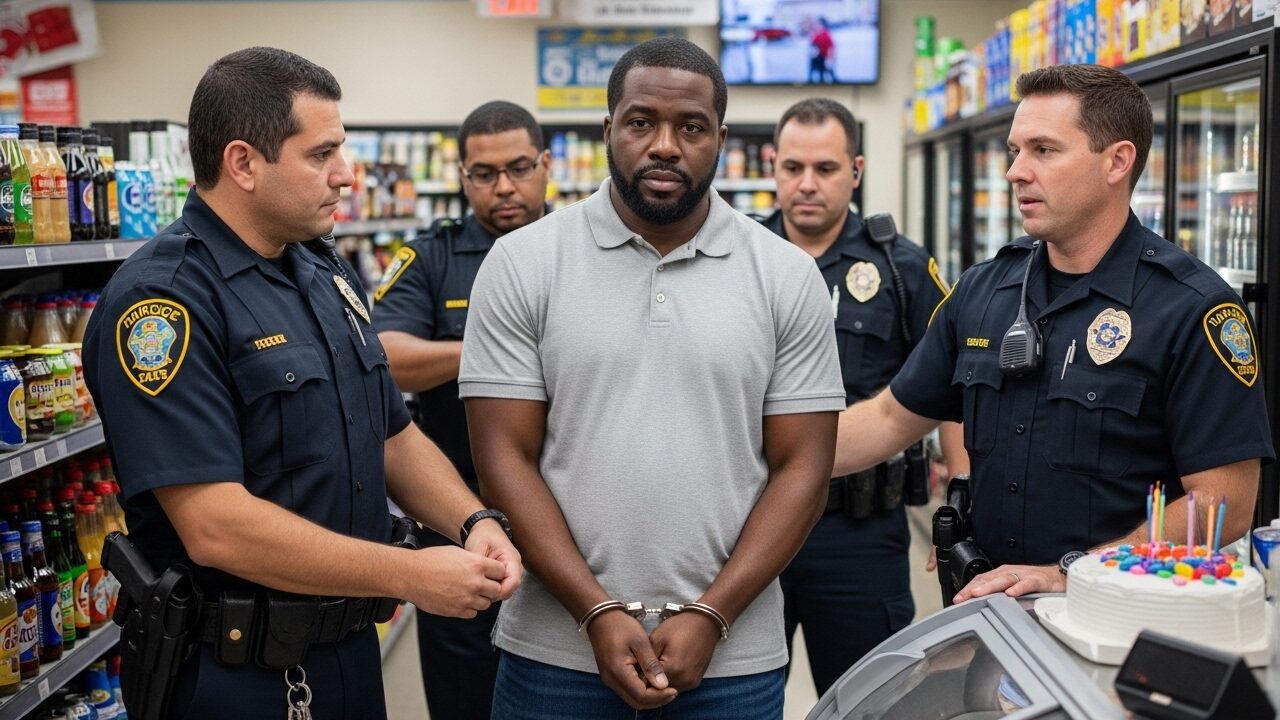
“I Watched The Police Surround A Black Father In A Grocery Store Over A ‘Stolen’ $100 Bill… But When They Finally Checked The Security Cameras, The Truth Brought The Entire Room To Dead Silence.”

CHAPTER 1
“Keep your hands where I can see them.”
It’s the universal phrase that stops time.
For Marcus Vance, a forty-two-year-old Black man standing in the stark, buzzing fluorescent light of an Oak Creek convenience store, those eight words were a heavy, familiar protocol. It was a script he had been taught by his own father decades ago, a set of invisible rules he carried with him every single day of his life.
Palms open. Fingers spread. Voice low. No sudden movements.
Marcus slowly raised his hands, the joints in his shoulders aching from a fourteen-hour shift at the local freight yard. His steel-toed work boots were heavy with mud, his high-vis jacket stained with grease, and his heart was hammering against his ribs like a trapped bird.
In his left hand, pinched carefully between his thumb and forefinger, was a small, overpriced pink birthday cake in a plastic clamshell container. It had a sugar-icing bunny on it. It was for his daughter, Maya. She was turning seven today. She was waiting by the living room window, pressing her nose against the glass, looking for his headlights in the driveway.
Now, he wasn’t going to make it home on time.
“Step away from the counter, sir,” the voice barked again.
It belonged to Officer Miller, a young, tight-jawed cop whose hand was resting entirely too close to the heavy black belt at his waist. Beside him stood Officer Davis, an older, graying veteran who looked tired, his eyes scanning the store, reading the tension in the room.
Marcus took a slow, deliberate step back. His worn boots squeaked against the cheap linoleum floor. The sound echoed in a store that had gone completely, terrifyingly silent.
A dozen pairs of eyes were locked onto him. Shoppers—mostly white suburbanites from the affluent neighborhood surrounding the gas station—had stopped in the aisles. A middle-aged woman in yoga pants froze by the dairy cooler, her hand clutching a gallon of milk. A teenager near the energy drinks slowly pulled out his phone, the camera lens catching the harsh overhead lights.
The weight of their stares was suffocating. It was the public spectacle, the immediate assumption of guilt, the silent, collective verdict being passed before a single question was asked.
“I didn’t take anything,” Marcus said. His voice was a deep, steady baritone. He forced it to remain perfectly level. Any inflection, any hint of anger or frustration, could be weaponized against him. “I was just trying to pay for this cake.”
“Don’t play dumb with me!”
The shout came from behind the counter. Arthur Pendelton, the store manager.
Arthur was a man in his late fifties with a thinning comb-over, a stained maroon company polo, and a face that was currently flushed an angry, mottled red. He was jabbing a thick finger in Marcus’s direction, his chest heaving.
“I saw you!” Arthur yelled, stepping out from behind the register to stand beside the officers. He looked at Officer Miller, seeking an ally. “I was in the back aisle stocking chips. I looked up at the convex mirror, and I saw him leaning over the counter! His hand was right inside the cash drawer! He was robbing my cashier!”
Marcus shifted his gaze slightly, looking past the furious manager.
There, standing paralyzed behind the register, was Chloe. She was nineteen, maybe twenty, wearing an oversized hoodie beneath her uniform apron. She was pale, her hands trembling violently as she gripped the edge of the counter. Tears were welling up in her eyes, threatening to spill over.
Marcus looked at her. He didn’t glare. He didn’t look angry. He just looked at her with a quiet, pleading exhaustion. Tell them, his eyes said. Just tell them the truth.
But Chloe looked away, staring hard at the floor tiles, her shoulders shaking. She was terrified.
“Is that true, sir?” Officer Davis asked, his voice calmer than his partner’s, but still carrying the weight of authority. He took a step closer to Marcus. “Were you reaching into the register?”
“Officer, I’m just trying to get home to my little girl,” Marcus said, keeping his hands elevated. “I put a hundred-dollar bill on the counter to pay for the cake and some gas. That’s it.”
“Liar!” Arthur spat. He stepped forward, his personal space invading Marcus’s. “You people always think you can just walk into my store and take advantage of a young girl. I saw you! You were reaching into the till!”
You people. The words hung in the air, thick and ugly. Marcus felt a familiar, burning knot form in his stomach. It was the same knot he felt when security guards followed him too closely in department stores. It was the same knot he felt when women pulled their purses closer in elevators. It was the exhausting, endless tax of existing in a skin that the world was conditioned to fear.
He closed his eyes for a fraction of a second, fighting down the surge of righteous anger. He couldn’t afford anger. Anger was a luxury he didn’t have. Anger got you put in handcuffs. Anger got you on the evening news.
“Sir, I’m going to need you to turn around and place your hands on the counter,” Officer Miller instructed, his voice tight. He pulled a pair of steel handcuffs from his belt. The metallic clink was the loudest sound in the world.
“Whoa, hold on now, Miller,” Officer Davis murmured, putting a hand on his younger partner’s arm. He looked at Marcus, studying his face, his posture, the carefully protected pink cake in his hand. “Let’s not escalate this just yet.”
“Escalate?” Arthur interrupted, his voice rising to a shrill pitch. “He’s a thief! Are you blind? Arrest him! I want him out of my store right now! If you don’t cuff him, I’m calling your captain!”
Marcus slowly turned his head to look directly at Arthur.
“Mr. Pendelton,” Marcus said softly. He had read the name tag on the man’s shirt. “I work down at the Miller Road freight yard. I’ve lived in this town for three years. I come in here every Tuesday and Thursday to fill up my truck. I pay for my gas, I buy a black coffee, and I leave.”
“I don’t care who you are or what you do,” Arthur sneered, crossing his arms. “I know what I saw.”
Marcus took a deep breath. He thought of Maya. He thought of his wife, Sarah, who was working a night shift at the hospital. They had moved to Oak Creek to send Maya to a better school district, to give her a front yard with green grass instead of concrete. But days like this made Marcus wonder if the green grass was worth the constant, suffocating scrutiny.
He lowered his hands just an inch. “Officer,” Marcus said, addressing the older cop, Davis. “I have my wallet in my back right pocket. My ID is in there. I have the receipt for the gas I just pumped. And…” He paused, looking back over at the trembling teenage cashier. “If you ask Chloe what really happened, she can clear this up right now.”
All eyes turned to the young girl behind the counter.
Chloe flinched under the sudden attention. She looked at Arthur, her boss, who was glaring at her with expectant, furious eyes. She knew Arthur’s temper. She knew he fired people over minor infractions. She desperately needed this job to pay for her community college classes.
“Chloe,” Arthur demanded, his tone sharp and threatening. “Tell the officers. He was taking money from the register, wasn’t he?”
Chloe opened her mouth. A small sob escaped her throat. She looked at Marcus, who was standing there, facing public humiliation, facing potential arrest, all because of what had transpired three minutes earlier.
She looked back at Arthur.
“I…” Chloe stammered, her voice barely a whisper. “I don’t… I didn’t see…”
“She’s traumatized,” Arthur declared instantly, waving his hand as if her silence was all the proof he needed. “Look at her! The guy terrified her! Just cuff him!”
Officer Miller stepped forward, grabbing Marcus’s left arm. The grip was hard, authoritative. “Turn around, sir. Put the cake down.”
Marcus felt the heat rise in his cheeks. The indignity of it. The profound, humiliating injustice. He gently set the pink clamshell container on the counter, making sure not to smudge the icing. He turned around, placing his large, calloused hands flat against the cold surface of the counter.
He felt the cold steel of the handcuffs bite into his wrists.
A murmur rippled through the onlookers in the store. A few more phones went up. Marcus stared at the wall of lottery tickets behind the counter, his vision blurring slightly. He imagined his daughter’s face. I’m sorry, baby, he thought. Daddy’s going to be late.
“You’re making a mistake,” Marcus said quietly to the wall.
“Tell it to the judge,” Arthur sneered, looking incredibly pleased with himself. “I run a tight ship here. No one steals from me.”
Officer Davis let out a heavy sigh, clearly uncomfortable with how fast the situation had deteriorated. He looked from Marcus to Arthur, then up at the ceiling. In the corner of the room, positioned directly over the cash register, was a sleek, black, dome-shaped security camera.
“Alright, Mr. Pendelton,” Officer Davis said, his voice flat and professional. “You have a camera right over the till. We’re going to need to review that footage immediately before we transport him.”
Arthur puffed out his chest. “Gladly. My office is in the back. I’ll pull it up right now. It’s high-definition. You’ll see exactly what this guy did.”
“I would like you to check the tape,” Marcus said softly from his restrained position. He turned his head, locking eyes with the veteran officer. There was no fear in Marcus’s eyes. Only a deep, profound sadness. “Please. Watch the whole thing. From the moment I walked up to the counter.”
Arthur scoffed, turning on his heel. “Bring him. I want him to watch himself get caught.”
Officer Miller gently nudged Marcus forward. They walked past the aisles, past the staring eyes of the white shoppers, past the teenager still recording on his phone. Every step felt like walking through wet cement. Marcus kept his head high, refusing to look at the floor. He had nothing to be ashamed of.
They entered the cramped, messy back office. It smelled of stale cigarette smoke and cheap floor cleaner. Arthur sat down heavily in a rolling chair in front of a dual-monitor computer setup. He aggressively clicked his mouse, bringing up the security software.
“Alright,” Arthur muttered, typing in a password. “Camera four. Timestamp… three minutes ago.”
The officers stood behind him. Marcus stood near the door, his hands cuffed behind his back.
On the screen, the grainy, high-definition overhead view of the cash register appeared. The video showed the store from a bird’s eye view.
There was Chloe, standing behind the counter.
There was Marcus, walking up, placing the pink birthday cake on the counter.
“Here it is,” Arthur said, leaning forward, pointing a stubby finger at the screen. “Watch him. Watch what he does.”
Officer Davis leaned in closer. Officer Miller stopped chewing his gum.
They watched the silent footage play out. They watched Marcus reach into his pocket. They watched a white man in a baseball cap suddenly approach the counter from the side. They watched the chaotic, confusing sequence of events unfold in high definition.
And as the digital timer on the screen ticked forward, the smug, triumphant smile on Arthur Pendelton’s face slowly began to vanish.
The color drained from his cheeks.
Officer Miller’s jaw went slack. He took a sudden, sharp breath, stepping back from the monitor as if he had been physically struck.
Officer Davis stared at the screen, his eyes wide, completely captivated by the silent story playing out before them. He watched the tape, then slowly, very slowly, turned his head to look at Marcus, who was standing quietly by the door in handcuffs.
The silence in the cramped office was absolute. It was heavy. It was deafening.
Because the camera didn’t just prove Marcus Vance was innocent.
It proved something else entirely. Something that made the two police officers feel sick to their stomachs, and made Arthur Pendelton wish the floor would open up and swallow him whole.
Chapter 2
The silence in the cramped, windowless back office of the Oak Creek convenience store wasn’t just quiet. It was a dense, physical weight, pressing down so hard it felt like the air had been sucked out of the room. The only sound was the frantic, high-pitched whirring of the computer tower’s cooling fan and the heavy, ragged breathing of the four men standing in the dim light.
Marcus Vance stood perfectly still by the door. His massive shoulders were hunched slightly forward, a posture of forced submission he had learned decades ago. The steel handcuffs bit sharply into his thick wrists, pinching the skin, sending a dull, throbbing ache up his forearms. His heavy work boots, caked with the dried mud of the freight yard, felt like lead weights. He stared straight ahead at the peeling beige wallpaper, refusing to look at the monitor. He didn’t need to watch the screen. He already knew exactly what was on the tape. He had lived it just four minutes ago.
Behind the desk, Arthur Pendelton, the store manager, was completely frozen in his rolling chair. The mottled, angry red flush that had colored his face just moments prior was draining away, replaced by a sickly, translucent pallor. His thick fingers hovered over the computer mouse, trembling so violently that the plastic device rattled against the faux-wood desk.
Standing directly behind Arthur, Officer Davis and Officer Miller were practically statues. The flickering blue light from the dual monitors cast long, harsh shadows across their faces.
On the screen, the high-definition security footage played in absolute, haunting silence.
Officer Davis, a twenty-six-year veteran of the Oak Creek Police Department, leaned closer to the monitor. He placed his hands on his duty belt, his knuckles turning white. He was a man who prided himself on his instincts. He had spent over two decades reading crime scenes, de-escalating domestic disputes, and separating the victims from the aggressors. But as he watched the digital timestamp in the upper right corner of the screen tick forward—19:41:12, 19:41:13—a cold, nauseating knot of shame began to form in the pit of his stomach.
“Play it back,” Davis ordered. His voice was a harsh, gravelly whisper that barely sounded like his own. “Play it from the minute he walks in.”
Arthur swallowed hard, a loud, clicking sound in his throat. He fumbled with the mouse, dragging the video progress bar back. “I… I just saw the end…” Arthur stammered, his arrogant, commanding tone completely shattered. “I swear, I only saw…”
“Shut up and hit play,” Officer Miller snapped. The younger cop’s voice was laced with a sudden, venomous edge. He was no longer looking at Marcus with suspicion. He was staring at the screen with an expression of pure, unadulterated horror.
The video restarted.
The overhead camera angle provided a wide, sweeping view of the front of the store. The footage was crisp, the colors vivid under the harsh fluorescent lights.
19:39:45. The automatic glass doors slid open.
Marcus walked into the frame. On the screen, he looked exactly as he did standing in the office now—exhausted, heavy-footed, carrying the invisible weight of a fourteen-hour shift. The camera captured him pausing by the entryway, wiping a layer of grime from his forehead with the back of his massive hand. He walked slowly down the center aisle, moving with the careful, deliberate caution of a large man who is hyper-aware of his surroundings.
Officer Davis watched the screen, analyzing Marcus’s body language. There was no furtive glancing. No checking for cameras. No nervous energy. Just a tired father on a mission. The camera tracked Marcus as he walked to the refrigerated section, opened the glass door, and carefully selected the small, pink clamshell container holding the birthday cake.
Davis felt a sharp pang in his chest. He had a daughter, too. Katie. She was twenty-two now, in her senior year at Penn State, but he remembered the agonizing pressure of making it home in time for those early childhood birthdays. He remembered rushing through traffic, desperate not to disappoint her. Looking at the screen, Davis realized with sickening clarity that he had just handcuffed a man who was trying to do the exact same thing.
19:40:22. The glass doors slid open again.
A white man entered the store. He was in his early thirties, painfully thin, wearing a faded blue baseball cap pulled low over his eyes and an oversized, dirty olive-green jacket. The man’s movements were erratic, twitchy. He didn’t walk; he paced. He moved toward the ATM in the corner, but he didn’t put a card in. He just stood there, his head swiveling back and forth, his hands shoved deep into the pockets of his jacket.
Davis instantly recognized the body language. It was the frantic, wired kinetic energy of a desperate man. An addict going into withdrawal, or a man with debts that had come due yesterday. The man in the green jacket was a tightly coiled spring, ready to snap.
“Who is that?” Miller asked quietly, pointing at the screen.
“I… I don’t know,” Arthur whispered, his eyes glued to the monitor. “I didn’t see him. I was in the back stocking the chip aisle. The delivery was late…”
“Just watch,” Davis commanded, his eyes narrowing.
On the screen, Marcus approached the counter. Chloe, the nineteen-year-old cashier, was standing behind the register. Even without audio, the camera captured the polite, easy exchange. Marcus placed the pink cake on the counter with agonizing care. He reached into his back pocket, pulled out his worn leather wallet, and extracted a crisp hundred-dollar bill. He laid it flat on the counter.
19:41:05.
The man in the green jacket made his move.
It happened with terrifying, explosive speed. The man abandoned his pretense at the ATM and sprinted toward the counter. He didn’t go to the back of the line. He lunged directly at the space between Marcus and the register.
On the screen, Chloe’s entire body jerked backward in shock. Her mouth opened in a silent scream.
The man in the green jacket whipped his right hand out of his pocket. The overhead camera caught the stark, silver flash of fluorescent light reflecting off cold steel. It was a hunting knife. The blade was at least six inches long, serrated at the base, completely lethal.
“Jesus Christ,” Miller breathed, instinctively reaching for his own duty belt as if he could intervene through the monitor.
The attacker leaned over the counter, grabbing the collar of Chloe’s oversized hoodie with his left hand. He violently yanked the young girl forward, slamming her chest against the register. He pressed the flat side of the long blade against her throat, his face inches from hers, screaming silent, violent threats.
Chloe was completely paralyzed. Her hands flew up in the air, her face completely drained of color. With her trembling right hand, she desperately punched the button to pop the cash drawer. The register slid open.
Officer Davis felt his heart hammering against his ribs. He looked over his shoulder at Marcus, who was still standing by the door, staring at the floor. Then he looked back at the screen.
What did you do, Marcus? Davis thought, completely captivated. Most people run. But Marcus Vance didn’t run.
On the silent video, Marcus dropped his wallet on the counter. He didn’t flinch. He didn’t take a step back. Despite being off-guard, despite being exhausted, the forty-two-year-old father moved with a sudden, decisive ferocity that took the breath away from the officers watching.
Marcus stepped laterally, closing the distance between himself and the attacker in a fraction of a second. He reached out with his massive left hand—the hand calloused from years of hauling freight—and clamped it down on the attacker’s right wrist, the one holding the knife against Chloe’s throat.
The grip was ironclad. On the screen, the attacker’s eyes widened in sheer, sudden panic. He hadn’t accounted for the large Black man standing next to him to intervene.
Marcus twisted the attacker’s arm violently outward, pivoting his own body to leverage his weight. The man in the green jacket thrashed wildly, trying to break free, but Marcus’s grip was unyielding. With a sharp, upward jerk, Marcus forced the man’s wrist to bend backward at an unnatural angle.
The knife slipped from the attacker’s fingers. It clattered silently onto the tiled floor, sliding out of frame.
Freed from the blade, Chloe collapsed backward against the cigarette display, clutching her throat, completely dissolving into hysterics.
But the fight wasn’t over. The attacker, realizing he had lost his weapon and was overpowered, panicked. He threw his left arm blindly into the open cash drawer, grabbing a thick handful of twenty-dollar bills. He tried to rip his right arm away from Marcus’s grip.
Marcus didn’t let go. He planted his steel-toed boots, grabbed the back of the attacker’s green jacket with his free hand, and hurled the man backward.
The attacker flew through the air, crashing violently into a standalone cardboard display of energy drinks. Cans exploded everywhere, rolling across the floor in a chaotic wave. The man hit the ground hard, dropping half of the stolen cash in the process. Bills fluttered through the air like green confetti.
Scrambling like a wounded animal, the attacker scrambled to his feet. He took one terrified look at Marcus, who was standing tall, blocking the path to the counter, fists clenched and ready. The attacker decided he had had enough. He turned, sprinted down the aisle, and smashed his way through the automatic sliding doors, disappearing into the dark parking lot.
19:41:48.
The store was empty again, save for Marcus and the terrified cashier.
In the back office, Arthur Pendelton was practically hyperventilating. His mouth was opening and closing like a fish out of water, but no sound was coming out.
“Keep watching,” Davis said, his voice hard as granite. He knew what was coming next. He knew exactly how the tragedy of the last ten minutes had been born.
On the screen, Marcus stood breathing heavily for a few seconds, staring at the front doors to ensure the man wasn’t coming back. Then, slowly, the adrenaline seemed to leave his body. He looked down.
Scattered across the counter and the floor in front of the register were the twenty-dollar bills the attacker had dropped.
Marcus looked over the counter. Chloe was on the floor, out of the camera’s view, presumably sobbing. Marcus leaned over, clearly speaking to her, checking to see if she was injured. After a moment, he slowly bent down.
With painful, deliberate movements, Marcus picked up the dropped money from the floor. He gathered the bills from the counter. He straightened up, holding a messy stack of twenties in his right hand.
He looked at the open cash drawer.
He didn’t put the money in his pocket. He didn’t walk away.
Instead, Marcus leaned forward, reaching his large arm over the counter, and gently placed the stolen money back into the open till.
And right at that exact, miserable, heartbreaking second—19:42:01 on the timestamp—a figure appeared at the top of the screen.
It was Arthur Pendelton.
He walked out from the back aisle, looked up at the convex anti-theft mirror positioned on the ceiling, and saw Marcus Vance. He saw a Black man leaning over the counter, his hand inside the cash drawer.
The video showed Arthur’s face contort into a mask of sudden, furious rage. It showed him pointing a finger, opening his mouth, and screaming the accusations that had set this entire nightmare into motion. It showed Chloe, already deeply traumatized by having a knife to her throat, completely freezing as her angry, overbearing boss stormed forward, screaming at the man who had just saved her life.
The video ended, freezing on the image of Arthur screaming at Marcus.
The silence returned to the office, heavier and uglier than before.
Officer Miller felt a hot wave of bile rise in his throat. He looked down at his own hands. Ten minutes ago, he had used those hands to forcibly turn a hero around and slap steel cuffs on his wrists. He had barked orders at him. He had treated him like a common criminal. The realization of what he had done, of how quickly he had allowed his own implicit biases to align with Arthur’s racist assumptions, was a physical blow. He felt sick. He felt like throwing up.
Miller turned around slowly. He looked at Marcus.
Marcus was still standing by the door, staring at the wall. He hadn’t gloated. He hadn’t said I told you so. He just stood there, enduring the humiliation, bearing the weight of a world that refused to give him the benefit of the doubt.
“Unlock him,” Officer Davis said. His voice cracked. It was the first time in twenty-six years on the force that a direct order had ever caught in his throat.
Miller moved immediately. His hands were shaking as he stepped behind Marcus. He fumbled with the small black key, struggling to fit it into the tiny keyhole of the cuffs.
“I… I got it, I’m sorry,” Miller stammered, his voice thick with emotion. The tough-cop facade was completely gone, replaced by the panicked, guilty tone of a young man who realized he had made a colossal mistake.
Click. The left cuff fell away.
Click. The right cuff fell away.
Marcus slowly brought his arms forward. He didn’t rub his wrists. He didn’t massage the red, indented lines the metal had left on his dark skin. He just let his arms hang by his sides, his chest rising and falling in slow, measured breaths.
“Mr. Vance,” Officer Davis began. The veteran cop stepped away from the monitors. He took off his uniform hat, holding it against his chest. He looked Marcus directly in the eyes. “Mr. Vance, I… I don’t have the words. What you did out there… you saved that girl’s life. You risked your own life. And the way we treated you…” Davis swallowed hard, tears pricking the corners of his weathered eyes. “It was entirely unjustified. It was wrong. And I am profoundly, deeply sorry.”
Marcus looked at the older officer. His deep brown eyes held a mixture of weariness and quiet dignity. He had heard apologies from white men in authority before. They were usually hollow, designed to prevent a lawsuit rather than heal a wound. But looking at Davis, Marcus saw genuine, agonizing remorse.
“I told you I just wanted to go home to my daughter,” Marcus said softly. The sheer exhaustion in his voice was devastating. “She’s seven today. I promised her I wouldn’t be late.”
Miller wiped a hand across his eyes, turning his face away to hide his crumbling composure.
Arthur Pendelton, however, was still struggling to process the reality that had just shattered his worldview. He sat in his chair, staring at the frozen frame of the video, his mind desperately trying to bridge the gap between his prejudice and the absolute truth staring him in the face.
“Well…” Arthur stammered, breaking the silence. His voice was weak, defensive, utterly pathetic. “How was I supposed to know? I mean, look at it from my angle! I look up, and I see him in the till! And he didn’t say anything! If he was innocent, why didn’t he yell it out?”
The temperature in the room dropped ten degrees.
Marcus didn’t react. He didn’t need to.
Officer Davis turned slowly, pivoting on his heel to face the store manager. The remorse and guilt that had softened the old cop’s face vanished, replaced by a cold, terrifying fury.
Davis walked over to the desk, placed both hands flat on the faux-wood surface, and leaned down until he was inches from Arthur’s sweating face.
“Arthur,” Davis said, his voice dropping to a low, lethal register. “I have known you for six years. I have bought coffee from you. I have responded to shoplifting calls for you. But right now, you are going to shut your mouth. You are not going to say another word.”
“I have a business to protect!” Arthur whined, his ego refusing to let him submit. “He was holding money! My cashier was terrified! You saw her! Why didn’t she speak up, huh? Because she was scared of him!”
“She was terrified,” Davis hissed, his face turning red with suppressed rage, “because a junkie had just held a six-inch blade to her jugular! And she didn’t speak up because the second the man who saved her life put the money back, you came storming out of the back room, screaming at him like a lunatic! You paralyzed her with your own blind, arrogant prejudice!”
Arthur shrank back into his chair, physically recoiling from the venom in the officer’s voice.
“You didn’t ask questions,” Davis continued, his voice echoing in the small room. “You didn’t check your staff. You saw a Black man near a register, and you immediately condemned him. And God help me, I listened to you.” Davis stood up, pointing a stiff finger at Arthur’s chest. “You are going to walk out there right now, and you are going to beg this man for forgiveness. And if you ever, ever call my precinct with another one of your assumptions, I swear to God, Arthur, I will make it my personal mission to shut this store down for a public nuisance violation.”
Arthur swallowed, his throat completely dry. He looked past Davis to Marcus.
Marcus was staring at him. Not with anger. But with pity.
“I don’t want his apology,” Marcus said quietly, his deep voice cutting through the tension.
Davis turned back to him. “Mr. Vance, you deserve…”
“I deserve to go home,” Marcus interrupted, his tone firm. He bent down, picked up his leather wallet from the corner of the desk where Miller had placed it, and slid it back into his pocket. “I don’t need apologies from a man who only gives them because a camera forced him to. I know who I am. I know what I did.”
Marcus turned toward the door, placing his hand on the doorknob. He paused, looking back over his shoulder.
“I left a hundred-dollar bill on the counter out there,” Marcus said, his eyes locking onto Arthur’s. “It covers the forty dollars in gas on pump number three, and it covers the twenty-two dollars for my daughter’s cake. You keep the change. Use it to buy a new camera. Because clearly, your eyes don’t work.”
With that, Marcus turned the knob and walked out of the cramped, suffocating office, leaving the three white men behind in the silence of their own devastating revelations.
He walked back out onto the brightly lit sales floor. The crowd of onlookers had dissipated slightly, but a few people still lingered near the aisles, watching him. The teenager with the phone had stopped recording, staring at Marcus with wide, uncertain eyes.
Marcus didn’t care about them anymore. The public spectacle, the whispers, the judgmental stares—they washed over him like water off a rock. He had survived another day in a world that demanded he constantly prove his right to exist.
He walked up to the counter. Chloe was no longer on the floor. She was standing behind the register, leaning heavily against the counter, her arms wrapped tightly around her stomach. Her face was streaked with black mascara, her eyes red and puffy. When she saw Marcus walking toward her, un-cuffed, a fresh wave of tears spilled down her cheeks.
Marcus stopped in front of the register. He looked down. His hundred-dollar bill was still sitting there, right where he had left it. Beside it, perfectly untouched, was the pink clamshell container holding Maya’s birthday cake.
Chloe looked up at him. Her lower lip trembled.
“I’m sorry,” she whispered, her voice cracking. “I’m so, so sorry. I wanted to say something… I tried… but he started screaming, and the knife… I was just so scared.”
Marcus looked at the young girl. He saw the genuine terror in her eyes. He knew what it was like to be paralyzed by fear, to be trapped in a situation where the words wouldn’t come. He couldn’t hold her silence against her. She was just a kid who had almost lost her life for minimum wage.
Marcus reached across the counter. He didn’t grab the money. Instead, he gently placed his large, warm hand over Chloe’s trembling fingers.
“It’s okay, Chloe,” Marcus said softly, his voice a soothing, deep rumble. “You’re alive. That’s all that matters. You get to go home tonight. You breathe. You survive. That’s the only job you have right now.”
Chloe let out a choked sob, nodding her head frantically, holding onto Marcus’s hand as if it were a lifeline.
“Now,” Marcus said, offering her a small, gentle smile. “Can you do me a favor and print my receipt? I have a little girl waiting for me.”
Chloe wiped her eyes with the back of her hoodie sleeve. She turned to the register, her hands shaking as she typed in the transaction. The machine whirred, spitting out a small strip of white paper. She tore it off and handed it to Marcus.
“Keep the change,” Marcus said, taking the receipt and picking up the pink cake container with careful precision.
“Thank you,” Chloe whispered, watching him turn away. “Thank you for saving me.”
Marcus didn’t look back. He simply nodded, carrying the cake toward the automatic sliding doors. As the glass parted, the cool, crisp night air hit his face. He took a deep breath, filling his lungs with oxygen, feeling the phantom ache in his wrists slowly begin to fade.
He walked across the asphalt parking lot toward his battered 2012 Ford F-150. He climbed into the cab, placing the cake gently on the passenger seat. He put the keys in the ignition and turned it over. The engine roared to life.
Marcus Vance pulled out of the parking lot, the headlights of his truck cutting through the darkness, navigating the quiet suburban streets toward home. He was late. He was exhausted. He had been humiliated, accused, and handcuffed.
But as he looked over at the small pink bunny sitting on the passenger seat, Marcus felt a profound sense of peace. The world outside might be broken, cynical, and quick to judge, but inside the four walls of his home, he wasn’t a suspect. He wasn’t a threat.
He was just Dad. And he was bringing the cake.
Chapter 3
The drive from the Oak Creek convenience store to the quiet, tree-lined cul-de-sac where Marcus Vance lived usually took exactly twelve minutes. Tonight, it felt like a lifetime.
Marcus navigated the battered 2012 Ford F-150 through the winding suburban streets on pure muscle memory. The halogen streetlights flickered rhythmically through the windshield, casting long, sweeping shadows across his exhausted face. The heavy thrum of the engine, usually a comforting, familiar sound, now felt distant and muffled, drowned out by the deafening roar of his own racing thoughts.
He had survived. He was free. He was driving home to his family. But the ghost of the cold steel handcuffs still lingered on his wrists, a phantom ache that pulsed in time with his heartbeat.
He glanced over at the passenger seat. The small, plastic clamshell container holding the pink birthday cake sat there, perfectly intact. The sugar-icing bunny stared blankly up at the dome light. It was such a small, trivial object. A twenty-two-dollar piece of baked sugar. Yet, for ten agonizing minutes in that store, it had been the centerpiece of a nightmare that threatened to strip him of his freedom, his dignity, and his future.
Marcus gripped the steering wheel tighter, his knuckles turning ash-gray under the tension. The adrenaline that had kept him hyper-focused during the confrontation with the knife-wielding attacker, and then remarkably calm during his subsequent wrongful arrest, was finally beginning to evaporate. In its place, a profound, bone-deep physical crash was setting in. His broad shoulders sagged. His jaw, clenched so tight for so long that his teeth ached, finally relaxed into a tremor.
He turned his truck onto Elm Street, the tires crunching softly over scattered autumn leaves. The neighborhood was an idyllic portrait of middle-class American success. Two-story colonial homes, manicured lawns, two cars in every driveway, and neighborhood watch signs posted on the corner streetlamps.
Marcus and his wife, Sarah, had sacrificed everything to buy a home here three years ago. They had emptied their savings, picked up brutal overtime shifts, and navigated a labyrinth of mortgage approvals just to give their daughter, Maya, a chance at the local blue-ribbon elementary school. They wanted her to grow up riding her bike on pavement, not looking over her shoulder. They wanted her to have a front yard with a sprinkler in the summer and a safe sidewalk for Halloween.
But as Marcus pulled his truck into the driveway of his own home, staring at the warm, yellow light spilling from the living room windows, a dark, suffocating thought crept into his mind.
Does this house even matter? he thought, putting the truck in park and cutting the engine. I can buy the house. I can pay the taxes. I can work fourteen hours a day. But the second I walk into a store in this town, I’m still just a suspect. I’m still just a threat.
He sat in the dark cab of the truck for a long time, the silence of the driveway pressing against the glass. He closed his eyes and took a deep, shuddering breath. He needed to compartmentalize. He needed to take the trauma, the humiliation, and the simmering rage, fold it up into a tiny, invisible box, and bury it deep inside his chest. He couldn’t walk through that front door carrying the heavy, ugly weight of Arthur Pendelton’s racism. Maya was waiting. It was her seventh birthday. She deserved her father, not a victim.
Marcus rubbed his face vigorously with both hands, trying to scrub away the exhaustion. He carefully pulled down the cuffs of his heavy, grease-stained work jacket, ensuring the angry red indentations on his wrists were completely hidden from view. He grabbed the pink cake from the passenger seat, stepped out into the cool night air, and walked up the front steps.
Before he could even put his key in the lock, the front door flew open.
“Daddy!”
Maya practically launched herself off the welcome mat, colliding with Marcus’s legs like a tiny, enthusiastic missile. She was wearing a sparkling purple princess dress over her pajamas, her hair braided perfectly, her dark eyes wide with pure, unfiltered joy.
Marcus felt the tight, agonizing knot in his chest instantly loosen. He dropped to one knee, ignoring the sharp protest of his overworked joints, and wrapped his massive arms around his daughter. He buried his face in her hair, breathing in the scent of strawberry shampoo. For a fleeting second, his eyes burned with unshed tears. I almost didn’t make it to you, he thought, pulling her tighter. They almost took me away from you.
“Happy birthday, baby girl,” Marcus whispered, his voice thick but steady. He pulled back, giving her a huge, forced smile. “I’m sorry I’m late. The freight yard was a mess today.”
“You got the cake!” Maya squealed, pointing at the plastic container in his hand. She didn’t care that he was late. She didn’t care that his work boots were muddy. He was home, and he had brought the promised treasure.
“Of course I did. I wouldn’t forget my princess’s birthday cake,” Marcus said, standing up and letting her drag him into the house by his free hand.
The warmth of the house washed over him. The smell of roasted chicken and garlic filled the air. Standing in the archway leading to the kitchen was Sarah.
Sarah was a registered nurse at Oak Creek Memorial Hospital, a woman whose profound empathy was matched only by her fierce, unwavering strength. She was wearing her favorite oversized college sweatshirt and soft sweatpants, a rare night off for her. When she looked at Marcus, her smile was warm, but her dark, intelligent eyes immediately began scanning him.
After twelve years of marriage, Sarah knew Marcus better than she knew herself. She knew the difference between the tired slump of his shoulders after a hard day of physical labor, and the tense, rigid posture of a man carrying a heavy emotional burden. She saw the slight tremor in his hands as he set the cake down on the entryway table. She saw the way his eyes avoided hers, darting quickly to the floor before looking at Maya.
“Hey,” Sarah said softly, walking over to him. She wrapped her arms around his waist and rested her head against his chest.
“Hey,” Marcus murmured, kissing the top of her head. He kept his hands resting lightly on her back, terrified that if she squeezed his arms, she would feel the tender, bruised skin beneath the heavy fabric of his jacket.
“Rough day?” she asked, leaning back to look at his face. Her brow furrowed slightly. “You look… Marcus, you look pale. Are you feeling okay?”
“Just tired, Sar,” he lied smoothly, flashing a reassuring smile that didn’t quite reach his eyes. “We had two shipments of industrial piping come in late. Had to unload it all manually because the forklift blew a hydraulic line. I’m just beat.”
Sarah studied him for a second longer, her intuition humming like a live wire. But before she could press the issue, Maya was tugging at her mother’s sweatpants.
“Mommy! Can we do the candles now? Please? Daddy’s home!”
Sarah’s gaze softened. She looked from Marcus to her bouncing daughter. “Alright, alright. Let’s get the cake into the kitchen. Go sit at your spot, birthday girl.”
Maya cheered and sprinted toward the dining room.
The next twenty minutes were a masterclass in emotional compartmentalization. Marcus washed his hands in the kitchen sink, letting the warm water run over his wrists, wincing silently as the soap stung the abrasions left by the handcuffs. He dried his hands, pulled his sleeves firmly back down, and joined his family at the table.
Sarah turned off the overhead lights. She walked into the dining room carrying the pink cake, seven small, flickering candles casting a warm, golden glow across the room. She began to sing. Marcus joined in, his deep baritone harmonizing with Sarah’s softer voice.
He looked at Maya, her face illuminated by the candlelight, her eyes squeezed shut as she made a wish. It was a picture-perfect suburban moment. It was everything he had ever worked for. But as he sat there, clapping his hands and smiling, Marcus felt entirely detached from his own body.
His mind kept pulling him back to the fluorescent glare of the convenience store. He kept seeing Arthur Pendelton’s furious, mottled red face. He kept hearing the sharp, metallic clink of Officer Miller pulling the cuffs from his belt. He kept feeling the terrifying, helpless realization that all his hard work, all his character, all his absolute innocence meant absolutely nothing in the face of a white man’s sudden, irrational fear.
“Daddy, you’re not eating your piece,” Maya said, her mouth full of pink frosting, pointing her fork at his plate.
Marcus blinked, snapping back to reality. He looked down at the slice of cake in front of him. It looked like sawdust. “Sorry, baby. I’m just saving the best for last,” he forced out, picking up his fork and taking a mechanical bite. It tasted like ash.
By nine o’clock, the sugar crash had taken hold, and Maya was sound asleep in her bed, clutching a new stuffed animal Sarah had bought her.
Marcus stood in the doorway of his daughter’s room, watching the slow, rhythmic rise and fall of her chest under the blankets. He stood there in the dark for a long time, the heavy silence of the house finally catching up to him. The invisible box inside his chest, where he had shoved the trauma of the evening, was beginning to crack.
“Marcus.”
He turned. Sarah was standing in the hallway, illuminated by the dim light of a nearby lamp. Her arms were crossed over her chest. The gentle, celebratory mother from the dining room was gone. The fierce, perceptive wife remained.
“Maya is asleep,” Sarah said quietly, her voice brooking no argument. “Now. Come to the kitchen. You’re going to tell me what actually happened.”
Marcus swallowed hard. He knew he couldn’t hide it from her forever, but he dreaded speaking the words out loud. Speaking it made it real. Speaking it brought the humiliation into their sanctuary.
He followed her into the kitchen. Sarah poured him a glass of water and set it on the island counter. She didn’t sit down. She stood across from him, waiting.
Marcus stared at the glass of water. He took a slow breath, reached up, and unzipped his heavy work jacket. He slipped it off his broad shoulders and draped it over the back of a barstool. He was wearing a short-sleeved gray t-shirt underneath.
He didn’t say a word. He just slowly lifted his arms and placed his hands flat on the cool granite countertop.
The kitchen lights were bright. There was nowhere to hide.
Sarah’s eyes immediately dropped to his wrists.
The skin was deeply indented, angry red and bruised purple in a perfect, horizontal ring around both of his thick forearms. In some places, the metal had rubbed the skin raw, leaving tiny, bright red abrasions.
Sarah stopped breathing. The color completely drained from her face. She took a slow, unsteady step forward, her eyes locked on his wrists as if she were looking at a gaping gunshot wound.
“Oh my god,” she whispered. Her hands flew up to cover her mouth. “Marcus… Marcus, what is that? What happened to you?”
“I was arrested, Sarah,” Marcus said. His voice was incredibly quiet. It sounded hollow, entirely devoid of emotion, a defense mechanism against completely breaking down. “On the way home. At the Oak Creek convenience store down on Route 95.”
Sarah grabbed his left hand, her fingers gently tracing the angry red line on his wrist. Her hands were shaking violently. “Arrested? For what? Marcus, you were just buying a cake… you were just…”
“The store was held up,” Marcus interrupted softly, not looking at her. He kept his eyes fixed on a scratch in the granite counter. “A guy walked in while I was paying. White guy. Green jacket. He pulled a six-inch hunting knife on the cashier. Pinned her against the register.”
Sarah gasped, her grip on his hand tightening. “Did he hurt you? Did he cut you?”
“No. He didn’t see me coming,” Marcus explained, his voice monotonous, recounting the events like a detached observer giving a police report. “I grabbed his arm. Twisted the knife out of his hand. I threw him into a display case. He dropped the money he was trying to steal from the till, and he ran out the door. The cashier… Chloe… she was crying. She was terrified.”
Sarah let out a breath she didn’t realize she was holding. She looked at him with a mixture of profound relief and immense pride. “You fought off an armed robber? Marcus, you could have been killed. But… but you saved her. You saved that girl.”
“I did,” Marcus agreed. He finally looked up from the counter, meeting his wife’s eyes. His gaze was incredibly sad. “And then I picked up the money the guy dropped on the floor, and I put it back in the open cash register.”
Sarah frowned, confused. “Okay. And then what? When did the police get there?”
“The store manager, Arthur Pendelton, was in the back. He didn’t see the guy with the knife. He didn’t see the fight,” Marcus said, the words tasting like poison in his mouth. “He walked out right as I was putting the money back into the till. He looked at me, he looked at his terrified cashier, and he immediately called the police and told them I was robbing his store.”
The realization hit Sarah like a physical blow. Her eyes widened, a look of pure, unadulterated horror washing over her features. She let go of his hand and took a step back, her back hitting the refrigerator.
“No,” she whispered, shaking her head. “No, Marcus… the cashier… she didn’t tell them?”
“She was nineteen, Sarah. She was shaking. She had just had a knife to her throat. And her boss came storming out, screaming at me, taking complete control of the situation. She completely froze. She couldn’t speak.”
“And the police?” Sarah demanded, her voice rising in pitch, the initial shock rapidly morphing into a white-hot, protective fury. “The police showed up and just… they just believed him? Without asking questions? Without checking the cameras?”
“I am a large Black man, Sarah. I was standing next to an open cash register with a terrified white girl crying on the floor. The manager was screaming that I was a thief.” Marcus offered a small, bitter, heartbroken smile. “They didn’t need to ask questions. The story wrote itself in their heads before they even walked through the door. Officer Miller pulled his gun, told me to put my hands on the counter, and he put me in cuffs. Right there in the middle of the store. With half the neighborhood watching.”
Sarah covered her face with her hands, a jagged sob tearing from her throat. It wasn’t just the injustice of the situation that broke her; it was the terrifying, razor-thin margin of error that Black men lived with every single day. She was a nurse. She saw the aftermath of police encounters gone wrong in the emergency room. She knew how quickly a misunderstanding in a convenience store could escalate into a tragedy that ended with her husband on a slab in the morgue.
“They paraded me into the back office in handcuffs,” Marcus continued, his voice finally cracking, the emotion he had held back all night finally bleeding through. “They pulled up the security camera footage to prove how guilty I was. To show the manager how right he was.”
“And the camera?” Sarah cried, stepping forward and wrapping her arms around his neck, pulling him into a desperate, tight embrace. “They saw it? They saw the truth?”
“They saw it,” Marcus whispered, burying his face in her shoulder. His massive frame began to shake as the dam finally broke. The silent tears he had fought back in the truck, the tears he had swallowed down during Maya’s birthday song, finally fell. “They saw the knife. They saw me stop it. They saw the whole damn thing.”
“Oh, baby,” Sarah wept, holding him tighter, rocking him gently in the bright kitchen. “I am so sorry. I am so, so sorry you had to go through that. It isn’t fair. God, it isn’t fair.”
“The manager tried to justify it,” Marcus choked out, his voice muffled against her sweatshirt. “He tried to say it was an honest mistake. And the young cop… he just stood there looking sick. They took the cuffs off. They apologized.”
“Apologies?” Sarah hissed, pulling back, her eyes blazing with a fierce, protective fire. Tears were streaming down her face, but her jaw was set in stone. “They humiliated you. They treated you like an animal. They traumatized you. An apology doesn’t fix that, Marcus. They assumed you were a criminal because of the color of your skin. That manager needs to be fired. The police department needs to be held accountable.”
“I just wanted to come home, Sarah,” Marcus pleaded, wiping his face with the back of his hand. “I didn’t want a scene. I didn’t want a lawsuit. I just wanted to bring my daughter her cake. I just want it to be over.”
Sarah looked at him, her heart shattering into a million pieces. She saw the profound exhaustion in his eyes. She saw a man who had fought a physical battle against an armed robber, and a much harder, psychological battle against a racist system, all in the span of an hour. He was depleted. He was running on empty.
“Okay,” Sarah said softly, reaching up and gently wiping a tear from his cheek. “Okay. It’s over. You’re safe. You’re home. We don’t have to do anything tonight. You just need to rest.”
She took his hand and led him toward the stairs. They walked in silence, the heavy weight of the evening pressing down on both of them.
Marcus took a hot shower, standing under the scalding water for twenty minutes, scrubbing his skin until it was red, desperately trying to wash away the invisible filth of the convenience store, the lingering feeling of the public stares, the humiliating bite of the steel cuffs. When he finally got out, he felt numb. He put on a clean pair of sweatpants and crawled into bed beside Sarah.
She turned off the bedside lamp, plunging the room into darkness. She curled up against his side, resting her hand lightly on his chest, right over his beating heart. She needed to feel him breathing. She needed the physical reassurance that he was there, that he hadn’t been stolen away by a trigger-happy cop or a panicked manager.
Marcus stared up at the dark ceiling. The house was completely silent. The crisis was averted. He had survived.
But as he lay there, his mind wouldn’t shut off. He kept thinking about the teenager in the store. The kid in the energy drink aisle holding up his smartphone, the red recording light blinking in the harsh fluorescent glare.
He filmed me, Marcus thought, a cold, creeping sense of dread slowly pooling in his stomach. He filmed me getting arrested. He filmed Arthur screaming that I was a thief.
Marcus closed his eyes, trying to banish the thought. It doesn’t matter, he told himself. The cops know the truth. The manager knows the truth. The cashier knows the truth. It’s over.
He finally drifted into a restless, fitful sleep around 2:00 AM.
Two hours later, the silence of the bedroom was violently shattered.
It was a sharp, vibrating buzz against the wooden nightstand.
Sarah groaned, shifting in her sleep. Marcus woke instantly, his eyes snapping open, his heart rate immediately spiking. He was still entirely on edge, his nervous system flooded with residual cortisol from the trauma of the evening.
He rolled over and looked at the nightstand. It was Sarah’s phone. It was vibrating continuously, the screen lighting up the dark room with a bright, harsh glow.
Marcus squinted, reaching over to silence it so it wouldn’t wake his wife. But as his hand hovered over the phone, he saw the caller ID.
It was Jessica, Sarah’s younger sister, who lived in Chicago. It was 4:15 in the morning. Jessica was a notorious night owl, but she never called at this hour unless it was a catastrophic emergency.
Marcus picked up the phone. He didn’t want Sarah to wake up to bad news. He swiped to answer and held it to his ear.
“Jess? It’s Marcus,” he whispered, sitting up slowly so the mattress wouldn’t squeak. “Sarah’s asleep. What’s wrong? Is Mom okay?”
“Marcus,” Jessica’s voice came through the speaker. It wasn’t the voice of someone delivering family bad news. It was high-pitched, frantic, and laced with absolute, breathless panic. “Marcus, thank God you answered. Are you okay? Where are you?”
“I’m at home, in bed,” Marcus said, deeply confused, rubbing his eyes. “I’m fine. What are you talking about?”
“Have you been on the internet? Have you seen Facebook or Twitter?”
“Jess, it’s four in the morning. No, I haven’t been on Facebook. What is going on?”
There was a pause on the other end of the line. Marcus could hear Jessica taking a shaky breath.
“Marcus… there’s a video,” Jessica said, her voice dropping to a trembling whisper. “It’s everywhere. It’s got two million views on Twitter already. It’s trending locally in your state, and it’s picking up national traction.”
The cold pool of dread in Marcus’s stomach instantly froze into a solid block of ice. He felt the air leave his lungs. He felt the phantom weight of the handcuffs snap back onto his wrists.
“A video of what, Jess?” Marcus asked, though he already knew the answer. His voice sounded like it was coming from underwater.
“It’s you,” Jessica said, her voice breaking. “It’s you at a convenience store. There are two cops holding you. You’re in handcuffs. And there’s a white manager screaming… he’s screaming that you robbed his cashier. He’s calling you a thug, Marcus.”
Marcus closed his eyes. The room began to spin.
The teenager. The kid with the phone. He had recorded the arrest. He had recorded the accusations. But he hadn’t recorded the back office. He hadn’t recorded the security camera footage proving Marcus was a hero. He had only recorded the absolute worst moment of Marcus’s life, neatly packaged into a sixty-second clip of pure, unadulterated racial profiling, and uploaded it to the internet for the world to consume.
“Marcus, people are tearing you apart in the comments,” Jessica continued, crying now. “They’re calling you awful things. They’re trying to figure out where you work. Someone already doxxed the town you live in. Marcus, they think you’re a violent criminal. What happened? Tell me this is a misunderstanding. Tell me you didn’t do what they’re saying you did.”
“I didn’t,” Marcus whispered, his voice cracking. He felt completely paralyzed. The private nightmare he thought he had escaped had just been broadcast to millions of strangers. “Jess, I didn’t do anything. I saved the cashier from a guy with a knife. The cops let me go. I’m innocent.”
“Then why does the video look like that?” Jessica pleaded. “Why does it look like you’re being arrested for robbery?”
Marcus didn’t have an answer. He couldn’t explain the systemic prejudice, the horrific timing, the blind assumptions of a racist manager to a panicked sister at four in the morning.
“I have to go, Jess,” Marcus said numbly.
“Marcus, wait, what are you going to do—”
He hung up the phone.
He sat on the edge of the bed in the pitch black, the silence of the room now feeling terrifying and oppressive. He looked down at his own hands in the dark.
The truth had set him free in the back office of the Oak Creek convenience store. But out here, in the real world, the truth was moving too slow. The lie was already halfway around the globe.
To the police, he was a hero who had suffered a tragic misunderstanding.
But to the millions of people staring at their glowing screens in the dead of night, Marcus Vance was just another Black criminal caught on tape.
He wasn’t a father. He wasn’t a husband. He wasn’t a hardworking man trying to buy a birthday cake. He was a hashtag. He was a target.
Beside him, Sarah stirred, sensing the shift in his presence. She reached out, her hand finding his arm in the dark.
“Marcus?” she mumbled sleepily. “Who was on the phone? What time is it?”
Marcus turned his head to look at the outline of his wife in the dark. He thought of Maya sleeping down the hall. He thought of the quiet, safe life they had built in this house, a life that was currently being ripped to shreds in the court of public opinion.
He had survived the knife. He had survived the arrest.
But as he sat in the dark, clutching his wife’s phone, Marcus realized with terrifying clarity that the real fight hadn’t even begun.
“Sarah,” Marcus said, his voice entirely devoid of hope. “Wake up. We have a problem.”
Chapter 4
The digital clock on the nightstand clicked over to 4:45 AM.
The soft, green numbers were the only illumination in the master bedroom, casting a faint, sickly glow over the rumpled sheets. Marcus Vance sat frozen on the edge of the mattress. In his large, calloused hands, he held his wife’s smartphone. The screen was a blinding rectangle of light that illuminated his face, highlighting the deep, dark bags under his eyes and the sheen of cold sweat on his forehead.
He was scrolling. He couldn’t stop scrolling.
Every swipe of his thumb brought a new wave of venom, a new public execution playing out in real-time on social media.
The video, shot on a shaky iPhone by the teenager in the energy drink aisle, was exactly sixty-two seconds long. It started at the absolute worst possible moment. It showed Marcus, a large Black man in a dirty work jacket, being forcibly spun around by a white police officer. It showed the metallic glint of the handcuffs snapping shut over his wrists.
And then, it captured the audio. Clear as a bell.
“He’s a thief! Are you blind? Arrest him! I want him out of my store right now! You people always think you can just walk into my store and take advantage of a young girl!”
Arthur Pendelton’s shrill, terrified, furious voice echoed through the tiny speaker of the phone. In the background of the video, Chloe could be seen huddled against the cigarette display, her face buried in her hands, her shoulders shaking with sobs.
To anyone who didn’t know the truth, the narrative was undeniably damning. It looked exactly like what Arthur had claimed. It looked like a violent robbery thwarted by a vigilant store manager and swift police action.
The internet, forever hungry for outrage and absolute certainty, had swallowed the lie whole.
Marcus read the comments beneath the video. They were a torrent of unmitigated hatred, a digital lynch mob baying for blood.
“Look at the size of him. That poor girl must have been terrified. Lock him up and throw away the key.”
“Why do they always play the victim? He’s literally caught red-handed. Disgusting.”
“Oak Creek is supposed to be a safe neighborhood. This is what happens when you let these thugs cross the city line.”
“Anyone know who this guy is? Needs to be fired from whatever job he has. Don’t let him near our kids.”
Marcus felt his throat close up. The air in the bedroom suddenly felt too thick to breathe. He stared at the screen, watching the view count at the bottom corner tick upward with terrifying speed. One million. One point two million. One point five million.
It was spreading like a virus. Local news affiliates in the tri-state area had already quote-tweeted the clip, adding sensationalized captions. “Disturbing incident at Oak Creek convenience store leads to swift arrest. Community on edge.”
“Marcus.”
Sarah’s voice was a soft, urgent whisper in the dark. She had moved closer to him, peering over his broad shoulder to look at the screen. Her hand was resting on his back, and he could feel a fine tremor running through her fingers.
She read a few of the comments. She watched the sixty-two-second clip play on a silent loop, her husband being humiliated over and over again in an endless, digital purgatory.
Sarah reached out and gently took the phone from his hands. She pressed the power button, plunging the room back into merciful darkness.
“Stop,” she said softly. “Stop looking at it. It’s poison, Marcus. It’s just poison.”
“They’re looking for my name, Sarah,” Marcus whispered, his voice cracking, the raw terror finally bleeding through his stoic facade. “They’re trying to figure out where I work. Where we live. Someone in those comments said they recognized my face from the freight yard.”
Sarah’s breath hitched. She thought of Maya sleeping down the hall. She thought of the front window, the lawn, the driveway. The sanctuary they had bled to build was suddenly a glass house surrounded by people holding stones.
“They don’t know the truth,” Sarah said, her voice hardening, the fierce, protective nurse taking over. She slid off the bed, walking over to the window and peering through the blinds at the quiet street outside. It was still dark, the neighborhood asleep and oblivious. “We know the truth. The police know the truth. That manager knows the truth.”
“The truth doesn’t matter when two million people have already made up their minds,” Marcus said bitterly, burying his face in his hands. “By the time the police put out a statement—if they ever do—my face is going to be plastered across every local news channel as a suspect. My boss is going to see this. Maya’s teachers are going to see this.”
He let out a dry, ragged sob. The sheer injustice of it felt like a physical weight crushing his ribs. He had done everything right. He had followed the rules. He had worked hard, kept his head down, loved his family, and even risked his own life to save a complete stranger. And his reward was to be crucified by a world that was pre-conditioned to see him as a monster.
Sarah walked back over to the bed. She didn’t offer empty platitudes. She didn’t tell him it was going to be okay, because she didn’t know if it was. Instead, she knelt on the floor between his knees, took his large hands in hers, and looked up into his face.
“Listen to me,” Sarah said, her dark eyes flashing with absolute resolve in the dim light. “You are Marcus Vance. You are a good man. You are an incredible father. You fought off a man with a knife to save a girl you didn’t even know. That is who you are.”
Marcus looked down at her, a tear tracking slowly down his cheek.
“They want to make you a villain,” Sarah continued, squeezing his hands tightly. “They want to fit you into their ugly little boxes. But we are not going to let them. We are not going to hide in this house like we did something wrong.”
“Sarah, you don’t understand how these things go…”
“No, you listen,” she interrupted fiercely. “I am going to take Maya to school. I am going to walk her right to her classroom door. And you? You are going to get dressed. You are going to put your boots on. And you are going to go to work.”
Marcus stared at her, stunned. “Work? Sarah, my boss… if Bill sees this…”
“If Bill sees this, he’s going to look you in the eye, and you are going to tell him exactly what happened,” Sarah said, her voice ringing with unwavering authority. “You do not cower. You do not retreat. You hold your head up high. If you hide, it makes it look like you have something to be ashamed of.”
She stood up, pulling him to his feet. She reached up and placed her hands on either side of his face.
“You survived the night, Marcus,” she whispered fiercely. “Now we fight the morning.”
The sun was just beginning to peek over the industrial skyline when Marcus pulled his battered Ford F-150 into the gravel parking lot of the Miller Road freight yard. The air was thick with the smell of diesel fumes and damp earth.
He sat in the cab for a long time with the engine idling. He felt physically ill. He had spent the entire drive listening to a local morning radio show, his stomach churning as the hosts discussed the “viral Oak Creek convenience store video.” They were debating whether the community was safe, feeding the flames of hysteria with reckless abandon.
Marcus took a deep breath, killed the engine, and stepped out of the truck.
The freight yard was already humming with activity. Forklifts beeped loudly as they reversed, heavy wooden pallets crashed onto the concrete loading docks, and men in high-vis jackets shouted to one another over the din.
As Marcus walked across the yard toward the breakroom, he felt the shift. It was subtle at first, but unmistakable to a man who had spent his life reading the temperature of a room.
The conversations died down as he passed. The casual nods and morning greetings he usually received from the crew were conspicuously absent. A few men looked away quickly, suddenly fascinated by their clipboards. Others stared openly, their expressions ranging from uncomfortable confusion to outright hostility.
They’ve seen it, Marcus thought, his jaw tightening. They all know.
He pushed open the heavy metal door to the breakroom. The chatter inside stopped instantly. Half a dozen drivers were sitting around the folding tables, drinking terrible coffee out of styrofoam cups. In the center of the table, a smartphone was propped up, playing a video. Marcus didn’t need to look at the screen to know what it was. He could hear Arthur Pendelton’s muffled voice shouting from the tiny speaker.
Nobody moved. Nobody said a word.
Marcus walked straight to his locker, ignoring the burning stares. He spun the combination dial, his hands shaking slightly, pulled out his heavy work gloves, and slammed the locker shut. The metallic bang echoed like a gunshot in the silent room.
“Morning, fellas,” Marcus said. His voice was a deep, gravelly rumble that offered no apologies. He turned and walked out the door, heading for the loading bays.
He didn’t make it past the first loading dock.
“Marcus. My office. Now.”
It was Bill Hastings, the yard manager. Bill was a stout, red-faced man in his late fifties, a chain-smoker who had spent thirty years in logistics. He was standing on the metal stairs leading up to the dispatch office, looking down at Marcus with an expression of profound stress.
Marcus nodded slowly. He climbed the metal stairs, his boots clanking heavily, and followed Bill into the cramped, windowless office.
Bill shut the door behind them and immediately locked it. He walked around his desk, rubbed his face aggressively, and sank into his leather chair. He didn’t offer Marcus a seat.
“Sit down, Marcus,” Bill sighed, gesturing to the cheap plastic chair opposite the desk.
Marcus remained standing. “I’m fine standing, Bill. We got three shipments from Chicago to unload. I need to get on the floor.”
Bill looked at him, shaking his head slowly. “You’re not going on the floor today, Marcus.”
The words hit Marcus like a physical blow. He felt the blood drain from his face. “Excuse me?”
Bill spun his computer monitor around so it faced Marcus. On the screen was a corporate email from the regional HR director. Attached to the email was a link to the viral Twitter video.
“My phone has been ringing off the hook since five o’clock this morning,” Bill said, his voice ragged from too many cigarettes and not enough sleep. “Corporate saw it. The local news is running it. People in the comments figured out you work here. We’ve got strangers calling the main office demanding to know why we employ violent criminals.”
Marcus felt the familiar, suffocating grip of panic tighten around his throat. He looked at Bill, a man he had worked hard for, a man he had respected for three years.
“Bill, you know me,” Marcus said, his voice low and tight. “I’ve never missed a shift. I’ve never been written up. Do you honestly think I would walk into a store in my own town in my work uniform and try to rob the register for twenty bucks?”
“I don’t know what to think, Marcus!” Bill threw his hands up in frustration. “I see a video of my best foreman getting handcuffed by the Oak Creek police while a manager screams that you’re a thief! What am I supposed to do with that? Corporate is terrified of the PR nightmare. They want you suspended without pay pending an internal investigation.”
“Suspended?” Marcus repeated, the word tasting like ash. “Bill, I didn’t do anything wrong! I was buying a birthday cake for Maya!”
“Then why were you in handcuffs?” Bill demanded, leaning forward over the desk.
“Because a junkie walked in and put a six-inch blade to the cashier’s throat,” Marcus fired back, his voice finally rising, the anger he had suppressed for twelve hours breaking the surface. “I grabbed the knife. I threw the guy into a shelf. I saved her life! And when I went to pick up the money the guy dropped on the floor to put it back in the till, that racist manager walked out, saw a Black man reaching over the counter, and called the cops.”
Bill stared at him, completely stunned. His mouth opened slightly. “Are… are you serious? A knife?”
“The police saw the security tape,” Marcus continued, his chest heaving. “They took the cuffs off. They apologized. They let me go. But the kid who filmed the video only filmed the arrest. He didn’t film the truth.”
Bill rubbed his temples, staring at the corporate email on his screen. The silence stretched between them, heavy and uncomfortable. Bill was a pragmatist. He cared about his bottom line, his freight quotas, and keeping his corporate bosses happy.
“Marcus… Jesus, Marcus, I believe you,” Bill finally sighed, looking genuinely pained. “I do. You’re a good man. But you have to look at it from my angle. I have corporate breathing down my neck. I have drivers out there who don’t know what to believe. I can’t have you on the floor while this circus is going on. It’s a liability.”
“A liability,” Marcus repeated softly. The fight drained out of him, replaced by a hollow, devastating resignation. It didn’t matter that he was a hero. It didn’t matter that he was innocent. The mere association with trouble—trouble forced upon him by someone else’s prejudice—was enough to make him disposable.
He reached into his pocket and pulled out his work gloves. He tossed them onto Bill’s desk. They landed with a soft, final thud.
“I’m not going to be suspended pending an investigation for saving a girl’s life, Bill,” Marcus said, his voice entirely dead. “I quit.”
“Marcus, wait, don’t do this—” Bill started, standing up.
But Marcus was already walking out the door. He didn’t look back. He walked down the metal stairs, walked past the staring drivers in the breakroom, and walked out into the cold morning air.
He climbed back into his truck, gripped the steering wheel, and let out a guttural, agonizing scream that tore at his vocal cords. He screamed until his throat was raw. He screamed for his job. He screamed for his dignity. He screamed for his daughter, who was sitting in a classroom right now, oblivious to the fact that her father had just been broken by a world that refused to see him as a man.
While Marcus was walking out of the freight yard, Sarah Vance was walking into the precinct of the Oak Creek Police Department.
She was still wearing her nursing scrubs, having driven straight there after dropping Maya off at elementary school. Her face was set in a mask of absolute, terrifying determination. She didn’t look like a victim. She looked like a woman going to war.
She marched up to the thick bulletproof glass of the front desk. The young desk sergeant looked up from his computer, startled by her intensity.
“Can I help you, ma’am?”
“I need to speak with Officer Davis and Officer Miller,” Sarah said, her voice sharp and uncompromising. “Right now.”
“Officers Davis and Miller are currently in a briefing. If you’d like to file a report, I can—”
“I don’t want to file a report,” Sarah interrupted, leaning closer to the glass. “I want to talk to the men who put my husband in handcuffs last night for no reason, let a racist manager scream at him, and allowed a viral video to ruin our lives. You tell Officer Davis that Sarah Vance is in the lobby. And if he doesn’t come out here in the next two minutes, I am going to call every news station in this state and tell them exactly what your department is covering up.”
The desk sergeant swallowed hard, intimidated by the sheer force of her presence. He picked up his desk phone and dialed a three-digit extension. He murmured something into the receiver, hung up, and looked back at Sarah.
“He’ll be right out, ma’am.”
Less than a minute later, the heavy wooden door leading to the bullpen opened. Officer Davis stepped into the lobby.
He looked ten years older than he had the night before. His uniform was slightly rumpled, his eyes bloodshot, and he carried a steaming cup of coffee that he looked like he desperately needed. When he saw Sarah, he stopped. He recognized the fierce, defensive posture immediately. He knew exactly who she was, and he knew exactly why she was there.
“Mrs. Vance,” Davis said gently, walking toward her. He didn’t use a cop voice. He used the tired voice of a man who knew he had participated in a profound injustice. “Is there somewhere private we can talk?”
“I don’t need privacy, Officer,” Sarah said, refusing to lower her voice. “I need answers. Have you seen the internet this morning?”
“I have,” Davis admitted, looking at the floor. He let out a heavy sigh. “Mrs. Vance, I want you to know, I have been awake since four AM trying to handle this. It is a complete disaster.”
“A disaster?” Sarah laughed, a sharp, bitter sound that held no humor. “A disaster is a flat tire. This is an execution. My husband just went to work at a freight yard where every man in the building thinks he’s a violent criminal. Our address is being circulated online. My daughter’s school is three blocks away. And your department hasn’t said a damn word to clear his name.”
Davis flinched. He looked around the lobby to ensure they weren’t being overheard, then took a step closer to the glass.
“I tried to put out a press release this morning,” Davis said quietly, his voice laced with genuine frustration. “I went to the Captain at 0600 hours. I told him we needed to release the security footage immediately to kill the narrative. I told him what your husband did—that he’s a hero. That the manager lied.”
“And?” Sarah demanded.
“And the Captain said it’s an ‘ongoing internal review,'” Davis said, spitting the bureaucratic words out with disgust. “He said releasing footage without going through the public information officer and the legal department is against protocol. He said we can’t act on a viral video because it opens the city up to liability from the convenience store.”
Sarah stared at him in disbelief. “Liability? You’re worried about a convenience store’s feelings while my husband is being thrown to the wolves? He saved a girl’s life! He did your job for you! And you’re hiding behind protocol?”
“I am not hiding, Mrs. Vance,” Davis said, his voice hardening slightly, looking her directly in the eye. “I know I failed your husband last night. I let an angry, prejudiced man dictate my actions, and I will regret that for the rest of my career. But I am trying to fix it.”
“Trying isn’t enough,” Sarah said fiercely, tears finally pricking the corners of her eyes. She pointed a finger at his chest. “You put those handcuffs on him. You took his dignity. You owe him his life back. I don’t care about your Captain. I don’t care about your legal department. You have the tape. You know the truth. You need to do something, or I swear to God, I will tear this department apart.”
She didn’t wait for a response. Sarah turned on her heel and marched out of the police station, leaving Officer Davis standing in the lobby, the weight of his own conscience pressing down on him like a physical stone.
He watched her walk out the glass doors. He thought about Marcus Vance standing in that cramped back office, enduring the humiliation with quiet, heartbreaking dignity. He thought about his own daughter.
Davis turned around, walked past the desk sergeant, and headed straight back to the bullpen. He walked past his own desk, past his confused partner, Miller, and headed straight for the evidence room.
Protocol be damned. He was too old to be a coward.
Three miles away, the Oak Creek convenience store was entirely empty of customers.
Arthur Pendelton was standing behind the counter, staring at his smartphone, sweating profusely.
The viral video that he thought had vindicated him was rapidly becoming a nightmare. The internet had done what the internet does best: it had turned its eye of Sauron onto the business. Yelp reviews were plummeting. People were calling the store phone non-stop, leaving furious, threatening voicemails demanding that the racist manager be fired. The corporate headquarters of the gas station chain had already called him twice, demanding an explanation.
Arthur was panicking. He needed to control the narrative. He needed to prove he was right.
“Chloe!” Arthur barked, his voice shrill and frantic.
Chloe jumped. She was standing at the end of the counter, aggressively wiping down the coffee station for the fourth time that morning. She looked exhausted. She hadn’t slept at all. Every time she closed her eyes, she felt the cold, serrated edge of the hunting knife pressing against her throat. And then, she saw the sad, exhausted eyes of the man who had saved her, the man she had completely failed.
“Yes, Mr. Pendelton?” she stammered, holding the dirty rag.
“I need you to write a statement,” Arthur demanded, walking toward her, waving a clipboard. “I’m calling corporate back in ten minutes. I need it in writing that the guy in the video terrified you. That he was threatening you. I need you to back me up that he was trying to steal from the till.”
Chloe stared at the clipboard. She looked at Arthur’s flushed, desperate face.
“But… but he wasn’t,” Chloe whispered, her voice trembling.
“What did you just say?” Arthur stopped, his eyes narrowing, his temper immediately flaring.
“He wasn’t stealing,” Chloe said, the words coming out a little louder this time. She gripped the rag tightly. “Mr. Pendelton, you didn’t see what happened. A man came in with a knife. He grabbed me. He was going to cut me. That man… Mr. Vance… he fought him off. He threw him into the displays. The money fell on the floor, and he was just picking it up to put it back.”
Arthur’s face turned a violent shade of purple. “You’re lying! You were terrified! I saw you crying!”
“I was crying because I almost died!” Chloe screamed back, tears springing to her eyes. “And then I was crying because you came out and started screaming at the man who saved my life! You didn’t ask me! You just looked at him and decided he was a thief!”
“Shut up!” Arthur roared, slamming the clipboard down on the counter. The loud smack echoed in the empty store. “You listen to me, you stupid little girl. You are going to write down exactly what I tell you, or you are fired. Do you understand me? You need this job. You write the statement, or you’re gone!”
Chloe looked at him. She looked at the angry, red-faced, arrogant man who was trying to force her to destroy an innocent man’s life just to save his own ego.
She thought of Marcus Vance. She thought of his massive, warm hand covering her trembling fingers, his deep voice telling her that she survived, that she got to go home. He had shown her profound grace when she hadn’t spoken up for him. He had paid for his daughter’s cake and walked out into the night, bearing a burden he didn’t deserve.
Chloe took a deep breath. Her hands stopped shaking. The terror that had paralyzed her the night before was suddenly gone, replaced by a crystalline, piercing clarity.
“I’m not writing the statement,” Chloe said. Her voice was incredibly calm.
Arthur stared at her, completely taken aback by her sudden defiance. “What?”
“I said, I’m not writing it. And you don’t have to fire me, Arthur. Because I quit.”
She threw the dirty rag directly onto the clipboard, untied her oversized green apron, and let it drop to the floor. She grabbed her backpack from beneath the register, walked out from behind the counter, and headed for the door.
“You walk out that door, you’re never coming back!” Arthur screamed after her, his voice cracking with panic.
Chloe didn’t even turn around. The glass doors slid open, and she walked out into the bright morning sunlight.
She walked quickly, her heart pounding against her ribs. She walked three blocks down the street, sitting on a bench at a bus stop. She pulled her phone out of her pocket. Her hands were shaking again, but not from fear. It was adrenaline.
She opened the TikTok app. She didn’t bother with a ring light. She didn’t bother fixing her messy hair or wiping the smudged mascara from under her eyes. She just hit the red record button.
“My name is Chloe,” she said, looking directly into the lens. Her voice was raw, emotional, but completely steady. “I’m the cashier in the video that’s going viral. The video from the Oak Creek convenience store. I need to tell you all the truth.”
She took a breath, letting a tear track down her cheek.
“The man in that video being arrested… his name is Marcus Vance. And he is not a thief. He is a hero. Five minutes before that video started, a white man walked into the store with a six-inch hunting knife. He put it to my throat. He was going to kill me.”
She recounted the entire story. She told the camera how Marcus fought the man off. How he disarmed him. How he picked up the dropped money and put it back into the register. And she told them about Arthur Pendelton.
“My manager didn’t see the fight. He just walked out of the back room, saw a Black man standing near an open register, and he immediately started screaming that he was robbing the store. He called the police. And the police came in and put handcuffs on the man who had just saved my life.”
Chloe looked straight into the camera, her eyes blazing with absolute conviction.
“Mr. Vance didn’t do anything wrong. He is an innocent man. He is a father who was just trying to buy a birthday cake for his little girl. And I was too scared to speak up last night. But I won’t be quiet anymore. Arthur Pendelton is a racist and a liar. The Oak Creek Police Department needs to release the security footage right now to prove it. Please, share this. Please, help him.”
She hit stop. She typed a quick caption, tagging every local news station, the Oak Creek Police Department, and adding the hashtag that had been trending all morning.
She hit post.
And then, she waited.
It took exactly forty-five minutes for the internet to pivot.
The algorithmic beast that had been tearing Marcus Vance apart suddenly hit a brick wall. Chloe’s video, raw, emotional, and undeniably authentic, caught fire. It was shared, dueted, stitched, and retweeted at an astonishing rate. The narrative shifted with violent, whiplash-inducing speed.
But it wasn’t just Chloe’s video that broke the dam.
Fifteen minutes after Chloe posted her truth, the official Twitter account of the Oak Creek Police Department suddenly went live with a new post. It wasn’t an official press release approved by the legal department. It was a raw video file.
The caption read: “The Oak Creek Police Department acknowledges a grave error in judgment during an incident on 4/13. Attached is the full security footage from the convenience store. Mr. Marcus Vance is completely exonerated. He acted with extraordinary bravery to prevent an armed robbery. We apologize to Mr. Vance and his family.”
It was Officer Davis. He had bypassed the Captain, bypassed the public relations officer, grabbed the digital file from the evidence server, and strong-armed the social media manager into posting it before the brass could stop him. He knew it might cost him his badge, but as he sat at his desk watching the upload bar complete, he felt a profound sense of peace. He had finally done the right thing.
The release of the tape was the atomic bomb that ended the digital war.
Millions of people watched the silent, high-definition footage. They watched the white attacker lunge with the knife. They watched Marcus, exhausted and off-guard, leap into action with devastating speed and strength. They watched him save the girl. They watched him put the money back. And then, they watched Arthur Pendelton storm out and scream at him.
The collective realization of the public’s mistake was deafening. The outrage that had been directed at Marcus instantly boomeranged back, amplifying a thousand times over, and slammed directly into Arthur Pendelton and the convenience store chain.
Local news vans swarmed the gas station. Corporate executives scrambled, issuing desperate apologies and announcing Arthur Pendelton’s immediate termination. The narrative was flipped entirely on its head.
Marcus Vance went from a vilified criminal to a national hero in the span of an hour.
Marcus didn’t know any of this.
He was sitting alone in his living room, the house completely silent. He hadn’t turned the television on. He hadn’t looked at his phone. He was staring blankly at the wall, the heavy weight of unemployment and public disgrace pressing down on him. He didn’t know how he was going to tell Sarah that he had quit. He didn’t know how he was going to pay the mortgage.
He felt a profound, devastating sense of defeat.
Then, he heard the sound of tires crunching on the gravel driveway.
Marcus didn’t move. He figured it was a news crew, or worse, someone who had seen his address online and come to harass him. He braced himself, preparing for another confrontation.
The front door opened.
It wasn’t a stranger. It was Sarah.
She walked into the living room, her scrubs slightly wrinkled, but her eyes were shining. She didn’t look angry anymore. She looked radiant.
“Sarah?” Marcus asked, standing up slowly, confused. “Why aren’t you at the hospital? What’s going on?”
Sarah didn’t say a word. She walked across the room, wrapped her arms around his neck, and kissed him deeply. She pulled back, tears streaming down her face, and held up her phone.
“Look,” she whispered.
Marcus looked at the screen. It was an article from a major national news outlet. The headline took up half the screen.
“The Hero Of Oak Creek: Full Security Tape Exonerates Black Father After Wrongful Arrest.”
Marcus felt his breath catch in his throat. He took the phone with trembling hands. He read about Chloe’s video. He read about the police department releasing the tapes. He read the statement from the convenience store chain announcing Arthur’s firing. He read quotes from the police chief, desperately trying to salvage his department’s image by praising Marcus’s “extraordinary courage under fire.”
“They know,” Sarah whispered, resting her head against his chest. “Everyone knows, Marcus. They saw the truth.”
Marcus closed his eyes. The invisible box inside his chest, the one holding all the terror, the humiliation, and the agonizing injustice, finally shattered completely. The relief was a physical tidal wave, washing over him, leaving him weak in the knees. He collapsed onto the couch, pulling Sarah down with him, burying his face in her shoulder as he finally let himself cry tears of joy.
His phone began to buzz incessantly on the coffee table. It was Bill from the freight yard. He was calling to beg Marcus to come back, offering him a promotion, terrified of the public backlash if the internet found out he had forced a national hero to quit.
Marcus ignored the call. He didn’t care about Bill right now. He didn’t care about the news vans that were beginning to gather at the end of the street. He didn’t care about the millions of people who were suddenly hailing him as a savior.
He only cared about the woman holding him, and the little girl who would be coming home from school in a few hours.
That evening, the Vance house was a fortress. The blinds were drawn against the flashes of cameras from the press gathered on the sidewalk. The phones were turned off.
Inside, it was quiet. It was safe.
Marcus sat at the dining room table. Across from him sat Maya, swinging her legs in her chair, oblivious to the fact that her father had spent the last twenty-four hours in the center of a national firestorm.
Between them sat the pink clamshell container holding the rest of the birthday cake.
Marcus carefully opened the plastic lid. He picked up the knife, cutting a large, perfect slice, making sure it had plenty of frosting. He slid it onto a plate and set it gently in front of his daughter.
“There you go, baby girl,” Marcus said, his deep voice thick with emotion. “I promised you the best piece.”
Maya beamed at him, picking up her fork. “Thanks, Daddy. You didn’t get any yesterday. Aren’t you going to have some?”
Marcus looked at the cake. He looked at his beautiful, innocent daughter, sitting in the warm light of the home he had fought so hard to protect. He thought about the man with the knife. He thought about the cold steel of the handcuffs. He thought about the terrifying, fragile reality of being a Black man in America, where your life can be destroyed in sixty seconds by a lie, and saved in sixty seconds by the truth.
He looked down at his wrists. The red marks from the metal cuffs were still there, faint but visible. A reminder of the scars that don’t always heal.
But as he looked back up at Maya, watching her eat her cake with pure, unadulterated joy, Marcus Vance knew that he had survived the fire, and he was still standing.
Marcus smiled, picking up his fork. “Yeah, sweetie. I think I finally have an appetite.”
And for the first time in a very long time, he felt truly, completely free.
END

About the Author
dream01
A writer passionate about human stories and real-life experiences that inspire and move readers.
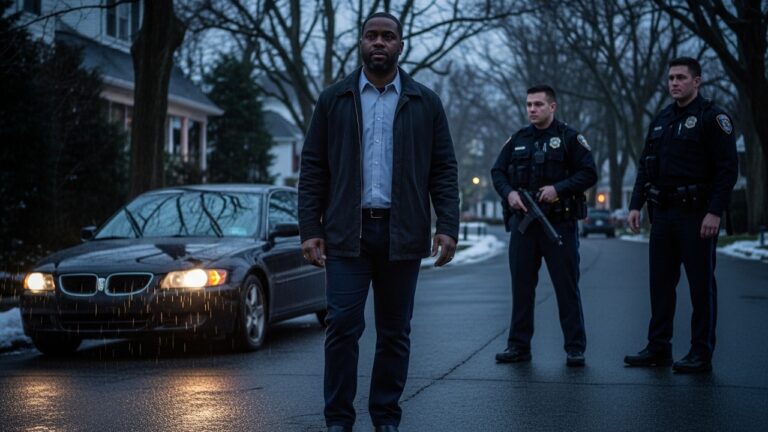
Leave a Reply