
“They Drew Their Guns On A Man Walking Alone At 2 AM… What He Pulled From His Coat Made Every Officer Freeze.”

Chapter 1
The freezing October rain felt like little needles against Marcus’s face, but he didn’t have the energy to pull his collar up.
He was forty-two years old, his lower back was screaming, and the soles of his worn-out New Balance sneakers were soaking wet.
Fourteen hours. That’s how long his shift at St. Jude’s Pediatric Ward had been.
Fourteen hours of monitoring IV drips, changing soiled sheets, and holding the tiny, fragile hands of children whose parents were too exhausted to stay awake.
All Marcus wanted was his bed. He wanted to unlock the door of his cramped apartment, heat up a bowl of leftover chili, and sleep until noon.
But his 1998 Honda Civic had other plans. The alternator had finally given out two miles down Route 9, leaving him stranded on the shoulder with a dead battery and a dead cell phone.
With no money for a late-night tow truck and no way to call a cab, he had done the only thing he could do. He started walking.
To shave a mile off the journey, Marcus took a shortcut through Oakridge Estates.
It was the kind of neighborhood where the driveways were longer than Marcus’s entire apartment building.
The lawns were manicured, the streetlights were designed to look like antique gas lamps, and the houses were massive, silent fortresses hidden behind wrought-iron gates.
Marcus knew the unspoken rules of America.
He knew that a six-foot-two Black man walking through a wealthy white neighborhood at 2:15 AM was a recipe for disaster.
His father had taught him those rules when he was just a teenager. Keep your hands out of your pockets. Don’t walk too fast, but don’t dawdle. Keep your head down, but don’t look suspicious. Smile, but not too much.
It was an exhausting tightrope to walk, but tonight, Marcus was too tired to care.
His legs throbbed with a dull, persistent ache. His scrubs, hidden beneath a cheap, oversized navy-blue parka, were damp with sweat and rain.
He kept his right hand buried deep in his coat pocket, his fingers tightly wrapped around a small, crinkled paper bag.
Inside the bag was a stuffed blue elephant.
It was a cheap little thing from the hospital gift shop, but he had bought it for Leo, a seven-year-old boy in Room 312 who was starting his second round of chemotherapy tomorrow morning.
Leo was terrified of the needles. Marcus had promised him he’d bring a “bravery buddy” for the procedure.
He was just thinking about Leo’s smile when the headlights hit him.
They didn’t just illuminate the street; they cut through the darkness like a physical blow.
The beam was painfully bright, casting a long, distorted shadow of Marcus against the wet pavement.
Then came the sound. The low, aggressive growl of a heavy engine accelerating, followed by the sharp chirp of a police siren.
Whoop-whoop.
Marcus’s heart slammed against his ribs.
The exhaustion that had been weighing him down vanished, instantly replaced by a cold, sharp spike of adrenaline.
He stopped walking. He didn’t turn around immediately. He just froze, his breath pluming in the icy air.
Don’t run. Don’t flinch. Make your movements slow. He recited the rules in his head, a desperate prayer against the rising panic.
Slowly, carefully, Marcus turned around.
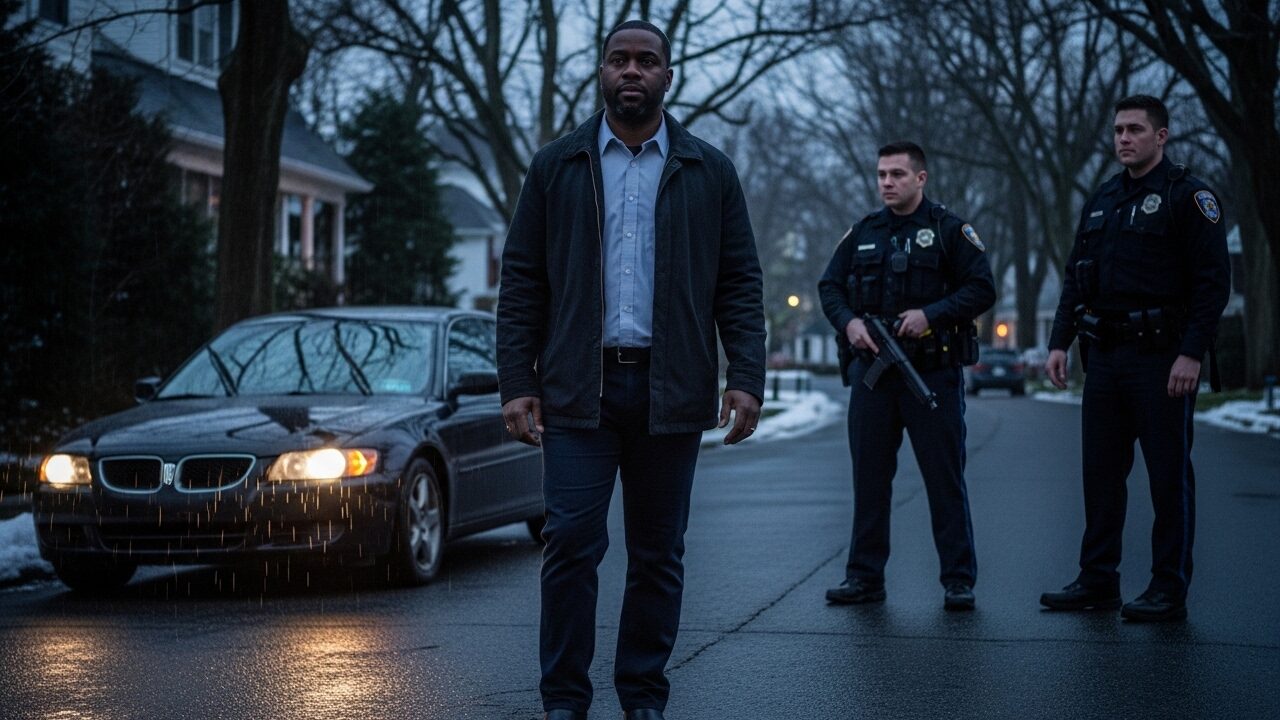
A Ford Explorer police cruiser was angled aggressively across the street, blocking his path. The blinding white spotlight was pinned directly on his chest.
Behind the glare, the red and blue lightbar erupted, painting the manicured lawns of Oakridge Estates in chaotic, flashing colors.
Both front doors of the cruiser swung open simultaneously.
“Hey! Stop right there! Do not move!”
The voice was young, strained, and vibrating with an unmistakable edge of panic.
Officer Dean Miller stepped out from behind the driver’s side door. He was twenty-eight years old, practically a kid, but the badge on his chest and the heavy leather duty belt around his waist gave him the authority of a god on this quiet street.
Miller’s hand was already resting heavily on the butt of his holstered Glock.
His knuckles were white. His jaw was clenched so tight it looked painful.
It had been a brutal month for the Oakridge precinct. Four high-end burglaries in the span of three weeks. The wealthy residents were screaming at the mayor, the mayor was screaming at the captain, and the pressure was rolling straight downhill onto the patrol officers.
Miller was a new father. He had a six-month-old daughter at home and a mortgage he could barely afford. The stress had been eating him alive, making him jumpy, hyper-vigilant, and prone to seeing threats where there were none.
Fifteen minutes ago, dispatch had relayed a 911 call from Eleanor Vance, a sixty-eight-year-old widow living on Elmwood Drive.
“There’s a man prowling around,” she had whispered into the phone, peeking through her heavy velvet curtains. “A large man. Dark clothes. He’s casing the houses. Please, hurry.”
She hadn’t seen him do anything illegal. She had just seen him existing. But in Oakridge, that was enough.
Now, Miller was staring down the barrel of his own anxiety, looking at the exact description that had crackled over the radio.
“I said do not move!” Miller shouted again, stepping out further from the protection of the car door. “Keep your hands where I can see them!”
From the passenger side, Officer Sarah Jenkins emerged.
Jenkins was forty-five, a twenty-year veteran of the force. She had bags under her eyes and a divorce lawyer who was draining her savings.
She was tired, but she wasn’t panicked. She read the scene differently than her young partner.
She saw a man in a wet coat, shivering in the rain. She didn’t see a crowbar. She didn’t see a bulging backpack full of stolen silver.
But Miller was already escalating, feeding off his own nervous energy.
“Dean, let’s just talk to him,” Jenkins murmured, keeping her voice low, trying to bring the temperature down.
Miller ignored her. The adrenaline was too loud in his ears.
“Take your right hand out of your pocket!” Miller commanded, his voice cracking slightly. “Do it now! Slowly!”
Marcus stood perfectly still. The rain was running down his forehead, stinging his eyes.
His right hand was still in his pocket. He was still clutching the paper bag with the stuffed elephant.
He knew how this looked. A Black man in a dark coat, standing in the rain at 2 AM, refusing to show his hands.
It was a scenario that played out on the evening news with tragic, repetitive predictability.
“Officer,” Marcus started, his voice remarkably calm despite the violent trembling in his chest. “My name is Marcus Hayes. I’m a nurse at St. Jude’s. My car broke down on—”
“I don’t care about your car!” Miller interrupted, taking a step forward. He unclasped the retention strap on his holster. The loud click echoed like a gunshot in the quiet street. “I said take your hand out of your pocket! If you don’t comply, I will draw my weapon!”
“Dean, back it up a step,” Jenkins said sharply, stepping around the front of the cruiser. “Sir, please just do as he asks. Take your hand out. Let’s make this easy.”
Marcus looked at Jenkins. He saw a flicker of reason in her eyes, a sharp contrast to the wild, terrified aggression in Miller’s.
But Marcus also knew that fear was dangerous. A frightened cop with a gun was the most unpredictable force on earth.
If he pulled his hand out too fast, Miller might think he was drawing a weapon.
If he kept it in, they would eventually tackle him, tase him, or worse.
“I have a paper bag in my pocket,” Marcus said, speaking slowly, enunciating every single syllable as if he were talking to a frightened child. “It is a toy for a patient. I am going to pull it out now. I am moving very slowly.”
“Don’t pull anything out!” Miller yelled, completely contradicting his earlier order. The contradictory commands were a classic symptom of a panicked officer. “Keep your hands where they are! Get on the ground! Face down on the wet pavement, right now!”
Marcus closed his eyes for a split second. The indignity of it washed over him, a bitter, familiar taste.
He was a man who spent his life saving children. He paid his taxes. He had never had a parking ticket.
Yet here he was, about to be forced face-down into the freezing mud of a rich stranger’s driveway because he dared to walk home.
He thought of his own son, Julian.
Julian had died when he was sixteen. Not from sickness, but from a stray bullet in a neighborhood nothing like this one.
Marcus had spent the last decade trying to heal the world to make up for the fact that he couldn’t heal his own boy.
He was so, so tired.
“I am not getting on the ground,” Marcus said. His voice wasn’t aggressive, but it was anchored with a heavy, unmovable dignity.
Miller’s gun cleared the holster.
He didn’t aim it directly at Marcus, keeping it pointed at a low ready angle, but the threat was absolute.
“Get on the ground!” Miller screamed, his voice echoing off the brick facades of the silent mansions. “Last warning!”
Suddenly, the wail of a second siren pierced the night.
A second cruiser came sliding around the corner of Elmwood Drive, tires screeching on the wet asphalt.
Backup had arrived.
The new cruiser slammed to a halt behind the first, boxing Marcus in. Two more officers jumped out, instantly feeding off the high-stress environment Miller had created.
Four cops. Four sets of eyes. Flashlights blinding him from every angle.
The air was electric. One sudden sneeze, one slip on the wet pavement, and Marcus knew he would be dead.
“Hands in the air! Do it now!” one of the new arrivals barked.
Marcus knew he had run out of time to negotiate. The situation had spiraled beyond reason.
He took a slow, deep breath, letting the freezing rain fill his lungs.
“I am taking my hands out,” Marcus said, his voice carrying over the chaos. “I am holding a bag.”
“Shoot him if he pulls something!” someone yelled.
Slowly, deliberately, moving at a glacial pace, Marcus withdrew his right hand from the deep pocket of his parka.
Every officer tensed. Miller raised his weapon slightly, his finger hovering dangerously close to the trigger guard.
Jenkins held her breath.
Marcus brought his hand into the harsh glare of the spotlight.
His fingers were open, clearly displaying the small, crumpled paper bag from the hospital gift shop.
The officers froze. The aggressive shouting abruptly ceased, leaving only the sound of the idling engines and the patter of the rain.
But Marcus wasn’t done.
With his left hand, he slowly reached up to the collar of his parka and unzipped it halfway.
He pulled the heavy fabric aside, exposing what he was wearing underneath.
The blinding police lights illuminated the bright, unmistakable pastel patterns of his hospital scrubs. Pinned directly to his chest, glowing in the beam of the flashlight, was his laminated St. Jude’s Medical Center ID badge.
The silence that fell over the street was heavier than the rain.
Miller stared at the scrubs, then at the ID badge, and finally at the paper bag in Marcus’s hand. The young officer’s face went completely pale, the color draining out of him as the terrifying reality of what he had almost done crashed into his chest.
Chapter 2
The rain didn’t stop, but the world had gone entirely still.
For five agonizing seconds, the only sound on Elmwood Drive was the heavy, rhythmic thwack-thwack-thwack of the Ford Explorer’s windshield wipers and the harsh, ragged breathing of Officer Dean Miller.
Miller’s service weapon, a matte-black Glock 17, was still unholstered, but the barrel had dipped dangerously toward the wet pavement. His arms felt like lead. The blood was roaring in his ears, a deafening waterfall of pure, unfiltered panic. He stared at the laminated plastic rectangle pinned to Marcus’s chest. The harsh glare of the cruiser’s spotlight caught the glossy surface of the ID badge, illuminating the smiling face of a younger Marcus, the bold blue letters of St. Jude’s Medical Center, and the unmistakable word printed in bold red: RN.
Then, Miller’s eyes tracked down to the crinkled paper bag in Marcus’s right hand.
It wasn’t a weapon. It wasn’t stolen jewelry from the Vance estate. It wasn’t a crowbar.
It was a small, plush blue trunk poking out of a brown paper sack. An elephant. A toy for a sick child.
“Oh, God,” Miller whispered. The words barely made it past his lips, swallowed instantly by the cold October wind. He stumbled backward, his tactical boots slipping slightly on the wet asphalt. He looked at his own hands, realizing his finger was still resting just outside the trigger guard. His entire body began to violently tremble.
Officer Sarah Jenkins moved with the swift, practiced efficiency of a twenty-year veteran who had just watched a disaster narrowly avoid becoming a tragedy. She closed the distance between herself and her partner in three long strides. She didn’t yell. She didn’t panic. She simply reached out, placed a firm, heavy hand over Miller’s, and physically forced the weapon downward.
“Holster it, Dean,” Jenkins ordered. Her voice was terrifyingly calm, a razor-sharp whisper meant only for him. “Holster your weapon right now.”
Miller couldn’t seem to process the command. He was staring at Marcus, his face pale as a sheet of ice, his pupils dilated wide with shock. He was a twenty-eight-year-old kid with a newborn at home, suddenly confronting the reality that he was a hair’s breadth away from taking an innocent man’s life. He had been so sure. The dispatcher had said a prowler. The neighborhood was on edge. The man had his hands hidden. It was textbook.
Except the textbook didn’t account for a pediatric nurse whose car had died on a Tuesday morning.
“Dean!” Jenkins snapped, her fingers digging painfully into his wrist. “Put the gun away. Now.”
With a jerky, mechanical motion, Miller shoved the Glock back into its Kydex holster. The metallic click of the retention strap snapping into place echoed like a gunshot. As soon as the weapon was secured, the remaining adrenaline drained from Miller’s body all at once. His knees buckled slightly, and he had to lean heavily against the hood of the cruiser to keep from collapsing. He turned his head away, gagging as a wave of intense nausea hit him.
Behind them, the two backup officers who had arrived moments before were frozen in their tracks, their flashlights crisscrossing the wet street. They had exited their vehicle ready for a firefight, hyped up on the radio chatter. Now, they were staring at a middle-aged Black man in floral scrubs holding a stuffed animal.
“Stand down,” Jenkins called out to them, waving a hand in the air. “Scene is secure. It’s a misunderstanding. Stand down.”
The tension in the air shattered like glass. The backup cops awkwardly lowered their flashlights, suddenly looking very interested in the toes of their boots. The red and blue lights of the cruisers continued to spin, painting the immaculate, wealthy neighborhood in a chaotic disco of emergency colors, but the absolute silence of the suburban street had returned.
Marcus hadn’t moved.
His hand was still suspended in the air, holding the paper bag. His coat was still unzipped, exposing his scrubs to the freezing, driving rain. The cold was seeping into his bones, but he couldn’t feel it. What he felt was a deep, hollow crater opening up inside his chest.
It was a feeling he knew intimately. It was the feeling of powerlessness.
He was a forty-two-year-old man. He paid taxes. He saved lives. He had spent fourteen hours today performing chest compressions on a toddler, comforting a grieving mother, and calculating complex medication dosages. He was a professional. He was a human being.
But for the last three minutes, none of that had mattered. He had been reduced to a threat. A shadow. A monster in the dark.
“Sir,” Jenkins said, her voice softening as she turned her attention back to Marcus. She took a step forward, her hands visible and empty, palms facing outward in a universal gesture of peace. “Sir, you can put your hands down. I am so sorry. You can zip your coat up.”
Slowly, Marcus lowered his arm. His joints ached. His fingers, numb from the cold, fumbled clumsily with the zipper of his parka until he managed to pull it up to his chin. He clutched the paper bag tightly against his side, a small anchor in a reality that had just spun violently out of control.
“My car,” Marcus said. His voice sounded strange to his own ears—raspy, dry, and hollow. “My alternator died on Route 9. I didn’t have money for a tow. I was just walking home to the East Side.”
“I know,” Jenkins said softly. She stepped closer, stepping into the pool of light illuminating Marcus. For the first time, she really looked at him. She saw the deep, purple bags under his eyes. She saw the gray hair dusting his temples. She saw the profound, bone-deep exhaustion radiating from him. “I know. It’s okay. You’re okay.”
“Is there a problem out here?”
A booming, authoritative voice cut through the rain. A third police vehicle—an unmarked black Dodge Charger—had pulled up behind the backup cruiser. The heavy door swung open, and Sergeant Tom Brody stepped out.
Brody was a massive man in his late fifties, built like a brick wall with a thick, silver mustache that hid his upper lip. He was a relic of an older era of policing, the kind of supervisor who protected his patrolmen with the ferocity of a mother bear, often to a fault. He had heard the frantic radio traffic and had raced over from a neighboring precinct.
He marched toward the center of the street, ignoring the rain, his eyes scanning the scene. He saw Miller pale and trembling against the cruiser. He saw Jenkins looking defeated. And he saw Marcus.
“What’s the situation, Jenkins?” Brody demanded, stopping a few feet away. His eyes narrowed as he looked Marcus up and down. He didn’t see a nurse. He saw a liability.
“It’s a misunderstanding, Sarge,” Jenkins said quickly, stepping slightly between Brody and Marcus. “This is Mr. Hayes. He’s a nurse at St. Jude’s. His car broke down on the highway. He was just walking home.”
Brody frowned, his thick eyebrows pulling together. He looked at Miller, who was refusing to make eye contact with anyone. Then he looked back at Marcus.
“Walking home,” Brody repeated, his tone skeptical. “At two-thirty in the morning. Through Oakridge.”
“Yes,” Marcus said. He didn’t raise his voice, but the single word carried a heavy, unyielding weight. He met Brody’s gaze and held it. He was done being afraid. The adrenaline had burned away, leaving behind a cold, hard anger. “It is a public street, is it not, officer?”
Brody’s jaw tightened. He didn’t like the tone. He didn’t like civilians who didn’t shrink under his stare.
“We got a 911 call from a resident,” Brody said, his voice dropping into a low, defensive growl. “Report of a prowler matching your exact description. Large male, dark clothing, casing the neighborhood. We’ve had a string of B&Es here this month. My officers were doing their job. They responded to a threat.”
“A threat,” Marcus repeated flatly. He held up the crumpled paper bag. “I am holding a stuffed elephant, Sergeant. Your officer over there,” he gestured slightly toward Miller, “was screaming contradictory orders at me with his weapon drawn. If I had flinched, if I had slipped on this wet asphalt, he would have put a hollow-point bullet through my chest. Is that what you consider doing your job?”
The silence that followed was suffocating. The backup officers shuffled uncomfortably. Jenkins closed her eyes for a brief second, wishing she could vanish.
Brody took a half-step forward, his chest puffing out instinctively. “Listen here, pal—”
“No, you listen to me,” Marcus interrupted, his voice finally rising, echoing off the expensive brick facades of the surrounding mansions. “I have spent the last fourteen hours watching children fight for their lives. I have held parents while they cried. I am tired. I am freezing. And I am walking home because I cannot afford a hundred-dollar tow truck. I did not break a single law. I did not threaten anyone. But because a paranoid woman looked out her window and saw a Black man walking in her neighborhood, I almost didn’t make it home tonight.”
Marcus paused, his chest heaving. The rain plastered his hair to his forehead.
“So don’t tell me about your burglaries,” Marcus said, his voice dropping back to a lethal whisper. “And don’t try to justify what just happened here. You and I both know the truth.”
Brody stared at Marcus, his face flushed red beneath his tan. He opened his mouth to argue, to assert his authority, to defend the badge. But he looked at the ID clipped to Marcus’s chest. He looked at the paper bag. He looked at Miller, who looked like he was about to pass out.
Brody swallowed hard. The fight drained out of him. He knew a losing battle when he saw one. More importantly, he knew a massive lawsuit when he saw one.
“Run his ID,” Brody muttered to Jenkins, refusing to look at Marcus anymore. “If he’s clean, give him a ride home. Let’s clear this circus out.”
Brody turned on his heel and marched back to his unmarked Charger. The backup officers quickly followed suit, practically sprinting to their cruiser to escape the radioactive tension of the scene.
Jenkins let out a long, shuddering breath. She looked at Marcus, her eyes filled with a profound, weary sadness.
“I don’t need to run your ID, Mr. Hayes,” she said softly. “Come on. Get in the front seat. I’ll take you home.”
Marcus didn’t argue. His legs were shaking so badly he wasn’t sure he could walk another block anyway.
He walked around the front of the Ford Explorer, the headlights washing over him. Miller was still leaning against the driver’s side door. As Marcus passed him, the young officer finally looked up.
Miller’s eyes were red-rimmed and wet. He looked like a terrified child who had just broken something irreplaceable.
“I… I’m sorry,” Miller choked out, his voice barely audible over the rain. “I’m so sorry, man. I thought… I don’t know what I thought. I have a baby girl at home, and I was just…”
He trailed off, unable to finish the sentence. The apology hung in the air, pathetic and inadequate.
Marcus stopped. He looked at the young cop. He saw the genuine terror, the shame, the profound realization of a near-fatal mistake. A part of Marcus wanted to scream at him. He wanted to rage against the systemic fear that had put a gun in this boy’s trembling hand. He wanted to tell him that his baby girl didn’t excuse almost taking someone else’s father away.
But Marcus was just so incredibly tired.
“Do better,” Marcus said quietly. It wasn’t forgiveness, but it wasn’t a curse, either. It was a command.
He opened the passenger side door of the cruiser and slid into the front seat.
The interior of the police SUV smelled like stale black coffee, wet wool, and cheap vanilla air freshener. The heater was blasting, but Marcus couldn’t stop shivering. His clothes were soaked through, sticking uncomfortably to his skin.
Jenkins slid into the driver’s seat and slammed the door, shutting out the storm. She didn’t turn the sirens back on, but she kept the flashing lights rolling as she shifted into drive and slowly pulled away from the curb, leaving the pristine lawns of Elmwood Drive behind them.
For the first ten minutes, neither of them spoke. The rhythmic thumping of the wipers was the only sound. Jenkins drove carefully, her eyes fixed straight ahead.
“St. Jude’s,” Jenkins finally said, breaking the heavy silence. Her voice was conversational, forced but gentle, trying to build a bridge over the chasm that had just opened up in the street. “That’s a tough place to work.”
“It has its days,” Marcus replied, staring out the passenger window at the passing city lights. The transition from the wealthy suburbs back to the gritty, neon-lit reality of the city was jarring.
“My sister’s kid was there,” Jenkins continued, her grip tightening slightly on the steering wheel. “A few years ago. Leukemia. He was there for eight months.”
Marcus turned his head slightly to look at her. “Did he make it?”
Jenkins offered a small, sad smile. “Yeah. He did. He’s twelve now. Plays soccer. You guys… the nurses there… you kept our family from falling apart. I mean that. You’re angels.”
“We’re just people,” Marcus said, resting his head back against the hard plastic headrest. “We just try to fix what’s broken.”
“You were holding a toy,” Jenkins said softly, glancing over at the wet paper bag sitting on Marcus’s lap. “For a patient?”
Marcus looked down at the bag. He carefully pulled the edges apart, revealing the soft blue fabric of the elephant.
“His name is Leo,” Marcus said, a faint, genuine smile touching his lips for the first time all night. “He’s seven. He starts his second round of chemo tomorrow. Well, today, I guess. He’s terrified of the IVs. I told him I’d find him a bravery buddy. Someone to sit on his chest while they do the port access.”
Jenkins swallowed hard, her throat clicking audibly in the quiet cab. “You were walking through a storm at two in the morning to bring a kid a stuffed elephant.”
“I was walking home,” Marcus corrected gently. “The elephant just happened to be with me.”
They fell quiet again. Jenkins navigated the cruiser through the increasingly familiar streets of the East Side. The manicured lawns and gas lamps faded away, replaced by cracked sidewalks, flickering amber streetlights, and iron bars on convenience store windows.
This was Marcus’s world. It wasn’t pretty, and it wasn’t wealthy, but it didn’t look at him like he was a monster.
“Miller…” Jenkins started, hesitating, as if she was afraid to say the name. “Dean isn’t a bad kid, Mr. Hayes. He really isn’t. He’s just… he’s drowning right now. The pressure from the brass, the new baby, the lack of sleep. He got tunnel vision tonight. He saw what the radio told him to see.”
“Tunnel vision kills people, Officer Jenkins,” Marcus said quietly. He didn’t say it with malice; he stated it as an empirical medical fact. “If you administer the wrong medication because you’re stressed, a patient dies. If you pull a trigger because you’re scared, someone dies. Stress is not an excuse for a lethal mistake.”
“I know,” Jenkins whispered. “Believe me, I know. I’m going to report this. Everything that happened. I’m taking him off patrol until he gets his head right. I promise you that.”
Marcus didn’t respond. Promises from the police didn’t hold much currency in his neighborhood.
“Take the next left,” Marcus instructed, pointing toward a row of dilapidated brick apartment buildings. “It’s the third building on the right. Number 402.”
Jenkins pulled the heavy SUV up to the curb, shifting into park. The engine idled loudly. The neighborhood was silent, asleep under the relentless rain.
She turned in her seat to face him. She looked older than her forty-five years. The job was eating her alive, same as it was eating Miller, just in a different way.
“Mr. Hayes,” she said, her voice thick with emotion. She reached into her breast pocket and pulled out a plain white business card, offering it to him. “This is my personal cell. If… if you need anything. If you want to file a formal complaint, I will stand with you. I will testify to exactly what happened. I am so deeply sorry for what my partner put you through tonight.”
Marcus looked at the card, then at her hand. He slowly reached out and took it, slipping it into his damp pocket.
“Thank you for the ride, Officer Jenkins,” he said. He opened the door, letting the cold air rush back in.
“Will you be okay?” she asked, her concern genuine.
Marcus paused with one foot on the pavement. He looked back at her. “I have a shift in ten hours. I’ll be fine.”
He shut the door and walked away, not looking back as the police cruiser finally pulled away from the curb and disappeared down the dark street.
The lock on Marcus’s apartment door was tricky. You had to jiggle the key just right, pull the handle up, and push with your shoulder all at the same time. Most days, it was an annoyance. Tonight, with his hands shaking and his muscles locking up from the cold, it felt like an insurmountable obstacle.
After a minute of frustrated struggling, the lock clicked, and the heavy wooden door swung open.
He stepped inside, locking the deadbolt behind him.
The apartment was small, cramped, and smelled faintly of bleach and old cooking grease. The furniture was thrift store mismatched, and the carpet was a faded, depressing brown. But it was warm. And it was safe.
Marcus dropped his keys onto the small table by the door. He didn’t turn on the overhead lights, navigating by the pale orange glow of the streetlamp filtering through the blinds.
He took off his soaking wet parka, letting it drop to the linoleum floor of the kitchen with a heavy, sodden slap. He stood there for a moment in his damp scrubs, the silence of the empty apartment ringing in his ears.
He walked into the tiny galley kitchen and set the paper bag on the counter. He carefully pulled the blue elephant out, smoothing its damp fur. He set it upright next to the toaster, making sure it looked presentable for Leo.
Then, he walked into the narrow hallway that led to his bedroom.
There was a small console table in the hallway, acting as a makeshift shrine. A single, battery-operated candle flickered constantly in the center. Next to it was a worn leather baseball glove, a tarnished silver medal from a middle school track meet, and a framed 8×10 photograph.
Marcus stopped in front of the table. He leaned his hands heavily on the edge, his head dropping forward.
The photograph was of a young boy, maybe sixteen years old. He had Marcus’s eyes and a bright, infectious smile that seemed to leap out of the frame. He was wearing a basketball jersey, holding a trophy, looking like he had the whole world figured out.
Julian.
“Hey, Juju,” Marcus whispered to the empty hallway. His voice finally broke, a jagged crack splitting through his stoic facade.
It had been ten years. Ten years since the phone call in the middle of the night. Ten years since he arrived at the trauma center—his own hospital—only to be met by a solemn surgeon shaking his head.
Julian had been at a block party. A fight broke out. Someone pulled a gun. The bullets didn’t have names on them, but one of them had found Julian’s chest.
He was just a kid. A good kid who made honor roll and helped old ladies carry their groceries. But to the world that took him, he was just collateral damage. Another statistic in a neighborhood that America had forgotten.
Marcus stared at the photograph, his vision blurring as hot, thick tears finally began to fall. They slid down his cheeks, mixing with the rainwater still clinging to his face.
He hadn’t cried when Miller pulled the gun. He hadn’t cried when Brody tried to justify it. He had stayed strong because he had to. Because the world demanded it of him.
But here, in the dark, in front of his son, the dam broke.
The terror of the night finally caught up to him. He sank to his knees on the cheap carpet, his chest heaving with silent, racking sobs. He curled in on himself, burying his face in his hands.
He cried for the indignity of it all. He cried for the sheer exhaustion of having to prove his humanity every time he walked out his front door. He cried because he had almost died on a wet street for holding a toy, and if he had, he would have just been another hashtag. Another news cycle. Another tragedy quickly forgotten by a world that refused to change.
Most of all, he cried because he missed his boy with a physical agony that never, ever went away.
“I’m still here,” Marcus choked out, his forehead resting against the edge of the console table. “I’m still trying, Julian. I swear I’m trying.”
He stayed on the floor for a long time, letting the pain wash over him, letting the adrenaline metabolize and burn out.
Eventually, the tears stopped. The shivering subsided.
Marcus slowly pushed himself up from the floor. His joints popped, and his back screamed in protest, but he stood tall. He reached out and gently wiped a speck of dust off the glass of Julian’s photograph.
He went into the bathroom, stripped off his wet scrubs, and stood under the shower until the hot water ran completely cold. He put on a worn-out t-shirt and a pair of sweatpants, crawled into his unmade bed, and stared at the ceiling.
He had to be back at the hospital in nine hours. Leo was waiting. The other kids were waiting.
He closed his eyes, willing himself to sleep.
He thought the nightmare of the night was over. He thought it would be just another quiet trauma to swallow down and carry with him.
He didn’t know that three miles away, a teenager with insomnia had just changed everything.
Chloe Adams was seventeen years old, and she hated living in Oakridge Estates.
She hated the suffocating perfection of the lawns. She hated the gossip at the country club. She hated how everyone smiled to your face and judged you the second you turned around.
Most of all, she hated her insomnia.
It was 2:15 AM, and Chloe was sitting cross-legged on the window seat of her second-story bedroom, wrapped in a fluffy blanket, staring out at the rain. She lived directly across the street from Mrs. Vance, the neighborhood’s self-appointed, curtain-twitching watchdog.
Chloe had her phone in her hand, mindlessly scrolling through TikTok, when the first police cruiser came screaming down Elmwood Drive and slammed on its brakes.
She jumped, nearly dropping her phone. She peered through the glass, her breath fogging the pane.
She saw the man in the dark coat. She saw the cop jump out, weapon drawn.
Without thinking, driven by a generation’s instinct to document the unimaginable, Chloe opened her camera app and hit record.
She pressed her phone against the cold glass to steady it, zooming in slightly. The streetlights and the flashing police bar provided enough illumination for the latest iPhone camera to pick up the scene with terrifying clarity.
She recorded the screaming. She recorded the second cruiser arriving. She recorded the agonizing standoff.
Her heart pounded in her throat. She thought she was about to watch a man die on her street. She held her breath as the man slowly unzipped his coat.
Through the lens of her camera, Chloe zoomed in as the man pulled out the paper bag. And then, she saw the bright blue scrubs. She saw the ID badge catching the light.
Even from her window, she could read the large red letters. RN.
She stopped recording when the sergeant showed up, her hands shaking so badly she almost dropped the phone.
Chloe sat in the dark for a long time, the video looping silently on her screen. She watched the cop pull a gun on a man who was just trying to walk home. She watched the man reveal he was a nurse.
She felt sick to her stomach. She thought about her dad, who was asleep down the hall. Her dad was a lawyer. If he had been walking down the street in a suit, this never would have happened. She knew it. The whole world knew it.
Oakridge wanted to pretend it was a safe haven, a bubble of perfection.
Chloe looked at the video. She looked at the timestamp.
She opened the Twitter app. She created a new post, attached the two-minute video, and stared at the blank text box.
Her fingers flew across the keyboard.
“I just watched Oakridge PD pull guns on a Black man walking home in the rain. He didn’t have a weapon. He was wearing hospital scrubs. He was a nurse holding a stuffed animal. They almost killed him for walking in our neighborhood.”
She tagged the local news stations. She tagged the Oakridge Police Department. She added the hashtags #OakridgePD #Profiled #DoBetter.
Chloe hovered her thumb over the ‘Post’ button. If her parents found out, they would kill her. The neighborhood association would lose its mind.
She looked back at the video. She saw the dignified, exhausted face of the nurse standing in the rain.
Chloe pressed ‘Post’.
She locked her phone, tossed it onto her bed, and pulled her blanket tighter around her shoulders.
It was 3:00 AM.
By the time Marcus Hayes woke up for his shift at 9:00 AM, the video had fifty thousand views.
By noon, it would have three million.
Chapter 3
The drive from the Oak Creek convenience store to the quiet, tree-lined cul-de-sac where Marcus Vance lived usually took exactly twelve minutes. Tonight, it felt like a lifetime.
Marcus navigated the battered 2012 Ford F-150 through the winding suburban streets on pure muscle memory. The halogen streetlights flickered rhythmically through the windshield, casting long, sweeping shadows across his exhausted face. The heavy thrum of the engine, usually a comforting, familiar sound, now felt distant and muffled, drowned out by the deafening roar of his own racing thoughts.
He had survived. He was free. He was driving home to his family. But the ghost of the cold steel handcuffs still lingered on his wrists, a phantom ache that pulsed in time with his heartbeat.
He glanced over at the passenger seat. The small, plastic clamshell container holding the pink birthday cake sat there, perfectly intact. The sugar-icing bunny stared blankly up at the dome light. It was such a small, trivial object. A twenty-two-dollar piece of baked sugar. Yet, for ten agonizing minutes in that store, it had been the centerpiece of a nightmare that threatened to strip him of his freedom, his dignity, and his future.
Marcus gripped the steering wheel tighter, his knuckles turning ash-gray under the tension. The adrenaline that had kept him hyper-focused during the confrontation with the knife-wielding attacker, and then remarkably calm during his subsequent wrongful arrest, was finally beginning to evaporate. In its place, a profound, bone-deep physical crash was setting in. His broad shoulders sagged. His jaw, clenched so tight for so long that his teeth ached, finally relaxed into a tremor.
He turned his truck onto Elm Street, the tires crunching softly over scattered autumn leaves. The neighborhood was an idyllic portrait of middle-class American success. Two-story colonial homes, manicured lawns, two cars in every driveway, and neighborhood watch signs posted on the corner streetlamps.
Marcus and his wife, Sarah, had sacrificed everything to buy a home here three years ago. They had emptied their savings, picked up brutal overtime shifts, and navigated a labyrinth of mortgage approvals just to give their daughter, Maya, a chance at the local blue-ribbon elementary school. They wanted her to grow up riding her bike on pavement, not looking over her shoulder. They wanted her to have a front yard with a sprinkler in the summer and a safe sidewalk for Halloween.
But as Marcus pulled his truck into the driveway of his own home, staring at the warm, yellow light spilling from the living room windows, a dark, suffocating thought crept into his mind.
Does this house even matter? he thought, putting the truck in park and cutting the engine. I can buy the house. I can pay the taxes. I can work fourteen hours a day. But the second I walk into a store in this town, I’m still just a suspect. I’m still just a threat.
He sat in the dark cab of the truck for a long time, the silence of the driveway pressing against the glass. He closed his eyes and took a deep, shuddering breath. He needed to compartmentalize. He needed to take the trauma, the humiliation, and the simmering rage, fold it up into a tiny, invisible box, and bury it deep inside his chest. He couldn’t walk through that front door carrying the heavy, ugly weight of Arthur Pendelton’s racism. Maya was waiting. It was her seventh birthday. She deserved her father, not a victim.
Marcus rubbed his face vigorously with both hands, trying to scrub away the exhaustion. He carefully pulled down the cuffs of his heavy, grease-stained work jacket, ensuring the angry red indentations on his wrists were completely hidden from view. He grabbed the pink cake from the passenger seat, stepped out into the cool night air, and walked up the front steps.
Before he could even put his key in the lock, the front door flew open.
“Daddy!”
Maya practically launched herself off the welcome mat, colliding with Marcus’s legs like a tiny, enthusiastic missile. She was wearing a sparkling purple princess dress over her pajamas, her hair braided perfectly, her dark eyes wide with pure, unfiltered joy.
Marcus felt the tight, agonizing knot in his chest instantly loosen. He dropped to one knee, ignoring the sharp protest of his overworked joints, and wrapped his massive arms around his daughter. He buried his face in her hair, breathing in the scent of strawberry shampoo. For a fleeting second, his eyes burned with unshed tears. I almost didn’t make it to you, he thought, pulling her tighter. They almost took me away from you.
“Happy birthday, baby girl,” Marcus whispered, his voice thick but steady. He pulled back, giving her a huge, forced smile. “I’m sorry I’m late. The freight yard was a mess today.”
“You got the cake!” Maya squealed, pointing at the plastic container in his hand. She didn’t care that he was late. She didn’t care that his work boots were muddy. He was home, and he had brought the promised treasure.
“Of course I did. I wouldn’t forget my princess’s birthday cake,” Marcus said, standing up and letting her drag him into the house by his free hand.
The warmth of the house washed over him. The smell of roasted chicken and garlic filled the air. Standing in the archway leading to the kitchen was Sarah.
Sarah was a registered nurse at Oak Creek Memorial Hospital, a woman whose profound empathy was matched only by her fierce, unwavering strength. She was wearing her favorite oversized college sweatshirt and soft sweatpants, a rare night off for her. When she looked at Marcus, her smile was warm, but her dark, intelligent eyes immediately began scanning him.
After twelve years of marriage, Sarah knew Marcus better than she knew herself. She knew the difference between the tired slump of his shoulders after a hard day of physical labor, and the tense, rigid posture of a man carrying a heavy emotional burden. She saw the slight tremor in his hands as he set the cake down on the entryway table. She saw the way his eyes avoided hers, darting quickly to the floor before looking at Maya.
“Hey,” Sarah said softly, walking over to him. She wrapped her arms around his waist and rested her head against his chest.
“Hey,” Marcus murmured, kissing the top of her head. He kept his hands resting lightly on her back, terrified that if she squeezed his arms, she would feel the tender, bruised skin beneath the heavy fabric of his jacket.
“Rough day?” she asked, leaning back to look at his face. Her brow furrowed slightly. “You look… Marcus, you look pale. Are you feeling okay?”
“Just tired, Sar,” he lied smoothly, flashing a reassuring smile that didn’t quite reach his eyes. “We had two shipments of industrial piping come in late. Had to unload it all manually because the forklift blew a hydraulic line. I’m just beat.”
Sarah studied him for a second longer, her intuition humming like a live wire. But before she could press the issue, Maya was tugging at her mother’s sweatpants.
“Mommy! Can we do the candles now? Please? Daddy’s home!”
Sarah’s gaze softened. She looked from Marcus to her bouncing daughter. “Alright, alright. Let’s get the cake into the kitchen. Go sit at your spot, birthday girl.”
Maya cheered and sprinted toward the dining room.
The next twenty minutes were a masterclass in emotional compartmentalization. Marcus washed his hands in the kitchen sink, letting the warm water run over his wrists, wincing silently as the soap stung the abrasions left by the handcuffs. He dried his hands, pulled his sleeves firmly back down, and joined his family at the table.
Sarah turned off the overhead lights. She walked into the dining room carrying the pink cake, seven small, flickering candles casting a warm, golden glow across the room. She began to sing. Marcus joined in, his deep baritone harmonizing with Sarah’s softer voice.
He looked at Maya, her face illuminated by the candlelight, her eyes squeezed shut as she made a wish. It was a picture-perfect suburban moment. It was everything he had ever worked for. But as he sat there, clapping his hands and smiling, Marcus felt entirely detached from his own body.
His mind kept pulling him back to the fluorescent glare of the convenience store. He kept seeing Arthur Pendelton’s furious, mottled red face. He kept hearing the sharp, metallic clink of Officer Miller pulling the cuffs from his belt. He kept feeling the terrifying, helpless realization that all his hard work, all his character, all his absolute innocence meant absolutely nothing in the face of a white man’s sudden, irrational fear.
“Daddy, you’re not eating your piece,” Maya said, her mouth full of pink frosting, pointing her fork at his plate.
Marcus blinked, snapping back to reality. He looked down at the slice of cake in front of him. It looked like sawdust. “Sorry, baby. I’m just saving the best for last,” he forced out, picking up his fork and taking a mechanical bite. It tasted like ash.
By nine o’clock, the sugar crash had taken hold, and Maya was sound asleep in her bed, clutching a new stuffed animal Sarah had bought her.
Marcus stood in the doorway of his daughter’s room, watching the slow, rhythmic rise and fall of her chest under the blankets. He stood there in the dark for a long time, the heavy silence of the house finally catching up to him. The invisible box inside his chest, where he had shoved the trauma of the evening, was beginning to crack.
“Marcus.”
He turned. Sarah was standing in the hallway, illuminated by the dim light of a nearby lamp. Her arms were crossed over her chest. The gentle, celebratory mother from the dining room was gone. The fierce, perceptive wife remained.
“Maya is asleep,” Sarah said quietly, her voice brooking no argument. “Now. Come to the kitchen. You’re going to tell me what actually happened.”
Marcus swallowed hard. He knew he couldn’t hide it from her forever, but he dreaded speaking the words out loud. Speaking it made it real. Speaking it brought the humiliation into their sanctuary.
He followed her into the kitchen. Sarah poured him a glass of water and set it on the island counter. She didn’t sit down. She stood across from him, waiting.
Marcus stared at the glass of water. He took a slow breath, reached up, and unzipped his heavy work jacket. He slipped it off his broad shoulders and draped it over the back of a barstool. He was wearing a short-sleeved gray t-shirt underneath.
He didn’t say a word. He just slowly lifted his arms and placed his hands flat on the cool granite countertop.
The kitchen lights were bright. There was nowhere to hide.
Sarah’s eyes immediately dropped to his wrists.
The skin was deeply indented, angry red and bruised purple in a perfect, horizontal ring around both of his thick forearms. In some places, the metal had rubbed the skin raw, leaving tiny, bright red abrasions.
Sarah stopped breathing. The color completely drained from her face. She took a slow, unsteady step forward, her eyes locked on his wrists as if she were looking at a gaping gunshot wound.
“Oh my god,” she whispered. Her hands flew up to cover her mouth. “Marcus… Marcus, what is that? What happened to you?”
“I was arrested, Sarah,” Marcus said. His voice was incredibly quiet. It sounded hollow, entirely devoid of emotion, a defense mechanism against completely breaking down. “On the way home. At the Oak Creek convenience store down on Route 95.”
Sarah grabbed his left hand, her fingers gently tracing the angry red line on his wrist. Her hands were shaking violently. “Arrested? For what? Marcus, you were just buying a cake… you were just…”
“The store was held up,” Marcus interrupted softly, not looking at her. He kept his eyes fixed on a scratch in the granite counter. “A guy walked in while I was paying. White guy. Green jacket. He pulled a six-inch hunting knife on the cashier. Pinned her against the register.”
Sarah gasped, her grip on his hand tightening. “Did he hurt you? Did he cut you?”
“No. He didn’t see me coming,” Marcus explained, his voice monotonous, recounting the events like a detached observer giving a police report. “I grabbed his arm. Twisted the knife out of his hand. I threw him into a display case. He dropped the money he was trying to steal from the till, and he ran out the door. The cashier… Chloe… she was crying. She was terrified.”
Sarah let out a breath she didn’t realize she was holding. She looked at him with a mixture of profound relief and immense pride. “You fought off an armed robber? Marcus, you could have been killed. But… but you saved her. You saved that girl.”
“I did,” Marcus agreed. He finally looked up from the counter, meeting his wife’s eyes. His gaze was incredibly sad. “And then I picked up the money the guy dropped on the floor, and I put it back in the open cash register.”
Sarah frowned, confused. “Okay. And then what? When did the police get there?”
“The store manager, Arthur Pendelton, was in the back. He didn’t see the guy with the knife. He didn’t see the fight,” Marcus said, the words tasting like poison in his mouth. “He walked out right as I was putting the money back into the till. He looked at me, he looked at his terrified cashier, and he immediately called the police and told them I was robbing his store.”
The realization hit Sarah like a physical blow. Her eyes widened, a look of pure, unadulterated horror washing over her features. She let go of his hand and took a step back, her back hitting the refrigerator.
“No,” she whispered, shaking her head. “No, Marcus… the cashier… she didn’t tell them?”
“She was nineteen, Sarah. She was shaking. She had just had a knife to her throat. And her boss came storming out, screaming at me, taking complete control of the situation. She completely froze. She couldn’t speak.”
“And the police?” Sarah demanded, her voice rising in pitch, the initial shock rapidly morphing into a white-hot, protective fury. “The police showed up and just… they just believed him? Without asking questions? Without checking the cameras?”
“I am a large Black man, Sarah. I was standing next to an open cash register with a terrified white girl crying on the floor. The manager was screaming that I was a thief.” Marcus offered a small, bitter, heartbroken smile. “They didn’t need to ask questions. The story wrote itself in their heads before they even walked through the door. Officer Miller pulled his gun, told me to put my hands on the counter, and he put me in cuffs. Right there in the middle of the store. With half the neighborhood watching.”
Sarah covered her face with her hands, a jagged sob tearing from her throat. It wasn’t just the injustice of the situation that broke her; it was the terrifying, razor-thin margin of error that Black men lived with every single day. She was a nurse. She saw the aftermath of police encounters gone wrong in the emergency room. She knew how quickly a misunderstanding in a convenience store could escalate into a tragedy that ended with her husband on a slab in the morgue.
“They paraded me into the back office in handcuffs,” Marcus continued, his voice finally cracking, the emotion he had held back all night finally bleeding through. “They pulled up the security camera footage to prove how guilty I was. To show the manager how right he was.”
“And the camera?” Sarah cried, stepping forward and wrapping her arms around his neck, pulling him into a desperate, tight embrace. “They saw it? They saw the truth?”
“They saw it,” Marcus whispered, burying his face in her shoulder. His massive frame began to shake as the dam finally broke. The silent tears he had fought back in the truck, the tears he had swallowed down during Maya’s birthday song, finally fell. “They saw the knife. They saw me stop it. They saw the whole damn thing.”
“Oh, baby,” Sarah wept, holding him tighter, rocking him gently in the bright kitchen. “I am so sorry. I am so, so sorry you had to go through that. It isn’t fair. God, it isn’t fair.”
“The manager tried to justify it,” Marcus choked out, his voice muffled against her sweatshirt. “He tried to say it was an honest mistake. And the young cop… he just stood there looking sick. They took the cuffs off. They apologized.”
“Apologies?” Sarah hissed, pulling back, her eyes blazing with a fierce, protective fire. Tears were streaming down her face, but her jaw was set in stone. “They humiliated you. They treated you like an animal. They traumatized you. An apology doesn’t fix that, Marcus. They assumed you were a criminal because of the color of your skin. That manager needs to be fired. The police department needs to be held accountable.”
“I just wanted to come home, Sarah,” Marcus pleaded, wiping his face with the back of his hand. “I didn’t want a scene. I didn’t want a lawsuit. I just wanted to bring my daughter her cake. I just want it to be over.”
Sarah looked at him, her heart shattering into a million pieces. She saw the profound exhaustion in his eyes. She saw a man who had fought a physical battle against an armed robber, and a much harder, psychological battle against a racist system, all in the span of an hour. He was depleted. He was running on empty.
“Okay,” Sarah said softly, reaching up and gently wiping a tear from his cheek. “Okay. It’s over. You’re safe. You’re home. We don’t have to do anything tonight. You just need to rest.”
She took his hand and led him toward the stairs. They walked in silence, the heavy weight of the evening pressing down on both of them.
Marcus took a hot shower, standing under the scalding water for twenty minutes, scrubbing his skin until it was red, desperately trying to wash away the invisible filth of the convenience store, the lingering feeling of the public stares, the humiliating bite of the steel cuffs. When he finally got out, he felt numb. He put on a clean pair of sweatpants and crawled into bed beside Sarah.
She turned off the bedside lamp, plunging the room into darkness. She curled up against his side, resting her hand lightly on his chest, right over his beating heart. She needed to feel him breathing. She needed the physical reassurance that he was there, that he hadn’t been stolen away by a trigger-happy cop or a panicked manager.
Marcus stared up at the dark ceiling. The house was completely silent. The crisis was averted. He had survived.
But as he lay there, his mind wouldn’t shut off. He kept thinking about the teenager in the store. The kid in the energy drink aisle holding up his smartphone, the red recording light blinking in the harsh fluorescent glare.
He filmed me, Marcus thought, a cold, creeping sense of dread slowly pooling in his stomach. He filmed me getting arrested. He filmed Arthur screaming that I was a thief.
Marcus closed his eyes, trying to banish the thought. It doesn’t matter, he told himself. The cops know the truth. The manager knows the truth. The cashier knows the truth. It’s over.
He finally drifted into a restless, fitful sleep around 2:00 AM.
Two hours later, the silence of the bedroom was violently shattered.
It was a sharp, vibrating buzz against the wooden nightstand.
Sarah groaned, shifting in her sleep. Marcus woke instantly, his eyes snapping open, his heart rate immediately spiking. He was still entirely on edge, his nervous system flooded with residual cortisol from the trauma of the evening.
He rolled over and looked at the nightstand. It was Sarah’s phone. It was vibrating continuously, the screen lighting up the dark room with a bright, harsh glow.
Marcus squinted, reaching over to silence it so it wouldn’t wake his wife. But as his hand hovered over the phone, he saw the caller ID.
It was Jessica, Sarah’s younger sister, who lived in Chicago. It was 4:15 in the morning. Jessica was a notorious night owl, but she never called at this hour unless it was a catastrophic emergency.
Marcus picked up the phone. He didn’t want Sarah to wake up to bad news. He swiped to answer and held it to his ear.
“Jess? It’s Marcus,” he whispered, sitting up slowly so the mattress wouldn’t squeak. “Sarah’s asleep. What’s wrong? Is Mom okay?”
“Marcus,” Jessica’s voice came through the speaker. It wasn’t the voice of someone delivering family bad news. It was high-pitched, frantic, and laced with absolute, breathless panic. “Marcus, thank God you answered. Are you okay? Where are you?”
“I’m at home, in bed,” Marcus said, deeply confused, rubbing his eyes. “I’m fine. What are you talking about?”
“Have you been on the internet? Have you seen Facebook or Twitter?”
“Jess, it’s four in the morning. No, I haven’t been on Facebook. What is going on?”
There was a pause on the other end of the line. Marcus could hear Jessica taking a shaky breath.
“Marcus… there’s a video,” Jessica said, her voice dropping to a trembling whisper. “It’s everywhere. It’s got two million views on Twitter already. It’s trending locally in your state, and it’s picking up national traction.”
The cold pool of dread in Marcus’s stomach instantly froze into a solid block of ice. He felt the air leave his lungs. He felt the phantom weight of the handcuffs snap back onto his wrists.
“A video of what, Jess?” Marcus asked, though he already knew the answer. His voice sounded like it was coming from underwater.
“It’s you,” Jessica said, her voice breaking. “It’s you at a convenience store. There are two cops holding you. You’re in handcuffs. And there’s a white manager screaming… he’s screaming that you robbed his cashier. He’s calling you a thug, Marcus.”
Marcus closed his eyes. The room began to spin.
The teenager. The kid with the phone. He had recorded the arrest. He had recorded the accusations. But he hadn’t recorded the back office. He hadn’t recorded the security camera footage proving Marcus was a hero. He had only recorded the absolute worst moment of Marcus’s life, neatly packaged into a sixty-second clip of pure, unadulterated racial profiling, and uploaded it to the internet for the world to consume.
“Marcus, people are tearing you apart in the comments,” Jessica continued, crying now. “They’re calling you awful things. They’re trying to figure out where you work. Someone already doxxed the town you live in. Marcus, they think you’re a violent criminal. What happened? Tell me this is a misunderstanding. Tell me you didn’t do what they’re saying you did.”
“I didn’t,” Marcus whispered, his voice cracking. He felt completely paralyzed. The private nightmare he thought he had escaped had just been broadcast to millions of strangers. “Jess, I didn’t do anything. I saved the cashier from a guy with a knife. The cops let me go. I’m innocent.”
“Then why does the video look like that?” Jessica pleaded. “Why does it look like you’re being arrested for robbery?”
Marcus didn’t have an answer. He couldn’t explain the systemic prejudice, the horrific timing, the blind assumptions of a racist manager to a panicked sister at four in the morning.
“I have to go, Jess,” Marcus said numbly.
“Marcus, wait, what are you going to do—”
He hung up the phone.
He sat on the edge of the bed in the pitch black, the silence of the room now feeling terrifying and oppressive. He looked down at his own hands in the dark.
The truth had set him free in the back office of the Oak Creek convenience store. But out here, in the real world, the truth was moving too slow. The lie was already halfway around the globe.
To the police, he was a hero who had suffered a tragic misunderstanding.
But to the millions of people staring at their glowing screens in the dead of night, Marcus Vance was just another Black criminal caught on tape.
He wasn’t a father. He wasn’t a husband. He wasn’t a hardworking man trying to buy a birthday cake. He was a hashtag. He was a target.
Beside him, Sarah stirred, sensing the shift in his presence. She reached out, her hand finding his arm in the dark.
“Marcus?” she mumbled sleepily. “Who was on the phone? What time is it?”
Marcus turned his head to look at the outline of his wife in the dark. He thought of Maya sleeping down the hall. He thought of the quiet, safe life they had built in this house, a life that was currently being ripped to shreds in the court of public opinion.
He had survived the knife. He had survived the arrest.
But as he sat in the dark, clutching his wife’s phone, Marcus realized with terrifying clarity that the real fight hadn’t even begun.
“Sarah,” Marcus said, his voice entirely devoid of hope. “Wake up. We have a problem.”
Chapter 3
The pediatric oncology ward at St. Jude’s Medical Center smelled like a very specific kind of heartbreak. It was a sterile, unforgiving blend of industrial bleach, cherry-flavored liquid Tylenol, and the faint, metallic tang of fear.
Marcus Hayes walked through the double doors at exactly 6:45 AM.
His bones felt like they were made of ground glass. He had managed maybe three hours of broken, sweat-soaked sleep. Every time he closed his eyes, the blinding white glare of the police spotlight had burned through his eyelids. He kept hearing the metallic clack of Officer Miller unholstering his weapon.
But as Marcus stepped onto the floor, he took a deep breath, boxed up the trauma, and shoved it into a dark corner of his mind. He had to. The children in these rooms didn’t care about the police. They didn’t care about the news. They only cared about surviving another day.
He walked into the breakroom, poured a cup of coffee that had been sitting on the burner since the night shift, and checked the whiteboard.
Room 312. Leo.
Marcus pulled the small brown paper bag out of his scrub pocket. The blue plush elephant was slightly damp and smelled faintly of rain, but it was intact.
He walked down the quiet, brightly lit hallway and pushed open the heavy wooden door to Room 312.
The room was dim. The only light came from the blinking monitors beside the bed. Leo was sitting up, his knees pulled tightly to his chest. He was seven years old, but the leukemia had hollowed out his cheeks and stripped away his hair, making him look at once ancient and incredibly fragile.
Sitting in the chair next to the bed was Leo’s mother, Sarah. She was a young white woman, a single mom who worked two jobs just to keep her health insurance active. She looked up as Marcus entered, her eyes red-rimmed and exhausted.
“Hey, Marcus,” she whispered, offering a weak, trembling smile. “He didn’t sleep much.”
“Neither did I,” Marcus replied softly. He walked over to the bed and crouched down so he was eye-level with the boy. “Morning, Leo. Big day today.”
Leo didn’t look at him. He was staring at the IV stand in the corner of the room, his small body trembling. The port access. They had to insert a large needle directly into a port in his chest to administer the chemotherapy drugs. It was painful, it was terrifying, and Leo had been dreading it all week.
“I don’t want to,” Leo whispered, his voice cracking. “It hurts, Marcus. Please don’t let them.”
Marcus felt a familiar ache in his chest. It was the same ache he used to get when his own son, Julian, would scrape his knee and look up at him, expecting his dad to fix the whole world.
“I know it hurts, buddy,” Marcus said, keeping his voice incredibly gentle, a stark contrast to the booming, aggressive shouts he had endured just a few hours ago. “But I made you a promise yesterday, didn’t I?”
Leo sniffled, finally looking at Marcus. “You said you’d bring backup.”
“I did.” Marcus reached into his pocket and pulled out the paper bag. He opened it with a theatrical flourish and produced the blue elephant.
Leo’s eyes widened slightly. He uncurled his arms and reached out, taking the plush toy with trembling fingers.
“His name is Barnaby,” Marcus said quietly. “He’s a very brave elephant. But he’s a little scared of hospitals. So, I was thinking… maybe while Dr. Chen puts the needle in, you could hold Barnaby really tight? Show him how a tough guy handles it?”
Leo looked at the elephant, then at Marcus. A tiny, brave nod followed. He pulled the toy tightly against his chest.
“Okay,” Leo whispered.
For the next forty-five minutes, Marcus stayed right there. When the oncologist arrived, Marcus held Leo’s left hand while the boy crushed the stuffed elephant with his right. When Leo cried out, Marcus didn’t flinch. He just leaned in closer, his deep, resonant voice a steady anchor in a storm of medical trauma.
Breathe with me, Leo. You’re doing great. You’re almost there.
He was doing exactly what he was meant to do. He was protecting a life.
He had no idea that while he was holding a little boy’s hand in a quiet hospital room, his own life was being dismantled on the internet.
Ten miles away, in the affluent suburbs of Oakridge Estates, Chloe Adams was having a panic attack in the girls’ bathroom of Oakridge High School.
She was locked inside a stall, sitting on the closed toilet lid, her thumbs flying across her phone screen.
When she had posted the video at 3:00 AM, she had expected a few angry retweets. Maybe some local kids agreeing that the Oakridge PD sucked.
She hadn’t expected the algorithm to pick it up like a dry brush fire.
The video had crossed four million views. It was the number one trending topic on X. It was on the front page of Reddit. Major civil rights attorneys were quoting it. Politicians were demanding an investigation.
And the comments. The comments were a terrifying tidal wave of human rage.
“Look at his face. That cop wanted to kill him. He was begging for a reason to pull that trigger.”
“Defund the Oakridge PD. Fire Officer Miller. They are hunting Black men in rich neighborhoods.”
“The man is wearing SCRUBS. He is literally a frontline healthcare worker and they treated him like a terrorist.”
Chloe’s chest was tight. She couldn’t catch her breath. The internet sleuths had done what they do best. Within hours, they had enhanced the audio. They had read the license plates on the cruisers. They had cross-referenced the precinct roster.
They had identified Officer Dean Miller. They had found his Facebook page. They had found pictures of his wife and his new baby.
And they had doxxed him. His address, his phone number, his email—everything was public.
Suddenly, Chloe’s phone buzzed violently in her hand. It was an incoming call from her father.
She stared at the screen, her stomach dropping to the floor. Her father, Richard Adams, was a senior partner at a corporate law firm and the vice president of the Oakridge Homeowners Association.
She answered the phone, her hand shaking. “Dad?”
“Chloe Elizabeth Adams,” her father’s voice was a low, terrifying hiss. “Where are you right now?”
“I’m at school. I’m in the bathroom.”
“I am coming to get you. I am pulling you out of class.” His voice was trembling, but not with sadness. It was pure, unadulterated fury. “Do you have any idea what you’ve done? Do you know who called the police last night? It was Eleanor Vance. Do you know who represents Eleanor Vance’s late husband’s estate? My firm. The mayor just called me. The Chief of Police just called me.”
“Dad, I just—I filmed what happened. It was wrong! They almost shot that man!”
“You didn’t just film it, Chloe! You broadcasted it to the entire planet!” he shouted, his professional veneer completely cracking. “There are news vans parked at the end of our street! We have reporters knocking on our door! You made us a target!”
Chloe hung up the phone. She leaned her head against the cold metal door of the bathroom stall and started to cry. She had wanted to do the right thing. She had wanted to expose an injustice.
But as she watched the view count tick over to five million, she realized she had thrown a grenade into a crowded room without thinking about who was going to catch the shrapnel.
At the Oakridge Police Precinct, the shrapnel was already tearing the place apart.
Officer Dean Miller was sitting in the locker room, staring blankly at the beige metal door of his locker. He wasn’t wearing his uniform. He was in a gray hoodie and jeans. His service weapon, his badge, and his radio were sitting in a neat, depressing pile on his captain’s desk down the hall.
His phone was sitting on the bench next to him, face down. It hadn’t stopped vibrating for three hours.
The calls were relentless. Unknown numbers from across the country.
He had made the mistake of answering one at 6:00 AM. A man with a thick southern drawl had calmly told Miller that he knew what hospital his wife had delivered their baby in, and that he was going to come pay them a visit.
Miller had immediately driven his wife and daughter to his mother-in-law’s house two towns over. His wife hadn’t spoken a single word to him the entire car ride. She had just looked at him with a mixture of horror and disgust. She had seen the video.
I said take your hand out of your pocket! If you don’t comply, I will draw my weapon!
His own panicked, cracking voice played on a loop on every news channel in the country.
The locker room door swung open. Officer Sarah Jenkins walked in.
She looked a decade older than she had the night before. The bags under her eyes were dark purple. She walked over to the bench and sat down next to Miller, leaving two feet of space between them.
“They suspended you without pay,” Jenkins said. Her voice was flat, devoid of emotion.
“I know,” Miller whispered. He stared at his hands. They were still shaking. “Captain said it’s pending an internal affairs investigation and a review by the District Attorney.”
Jenkins didn’t say anything. She just stared at the far wall.
“Sarah… it was dark,” Miller pleaded, his voice cracking, desperate for an ally. Desperate for someone to tell him he wasn’t a monster. “Dispatch said he was a prowler. A big guy in dark clothes. The neighborhood has been getting hit all month. I was just reacting to the environment.”
Jenkins turned her head slowly and looked at him. There was no pity in her eyes. Only a cold, hard exhaustion.
“He was holding a stuffed animal, Dean.”
“I couldn’t see that! He wouldn’t take his hand out of his pocket!”
“Because he knew if he moved too fast, you would have shot him,” Jenkins said, her voice dropping to a harsh whisper. “And he was right. I was there, Dean. I felt it. You were out of control. If I hadn’t pushed your weapon down, we would be dealing with a murder charge right now, not a PR nightmare.”
Miller buried his face in his hands, letting out a ragged sob. “My life is over. They put my address on Twitter. People are threatening my baby, Sarah. My baby.”
“And what about his kid?” Jenkins asked softly.
Miller looked up, confused. “What?”
“I ran his background check this morning, before the brass locked us out of the system,” Jenkins said, staring down at her boots. “Marcus Hayes. No criminal record. Not even a speeding ticket. But I found an old police report from ten years ago. His son, Julian Hayes. Sixteen years old. He was shot and killed in a drive-by on the East Side. Crossfire.”
Miller went completely still. The air in the locker room felt like it had been sucked out.
“That man,” Jenkins continued, her voice trembling slightly, “lost his son to gun violence. And last night, he had to stand in the freezing rain while a cop pointed a gun at his chest and screamed at him. Can you even begin to imagine what was going through his head? Can you imagine the trauma you forced him to relive?”
Miller couldn’t breathe. The reality of what he had done—the sheer, catastrophic weight of it—finally crashed through the walls of his self-pity. He hadn’t just scared a man. He had terrorized a grieving father.
The locker room door banged open again. Sergeant Brody stood in the doorway, his face purple with rage.
“Jenkins. Miller. Chief’s office. Now,” Brody barked. “The Mayor is on line one, and CNN is parked in our damn lobby.”
Miller stood up, his legs feeling like lead. He walked out of the locker room, a dead man walking into a storm of his own making.
By 1:00 PM, Marcus Hayes was finally taking his lunch break.
He walked into the staff lounge, rubbing the back of his neck. His muscles were screaming. The adrenaline crash from the night before had finally caught up with him, leaving him feeling hollowed out and dizzy.
He opened his locker, pulled out a lukewarm Tupperware container of leftover chili, and turned around to walk to the microwave.
The lounge was usually loud, filled with the chaotic chatter of nurses blowing off steam.
Today, it was dead silent.
Seven nurses and two orderlies were clustered around one of the small tables in the center of the room. They were all staring down at an iPad.
Rachel, a pediatric floor nurse who had been working with Marcus for five years, looked up. Her eyes were wide, her face pale.
“Marcus,” she said, her voice barely a whisper.
Marcus stopped. He looked at the faces in the room. Some looked horrified. Some looked furious. A young orderly was looking at Marcus with tears in his eyes.
“What’s wrong?” Marcus asked, his grip tightening on the plastic container. “Did a patient code?”
“No,” Rachel said. she stood up slowly, picking up the iPad. She turned it around so the screen was facing him. “Marcus… is this you?”
Marcus stepped closer.
He saw the dark, rain-slicked street. He saw the blinding flash of red and blue lights. And then, he heard it.
“I said take your hand out of your pocket! If you don’t comply, I will draw my weapon!”
The sound of Miller’s voice hit Marcus like a physical blow to the sternum. He stumbled backward, dropping his Tupperware. It hit the linoleum floor with a dull thud, the plastic lid popping off and spilling chili across the tiles.
He stared at the screen. He watched himself standing in the rain. He watched the agonizingly slow movement of his hand as he pulled out the paper bag. He watched himself unzip his coat to reveal his scrubs.
It was an out-of-body experience. He was watching his own humiliation, his own near-death experience, packaged into a two-minute clip.
“Where did you get that?” Marcus asked, his voice rough and guttural.
“It’s everywhere,” Rachel said, her voice shaking. “It’s all over Twitter, Marcus. Someone in one of those houses filmed it. It has eight million views. The whole country is talking about it.”
Marcus felt the room spinning. The walls of the staff lounge seemed to close in on him.
He didn’t want this. He had spent his entire life trying to stay invisible outside of these hospital walls. He had learned the hard way that when the world looked at a Black man, they rarely saw a hero. They saw a headline. They saw a target.
When Julian died, the local news had camped outside his apartment for a week. They had shoved microphones in his face, asking him to perform his grief for the cameras. They had dug into Julian’s life, looking for a reason to justify his murder. Was he in a gang? Was he selling drugs?
They had tried to turn his beautiful, brilliant boy into a thug just to make the story fit their narrative.
Marcus had sworn he would never let the media touch his life again. He had built a fortress of quiet dignity. He came to work, he saved children, he went home, and he mourned his son in private.
And now, some teenager behind a window had taken a sledgehammer to his fortress.
“Turn it off,” Marcus said, his breathing becoming shallow and fast.
“Marcus, they’re doxxing the cops,” the orderly said, stepping forward. “People are protesting outside the Oakridge precinct. You’re trending.”
“I said turn it off!” Marcus roared.
The silence in the room shattered. Rachel scrambled to lock the iPad, her hands shaking.
Marcus backed away, his chest heaving. He couldn’t be in this room. He couldn’t look at their pity. He didn’t want their sympathy.
Before anyone could say another word, the door to the staff lounge swung open.
Dr. Aris Thorne, the Chief Administrator of St. Jude’s, stood in the doorway. He was a tall, immaculately dressed white man who cared more about the hospital’s endowment fund than he did about clinical outcomes. He was holding a sleek black smartphone, looking incredibly stressed.
“Marcus,” Dr. Thorne said, his voice carrying a false, corporate warmth. “My office. Right now, please.”
Marcus didn’t argue. He stepped over the spilled food on the floor and followed the administrator out into the hallway.
The walk to the executive suites felt like a death march. Every nurse, every doctor, every receptionist they passed stopped and stared at Marcus. The whispers followed him down the corridor like a swarm of angry bees.
They had all seen it.
Dr. Thorne ushered Marcus into his massive corner office and closed the heavy mahogany door, shutting out the hospital noise.
“Sit down, Marcus. Can I get you some water?” Thorne asked, gesturing to a leather chair opposite his desk.
“I’ll stand,” Marcus said. He crossed his arms over his chest, his posture rigid.
Thorne sighed, sitting down heavily behind his desk. He steepled his fingers, looking at Marcus with calculated concern.
“The hospital’s public relations team has been fielding calls for the last two hours,” Thorne began, carefully choosing his words. “CNN, Fox News, the New York Times. They all want an interview with you. The ‘Hero Nurse in the Crosshairs,’ that’s what they’re calling it.”
Marcus felt a cold wave of nausea wash over him. “I’m not doing any interviews.”
“I completely understand,” Thorne said smoothly. “And the hospital stands behind you one hundred percent. What happened last night was a travesty. A clear case of racial profiling. But we have a situation here, Marcus. You represent St. Jude’s. When they see that video, they see our badge on your chest.”
Marcus narrowed his eyes. “What are you saying, Aris?”
“I’m saying that there are currently three news vans setting up in the visitor parking lot,” Thorne replied, pointing toward the large window behind him. “And the local chapter of Black Lives Matter has just announced they are holding a rally at the hospital gates in two hours to demand justice for you.”
Marcus walked over to the window and looked down.
Three stories below, the scene was rapidly deteriorating. News trucks with giant satellite dishes were aggressively maneuvering into parking spots. Reporters in trench coats were doing stand-ups on the manicured lawns. A crowd was already forming near the main entrance, carrying hastily painted cardboard signs.
JUSTICE FOR MARCUS. ARREST DEAN MILLER. WHITE COATS, NOT WHITE SUPREMACY.
Marcus gripped the window sill, his knuckles turning ash-white.
They were using his name. They were chanting his name.
“We need to control the narrative, Marcus,” Thorne said, standing up and walking over to stand beside him. “The PR team wants to hold a press conference at 3:00 PM. We want you up there on the podium. We will issue a joint statement condemning the police action, but also emphasizing the incredible, life-saving work you do here at St. Jude’s. It’s an opportunity, Marcus. An opportunity to shine a light on the hospital, on pediatric cancer…”
“An opportunity?” Marcus interrupted, turning his head slowly to look at the administrator.
Thorne swallowed hard, realizing he had misstepped. “I just mean—”
“I was almost murdered last night, Aris,” Marcus said, his voice dropping to a terrifying, quiet rumble. “I had a loaded gun pointed at my heart because my car broke down. And you want to use my trauma as a fundraising opportunity for the pediatric wing?”
Thorne’s face flushed. “That is not what I am saying. We want to protect you.”
“You want to protect the brand,” Marcus corrected him, stepping away from the window. “I am not a mascot. I am not a martyr. And I am not getting on a podium to perform my pain for a country that couldn’t care less if I died on that street.”
“Marcus, you don’t have a choice!” Thorne snapped, his corporate veneer finally cracking. “The mob is outside! If you don’t go out there and say something, they will tear this place apart looking for a story. We have sick children in this building. The police are going to have to set up barricades. You are a liability right now.”
The word hung in the air. Liability.
Last night, to Officer Miller, he was a liability. A threat.
Today, to his own employer, he was a liability. A PR crisis.
He was never just Marcus Hayes.
“I have two hours left on my shift,” Marcus said, his voice completely deadened. He turned toward the door. “I am going to go finish my rounds. When my shift is over, I am going home.”
“You can’t go out the front door,” Thorne warned him. “They’ll swarm you.”
“Then I’ll go out the back,” Marcus said, pulling the door open.
“Marcus!” Thorne called out, desperation in his voice. “If you walk away from this, the media will paint you as uncooperative. The police union will spin it. They’ll dig into your past. They’ll find something. They always do.”
Marcus stopped in the doorway. He didn’t turn around.
“Let them dig,” Marcus said. “I have nothing left for them to take.”
He walked out of the office, the heavy door slamming shut behind him.
The hospital was a powder keg.
By the time Marcus finished checking on his patients, the noise from outside was penetrating the thick glass of the hospital windows. The chanting was a low, rhythmic thunder that rattled the equipment trays in the hallways.
He had tried to stay focused. He had checked Leo’s vitals, made sure the boy was resting comfortably after the chemo port access. But every time he looked at a colleague, he saw the pity. He saw them looking at him not as a peer, but as a victim.
At 3:15 PM, his shift was officially over.
Marcus changed out of his scrubs in the men’s locker room, putting on a pair of jeans and a plain black sweater. He grabbed his worn-out parka—the same one he wore last night—and shoved it into a plastic grocery bag. He couldn’t bear to put it on.
He avoided the main lobby, opting for the freight elevators that led down to the loading docks in the basement.
The basement was a labyrinth of concrete corridors, smelling of laundry detergent and ozone from the massive generators. It was quiet down here. Safe.
Marcus navigated the familiar turns until he reached the heavy steel doors of the loading dock. He pushed the push-bar, and the door swung open to the gray, overcast afternoon.
The loading dock faced an alleyway behind the hospital, away from the main entrance. For a second, Marcus thought he had made a clean getaway.
Then, a bright spotlight hit him directly in the eyes.
“Mr. Hayes! Marcus Hayes! Over here!”
A freelance photographer had figured out the back exit. He was standing near a dumpster, a massive DSLR camera pressed to his face. The shutter clicked furiously, firing off a dozen frames a second.
Click-click-click-click.
The sound was identical to the metallic click of Miller unholstering his Glock.
Marcus flinched violently. His hands flew up instinctively to shield his face, a defensive posture that was caught forever on digital film.
“Mr. Hayes, what is your message to the Oakridge Police? Do you plan to sue the city? Are you pressing charges against Officer Miller?” a reporter shouted, running down the alleyway with a microphone extended like a weapon.
Panic, cold and sharp, seized Marcus’s chest.
He couldn’t breathe. The alleyway was shrinking. The camera flashes were blinding. He was back on Elmwood Drive. He was back in the rain.
Get on the ground! Face down on the wet pavement, right now!
The voices blurred together.
Marcus turned around and slammed his fist into the push-bar of the steel door, desperately trying to get back inside the hospital.
The door was locked from the inside.
He was trapped.
“Marcus! Look over here! Just one quote for the local news!”
Marcus pressed his back against the cold steel door, breathing heavily, feeling like a hunted animal. He closed his eyes, trying to block out the flashes.
Suddenly, the sharp, aggressive screech of tires echoed down the alley.
A heavy, unmarked black Dodge Charger swung into the loading dock area, moving way too fast. It slammed on its brakes, the back end fishtailing slightly before coming to a halt directly between Marcus and the reporters.
The passenger door was shoved open.
“Get in!” a voice barked from inside.
Marcus opened his eyes. He couldn’t see the driver through the tinted glass, but he recognized the car. It was the same unmarked cruiser from last night.
He didn’t have time to think. The reporters were running around the front of the car.
Marcus lunged forward, diving into the passenger seat and slamming the door shut.
The driver floored the accelerator before Marcus even had his seatbelt on. The Charger roared out of the alley, leaving the reporters choking on exhaust fumes.
Marcus leaned back against the seat, his heart hammering against his ribs. He turned his head, expecting to see Sergeant Brody or Officer Jenkins.
Instead, he was staring at a man in a rumpled gray suit. He had short, thinning hair, a prominent nose, and deeply cynical eyes.
“Who the hell are you?” Marcus demanded, his voice shaking with residual adrenaline.
The man kept his eyes on the road, aggressively merging onto the highway.
“Detective Ray Vance, Oakridge Major Crimes,” the man said, his voice a gravelly monotone. “And you, Mr. Hayes, are currently the most famous man in the state.”
Marcus stared at him. The name registered in his tired brain.
“Vance,” Marcus repeated. “The woman who called 911 last night. Eleanor Vance.”
“That’s my mother,” Detective Vance said dryly. He checked his rearview mirror to make sure no news vans had followed them. “She’s a paranoid, racist old bat who watches too much Fox News. And thanks to her, my precinct is currently being dismantled by the Department of Justice.”
Marcus didn’t know what to say. He gripped the door handle, ready to bail out at the first red light. “Where are you taking me?”
“I’m taking you somewhere safe,” Vance said. “Because whether you like it or not, your life as a private citizen ended at three o’clock this morning. And we have a very, very serious problem.”
“My problem is that your officers tried to kill me,” Marcus snapped.
“That’s the PR problem,” Vance corrected him, finally looking over at Marcus. His eyes were dead serious. “The real problem is why they were on edge in the first place. The Oakridge burglaries. The ones Miller was looking for.”
“I don’t care about your burglaries.”
“You should,” Vance said grimly. “Because an hour ago, while you were hiding from the cameras, we found the guys who have been robbing the estates. We raided a stash house on the East Side.”
Marcus felt a cold sense of dread creeping up his spine. “And?”
“And we found half a million dollars in stolen jewelry,” Vance said. “We also found the crew. Three kids. Gangbangers. And one of them, the leader…”
Vance reached into his suit jacket and pulled out a crime scene photograph. He tossed it onto Marcus’s lap.
Marcus looked down.
The photograph showed a young Black man, maybe twenty years old, sitting in handcuffs on the curb outside a dilapidated house. He had a bloody lip and a defiant glare.
But it wasn’t the boy’s face that made Marcus’s blood run cold.
It was the jacket the boy was wearing.
It was a custom, vintage Detroit Pistons starter jacket. A very specific jacket with a tear on the left shoulder that had been crudely sewn up with bright red thread.
Marcus knew that jacket. He had sewn that tear himself.
He had buried his son Julian in that jacket ten years ago.
Marcus felt all the air leave his lungs. He stared at the photograph, his hands shaking so violently he dropped it onto the floor mats.
“Where did he get that?” Marcus whispered, the world tilting on its axis.
Detective Vance looked straight ahead, his jaw tight.
“That’s what I’m trying to figure out, Mr. Hayes,” Vance said softly. “Because the kid in that picture? He’s claiming his name is Julian Hayes. And according to the DNA swab we just rushed through the lab… he’s telling the truth.”
Chapter 4
The interior of the unmarked Dodge Charger smelled of stale tobacco, black coffee, and the sharp, metallic tang of ozone from the police radio. Outside, the gray afternoon sky had opened up again, unleashing a torrential downpour that hammered against the windshield like a swarm of angry locusts.
Marcus Hayes couldn’t hear the rain. He couldn’t hear the frantic, staticky chatter of the dispatch radio. He couldn’t even hear the rhythmic, heavy thud of his own heart slamming against his ribcage.
He was entirely paralyzed, his eyes locked on the glossy crime scene photograph lying face-up on the rubber floor mat between his wet boots.
The world had stopped spinning. The fundamental laws of physics, of life and death, of time itself, had abruptly fractured.
And according to the DNA swab we just rushed through the lab… he’s telling the truth.
Detective Ray Vance’s words echoed in the tight confines of the car, suspended in the suffocating air. Vance kept his eyes glued to the slick highway, his knuckles white on the steering wheel as he aggressively maneuvered the heavy cruiser through the heavy afternoon traffic, putting as much distance between them and the media circus at St. Jude’s as possible.
Marcus slowly, agonizingly, unbuckled his seatbelt. He leaned forward, his spine screaming in protest, and picked up the photograph with trembling fingers.
He pulled it close to his face, the dim light of the car washing over the image.
It was a mugshot-style photo taken on a wet curb. The subject was sitting on the concrete, his hands cuffed behind his back. He had a split lip, a swelling black eye, and a look of profound, cornered defiance.
When Vance had first tossed the picture, Marcus’s traumatized, exhausted brain had registered the face of a stranger. A twenty-something kid caught up in the vicious cycle of the East Side streets.
But looking at it now, really looking at it, the illusion dissolved.
The jawline. The slope of the nose. The deep, heavy-lidded eyes that were a mirror reflection of the ones Marcus saw every morning when he shaved.
And then, the jacket.
It was a vintage Detroit Pistons starter jacket, faded and weathered. On the left shoulder, exactly two inches from the collar seam, was a jagged tear that had been meticulously sewn shut with bright, incongruous red thread.
Marcus remembered buying that thread. He remembered sitting at the tiny kitchen table in his old apartment, squinting through his reading glasses, pushing the needle through the heavy nylon fabric because Julian had tripped over a chain-link fence and was terrified his mother would kill him for ruining his favorite coat.
Marcus dragged his thumb across the glossy surface of the photo, right over the red stitching.
“This is impossible,” Marcus whispered. His voice didn’t sound human; it was a hollow, scraping sound, like stone dragging across concrete. “He died. I buried him.”
Vance glanced over, his expression grim and rigidly professional. “Tell me about the night he died, Marcus. The coroner’s report from ten years ago was a mess. It was a Saturday night in July. The trauma center was overflowing with victims from a multi-car pileup on the interstate. The medical examiner was backed up. What exactly happened?”
Marcus squeezed his eyes shut. The memories, buried under a decade of carefully constructed emotional armor, rushed to the surface with violent force.
“I was on shift,” Marcus choked out, the air leaving his lungs in shallow, panicked gasps. “I was working the pediatric ICU. The charge nurse pulled me aside. She said there had been a drive-by shooting at a block party on 4th Street. Three kids hit. One dead on arrival.”
Marcus swallowed hard, tasting bile and copper in the back of his throat.
“They took me down to the morgue,” he continued, the words spilling out of him as if he were bleeding them. “The attending physician… he wouldn’t let me look at the face. He said the trauma was too severe. A point-blank shotgun blast to the jaw and upper cranium. It was catastrophic. He told me I shouldn’t see him like that. That I should remember him how he was.”
“So you didn’t make a visual identification of the face,” Vance stated. It wasn’t a question. It was a detective assembling the pieces of a horrifying puzzle.
“I didn’t have to,” Marcus snapped, his voice cracking with sudden, desperate anger. “He was wearing this exact jacket. He had Julian’s height. Julian’s build. Julian’s wallet was in the pocket with his learner’s permit. The blood… there was so much blood. It was my boy. I know it was my boy.”
“No, Marcus. It wasn’t,” Vance said quietly. He hit his blinker and took a sharp exit off the highway, heading toward the industrial district on the edge of the city. “When we pulled this kid out of the stash house two hours ago, he didn’t have any ID on him. He refused to give a name. My guys ran his prints through the portable live-scan. No hits. He was a ghost. Never been arrested as an adult, never been fingerprinted for a job.”
Vance reached into the center console, pulled out a crushed pack of Nicorette gum, and popped a piece into his mouth, chewing aggressively.
“But he was bleeding from a laceration on his arm where he caught a piece of broken glass climbing out a window,” Vance continued. “We swabbed it. Ran it through the rapid DNA familial database to see if we could find a relative to identify him. The machine spit out a direct, one-to-one CODIS match to a juvenile file from twelve years ago. An old swab taken when a sixteen-year-old kid was hospitalized for suspected appendicitis.”
Vance finally turned his head and locked eyes with Marcus.
“The DNA is an absolute match, Marcus. The kid in that photograph isn’t twenty. He’s twenty-six. And his genetic profile belongs exclusively to Julian Hayes.”
Marcus dropped the photograph. It fluttered to the floorboard like a dead leaf.
He pressed his trembling hands against his face, his fingers digging into his scalp. He couldn’t breathe. The walls of the car were closing in, the air turning thick and heavy.
For ten years, he had lived with a hole in his chest. He had spent every holiday, every birthday, staring at a framed photograph in a dark hallway, talking to a ghost. He had dedicated his entire life, every agonizing, exhausting hour at St. Jude’s, to saving other people’s children because he couldn’t save his own. He had nearly allowed a terrified, racist police officer to shoot him in the street just hours ago, partly because a piece of him—the piece that died with Julian—didn’t care if he lived or died anymore.
And it had all been a lie.
“Who did I bury?” Marcus whispered into his hands, the horror of it twisting his stomach into violent knots. “Oh my god… whose child did I put in the ground?”
“We don’t know yet,” Vance said, his voice softening just a fraction. “We’re pulling the exhumation orders right now. But based on what the kid… what Julian… told my partner in the holding cell, it was a kid named DeAndre Lewis. A runaway from the foster system. They were the same size. They were hanging out at the party. When the shooting started, DeAndre borrowed the jacket because it was raining.”
Vance slowed the car down as they approached a sprawling, derelict warehouse district. The buildings were monolithic concrete structures with rusted-out windows and chain-link fences topped with razor wire.
“Why didn’t he come home?” Marcus cried out, his voice finally shattering into a raw, guttural sob. “If he survived… if he was alive… why did he let me think he was dead? Why did he leave me in hell for ten years?”
Vance turned the steering wheel sharply, pulling the Charger through an unmarked security gate that rolled open automatically. They drove down a steep, concrete ramp into a subterranean parking garage beneath a massive, unmarked building.
“Because he thought he was saving your life,” Vance said grimly, shifting the car into park and killing the engine. The sudden silence in the underground garage was deafening.
Vance turned fully in his seat to face Marcus.
“The drive-by wasn’t random, Marcus,” Vance explained, his cop persona firmly in place. “Julian was targeted. He got tangled up with the Westside Kings. He owed them money, or he saw something he shouldn’t have. We’re still getting the details. But when the shooting happened, and DeAndre took the blast while wearing Julian’s coat… Julian saw an out. The Kings thought he was dead. The police thought he was dead. And if Julian had come home, if he had revealed he was alive, the Kings would have finished the job. And they would have killed you, too, just to send a message.”
Marcus stared at the dashboard, his mind unable to process the sheer, terrifying weight of the revelation. His son had faked his own death. He had sacrificed his identity, his family, his entire existence, to protect his father.
But in doing so, he had become a ghost. A phantom wandering the streets of the city.
“Where is he?” Marcus demanded, his voice dropping to a harsh, dangerous whisper. He unbuckled his seatbelt and grabbed the door handle. “Take me to him.”
“Listen to me very carefully, Marcus,” Vance said, his hand shooting out to grab Marcus’s forearm, holding him in place. His grip was like a vise. “You need to understand the reality of the situation before you walk through those doors. This building is the Major Crimes Annex. It’s off the books. There are no reporters here. No cameras. I brought you here because the minute this story breaks, the minute the media realizes that the ‘Hero Nurse’ who was racially profiled by Oakridge PD is actually the father of the criminal mastermind terrorizing Oakridge Estates… you are finished.”
Marcus ripped his arm out of Vance’s grip. “I don’t care about the media! I don’t care about the PR! That is my son!”
“You should care!” Vance barked back, his voice echoing in the concrete garage. “Because the District Attorney cares! The Mayor cares! Right now, my department is bleeding out in the press. We have riots threatening to break out because of what Miller did to you. The Mayor is desperate for a win. And if they find out that the man the entire country is rallying behind is connected to the very burglaries that put Miller on edge in the first place, they will use it to destroy you. They will spin it. They will say you were casing the neighborhood for him. They will say Miller was justified in drawing his weapon because you fit the profile of a criminal enterprise.”
Vance leaned closer, his deeply cynical eyes boring into Marcus.
“And worse,” Vance whispered, “they will throw Julian under the jail. He was caught with half a million dollars in stolen goods. He’s facing twenty years in a maximum-security penitentiary. If the DA realizes who he is, they will make an example out of him to save the department’s reputation. They will crush him to prove that the Oakridge PD was right all along.”
Marcus felt the blood drain from his face. The sick, twisted irony of it all felt like a physical weight crushing his chest.
He had survived a loaded gun pointed at his heart. He had survived the indignity of the street. He had survived the PR vultures at his own hospital.
But this? This was a trap he couldn’t see a way out of. The system had found a way to use his own flesh and blood as the ultimate weapon against him.
“What do you want from me?” Marcus asked, his voice deadened, completely devoid of hope.
“I want to help you,” Vance said quietly. “My mother called the cops on you because she’s a terrified old woman who sees shadows everywhere. My partner drew a gun on you because he’s an undertrained kid who let panic override his training. My department is guilty as hell. But this kid upstairs? Julian? He’s a victim of this city, just like you are. I don’t want to see him burn to save the Mayor’s political career.”
Vance popped the car doors unlocked.
“Come with me,” Vance said. “You need to see him.”
The inside of the Major Crimes Annex was a stark contrast to the polished oak and glass of the main precinct. It was a labyrinth of dingy, fluorescent-lit corridors with scuffed linoleum floors and peeling gray paint. It smelled of bleach and old sweat.
Vance led Marcus past a series of empty cubicles and down a narrow hallway that ended at a heavy steel door marked Observation 2.
Vance swiped a keycard, the lock clicking open with a heavy metallic clunk. They stepped into a small, dark room. The only light came from the large, rectangular two-way mirror that dominated the far wall.
Marcus walked slowly up to the glass. He pressed his fingertips against the cold surface, his breath fogging the pane.
On the other side of the glass was an interrogation room. It was bare except for a metal table bolted to the floor and two heavy steel chairs.
Sitting in one of the chairs was Julian.
Marcus’s knees buckled slightly, and he had to lean heavily against the wall to keep from collapsing.
It was him.
He was older, yes. The soft, boyish roundness of his cheeks had vanished, replaced by sharp, hard angles carved by ten years of street survival. His shoulders were broader, his arms corded with lean muscle beneath the torn sleeves of the old Pistons jacket. His hair was cropped close to his scalp, and a jagged, silver scar ran through his left eyebrow.
He was hunched over the table, his handcuffed wrists resting on the metal surface. He was staring at the blank wall, his jaw clenched, his entire posture radiating a mixture of exhaustion and caged, predatory anger.
He didn’t look like the honors student who used to build model airplanes on the living room rug. He looked like a hardened felon. He looked exactly like the monster Oakridge Estates believed was prowling their streets.
But as Marcus stared through the glass, his nurse’s eyes instinctively took over, piercing through the tough exterior.
He saw the subtle, uncontrollable tremor in Julian’s hands. He saw the way Julian favored his left side, subtly protecting a bruised rib. He saw the shallow, rapid breathing of a young man who was terrified out of his mind.
He wasn’t a monster. He was a boy who had spent ten years running from ghosts, only to end up caught in a cage.
“He hasn’t asked for a lawyer,” Vance said quietly from the shadows of the observation room. “He hasn’t asked for a phone call. He just confessed to the burglaries. Said he acted alone. Said the other two kids in the stash house were just sleeping there. He’s trying to take the fall for the whole crew.”
“Because he thinks he has nothing to lose,” Marcus whispered, his tears finally falling, hot and fast, down his cheeks. “He thinks nobody is coming for him.”
“Do you want to go in?” Vance asked.
Marcus didn’t answer. He just pushed away from the glass, walked to the heavy steel door connecting the observation room to the interrogation room, and pushed it open.
The hinges screamed in the quiet space.
Julian didn’t look up immediately. He kept his eyes locked on the table, expecting another detective. Expecting another round of questions about the stolen jewelry.
Marcus stepped into the room, letting the door swing shut and click behind him.
He stood there, ten feet away from the son he had mourned for three thousand, six hundred, and fifty days.
“I already told the other cop,” Julian rasped, his voice deeper, rougher than Marcus remembered. “I did the Oakridge houses. The jewelry is in the duffel. Just process me and get me to county.”
“Julian.”
The name hung in the sterile, fluorescent air.
Julian’s entire body went rigid. The tremor in his hands stopped instantly. Slowly, as if fighting a physical weight, he lifted his head.
His dark eyes met Marcus’s.
For five agonizing seconds, neither man breathed. The silence was absolute, heavier than the ocean floor.
Julian’s face cycled through a hurricane of emotions so fast it was terrifying to watch. Pure shock. Deep, paralyzing fear. And then, a sudden, violent crumbling of his entire hardened facade.
“Dad?” the word was barely a whisper, a sound pulled from the throat of a frightened sixteen-year-old boy.
Marcus closed the distance in three strides. He didn’t care about the handcuffs. He didn’t care about the blood on Julian’s face or the dirt on the jacket.
Marcus fell to his knees beside the metal chair and threw his arms around his son. He buried his face into the rough nylon of the torn shoulder, right over the red stitching, and wailed.
It was a sound of pure, unadulterated agony and salvation. It was the sound of ten years of suffocating grief violently leaving his body. He crushed Julian against him, his massive hands gripping the boy’s back as if he were afraid Julian would evaporate into mist if he let go.
“I’m here,” Marcus sobbed, rocking back and forth. “I’ve got you. I’ve got you, Juju. Oh, God. You’re alive.”
Julian hesitated for a fraction of a second before he broke. He dropped his head onto his father’s shoulder, his chained hands reaching up awkwardly to grip the back of Marcus’s sweater. Julian began to hyperventilate, his chest heaving with violent, racking sobs that shook the metal chair.
“I’m sorry,” Julian choked out, the tears mixing with the dried blood on his cheek, soaking into Marcus’s collar. “I’m so sorry, Dad. I’m sorry.”
They stayed like that for a long time. Time ceased to exist in the windowless room. The universe shrank down to the space between them.
Eventually, the initial, violent wave of shock subsided, leaving them both drained and trembling.
Marcus slowly pulled back, keeping his hands firmly planted on Julian’s shoulders. He looked into his son’s face, his nurse’s instincts kicking in. He reached up, his thumb gently wiping a smear of blood away from the cut above Julian’s eye.
“You’re hurt,” Marcus said, his voice thick and raspy. He touched the split lip. “Who did this? Did the cops do this?”
“No,” Julian whispered, shaking his head, his eyes avoiding Marcus’s gaze. “I caught a bad bounce coming out a window when the raid hit. It’s fine. I’m fine.”
“You’re not fine,” Marcus said, his voice hardening with a sudden, protective ferocity. “Look at you. Look at what you’ve become.”
The words weren’t an accusation; they were a lament.
Julian flinched, pulling away slightly, the street-hardened shell trying to reassert itself. He slumped back in the metal chair, the chains clinking loudly.
“I had to, Dad,” Julian said, his voice taking on a desperate, defensive edge. “You don’t understand. The Kings… they knew I snitched on Marcus Jr.’s brother. They put a hit out. When the shooting started, DeAndre… he was already dead before he hit the ground. His face was gone. He was wearing my coat. I heard the sirens. I knew if the cops realized I was alive, the Kings would come to the hospital. They would have killed you in the waiting room.”
Julian looked up, his eyes pleading for understanding. “I ran. I hopped a freight train down to the yards. I lived in an abandoned rail car for two years. I ate out of dumpsters. I thought about calling you every single day. Every day, Dad. But I knew if I did, I was signing your death warrant.”
Marcus stared at him, the sheer horror of his son’s reality washing over him. A sixteen-year-old boy, terrified and alone, choosing homelessness and starvation to protect his father.
“So you became a thief,” Marcus stated, the heartbreak evident in every syllable.
“I had to survive,” Julian shot back, his voice rising, the anger masking his shame. “You can’t get a real job without an ID, Dad! You can’t rent an apartment! You’re a ghost! So yeah, I stole. I started small. Cars. Then houses. The Oakridge jobs… they were supposed to be my last score. Enough money to get a fake passport and get the hell out of the country. Start over somewhere they couldn’t find me.”
Julian let out a bitter, self-deprecating laugh. “And instead, I got caught. And now I’m looking at twenty years in state lockup.”
Marcus stood up slowly. He paced to the other side of the small room, rubbing his temples. The migraine that had been building since 2:00 AM was now a blinding, throbbing agony behind his eyes.
“The police officer who nearly shot me last night,” Marcus said quietly, turning back to face Julian. “He was looking for you.”
Julian went perfectly still. The color completely drained from his face. “What?”
“I was walking home from the hospital,” Marcus explained, his voice eerily calm. “Through Oakridge. A cop stopped me. Drew his weapon. Screamed at me to get on the ground. He thought I was the prowler. He thought I was you.”
Julian stared at his father, his chest rising and falling rapidly. The realization hit him like a physical blow. His actions, his desperate attempt to survive, had almost resulted in the death of the very man he had sacrificed his life to protect.
“Oh, God,” Julian whispered, bending forward until his forehead hit the metal table. “I’m a poison, Dad. I touch everything, and it dies. I should have just let them kill me that night.”
“Don’t you ever say that,” Marcus roared, the sheer volume of his voice vibrating off the concrete walls. He crossed the room and grabbed the back of Julian’s chair, violently shaking it. “Don’t you ever wish for death! I spent ten years wishing I could trade places with you in that coffin! You are alive! You are breathing!”
Before Julian could respond, the heavy steel door clicked open.
Detective Vance stepped into the room. He wasn’t alone.
Standing behind him was a tall, immaculately dressed white man with silver hair and a silk tie that cost more than Marcus’s monthly rent. He carried a leather briefcase and an aura of absolute, terrifying authority.
“Mr. Hayes,” the man said smoothly, stepping into the room. He didn’t look at Julian. He kept his eyes entirely on Marcus. “My name is Arthur Sterling. I am the District Attorney for the city.”
Marcus stepped between the DA and his son, his body instinctively shielding Julian. “What do you want?”
Sterling offered a tight, professional smile that didn’t reach his cold eyes. “I want to solve a problem. A very large, very public problem that is currently threatening to burn this city to the ground.”
Sterling walked over to the two-way mirror, checking his reflection for a brief second before turning back.
“The video of your encounter with Officer Miller has reached twelve million views,” Sterling said, his tone conversational, as if they were discussing the weather. “The Governor just called the Mayor. The Department of Justice is threatening a civil rights investigation. The police union is threatening a strike. It is a powder keg, Mr. Hayes. And you are holding the match.”
Sterling finally shifted his gaze to Julian. The DA’s eyes hardened into chips of ice.
“And then, Detective Vance calls me with a rather… incredible update regarding our Oakridge burglary ring,” Sterling continued. “A DNA match that proves the man we caught with half a million dollars in stolen goods is none other than the legally deceased son of our national hero.”
Sterling clasped his hands behind his back.
“If this goes public, Mr. Hayes, the narrative flips instantly,” Sterling warned softly. “The media will crucify you. They will say you were complicit. They will say Officer Miller possessed remarkable instincts, stopping the father of a known felon casing a wealthy neighborhood. The sympathy you have right now will evaporate in seconds. And your son… your son will be prosecuted to the absolute fullest extent of the law. Armed burglary, grand larceny, evading arrest, identity fraud. I will personally see to it that he doesn’t see daylight until he is fifty years old.”
Marcus felt Julian tense behind him. The boy was preparing to fight. Preparing to run. But there was nowhere left to run.
“What’s your offer?” Marcus asked. His voice was steady, betraying none of the terror tearing through his chest. He had played poker with death every day in the ICU. He knew how to bluff.
Sterling raised an eyebrow, clearly impressed by Marcus’s composure.
“A trade,” Sterling said simply. “You have something the Mayor and the police department desperately need right now. Absolution.”
Sterling opened his briefcase and pulled out a single sheet of paper.
“In exactly one hour, the Chief of Police is holding a press conference on the steps of City Hall,” Sterling explained. “I want you standing next to him. I want you to step up to the podium and tell the world that you forgive Officer Miller. I want you to say that while mistakes were made, you understand the intense pressure the police are under due to the recent burglaries. I want you to call for peace, unity, and an end to the protests. You kill the story, Marcus. You give the police their dignity back.”
“And in return?” Marcus asked, his jaw locked so tight his teeth ached.
“In return,” Sterling said, looking down at the paper in his hand, “the DNA report regarding this suspect mysteriously vanishes from the system due to a ‘clerical error.’ He ceases to be Julian Hayes. He becomes John Doe. Furthermore, the District Attorney’s office will drop the armed burglary and grand larceny charges due to ‘insufficient evidentiary procedure during the raid.'”
Sterling looked back at Marcus.
“He pleads guilty to a single misdemeanor charge of trespassing. Time served. Three years of strictly supervised, out-of-state probation. He walks out the back door of this annex with you tonight. He gets a second chance at life. But he can never set foot in this city again, and you can never breathe a word of this arrangement to anyone.”
The silence in the interrogation room was suffocating.
It was a devil’s bargain.
They were asking Marcus to sell his pride, his dignity, and his truth. They were asking him to stand on national television and defend the very system that had nearly murdered him, the very system that terrorized his community every single day. They were asking him to validate the racist fears of Oakridge Estates.
If he did it, his community would call him a sellout. The nurses at St. Jude’s would look at him with disgust. He would be paraded around as the ‘Good Black Man’ who knew his place and forgave his oppressors.
It was a profound, nauseating humiliation.
Marcus looked back over his shoulder. Julian was staring at him, his eyes wide with horror.
“No, Dad,” Julian whispered frantically, shaking his head. “Don’t do it. Don’t let them humiliate you like that. Not for me. I’m not worth it. Let me take the time.”
Marcus looked at his son. He saw the torn jacket. He saw the scars. He saw the sixteen-year-old boy who had thrown his life away to save his father.
Marcus turned back to the District Attorney. He straightened his spine, rolling his shoulders back until he stood at his full, imposing height.
“Draw up the paperwork,” Marcus said, his voice cold, hard, and final. “And give me a clean shirt. The one I’m wearing has my son’s blood on it.”
The flashbulbs were blinding, a strobe-light assault that triggered a phantom echo of the police spotlight in Marcus’s brain.
He stood on the marble steps of City Hall, the grand columns looming behind him. A sea of reporters, microphones, and camera lenses stretched out across the plaza. Beyond them, behind the metal police barricades, hundreds of protesters were holding signs, chanting his name, demanding justice.
To his right stood the Mayor, sweating profusely in his tailored suit. To his left stood the Chief of Police, looking stoic and grim. And standing slightly behind the Chief, in his dress uniform, was Officer Dean Miller.
Miller looked physically ill. He couldn’t meet Marcus’s eyes.
Marcus stepped up to the podium. He adjusted the microphones. He looked out over the crowd. He saw the faces of the protesters—young Black men and women who saw him as a symbol of their own daily survival. He felt the crushing weight of their expectations.
He closed his eyes for a brief second. He thought of Julian, sitting in an unmarked van in the underground garage, waiting for him.
Marcus opened his eyes and leaned into the microphone.
“Last night, I was walking home in the rain,” Marcus began, his deep, resonant voice booming out over the plaza speakers, instantly silencing the crowd. “I was stopped by the police. I was treated as a threat. I had a weapon drawn on me. I experienced a terror that no human being should ever have to endure.”
He paused, letting the truth of those words land. The Mayor shifted nervously next to him.
“That terror is real,” Marcus continued, his voice steady. “It is a terror that lives in the bones of every Black man in this country. And it is a terror that is fueled by fear. A systemic, blinding fear that makes people look at a nurse holding a stuffed toy and see a monster.”
Marcus turned his head slowly and looked directly at Officer Miller. Miller flinched as if he had been struck.
“Officer Miller was terrified last night,” Marcus said, his voice echoing off the surrounding buildings. “He let his fear dictate his actions. He was wrong. He was profoundly, dangerously wrong.”
The crowd murmured, the tension rising. This wasn’t the script Sterling had written. Sterling, standing off to the side, took a step forward, panic flashing in his eyes.
But Marcus wasn’t finished. He turned back to the microphones.
“But if we demand that the police see our humanity,” Marcus said, his voice rising in volume and power, “we must, in turn, refuse to let their fear strip us of our own grace. We cannot cure fear with more fear. We cannot heal this city with vengeance.”
Marcus gripped the edges of the podium, his knuckles white. The humiliation burned in his throat, bitter and acidic. But he swallowed it down. He swallowed it all down.
“I have spent my life in a hospital,” Marcus declared. “I know what it takes to save a life. It requires sacrifice. It requires doing the hard, painful thing because you know it’s the only way the patient survives.”
He looked out at the sea of cameras. He knew Julian would be watching this on a monitor somewhere.
“I forgive Officer Miller,” Marcus said. The words tasted like ash. “I ask that this city stop the protests. I ask that we let the anger go. I am not a martyr. I am a father. I am a nurse. And I just want to go home.”
The silence that followed was absolute. The protesters lowered their signs, confused, disappointed, and stunned. The reporters scrambled to dictate the quote.
Marcus didn’t wait for the questions. He didn’t wait for the Mayor to shake his hand. He stepped away from the podium, turned his back on the cameras, and walked through the heavy brass doors of City Hall.
He walked down the marble corridors, descended the back stairwells, and emerged into the subterranean parking garage.
The unmarked van was waiting. The side door slid open.
Julian was sitting in the back, wearing a plain gray sweatshirt Vance had provided. The handcuffs were gone.
Marcus climbed into the van and slid the door shut, plunging them into the dim, quiet interior. The engine started, and the van rolled toward the exit.
Julian looked at his father. He had watched the speech on the van’s dashboard screen. He saw the profound toll it had taken on Marcus. He saw the gray in his father’s hair, the deep lines of exhaustion etched into his face.
“You shouldn’t have done that,” Julian whispered, his voice thick with tears. “You let them win. You let them break you, Dad.”
Marcus reached out and placed his large, calloused hand over Julian’s trembling fingers.
He thought about the blue plush elephant sitting on his kitchen counter, waiting for a little boy fighting for his life. He thought about the empty shrine in his hallway, the candle that had burned for ten years for a ghost. He thought about the terrifying, beautiful, chaotic reality of having his son sitting right next to him, breathing, living, and free.
Marcus squeezed his son’s hand, a fierce, protective grip that promised he would never let go again.
“They didn’t break me, Julian,” Marcus said quietly, staring straight ahead as the van emerged from the underground darkness and drove out into the fading, rain-washed light of the city. “They just told me the price of a miracle. And I paid it.”
END

About the Author
dream01
A writer passionate about human stories and real-life experiences that inspire and move readers.
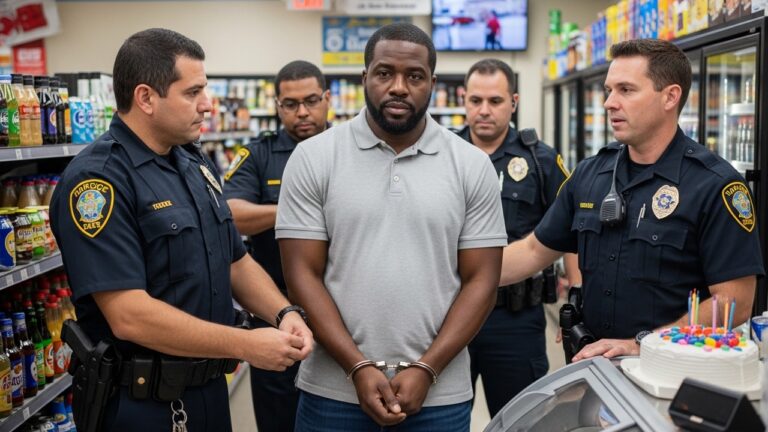
Leave a Reply