
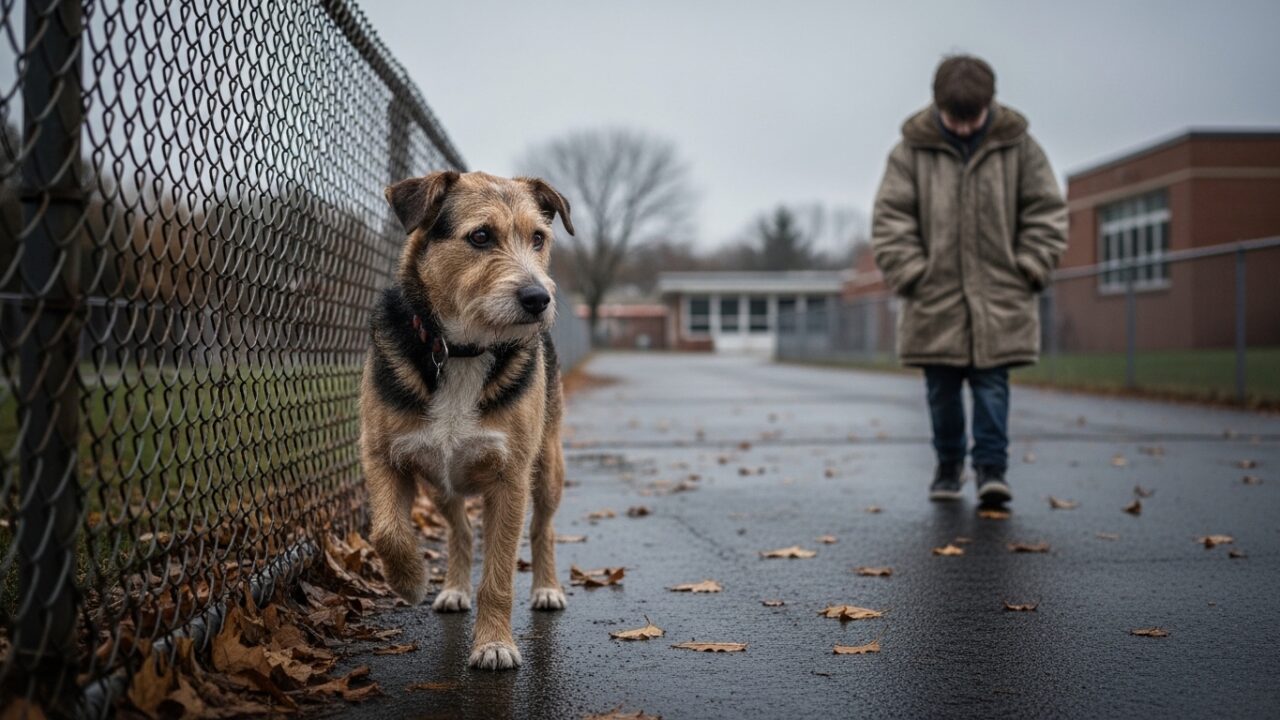
The Dog With The Crooked Leg Waited Outside The School Every Day, Hoping The Boy Who Never Smiled Would Look Back

The little wire-haired dog had learned a long time ago that the world was a fast and dangerous place, especially when you couldn’t run.
His right front leg sat at a strange, unnatural angle. It had been broken months ago—perhaps by a passing car, perhaps by a heavy boot—and had healed on its own, leaving him with a permanent, awkward limp. Every step he took was a jagged, bobbing motion that made his shoulders ache.
Because of his leg, he couldn’t chase squirrels. He couldn’t outrun the larger, meaner stray dogs that roamed the alleys. Most importantly, he couldn’t easily escape the cruel teasing of the neighborhood kids who sometimes threw pebbles at him just to watch him stumble away.
For a dog like him, a loud, crowded schoolyard at 3:00 PM was the absolute worst place to be. The sudden screech of the dismissal bell was terrifying. The explosion of shouting, running, and heavy backpacks swinging wildly meant danger.
Yet, for the past three weeks, the little dog with the crooked leg had been there every single afternoon.
He always arrived at exactly 2:50 PM. He would drag his tired, aching body across the wet autumn leaves, shivering in the biting November wind, and tuck himself beneath a thick, prickly juniper bush just outside the main gates.
He would lie completely still, his chin resting on his good paw, blending in with the shadows and the dirt. He didn’t come here for the discarded food wrappers that the children sometimes dropped. He didn’t come here to beg.
He came here for the boy.
The dog didn’t know the boy’s name. He only knew that the boy wore a faded, oversized gray coat that seemed too thin for the changing weather. He knew that the boy always wore an old pair of sneakers with the laces heavily knotted to keep them from breaking.
But what the dog understood most of all was the way the boy carried himself.
While the other children exploded out of the brick building in bursts of laughter and energy, forming tight groups and chasing each other down the sidewalk, the boy in the gray coat always walked alone. He hugged the very edge of the concrete path, pressing his shoulder close to the rusted chain-link fence, as if trying to make himself invisible.
His head was always down. His shoulders were always slumped. He never spoke to anyone, and no one ever spoke to him. He carried a heavy, invisible weight that the little dog recognized instantly, because the dog carried the exact same weight. It was the crushing, quiet exhaustion of being entirely alone in the world.
Their first encounter had been an accident. Two weeks earlier, the dog had been rummaging near the school’s overflowing trash cans, desperately looking for a crust of bread. A group of older boys had come around the corner laughing loudly. Startled, the dog had tried to scramble away, but his crooked leg had given out on the wet pavement. He had tumbled hard onto his side, whimpering softly and waiting for the shouting or the kicks to follow.
But the older boys hadn’t even noticed him. They had walked right past.
Instead, it was the boy in the gray coat who had stopped. The boy had been walking several paces behind the others, keeping his distance. He saw the little dog struggling to get back up. He saw the matted fur, the ribs showing through the dirt, and the trembling, ruined leg.
The boy hadn’t tried to pet him. He hadn’t made any loud kissing noises or reached out a sudden hand—things that always terrified the dog.
The boy had simply stopped. He stood there on the cold sidewalk, looking down at the broken animal. For a long, silent moment, their eyes met. The dog’s wide, amber eyes held a lifetime of fear and rejection. The boy’s pale, shadowed face held a profound, quiet sorrow.
Then, moving very slowly, the boy had reached into his coat pocket. He pulled out half of a crushed peanut butter sandwich wrapped in a napkin. He didn’t toss it. He didn’t throw it. He gently bent down, placed the sandwich on the dry concrete near the fence, and then stood back up.
He didn’t wait to watch the dog eat. He just turned around, shoved his hands deep into his frayed pockets, and continued his slow, lonely walk home.
That single, quiet gesture had changed the little dog’s entire world.
He had eaten the sandwich, the sweet taste of peanut butter sticking to his dry mouth, feeling a strange, unfamiliar warmth spreading through his chest. It wasn’t just the food. It was the fact that someone had seen him. Someone had noticed his pain and hadn’t used it against him.
From that day on, the school gates became the center of the dog’s universe.
Every afternoon, he waited under the juniper bush. When the bell rang and the flood of children poured out, the dog’s amber eyes would scan the chaotic sea of brightly colored jackets and backpacks. He would ignore the loud voices. He would ignore the cold wind biting at his thin coat.
He only relaxed when he spotted the oversized gray coat.
As the boy walked down the sidewalk, the dog would crawl out from under the bush and follow him. He always kept his distance, staying about ten feet behind, matching his broken, limping pace to the boy’s slow, trudging footsteps.
The boy never turned around to call him. The dog never barked to demand attention. They simply walked down the street together, two silent ghosts navigating a world that seemed to have no space for either of them.
When the boy reached the corner of Elm Street, where he had to cross toward the poorer side of town, he would finally stop. He would turn his head just slightly, looking back over his shoulder. The dog would immediately sit down on the cold pavement, his crooked leg sticking out awkwardly, his tail giving one tiny, hesitant thump against the concrete.
The boy would look at him. The dog would look back.
No words were spoken. No smiles were exchanged. But in that brief second of eye contact, the little dog felt a sense of belonging he had never known. Then, the boy would turn and cross the street, disappearing into the gray afternoon, and the dog would limp back to his lonely alley to survive another freezing night.
But as November deepened, the weather began to turn brutal. The wind grew sharper, carrying the bitter promise of early snow. The dog’s crooked leg began to throb constantly in the freezing dampness, making it harder and harder to walk.
His breathing grew shallow. He was losing weight. There were mornings when he woke up behind the dumpster shivering so violently he could barely stand. The instinct of a street dog told him to find a warm basement vent, to hide deep somewhere and never come out. To conserve his fading energy.
But every afternoon, no matter how badly his joints screamed, no matter how much the frozen ground cut into his paw pads, he dragged himself out of his hiding spot. He forced his broken body down the long, empty streets toward the school.
Because he knew the boy in the gray coat would be walking out of those gates entirely alone.
He knew the boy’s head would be down. He knew the boy’s shoulders would be heavy. And the little dog simply could not bear the thought of the boy looking back at the corner of Elm Street and finding the sidewalk empty.
CHAPTER 2
A Fragile Bond
The November chill settled deep into the bones of the city, turning the daily mist into a bitter, stinging rain. For the dog with the crooked leg, every morning was a battle against the freezing dampness that seeped into his ruined joint. Yet, his routine never changed.
He still waited under the prickly juniper bush. The boy in the oversized gray coat still walked out of the school gates completely alone. And the slow, silent procession down the cracked sidewalks continued just as it always had.
But slowly, almost imperceptibly, the distance between them began to close.
It started with a piece of a bruised apple. The boy had stopped at the corner of Elm Street, but this time, he didn’t immediately cross. He fumbled in his frayed pocket, pulled out the apple slice, and placed it on the edge of the curb. Then he took two steps back and waited.
The dog limped forward, his amber eyes locked cautiously on the boy. He sniffed the fruit, then looked up. The boy was watching him, his pale face partially hidden by the high collar of his coat.
The dog carefully picked up the apple, his tail giving a tiny, hesitant wag. For the first time, a faint, fleeting softness appeared in the boy’s eyes before he turned away and crossed the street.
By the end of the third week, the ten-foot gap between them had shrunk to five. The dog no longer waited for the boy to reach the corner before following. Now, the moment the boy cleared the noisy school gates, the dog would fall into step just behind his right heel.
They became a strange, quiet pair navigating the harshness of the neighborhood. The boy never tried to put a leash on him or lure him into a house. He seemed to understand that the street dog needed his space, just as the boy seemed to need his own invisible barrier against the world.
But the little dog was learning the boy’s rhythms. He learned that the boy’s breathing grew heavier and his shoulders slumped even further when they approached the rusted gates of a dingy apartment building at the end of the street. This was where the boy lived. And this was where the boy always seemed the saddest.
Often, the boy wouldn’t go inside right away. He would sit on the cold, concrete steps leading up to the heavy metal door, his chin resting on his knees. He would stare out at the gray street as if willing himself to disappear.
The dog didn’t know what waited for the boy inside that building. He didn’t understand the concepts of an empty pantry, an overworked mother on the night shift, or the crushing silence of a home that felt entirely hollow. He only knew that the boy was hurting.
So, the dog stayed. Instead of turning back toward his lonely alley, he began sitting across the street, watching the boy on the steps. He would tuck his aching leg under his body to keep it warm, his eyes never leaving the small figure in the gray coat.
One late afternoon, the biting mist turned into the first real snow of the year. Thick, wet flakes began to fall, melting against the dirty pavement and chilling the air to freezing. The boy was sitting on the concrete steps, shivering violently, his thin jacket completely inadequate for the harsh weather.
From across the street, the dog watched. His own thin, wiry coat was soaked, and his crooked leg was shaking so badly he could barely hold himself up. Every instinct screamed at him to find shelter under a parked car or beneath a dry porch before the cold stole the rest of his strength.
Instead, he stood up. He dragged himself across the wet, freezing asphalt, his bad leg scraping painfully against the gathering ice.
He approached the bottom of the steps. The boy looked down, his lips blue from the cold, his eyes wide with surprise. The dog didn’t stop. He hobbled up the first step, then the second, his breathing ragged and shallow. He stopped right next to the boy’s worn-out sneakers.
For a long moment, neither of them moved. The dog trembled from the cold, his amber eyes looking up at the boy, waiting to be chased away.
Then, with a heavy sigh, the dog did something he hadn’t done since he was a tiny, hopeful pup. He stepped closer, curled his small, shivering body into a tight circle, and pressed his back firmly against the boy’s leg.
The boy stiffened. He had never been this close to the dog before. He could feel the bony ribs, the wet matted fur, and the violent, terrifying shivering of the little animal.
Slowly, the boy uncrossed his arms. He reached out a trembling, freezing hand. The dog instinctively squeezed his eyes shut, his ears flattening against his head, bracing for a strike. He had learned the hard way that human hands usually brought pain.
But the strike never came. Instead, the boy’s hand rested gently on the back of the dog’s neck. The fingers were freezing, but the touch was incredibly soft.
The boy began to stroke the wet fur. It was a clumsy, hesitant motion, as if he had forgotten how to be gentle. The dog opened his eyes. He didn’t pull away. He leaned his heavy head into the touch, letting out a long, shuddering exhale.
“You’re cold,” the boy whispered, his voice cracking.
It was the first time the dog had ever heard him speak. The sound was incredibly small, fragile, and deeply sad. The dog shifted his weight, resting his chin directly on the boy’s muddy shoe. He looked up, his tail giving a slow, steady thump against the freezing concrete.
They sat there on the icy steps as the snow fell harder, two broken souls sharing the only warmth they had left in the world. The boy’s hand kept stroking the dog’s fur, and for the first time in a very long time, the tears that spilled down the boy’s cheeks weren’t just from the cold.
The dog didn’t know how to fix the boy’s life. He couldn’t make the school bullies disappear, and he couldn’t make the apartment warm. But as he pressed his crooked, aching body against the boy, the little dog made a silent promise.
He would never let the boy walk home alone again.
CHAPTER 3
The Night Everything Changed
December arrived with a cruelty the city hadn’t seen in decades. An unnatural, biting cold descended overnight, turning the lingering autumn dampness into sheets of solid ice that coated the streets. The neighborhood grew quiet and desolate as the temperatures plummeted to dangerous, freezing lows.
The schools had dismissed the children early that Friday, sending them rushing home to warm living rooms and locked doors. But the boy in the oversized gray coat did not rush. He walked his usual slow, heavy route, leaning his small body against the howling wind.
A few feet behind him, the little dog with the crooked leg struggled to keep up. The brutal wind sliced through his thin, wiry fur, chilling him to the bone. Every step on the jagged, icy pavement sent a jolt of sharp pain shooting up his ruined leg, but he refused to stop following the boy.
To reach the apartment building, they had to walk past an old, concrete-lined storm drainage canal. It was a steep, ten-foot drop into a narrow ditch that was currently frozen over with dirty, slick ice. The chain-link fence that was supposed to block it off had been torn down years ago.
As they walked past the dangerous edge, a sudden, violent gust of wind whipped down the street. It tore the boy’s thin knitted hat right off his head. It was the only winter gear he owned, and he watched in panic as it fluttered over the edge and landed halfway down the steep concrete bank.
Without thinking, the boy stepped off the sidewalk and reached out to grab it. But his worn-out sneakers, with their heavily knotted laces and smooth soles, found absolutely no grip on the frozen concrete.
His feet shot out from under him. The boy let out a terrified gasp as he tumbled backward over the edge. He slid violently down the sheer, icy embankment, his body crashing hard into the frozen bottom of the canal.
The sickening crack of his knee twisting echoed softly before the wind swallowed the sound entirely. The boy cried out in sudden, blinding pain, clutching his leg in the dark ditch. He tried to push himself up, but his leg gave way instantly, sending him collapsing back onto the freezing ice.
Above him, the little dog whimpered in panic. He didn’t hesitate. Ignoring his own pain, he slid wildly down the slick concrete, tumbling the last few feet before landing beside the boy.
The dog instantly pressed his small, shivering body against the boy’s chest, licking his tear-stained face. The boy wrapped his trembling arms tightly around the dog’s neck, burying his face in the coarse fur. The sheer, paralyzing cold of the ice beneath him was already seeping through his thin gray coat.
The boy tried to call for help, but his voice was a weak, breathy whisper lost in the howling wind. He was trapped at the bottom of a dark, icy pit, hidden from the street, as the afternoon sky rapidly darkened into a black, freezing night. No one walked behind the building in this weather. No one knew he was there.
As the minutes dragged on, the brutal temperature began to do its deadly work. The boy’s violent shivering slowly began to subside, a dangerous sign that his core temperature was dropping to a critical level. His pale face grew unnaturally still, and his eyes fluttered shut as the overwhelming urge to sleep washed over him.
The dog nudged the boy’s cheek urgently with his wet nose, letting out a sharp, distressed whine. The boy didn’t respond. His arms grew limp, falling away from the dog’s neck. The little animal knew, with a deep, primal instinct, that if they stayed in this dark ditch, the boy would never wake up.
The dog turned and looked up at the sheer, icy slope of the concrete bank. He only had three good legs. He was malnourished, exhausted, and freezing. But he looked back at the unconscious boy—the only human being who had ever looked at him with kindness.
The dog began to climb. He dug his dull claws into the freezing concrete, desperately trying to find traction. He pushed upward with all his might, but his ruined front leg buckled under the strain. He slid backward, scraping his belly and tearing the pads of his paws on the sharp, jagged ice.
He crashed back down to the bottom, his chest heaving, his shoulder burning in agonizing pain. He let out a low, defeated cry. But the terrifying silence from the boy lying motionless on the ice pushed him forward again.
The little dog launched himself at the wall a second time. He scrambled frantically, his back legs kicking, his good front paw tearing until it bled. He fought the slick ice with every ounce of desperate strength he had left, his breathing ragged and loud in his own ears.
With one final, violent heave, he dragged his battered body over the ledge. He collapsed onto the frozen grass at the top, panting heavily, leaving small drops of blood in the snow.
But he couldn’t rest. He forced himself to his trembling feet and limped frantically toward the front of the apartment building. The street was entirely empty, illuminated only by the faint, flickering glow of a single yellow streetlamp. The world was terrifyingly quiet.
Then, he saw her. A middle-aged woman, wrapped tightly in a thick coat, was hurrying down the sidewalk, her head bowed against the stinging wind. She lived on the first floor of the building, rushing home from the bus stop to get out of the deadly cold.
The little dog, who had spent his entire life making himself completely invisible to avoid being hurt, threw himself directly into her path.
He planted his bleeding paws on the sidewalk and let out a frantic, raw bark. It was a loud, desperate sound that tore at his throat. The woman gasped, startled by the sudden noise, and tried to quickly step around the scruffy, dirty stray blocking her way.
But the dog wouldn’t let her pass. He lunged forward, snapping his jaws around the thick fabric of her heavy winter coat. He clamped down hard and pulled backward with all his remaining strength, growling and whining simultaneously.
“Shoo! Let go of me!” the woman yelled, raising her heavy purse as if to strike him.
The dog cowered instinctively, squeezing his eyes shut, fully expecting the agonizing blow to fall. He was terrified. But he absolutely refused to release the fabric. He dug his paws into the icy sidewalk and tugged violently toward the dark alley behind the building.
Something in the desperate, frantic pull of the dog made the woman pause. She lowered her purse. She looked down and saw the blood smearing from the dog’s paws onto the snow, and the wild, panicked pleading in his amber eyes.
The dog instantly let go of her coat. He ran a few frantic feet toward the dark alleyway, stopped, and looked back at her. He barked again, a single, piercing cry for help.
With a sinking feeling in her chest, the woman tightened her scarf and cautiously followed the limping dog into the dark.
CHAPTER 4
The Dog Who Was Never Useless
The beam of the woman’s phone flashlight cut through the swirling snow and pierced the darkness of the canal. When the pale light finally landed on the motionless figure in the oversized gray coat, the woman let out a terrified gasp.
She didn’t hesitate. Her trembling hands fumbled with her phone as she dialed emergency services, her voice cracking as she screamed their location to the dispatcher.
Down in the freezing ditch, the little dog with the crooked leg didn’t wait for her. He turned and slid back down the treacherous, icy bank. His bleeding paws left crimson streaks on the frost, but he didn’t care about the pain. He crawled back to the boy, curled his exhausted, trembling body tightly against the child’s chest, and waited.
Within minutes, the wail of sirens cut through the dead silence of the neighborhood. The freezing alleyway was suddenly bathed in the frantic, spinning glow of red and blue emergency lights.
Paramedics scrambled down the icy embankment with ropes and a backboard. As they approached, the little dog bared his teeth and let out a weak, raspy growl, instinctively trying to protect his only friend. But when a paramedic gently reached out and spoke in a soft, calm voice, the dog’s defenses crumbled. He stepped back, his ruined leg trembling uncontrollably, and let them lift the boy from the ice.
As they hoisted the boy up to the safety of the street, the dog tried to follow. But his strength was completely gone. His body gave out, and he collapsed onto the frozen concrete, his eyes slipping shut.
He expected to be left behind. He was just a stray, a dirty, broken thing that belonged to the cold. But suddenly, he felt strong hands lifting him. A thick, heated blanket was wrapped securely around his shivering, battered body.
“You’re coming too, little guy,” a rough voice whispered. “You saved his life.”
When the dog finally opened his eyes again, the world was blindingly bright, and perfectly, miraculously warm. He was lying on a soft blanket at the foot of a narrow hospital bed. The harsh, biting wind was gone, replaced by the steady, rhythmic beeping of a heart monitor.
His raw, bleeding paws had been carefully cleaned and wrapped in soft white bandages. His aching, crooked leg had been examined and gently rested on a cushion.
He lifted his heavy head and looked up. The boy in the gray coat was lying in the bed, tucked under layers of thick thermal blankets. His pale skin had regained its color, and his chest rose and fell in a deep, peaceful sleep.
Sitting in a chair next to the bed was the boy’s mother. She was still wearing her faded diner uniform, her eyes red and swollen from hours of terrified crying. The dog tensed, instinctively preparing to be yelled at or shooed away.
Instead, the mother stood up. She walked over to the foot of the bed and slowly sank to her knees until she was at eye level with the scruffy, battered street dog. Tears spilled over her cheeks as she reached out a trembling hand.
She didn’t care about his matted fur or the dirt still clinging to his coat. She gently wrapped her arms around his neck and buried her face in his shoulder, sobbing softly into his fur. “Thank you,” she whispered over and over again. “Thank you for bringing him back to me.”
For the first time in his entire life, the dog did not flinch away from a human’s embrace. He let out a long, heavy sigh, resting his chin against her shoulder, and gently thumped his tail against the mattress.
Two weeks later, the rusted gates of the elementary school swung open at 3:00 PM. The loud dismissal bell rang, and the usual chaotic flood of children poured out onto the wet, winter pavement.
The boy walked out of the gates, moving a little slower than usual. He was wearing a heavy, brand-new winter coat, and a thick brace supported his injured knee.
But this time, he wasn’t walking alone. He wasn’t hugging the chain-link fence, and his head wasn’t hung down in quiet defeat.
Waiting for him on the sidewalk was the little dog. He wasn’t hiding in the shadows of the prickly juniper bush anymore. He was standing proudly in the open, wearing a bright red collar with a shiny silver tag that jingled softly in the wind.
When the dog saw the boy, his amber eyes lit up. He let out a happy, joyful bark, his tail wagging so hard his entire body wiggled.
The boy stopped. For the first time since the dog had known him, a wide, genuine smile broke across the boy’s face. He dropped to his good knee right there on the crowded sidewalk, holding out his arms. The dog limped forward as fast as his crooked leg could carry him and buried his head into the boy’s chest.
They walked home together, just as they always had. But the crushing, invisible weight they used to carry was gone.
The dog’s leg would always be crooked. He would always have a strange, bobbing limp. He would never be the fastest, the strongest, or the most beautiful dog in the neighborhood.
For a long time, the world had made him believe that meant he was useless. That he was something broken, something to be ignored and left in the cold.
But as he walked proudly beside the boy who was finally smiling, the little dog knew the truth. He didn’t need to be perfect to be a hero. He just needed a heart brave enough to stay, and a boy who needed someone to walk home with.
Thank you so much for reading this story. Please remember that true heroes don’t always look strong or perfect—sometimes, they are just the ones who refuse to leave us in the dark. Keep kindness alive in your heart, because even the smallest, quietest act of love can completely change someone’s world.
The End

About the Author
dream01
A writer passionate about human stories and real-life experiences that inspire and move readers.
 Dog Story
48 min read
Dog Story
48 min read
As a 12-year animal control officer, I seized a homeless man’s dog from the park—but feeling the heavy, “government-issued” tracker hidden under its collar, I quietly locked the truck doors and radioed dispatch.
I’ve been a county animal control officer for exactly 12 years, but absolutely nothing prepared me for the truth hidden…
 Dog Story
5 min read
Dog Story
5 min read
“€100,000 TO ANY MAN WHO CAN TAME THIS BEAST!” — Don Mateo’s voice boomed over the arena, a thick envelope of cash thrust into the blistering air.
The crowd of tough, hardened men immediately shrank back. Then, a barefoot 15-year-old boy stepped onto the dirt. What happened…
 Dog Story
51 min read
Dog Story
51 min read
“I’ve Worked The ER Night Shift For 12 Years, But When A Terrified Little Girl Refused To Let Go Of A Massive, Blood-Stained Biker’s Jacket… What He Told Us Left The Entire Waiting Room Breathless.”
I’ve been an emergency room triage nurse for over a decade, but absolutely nothing prepared me for what I found…
Leave a Reply