
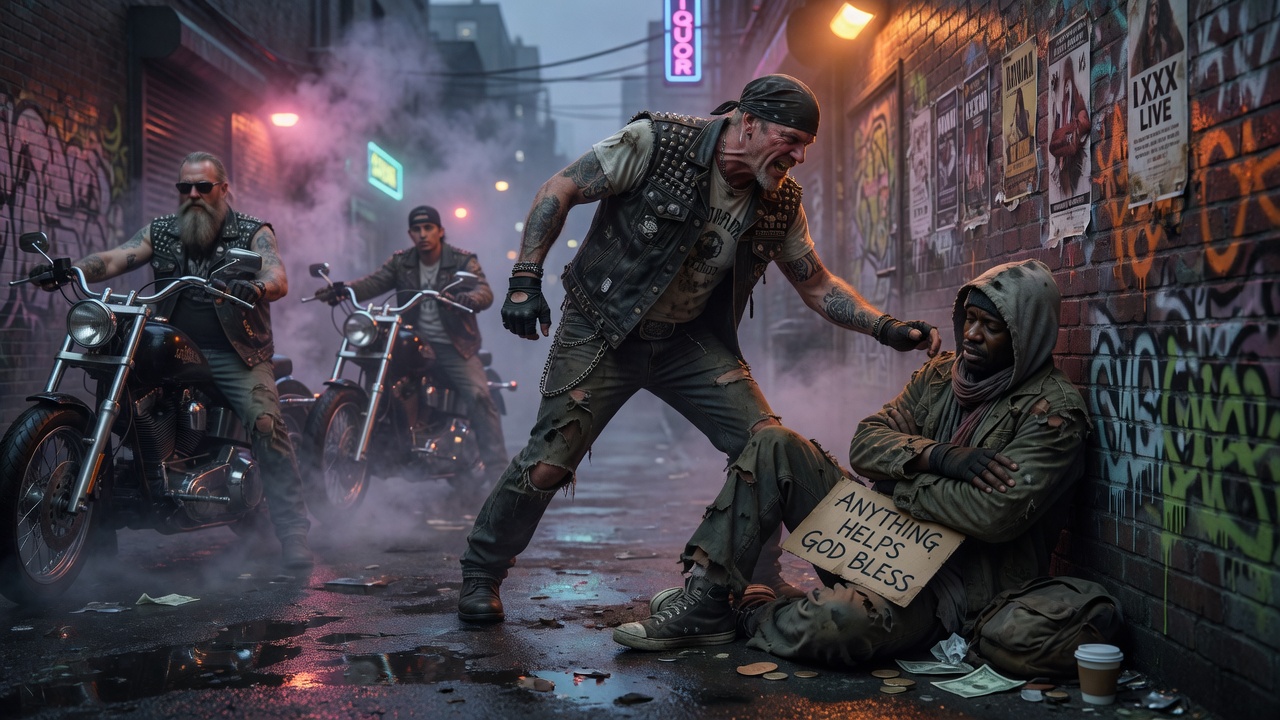
The Debt of Blood / Thought Beating a Helpless Man Would Earn Me My Brothers’ Respect—But One Look in His Eyes Made Me Realize We Had Just Opened a Door That Could Burn Our Whole Town Down

I knew it was bad the second I heard the sound his head made against the concrete.
Not a movie sound. Not the kind of hit you laugh at with a beer in your hand while somebody bigger and meaner than you tries to prove a point.
It was a sick, flat crack that cut through the rumble of idling bikes and made my stomach tighten so fast I thought I was gonna throw up right there in the parking lot.
For half a second, nobody moved.
Not me.
Not my brother.
Not the old man sprawled on the ground with one arm twisted under him and blood running from a split over his eye into the dirt like somebody had opened a faucet.
Then my brother Curtis grinned.
That was the worst part.
Not the blood.
Not the way the other guys laughed because they didn’t know what else to do.
It was that grin.
Like this was just another Friday night.
Like this was what we did now.
I stood there with my helmet hanging from two fingers, sweat cooling under my cut even though the night was still thick and hot. The gas station sign buzzed over us, half the letters dead. We were on the edge of Mercer, just past the railroad tracks where the town stopped pretending it cared what happened after dark.
This was our side.
That was the lie, anyway.
Curtis stepped over the old man and spat next to his hand. “Told you,” he said, looking back at the guys. “You let one of them squat here, next thing you know every drifter in the county thinks this strip belongs to them.”
A few of the boys chuckled.
Nobody too loud.
Because even they could feel something had shifted.
I looked down at the man on the pavement. He wasn’t begging now. He was trying to breathe.
He’d been standing by the side of the mini mart with a cardboard sign when we rolled in. Not bothering anyone. Not shouting. Not chasing cars. Just standing there in a faded army coat with a paper cup at his feet and a sign that said HUNGRY. GOD BLESS.
Curtis had decided that made him a problem.
Everything was about turf with Curtis.
A corner.
A parking lot.
A barstool.
A name.
A stare held too long.
He was the kind of man who could turn an empty sidewalk into a battlefield if he thought somebody else might stand on it without permission.
I should know.
He was my older brother.
And for most of my life, he was the only person who ever made me feel safe.
That was before safe started to look too much like scared.
“You just gonna stare at him all night?” Curtis asked me.
I looked up.
He had that look on his face, the one that meant he was measuring me again. Always measuring. Seeing if I was man enough, loyal enough, hard enough. Seeing if I still belonged at his side or if I was turning soft like our old man used to say.
The boys were watching now.
Nash with his cigarette hanging from his lip.
Deke cracking his knuckles.
Little Roy trying too hard to look amused.
Every one of them waiting to see what I’d do.
That’s the thing about gangs nobody tells you when you’re young and dumb and desperate to belong.
Half the violence isn’t even about the victim.
It’s about the audience.
I swallowed and said, “He’s had enough.”
Curtis tilted his head.
Just a little.
That was always more dangerous than yelling.
“What’d you say?”
I should’ve backed down.
I should’ve laughed it off.
Said something like, Yeah, sure, let’s bounce.
That would’ve been easier.
Instead I heard myself say, “I said he’s had enough.”
The parking lot got real quiet.
The old man pushed himself up on one elbow, slow and shaky, blood dripping off his chin. He looked older up close than I first thought. Late fifties maybe. Maybe older than that. Hard years do that to a person. They blur the math. His beard was gray in patches. One cheek was already swelling. But his eyes—
I still remember his eyes.
Steady.
Not scared.
Not wild.
Just fixed on me like he was trying to decide whether I was worth remembering.
Curtis laughed once, short and ugly. “You grow a conscience on me, Eli?”
Nobody moved.
I hated when he used my name like that. Like he was dragging it through the dirt.
I set my helmet on my bike seat and stepped forward before my good sense could grab me by the throat. “This ain’t turf,” I said. “It’s a gas station.”
That got a couple nervous looks.
Because I’d said it in front of everybody.
And because I was right.
Curtis came closer until I could smell the whiskey on him. “Everything’s turf,” he said softly. “That’s why you’re still breathing. Men take what’s theirs or they lose it.”
The old man coughed behind us.
A wet, rough sound.
Curtis didn’t even turn around. “Hear that? He’s alive. Lesson landed just fine.”
I could’ve let it go then. God knows I should have.
But I looked past Curtis and saw the man trying to wipe blood from his mouth with the back of his hand. He was doing it with this strange kind of dignity, like he refused to put on a show for us. Like he’d been hurt before and had long ago decided pain didn’t deserve the satisfaction.
And all at once I saw my mother.
Not literally.
Just the memory of her sitting at our kitchen table when I was twelve, ice pressed to her cheek after Curtis had thrown a plate at the wall so hard it shattered and cut her when it came down.
She’d smiled at me through busted skin and said, “Some people live like they owe the world blood.”
I hadn’t understood it then.
Standing in that parking lot, I did.
Curtis saw something change in my face.
His eyes narrowed.
“Don’t do this,” he said.
I said, “You already did.”
Then I walked around him and knelt beside the old man.
The whole lot went dead still.
Up close, I could see his coat was stitched at the elbow by hand. His boots were split near the sole. His cup had rolled under a pickup truck, and coins were scattered near the curb. One quarter sat in a small smear of his blood.
“You okay?” I asked.
Stupid question.
He let out a breath that was almost a laugh and almost a groan.
“I’ve been better,” he said.
His voice surprised me.
Low. Calm. Educated, almost.
Not what the guys expected. Not what I expected either.
I reached to help him sit up the rest of the way.
That was when Curtis grabbed the back of my vest and yanked me up so hard my shoulder popped.
“You touch him again,” he hissed, “and you touch every one of us.”
I turned on him. “Maybe that’s the problem.”
The second the words left my mouth, I knew there was no putting them back.
Nash looked away.
Deke muttered, “Aw, hell.”
Little Roy shifted his weight like he was deciding whether tonight was about to become a beating or a funeral.
Curtis stared at me, and for a moment he didn’t look like my brother at all. He looked like a man standing on the edge of a cliff, furious that the ground under him had moved.
Then he smiled.
That was worse.
“You got one chance,” he said. “Get on your bike and ride.”
I didn’t.
The old man was trying to stand now, using the gas pump for support. I put a hand under his arm before Curtis could stop me, and this time I didn’t pull away when Curtis stepped forward.
The old man leaned into me just enough to stay upright.
He smelled like sweat, rain, old wool, and iron from the blood.
Curtis looked at my hand on the man’s arm like I’d set fire to the club patch on my back.
“You choosing him?” he asked.
It wasn’t really a question.
I didn’t answer.
Because whatever I said would be the wrong thing.
Because I didn’t know if I was choosing that man or choosing the version of myself I hadn’t completely killed yet.
Because part of me was still terrified of my brother in ways I couldn’t explain to anybody who hadn’t grown up in the same house.
So I just stood there.
And that was answer enough.
Curtis’s jaw flexed. “Fine,” he said. “Then hear this clear. You walk him off this lot, you don’t walk back on it like family.”
The words hit harder than I expected.
As messed up as it sounds, that’s what he knew would hurt most.
Not a punch.
Not a knife.
Exile.
To men like Curtis, family was only real when it came with conditions.
I looked at the line of bikes under the gas station lights. Chrome. Black paint. Patches on denim and leather. The whole life I’d built since I was sixteen. Nights in garages. Back roads at midnight. Beer and smoke and the thrill of engines shaking through my chest so hard I could pretend I was free.
But freedom that depends on someone else’s cruelty isn’t freedom.
It’s rent.
And I was tired of paying it.
So I picked up the old man’s cardboard sign from the ground, folded it in half, and tucked it under his arm.
Curtis let out a sound I’d never heard from him before. Not anger. Not exactly.
Betrayal.
“Unbelievable,” he said.
I met his eyes. “You want turf? Take the sidewalk. I’m done fighting over scraps.”
Then I walked the old man toward my bike.
Nobody stopped me.
That didn’t make it better.
If anything, it made it worse.
Because it meant they were letting Curtis decide what happened next.
I got the old man to the curb and sat him down while I pulled a rag from my saddlebag. His eye was swelling bad now. The cut on his brow was still bleeding, but slower.
“You got a name?” I asked.
He looked at me a long moment before saying, “Moses.”
I nodded. “I’m Eli.”
“I know,” he said.
That made me pause.
“How?”
He lifted his chin toward the lot behind me.
“Your brother’s been screaming it for ten minutes.”
I almost laughed, but it died in my throat.
I soaked the rag with water from a bottle in my bag and handed it to him. He pressed it to his face without flinching much.
“You need a hospital,” I said.
He shook his head. “Need and trust ain’t always cousins.”
“That bad?”
He gave me a look that said I hadn’t lived enough life to ask that question.
Then, after a second, he said, “Been worse.”
I leaned against my bike and glanced back toward the others.
Curtis was still standing where I’d left him, arms folded, talking to Nash but never taking his eyes off me. I could feel that stare all the way across the parking lot.
Trouble was already moving.
I could feel it like weather.
Moses followed my gaze. “He your blood?”
“Yeah.”
He dabbed the rag against his eye. “That’s heavy chain to drag.”
I looked at him. “You always talk like that?”
“Only when somebody earns full sentences.”
That one actually got a short laugh out of me. It felt wrong in a place like that.
“You should get out of Mercer tonight,” I said. “Go someplace safe.”
Moses was quiet.
Then he asked, “There such a place?”
I didn’t answer because I didn’t have one.
The neon sign buzzed louder overhead. Somewhere down the road, a freight train moaned through the dark. Cars passed on the highway without slowing, like the whole world had agreed to look away.
I crouched down so I could talk lower. “You got somewhere I can take you?”
Moses stared at me.
For a second I thought he was gonna refuse just on principle.
Then he said, “There’s a church on Rose Hill. Pastor named Warren lets me sleep in the shed when weather gets mean.”
“All right,” I said. “I’ll take you.”
That was when I heard boots behind me.
I stood up fast.
Not Curtis.
Nash.
He held his palms out a little, like he didn’t want smoke. “Curt says you’re gone,” he said.
“I heard him.”
Nash glanced at Moses, then back at me. His mouth tightened. “You know he can’t let this slide.”
“I’m not asking him to.”
“That’s the problem.” Nash lowered his voice. “There’s more going on than this bum—”
Moses looked up sharply when he said that, and Nash caught it.
“Sorry,” Nash muttered, not sounding sorry at all.
I stepped between them. “More going on how?”
Nash shifted. “Red Kings been pushing east all month. Curtis has the guys jumpy. He thinks if he gives an inch on anything, they’ll smell weakness.”
That got my attention.
The Red Kings ran the county south of us. Mean outfit. Mostly pills, guns, stolen parts. They’d been nibbling at Mercer for months, sending lookouts into bars that used to be ours, buying loyalty where they couldn’t earn fear.
Still, I said, “This man ain’t a Red King.”
Nash looked uncomfortable.
“That ain’t what I’m saying.”
“Then say what you came to say.”
He rubbed his mouth. “Curtis heard somebody’s been carrying messages. Between Rose Hill and the south end. He thought maybe this guy was watching us.”
I stared at him.
Then at Moses.
Moses said nothing.
A little chill worked its way up my spine despite the heat.
“You searched him?” I asked.
Nash shook his head. “Curtis didn’t care enough to search him.”
Of course he didn’t. That would’ve made this about facts instead of ego.
I turned to Moses. “You carrying anything?”
He met my eyes and answered real calm.
“No.”
Maybe that should’ve settled it.
But something in the way he said it made me unsure whether he was telling the truth or just choosing the part of the truth I’d earned.
Nash leaned closer. “Just leave him, Eli. Walk now while you still can.”
I looked past him at Curtis again.
He hadn’t moved.
He was waiting for me to make this final.
That was his way.
Make a man choose publicly, then punish him privately.
I said, “Tell Curtis I heard him.”
Nash’s shoulders dropped a little, like I’d disappointed him. Or maybe scared him.
Then he walked back.
I helped Moses onto the back of my bike, slow and careful. He hissed once when he swung his leg over. I gave him my extra bandana to hold against his head.
“You ever ridden one of these?” I asked.
“Son,” he said, settling in with a grunt, “I’ve survived worse ideas.”
That made me smile despite everything.
I kicked the engine alive.
The sound rolled across the lot and bounced off the boarded-up laundromat next door.
Curtis took one step forward.
Just one.
Enough to let me know this wasn’t over.
I held his stare a second longer than I should have, then pulled out onto the road.
I didn’t look back after that.
Mercer at night always felt like a town holding its breath. The streets past the tracks were mostly empty, lined with pawn shops, chain-link fences, and old brick buildings with windows blacked out like dead eyes. Moses held on with one hand and kept the other pressed to his face. I took the back roads, partly to avoid patrol cars, partly because I knew if Curtis sent anybody after us, they’d expect me to use the main drag.
We rode in silence for a while.
I kept replaying the lot in my head.
The hit.
The blood.
Curtis’s grin.
Then those words: you don’t walk back on it like family.
Funny thing is, losing my brother should’ve felt clean after all the years he’d spent turning loyalty into a cage.
It didn’t.
It felt like cutting off a limb to stop poison from spreading.
Necessary.
Still painful.
“You’re shaking,” Moses said behind me.
“I’m riding.”
“No,” he said. “You’re shaking.”
I tightened my hands on the bars.
He was right.
I was.
Not from fear of what I’d done.
From fear of what came next.
We crossed under the overpass near the old mill. The church on Rose Hill was another ten minutes out, up past a stretch of houses with sagging porches and yards full of dead appliances. A dog barked at us from behind a fence. Lightning flashed somewhere far off, painting the clouds white for an instant.
Then Moses leaned toward me and said, almost into my ear, “They’re following.”
Cold went straight through me.
I checked the mirror.
At first I saw nothing but darkness and road.
Then two headlights blinked into view a few blocks back.
Low.
Fast.
Too steady to be random traffic.
My heart kicked hard against my ribs.
“How many?” I asked.
“Just one bike,” Moses said.
I looked again.
Then another light joined it.
A second bike.
They’d kept dark until they knew we were committed.
I rolled the throttle.
The engine growled under me, and Mercer started to blur at the edges.
Moses’s hand tightened on my shoulder.
Behind us, the bikes closed the gap.
And then, over the scream of wind and engine, I heard the sound I knew better than my own pulse—
Curtis’s horn.
Read the full story in the comments.
If you don’t see the new chapter, tap “All comments”.
— PHẦN 2 —
CHAPTER 2
Curtis had a way of making a motorcycle sound personal.
Most men rode loud because they wanted to be heard.
Curtis rode like he wanted the whole world to know exactly who was coming to break it.
The second that horn cut through the night behind us, my chest locked up so hard I could barely breathe.
I leaned lower over the bars and pushed the bike faster, the front end rattling when I hit a pothole near the old feed store. Wind slapped tears out of my eyes. The road ahead kept flashing in and out under broken streetlights, all cracked asphalt and oil stains and shadows that looked like traps.
Behind me, Moses held on tighter.
“You got room to outrun blood?” he shouted over the engine.
“No,” I yelled back. “But I got room to make him work for it.”
That earned a dry sound from him that might’ve been a laugh.
The church on Rose Hill was still too far.
I could picture it in my head. White paint turning gray, a sagging little steeple, two dark stained-glass windows facing the road like tired eyes. Pastor Warren had preached my mama’s funeral ten years ago. That church was the last place in Mercer where people still talked about mercy like it was real.
Which meant Curtis would expect me to go there.
And if Curtis expected it, I couldn’t.
A pickup roared across the intersection ahead, forcing me to cut left so hard the bike slid half a foot before catching again. Moses cursed behind me. One of the bikes chasing us gained ground when I corrected, its headlight jumping in the mirror like a predator’s eye.
“Hold on,” I said.
“I am holding on.”
“No, I mean really hold on.”
I cut right down an alley between a shuttered furniture store and an auto parts place that had been closed since before Christmas. Trash cans went flying when I clipped one. Something metal clanged and bounced under our back tire. The alley stank like old beer and rotten food and hot brick.
I knew these roads.
I’d grown up tearing through them before I was old enough to shave, before I was old enough to understand that memorizing escape routes usually meant you were already trapped.
The bikes followed.
Of course they did.
Curtis didn’t send boys after me unless he trusted them to ride blind.
I hit the far end of the alley and shot across Maple, then took a narrow side street toward the mill yard. Gravel popped under the tires. Chain-link fences flew by on both sides. I risked another glance in the mirror.
Two bikes.
One was definitely Curtis.
I knew the shape of his shoulders. Knew the way he leaned slightly right because of the old knee he’d messed up in county lockup. The other rider stayed half a length behind.
Not Nash.
Too broad.
Deke maybe.
That made my stomach turn worse.
Deke liked pain.
Curtis liked lessons.
Put those together and people ended up buried in stories nobody wanted to repeat out loud.
“You got anybody you trust?” Moses asked.
The question hit me so hard I almost missed the turn.
I barked out a laugh that sounded ugly even to me. “Not tonight.”
He was quiet for half a second.
Then he said, “Then trust the road.”
I didn’t know what that meant, but I didn’t have time to ask.
The mill yard opened ahead, a huge dead lot of rusted fencing, loading docks, and skeletal warehouses left over from when Mercer still built things instead of just breaking them. I shot through a gap in the fence where kids had peeled back the chain link years ago. The bike bounced hard over broken concrete. Behind us, Curtis’s headlight swung wide as he followed.
Good.
He’d have to slow in here.
I cut the engine the second we slipped behind Warehouse C, one of the long brick buildings with half the roof caved in. Silence slammed into us so suddenly my ears rang. I coasted the last few yards into darkness and stopped behind a stack of old pallets.
Moses climbed off slower this time, biting back pain.
“You do this often?” he asked.
“Hide from family?” I said quietly. “More than I should.”
We crouched beside the bike while the night swallowed us. I could hear the ticking of the cooling engine. Farther off, one motorcycle passed the opening to the yard, then doubled back. Another entered through the fence, rolling slow now.
Searching.
My pulse pounded so hard it blurred my hearing.
Moses pressed the bandana harder to his forehead and looked at me through one narrowed eye. In the faint spill of distant light, his face looked carved out of old wood and hard weather. “You’re not built for this life,” he said.
I almost snapped at him.
Not because he was wrong.
Because he wasn’t.
“You don’t know what I’m built for.”
He held my gaze. “That’s true. But I know what you ain’t.”
A beam of light swept the far wall inside the warehouse. Somebody had dismounted. Boots crunched glass.
I grabbed Moses by the sleeve and pulled him deeper behind the pallets.
The footsteps paused.
Then Curtis’s voice rolled through the dark, calm as cold water.
“Eli.”
He always sounded the most dangerous when he wasn’t mad.
“You put that man in front of me again,” he called, “you’re making this worse than it has to be.”
I kept still.
Moses kept still too, but I felt the tension in him like wire pulled tight.
Curtis took a few slow steps. His flashlight moved across old machines, rusted pipes, piles of debris. “You know I can find you,” he said. “You know I always do.”
That sent me somewhere I hated.
Back to being fourteen.
Back to locking myself in the bathroom after he’d come home drunk and mean, hearing his knuckles rap against the door in that same patient rhythm, listening to him promise that if I made him kick it in, whatever happened next would be my fault.
Some fears don’t live in your head.
They live in your muscles.
In your breath.
In the automatic way your body prepares to lose.
I forced air into my lungs and whispered to Moses, “When I move, go left. Stay low.”
He didn’t answer.
I peered around the pallets.
I could see Curtis now, twenty yards away, flashlight in one hand, pistol tucked into the back of his jeans where the leather vest didn’t fully cover it.
My blood went cold.
Curtis usually kept guns for club business, not family business.
That meant one of two things.
Either he wanted to scare me.
Or he was already past that.
The second rider stepped in behind him.
Deke.
Big shoulders. Bald head. Mouth like he’d been born chewing nails.
He carried a length of chain wrapped around one fist.
Perfect.
Curtis angled the flashlight across the room again. “I’m gonna count to three,” he said. “Then Deke starts pulling this place apart.”
Deke grinned.
I’d seen that grin too many times at too many bad moments.
“One,” Curtis said.
Moses shifted next to me.
Not scared.
Ready.
That scared me more.
“Two.”
I made my decision before I really knew I was making it.
I stood up and stepped out from behind the pallets with my hands open.
“Leave him out of it,” I said.
Curtis’s flashlight snapped onto my face.
For half a second nobody said anything.
Then Deke muttered, “There he is.”
Curtis studied me. “Where’s the old man?”
“Gone.”
“Don’t insult me.”
“He ran when I cut the bike.”
That was a gamble. A bad one.
Curtis searched the shadows behind me. Deke took three steps right, trying to widen the angle.
I moved to block him.
Deke’s grin widened. “Boy, you don’t look too sure of that lie.”
Curtis lowered the flashlight a little. “You make me chase you through half of Mercer over this?” he asked. “Over some sidewalk ghost with a cup?”
I said nothing.
Because it wasn’t about Moses anymore.
Not fully.
It was about the moment in that parking lot when I’d finally stopped translating cruelty into loyalty.
Curtis took another step forward. “You embarrassed me in front of the boys.”
“There were no boys there,” I said. “Just men acting like children.”
Deke barked out a laugh. “You hear him? He found religion.”
Curtis didn’t smile. “You think I wanted to hurt you tonight?”
I almost laughed in his face at that. He’d always been best at sounding wounded by the damage he chose.
Instead I said, “You didn’t come here to talk.”
“No,” he said. “I came to bring you home.”
That word hit something sore in me.
Home.
Like he still had one to offer.
Like a clubhouse with stained couches, stolen whiskey, and rules written in bruises was the same thing as belonging.
“You don’t get to call it that,” I said.
Curtis’s expression hardened.
Behind me, something shifted in the shadows.
Tiny sound.
Maybe a boot scraping brick.
Maybe my whole life ending.
Deke heard it too. His eyes flicked past my shoulder.
I moved fast.
Too fast to think.
I lunged into Deke just as he started toward the pallets. We hit the concrete hard. The chain in his hand cracked against my ribs and fire tore through my side. I got one fist into his throat before he rolled and drove an elbow into my jaw so hard I saw white.
Curtis shouted something.
I never caught the words.
The world narrowed to Deke’s breath in my face and the taste of blood in my mouth. He was stronger than me by forty pounds easy, but I had desperation and a little speed left. I grabbed the chain, wrapped it once around my forearm before he could swing again, and yanked him off balance.
He fell sideways into a broken crate.
That gave me one second.
Maybe less.
I kicked him in the knee, scrambled up, and slammed shoulder-first into Curtis before he could draw the gun from his waistband.
The flashlight spun away.
We crashed into a rusted conveyor frame, metal shrieking under our weight. Curtis hit me twice in the body before I could even get my hands up. Old instincts made me eat the pain instead of showing it. He went for my throat. I caught his wrist. His face was inches from mine, eyes wide and furious and weirdly hurt.
“You picked him over me,” he hissed.
I shoved him back. “I picked right over wrong.”
He smashed his forehead into my nose.
Pain exploded bright and hot. I stumbled. He went for the gun again.
Then a piece of rebar came out of the dark and struck his forearm with a crack.
Curtis howled.
Moses.
He stood there breathing hard, both hands on the rusted metal rod like he’d held worse things before.
For one frozen second all four of us stared at him.
Then Deke surged up behind me with the chain.
Moses shouted, “Down!”
I dropped on instinct. The chain whistled past where my head had been. Moses drove the rebar into Deke’s gut so deep the big man folded like wet cardboard. Curtis lunged at Moses with his good arm, but the old man turned smooth and fast, nothing shaky about him now, and caught Curtis across the jaw with the rod.
The sound of it echoed through the warehouse.
Curtis hit the floor on one knee, stunned.
I looked at Moses in disbelief.
He wasn’t just standing.
He was balanced.
Alert.
Dangerous.
His whole body had changed.
The limp was still there, the blood was still real, but underneath it was something I hadn’t seen in the parking lot.
Training.
Old, deep, lived-in training.
Deke groaned on the ground, clutching his stomach.
Curtis wiped blood from his mouth and stared at Moses with sudden recognition. “I knew it,” he said. “I knew I’d seen you before.”
Moses kept the rebar up. “Then you should’ve walked away.”
Curtis laughed, breathless and mean. “You ain’t no beggar.”
Moses didn’t answer.
Which was answer enough.
My heart was still pounding from the fight, but now it had changed shape. This was bigger than a bad night at a gas station. Bigger than my brother losing his temper.
“What is he talking about?” I asked.
Neither of them looked at me.
That felt worse than any punch.
Curtis rose slowly, favoring his arm. “You want to know why the Red Kings been sniffing around Mercer?” he said, eyes still locked on Moses. “Ask your new friend who he’s carrying for.”
Moses said quietly, “Don’t.”
I looked at him. “Were you?”
He finally looked at me then.
Something in his face almost made me wish he’d lied.
“I was carrying a message,” he said.
The warehouse seemed to tilt around me.
“For who?”
He hesitated just long enough to hurt.
“For a woman named Lena.”
That name meant nothing to me.
Curtis smiled through split lips. “Tell him the rest.”
Moses didn’t.
So Curtis did.
“She’s Red King blood,” he said. “Sister to their vice president. Been hiding in Mercer three weeks. Moses here’s been slipping word back and forth so they can negotiate.”
“Negotiate what?” I asked.
Curtis’s eyes flashed. “Territory. Access. Protection. Depends who’s lying.”
I turned back to Moses. “That true?”
His silence lasted too long.
Then he said, “Partly.”
I laughed once, harsh and unbelieving. “Partly?”
“Nothing in towns like this is clean,” he said.
“No,” I snapped, “don’t do that wise old man thing with me. You let me stick my neck out for you.”
“You did that because you knew what your brother was.”
That hit hard because it was true.
And because it wasn’t enough.
Curtis took a step closer, sensing blood in the water. “He didn’t tell you because he used you,” he said. “Same as everybody else.”
I wanted to shut him up.
I wanted to punch Moses.
I wanted the last hour to un-happen.
Instead I stood there with blood running over my mouth, feeling stupid and split open.
Moses lowered the rebar a fraction. “Lena isn’t here to start a war,” he said. “She’s here to stop one.”
Curtis barked out a laugh. “By talking through street bums and church sheds?”
“By staying alive long enough to talk at all,” Moses said.
That shut Curtis up for exactly one second.
Then he reached slowly into his vest and pulled out a folded photograph.
He tossed it at my feet.
I bent and grabbed it before I could stop myself.
It was grainy, taken at night from a distance.
A woman standing outside the Rose Hill church.
Dark hair pulled back.
Denim jacket.
Sharp face.
And beside her—Moses.
No disguise.
No sign.
No cup.
They looked like they were waiting for someone.
My stomach dropped.
“It ain’t about mercy,” Curtis said softly. “It’s about leverage. Red Kings want a sit-down, and this old bastard’s the courier. You save him, you ain’t saving a victim. You’re protecting the thing that could hand our town over.”
I looked from the photo to Moses.
He seemed older suddenly.
Not weaker.
Just older.
Like all the miles he’d walked had caught up at once.
“Tell me he’s lying,” I said.
Moses met my eyes. “He’s framing it the way a man like him would.”
“Tell me he’s lying.”
He drew a slow breath. “I was carrying a message for Lena, yes.”
The truth landed like a blade sliding between ribs.
Not because it meant Curtis was right.
Because it meant I had chosen a side before I even knew there were sides.
I took one step back.
Then another.
Moses saw it and something like disappointment flickered across his face.
Maybe not in me.
Maybe in himself for expecting better.
Curtis straightened and smiled a little despite the blood. “Now we’re getting somewhere.”
He held his hand out toward me without taking his eyes off Moses.
“Come on, Eli. We handle this together. Like brothers.”
That was the moment.
Not the gas station.
Not the chase.
Not even the fight.
This.
Standing between the brother who’d raised me in fear and the stranger who’d earned my pity without earning my trust.
A gun somewhere near Curtis’s boot.
Deke groaning on the floor.
My ribs screaming every time I breathed.
And me realizing that every choice in my life had come down to the same ugly bargain: protect yourself, or protect something human.
Curtis still had his hand out.
“Don’t make me ask twice,” he said.
Moses spoke without looking away from him.
“Whatever you do now,” he said, “you live inside it after.”
I hated them both for making me be the man in the middle.
I looked at Curtis’s hand.
At the blood on his knuckles.
At the photo in my other hand.
At Moses, still holding that rebar, still wounded, still hiding something.
Then I saw a red dot appear on Moses’s chest.
Tiny.
Steady.
Laser sight.
For half a heartbeat, my brain refused to understand what my eyes were seeing.
Then another red dot crawled across Curtis’s shoulder.
And another landed on the wall beside my head.
All of us froze.
From somewhere outside the warehouse, a voice called out through a bullhorn.
Cold. Amplified. Female.
“Nobody move.”
Curtis’s face changed first.
Not fear.
Recognition.
And that was somehow worse.
The voice came again.
“Mercer belongs to the dead if anybody reaches for a weapon.”
My mouth went dry.
Moses closed his eyes for the briefest second, like he’d hoped we had more time.
Then he opened them and said one word I felt all the way in my bones.
“Lena.”
— PHẦN 3 —
CHAPTER 3
I had never heard a room go colder without the temperature changing.
One second the warehouse was sweat and blood and rust and bad decisions.
The next, it felt like the whole place had been dropped into ice.
Nobody moved.
Not Curtis.
Not Deke on the floor, still trying to breathe through whatever Moses had done to his gut.
Not me, standing there with my ribs on fire and a photograph in my hand that suddenly felt like evidence against everybody.
And not Moses, whose face had gone so still it looked carved from stone.
The red laser dot on his chest didn’t shake.
Neither did the one on Curtis’s shoulder.
Whoever was outside had a clean line of sight and a steady hand.
Then the woman on the bullhorn spoke again.
“Kick the gun away from you,” she said. “Slow.”
Curtis’s eyes shifted down for just a second toward the pistol near his boot.
That was enough to confirm it.
She knew exactly where everything was.
Which meant this wasn’t random.
It wasn’t luck.
It was a setup.
Or maybe not a setup.
Maybe a rescue.
Maybe both.
Curtis smiled without any warmth. “That you, Lena?”
The answer came back sharp and clear through the bullhorn. “Do it.”
Curtis kept smiling.
That smile used to mean he had a trick left. Growing up, I’d learned to fear it more than his fists. Fists were simple. Tricks stayed with you.
“Careful,” he called. “Your people are aiming at my brother too.”
My stomach twisted.
Of course that was his first move. Even with rifles on him, even bleeding from the mouth, he was still trying to pull me into the middle and wear me like armor.
Outside, silence answered for two long seconds.
Then the woman said, “Eli wasn’t the target tonight.”
The way she said my name hit me strange.
Like she knew me.
Or knew of me.
I looked at Moses.
He didn’t turn.
Didn’t blink.
But I saw something tighten around his eyes.
A detail.
Tiny.
Enough.
I said, “You told her about me.”
Moses answered without taking his eyes off the warehouse opening.
“No.”
He didn’t sound like he was lying.
That only made me more confused.
Curtis slowly lifted one boot and nudged the pistol across the concrete. It scraped loud in the silence. Sparks of sound bounced off the steel beams overhead. The gun spun once and stopped near a puddle of rainwater leaking through the roof.
“Happy now?” Curtis called.
“No,” the woman said.
That one word did something to the air. Calm. Controlled. Not angry. Which somehow felt more dangerous than anger.
I took one cautious step sideways, trying to get a better angle on the open warehouse door without doing anything stupid enough to get myself shot. Moonlight and a little road-glow spilled in through the entrance, but not enough to show faces. Just shapes outside. Movement in the dark. More than one person.
Not a huge crew.
Three, maybe four.
Professionals or close enough.
Too disciplined to chatter.
Too patient to rush in.
Curtis saw me looking and said quietly, for me this time, “You still got a choice.”
That almost made me laugh.
My face hurt too much for laughing.
“Do I?” I said.
His eyes cut to me, full of that old familiar fury. “You think they’re here for peace?”
“No,” I said. “I think nobody here is.”
That landed.
I saw it hit him even if he’d never admit it.
Deke rolled onto one elbow with a groan, and instantly one of the laser dots snapped from the wall to the center of his forehead.
He froze.
The bullhorn spoke again. “Tell him to stay down.”
Curtis didn’t say anything.
So I did.
“Deke,” I said, voice rough, “stay down.”
He looked at Curtis first.
Of course he did.
Then at the dot on his face.
Then back at me.
Humiliation burned in his eyes, but survival won. He lowered himself with a curse and stayed there breathing hard through his nose.
Moses eased the rebar down to his side.
Not dropping it.
Just making a point.
He wasn’t here to escalate unless somebody else did first.
Or maybe he was just smart enough to look that way.
A figure stepped into the doorway.
Woman.
Mid-thirties maybe.
Dark jacket.
Jeans.
Hair pulled back tight.
A rifle tucked into her shoulder like it belonged there.
Everything about her was still.
Not stiff.
Still.
The kind of stillness that comes from living too long with violence and deciding panic is a luxury for other people.
Lena.
She didn’t need the bullhorn anymore, but one of her people behind her still held it lowered at his side. Another stayed outside with a scope trained in. I could feel it even without seeing him clearly.
Lena’s gaze landed on Moses first.
“You’re late.”
Moses let out a breath through his nose. “I got delayed.”
Her eyes flicked over the blood on his face, then to Curtis, then to me.
Nothing in her expression changed, but she missed nothing.
Not Deke’s chain.
Not the gun on the floor.
Not the photo still in my hand.
And definitely not the fact that I was standing closer to Moses than to my own brother.
Curtis spread his hands a little. “You Red Kings always enter with a show like this?”
Lena ignored him.
She looked at Moses and asked, “Can you walk?”
“Yes.”
He was lying.
I could tell now.
Maybe she could too.
She gave the smallest nod, then finally turned her full attention to Curtis.
“I told your club I wanted a meeting,” she said.
Curtis laughed. “By sending spies into my town?”
“By sending a messenger you beat in a parking lot.”
“He should’ve come as himself.”
“He tried that in Benton County two years ago,” Lena said. “Your cousins put him in the ICU.”
The words hung there.
Not just because of what they meant.
Because of how casual she sounded saying them.
Not cold.
Not cruel.
Just matter-of-fact. Like this was weather people like us kept pretending was unusual.
Curtis tipped his head, studying her. “So what now? You drag him out and we call it diplomacy?”
“No,” she said. “Now we find out whether you’re stupid enough to make tonight larger than it already is.”
Curtis smiled again. “Depends. You threatening me?”
Lena’s face stayed blank. “I’m correcting your math.”
I hated that some part of me respected her for that line.
I hated even more that Curtis did too.
You could always tell when somebody impressed him. He got meaner. More alert. Like part of him enjoyed finally being in the room with another predator.
The voice in my head that still sounded like my mother whispered the same thing it always did around men like that:
They don’t stop because they’re fed.
They stop because they’re forced.
I looked at Lena again, trying to fit the pieces together.
Red King blood, according to Curtis.
Here to negotiate, according to Moses.
Armed like she expected betrayal before she even crossed county lines.
None of that felt like peace.
But none of it felt simple either.
I said, “What do you want?”
Every eye in the room cut to me.
Lena held my gaze.
There was no softness in her face, but there was something like curiosity.
“You’re Eli.”
Not a question.
I felt my skin go tight. “You know me too?”
Curtis made a dark, bitter sound. “There it is.”
Lena ignored him. “I know you’re the reason Moses is still alive.”
“That don’t answer my question.”
“No,” she said. “It answers the one under it.”
I almost snapped back, but stopped.
Because she was right.
What I really wanted to know wasn’t just what she wanted.
It was whether saving Moses had made me the dumbest man in Mercer or the only one who’d managed not to drown in the filth yet.
Lena shifted the rifle slightly, not lowering it. “I want a corridor.”
Curtis barked a laugh. “There it is. Turf.”
“Passage,” she said. “Not ownership.”
“To move what?”
“People.”
Curtis’s smile widened. “And there’s the lie.”
Lena didn’t even blink. “You asked.”
Curtis nodded toward me. “Ask him what you told my courier boy. Ask him why your messenger was sleeping in church sheds and begging at gas stations if this is all noble and clean.”
Moses finally turned toward me.
For the first time since the lasers appeared, he looked tired.
Not physically.
Soul-tired.
“I told you already,” he said. “Nothing in towns like this is clean.”
I flinched at that because I’d mocked him for it, and I still didn’t want that to be true.
But it was.
God, it was.
Lena took one step into the warehouse. Her people outside didn’t twitch. “A girl disappeared out of Dalton six weeks ago,” she said. “Seventeen. Foster kid. Then another from Barstow. Then a boy out of Franklin. All Black. All poor. All written off fast.”
Something about the way she said written off made my stomach go hollow.
Curtis’s face didn’t change.
That scared me more than if it had.
Lena went on. “We tracked the route north. It runs through Mercer.”
I looked at Curtis.
Then at Deke.
Then at Moses.
No one interrupted her.
That was answer enough to at least part of it.
My mouth felt dry. “Trafficking?”
The word sounded filthy in the warehouse.
Lena nodded once.
“We think a broker’s using county lines and bike territory to move kids where nobody coordinates long enough to notice.” Her eyes stayed on Curtis. “Some of those lines cross land your club claims.”
Curtis gave a shrug so slight it was almost elegant. “Then sounds like you got a police problem.”
Lena’s voice sharpened by half a degree. “Police are paid. Or blind. Or both.”
That, I believed instantly.
Mercer had uniforms.
Law was something else.
I said, “And you think he’s involved?”
Curtis answered for her. “She don’t know a damn thing.”
Lena didn’t deny it.
Interesting.
Very interesting.
She said, “I think someone in Mercer is renting protection to the route. I think Moses got close enough to names that he became bait.”
Moses looked at her then.
Not surprised.
Not exactly.
More like annoyed she’d said that much in front of Curtis.
A bad feeling opened under my ribs.
“You used him,” I said.
Lena’s eyes came to me.
“He volunteered.”
“That ain’t what I asked.”
Her jaw tightened. Just a little.
Finally, Moses said, “Enough.”
Nobody listened.
I stepped toward him. “You knew they might jump you.”
“Yes.”
“And you still let me think this was just some random beating over turf.”
His face hardened. “It started that way.”
“That’s not good enough.”
“No,” he said. “It isn’t.”
For a second I saw something raw in him. Regret, maybe. Or guilt. Not because he’d hidden things in general. Because I had ended up inside them.
Curtis saw it too. Saw every crack. He was built for cracks.
“Look at you,” he said to me softly. “These people play in shadows, and you’re still acting shocked they got dirt on their hands.”
I rounded on him. “Don’t you dare pretend this makes you better.”
His eyes flashed. “It makes me honest.”
That did it.
I crossed the space between us before sense could stop me and hit him.
Hard.
Straight across the mouth.
The impact sent pain through my knuckles, but not enough. Never enough. Curtis stumbled a step and looked at me with real surprise for the first time that night.
The warehouse went dead silent again.
Even Lena’s people held.
I’d never hit my brother first.
Not once in my life.
He touched his lip, looked at the blood on his fingers, and then smiled.
A real smile this time.
Almost proud.
That made me want to hit him again.
“About time,” he said.
Then he came at me.
He moved fast even hurt. We slammed into each other hard enough to rattle the metal frame behind us. He drove a fist into my bad ribs and all the air left my body at once. I got a hand on his collar and dragged him sideways. He clipped my ear. I shoved him into a support beam.
“Stop!” somebody shouted.
Maybe Lena.
Maybe Moses.
Didn’t matter.
Curtis and I had dropped past hearing.
Years of poison came up at once. Every kitchen argument. Every slammed door. Every time he’d called me weak for not enjoying somebody else’s pain. Every time I’d told myself staying close to him was loyalty instead of fear.
He swung again. I ducked. His fist hit steel and he cursed. I hit him in the stomach and he folded just enough for me to hook his shoulder and drive him to the ground.
We landed hard.
He rolled and got on top, forearm across my throat.
“Still think you can choose strangers over blood?” he snarled.
I clawed at his wrist, vision dimming. “You ain’t blood,” I rasped. “You’re a debt.”
That changed his face.
Completely.
For a split second I saw the boy he used to be before our father taught him that love only counted when it hurt. Hurt, confused, furious that I’d said the one thing he couldn’t punch out of the air.
Then a shot cracked outside.
Everything stopped.
Not inside.
Outside.
Single round.
Warning shot or signal, I couldn’t tell.
Lena spun toward the door instantly. Her rifle came up. The laser dots vanished from inside the warehouse as her people redirected.
Another voice shouted from outside.
Not Lena’s crew.
Male.
Farther off.
Then engines.
More than one.
A lot more than one.
Curtis heard it too and his eyes widened just a fraction.
Not Red Kings.
He recognized the sound.
So did I.
The club.
More of our guys.
Maybe all of them.
Coming in hot.
Deke started laughing from the floor, broken and ugly. “That’s ours,” he wheezed.
Lena swore under her breath and moved to the doorway. One of her men appeared beside her and said something too low for me to catch. She answered fast, clipped, tactical.
Moses grabbed my arm and hauled me up before I could find my balance on my own.
Outside, the night had changed shape. Engines rolled across the mill yard from two directions now, one deep and familiar, one lighter and quicker. Headlights cut through broken windows, slashing white beams across brick and rust.
Curtis shoved to his feet too, wiping his mouth. “Well,” he said, breathing hard. “Looks like everybody came to the meeting after all.”
Lena ignored him. She looked at Moses. “How long?”
“Less than a minute.”
Her eyes shifted to me.
“Can you ride?”
I almost laughed at that. My ribs felt like somebody had buried glass under them. My nose was still leaking blood. My left shoulder was half numb.
“Probably not well,” I said.
“Good enough?”
“Depends who’s shooting.”
Before she could answer, one of the warehouse windows exploded inward.
Glass rained across the floor.
Everybody dropped on instinct.
A voice from outside thundered through the yard.
Club voice.
Angry.
Amplified with nothing but lungs and hatred.
“Mercer Riders! Move!”
Then gunfire erupted for real.
Not one shot.
A burst.
Then another from a different angle.
Lena’s people returned fire from outside the doorway. Muzzle flashes strobed blue-white through the dark. Deke started crawling toward the pistol on the floor. Curtis saw it. So did I.
I kicked the gun away just as Deke’s fingers brushed it.
He snarled, and I kicked him in the face for good measure.
Curtis looked at me like I’d finally become something he understood.
I hated that.
Moses crouched low beside a steel column, scanning the doorway with the rebar still in one hand like he couldn’t quite accept that tonight had advanced beyond blunt objects. Lena fired twice through the window line, controlled and precise.
One engine outside screamed, then crashed.
Metal tore.
Somebody shouted in pain.
The warehouse filled with smoke and grit and echoes.
And suddenly I understood the real shape of the trap.
This hadn’t been a meeting.
Not really.
It had been a fuse.
Maybe everybody thought they were managing it.
Maybe nobody had.
Curtis ducked beside me behind an overturned crate while bullets chewed brick above our heads. For the first time in years, we were hiding shoulder to shoulder like brothers again.
The thought made me sick.
He leaned close and shouted over the gunfire, “This is what your mercy bought!”
I shouted back, “This started before me and you both know it!”
He stared at me, something wild moving behind his eyes.
Then he said the last thing I expected to hear in the middle of a firefight.
“Dad was on the route.”
The words hit harder than the bullets.
I blinked at him. “What?”
Another burst of gunfire hammered the doorway. Sparks spit off steel. Lena shouted commands to her people. Deke crawled behind a machine housing. Moses looked toward us, but couldn’t have heard.
Curtis grabbed my vest and yanked me closer until his face was inches from mine.
“I said Dad was on the route,” he snapped. “Years ago. Before he drank himself dead. He ran escorts for shipments. Girls, boys, pills, whatever paid.”
The warehouse seemed to go hollow around me.
“No.”
“Yes.”
“No.”
Curtis’s face twisted. “You think I came out of nowhere? You think I built all this from bar fights and gasoline? He handed me names. Roads. Cops to pay. Men to fear.”
I couldn’t breathe.
Not from the ribs.
From that.
All my life I had blamed my father for rage, drink, bruises, broken plates, the way our house sounded at night.
But this—
This was rot at the root.
“He made me useful,” Curtis said, almost shouting now, almost confessing. “Then he died and left me holding it.”
A bullet punched through the crate inches from my head and buried in the wall behind us. We both ducked lower.
My ears were ringing.
My mind was worse.
If Curtis was telling the truth, then this wasn’t just gang pride and county beef.
This was inheritance.
A machine older than us, dirtier than us, and maybe stronger than anything one good choice in a gas station parking lot could stop.
I looked at him differently then.
Not with pity.
Never that.
But with the sick understanding that monsters don’t fall from the sky.
Some get raised in kitchens right next to you.
“You could’ve ended it,” I said.
His laugh was broken. “With what? Morals?”
“With anything but this.”
He stared at me.
Then something in his face closed back up.
There was my brother again.
The man I knew.
The one who only opened old wounds when he thought bleeding me would help him win.
Gunfire outside slowed for one strange second.
In that second, Lena shouted from the doorway, “They’re circling the east fence!”
Moses called back, “How many?”
“Too many!”
Then from somewhere deeper in the mill yard came another sound.
Not engines.
Not shots.
A scream.
High.
Human.
Young.
Every head in the warehouse turned.
It came again.
A girl.
No older than maybe sixteen.
Muffled like from inside a vehicle or behind a wall.
The scream cut off fast.
Lena went white around the mouth.
Moses said, “No.”
Curtis looked genuinely confused.
That was all I needed to see.
He hadn’t expected that.
Neither had I.
Lena spun toward the yard and yelled a name I’d never heard before. One of her people answered from outside, panicked now for the first time. Flashlights bounced wild between buildings. Somebody shouted, “Van! East side!”
Van.
My whole body went cold.
Not theory.
Not routes.
Not rumors.
Real.
Here.
Tonight.
Using the chaos.
Maybe because of the chaos.
Maybe planned to arrive right inside it.
Curtis grabbed my arm. “Eli, listen to me—”
I ripped free so hard the seam of my vest tore.
“No,” I said, voice shaking. “You listen.”
Another scream tore through the yard.
And this time, without thinking, every person in that warehouse moved toward it.
— PHẦN 4 —
CHAPTER 4
The scream hit me like a knife between the ribs.
Not because it was loud.
Because it was young.
That sound did something bullets couldn’t do. It cut through all the posturing, all the gang pride, all the stupid lies men tell themselves when they need cruelty to feel like order. In one second, the whole warehouse stopped being about turf, blood, clubs, family, and revenge.
It became about whoever was making that sound.
Lena moved first.
She ran for the doorway with her rifle up, fast and low, shouting to her people outside. Moses was right behind her, and I was right behind Moses before I’d even consciously decided to move. Curtis grabbed at my arm again.
“Eli!”
I shook him off so hard he stumbled.
“No more,” I said.
Then I was out in the yard.
The mill yard looked like hell opened up and forgot to close. Headlights slashed across broken concrete. Smoke drifted low through the rusted frames of dead machinery. Bikes lay tipped over near the fence. One of Lena’s people was crouched behind an oil drum firing toward the west wall. Two Mercer Riders had taken cover behind an old forklift, yelling over each other. Somewhere on the far side of the property, an engine revved hard, then squealed as tires fought for grip.
And from the east side, near the collapsed loading dock, I saw it.
A dark van.
Back doors half open.
Trying to swing around the edge of Warehouse B and make the gap in the fence.
A man in a ball cap was shoving somebody inside.
Not somebody.
A girl.
Small.
Writhing.
Kicking.
She got one arm free long enough for the yard light to catch her face.
Teenager.
Terrified.
Alive.
My whole body flooded hot.
Lena shouted, “East side! Cut them off!”
One of her people ran for a truck. Another opened fire toward the van’s tires. Sparks jumped off metal, but the van kept moving. Whoever was driving knew what they were doing.
Curtis came out of the warehouse a second later, Deke limping behind him. Curtis took one look at the van and froze.
It was small.
Just a beat.
But I saw it.
Recognition.
Not of the girl.
Of the operation.
Of the pattern.
Maybe not this exact run.
But enough.
I wheeled on him. “You knew.”
He looked at me, furious. “I knew there were rumors.”
“Don’t lie to me now!”
A Mercer Rider I recognized as Boone came tearing through the yard on his bike and nearly clipped Lena. She spun and aimed at him, but he shouted, “They ain’t ours!” before she could fire.
The words barely registered.
Because the van lurched forward and the girl’s hand slapped the inside of the back door once before somebody yanked her out of sight.
I ran.
Straight at it.
No plan.
Just ran.
Somebody behind me yelled my name. Might’ve been Lena. Might’ve been Curtis. Wind and engines swallowed it.
The ground was uneven, slick with old oil and rainwater. My bad ribs screamed with every step. I didn’t care. Moses was off to my left moving faster than a man with his injuries should’ve been able to. Lena cut right, trying to angle toward the driver’s side. Gunfire cracked somewhere behind us, but the yard had split now. Half the people were still fighting each other out of habit and fear. The other half had finally seen the real enemy move.
The van’s driver slammed it into reverse to straighten out.
Big mistake.
I reached the back corner just as it fishtailed. I grabbed the handle of the right rear door and held on. The force nearly tore my shoulder out of its socket. My boots skidded across the concrete. The van dragged me five feet, ten. I almost lost my grip.
Then the door flew wider.
Inside, there were two men.
One in back with the girl.
One crouched near the side wall with a pistol coming up.
I saw the barrel.
Too late to let go clean.
Too late to jump.
Then Moses’s rebar crashed through the side window with an explosion of safety glass, and the man with the pistol jerked sideways with a scream. His shot went wild into the roof of the van.
I used that second.
I planted a boot on the bumper and threw myself through the open back door.
Everything became limbs and metal and noise.
The girl screamed again, right in front of me this time. The man in the back hit me in the face with something hard—elbow maybe, maybe the butt of his hand. I slammed into the van floor, caught myself, and drove forward blind with pure panic and rage. We hit the opposite wall. Crates shifted. A bag split open and spilled zip ties across the floor.
That sight turned my blood to acid.
I grabbed his throat with one hand and his jacket with the other and rammed him into the door frame. He smelled like sweat, cheap cologne, and the inside of old cars. He tried to knee me. I took it in the hip and kept going. He clawed for my eyes.
Then the van jolted hard.
Lena had reached the driver’s side.
I didn’t see what she did, but I heard the driver shout and the steering wheel wrench. The whole van swerved left, slammed a pallet stack, and half-rolled onto two wheels before crashing back down.
The man in back lost balance.
So did I.
The girl slid across the floor toward the opening.
I caught her hoodie before she pitched out.
“Hey! Hey, I got you!” I shouted.
I don’t know if she heard the words.
I don’t know if they even sounded like words.
Her whole body was locked in pure animal terror. She kicked at me, sobbing, trying to get away from every hand because every hand probably meant danger by now.
The man beside me recovered first and went for a knife at his belt.
Then Curtis appeared at the back door.
For one insane second I thought he was coming for me.
Instead he grabbed the man’s wrist, slammed it against the metal frame, and growled, “Wrong county.”
The knife clattered away.
The trafficker spat blood and tried to swing at Curtis, and Curtis beat him like he was trying to cave in everything he’d hated in himself for twenty years. Fists. Elbows. The kind of violence Curtis usually saved for making examples out of people.
This time, he looked almost sick doing it.
“Curtis!” I shouted.
He didn’t stop.
“Curtis!”
The man’s face was already turning into meat.
I shoved the girl toward the opening where Moses could take her and then grabbed my brother around the shoulders. It took everything I had left just to move him half an inch.
“He’s done!”
Curtis shook me off, panting like an animal. “There’s more,” he snarled. “There’s always more.”
And he was right.
Because from the front of the van came the crack of another gunshot.
Lena staggered back from the driver’s door, one hand clutching her side.
My stomach dropped.
The driver bailed out the opposite side and ran toward the fence with a handgun.
Moses had the girl now, pulling her away from the van, shielding her with his own body. She couldn’t stop crying. There was duct tape tangled in her hair.
I jumped down from the van.
Lena was still standing, barely.
“You hit?” I asked.
“Graze,” she hissed, though blood was already soaking through her jacket near the ribs.
Before I could answer, a bike roared up from the west side and cut the driver off near the fence.
Boone.
He slid sideways, clipped the man’s legs, and sent him tumbling. The gun flew into the weeds.
Then Deke of all people limped in and stomped the driver’s wrist until something cracked.
The man screamed.
The whole yard seemed to hold its breath.
Not because the violence was shocking anymore.
Because everybody was finally looking at the same thing.
The same van.
The same tools.
The same terrified child wrapped in Moses’s coat.
No more pretending.
No more rumors.
Truth had ripped the sheet off and was standing in the middle of the yard covered in oil and blood.
One of the Mercer Riders walked to the van and stared inside.
I knew him. Younger guy, Patch. Mean when he was drunk, soft with dogs, dumb in the specific way men get when they think a patch is a personality.
He looked at the zip ties. The duct tape. The stained blanket on the floor.
Then he turned slowly toward Curtis.
“What the hell is this?”
No one answered.
Patch’s voice cracked louder. “What the hell is this?”
Curtis stood breathing hard, blood on both fists, face lit by the van’s interior light.
And for the first time since I’d known him, he looked cornered in a way strength couldn’t fix.
“I didn’t run this,” he said.
Lena laughed once, bitter and pained. “Listen to him. Already narrowing the confession.”
“I said I didn’t run this.”
Boone dismounted and pulled off his helmet. “Did you know?”
Curtis didn’t answer fast enough.
That was enough.
Patch actually took one step back from him.
Then another.
Deke looked between Curtis and the van and said nothing, which in its own way felt like a confession too.
The club was cracking open right in front of me.
Not because Lena outshot them.
Not because I betrayed them.
Because they could finally see what some of them had been protecting without asking questions.
That happens more than people want to admit. Evil survives on layers. One man runs a route. Another man takes payment to look away. Another beats strangers off corners because he’s scared of appearing weak. Another tells himself he’s just loyal to family.
Everybody only touches one dirty part and calls himself clean.
The girl made a small choking sound.
That cut through all of it.
I knelt beside her. “You’re safe now.”
I hated how weak that sounded.
Safe now.
Like two words could undo miles of fear.
She looked maybe fifteen up close. Sixteen at most. Dirt on her cheek. Bruise on one wrist. Eyes huge and empty and lit up all wrong, like she was still trapped somewhere inside her own body. Moses kept his coat around her shoulders and spoke to her low and calm, the way you’d talk to a wounded animal without insulting its fear.
“What’s your name?” he asked.
At first she couldn’t answer.
Then, barely audible, “Tia.”
Lena crouched despite the blood on her side. “Tia, how many were with you?”
Tia swallowed. “Two. In the first house.”
First house.
The words landed like more gunfire.
Lena closed her eyes once.
Moses muttered, “God.”
I looked at Lena. “You knew there were others.”
“We had indicators,” she said through her teeth. “Not location.”
“Then now we have location.”
“Not enough.”
I grabbed her arm, maybe rougher than I meant to. “Where?”
Tia flinched.
I let go instantly, ashamed.
Lena looked at Tia, softened by a fraction, then asked carefully, “Can you tell us anything? Street, building, sound, smell, anything.”
Tia’s lips trembled. “Blue house. Train sound. Dogs. One room upstairs.” She looked around wildly, trying to anchor herself. “They moved me tonight because… because they heard shooting.”
That made terrible sense.
The firefight hadn’t created the route.
It had flushed it.
Which meant if there were others, they were in motion now.
Curtis heard that too.
I watched the realization hit him.
His eyes moved over the yard, over his own men, over the van, over the blood on Lena’s side, over me.
Then he said, to no one in particular, “East rail houses.”
Lena stood slowly. “What?”
He looked at her. “If she heard trains and dogs and they wanted a house nobody checks, east rail houses. Old company homes past the grain silos. Half boarded, half rented cash. Easy out to County 9.”
Moses was already nodding. “He’s right.”
I stared at Curtis. “How do you know?”
His face went flat. “Because Dad used them.”
The yard went silent all over again.
This time it wasn’t fear.
It was shame.
Curtis looked at Boone, at Patch, at Deke, at the others beginning to gather from both sides of the fight. “Anybody who didn’t know, step left.”
No one moved at first.
Then Boone stepped left.
Patch stepped left.
Another rider named Miguel stepped left, jaw clenched.
Two more followed.
Deke didn’t.
My stomach sank.
Curtis looked at him. “You knew enough to suspect.”
Deke stared at the dirt.
“That ain’t the same as knowing.”
Curtis walked toward him.
Deke straightened, maybe thinking he still had rank or loyalty or some old shield between them.
He was wrong.
Curtis hit him once.
Just once.
A brutal, clean right hand that dropped him flat.
Then Curtis stood over him breathing hard. “That’s for every time you kept your mouth shut.”
I’d seen Curtis beat men for less.
I’d never seen him look emptier afterward.
Lena pressed a hand to her side and said, “We don’t have time for club justice.”
She was right.
Tia’s first house.
Plural.
My heartbeat started climbing again.
I said, “We go now.”
Moses nodded. “Agreed.”
Lena looked at her people. One was down with a leg wound near the oil drum. Another was reloading by the doorway. They were too few.
Then she looked at the Mercer Riders who had stepped left.
At Boone. Patch. Miguel. The others.
Men who an hour ago would’ve backed Curtis on pride alone.
Now staring at a van full of proof.
“Choose,” Lena said.
No speech.
No bargain.
Just that one word.
Boone spat in the dirt. “I ain’t letting kids disappear through my county.”
Patch wiped his mouth with the back of his hand and nodded. “Yeah.”
Miguel said, “Tell me where.”
It should’ve felt triumphant.
It didn’t.
It felt like arriving late to a fire and deciding maybe now was the time to look for water.
Curtis turned to me.
Here we were again.
Brothers in the middle of wreckage.
Only this time the truth was laid out between us plain as roadkill.
He said, “You coming?”
I looked at him.
At the man who’d terrified me half my life.
The man who’d inherited rot and built a kingdom around it because fear felt easier than grief.
The man who might not have ordered the van, but had spent years making space for men like that to breathe.
He must’ve seen the answer in my face because he gave a short, ugly nod.
“Fair,” he said.
That word hurt in a way I didn’t expect.
Because all I’d ever wanted from him was maybe one honest word.
And here, at the edge of disaster, he finally found one.
Moses took Tia toward Boone’s bike, but she panicked the second she saw it. So Patch ran and brought a pickup from near the gate instead. They wrapped her in blankets from the cab and put one of Lena’s people with her.
I moved toward the bikes.
Curtis caught my shoulder.
Not hard.
Just enough to stop me.
“I’m serious,” he said quietly. “I didn’t know they were moving kids tonight.”
I looked at his hand on me until he let go.
“Maybe,” I said. “But you knew enough.”
He swallowed.
That was all.
No defense.
No rage.
Just swallowed it.
Then he said, “I was trying to keep the club from being swallowed by worse men.”
I nodded once. “And you became one.”
It landed.
I saw it land.
He looked away first.
We rode out a minute later in a convoy that would’ve been unthinkable an hour before. Mercer Riders beside Red King guns beside me and Moses and Lena in Boone’s truck because of her side wound. The yard behind us looked like a crime scene and a civil war had a child together. Nobody stayed to admire it.
East rail houses sat beyond the grain silos where Mercer gave up and the county started pretending nobody lived there. Company homes from another century, all the same shape once, now rotted into different kinds of neglect. Sagging porches. Blue tarps. Chain-link fences patched with bed springs. Dogs barking from somewhere deep in the dark.
Train tracks ran just past them.
Tia had remembered right.
By the time we rolled in, every light in those houses was off.
That told us plenty.
Too quiet.
Too ready.
Curtis killed his engine and the silence came down heavy.
“There,” he said, pointing to a peeling blue house at the end of the row near a ditch full of weeds.
One upstairs window was boarded from inside.
Padlock on the front gate.
Fresh tire marks in the mud.
Lena stepped out of Boone’s truck, pale but steady enough. “Perimeter,” she said. “No heroics.”
I almost told her it was too late for that.
Instead I moved with Moses toward the back.
The yard smelled like wet dog, old trash, and bleach.
Bleach.
That smell curdled my stomach immediately.
Behind the house was a cellar door.
Metal.
Recently used.
Curtis came around the corner and saw it at the same time I did.
He looked at me once.
No words.
Then he kicked it in.
The smell that came out was enough to stop my heart.
Bleach.
Mold.
Urine.
Fear.
Human fear has a smell when it’s trapped long enough.
We went down hard and fast. Flashlights slicing dark. Moses first despite everything. Me behind him. Curtis on my left. Boone behind us with a shotgun.
At the bottom was a room with a mattress on the floor, plastic bins, water jugs, a camera on a tripod, and chains bolted into concrete.
I will never forget that room.
Not in a hundred years.
Two kids were there.
A boy maybe thirteen.
A girl younger than that.
Both alive.
Both staring at us like rescue and terror had merged into the same thing.
The girl screamed.
The boy threw himself over her on instinct.
“It’s okay,” I said immediately, hating how impossible that sounded. “It’s okay. We’re getting you out.”
Boone made a sound behind me like his soul had cracked.
Moses knelt slow, hands open, voice lower than I’d ever heard it. “No one here is gonna hurt you now.”
The boy didn’t believe him.
Why would he?
Then footsteps thundered overhead.
Running.
Lena shouted from upstairs, “Back room! Window!”
Curtis was already moving before she finished.
He tore back up the cellar stairs like something was chasing him from below.
I went after him.
Back room.
Open window.
One trafficker halfway out.
Another turning with a shotgun.
Curtis hit the one at the window and drove him through the frame onto the porch roof outside. I ducked as the second fired. The blast took plaster off the wall and filled the room with dust. I slammed into him low and we both crashed into a dresser.
The shotgun slid away.
He reached for my throat.
I reached for whatever I could find and came up with a lamp base.
I hit him with it until he stopped moving.
When I looked up, Curtis was on the ground outside wrestling the other man in the mud below the porch. The man had a knife. Curtis had one hand on his wrist and the other around his neck. They rolled once, twice, grunting and cursing.
Then the knife came free.
For one awful second I thought it had gone into Curtis.
Then I saw the blade in Curtis’s hand.
And the man under him go still.
Everything froze.
Rain started.
Not a storm.
Just a hard, sudden spring rain sweeping across the rail houses and turning the dirt black.
Curtis stayed kneeling over the body, chest heaving.
I climbed down from the porch roof and stood a few feet away.
He looked up at me through rain and blood.
“Wasn’t for the club,” he said.
I knew what he meant.
Not the killing.
The choice.
This time, whatever line he crossed, he crossed it toward something human instead of away from it.
Lena came around the house with Boone and Moses behind her. She took one look at the dead trafficker and said nothing. Maybe there was nothing to say.
Because inside that house were records.
Phones.
Cash.
Photos.
More names than any of us wanted.
Enough evidence to rot half a county if anybody honest ever got hold of it.
And in the cellar, those two kids were alive.
Plus Tia.
Three.
Only three found tonight, God help us.
But three alive.
Sirens started in the distance then.
Real sirens.
Somebody must’ve finally made a call big enough to force an answer.
Or maybe too many guns had gone off for too long to ignore.
Lena looked toward the road, then at Curtis, then at me.
“This is where stories change,” she said.
She was right.
Police would come.
Questions would come.
War might still come too, once names started surfacing and alliances got dragged into daylight.
Nothing was fixed.
Not Mercer.
Not the club.
Not my brother.
Not me.
But something had been dragged into the open that would not go back into shadow quietly.
Moses led the children out under blankets.
The younger girl clung to his hand so tight her knuckles were white. The boy wouldn’t let go of Boone’s sleeve. Boone, who’d spent years playing hard man on a bike, looked one second away from crying.
Tia sat in the pickup and saw them and let out a sob so deep it sounded torn from the center of her.
Alive recognizes alive.
Even in the worst dark.
Curtis got to his feet slow. Rain ran down his face, washing blood into his collar. He looked older than he had that morning. Older than our father had looked at forty.
Maybe truth ages a man faster than whiskey.
The sirens got louder.
He turned to me and said, “When they ask, I’ll tell them what I knew.”
I stared at him.
“You’ll bury yourself.”
He nodded once. “Maybe that’s overdue.”
I wanted to hate him in that moment.
It would’ve been easier.
Cleaner.
Instead I felt something uglier and more difficult.
Grief.
For what he’d been.
For what he chose.
For what we came from.
For the simple fact that confession doesn’t resurrect anybody and doesn’t erase what came before, but it still matters.
“I can’t save you,” I said.
Rain tapped the porch roof above us.
Sirens wailed closer.
Curtis gave a tired, crooked almost-smile. “Ain’t asking.”
Then he looked toward the cellar door, toward the kids being loaded into the truck, toward Moses and Lena standing in the rain like the night had finally become too heavy even for them.
And my brother said the truest thing I had ever heard him say.
“Maybe blood only means something when you stop spending other people’s.”
The police lights hit the houses then, red and blue washing over peeling paint and mud and faces that looked wrecked clean through.
Everything after that came fast and blurry.
Commands shouted.
Weapons dropped.
Hands shown.
Officers trying to piece together a battlefield, a trafficking house, a dead man in the mud, two rival crews standing in the same rain without shooting.
It would take statements and raids and warrants and courage from people who’d spent too long without any.
It would take more than one night.
But the door was open now.
And some doors don’t close once enough truth gets through them.
Hours later, near dawn, I sat on the curb outside the rail house with a blanket over my shoulders I didn’t remember anyone giving me. My ribs throbbed. My face felt cracked in six places. Mercer smelled like wet earth and gasoline and morning trying to happen anyway.
Moses sat beside me.
His eye was swollen nearly shut. The cut on his brow had clotted dark.
“You all right?” he asked.
I laughed softly, because what kind of question was that after a night like this.
“No,” I said.
He nodded. “Good. Means you still feel it proper.”
For a while we watched EMTs work.
Lena was on the tailgate of an ambulance getting stitched, still somehow issuing instructions between clenched teeth. Tia and the other two kids were wrapped in blankets with social workers and cops and one woman from the church I recognized faintly. Boone was giving a statement with hands that wouldn’t stop shaking. Patch sat in the mud staring at his boots like he’d never seen them before.
Curtis stood apart in handcuffs under a floodlight.
Not fighting.
Not talking.
Just waiting.
I looked at him a long time.
Then Moses said quietly, “Debt’s a strange thing.”
I glanced at him.
He went on, “Some debts ask to be paid in blood. The better ones ask for witness.”
I thought about that.
About what I owed.
To the kids.
To the truth.
To the boy I used to be before fear started dressing itself up as family.
Finally I stood.
Every muscle in my body objected.
I walked across the wet gravel toward Curtis.
He looked up when I stopped in front of him.
The cuffs looked wrong on him only because I’d spent so many years seeing invisible ones instead.
We stared at each other in the flashing light.
“I don’t forgive you,” I said.
He nodded like he expected nothing else.
“But I’m done carrying you.”
That one hurt him.
I saw it.
Good.
Some pain should.
He looked toward the ambulance where the kids were, then back at me. “Carry them instead.”
I swallowed hard.
Then I nodded once.
Not for him.
For me.
For what came after.
When the sun finally started to rise over Mercer, it came weak and gray through low clouds, touching the tracks, the silos, the ruined houses, the blood washed thin into the mud.
Nothing about the town looked redeemed.
That’s not how mornings work.
They don’t erase.
They reveal.
And as I stood there with bruised ribs, split knuckles, and a future I couldn’t yet see, watching police cars, ambulances, and battered bikes share the same road, I understood something I should’ve learned years ago.
A man can inherit violence.
He can be raised inside it.
Fed by it.
Rewarded by it.
He can mistake it for loyalty, for manhood, for survival.
But sooner or later, life drags him to a moment where he has to decide whether blood is just what runs through him—
or what he’s willing to stop.
That morning, with my brother in cuffs and three children alive behind me, I made my choice.
And for the first time in my life, the debt was no longer mine to pay in blood.

About the Author
dream02
A writer passionate about human stories and real-life experiences that inspire and move readers.
 Biker
11 min read
Biker
11 min read
I Bled For The Brotherhood And Built Their Choppers For A Decade… But What I Found Welded Deep Inside My Dead Father’s Motorcycle Frame Shattered My Reality.
I’ve spent the last ten years breathing gasoline and bleeding motor oil for the Iron Kings Motorcycle Club, but nothing…
 Biker
8 min read
Biker
8 min read
I Let The Most Ruthless Outlaw Bikers In America Beat Me Bloody For 14 Months Just To Earn Their Patch… But What I Was Hiding In The Lining Of My Vest Cost Me My Soul.
I’ve been an investigative journalist for eight years, chasing ghosts in the darkest, most dangerous corners of the country, but…
 Biker
44 min read
Biker
44 min read
I Thought They Were Coming To Tear My House Down When I Heard The Engines… But When The Man With The Scar On His Face Knelt Down To My Son, I Realized The Real Monsters Weren’t The Ones Wearing Leather.
I’ve been a patch-wearing member of the Iron Souls for seventeen years, but nothing in my life of violence prepared…
Leave a Reply